Reuters has once again demonstrated its penchant for viewing India’s citizenship and immigration policies through a religious lens. Its 16 November 2026 report, titled “Deleted from India’s voter rolls, some Muslims face detention, deportation”, raises questions not merely about its reporting but also about the editorial choices behind its headline.
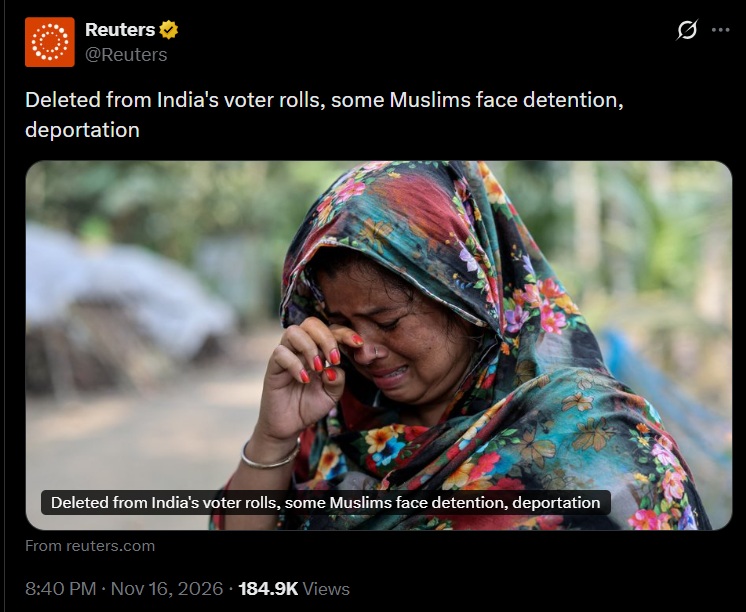
The report concerns the detention and deportation of individuals identified by Indian authorities as Bangladeshi nationals, amid a wider exercise to revise electoral rolls and identify suspected illegal immigrants. Now, instead of focusing on the central issue of illegal immigration, citizenship verification and deportation, Reuters chooses to talk about the religious identity of those involved: Muslims.
Why?
The report itself states that the voter-roll revision has become entangled with a separate drive to identify and expel suspected illegal immigrants. It also acknowledges that deletion from electoral rolls does not, by itself, establish that an individual is a foreigner.
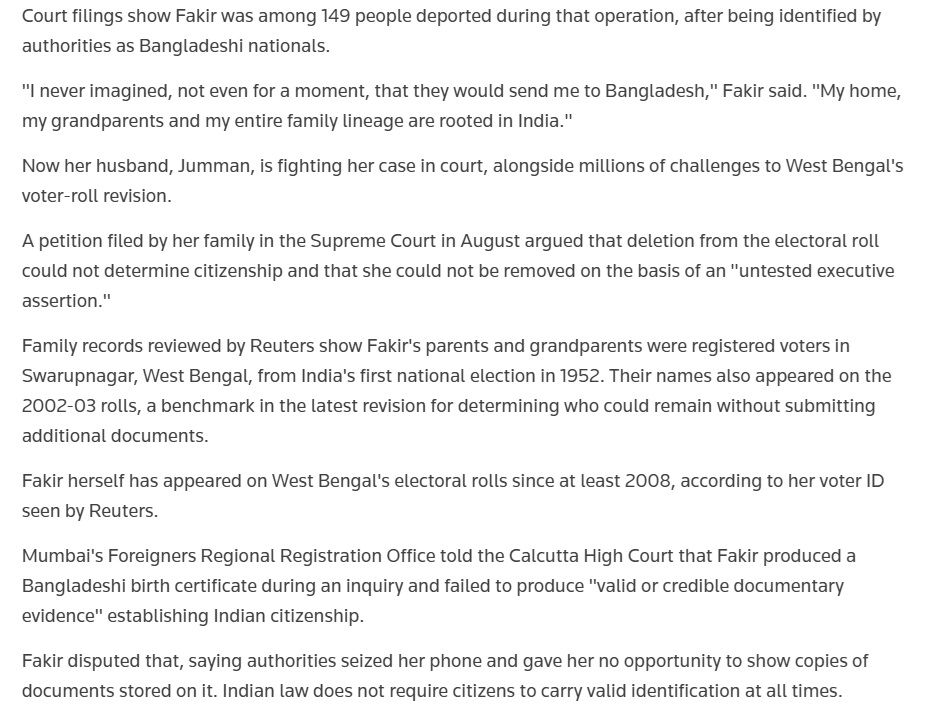
It then documents the case of Sahida Fakir, who was deported to Bangladesh after Indian authorities identified her as a Bangladeshi national. Fakir disputes the identification and claims Indian citizenship. Reuters also reports that her family has approached the Supreme Court, citing generations of electoral records.
Similarly, it reports the case of Nasiruddin Sheikh, who was detained after his name disappeared from the electoral rolls, despite an appeal against the deletion being pending.
These are legitimate issues deserving scrutiny. If Indian citizens are being wrongly detained or deported, the authorities must be held accountable. Citizenship cannot be determined merely by the deletion of someone’s name from an electoral roll.
But the question is why Reuters repeatedly makes religious identity the defining lens through which it presents India’s citizenship and immigration debates.
Consider its 13 March 2024 report on the Citizenship Amendment Act (CAA), titled “CAA: Why is India’s citizenship law contentious?”
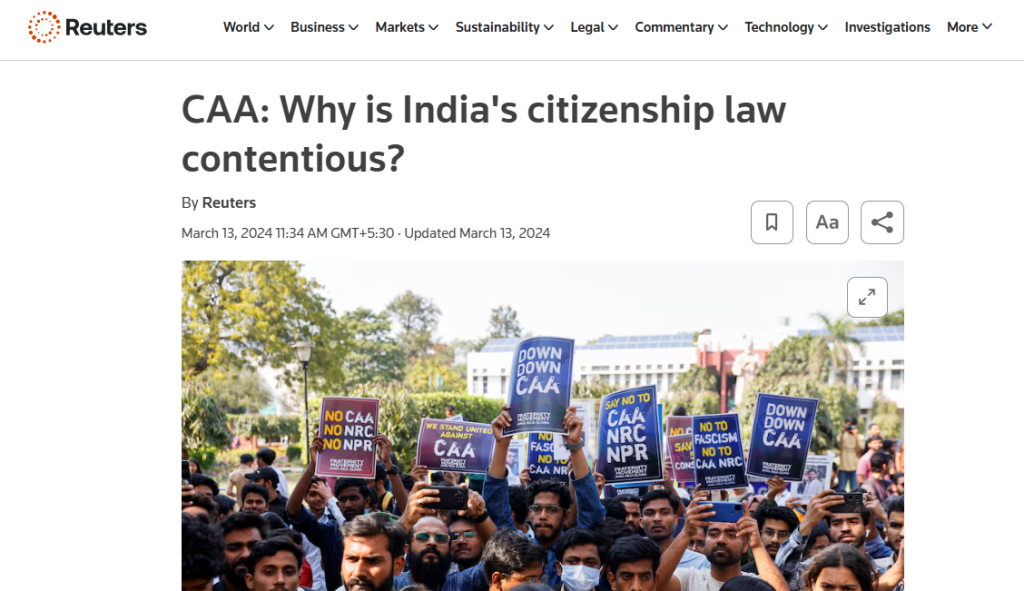
In that report, Reuters highlighted the argument that the CAA discriminates against Muslims because it fast-tracks citizenship for persecuted Hindus, Sikhs, Buddhists, Jains, Parsis and Christians from Pakistan, Bangladesh and Afghanistan, while excluding Muslims from these categories.
It focused on opposition claims that the legislation undermined India’s secular Constitution and quoted concerns that the CAA, combined with a proposed National Register of Citizens, could be used to declare Muslims illegal immigrants and strip them of citizenship.
When reporting on the CAA, Reuters made the exclusion of Muslims central to its framing. When reporting on the identification and deportation of suspected illegal immigrants, it once again makes Muslims the headline, rather than foregrounding the question of citizenship verification and suspected illegal immigration.
In both instances, the agenda is clear: They want the reader to think on religious lines when interpretating India’s citizenship policies.
There is another problem with the recent article’s headline. The report itself says that 149 people were deported after authorities identified them as Bangladeshi nationals. It also records the authorities’ position in Fakir’s case: the Foreigners Regional Registration Office told the Calcutta High Court that she had produced a Bangladeshi birth certificate and failed to provide what it considered credible documentary evidence of Indian citizenship. Fakir disputes this account.
These competing claims are precisely why the cases deserve careful reporting. But the headline does not point out the distinction between individuals identified as foreign nationals and those contesting that identification. Instead, it makes religious identity the main focus.
Reuters also cites figures suggesting that Muslims constituted around 70% of the 2.7 million names deleted after closer scrutiny in West Bengal, despite comprising approximately 27% of the state’s population. While this might need examination, it does not establish that every deleted Muslim was an Indian citizen, just as deletion cannot establish that someone is a foreign national.
Illegal immigration is a serious national security and citizenship issue. Wrongful detention and deportation of Indian citizens are equally serious violations that deserve investigation. Neither issue should be obscured by the selective highlighting of religious identity.
Reuters is free to scrutinise the Indian government, but it cannot keep reducing every citizenship and immigration dispute to a story of Muslim victimhood.
When reporting on the CAA, Muslims are placed at the centre of the narrative. When reporting on the deportation of suspected illegal Bangladeshi immigrants, Muslims are once again made the headline, while the question of illegal immigration takes a backseat.
If Indian citizens are being wrongfully detained or deported, expose it. Nobody should face injustice on account of religion. But why must every immigration crackdown be packaged as a Muslim persecution story?
Different issues, different circumstances, but the same predictable editorial framing.
For Reuters, it seems, India’s immigration story is never about illegal immigration. It is always about Muslims.
Subscribe to our channels on WhatsApp, Telegram, Instagram and YouTube to get the best stories of the day delivered to you personally.