As Delhi’s Jantar Mantar became the focal point of protests over the contentious NEET issue on 20 June 2026, attention is drawn to the presence and influence of a US-based social media activist whose image and messaging appeared prominently throughout the demonstration, as per an OpIndia report.
The protest, organised by the Cockroach Janta Party (CJP), was presented as a youth-led mobilisation against Union Education Minister Dharmendra Pradhan and the central government over alleged grievances related to NEET. However, the agitation was not entirely organic and appeared to be receiving significant amplification from individuals operating outside India. Central to this is Osman Faizan Ali, a social media personality based in the United States, who reportedly actively mobilised and influenced young Indians through online platforms.
Who is Osman Ali, the man sitting in the US and provoking Indian youth toward unrest?
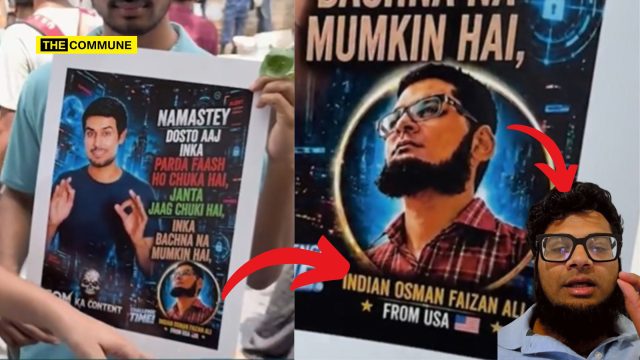
A protester reached Jantar Mantar carrying posters of Dhruv Rathee and Osman Faizan Ali.
Is the internet being weaponized to turn India’s youth into a disruptive mob? @ashu_nauty reports from… pic.twitter.com/RBejg8WnpN
— OpIndia.com (@OpIndia_com) June 20, 2026
Posters Raise Questions At Protest Site
According to OpIndia’s report, protesters across Jantar Mantar were seen carrying professionally designed placards featuring social media commentator Dhruv Rathee, activist Abhijit Dipke and actor Rakhi Sawant. However, another face repeatedly appeared on several of the posters.
Printed prominently on many placards was the image of a bearded man identified as “Indian Osman Faizan Ali – From USA.”
This immediately raised questions about the role of a US-based activist in a protest that was being portrayed as a grassroots movement led by students and young people.
OpIndia reporters who spoke to demonstrators at the venue were allegedly met with surprising responses. According to the report, several protesters admitted they did not know who Osman Faizan Ali was. One young participant reportedly said that the placard had been handed to him by organisers and that he had no knowledge of the individual whose image appeared on it.
Similar responses from other participants suggested many protesters were unknowingly promoting Ali’s image and messaging without being familiar with him or his activities.
Based on these interactions, OpIndia states that the incident reflected a broader effort to shape public sentiment through centrally distributed campaign material rather than through spontaneous public support.
Social Media Activity Suspicious
Let’s take a look at Ali’s social media presence, particularly his Instagram account, @bbm_india_.
Ali has spent weeks posting content related to the Cockroach Janta Party protests and has consistently attempted to frame the demonstrations as a confrontation between young Indians and the state.
His content relies heavily on emotionally charged messaging, aggressive rhetoric and repeated attempts to convince followers that they are participating in a historic movement.
The objective of such content appears to be transforming public frustration into large-scale mobilisation driven by anger and confrontation.
June 1 Video To Delhi Police
A video was uploaded by Ali on 1 June 2026 in which he addressed the Delhi Police directly.
View this post on Instagram
The video did not focus on appeals for peaceful protest. Instead, it warned authorities to deploy large numbers of personnel before allowing CJP activists and supporters of Abhijit Dipke to gather at Jantar Mantar.
Ali repeatedly referrs to an unstoppable “tsunami” of people that would overwhelm attempts by authorities to control the gathering.
Such language is significant because it appeared designed to create an atmosphere of confrontation rather than encourage democratic participation. This messaging can be seen as an attempt to portray supporters as a powerful force capable of challenging state institutions.
These statements are being made from outside India – while young Indians could possibly face police action or legal consequences, Ali who has been issuing such calls remained insulated from the fallout.
Continued Mobilisation
Ali’s efforts did not stop with a single video.
He has continued producing content aimed at mobilising supporters of the Cockroach Janta Party ever since the movement gained online traction.
There is another video uploaded shortly before the June 20 protest in which Ali appealed to Delhi Police and security agencies to permit the demonstrations.
View this post on Instagram
The appeal in this video carries an implicit warning, repeatedly suggesting that preventing the protest could lead to unrest and instability.
This style of messaging allows Ali to maintain plausible deniability because he did not explicitly advocate violence while simultaneously framing confrontation as a likely outcome if authorities intervened.
The practical effect of such rhetoric is to heighten tensions, deepen mistrust of law enforcement and encourage supporters to view administrative action as oppressive.
Political Activity Beyond The Protest
Examining Ali’s broader online footprint and his involvement in the NEET-related protests indicate he was a part of a longer pattern of political activism.
His YouTube channel, “Button Ballot Movement by Osman Faizan Ali” needs to be analysed.
Although largely inactive today, the archived content provides insight into his political objectives.
One recording that was uploaded on 13 May 2024 is of particular interest. In the audio message, he urged voters in Hyderabad and Secunderabad to vote strategically for AIMIM and Congress candidates with the stated objective of defeating the BJP.
The appeal focused on defeating a political opponent rather than promoting specific policies or programmes.
Ali’s activism extends beyond student issues and reflects a broader attempt to influence political discourse and electoral outcomes in India while residing abroad.
From Electoral Appeals To CJP Support
Ali’s current support for the Cockroach Janta Party represents a shift in political positioning.
Ali had openly campaigned in favour of AIMIM and Congress candidates in 2024 with the stated goal of defeating the BJP.
His current embrace of the CJP movement appears less rooted in ideological commitment and more reflective of political opportunism.
Ali’s activism seems to follow movements that offered visibility and mobilisation potential rather than a consistent ideological framework.
His support for the CJP agitation reflected an attempt to align with a viral online phenomenon that had recently gained traction among sections of India’s youth.
Social Media-Led Mobilisation Is Worrying
The events at Jantar Mantar highlighted a broader transformation in political mobilisation.
Social media now allows individuals located thousands of kilometres away to shape narratives, design campaign material, influence crowds and direct public discourse without being physically present.
Many protesters were seen carrying Ali’s image reportedly without knowing who he was.
One wonders how many young participants consume such content without understanding the motivations behind it and how many may be encouraged to view confrontation with institutions as desirable.
Individuals encouraging others to take risks often bear none of the consequences themselves.
The Jantar Mantar protest offered a glimpse into a new model of political agitation in which overseas influencers use local grievances to advance broader political objectives.
By distributing inflammatory content, portraying institutions as adversaries and framing protests as confrontations with the state, such figures seek to convert public dissatisfaction into organised unrest.
While protesters on the ground may face detention, legal proceedings or other consequences if demonstrations escalate, individuals directing messaging from abroad remain beyond the immediate reach of Indian authorities.
The prominence of Osman Faizan Ali’s image at the protest is not merely a curious detail but evidence of can be an attempt by a foreign-based activist to insert himself into a domestic political agitation and influence public behaviour through digital platforms.
Subscribe to our channels on WhatsApp, Telegram, Instagram and YouTube to get the best stories of the day delivered to you personally.