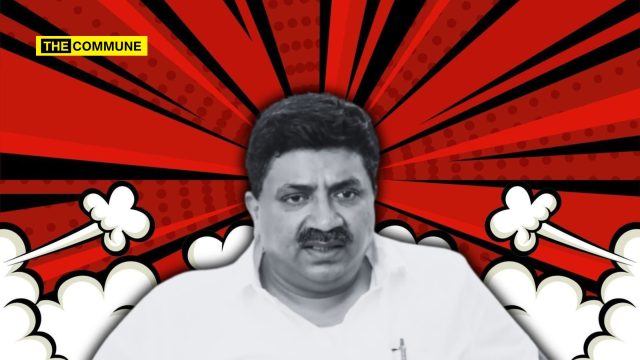
In a televised interview with Rajdeep Sardesai on the proposed delimitation bill, senior DMK leader PTR Palanivel Thiagarajan (PTR) delivered one of the most rhetorically aggressive attacks yet on the central government’s move. But strip away the volume and you are left with a pattern: exaggerated doomsday language, open distrust of national institutions, and a deliberate sharpening of north–south fault lines.
From Policy Disagreement to “New India” and a “Slap” at the Union
PTR does not confine himself to specific objections about the text of the bill. He repeatedly elevates a legislative proposal into a civilisational rupture:
“As far as I am concerned as a citizen of India, this is beyond the pale to the extent that this is a new India today after the introduction of this bill and it was a different India before the introduction of this bill.”
“This has been the greatest insult and the greatest slap to the notion of a union of states, federal society that was envisioned by the constitutional fathers…”
“…it is going to breach the trust that had been built over 70–75 years.”
A bill that has not even completed parliamentary scrutiny is described as “the greatest insult” to the Union since Independence and as having already “transformed” India into a different country. That is not sober constitutional critique; it is political theatre designed to maximise grievance.
Invoking Anti‑Hindi Agitations as a Template for Consequences
Asked about Chief Minister M.K. Stalin’s warning that the “price” for ignoring Tamil Nadu’s voice would be “heavy,” PTR explicitly cites the violent anti‑Hindi agitations as the reference point: “He is explicitly saying look what happened to Tamil Nadu to the union to India when you try to impose Hindi on us once in the 60s… you see what resulted it was complete breakdown of the social structure and order… this is something that we are not going to take lying down.”
Instead of distancing himself from the spectre of past unrest, PTR holds it up as “evidence of what it means in practice.” That is not a call for democratic negotiation; it is a reminder that attempts at central policy change in the south can end in “complete breakdown of social structure and order.” The undertone is clear: push this bill and be prepared for serious social strife.
“Balkanisation” as a “100%” Legitimate Fear
When Sardesai puts to him the accusation that talk of a north–south split is fearmongering, PTR embraces the most extreme framing:
Question: “Are those consequences that you fear that India will get Balkanized, north–south divide? Is that fearmongering or do you believe that is a genuine fear that this bill has raised?”
PTR: “100%. No, no, no. I 100% agree…”
A state minister saying on national television that he “100%” agrees with the idea that India risks “Balkanisation” over a bill still being debated is extraordinary. He does not present it as a danger to be averted, but as a legitimate outcome that the bill has already set in motion: “We are already in a different India today than we were 2 days ago… it is a wound to the integrity… a stain on the fabric of the unity in India already.” This is textbook escalation – normal policy disagreement recast as an existential north–south fracture.
Legislatures as “Rubber Stamps”, Rule of Law “No Longer Exists”
PTR’s contempt is not limited to the bill or the current government. He generalises it to Parliament and state legislatures themselves:
“First at this point the legislatures are mere rubber stamps for the executive anyway.”
“What is the point of a legislature when bills such as this can get passed on 24 hours, 48 hours? How does it matter how many legislators you have?”
“We don’t live in a country which follows the rule of law or the procedure code of the parliament or the legislatures anymore. Let’s be clear.”
These are sweeping indictments of the constitutional order, not targeted criticisms of one party’s behaviour. A sitting minister declaring that India no longer follows “the rule of law” and that legislatures are pointless “rubber stamps” erodes public trust in every democratic institution including the very Assembly in which he sits. It is difficult to miss the contradiction: he demands more debate and process from institutions he simultaneously describes as useless and lawless.
Blanket Distrust of Constitutional Offices
PTR goes further and attacks the impartiality of specific presiding officers:
“I can’t believe that the Speaker and the Chairman/Vice Chairman of the Rajya Sabha rejected the impeachment motion without even considering it when it was signed by the right number of MPs.”
“I don’t believe and trust this government to do or this parliament [to] do anything.”
These are not narrowly framed legal criticisms; they allege that constitutional office‑holders flouted procedure and that Parliament as a whole cannot be trusted. No evidence is offered on air, no nuance is attempted. Once again, the message to viewers is stark: the system is rigged, the rules are not followed, and nothing that comes out of Delhi can be taken at face value.
A One‑Sided “Union of States”
PTR insists that the bill is a “slap” on the “union of states” and repeatedly claims southern states are being “punished” for implementing family planning and contributing to national growth. Yet when asked to consider any formula that might reconcile population and performance such as a 50-50 mix of population and GSDP suggested by Telangana’s CM – he falls back to a single demand: extend the freeze for another 25–30 years.
He calls this a “clean and elegant solution” because “any other solution is going to be much more complicated than that,” and openly downplays the problem of unequal citizen representation: “I think it is not such a big deal if there is a disproportional representation by the number of citizens per MLA or MP.”
In other words, he is comfortable with one citizen’s vote in a southern constituency being worth significantly more than a citizen’s vote in a high‑growth northern state while simultaneously accusing the Centre of punishing the south. The rhetoric of “union of states” is thus selectively deployed: parity for the south, but permanent structural under‑representation for large northern electorates.
Everything Is a “Dictatorship”
Any move by the government that PTR dislikes is quickly labelled authoritarian:
“This is a complete dictatorial, you know, my way or the highway approach.”
On the CEC appointment law: “This dictatorial tendency is not make believe… It has been seen in practice.”
On the current bill: “Here we have a deeply flawed bill that doesn’t commit anything at all. It says that we will decide to do whatever we do whenever we do and you cannot challenge it in court.”
The word “dictatorial” appears as a catch‑all descriptor, lumping together very different issues: appointment laws, special sessions of Parliament, delimitation clauses. Used this loosely, “dictatorship” stops being a meaningful warning and becomes a partisan slogan – one that cheapens the term and makes it harder to distinguish genuine authoritarian excess from ordinary legislative hardball.
North–South Politics as a Campaign Strategy
Crucially, all of this is happening just a few days prior to the elections in Tamil Nadu. PTR claims outrage at the timing of the bill – “Two days’ notice, in the middle of state elections… it couldn’t be more grotesquely wrong” but then leans fully into exactly the emotive Tamil‑versus‑Delhi narrative he accuses the Centre of enabling. “Black day,” “every house will fly a black flag,” “self‑respecting Tamil,” “heavy price” – the vocabulary is carefully chosen to inflame sentiment in one region against the Union government as such, not just against a specific policy.
Last but not the least, PTR does not fail to boast about his credentials, his experience outside of India, even in this 18 minute interview while pooh-poohing on Rajdeep Sardesai every now and then.
PTR could have made a narrow, technocratic case against the delimitation bill: lack of detail, need for consultation, potential distortions in seat allocation. Instead, he chose maximalist language: dictatorship, rubber‑stamp legislatures, dead rule of law, Balkanisation, and a “new India” wounded at its very core while not forgetting to blow his own trumpet and belittling the person sitting across him. For a sitting minister in a key southern state, that is not just opposition. It is a deliberate strategy to deepen distrust between regions and between citizens and their own democratic institutions.
Subscribe to our channels on WhatsApp, Telegram, Instagram and YouTube to get the best stories of the day delivered to you personally.