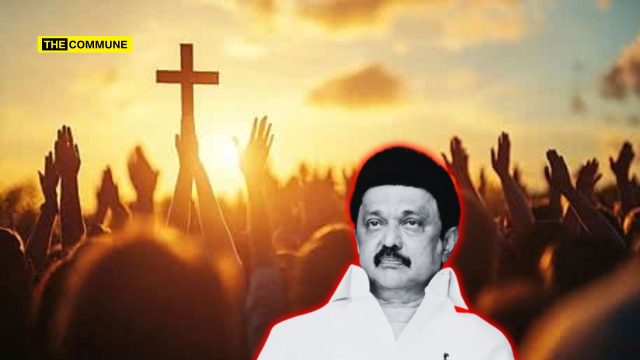
Three days before Tamil Nadu goes to the polls on 23 April 2026, a damning question hangs over the Dravidian political establishment: If DMK has spent years accusing the BJP of weaponising religion, why are Tamil Nadu’s Catholic bishops handing out anti-BJP vote pamphlets inside churches during Sunday Mass?
The answer, documented in black and white or rather, in stark red print exposes a political hypocrisy that the state’s ruling party can no longer paper over.
The Pamphlet That Said It All
The Tamil Nadu Bishops’ Council (TNBC), along with the Christian Livelihood Movement Tamil Nadu, the United Christian Federation, and Kanyakumari district representatives, circulated pamphlets explicitly targeting the BJP-AIADMK alliance and urging parishioners to vote for the DMK-led Secular Progressive Alliance. The pamphlets, distributed during Sunday prayers at churches across Tamil Nadu, were published under the banner of organisations including Tamil Nadu Ayar Peravai, Krisdhavar Vaazhvurimai Iyakkam, and Krisdhavar Jakiya Peravai, Kanyakumari District.
The document pulls no punches. On the BJP-led National Democratic Alliance, the pamphlet catalogues a litany of attacks: “There’s nothing wrong with singing Vande Mataram. But viewing the land of India as Durga, Lakshmi, or Saraswati and worshipping it may be a belief within Hinduism. That, however, cannot be imposed on people of other religions.” – essentially accusing the BJP of imposing Hindu religious practices on non-Hindus. It charges the BJP with renaming Gandhi’s 100-day employment scheme after Hindu deity Ram, of attacking Christian worship sites, and of enabling RSS-affiliated organisations to receive foreign funds while denying the same to Christian and Muslim bodies.
Among the key lines highlighted:
The pamphlet claims that “in the upcoming 2026 elections, we must decisively defeat forces that threaten minorities and democratic values.”
It further alleges that “policies and actions linked to the BJP have created fear among minorities, weakened federalism, and undermined social harmony.”
In contrast, it suggests support for parties aligned with what it describes as “secular and inclusive governance,” widely interpreted as a reference to the DMK-led alliance.
The document also lists policy criticisms, including language on education, centralisation, NEET, and alleged discrimination against minorities, framing these as reasons for electoral choice.
The pamphlet then explicitly demands votes against this alliance, stating that parties must be evaluated based on their policies and actions toward minorities – a directive issued not from a political party office but from church pulpits.
#BREAKING | Anti-BJP pamphlets distributed during Sunday prayers at churches in Tamil Nadu.
Issued jointly by the Tamil Nadu Bishops’ Confederation, Christian Livelihood Movement Tamil Nadu, United Christian Federation, and Kanyakumari district representatives. pic.twitter.com/HWt1aVmYi6
— Organiser Weekly (@eOrganiser) April 19, 2026
The Blowback: Christian Community Turns on TNBC
The reaction from within the Christian community itself was swift and damning. Office-bearers of the Tamil Thesiya Christian Iyakam demanded a formal explanation from the TNBC, condemning the council’s decision to turn sacred spaces into campaign venues. Senior priests, including Rev. Fr. Selvaraj, publicly denounced the endorsement, calling it an “embarrassment” to the church.
The backlash grew into a full-scale revolt. Facing mounting internal dissent, legal complaints over the alleged misuse of foreign funds, and public outrage at the naked politicisation of Sunday services, the TNBC was compelled to withdraw its earlier endorsement of the DMK alliance in what political observers are calling a major last-minute setback for the ruling coalition.
சிறுபான்மை மக்களின் ஆதரவை இழந்தது #திமுக.
Tamil Nadu Bishops’ Council WITHDRAWS support for the secular (DMK) alliance! After facing widespread public backlash, the Tamilnadu Bishops Council has been forced to walk back its political endorsement. pic.twitter.com/Xp5aXyW88B
— Kovai Sathyan (@KovaiSathyan) April 19, 2026
DMK’s “Secularism” Exposed
The pamphlet’s own contents deliver the most devastating indictment of DMK’s political positioning. For years, DMK and its ideological ecosystem that also includes TVK leader, a very Christian Joseph Vijay’s nascent party, have relentlessly accused BJP of “bringing religion into politics.” Yet the very groups backing the DMK openly frame their political argument in religious terms. The pamphlet opens by invoking the Biblical verse Luke 2:25 – “Render unto Caesar what is Caesar’s, and unto God what is God’s”, while proceeding to do precisely the opposite.
The document explicitly calls on Christian voters to vote against BJP using the framework of secularism, invoking it as a theological and political obligation in the same breath. On the ruling DMK government’s record, the pamphlet praises welfare schemes but concedes, “we do not have zero complaints against the DMK government”. It lists unfulfilled promises to minority-run educational institutions and unresolved demands from Christian minority bodies. Yet despite these admissions, the conclusion is unambiguous: vote DMK.
Who Is Really Mixing Faith and Politics?
The pamphlet’s section on Dravidian ideology is particularly revealing. It traces the political genealogy of Dravidianism back to its Christian intellectual roots – acknowledging that it was Christian scholars who propagated Dravidian ideology before Periyar. The document records that as early as 1816, Robert Caldwell identified Tamil as independent from Sanskrit; that Periyar’s Self-Respect Movement of 1925 was itself built on ideas first circulated by Christian reformers; and that figures like Vallalar, Ayya Vaikundar, and Manonmaniam Sundarampillai advanced Dravidian thought within a framework that the church now openly claims as its own political legacy.
This is not coincidence – it is a coordinated ideological project.
The political alignment was explicit, institutionalised, and coordinated. DMK’s loudest accusation against BJP, that saffron politics weaponises religion, now stands reflected back at the party in the form of red-ink pamphlets handed out at Sunday Mass.
The irony is complete. The party that built its identity on secularism enters polling day on 23 April 2026, with its most visible endorsement coming not from trade unions or farmers’ bodies, but from bishops who quoted scripture to justify their ballot choice and then retracted when the cameras turned.
Subscribe to our channels on WhatsApp, Telegram, Instagram and YouTube to get the best stories of the day delivered to you personally.