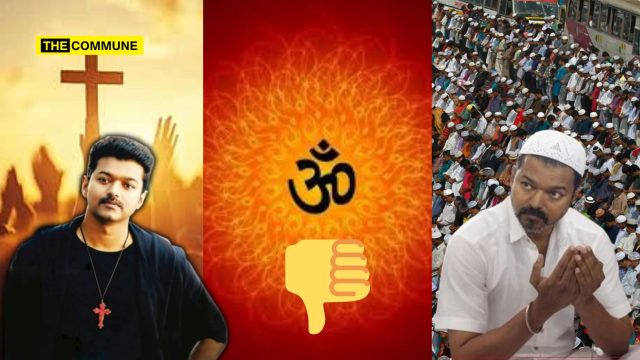
Joseph Vijay rode to power in Tamil Nadu promising a political alternative. For many Hindu voters who supported TVK, the expectation was that the party would break from the DMK’s ideological hostility towards Sanatana Dharma and adopt a more even-handed approach towards religious institutions. Six months into its tenure, however, a series of decisions and statements by the government and its leaders point over and over again at the anti-Hindi nature of the TVK government.
Consider the record.
Government Land For Mosques, Churches And Dargahs
On 2 November 2026, Minister for Minorities Welfare A.M. Shahjahan had announced steps to issue land pattas to thousands of mosques, churches and dargahs operating without proper ownership documents, including structures occupying government land.
According to Shahjahan, Revenue Minister K. Sengottaiyan had agreed to conduct a survey and initiate the process for eligible institutions. The proposal covers religious structures that have reportedly existed without ownership documents for 25 to 50 years.
The question is whether the government will apply the same consideration to Hindu religious structures facing disputes over land ownership, encroachments and access.
Hajj Assistance Increased, Jerusalem Pilgrimage Subsidy Continues
In the 2026-27 Budget, Finance Minister N. Marie Wilson increased the Tamil Nadu government’s Hajj assistance for first-time pilgrims from ₹25,000 to ₹35,000.
The government also continued its Jerusalem pilgrimage subsidy for 600 Christians: ₹37,000 each for 550 pilgrims and ₹60,000 each for 50 nuns and religious brothers.
The Jerusalem subsidy is an existing welfare scheme, not a new TVK initiative. Nevertheless, the government’s continued financial support for religious pilgrimages across minority communities raises questions about the corresponding support and attention given to Hindu religious institutions and devotees.
Five Coimbatore Blast Terrorist Convicts Granted 60-Day Parole
In October 2026, the TVK government granted 60 days of parole to five life convicts in the 1998 Coimbatore serial bomb blasts case.
The five — Mohammed Ansari, Mohammed Ali, Monappa alias Mohammed Hassan, Mohammed Ajam and Nawab Khan — were among those convicted in the terror attack that killed 58 people and injured hundreds. The blasts took place ahead of BJP leader L.K. Advani’s scheduled election campaign meeting.
The prison department cited personal reasons, including the death of one convict’s mother, for granting parole.
TVK Leaders Echo Calls To Eradicate Sanatana Dharma
The ideological question is equally significant.
On 12 May 2026, DMK leader Udhayanidhi Stalin reiterated in the Assembly that Sanatana Dharma must be eradicated, with Chief Minister Vijay present.
Two days later, TVK minister Aadhav Arjuna said his party had the same policy as Udhayanidhi on the issue, while attempting to distinguish opposition to Hindutva from opposition to Hindus.
Earlier, TVK MLA V.M.S. Mustafa had declared that his party had entered politics to eradicate Sanatana Dharma.
These are not statements by political opponents describing TVK’s ideology. They are statements made by TVK’s own elected representatives and ministers.
Thiruparankundram: TVK Takes The DMK’s Position
Perhaps the most consequential test has come at Thiruparankundram.
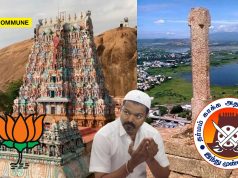
Despite the Supreme Court permitting the lighting of Karthigai Deepam at the disputed hilltop Deepathoon on November 24 as a one-time arrangement, the TVK government, through its HR&CE Department, filed a review petition challenging the order.
The government has continued the legal position previously adopted by the DMK, arguing against the lighting of the lamp at the hilltop pillar and citing concerns over religious custom and law and order.
The administration’s restrictions, barricades and heavy police deployment have further intensified the dispute.
A Change Of Government, But What Has Changed For Hindus?
Taken together, these developments raise a larger question about TVK’s political and ideological direction.
Minority welfare measures are not inherently objectionable. The issue is whether Hindu religious institutions and devotees receive comparable consideration, particularly when their demands involve access to places of worship, religious practices and the protection of temple interests.
For Hindu voters who expected Vijay to offer a departure from the DMK’s approach to Sanatana Dharma, the emerging record speaks the opposite.
The face of the government has changed. But its approach towards Hindu religious interests seems to have not changed. So what change is Vijay claiming to have brought to the administration?
Subscribe to our channels on WhatsApp, Telegram, Instagram and YouTube to get the best stories of the day delivered to you personally.