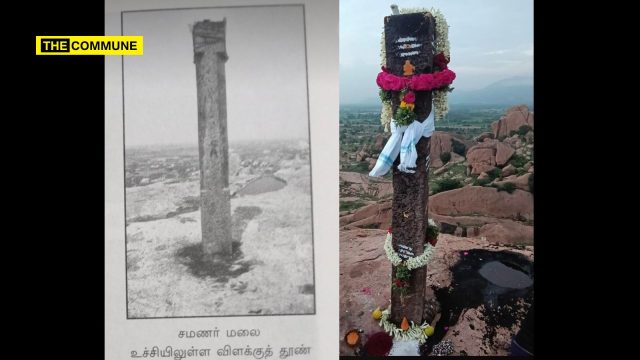
The TVK government’s claim that the stone pillar atop Thirupparankundram hill is merely a British-era Great Trigonometrical Survey (GTS) marker has come under fresh scrutiny, with photographs of similar stone pillars at two other historic hills in Madurai district — Samanar Malai and Arittapatti — being highlighted by historians, heritage enthusiasts and devotees.
Both locations have a rich historical association with Jain heritage, including ancient Tamil-Brahmi inscriptions, rock-cut sculptures and stone beds used by Jain monks. However, they also feature stone pillars atop their rocky hill formations, adding to the questions surrounding the Joseph Vijay government’s attempt to classify the Thirupparankundram pillar exclusively as a colonial survey structure.
Samanar Malai: A Hilltop Pillar With A Deepam Tradition
Located at Keelakuyilkudi, approximately 12 km west of Madurai, Samanar Malai is an important Jain heritage site featuring inscriptions dating back nearly 2,000 years, rock-cut Tirthankara sculptures at Settipodavu and Pechipallam, and stone beds used by Jain monks.
A stone pillar also stands atop the hill. Historical documentation by the Development of Humane Action (DHAN) Foundation records that the pillar is used as a lamp stand during the Thiru Karthigai Deepam festival.
Significantly, the existence of this pillar was also brought up during the Thirupparankundram litigation. The Madras High Court’s January 2026 judgment records that photographs of a similar pillar at nearby Samanar Malai were produced before the court during arguments over the nature of the disputed Thiruparankundram structure.
Arittapatti: Another Hill With An Ancient Stone Pillar
Arittapatti, near Melur, is another historically significant location in Madurai district. Recognised as Tamil Nadu’s first Biodiversity Heritage Site, the region is known for its ancient Tamil-Brahmi inscriptions, Jain beds and rock-cut religious monuments.
The hill, also known as Kalinjamalai, features an old stone pillar atop its rocky outcrop. The presence of similar structures at these historic hill sites has prompted devotees to question why the Thirupparankundram pillar is being treated as an exclusively colonial-era installation.
மதுரை சமணர் மலையிலும் அரிட்டாபட்டியிலும் உள்ள தீபத்தூண்கள் ! https://t.co/xV2ko1rQj8
— 𑀓𑀺𑀭𑀼𑀱𑁆𑀡𑀷𑁆 🇮🇳 (@tskrishnan) November 23, 2026
Not Just a Survey Pillar: Similar Deepathoons Found Across Madurai Hills
The TVK government’s attempt to dismiss the Thirupparankundram Deepathoon as merely a British-era survey marker ignores the existence of similar hilltop pillars across Madurai.
These are not isolated architectural coincidences. The documented use of the Samanar Malai pillar for Karthigai Deepam establishes that hilltop stone pillars in the Madurai region have served a religious purpose. The government cannot simply point to British survey records and expect the religious history of the Thirupparankundram Deepathoon to be erased. A survey marker and a Deepathoon are not necessarily mutually exclusive.
The obvious question is: if such pillars exist across Madurai’s historic hills, why is the Thiruparankundram Deepathoon being reduced to a colonial survey installation?
Subscribe to our channels on WhatsApp, Telegram, Instagram and YouTube to get the best stories of the day delivered to you personally.