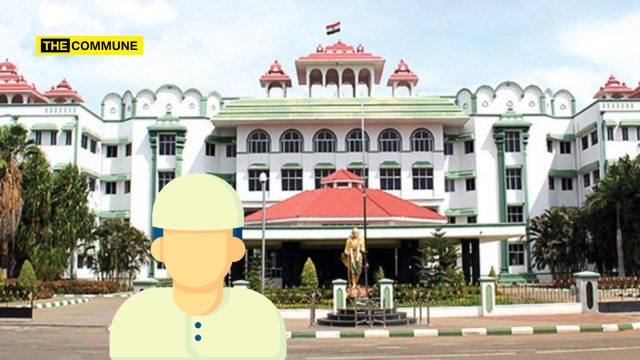
The Madras High Court on Thursday, 25 June 2026, struck down a Tamil Nadu government order that allowed persons from Backward Classes, Most Backward Classes, Denotified Communities and Scheduled Castes to be treated as Backward Class Muslims after converting to Islam.
A Division Bench of Justice GR Swaminathan and Justice PB Balaji declared G.O. (Ms) No.31, Backward Classes, Most Backward Classes and Minorities Welfare Department, dated 9 March 2024, unconstitutional while disposing of a writ petition filed by Sameer Ahamed N., formerly Paramasivam, from Thoothukudi district.
“As a corollary, we hold that a convert to Islam cannot claim the status of Backward Class Muslim. He is only a Muslim and that’s all there is to it,” the Court held.
The case concerned a man born on 12 April 1993 to Hindu parents Narayanan and Gomathiammal in Tuticorin district. According to the order, a certificate issued by Sunnath Jamath, Kayathar, dated 11 September 2015, stated that he had embraced Islam and changed his name to Sameer Ahamed. A gazette publication was made on 2 November 2016. He later married one Vahitha as per Islamic rites and customs on 4 November 2016, and the couple have two children.
Ahamed applied for a community certificate identifying him as “Muslim Lebbai”, claiming that he followed the faith of Lebbai Muslims. However, the Tahsildar, Kayathar, rejected the application. He then approached the High Court seeking to quash the rejection order and direct the authorities to issue him a Muslim Lebbai community certificate.
Petitioner Relied On 2024 Government Order
The Court noted that when the writ petition was filed, the petitioner had no case, and that “life was infused into his case” only by virtue of G.O. (Ms) No.31 dated 9 March 2024.
The government order had followed a recommendation made by the Tamil Nadu Backward Classes Commission on 6 February 2024. The Commission had recommended that persons belonging to Backward Classes, Most Backward Classes, Denotified Communities or Scheduled Castes who converted to any one of the seven groups notified as Backward Class Muslims should be issued community certificates as Backward Class Muslims, enabling them to avail reservation benefits.
The State defended the government order before the Court. The learned Additional Advocate General submitted that the recommendation of the Commission was binding on the government and that the GO had not been issued arbitrarily. He argued that only those who already enjoyed reservation benefits before conversion would continue to retain such benefits after conversion to Islam, while persons from forward communities converting to Islam would not receive the Backward Class Muslim tag.
The State also argued that the identified Muslim groups followed particular faiths and practices and that it was for the concerned Jamath to accept the convert into one of the sects. Once the Jamath issued a certificate, the State argued, it was not for the revenue authority to question it.
The Bench rejected this stand.
Court Cites Earlier Rulings On Conversion To Islam
The High Court relied on the 1951 Division Bench judgment in G. Michael v. S. Venkateswaran, which held that when a Hindu converts to Islam, he becomes “just a Mussalman” and his place in Muslim society is not determined by the caste to which he belonged before conversion.
The Court noted that this position had been approved by the Supreme Court in Kailash Sonkar v. Maya Devi, K.P. Manu v. Scrutiny Committee and C. Selvarani v. Special Secretary cum District Collector.
“When the proposition laid down by the Hon’ble Division Bench is holding the field, it cannot be undone by issuing a mere Government Order,” the Bench said.
The Court held that the executive cannot override or dilute binding judicial decisions through a government order. It observed that if the State Government could nullify judicial review by overriding decisions against it, it would strike at the rule of law.
“When the Division Bench of the Madras High Court in G. Michael had held that a convert to Islam becomes just a Mussalman, it is not open to the State Government to issue a G.O undermining the said decision,” the Bench said.
Seven Muslim Groups Notified As Backward Class Muslims
The Court recorded that Tamil Nadu had not included all persons professing Islam under the Backward Class category. Instead, the State had identified only certain Muslim groups as Backward Class Muslims.
As per Section 3(a) of the Tamil Nadu Act 45 of 1994, the seven notified Backward Class Muslim groups are Ansar, Dekkani Muslims, Dubekula, Labbais including Rowthar and Marakayar whether their spoken language is Tamil or Urdu, Mapilla, Sheik and Syed.
“A Muslim who does not belong to any of the aforesaid 7 sects cannot be called as a BC(Muslim),” the Court observed.
The Bench said the crucial question was whether a convert to Islam from a reserved category could be treated as belonging to one of these seven notified Muslim groups for reservation purposes.
Court Says One Can Convert To Islam, Not To A Muslim Community For Reservation
The Court held that a person may convert to Islam, but cannot convert into a caste or community within Islam for reservation purposes.
Referring to Islamic theology, the Bench quoted the Quran and the farewell sermon of Prophet Muhammad to underline the principle of equality in Islam.
The Court observed, “The Christian missionaries as well as Islamic preachers harangued through decades and centuries that their religions offer social equality unlike Hinduism which has caste as its inherent feature. Having taken such a stand for effecting conversions, it is disingenuous to claim that there is hierarchy in Islam also.”
“In our respectful view, categorising certain sects as Backward and the remaining as Forward is antithetical to Quranic injunctions. Islam seeks to establish an egalitarian society. Everyone is equal in the eye of God. There is no social hierarchy,” the Court said.
At the same time, the Bench acknowledged that Islamic society had, due to historical reasons, become stratified into various communities.
“One can even boldly remark that they are akin to caste in Hinduism. Just as caste is determined by birth, one is a Rowther or Marakkayar or Deccani Muslim by birth alone. It is ridiculous to suggest that one can be converted into a Rowther Muslim,” the Bench observed.
The Court said that after conversion to Islam, a person becomes a Muslim and cannot be “pigeonholed into any particular sect or community” which can be acquired only by birth.
GO Found Arbitrary For Clubbing BC, MBC, DNC And SC Converts Together
The Bench also found the government order arbitrary for another reason.
It noted that the Backward Classes Commission’s recommendation and the 2024 GO sought to accommodate converts from BC, MBC, DNC and SC communities into any one of the seven Backward Class Muslim categories.
“In other words, a SC who is at the bottom-most rung of the social ladder is put on par with a BC,” the Court observed.
The Bench said the Supreme Court had repeatedly held that OBCs and SCs form separate categories.
“Just for the sake of ensuring that the converts to Islam continue to enjoy some form of reservation benefit, such a bunching has been done by the State Government. This exposes the inherent flaw in the approach adopted by the Government,” the Court said.
‘Unconstitutional And Un-Islamic’
The Court also took note of the certificate issued by the Sunnath Jamath of Kayathar in the petitioner’s case, stating that it only certified that he had embraced the Islamic path.
The Bench concluded that the government had brought in the 2024 GO only to undo earlier judgments of the Court.
“We have no option but to conclude that only to undo the judgments of this Court, has the Government come out with an innovation that is not only unconstitutional but also un-Islamic,” the Court said.
The Bench further observed that although the government order used the word “sects”, what had been notified in earlier government orders were more properly communities and not Islamic sects in the theological sense.
The Court referred to historical records, including the Madras Census Report, 1901, and the writings of Edgar Thurston, to conclude that groups such as Labbai and Deccani were treated as communities, and that membership in such notified communities flowed from birth.
“The stand of the Government that there can be conversion to a notified Islamic sect is inconceivable in principle,” the Court said.
Tahsildar’s Rejection Sustained
The Court finally declared G.O. (Ms) No.31 dated 9 March 2024 unconstitutional and sustained the Tahsildar’s order rejecting Ahamed’s request for a Muslim Lebbai community certificate.
The writ petition was disposed of with no costs, and the connected miscellaneous petition was closed.
The ruling makes it clear that a person who converts to Islam cannot claim Backward Class Muslim status merely on the basis of conversion or Jamath certification. According to the Court, such a person is entitled to profess Islam as a matter of faith, but cannot claim entry into a notified Muslim backward community for reservation benefits.
When a Hindu embraces Islam, he/she will just become a Musalman. It would be ridiculous to suggest that such converts can choose to become a part of any of the seven categories (Ansar, Dekkani Muslims.Dubekula, Labbais including Rowthar and Marakayar. Mapilla, Sheik or Syed) of… pic.twitter.com/KH9NcZ6wUJ
— Mohamed Imranullah S (@imranhindu) June 25, 2026
Subscribe to our channels on WhatsApp, Telegram, Instagram and YouTube to get the best stories of the day delivered to you personally.