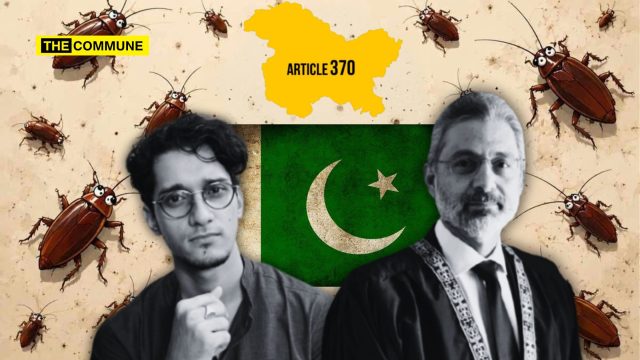
Saurav Das, the freshly appointed Chief Spokesperson for the Cockroach Janta Party (CJP), has a documented history of opposing India’s sovereign decision to abrogate Article 370 — not by relying on Indian constitutional experts or parliamentary debates, but by platforming the Chief Justice of Pakistan, a nation long designated as a terror sponsor and India’s adversary.
In a 2023 post, Das approvingly quoted then-Pakistan Chief Justice Qazi Faez Isa criticizing India’s judiciary and the impending Article 370 verdict. Das went further, calling the abrogation “an open-and-shut case, a grave assault on the Indian constitution” and warning that upholding it would mark the “downfall” of the Supreme Court. This came even as Pakistan-backed terrorism had plagued Kashmir for decades under the shield of Article 370’s special status.
Doing away with Article 370 was a grave assault on the Indian Constitution.
And who does he quote to make his case?
The Chief Justice of Pakistan. CJP then. CJP now. pic.twitter.com/VElNiKdQpq
— Tushar Gupta (@Tushar15) June 3, 2026
Championing Pakistan-Aligned Narratives On Kashmir
Das’s commentary consistently portrays post-2019 Jammu and Kashmir as a site of “human rights violations” and “muzzling of the free press” by the Indian government. He has amplified stories of journalists facing NIA/UAPA cases, expressed solidarity with those arrested in terror-related probes, and highlighted anonymous reports decrying “normalcy” in the region. While raising legitimate questions about governance is part of journalism, Das’s selective focus — ignoring the sharp decline in stone-pelting, infiltration attempts, and tourist influx post-abrogation — aligns strikingly with Islamabad’s propaganda line that India’s integration move was illegitimate.
He criticized the Supreme Court’s unanimous 2023 verdict upholding the abrogation as a blow to federalism and a sign of judicial decline. In doing so, he framed the full constitutional integration of India’s own territory — long disrupted by cross-border terrorism from Pakistan — as an act of central overreach rather than a necessary correction to a temporary provision that had enabled separatism.
Pattern of Defending Accused In Terror-Linked Cases
Das has been a vocal advocate for Umar Khalid and others in the 2020 Delhi riots “larger conspiracy” case, repeatedly calling charges “frivolous,” highlighting prolonged incarceration, and questioning UAPA applications — including against Kashmiri students allegedly raising pro-Pakistan slogans. He has portrayed such cases as misuse of anti-terror laws rather than legitimate security measures against radicalization often stoked from across the border.
This pattern extends to his broader critique of Indian institutions, including his forthcoming book framing the judiciary as complicit in “quiet suffering” under the current dispensation. As CJP’s chief spokesperson, he now channels this worldview into a movement positioning itself as youth-led resistance.CJP’s Troubling Echo ChamberThe Cockroach Janta Party itself faces accusations of drawing significant support from Pakistan-based accounts. Union ministers have publicly noted demographics showing a heavy foreign following for the group, raising questions about the ecosystem Das now represents.
Pakistan remains a terror state — sheltering extremists, exporting radicalism to Kashmir, and refusing to acknowledge India’s sovereignty over the region. For an Indian journalist-turned-spokesperson to repeatedly echo Pakistani judicial skepticism on core sovereignty issues, defend narratives that weaken anti-terror frameworks, and now lead a political outfit with questionable follower bases is not neutral dissent. It is ideological alignment that undermines India’s national interests.
Subscribe to our channels on WhatsApp, Telegram, Instagram and YouTube to get the best stories of the day delivered to you personally.