Home Blog Page 915

Jayakumar Calls Dindigul Leoni “A Drunk Street Dog, Poramboke” For Derogating Jaya, Tells Udhayanidhi “What You Did To Nayan Will Be Exposed”

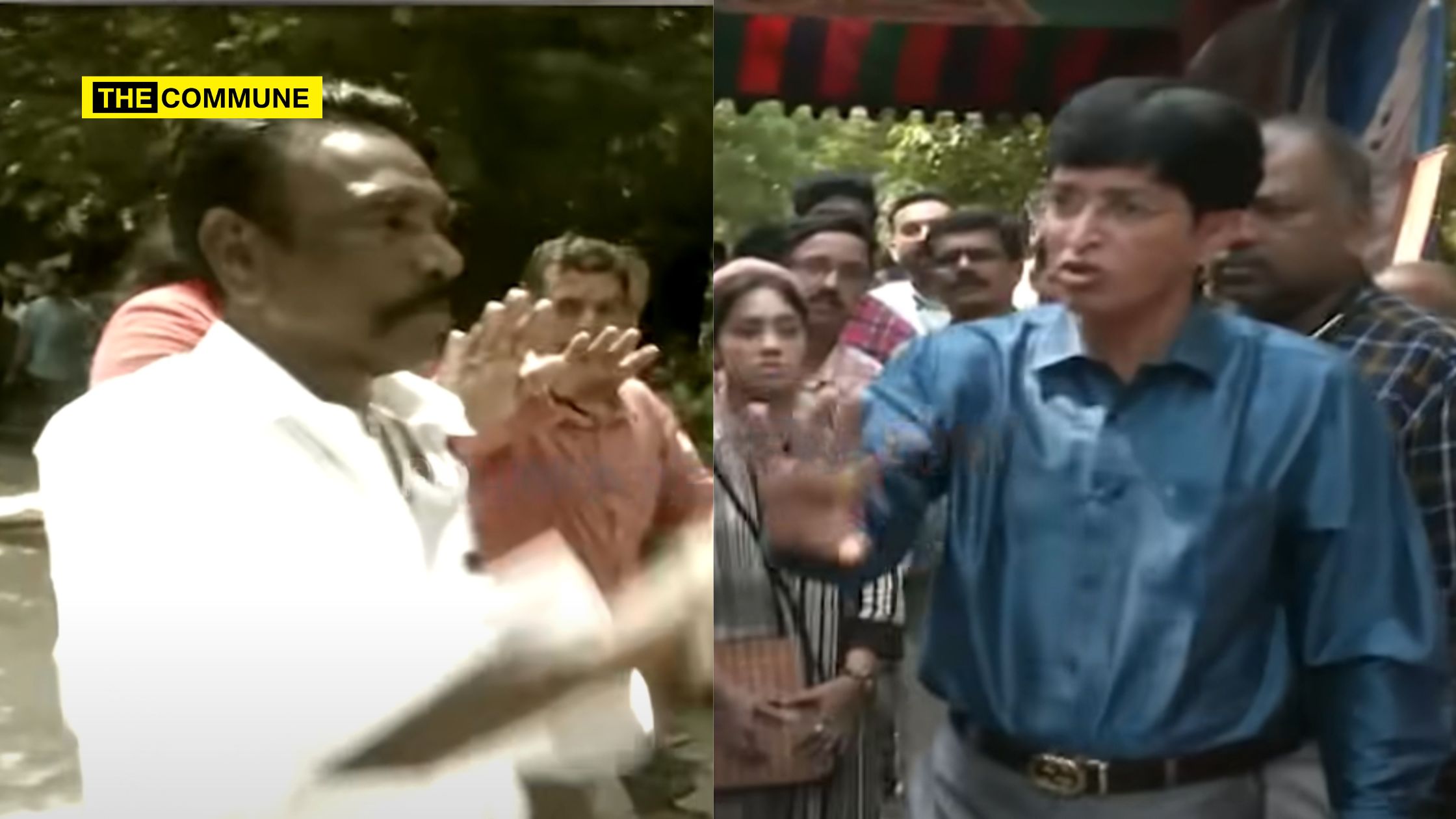
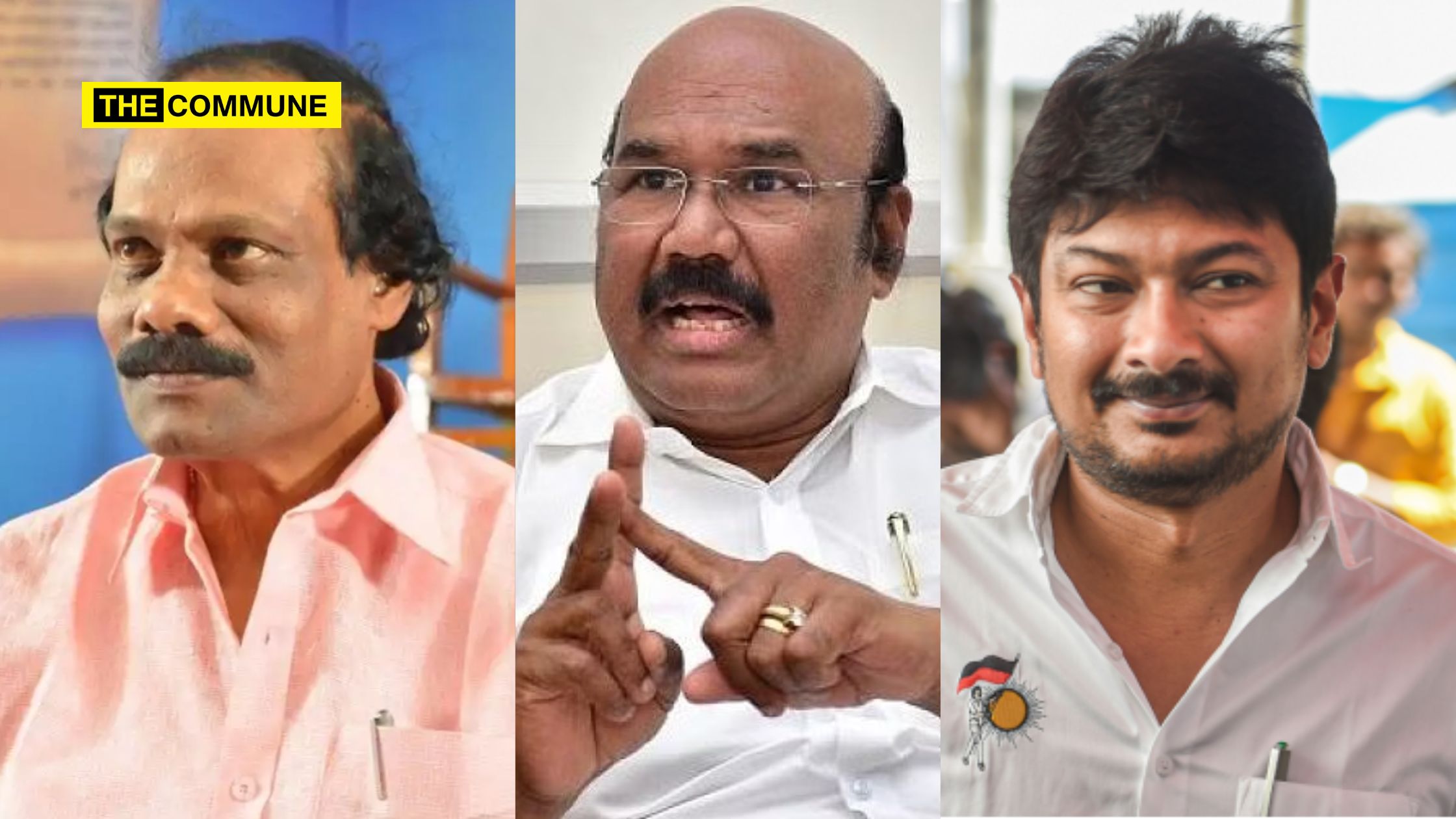
Dindigul Leoni, a controversial Tamil orator and a member of the Dravida Munnetra Kazhagam (DMK), known for his egregious and misogynistic comments about women, has made it to the news once again.

Leoni has previously drawn attention to former Tamil Nadu Chief Minister J Jayalalithaa’s frequent use of DMK leader K Karunanidhi’s name as her having great affection for him. His consistent and degrading remarks about women’s appearances have sparked widespread outrage. He has repeatedly objectified and ridiculed women, often targeting their physique. He had said during an election rally, “Women are now drinking milk from foreign cows, which is the reason behind them putting on extra kilos.” He went on to say that women used to be “thin and their hips would have curves”.

“In a cowshed, people use a milking machine for foreign cows. These days, women drink milk from foreign cows because of which they have put on weight. Those days, a woman’s hip resembled the number 8 [had curves]. When she lifted her child, the little one stayed put on the hip. But now they’ve become like a barrel because of which women cannot carry their children on their hips,” Dindigul Leoni added. The inappropriate hand gestures that accompanied this action added fuel to the fire.

In a recent speech, Leoni quoted a comment allegedly made by K. Kalimuthu, member of the All India Anna Dravida Munnetra Kazhagam (ADMK) regarding Jayalalithaa. He said, “If I see Janaki amma (wife of MGR and later leader of ADMK), I feel like folding my hands in reverence to her, but if I see Jayalalithaa I feel like I want to “call” her (derogatory).”

Leoni shifted blame asserting that the controversy surrounding the late Jayalalithaa was instigated by the BJP Finance Minister, Nirmala Sitharaman, accusing the latter of tarnishing the ADMK’s image by bringing up the distressing events that occurred in the Tamil Nadu Assembly to J Jayalalithaa.

In response, D Jayakumar, a leader of the ADMK, launched a scathing attack on Leoni. Speaking to the press said, “Leoni is a drunkard, a street dog, dont know what he drinks and speaks. Had he been born to a good mother, he would not have made such distasteful comments about Amma (J Jayalalithaa). He is of low birth, he is a poramboke (waste barren land in Tamil), that poramboke has no right to speak about Amma and you expect me to comment on that? It is better that poramboke like him don’t speak any further. We all know what happened in Malaysia, he got it back from the Malaysian public and had to return to India, What an embarrassment, aren’t you ashamed? If you had an ounce of honour, you’d have hanged yourself to death.”

Earlier this year, Dindigul Leoni’s visit to Malaysia for a series of debates (pattimandram) in Kuala Lumpur and Penang took an unfavourable turn. He failed to arrive on time for the Penang event, infuriating the audience who questioned his commitment and professionalism.

Adding to the controversy, Leoni holds the position of Chairman at the Tamil Nadu Textbook Corporation, a move criticised by many due to his history of offensive comments. Despite the backlash, he continues to retain this position.

The AIADMK has taken legal action against Dindigul Leoni for his crass remarks about J Jayalalithaa. His pattern of offensive speech, consistently objectifying and demeaning women, has prompted calls for his accountability and raised doubts about his suitability for any public role or platform.

Jayakumar also trained his guns towards DMK Minister Udhayanidhi Stalin who while speaking at a meeting insinuated the AIADMK leader of sexual misconduct.

Udhayanidhi had said “In Madurai, a public meeting was held. It stands as an example of how a public meeting should not be conducted, a joke of a meeting they (AIADMK) conducted. Have you ever seen a public meeting like that? The organizers of the meeting had no clue of why the meeting was conducted. The participants of the meeting were clueless about why they were participating. The meeting happened on 20 August 2032. You look at the papers of 21 August 2023. Look at what news about the meeting was carried. Two days back, an AIADMK functionary had given a complaint to the police station. You know what is the complaint? That his wife whom he had taken to the meeting was missing. I’m not joking. This is real news. An AIADMK functionary has given a complaint to the police station. The police are investigating. Whom should they investigate first? They should investigate Jayakumar first. Because, he is one of the organizers of the meeting. I did not say with any wrong intention. If you take it wrongly, I am not responsible.

Responding to this comment of Udhayanidhi, AIADMK leader Jayakumar said in the press meet “Your grandfather’s sleazy mischiefs. Your father’s sleazy mischiefs. Your sleazy mischiefs. If we start writing about it, we would have to take those volumes of books in four vehicles. You are making personal remarks on people as if you are a saint and a virtuous man. We will tarnish your reputation by putting the Ceylon Laila matter and your father’s matter. Then what you did to Nayan will be exposed. Look at the dirt behind your back first.

Click here to subscribe to The Commune on Telegram and get the best stories of the day delivered to you personally.

Vamana And Mahabali: An Iconographical Inquiry Into The Legend

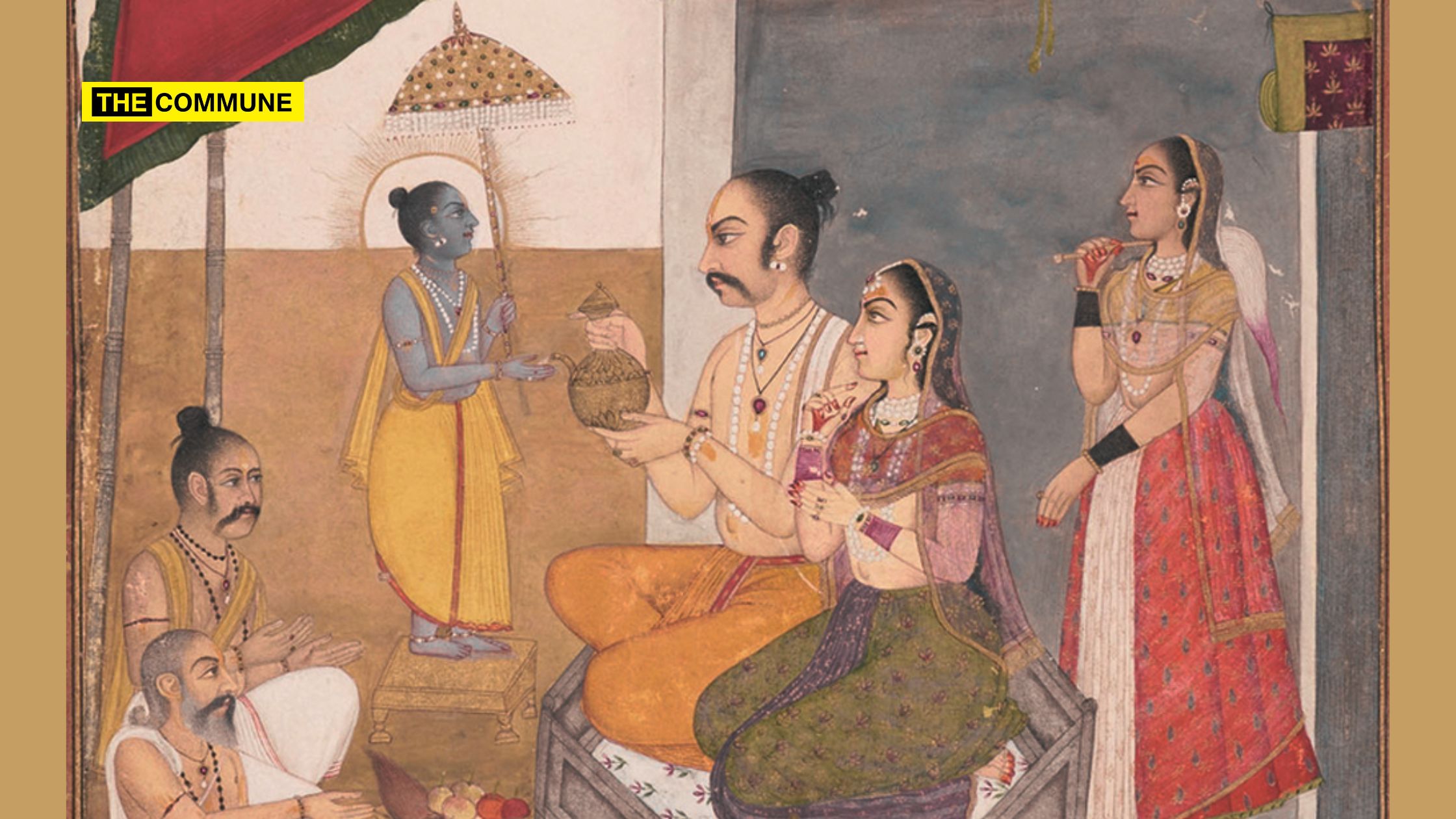
The historical memory of any individual and society is temporary. Any memory can be manipulated or erased from the collective memory, if not reminded and preserved properly; an example for this can be the legend of lord Trivikrama and Mahabali. The legend of Vamana, otherwise known as Trivikrama, which means “one who strides over the three worlds” and Mahabali has been subject to various interpretations and distortions. According to the Puranas, Trivikrama was the son of Rishi Kashyapa and his wife Aditi. The concept of Trivikrama can be traced as far as back to the Vedic period. In earlier times, Trivikrama was regarded as the deity of perpetual motion, which moves forward the entire cosmos. In the later traditions, the deity was incorporated into the Dasavatara concept. Trivikrama is mentioned in many prominent ancient treatises such as Yaska’s Nirukta. The popular festival of Onam, celebrated in Kerala is closely associated with the Vamana- Mahabali legend. The legend can be briefly narrated as follows.

Bali’s story goes like this: He was the son of Asura ruler Virochana and grandson of Prahlada, the renowned devotee of Vishnu, who was able to defeat the Devas thanks to the strength he gained through religious penances. As a result, Indra was pushed out of his kingdom, which upset Aditi, his mother, who begged to Vishnu to be born as her son, defeat the Asuras, and restore Indra to his celestial dominion. As a result, Vishnu assumed the avatar of Vamana, and went to the site where Bali was performing his hundredth Ashvameda sacrifice; an important Yaga described in the Vedas, and begged him for some land to be given as a gift. When Bali saw the Brahmin lad disguised as a Brahmachari or Vedic student, he dutifully honoured him and requested him to offer for himself whatever he desired as a sacrificial present. Sukracharya, the guru of the Asuras, knowing that the young Brahmachari was no other than Vishnu himself, warned his disciple Bali to be careful in making promises. The noble and generous-hearted Bali however, paid no heed to this warning, and said that, if Vishnu who, as Yajna-Purusha, is the divine embodiment of the sacrifice and for whose acceptance he was offering the sacrifice, have himself come to him to ask for a favour on the occasion of the sacrifice, he would consider it to be the greatest honour shown to him, and would certainly promise to give him anything asked. The boy then asked Bali, the emperor of the Asuras to bestow upon him the gift of just three paces of space, which was of course readily promised and confirmed by the ceremonial pouring out of water. At once this Vamana, the young dwarfish boy, assumed a gigantic form; with one pace he measured the whole of the Bhuloka or the earth world and with another the Antariksha-loka or the mid-world between the earth and the heaven. There was thus nothing left for measuring out the third pace of space which Bali had promised. What happed then-after is subject to many interpretations and is the subject of discussion here.

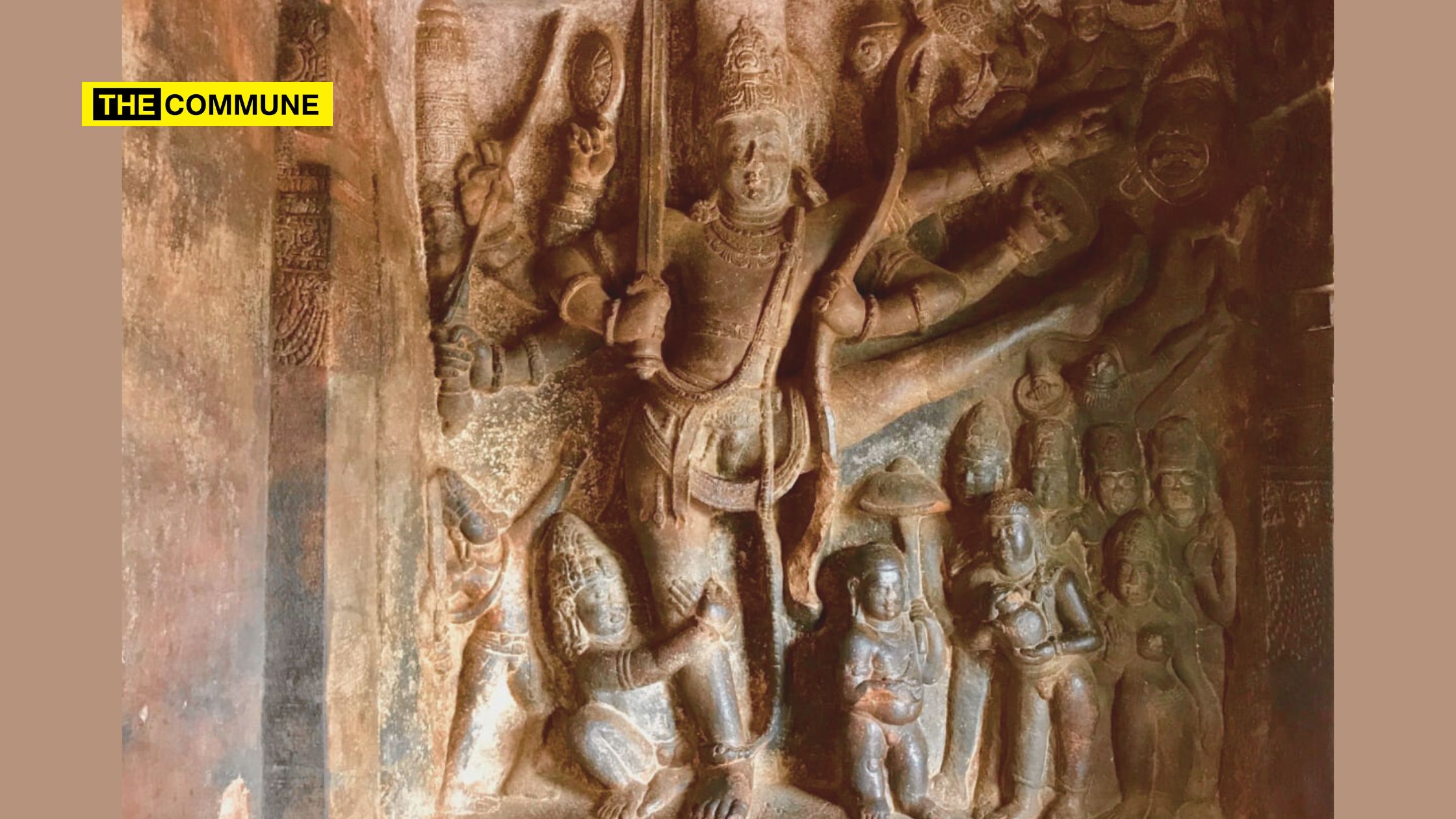
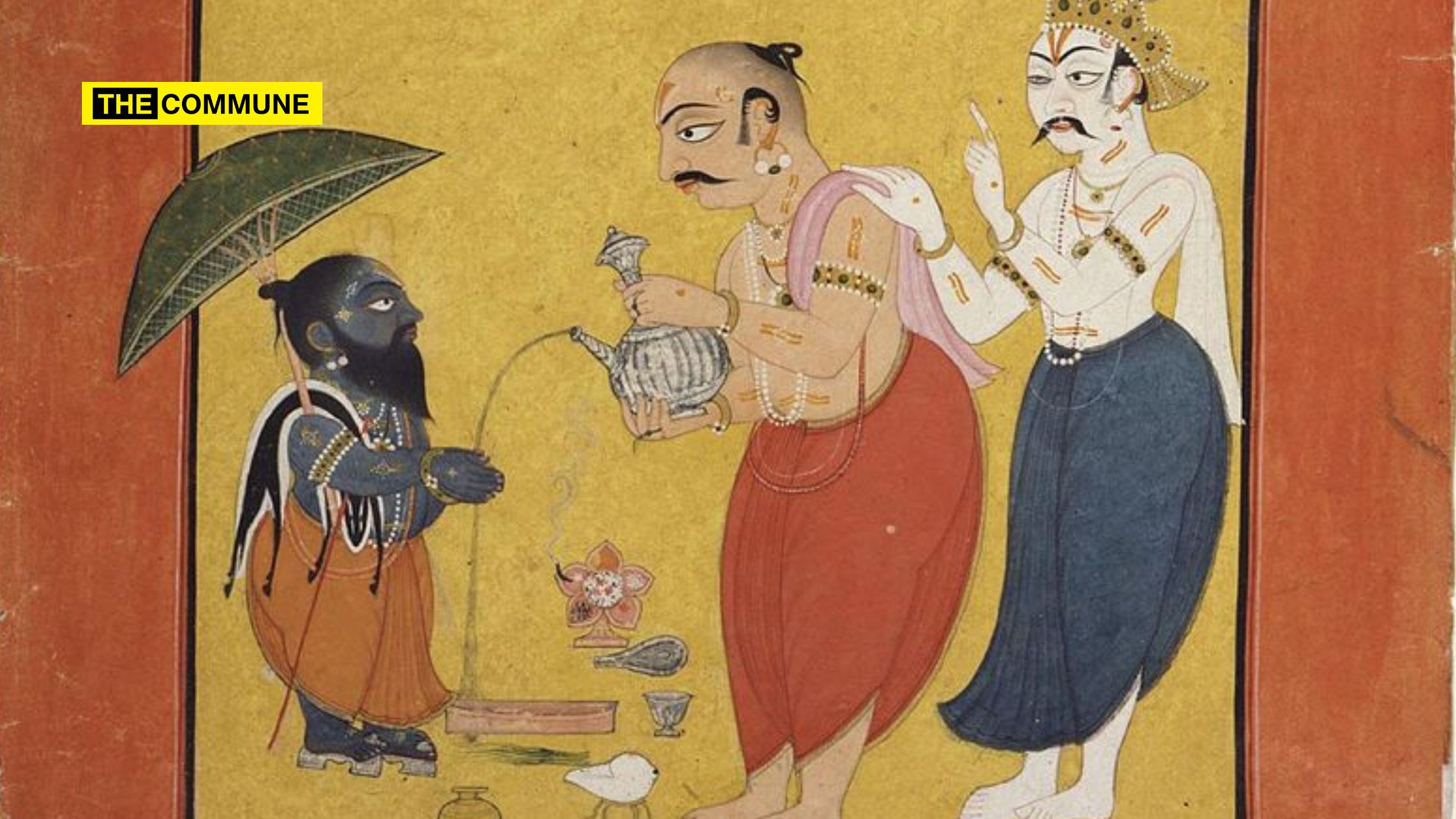
In the academic narratives, the Vamana-Bali legend in context of Kerala has stimulated heated debates, discussions and re-interpretations based on philosophical, religious and political views. However, the objective of the present study is to trace the patterns in which Vamana- Mahabali legend has been represented in Indian art and iconography. As stated above, the veneration of Vamana as a god-head could have its origins right from the Vedic period. By the time of Gupta Empire, Vamana worship, art and iconography had already assumed its distinctive form and structure, many of which have survived into our own times. Sanskrit literatures discussing about art provides very detailed characteristics of Vamana iconography. Vamana is represented as a young Vedic student of short stature adorning deer skin, kundalas and the sacred thread, with a Kamandalu (Water-jar) in one hand and an umbrella in the other. On the crown of the head there should be a tuft of hair tied up in a knot. In other sources, Vamana is not regarded as a young boy but an ill shaped man with protruding joints of bones and a big belly. In actual representations, we find both these sets of features displayed prominently. The iconographic representation of Trivikrama, the transformed state of Vamana is shown in three different poses; his left leg raised upto the right knees, or upto the navel or upto the forehead. The sculptures with left leg raised upto the right leg represents the deity striding over the earth, wheras a raised leg upto the navel and forehead is for mid-world and the heaven respectively. In some sculptures, Trivikrama has four hands, holding conch shell, Chakra in two hands, wheras the right palm is raised upwards and the left hand hung parallel to the raised feet. Sculptures with eight hands are also known, in case of which the deity bears the conch shell, Sudarshana Chakra, Mace, bow and plough, the other two hands sculpted as in the former case. The remaining hand is raised in the Abhaya-Mudra. Along with Trivikrama, Shiva, Brahma, the Sun, Moon and the Devas are depicted on the top of the sculpture and Asuras and Nagas in the bottom.

Trivikrama At Rajim

The earliest known Vamana sculpture is available to us in the Rajivalochan Mandir, in Rajim, Chhattisgarh. The sculpture is weathered and its facial features partially worn out. The limbs are in a fragmented state. However the Kundalas in both ears and the scant clothing are intact. The left hand bears an umbrella. Another, more intact sculpture of Vishnu in Trivikrama form is found in the same temple, which has the deity, raised his legs upto the navel. The four hands bear conch shell and Chakra. What makes the sculpture distinct is that Adi Shesha, the serpent king is depicted below the feets of the deity with his hands in a bowing posture. It is to be noted that Mahabali is not depicted in the sculpture, which might suggest that Mahabali was not yet associated with Trivikrama concept during this period. Trivikrama is a deity associated exclusively with motion, and as such has an independent identity of its own different from the Vamana-Bali episode.

Trivikrama at Badami

The 6th Century Trivikrama sculpture at cave 3 of Badami bears a close resemblance to the art of Mahabalipuram, except that the deities Brahma and Shiva are not portrayed in this panel. Trivikrama raises his leg upto his chest. Quite interestingly, Vamana too is also depicted in the sculpture, which is shown as receiving the jar of holy water from Mahabali, his queen and retinue being depicted as well. Mahabali is shown without a crown, implying that he is attending a yajna ceremony.

Trivikrama at Mahabalipuram

Mahabalipuram, the capital of the Pallava dynasty is known for its fine temple Architecture, especially the unique stone ratha structures and delicate wall carvings. Among the numerous deities represented in the Pallava wall art are a 7th century artwork that represents Trivikrama and the Mahabali episode, which is intricately carved in a panel south to the Ganesha Ratha. This Trivikrama form has eight hands wielding the usual symbols of Vishnu iconography. The left leg is lifted upto the forehead. The panel also depicts other deities namely Brahma, Shiva, Surya and Chandra. What makes the art unique is that Jambavan can also be seen playing a drum. Next to the right leg of Trivikrama are Mahabali and other Asuras, worshipping him.

Trivikrama at Ellora

The 8th Century sculpture at cave no. 15 in the Dasavatara cave complex is yet another notable representation of Trivikrama.  The typical features of Eight hands, leg raised upto the navel are depicted wheras the sword held sideways along the hip stands out as a unique feature. Similar to the art of Badami, Mahabali and his queen gifting Vamana finds its depiction here too, showing continuity.

Another notable representation of Trivikrama is the Chalukya-Hoysala sculpture displayed at the art Museum, Kolkata. Relatively simple in its form and technique, the Deity has four legs. Vamana, Mahabali and his queen are depicted. Similar sculptures are also found at Belur and Nagalapura.

The concept is also described in the major Puranas namely Vamana Purana and Harivamsha Purana. Apart from Hindu literature, Buddhist and Jain texts also provide their own version of the Vamana concept. Even though the Vamana avatar remains as one  among  the most popular forms of Lord Vishnu worshipped all over India, the Trivikrama concept was a much more older one, going all the way back to the Vedic period.  The Trivikrama and Vamana concepts might have been merged together at a later point of time. Even so, the Trivikrama form possesses an independent identity and existence of its own, free from both the concepts of Vamana avatar and Mahabali. This can be a reason why both Trivikrama and Vamana were portrayed separately in the earliest sculptures which depicted these forms. Mahabali, on the other hand, is one of the Ashta chiranjeevi or the famed eight immortals of Hindu belief, along with Parashurama, Vibhishana and Hanuman, and so, a venerated figure among devote Hindus.

A prominent rendering among the academic circles is that Vamana, after “conquering” the entire world with his strides, placed his leg on Mahabali’s head and pushed him to Patala or the underworld beneath the earth, an interpretation of which is that the entire story was the commemoration of a supposed class or race struggle in the past. However, even when Bali was introduced into the already existing legend of Trivikrama, he was never shown as being stomped down by the deity in the earliest iconographies, as we have discussed in detail above. A painting from Mankot in Kashmir painted in the early part of 18th century depicts both Mahabali and Sukracharya as fair-skinned, while the dwarf Vamana is shown as dark-skinned.

In the light of all such overwhelming evidences, can’t it be said that portraying the story of Mahabali and Vamana through the prism of casteism and racism is unhistorical? Also, since most of the iconographic depictions of this legend was found outside of the modern state of Kerala, can this legend and its characters be in anyway be restricted within the narrow borders of regionalism?

Lalkrishna M is a Research Scholar at Centre for Historical Studies, Jawaharlal Nehru University, Delhi 

Click here to subscribe to The Commune on Telegram and get the best stories of the day delivered to you personally.
Aavin Rescinds Informal Order Limiting Milk Packets To Agents Following BJP MLA Vanathi Srinivasan’s Demands

Following the demand made by BJP MLA Vanathi Srinivasan in Tamil Nadu, the state’s dairy cooperative Aavin has chosen to eliminate the restrictions on dairy packet allocations for individual agents. This decision, previously perceived as benefiting private dairy companies, has now been revised.

A few days ago, there were reports indicating that Aavin had imposed restrictions on the number of milk packets allocated to individual agents, a move perceived to be advantageous to private dairy enterprises. Numerous concerned citizens reached out to Coimbatore South BJP MLA Vanathi Srinivasan, expressing their apprehensions about the limitations, which would have a direct impact on consumers. Responding to the pleas of these concerned citizens, Vanathi Srinivasan released a press statement condemning Aavin’s actions and called for the immediate removal of the restrictions imposed on agents.

In a press statement issued on August 25, 2023, MLA Vanathi Srinivasan said, “Throughout the various districts of Tamil Nadu, individuals from middle and economically disadvantaged backgrounds residing in rural locales rely on dairy cattle farming as their means of livelihood. A substantial portion of the populace supplies milk to Aavin. Regrettably, following the establishment of the DMK government, Aavin’s milk procurement has encountered a significant downturn spanning over two years.”

MLA Vanathi Srinivasan further commented, “The Aavin management and the dairy department, responsible for boosting milk production, have shown no intent in this regard. The lack of action by the DMK government appears to be favoring private milk companies. Additionally, in the Coimbatore district, there has been a sudden reduction of 10 to 20 percent in the daily milk packet allocations to milk agents, starting from August 23, 2023. This decision was informally communicated and has been implemented throughout the Coimbatore district. Consequently, residents of the Coimbatore district have been compelled to purchase private milk due to the unavailability of the required quantity of milk.”

The press statement states, “Historically, Coimbatore has consistently procured 200,000 liters of milk daily. However, recent reports from milk agents indicate that the procurement has dwindled to merely 96,000 liters. These developments raise suspicions regarding the management’s intentions, suggesting a possible inclination to favor private milk companies and subsequently creating a deficit in milk availability. Such actions are deeply reprehensible.”

MLA Vanathi Srinivasan concluded by saying, “It is imperative that the Aavin administration and the dairy department proactively enhance milk procurement, guaranteeing the seamless availability of dairy products such as milk, curd, butter, ghee, and paneer. I urge Chief Minister MK Stalin to personally intervene in this matter and initiate measures to safeguard the welfare of both milk producers and consumers.”

Under these circumstances, it has been reported that the Aavin administration has rescinded its informal directives restricting the allocation of milk packets to individual agents. Instead, they will revert to the previous protocol, a decision made in response to the appeals put forth by BJP MLA Vanathi Srinivasan. MLA Vanathi Srinivasan took to social media to thank the Aavin administration for heeding her demands.

Click here to subscribe to The Commune on Telegram and get the best stories of the day delivered to you personally.


Onam: An Enquiry Through Literature

onam secular hindu festival

This article intends to trace the historical evidence and sources associated with Onam and the concept of Vamana and Mahabali. The story spread in association with Onam is that of Mahabali and Vamana, in which the narratives are constructed in such a way as to establish the authority of Mahabali. The historical accuracy to prove Onam as a festival of Mahabali is very limited and almost non-existent. In contrast, it can be seen as a festival of Vamana everywhere in the subcontinent. From the Epics of Bharata to other modern works, references to Vamana, Bali, and Onam can be traced. It is clear from the historical records that the festival celebrated as Onam in Kerala is not limited to Kerala only but is a festival that has importance throughout India.  

References Related to Vamana in Rigveda

This celebration is believed to have deep historical roots in India, as suggested by ancient literary sources and eulogistic evidence. The origins of the narrative surrounding Vamana, the deity who obtained dominion over the earth through the acquisition of three strides, can be traced back to the Rigveda. Rigveda mentions:

यो रजांसि विममे पार्थिवानि त्रिश्चिद्विष्णुर्मनवे बाधिताय। तस्य ते शर्मन्नुपदद्यमाने राया मदेम तन्वा३ तना च ॥१३॥                                                         

– (Rigveda: 6th Mandala – 49th Sooktha – 13th Mantra)

This means – “O lord all-pervasive, Vishnu, who have created the three regions of the universe for humanity and sustain the three to save us from the limitations of suffering and darkness, we pray that with the abundant and expansive gifts of health and wealth, we may live and enjoy life in this vast home given by you.” 

Epics And Onam

Shanti Parva (326th Shloka) of Mahabharata mentions the story of Krishna, who suppresses the asura king Bali. Two times in the Mahabharata, Vamana is the only character mentioned; Bali is left out. Draupadi mentions how Lord Vishnu measures the cosmos in three steps when speaking to Lord Krishna in Vana Parva. Shanti Parva symbolises Vishnu’s birth as Vamana. However, the Bali narrative has been explored as the Bali-Vasava Samvada in Shanti Parva. The Mahabharata’s Vana and Shanti Parva have a section on the Vamana-Bali tale. Son of Aditi, a young Brahmachari who approached Bali, the Danava king, and measured the entire globe with just three steps, is how Mahavishnu is described as being born in this passage. In Adi Parva, the genealogy of Bali is explained. Virochana was the father of Bali. He was the brother of Kumbha and Nikumba, who were Prahlada’s children. Prahlada was the son of Hiranyakashyapu, who was the son of Diti. While taking Lakshmana and Sree Rama to the Siddha Asrama to defend Yaga in the Balakanda of Ramayana, Rishi Vishwamitra tells them the tale of the Vamana Incarnation.

References Of Vamana And Bali In Brahmanas And Puranas 

Vamana and Bali characters can be seen in Brahmanas and Puranas also. In Brahmanas, Vishnu appears as Trivikrama in various forms, whereas in Shatapatha, Brahmana Vishnu appears as Vamana. According to the Skanda Purana, the capital of Mahabali is located close to Someshwara of Vastrapath in the Saurashtra Desha, and he performed Aswamedha at Gurukulya Theertha on the banks of Narmada. As per the Bhagavatapurana, that yajna was held at Bhrigukachchha, on the Narmada River’s northern banks. According to the Vamana Purana, Vamana belongs to Kurukshetra. Vamana was born in the Shravani Nakshatra on Bhadrapada Ekadasi, according to the Bhavishya Purana. At the same time, the Bhagavata places Shravana as the period of his birth, Shronam, later changed to Onam, during Bhadrapada’s Shukla Dwadashi. Vamana, Vishnu’s Vishwaroopa Trivikrama form, is also extensively described in the Skanda, Matsya, Bhagavata, Brahmanda, and Vamana Puranas. Most Puranas claim that after sending Mahabali to Sutala, Trivikrama Vamana took the incarnation of Vishnu and vanished.

Onam In Sangam Literature And Tamil Nadu

The inception of Onam celebrations is said to have originated in the Sangam era. The historical documentation of festive commemorations can be traced back to the Kulasekhara Perumals, which occurred about 800 CE. The duration of Onam celebrations spanned a month. The festival’s historical roots may be traced to ancient times, as evidenced in the Pathupaattu of Mathuraikanchi, a literary composition by Mankudi Marutanar. He recorded the ten-day Onam celebration in Madurai’s Kanchi as ‘Mayon Meya Ona Nan Naan Konam Dinla’. This text explains the celebration of Onam festivals by those affiliated with the Madurai temple in Tamil Nadu during the historical period of the Pandya empire. The Pandyan king Nednchezhiyan of Talaialankanam and its citizens celebrated Onam before 1500 years was evidenced from this literature. Mankudi Maruthanar provides a comprehensive depiction of the festival. In the regal courtyard, the monarch would bestow esteemed gifts upon the poets, dancers, singers, and soldiers hailing from his realm. The elephant altercation held significant significance at that era of the event. The commemoration involves engaging in various leisure activities and festivities inside the confines of the temple grounds. 

In his literary composition titled Thevaram, dating back to the 7th Century, the Shaivite saint Thirugnanasambandar documented the occurrence of the Onam festivities held at the Kapaleeswarar temple in Mylapore during the Tamil month of Aipassi. The Nalayiram Divyaprabandha, a sacred text within the Vaishnava tradition, references the commemoration of Thiruvona Thiruvizha, a festival that marks the birth of Lord Vishnu. One of the notable figures associated with this festival is Nammalvar, a revered saint within the Vaishnava community. The festival of Onam, or a comparable occasion, is commemorated by numerous temples throughout the historic Tamil region as the auspicious birth anniversary of Lord Vishnu. Additionally, the text refers to a total of 108 sacred sites, with Thrikkakkara being among them. The 9th-century literary works “Pallas” and “Pathikas,” authored by Periyazharwar, provide a detailed account of a celebration characterized by offering oblations to Lord Vishnu, communal activities, and festive banquets. The inscription attributed to Jadavarman Sundarapandyan, dated 1276 CE, references a Pandya monarch, Mavalivanadirayan.

References Of Onam In Kerala And Malayalam Literature

A copper plate from Sthanu Ravivarma’s (861 C.E.) reign identified at Thiruvalla refers to the Thiruvattruvayi temple’s Onam rituals. Inscriptions of donations made by one Chendan Changaran provide a reference that Onam was celebrated during the 7th Century CE. Another inscription from Thiruvalla dates to the 12th Century and discusses the income and expenses associated with the Shree Vallabha temple’s Avani Onam celebration. Onam is referred to in a stone inscription of the Manalikkara Azhwar temple in Kanyakumari of Travancore. Moozhikulam Kacham, a medieval code of law, provides evidence of the observance of the festival of Onam during the reign of Indukotha Varma, a ruler of Kerala in the 10th Century.


mahabali
Fig.: Thiruvalla (Thiruvattruvayi copper plates) of 9th Century C.E.


The inscription at the Thrikkakara temple, dating back to the 11th Century, elucidates the Onam festival, described as a religious observance dedicated to Vamana, an avatar of the Hindu deity Vishnu. In the past, individuals would prepare in advance, typically two days before the occasion known as ‘Thiru Onam,’ to make offerings. The inscription from the 11th Century, authored under the reign of Bhaskara Ravivarman, refers to Puradam, Utradam, and Thiruvonam as days of great significance within the temple’s auspicious calendar. The region around Thrikakkara has been historically designated as Kal Karai Nadu. The event, attended by the rulers of Kerala in the past, is characterized by twenty-eight days and is celebrated with grandeur and magnificence.

The carnival in question is referenced in the 12th-century inscription found in the Thiruvalla temple. Additionally, it is mentioned that this temple was bestowed with a donation in the form of an offering. Uddanda Shastrikal, a Sanskrit poet associated with the Zamorin, articulated the Sravana celebration. Contemporary historians suggest that the festival is called Onam, as Sravana corresponds to the Sanskrit designation for the Thiruvonam constellation.

The Thirunizhalmala inscriptions, a 13th-century literary work, make mention of the Vamana avatar and Mahabali, extolling the god Lord Vishnu of Aaranamula. The 14th-century work, Unnuneelisandesham, refers to Onam, drawing a parallel between the festivities and ceremoniously receiving guests. The narrative delineates the attire the five-year-old character wore during the Onam festival and their engagement in many customary pursuits. Consequently, more than the available evidence within early Malayalam literature is needed to substantiate the prevailing presumption that Onam is a festival commemorating the reign of King Mahabali.

Foreigners’ Observations

Nevertheless, a comprehensive and accurate depiction of Onam can be found in a memoir from 16th-century Europe. The text highlights that this propitious commemoration takes place in September as an act of reverence towards Laxmi, the deity associated with affluence and opulence. Bartolommeo, a missionary who visited the Malabar region in 1776, documented the observance of the Onam festival during the 16th Century in his literary work titled ‘A Voyage to the East Indians.

The book titled “Livro da Seita dos Indios Orientales” authored by Jacobo Fenicio, a Jesuit European missionary who was active in Kerala during the 17th Century provides the initial and potentially singular mention of Onam as a commemoration dedicated to the homecoming of Mahabali. Fenicio further alludes to a poet who exhibited disobedience and a critical attitude against Brahmins and their customary rituals. The poet in question is widely believed to be the author of modern poetry centered around the reign of Mahabali. According to Francis Day’s book on Kochi in the 19th Century, it is argued that Vishnu, rather than the commonly held notion, is the deity that visits the local population during the festival of Onam. Upon William Logan’s realization that Vishnu and Parashurama were present on that particular day, he inferred that the Onam festivities were conducted as a commemoration of Mahabali.

Last Word

Ancient literature, including Rigveda, references the story of Lord Mahavishnu’s incarnation as Vamana. Thiruvonam, which occurs during the month of Shravana, is considered to be Vamana’s or Mahavishnu’s birth star, and the entire country of India celebrates this occasion. The same festival is observed around Kerala, although it is most prominent in Maveli. This story was told so that it may be interpreted as a struggle between those who are oppressed and those who do the oppressing from a Marxist point of view.

These views are the product of the underlying fallacy that Kerala is the only area in the world where Mahabali is worshiped as a deity. Except for books written in the 17th Century by Westerners, no reliable evidence connects the Onam celebrations held in houses with the Mahabali story.

R. Harinarayanan is a Ph.D scholar at Department of History, University of Kerala.

Click here to subscribe to The Commune on Telegram and get the best stories of the day delivered to you personally.
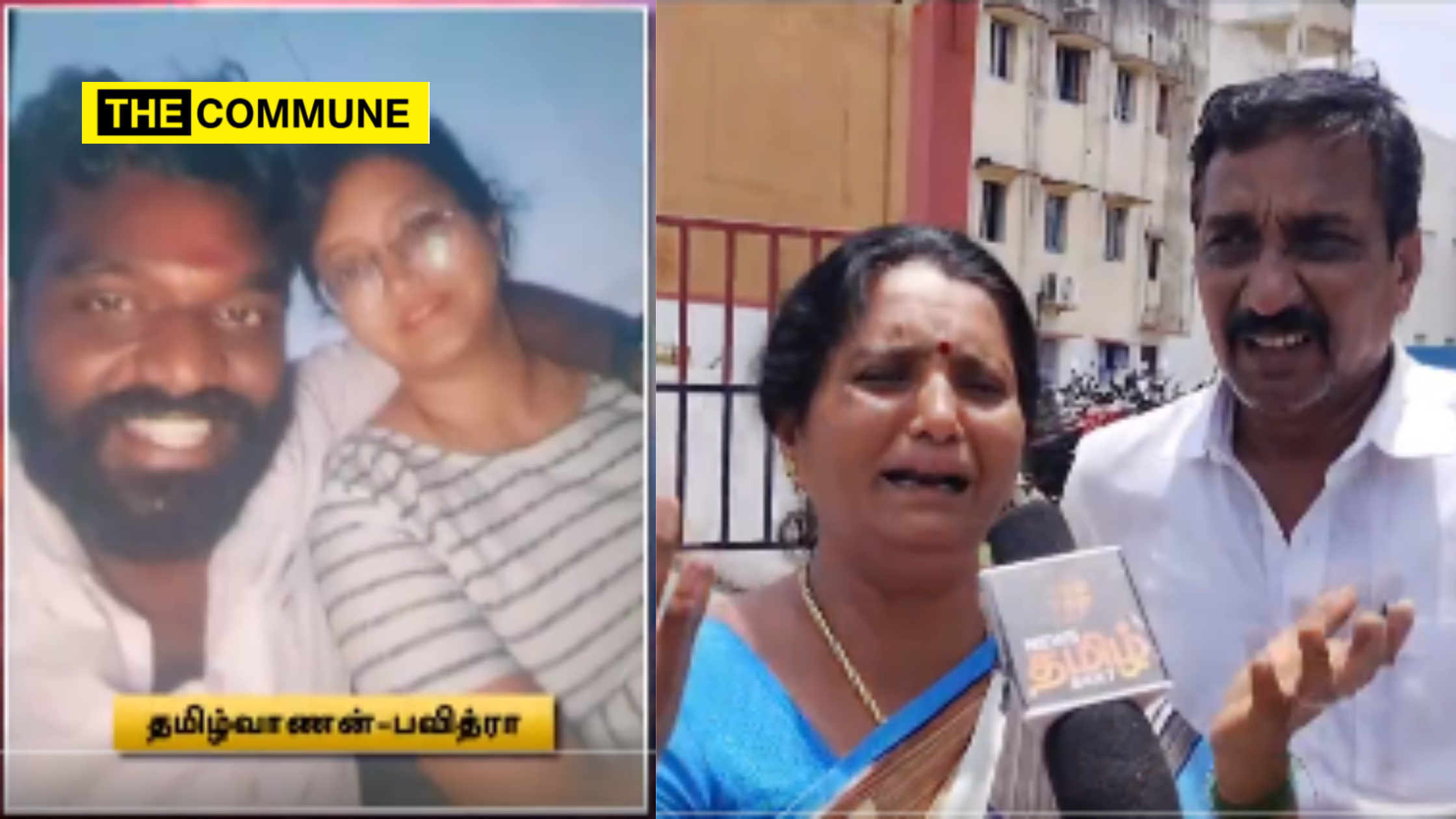
Chennai Girl Commits Suicide Due To Alleged Torture By VCK Functionary

In an incident that was not so surprising, a member of the Viduthalai Chiruthaigal Katchi (VCK) party reportedly engaged in an extramarital affair, eloped with the partner, and subsequently subjected the girl to torture, ultimately leading to the tragic demise of a young woman from Chennai.

Govindaraj, hailing from Maraimalai Nagar, has been working as a cable TV operator. Tamilvaanan, a VCK functionary, was working under him. Reportedly, there was romantic affection between Tamilvaanan and Govindaraj’s elder daughter, Pavithra. However, Govindaraj, disapproving of their relationship, managed to persuade his daughter Pavithra to wed a relative named Purushothaman instead. Consequently, Pavithra chose to sever ties with Tamilvaanan, deactivating her SIM card and discontinuing all communication with him.

Pavithra who got married to Purushothaman in 2016, has a daughter aged four. Amidst this backdrop, VCK functionary Tamilvaanan reached out to Pavithra via social media and rekindled their romantic involvement. Allegedly, Pavithra reciprocated the interest, leading them to clandestinely roam around the city without the knowledge of Pavithra’s husband, Purushothaman.

In this situation, four months ago, Pavithra eloped with Tamilvaanan and was living with her baby at Potheri in Chennai. However, Pavithra did not know that the real intention of Tamilvaanan was to extort money from her. Within a few days of eloping, VCK Tamilvaanan started torturing Pavithra and demanding money from her. A few days back, Pavithra who met her father Govindaraj explained to him the ordeals she was facing from Tamilvaanan. She had reportedly said to her father that Tamilvaanan was demanding ₹10 lakhs of cash. Govindaraj agreed to pay 10 lakhs to Tamilvaanan and her daughter Pavithra said that she would return home after paying the money he demanded. However, two days ago, Govindaraj received a call from the police that her daughter committed suicide by hanging.

In this situation, the parents of Pavithra lodged a complaint with the police demanding the arrest of VCK functionary Tamilvaanan. They said that the Tamilvaanan enjoys the support of the party and that the police are not taking any action against him. They also alleged that Tamilvaanan is threatening to kidnap their second daughter if they fail to withdraw the case.

(with inputs from NewsTamil24x7)

Click here to subscribe to The Commune on Telegram and get the best stories of the day delivered to you personally.

How Are BJP’s Preparations For The 2024 Elections In Telangana And Andhra Pradesh?

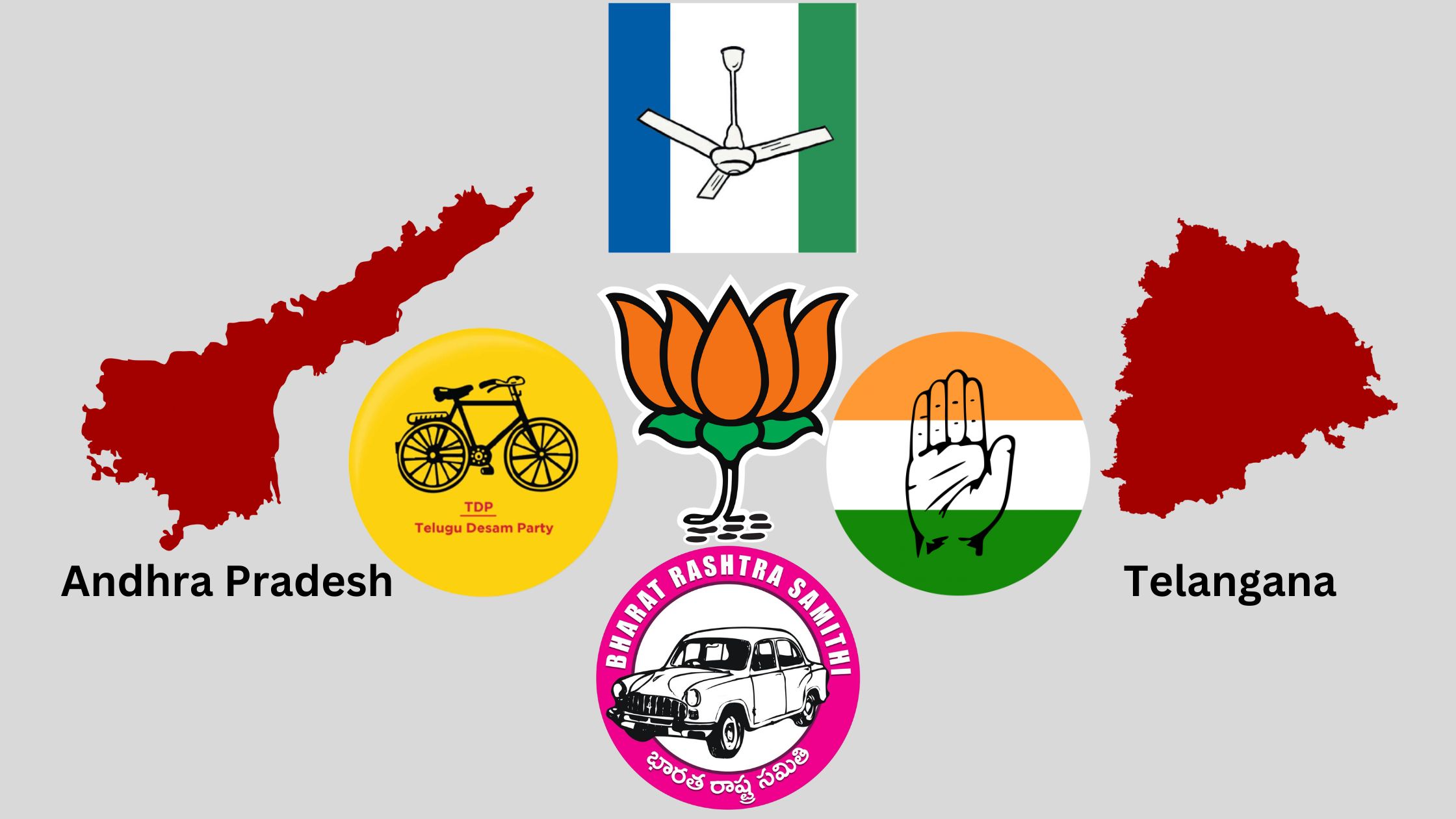
In the run-up to next year’s national elections, the BJP party units of the two Telugu states are seen holding more than the average number of party meetings. In addition to the General Election next year, both Telugu states are scheduled to have state elections as well, raising the stakes for the BJP in the South – Telangana goes to the polls in or before December 2023 and Andhra’s state elections are scheduled before June 2024, most likely in tandem with the 2024 national election.

These dates indicate a sense of urgency in collecting/verifying voter information, effective implementation of the BJP’s central-planned social schemes, fair disbursement of funds to the needy for such schemes, and popularizing the core message of a healthy balance between welfare schemes and development-oriented incentives, that the party’s economic policy stands for. A sense of urgency also prevails in training and keeping their cadre alert and active for local booth-level engagement and ensuring that there is no voter-id tampering, as is being alleged in Andhra, where the YSRCP has been accused of voter-list tampering in almost all districts. Jagan Reddy’s current YSRCP government in Andhra Pradesh had been accused of the same in the 2019 state elections as well, when it won the state elections, wresting power from the previous Telugu Desam Party (TDP) government.

This time around, the BJP’s stakes are higher in the Telugu states. After a poorly strategized and miscalculated election campaign in this year’s Karnataka state elections, it needs to show better numbers and an indication of growth in the neighboring Southern states of Telangana and Andhra. Unlike Karnataka where it already has a strong base, it is yet to strike out with the right messaging in Telangana and Andhra. Analysts speculate that the BJP is better off marketing itself as a progressive Hindu party with a strong development agenda in both the Telugu states. It can play the patriotism card as well (reduced terrorism, tough action against terror outfits and their sponsors, better border protection, etc.)… but this is best done, only after its development agenda and increased economic opportunities, are highlighted.

Earlier this week, the BJP’s Andhra unit president, Daggubati Purandeswari, appealed to the local cadre to ensure that all eligible voters are on the electoral roll ahead of the 2024 state and national elections amid continued speculation of vote tampering by Jagan Reddy’s YSRCP. Incidentally, the Andhra Pradesh state BJP president is the daughter of the late actor, politician, and TDP founder, N.T Rama Rao and is also the sister-in-law of N Chandrababu Naidu, current TDP party president and former Andhra Pradesh chief minister.

At this week’s party meeting held in Vijayawada, both Purandeswari and Bandi Sanjay Kumar (BJP National General Secretary) were in attendance. Both leaders emphasised the importance of conducting regular checks and verification of electoral rolls and Voter ID details at the grassroots level. They also highlighted the necessity of ensuring that the citizens of Andhra and Telangana comprehend that they have reaped the rewards of central government schemes facilitated by their respective state governments despite the state governments disproportionately claiming exclusive credit for the distribution of these central government benefits. Bandi Sanjay also reiterated the unhealthy debt scenario in both states with Andhra doing worse on account of Jagan Reddy’s extreme welfarism and irresponsible spending on non-developmental activities with zero returns on investment and employment opportunities or sustainable local economic growth.

In a noteworthy development in neighbouring Telangana, Chandrasekar Rao’s ruling Bharat Rashtra Samithi (BRS) announced candidates for 115 of the 119 seats in the state assembly ahead of this year’s polls. Only seven current MLAs appear to have lost their seats. BRS party leaders claim that this is an indication of their party’s confidence in winning the 2023 state elections for a record, third consecutive term. Meanwhile, the Telangana state Congress party unit, desperate for a win or at least a close fight, is observed trying to grab state headlines almost every day over pretty much anything to do with BRS leaders, party policies and schemes, various events, alleged irregularities and instances of graft. The Congress party feels entitled to stake a claim on Telangana’s administration, as its 2014 central leadership was instrumental in the split of Telangana from the larger Andhra Pradesh, with a covert understanding of cooperation from BRS party leader and current Telangana CM, K Chandrasekar Rao.

In the higher rank and file of the Congress, people who have expressed interest in contesting the upcoming state elections, include former cricketer, Mohammed Azharuddin. He is the current Telangana state Congress working president (appointed in 2018) and has hinted at his plans of contesting from Hyderabad.

The BJP’s Telangana unit continues its satisfactory growth trajectory, expanding its support among a core base. After successfully establishing a strong presence in a short span of under 10 years, it is hoping to emerge as the winner of the 2023 state polls or the largest opposition party, with considerable political and social clout in the state.

In Andhra Pradesh, it has a long way to go in terms of two critical factors – effective, popular local leaders and gaining support from its target population. It hasn’t had much success on either front. It has had a few strong, strategy-focused, national-level leaders hailing from Andhra Pradesh (M Venkaiah Naidu, GVL Narasimha Rao, V Ram Madhav, Y Sujana Chowdary, etc.) but none except former Vice President of India, Venkaiah Naidu, has been able to build a strong rapport with the local voters and electoral constituents.

While continuing to work towards building its base and establishing a strong foundation in Andhra, it is trying to increase its presence and popularity in Telangana where it hopes to bank on local leaders like Bandaru Dattatreya, current Governor for Haryana and G Kishan Reddy, Union Minister of Tourism.

(Shivani is a freelance writer based in Vijayawada)

Click here to subscribe to The Commune on Telegram and get the best stories of the day delivered to you personally.
Tracing The History Of Onam

Onam, the official festival of Kerala, is celebrated with great spirit and enthusiasm every single year. The role of festivals in the cultural integration of a region is significant. They are an integral part of the cultural heritage of all communities worldwide. Sometimes they are mainly centred on some characteristic aspects of a community, and sometimes their religious features. The stories or myths of Onam are mainly related to Hinduism. Individuals cutting across faith from Kerala celebrate Onam. The festival is observed during the Malayalam month of Chingam. The event represents a celebration of cultural unity and harmony. While considering Onam from a historical perspective, Maduraikkanchi of the Sangam period, a 9th Century Pathikas and Pallads by Periyazharwar, a 11th-century Trikkakkara inscription, a 12th-century Tiruvalla temple inscription are very important documents on Onam festival. 

Etymology Of Mahabali  

The main story in connection with Onam is related to Mahabali, also referred to as Maveli, and Vamana. Mahabali is considered as a ruler of Kerala. When Mahabali ruled the land, it was prosperous, and the people lived in harmony. The festival is celebrated in Kerala to remember the golden rule of Mahabali. The episode of Vamana is deeply connected with the story of Mahabali and is narrated in detail in the 8th Skandha of Srimadbhagavata. Mahabali-Vamana’s story can be seen in several other Puranas, e.g., Vamana Purana, Padma Purana, and the Harivamsa Purana. Sometimes references like Mavelinad, which denotes the land of Kerala, are connected with the story of Maveli and Vamana. Even though there are no official records concerning the name Mavelinad, certain folk songs rely on the name and believe that the land of Maveli or Mahabali is Kerala. 

The Authenticity Of Mahabali As A Ruler

There are several stories and myths surround whether Mahabali was the king of Kerala. First among them is the folk song glorifying Mahabali’s reign. The folk song carries the title Maveli means Mahabali, and it is believed that he ruled the land of Kerala. Scholars are of different opinions about the origin and age of the song, even though it is very prevalent all over Kerala. The language and words of the song seem pretty recent indicating that it may have originated in the 16th or 17th centuries. If Mahabali ruled way back in time, singing a song with a polished language is impossible. Several wrods and phrases in the folk song are of recent origin. Those terms can connect with the central Travancore region, Mavelikkara or Onattukara, where Maveli ruled. 

Another folksong related to Maveli is believed to be written by Pakkanar. This song is a mixture of Tamil and an earlier version of Malayalam, which makes it more realistic. In this song, Maveli is said to come from the northern side. He is coming to see the prosperous life of his people. On his arrival, the people modify their surroundings; paths will be cleaned, mud houses will be renovated, new clothes, particularly Veshti or Mundu, will be purchased, lamps to be hung for more than five days, and a feast to be prepared. The song replicates the people’s joyful attitude and happiness in welcoming Maveli.

Mavelikkara, a central Travancore region, has the title of maveli in its name indicating the connection. Some scholars think that the region’s rulers and nobles celebrated their harvest season harmoniously in that period. This region of Travancore is popularly known as Onattukara or Odanad. The Sravana month is said to be this region’s harvesting season, where the famous Onattan, a particular crop popular in the central Travancore region, is cultivated. Some scholars believe that Maveli and Onam originated from the titles Mavelikkara and Onattan (Onattukara).

The title of Maveli can be seen in various other places. An inscription found from Kanjirappalli in Changanassery refers to the name of Maveli. Madhura Meenakshi temple at Kanjirappalli features a Tamil inscription that refers to Maveli as Samarakolahalan and Mudiyedamannamanavalan, denominated as Maveli Vanadiraya. K.A.Neelakanta Sasthri, in his book Pandya Kingdom, refers to Mavelivanadirayan or Vanadirayan as a contemporary king of Veerapandya and Maravarman Kulaseskharan (C.E. 1250). After the decline of the Pandya kingdom, certain regions came under the nobles of Madurai, known as Vanadirayans, and they annexed some regions of Tirunelveli. The inscriptions of Jadavarman Sundara Pandyan (C.E. 1276) reference Parakramapandya Maveli Vanadiraya. His children were referred to as Nayanar and PavanagakaraaMavelivanadiraynans were considered higher nobles under the Pandya kingdom and possessed a large region near the river Palaar during or later Maravarman Kulaseskharan. They believed themselves to be the successors of Mahabali and Bana and titled themselves Baandadhiraja or Mahabali. One of their settlements was at Mahabalipuram near Chennai. Malladeva Nandivarma Jagadarbhakamallan, Mahabli Banaraja Sree Paraman, Banavidyadharan were some of the names of their ancestors. The Mavelivanadirayans mentioned above ruled the regions of Madurai and Ramanathapuram. One among them extended his kingdom to the west and established his supremacy in the regions of Kanjirappalli or Mavelikkara. Another piece of evidence about Maveli is about Mavelivanadirayan, a contemporary of Jadavarman Sundarapandyan, who was the head of Keralasimhavalanatu. 

Valanadu is a term used to refer to the administration of the combination of many small kingdoms. The regions of Changanassery, Peerumed, were near the Ramanathapuram district and Keralasimhavalanadu of Tamil Nadu. All these references show the connection between Maveli and Banadhirajas, who ruled over the regions of Kanjirappalli and nearby areas.

Another assumption is that the Pandya kings or their subordinates may control the regions from Mavelikkara to Pandhalam and Poonjar, known as Mavelivanadirayans. The region from Kayamkulam to Mavelikkara, popularly known as Onad or Odanad, can be traced to this Pandya relationship. So, the rulers of Poonjar, Pandalam, and Kanjirappalli regions have a Pandyan connection. Again, Madhura Meenakshi temples in Kanjirappalli, Chirakkadavu, and Kumaranalloor are believed to have originated during this time. Later the names of Pandyas were carried out by certain Venad rulers also. It shows their relationship with the Pandya kingdom. The folksong carries the glories of Maveli, which may have originated because of the presence of a ruler who ruled the central Travancore regions.  

Similar to the story of the homecoming of Mahabali, is the annual visit of Parasurama to the region of Trichur or Trikkakkara, but the tradition is wholly unfounded. Another story indirectly connected with the Onam myth is about the ruler Paari of Parambumala. He was a benevolent ruler, and the people enjoyed a peaceful life during his time. Later, the Moovendar stole his land, and the people worshipped him and wished for his return every year. The story of Paari has no direct connection with the story of Onam, yet it can be traced as a story of a king who ruled his subjects with utmost care and affection.

The three stories of Mahabali-Vamana, Parasurama, and Paari are directly connected to the ownership of land with a ruling and controlling power and its grant given to the persons who were in need. The land is always under the custody of the ruler. It simply indicates the distribution of land into the hands of powerful people. Moreover, people in need could assume that influential individuals gave land to those who wanted to use it – ‘use’ in the sense of using for cultivation or other purposes. Because, at that time, the land was the major source of income. Through productive measures and perfect land distribution, the social hierarchy functioned.

Onam Outside Kerala

Onam is believed not to be confined to Kerala but extended over Tamil Nadu in early times. There are references to Onavizhavu in Tamil literature. The earliest reference to Onam can be seen in the Maduraikkanji written by Mankudi Marutanar during the Sangam period. In the 2nd century C.E., according to Mankudi Maruthanar, Onam was celebrated in the regions of Madurai during the period of Nedumchezhiyan, the Pandya king, which forms the sixth poem in the Pathupattu collection, contains a significant passage describing the story of Maveli and Vamana. The story indicates that several ancient social customs of the Tamils continue to flourish intact in Kerala. At the same time, they have disappeared in other parts of Tamil Nadu, and this is one of them. Onappiran, the Lord of Onam, is one of the names of Vishnu in Tamil. This celebration was highly rich, and the festival was conducted in the same style as the Chera rulers celebrated it. In Madurai, it was celebrated for seven days. According to N.V.Krishnavarier, Avani Avittam, a festival celebrated in the Tamil region, has similarities with Onam in Kerala. He substantiated the references in the Irainar Akapporul, an ancient Tamil grammar text. He stated that Hindus, Buddhists, Vaishnavites, and Jains celebrated Onam without religious differences.

In addition to Madurai, Onam was celebrated in certain regions in Andhra, particularly in Tirupati. It was their annual festival. In the works of the famous Vaishnava saint Periyalwar, Tiruvaymozhi refers to the celebration of Onam in Tirupati, Madhurai, and Kottiyoor. Before the Tamil and Malayalam people did the seven days of Onam, the practice of Mulayidal is why the roots of Onam can be seen in the Mooladravida period. From this Mooladravida origin, N.V. Krishnavarier references Mahabali with the Assyrian rulers. However, Perumal Thiruvaymozhi Onam is mainly connected with Lord Vishnu and Lord Krishna. The hymns refer to the special feast and sacrifices conducted in the Onam festival in Tirupati and Tamil Nadu. 

Tirupati is among the 108 sacred centres (Divyadesam) of Vaishnavites, like Trikkakkara in Kerala. In both temples, the Trivikrama style of Vamana is incarnated.

In the Tulu region, the Brahmans of Seevalli, Havyak, and other notable communities like Bands, Billar, Cheriya, Padarthi, and Sthanik also celebrated Onam. In Udupi temple, the day is celebrated with various specialties. Temples at Byndoor, Kunthapura, Kollur, Honnavaram, and Gokarnam also celebrate the festival. Certain lower communities used to dance in special dresses practiced from Gokarna to Gangavali and in the northern regions at Sirasi of Canara, especially celebrated Onam. In Dharmasthala, the Jain centre celebrated Onam in earlier times.

Onam: Harvest Festival Or Commercial Festival

It is considered that Onam is a harvest festival. There are differences of opinion about this, yet, the festival rejoices for ten days from Atham to Thiruvonam. It is to be believed that there is a memory of a historic agrarian past of Kerala. However, it is to be analysed differently because in Kerala, the harvest season is connected with the two monsoons. The harvest season occurs in the middle of the monsoons. It is popularly known as Kannikkoyth and Makarakkoyth for paddy cultivation. However, in the month of Chingam in Kerala, another event in connection with paddy cultivation is conducted; Niraputhari. It means the grains will be cultivated, and some pieces of the Nelkkathir are ritually brought to temples and homes for fruitfulness and future prosperity. The ceremony is to welcome prosperity after getting rid of Karkkidam. Since it was an agricultural culture, a filling of paddy in the month of Chingam means there will be prosperity for the whole year. The saying Onathinu Puthariyunnuka is associated with agricultural prosperity and culture. Another saying, Atham Karuthal Onam Velukkum, indicates that if there is rain in the days of Atham, the Onam days, i.e., Uthradam, thiruvOnam (I and II Onam days) will be full of colour and warmth. Another saying, Onam Kazhinjal Olappura Ottappura, means that after the celebrations of Onam, the homes of the poorer section again will become poorer. All the popular sayings of Onam indicate its connection with prosperity and fertility.

Another practice of Onakkazhcha that was practiced all over Kerala was the offering of various agricultural or forest items to the regions’ temples, kings, and lords. The tenants and customary ones practiced it. After receiving the products, the landlord gave the tenants Onakkodi, a new dress, and an Onam feast. Still, it continues in certain regions of Kerala. Kazchakkula Samarppanam practice of offering bananas to temples continues.

In those days, weaving was not popular in Kerala due to the scarcity of cotton. In the 17th and 18th centuries weaving became popular in Kerala after various kings brought weavers from different parts of south India. Hence, the weaving of Kerala has an inextricable connection with the other South Indian weaving communities in their language and customs even today. Several Tamil traders regularly arrived in Kerala with new trunks in the month of Chingam, Sravanam, or Avani. The reason for this is that the poverty of Karkkidakam has changed, and there was an abundance of paddy, rice, and coconut. Wearing new dresses in Onam is general in Kerala and is termed Onakkodi for children and adults on Onam. The small Mundu for children to wear is yellow, known as Onamundu. So, it can be concluded that Onam has a commercial connection. Today, the market of Kerala reaches its heights in the Onam season, particularly the textile market. Compared with the Deepavali season in North India and the other regions of South India, the market gets maximum profit in the days of Onam in Kerala. Kanam Vittum Onam Unnanam indicates we must celebrate Onam at its maximum level. The market, particularly the textile market today, opens its doors in the month of Karkkidakam, i.e., the Aadi sale indicates the earlier practice of textile sales by Tamil traders. Whether it is a harvest or trade is a question is continues, but it can be concluded that it is a festival of prosperity or Niravu

Onam – A Cultural Symbiosis

Edward B. Tylor and Lewis Morgan propound the unilinear school of cultural evolutions, stating that all societies passed through the stages of primitive savagery and barbarism, culminating ultimately in complex civilizations. However, this school was later replaced by scholars like Leslie A. White and Julian Steward, who propounded a theory of multi-linear school of evolution through the Diffusions school in the late 19th and early 20th century. They believed cultural change began in a particular region and spread to other regions. Another school of Historical Particularism proposed by Franz Boas rejected the uni-cultural school and believed that cultural attributes were primarily due to unique historical factors. In the case of Onam, various theories of cultural evolution can be attributed. Because if it originated in another place, it later entered this region and evolved differently.

Moreover, still, it is celebrated from a wide angle. A different type of cultural symbiosis can be seen here in the case of Onam. Even though there are so many celebrations in Kerala, Onam became the official festival of Kerala in 1961. How Onam became the official festival of Kerala is very interesting. It can be connected with various cultural theories.

Furthermore, we can finally conclude with the term symbiosis. Before the formation of the state, the land was divided into three regions; Travancore, Cochin, and Malabar. These regions had different types of festivals and each was celebrated with pomp and splendour. However, Onam possessed a different aspect here. In all these regions, Onam was celebrated with different cultural activities. In northern Malabar, particularly in Kannur, a Theyyam form of Onappottan or Oneswaran arrives at every house in the Uthradam and ThiruvOnam days. The person is fully decorated with different types of natural colours and dresses. The Malaya communities practice it. By not opening their mouths, they visited the houses and blessed the people. The Onappottan was rewarded with rice and provisions.

In Thrissur, Palakkad, and Malappuram, the practice of Kummatti is famous. It is covered with banana leaves with full make-up. It also visits the Desams of the region with music and sounds. The practice of Pulikali in Thrissur shows another picture. Also, making Onathappans in Thrissur, Ernakulam, and Kottayam’s northern regions shows Onam’s connection with Thrikkakkara.

The festival of Athachamayam in Trippunithura is another peculiar type of activity. In Pathanamthitta, particularly Pampa’s shores, welcome Onam with Aranmula Sadya and boat races. In the Alappuzha district also, we can see the boat races. In the southern corner of Kollam and Thiruvananthapuram, Maramadi is very popular. Another notable practice is making Onavillu popular in the present Kanyakumari district and Palakkad regions. There were various cultural practices all over Kerala in the time of Onam.

In all these cases, we can see that the different sections of people are deeply interconnected. Without any caste discrimination, all these are practiced. All practices have a deep connection with the nature they belong to. For example, the Pathanamthitta and Alappuzha boat race is practiced because of the big rivers and backwaters. This cultural assimilation may be why Onam became the official festival of Kerala. 

Dr Sandhya J Nair works as an Assistant Professor at University College, Thiruvananthapuram.

Click here to subscribe to The Commune on Telegram and get the best stories of the day delivered to you personally.
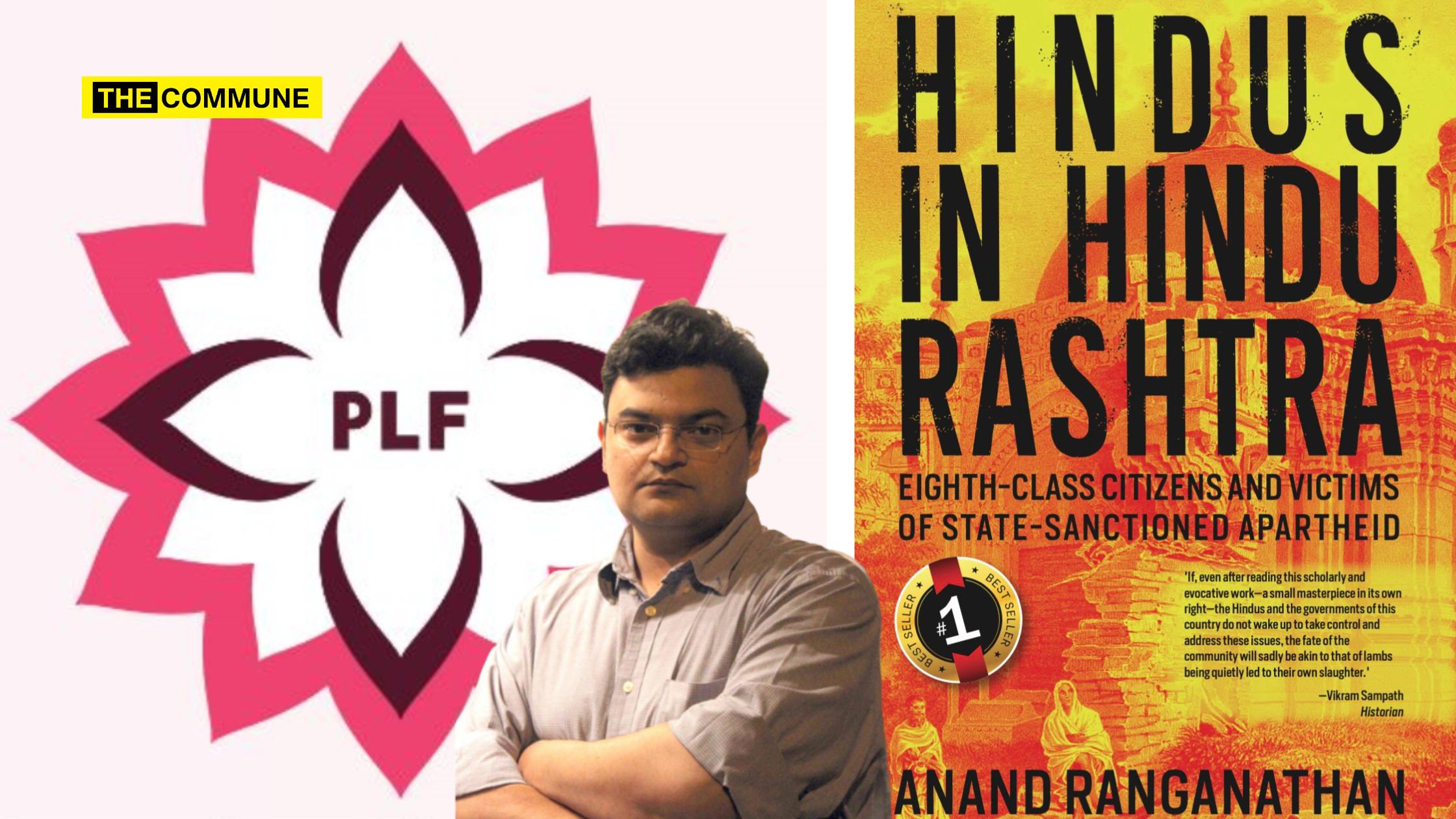
“Hindus In Hindu Rashtra” By Anand Ranganathan Set For Grand Launch At Pondy Lit Fest

pondy lit fest

A book that has become a best-seller and has gone for a second print even before a formal launch, “Hindus In Hindu Rashtra – Eighth-Class Citizens and Victims of State-Sanctioned Apartheid” by author, scientist, and political commentator Anand Ranganathan, is all set for its official launch at the upcoming Pondy Lit Fest. The literary extravaganza is scheduled to take place from 15 September 2023 to 17 September 2023 at Puducherry, with the book launch happening on the inaugural day, the 15 September 2023.

The book is an incisive analysis where the author dismantles the misleading and self-deprecating narrative that has been imposed on Hindus since Independence with utmost clarity. This commentary doesn’t tiptoe around the issues or conform to political correctness; instead, it presents an uncompromising truth – that Hindus are enduring a form of state-sanctioned apartheid.

The book, which has already made waves, was initially unveiled on 15 August 2023, with an impressive print run of 20,000 copies. Merely a week later, on 21 August 2023, Anand Ranganathan announced via Twitter that it was going into its second print run, an equally substantial 20,000 copies.

This robust response underscores the book’s significance and its resonance with readers. The book is published by BluOne Ink who is also the Platinum partner for Pondy Lit Fest.

Anand Ranganathan, known for his contributions to science as well as political commentary, made a unique commitment when he revealed his book’s release. He declared that all royalties from the sale of the book would be donated to the Hindu Refugee cause, a cause close to his heart.

As of 17 August 2023, the first tranche of royalties had been received, and Anand Ranganathan fulfilled his pledge by donating the entire sum of Rs 50,000 to Sewa Nyaya, an organization dedicated to assisting Hindu Refugees, managed by Swati Goel Sharma and Sanjeev Newar.
Sanskrit.

Continuing his commitment to this noble cause, on 27 August 2023, Anand Ranganathan donated the second installment of royalties, amounting to ₹135,000, entirely to Nimittekam. This organization is actively working to support Hindu refugees and is led by Jai Ahuja and Omendra Ratnu.

On the panel alongside Anand Ranganathan at the book launch will be historian Meenakshi Jain, Vishnu Shankar Jain, advocate in the Gyanvapi & Mathura temple case, and RSS ideologue and author Ratan Sharda.

This third edition of Pondy Lit Fest will see eminent personalities from different domains speaking on contemporary issues of importance. The lit fest is free and open for all.


Click here to subscribe to The Commune on Telegram and get the best stories of the day delivered to you personally.
DMK Members Publicly Harass Chennai Corporation Commissioner At Anna Nagar Tower Park Event

radhakrishnan

A recent art and painting exhibition held at Anna Nagar Tower Park took an unpleasant turn as Dr. J Radhakrishnan, the Commissioner of Greater Chennai Corporation and Additional Chief Secretary, found himself dealing with the menace of a few DMK men demanding money. The incident, involving members of the Dravida Munnetra Kazhagam allegedly seeking bribes from event stalls, has raised eyebrows and sparked controversy.

The event, organised as part of the Madras Day celebrations, turned chaotic when a video of Dr. Radhakrishnan being heckled by a DMK party member went viral on social media. The party member claimed that the local MLA had not received an invitation to the event. 

The DMK party member whose name is said to be Jayashankar, also asserted that event stalls had paid sums ranging from ₹2,000 to ₹3,000 to the event organisers. He argued that the frequent hosting of private events at the park inconvenienced regular visitors. In response, Commissioner Radhakrishnan, visibly angered, stated that he would reimburse the money paid by the stalls. He further directed authorities not to permit any more private events at Anna Nagar Tower Park and instead arrange them elsewhere in the city. 

Amidst continuous heckling, Chennai Corporation Commissioner Dr. J Radhakrishnan firmly stated that such events must be allowed and emphasised that the park was meant for the public at large. He acknowledged that they were not the only ones using the space and, in response to repeated complaints, assured that the issues would be resolved. He even offered to cover the expenses incurred, declaring that there would be no further events held at this location. He pointed out that there were numerous other suitable venues for hosting events. 

Faced with relentless interruptions, Radhakrishnan decided to leave the event prematurely due to the heckling by DMK party members. In a retort, Radhakrishnan addressed the party member, Jayashankar, stating, “I am aware of how much you collect and from where. I will not hesitate to reveal these details on live television.” With these words, Radhakrishnan exited the premises, effectively silencing the DMK party member.

It’s worth noting that it is common practice for the Chennai Corporation to provide its parks for social gatherings, family outings, resident welfare association activities, and private exhibitions.

In an attempt to clarify the situation, Thapasiya International Art Foundation, the event organiser, stated that they had obtained proper permission from the civic body for the event and had paid the necessary fees for stall equipment to private organisers. They emphasised that the absence of the MLA was not due to any oversight but rather a scheduling conflict. 

The event itself was organised with a noble cause in mind, as it provided a platform for individuals with impairments to showcase their talents in a photo exhibition. 

Several netizens questioned the way in which the ruling Dravida Munnetra Kazhagam operated where even a Corporation Commissioner is hounded for bribe in broad daylight.

Click here to subscribe to The Commune on Telegram and get the best stories of the day delivered to you personally.
Dalit DMK Panchayat Union President Alleges Discrimination By Partymen And Officials

It was reported that there was a fiasco in the launch of the breakfast scheme for government school children in Palladam Union in Tirupur district of Tamil Nadu.

According to Thenmozhi, the DMK Panchayat Union President, the Commissioner and District Development Officer  working in the Palladam Panchayat Union office are transferred once in 3 months because of which development works get hindered. She along with a few concillors and Ramesh who earlier worked as a Commissioner in Palladam held a consultation meeting and made arrangements for the breakfast scheme launch. However, the Commissioner was changed later. Because of the frequent changes, work on the breakfast scheme got paralyzed.

However, the scheme seems to have been later launched by DMK Minister MP Saminathan and she was kept unaware.

“Government events including Bhoomi Pooja are frequently held in Palladam. It is done under the supervision of Minister of Tamil Development and Information & Publicity MP Saminathan. He does Bhoomi Pooja in the capacity of Minister in-charge of the district. But I am neither informed nor invited through the officials or by the Minister. Is it because I’m a woman? Or is it because I belong to a Scheduled Caste? I don’t know why I’m being stifled. Why are they not informing me? I am people’s representative. I have come to deliver service to the public beyond party lines. I would like to take this to the notice of the Chief Minister as to why I am being neglected. I’m not kept informed continuously. I don’t understand why they are avoiding me. This issue must reach the high command, investigated and concluded. I’m not able to show my head outside. I’m being asked whether I am getting any information from the Minister or not? Even if the Minister is not able to inform me, atleast the officials must inform. Without giving any information, he comes to my own block and performs Bhoomi Pooja. I would like to take this issue to the CM. I request for justice in this issue through you. I don’t have any vengeance against him (Minister). If he informs me, I am ready to attend the events and make them a success.”

A vexed Thenmozhi said that she is ready to quit the post if she is not allowed to work freely.

BJP Tamil Nadu President K. Annamalai condemned the DMK for its casteist politics and discriminating their own party leaders who hail from the Scheduled Caste. He also invoked how Satyavani Muthu, a Dalit woman Minister in Karunanidhi’s government resigned from the ministry and left the DMK due to constant humiliation.

“The lament of a people’s representative from DMK exemplifies DMK’s phoney advocacy of social justice. From Smt. Sathyavani Muthu to Smt. Thenmozhi, nothing has changed in the functioning of DMK. DMK & its leader continue to thrive on creating inequality in society.”, he said.

Click here to subscribe to The Commune on Telegram and get the best stories of the day delivered to you personally.