Home Blog Page 853

Lord Rama’s Connection To The Chola Dynasty: Unraveling The Mystery Of Hanging Walls Of Lanka
This article was first published in Vijayvaani and has been republished here with permission.

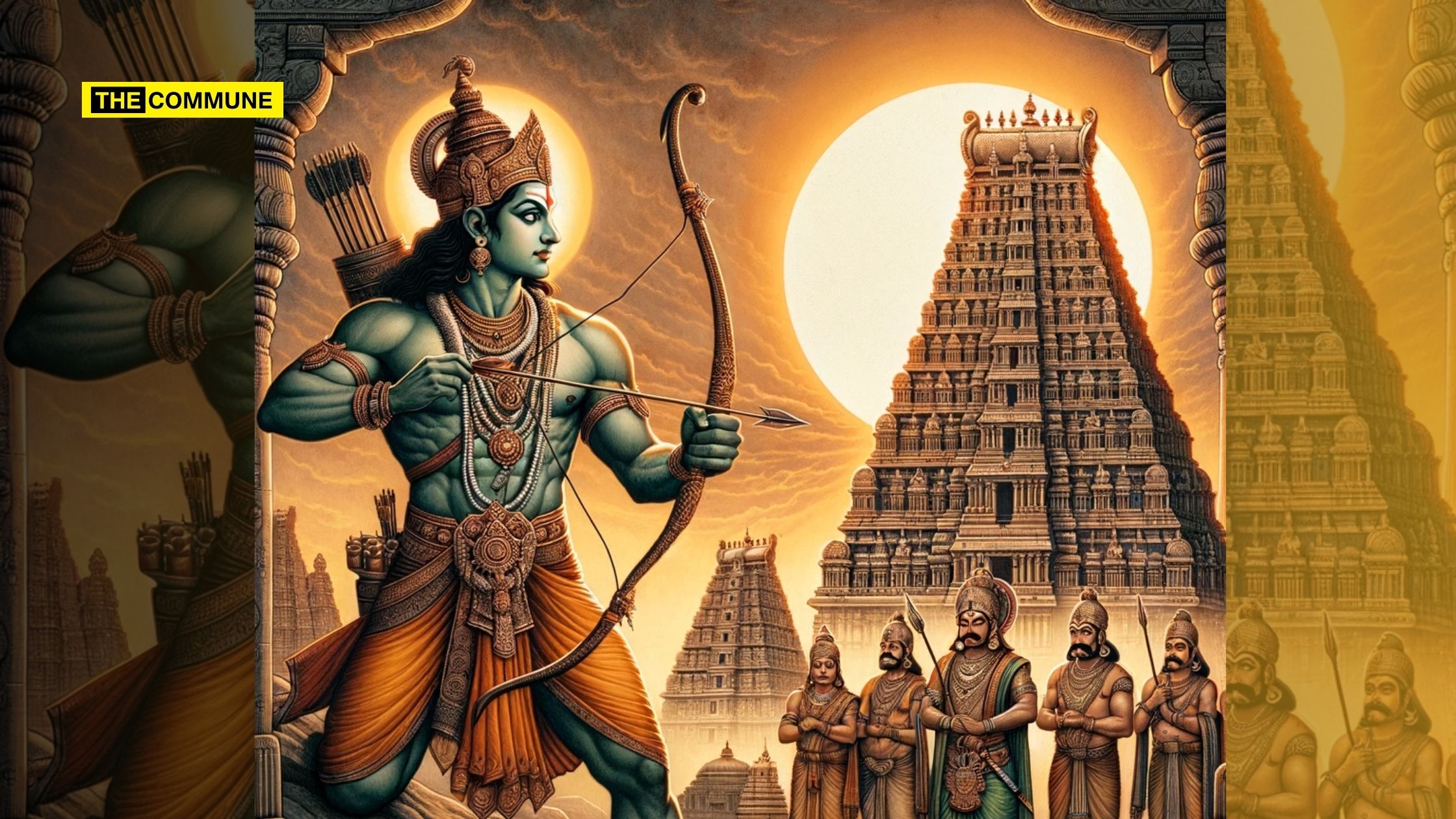
There is literary evidence that the Cholas were the descendants of Rama. There are hymns in the Tamil Sangam texts that refer to Rama as the ancestor of the Chola clan. However, in tune with the practice of not mentioning the name of the king but indicating the name by the special deed done by them, the poets have often written about just two ancient kings as ancestors of the Cholas by mentioning the feats done by them. One saved a pigeon by offering his own flesh, whose identity can be easily found out as Sibi. Another was a valiant king who destroyed the hanging walls of the enemy. Until now no one had been able to identify either the city of hanging walls or the ancestral king who destroyed it. Analysis shows that it was Rama!

Let us begin with the hanging walls. Which city had the hanging walls? How could the walls be hanging? In the stories that have been handed down to us so far, there are two cities that are said to have had walls hanging from the sky.

Hanging Cities

One was the city of Amaravati, the capital of Indra. It was said to be in the sky. The Chola genealogy says that Muchukunda who came in the Chola lineage was a friend of Indra, thereby giving the impression that Indra was not a mythical figure. Muchukunda’s name appears after Mandhata of the Ikshvaku lineage. Up to Mandhata, the Ikshvaku lineage and the Chola lineage have the same names. After Mandhata a diversion is seen with the name Muchukunda appearing as the son of Mandhata but not ascending the Ikshvaku throne. His name gets related to the Chola lineage in the Chola inscriptions.

Muchukunda once helped Indra to protect the city of Amaravati when he went to fight with the Asuras. This information given in Silappadhikaram further states that pleased with Muchukunda’s help in protecting Amaravati in his absence, Indra gifted him a deity by name “Naalangaadi Bhootha”. This deity was installed at the centre of the marketplace in Poompukar by Muchukunda. The worship of this deity continued till Silappadhikaram times (2000 years ago). Muchukunda’s name is also associated with the seven temples of Shiva known as Sapta Vidanga Sthalas in Thanjavur, giving further evidence of the existence of Muchukunda and his presence in south Tamilnadu long ago. What is of importance is that Amaravati was said to be in the sky.

Similarly, another city said to be in the sky was Lanka ruled by Ravana. Ravana told Sita that Lanka was situated on a mountain (Va- Ra: 3-47-29). On the hilltop, the city looked like a ‘hanging city’ through the clouds. Lanka was a walled city. As the clouds surround the mountain, those looking at it from below can only see the clouds on top of the mountain. The walls of the city partially concealed by the clouds gave an appearance as though the walls were hanging from the sky. Thus, the city of Lanka was praised as a city in the sky.

Ravana also said that his city was like Indra’s city of Amaravati (Va-Ra: 3-48-10) by which it is known that Amaravati must also have been a city situated on a hill. People called Devas might have lived there. It should be pointed out here that the region encompassing Thailand, Burma and Vietnam was named as Indra Dweepa. This region, in close proximity to Bharat, gives ample scope for movement and interaction between these two places.

Indra’s charioteer Matali gave his chariot to Rama and charioteered him in the war with Ravana, proving that Indra lived during Rama’s times. Matali sought an alliance for his daughter from human beings, indicating that Indra and the so-called Devas were also human beings, but could have been of a different human species. Ravana’s son was named Indrajit because he defeated Indra. All these show that there was nothing mythical about Devas and that Indra could have been a titular name of kings of Indra Dweepa. During the period of Rama, Amaravati and Lanka were hilltop cities, surpassing each other in beauty and structure.

The King Who Destroyed Hanging Walls

The account of the destruction of hanging walls is found in the 39th verse of the Purananuru. The poetess Marokatthu Nappasalaiyar congratulates Chola King Kulamurrathu Thunjiya Killi Valavan as one who was compassionate towards living beings like his ancestor who gave his body to save the dove. He is praised again as one who conquers the enemy like his ancestor who destroyed the hanging walls of the enemy’s city.

Another poet, Nallur Naththathanar, in the Sangam text called Sirupaanaarru padai, recalled the king who gave his flesh to save the dove and the king who destroyed the hanging walls.

In Tamil there is a compilation of proverbs written as poems by Munururai Araiyanar by citing an example to explain each proverb. In this compilation having 400 such poems, one of them refers to the one who destroyed hanging walls. In the context of expressing a proverb on the importance of hard work to be taken by one, the poet recalls the efforts put forth by the one for breaking the hanging walls.

In Manimegalai, in the story about the Chola king who celebrated Indra Festival, the author refers to “the king who destroyed the hanging walls”. This was written 2000 years ago.

In the Kalingatthu Bharani written in the eleventh century, the author Jayamkondar also refers to “the one who demolished the hanging walls” while recounting the greatness of the Chola lineage.

Solving The Puzzle Of Hanging Walls

The repeated reference to the hanging walls and the king who managed to break them was not given serious thought by scholars. While we are clueless about the city of hanging walls and the king who destroyed it, the first hint at solving this puzzle appears in Silappadhikaram. The context was the camp of the Chera king Senkuttuvan on the banks of the Ganga. After procuring the stone from the Himalayas to make the image of Kannagi, he was camping at the Ganga to conduct the abhisheka for the stone with the water of Ganga.

It had been thirty-two months since the king left his country (Vanji) on his northern expedition. While he was staying on the banks of the river Ganga, an ascetic by name of Maadalan from the Chera country came to the Ganga on a pilgrimage. He met the King and explained the happenings back home after the king left the country. While describing the events in the Chola country to which the queen belonged, Maadalan praised the Chola lineage by mentioning the king who destroyed the hanging walls. Herein he made a notable mention that the walls were three in number!

His specific mention of three-sided walls destroyed by an ancestral Chola king gives the first qualifying hint on the appearance of the fort wall. (Silappadhikaram: Ch- 27: lines 164-168)

This clue makes our search easier because such a city surrounded by three walls is mentioned by an Alwar in his composition. Tirumangai Alwar in his work called ‘Thiruvezhu koorrirukkai” refers to “Mummadhil ilangai” – Lanka of three walls! He goes on to say that Lanka’s three walls were destroyed by Vishnu (Rama)

So, Ravana’s Lanka which was situated on a hilltop was surrounded on three sides by walls. It looked as though it was hanging from the sky. It was destroyed by Rama. The ultimate hint comes from the religious literature of Alwars, but all along the Sangam Age poets were thrilled to mention the deed and not the name of the king. Perhaps the common man was aware of the name of the king, i.e., Rama in olden days. The information about the destruction of the hanging walls appearing until the 11th-century literary works, we can assume that it was common knowledge until then, but forgotten later. Without the verse of Alwar, we could not have established that it was Ravana’s Lanka.

The Cholas of the 10th and 11th century explicitly mentioned Rama as their ancestor. In the text called “Vikramacholan Ula” sung by Odda Koothar in praise of Vikrama Chola, the son of Kulottunga I, the poet refers to this king (Rama) who destroyed the hanging walls (line 17).

The same poet in another work called “Rajarajacholan Ula” refers to King Dasharatha as an ancestor of the Cholas. He also describes how Dasharatha got that name by having destroyed ten chariots with a single chariot he was riding. He further says that Rama was born in that lineage. Rama constructed a bridge across the sea with huge bounders to reach Lanka, and destroyed the hanging walls of Lanka (lines 19-25).

The riddle about the hanging walls is thus solved by the olden Tamil poets themselves who have made it known that Rama had done that feat. They also linked Rama with Chola-s ancestry which should put at rest the mischievous propaganda that Rama was alien to Tamil people. These details also open a new revelation in identifying the location of Lanka situated on top of a hill. Wouldn’t it be appropriate to say that Rama, who gave the Chola heritage, was the son of the Tamil land?

Jayasree Saranathan is a researcher, writer and astrologer with a Ph.D. in Astrology. Her research areas include Indology, Hindu Epics, Tamil Sangam literature and Astrometeorology. She is the author of “Mahabharata 3136 BCE: Validation of the Traditional Date”.
Who Is Honestly Working For The Success Of I.N.D.I. Alliance?

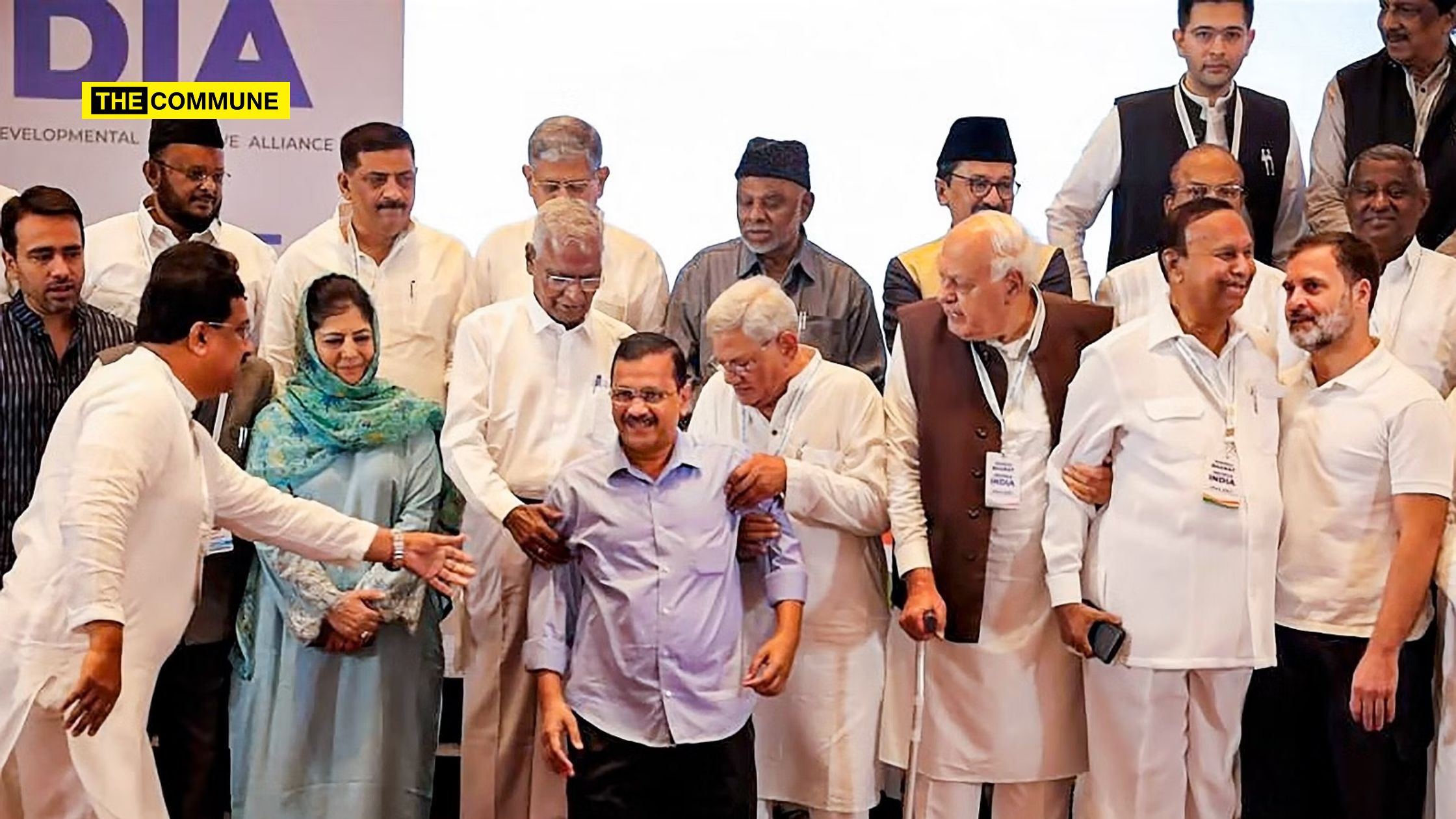
2024 will not be a very happy year for the I.N.D.I Alliance, especially if you take it as one single united Opposition which was what the constituent parties envisioned it to be. In this piece, I will try to dig into which party in this alliance is actually working for its success wholeheartedly.

With only around three months to go for the Lok Sabha elections, the dot dot alliance seems to be still waiting for the green signal in a railway platform with several of its bogies not fully ready for the journey while the Vande Bharat of BJP is speeding ahead comfortably nearing its destination. The Congress holds a “Hain Tayyar Hum” (We’re ready) rally but they don’t look as tayyar as they should be with the dotted alliance still debating on seat sharing.

The TMC feels that they are the only party that can give a fight to BJP on West Bengal. There is a fight going on between Congress and BJP in that state. On one hand Congress publicly says that TMC is working like BJP and on the other side one TMC leader says Congress is behaving like a Dalal (broker) of BJP. The TMC hurriedly put forward Mallikarjun Kharge’s name for PM candidature which seemed to surprise Congress who was trying to position Rahul Gandhi against Narendra Modi. The grand old party chose to keep mum. Mamata Banerjee probably didn’t want Nitish Kumar to lead as she herself wanted to lead this alliance. Arvind Kejriwal is silently having side conversations with didi. Therefore, it is very clear that the TMC is not helping the dot dot alliance much for its success.

In Maharashtra, there is a fight going on between two Sanjays, one in Congress and one in Udhav Shiv Sena. Both are claiming to be the best party to defeat BJP in Maharashtra. On the other hand, the Senior Pawar has kept his legs on both the boats. He stands with the dot dot alliance while his disciples stand with BJP. That is a smart move. Eventually, he will go with the winner. If BJP wins, I will not be surprised if all NCP factions again merge and become one happy family. By creating all this confusion NCP, Udhav Shiv Sena and Congress are tried hard to help BJP sweep the state in 2024 and therefore are not honestly working to see their alliance succeed.

Down south, DMK is issuing controversial statements after statements which are impacting the prospects of success of the alliance, especially the Congress, in other parts of India. They don’t seem to care even after the recent Hindi Heartland state results and are continuing to play the politics that will benefit them in Tamil Nadu. The jibes at Hindi speaking people are proving to be a big embarrassment to the dot dot alliance with Nitish Kumar having to react to them angrily during an alliance meet. Even RJD party had to issue a statement. DMK themselves are in troubled waters with two of their Ministers caught in the corruption net ending up losing their seats. The recent public ire on their shabby handling of the flood situation has forced them to just focus on saving their fort instead of the alliance interests.

In Bihar, Nitish Kumar just avoided a coup and stopped his party from breaking and Tejaswi becoming the CM. It looks like he has started feeling that his priority now is to save his position in his state before caring for the alliance in which he is anyways not getting any importance and didn’t even get the Convenor role that he aspired for leave alone the PM candidature.

In Punjab, AAP is not going to let Congress in although they might be a little considerate with sharing some Delhi seats as they are anyways losing popularity there. It is a fact that their immediate goal is to capture the Congress space in the states in order to expand as they cannot clearly beat the BJP. Given these circumstances, how can one expect them to sacrifice for the dot dot alliance’s success?

The Left parties, although being irrelevant, would also not do lot of sacrifices in Kerala as that is the only state where they have presence and they have to save their identity which they have lost totally in West Bengal too.

Finally, the Loksabha elections will be a big test for Congress to prove that they are still relevant as a national party. They don’t have any other go but to fight with their friendly parties for more seats in their states which they will not give. They will also not be able to sacrifice a lot as that will be counterproductive for them which makes them an unwanted elephant in the room for the regional parties who want to go pan-India however ludicrous that might be but having a dream is not a bad thing. Therefore, Congress cannot also wholeheartedly do what is in the best interest of the alliance.

Based on all of the above issues, I conclude that the only parties that are honestly working for the success of the I.N.D.I Alliance are the other parties lead by Vaiko, Thirumavalavan who don’t have too much influence unfortunately. Goes without saying that it is going to be a very happy new year for BJP and NDA. Some DMK spokesperson in some national TV debate in their usual abusive boring style said that even if Bhagawan Ram contests in Tamil Nadu people will not vote for him. I am not sure about that as after seeing their work during the floods, their popularity amongst the public is diminishing.

The I.N.D.I. Allies have yet another big political decision to make, more important than seat sharing – whether they should attend the consecration of Ram Janmabhoomi Temple in Ayodhya on 22 January 2024 or not. Any decision that they take is bound to corner them one way or the other. Although Lord Ram might not be contesting elections himself, he will be elemental in this Lok Sabha election. Let us see on whom Bhagawan Shri Ram showers his blessings!

Ananth Mahadevan is a political commentator based in Bengaluru.

Subscribe to our channels on TelegramWhatsApp, and Instagram and get the best stories of the day delivered to you personally.

PM Narendra Modi To Unveil Mega Development Projects In Tamil Nadu And Lakshadweep

Modi

In a significant stride towards fostering development and connectivity in South India, Prime Minister Narendra Modi is scheduled to embark on a visit to Tamil Nadu and Lakshadweep on 2 & 3 January 2024. The Prime Minister’s itinerary includes the inauguration, dedication to the nation, and laying the foundation stone for various projects with a cumulative value exceeding ₹19,850 crore in Tamil Nadu.

Tamil Nadu Highlights

On 2 January 2024, the Prime Minister will grace the 38th Convocation Ceremony of Bharathidasan University in Tiruchirappalli, where he is expected to confer awards upon outstanding students and deliver an address. Following this, a public program in Tiruchirappalli will witness the inauguration of the new Terminal Building at Tiruchirappalli International Airport, designed at a cost exceeding ₹1100 crore. This state-of-the-art facility is capable of serving over 44 lakh passengers annually.

Additionally, Prime Minister Modi will dedicate several railway projects, including the doubling of the Salem–Magnesite Junction–Omalur–Mettur Dam section, the electrification of various rail lines, and crucial road sector projects aimed at enhancing connectivity in the region.

Furthermore, he will lay the foundation stone for vital road development projects, such as the construction of a 31 km four-lane road from Mugaiyur to Marakkanam (NH 332A) that will connect ports on the East Coast of Tamil Nadu, enhancing connectivity to the world heritage site – Mamallapuram.

PM Modi will also dedicate the General Cargo Berth-II at Kamarajar Port, marking a significant step toward fortifying the nation’s trade and boosting economic growth and employment.

In the energy sector, Prime Minister Modi will dedicate two major projects: the 488 km long natural gas pipeline by Indian Oil Corporation Ltd (IOCL) and the 697 km long Vijayawada-Dharmapuri Multiproduct (POL) Petroleum Pipeline by Hindustan Petroleum Corporation Limited (HPCL).


The pinnacle of the Tamil Nadu visit will be the dedication of the Demonstration Fast Reactor Fuel Reprocessing Plant (DFRP) at Indira Gandhi Centre for Atomic Research (IGCAR), Kalpakkam. This unique facility, developed at a cost of ₹400 crore, signifies a significant step toward establishing large-scale commercial fast reactor fuel reprocessing plants.

Lakshadweep Highlights:

Upon reaching Lakshadweep on 2 January 2024, Prime Minister Modi will unveil development projects exceeding ₹1150 crore. A transformative move includes the inauguration of the Kochi-Lakshadweep Islands Submarine Optical Fiber Connection (KLI – SOFC) project, significantly improving internet speed in the region.

For the first time since independence, Lakshadweep will be connected through Submarine Optic Fibre Cable, facilitating faster and more reliable internet services, telemedicine, e-governance, educational initiatives, digital banking, digital currency usage, and digital literacy.

The Prime Minister will also dedicate the Low Temperature Thermal Desalination (LTTD) plant at Kadmat, producing 1.5 lakh litres of clean drinking water daily. Additionally, Functional Household Tap Connections (FHTC) in all households of Agatti and Minicoy islands will be dedicated, addressing the longstanding challenge of potable water scarcity in the coral islands.

Other projects include the solar power plant at Kavaratti, the new administrative block and 80 Men barrack in India Reserve Battalion (IRBn) Complex at Kavaratti, and the foundation stone laying for the renovation of the Primary Health Care facility in Kalpeni and the construction of five model Anganwadi Centres (Nand Ghars) in various islands.

The Prime Minister’s visit is poised to usher in a new era of development, connectivity, and progress in Tamil Nadu and Lakshadweep, setting the stage for a brighter future in the region.

(with inputs from PIB)

Subscribe to our channels on TelegramWhatsApp, and Instagram and get the best stories of the day delivered to you personally.

‘Raja Virundhu’ For The Unsung Rajas & Ranis: BJP’s SG Suryah Organizes Extravagant Dinner To Honour Hygiene Workers

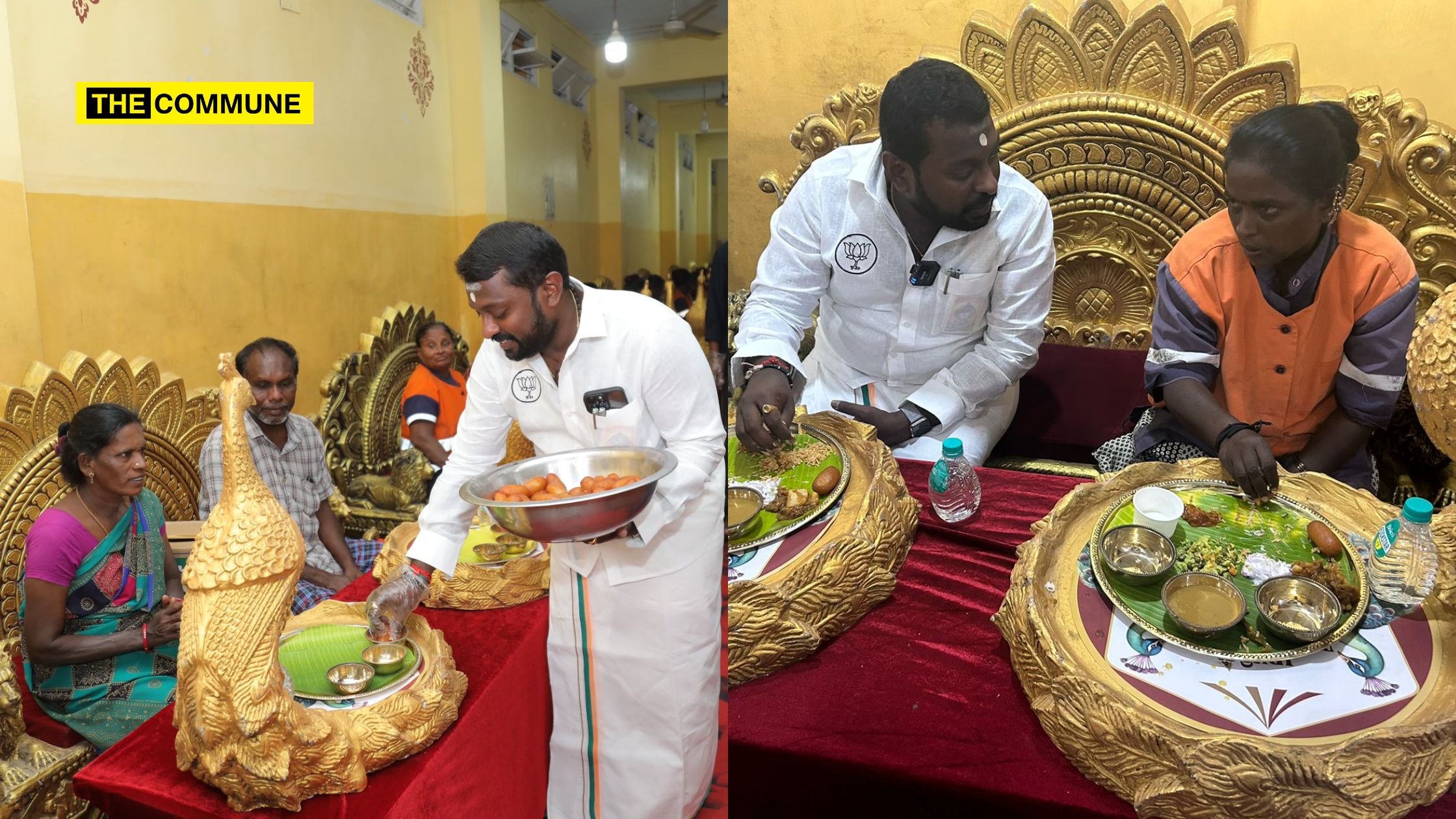
In a heartwarming gesture, Dr. SG Suryah, the BJP Tamil Nadu State Secretary, hosted an extravagant dinner for hygiene workers of Velachery and surrounding regions, as a mark of respect for their relentless service particularly commending their remarkable contributions in the aftermath of Cyclone Michaung.

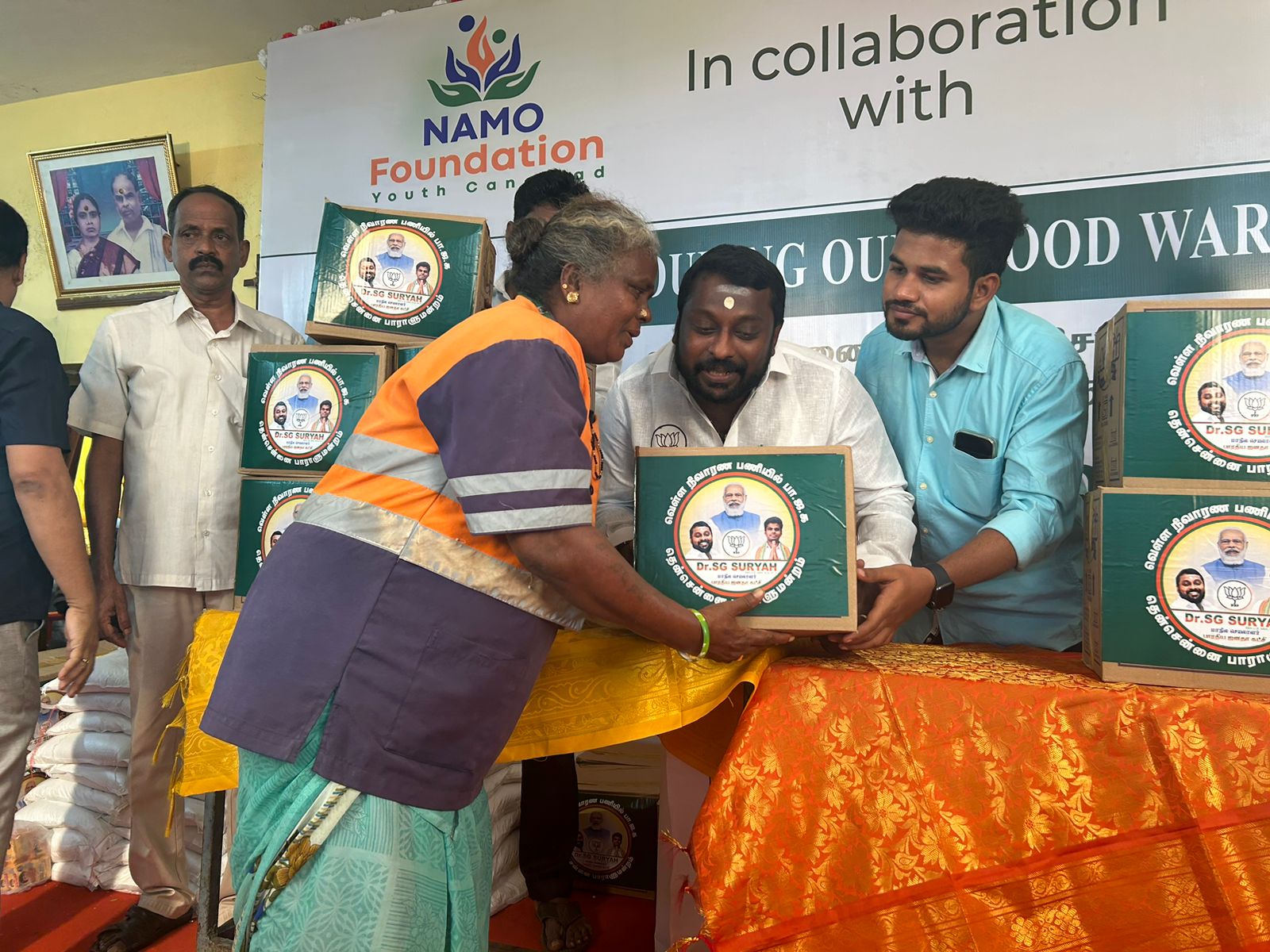
This noble initiative was organized by the NaMo Foundation, under the leadership of SG Suryah, in collaboration with the non-profit organization “Aram Seya Virumbu” on 30 December 2023 at the Kabali marriage hall in Velachery, Chennai.

Apart from a grand dinner, over 150 of the hygiene workers who had come were felicitated and given food kits comprising of essentials like rice, pulses, oil, sugar, etc.

The highlight of the evening was the way in which the delectable feast organized and the royal treatment extended to the hygiene workers. Over 70 throne-like seats were elegantly arranged, with the hygiene workers seated like kings and queens. Food was served in a nice embollished plate resting on a holder shaped like a peacock, adding an extra touch of grandeur to the occasion.

The dinner comprised of an array of dishes – Dry Gulab Jamun, Paruppu Payasam, Chappathi, Cauliflower 65, Paneer Butter Masala, Vegetable Biryani, Onion-Curd Raita, and a variety of traditional South Indian delicacies like Sambar, Rasam, Vathakozhambu, Bean-Carrot Poriyal, Potato-Peas Sabji, pickle and Appalam with buttermilk to wash it all down and a delightful serving of ice cream for dessert.

The hygiene workers were overwhelmed with gratitude for this extraordinary gesture. Ranganayaki, a hygiene worker residing in Kannagi Nagar, expressed her emotions, saying, “Either we are looked at with sympathy or we’re just ignored. For the first time, we’ve had someone treat us so royally with so much dignity and respect.

Speaking to The Commune, Dr. Suryah emphasized the invaluable contribution of hygiene workers, who often go unrecognized. He highlighted their pivotal role in restoring normalcy to Chennai in the aftermath of Cyclone Michaung.

“Providing relief materials through cash and kind is one thing. Many of them struggle to make ends meet, yet they were out on the streets serving us so that we could get on with our lives. That sacrifice cannot be compensated by providing cash or relief materials. The least one can do is be thankful to them, and what better way than to treat them like emperors with sumptuous food.”, Suryah said.

The spirit of the occasion can be encapsulated in a Tamil saying: “Vayirara Saptu, Manadhaara Vazhthinar,” which translates to “They ate to their full bellies and blessed heartily”. This sentiment was unmistakably visible in the eyes of the hygiene workers as they relished the food.

Subscribe to our channels on TelegramWhatsApp, and Instagram and get the best stories of the day delivered to you personally.

Why 22 January 2024 Is A Historic Moment For Hindus

Many might not understand the “might” of the date 22.01.2024 but the pranpratishtha (of Maryada Purushottam Shri Ram is one of the most important geopolitical event.

To understand its significance fully, we must delve into the pages of history and explore the age-old clash between monotheistic and polytheistic worldviews.

The Clash Of Clans

Throughout history, we have witnessed a continuous clash between monotheistic and polytheistic worldviews.

This clash traces its origins back to the Rig Vedic era, over 5,500 years ago, when the Battle of Ten Kings erupted over the philosophical interpretation of Ishwar (God/Supreme).

It wasn’t merely a territorial war. Those defeated included a tribe which would migrate to Persia, where Zarathustra established first faith system tending to monotheism.

Mind you, the Zoroastrians too initially had concept of dividing timeline into four parts (as our Yugas). There is a specific reason that why the Zend Avesta is bit too identical to Rig Veda and even Zoroastrians saw Sapta Sindhu (Hapta Hendu) as their homeland. That schism ended up being one of the biggest change maker of world order. A few tribes that migrated out of India, would later become Egyptians, Greeks etc.

The Shift Towards Monotheism

Along with migration of people the idea of faith and philosophy too had made route into the lands where people migrated. Building on the ideas of Zoroastrians, people of Canaan, began to observe Yahwehism which would mature to become Judaism (Jewish Faith).

As the Hellenic world and nearby vicinity came in contact with Buddhism & when those ideas (along with memory of Vaidik fold) came in contact with the Judaic principles, Christianity came into being.

The movement towards monotheistic worldview always came with condition to see problem in polytheism and hence rejection of later. By virtue of inherent philosophy, while polytheism won’t ever have problem with monotheistic views, latter would always pose threat for former.

Rightfully so, the Christian world brought upon massive crackdown of polytheistic pagans. The forceful conversion of places and people to Christian character became the virtue. In contrast jewish world largely lived in peace with the pagans and other faiths even through many Judaic texts called upon annihilation of idolatrous people.

Perhaps, it was for the reason that Judaism was more like a transit station where pagans didn’t appear like enemies for practical purposes. However we can’t deny a few skirmishes.

The Christian World And Its Impact

Coming back to the Christian world, they had been restlessly dangerous for Jews, pagans and Zoroastrians. In the Christian world, religious dominance and political authority became intertwined. The idea of messiah and prophets with a book had become the idea of religion and polity. The religious dominance and political dominance had become equivalent and hence persecution of different faiths was vogue. They built churches breaking temples and many temples were converted as one.

Not only pagans, but the Jewish Temples were destroyed in mass. The template of persecution and forceful conversion graduated to epitome as youngest Abrahmic faith came in being. According to the traditional Muslim accounts almost all important Muslim places (Ka’aba, Al-Aqsa, Dome-of Rock etc) got erected over existing Jewish Temples or place of Pagan Idols. Al-Aqsa is indeed built on Temple Mount where Jewish Temples existed. Hagia Sofia has been converted into a Mosque.

There are numerous examples where Mohammedans converted other religious places into Mosque.

The Resurgence Of Bharat

In India we have thousands (approximately 2k as per SR Goel’s documentation). The reverting to original religious character speaks of a big slap to most bullish, terrorising worldview on earth.

Not many reverts have been possible and Ram Janmabhoomi is ought to be a great precedent for the way forward. Terrorism and bullish trait must die.

Aabhas Maldahiyar is an author and a columnist for The Print, Firstpost, Swarajya and Organiser.

“Our Support Is For BJP And PM Modi”: OPS Signals Continued Partnership With BJP For 2024 Lok Sabha Elections

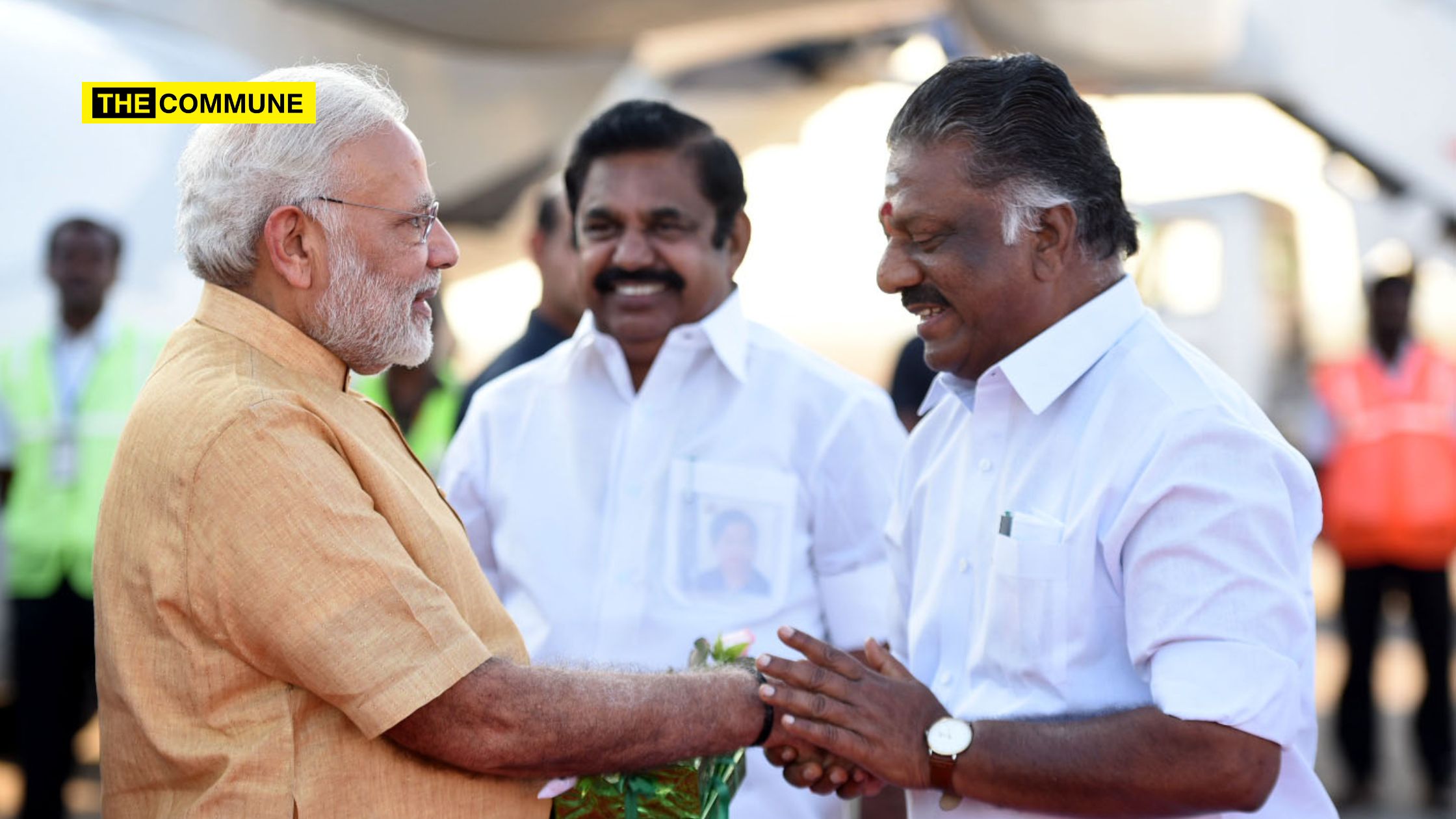
Former Chief Minister and ousted coordinator of the AIADMK, O. Panneerselvam, revealed on  28 December 2023 that talks regarding an alliance with the BJP are currently underway for the upcoming Parliamentary elections.

Addressing a gathering at a workers’ rights consultation meeting in Salem, Panneerselvam affirmed that the party faction led by him has been collaborating with T.T.V. Dhinakaran, the general secretary of Amma Makkal Munnetra Kazhagam (AMMK) for the upcoming Lok Sabha elections. When questioned about the possibility of working with V.K. Sasikala, the close aide of the late Chief Minister J. Jayalalithaa, Panneerselvam stated, “It is her wish to work along with us, and we are also expecting and waiting for her.”

Touching upon the issue of AIADMK property, particularly the assets earmarked for followers of the iconic M.G. Ramachandran (MGR), Panneerselvam clarified that there has been no official announcement regarding the sale of AIADMK properties.

Responding to legal matters, Panneerselvam addressed the case filed during the tenure of the late M. Karunanidhi and expressed his intent to present his arguments in court. He also took a swipe at Edappadi K. Palaniswami, asserting that the former Chief Minister contested in nine electoral fields without garnering public support, resulting in the party’s decline.

Panneerselvam declared his intention to seek the opinion of the people in his constituency on alliance formation through a ballot paper. Referring to a previous instance in the Nagapattinam assembly constituency, he disclosed that 81 votes favored him, while 59 votes went to Edapadi Palaniswami.

Looking ahead to the 2024 Parliamentary elections, Panneerselvam reiterated the AIADMK’s alliance with the BJP since the 2019 elections. He expressed support for Prime Minister Narendra Modi, he said, “Following the previous Parliamentary elections in 2019, we’ve maintained a partnership with the BJP. Over the past decade, Prime Minister Narendra Modi has consistently delivered commendable governance, earning praise from numerous nations and world leaders. As we approach the upcoming Parliamentary elections, our support is for Prime Minister Modi and talks are going on with the BJP.”

(With inputs from The Hindu)

Subscribe to our channels on TelegramWhatsApp, and Instagram and get the best stories of the day delivered to you personally.

DMK Councillors Move No-Confidence Motion Against Tirunelveli DMK Mayor

In a significant development, 38 DMK councillors from the Tirunelveli corporation have formally petitioned Commissioner Shubham Dnyandeorao Thakare, urging him to present a no-confidence motion against their party mayor, PM Saravanan. The councillors have been actively protesting against Mayor Saravanan for several months, citing grievances and corruption allegations. Before this, they had submitted requests for the mayor’s removal to Chief Minister MK Stalin, along with ministers KN Nehru, Durai Murugan, and Thangam Thennarasu.

Public posters accusing Saravanan of corruption were displayed across the city by the dissenting DMK councillors, who also shared audio and video clips on social media. Allegations arose that the councillors boycotted a council meeting, claiming that Mayor Saravanan failed to distribute the purported “kickbacks” received from contractors among them.

Approximately 20 councillors engaged in a sit-in protest during a recent grievance meeting, emphasizing that the mayor neglected issues within their respective wards. In response to these actions, the DMK headquarters expelled three councillors and a woman councillor’s husband from the party.

AIADMK district secretary Thachai Ganesaraja, addressing the media in a press conference, revealed that four AIADMK councillors would support the DMK councillors’ no-confidence motion if it is presented. Ganesaraja asserted that the commissioner must introduce the motion within a month, highlighting that the core issue revolves around the alleged distribution of kickbacks from contractors. The corporation council comprises a total of 55 councillors, with 51 affiliated with the DMK and its allies.

Following a meeting on 27 December 2023 to discuss and vote on a resolution of no confidence that has been put forth by the members of the Council against the President of the Council, it was decided that on 12 January 2024, a no-confidence motion will be moved against Tirunelveli Corporation’s DMK Mayor, P M Saravanan.

(with inputs from The New Indian Express)

Subscribe to our channels on TelegramWhatsApp, and Instagram and get the best stories of the day delivered to you personally.

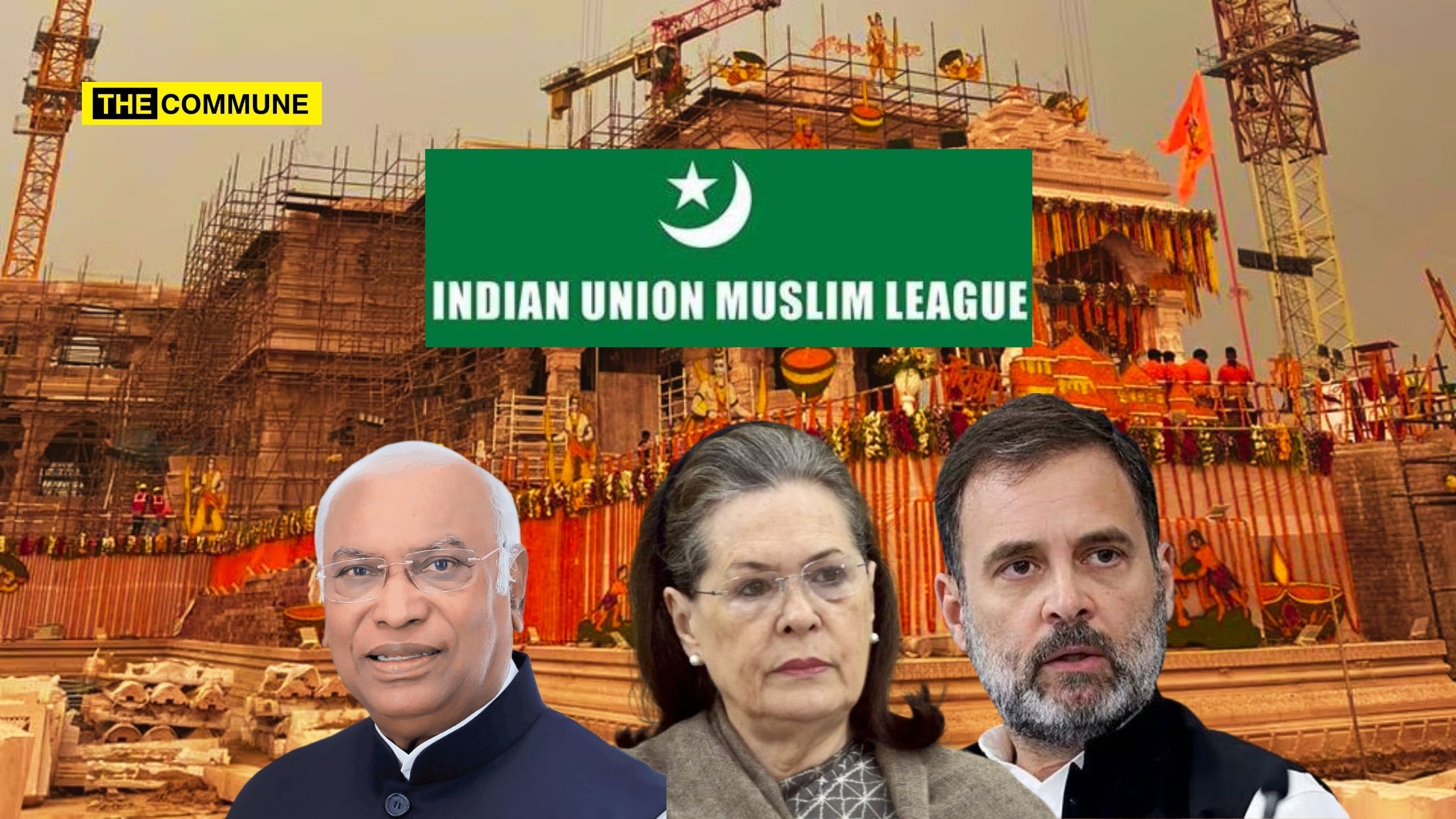
Congress Opting Out Of Participation In Ram Mandir Inauguration Due To IUML?

In the lead-up to the 2024 Lok Sabha elections, a fierce competition has unfolded in Kerala as both the Congress and the Communist Party of India (Marxist) strive to win the support of the influential Indian Union Muslim League (IUML). Originating from Jinnah’s Muslim League, IUML’s sway over key seats in Kerala has prompted both parties to vie for its endorsement. In a strategic twist, IUML is leveraging its position to compel Congress and CPI(M) to adopt more assertive Islamist stances in exchange for electoral backing.

As the scheduled Ram Mandir consecration ceremony on 22 January 2024 looms, IUML has issued a stern warning to Congress, insisting on complete alignment with its position for their support. The Muslim outfit Samastha, closely affiliated with IUML, has criticised Congress for what it deems a ‘non-committal’ stance on attending the Pran Pratishtha ceremony in Ayodhya. In an editorial in its mouthpiece Suprabhaatham, Samastha asserted that Congress’s purportedly soft Hindutva approach has led the party into its present situation. The editorial urged Congress to reevaluate its stance, threatening that failure to do so might pave the way for a BJP victory in the 2024 Lok Sabha elections. Essentially, the message conveyed was that Congress must explicitly declare its non-attendance, akin to CPI(M), to avoid alienating its Muslim vote bank in Kerala.

Notably, Samastha, the backbone of IUML, is a formidable Muslim body in Kerala with influential clerics and Imams among its ranks. While Samastha has issued a stern warning to Congress, IUML’s state general secretary, P M A Salam, criticised BJP’s communal strategy, emphasising the party’s stand against falling into the trap of communal sentiments.

The editorial in Samastha’s mouthpiece not only commended CPI(M) for refusing to attend the Ram Mandir consecration but also criticised Congress for allegedly adopting a soft Hindutva approach, contrasting it unfavorably with BJP’s hard Hindutva stance. It highlighted instances, such as Kamal Nath’s gestures in Madhya Pradesh, as futile attempts that did not aid Congress in retaining power.

Despite Congress’s vocal opposition to the Ayodhya ceremony, IUML and Muslim bodies from Kerala seem insistent on a more assertive stance. Even Sam Pitroda’s comments on democracy being undermined by the emphasis on the Ram Mandir did little to assuage IUML’s concerns. The underlying message from IUML and its ally, Samastha, is clear – Congress must overtly cater to Muslim sentiments and adopt a hardline approach if it harbors aspirations of regaining power, especially with Hindu votes consolidating towards BJP.

Interestingly, this battle for IUML’s attention had surfaced earlier in November, with E. P. Jayarajan of CPI(M) criticising Congress’s position on the Israel-Palestine conflict, revealing dissent within the IUML. The complex interplay of religious sentiments, electoral strategies, and ideological posturing continues to shape the political landscape in Kerala as the 2024 elections draw near.

Amid reports of Congress Parliamentary Party chairperson Sonia Gandhi’s potential attendance at the Ram Temple consecration in Ayodhya on January 22, the Congress stated that a decision would be made and communicated at the appropriate time.

Congress President Mallikarjun Kharge and Lok Sabha leader Adhir Ranjan Chowdhury have also received invitations to the event. Party communication chief Jairam Ramesh clarified that senior leader Sam Pitroda’s comments did not represent the official stance of the Congress. The invitation issue has been discussed within the party, with a meeting of top leaders to decide the party’s position.

The invitation may not be transferable, adding complexity to the situation. The Congress has differing opinions within its ranks and among its allies on this issue, making it a sensitive matter. While the Indian Union Muslim League (IUML) opposes it, they have now ‘left the decision to the Congress’. The Indian National Developmental, Inclusive Alliance is divided on the matter, with various leaders taking different stances. Despite past statements favoring the construction of the Ram Temple, the situation remains contentious within the party.

Congress & IUML

Rahul Gandhi’s recent assertion labelling the Indian Union Muslim League (IUML) as “completely secular” during his recent US trip questioned the nature of the alliance between Congress and IUML in Kerala. Gandhi’s claim contradicts historical ties between IUML and the All India Muslim League (AIML), founded by Muhammad Ali Jinnah, advocating for the creation of Pakistan in 1947.

The complex web of alliances unfolds further with IUML’s unconditional support for Congress in the upcoming Telangana assembly elections. IUML’s national general secretary, PK Kunhalikutty, expressed a commitment to collaboratively form a new government against the governing “fascists.”

During the 2019 Kerala general elections, Congress and IUML joined forces, evident in the proliferation of Muslim League flags during Rahul Gandhi’s Wayanad roadshow. Reports suggest Congress instructed IUML not to display flags, fearing repercussions in North India elections, indicating a delicate balance in their alliance.

The historical backdrop reveals IUML’s roots in the AIML, a party pivotal in the partition of British India. M. Muhammad Ismail, IUML’s first President, played a role in the country’s partition, championing IUML as a secular group despite supporting Sharia law for Indian Muslims post-independence.

(With inputs from OpIndia)

Subscribe to our channels on TelegramWhatsApp, and Instagram and get the best stories of the day delivered to you personally.

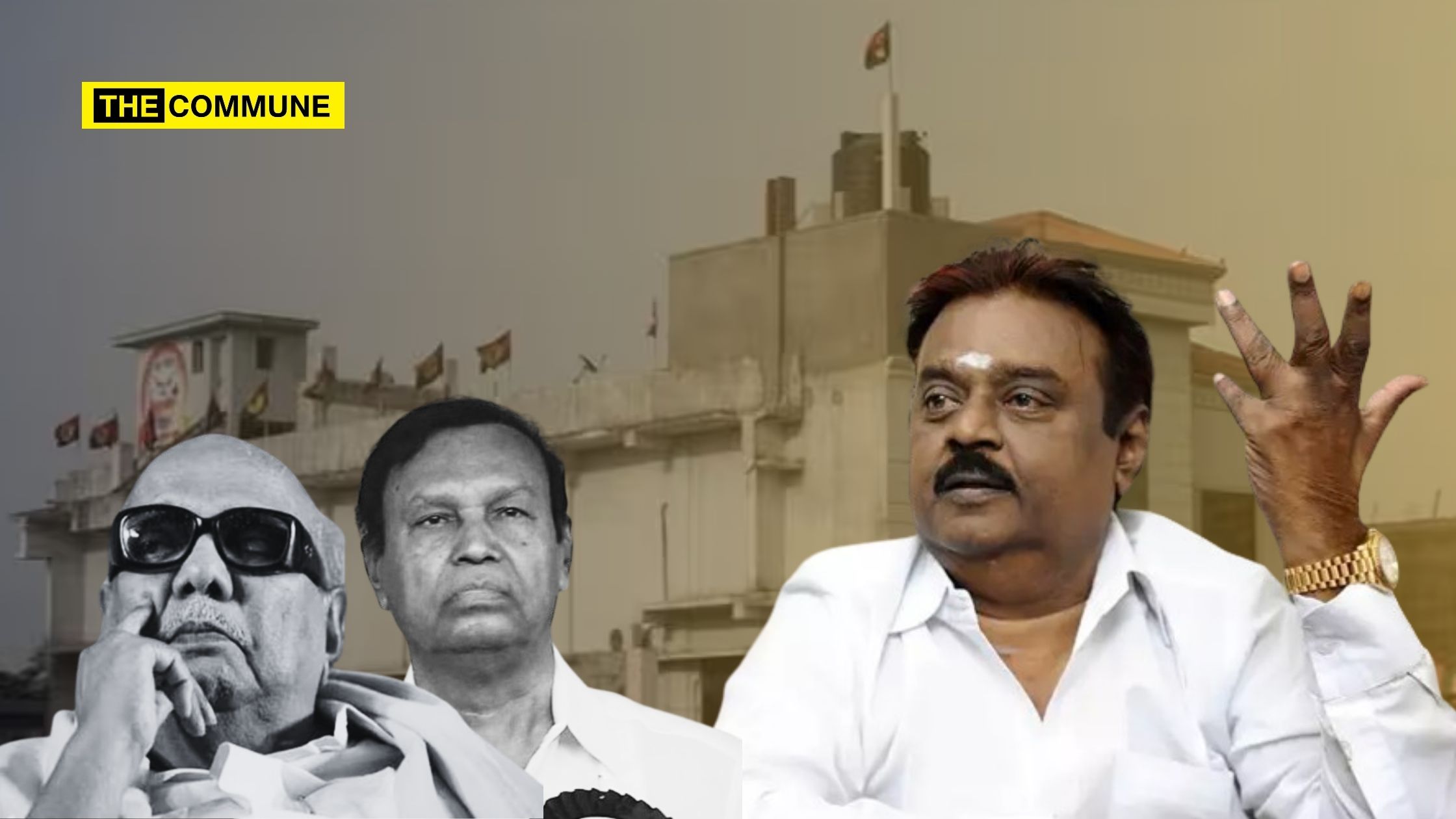
How DMK Destroyed Vijayakanth’s Cherished Marriage Hall Over Political Vendatta

Throwback to 2006-2007. TR Baalu, the present DMK MP from Sriperumbudur, who served as the Minister for Road Transport, Highways, and Shipping in the Congress-led UPA government, faced criticism for the controversial demolition of Andal Azhagar Kalyana Mandapam. This wedding hall, owned by actor turned politician Vijayakanth’s wife, Premalatha, which also served as his party office, was razed by the National Highways Authority of India (NHAI) which came under Baalu’s jurisdiction back then.

Situated on Jawaharlal Nehru Road in Chennai, the auditorium became a casualty of a flyover construction project aimed at alleviating congestion at the Jawaharlal Nehru Road-Bangalore Highway junction.

Vijayakanth accused the DMK government of orchestrating the swift demolition due to their inability to tolerate his party’s growth. While acknowledging the necessity for the structure’s removal for road expansion, he claimed the move was politically motivated.

Vijayakanth had in fact expressed his willingness to surrender the building for road expansion, requesting only an extension until 31 August that year to honour existing marriage bookings.

Despite proposing alternative plans and engaging with DMK president M Karunanidhi, the state government, proceeded with the demolition after months of delay in responding to Vijayakanth’s alternatives. The incident underscored the political ruthlessness of the DMK government under Karunanidhi.

The wedding hall, spanning 1 acre and 56 cents, was torn down by the then DMK government led by Karunanidhi, reducing it to approximately 3 grounds. 

Vijayakanth, reflecting on the demolition, expressed deep emotional distress, stating, “When I saw that, it felt as if my intestines were hanging out. I was so upset. I saved each penny and worked hard to earn each penny to build that wedding hall. It came solely from my hard work; I did not indulge in corrupt practices to acquire it.”

Vijayakanth had questionedWhat is the urgency to demolish the marriage hall. What happened to 233 other structures for which notice were given for demolition

Notably, Vijayakanth, who left an indelible mark on Tamil Nadu’s political landscape, will be buried at the very location that once housed his cherished wedding hall. The controversial demolition incident has resurfaced as the state mourns the passing of the enigmatic leader that was Vijayakanth. 

Subscribe to our channels on TelegramWhatsApp, and Instagram and get the best stories of the day delivered to you personally.

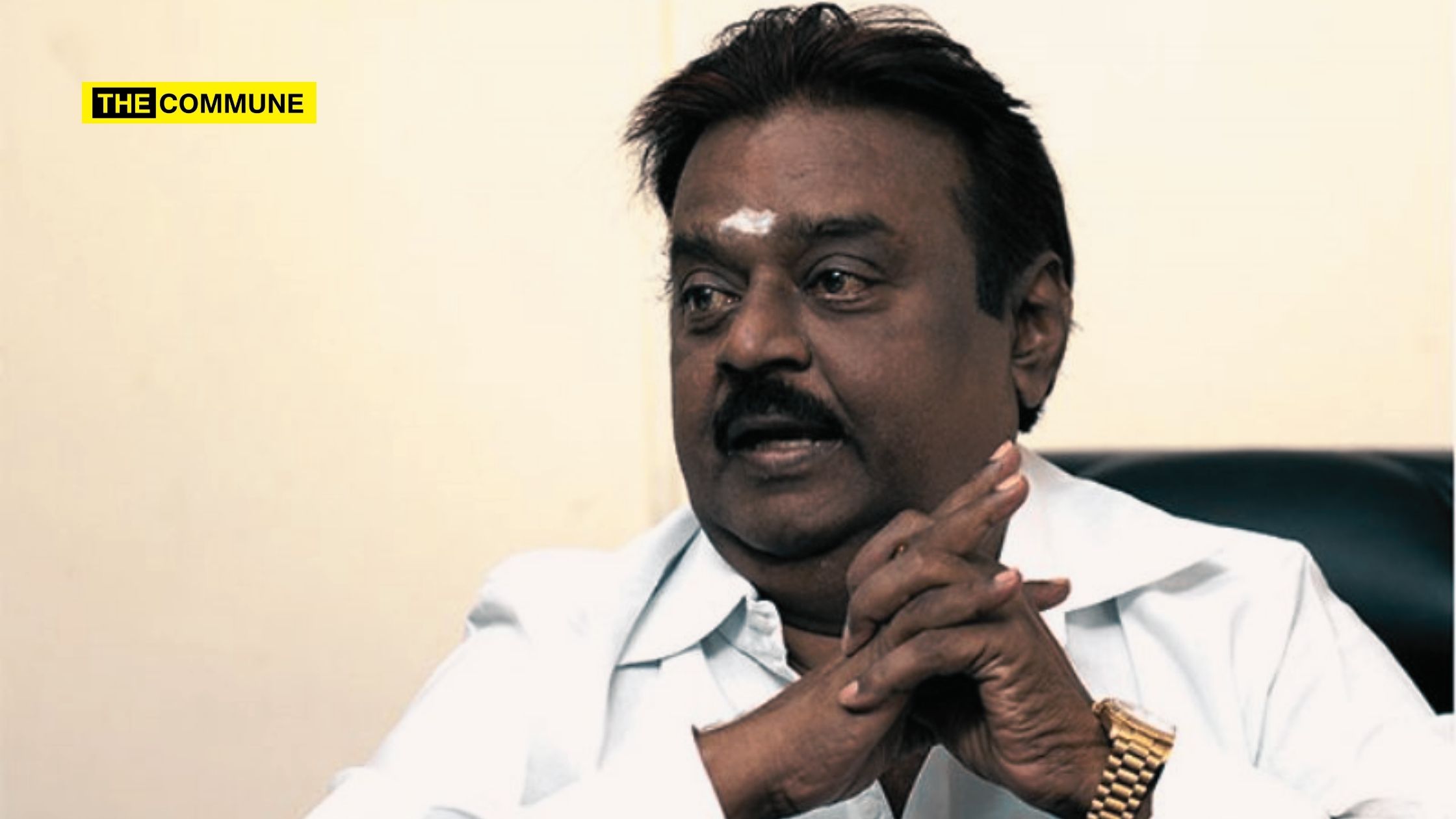
From Having No ‘Minority Wing’ In DMDK To Condemning Vairamuthu For Slandering Aandal, Here Are 10 Lesser Known Facts About Vijayakanth

In the world of Tamil cinema and politics, Vijayakanth, fondly known as Captain and Karuppu MGR, transcended the boundaries of stardom and leadership. His legacy is not merely a cinematic saga or a political journey; it is a testament to a man who seamlessly blended philanthropy, leadership, and the essence of being a true Tamizhan.

Beyond the glare of the spotlight, Vijayakanth earned the moniker Karuppu MGR not just for his on-screen charisma and his skin colour but for his philanthropic endeavours akin to MGR himself. His open-handed generosity, be it helping people financially or just feeding them any time anyone came home – be they bigshots or anyone else, they had to eat at home and only then leave or do the next job at hand. 

Everybody knows that the man was as generous as Karna. But here are a few things about the man that only a few people know.

Revitalised Nadigar Sangam

In the annals of Tamil cinema, Vijayakanth’s feat of starring in 18 films in a single year stands as a testament to his unparalleled dedication. He took on the mantle of developing the Nadigar Sangam (South Indian Artist Association), serving as its president for an extensive period. Under his leadership, the association witnessed a transformative era, marked by numerous public events strategically aimed at fundraising. This financial support proved instrumental in aiding fellow cinema stars facing a dearth of opportunities, setting a compelling example of responsible leadership. His adept leadership not only revitalised the organisation but also rescued it from substantial debts. His innovative approach, notably the organisation of ‘star night shows,’ became legendary in the Tamil film industry. 

Helped Launch Actor Vijay

Vijayakanth played a pivotal role in shaping Vijay’s early film career. Vijay’s film ‘Vetri,’ was in a Vijayakanth-starrer directed by Vijay’s father, SA Chandrasekhar. Facing a setback with his initial lead role in ‘Naalaiya Theerpu,’ Vijay’s father sought Vijayakanth’s support. The ensuing collaboration in ‘Sendhoorapandi’ proved a blockbuster, reviving Vijay’s career. Remarkably, Vijayakanth acted in the film without remuneration, as a mark of showing his gratitude to SAC with whom he had a successful stint. 

Like Vijya, he had catapulted numerous talents to stardom. He played a pivotal role in launching and nurturing the careers of actors like Mansoor Ali Khan, Sarathkumar, Arun Pandian, and others, transforming them from emerging talents to established stars. 

Condemned Vairamuthu For His Controversial Remarks On Aandal

In 2018, Kollywood lyricist Vairamuthu made disgusting and controversial remarks on Vaishnavite poet-saint calling her a “devadasi”. Vijayakanth was probably the only politician and cinema star to condemn these remarks. He said he condemned Vairamuthu with regard to the Aandal issue. He also said that Vairamuthu should come to Srivilliputhur shrine and apologise. He also extended his support to the Jeeyar who was on a hunger strike then.

Never Took Remuneration For Many Films

Vijayakanth displayed a remarkable approach to remuneration throughout his career. Unconcerned about immediate payment, he often opted to receive compensation post the film’s success and willingly accepted pay cuts in cases of box office failure. Notably, the actor has generously foregone charges for cameo or supporting roles in films belonging to friends. His flexible and generous stance towards remuneration underscores his commitment to the art of cinema and his collaborative spirit within the industry.

No Minority Wing In DMDK

Transitioning from a cinematic icon to a political force, Vijayakanth’s DMDK became synonymous with his leadership qualities. His party, many are unaware, has no minority wing, and reflected a truly secular and non-casteist ideology, embracing the concept of an Indian Tamil. By launching the DMDK which stood for Desiya Murpokku Dravida Kazhagam (National Progressive Dravidian Federation) Vijayakanth successfully bridged the seemingly opposing ideologies of nationalism and Dravidianism, creating a unique blend within his political sphere.

Called For Dr APJ Kalam’s Birthday To Be Celebrated As National Students Day

Captain Vijayakanth garnered widespread praise for paying his last respects to former President APJ Abdul Kalam in Rameswaram. Photos of him shedding tears went viral, earning admiration from many youngsters. Vijayakanth sent a letter to Prime Minister Narendra Modi, urging the celebration of Dr. Kalam’s birthday as National Students Day. It is now a special day celebrated every year and that Vijayakanth actually had a role to play in it went unnoticed.

The PV Sindhu Connection

Star shuttler PV Sindhu had a notable Chennai connection through her role as captain for the Chennai Smashers in the Indian Premier Badminton League. The team was owned for 4 years by Vijayakanth’s son, Vijay Prabhakaran, who was also Sindhu’s main sponsor and close friend. 

True Tamizhan Despite Being A Telugu

Vijayakanth though was born in Madurai, Tamil Nadu, his ancestry is Telugu. His was born into a Naidu family. However, Vijayakanth’s commitment to the Tamil cause was exemplified by his participation in the anti-Hindi imposition protests. His decision to exclusively act in Tamil films showcased a deep-rooted love for his language and culture, making him the only actor of his time to make such a bold stand.

He Never Allied With DMK

Throughout his life, Vijayakanth remained a bitter critic of the DMK and resisted attempts by them to join his alliance. Karunanidhi badly wanted him to be an ally of the DMK for the 2016 Assembly elections but Vijayakanth stood his ground.

The Annamalai Connection With Vijayakanth

During his stint at IIM Lucknow, Annamalai in an interview a few months ago, revealed that he did his internship with Vijayakanth’s DMDK for about 3 months. Interestingly, in July 2023, Vijayakanth also announced that the DMDK would participate in the En Mann En Makkal padayatra launched by Annamalai. 

In a poignant departure from the tradition of political leaders being laid to rest at Marina Beach, Captain, a true nationalist and exemplar of honesty, will find his final resting place on his own soil. His life was characterised by integrity; a principle that resonated even in his passing.

Subscribe to our channels on TelegramWhatsApp, and Instagram and get the best stories of the day delivered to you personally.