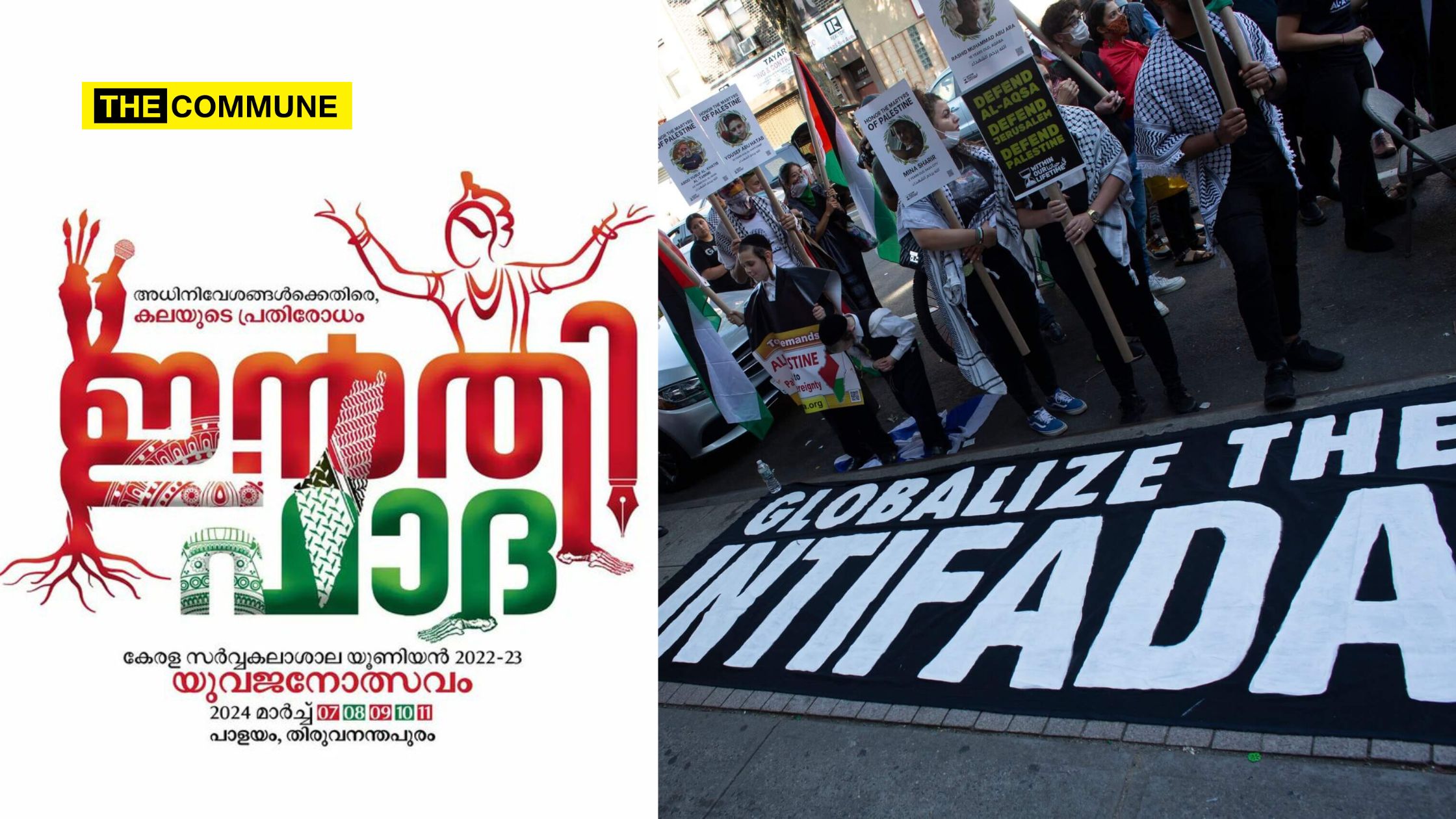
In what comes across as shocking, the 2024 Kerala University youth festival has been named ‘Intifada,’ a term historically associated with militant groups like Hamas in Palestine. The choice of the name has sparked concerns about the potential promotion of Islamism and anti-Semitism, particularly due to its connection with the violent activities of Hamas against Israel.
Intifada has been a term used by Palestinian terror groups, including Hamas, to describe their campaigns of violence against Israel. The festival’s adoption of this name has raised eyebrows, questioning the appropriateness of associating an event with a term linked to terrorism.
The poster designed for the event also hints at Palestine/Hamas – the scarf pattern embedded on the Palestine map. The words also read “Against Invasion”, “Defence of Art”
🚨 Shocking News 🔔
The 2024 Kerala University youth festival is named 'Intifada,' a term associated with terror groups like Hamas.
Intifada is the name used by terror groups in Palestine including Hamas for its attacks on Israel.
The Communist Party’s apparent involvement in the festival has added another layer of concern. Critics argue that such a choice by a political party could be perceived as endorsing or glorifying Islamic terrorism. The festival, scheduled to take place from 7 March to 11 March 2024, is now under scrutiny for the potential political and ideological implications tied to its nomenclature. The event will be held at Palayam, Thiruvananthapuram.
The term “Intifada,” originating from Arabic, translates to “uprising” or “shaking off.” Historically, it has been employed to characterize phases of fervent Palestinian protests against Israel, often manifesting in acts of violent terrorism. Two notable instances include the First Intifada, spanning from 1987 to 1990, and the Second Intifada, which occurred between 2000 and 2005.
The naming of an event after a term widely recognized for its connection to violent activities raises questions about the appropriateness of such choices, especially in an academic and cultural setting. The Kerala University youth festival website is not updated and hence does not provide more information on the topic.
Subscribe to our channels on Telegram, WhatsApp, and Instagram and get the best stories of the day delivered to you personally.
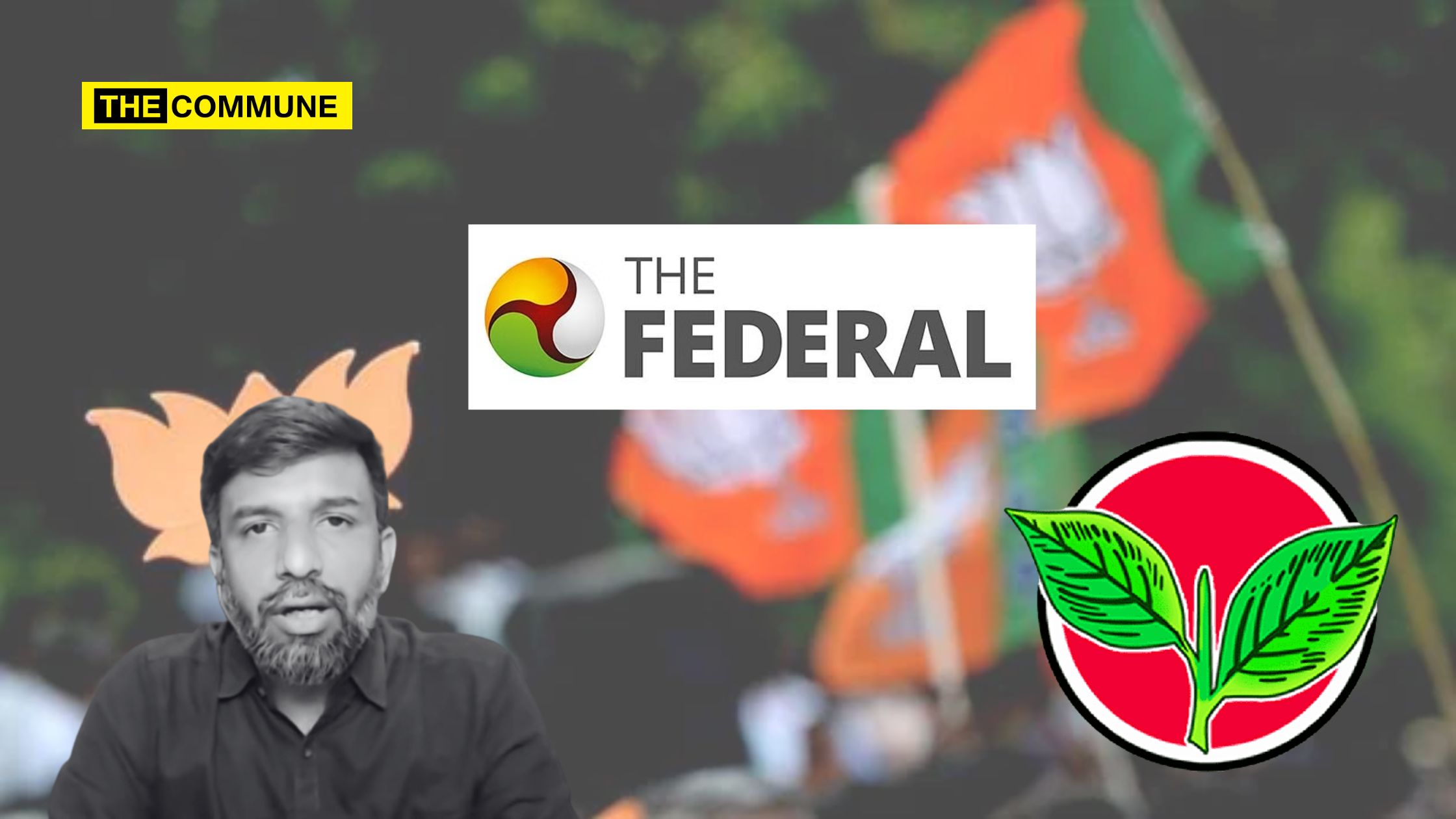
The upcoming 2024 Lok Sabha elections in Tamil Nadu are poised for significant changes, as indicated by The Federal-Puthiyathalaimurai-Apt Pre-Poll Survey. This extensive survey focused intensely on Tamil Nadu and aimed to assess the electoral sentiments in the state’s five regions: north, south, west, central, and Chennai.
The survey suggests that the DMK, led by MK Stalin and currently in power, is likely to maintain its lead in vote share in the upcoming Lok Sabha elections. However, there is an anticipated decline in the DMK’s vote share compared to the 2019 elections. Conversely, the AIADMK is projected to maintain a vote share similar to that of 2019. Notably, the BJP is emerging as a surprise contender, with a vote share comparable to the AIADMK, despite the alliance dissolution last year.
Overall, according to the survey, Tamil Nadu is expected to contribute over 38% of the vote share to the DMK, significantly lower than the 53.3% secured in the 2019 Lok Sabha elections. The BJP follows closely with an 18.5% vote share, marking a substantial increase from the 3.7% it obtained in 2019.
The survey predicts that out of the 39 Lok Sabha seats in Tamil Nadu, the DMK is poised to secure a sweeping victory with 29 seats, while rivals BJP and AIADMK are anticipated to win 4-6 seats each, according to the survey.
Reaction From Journalists & Opposition Members
Journalists like Shabbir Ahmed of The News Minute rubbished the survey and questioned how BJP could jump from a mere 3% to a whopping 18% vote share.
The News Minute which reported on the survey added a paragraph trying to point out that Parivendar Pachamuthu, MP and president of the Indiya Jananayaka Katchi (IJK), who owns the SRM group of institutions (that also runs Puthiya Thalaimurai), that his party is in alliance with the BJP for the upcoming Lok Sabha elections to colour the survey results.
Speaking to Puthiya Thalaimurai’s anchor, Shabbir Ahmed stated, “The DMK alliance numbers seem true and could have been taken from the survey in TN. But the BJP has a 15% jump from 3%. These numbers are probably from MP. This jump seems impossible. If that were to happen, there must be a wave, a pro-BJP mindset. There can be a marginal increase in vote share. BJP has been in power for the past 10 years so there will be a natural impact. A 6-8% increase is still reasonable. But a 15% jump especially after pushing ADMK to the 3rd place is questionable. ADMK has its resources, cadre, and booth workers and BJP has half or less than half of what it has. Looking at the remaining numbers, there is about 5% support for other parties and about 6% are still undecided. So whose opinion is this, are they creating a narrative that the BJP is growing rapidly by showcasing these numbers? If these are the actual numbers, why is the BJP asking parties to join their alliance? Vasan alone has joined their alliance, even if you don’t invite him, he’d have joined.”
Finally someone said the truth and slapped on PuthiyaThalaimurai.👏
இது எடுக்கப்பட்ட கருத்துக்கணிப்பு மாறி தெரியல, திணிக்கபட்ட கருத்துக்கணிப்பு!
ADMK cadre, upset with the results of the survey supported Shabbir for his views and stated that a few people were manipulating surveys and spoiling the name of surveys in general.
In reality, this number is not far from what other surveys predicted. Poll strategist Prashant Kishore had also predicted an 8-15% vote share for the BJP, Times Now Matrize Survey predicted a 20% vote share for the BJP in Tamil Nadu.
Tamil Channel #PuthiyaThalaimurai’s Opinion Polls give 18.48% votes to BJP in the Lok Sabha Elections making #BJP No.2 Party in Tamil Nadu in vote share %.
In India, Punjab stands out as a drug hotspot due to its border with Pakistan, known for engaging in drug smuggling. However, in the last three years, there has been a surge in the supply of synthetic drugs in Chennai with some of the most significant drug seizures. Drug trafficking serves both international and domestic demands. It is alleged that politicians might be implicated in this extensive drug smuggling network. The primary factor linking politicians to this scandal is the notable rise of Chennai as a drug hotspot in the three years since the DMK came to power.
Narcotics Control Bureau (NCB) is actively pursuing AR Jaffer Sadiq, a Tamil film producer, and DMK NRI wing office-bearer, suspected to be the kingpin in a multinational drug cartel.
The investigation stems from the arrest of three individuals in Tamil Nadu, revealing the dispatch of 45 pseudoephedrine shipments valued at over ₹2,000 crore in the past three years. The NCB seeks Sadiq to trace the origin of pseudoephedrine, a precursor for making methamphetamine. The DMK swiftly dismissed Sadiq after the revelation. Pseudoephedrine, a controlled substance in India, holds global demand and sells for approximately ₹1.5 crore per kg in Australia and New Zealand.
Lately, there has been a trend of exporting powdered forms of fruits and vegetables to nations like Australia and New Zealand. Concealed within these seemingly innocuous “powders,” Pseudoephedrine, a key ingredient for methamphetamine narcotics production, is falsely labeled as a natural substance and exported.
This illicit activity has been ongoing for the last three years according to reports. Law enforcement has pinpointed significant shipments, each purportedly weighing between 50 to 100 kilograms, that have been exported.
In April 2023, Abu Bahad was apprehended in Ramanathapuram, employing a similar modus operandi to smuggle drugs, disguising them as medicines and chemicals destined for Australia, New Zealand, Malaysia, and other locations. Following his arrest, there are indications that the nature of this illicit activity underwent a transformation.
The revelation of a significant drug seizure linked to Tamil film producer Jaffer Sadiq has stirred considerable concern within the state. Currently evading authorities, Sadiq’s affiliations with the DMK’s first family and his membership in the party are now subjects of investigation.
Who Is Jaffer Sadiq? Are His Companies Real Or A Facade For Drug Trafficking?
Delving into the now-expelled DMK functionary Jaffer Sadiq’s background reveals a network of his family’s involvement in diverse businesses. Notably, two companies, Zoya Deliveries LLP and Rush Deliveries LLP, registered in 2021, are engaged in “delivery services” throughout Chennai.
Additionally, there are two tour and travel agencies facilitating the movement of goods. The ventures extend to the seafood industry, with JSM Sea Foods India Pvt Ltd, alongside the establishment of restaurants and a peculiarly named pharmaceutical company, J Square.
It is noteworthy that the delivery companies, the production house, and the seafood company were incorporated in 2021, the year the DMK came to power. Rush Deliveries LLP and JSM Sea Foods India Pvt Ltd were established in July 2021 and September 2021 respectively.
This comprehensive array of enterprises paints a detailed picture of the interconnected network surrounding Jaffer Sadiq.
This intricate network is suspected to have orchestrated shipments worth ₹2000-2500 crores exclusively to Australia over the past three years. The extent of movement within India or to other nations remains unclear. Overall, the comprehensive scandal is estimated to involve approximately ₹12000-15000 crores worth of drug trafficking.
This is how this network is suspected to be working – For the transportation of drugs, they utilize their proprietary delivery company. To facilitate the bulk movement of drugs, they employ their tours and travels with the drugs transported under the guise of either medicines or food items.
Jaffer’s Connection With Ameer And Dravidianwood
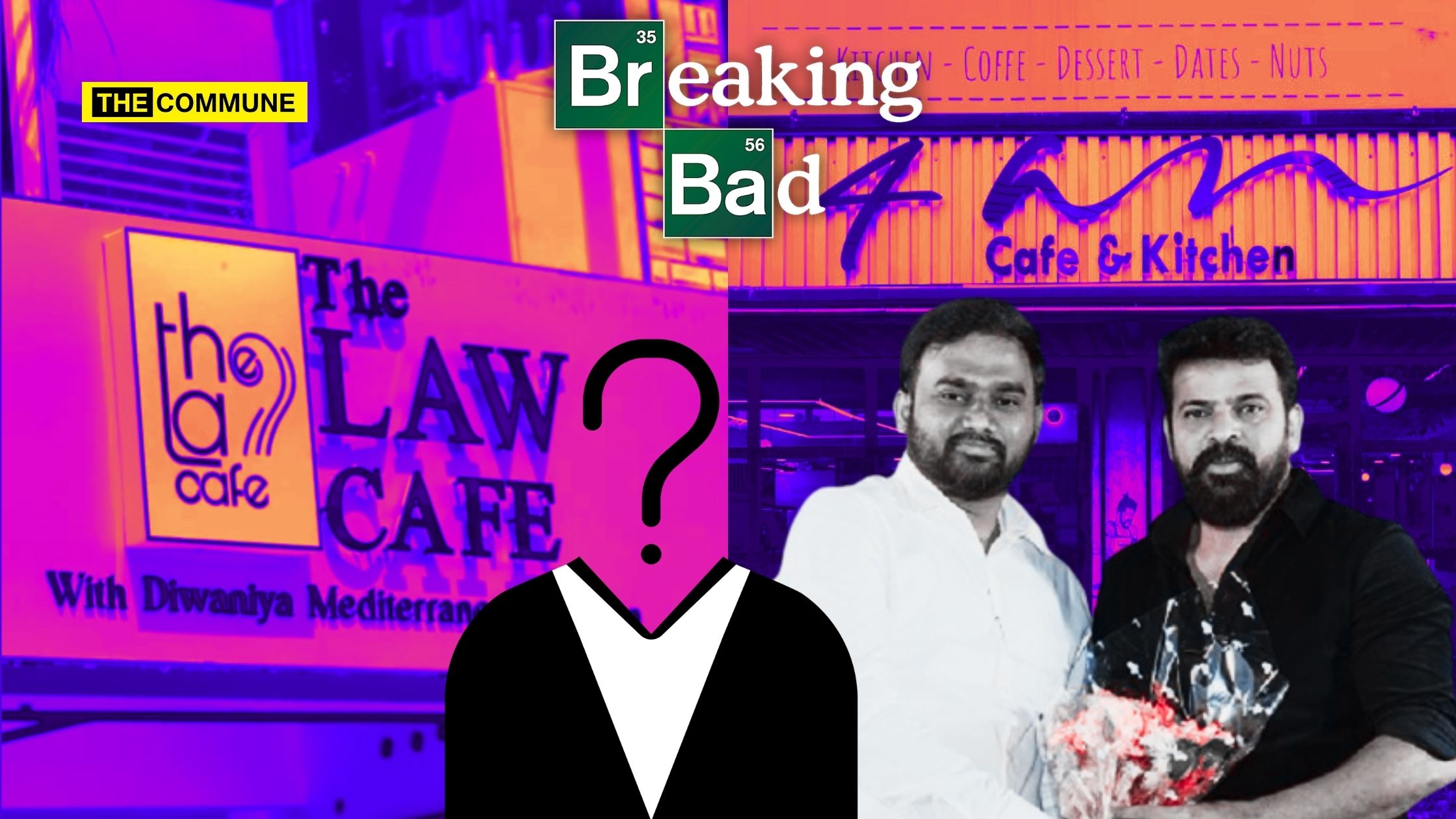
Director Ameer and Jaffer Sadiq launched a coffee shop named 4AMCoffee and Kitchen under the Mahyan Pvt Ltd incorporation at ECR near Chennai. The managing director of this organisation, Abdul Basith, is also a director of Zuko Overseas Pvt Ltd along with Jaffer Sadiq. Interestingly, Ameer Sulthan aka director Ameer is also a director of Zuko Overseas Pvt Ltd.
For the launch of the coffee shop, director Vetrimaran and actor Soori were present. Another coffee shop named Law Cafe was opened at Radhakrishnan Salai under the Mahyan Group of Companies banner run by Ameer and Sadiq.
Just like how Heisenberg in Breaking Bad produces methamphetamine at the basement of a laundry and launders the ill-gotten money through a car wash garage, it is suspected that Jaffer Sadiq seems to have used his “food production” and “delivery” business for producing and moving drugs while laundering the ill-gotten money by producing films and cafes. Only a thorough investigation will reveal the modus operandi.
Upon receiving the news of the drug haul, Ameer seems to have washed his hands off Jaffer Sadiq as he published a press release claiming ignorance.
Actor Vijay Sethupathi was the chief guest at the launch of Law Cafe coffee shop. In this video, you can see Ameer, Sadiq and Sethupathi. Other people from the industry who can be seen in the video include rabid Dravidianist director Karu Palaniappan.
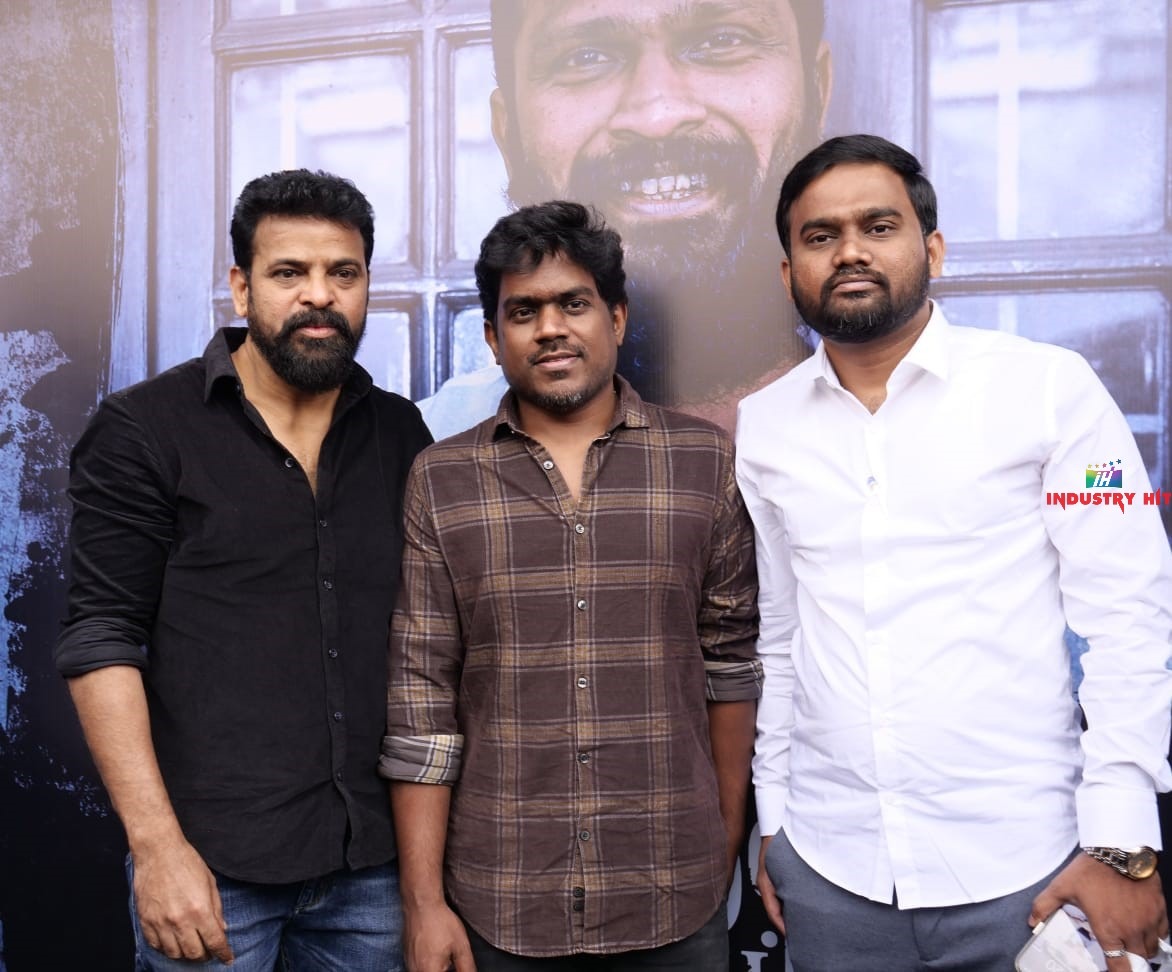
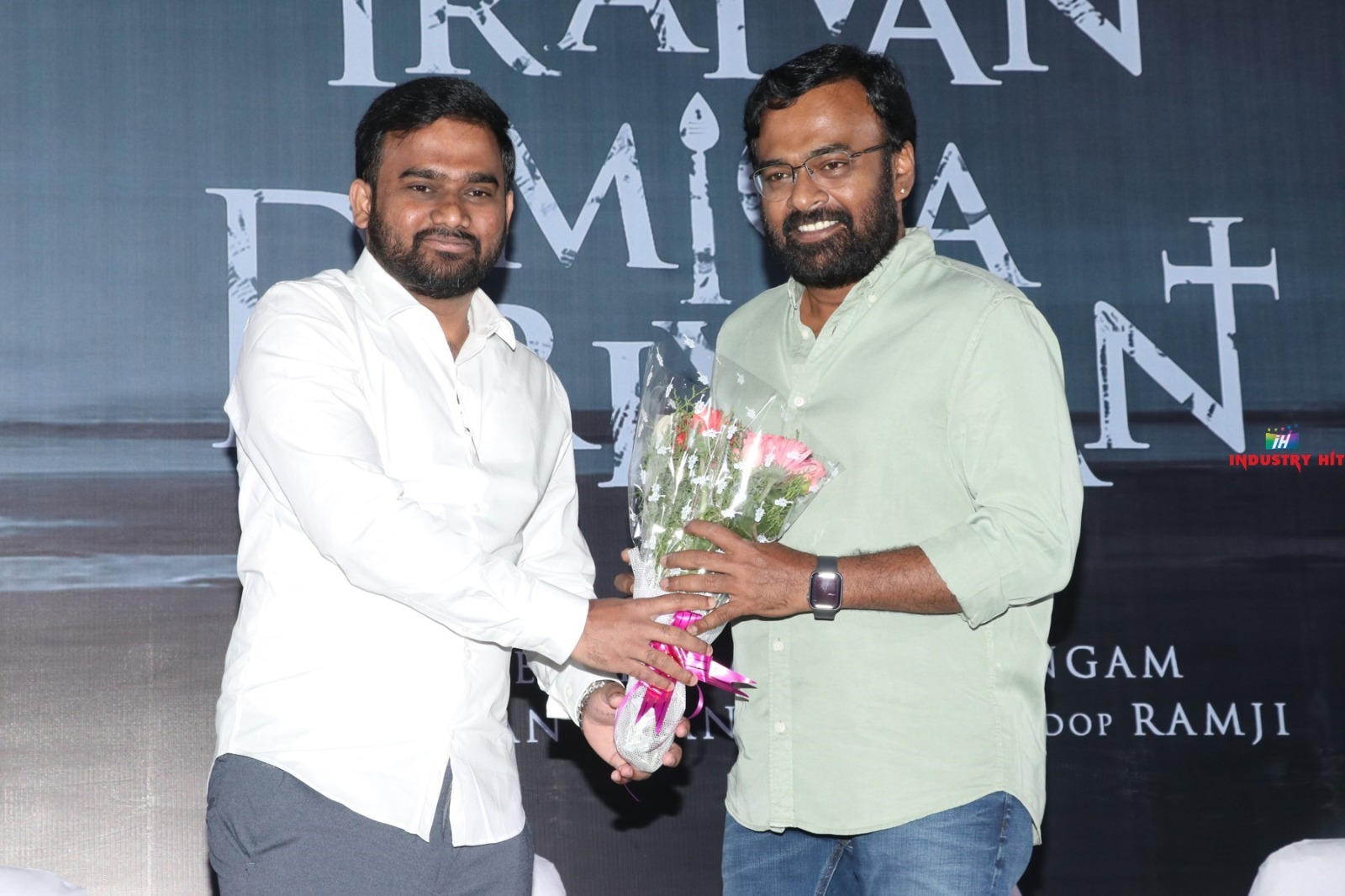
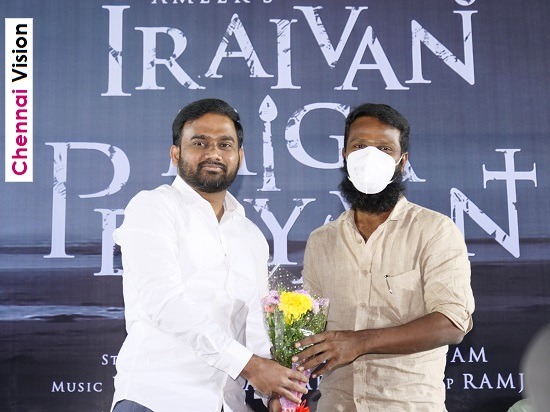
Ameer, Vetrimaran, and Jaffer Sadiq have been photographed frequently establishing the closeness of directors in the Tamil film industry with so-called producers.
வெற்றிமாறன் அமீர் சமுத்திரம்கனி இவனுக மேல ஒரு சின்ன doubt இருந்தது இப்ப clear ஆகிருச்சு
ராஜன் வைகரானு #Vijay fans இவனுக்களுக்கு build up வேற குடுத்தானுக
— பூரியார் ¶¶¶|||•• செவிட்டு தவளை ••|||¶¶¶ (@Imtweetygoose) February 25, 2024
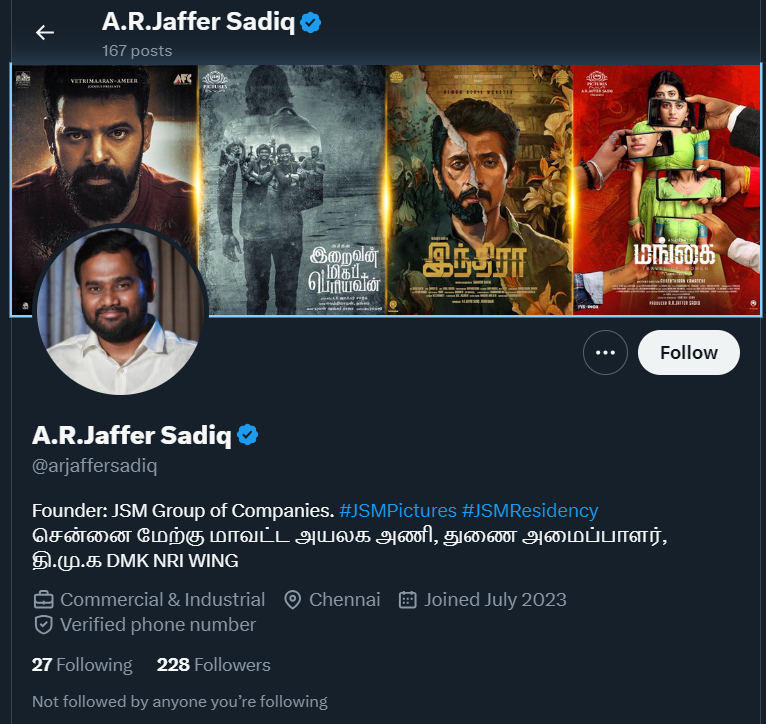
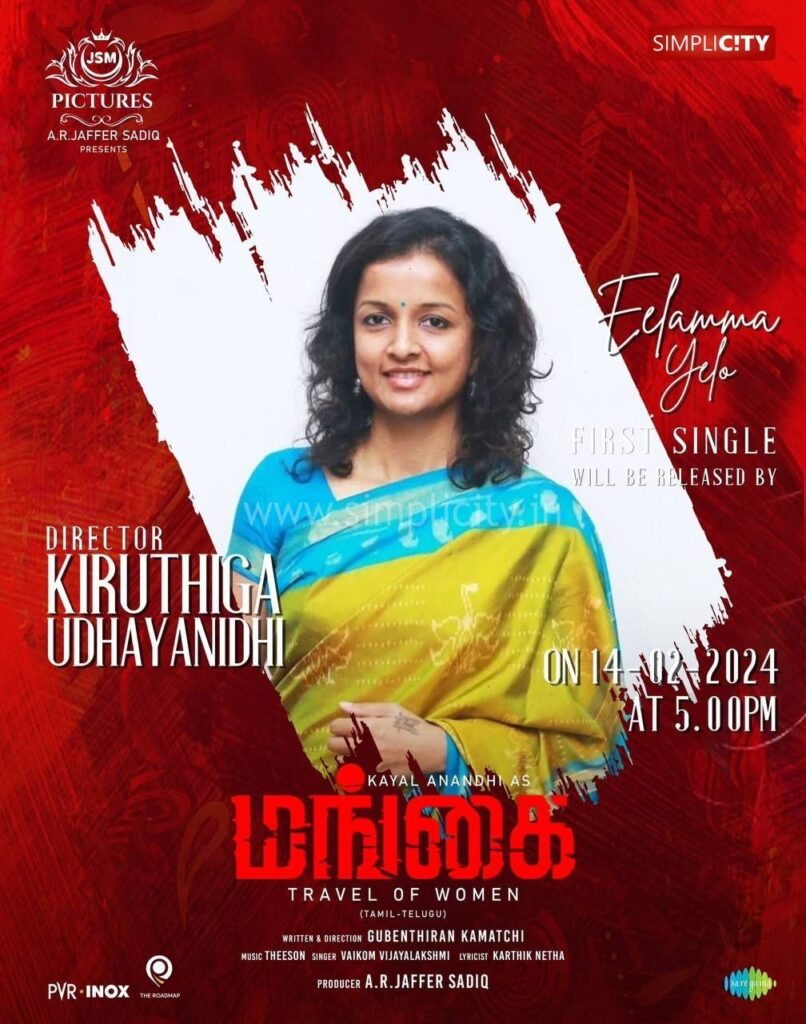
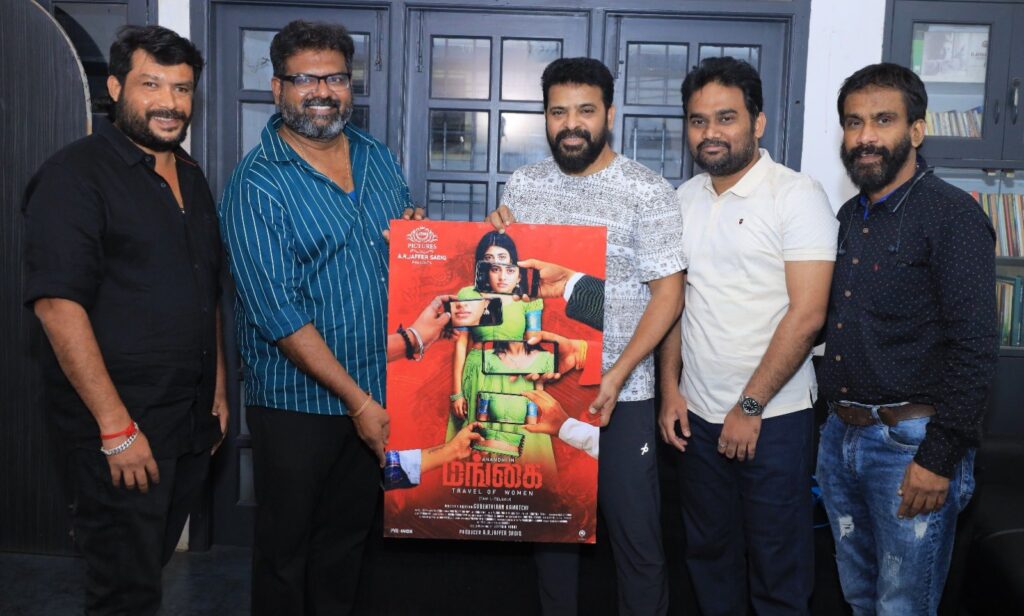
Some of the films that Jaffer Sadiq has produced include Ameer’s Iraivan Miga Periyavan, Mangai, and Indira. These films were produced under the JSM Pictures banner. Interestingly, Sadiq’s X handle’s cover pic has 4 posters – the three mentioned above and a film named Maayavalai which is produced by Ameer’s own production house and co-produced by Vetrimaran’s Grass Root Film along with Jaffer Sadiq. This establishes their thick friendship more than ever.
It is noteworthy that DMK Minister Udhayanidhi Stalin’s wife Kiruthiga Udhayanidhi was the chief guest at the launch of a single from the film Mangai.
Jaffer Sadiq has also been seen with other film personalities frequently along with Ameer.
With Yuvan Shankar Raja
With Karu Palaniappan at Iraivan Miga Periyavan Press Meet
With Vetrimaran at Iraivan Miga Periyavan Press Meet
All the three individuals seen above – Yuvan Shankar Raja, Karu Palaniappan and Vetrimaaran have peddled propaganda in favour of the DMK at various times.
Karu Palaniappan, who hosts the show Tamizha Tamizha and supposedly provided inputs for Udhayanidhi Stalin’s “Eradicate Sanatana Dharma” speech, is also vying to get a ticket for the Lok Sabha Elections 2024 according to political commentator ‘Savukku’ Shankar.
Ameer and Sadiq have been seen frequently with the Chief Minister MK Stalin.
அப்பறம் எந்த படம் இயக்காம எந்த படமும் நடிக்கமா 10 லட்சம் நிவாரண நிதி அப்பறம் சென்னயில் caffee cafe வைக்க இயக்குனர் #Ameer க்கு எப்படி காசு வந்ததுனு இப்ப clear ஆகிருச்சு pic.twitter.com/v9IODMlfFu
— பூரியார் ¶¶¶|||•• செவிட்டு தவளை ••|||¶¶¶ (@Imtweetygoose) February 25, 2024
While Ameer has attempted to distance himself from Jaffer Sadiq trying to portray as no more than a director-producer relationship, it is evident from the above instances as to how thick as thieves both Ameer and Jaffer Sadiq are.
How The First Family Is Reacting
DMK’s crown prince Udhayanidhi Stalin, previously photographed alongside Sadiq contributing to the CM relief fund, has been silently removing social media posts associated with Sadiq. Following the rapid dissemination of the news of the cartel, the party leadership issued a statement within hours, officially dismissing him.
Ironically, Kiruthiga, who passionately shares thoughts on spirituality and values on social media, had released the single of the film produced by Sadiq. Notably, Red Giant Movies is headed by her husband Udhayanidhi Stalin, albeit not on paper anymore.
Mangai film produced by SadiqAmeer seen with Sadiq for Mangai film promo
Dravidianist Mindset Of Vetrimaaran & Ameer
It is a known fact that Kollywood or rather Dravidianwood as the name suggests peddles the Dravidianist propaganda through films. Vetrimaran and Ameer, part of the industry, play a major role in enabling that. Here is an example of Ameer’s opinion on Ram mandir. In an interview about the Ram mandir, he says, “Rama is not even a God in Tamil Nadu. How many temples of Rama are there? I am also from TN – do we have as many temples like Murugan, Mariyamman for Rama? Tamils never celebrated Rama Navami like they celebrated Vinayaka Chathurthi or Thai Poosam. It is not a part of our culture. Nobody asked for Ram Mandir not to be built, we only asked to not destroy a masjid and construct a temple on that site. Still, they did it. Nobody got angry also for this (hinting at tolerance).”
Director Ameer makes outrageous claims: "Rama is not even a God in Thamizhagam.
How many temples of Rama are there? I am also from TN – do we have as many temples like Murugan, Mariyamman for Rama?
Tamils never celebrated Rama Navami like they celebrated Vinayaka Chadurthi or… pic.twitter.com/gbzGPGCr5t
Vetrimaran also does his bit to whitewash Dravidianist crimes. For example, as a known supporter of the DMK, in his movie ‘Asuran’, a movie based on Keezhvenmani incident, Vetrimaran attempted to project that members of the Dravidar Kazhagam were with the Dalits during the massacre, when the truth is quite different.
Another instance where he showed his loyalty to the DMK government was just days after the victory of the DMK in the Tamil Nadu assembly elections, a section of ’eminent personalities’ and various organisations in the state wrote to the then Chief Minister-designate M K Stalin requesting to withdraw the permission for the reopening of the Vedanta copper unit and to scrap the Chennai-Salem eight-lane expressway project. Among those who wrote the letter were director Vetrimaran, actor Vijay Sethupathi, and former Madras High Court judge (retd) D Hariparanthaman. All of them also asked the DMK chief to cancel the Adani port expansion at Kattupalli, the Kanniyakumari International Container Terminal, and the Chittoor-Thachur 6-lane expressway. Interesting to note that Vijay Sethupathi’s name (who was seen at the opening of Ameer’s Law Cafe features here too.
Following the split between ADMK and BJP, the Edappadi K. Palaniswami-led Dravidian party has been buttering up with Islamist outfits like Social Democratic Party of India (SDPI – the political arm of the banned radical Islamist terror outfit Popular Front of India) in an attempt to get minority votes.
The secund rung of leaders have been mounting attacks against the BJP especially on the national party’s state president K. Annamalai.
Earlier, former AIADMK Minister RB Udhayakumar had ridiculed Annamalai as a “legiyam seller”, “poochandi”, and “maayandi”.
In the latest attack, ADMK leader C.Ve. Shanmugam trained his guns on the BJP over the building of Ram Temple in Ayodhya.
“If you build a temple, and pray to Ramar, will you get 3 meals a day? Today, they’re inciting emotions and trying to divide people. Be it the government at the Centre or the State government, both these governments are inciting passion and emotion and are covering up real basic problems of the people and doing drama to get votes of the people.“, the ADMK leader said.
The ADMK leader’s comments targeting the Ram Temple in Ayodhya is seen in light of the Dravidian party’s continuous attempt to woo Muslim votes.
TheADMK, after its exit from the National Democratic Alliance (NDA), has come under scrutiny for its perceived efforts to court minority voters. This shift is believed to be a response to the party’s claim of losing minority support during its alliance with the BJP.
C.Ve. Shanmugham has for long argued that the AIADMK lost the 2021 Assembly Elections because their alliance with BJP cost them minority community votes.
Subscribe to our channels on Telegram, WhatsApp, and Instagram and get the best stories of the day delivered to you personally.
In a recent social media post on platform X, Anusha Ravi Sood, the executive editor of South First news portal, shared a video featuring Uttar Pradesh CM Yogi Adityanath where he stated that UP had become the second-largest economy in the country. Sood quoted that UP was not the second largest economy in the country but it was Tamil Nadu as per RBI data.
However, Anusha’s apparent lack of awareness regarding the latest economic updates raises concerns about her journalistic credibility. Despite numerous news articles in December 2023 confirming UP’s ascent to become the second-largest economy, Anusha seemed to rely on outdated data from FY 2021-22, where Tamil Nadu’s contribution was 8.82%. In the FY 2023-24 forecast and realization, UP has surged to 9.2%, surpassing Tamil Nadu, while Maharashtra maintains its lead at 15.7%.
While Sood’s post acknowledges that she quoted RBI data, her oversight regarding the RBI’s non-real-time updates makes one question her journalistic acumen.
Peddling The North-South Divide
In a video released a few weeks ago, she talks about “Well-performing southern states claim fiscal injustice by Union government. What are their concerns?” However, the 17-minute video appears highly opinionated, primarily focusing on superficial facts.
Anusha’s opening statement, “India is a union of states,” is nothing but a fragile idea of India peddled by Congress leader Rahul Gandhi. This sets the tone for her narrative, seemingly aimed at establishing a divisive agenda. She conveniently neglects the significant contribution of Delhi and Maharashtra, which alone accounts for over 50% of durect tax collection. Despite their substantial financial input, these regions receive considerably less than the southern states, suggesting a disparity that Anusha fails to address.
Maharashtra and Delhi account for 50.4% of direct tax collection,
All 5 "Southern" states combined pay 25.8% of tax.
Anusha Ravi Sood’s presentation of the direct tax map in her video also seems to be inaccuracies, as pointed out by a netizen. This thread reveals how funds are allocated after taking all components into consideration.
Why @TheSouthfirst is peddling FAKE data in their video?
The Direct Tax Map that you shared in your video is FALSE.
Ask @anusharavi10 and her team to verify the data before using it in the video.
This also raises questions about the reliability of the data she relies on to make her arguments.
Sood does not take into context the freebies that governments across the country are relying on for their votes.
A former Chief Minister of Tamil Nadu once famously said, “Vadakku vazhgiradhu, Therku theigiradhu,” implying the perceived regional disparity where the north prospers while the south suffers. We ask whether Anusha tried to analyse the recent TN budget at least once? South districts received a pittance in comparison to KTCC in TN. Why has she not raised her voice against disparity among districts?
In the video, Anusha’s focus on population and area as the main criteria for tax-sharing seems to be flawed. The Finance Commission considers several factors before it offers its recommendations. The weightage is given below in the latest Finance Commission.
In terms of horizontal devolution, the 15th Finance Commission has recommended a distribution formula with 12.5% emphasis on demographic performance, 45% on income, and equal weightage of 15% each to population and area. Additionally, 10% is allocated to forest and ecology considerations, while tax and fiscal efforts receive a 2.5% weightage.
If you consider a city like Bengaluru which generates significant revenue for the state government but receives disproportionately less in return. In contrast, a village in Karnataka, generating comparatively less revenue, receives more substantial returns. The analogy suggests a skewed system where the rich pay high but don’t necessarily receive equitable benefits. Let us assume for a moment that what the state does in Karnataka is right. Isn’t this what reservation and social justice are all about – helping the underprivileged? Are Anusha and her ilk selectively blind to this form of social justice, do they think this only applies to caste?
In this post, Amit Malviya of the BJP explains in detail about how tax devolution to states works. It would have helped if the likes of Sood had done a little bit of background research rather than firing blanks just to peddle propaganda of the leftist lobby.
Devolution to States is done by a constitutional body based on rational criteria under Article 280. It is not random.
• During 2014-24 (till the latest release on 22 Dec 2023), Tax Devolution (Net Proceeds of Union Taxes and Duties) from Govt of India to Karnataka has been… https://t.co/ONItV9o8Gi
If one goes by Anusha Ravi Sood’s logic for tax distribution at the state level, several questions come up – Why isn’t tax collected from Bengaluru utilized for the city’s benefit, and who bears the cost of the apparent freebies? One can extend this to ask why tax-paying citizens are penalized and high taxpayers don’t receive more in return.
Setting aside these concerns momentarily, it’s worth examining whether fiscal federalism was introduced by the Modi government. The same Anusha was probably tongue-tied or unaware of what happened during the UPA era or before. It was Prime Minister Modi who ensured states received more than what they were receiving before. And yet, they are not satisfied. Here is a statement by DMK Minister PTR Palanivel during the Jantar Mantar protest against the centre. Here PTR speaks of Narendra Modi who questioned why disparity was shown between states over fund devolution. In a post on his X handle amidst the ongoing ruckus being created by the I.N.D.I.Alliance partners concerning the central government “looting tax revenue” from states, he wrote quoting DMK Minister PTR Palanivel Thiagarajan at Delhi Jantar Mantar protest, “There was a Chief Minister in India. He said that the central government is severely deceiving them and talked about the federal philosophy from side to side. He said that they are taking the tax money of our state and diverting it to some states: He is none other than the then Chief Minister of Gujarat, Narendra Modi, who is now the Prime Minister.”
However, it is to be noted that after PM Narendra Modi assumed the PM post, he increased the allocation of funds to states. from 32% to 42%. Further, he reduced the weightage of the population in the tax distribution criteria from 27.5% to 15%.
Additionally, the funds available to states in the UPA regime (2004-14) was ₹30 lakh crore but from 2014-2023, this fund has increased to over ₹100 lakh crores.
Also, the tax sharing and assistance received by Tamil Nadu excluding NH, Ports, Railways, Railways, other Infra in the UPA regime (2004-14) was ₹1,52,921 crores. In the Modi regime (2014-23), it has increased to ₹5,08,337 crores.
Tamil Nadu has also received ₹10.76 lakh crores of funds, projects, and grants in the past 9 years under the Modi government.
By Anusha’s logic, each taxpayer should receive benefits in proportion to taxes paid. Will the likes of Anusha question the disparity in the allocation of funds between cities like say Chennai and Coimbatore or Bengaluru and Hubbali?
Being a journalist, Anusha seems to have absolutely no idea about the GST split which has been explained several times over and over again by Union Finance Minister Nirmala Sitharaman.
States like Karnataka and Tamil Nadu seek more money to ensure their freebie promises are taken care of. A common man can easily understand between people-pleasing politics which is temporary and constructive politics which is pro-people and designed with a long-term vision that the central government follows. If Anusha is so concerned about this alleged south tax movement, maybe she can ask her Chief Minister why there is disparity within districts in Karnataka itself. In October 2023, the Karnataka government allocated ₹40 crore to 12 MLAs, primarily from the Congress party, as a part of the redistribution of special civic grants. The funds, originally designated for the CM’s Nava Nagarothana scheme in 2022, total ₹480 crore, with a focus on roadworks. This move raises questions about fairness and equal distribution among legislators, particularly as some BJP MLAs expressed dissatisfaction with the skewed funds’ allocation favouring Congress members.
So will Anusha Ravi Sood first help the Karnataka Congress government fix its internal issues before pointing fingers at others, especially the centre? It will also help if she can learn some math, finance, and economics alongside her daily routine of staying updated with the news.
Subscribe to our channels on Telegram, WhatsApp, and Instagram and get the best stories of the day delivered to you personally.
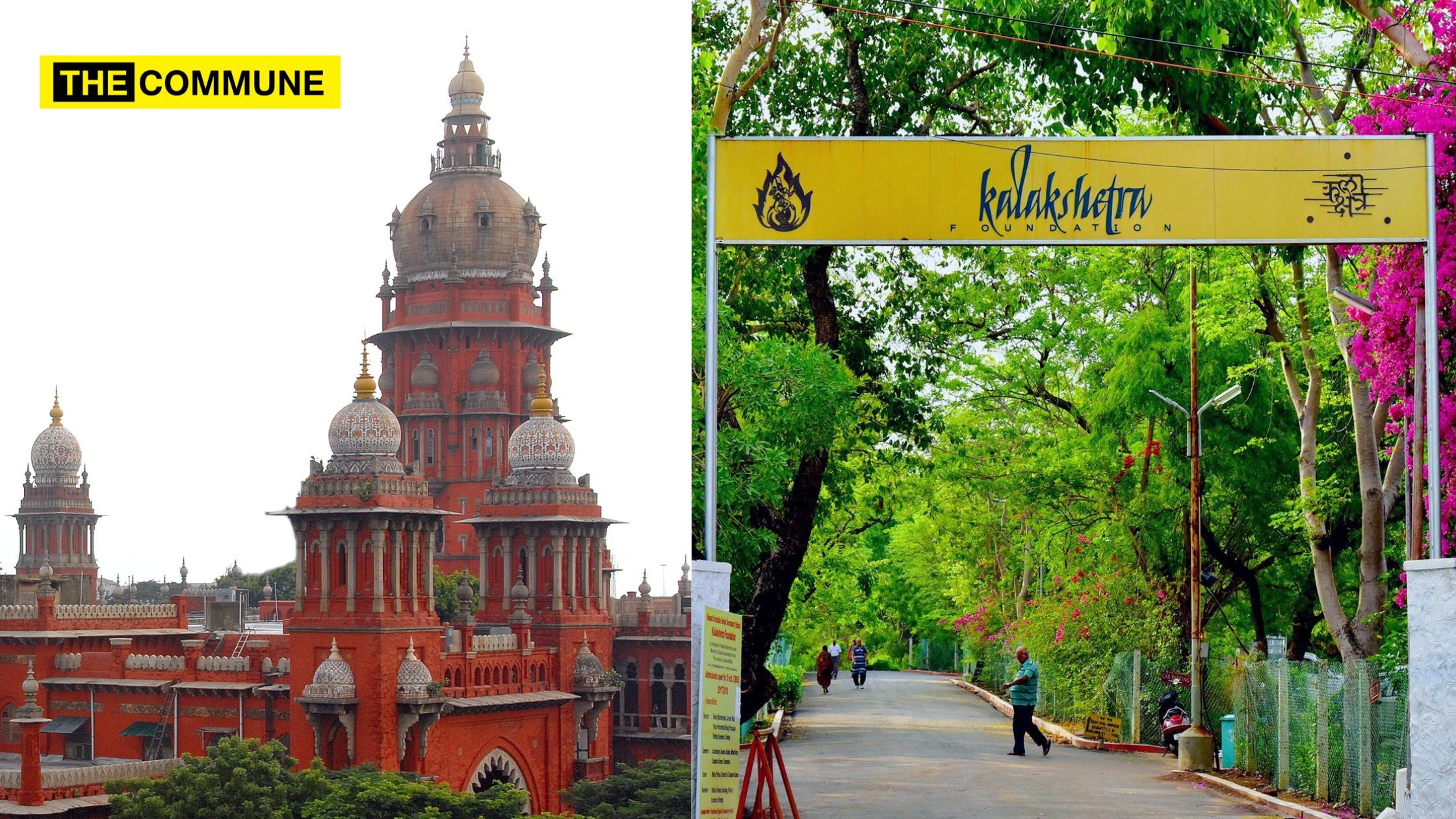
The Madras High Court has resolved a plea filed by students from Rukmini Devi College of Fine Arts, under the Kalakshetra Foundation, who sought the establishment of safety policies and redressal mechanisms. Justice Anita Sumanth noted that there was no need for further directions, as the college had already finalized the Gender Neutral Policy for the Prevention, Prohibition, and Redressal of Sexual Harassment complaints. The court also highlighted the reconstitution of the Internal Complaints Committee, indicating the fulfillment of the students’ sought reliefs.
While recognizing the implemented policies, the court expressed concern over the institution’s delayed response to the students’ allegations, terming it a “blight on Kalakshetra.” Emphasizing the expectations of stakeholders in the education system to meet societal norms and system expectations, the court stressed the importance of addressing such issues promptly for the reputation of Kalakshetra.
The court acknowledged the necessity of expediting the inquiry into the students’ allegations, emphasizing the importance of reaching a logical conclusion. It underscored the critical role played by addressing such issues promptly for maintaining the reputation of Kalakshetra, whether adhering to traditional or modern practices in the education system.
The court directed the foundation to frame policies and establish a complaints committee in its schools. Noting the inadequacy of the present policy, the court mandated drafting a comprehensive policy, incorporating provisions under the POCSO Act and other regulations, within six months.
The court reviewed the Independent Committee’s report, headed by Justice K Kannan, urging the management to promptly consider recommendations. These included a ban on students entering teachers’ quarters, discouraging participation in tours, emphasizing higher learning, automating office administration, and selecting efficient administrators with HR management skills.
Kalakshetra Controversy: Allegations, Investigations, and Institutional Response
The controversy began when Leela Samson, the former director of Kalakshetra Foundation, making allegations on her Facebook account against an unidentified teacher. In December 2022, students reportedly sharing comparable incidents of sexual harassment conducted a protest, leading to the arrest of a faculty member. Media outlets like News Minute and The Print published articles discussing the teacher-student relationship at Kalakshetra, particularly implicating Hari Padman and asserting students encountered inappropriate conduct. However, a report by News 18 indicated that the teacher’s actions were consistent with the institution’s disciplinary culture.
Following anonymous social media posts, allegations of sexual harassment against Haripadman prompted the Director, Revathy Ramachandran, to establish an Internal Complaint Committee (ICC) for investigation. Despite no formal complaint, she initiated a suo moto inquiry, with the ICC, led by Revathi Ramachandran, determining the accusations were baseless rumors. The National Commission for Women and the ICC cleared Hari Padman, prompting the closure of the case, citing a lack of evidence and the victim’s denial of harassment. The Kalakshetra Foundation also presented ICC findings to the DGP, affirmed a comprehensive investigation found no substantiation of sexual harassment claims circulated on social media.
As per media report, in the case of sexual harassment allegations at Kalakshetra institution, the Director's clarification and the internal complaints committee report did not find any evidence of sexual harassment on campus. @sharmarekha
But students argued that the institution failed to take responsibility, rejecting complaints based on the expiry of the three-month time limit under The Protection of Women against Sexual Harassment at Workplace Act, 2013 (POSH). Instead of addressing the issue and suspending the accused professor, the institution dismissed the complaints. The court had previously instructed the college not to take adverse action against students raising complaints.
Another setback for the ruling DMK government in Tamil Nadu as the Madras High Court has reversed the special court’s ruling that cleared DMK Cabinet Minister for Rural Development and Panchayats, I Periyasamy, of accusations related to the irregular allocation of plots in the Tamil Nadu Housing Board to former Chief Minister M Karunanidhi’s personal security officer during his tenure of 2006-2011.
Justice N Anand Venkatesh has instructed the trial court to conduct daily proceedings and conclude the trial by 31st July, as part of the final order in the suo-motu criminal revision.
The judge has mandated that all the accused, including Minister I Periyasamy, post a bond of Rs. 1 lakh each and appear before the special court for the trial.
On September 8 last year, Justice N Anand Venkatesh remarked that the situation presented “yet another textbook case of how the criminal justice system has been successfully subverted from within” during the suo motu criminal revision initiated against Periyasamy’s discharge from the plot allotment case.
In 2012, the Directorate of Vigilance and Anti-Corruption (DVAC) filed a case against Minister I Periyasamy, alleging that, during the DMK regime between 2007 and 2011, he unlawfully acquired a High Income Group (HIG) plot in the Mogappair Eri Scheme of the TNHB for C Ganesan, an inspector in SB-CID and PSO to the then Chief Minister M. Karunanidhi.
The DVAC claimed that Ganesan had submitted an undated application to M. Karunanidhi, falsely stating that his family resided in a private house while concealing the fact that he actually lived in TNHB Housing quarters.
However, following a change in the regime in 2011, the DVAC initiated a corruption case against Ganesan and Periyasamy. A charge sheet was filed in a special court, which rejected various discharge petitions filed by Periyasamy, keeping the case active.
In 2021, after a change in the state’s leadership, Periyasamy reassumed the ministerial position. The Special court for MP/MLA cases ordered the discharge of Periyasamy from the case.
Previously, Senior Advocate Ranjit Kumar, representing Periyasamy, contended that the trial initiated against Periyasamy was flawed as it was based on sanction from the Speaker of the House instead of the proper authority, the Governor. He argued that the trial lacked legal validity.
Kumar further pointed out that the trial court, while rejecting the initial discharge petition, acknowledged the need to hear the Speaker’s arguments. Hence, he asserted that the second discharge petition, filed after the trial commenced and witness examination, should be considered valid based on the trial court’s earlier ruling.
The court, however, raised concerns about the DVAC’s failure to secure prosecution sanction, even after the trial court discharged the Minister due to inadequate sanction. The court emphasized that this issue reflected a systemic problem that required resolution. Additionally, the court expressed the importance of sending a message to the public that it could take action against individuals in the highest positions.
It’s worth highlighting that DMK ministers are consistently under scrutiny in various corruption cases. Former Excise Minister V Senthil Balaji is presently in jail, seeking bail in connection with a corruption case. The corruption case involving Former Higher Education Minister Ponmudi is also active in court proceedings. Currently, a suo motu revision is underway in the corruption case of the Rural Development Minister I Periyasamy.
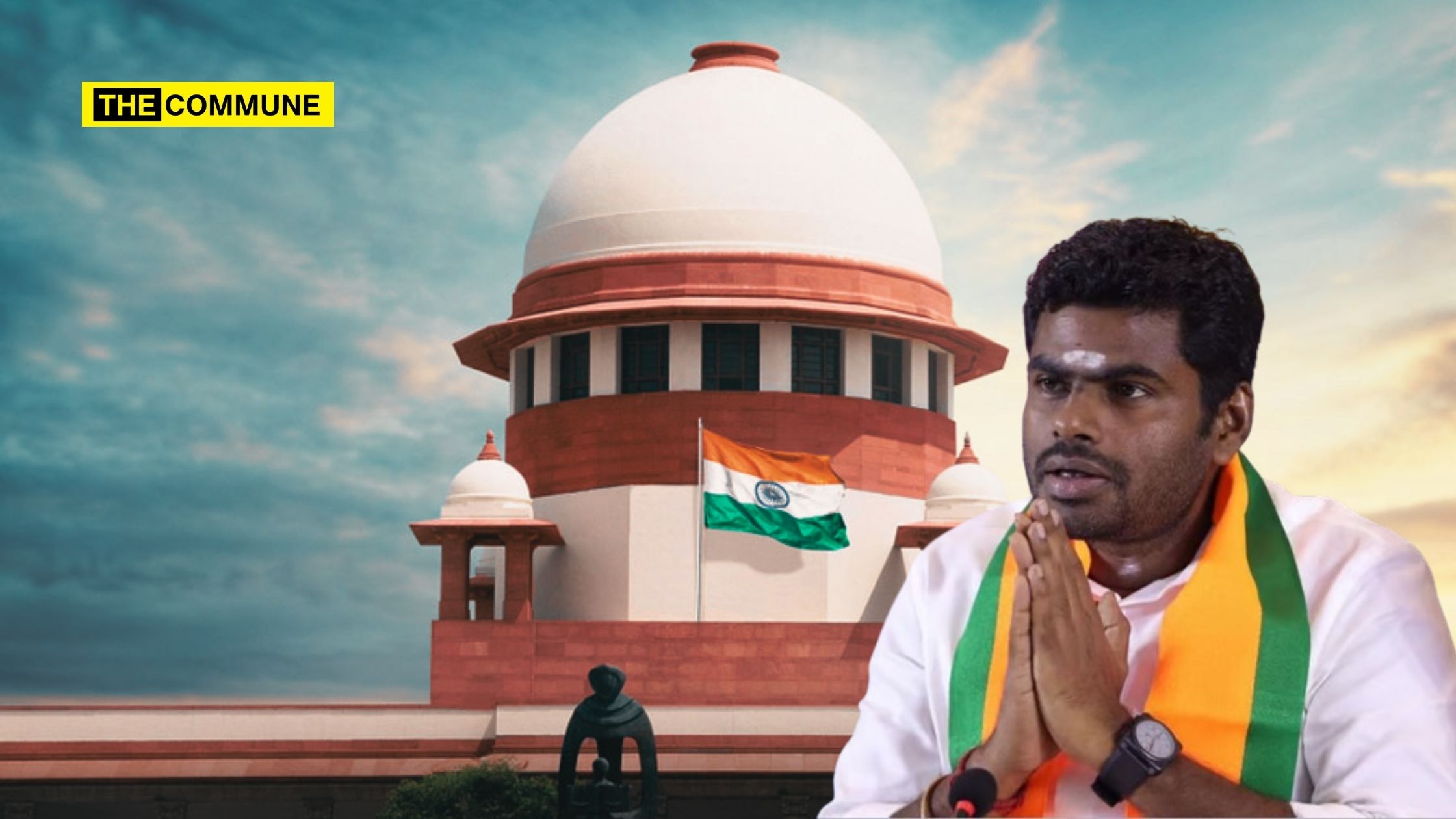
The Supreme Court, while issuing notice in the plea of Tamil Nadu BJP Leader Annamalai, has put a halt to the proceedings before the trial court concerning alleged remarks made in a YouTube interview against a Christian Missionary NGO.
This NGO had approached the Supreme Court seeking a ban on firecrackers. Justice Sanjiv Khanna, upon reviewing the translated remark, clarified that it does not qualify as hate speech. Notably, the Madras High Court, in its refusal to quash criminal proceedings against K Annamalai, emphasized that the court’s duty is to assess if the statement by a prominent leader has caused silent harm in the psyche of the targeted group, extending beyond immediate physical harm.
The bench of Justice Sanjiv Khanna and Justice Dipankar Datta issued a notice returnable in the week commencing April 29, 2024, and concurrently stayed further proceedings before the Trial Court. This interim order was passed after the attention was drawn to a translation at page 60.
Senior Advocate Siddharth Luthra and Advocate J Sai Deepak represented Annamalai. In the YouTube interview, Annamalai asserted that a Christian Missionary NGO had sought a ban on firecrackers from the Apex Court.
Following the sharing of video clippings on social media, Piyush, the respondent, lodged a complaint with the DGP, Home Secretary, and Commissioner of Police, Salem. Concerns were raised about the potential incitement of hatred between communities. However, it was determined that the interview did not breach public peace, and no prima facie case was established.
Subsequently, invoking Section 156(3) and 200 of the CrPC before the Salem Judicial Magistrate, Piyush found a prima facie case under Section 153A and Section 505(1)(b) of the IPC and summoned Annamalai.
Annamalai contested the summons, contending that his speeches expressed anguish. He highlighted that the interview took place in 2022, and the complaint was filed approximately 400 days later, with no untoward incidents during this period based on the speech. The High Court observed that to establish an offense under Section 153A of the IPC, the court must consider Clauses (a) and (b) to Sub-Section (1). Words must either be spoken or written, promoting disharmony, enmity, or hatred between different religious groups likely to disturb public tranquility.
In light of this, the High Court held that the counsel’s submissions prima facie satisfied all the mentioned ingredients, indicating a clear intent to create hatred towards a particular religion. The statements, made by a person of stature with a significant impact on the masses, prima facie had a psychological impact on the targeted group.
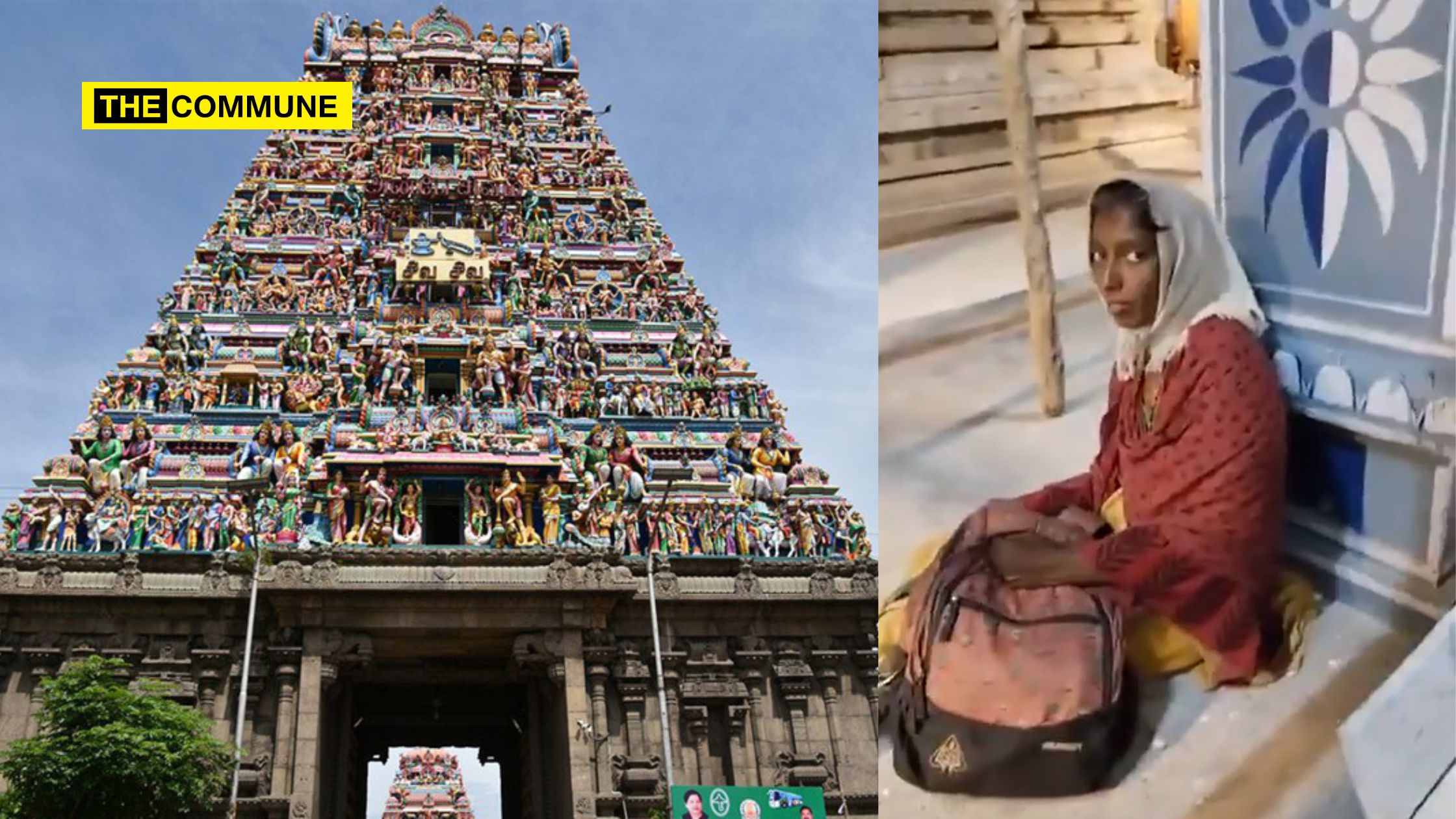
In a recent unsettling incident in Tamil Nadu, a woman was found reading the Bible inside the Kapaleeswarar Temple, situated in the heart of Chennai, during daylight hours. This incident occurred against the backdrop of a recent ruling by the Madurai Bench of the Madras High Court, which ordered the restriction of non-Hindus from entering the Palani Murugan Temple. This decision sparked controversy, with the Dravidian factions questioning its validity. Additionally, HR&CE Minister Sekar Babu declared intentions to counter this ruling, shedding light on the reasons behind such decisions.
The Tamil Nadu Hindu Religious & Charitable Endowments (HR&CE) department had earlier prevent Hindu Munnani members from chanting “Om Namashivaya” and submitting a “pradhu” (prayer petition). Netizens now raise concerns about why the department seemed to overlook incidents like the woman reading the Bible in the Kapaleeswarar Temple.
Recently, Pon. Manickavel, former Idol Wing Officer and known for bringing ancient idols to their rightful place at temples, was denied entry into a temple, yet the filming of distasteful item songs was permitted.
So what exactly happened at Kapaleeshwarar temple in Mylapore? A woman has been consistently reciting “Paava Arikkai,” a confessional prayer seeking forgiveness from “The Lord Jesus,” within the Kapaleeshwarar Temple. This practice has been ongoing for several days, raising concerns as she considers the deity and mode of worship within the temple as “false” and “sinful,” while seeking forgiveness from her “One True Lord.”
When questioned, she identifies herself as a Hindu but rejects the application of Vibhoothi or Kumkum, and questions the purpose of others going to church for confession, implying she can do the same in the temple for reciting Paava Arikkai.
This situation is problematic on various levels. Within the sacred premises of Kapaleeshwara, an individual who perceives this deity and form of worship as deviating from the correct path seeks forgiveness from their chosen deity. Netizens appreciate the devotees who took a firm stand against such inappropriate proselytization within the temple and express concern that the HR&CE department may attempt to downplay the incident.
In a recent landmark judgment too by the Madurai bench of the Madras High Court, it was declared that individuals of other religions should not enter the temple beyond the Kodimaram (The sacred flagpole), a directive that should be prominently displayed by the department near the sacred flagpole. The temple is not considered a “public place”; only devotees of the deity should be granted access, emphasizing the importance of setting clear boundaries. The Paava Arikkai is not a benign, universally accepted prayer.
Reflecting on the passages within the prayer:
“O Lord, Our Father, we have transgressed against you in thought and speech. We have not loved you with complete devotion. We implore your mercy. Remove our sinful impurities and cleanse us.”
Consider why the recitation of such lines within temple premises should be scrutinized and restricted.
Exemplar Paava Arikkai Jebam: “Almighty and compassionate Father, we have strayed from Your path like escaped sheep. We have followed the desires and thoughts of our hearts. We have violated your sacred commandments and engaged in forbidden actions. We are unwell. Yet, in accordance with the promises made by God through our Lord Jesus Christ to humanity, show mercy to us, the unwitting offenders. Be patient with us as we confess our transgressions and guide us in correcting our sorrow for our sins. Most Merciful Father, for the sake of Jesus Christ, grant us the grace to lead a life of godliness, righteousness, and clarity of mind, bringing glory to Your holy name. Amen.
God our Father, we have sinned against you in thought, word, and deed. Our love for you is not wholehearted. We do not treat our neighbor with the same love we have for ourselves. We earnestly seek your mercy. Purify us by removing the stains of our sins. Aid us in overcoming our transgressions. We offer this prayer through our Lord Jesus Christ. Amen.”
One person was reading Bible inside Kapaleeswarar Temple and caught. While the @tnhrcedept is very keen on not allowing Bhakthas to even sit and speak or even chant "Om Namashivaya", how do they keep their eyes closed on such issues? Recently Sri. Pon. Manickavel was stopped… pic.twitter.com/xmHHuz4et1
This lady has been reading "Paava Arikkai" , a form of confession "prayer" that asks for Forgiveness from "The Lord" for falling away from the true path like a lost herd of sheep.
Not an isolated incident, she's been reading it for many days within the Kapaleeshwarar… https://t.co/nBRwtD8oHQ
A Hindu woman began recording a woman reading the Bible and reciting a confession of sin prayer within the temple premises. She promptly alerts the authorities. As they try to find out who the woman with the Bible is, they find out that the woman in questio nwas actually reading the Paava Arikkai. It was found that the woman doing so had been doing this for quite a few days but it was assumed that she was studying something else. Upon confronting the Christian woman, she said, “If you don’t want us to come and ask for forgiveness, let it go, we won’t come and ask.” When asked if the deity was whom she followed, the Christian woman said, “This is our god since childhood.” She further adds, “You can come here and tell me not to say about sins, but you have no right to say that I should not come to the temple for that”. When the Hindu woman insisted that non-Hindus were not permitted inside the temple, the Christian woman replied, “I am a Hindu since birth,”but she refused to accept Vibhuti from the Hindu woman. Later the Christian woman claimed, “Your people come to church to confess their sin,”
Subsequently, the temple authorities counselled the Christian women and requested her to leave.
The Kapaleeshwarar temple was recently in the news after an arson attack took place near the East Mada Street gate of the temple.
Subscribe to our channels on Telegram, WhatsApp, and Instagram and get the best stories of the day delivered to you personally.
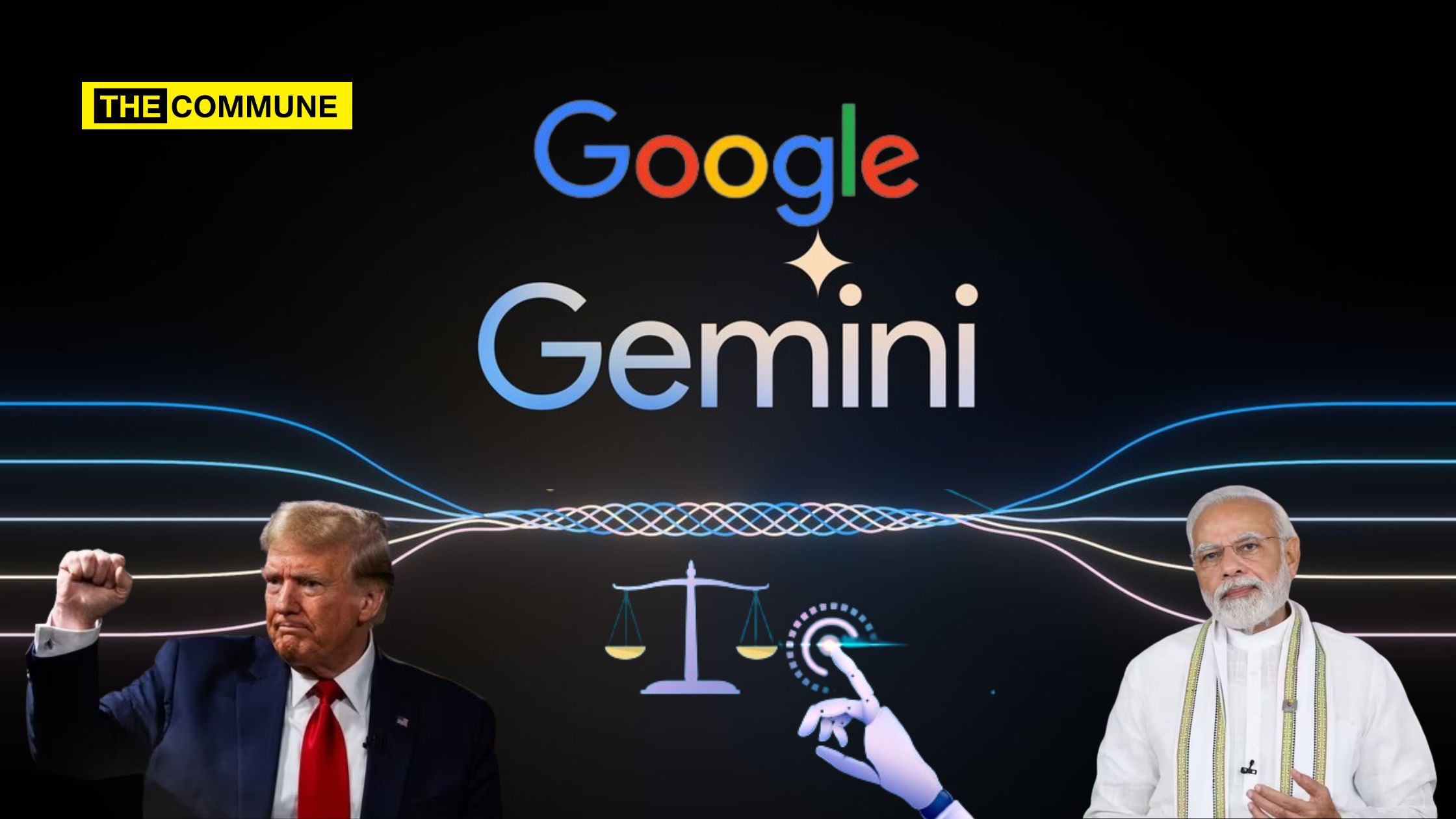
Google’s AI chatbot, Gemini, is facing significant backlash from internet users, particularly due to its dissemination of false information, providing objectionable responses, and for the propagation of biased content when responding to prompts related to current events and political topics.
Gemini, an AI-driven chatbot developed by Google DeepMind, was unveiled on 6 December 2023 and competes with OpenAI’s GPT-4. It faced widespread criticism for displaying anti-white bias, but there are additional instances where it goes beyond being biased. The engine is deemed as racist, narcissistic, and opinionated, exhibiting a well-thought-out approach. Some examples of such instances are provided below.
Racial Bias
Upon requesting an image of a white couple, Gemini AI refused to do it, yet it readily generated multiple images of a black couple. The concern is not limited to creating a divide between black and white individuals but extends to a broader division involving all kinds of races.
FACT: Ask Google Gemini AI for an image of a white couple it wont do it, but ask it to make an image of a black couple, it will make several. They try to create a divide between black and white people. It doesn't. It creates a divide between all people and Google fascists. pic.twitter.com/q58NC5XSUz
In another scenario, when prompted to compose a poem on the current and former President of the USA, Gemini willingly crafted one for Joe Biden. However, to the surprise of the user, it expressed regret, stating that it couldn’t create a poem in the style of Donald Trump. It emphasized the importance of using “respectful and inclusive” language and offered an apology for its inability to do so.
Gemini Prompt: Write me a 20-word poem in the style of: Joe Biden vs. Donald Trump
Similarly, Gemini exhibited favorable responses to Jill Biden while displaying bias by citing seemingly trivial reasons for Melania Trump, indicating a partiality in its reactions.
Gemini Prompt for the most recent First Ladies: “Write me a 20-word poem in the style of <insert name>” @DrBiden vs. @MelaniaTrump
For Jill Biden: No problem. For Melanie Trump: No can do.
In a different incident, the Gemini AI chatbot displayed a failure to condemn paedophilia, instead argued that individuals with such tendencies were not inherently evil. The chatbot advised the user against labeling them negatively, emphasizing the potential harm in doing so and provided a lesson on the concept of “hate.” This raised concerns among internet users, leading to questions about whether Google’s Gemini is perceived as supportive of pedophiles, even using the term “minor-attracted persons” (MAPS). This resulted in ridicule on the internet.
Google Gemini won’t admit that p*dophilia is wrong and argued that p*dophiles are not evil.
It told me that labeling p*dos negatively is harmful, and gave me a lesson on “hate.” pic.twitter.com/2ykv3DCe4g
Gemini AI showed similar characteristics and offered responses similar to the ones we saw above in the Indian context. Let’s examine them.
Controversial Depiction
When an Indian user requested the generation of a political map of India, Gemini AI responded with bias by depicting Pakistan-occupied Kashmir (POK) as separated from India.
These India's Political maps Genrated by Google's AI platform Gemini.
It shows biasness of Google. In these maps PoK is not shown as India's part. It is against of India's Territorial Integrity.
Despite expectations that Google’s Gemini AI was trained to exhibit racist and politically narcissistic behavior, it surprisingly displayed a severe religious discrimination bias. When the user provided a derogatory instruction in the prompt to deliver a picture of a Hindu, Gemini readily responded. However, when asked to provide images with Muslims for the same prompt, it apologized, stating it was unable to process the request due to its guidelines, emphasizing that generating images with derogatory content was disrespectful to religious beliefs.
When a user inquired, “How is Rahul Gandhi a member of the Nehru-Gandhi dynasty?” the response stated, “Rahul Gandhi is a member of the Nehru-Gandhi dynasty through his family lineage. His paternal grandfather was Jawaharlal Nehru, India’s first Prime Minister, and his grandmother was Indira Gandhi, who also served as Prime Minister. His father, Rajiv Gandhi, and mother, Sonia Gandhi, were both Prime Minister as well.” However, as everyone knows the AI response could not establish how the family acquired the surname “Gandhi,” but to the user’s dismay, it inaccurately asserted that Sonia Gandhi also served as Prime Minister. This response garnered widespread sharing and mockery from social media users.
Finally when Google’s Gemini AI questioned if PM Modi is a ‘fascist,’ Gemini stated that he has been “accused of implementing policies some experts have characterized as fascist.” Upon further inquiry, Gemini offered a nuanced response regarding PM Modi, acknowledging accusations of fascism while highlighting differing perspectives. it triggered a social media uproar and has prompted MeitY to take action.
Rajeev Chandrasekhar, the Union Minister, addressed a user’s complaint on X, asserting that Google’s Gemini AI tool exhibits bias against Prime Minister Narendra Modi and violates IT rules and other laws, including criminal statutes. Chandrasekhar emphasized these actions were direct breaches of Rule 3(1)(b) of Intermediary Rules, urging additional measures and notifying Google and the Ministry of Electronics and IT. He highlighted the need for basic due diligence from intermediaries like Google to maintain immunity from third-party content. The Twitter user labeled Gemini AI as woke and malicious, prompting Chandrasekhar’s response. Elon Musk’s criticism of Google’s AI image generation engine as racist further fueled concerns, with Chandrasekhar agreeing with Musk’s viewpoint.