Home Blog Page 770

CM Adityanath Announces Complete Ban On Meat & Alcohol During Mahakumbh In Prayagraj

During the Mahakumbh 2025, the sale of meat and alcohol will be prohibited within Prayagraj. Chief Minister Yogi Adityanath announced this on Sunday in the presence of representatives from all 13 akharas.

He stated that the Mahakumbh is organized between January 14 and February 16 under the guidance of the akharas, which are the flag bearers of Sanatan Dharma, with the state government providing support.

The Chief Minister said pilgrims worldwide would experience Sanatan culture during the Mahakumbh and that the government is dedicated to respecting this tradition.

While addressing the saint community at the Mahakumbh site, Chief Minister Adityanath underlined that every saint and devotee coming to bathe in the holy Triveni Sangam would witness the continuous and pure flow of the Ganga and Yamuna rivers.

He assured that efforts are being made to ensure the cleanliness of these sacred rivers, but also stressed the need for cooperation from the saint community.

The Chief Minister announced that land would soon be reserved in Prayagraj for the ‘samadhi’ of saints who pass away during the Mahakumbh.

He stressed that the progress of Sanatan society is possible under saints’ guidance and called for everyone to contribute to making Mahakumbh 2025 even grander than the previous one in 2019.

The Chief Minister mentioned the late Narendra Giri Maharaj and said that construction of a corridor near the Hanuman temple is being carried out.

He urged all saints to join the campaign for a clean Mahakumbh, asserting that avoiding the use of prohibited plastic would be appropriate. In response to the saint community’s demand for a ban on cow slaughter, the Chief Minister stated that cow slaughter is a crime in Uttar Pradesh, with penalties of up to life imprisonment.

The state government operates over 7,000 cow shelters, housing over 1.4 million cattle. He called for the support of the saint community in promoting cow conservation and suggested that every ashram develop cow protection facilities and engage in cow service. Prioritising security during the Mahakumbh, the Chief Minister urged all saints to verify the identity of anyone staying in their ashrams before granting permission.

Earlier, amidst Vedic chants and slogans praising Sanatan Dharma, the Chief Minister honoured each revered saint and Acharya with traditional shawls.

A short film regarding the management and arrangements for Mahakumbh 2025 was also presented to the saints. During this dialogue session with akhadas and saints, the representatives expressed that Chief Minister Yogi Adityanath protects Sanatan Dharma, under whom the community feels honoured.

They noted that he is the first Chief Minister to directly engage with saints regarding the Mahakumbh, listening to their concerns and suggestions. The saints expressed satisfaction with the preparations for Mahakumbh 2025 and affirmed that it would be grander and more divine than previous events.

They collectively thanked Chief Minister Yogi, highlighting the prevalent global tensions and the potential of Mahakumbh 2025 to convey a message of peace to the world.

–IANS

Subscribe to our TelegramWhatsApp, and Instagram channels and get the best stories of the day delivered to you personally.
Hon’ble Judges’ Burden: Judicial Overreach And The Erosion Of Personal Liberty In Isha Sadhguru Case

Judicial Overreach And The Erosion Of Personal Liberty In Isha Sadhguru Case

When I was in the 8th grade, our school administration mandated that we all speak English within the school premises. A friend jokingly remarked, “Angrez gaye par Angreziyat rah gayi hai” (The colonialists have gone but the colonialism remains). We all laughed at the time, and like every fleeting moment of innocence that one, too, faded into the past.

Earlier today, someone in a WhatsApp group shared a news clipping from a leading English newspaper titled, “When Jaggi Vasudev’s daughter is married, why is he telling others to be hermit?” The headline left me stunned. I reread it, hoping it was merely a journalist’s creative liberty, but it wasn’t. Instantly, I recalled the remark, “Angreziyat rah gayi hai” Such uninformed and casual commentary from those entrusted with the duty of delivering justice is deeply concerning.

Let’s first understand the context in which the Hon’ble Judges made these remarks. One S Kamaraj filed a habeas corpus petition under Article 225 of the Constitution of India, seeking ‘an order or direction more particularly in the nature of a writ of habeas corpus directing the respondent to produce the corpus or body of the petitioner’s daughters, Geetha Kamaraj alias Maa Mathi, aged 42, and Latha Kamaraj alias Maa Maayu, aged 39, daughters of Dr. Kamaraj, who are held captive inside Isha Foundation, Coimbatore, before this court and set them at liberty.

The Hon’ble High Court, during the adjudication of the matter, examined Maa Mathi and Maa Maayu, both of whom clearly stated that they had voluntarily taken Sanyas of their own free will. Yet, despite this, the Hon’ble Court, in its order dated 30.09.2024, stated:

…In view of the serious nature of the allegations raised against the institution and the way and the manner in which the detenues have spoken before us, we could form an opinion that some more deliberations are required to understand the truth behind the allegations. Therefore, the petitioner shall produce the details of criminal cases registered against the institution and the learned Additional Public Prosecutor also shall collect all those case details and place before us for further consideration.

What’s particularly intriguing here is that the petitioner, Mr. S Kamaraj, had earlier appeared in a habeas corpus petition filed by his wife, Mrs K Sathiajothi, in 2016, making similar allegations and seeking similar relief. In HCP No. 1656/2016 titled Mrs. K. Sathiajothi v. State of Tamil Nadu & Ors, the Hon’ble Division Bench directed the Principal District and Sessions Judge, Coimbatore, to visit the Isha Yoga Centre, interact with the family, and file a detailed report. Following the judge’s visit and interaction, the Hon’ble High Court dismissed the petition on 12.08.2016. The relevant portion of that order reads:

17. Having gone through the report of the learned Principal District Judge and having gone through the statements of Ms. Geetha Kamaraj and Ms. Latha Kamaraj, and having heard the statements of Dr. Kamaraj, the husband of the petitioner, and the learned counsel for the fifth respondent/Isha Foundation, and the learned Additional Public Prosecutor appearing for the State, we are of the view that as of now, there is no material on record even to remotely infer that Ms. Geetha Kamaraj & Ms. Latha Kamaraj are illegally detained by the Isha Foundation. Prima facie, we are satisfied that the detenues are staying in the Isha Foundation on their own volition, following a path of Sanyasin which they like. Therefore, no relief as prayed for in this petition can be granted.

18. In the result, this Habeas Corpus Petition is dismissed…

Despite the dismissal of a similar petition with the same prayers, the petitioner once again approached the Hon’ble High Court in the present matter. What concerns me is the lack of mindfulness in the remarks made by the Hon’ble Judges.

Regarding the legal framework for habeas corpus petitions, a three-judge bench of the Hon’ble Supreme Court, consisting of then Chief Justice Dipak Mishra, Justice AM Khanwilkar, and Justice DY Chandrachud, clarified the ambit of habeas corpus in the Shafin Jahan v. Asokan K.M. & Ors case, commonly known as the Hadiya case. While the bench reached the same conclusion, Justice Chandrachud wrote a concurrent judgment on the issue. The key observations from the judgment authored by the Hon’ble CJI for himself and Justice Khanwilkar are as follows:

“The ambit of a habeas corpus petition is to trace an individual who is stated to be missing. Once the individual appears before the court and asserts that as a major, she or he is not under illegal confinement, which the court finds to be a free expression of will, that would conclude the exercise of the jurisdiction…

The schism between Hadiya and her father may be unfortunate. But it was no part of the jurisdiction of the High Court to decide what it considered to be a ‘just’ way of life or ‘correct’ course of living for Hadiya. She has absolute autonomy over her person. Hadiya appeared before the High Court and stated that she was not under illegal confinement. There was no warrant for the High Court to proceed further in the exercise of its jurisdiction under Article 226.

The purpose of the habeas corpus petition ended. It had to be closed as the earlier Bench had done. The High Court has entered into a domain which is alien to its jurisdiction in a habeas corpus petition…

The duty of the Court is to uphold the right and not to abridge the sphere of the right unless there is a valid authority of law.

Justice Chandrachud, in his concurring judgment, added:

1…. The High Court of Kerala has committed an error of jurisdiction. But what to my mind, is disconcerting, is the manner in which the liberty and dignity of a citizen have been subjected to judicial affront… The reason for this concurring judgment is that it is the duty of this Court, in the exercise of its constitutional functions, to formulate principles in order to ensure that the valued rights of citizens are not subjugated at the altar of a paternalistic social structure….

23. The High Court, in the present case, has treaded on an area which must be out of bounds for a constitutional court. The views of the High Court have encroached into a private space reserved for women and men in which neither law nor the judges can intrude. The High Court was of the view that at twenty four, Hadiya “is weak and vulnerable, capable of being exploited in many ways”. The High Court has lost sight of the fact that she is a major, capable of taking her own decisions and is entitled to the right recognised by the Constitution to lead her life exactly as she pleases….

Thus, the legal position on habeas corpus is clear.  The Sanyasins appeared before the court and confirmed that they had taken Sanyas of their own free will. The matter should have been settled then and there. With the same issue already settled by the Hon’ble High Court in 2016, reopening it and subjecting two adult individuals—one aged 39 and the other 42—to further scrutiny is a clear violation of their constitutional rights. Do they not have the right to autonomy over their own lives? Is this not a repeat affront to their liberty and dignity at the hands of the judiciary?

What exactly is Sanyas? Can anyone force someone to take Sanyas? There are millions of people worldwide associated with Isha Yoga Centre, but are all of them Sanyasins? Certainly not. Only a select few have embraced the path of Sanyas, and they did so not because Sadhguru compelled them, but because Sanyas comes from within. Thousands of years ago, Prince Siddhartha renounced his kingdom and became a Sanyasi, known today as Gautam Buddha. Countless devotees of his have renounced worldly life, and many continue to do so each year. Similarly, Jain monks follow this path, with entire families—sometimes including minors—embracing Sanyas. In Hinduism, since time immemorial, people have taken up Sanyas, severing all worldly ties, sometimes even performing ‘Shradh’ for their living parents. Despite attempts by various foreign powers, from the Greeks to the British, to dismantle this institution of Sanyas, they all failed.

In independent India, many attempts have been made to discredit Gurus and Mathas, deterring people from associating with them. The attack on Sadhguru is just the latest in this ongoing effort. What’s troubling is the judiciary’s involvement. Are we now suggesting that courts must approve Sanyas? Sanyas often faces opposition from family members, and if courts start scrutinizing every case, it could undermine the institution and provide a tool for those seeking to erode our cultural heritage.

The unnecessary oral remarks by the Hon’ble Judges reveal how certain elements in our legal system still echo the approach of British judges before 1947. Much like how British judges, with little understanding of Indian culture and traditions, used to view matters through a Western lens, the oral observations made by the Hon’ble Judges regarding ‘Sanyas’ demonstrate that even after 75 years of independence, we continue to approach such issues with the same colonial mindset. While our country has attained sovereignty, ‘sovereignty of thought’ remains elusive.

This entire situation reveals the colonial mindset of some in the judiciary, who still view Dharma through the same lenses as the British did. It’s a complete disregard for our cultural heritage and traditions. What was once the “White Man’s Burden” seems to have transformed into the “Hon’ble Judges’ Burden.”

Shivam Raghuwanshi is an Advocate at Supreme Court of India and author of book ‘Ballot, Bullet and Blood’.

Subscribe to our TelegramWhatsApp, and Instagram channels and get the best stories of the day delivered to you personally.
AI Can Be As Dangerous For World As Nuclear Weapons: EAM Jaishankar

Jaishankar on AI

External Affairs Minister Dr S. Jaishankar on Sunday said that artificial intelligence (AI) will be a profound factor for the world, after nuclear weapons.

Participating in the third edition of the Kautilya Economic Conclave, organised by the Institute of Economic Growth and the Finance Ministry, on its third and final day, Jaishankar said that AI is going to be the next big thing and that countries should be prepared to deal with its after-effects. He further said that AI is also going to become a profound factor in the global ecosystem.

“AI will be as dangerous for the world as nuclear bombs once were,” he observed. Minister Jaishankar also said that demographics, connectivity, and AI will change the global order.

“Globalisation can be weaponised in the next decade and the world must be cautious about it. Many people worldwide blame it for the large number of job losses and other negative effects of the revolution.

This issue will remain as long as there is change (globalisation),” he said, noting that the social and political reaction to globalisation has gained momentum in the last decade. The realities of globalisation inevitably collide with protectionism, he said.

The External Affairs Minister also said that in today’s era, the United Nations’s role has become only that of a spectator. Comparing the United Nations to the business world, he said that it is an old business that is taking up a lot of space but is not changing according to the world.

On the ongoing Middle East conflict, he said that today the fight is taking place only for economic corridors, land and sea, but in the future, there will be fights over climate change also. He further highlighted that the Global South feels these geopolitical tensions’ impacts more acutely than others, raising concerns about the region’s stability.

–IANS

Subscribe to our TelegramWhatsApp, and Instagram channels and get the best stories of the day delivered to you personally.
Questioning Reliability Of Exit Polls: A Closer Look At Their History Of Inaccuracy In Elections

Questioning Reliability Of Exit Polls

As the Haryana and J&K Assembly elections draw to a close, survey agencies are back in action with their Exit Polls.

However, one must question why these pollsters should be trusted, especially given the numerous instances of significant inaccuracies in their projections in the past.

While Exit Polls claim to offer insights into voter sentiment, a closer look at past elections – Lok Sabha and Assembly – reveals a troubling trend: pollsters frequently misjudge actual outcomes.

The consistent failures of Exit Polls to align with reality raise serious doubts about their reliability. Based on some data related to past predictions, IANS has made an assessment of the history of overestimations by the Exit Polls.

2014 Lok Sabha elections In the 2014 parliamentary elections, pollsters predicted a substantial win for the BJP-led National Democratic Alliance (NDA), with an average prediction of 283 seats.

But the actual result was a massive 336 seats for the NDA. The BJP alone secured 282 seats. This suggests that the polls could not gauge the scale of the win. This underlined the disconnect between the data and voter mood.

2019 Lok Sabha elections The prediction in 2019 polls was that the NDA would secure around 306 seats. On the contrary, the NDA bagged 353 seats. The BJP alone got 303. Once again, the Exit Polls failed to judge the mood of the electorate.

Voters favoured the NDA by a larger margin than what was predicted. 2024 Lok Sabha elections Exit Polls projected a massive victory for the NDA in 2024 parliamentary polls, with estimates ranging from 361 to 401 seats.

However, the actual results were far more modest, with the NDA ending up with just 293 seats and the BJP alone winning 240. This was a loss of 63 seats from their previous tally. This marked a significant blunder in Exit Poll predictions.

The 2004 Lok Sabha elections were interesting in this context. The pollsters overestimated the BJP-led NDA’s chances. They had predicted a comfortable majority with seats ranging from 240 to 275 seats.

The outcome, however, was a shock, with the NDA securing only 187 seats, whereas Congress and its allies emerged victorious with 216 seats. Discrepancies in state polls These inaccuracies extend beyond national elections to state assemblies as well.

For example, in the 2019 Haryana Assembly elections, Exit Polls suggested that the BJP would secure around 61 seats, with some estimates soaring as high as 75-80 seats. The reality was completely different: the BJP won only 40 seats, while Congress managed to capture 31, contradicting the Exit Polls’ indications about a clear BJP majority.

In this Haryana polls, C Voter had predicted 72 seats for BJP which turned out to be only 40. Similarly, Exit Polls predicted a competitive fight in Chhattisgarh Assembly polls in 2023 but were again off the mark.

The BJP won 54 seats compared to expectations of 34-42. The 2023 Madhya Pradesh Assembly elections saw pollsters predicting a BJP majority, with estimates ranging from 140 to 162 seats.

Ultimately, the BJP won 163 seats, which, while close, still reflected the unpredictability of voter behaviour. In the 2021 Bengal Assembly elections, predictions of an overwhelming BJP victory (with estimates ranging from 138 to 185 seats) were smashed as the Trinamool Congress (TMC) emerged winner with 215 seats, leaving the BJP with just 77.

–IANS

Subscribe to our TelegramWhatsApp, and Instagram channels and get the best stories of the day delivered to you personally.
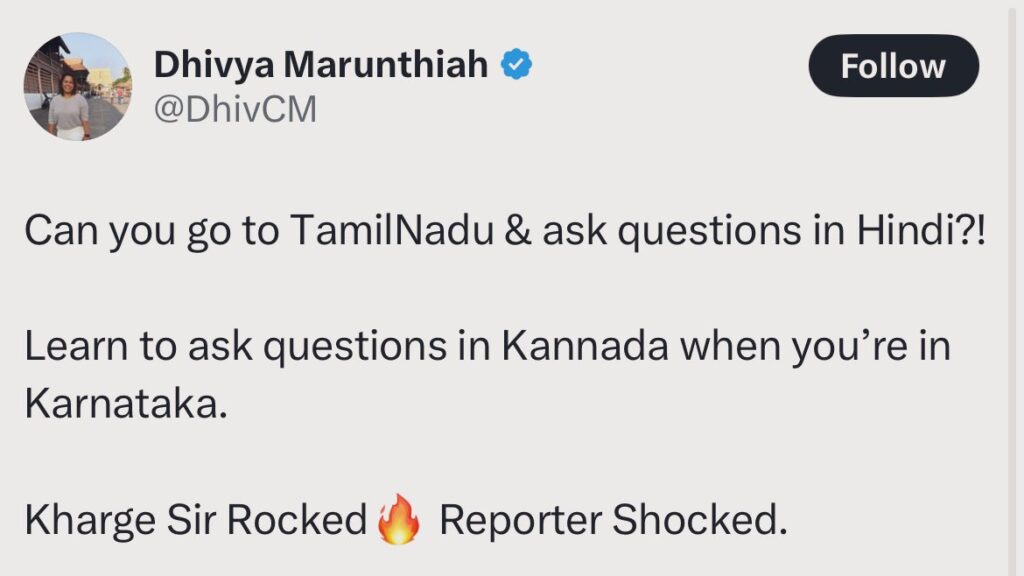
Beautician YouTuber-Turned, MNM Functionary-Turned, DMK IT Wing Functionary Peddles Fake News About PM Vishwakarma Scheme, Here Are The Facts

Beautician YouTuber-Turned DMK Functionary Peddles Fake News About PM Vishwakarma Scheme

Padma Priya, a YouTube beautician who gained attention through her so-called ‘environmental activism’ video and later transitioned into politics by joining Kamal Haasan’s Makkal Needhi Maiam before becoming a DMK IT Wing functionary, has spread blatantly false information about the Prime Minister Vishwakarma Scheme in an attempt to target the Narendra Modi government.

In a video titled “Hereditary Education Scheme 2.0, The Scheme That Was Abolished Is Being Brought Again By Modi” in Tamil, DMK IT Wing State Deputy Secretary Padma Priya goes on to say “Kids of those who stitch slippers have to do only stitching slippers. A barber’s son should become only a barber. Those who make garlands, nets, pots, and washermen – all their children have to do only their hereditary jobs. Students who have completed 18 years of age, instead of going to college to become doctors, engineers, scientists, and government officials, if they’re ready to learn their hereditary jobs, the Union BJP government is giving an incentive of ₹500 and promoting their hereditary jobs. This scheme, which on hearing makes us frown, is called Vishwakarma Yojana.

She further goes on to say “Teaching students of 18 years and above a vocational skill is not wrong but this scheme incentivizes only children of specific communities and this Vishwakarma scheme has been introduced to promote only these 18 professions.

She claims that the PM Vishwakarma Scheme has been brought in only to incentivize professions done by communities who are socially and economically backward.

She also peddles false information that unemployment rate has been rising in India when infact it has been the opposite. In April to June 2024, India’s unemployment rate was 6.6%. This is a slight decrease from the previous quarter, when the rate was 6.7%.

PM Amit Shah.. Sorry.. PM Modi instead of taking forward, you know where he is taking India by now.“, she says.

The Truth About PM Vishwakarma Scheme

The PM Vishwakarma Scheme, launched by Prime Minister Narendra Modi in September 2023, is a government initiative aimed at supporting traditional artisans and craftspeople across India. The scheme is named after Vishwakarma, the Hindu deity associated with craftsmanship, and is designed to empower those involved in traditional skills that are often passed down through generations. It is a Central Sector Scheme which means that it is fully funded by the Central Government.

1. Target Beneficiaries: The scheme focuses on artisans and craftsmen like carpenters, blacksmiths, goldsmiths, potters, tailors, weavers, and other traditional workers who rely on their manual skills for livelihood.

2. Objectives:

  • To enhance the skills of these workers.
  • To provide financial support for upgrading tools and technology.
  • To preserve and promote traditional crafts that are often at risk of being overshadowed by modern industries.
  • To improve the market access and overall economic stability of the beneficiaries.

3. Financial Assistance: The scheme offers easy access to credit through micro-loans. Under the scheme, artisans can avail loans of up to ₹1 lakh in the first tranche and up to ₹2 lakh in the second tranche. These loans come with a concessional interest rate of 5%, helping reduce the financial burden on the workers.

4. Training and Skill Development: In addition to financial aid, the scheme provides comprehensive skill training to improve the quality of traditional crafts. This includes upskilling programs to modernise their craft techniques while retaining their traditional essence.

5. Market Linkage: The PM Vishwakarma Scheme aims to connect artisans with larger markets, enabling them to sell their products more widely and effectively, both domestically and internationally.

6. Subsidies for Tools and Equipment: Beneficiaries receive financial assistance for purchasing modern tools and equipment to help enhance their productivity and the quality of their products.

7. Social Security and Recognition: The scheme also aims to provide better social security coverage for these workers and recognize their contribution to the economy by promoting their skills and craftsmanship nationally.

The PM Vishwakarma Scheme is an effort to protect and revitalize India’s rich tradition of craftsmanship while empowering skilled artisans to become financially self-reliant and competitive in a modern marketplace. The initiative also aligns with the government’s larger vision of promoting “vocal for local” and supporting the MSME sector.

Busting The Myths Of PM Vishwakarma Scheme

Myth: The scheme promotes caste-based professions.

Fact: No, caste is not an eligibility criterion for the PM Vishwakarma Scheme. The scheme focuses on providing support to individuals engaged in traditional craftsmanship and artisanal professions, such as carpenters, blacksmiths, goldsmiths, potters, tailors, and other similar trades, regardless of their caste background. The eligibility is based on the type of profession, not caste, with the goal of helping traditional artisans and craftsmen, many of whom may come from historically marginalized communities, but caste itself is not a determining factor.

The emphasis is on promoting and supporting traditional skills, enhancing livelihoods, and providing financial assistance, training, and market access to those already involved in these professions.The goal is to empower artisans, not to reinforce caste-based roles.

Myth: The scheme encourages students to leave their education for traditional professions.

Fact: The scheme is NOT intended for students to abandon their studies and pursue traditional professions. It is designed for individuals who are ALREADY employed or self-employed in one of the 18 traditional professions, offering them support such as technology assistance, loans, insurance, and more. If you are currently a goldsmith, carpenter, mason, or involved in any of these trades, you are eligible to register. It provides financial aid, skill development, and technological assistance to enhance their livelihoods, not to draw new entrants away from education.

Myth: The scheme is only for people practicing hereditary occupations.

Fact: While the scheme supports traditional professions, it does not limit eligibility to those who have inherited these skills from their families. Anyone currently working in the listed professions can apply for benefits under the scheme. For example, a father might be a mason, while the son is free to pursue any career, such as becoming an engineer or a doctor. However, suppose the son has already become a goldsmith or chosen any of the 18 listed professions (which doesn’t have to match the father’s occupation). In that case, he is still eligible to benefit from the scheme.

Subscribe to our TelegramWhatsApp, and Instagram channels and get the best stories of the day delivered to you personally.
AIADMK To Hold Party’s Foundation Day Celebrations From Oct 17-20

AIADMK To Hold Party's Foundation Day Celebrations From Oct 17-20 eps madras high court

The AIADMK, the principal opposition party in Tamil Nadu, will conduct its 53rd Foundation Day celebrations from October 17 to 20. Party General Secretary and Leader of Opposition in Tamil Nadu Legislative Assembly, Edappadi K.Palaniswami (EPS), will inaugurate the celebrations at Kancheepuram on October 17.

In a statement on Saturday, EPS said he was overwhelmed that the AIADMK, founded by iconic leader M G Ramachandran (MGR) and taken forward by ‘Amma’ Jayalalithaa, was celebrating its 53rd Foundation Day.

The party will conduct public programmes across the state. The AIADMK leader also said the Foundation Day celebrations would be held in Puducherry and Andhra Pradesh.

AIADMK leaders KP Munusamy, Dindigul C Sreenivasan, and Natham R Viswanathan will address the people of the state. Party cadres and leaders will also garlands the statues of MGR and J. Jayalalithaa.

On the occasion, beneficial aids and food will also be distributed by the party cadres. The AIADMK is facing an uphill task to come to power in Tamil Nadu after it lost the 2021 Assembly elections. In the 2024 Lok Sabha elections, the AIADMK and its allies drew a blank.

The BJP-AIADMK alliance in Tamil Nadu fell apart after K Annamalai became the BJP’s state president. This led to major losses for the BJP and AIADMK, and both parties could not win a seat in the Lok Sabha elections.

C Rajeev, Director of the Centre for Policy and Development Studies, a think tank based in Chennai, told IANS: “If the BJP and AIADMK were in an alliance for the 2024 Lok Sabha elections, both would have been in a win-win situation, and the NDA could have garnered a minimum of ten seats.”

The AIADMK is facing a major internal problem after the party expelled its senior leader and former Chief Minister of Tamils Nadu, O. Panneerselvam, late Jayalalithaa’s close aide VK Sasikala and her nephew TTV Dhinakaran from the party. This led to the AIADMK dividing into different groups thus weakening itself. Sources in the AIADMK told IANS that unofficial discussions are taking place between the various factions of the party for a probable merger between the different factions.

–IANS

Subscribe to our TelegramWhatsApp, and Instagram channels and get the best stories of the day delivered instantly.

Taxpayer-Funded DMK Govt’s Fact-Check Unit Peddles Fake News About Chennai Metro Rail Funding, Centre To Fund Almost 65% Of Phase 2

Taxpayer-Funded DMK Govt's Fact-Check Unit Peddles Fake News About Chennai Metro Rail Funding

In yet another instance of disseminating false information at taxpayers’ expense, the TN Fact Check Unit—a controversial state government agency often accused of targeting opposition voices—has wrongly claimed that the Central Government is providing only ₹7,425 crores in funding for the Chennai Metro Rail instead of the actual ₹63,246 crores.

The Fake News Peddled By TN Fact-Check

The DMK government’s TN Fact Check posted on social media that the BJP wrongly claims that the Central Government is funding ₹63246 crores of Phase 2 of the Chennai Metro Rail project.

The post said that the Central Government was funding only ₹7,425 crores, with the state government putting in ₹22228 crores and the rest ₹33593 through loans based on guarantees of the Tamil Nadu government.

You-Turn, a Dravidianist propaganda media outlet whose former Editor-In-Chief now leads the TN Fact Check unit, falsely claimed that the responsibility for repaying the Chennai Metro loan ultimately lies with the state government. They cited an official Government of India press release asserting that the state must step in if Chennai Metro Rail Limited (CMRL) cannot meet its repayment commitments. This narrative, however, distorts the actual terms and misrepresents the situation.

What’s The Truth?

The Union Cabinet recently approved Chennai Metro Rail Project Phase 2 as a ‘Central sector’ project at an estimated cost of ₹63,246 crore. Previously, the project was classified as a ‘State sector’ initiative, with the Government of Tamil Nadu responsible for financing nearly 90% of the project cost. The Central Government’s contribution was limited to 10%, excluding land and certain other expenses, as per the 2017 Metro Rail Policy. However, the Centre had helped Tamil Nadu secure ₹32,548 crore in loans from bilateral and multilateral agencies, of which around ₹6,100 crore has been used.

With this new approval, the central government will finance about 65% of the project cost, covering the entire loan amount of ₹33,593 crore, along with equity and subordinate debt of ₹7,425 crore. The State Government will fund the remaining 35%.

The loans from international agencies will now be treated as central government loans and routed directly to Chennai Metro Rail Limited (CMRL) through the Centre’s budget instead of through the State Government. This change relieves Tamil Nadu of securing loan financing for the project, freeing up ₹33,593 crore for other state development activities.

The Ministry of Finance will renegotiate loan terms with agencies like the Japan International Cooperation Agency, Asian Development Bank, Asian Infrastructure Investment Bank, and New Development Bank to treat the loans as central government debt. The loan flow will now go from these agencies to the central government and then directly to CMRL. The Ministry of Housing & Urban Affairs, through CMRL, will take over as the project’s executing agency from the State Government.

CMRL will be responsible for repaying the loans, typically starting after a five-year moratorium. That means, this repayment will start tentatively from 2032. If CMRL is unable to repay, the State Government will be obligated to provide financial support for the repayment. The CMRL is a joint venture of Government of India and the State Government of Tamil Nadu.

It is utterly absurd to prematurely assume that CMRL will be unable to service the loan, especially given the potential for increased ridership and passenger growth. This raises the question: has the TN Fact Check Unit somehow time-travelled and assessed CMRL’s financial status years ahead? Their conclusions seem far-fetched and speculative at best.

Other Instances Of TN Fact-Check Peddling Fake News

Previously on 24 January 2024, The official Tamil Nadu BJP handle released a video alleging severe food shortages at the MGR Stadium in Madurai, claiming athletes were provided only a chapati and a half-boiled egg. Athletes and coaches raised concerns about the inadequate food portions, with reports indicating a private contractor managing the food arrangements. The district administration, including Collector Sangeetha, intervened, assuring prompt resolution of the issues within a day. DMK MP Venkatesan emphasized the potential harm to Tamil Nadu’s reputation, and the official fact-check team of the state government refuted the claims, labeling them as fake news.

In November 2023, when allegations of Aavin reducing fat content in the green packet milk surfaced, instead of proving that the milk contained a specific amount of fat as claimed or other details that pertained to the topic of discussion, the FCU’s Mission Director ended up fact-checking the “container” in which the sample was received.

About TN Fact Check

The DMK government in Tamil Nadu has faced criticism for establishing a state-run FCU. Critics allege that this unit, headed by former and Dravidian propagandist YouTuber Iyan Karthikeyan, was created without transparency and aimed to crack down on dissent. Concerns have been raised about the lack of public notice for job recruitment and potential favouritism in appointments, sparking allegations of suppressing free speech and to cover-up government fallacies. A public interest litigation (PIL) has been filed against the unit in the Madras High Court, challenging its constitutionality.

Subscribe to our TelegramWhatsApp, and Instagram channels and get the best stories of the day delivered instantly.

Colder Winter Expected In Mongolia

Colder Winter Expected In Mongolia

According to the National Agency for Meteorology and Environmental Monitoring on Saturday, most parts of Mongolia are predicted to experience colder temperatures than the long-term average during the upcoming winter.

“During the upcoming winter months, most regions of Mongolia, particularly in the eastern part of the country, are expected to experience temperatures below the long-term average, along with increased precipitation,” the weather monitoring agency said, urging the public, especially nomadic herders, to take necessary preparations for the colder winter ahead in Mongolia.

Last winter, Mongolia faced extreme wintry conditions known as dzud, accompanied by record snowfall — the largest since 1975 — with around 90 per cent of the territory covered in snow up to 100 centimetres thick. The harsh weather conditions last winter resulted in the deaths of at least 7,949,400 livestock animals across the Asian country, accounting for over 10 per cent of Mongolia’s total livestock population, according to the National Statistics Office.

“Dzud” is a Mongolian term to describe a severely cold winter when many livestock animals die because the ground is frozen or covered in snow. Mongolia’s climate is characterised by a strong continental influence, featuring long, frigid winters and short, warm summers. Temperatures around minus 25 degrees Celsius are considered normal during winter.

–IANS

Subscribe to our TelegramWhatsApp, and Instagram channels and get the best stories of the day delivered to you personally.
Meiyazhagan Film Director Justifies Placing Anti-Hindu EVR & Hindu God Murugan On Same Pedestal Exposing His Ignorance About How EVR Disgustingly Described Birth Of Murugan

Meiyazhagan Film Director Justifies Placing Anti-Hindu EVR & Hindu God Murugan On Same Pedestal

In an interview with acclaimed film critic Baradwaj Rangan, the director of ‘Meiyazhagan’ film C Prem Kumar (who also made the film 96) justified showing portraits of EV Ramasamy Naicker (hailed as ‘Periyar’ by his followers) and Hindu God Murugan in the same frame, saying that Tamil people celebrate EVR as much as Murugan.

Tamil people are like that. As much as we go to a Murugan Temple, we celebrate Periyar too. He is literally like a clan deity for us. Because if he had not fought, I’m not sure if we would’ve got this much rights. A few were there before and after, but the impact that he gave is almost in our genes. Even to this generation, he’s relevant as youngsters proudly wear t-shirts that say ‘I’m Periyar’s grandson’. We should venerate him.“, the Dravidianist director said.

The Meiyazhagan director then went on to expose the typical separatist undercurrent present in the mind of a Dravidianist, saying, “Because we’re so educated today, we’ve a fighting spirit in us, we boldly talk back. All over India, we’ve our own separate identity as Tamil Nadu. Other state people fear us. That fear comes from him.

Kumar further went on to peddle half-truths about how EVR was not against any religion and how he is hailed as a ‘Vaikkom Veerar’.

However, here’s where the Meiyazhagan film director exposed his ignorance and peddled the usual Dravidianist rhetoric on EVR.

What EVR Said About Hindu God Murugan

This is how EVR disgustingly described the birth of Hindu God Murugan as per the book Thoughts of Periyar EVR and was originally cited from “Kadavul Oru Karpanaye – 1971″:

The birth of Kandhan (another name for Murugan’s) has been explained in Ramayanam, Kanchi Puranam and (S)Kandha Puranam. Apparently, Devas asked Siva “Oh Lord Siva! The atrocities of demons has increased. We’re not able to bear it. You’ve to give birth to a son who is valiant to slay them” and prayed to him. Accordingly, Lord Siva married Parvathi and started having sex with her to get a child. Sivan and Parvathi kept having sex for a thousand years. The Devas after seeing that the child has not been born despite having sex for a thousand years, feared that ‘If a child is born now, the world can’t handle. It will be that strong. It might destroy the world.’ They went to Siva and prayed to him to stop having sex. Siva responded to them, saying, “As per your wish, I don’t have a problem in stopping. But what do I do with the sperm that comes out?”. Immediately, the Devas cupped their hands and asked him to release the sperm in there. Accordingly, Siva released his sperm in their hands and asked them to drink it. Devas drank it. Siva released the remaining sperms in the Ganga. Ganga couldn’t bear it and started boiling. The Devas who drank it got pregnant. They went to Siva, prayed and asked him for a remedy for this pregnancy problem. Siva apparently told them their pregnancy would be resolved if they took a bath in Suragareeswarar Pond in Kancheepuram. Devas accordingly took a dip in the pond and relieved themselves of the pregnancy. The sperms of Siva, which was flowing in the earth, split into six branches and became six babies. Six ladies fed those six babies milk. Since giving milk to 6 babies was difficult, they made the six babies into 1. Because of this, the body became 1, and the head became 6. That’s the story of ‘Arumugam’ (another name for Lord Murugan). Since he emerged from a ‘Skalam’, hence the name ‘Skandha’. Brahma made his daughter his wife. Lakshmi had sex with a horse. These are the qualities of the Gods we have!”

Busting The ‘Vaikom Veerar’ Myth

The Vaikom Satyagraha, a historic nonviolent agitation that began in March 1924, sought to secure the right of lower caste members to walk on the roads leading to the Vaikom Temple in Travancore. Led by Indian National Congress leaders, particularly George Joseph (Rosappu Dorai), and inspired by Hindu reformer Shree Narayana Guru, the movement aimed to abolish untouchability and allow Dalits entry into temples.

Although EV Ramasamy Naicker (Periyar) had minimal involvement—attending only one event during the year-long protest—he is credited as a central figure in Tamil Nadu. School textbooks refer to him as the “Vaikom Warrior” despite historical evidence showing he was not the leader. Meanwhile, Rosappu Dorai remains unrecognised mainly, and the Dravidar Kazhagam has promoted Periyar as the hero of the struggle despite his limited role.

Subscribe to our TelegramWhatsApp, and Instagram channels and get the best stories of the day delivered to you personally.
Thirumavalavan’s Anti-Women Comments Made In The Past

VCK MP Thirumavalavan praising Hamas

Viduthalai Chiruthaigal Katchi (VCK) conducted a women’s conference on alcohol and drug addiction on 2 October 2024 in Ulundurpettai, Kallakurichi, on Mahatma Gandhi’s birthday. Party leader Thol Thirumavalavan inaugurated the conference by giving a speech on the importance of alcohol prohibition.

However, the event soon became a political battleground after senior BJP leader Tamilisai Soundararajan criticized Thirumavalavan’s participation in the conference. Soundararajan, a former Governor of Telangana and Puducherry, questioned the sincerity of the event, claiming there was no real support for the anti-liquor movement even within VCK.

Soundararajan also pointed out that Thirumavalavan had paid tribute to Kamaraj at a memorial instead of Mahatma Gandhi on the latter’s birth anniversary. She remarked, Thirumavalavan went to pay tribute to Kamaraj instead of Gandhi. Perhaps he avoided it due to a guilty conscience that his party’s policies don’t align with Gandhi’s principles.”

In response, Thirumavalavan fired back during his speech at the conference, explaining that he had intended to pay tribute to Gandhi but could not due to the Governor’s visit. The police informed me that I could only pay my respects to Gandhi after the Governor had done so. Since the conference was about to start, I placed the garland meant for Gandhi on Kamaraj’s statue and left, Thirumavalavan clarified.

However, he didn’t stop there, accusing Soundararajan of insinuating about his habits. What Tamilisai is trying to say is that Thirumavalavan is a man who can open a bottle every day. Sister Tamilisai, I hope you don’t drink. I hope you don’t have a drinking habit. Like you, I don’t have that habit, he added pointedly.

Thirumavalavan has a history of speaking derogatorily about women. Here are a few examples.

Hindu Women Are Prostitutes

Speaking at an online seminar on 27 September 2020 organized by Periyarist groups ( European Periyar Ambedkar Comrades’ Federation), Thirumavalavan called Hindu women prostitutes citing Manusmriti.

“If one were to look at how women are valued in Sanatana Dharma… how they are treated… how they are being suppressed for time immemorial… how they are being exploited… what does Sanatana Dharma say about women? Women are basically created as prostitutes by God. All women are prostitutes as per Hindu Dharma… Manu Dharma. All women are prostitutes. That is how they have been created by God. They are of lower status than men. This applies to Brahmin women as well as women of other castes. This is what the Sanatana Dharma says, he said.

Their Women Go Behind Our Men Because Their Men Don’t Have Stuff

A few years ago, he made crass comments on the women of a community. In the video, he is seen saying thattheirwomen go behindourmen becausetheirmen do have have anystuff’.

For these people, what has been taught as honor is onlywomen matter’… Not any other darn (mairu) thing… They are jealous that their women are notlookingat them… Those guys are fair, have a moustache, wear ironed clothes, wear shoes worth thousands of rupees, spray scent worth thousands of rupees… Despite all this, they [referring to women of that caste] are not looking at them… But if she is looking at a man belonging to a poor household, born to oppressed class people like Chakliyan, Pallan, Paraiyan, then understand what your [referring to men of those castes] worth is… Women from your community show what you [referring to men of those castes] are worth…Despite having everything, there is no use in you. There is no stuff in you [referring to men of those castes]. Even if he is poor, he has stuff and strength (sarakku midukku)… That is why I go behind him… If you have an iota of honor, hang yourself to deathis what their women say, Thirumavalavan says in that speech.

He further adds Their men… They don’t care even if their women have slept with our men for 10 months. They will sayIt is okay… I will wash it off…You come and live with me…This is the disgusting politics these disgraceful beings do.”

He also said that when the women of his village or family ran away with another man, the parents would try to persuade the girl to come with them, but if the girl stood her ground, the parents would just go take a dip in the river and sever ties with the girl. Thirumavalavan made this speech when the Paatali Makkal Katchi had accused the VCK and its men of luring the young girls in their community into marriage.

Subscribe to our TelegramWhatsApp, and Instagram channels and get the best stories of the day delivered to you personally.