Home Blog Page 74

DMK Govt Says No Caste Name For Streets, But Stalin Says Coimbatore Flyover Will Be Named After GD ‘Naidu’
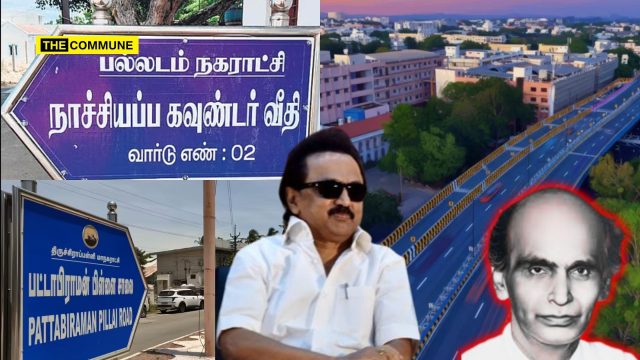
The DMK government in Tamil Nadu has ordered the removal of all caste-based names from streets, localities, and water bodies by 19 November 2025. These must be replaced with neutral names such as Tamil literary figures, eminent leaders, or flowers. The directive, issued on October 6 by Chief Secretary N. Muruganandam, includes 16 suggested names such as Tiruvalluvar, Avvaiyar, Kabilar, Bharathiyar, ‘Periyar’, and former Chief Ministers C.N. Annadurai and M. Karunanidhi.

For water bodies, the state suggests adopting one of 15 flower names like Roja, Malli, Sembarathi, or Suryagandhi. This move builds on Chief Minister M.K. Stalin’s earlier announcement (on April 29) to eliminate the term “colony” from official records and public usage.

Names such as Adi Dravidar Colony, Harijan Colony, Vannankulam, Paraiyar Theru, and Sakkiliyar Salai are to be rescinded and replaced by caste-neutral alternatives.

Former Chief Minister MG Ramachandran and J. Jayalalithaa have been omitted which is seen as political vengeance.

Meanwhile, Chief Minister M.K. Stalin on Tuesday announced that the state’s longest flyover, the Avinashi Road Elevated Corridor in Coimbatore, will be named after inventor and industrialist G.D. Naidu, a decision that has drawn mixed reactions, particularly in light of the DMK’s repeated claims of working to eliminate caste identities from public life.

Stalin, in a post on X, said his government had completed 95% of the project’s work after assuming office, noting that only 5% had been finished when the DMK came to power. He said the 10.10 km-long flyover, built at a cost of ₹1,791 crore, reflects the government’s commitment to infrastructure and progress under the “Dravidian model.”

The Chief Minister added that the structure was being named after G.D. Naidu, hailed as the “Edison of India”, describing him as a close ideological associate of Periyar (original name – EV Ramasamy Naicker) and a symbol of innovation and scientific spirit.

The Avinashi Road Elevated Corridor, executed by the Special Projects Wing of the State Highways Department, stretches from Uppilipalayam to Goldwins and is expected to ease traffic congestion along one of Coimbatore’s busiest routes. The inauguration is set to take place on 9 October 2025.
While many industrialists and civic groups welcomed the naming, the inclusion of “Naidu” in the official title has prompted questions about the DMK’s consistency on caste-related issues. Critics noted that the ruling party has frequently advocated removing caste-based titles and surnames from public and official usage.

Local industry representatives, however, praised the gesture. J. Sathish, director of the Kongu Global Forum, said G.D. Naidu’s contributions to entrepreneurship, technical education, and social upliftment were “woven into the fabric of Coimbatore.” Rajesh B. Lund, president of the Indian Chamber of Commerce and Industry, Coimbatore, said the naming was a “fitting tribute” to a visionary who embodied the city’s industrious spirit.

The irony couldn’t be starker — while the DMK government orders the removal of caste names from streets and villages, it proudly names a major flyover after G.D. Naidu. In Tamil Nadu, it seems caste names are objectionable only when politically inconvenient.

(With inputs from The New Indian Express)

Subscribe to our channels on TelegramWhatsApp, and Instagram and get the best stories of the day delivered to you personally.

BJP, PMK Slam DMK Govt Over Child Rapist And Murderer Dashwanth’s Release

BJP, PMK Slam DMK Govt Over Child Rapist And Murderer Dashwanth's Release

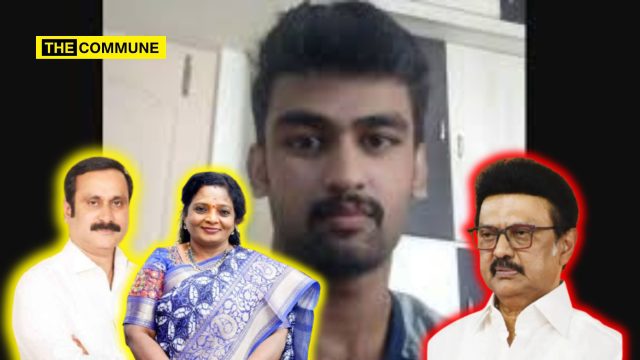
The Supreme Court’s acquittal of S. Dashwanth in the 2017 rape and murder of a six-year-old girl has ignited a political firestorm in Tamil Nadu, with opposition parties training their guns on the ruling DMK government for a “catastrophic failure” of law and order that led to the convict walking free.

Leaders from the Bharatiya Janata Party (BJP) and the Pattali Makkal Katchi (PMK) have condemned the release, labeling it a “black day” for child safety and placing the blame squarely on the state’s “Dravidian Model” government for its incompetent police investigation and prosecution.

PMK Chief Anbumani Ramadoss: “A Painful Example of Powerlessness”

PMK President Dr. Anbumani Ramadoss led the charge, posting a detailed condemnation on social media platform X. He stated that the acquittal of Dashwanth, who was previously sentenced to death and 46 years in prison, is a “painful example of how powerless we are in getting justice for children who are victims of human animals.”

“This case was not conducted properly from the beginning,” Anbumani wrote, highlighting the procedural lapses. “Dashwant got bail as the chargesheet was not filed within 3 months. Since then, the case has started to change course.”

He expressed deep anguish over the Supreme Court’s reasoning, which pointed to insufficient video evidence and mismatched DNA results. “If Dashwant did not do anything wrong in this case, then who killed Hasini? The question arises,” he questioned, demanding accountability from the police and government.

“The government and the police should bow their heads for this,” he asserted, concluding his post with a call for a review petition and systemic reforms to ensure punishment for culprits in heinous cases.

BJP’s Tamilisai Soundararajan: “Women’s Safety Hanging by a Thread”

Adding to the chorus of condemnation, BJP leader and former Telangana Governor Dr. Tamilisai Soundararajan expressed her shock and pain over the release. In a strongly worded post on X, she wrote, “Hasini.. The beast accused of brutally assaulting and burning this child to death has been released today.. The reason given by the court.. Proper evidence was not submitted.”

She framed the acquittal as a direct result of the deteriorating law and order in the state under the DMK regime. “That beast has been released.. In Tamil Nadu, women’s safety is hanging by a thread…. Pain.!,” she stated.

Echoing Anbumani’s demand, Tamilisai called for immediate action. “A re-investigation is needed… The cruel one must be hanged,” she demanded, underscoring the public outrage and the demand for justice for the victim, Hasini.

 A Collapse of Justice Becomes a Political Flashpoint

The coordinated criticism from the BJP and PMK turns a tragic judicial outcome into a major political issue. The opposition is leveraging the acquittal to paint the DMK government as weak on law and order, incapable of protecting its most vulnerable citizens, and presiding over police force whose incompetence allows heinous criminals to escape punishment.

The central thrust of their attack is that the Supreme Court’s acquittal was not a finding of innocence, but a direct indictment of the state’s investigation. The failure to file a chargesheet on time, the alleged mishandling of forensic evidence, and the inability to present a foolproof case in court are being cited as symptomatic of a larger administrative failure.

Subscribe to our channels on TelegramWhatsApp, and Instagram and get the best stories of the day delivered to you personally.

Dravidianist Media/Journos Maintain Pin Drop Silence on Child Rapist And Killer Dashwanth Walking Free

Dravidianist Media/Journos Maintain Pin Drop Silence on Child Rapist And Killer Dashwanth Walking Free

In a verdict that should have sent shockwaves through Tamil Nadu’s public consciousness, the Supreme Court acquitted S. Dashwanth in the 2017 rape and murder of a seven-year-old girl. The judgment was not a declaration of innocence, but a damning indictment of a police investigation so shoddy, so fraudulent, and so procedurally vile that it forced the highest court to let a man, once sentenced to death for a heinous crime, walk free.

Yet, across Tamil Nadu, the response from the dominant Dravidianist media machinery has been a pin-drop silence. Not the silence of shock, but the silence of complicity.

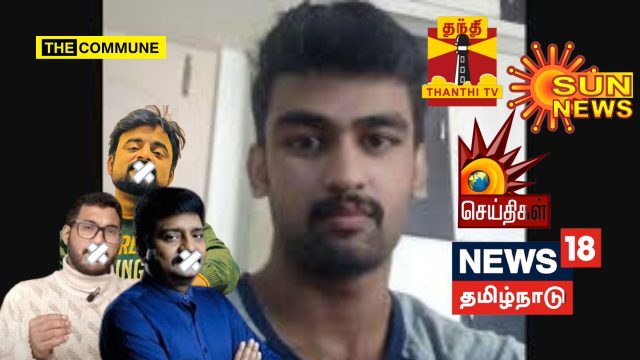
While the news wires carried the bare bones of the acquittal, major media houses like Thanthi TV, News18 Tamil Nadu, and Sun News treated it as a passing item – a short news byte or a static news card to be scrolled past. Worse, DMK mouthpiece Kalaignar News didn’t even think it was newsworthy and completely blacked out the news.

There were no prime-time debates, no hard-hitting panels, no relentless questioning of the Home Department, and no demand for accountability from a police force whose “Dravidian Model” has been exposed as a model of catastrophic failure.

Where Are the Crusaders?

Where is the fiery outrage from ‘journalists’ like Karthigaiselvan or Niranjan Kumar or Nelson Xavier who would jump up and down had the same been done to a case in UP or a BJP-ruled state? They would conduct debate after debate and flog a dead horse even if the issue was irrelevant. These journalists, often vocal on politically convenient issues, have suddenly lost their voice when it matters most. Their silence is a betrayal of the fourth estate’s fundamental duty: to speak truth to power and to be a voice for the voiceless.

A little girl was brutally raped and murdered. Her family has been denied justice not because of a lack of evidence, but because of a police force that allegedly fabricated evidence, manipulated witnesses, and violated every tenet of a fair investigation and trial. This is not just a legal failure; it is a monumental governance failure. It reveals a law-and-order machinery so incompetent or so corrupt that it cannot secure a conviction even in a case with a charred body of a child. And yet, the media, which styles itself as the guardian of the people, looks the other way.

Selective Outrage and Political Servility

This deafening silence is not accidental. It is symptomatic of a media ecosystem that thrives on selective outrage. The same channels that will run week-long debates on minor political slights or orchestrated controversies cannot muster the courage to question their political masters over a collapse of the criminal justice system.

To question the police is to question the government that controls it. And for the Dravidianist media, that is a red line they dare not cross. The pursuit of truth has been sacrificed at the altar of political servility.

The acquittal of Dashwanth is not an isolated incident. He was also acquitted in the murder of his own mother, with sources indicating the evidence was too weak to pursue. This points to a pattern of ineptitude that should be the biggest story in the state. Instead, it is being swept under the rug.

The message this silence sends is that, if you are a victim of a gruesome crime in Tamil Nadu, not only might the police fail you, but the media will too. They will not fight for you. They will not hold the powerful accountable. They will simply look away.

The Supreme Court did its job by upholding the law, even when it meant setting a potentially dangerous man free due to the state’s incompetence. It is now the media’s job to do its duty – to scream from the rooftops about this failure, to demand answers, and to ensure that such a travesty of justice never happens again. But if their current silence is anything to go by, the people of Tamil Nadu should not hold their breath. The Dravidianist media has spoken, not with words, but with a cowardice that echoes louder than any headline.

Subscribe to our channels on TelegramWhatsApp, and Instagram and get the best stories of the day delivered to you personally.

Supreme Court Acquits Child Rapist And Murderer Dashwanth Due To Glaring Lapses By DMK Govt’s Dravidian Model Police

Child Rapist Dashwanth Walks Free As DMK Govt's Dravidian Model Police Fail To Provide Evidence

In a verdict that delivers a staggering blow to the pursuit of justice, the Supreme Court on Wednesday acquitted S. Dashwanth in the 2017 rape and murder of a seven-year-old girl, unleashing a torrent of anguish and raising terrifying questions about the competence of the Tamil Nadu police.

While the legal outcome is an acquittal, the story told by the apex court is not one of Dashwanth’s innocence, but of a catastrophic systemic failure so profound that it rendered a conviction legally impossible. The court did not find a saint; it found a case so badly botched by the Dravidian Model police that a man once sentenced to death for a heinous crime had to be set free.

“We are of the view that the prosecution has miserably failed to prove the vital circumstances, that is, last seen together, suspicious […] of the appellant captured in the video footage of the CCTV camera, the confessional disclosure statement, the FSL report […] which constituted the entire edifice of the prosecution case on which the conviction of the appellant was based. The impugned judgment is set aside. The appeal is allowed. The conviction and sentence awarded to the appellant are hereby set aside. Appellant is acquitted. He shall be released from custody forthwith, if not wanted in any other case”, the Court ordered.

A Heinous Crime, A Hollowed-Out Case

The case stemmed from a parent’s worst nightmare. On 5 February 2017, the seven-year-old daughter of CSD. Babu and Sridevi went missing from their apartment complex. Her charred body was discovered days later. The prosecution alleged that Dashwanth, a neighbour, lured the child, sexually assaulted her, murdered her, and then burned her body to destroy evidence.

However, the Supreme Court systematically dismantled the state’s case, not by vindicating Dashwanth, but by exposing how the police and prosecution violated the law to secure a conviction, ultimately ensuring its collapse.

“Grave Doubt” and “Planting” of Evidence

The judgment paints a picture of an investigation riddled with concoction and coercion:

A “Concocted” Last-Seen Story: The court found the sole “last seen” witness, Murugan, wholly unreliable. His claim of seeing Dashwanth with the child was disclosed only after a two-month delay, even though he was part of the initial search party. The court concluded this was a later fabrication to “lend credence to the otherwise weak case.”

A “Fictional” Confession: In a damning finding, the court revealed that a Village Administrative Officer was informed by police before Dashwanth’s official arrest that he would confess to the rape and murder. This, the court held, proved the confession was a pre-written script, extracted under coercion during illegal detention. The subsequent “recoveries” of the victim’s ornaments were labeled “planted” to fit this script.

Forensic Evidence with a “Broken Chain”: The DNA evidence, a potential cornerstone of the case, was rendered “redundant”. The prosecution failed to maintain a proper chain of custody for samples, with an unexplained four-month delay in collecting Dashwanth’s blood. The court noted a “strong possibility” this delay “may have been utilized to manipulate the samples,” making the forensic reports unreliable.

A “Sham” Trial That Sealed the Failure

Beyond the investigation, the Supreme Court highlighted a “total failure of justice” in the trial process, violating Dashwanth’s fundamental right to a fair trial under Article 21 of the Constitution.

Charges were framed against Dashwanth on 24 October 2017, without a defence lawyer being present or appointed for him. The mandatory copies of prosecution documents were not provided to him until 13 December 2017. A legal aid lawyer was appointed on December 13, and the trial commenced just four days later, with 30 witnesses examined and the case concluded in a mere month and a half. The court held that the lawyer had “no reasonable and effective opportunity to prepare.”

The trial court delivered its conviction and death sentence on the very same day, without calling for any reports on mitigating circumstances or a psychological evaluation, reducing the sentencing exercise to a “mere formality.”

The court stated that for a trial to be fair, “an effective opportunity to defend must be provided.” This was denied, making the entire process a “mere formality.”

A Chilling Precedent and a Family’s Agony

This acquittal follows another for Dashwanth, in the murder of his own mother, Sarala in December 2017, for which he had been acquitted earlier this year. Sources indicated the state did not appeal that acquittal as the evidence had “no merit,” further questioning the police’s investigative rigor in cases involving the same individual.

The Supreme Court was forced to make a painful but legally necessary decision. As the bench observed, “The legal framework does not permit the Courts to punish an accused person based merely on moral convictions or conjectures.”

The outcome is a travesty. A little girl was brutally raped and murdered. Yet, due to the very authorities tasked with delivering justice, no one will be held accountable. The verdict is not an exoneration of Dashwanth, but a devastating indictment of a system that failed at every turn, leaving a family without justice and a society questioning whether anyone is safe when those who enforce the law break it.

(With inputs from The New Indian Express)

Subscribe to our channels on Telegram, WhatsApp, and Instagram and get the best stories of the day delivered to you personally.
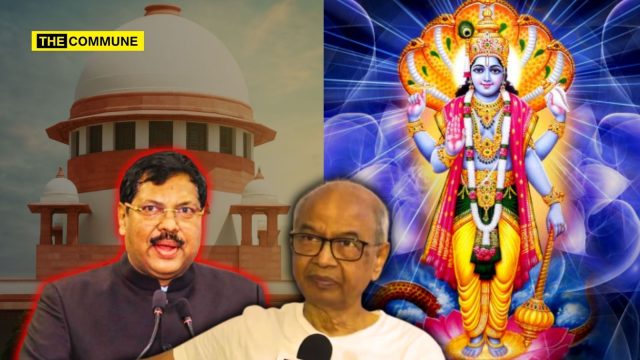
“I Am A Dalit Myself”, Says Lawyer Who Allegedly Attempted To Hurl Shoe At CJI Gavai Over Remarks Insulting Lord Vishnu In Idol Restoration Case

contempt plea supreme court shoe cji

Advocate Rakesh Kishore, who recently attempted to throw a shoe at Chief Justice of India Bhushan R. Gavai over his remarks on Lord Vishnu, has claimed that his life is under threat and announced plans to undertake a fast at Khajuraho to restore a Vishnu idol.

In an interview with OpIndia, Kishore introduced himself as a Dalit, saying, “I am Rakesh Kishore, I am not a Pandey, nor a Tiwari nor a Gupta nor a Jaiswal. I am myself a Dalit, and if they do not know it, they are ignorant. I even told the policemen who came here yesterday that I wanted to talk to people and show my document about my community so they would understand, but they refused to permit me. They said there was a threat to my life and asked me not to go out.”

Kishore, who identifies as a follower of Buddhism and claims extensive knowledge of Gautam Buddha’s teachings, commented on the controversial remarks made by CJI Gavai. He said, “No, he didn’t say that purposely. The feelings in his heart came pouring out. The anger he had in his heart towards Sanatan Dharma came out of his mouth. You must be knowing that another sect is being created that will break away from Hinduism… They are also terrorists, in a way. He is working together with them.”

Addressing the threat to his personal safety, Kishore cited previous attacks on Hindu activists, including the murder of Kanhaiyalal, and accused media and other groups of colluding against him. He said, “An attack can happen to me at any time. They can do anything to me at any time, so the voice of Hinduism is dead forever. My next step is that I will go to the Vishnu idol in Khajuraho and fast there. I have received the order from God to get the idol restored. My only message is to not keep quiet. We must rise up for Hinduism, tell your children, let us march together forward and start a movement.”

Kishore’s statement comes amid ongoing scrutiny and accusations that he was an “upper caste” person and that was the reason that he dared to hurl the shoe at CJI Gavai.

Subscribe to our channels on Telegram, WhatsApp, and Instagram and get the best stories of the day delivered to you personally.
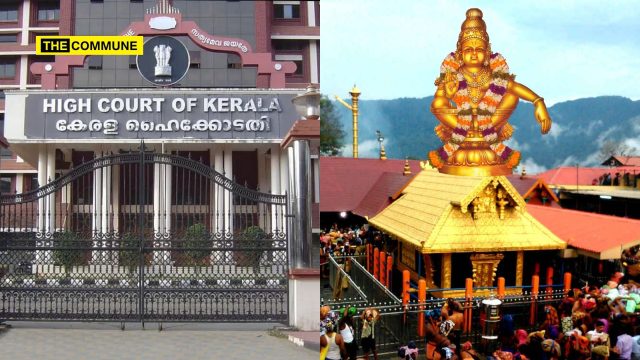
Kerala High Court Orders SIT Probe Into Alleged Gold Theft At Sabarimala Temple

sabarimala gold

The Kerala High Court has directed the formation of a Special Investigation Team (SIT) to probe alleged irregularities involving gold-plated copper plates from the Sabarimala Ayyappan Temple, following a controversy over the unexplained reduction in weight of the sacred items.

Court documents and NDTV reports reveal that Unnikrishnan Potty, a sponsor who had funded the gold-plating of the temple’s idols and other valuables, had sought permission to use the excess gold for sponsoring a girl’s wedding. According to NDTV, Potty had written to the Travancore Devaswom Board (TDB) on 9 December 2019, stating that after completing the gold work on the main door of the sanctum sanctorum and the dwarapalakars, he had some gold balance and requested guidance on using it for a wedding in coordination with the TDB.

The TDB Secretary, on 17 December 2019, reportedly sought clarity on the permissible use of the leftover gold, following Potty’s request.

Potty, who had been at the center of the controversy, had previously secured the TDB’s approval to sponsor the gold-plating at his own expense. The TDB had handed over the gold-clad copper plates, weighing 42.8 kilograms, to Potty’s company, Smart Creations, based in Chennai, for plating work. When the plates were returned to the temple, their weight was reportedly reduced to 38.258 kilograms. Despite this discrepancy, the TDB entrusted Potty with another gold-plating project in 2025.

The controversy intensified after the Kerala High Court ordered the immediate return of the panels removed for repair and censured the TDB for violating the Devaswom manual. The court noted that the TDB had failed to inform the court-appointed Sabarimala Special Commissioner. According to the court, the incident highlighted the “alarming manner” in which the Devaswom officials allegedly acted jointly with Potty, breaching the sanctity of temple property and the trust of devotees.

Following the court’s orders, a High Court-monitored SIT has been constituted to investigate the alleged irregularities related to the reduced weight of the gold-plated copper plates. The SIT will be led by former Superintendent of Police S. Sasidharan and overseen by Crime Branch chief Additional Director General of Police H. Venkatesh. The team will include three inspectors, including cyber experts, and will also examine TDB records and the role of Potty.

Congress MP Shashi Tharoor has publicly demanded accountability from the Pinarayi Vijayan-led Kerala government over the alleged gold theft. He reportedly expressed suspicion over the incident, stating that allegations of gold being siphoned off raised serious concerns. Tharoor reportedly told the media that the High Court-monitored SIT investigation was a welcome step, but that the public would remain concerned given the “shocking details” and the possibility of a systematic problem occurring over several years. He emphasized that “accountability is a must” in the matter.

The Kerala High Court continues to monitor the situation closely, while the SIT begins its inquiry into the alleged gold theft at one of India’s most venerated temples.

(With inputs from NDTV)

Subscribe to our channels on TelegramWhatsApp, and Instagram and get the best stories of the day delivered to you personally.
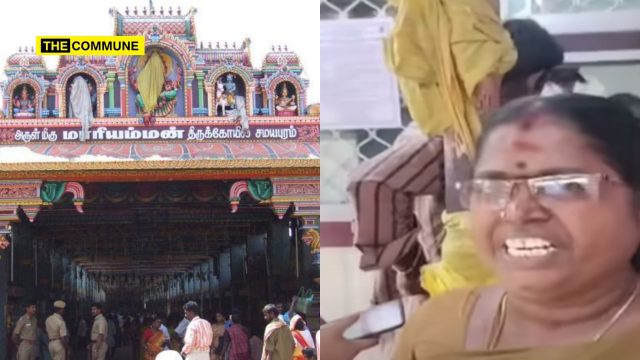
Video Evidence Emerges Of Devotees Getting Extorted At HR&CE Administered Samayapuram Mariamman Temple

A viral video has brought to light alleged extortion of devotees at the Samayapuram Mariamman Temple, which is administered by the Hindu Religious and Charitable Endowments (HR&CE) Department. In the footage, a temple worker can be seen demanding ₹400 for two devotees to gain entry, raising serious concerns about misconduct at one of Tamil Nadu’s most frequented temples.

The video captures a tense exchange between a female temple worker and devotees. She is heard repeatedly insisting on the ₹400 payment and dismissing their protests, even challenging them to report the matter to the Collector’s office. The worker boasts of her 20 years of experience in the temple and asserts that she answers only to the superintendent and higher authorities, speaking in a commanding tone.

Currently, the temple has only ₹100 tickets available for devotees, the maximum prescribed amount. The north gate of the temple, as per a ruling in the Tamil Nadu Assembly, is restricted exclusively to pregnant women, women with infants, and the elderly. Despite these rules, the video and accompanying reports suggest that certain individuals are being allowed entry for free or via purchased tickets, allegedly facilitated by temple staff and intermediaries.

According to eyewitnesses, more than five individuals claiming authorization from temple authorities were permitted free entry into the ₹100 queue. Some visitors have reportedly been asked to pay ₹500–₹1,000 per person under the name of “Padi Darshan.” A person identified as Graki is alleged to be coordinating these special entries and compensating temple workers in return.

Devotees have expressed outrage over the apparent violation of temple protocols, the extortion of funds, and the preferential treatment, which has caused significant distress.

The HR&CE Department has yet to respond to these allegations.

Subscribe to our channels on TelegramWhatsApp, and Instagram and get the best stories of the day delivered to you personally.
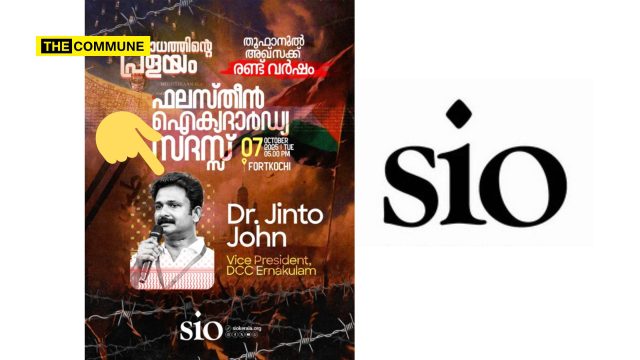
Kerala Congress Leader Jinto John Attends ‘Palestinian Solidarity’ Event Organized By Terror-Sympathizing Students Islamic Organization (SIO)

Kerala Congress Leader Jinto John Attends Palestinian Solidarity Event by Terror-Sympathizing Students Islamic Organization (SIO)

Dr. Jinto John, Vice President of the District Congress Committee (DCC) Ernakulam, participated in an event titled The Flood of Resistance (പ്രതിരോധത്തിൻ്റെ പ്രളയം) organized by the Students Islamic Organization (SIO) Kerala chapter. The gathering, held in Fort Kochi on 7 October 2025 Tuesday, was part of a programme commemorating two years of Toofanul Aqsa and focused on Palestinian solidarity.

The program, attended by local activists and supporters, featured speeches highlighting ongoing struggles in Palestine. Dr. Jinto John, a Congress member, openly has indulged in such activities especially with an organisation that has earlier mourned the deaths of terrorists while celebrating the 2023 bloody 7 October killings of Israelis by Hamas.


View this post on Instagram


A post shared by SIO Kerala (@sio_kerala)

SIO Mourned Terrorists

In October 2024, a “Mayyath Niskaram” (funeral prayer) for Yahya Sinwar, the slain leader of Hamas, was organized in Kerala, raising eyebrows and igniting discussions about the complex socio-political landscape of the region. Sinwar was killed four days ago by Israeli forces, following his role as the architect behind the October 7th attack that claimed the lives of 1,200 innocent civilians in Israel. The prayer was organized by the Student’s Islamic Organization (SIO), a youth wing of Jamat-e-Islami, a group known for its Islamic activism. Photos of the event were widely circulated on social media, featuring Samad Kunnakav, assistant secretary of Jamat-e-Islami Kerala, leading the prayer. 

The SIO’s Facebook page for Ernakulam publicized the event, depicting Sinwar as a “valiant warrior” and showcasing images of the gathering, which drew participation from local youths and students. 

In August 2024, in Kozhikode, the Students Islamic Organisation (SIO) displayed banners and standees in remembrance of Hamas terrorist leader Ismail Haniyeh a few weeks after his death. The organization used social media platforms to call on Muslim youth in Kerala to unite in support of Hamas and the Palestinian cause.

It is shocking that a Congress member attends and endorses events conducted by an organisation that openly supports mass murder and celebrates terror and mourns terrorists’ deaths.

Subscribe to our channels on TelegramWhatsApp, and Instagram and get the best stories of the day delivered to you personally.
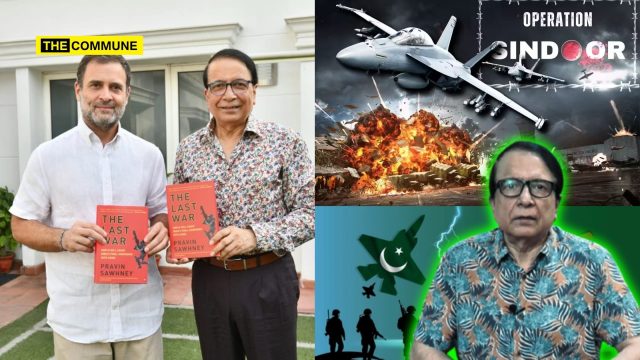
Congress-Friendly Defence Expert Pravin Sawhney Speaks Like Pak Spokesperson, Endorses Pakistani Military’s Claims, While Doubting Indian Air Force In Operation Sindoor

In a recent interview broadcast on The Wire, editor of “Force Magazine” Pravin Sawhney and journalist Karan Thapar offered commentary on India’s Operation Sindoor that has raised eyebrows for its strikingly pro-Pakistan tilt. During the discussion, Sawhney openly questioned the claims of the Indian Air Force, repeatedly casting doubt on the reported destruction of Pakistani aircraft while giving credence to Pakistani assertions of Indian losses.

The interview, aired on 6 October 2025, focused on statements made by Air Chief Marshal V.R. Chaudhari regarding India’s alleged downing of 12–13 Pakistani aircraft, including fighter jets such as F-16s and JF17s, a C130, and possibly airborne early warning aircraft. Sawhney told Thapar that these claims were “very hard to accept,” citing a Russian expert’s assessment that India’s S400 system cannot conclusively confirm kills of fast-moving fighters. He emphasized that only the downing of a slow-moving airborne early warning aircraft at 300 km could be verified.

Sawhney repeatedly stressed that the Air Force Chief’s claims were based on system intelligence rather than conclusive proof, implying that India’s reported strikes on Pakistani aircraft might be exaggerated. He also criticized the Chief for refusing to comment on Indian losses, describing this as “not befitting an Air Force Chief” and claiming it undermines India’s credibility internationally.

Shockingly, Sawhney went further to suggest that the world remains impressed by Pakistan’s air operations during the campaign. He cited Pakistan’s multi-domain air strategy and post-Operation Sindoor military diplomacy—including the Pakistan–Saudi Arabia strategic defense agreement—as evidence of Pakistani success, implicitly legitimizing Islamabad’s narrative while casting India’s performance as underwhelming. He highlighted press statements by Pakistani Lt. Gen. Khaled Kidwai, who claimed four Rafale aircraft were downed by Pakistan, noting that India’s silence on these claims would be interpreted globally as acquiescence.

Throughout the interview, Thapar allowed Sawhney’s arguments to flow unchallenged, framing questions in ways that amplified doubts about India’s military performance rather than interrogating the methodology or credibility of Pakistani claims. Sawhney repeatedly referred to Indian losses reported by the Chief of Defence Staff and Air Marshal Bharti, dismissing them as “fanciful stories”/“Manohar Kahaniyaan,” while simultaneously elevating Pakistan’s version of events without evidence.

Pravin Sawhney, The Wire Push Narratives Favorable To Pakistan – Says Pak Journalist

In September 2025, in a shocking admission aired on Pakistan’s Samaa TV, prominent Pakistani journalist Najam Sethi explicitly named several Indian media platforms and individuals whom he credited with advancing narratives favorable to Pakistan’s interests, often at the expense of India’s sovereignty and security.

In the video, now viral online, he says “In India, there are some very powerful things coming out in Caravan magazine. Similarly, in India, there are independent sources that provide challenging analysis. One such source is The Wire; it is something you should look at. There are many independent alternative news sources like this. Among military experts, there is Scott Ritter, who is an American Pentagon and defence analyst. Similarly, in India, there is Pravin Sawhney who does a great job, and he provides very powerful analysis. So, I can name a lot, a lot of sincere people. If you want, I can definitely make a list next time.”

Karan Thapar Had Pakistani Handlers?

In an interview clipping from 13 years ago, journalist Madhu Trehan grilled Karan Thapar over allegedly having Pakistani handlers.

Thapar addressed allegations that some of his writings and commentary “push Pakistan’s agenda.” The issue arose when a politician reportedly told Trehan that Thapar, through his reporting and articles on India-Pakistan relations, often presented Islamabad’s point of view rather than India’s. The politician clarified that Thapar was not a spy, but that his articles reflected Pakistan’s perspective so consistently that it seemed he was advancing their narrative.

Thapar acknowledged that some of his articles did present a Pakistani point of view. However, he defended this practice, arguing that as an Indian journalist, it is important for the Indian public to be aware of how Pakistan views certain issues. He justified it by saying that showing Pakistan’s perspective is not the same as promoting it and that it was part of providing a full understanding of bilateral relations.

When pressed on whether this constituted pushing Pakistan’s agenda, Thapar denied being a spy and maintained that presenting Pakistan’s point of view was a ‘journalistic responsibility’. He admitted that occasionally his articles might appear to have favored Pakistan’s stance but framed it as an effort to inform Indian readers, not to serve Pakistan.

In essence, the interview left viewers with the impression that people like him were functioning as surrogate spokespersons for Pakistan rather than independent commentators on India’s defence operations.


View this post on Instagram


A post shared by Bharat Matter (@new_bharat2071)

So there you have it: Pravin Sawhney and Karan Thapar, along with The Wire, apparently moonlight as Pakistan’s spokespersons – all from Indian soil. Truth, objectivity, and journalistic duty? Clearly optional when one can peddle someone else’s talking points.

Subscribe to our channels on TelegramWhatsApp, and Instagram and get the best stories of the day delivered to you personally.
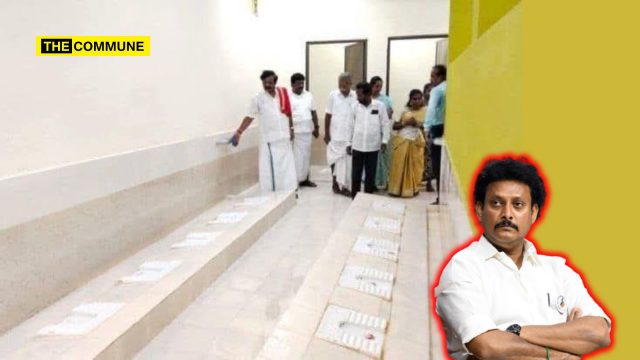
Dravidian Model School: Aduthurai Govt School New Toilet Block Has Open Toilet Layout With No Barriers

Dravidian Model School: Govt School New Toilet Block Has Open Toilet Layout With No Barriers

A newly constructed health complex at the Government Higher Secondary School in Aduthurai town panchayat has sparked controversy after its design left both teachers and students shocked.

The facility, built at an estimated cost of ₹34 lakh under the school development grant, was inaugurated on Tuesday by Aduthurai Town Panchayat Chairman Stalin. However, soon after the inauguration, concerns were raised over the layout of the toilets, which were constructed in open rows without individual barriers or partitions.

Teachers and students expressed discomfort over the lack of privacy, leading to commotion within the school premises. According to DMK member Senthilkumar, the structure was built in accordance with Public Works Department (PWD) norms, which reportedly permit this design for girls’ toilets in government schools.

PWD sources allegedly maintained that even when constructed using MPLADS (Members of Parliament Local Area Development Scheme) funds, this model follows the department’s approved standards.

Despite these clarifications, parents and local residents have questioned the practicality and appropriateness of such a design, urging authorities to ensure modifications that safeguard students’ privacy and dignity.

(With inputs from Dinamalar)

Subscribe to our channels on Telegram, WhatsApp, and Instagram and get the best stories of the day delivered to you personally.