Home Blog Page 701

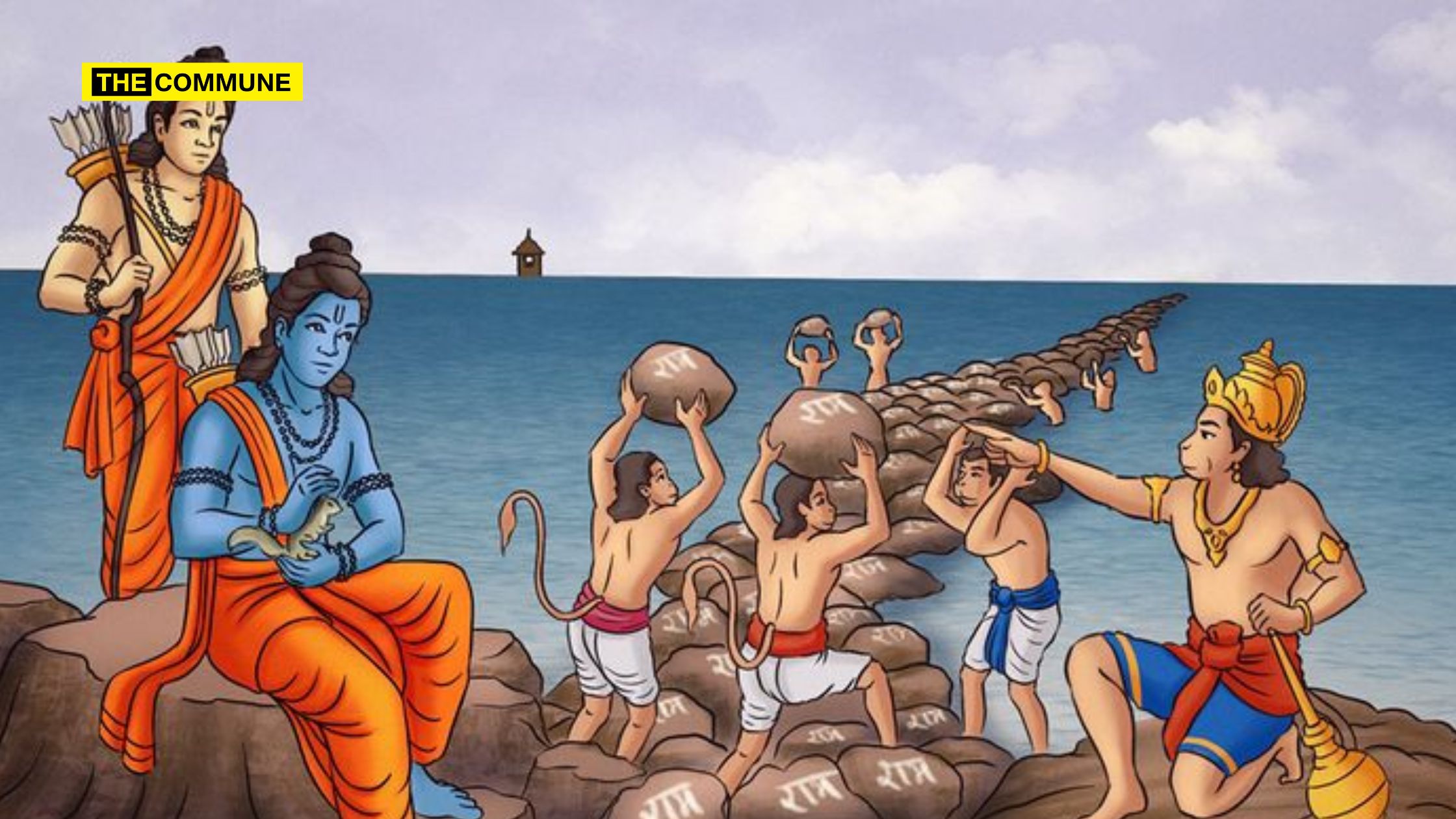
DMK Minister Raghupathi Asserts “Lord Ram Is Precursor To Dravidian Model Of Governance”

Raghupathi, DMK and Lord Ram
TN Law Minister Raghupathi claims that Lord Ram is Precursor to Dravidian Model of Governance.

Tamil Nadu Law Minister Raghupathi has asserted that Lord Ram represents the precursor to the Dravidian governance model. His remarks, praising Lord Ram for advocating social justice even before leaders like EVR and Ambedkar, have sparked debate on social media.

Speaking at the Kamban Vizha in Puducherry organised by Kamban Kazhagam, Tamil Nadu Minister of Law Raghupathi praised the Hindu epic “The Ramayana” aimed at creating a society devoid of disparities in the future and in that perspective. DMK Minister Raghupathi said, “We do not see in which clan Rama was born, we only see that Rama is common to all. We have to keep in mind, as if we say, Rama has accepted Vibheeshana, Guhan and Sugreeva as Dasharatha’s son then the Rama Kavya (Ramayana)/Kambaramayana is an epic created to create a society without disparities in the future.”

The Minister added that we should appreciate its virtues and take the good aspects from it. He further asserted that we consider Lord Ram to be the pioneer of today’s Dravidian model of governance. Miniter Raghupathi stated that the current DMK government in Tamil Nadu, continuing the legacy of social justice and egalitarian principles, extends Lord Ram’s rule.

DMK Minister Raghupathi said, “It is only when we look at it from a different perspective that it suits our Dravidian model and we bring Raman today as the precursor of the Dravidian model of rule. Before Periyar (EV Ramasamy Naickar), before Anna (Annadurai), before Ambedkar, before Karunanidhi, before Thalapathy (Stalin), the guardian of social justice who took this Dravidian model government forward, who taught equality and social justice to the world, who said that everyone is equal is Rama.”

His comparison of Lord Ram with the Dravidian model government has drawn attention, especially amid ongoing criticisms of the Ramayana by proponents of the Dravidian movement. Minister Raghupathi elaborated, “Kamban’s Ramavataram profoundly influenced the Dravidian model policies, emphasizing equality and social justice for all.” Later, Minister Raghupathi explained that Lord Ram’s acceptance of all as equals, depicted in the Ramayana, aligns with the Dravidian governance model’s core principles, which advocate for universal welfare and inclusivity.

Subscribe to our channels on TelegramWhatsApp, and Instagram and get the best stories of the day delivered to you personally.

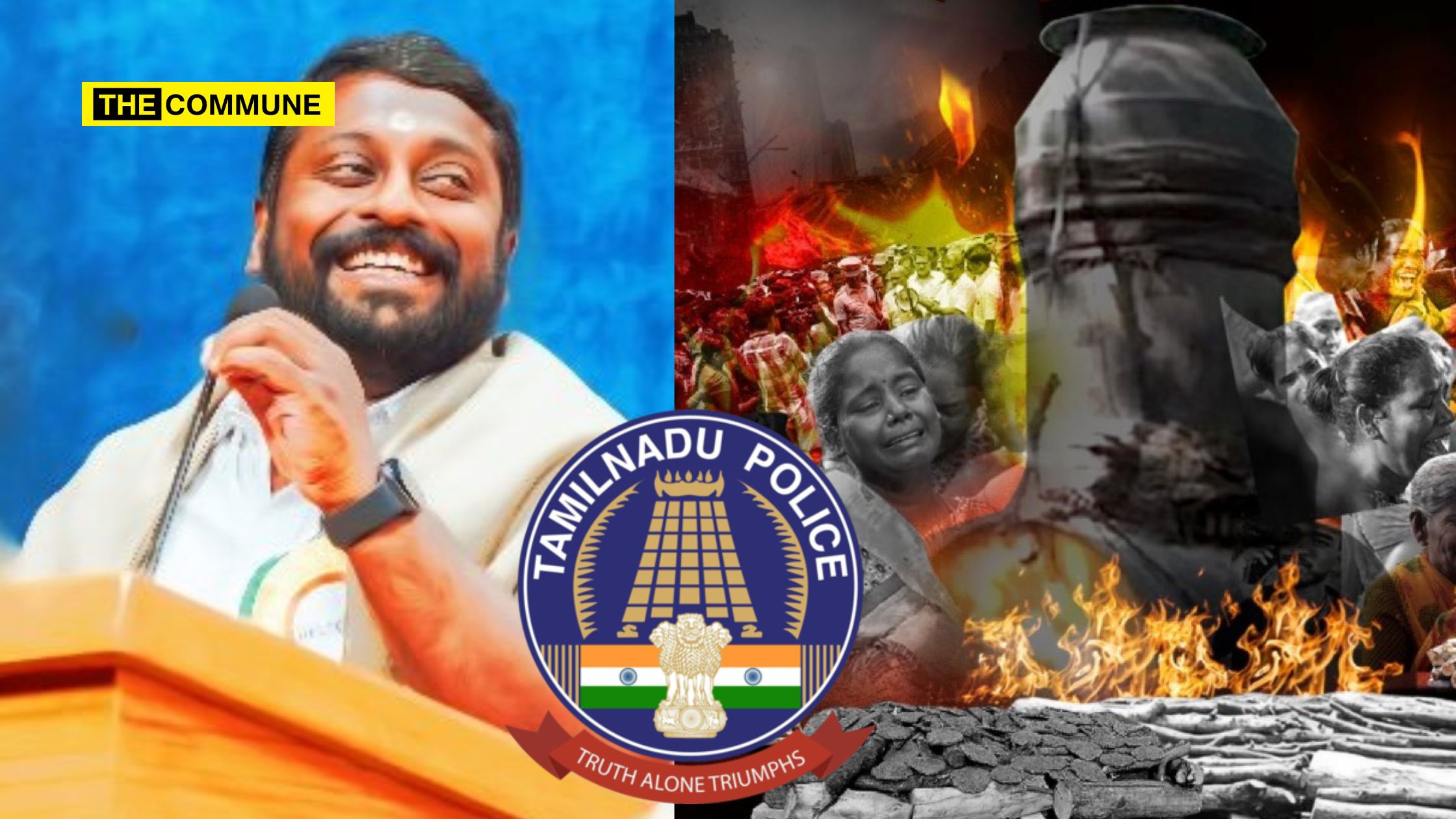
YouTuber Ajeet Bharti Faces Action From TN Police After KA Police Knocked On His Doors For Alleged Comment Against Rahul Gandhi

Ajeet Bharti and Rahul Gandhi

In June 2024, following the election results, YouTuber and journalist Ajeet Bharti referred to an interview with actor Naseeruddin Shah during a live session on his channel. Bharti recounted Shah’s experiences of being targeted for his Muslim identity and how he also targeted others in return. Shah suggested that such undercurrents of religious tension existed long before Modi’s tenure, but Modi capitalized on them.

Bharti argued that while Modi never explicitly made incendiary statements against specific communities, such comments were made by leaders of other parties. Bharti claimed that Congress party chief Rahul Gandhi intended to overturn the Ram Mandir verdict to restore Babri. He made this claim following a statement by former Congress leader Acharya Pramod Krishnam a month earlier. On 6 May 2024, Krishnam reported that Gandhi discussed overturning the Ram Mandir decision in a meeting with close aides.

Bharti clarified that he based his statements on Krishnam’s claims and was not making direct accusations against Rahul Gandhi. This context is essential to understanding Bharti’s commentary during the live session.

Following this, the Karnataka Congress filed an F.I.R. on Ajeet Bharti, and the Karnataka Police arrived at his residence. However, the High Court rebuked this move with a stay order. 

On 20 July 2024, it came to light that the Tamil Nadu Congress also decided to file a case, and the T.N. Police arrived at his doors. He wrote to social media platform X, After Karnataka Congress’ and F.I.R., now Tamil Nadu Congress is misusing @tnpoliceoffl. What does filing a case in another state after the alleged incident and stay on the case in which Karnataka High Court has given a stay order indicate? Send the police, I will meet you there.”

In “the post, Bharti shared a notice dated 15 July 2024 in which the Chennai police were seen soliciting information from X about his account details and IP address.

M. Samuel Diraviam MC, a Tamil Nadu Congress party member, lodged the complaint against Bharti. The complaint alleged that Bharti madefalse ‘claims’ about Rahul Gandhi in a video shared on the social media X.

In response to this complaint, the Tamil Nadu police registered a case against Bharti under the Indian Penal Code (I.P.C.) Sections 153A and 505 (1)(B). These sections typically deal with promoting enmity between different groups and making statements conducive to public mischief, respectively.

Furthermore, the police are seen to have taken additional steps by requesting X corporation provide detailed information about Ajeet BhaBharti’s account. This includes login and logout details, associated phone number, email ID, details of last activity, and I.P. address.

Notably, Ajeet Bharti only paraphrased a statement attributed to former Congress member Acharya Pramod. According to him, Rahul Gandhi allegedly told his close aides that if Congress formed the government, they would establish a superpower commission to overturn the Ram Mandir decision, drawing parallels to his father and former Prime Minister Rajiv Gandhi’s dismissal of the Shah Bano case ruling.

The former Congress member claimed he spent over 32 years serving the party and was present when Gandhi made that statement.

Following the repetition of these claims, Bharti is now facing legal action in Karnataka, a state currently under Congress rule. It is worth noting that Tamil Nadu, another state where Bharti might face consequences, is governed by the D.M.K., an ally of the Congress in the I.N.D.I. Alliance.

In 2023, after D.M.K. Minister Udhayanidhi Stalin made the infamous “eradicate Sanatana Dharma” “remarks, T.N. Police went to great lengths to reach the workplace of journalist Abhijit Majumder. The law enforcement authorities went as far as reaching out to a media house in Noida, actively seeking Abhijit without the issuance of any prior summons. In an X post on 20 December 2023, Abhijit updated that he had been summoned by the Tamil Nadu police for the second time to Chennai, having already attended the first summons. Notably, this action came after an F.I.R. was filed in September and four Tamil Nadu police officers were dispatched to Noida in search of him.

(with inputs from OpIndia)

Subscribe to our channels on TelegramWhatsApp, and Instagram and get the best stories of the day delivered to you personally.

BJP Leader Dr SG Suryah Summoned By Tamil Nadu CB-CID For Sharing News Article About Kallakurichi Hooch Tragedy

SG Suryah
TN BJP leader Dr SG Suryah summoned over news article on Kallakurichi hooch tragedy

On 23 June 2024, Tamil Nadu BJP State Secretary Dr SG Suryah brought attention to a news article that accused the Tamil Nadu police of attempting to fabricate a story, only to be thwarted by the Puducherry police.

The news article describes a situation where the Tamil Nadu police attempted to fabricate a story, but the Puducherry police intervened in the Kallakurichi hooch tragedy. According to the report, the Tamil Nadu government claimed that methanol for producing illegal liquor was sourced from Puducherry. After seizing the remaining methanol, the Tamil Nadu police allegedly headed to the house of a suspect’s grandmother in Madukarai.

However, before they arrived, the Puducherry police had already started their investigation at the exact location, ensuring all CCTV cameras were directed at the house. When the Tamil Nadu police arrived with methanol cans, they were reportedly required to conduct their investigation under Puducherry police supervision. The article claimed that the Puducherry police presence thwarted Tamil Nadu police’s alleged plan to stage a discovery of methanol at the scene. Furthermore, the Puducherry police reportedly instructed the Tamil Nadu team to clarify the true source of the methanol and warned against falsely implicating Puducherry based on the Tamil Nadu government’s claims. The Puducherry police are also monitoring the CCTV footage around the suspect’s grandmother’s house.

SG Suryah shared this article and posted on X saying, “According to this news, Tamil Nadu police took methanol cans to a suspect’s house in Puducherry to shift blame on Kallakurichi hooch tragedy to Pondicherry state but vigilant Puducherry police broke DMK government’s cunning plan. Right time for Home Minister Amit Shah to intervene.”

For sharing this post on X, the CB-CID wing of Tamil Nadu police in Vizhuppuram sent summons to the BJP leader asking him to present himself on 20 July 2014 at the Vizhuppuram CB-CID office.

This is not the first time SG Suryah has been summoned by the Tamil Nadu police for his posts on social media platform X.

Earlier, he was arrested for an X post against Communist MP Su. Venkatesan in which he chastised the Communist party and the MP for turning a blind eye to the death of hygiene worker who was made to clean a sewer allegedly by a Communist councillor. While the incident happened in Cuddalore, Suryah had inadvertently shared it as Madurai which he later corrected.

The police had also summoned SG Suryah in another case involving The Commune’s report on the standoff between HR&CE officials and the Deekshitars of the Chidambaram Temple.

With this latest summons, Suryah has alleged that the DMK government under MK Stalin is attempting to harass him by foisting cases against him for social media posts.

“Instead of catching the real culprits, the CB-CID officials are investigating those who criticize the DMK and the Tamil Nadu government in an attempt to intimidate the opposition parties.”, he said.

He further said in an X post about how the officials were waiting for him at his home to serve summons, just when he returned from his recent trip to the USA.

“No matter how hard they try to target me, the DMK government cannot do anything to me. My organization has prepared me to face any false cases and political vendetta.”, he wrote.

Subscribe to our channels on TelegramWhatsApp, and Instagram and get the best stories of the day delivered to you personally.

DMK Minister Mano Thangaraj Hails Christian Missionaries, Glorifies British Rule, Asks Christians To Unite At All-India Federation Of Christian Churches Conference

The ruling DMK in Tamil Nadu consistently carries out its efforts to court the minority communities in the state. The ministers (including the HR&CE Minister) actively participate in meetings with minority groups to solidify their vote bank, a strategy that is well-known to the citizens of Tamil Nadu. For example, immediately after their victory in the 2024 Lok Sabha elections, DMK MPs, especially those from the party’s first families, met with George Antonysamy, the controversial Archbishop of the Archdiocese of Madras-Mylapore, who had written an article to influence voters using religious sentiments advocating Christian support for the DMK in the recent Lok Sabha elections.

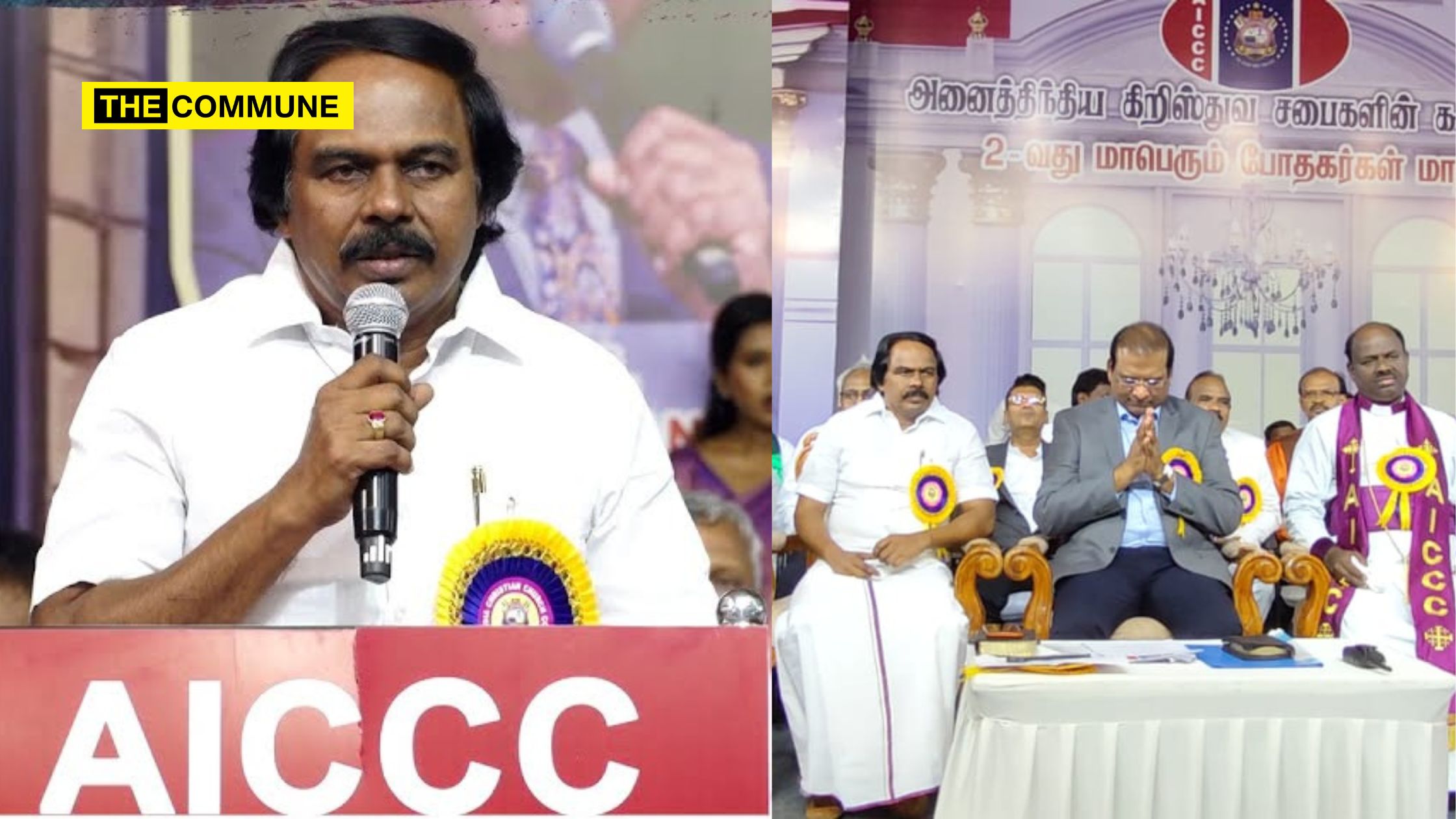
Against this backdrop, on 16 July 2024, DMK Minister for Milk & Dairy Development, Mano Thangaraj, attended the All-India Federation of Christian Churches’ Second Conference of Pastors as the chief guest. The conference, held at the Jesus Calls Prayer House in Vanagaram, Chennai, reaffirmed the Dravidian agenda of glorifying British colonial rule and the role of Christian missionaries during the Indian freedom struggle.

DMK Minister Mano Thangaraj began his speech at the conference by expressing gratitude to the pastors present, quoting a Bible verse: “For Kings and All Those in Authority, That We May Live Peaceful and Quiet Lives.” He thanked them for their prayers and then shifted focus to his main agenda, extolling the contributions of Christian missionaries.

He urged the Christian community to understand and teach the history of how Christianity arrived in the Indian subcontinent and the impact it had. Thangaraj then recounted the pre-independence era of India, highlighting the caste-based discrimination that existed. He specifically spoke about the Thol Seelai Porattam (Upper Cloth Revolt), a significant cultural movement led by women of the Nadar community fighting for their right to cover their breasts. He shamefully credited Reverend Mede with championing this cause, claiming that the Christian missionary’s support was instrumental in opposing Brahmanical supremacy in the Travancore state.

Continuing to spread historical half-truths, DMK Minister Thangaraj falsely credited the abolition of the practice of Sati to Christian missionary Governor-General of British India, Lord William Bentinck, contradicting historical facts. Sati was a ritual where a widow immolated herself on her husband’s funeral pyre. Thangaraj also attributed the progress in widow remarriage to another missionary, John Baptiste Trincal, a French Jesuit.

Thangaraj emphasized that all Christians should understand this history, acknowledging the suffering endured to create a more equitable India. The he advised the community to embrace unity and avoid caste discrimination within them, calling it a shame and stating that such issues are not addressed in the Bible. Thangaraj said, “It is my humble request that if we come as Christians we should learn to be together. If it comes to a Christian, you should not talk about the caste structure, it is an ugliness and a shame. Nowhere in the Bible is it taught.” He also urged pastors to stay informed about politics, Subtly suggesting DMK’s political activities said, “I will not say that you (pastors) should take part in politics, but it is my opinion that you should be aware of it. Apart from that, the congregation should also keep the people informed.”

He concluded his speech by contrasting the freedom of worship in the USA with the situation in India, sharing a story about a Catholic pastor who recounted the freedoms of religion in the USA during a flight with Minister Mano Thangaraj. Thangaraj said, “The Hindus living there (USA) are one percent. All of them went from India. They have the right to build temples wherever they want, the number of Muslims who can be there is very small. We all know the Twin Towers, when the Twin Towers were destroyed by Islamic terrorists, there were so many deaths. But after that, the government allowed a big mosque to be built near it, because there is freedom of religion, secularism prevails there.”

He then went on to mock Rishi Sunak, the former Prime Minister of the United Kingdom, for following the Indian cultural tradition of bowing to elders for blessings. This part of his speech was widely condemned by netizens on the internet.

Although the DMK’s strategy to win the minority vote is quite transparent, spreading falsehoods to support this agenda is quite unethical. For example, they falsely attribute the struggle for Nadar women’s liberation in the Thol Seelai Porattam and the abolition of Sati to Christian missionary.

Contrary to the minister’s agenda the true historical account says it otherwise that it was the Nadar women who started the protest, which began with the Nadar women’s courageous act of defiance against the breast tax imposed by the authorities in Travancore province. It is to be noted that Nangeli, a brave Nadar woman who cut off her breasts to protest the tax, has become a legendary figure in this struggle. The Mulachiparambu area, associated with this historic protest, is now a revered site of worship.

Likewise, the abolition of Sati is properly credited to Indian Hindu reformers such as Ram Mohan Roy. Similarly, throughout the Indian freedom struggle, there were many Hindu reformers who worked to end discriminatory practices and bring about social reform. It is a well-established fact that Christian missionaries and the British Empire were more interested in conversions rather than genuine community reform. This is underscored by the 1858 proclamation by Lord Canning at the Durbar in Allahabad, where he declared that the British would not interfere with Indian customs and traditions, primarily to maintain their rule.

Other Instances Of DMK Leaders Glorifying Christian Missionaries And British Rule

DMK MLA Appavu

DMK MLA and Tamil Nadu Assembly Speaker M. Appavu had declared that the MK Stalin-led government in the state was formed by Christians and for Christians.

Appavu openly admitted that the DMK came to power because of the ‘fasting’ and support of Roman Catholic Christians and that Chief Minister MK Stalin acknowledges that the DMK government was installed with the help of Christians.

“I frequently tell this. This is ‘your’ government. A government that has been formed by ‘you’. A government that has been formed because of your ‘fasting’. A government that has been brought by your prayers and wishes to the Lord. This is a government for ‘you’.” the DMK MLA said while addressing a gathering of Catholic Christians on the occasion of St. Paul’s Seminary held in Trichy on June 29, 2022.

He further added that Christianity and Christian priests were the root causes for the formation of the DMK government which talks about ‘social justice’ and ‘Dravida Model’.

DMK Minister PTR Palanivel Thiagarajan

Tamil Nadu Finance Minister PTR Palanivel Thiagarajan hailed Christian Missionaries as torchbearers of social justice who had contributed to the development of the region.

“Be it in India or Tamil Nadu or even Madurai, the contribution of American missionaries is not always talked about much. The link between Madurai and American missionaries goes back to 1881 or even beyond. They contributed to the overall development of the region by providing educational and medical facilities, though they were not the colonising power here,” Palanivel Thiagarajan was quoted saying in The Hindu.

Palanivel Thiagarajan also said that the work of American Christian missionaries across the world championed the cause of people’s welfare, be it the civil rights movement in the USA or the Dravidian movement in Tamil Nadu.

MK Stalin

CM Stalin himself had said that his government was formed because of Christians while participating in the platinum jubilee celebrations of the Church of South India in September 2021.

“The government that is there in Tamil Nadu today is one that has been created by you. I won’t call it as my government. This is our government.”, CM Stalin said.

Subscribe to our channels on TelegramWhatsApp, and Instagram and get the best stories of the day delivered to you personally.

‘Rāmāyaṇaṁ’ by Dushyanth Sridhar – A Critical Review

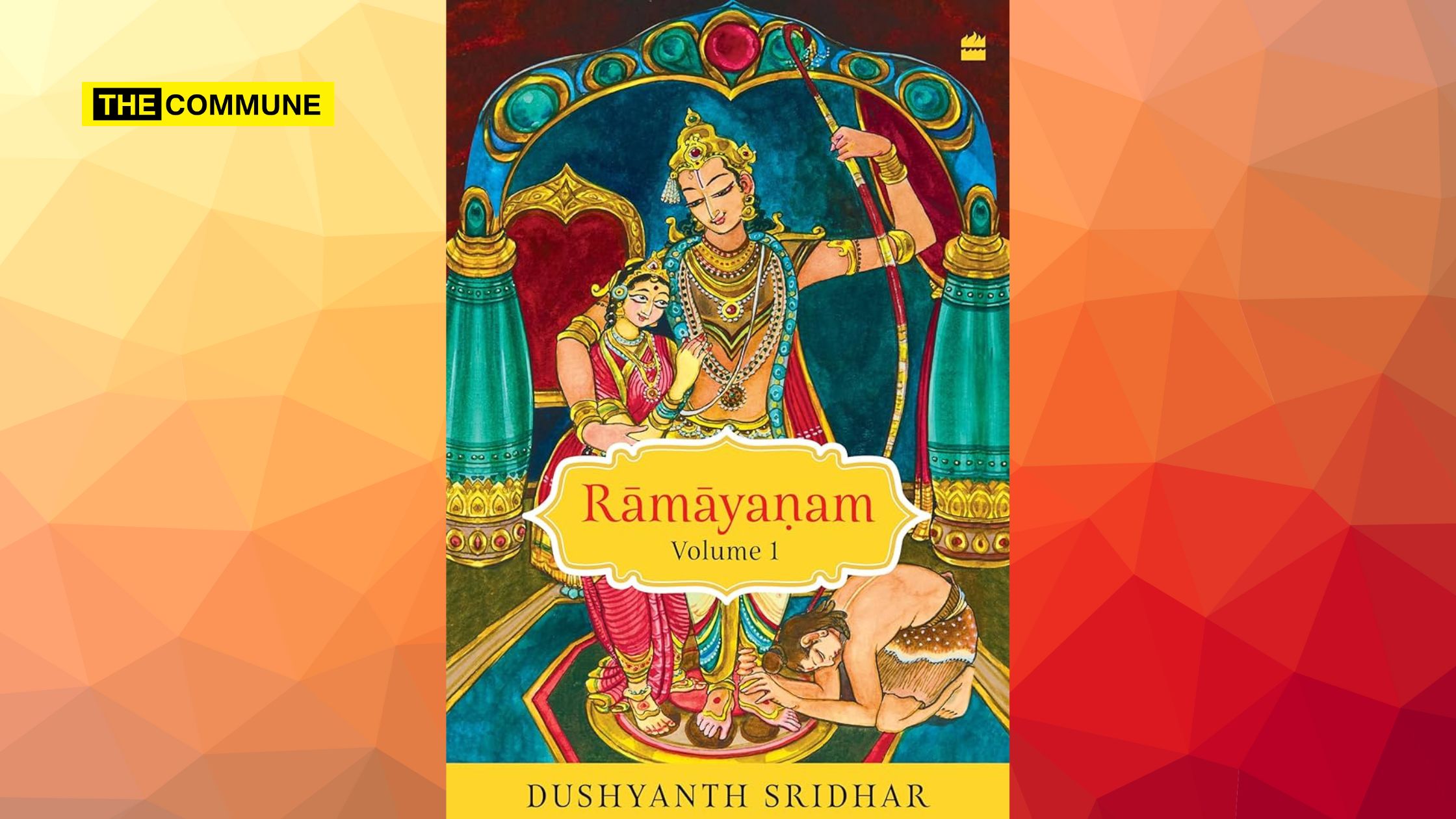
Cover page of Dushyanth Sridhar's Rāmāyaṇaṁ
Reviewing Rāmāyaṇaṁ, the much-awaited retelling by Dushyanth Sridhar.

As a believer in the timeless wisdom of the Ramayana, I recently had the pleasure of getting a copy of ‘Rāmāyaṇaṁ – Volume 1’, the latest literary endeavour by celebrated speaker Dushyanth Sridhar. This much-anticipated book has generated significant buzz since its announcement, and I was eager to delve into its pages and share my thoughts on this insightful work.

Bharatha, the land of Sanatana Dharma, worships the itihasas equal to the Paramatma, for it provides the path towards Dharma. From time immemorial, the Ramayana, or Rāmāyaṇaṁ as it is called in some languages, has held a very high place in the hearts and temples of this divine land. The legendary life of Sri Rama inspires generations even today with lessons on life, Satya, and Dharma. Sri Rama’s Prāṇa Pratiṣṭhā has reinvigorated this blessed land and infused new energy into the general populace.

In the preface of Dushyanth Sridhar’s ‘Rāmāyaṇaṁ’, the author quotes multiple references like Adhyatama, Adbhuta, Ananda Ramayana, various Puranas, and commentaries from various Acharyas. The list cited in the preface is quite exhaustive and overwhelming. However, the author does make a specific claim. Quoting from the book, “Interesting aspects of the above works have been incorporated in this book in a way that there is no digression from Valmiki’s text”. This review will be based on this tenet, i.e. what is the augmented information compared to the original Valmiki Ramayana, and how does it aid the overall reading experience, especially of an English reader with no background on Itihasas and Puranas?

‘Rāmāyaṇaṁ’ starts from the Uttara Kanda, where Sita is enjoying her pregnancy with Sri Rama just before the catastrophe occurs in the form of her exile into the woods. Valmiki’s background story is also provided to set the context for the following narrative. Ramayana is shown to be composed by Valmiki in consultation or discussion with Narada. The dialogue between Valmiki and Narada is a recurring feature of this book. Many portions of the book are explained in dialogues. The book describes the events leading up to the birth of Sri Rama and his illustrious brothers, along with a background story of Shanta & Rishyashringa. The feats of Sri Rama and Lakshmana during his time with Vishwamitra, followed by Sita – Sri Rama vivaha, form the book’s next part. The book captures the events leading up to his exile, Dasaratha’s death, and ends with Bharatha carrying ‘padukas’ back to Ayodhya. From a classical point of view, it captures the complete essence of Bala Kanda and Ayodhya Kanda, along with a backdrop story from Uttara Kanda.

In the following few sections, I try to capture the book’s standout features and underwhelming aspects.

Standout Features in Rāmāyaṇaṁ

From the onset, there are some standout features of the book. The author has consciously utilised Samskruta words like Rakṣaka, Candra, Candana, etc. This makes the reading much more authentic, though it may differ slightly for those unfamiliar with IAST terminologies. However, it should be noted that many terminologies are quoted without a translation or meaning, leaving the reader in a conundrum. For example, the word “prappati” is used extensively throughout the book. However, the meaning or definition of this word isn’t explained for the reader to comprehend the overall significance or establish the context.

While the use of Samskruta words is excellent, the proximity of a few words like rakṣaka and rākṣasa could easily be missed, if not read closely. Perhaps the anglicised version or the meanings may have helped better in these situations.

The illustrations by Keshav are masterful and a delight to look at. In fact, they are one of the better parts of this book. The inscriptions and illustrations of carvings from temples are yet other standouts. This department’s research depth is exemplary and needs to be lauded. The reading experience could have been augmented by translating the Samskruta verses from these inscriptions. The missing translations could be a put-off to those not familiar with Samskruta.

Shortcomings in Rāmāyaṇaṁ

I had very high expectations about this book, but unfortunately, there were a few shortcomings. Initially, I had planned to provide a detailed explanation for each of the specific instances. Still, I fear that the same would make this review a very lengthy one and perhaps deter the reader from reading. Possibly, it merits a separate specific discussion where the focus would primarily be on the reviewer’s differences with the author’s version. However, I will capture the most critical, underwhelming aspects of the book.

Ramayana Dates

There has been a fair bit of controversy in the social media world about the dates of Ramayana being set around 5100 BC. Skanda Purana – Prabhasa Kanda clearly outlines that Sri Rama was born in the 24th Chatur Yuga, which would put the time quite a long way back and not anywhere close to 5100 BC.

caturvinśē yugē rāmō vasiṣṭhēna purōdhasā
saptamō rāvaṇasyārthē jajñē daśarathātmajaḥ

I feel the book’s divinity wouldn’t have been lost if the dates were not included. However, by introducing the dates, unnecessary confusion and diversion of attention are created in the readers’ minds, which certainly should have been avoided.

Divergences From Valmiki Ramayana

The author has introduced many stories and anecdotes from Srimad Bhagavatha Purana as part of the narrative/dialogue between various epic characters in Rāmāyaṇaṁ. These stories are not part of the traditional telling of Valmiki Ramayana, and hence, the book would have benefitted from references that inspired these additions to the flow. Many stories of the original Valmiki Ramayana are condensed into the flow while making space for additions from other sources like Bhagavatham.

In one of the earlier chapters, it is quoted that Sri Rama implored Brahma to capture his biography to be written in verse. I presume this could be coming from Adhyatma Ramayana, but the author doesn’t clarify the source of such differences. Such instances leave the reader in a state of confusion, which I believe is a downfall of this book.

In the chapter on “Vishwamitra’s tutelage”, the author quotes Vishwamitra waking up Sri Rama by saying that Kausalya is fortunate to have a son as illustrious as Rama and ordains him to perform the daily duties. However, a very critical point was missed in this context. The verse from Bala Kanda, sarga 23 is as below:

कौसल्या सुप्रजा राम पूर्वा संध्या प्रवर्तते |
उत्तिष्ठ नरशार्दूल कर्तव्यं दैवमाह्निकम् ||

This verse is the opening line of the very famous Sri Venkateshwara Suprabhatham, a common morning prayer in Hindu households. I am quite surprised and shocked that the author missed adding this reference.

Sampradaya Views

In the narrative, there are many references where the author tries to promulgate the views of a specific sampradaya, with deft statements like Shiva, a Bhakta of Narayana, or Shiva realising Narayana through his inner eye. When the author claimed that this version of Ramayana is close to the original, it should have been written equanimous with no biases or specific views of a particular sampradaya. If this was the objective, the author should have called out the same. By introducing these nuanced references, the author may diverge from his stated goals. One shouldn’t forget the timeless wisdom of Yajurveda, i.e. Shiva and Vishnu are the same, and those who try to find differences don’t truly understand them.

शिवाय विष्णु रूपाय शिव रूपाय विष्णवे |
शिवस्य हृदयं विष्णुं विष्णोश्च हृदयं शिवः ||
यथा शिवमयो विष्णुरेवं विष्णुमयः शिवः |
यथाsन्तरम् न पश्यामि तथा में स्वस्तिरायुषि|
यथाsन्तरं न भेदा: स्यु: शिवराघवयोस्तथा||

Language of Rāmāyaṇaṁ

Our itihasas often describe unconventional births and procreation methods among kings and Rsis. These practices of yore require delicate phrasing to maintain their dignity. Unfortunately, the author’s choice of words in certain instances is less than ideal.

For example, when describing Kalmashapada’s inability to have a son and his request to Vasishta, the author uses rather a blunt language, stating, “Vasishta impregnated Madayanti”. This story could have been dealt with better narration when compared with other books on the same topic. This can significantly affect the reader’s experience.

The author’s tendency to explicitly describe intimate acts is also somewhat surprising. Although coitus is undeniably an integral part of human evolution, using overly direct terminology such as “ejaculation of retas” can be off-putting to some readers. A more nuanced approach would have been more appropriate for discussing these sensitive topics.

Ambiguous References

Throughout the book, there are many instances where Rama and Sita are made self-aware or identified with Narayana and Lakshmi. This is extended to the brothers of Rama, who are identified with Sudarshana, Adi Sesha, and Shanku. I presume these references are mainly derived from Adhyatama Ramayana, where Sri Rama’s divinity is established, and Sri Rama is self-aware.

Towards the end of the book, i.e. culminating parts of Ayodhya Kanda where Rama counters the philosophical tenets of Jabali, the author introduces the reader to Buddha and Baudhas. In Ayodhya Kanda, Sarga 109, various instances of the terms “Buddhyaya” or “Buddhim” are present, which pertain to intelligence or somewhat misleading aspects of the same. However, it was a bit shocking to read the concept of Buddha in the flow of Ramayana. Perhaps the author could have included references from where these sections are derived.

Possible Political Inclinations?

If one looks at the overall construct of the book, one can’t help but observe a recurring pattern throughout the book. Most of the inscriptions quoted are from Tamil Nadu. The verses quoted from inscriptions are also from Tamil Nadu. There are multiple references to Dravida desha or Dravidian women throughout the book. The pinnacle of this undercurrent comes in the context of Gajendra Moksha, where the author establishes the story of Rsi Agastya but extends the same to the establishment of Tamil language, Dravida desha being called Tamilakam and the grammatical treatise, Agattiyam.

While the author can establish their views and extend the narrative as deemed fit, the above doesn’t augur in the context of the stated objective of being an amplified version of Valmiki Ramayana. These casual references inserted into the narrative reeks of a more political motive of establishing the deep connection of Tamil Nadu with Ramayanam. While this is a noble objective, the same should have been stated clearly in the preface rather than the nuanced positioning within the epic.

Conclusion

Rāmāyaṇaṁ had set very high expectations based on the high-profile launch and the author’s celebrity status. The divergences could have been explained better with adequate and informative references.

References:
Srimad Valmiki Ramayana – Gita Press
The Valmiki Ramayana (Critical Edition) – Bibek Debroy
http://valmikiramayan.pcriot.com/
Srimad Bhagwatham – Gita Press
Sanskrit Ramayana other than Valmiki’s – Dr. V. Raghavan
The Ramayana in Classical Sanskrit & Prakrt Mahakavya Literature – Dr. V. Raghavan
Skanda Purana – Sri Jayachamarajendra Grantaratnamala series

Gee Vee is an engineer and avid fan of itihasas, puranas and books.

Response to the review from Dushyanth Sridhar is as below:

On Ramayana Dates

The paragraph about the Ramayana dates that the reviewer has written. As such, I have not discussed anything about the yugas, the duration of every yuga, Chaturyuga, etc in the text of my book, nowhere it has been discussed. Nor have I criticized the version of the Puranas or the Itihasas and upheld the research Jayashree Saranathan has done research which is much better than the Puranas. I have quoted Jayashree’s name stating she is the one who has given the dates. Her dates have been mentioned in the footnotes, that’s all. The concept of a Chaturyuga especially the number of years 43 lakh 20,000 years being the Chaturyuga, the 24th Chaturyuga where the Ramayana happened is different.

All this is not found in Valmiki Ramayanam itself. From Bala Kandam to Uttara Kandam, there is no mention of it. It is found in a Purana and between itihasas and Puranas, itihasas are given more respect than the Puranas. When I say more respect, more authentic because they are regarded as direct history or recording. So nowhere in the Ramayanam itself, there is a discussion of the 24th Chaturyuga, where the Chatur Yuga being 43 lakh 20,000 years, nothing of that sort, it comes only in the Purana. I have not analyzed the dates or anything of that sort. In fact, in one of the paragraphs within the text of the book, I mentioned that I think it’s Lakshmana vakyam towards Rama, Rama now we are living in the times of Treta, but your administration makes me feel that there is more than Dharma in it like the Krita Yuga. So I’ve clearly mentioned this as Treta, this as Krita, and all of that in the text. Because I’ve mentioned clearly that we are living during the times of Treta Yuga, Rama, but you make us feel as if we are living in the times of Krita Yoga, because this has been extracted from a line of Vedanta Deshika’s Raghuveera Gadyam which says “Tretayuga pravarthitha Karta yuga vritthantha.”

On Venkatesa Suprabhatam verse

With respect to the verse “Kausalya Supraja Ramapurava Sandhya Pravathathe”, this is a verse from Valmiki Ramayana where Vishwamitra wakes up Rama in the early hours of the morning. So the reviewer asks why didn’t I make reference to Venkatesha Suprabhatam. There is no need. The Venkatesha Suprabhatam of the 14th century where Prativaadhi Bhayangara Mannan imports the verse from Valmiki Ramayana – Kausalya Supraja Rama and from the next verse only he starts composing which is “Uttishtottiṣṭha gōvinda uttiṣṭha garuḍadhvaja”. So, I don’t think there is any need to add the reference of Venkatesha Suprabhatam anywhere in the book, because I don’t pick up any verse from Venkatesha Suprabhatam. This verse is from Valmiki Ramayana. And the comment whatever I’ve written is explaining those lines is from the commentator Periyavachan Pillai’s commentary of the 13th century and Govinda Raja’s commentary of the Bhushana.

Rama and Sita as Narayana and Mahalakshmi

The original Valmiki Ramayanam has six commentaries and one of the largest of the six and probably the grandest is Govinda Raja’s commentary called Bhushana. Nagesha Bhatta’s commentary Thilaka is good but it is not as big and as deep as Govinda Raja’s. So there, Govinda Raja makes very clear references to Rama as the avatar of Narayana. Narayana akhilaheya pratyaneekatharaha samastha kalyana gunatmakaha, jagatchakshuhu, So he calls him the one who controls all the functions of the world, the one who is the Antaryami or all Devatas. So I’ve used that particular line stating that Narayana who is the Antaryami of all, thereby even when Shiva’s made reference, I have used that. So it is conforming to the commentary of Govinda Raja.

Within Valmiki’s original Ramayanam itself (Yuddha Kandam), there are multiple open and hidden references to Rama and Sita as Lakshmi and Narayana. When Mandodari praises Rama,

व्यक्तमेष महायोगी परमात्मा सनातनः |

अनादिमध्यनिधनो महतः परमो महान् ||

तमसः परमो धाता शङ्खचक्रगदाधरः |

श्रीवत्सवक्षा नित्यश्रीरजय्यः शाश्वतो ध्रुवः ||

She says that I see you as Paramatma holding Shanka Chakra as Narayana who has got Mahalakshmi on his chest. And when looking at Jatayu, he says “Gachcha lokaanuktamaan”. I grant you Moksham, go to that place from which there is no return Jatayu, which is Mokshapradattvam. So, all these have been taken into verses by Kuresha in the 11th century in his work called Atimaanushasthavam where he says,
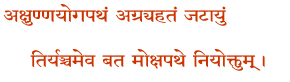
He clearly talks about the Moksha granting status and calls Rama as Narayana. So Valmiki in many instances, has given subtle references to their Parathvam.

Valmiki Ramayana inspiration

I have mentioned in the book flap in the front blurb as well as in the preface that I have completely been inspired by Valmiki his commentators, and many other works, and I had to use that little right of being the author of this book, to use some creativity to stitch those ends. 

Dravida/Tamil

Coming to the word Dravida Draavida, please note that in Ayodhya Kandam, Aranya Kandam also, when Lakshmana sees a branch full of flowers, Rama refers to them and states these are carrying so many flowers, like the women from the south of India (Dakshinayaam), who have flowers on their heads. So, there is a clear reference to the South Indian culture.

Gajendra Moksham Reference

This instance involves Agastya who was in the south of India, and Bhagavatham, we have a clear reference that it happened by the banks of river Tamirabharani. The word Dravida comes in Bhagavatham as well (Utpanna dravidesaaham) and Vedanta Desika has written Dramidopanishad Tat Parya Ratnavali. So Dravida Shishu says Adishankara. So the word Dravida Dramila Draavida has been in vogue in the Samskruta literature.

Even in Ramayanam, Sindhudouveeraaha Draavidaha, I remember this verse where the word Draavida comes. So, this word has been there. The word Tamizh may not explicitly occur in any of the granthas because that is the name given locally to this language. But I had to introduce that because in Sundarakandam when Hanuman says, “Instead of Samskrutham, I will talk to her in a Madura Basha”, many of the Acharyas in the south of India interpret that to be Tamizh. So, Tamizh must have existed then. And also Tamizh must have been a language completely soaked in Bhakti. Because Bhagavatam says “Utpanna dravidesaaham”, Bhakti grew and was born in the state of Dravida, which means where Tamizh is spoken and around that period Tamizh must have also come up.

Subscribe to our channels on TelegramWhatsApp, and Instagram and get the best stories of the day delivered to you personally.

Subscribe to our channels on TelegramWhatsApp, and Instagram and get the best stories of the day delivered to you personally.
TNM’s Dhanya Rajendran Glorifies Paedophile As “PhD Scholar”

TNM's Dhanya Rajendran extolls convicted paedophile.
TNM tried to humanize a convicted paedophile.

The propaganda efforts of The News Minute (TNM), a digital news outlet, and its journalists for misleading narrative-building in Tamil Nadu seem to know no bounds, even if it involves humanizing a convicted paedophile. In a classic display of opportunism, Dhanya Rajendran, the Editor-in-Chief of TNM, glorified a convicted paedophile or Child Sexual Abuser (CSA) who possessed Child sexual abuse material (CSAM) as a “PhD Scholar” and “Organic Farmer,” presenting a highly embellished image, as though the abuser were an activist fighting for a cause.

Dhanya Rajendran, on her official X account, glorified the paedophile as “A 36-year-old PhD scholar and an organic farmer from Thanjavur was sentenced to life for child sexual assault & distributing CSAM.

But that’s not all. TNM also held responsible Google and the dating app ‘Grindr’ for reporting the possession of CSAM and tipping off the CBI in India. This shameful false attribution of crime and misleading propaganda misrepresents the case’s timeline and facts. While Google indeed has the technology to flag such issues, the paedophile was already under the radar of the CBI.

CBI Investigations to Combat Child Sexual Abuse

Since 2022, the CBI has already contributed to Interpol’s ICSE database and carried out significant operations like Operation CARBON and Operation MEGHCHAKRA to combat online child sexual exploitation. The CBI’s investigation, which traced the CSAM to Thanjavur District, was part of this broader effort. The CBI had accessed the ICSE database, which India had recently joined, and conducted searches that uncovered incriminating electronic evidence at the accused man’s premises.

However, TNM, which is known to be a fervent leftist and Dravidianist propaganda outlet, has peddled this news as if an “organic farmer” and “PhD scholar” was arrested. In this case, they did not find the minor victims abused by the paedophile worthy of justice

Who Is Child Sexual Abuser/Paedophile Victor James Raja?

Victor James Raja (35), hailing from Thanjavur district, has been sentenced to life imprisonment by a special court under the POCSO Act for sexually assaulting children and sharing child pornography online.

Victor James Raja, who hails from Poondi Thoppu, has reportedly completed his M.Com and pursued a PhD in ecotourism. In a video published by Pasumai Vikatan of the Vikatan Group, they described him as afarmerwho creates awareness about organic farming while pursuing his doctorate.

According to reports, Victor forced minor boys and girls from his place to perform sexual acts and recorded the same. Raja allegedly engaged in regular sexual exploitation of boys and girls between the ages of five and eighteen for approximately two years. Penetrative sexual assaults, digital recordings of sexual abuse, criminal intimidation of minor victims, and pressuring and inciting minor victims to engage in sexual activity with both the accused and other minor victims were among the acts of sexual exploitation. Additionally, the accused was using the kids (victims) to record porn. 

Investigations into the case

The Interpol’s child sexual exploitation database contained several items related to child sexual abuse, including pictures and videos. The officials identified Victor James Raja through technical and forensic analysis. On 7 March 2023, they filed a case against him under the Information Technology Act of 2000 and the POCSO Act of 2012. The date of his arrest was 16 March 2023.

For sexual assault, penetrative sexual assault, aggravated penetrative sexual assault, using the child for pornographic purposes and abetment under the POSCO Act, rape of girls under the age of twelve, criminal intimidation, and publishing or transmitting of material depicting children in sexually explicit act in electronic form under the Information Technology Act, the CBI filed a chargesheet against Raja on 13 May 2023, before the Special Court for Exclusive Trial of Cases under POCSO Act, Thanjavur.

During the trial, officials questioned 34 witnesses and reviewed numerous documents and other evidence. Judge Sundarraj investigated the case and sentenced Victor James Raja to life imprisonment along with a fine of ₹6.54 lakh and suggested the government provide relief of ₹4 lakh each to the three affected boys and girls.

Subscribe to our channels on TelegramWhatsApp, and Instagram and get the best stories of the day delivered to you personally. 
Faith Or Logic? The Debate Over Ramayana Date

Don’t argue with an idiot. They will drag you down to their level and beat you with experience!

There are lot of discussions going on about the time frame of Sri Rama‘s history, one group consisting mainly of orthodox scholars putting it firmly several millions of years back while a few modern intellectuals asserting that it cannot be earlier than seven millennia. This dichotomy is described as difference between ‘Faith’ and Logic’. Now, let us carefully delve deeper into those two words so that a distinct view emerges on the debate over Ramayana date from such a dissertation.

It will be quite surprising to note that in our Sanathana Dharma parlance, the word ‘Faith’ or its synonyms like ‘Belief’, ‘Trust’ etc. are all discordant expressions. In religious matters what we possess is only ‘Knowledge’, that is all. The ‘we’ in the previous sentence represents an ordinary ‘Bharatiya’ unsullied by the nonsensical western educational doctrines. Let us probe into that word ‘Knowledge’ further.

In Sanatana Dharma epistemology knowledge is obtained through several means, called, ‘Pramanas’. Pramana, is the means by which one obtains accurate and valid knowledge about the entire universe. The study of Pramana Shastra is vast but let us confine only to three of them at present – ‘Pratyaksha’, ‘Anumana’ and ‘Shabda’.

‘Pratyaksha’ is knowledge obtained through our senses. ‘Anumana’ is inference based on earlier ‘Pratyaksha’. ‘Shabda’ is our scriptures, mainly Vedas.

For instance, the knowledge that ‘I have ten fingers’ is obtained by the sense of sight. The significant phrase is that it is not, ‘I believe I have ten fingers’. It is ‘I know that I have ten fingers’. The reason is ‘Pratyaksha Pramanam’.

When we see smoke behind a mountain, we infer that there is fire although we do not directly see the fire. Since we had seen the connection between fire and smoke earlier, we infer that knowledge. It is ‘Anumana Pramanam’. But, both of those Pramanas can quite often be wrong also, since the scope of our senses are awfully minimal.

We see that the sun travels from east to west but it is the earth that is doing the travel round the sun! Therefore, when there is a divergence between that knowledge and what is declared in the scriptures, we take it [or rather, prudence demands that we have to take it] that ‘Shabda’ is the ultimate authority.

‘Shabda’ knowledge is bequeathed to us by our rishis through their occult powers. It is a wonderful blessing that in our ‘Bharatvarsh’ one need not study even an alphabet of those scriptures to obtain that knowledge.

It is absolutely automatic, effortless, ingrained in their blood, in their nerves in their tradition. An illiterate farmer in the remotest village of our nation looks at the sun in the morning, immediately perceives the knowledge of Sun god and raises his hands soliciting benediction whereas the so called contaminated ‘literacy’ has unfortunately reduced that divine depiction into a lifeless inorganic revolving mass of extreme heat. Who is telling that innocent villager that sun, moon, stars. trees. rivers animals etc. are all divine representations? That precious ‘knowledge’ is inherent in him from his embryonic stage. Here there is no room for those confusing terms like ‘Faith’ etc. Knowledge is permanent, perpetual, perdurable while faith is temporary, fickle, fluctuating.

Unfortunately, an inferiority complex gets indelibly imprinted in our psyche once we get afflicted with the vicious, venomous virus of Macaulay education as a result of which, for every statement of our Shastras we seek endorsement from the west and shamelessly exhibit their certificate as proof. As long as we continue with this loathsome tendency, we can never be a true Bharatiya. It is regrettable to note that all our ancient guidelines on all aspects of life, nature, medicine etc. are only now being discovered by them one by one. The earlier we realize the enormity of our inherent potency vis-a-vis the elementary nature in which the west are still pathetically groping in, the better for us.

Coming to the other term, ‘Logic’ which our modern rationalists proudly boast of, while we dissect the origin of that knowledge on which they depend on for establishing their premise, we can locate lot of loopholes. Visual evidences, stone carvings, historical locations, astrological/astronomical data are all subject to debates, different derivations and not infrequently diametrically opposite denouements. The western scholars have been altering their views quite often over a period of time as a consequence of which all the theories like Darvin’s, Dalton’s, Einstein’s, Aryan invasion etc. are all either completely invalidated or modified beyond recognition and the day is not far off when what is asserted now as authentic truths will be buried into dust at a later date. The reason is simple. All the ultra modern contrivances, computer devices, artificial intelligence resources and any future gizmos are all limited in their facilities and faculties inasmuch, as all the inputs fed into them are only through human brains which are limited to the extent and efficacy of knowledge obtained through the senses.

We in Bharatam are indeed blessed. We inherited an infinite ocean of knowledge from our rishis, were fabulously rich in knowledge from time immemorial and were leading an exemplary social life whereas our occidental counterparts were living a nomadic, barbaric life with practically zero knowledge or even negative one. They sweated, strived and struggled to gain rudiments of living much later and that too through stolen resources from the oriental regions.

Unfortunately when they entered our nation and started ruling, they discovered to their dismay and dudgeon that the natives are equipped with enviable wealth of knowledge passed down from their progenitors. They started their wicked game of belittling our ancient wisdom, erasing all such materials and instead planting their defective curriculum to which till date we have sadly succumbed.

It is a noteworthy attempt to juxtapose our historical epics to fit in the framework of Pratyaksha Pramanam and Anumana Pramanam. However, the inquisitive modern youth they are attempting to convince will not be satisfied with just a single question about the date but will pursue further inquiries, such as ‘How can a monkey lift a mountain and fly across a country?’ or ‘How can a human being single-handedly kill 14,000 enemies?’. The learned attempting to breach the minds of logical learners will then find themselves in a complex situation with no easy answers.

The present debate over Ramayana date is a result of such diametrically opposite stance of the two sides. But there is no need to deride one over the other. When ego enters the scene, proper sense of judgement and and seeking of true knowledge will inevitably become causalities.

‘Never the Twain Shall Meet’. – Rudyard Kipling.

Parasuram Sharma is a retired bank officer and an octogenarian whose interests include Sanathana Dharmam, Samskritam, history and politics.

Subscribe to our channels on TelegramWhatsApp, and Instagram and get the best stories of the day delivered to you personally.
CM Stalin Licks Restaurant Food With Hand During “Inspection”, Flicks Remains Back Into Vessel

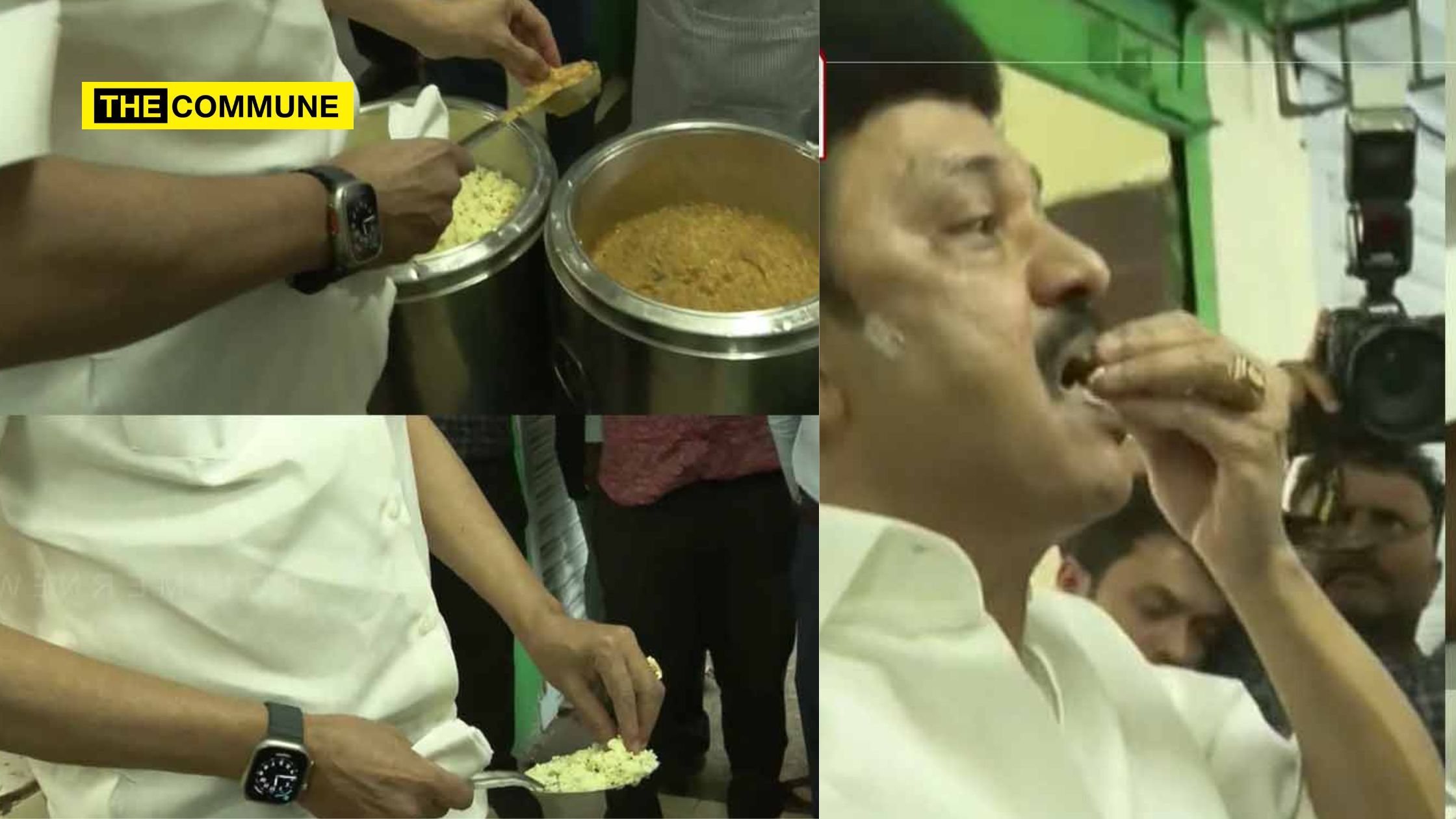
Netizens were disgusted by a video showing Chief Minister Stalin eating Sambar Rice with his hand and discarding the remaining food in the same serving vessel at an Amma Unavagam restaurant in Chennai.

After approving the allocation of ₹21 crore for the improvement of Amma Unavagam (restaurants) across Chennai, Chief Minister MK Stalin inspected one of these restaurants in Teynampet on July 19, 2024.

After returning to his residence in Teynampet from the Chennai Chief Secretariat, Chief Minister M.K. Stalin conducted a surprise inspection at an Amma restaurant near S.I.E.T. college. During the visit, he sampled the food to assess its quality. He engaged with the restaurant staff to discuss its operations and subsequently inquired about the standards of food quality and quantity. The inspection, attended by the new Chennai Corporation Commissioner Kumara Gurubaran, led Chief Minister M.K. Stalin to issue directives for the continued efficient functioning of Amma restaurants.

He emphasised the importance of maintaining cleanliness in the kitchen and canteen areas, as well as ensuring the preparation and serving of high-quality food for the benefit of the underprivileged.

During the inspection, Chief Minister Stalin attracted attention when he sampled the Sambar Rice by taking a portion in his hand and tasting it, then disposing of the remaining food from his hand into the same basin where the food was taken. When this incident was reported in the news, netizens criticized him severely, questioning the appropriateness of his actions. They asked whether it was acceptable for him to taste the food with his hands and then discard the rest onto the food meant for others.

https://twitter.com/Bakthan_TVK/status/1814226220965380296

Amma Unavagam or Amma Canteen – the flagship project of the then Chief Minister of Tamil Nadu J Jayalalithaa seems to be dying a slow death ever since the Dravida Munnetra Kazhagam (DMK) government came to power. The canteens that once flourished are now faced with declining income projections, budget inconsistencies, and difficulties in managing expenditures, particularly in terms of compensating the staff. Despite the Corporation’s claim of possessing a surplus of ₹315 crore in its capital account, this revelation has sparked discussions among netizens on social media and stirred concerns among the city’s residents.

Subscribe to our channels on TelegramWhatsApp, and Instagram and get the best stories of the day delivered to you personally.
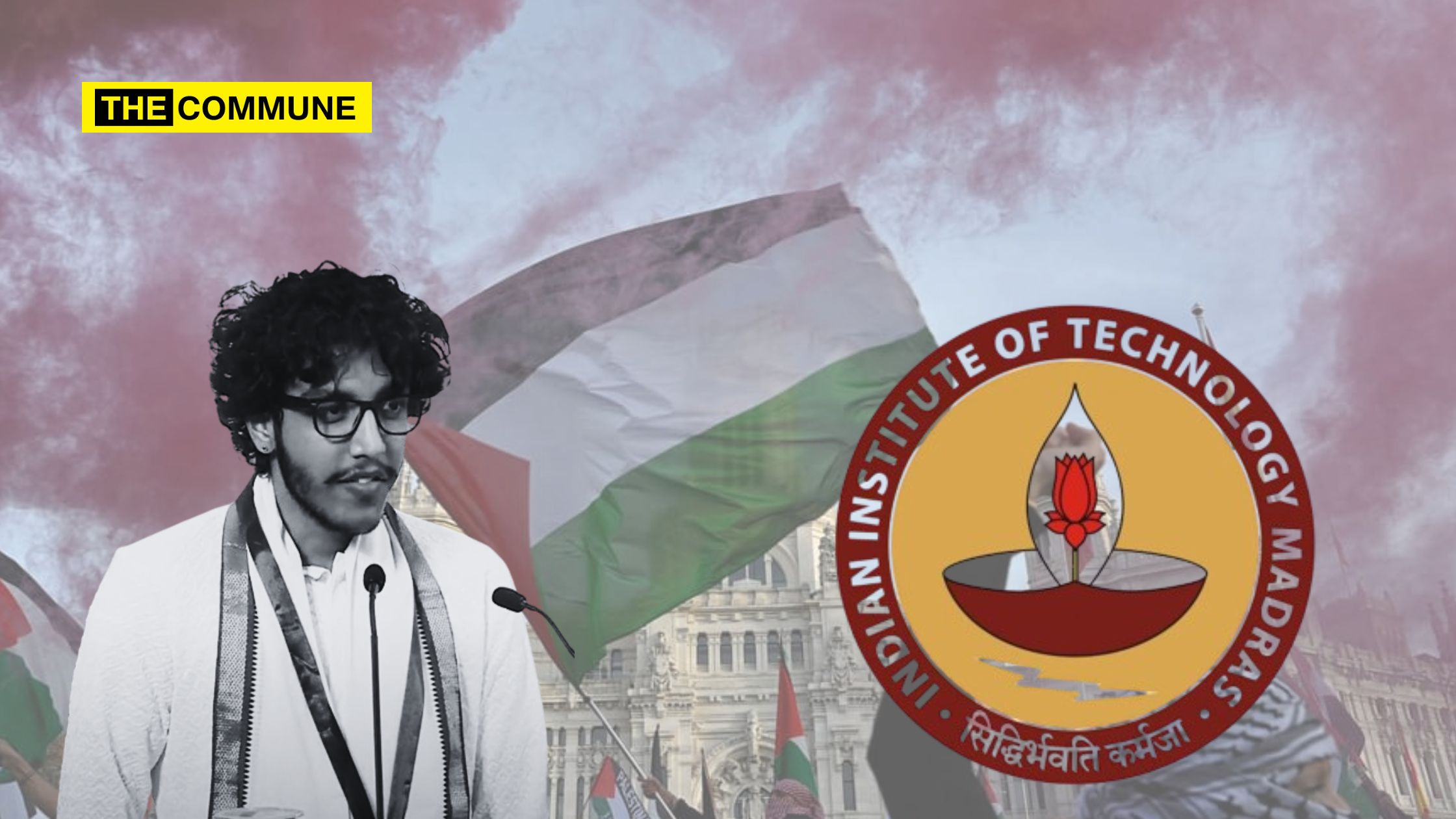
“STEM Has Been Used To Advance Imperial Powers Like Israel”: IIT-M Student Goes Woke During Convocation Speech

Wokeness appears to be infiltrating India’s premier tech institutions, as seen at the recent IIT-Madras convocation ceremony. A top mechanical engineering student used his award-acceptance speech to claim STEM fields, alleging they were being exploited to serve imperial powers like Israel. His anti-Semitic remarks have sparked concerns about the ideologies influencing young minds in such esteemed institutions.

IIT-M Convocation

The Indian Institute of Technology Madras (IIT-M) celebrated its 61st convocation on 19 July 2024 at its campus in Chennai, Tamil Nadu. This year, 3,016 degrees were awarded, including Joint and Dual Degrees. A total of 444 PhDs were conferred, encompassing PhDs, joint degree PhDs with foreign institutions, and dual degree PhDs.

Degrees were awarded to 2,636 graduates, including 764 BTechs (27 with Honours), 277 Dual-Degree BTech and MTech, 481 MTech, 151 MSc, 42 MA, 50 Executive MBA, 84 MBA, 236 MS, and 107 Web-enabled MTech for executives. Among the PhD recipients, seven joint degrees were awarded to universities in countries like Australia, Singapore, France, and Germany.

The Chief Guest, Dr. Brian K. Kobilka, Nobel Laureate in Chemistry (2012), addressed the convocation. Dr. Pawan Goenka, Chairman of the Board of Governors, IIT Madras, presided over the event with Prof. V. Kamakoti, Director, IIT Madras, faculty, staff, and students.

In his speech, Dr Kobilka congratulated the graduates and emphasised that his success was due to hard work, persistence, luck, and support from family, friends, and colleagues. He shared five key factors contributing to his career: finding his passion, having mentors, recognising and leveraging his strengths and weaknesses, maintaining a work-life balance, and learning from failures.

Dr. Kobilka highlighted his 21-year journey to obtaining structures of G-protein-coupled receptors in active/inactive states, which ultimately led to his Nobel Prize. He reflected on the many lessons learned from his failed experiments during this period.

Dhananjay Balakrishnan

At this time, Dhananjay Balakrishnan, a student from the Mechanical Engineering department, was awarded the Governor’s Prize for the best overall proficiency in curricular and extracurricular activities in Dual Degree.

In his acceptance speech for the award at the IIT-M convocation ceremony, Balakrishnan, who pursued an interdisciplinary dual degree in mechanical engineering and data science, made a statement that would remind us of Ashoka University’s convocation. He said he would be doing great injustice to himself and what he believes in.

He said, This is a call for action. There is a mass genocide going on in Palestine. People are dying in vast numbers and there is no visible end in sight. Why should we be bothered by this you ask? Because STEM as a field in itself has historically been used to advance the ulterior motives of the imperial powers such as Israel. As engineering students, we work very hard to get top-level jobs at tech giants which offer very lucrative pays and great benefits. However, these tech giants control various aspects of our lives today as you know better than anyone. Many of these prestigious companies are also directly and indirectly implicated in the war against Palestine by providing the state of Israel with technology, technology that is used to kill.”

He further said,There are no easy solutions and I don’t have all the answers but I do know this. As engineers graduating into the real world, it is our job to be aware of the consequences of the work we do and also to interrogate our own position in these complex systems of power imbalance. I hope that we can incorporate this awareness more into our daily lives attempting to understand what we can do to liberate the oppressed on lines of caste, class, creed, and gender. I believe that is the first step to curb the never-ending cycle of suffering.”

It was assumed that IITs are not as woke as other universities like JNU, Ashoka, or Jamia Milia Islamia. However, this instance indicates that wokeness has seeped into IITs, the very roots , especially IIT Madras, in the STEM field.

(with inputs from Indian Express)

Subscribe to our channels on TelegramWhatsApp, and Instagram and get the best stories of the day delivered to you personally.
“The Very Mountain Is Lord Shiva,” Says Madras High Court, Initiates Probe Into Tiruvannamalai Hill Girivalam Path Encroachments

HC tells TN govt to clear illegal encroachments from Tiruvannamalai Girivalam Hill And Thamarai Kulam tiruvannamalai madras high court arunachala hill

The Madras High Court has formed a committee to investigate reported encroachments on the Tiruvannamalai Girivalam path and instructed it to provide a comprehensive report.

Advocate Elephant Rajendran filed a petition to address encroachments on the sacred Arunachaleswarar hills in Tiruvannamalai town. The Court criticized the Forest and Revenue Departments of the Tamil Nadu government for permitting these encroachments, noting that The very Mountain is Lord Siva.

This marks Advocate Elephant Rajendran’s second Public Interest Litigation (PIL) concerning the temple town of Tiruvannamalai; the first addressed the disappearance and encroachment of 32 ponds in the area.

A division bench comprising Acting Chief Justice R Mahadevan and Mohammad Shaffiq heard the PIL and appointed a committee chaired by the Tiruvannamalai district collector. This committee, which includes representatives from the district revenue, forest departments, and corporation commissioner, aims to investigate encroachments along the slopes of the 718-acre sacred Tiruvannamalai hills Girivalam path.

The petitioner highlighted illegal constructions on the hill’s slopes, obstructing the traditional flow of rainwater through several streams that feed tanks in Tiruvannamalai. Specific concerns included houses and infrastructure encroaching up to 400 feet along the hill’s slopes, including lavatories, bathrooms, and septic tanks.

In response to the seriousness of the allegations and the hill’s sanctity, the bench tasked the committee with submitting a report within 15 days after visiting the site. The Court scheduled the next hearing for 30 July 2024, expecting the committee’s findings by then.

(With Inputs From DT Next)

Subscribe to our channels on TelegramWhatsApp, and Instagram and get the best stories of the day delivered to you personally.