Home Blog Page 700

Unacademy Describes Martand Sun Temple As ‘Shaitan Ki Gufa’ In Study Material, Silently Deletes Reference After Netizen Outrage, No Apology Whatsoever So Far

Surya Martand Temple and Unacademy platform
Unacademy demonizes Kashmir's Martand sun temple as "Shaitan ki Gufa"

Unacademy, an online learning platform, is in the news for posting fictional and incorrect information on its website regarding the Martand Sun Temple in Kashmir.

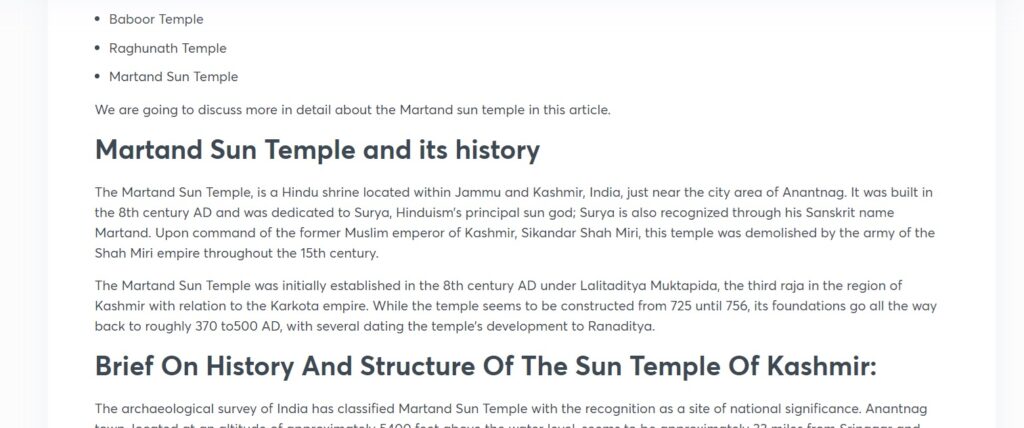
This Temple in Anantnag district is dedicated to the Sun god. Built in the 8th century, it was destroyed by Islamic invaders. The temple is an ASI-protected monument and is believed to have been destroyed on the orders of Sultan Sikandar Shah Miri. The temple’s origins trace back to King Lalitaditya of the Karkota dynasty, which ruled Kashmir in the seventh century. The epic Rajatarangini, which details the history of Jammu and Kashmir, also mentions the influential Karkota dynasty.

What Did Unacademy State About Martand Sun Temple?

On their website, in the study material about the temple, Unacademy said that the Sun temple is also called “Shaitan ki Gufa“.

This temple was popularised as Shaitan ki Gufa or Satan’s cave/Devil’s cave in the Hindi film Haider. Director Vishal Bharadwaj shot the song Bismil here with the lead actor Shahid Kapur wearing scary costumes.

Travel blogger Anuradha Goyal and a few other nationalistic handles posted about this inaccuracy on social media platform X. They questioned Unacademy about whether the organisation was taking lessons from Bollywood.

Upon checking the study material on their website, it became apparent that Unacademy had silently changed the text, removing the reference to “Shaitan ki Gufa”.

However, neither their founder, Gaurav Munjal, nor the official handle of Unacademy, has posted anything in connection with this, and neither have they apologised so far. 

It is noteworthy that the J&K government has initiated efforts to restore the temple and attempt to bring it back to its original glory.

Normalising Falsehoods Through Pop Culture

A grave falsehood such as describing a sacred temple as “Shaitan ki Gufa” is normalised through films and mainstream media. Our school textbooks are perfect example of how false propaganda of the leftists was peddled a few decades ago. Be it portraying Ashoka as a humane being or Akbar as someone who “planted trees on either side of the road for travellers to rest in its shade”. There is no proof that such things existed, and children and adults alike have been fed lies in the name of history.

This propaganda can be seen in Dravidian pop culture – literature and films. Tamil films depict the Brahmin as evil person and also ably enable the peddling of the Dravidianist ideology.

Subscribe to our channels on TelegramWhatsApp, and Instagram and get the best stories of the day delivered to you personally.

TN BJP President Annamalai Slams DMK Govt Over Unfulfilled Promises On Electricity Rates And Unemployment

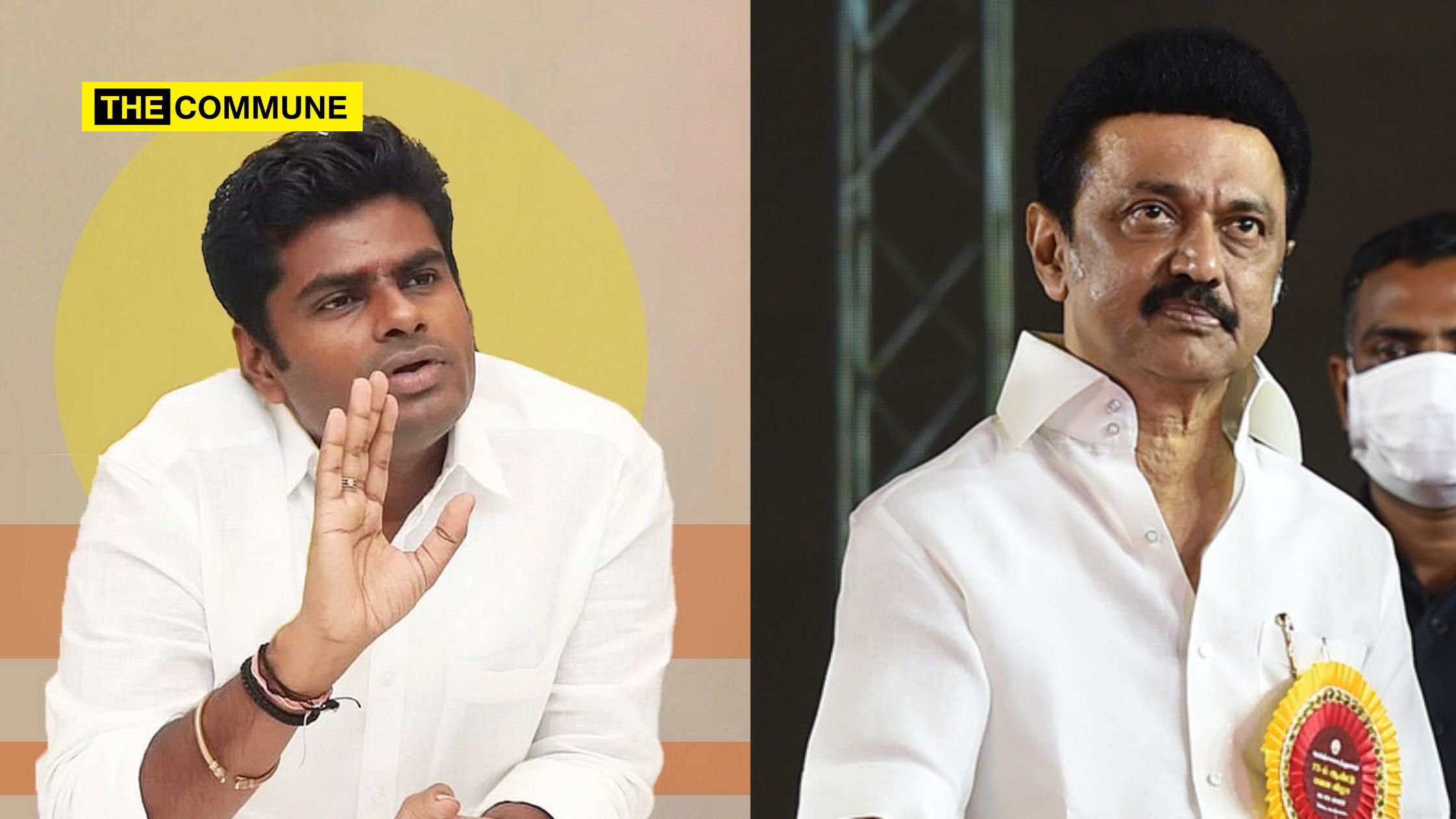
K Annamalai and MK Stalin
Annamalai fires DMK for misleading the public on electricity rates and the unemployment situation in Tamil Nadu.

Tamil Nadu Bharatiya Janata Party President Annamalai, criticized the DMK in Tamil Nadu for misleading the public by falsely comparing electricity rates with other states and misrepresenting the youth unemployment rate in Tamil Nadu.

Regarding this issue, Annamalai criticized the Tamil Nadu government for misleading the public by comparing electricity rates with other states. He highlighted that the DMK, in its election manifesto, promised a monthly electricity bill collection system as its 221st commitment, which he urged the government to fulfill. According to Annamalai, implementing this system would significantly reduce electricity costs for households.

Annamalai said, “What DMK said in its election manifesto promise number ‘221’ is that it is enough to pay electricity once a month. Neighboring states pay electricity bill once a month. Look at the problems if you don’t pay electricity once a month. For example, I use 200 units of electricity in Coimbatore, if I pay electricity bill once a month it is ₹450, if I pay it for two months i.e. this month 200-unit next month 200 unit, when I pay electricity bill once in two months it is ₹1440 for 400 units. If you pay this once a month then this month 450 next month 450 total ₹900 for 200 units. But if you calculate it as 400-unit slab for two months, you have to pay 1440 rupees. 540 as a loss for using just 200 units. Let’s talk about 300 units now, the electricity bill for me is 705 rupees, which is 300 unit this month and 300 unit next month in DMK’s bi-monthly electricity tariff, if you pay for 600 unit means it is ₹2940. So, where is ₹1410 and where is ₹2940 rupees, in this we pay ₹1400 more.

Annamalai, further revealed that 17.5% of young people aged 15 to 29 in the state are unemployed. He emphasized the high rate of unemployment among graduates in Tamil Nadu, comparing it unfavorably to states like Gujarat (6.1%), Karnataka, and Maharashtra (7-8%). Annamalai called on the DMK government to acknowledge the unemployment crisis affecting 17.5 percent of Tamil Nadu’s population.

Annamalai also discussed the BJP’s growth in Tamil Nadu, likening it to nurturing a Chinese bamboo plant. He stressed the importance of patience and persistence in strengthening the BJP’s presence, despite challenges. He mentioned that despite setbacks, the BJP had secured the top position in 8000 booths during the last election, which he interpreted as a sign of growing support and influence in the state.

Subscribe to our channels on TelegramWhatsApp, and Instagram and get the best stories of the day delivered to you personally.

A Few Comments On My Book ‘Rāmāyaṇaṁ’– Volume 1

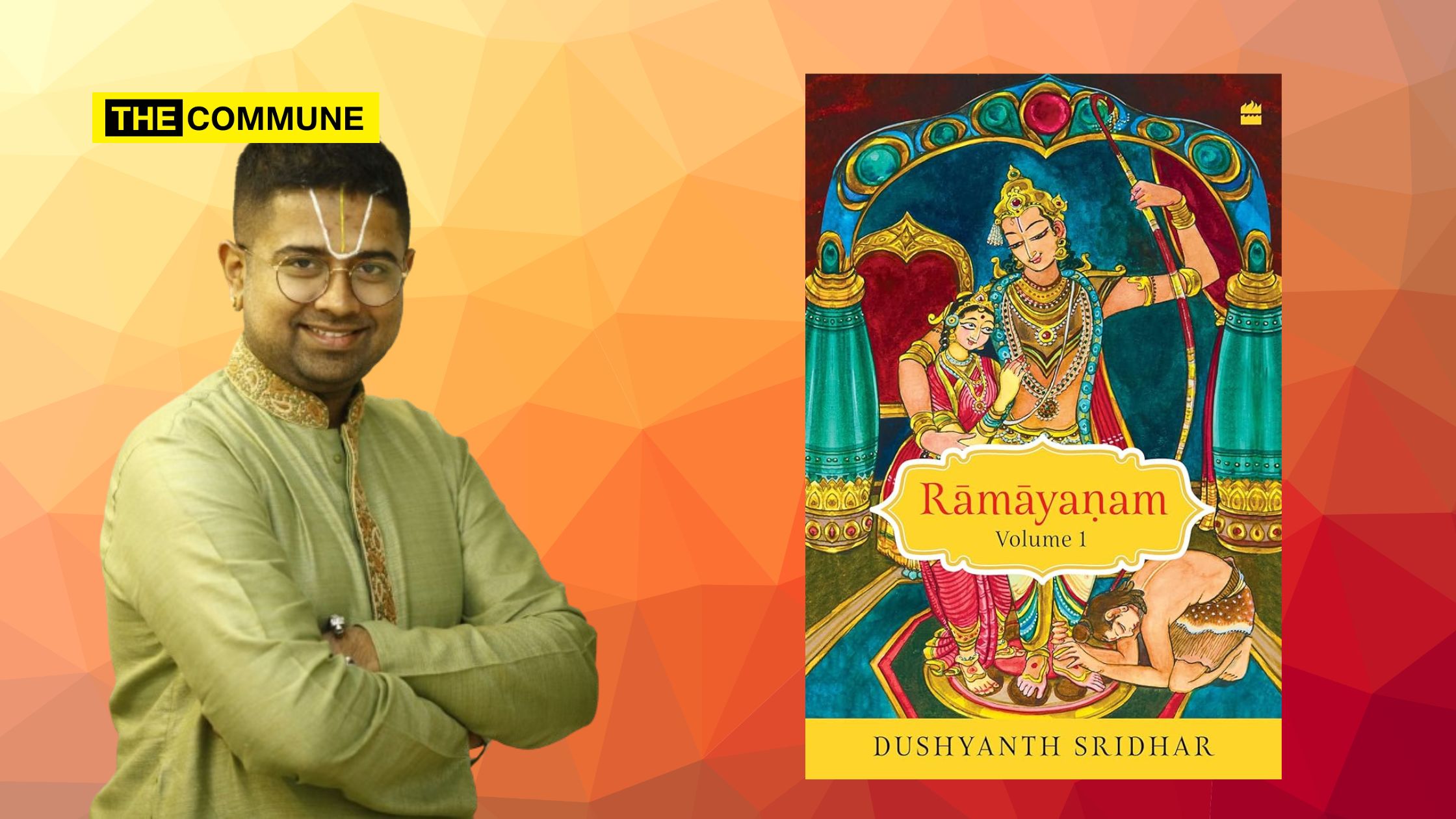
Dushyanth Sridhar and his book Rāmāyaṇaṁ’– Volume 1
Dushyanth Sridhar clarifies reviewer's doubts on Rāmāyaṇaṁ’– Volume 1

The Commune had published a review of my book by Vedic Speaker ‘Rāmāyaṇaṁ’– Volume 1. The reviewer came up with a few questions and doubts in the review. Here are the responses to some of those queries.

On Ramayana Dates

The paragraph about the Ramayana dates that the reviewer has written. As such, I have not discussed anything about the yugas, the duration of every yuga, Chaturyuga, etc in the text of my book, nowhere it has been discussed. Nor have I criticized the version of the Puranas or the Itihasas and upheld the research Jayashree Saranathan has done research which is much better than the Puranas. I have quoted Jayashree’s name stating she is the one who has given the dates. Her dates have been mentioned in the footnotes, that’s all. The concept of a Chaturyuga especially the number of years 43 lakh 20,000 years being the Chaturyuga, the 24th Chaturyuga where the Ramayana happened is different.

All this is not found in Valmiki Ramayanam itself. From Bala Kandam to Uttara Kandam, there is no mention of it. It is found in a Purana and between itihasas and Puranas, itihasas are given more respect than the Puranas. When I say more respect, more authentic because they are regarded as direct history or recording. So nowhere in the Ramayanam itself, there is a discussion of the 24th Chaturyuga, where the Chatur Yuga being 43 lakh 20,000 years, nothing of that sort, it comes only in the Purana. I have not analyzed the dates or anything of that sort. In fact, in one of the paragraphs within the text of the book, I mentioned that I think it’s Lakshmana vakyam towards Rama, Rama now we are living in the times of Treta, but your administration makes me feel that there is more than Dharma in it like the Krita Yuga. So I’ve clearly mentioned this as Treta, this as Krita, and all of that in the text. Because I’ve mentioned clearly that we are living during the times of Treta Yuga, Rama, but you make us feel as if we are living in the times of Krita Yoga, because this has been extracted from a line of Vedanta Deshika’s Raghuveera Gadyam which says “Tretayuga pravarthitha Karta yuga vritthantha.

On Venkatesa Suprabhatam verse

With respect to the verse “Kausalya Supraja Ramapurava Sandhya Pravathathe”, this is a verse from Valmiki Ramayana where Vishwamitra wakes up Rama in the early hours of the morning. So the reviewer asks why didn’t I make reference to Venkatesha Suprabhatam. There is no need. The Venkatesha Suprabhatam of the 14th century where Prativaadhi Bhayangara Mannan imports the verse from Valmiki Ramayana – Kausalya Supraja Rama and from the next verse only he starts composing which is “Uttishtottiṣṭha gōvinda uttiṣṭha garuḍadhvaja”. So, I don’t think there is any need to add the reference of Venkatesha Suprabhatam anywhere in the book, because I don’t pick up any verse from Venkatesha Suprabhatam. This verse is from Valmiki Ramayana. And the comment whatever I’ve written is explaining those lines is from the commentator Periyavachan Pillai’s commentary of the 13th century and Govinda Raja’s commentary of the Bhushana.

Rama and Sita as Narayana and Mahalakshmi

The original Valmiki Ramayanam has six commentaries and one of the largest of the six and probably the grandest is Govinda Raja’s commentary called Bhushana. Nagesha Bhatta’s commentary Thilaka is good but it is not as big and as deep as Govinda Raja’s. So there, Govinda Raja makes very clear references to Rama as the avatar of Narayana. Narayana akhilaheya pratyaneekatharaha samastha kalyana gunatmakaha, jagatchakshuhu, So he calls him the one who controls all the functions of the world, the one who is the Antaryami or all Devatas. So I’ve used that particular line stating that Narayana who is the Antaryami of all, thereby even when Shiva’s made reference, I have used that. So it is conforming to the commentary of Govinda Raja.

Within Valmiki’s original Ramayanam itself (Yuddha Kandam), there are multiple open and hidden references to Rama and Sita as Lakshmi and Narayana. When Mandodari praises Rama,

व्यक्तमेष महायोगी परमात्मा सनातनः |

अनादिमध्यनिधनो महतः परमो महान् ||

तमसः परमो धाता शङ्खचक्रगदाधरः |

श्रीवत्सवक्षा नित्यश्रीरजय्यः शाश्वतो ध्रुवः ||

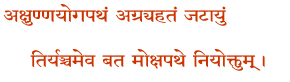
She says that I see you as Paramatma holding Shanka Chakra as Narayana who has got Mahalakshmi on his chest. And when looking at Jatayu, he says “Gachcha lokaanuktamaan”. I grant you Moksham, go to that place from which there is no return Jatayu, which is Mokshapradattvam. So, all these have been taken into verses by Kuresha in the 11th century in his work called Atimaanushasthavam where he says,

He clearly talks about the Moksha granting status and calls Rama as Narayana. So Valmiki in many instances, has given subtle references to their Parathvam.

Valmiki Ramayana inspiration

I have mentioned in the Rāmāyaṇaṁ’– Volume 1 book flap in the front blurb as well as in the preface that I have completely been inspired by Valmiki his commentators, and many other works, and I had to use that little right of being the author of this book, to use some creativity to stitch those ends. 

Dravida/Tamil

Coming to the word Dravida Draavida, please note that in Ayodhya Kandam, Aranya Kandam also, when Lakshmana sees a branch full of flowers, Rama refers to them and states these are carrying so many flowers, like the women from the south of India (Dakshinayaam), who have flowers on their heads. So, there is a clear reference to the South Indian culture.

Gajendra Moksham Reference

This instance involves Agastya who was in the south of India, and Bhagavatham, we have a clear reference that it happened by the banks of river Tamirabharani. The word Dravida comes in Bhagavatham as well (Utpanna dravidesaaham) and Vedanta Desika has written Dramidopanishad Tat Parya Ratnavali. So Dravida Shishu says Adishankara. So the word Dravida Dramila Draavida has been in vogue in the Samskruta literature.

Even in Ramayanam, Sindhudouveeraaha Draavidaha, I remember this verse where the word Draavida comes. So, this word has been there. The word Tamizh may not explicitly occur in any of the granthas because that is the name given locally to this language. But I had to introduce that because in Sundarakandam when Hanuman says, “Instead of Samskrutham, I will talk to her in a Madura Basha”, many of the Acharyas in the south of India interpret that to be Tamizh. So, Tamizh must have existed then. And also Tamizh must have been a language completely soaked in Bhakti. Because Bhagavatam says “Utpanna dravidesaaham”, Bhakti grew and was born in the state of Dravida, which means where Tamizh is spoken and around that period Tamizh must have also come up.

Dushyant Sridhar is a Hindu, Vedic Speaker and the author of ‘Rāmāyaṇaṁ’– Volume 1

Subscribe to our channels on TelegramWhatsApp, and Instagram and get the best stories of the day delivered to you personally.

The Real Face Of Dravidianist Suki Sivam That Very Few People Know

Suki Sivam
Although Suki Sivam claims to be a practicing Hindu, he is another Dravidianist.

Suki Sivam, the self-proclaimed scholar who occasionally uses his eye-opening research on Hindu gods to subtly interweave Dravidianist ideology into his spiritual talks, displays a level of arrogance that seems boundless. In Indian philosophy, Hindu teachings assert that choosing a spiritual path should transcend the inherent arrogance of human nature—a quality considered essential for the human experience, except in Charvaka philosophy. However, Suki Sivam stands as an exception to this notion. Despite presenting himself as a devoted Hindu follower and spiritualist, his arrogance persists, embodied in his unyielding sense of self.

In a recent interview, Suki Sivam expressed his grievances towards Hinduism with a remarkable degree of arrogance, claiming, “A group that should have followed and respected me disregarded me and created unnecessary animosity due to my caste. They were unwilling to accept my leadership.” This statement underscores a troubling contradiction; while he professes to uphold Hindu values, his own behavior reflects the very arrogance that spiritual paths are meant to overcome.

Suki Sivam, didn’t stop there, he went so far as to assert that the Hindu god Murugan at the Palani Temple is not a deity but a Tamil Siddha named Bohar. In Tamil Nadu, there are two distinct types of individuals when it comes to attitudes towards religion: one group rejects the idea of deities altogether, often ridiculing Hindu gods and practices, while another group, disguised as spiritual gurus, claims to be devout followers of Hinduism while covertly disparaging its traditions in the name of historical research. Both groups are dangerous, but the latter—epitomized by figures like Suki Sivam—poses a greater threat. This kind of ideology can be traced back to EV Ramasamy Naicker, who played a pivotal role in shaping such attitudes in Tamil Nadu.

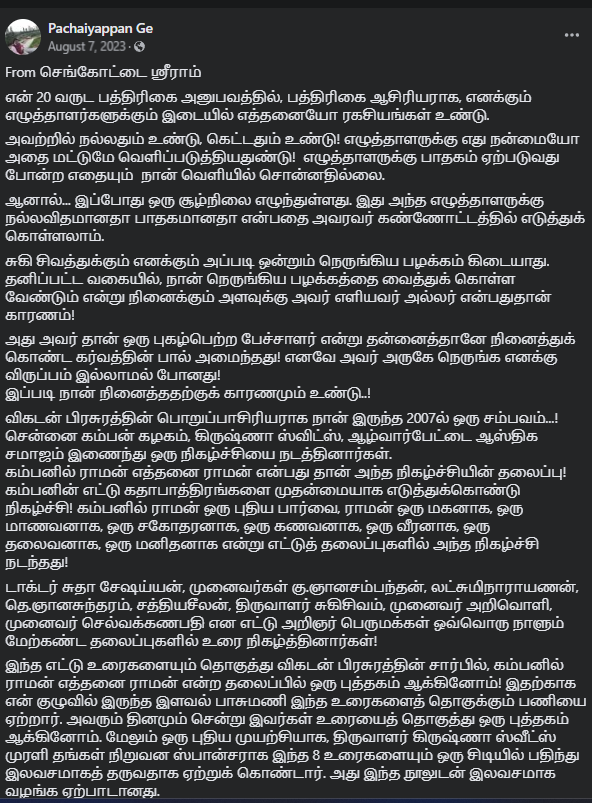
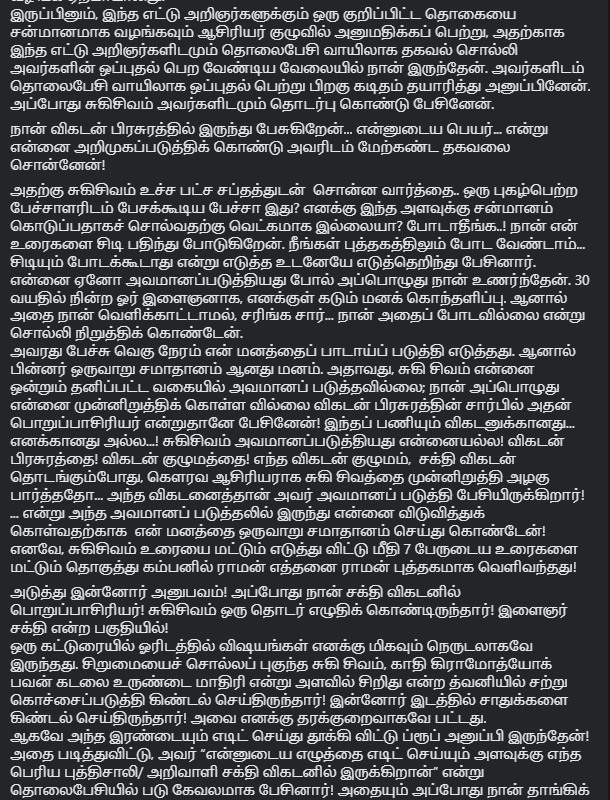
Suki Sivam’s tendency to demand respect for his supposed authority is not new. To illustrate this, we can look at the experiences of Sengottai Shriram, a former editor at Sakthi Vikatan (devotional magazine published by Vikatan group) and later a content writer for the exclusive Sakthi Vikatan. In 2023, Shriram recounted two instances of mistreatment by Suki Sivam, highlighting his arrogance and condescension.

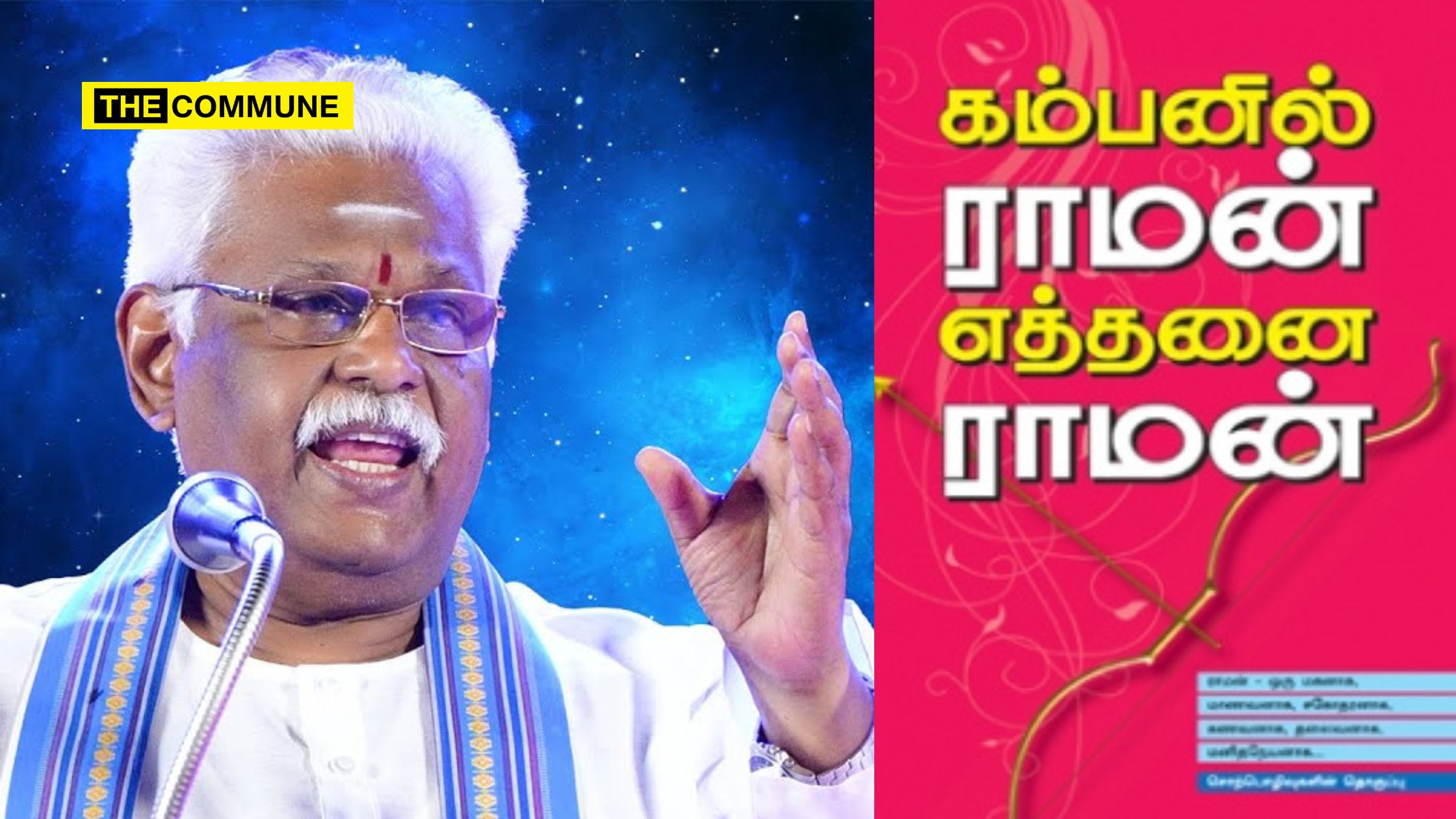
Shriram describes an incident from 2007 when he was the editor of Sakthi Vikatan of Vikatan Publications. At that time, Chennai’s Kamban Kazhagam, Krishna Sweets, and Alwarpet Asthika Samaj organized a program titled “How Many Raman in Kamban’s Raman!” The event aimed to explore eight different aspects of the character Raman from Kampan’s work. Eight scholars, including Suki Sivam, delivered speeches on these topics, which were later compiled into a book entitled “Kambanil Raman Ethanai Raman”.

Shriram, responsible for getting consent from the scholars for a monetary gift as compensation, approached Suki Sivam for approval. Suki Sivam responded with indignation, questioning why a celebrated speaker like himself should be honored in such a manner. He said, “I am a popular speaker; For my stature, is this the kind of petty amount you will pay me? I refuse to give you the rights to publish my speech, and also to give it out in CD format. I can sell my own CDs for a price deserving of my stature” causing Shriram great distress. Despite this insult, Shriram managed to calm himself by focusing on the fact that the work was on behalf of Vikatan Publications, not a personal affront.

However, other respected Tamil scholars such as Sudha Seshayan, Gnanasambandhan, Lakshminarayanan, Gnanasundaram, Sathyaseelan, Arivozhi, and Selvaganapathi, who were held in higher esteem than Suki Sivam, recognized the importance of preserving the legacy of the Tamil poet Kamban and his Ramayanam for future generations. They allowed Vikatan to publish the works with the understanding that the preservation of this cultural heritage was more important than immediate financial gain.

In another instance, while Shriram was overseeing Sakthi Vikatan, he found himself compelled to edit Suki Sivam’s writings due to their problematic content. When he made edits to remove derogatory comments about sages and other issues, Suki Sivam reacted with scorn, asking, “Who is so intelligent enough in the Sakthi Vikatan to edit my writing?.”

Contrary to Suki Sivam’s previous claim that he was not recognized, it is a blatant lie to say that the people of Tamil Nadu do not acknowledge the talent of Tamil scholars, regardless of their class, creed, religion, or gender. In Tamil Nadu, the contributions of spiritual scholars are celebrated and revered almost as if they were prophets. However, Tamil society also has a tendency to shun arrogance, which is considered uncharacteristic of true scholarship. In this case, Suki Sivam, who was once respected and admired for his Tamil expertise, displayed arrogance and mistreated others. As a result, he was eventually expelled from the scholarly community and has now become a mouthpiece of Dravidian ideology. His fall from grace was a consequence of his arrogance, not a reflection of any shortcomings in recognizing talent, as illustrated by these two incidents.

(With Inputs From Tamil Labs 2.0)

Subscribe to our channels on TelegramWhatsApp, and Instagram and get the best stories of the day delivered to you personally.

Cricket Jihad: Why India Must Boycott The Radicalized Pakistan Cricket Team

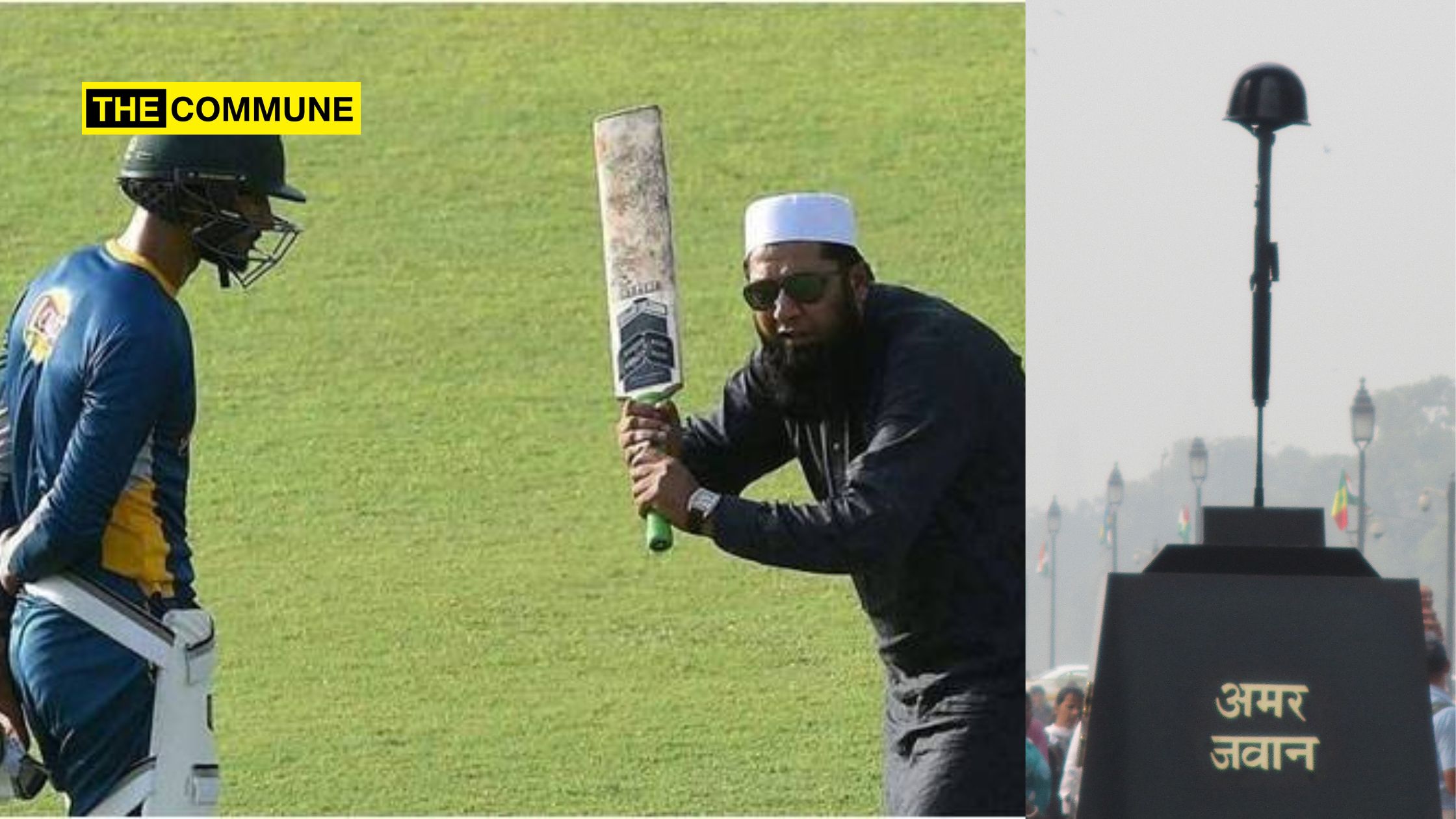
Inzamam-Ul-Haq radicalizing cricket, Amar Jawan Jyoti

I wholeheartedly endorse BCCI’s refusal to tour Pakistan for the upcoming Champion’s Trophy, which will be held there in 2025. I will go a step further and urge a complete boycott of Pakistan Cricket.

Let me break it down for those still wondering what is wrong with India going to Pakistan to play in the Champion’s Trophy. It is no longer a secret that cricket stopped being a gentleman’s game in Pakistan, especially in the last two decades. Under the influence of the Tablighi Jamaat (TJ), the game has become a medium to promote radical religious ideologies. Pakistan Cricket team players see the sport as a way to influence non-Muslims to convert to Islam and establish the nation’s image as an Islamic power. 

Most importantly, Pakistan Cricket players see the game as a way of waging “Jihad” against India and establishing the “victory of Muslims all over the world over Hindus”.

The Jamaat’s grip on the “Shaheens” has been well-known for some time. They made mandatory the display of Islamic symbols in the dressing rooms, namaz for players, and starting every response in front of cameras with “Thanks to Allah almighty”. Cricketers like Danish Kaneria, who didn’t follow the mandate, were conveniently sidelined, and those who bent to the diktat, like Yousuf Yohanna, were allowed to keep their place. 

How did this radicalisation begin in Pakistan Cricket?

It isn’t as if religious bigotry among Pakistani cricket players was uncommon before the 2000s.

In a 2009 article titled ‘Of Cricket and Other Demons’ in the Pakistani daily Dawn, Nadeem F. Paracha writes that the indoctrination process was set relatively early in society. He argues that the sixth president of Pakistan, Muhammad Zia-Ul-Haq, decided to radicalise the society so that he could efficiently recruit cheap cannon fodder for the ‘jihad’ in Afghanistan. Paracha writes:

With the ‘Afghan jihad’ raging against the former Soviet Union, Zia (ul-Haq), his intelligence agencies, and parties like Jamat-i-Islami and Jamiat Ulema-i-Islam started embracing a narrow and highly political version of Islam… Most Pakistanis were historically related to the mazaar and Sufi traditions of the subcontinent and, thus, were least suitable to fight a ‘jihad’ that Zia was planning to peddle in Afghanistan. 

Their beliefs were incompatible with Zia or, for that matter, with the late Abul Ala Maududi and Syed Qutb’s versions of Political Islam. To compensate for this ideological ‘deficiency’, the Zia regime sprang up indoctrination centres in the shape of thousands of madrassas. Almost all of them were handed over to radical puritans. These were preachers and ‘scholars’ who had become critical of the strains of faith most Pakistanis adhered to. Accusing these strains of being ‘adulterated’, they fell instead for the assertive charms of the Political Islam. 

Even though the stars of Pakistani cricket back then didn’t display their religion publicly, they were the generation bred on Zia’s radical notions. They were just as zealous in their views about ‘jihad’ for Kashmir or the indoctrination of non-muslims.

The former Indian High Commissioner to Pakistan, G Parthasarathy, recalled meeting Imran Khan when he was the captain of the Pakistan cricket team.

“I first met Imran Khan in 1982 during the tour of the Indian team led by Sunil Gavaskar to Pakistan. We lost the series badly. A Pakistani journalist told me that when he asked Imran how he bowls such fire against India, he said, ‘Whenever I play against India, I don’t treat it as a game. I think of Kashmir and treat it as a jihad’,” he wrote.

In 1978, after his team’s victory against India in a test series, the then Pakistani captain Mushtaq Mohammed went on record saying it was the “victory of Muslims all over the world over Hindus.”

Things took a real turn for the worse in 2001 when the Pakistan Cricket team’s opening batsman, Saeed Anwar, lost his three-year-old daughter, Bismah, after a prolonged illness. He sought solace in religion.

That is when the volunteers of the Tablighi Jamaat took his hand. They consoled him, guiding him towards the Quran to seek solace in its verses and read up on the companions of the Prophet who had to endure untold hardships. Over time, Anwar came to terms with his grief, finding succour in Surah Al-Imran’s verse 185: ‘He who has taken a breath shall taste death too.’ He was a changed man. Gone was the swagger and worldly attitude. He grew a beard, began to pray five times a day and took it upon himself to explain life’s larger purpose to his teammates. He became a regular at Tablighi Jamaat gatherings, becoming a powerful speaker. When he spoke, people listened in rapt attention. Soon, he came to be seen as the Tabligh’s most important ‘face’ in the country.

These are excerpts from ‘Inside the Tablighi Jamaat’ by Ziya Us Salam as he provides an inside view of the organisation and its various aspects, especially in the sub-continent.

What is Tablighi Jamaat?

Tablighi Jamaat (The Society of Preachers) is a supremacist Deobandi Islamic missionary group with footprints in over 150 countries. It shares the same goals as the Salafis, Wahhabis and other Islamist movements, i.e., Dar al Islam and establishing a global Caliphate.

TJ focuses on encouraging Muslims to return to practising their religion as it was during the time of their Prophet and give dawah (invitation to convert) to non-Muslims. Members consider music haram, and women observe strict purdah. 

Not too long ago, Aamir Khan posed happily with Tariq Jameel, easily the most recognisable face of the organisation headquartered in New Delhi. The organisation takes converts as far as possible from their native non-Muslim roots in the name of “Islamic revivalism.” Even the most elite members of the community in India support it.

They like to work quietly and were primarily unheard of by many Indians until 2020, when a TJ congregation in Delhi’s Nizamuddin Markaz Mosque became a COVID-19 super-spreader event. There were more than 4,000 confirmed cases and at least 27 deaths linked to the event reported across the country.

Consequences of Tablighi Jamaat Influence

Once Anwar began preaching, he became a mouthpiece of Tablighi Jamaat’s ideals. Once, he even said, “All 6 Billion non-Muslims will burn in hell. Let’s save them by converting them to Islam.”

He could significantly influence other players, especially Inzamam-ul-Haq, who admired his captain’s batting skills. Haq, otherwise known to be a mild-mannered and pleasant person, used to get agitated if anyone criticised Tablighi Jamaat. His ideas trickled down to other members when he took over the captaincy in 2004. 

Soon enough, bowlers Mushtaq Ahmed and Saqlain Mushtaq were seen sporting Tablighi Jamaat-mandated beards and started sharing things of faith with others. Fast bowler Shoaib Akhtar followed in their footsteps and joined the organisation. He was even seen sermonising, though, without the mandatory beard.

The Islamization of the ‘Men in Green’ became apparent on the field and off-the-field media interactions, too. Haq started using “Bismillah (In the name of Allah)” before all his soundbites and speeches. Players would often pray on the ground before the match. There would be reports of batsmen cramping up because of Ramzan fasting during games.

The dressing room soon became a hub for a conversion racket led by Haq. Check out posts by ‘Pakistan Untold’, where he brags about his attempts at converting other professional players.

While touring in a plane between cities during the 2007 World Cup, Haq reportedly ordered all the players to stand up and say their prayers in the jet’s aisle, even when asked by the cabin crew to remain seated.

In an interview, he proudly shared that batsman Yusuf had even tried to convert Brian Lara to Islam during the Karachi Test match after inviting him for a ‘da’wa’.

Being a Non-Muslim in Pakistan Cricket

This muggy control wielded by Tablighi Jamaat had crushing effects on the non-Muslim team members. 

Anwar’s ideas prompted Yousuf Youhana, the only Christian member of the team, to convert to Islam in 2005 and be known as Mohammad Yousuf. Much like other neo-converts, Yousuf was staunch in his beliefs. He reportedly talked about the genocide of non-muslims in Pakistan. 

Yousuf said, “If Pakistani Muslims start living as per Islam, there will be no non-Muslims left in Pakistan.” 

He had also said, “No non-Muslim can enter Jannat ever. But Allah will send even the worst criminal Muslim to Jannat.”

Instead of calling out his bigotry, his team members encouraged him further. Off-spinner Saqlain Mushtaq claimed that Yousuf’s average doubled because he started following Islam.

On the other hand, Danish Kaneria, the only Hindu player in the team, resisted these ideas and faced the consequences. In a candid admission of Hinduphobia within the team, Shoaib Akhtar spoke about how his teammates maltreated Kaneria over religion.

Without naming the captain, Akhtar also said that Kaneria wasn’t even allowed to pick up food from the same table as others because of his faith.

“Captain would raise eyebrows about him eating with us or taking the food from the same table. I told him you could be the captain, but your conduct is despicable. This guy (Kaneria) is chalking up so many wickets to win matches for us, and you’re treating him like this,” Shoaib Akhtar spoke on a cricket show titled ‘Game on Hai’ on PTV.

The treatment of minorities in the Pakistan team wasn’t a widely reported issue in the local or international press. However, one tragic incident in 2007 opened many cans of worms over TJ’s influence over the team. 

Many eyebrows were raised when the team’s coach, Bob Woolmer, was found dead in his room after Pakistan’s embarrassing performance in the 2007 World Cup. The India-born Woolmer was worried about the players’ decline in performance. He attributed this descent to TJ’s growing influence on some cricketers and their consequent indifference to training.

By then, Woolmer and Haq had professional differences in coaching and training methods. Haq led his team to believe that they could win simply by praying. TJ preachers would be allowed to meet players in the hotels during tours, and during such visits, Haq and his men would entirely ignore Woolmer and his instructions.

More than the team’s show of religious affinity, what bothered Woolmer was how Haq gained discipline and submission from the players. This obedience was not on adherence to a professional order but on a follow-or-perish-in-hell code of conduct based on TJ ideals.

On 18 March 2007, Woolmer died suddenly in Jamaica, just a few hours after the Pakistan team’s unexpected elimination at the hands of Ireland in the World Cup. Shortly afterwards, Jamaican police announced that they opened a murder investigation into the case. In November, a jury in Jamaica recorded an open verdict on his death.

The Aftermath

Pakistan Cricket team continues to be a highly radicalised organisation using a radicalised version of the faith to indoctrinate others. 

Sporting wins against Team India are now seen as a form of jihad by not just the team but also by Pakistani media and political leaders.

After the team won a T20I match by ten wickets for the first time, Pakistan’s Interior Minister Sheikh Rasheed claimed that all Muslims worldwide, including Indian Muslims, had supported Pakistan during the match. “Pakistan’s triumph against India is a victory of Islam. All Muslims worldwide are rejoicing,” he said in a video on Twitter.

He refused to make such boisterous claims when the New Zealand cricket team called off its Pakistan tour minutes before the first match was due to begin in Rawalpindi, citing security concerns.

Spewing rabid hatred against the Hindus continues to be applauded in the Pakistani media. Former captain and pacer Waqar Younis even said his favourite moment of the match was when Mohammed Rizwan offered namaz on the ground in front of Hindus.

Shahid Afridi boasted about breaking a TV set at home after he saw his young daughter imitate aarti after watching a Star Plus soap. The audience clapped for Afridi’s parenting choices. 

In another interview, he said, “They (Hindus in India) can never have large or pure hearts like what Allah has given to us Muslims”.

In an interview, Shoaib Akhtar casually talked about Ghazwa-e-Hind, attacking Kashmir and the rest of India to establish an empire from Attock to Cuttack. The interviewer kept smiling at those comments.

Pakistani cricketers weren’t allowed to participate in the 2010 IPL auction over their government’s inaction over the 26/11 Mumbai terror accused. On a TV show discussion on this BCCI decision, batsman Sohail Tanvir announced, “Hinduon ki zahaniyat hi aisi hai” (Hindus have such nature (back stabbers)’ The hostess responded with “muh mein Ram, bagal mein churi” (Hindus will stab anyone’s back with a knife while chanting the name of Ram). They received good applause from the audience.

Derisively labelling anyone practising Sanatan Dharma as “Hindu Banya” is a common practice in Pakistan. To them, the Hindu is a cunning businessman, unlike the Pakistani Muslim. How this stereotype percolated across the border into Bollywood is, perhaps, a subject for another day.

Pakistani cricketers are so obsessed with spreading Islam that they even support the Taliban and ISIS. When the Taliban took over Afghanistan, they slaughtered many Afghans. To this barbaric act, Afridi took a proud stand, saying, “Taliban love cricket. The Taliban has brought positivity to the world. Taliban are women rights champions.”

Perhaps the Pakistan team will always walk into the ground to wage ‘cricket jihad’ instead of playing professional cricket. In that case, it may be high time for the ICC and BCCI to decide if the team should be allowed to play any future games with other professional bodies.

In Conclusion

Lastly, I am not naive enough to believe that this plague of radicalisation is limited to the Pakistan cricket team alone.

We would be wise to remember that Pakistani cricket’s radicalisation is just a microcosm of its wider society. There is no reason to believe that its tennis, kabaddi, athletic, or hockey teams do not breed such radical elements. In the best interest of all national sporting talents, the government should boycott all interactions with any Pakistani sports body. 

Jayasri Viswanathan is a journalist and columnist. 

(Subscribe to our channels on TelegramWhatsApp, and Instagram to receive the best stories of the day personally.)

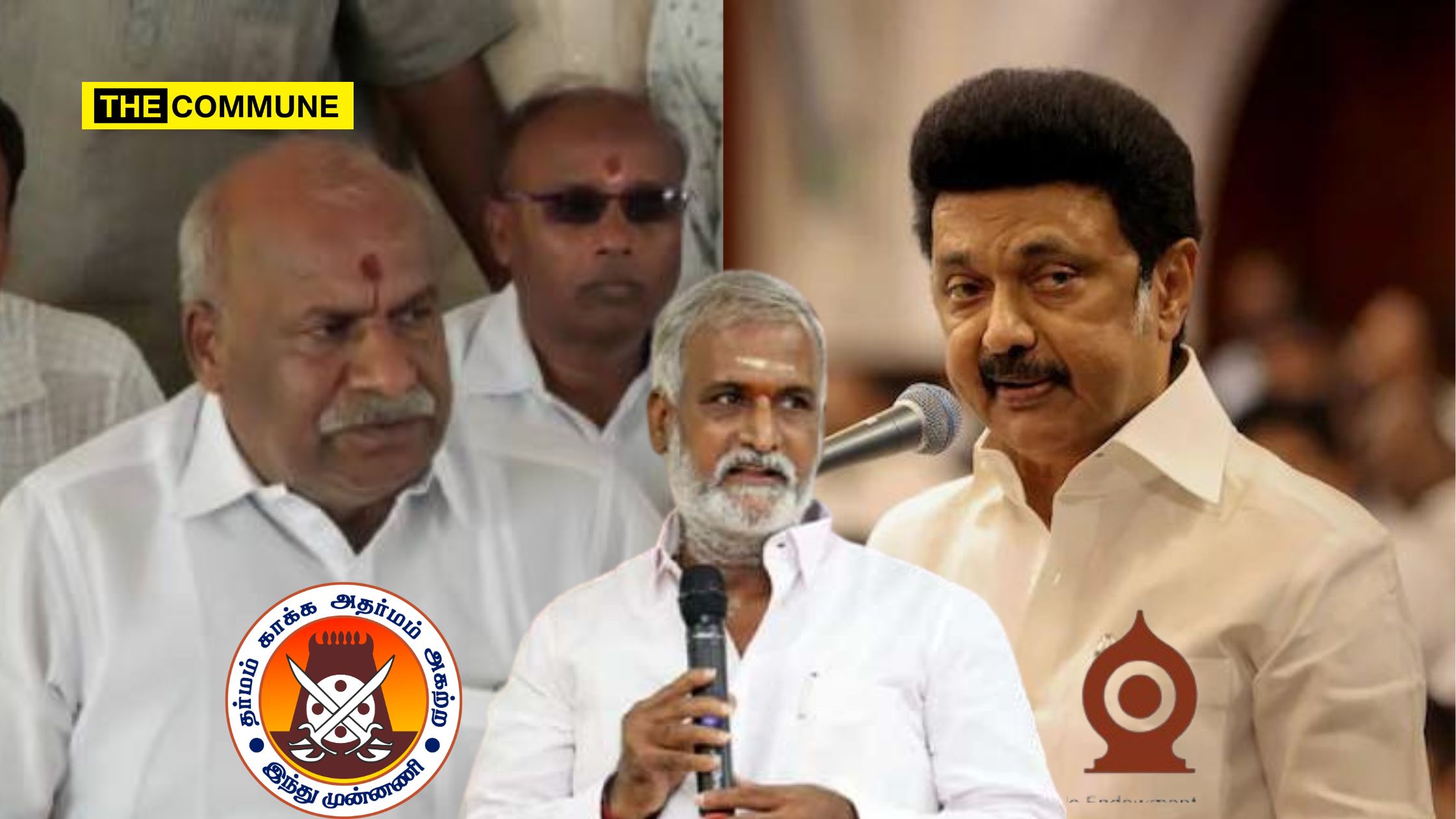
Hindu Munnani Defies DMK Govt To Protest Against Alleged Mismanagement Of Temples, Condemns Illegal Arrest Of Its Cadres

Hindu Munnani, Sekar Babu and MK Stalin
Hindu Munnani protestors harassed by TN Police as they criticized DMK-led regime for mismanaging Hindu Temples

Hindu Munnani leader Kadeswara Subramaniam strongly criticized the DMK government in Tamil Nadu, accusing it of fostering a dictatorial regime through undemocratic actions. His condemnation comes in response to the government’s interference with a planned statewide protest on 21 July 2024, organized by Hindu Munnani to protest the government’s mismanagement of temples.

Despite announcing the protest two weeks in advance, the police denied permission at the last minute, leaving no time for legal recourse. Undeterred, Hindu Munnani proceeded with the demonstration, targeting the Hindu Religious and Charitable Endowments Department and the DMK government. The protesters were met with arrests, mistreatment, and demands for identification.

In an official statement, Kadeswara Subramaniam declared, “Government that destroys only temples! Get out of the temple!!” On 21-7-24 (Sunday) on 21-7-24 (Sunday) massive protest demonstrations were planned and made on behalf of the Hindu Munnani across Tamil Nadu to condemn the anti-Hindu activities of the DMK government ruling Tamil Nadu and to demand that the Tamil Nadu government, which claims to be a secular government, should leave Hindu temples.” 

“In order to inform the police about these demonstrations, permission petitions were given to the concerned police stations to keep loudspeakers (mic sets) by the officials in the respective areas before last 15 days. The officials of the respective police stations who received the petitions issued a copy of the letter stating that the protest was not allowed on the midnight of 20th and early morning on the date of the protest on the 21st. No consideration has been given to the fundamental rights of every citizen under the Constitution of India to express their views, to protest against the government and to assemble at a place for that purpose,” the statement read.

“The Tamil Nadu Police, acting as a proxy department in the DMK’s regime with their autocracy and giving an illegal order, disrupted the demonstration that was to be held in a democratic way across Tamil Nadu yesterday (21-7-24). The unconstitutional and anti-democratic act of the Tamil Nadu Police is strongly condemned. The police do not have any powers to ban protests and demonstrations by the public, without legal reasons, and to prevent them from favoring the authoritarian ruling party. It seems that the Tamil Nadu DMK government, which is acting with the intention of taking away even these basic rights, wants to bury the democratic rights and stabilize its dictatorial rule,” the statement further read.

“It is well known that Tamil Nadu’s Hindu Religious and Charitable Endowments Department and Sekar Babu its minister showcase themselves to be some kind of human saints and act as if they are implementing welfare programs targeting only the temples that can generate more income. In thousands of temples in Tamil Nadu, there is not even a pooja being held, and there is a situation they can’t even light for the idols of God that housed in the temple. But at the same time, the Hindu Religious and Charitable Endowments (HR&CE) Department of the Tamil Nadu Government has taken into account only the income that can come from the thousands of temples in Tamil Nadu. This government has not taken any effort to maintain unworshipped temples without lighting. Similarly, the HR&CE Minister did not take any effort to protect the temples and spread the fame and growth of Hindu religion,” the statement added.

“Hindu devotees are forced to pay darshan in every temple to visit the deity. Starting from leaving sandals outside the temple, the charge for ordination, the charge for shaving the hair, the charge for lighting the lamp, wherever you turn inside the temple the bills placed on behalf of the HR&CE department, the three tiers, four types of charges for visiting God like in a cinema theater. When you look at all these, it is obvious that the HR&CE department’s intention is to rob the pilgrims by taking money from their shirt pockets than protecting the temples. The activities of the Hindu Religious and Charitable Endowments Department are such as to create a situation where no Hindu should come to worship the god in temple,” the statement further added.

“The DMK government and the Minister of HR&CE Sekar Babu have abused their powers and forced the police under them to ban the demonstration of Hindu Munnani that aimed to condemn these dire conditions, by giving orders to strangle the voice of democracy. The protestors arrested by the police were not escorted properly and were pushed into crowded buses. Also, the basic facilities for natural causes in the sheltered areas were not maintained. Also arrangements for drinking water, food etc. were neglected. They have forcefully arrested undemocratically to get Aadhaar card, finger print details, etc. This is a fascist trend of DMK. When asked about such intimidation they diverted saying it was under the new criminal law. While the DMK government is opposing the new criminal law, the drama is playing out that the police will implement it. Further, it also shows that the police have misunderstood the new criminal law. Who is the criminal? Depicting those who fight democratically for the welfare of society as criminals seems to be a mental illness of the police. This is a blatant abuse of power,” the statement further further added.

“The Hindu Munnani strongly condemns the illegal arrest and the police who refused permission to the public demonstration and Tamil Nadu DMK government and the Minister of Hindu Religious and Charitable Endowments Department Sekar Babu for forced them.” 

Some of the Protests across the State


Subscribe to our channels on TelegramWhatsApp, and Instagram and get the best stories of the day delivered to you personally.

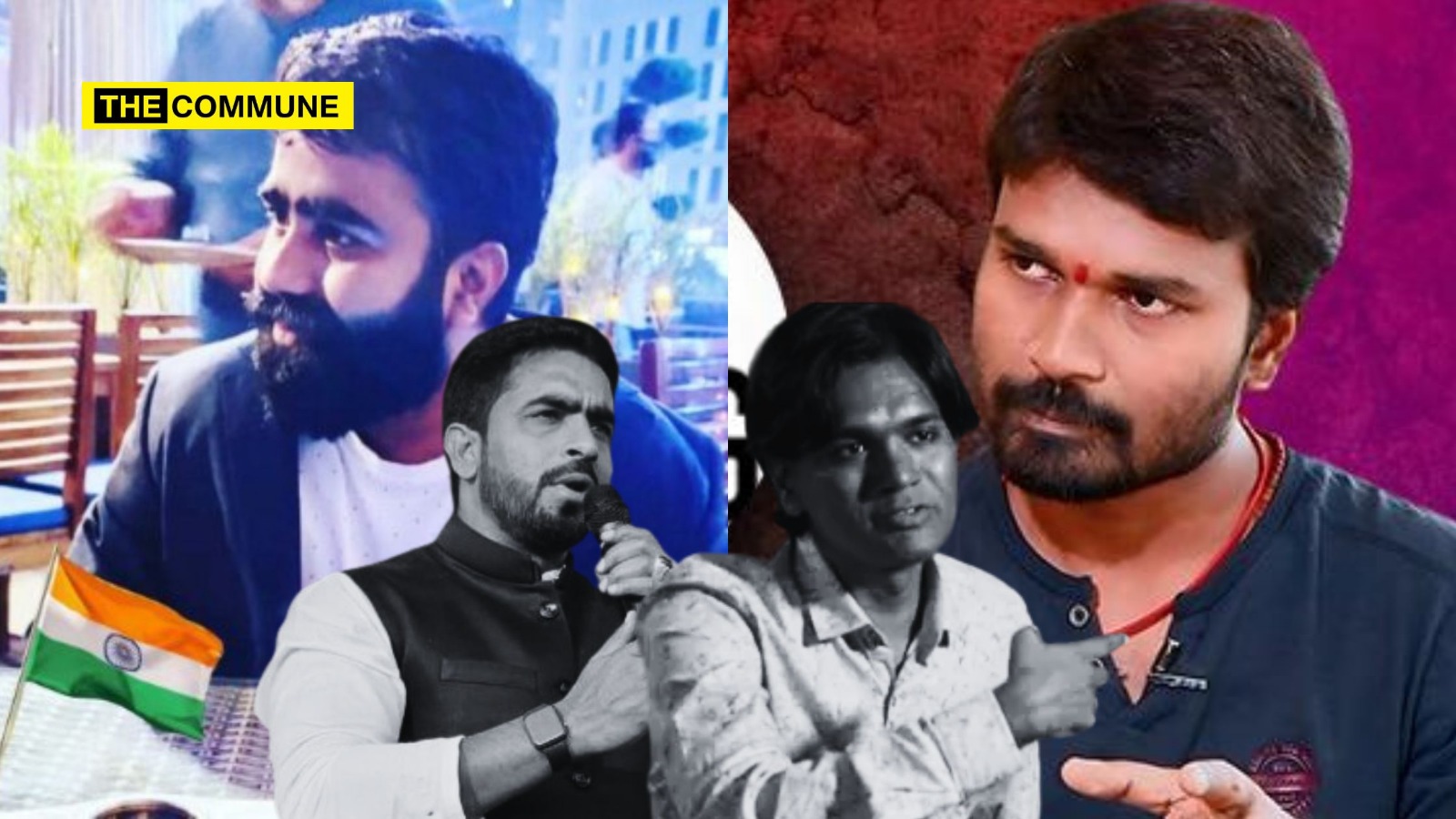
Telangana Police Files FIR Against ‘String’ Vinod Based On Complaint By AIMIM MLA Mohammed Majid Hussain For Circulating Controversial Video

Mr Sinha, String Reveals, targetted by Zubair and Majid Hussain
Mr Sinha, String Reveals, were targetted by Zubair and AIMIM Nampally MLA over a prank video.

All India Majlis-e-Ittehadul Muslimeen (AIMIM) Nampally MLA Majid Hussain has initiated legal action by filing a “cyber crime” complaint against social media influencer “String Reveals” and “Mr. Sinha”. They have been accused of circulating a misleading video on social media platform X, which allegedly targets the Muslim community in Telangana.

Amid the ongoing debate over the Uttar Pradesh government’s directive for hawkers and shopkeepers along the Kanwar Yatra route to display their names on signboards, a controversial video has emerged on social media, triggering widespread outrage. The video allegedly shows a man urinating into a container of sweets. This video has been extensively circulated and has led to questions directed at public figures such as actor Sonu Sood and journalist Rajdeep Sardesai, who have criticized the Uttar Pradesh government’s decision.

Although many shared the video without realizing it was a prank, the alleged fact-checker Muhammad Zubair deliberately propagated the narrative that influencers like “The String” and “Mr. Sinha” were responsible for the viral video. Zubair specifically alleged that the video had a communal undertone targeting the Muslim community in Telangana.


This assertion quickly gained traction, prompting AIMIM (All India Majlis-e-Ittehadul Muslimeen) Nampally MLA Majid Hussain to file an FIR with the Hyderabad Police, based on information provided by Zubair.

Majid Hussain made this announcement via his official social media account, stating, “On the Instructions of AIMIM President @asadowaisi Sahab In Connection with the Viral Video being falsely shared on X with a communal spin targeting Muslims Community in Telangana. Today 19.07.2024 Complaint is lodged by Majid Hussain at 21:00 Hrs and FIR is being registered in Cr.No. 1764/2024, U/s 66 (C), 66(D) IT Act U/Sec 196(1), 299, 336(4) BNS by Cyber Crime Police Hyderabad City Police”


The justification given here is that it is a prank video. While it may be the case, there have been instances where few Islamist miscreants have been found spitting on food. The tweets by String Reveals and Mr. Sinha came in light of the Uttar Pradesh and Uttarakhand governments mandating shopkeepers to reveal the owner’s name on the name board so that customers can have a choice as many hotels run by Islamic community cook using Halal method.

Fabricating false stories, distorting others’ statements to stir up controversy, and deriving satisfaction from it is not new for self-proclaimed fact-checker Mohammed Zubair. Previously, he concocted a narrative attributed to Anand Ranganathan, a professor from JNU, which was never actually spoken by him.

Zubair distorted Ranganathan’s proposal to combat terrorism in the region and initiate the rehabilitation of Kashmiri Pandits with his trademark spin. He concocted his own narrative, falsely claiming that Ranganathan openly advocated for the genocide of Kashmiris and consistently spread hatred against Muslims. Mohammed Zubair stated, “You need an Israel-like solution to Kashmir” says A Ranganathan. Isn’t this an open call for genocide of Kashmiris? This English speaking Yati Naraginghanand regularly gets platforms on multiple news channels to spew venom against Muslims.

Before that, Zubair carried out the same methodology to fuel communal tensions and call for the arrest of Nupur Sharma through his unfounded and provocative propaganda. This alleged fact-checker, known for spreading hatred and sowing division in society, masquerades as a supporter of Muslims and the Congress, persistently advancing their narrative without restraint.

Subscribe to our channels on TelegramWhatsApp, and Instagram and get the best stories of the day delivered to you personally.

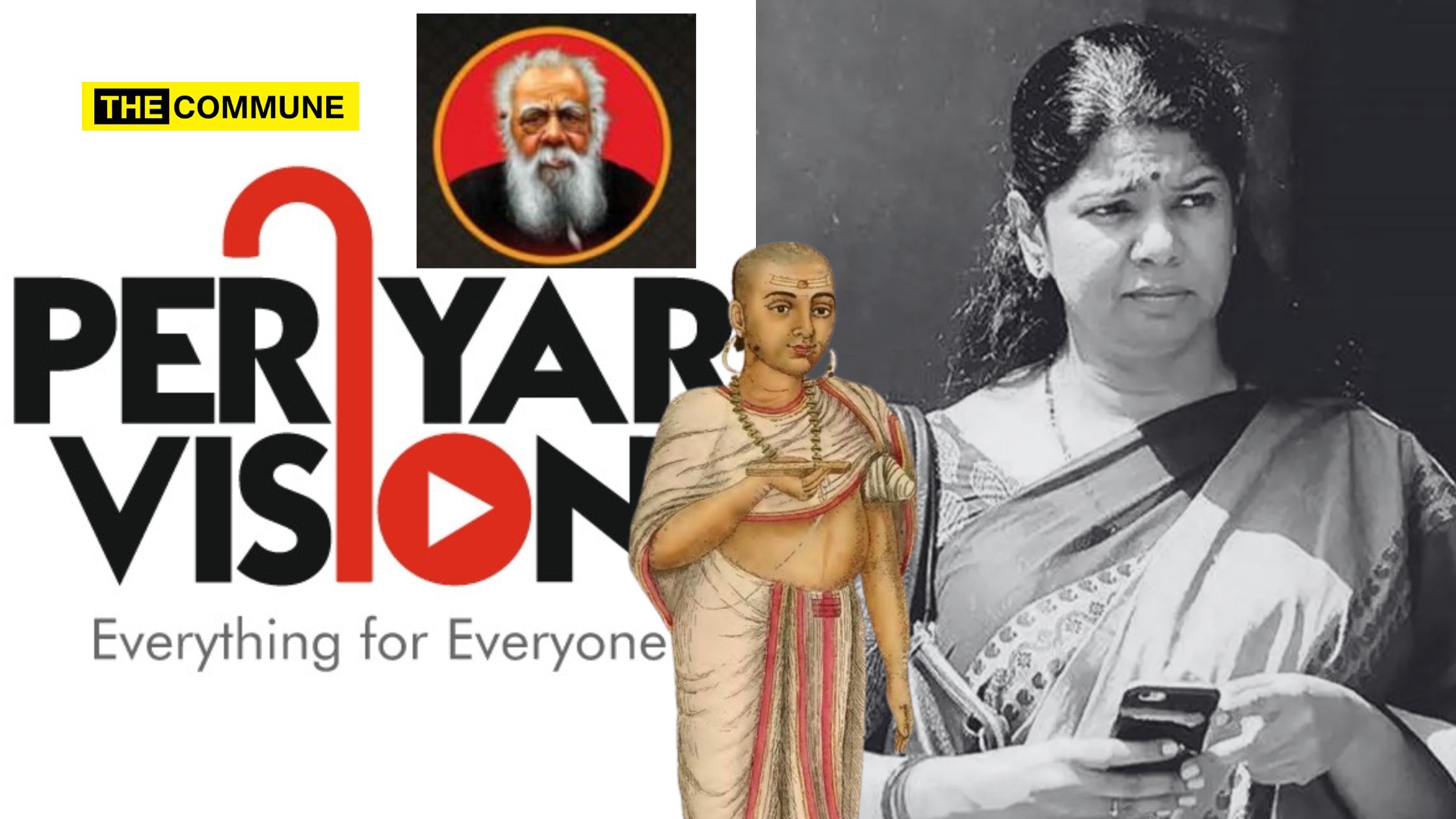
DMK MP Kanimozhi Says “Periyar Vision” OTT Channel Was Started To Spread Love, Here’s How It Spreads Hate Against Hindus Particularly Brahmins

OTT platform Periyar Vision and DMK Kanimozhi
DMK launched an OTT platform called "Periyar Vision". Content peddles anti-Brahmin, Hinduphobic propaganda normalized by Dravidianist stock.

The DMK’s parent organisation, the Dravidar Kazhagam (DK), launched “Periyar Vision”. It is an OTT platform “dedicated to promoting social justice and rationalism” in Chennai on 21 July 2023. DMK MP Kanimozhi inaugurated the platform in the presence of DK president K. Veeramani, actor Sathyaraj, and several other Dravidian ideologues.

Speaking to reporters after the event, Kanimozhi said, “It’s the need of the hour. Everybody uses the technology to talk about important things. Some use that to spread hate. We have launched this OTT platform to spread love, that is what Periyar’s life was. It was about loving people. He was the greatest humanist. This platform is to reach out to people. It is to bring people together.”

Chief Minister M.K. Stalin praised the initiative in a video message, emphasizing that Periyar Vision OTT, with the tagline “Everything for everyone,” is the world’s first-of-its-kind platform dedicated to an ideology. The platform aims to stream content, including current affairs programs, political commentaries, interviews, and films, all centered around the ideals of social justice and rationalism propagated by Periyar E.V. Ramasamy.

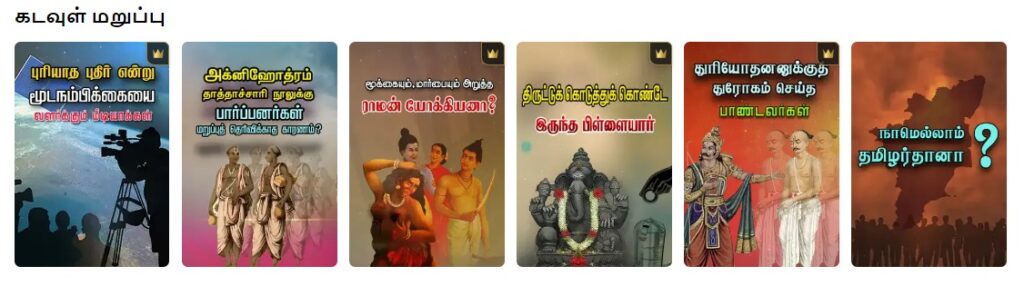
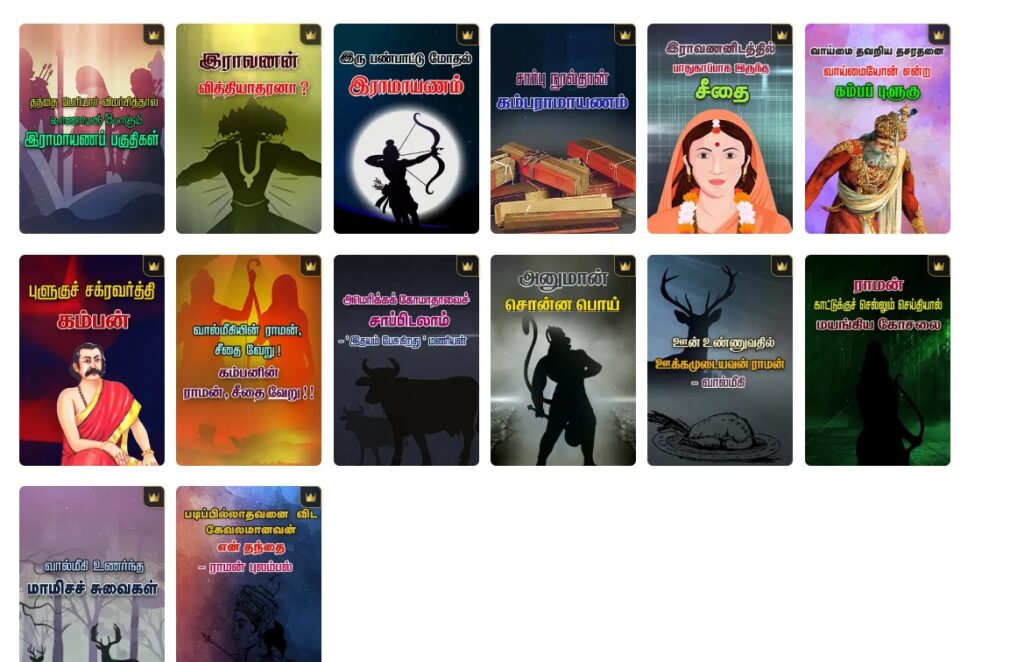
Here is where there is a problem. Upon scanning the app available on PlayStore, we found different categories of video material available on the platform. Among them were anti-Hindu and especially anti-Brahmin propaganda material. Here are some screenshots of the anti-Brahmin content.

Anti-Hindu Content

It is a well-known fact that Dravidianists give their own twist to our itihasas and Puranas. This OTT becomes a platform to mainstream those lies further. Here are some examples of the titles that are available on the platform that are anti-Hindu.

The titles are translated as:


On Atheism, the titles available are as below:

  • The media that fosters superstition is an incomprehensible puzzle
  • Why did the seers not object to Agnihotram Tathachariar?
  • Is Rama who cut off the nose and chest a good person?
  • Pillaiyar who kept allowing stealing
  • Pandavas who betrayed Duryodhana

Titles available on Ramayana include:

  • Is Ravana Vidyadharan?
  • Ramayana parts that are missing if Periyar criticizes
  • Ramayana is a clash of two cultures
  • Kambaramayanam is the dependent text
  • Sita who was safe with Ravana
  • Dasarathan who gave up truth
  • Valmiki’s Raman, Sita is different! Kamban’s Raman, Sita is different!!
  • Let’s Eat American Gomata
  • Lie told by Hanuman
  • Raman is enthusiastic about eating food – Valmiki
  • Kosala is mesmerized by the news of Raman going to the forest
  • Carnivorous flavors tasted by Valmiki
  • My father is worse than the uneducated – Raman’s Lament

Content on OTT Platform "Periyar Vision"

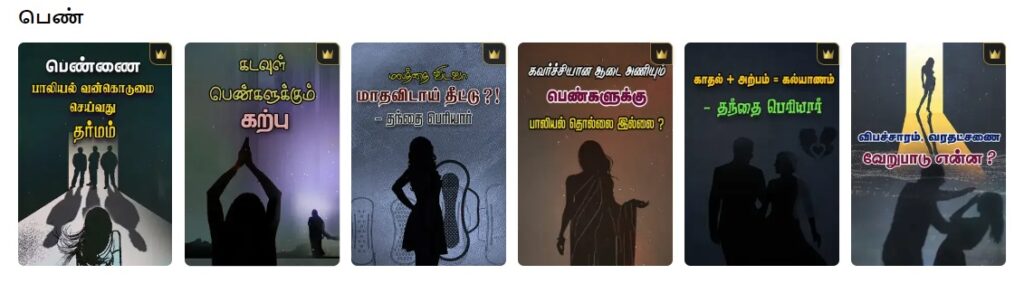
While one might think the content on women will be on the lines of women empowerment, it blatantly follows the anti-Hindu line. Here are the titles:

  • Dharma is sexual brutalizing woman
  • God is also chaste for women
  • Is menstruation worse than stools? – Periyar
  • Women who dress sexy aren’t sexually harassed?
  • Love + Pettiness = Marriage, By Periyar
  • What is the difference between prostitution and dowry?

Anti-Brahmin Content

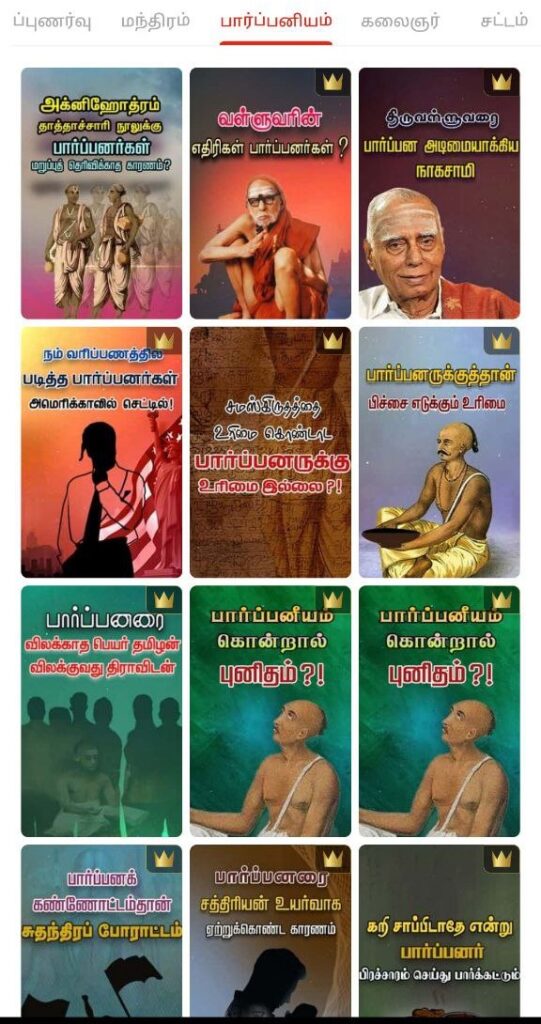
As expected, the platform peddles the anti-Brahmin propaganda to the hilt. Some of the content that could not have been disseminated in the public domain so well seems to have a new lease of life. Check out the categories and the kinds of titles available.

Under the category titled Brahminism, this is the kind of content available on “Periyar Vision”:

  • Why did the seers not object to Agnihotram Tathachari?
    Valluvar’s enemies are barbarians? (while the topic is about Valluvar, the image here is that of Mahaperiyava Chandrasekharendra Saraswati Swamigal of the Kanchi Math)
  • Nagaswamy who made Tiruvalluvar, a slave of Brahmins
  • The Brahmins who studied with our tax money are now settled in the US
  • Brahmins do not have the right to say they are the masters of Sanskrit
  • Those who embrace Brahmins are Tamilians, those who exclude them are Dravidians
  • Is it pure if Brahminism is killed
  • The freedom struggle was a viewpoint of Brahmins
  • The reason why Kshatriyas held Brahmins in high esteem
  • Let the Brahmins try to spread the word about not eating non-veg

Content on "Periyar Vision"

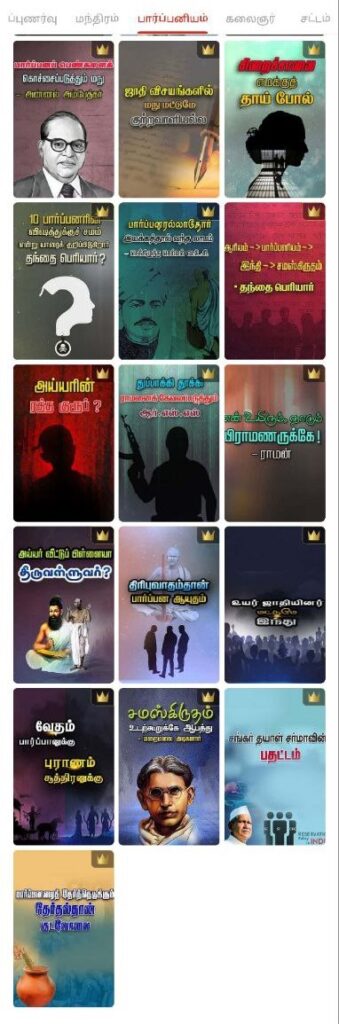
The other titles in “Periyar Vision” include:

  • Manu Dharma which belittles/denigrates the Brahmin women – Ambedkar
  • Alcohol is not the only culprit in caste matters
  • 10 Brahmins are equivalent to poison – Who does Periyar refer to?
  • Aryanism–>Brahminism–>Hindi–>Sanskrit – Periyar
  • What is the Aryan’s blood group?
  • The RSS is blaspheming Lord Rama by taking the gun
  • Aiyar is a family child Thiruvalluvar?

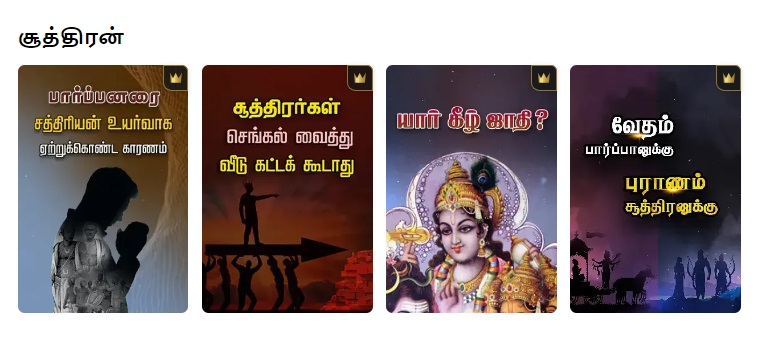
Under the category titled “Shudra“, the titles include:

  • The reason why Shudra held Brahmins in high esteem
  • Shudras should not build houses with bricks
  • Who is lower caste?
  • Vedas for Brahmins, Puranas for Shudras

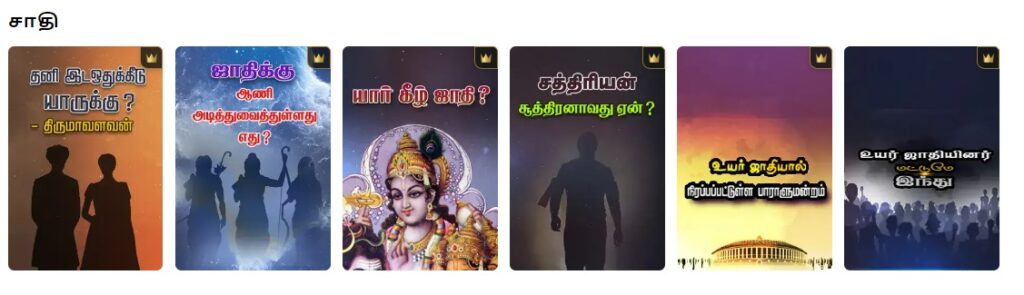
Under the category of caste, the titles are as below:

  • Why does a Kshatriya become a Shudra?
  • A parliament filled with upper castes
  • Only upper castes are Hindus

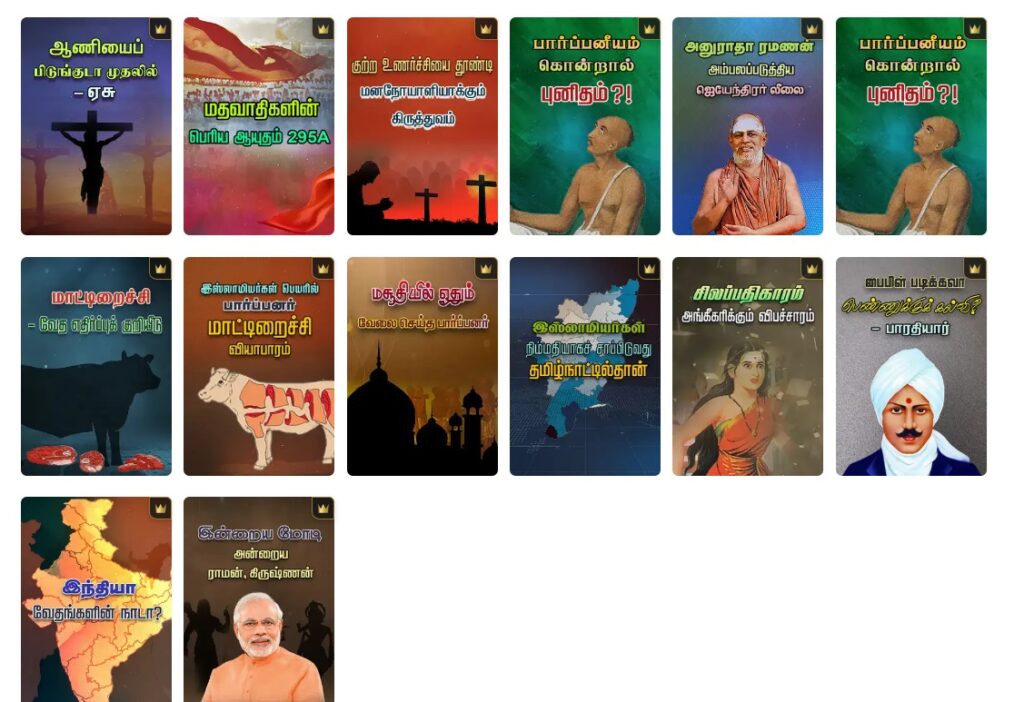
While the category states “Vedas and Religion“, the material inside is purely anti-Brahmin content with just one or two titles on Christianity and Islam – notably the content on Islam is very pro-Islamic in nature. Here is a look at the titles:

  • 295A Great weapon of the religious fanatics
  • Is it pure if Brahminism is killed?
  • Leelas of Jayendrar exposed by Anuradha Ramanan
  • Beef – anti-vedic symbol
  • Brahmins trade beef using the name of Muslims
  • Brahmins who recited prayers and worked at the mosque
  • Muslims can eat in peace only in Tamil Nadu
  • Adultery endorsed by Silappadikaram
  • Is India the land of Vedas?
  • Today’s Modi is yesterday’s Rama and Krishna


There are sections specifically on the topics of Godse, Hindutva, ManuDharma, Modi, RSS, Savarkar, education, caste, reservation, politics, atheism, Dravidianism, apart from Gandhi, Anna, Karunanidhi, etc.

The use of unconnected images by the Dravidianists to peddle an imagery and propaganda against Hinduism and Brahmins in particular has been documented by The Commune. It is a technique used by the Nazis against the Jews called Picture Superiority Effect – a phenomenon in which imagery/pictures are remembered more than text or words.

Whether or not this platform spreads love, it surely peddles hate among the general public. With pop culture being used as a medium to peddle falsehoods and induce hate among the Tamilians against Brahmins and ultimately, make Tamil Hindus ashamed of their own culture and tradition, the Dravidianist ideology has once again proved that its main agenda is to eradicate Sanatana Dharma and destroy Brahmins.

Subscribe to our channels on TelegramWhatsApp, and Instagram and get the best stories of the day delivered to you personally.

RSS Chief Mohan Bhagwat Affirms National Commitment At Guru Purnima Celebrations In Chennai

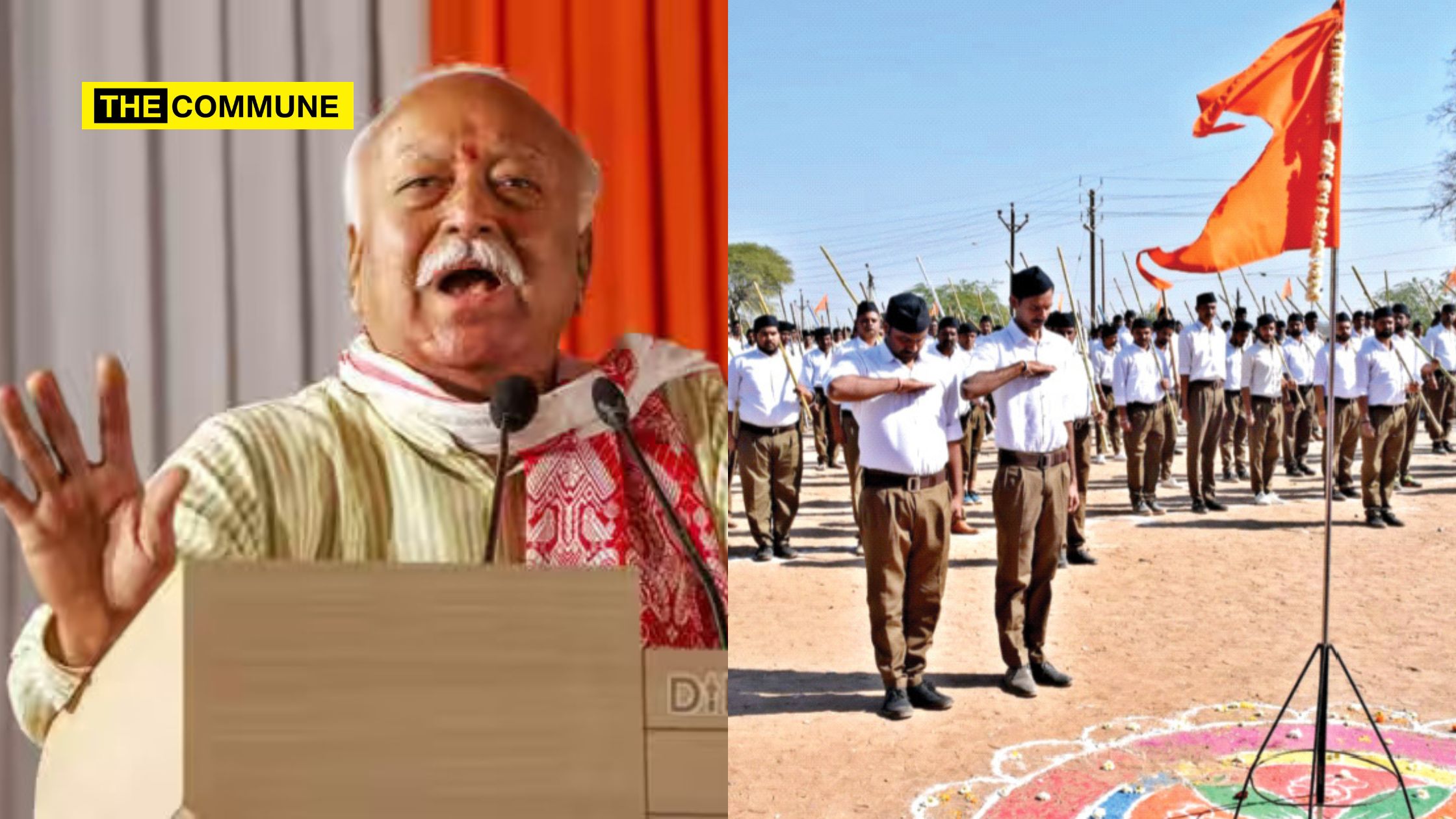
Mohan Bhagwat, RSS Volunteers
RSS Chief Mohan Bhagwat Affirms National Commitment at Guru Purnima Celebrations in Chennai.

Rashtriya Swayamsevak Sangh (RSS) Chief Mohan Bhagwat attended the Guru Purnima celebrations at the Ramachandra Convention Center in Thiruvanmiyur, Chennai. He emphasized the significance of the nation for the RSS, stating that the Sangh’s volunteers are committed to protecting the country whenever its culture and dharma are threatened.

During the event, Mohan Bhagwat participated in various rituals and pujas as part of the Guru Purnima observance. Numerous RSS volunteers attended the ceremony, including BJP State President K Annamalai, senior leader Tamilisai Soundararajan, and retired Madras High Court judge PN Prakash.

Addressing the gathering, Mohan Bhagwat highlighted, “Since 1928, the RSS has annually celebrated the Guru Puja festival. This event is where RSS volunteers pledge their dedication under the saffron flag. Saffron symbolizes Indian culture, tradition, sacrifice, and dharma. It represents the ideology that guides RSS volunteers.

He further said, “Guru Puja is not about fundraising; it is about dedicating oneself to the nation and dharma. The RSS instils a sense of selfless service towards the country. Whenever our culture and dharma face threats, RSS volunteers stand ready to protect the nation.

Guru Purnima is among the six festivals officially celebrated by the RSS, which was founded in 1925 by Hindu revolutionary and reformer Dr. Keshav Baliram Hedgewar. It is a day when every RSS Shakha organizes Guru Dakshina (Offering to the Guru). Later in the day, Mohan Bhagwat also participated in a youth meet organized by Chinmaya Mission at Chinmaya Heritage Center in Chetpet.

The RSS celebrates six festivals yearly: Varsha Pratipada, Vijayadashami, Makar Sankranti, Hindu Samrajya divas, Guru Purnima, and Raksha Bandhan. These festivals are celebrated in all their shakhas, spread across India and abroad.

Subscribe to our channels on TelegramWhatsApp, and Instagram and get the best stories of the day delivered to you personally.

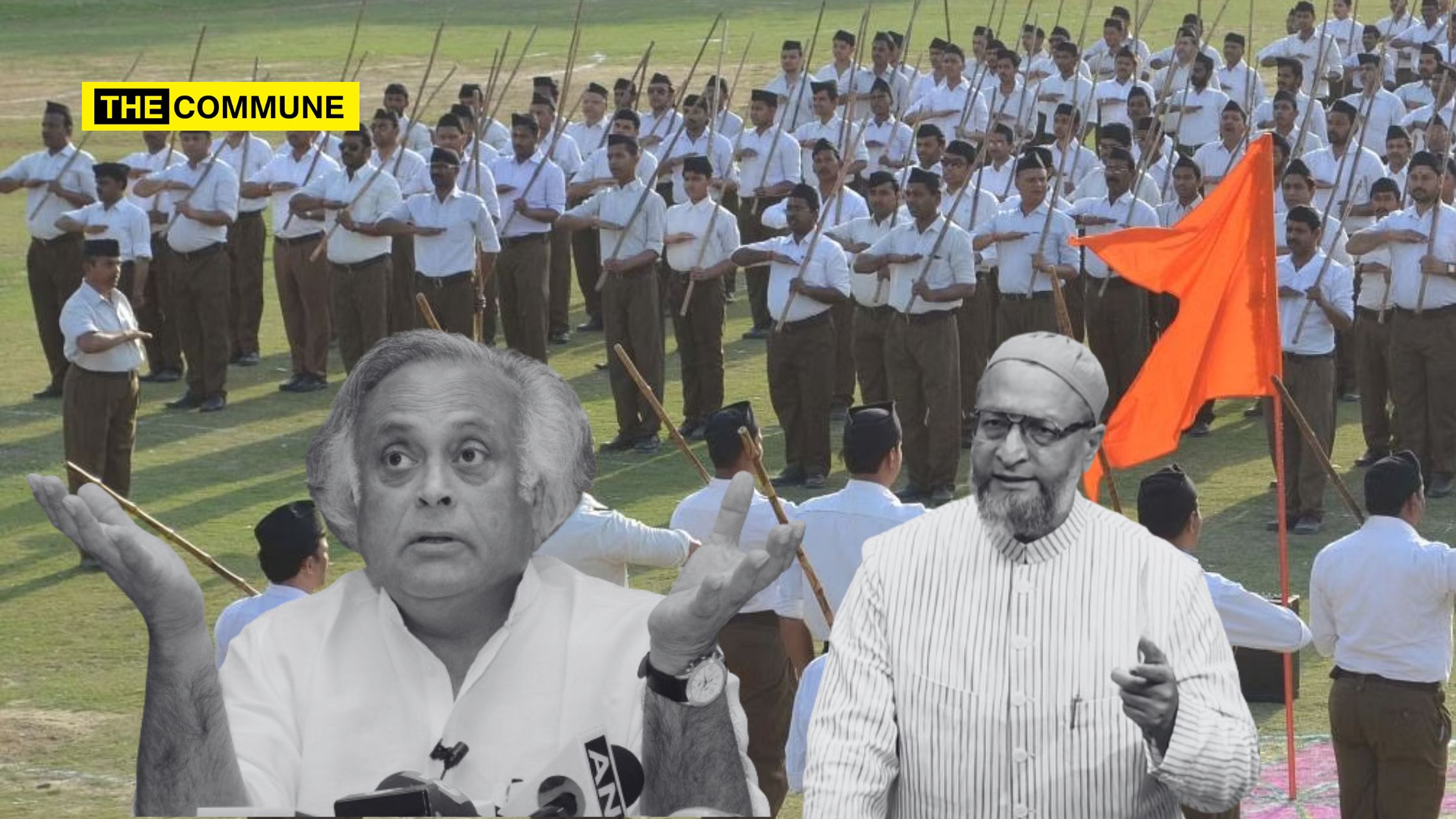
Modi Govt Lifts 58-Yr Ban On Civil Servants Joining RSS, Oppn Parties Cry Foul

RSS ban opposed by Jairam Ramesh and Owaisi
Centre lifts ban on government employees participating in RSS activities

The central government led by the Bharatiya Janata Party has lifted a decades-old ban on government employees participating in activities of the Rashtriya Swayamsevak Sangh (RSS), sparking a political controversy.

The order shared by many political leaders from all political parties read, “The undersigned is directed to refer to the OM (office memorandum)..dated 30.11.1966, OM No. 7/4/70-Est.(B) dated 25.07.1970 and OM No. 15014/3(S)/80- Estt. (B) dated 28.10.1980 on the above subject. 2. The aforesaid instructions have been reviewed and it has been decided to remove the mention of Rashtriya Swayam Sewak Sangh (R.S.S.S) from the impugned OMs dated 30.11.1966, 25.07.1970, and 28.10.1980.”

Congress member Jairam Ramesh wrote, “Sardar Patel had banned the RSS in February 1948 following Gandhiji’s assassination. Subsequently, the ban was withdrawn on assurances of good behaviour. Even after this the RSS never flew the Tiranga in Nagpur. In 1966, a ban was imposed – and rightly so – on government employees taking part in RSS activities. After June 4th, 2024, relations between the self-anointed non-biological PM and the RSS have nosedived. On July 9, 2024, the 58-year ban that was in force even during Mr. Vajpayee’s tenure as PM was removed. The bureaucracy can now come in knickers too I suppose.”

The decision, formalized in a 9 July 2024 order by the Ministry of Personnel, has been confirmed by BJP leader Amit Malviya, who called the original ban “unconstitutional.” Malviya explained why the 1966 ban was imposed in the first place. He wrote on his official X account, “The unconstitutional order issued 58 years ago, in 1966, imposing a ban on Govt employees taking part in the activities of the Rashtriya Swayamsevak Sangh has been withdrawn by the Modi Govt. The original order shouldn’t have been passed in the first place. The ban was imposed because, on 7 Nov 1966, there was a massive anti-cow-slaughter protest at the Parliament. RSS-Jana Sangh mobilised support in lakhs. Many died in police firing. On 30 Nov 1966, shaken by the RSS-Jana Sangh clout, Indira Gandhi banned Govt staff from joining the RSS.”

AIMIM chief Asaduddin Owaisi cried foul and wrote on his X handle, “This office memo purportedly shows that the govt has lifted the ban on govt employees participating in RSS activities. If true, this is against India’s integrity and unity. The ban on RSS exists because it had originally refused to accept the constitution, the national flag & the national anthem. Every RSS member takes an oath that puts Hindutva above the nation. No civil servant can be loyal to the nation if he is a member of RSS.”

The RSS welcomed the decision, describing the original ban as baseless and politically driven. The Print reported that Sunil Ambekar, Akhil Bhartiya Prachar Pramukh, RSS stated, “Due to its political interests, the then (1966) government had baselessly banned government employees from participating in the activities of a constructive organisation like the Sangh. The present decision of the government is appropriate and is going to strengthen the democratic system of India.”

Subscribe to our channels on TelegramWhatsApp, and Instagram and get the best stories of the day delivered to you personally.