Home Blog Page 688

Madras High Court Quashes Goondas Act Detention Of YouTuber Savukku Shankar

Madras High Court To Hear YouTuber Savukku Shankar's Bail Plea Tomorrow

On 9 August 2024, the Madras High Court quashed a Goondas Act detention order against YouTuber ‘Savukku’ Shankar, also known as A. Shankar, which had been issued by the Greater Chennai City Commissioner of Police on 12 May 2024. The order had placed Shankar under detention according to the Goondas Act for allegedly engaging in activities that were deemed harmful to public order.

A Division Bench consisting of Justices S.M. Subramaniam and V. Sivagnanam ruled in favour of a habeas corpus petition filed by Shankar’s mother, A. Kamala, challenging the legality of her son’s detention. The court ordered that Shankar be released immediately, provided he was not required for detention in connection with any other cases.

Savukku Shankar’s YouTube interview

Shankar had been initially arrested on 4 May 2024 following a criminal complaint lodged by the Coimbatore cyber-crime police.

The complaint stemmed from comments he made during a YouTube interview, which allegedly disparaged the conduct of women police officers.

Following his arrest, several additional cases were filed against him. Consequently, the Commissioner invoked the Tamil Nadu Prevention of Dangerous Activities Act, commonly known as the Goondas Act. The Act is designed to detain individuals involved in various offences, including cybercrime and activities prejudicial to public order.

Although the Supreme Court had earlier granted Shankar interim bail in the preventive detention case, he remained in custody due to his formal arrest in several other criminal cases while detained at Puzhal Central Prison.

Court’s criticism of the Goondas Act misuse

On 6 August 2024, the Court scrutinised the DMK-led Tamil Nadu government’s decision to detain Shankar under the Goondas Act, questioning whether the action was selective.

Justices SM Subramaniam and V Sivagnanam said preventive detention is a colonial-era law and should be employed cautiously. They warned that suppressing the voices of media professionals and YouTubers could revert the country to colonial practices.

The court remarked, “Preventive detention is a colonial law. Detaining power should be used sparingly. If the voices of YouTubers and media people are strangulated, we’ll return to colonial times. Media is the fourth pillar of democracy.”


(With inputs from The Hindu)

Subscribe to our channels on TelegramWhatsApp, and Instagram and get the best stories of the day delivered to you personally. 

DMK-Supporting Dravidian Stocks Simp For Pakistani Athlete As Neeraj Chopra Gets Silver

In a dramatic Olympic final, India’s “Golden Boy” Neeraj Chopra, who had won gold in Tokyo Olympica, ended up with a silver medal in javelin throw this time, achieving his best throw of 89.45 meters. The competition took a more somber turn for Indian fans as Pakistan’s Arshad Nadeem clinched gold with an Olympic record throw of 92.97 meters. This victory marked Pakistan’s first-ever individual gold medal at the Olympics.

While many Indian fans were disheartened, they supported Neeraj Chopra and hoped for his future success. However, surprising reactions emerged from Tamil Nadu, where Dravidianists and DMK sympathisers celebrated Arshad Nadeem as if he were a symbol of pride for India.

One Dravidianist handle shared a video stated, “Pride of the Indian subcontinent..! #ArshadNadeem Congratulations again brother!! #Paris2024.”

The same sympathizer shared another post on X stating, “The beast .. 92.97M new Olympic record! Congratulations #Arshad_Nadheem.

Another sympathizer who is also a Congress member expressed her pride by stating, “Sanghis are unhappy not because Neeraj got Silver, but because Arshad got gold. Bigots!” In this comment, she labeled Indians who were disappointed by Neeraj Chopra’s silver medal as “Sanghi,” a term often used to refer to BJP supporters, while themselves openly celebrating Pakistan’s victory.

Another Dravidian stock journalist from Galatta.com, Devendran Palanisamy, shared his joy stating, “Pakistan’s Arshad Nadeem sets new Olympic record in javelin.”

The post celebrating the Pakistani athlete by Dravidian supporters was met with considerable backlash, as netizens flocked to the comments section to register strong criticism. They ridiculed the anti-India sentiments and divisive politics being promoted, sharply countering the celebratory tone of the original post.

One netizen pointed out whether the Dravidianists didn’t feel proud when Neeraj Chopra got a silver medal but instead they boasted that Pakistani Arshad got the gold. One netizen criticized the focus on Arshad Nadeem’s gold medal over Neeraj Chopra’s silver, saying, “You are such a shameless clown. You have problems with Indians but your heart is filled with love for these ter***** (terrorists).”

https://twitter.com/BholisSoul/status/1821778999367860290

Another netizen noted that, “Pakistanis are less happy for Nadeem then Anti India Communist Bigots are those who are happy for Nadeem and making him a hero He belongs to Pakistan, Pakistan is an enemy country, Pakistan killed thousands of Indians in war and terror.

Another netizen stated, “Wow you’re such a mind reader! Thu! I enjoyed watching Arshad get the gold with that Olympic record throw but India- Pakistan rivalry is 75 years old though and Neeraj has set a bar before and that’s why we were disappointed. But then again why would you know? We aren’t traitors like you who wanted India to get only Silver so that Pakistan could get Gold!

Another netizens criticized stating, “Dravidians celebrating pakistan winning and india losing.. Wow”

Another netizen noting the Dravidian stocks anti-Indian sentiments stated, “congrats to Him but your over enthusiasm and joy on Pakistan’s win isn’t surprising.”

Another netizen angrily remarked, “You anti-national & ISLAMIC FUNDAMENTALS & JIHADI supporter – at least in the same breath why not Congratulate Neeraj..Oh, he is HINDU… and you are not just anti-national, but also HINDUPHOBIC, HATER of HINDUS, SANATANA DHARMA & HINDUISM.”

This support for Pakistan’s athlete is not unprecedented among Dravidianist supporters. Previously, similar instances have occurred, such as when the M.A. Chidambaram Stadium in Chepauk, October 2023, saw police preventing fans from carrying Indian flags during a cricket match between Pakistan and Afghanistan, with DMK ministers backing the ban on the Indian flag in matches where India did not play.

Subscribe to our channels on TelegramWhatsApp, and Instagram and get the best stories of the day delivered to you personally. 
Hindu Munnani Calls For Statewide Protest Against Violence In Bangladesh As Islamist Extremists Target Minority Hindu Community

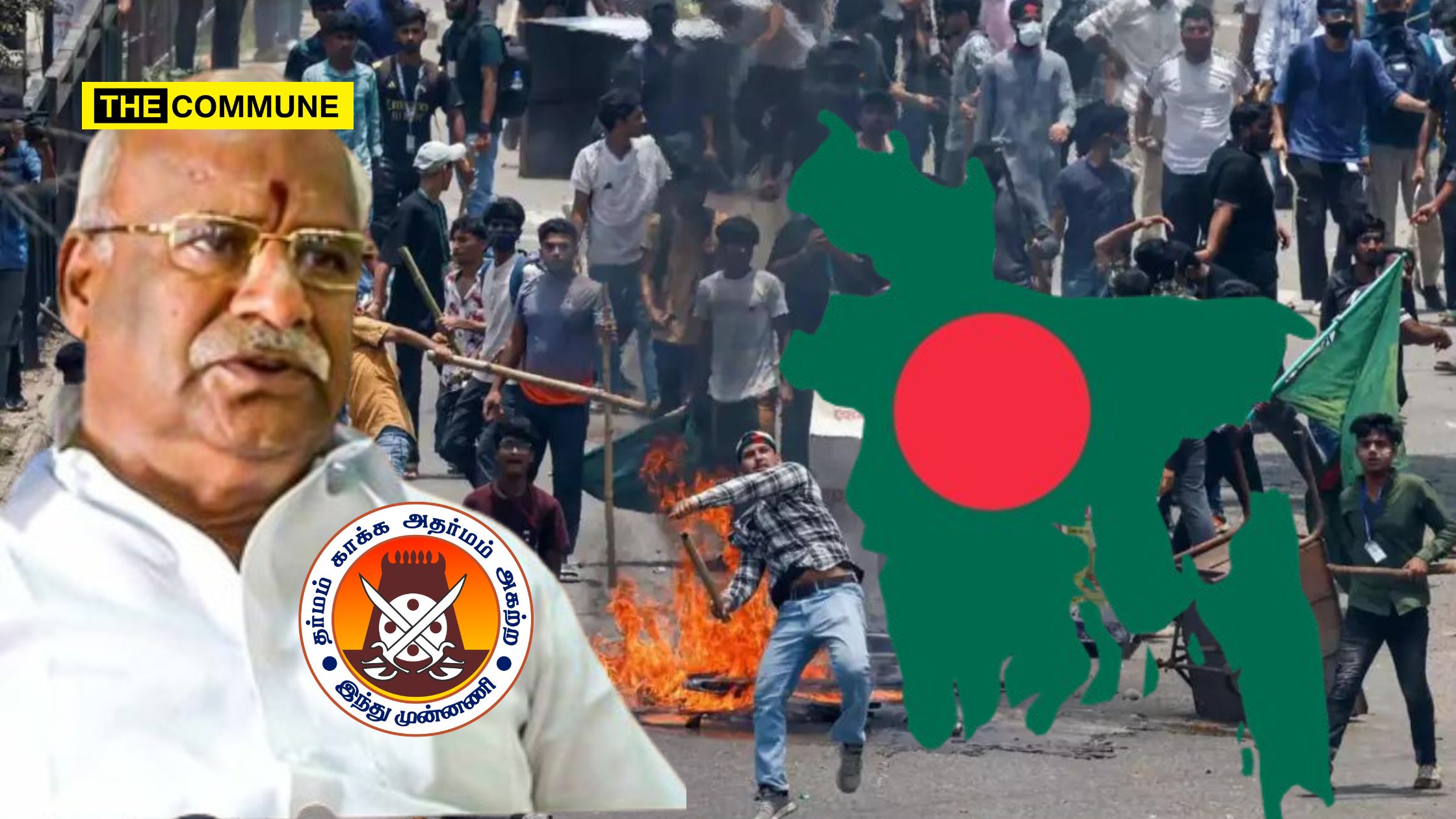
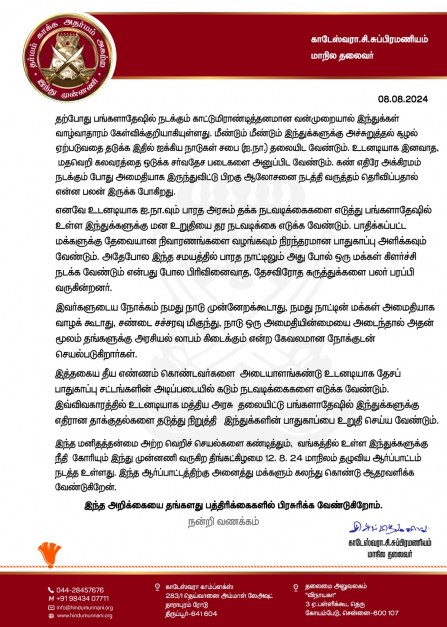
In response to the brutal atrocities against the Hindu community in Bangladesh, the Hindu Munnani announced a statewide protest demonstration against violence perpetrated by Islamist extremists, and to rally support for Bangladeshi Hindus against these attacks. The demonstration will take place on 11 August 2024 in Tamil Nadu.

What is happening to Hindus in Bangladesh?

Amid the escalating chaos in Bangladesh, where Islamist extremists are exploiting political instability to launch brutal violence against the minority Hindu community, reports are emerging of widespread brutality. Islamist mobs are attacking Hindu homes, setting them ablaze, and abducting women, plunging the region into an alarming state of anarchy. Hindu institutions, including ISKCON and the Kali temple, have been targeted, forcing many devotees into hiding.

Hindu Munnani demonstration against Hindu persecution

In response to this crisis, the Hindu Munnani has called for a statewide demonstration to protest the violence perpetrated by Islamist extremists and to rally support against these attacks on 11 August 2024.

In a statement released by the Hindu Munnani chief Kadeswara Subramaniam stated, “Bangladesh, once called as East Pakistan, gained independence with significant assistance from India during its struggle against Pakistani brutality. India has continued to support Bangladesh’s development in various ways. However, recent events reveal to the world that no matter how much help is given, fundamentalist fanaticism are not grateful.

Initially, the riots in Bangladesh were reported to be related to reservations. However, it has since become clear that the situation is different. The violence has been unleashed on Hindus, with Hindu institutions being looted and temples set on fire. A Hindu councilor was murdered, and his home was set on fire because he was a former Hindu cricketer. Given the widespread and indiscriminate attacks on Hindus and their places of worship, how will those who opposed the Indian Citizenship Act (CAA) address the violence targeting Hindus in Bangladesh?

India should provide refuge to those fleeing of violence in the name of religion, recognizing that their survival is paramount right? However, Islamic fundamentalists are systematically infiltrating India from Afghanistan, Pakistan, and Bangladesh which was created as a Islamic states. It is important for our people to understand that I.N.D.I alliance who have criticized the CAA and treated them equal to the refugee.

The current brutal violence in Bangladesh endangers the lives of Hindus. The United Nations (UN) must act to prevent further sectarian violence and deploy international troops to quell the unrest. Silence in the face of such evil is unacceptable; decisive action is required from both the UN and the Indian government to support and protect Hindus in Bangladesh, ensuring they receive adequate relief and security.

The United Nations (UN) must intervene urgently to protect Hindus from ongoing threats and violence. International troops should be deployed immediately to address and suppress the racist and sectarian riots. What good will it do to remain silent when evil is being done right in front of your eyes and then to consult and express your regret. Therefore, the UN and the Government of India should immediately take appropriate measures to give morale to the Hindus in Bangladesh.

Adequate relief and permanent protection should be provided to the affected people. Similarly, at this time many people are spreading separatist and anti-national ideas that there should be a people’s revolt in India as well. Their aim is that our country should not progress, people of our country should not live in peace, quarrels to be rampant and they are acting with the nefarious aim of gaining political gains if the country reaches a state of unrest. Such evil minded people should be identified and strict action should be taken immediately under national security laws. The central government should immediately intervene in this matter and stop the attacks against Hindus in Bangladesh and ensure the safety of Hindus. The Hindu Front is going to hold a statewide demonstration on Monday 11 August 24 to condemn these inhuman acts of violence and demand justice for the Hindus in Bengal. I request all people to participate and support this demonstration.”

Subscribe to our channels on TelegramWhatsApp, and Instagram and get the best stories of the day delivered to you personally. 

“Why Not Claim The Taj Mahal As Waqf Property?”, MP High Court Rips Into Waqf Board’s Claim On Burhanpur Monuments

Madhya Pradesh High Court Rips Into MP Waqf Board’s Claim on Burhanpur Monuments Why Not Claim the Taj Mahal and All of India as Waqf Property

The Madhya Pradesh (MP) High Court overturned the State Waqf Board’s claim on historical monuments in Burhanpur, even as the judge commented ironically that if the Board had its way, it would claim the Taj Mahal and the rest of India as a Waqf property.

Waqf Board decision on Burhanpur monuments

The court overturned a decision by the MP Waqf Board on 7 August 2024, which classified the Tomb of Shah Shuja, the Tomb of Nadir Shah, Bibi Sahib’s Masjid, and the palace within the Fort of Burhanpur under the control and administration of the Archaeological Survey of India (ASI) as Waqf property.

In 2013, the Waqf Board instructed the Archaeological Survey of India to vacate these sites, asserting ownership. The ASI, however, challenged this order through a writ petition, arguing that the sites—located in Emagird village, Burhanpur, and spanning about 4.448 hectares—were protected under the Ancient Monuments Preservation Act of 1904 and had been under their care for decades. The ASI contended that the designation as protected monuments could not be altered to waqf property without officially removing their protected status.

Conversely, the Waqf Board argued that its declaration of the property as waqf was valid and that the ASI should have appealed to the Waqf Tribunal rather than the high court.

The Trial

On 26 July 2024, Justice GS Ahluwalia’s bench noted that the properties had been officially designated as ancient monuments as early as 1913 and 1925 under the Ancient Monuments Preservation Act of 1904. There was no evidence indicating that this status had been revoked or altered according to Section 11 of the same Act.

The court highlighted that the Waqf Board’s claim was based on a notification under Section 5(2) of the Waqf Act, 1995. However, the Board failed to provide a complete notification to the court. Even though other parties did not contest this notification, the Board could not identify any legal basis for invalidating the earlier protections granted by the Ancient Monuments Preservation Act, 1904, without formal release by the Central Government or the Commissioner.

Referencing the Supreme Court’s ruling in Karnataka Board of Wakf vs. Government of India (2004), which affirmed that the Government of India maintains properties listed as Ancient Protected Monuments, the court agreed with the ASI’s position. It concluded that the Waqf Board’s notification was erroneous. Once a property is designated as an ancient monument and protected, it could not be retroactively classified as waqf property under the Waqf Act, 1995. Consequently, any such notification does not nullify the protections granted by the Ancient Monuments Preservation Act, 1904.

The High Court held that, “An erroneous notification issued in respect of property which is not an existing waqf property on the date of commencement of Waqf Act, wound not make it a waqf property thereby giving jurisdiction to the waqf Board to seek eviction of the Central Government from ancient and protected monuments.

“Why not claim the Taj Mahal as Waqf property?”

The court determined that the CEO of the MP Waqf Board had acted improperly in declaring the monuments as waqf property and ordering the ASI’s eviction.

Justice GS Ahluwalia remarked, “Why not claim the Taj Mahal as Waqf property? Tomorrow, you might say that the entire India is Waqf property. It won’t work like this that you’ll issue notifications and the property will be yours.”  As a result, the court nullified the CEO’s order from 19 July 2013.

(With inputs from Law Beat)

Subscribe to our channels on TelegramWhatsApp, and Instagram and get the best stories of the day delivered to you personally. 
The Kakori Conspiracy: A Forgotten Chapter In India’s Freedom Struggle?

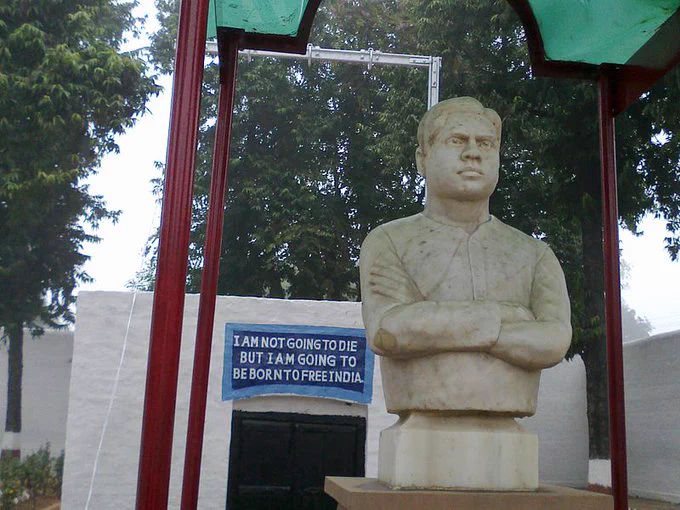
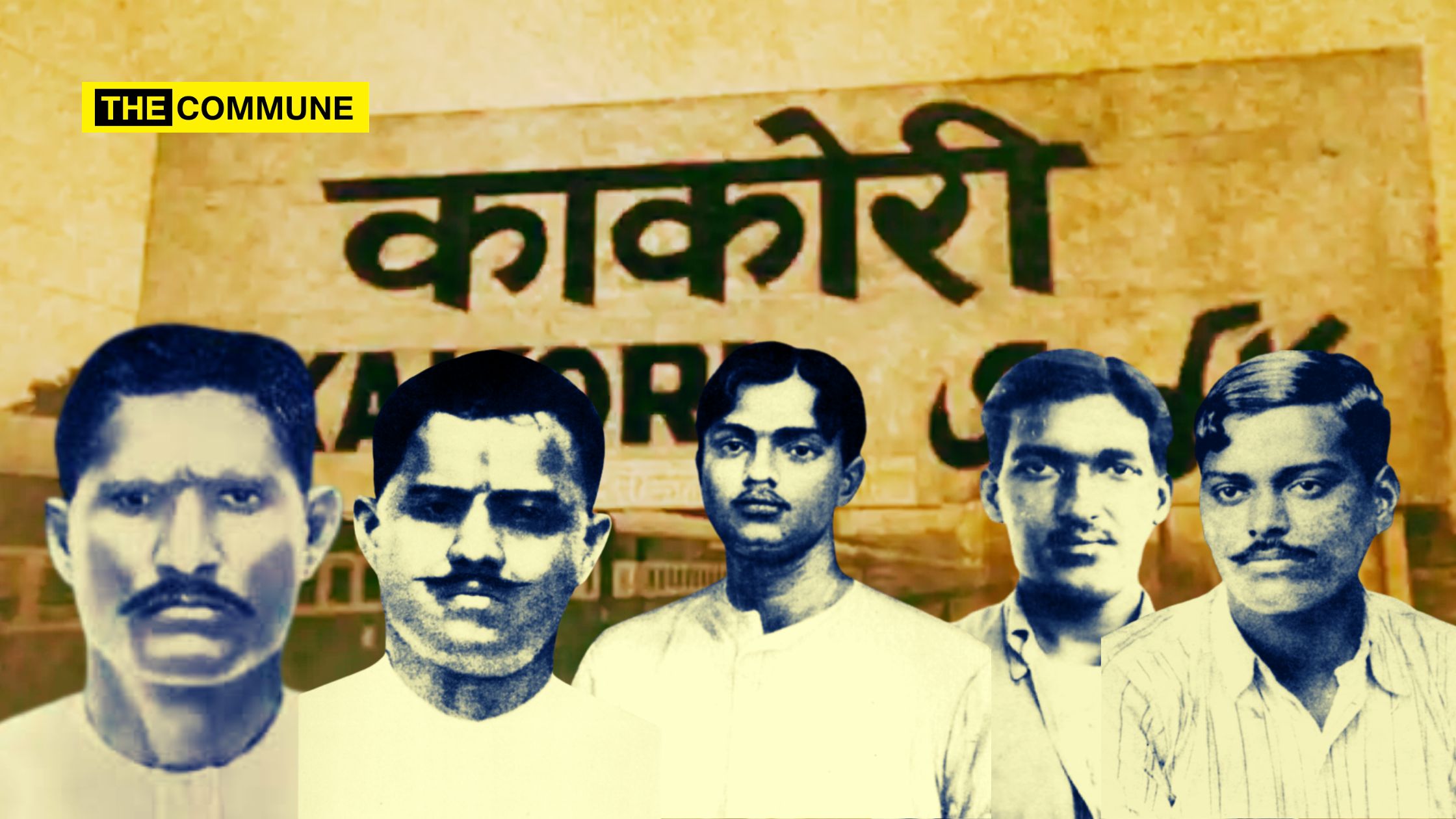
Nestled near Lucknow, Kakori is a small town known for its delicious kebabs, fragrant Dasheri mangoes, and intricate Zardosi embroidery. But beyond its cultural treasures and rich Sufi heritage, Kakori holds a profound place in India’s struggle for independence—a legacy often overshadowed in the annals of history. This quiet town became the stage for one of the most audacious acts of rebellion against British rule, led by the fiery revolutionary Ram Prasad Bismil. 


History of the Town

Kakori is also the seat of the Qadiriya Qalandari Sufi order and, since the 15th century, one of the main abodes of the Alavi and Abbasi branches of the Kakorvi Shaikh community. Like most of the towns in Avadh, it has large palatial homes of landed Muslim gentry. Many famous Muslim writers, such as Mohsin Kakorvi, his son Noorul Hasan Nayyier, who compiled Nurul Lughaat, a well-known Urdu dictionary, and satirist Ghulam Ahmed Alavi, hail from here.

Ram Prasad Bismil

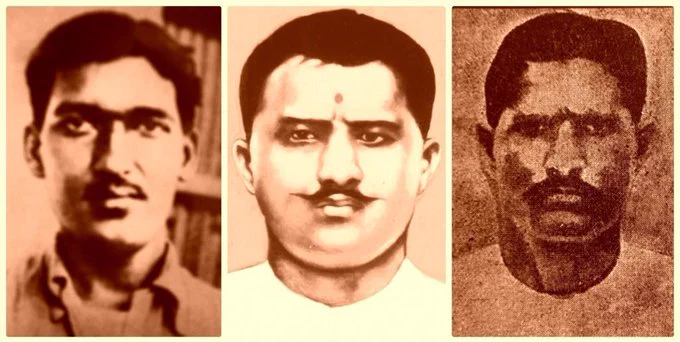
The mastermind of Kakori was Ram Prasad Bismil, one of the greatest revolutionaries ever who had co-founded the Hindustan Republican Association along with Sachindranath Sanyal and Jadugopal Mukherjee.

Bismil already had a well-running business in Shahjahanpur which he had left to organize the revolutionary movement. However, the lack of funds was proving to be a main hindrance.

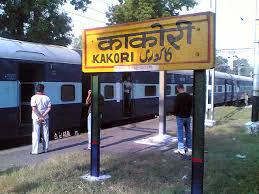
The 8 Down between Shahjahanpur and Lucknow used to pass through Kakori daily, and that was the genesis of the plot.  The intention was to stop the train at Kakori and loot the money bags, which would be used to fund the revolution.

Soon, a team was assembled, with his close friend Ashfaqullah Khan next in charge. Both hailed from Shahjahanpur, then a leading revolutionary hub. Ashfaq had long been an admirer of Bismil’s poetry.

Ashfaqullah initially opposed the plan, saying it was too risky and that the Government would crack down really hard. However, with others like Rajendra Lahiri and Thakur Roshan Singh supporting Bismil, he, too, lent his support.

The other team members included Chandrashekhar Azad, Sachindra Nath Bakshi, Keshab Chakravarty, Mukundi Lal, Banwari Lal Pandey, Kundan Lal, and Pranawesh Mukherjee. Above all, the team had Manmath Nath Gupta, whose book ‘They Lived Dangerously’ would give an excellent perspective of the revolutionary struggle for freedom.

9 August 1925

It was around evening time; the revolutionaries had already boarded the train. Rajendra Lahiri pulled the chain at Kakori station while Ashfaqullah held the driver hostage with his Mauser pistol.

Ram Prasad Bismil pushed the guard down and removed the government money from his cabin. However, when none could break the safe, it was Ashfaq once again who managed to break it with all his strength.

There was no bloodshed, except for one passenger killed accidentally. Soon, the Government cracked down on the Kakori rebels, and arrest warrants were issued.

While Azad managed to evade the crackdown, Ram Prasad was arrested soon enough at Saharanpur, while Ashfaqullah went into hiding for some time.  He would spend some time in Kanpur working at Ganesh Vidyarthi’s printing press. For quite some time, Ashfaqullah wandered all over the North from Kanpur to Bihar to Rajasthan, changing names. He finally went to Delhi and wanted to escape India somehow and meet Lala Hardayal. However, he was betrayed by his friend in Delhi to the police and arrested by Ikramul Haque.

The Trial

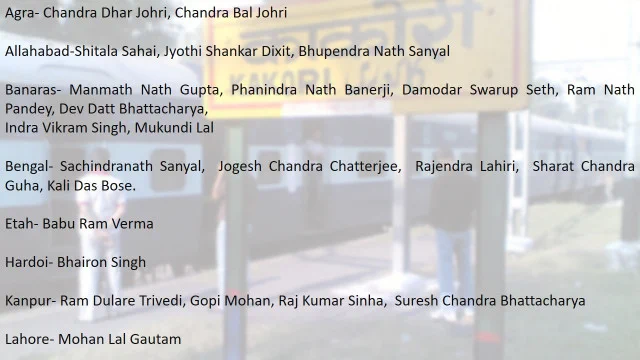
Around 40 more people from different cities were arrested. Prominent among them were Ashfaqullah, Bismil, Roshan Singh from Shahjahanpur, and Sachindranath Sanyal from Bengal. Of these, 15 were released due to lack of evidence, while Banwari Lal and Indu Bhushan Mitra turned approvers for a more lenient sentence. The trial began on 21 May 1926 against the remaining in the special sessions court of A. Hamilton. The revolutionaries were defended by Gobind Ballabh Pant, Mohan Lal Saxena, and Chandra Bhanu Gupta, among others. All the major leaders of the freedom movement, like Motilal Nehru, Madan Mohan Malviya, Lala Lajpat Rai, and Ganesh Shankar Vidyarthi, came out in support.

Finally, the verdict was pronounced. Ram Prasad Bismil, Ashfaq Ullah Khan, Rajendra Lahiri, and Thakur Roshan Singh were sentenced to death. 

Sachindranath Sanyal and Sachindranath Bakshi were to be deported to Cellular Jail. Sanyal wrote ‘Bandi Jeevan—A Life of Captivity’, detailing his experiences there. Manmath Nath Gupta was sentenced to 14 years of imprisonment, while the rest received relatively lesser periods.

Protests and Political Impact

Widespread protests broke out against the verdict, and members of the central legislature petitioned the viceroy to commute the death sentence to life. However, by 22 August 1927, the main court endorsed the original judgement. Madan Mohan Malviya sent a clemency petition to Lord Irwin, with signatures from around 78 members, which was also rejected. S.L. Polak sent a final mercy appeal to the king on 16 September 1927, which, too, was rejected.

They were hanged one after another. Ashfaqullah was hanged at Faizabad and Ram Prasad Bismil at Gorakhpur on 19 December 1927. Thakur Roshan Singh was hanged at Naini near Allahabad on the same date. Rajendra Lahiri was hanged two days earlier at Gonda.

The voices fell silent, but the spirit would continue to inspire countless other revolutionaries. Kakori would be an important chapter in our freedom struggle, it’s another thing most of our political leaders don’t give much importance to this.

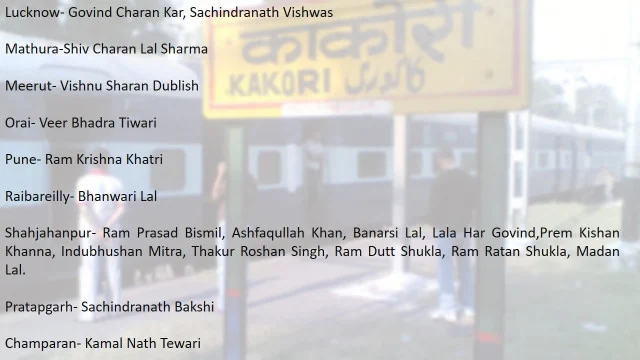
This is a list of the 40 odd arrested for Kakori. Some of their names are known, some are not.


Conclusion

Two significant events in our freedom struggle are Kakori and the Naval Ratings Mutiny. But our political elite class hardly commemorates them, unlike the Quit India Movement, which hardly achieved anything. The impact of the Kakori and Naval Ratings Mutiny was far more on the freedom struggle than the overhyped Quit India movement. However, our political leaders only remember the Quit India movement.

Schools and other institutions do nothing on the anniversary of Kakori or Naval Ratings Mutiny. Also, when it comes to Kakori, we must acknowledge the contribution of Shahjahanpur, as the majority of those involved came from this town – Bismil, Ashfaqullah, Thakur Roshan Singh, Banarsi Lal, Ram Ratan Shukla, Madan Lal.

It is truly a ‘Shaheedon Ki Nagari’.

(This article was originally published in History Under Your Feet Blog and has been republished with permission)

Ratnakar Sadasyalu is a blogger with a passion in movies, music, books, and history. A techie by profession and a writer at heart. Author of City of Victory a book on Vijayanagar Empire.

Subscribe to our channels on TelegramWhatsApp, and Instagram and get the best stories of the day delivered to you personally.
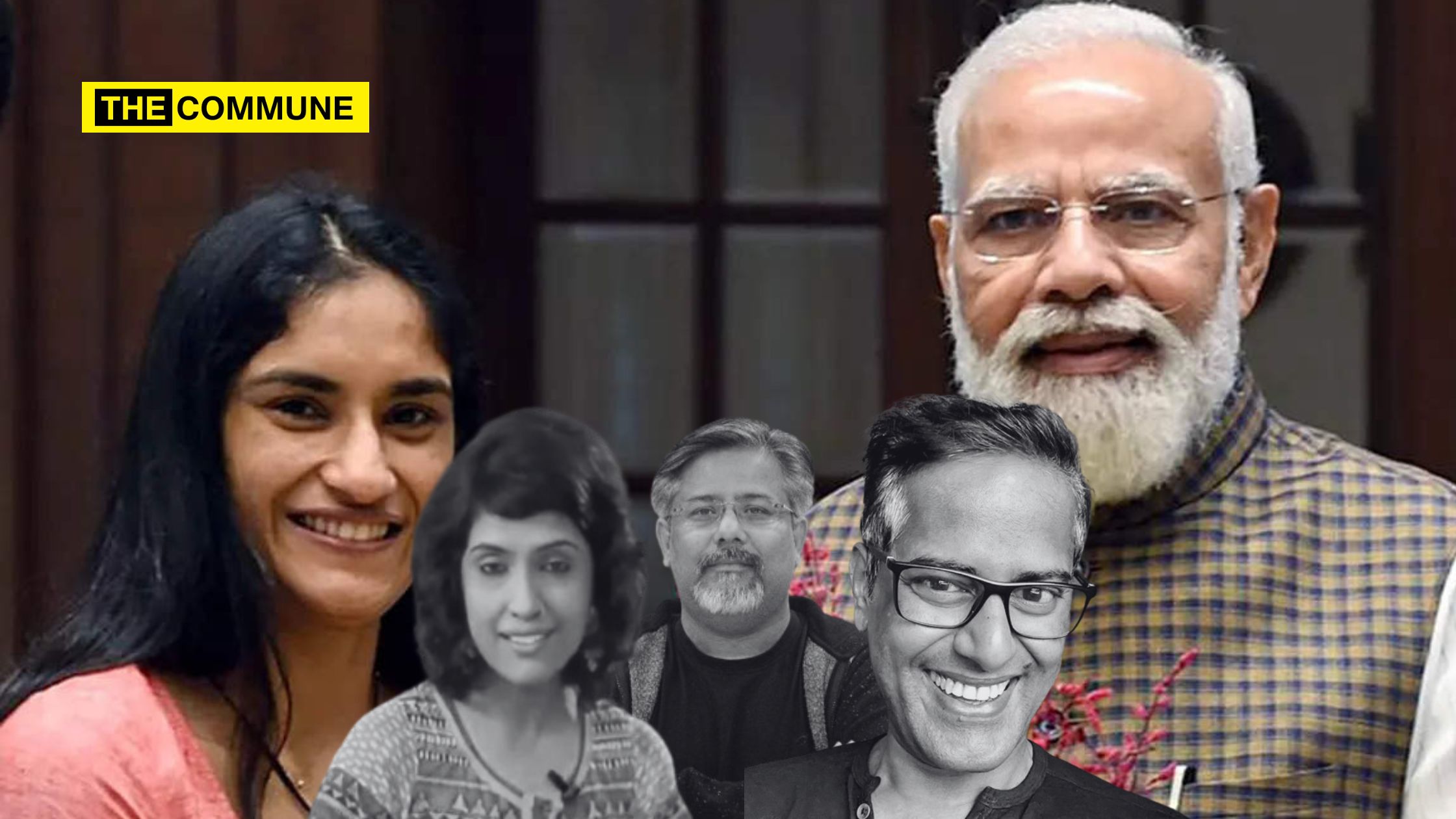
Vinesh Phogat’s Disqualification At Paris Olympics – Is It Leftist-Alleged ‘Modi Conspiracy’ Or Fact-Based?

Vinesh Phogat Disqualified At Paris Olympics

Indian wrestler Vinesh Phogat’s disqualification from the Paris Olympics for being overweight in her weight category has sparked a wave of misinformation and conspiracy theories from the anti-Modi camp. The group is attempting to blame Prime Minister Narendra Modi and the Wrestling Federation for Phogat’s disqualification, even though she was found 100 grams over the allowed weight limit for wrestlers in the 50 kg freestyle category during her gold medal bout weigh-in.

However, it’s essential to debunk the false narrative being peddled by left-leaning sympathisers. The disqualification was not a one-off incident. Several athletes have been disqualified from the Olympics for similar reasons. It’s crucial to focus on the facts rather than spreading misinformation and deflecting blame. Phogat’s disqualification resulted from her actions, not some grand conspiracy orchestrated by the government or the Wrestling Federation.

Vinesh’s Olympic Qualification Trials & Aftermath

Vinesh Phogat, competed in two Olympic weight categories qualification rounds, 50kg and 53kg, on the same day. Despite this unusual decision, she emerged victorious only in the lighter division, winning the selection trials for the Asian wrestling championships and Asian Olympic Games qualifier held at Patiala.

The ad-hoc committee and technical committee allowed her to compete in both weights, citing a lack of rule prohibiting wrestlers from competing in multiple weights during trials. However, this decision raised questions about the United World Wrestling’s Article-7, which states that each wrestler can only compete in one weight category at the official weigh-in. Vinesh fought her way to the top in the 50kg category, beating Nirmala Devi 10-0 in the semifinal and Shivanee Pawar 11-6 in the final. This gave her a chance to win a quota place in the lower weight category only.

In the 53kg category, Vinesh lost 10-0 to Anju in the semifinals but managed to secure a spot among the top-four contenders. This meant she was eligible to challenge Antim Panghal, the quota place winner in the 53kg category, for a spot in the Paris Olympic trials.

According to Bajrang Punia, Vinesh knew she was 2 kg overweight even before the competition, and her team had been working on reducing her weight since the night before. Despite trying every possible method, including severe dehydration, sweat sessions, and even cutting off her hair, Vinesh couldn’t shed more than 1.8 kg and was still 2.7 kg overweight.

Dr. Dinshaw Pardiwala, the Chief Medical Officer of the Indian Contingent, explained that Vinesh’s weight was monitored throughout the night, and despite efforts to reduce it, she was still over the allowed weight by 100 grams. He highlighted that Vinesh had tried every possible means to lose weight, but unfortunately, she didn’t have enough time.  Dinshaw Pardiwala said, “Her post-participation weight at the end of the semi-finals in the evening was found to be 2.7 kg more than the allowed weight. The team and the coach started off their usual process, which is of course limitation of water, no food. And you started with the whole process of sweating it out. Typically, you require some amount of time for that. But unfortunately, we didn’t have too much time. We had just 12 hours. So the whole night, the entire team, went ahead with this whole process of trying to reduce her weight, putting her in a steam and sauna, making her exercise and whatever was medically possible. We tried our best to try and get that weight down. When she couldn’t sweat anymore, we even had to go to some drastic measures like cutting off her hair…If we maybe had a few hours more we could have achieved those 100 grams, but we just didn’t have that time.”

This is not the first time Vinesh has been disqualified for being overweight. She was also disqualified in the 2016 Rio Olympics for being 400 grams overweight. This has raised concerns about the repeated instances of Vinesh being overweight and the consequences it has on her performance.

The situation has also sparked controversy, with some questioning whether Vinesh’s disqualification was a result of politics or not. Bajrang Punia and Vinesh Phogat herself acknowledged that she was overweight, and this has led to criticism about the lack of accountability and responsibility.

But Here’s What Leftists Peddled

One of them said, “Morning weight 49.1 Breakfast lunch served. In 12 hrs weight increased to 53kg. How it is possible. Shameless pawpaw Modi govt conspiracy.” 

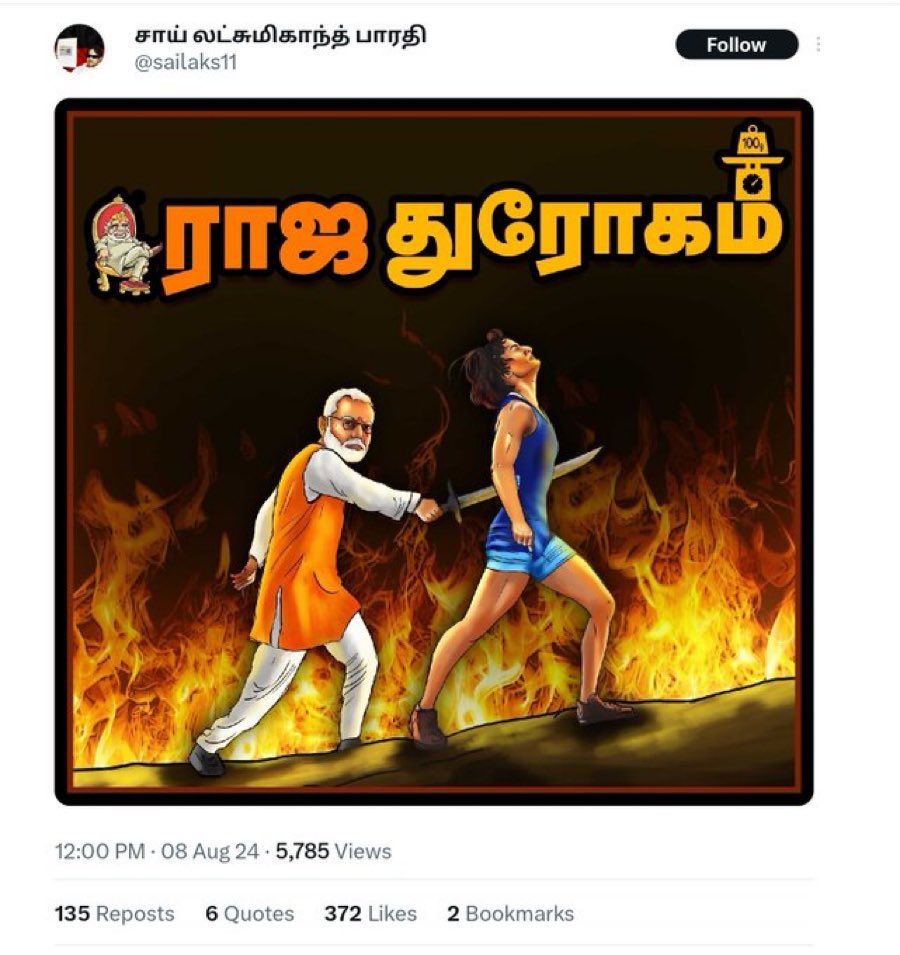
Another user who seemed like a Dravidianist supporter shared a controversial cartoon, showing Prime Minister Narendra Modi allegedly backstabbing the wrestler Vinesh Phogat, with a sword, and captioned it “Royal Treason”. This image was made akin to the Bahubali backstabbed by Kattappa scene.

Another cartoon by controversial cartoonist Manjul depicts a weighing machine with Prime Minister Narendra Modi’s face beaming with a smile, while Vinesh Phogat stands on the scale, adding to the conspiracy theory that the PM was behind the wrestler’s disqualification.

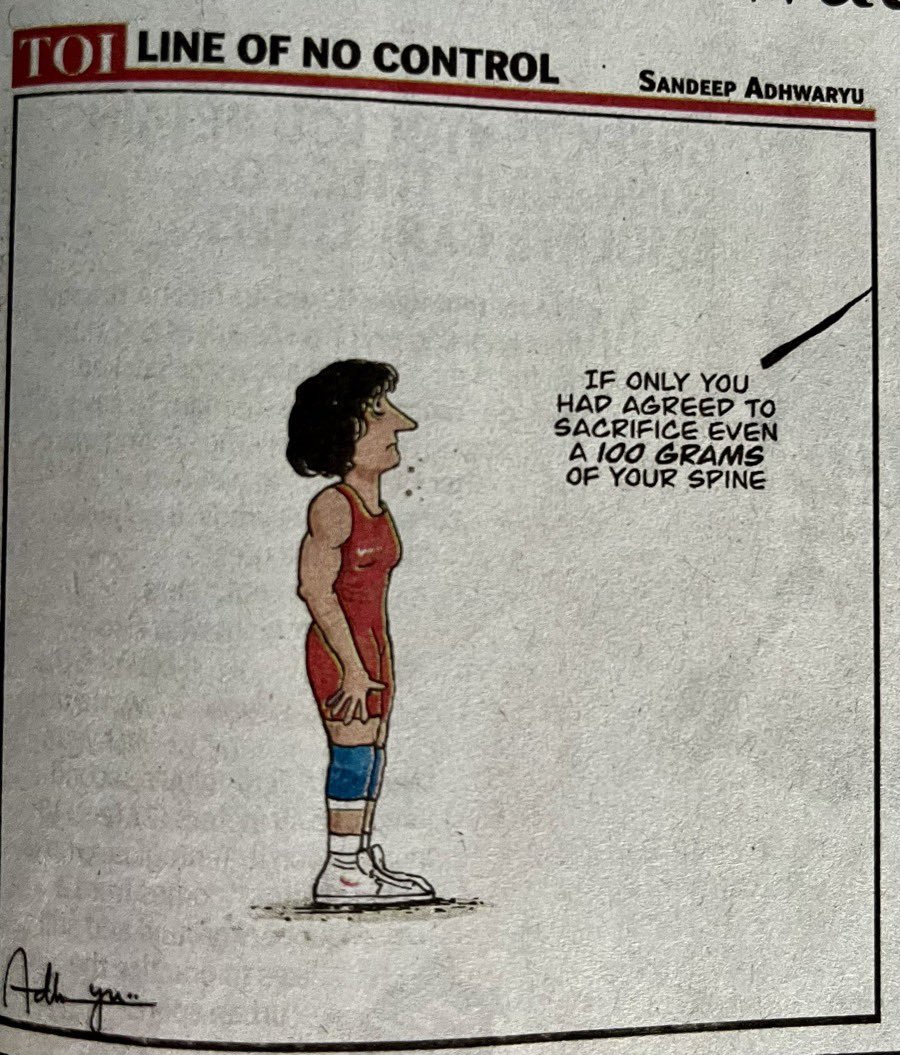
Another cartoon, published in the Times of India, showed a caption that read, “If only you had agreed to sacrifice even 100 grams of your spine.” – suggesting that Vinesh Phogat should not be participating in the protest against the BJP leader.

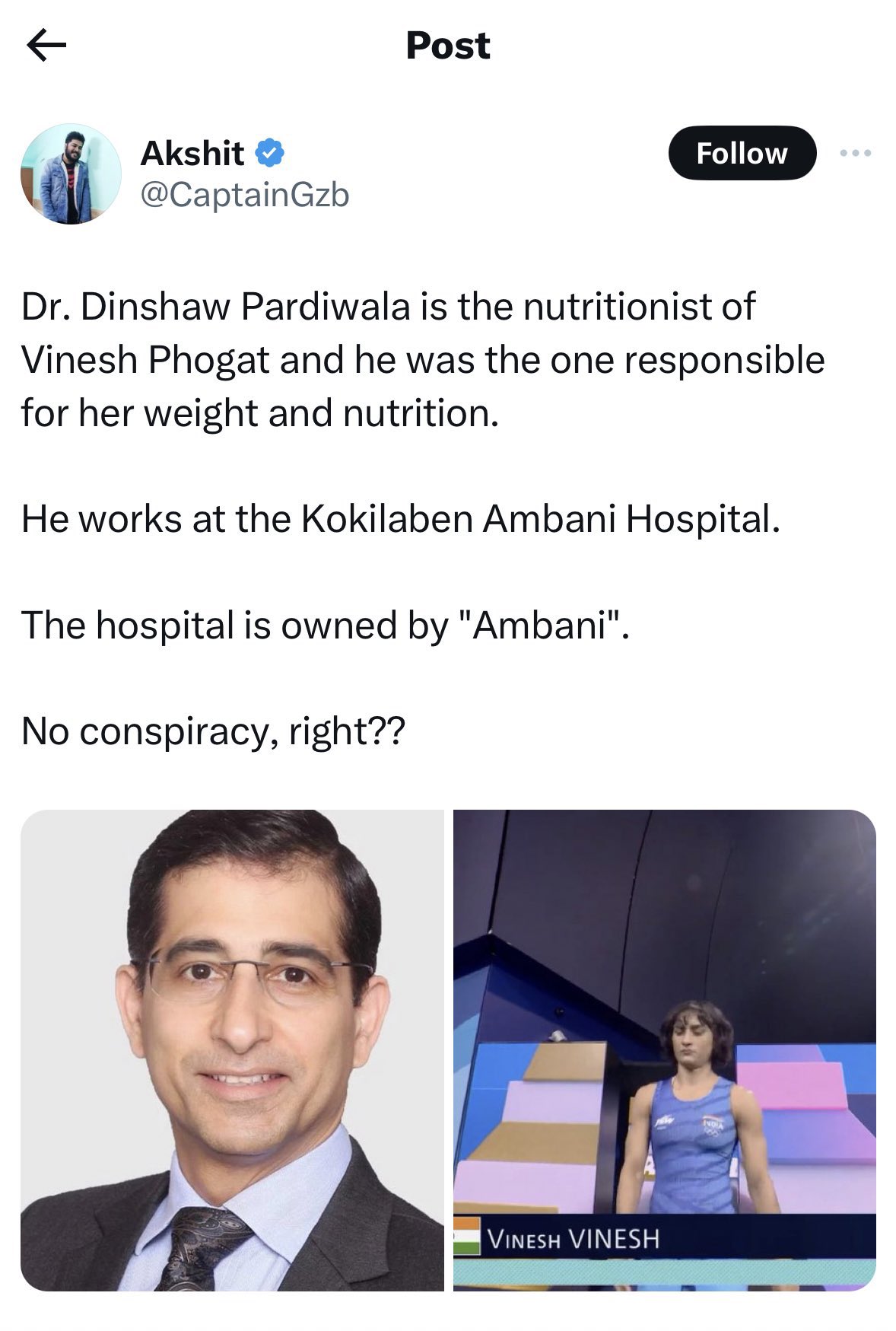
Another user (from a now missing account) stated that, “Dinshaw Pardiwala is the nutritionist of Vinesh Phogat and he was the one responsible for her weight and nutrition. He works at the Kokilaben Ambani Hospital. The hospital is owned by “Ambani” No Conspiracy right?”

This also hints at a “conspiracy” since Nita Ambani is a member of the IOC.

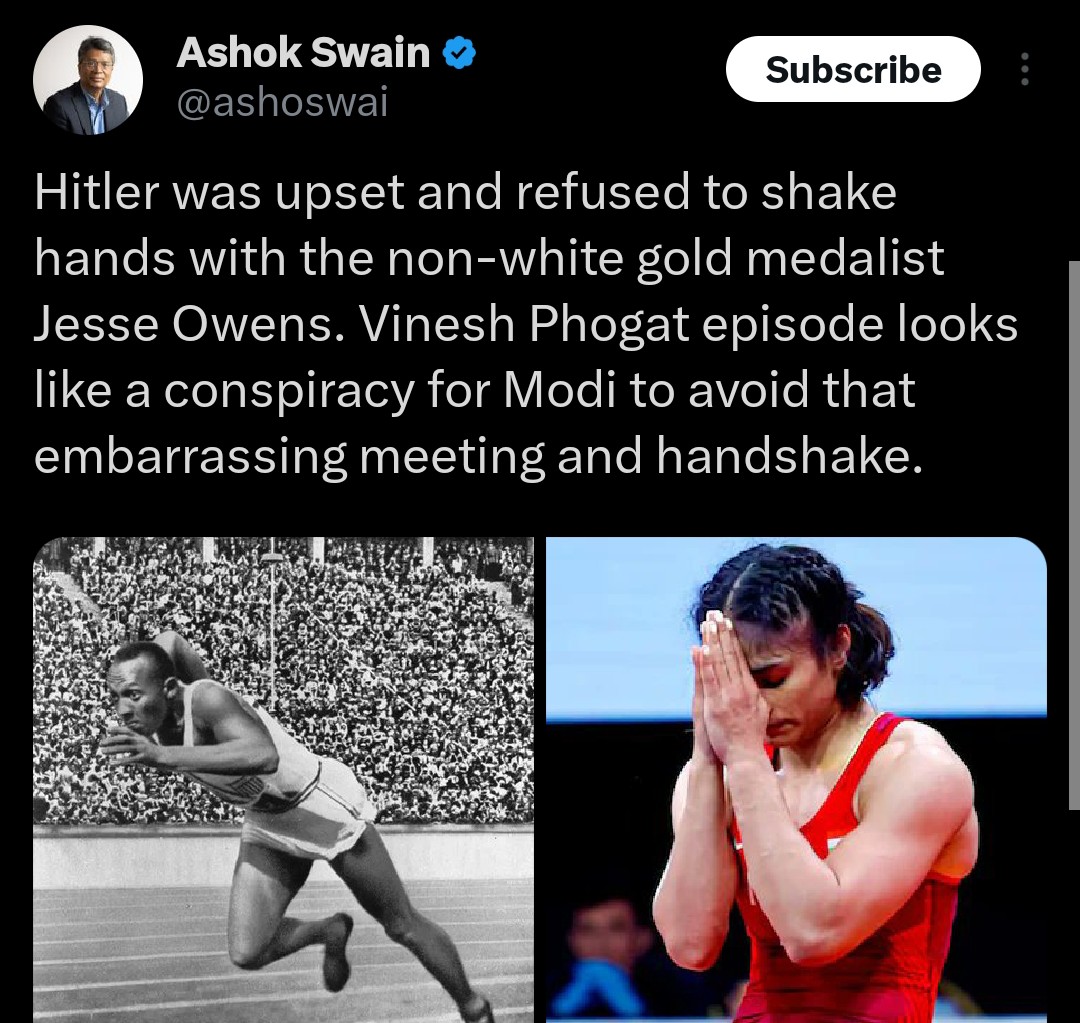
Sweden-based alleged professor Ashok Swain, whose account is withheld in India claimed that Prime Minister Narendra Modi allegedly manipulated the weighing machine to ensure Vinesh Phogat’s disqualification. The user went on to insinuate that this was a deliberate conspiracy by Modi to prevent Phogat from winning the competition, drawing a parallel with the infamous story of Hitler’s alleged manipulation of events.

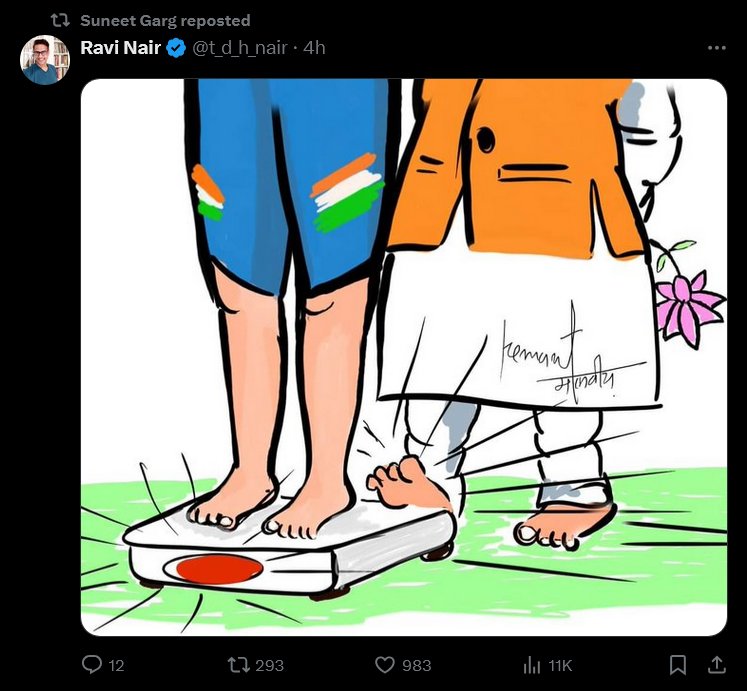
The Wire columnist, Ravi Nair, who also writes for The News Click and The Hindu, shared a cartoon on social media that depicted a person dressed like PM Modi with a lotus in hand, symbolizing the Bharatiya Janata Party (BJP), subtly manipulating the weighing machine to add extra weight to Vinesh Phogat’s scales. It is noteworthy that Ravi Nair had earlier made derogatory posts about PM Modi and also did many hit jobs against Adani group.

RJ Sayema who was nominated as “Equality Ambassador” by the US Embassy peddled lies that the WFI had conspired to prevent Vinesh Phogat from getting a medal. She wrote, “So, it IS the Wrestling Federation, after all! Sorry @Phogat_Vinesh, we truly don’t deserve you. “She wanted to compete in the still manageable 53kg category but a younger rival – Antim Panghal – had claimed that spot. Vinesh desperately asked for trials to determine who would represent India at the Olympics for that weight. *The federation didn’t budge. If she had to go to the Olympics, Vinesh had to wrestle at 50kg, or she wouldn’t get to wrestle at all.*”

IOC’s Weighing Rule

The International Olympic Committee (IOC) has a strict weighing rule in place to ensure the safety and well-being of athletes. Introduced in 2017, the rule aims to prevent wrestlers from drastically reducing their weight in a short span, which can have adverse health effects.

The rule states that wrestlers should compete in their natural weight category, rather than trying to shed excess pounds. This is because rapid weight loss can lead to health problems in the long run. The IOC’s president, Nenad Lalovic, emphasized that the rule is in place to protect athletes’ health, rather than revise it based on individual incidents.

According to Lalovic, “The wrestlers are losing too much weight and it’s not good for their health. Many have seen their interest at the moment but they don’t see what happens in 20-30 years. We want athletes to compete at their natural weight. That’s the idea. This is when they make the best performances.

Did Vinesh Phogat Alone Face Disqualification At Paris Olympics 2024?

Contrary to the misinformation campaign peddled by Congressi simps, Vinesh Phogat is not the only athlete who has been disqualified due to weighing issues in the Olympics. In fact, Italy’s Emanuela Liuzzi faced a similar situation as Phogat, as she was also disqualified from competing in the women’s freestyle wrestling finals for exceeding the 50kg weight limit.

So far, at the Paris Olympics, three athletes were forced to withdraw from their competitions due to issues with their weight. Emanuela Liuzzi, an Italian wrestler, was disqualified from the women’s 50kg freestyle category after being found overweight. Liuzzi had secured a spot in the Olympics after her North Korean counterpart, Kim Sonhyang, withdrew from the event. In another instance, Messaoud Redouane Dris, an Algerian judoka, was disqualified from the Judo competition for being 400 grams overweight. She was set to compete against Israel’s Tohur Butbul. Meanwhile, American wrestler J’den Cox, who had won a bronze medal at the 2016 Rio Olympics, failed to make it to the 97kg category at the 2021 Tokyo Olympics due to being overweight. He was subsequently disqualified from competing.

In contrast to the intense media attention and political backlash in India, the other nations taking the news in stride, without making a big fuss about it. In fact, unlike the Indian politicians who have criticized the decision, and officials did not jump into the controversy, instead maintained a low profile.

Does The “Conspiracy Theory” Hold?

Former Indian Olympic medalists and Olympians have spoken out about Vinesh Phogat’s disqualification from the Paris Olympics. Yogeshwar Dutt emphasized that according to wrestling rules, athletes must meet their designated weight requirements, and even a small deviation of 10 grams can result in disqualification. He noted that international wrestlers are aware of the risks of being disqualified for exceeding their weight limits.

Viren Rasquinha, CEO of Olympic Gold Quest and former Olympian/captain of Indian Hockey team, issued a statement to clarify the events surrounding Vinesh’s disqualification. He explained that Vinesh had to make weight on two days of her 50kg women’s wrestling category at the Paris Olympics and had made weight as per rules within 50kg on the morning of 6 August 2024. However, she missed the weight by 100 grams on the second day.

Viren Rasquinha stated, “As per the rules of UWW, Vinesh Phogat had to make weight on 2 days of her 50 kgs women’s wrestling category at the Paris Olympics if she reached the final or was eligible for repechage. She made weight as per rules within 50 kgs on the morning of 6th August. Generally, post the morning weigh in, wrestlers have a recovery meal to regain strength and your weight immediately bounces back by 2-3 kgs depending on your regular weight. Vinesh’s regular weight is 55 kgs.”

“On 6th August evening after the semi-final, Vinesh weighed in at 52.7 kgs. Post the semi-final, she did not have any water or food and immediately started on the plan for losing weight for the next day’s weigh in which was scheduled from 7.15am to 7.30am Paris time. She and team did everything possible steam, sauna, static cycling, running, gym etc. unfortunately she missed the weight by 100 gms.” he further stated.

Latest Update

It is noteworthy that PM Modi asked IOC Chief PT Usha to explore all ways possible to ensure Vinesh gets justice. Phogat submitted a plea to the Court of Arbitration for Sports (CAS) challenging the decision to disqualify her from the competition. Phogat placed a plea for a silver medal. It has been reported that the CAS has accepted her plea, and it is likely that former Solicitor General of India, Harish Salve will represent Phogat at the hearing.

Subscribe to our channels on TelegramWhatsApp, and Instagram and get the best stories of the day delivered to you personally. 
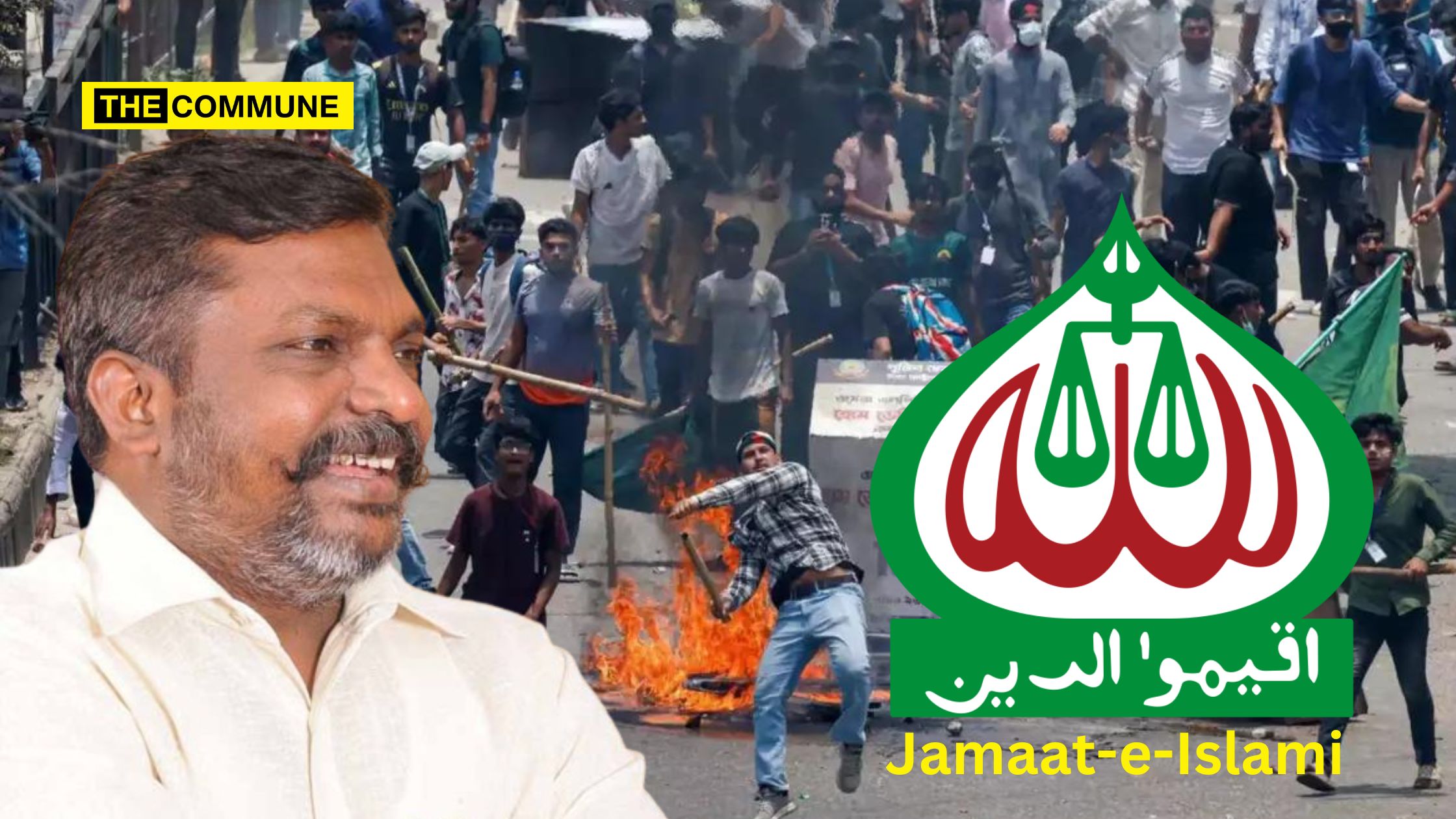
VCK Thirumavalavan Gives Award For “Religious Harmony” To Jamaat-e-Islami member

VCK gave award to terror-sympathizing Jamaat-e-Islami member for "advocating peace."

Viduthalai Chiruthaigal Katchi (VCK) leader and Chidambaram MP Thirumavalavan bestowed the “Quaid-E-Millath Pirai” award upon SN Sikander, the Secretary of Jamaat-e-Islami Hind in Tamil Nadu, for “advocating peace among different religious groups.”

Jamaat-E-Islami is an Islamist fundamentalist outfit that operates in India as Jamaat-e-Islami Hind. It is banned in Russia and Bangladesh. Thirumavalavan appears to overlook the disturbing actions and ideologies of this organisation, which is responsible for violence and terrorism in several countries. This notorious organisation is reportedly carrying out several atrocities on Hindu minorities, including brutal rape and abduction of Hindu women, in the ongoing turmoil in Bangladesh.

This award to a radical Islamist organisation raises concerns about Thirumavalavan’s stance on religious extremism.

Bangladesh Turmoil, Hindu Minority Persecuted by JeI

Since the forceful removal of Prime Minister Sheikh Hasina, there have been disturbing incidents of attacks on Hindus, their homes, and places of worship. These Islamic groups have unleashed destruction on the streets, instilling a climate of fear within minority communities, particularly Hindus.

Previous reports have revealed that Pakistan’s intelligence agency ISI, the Bangladesh Nationalist Party, and the Bangladeshi branch of JeI were the key orchestrators behind the campaign to oust Hasina. It is crucial to note that JeI is a banned extremist group that was held accountable for the massacre of Hindus and Bengali-speaking Muslims during the 1971 Bangladeshi independence war. The takeover of Bangladesh by these extremist Islamic groups, especially the JeI, has led to a concerning situation where minority communities, particularly Hindus, are facing targeted attacks, the destruction of their homes and places of worship, and an atmosphere of terror.

Against this background, social media highlighted the fear experienced by Hindu groups due to Islamic factions in neighbouring countries.

Quaid-E-Millath Pirai

The mention of Jamaat-e-Islami served as a trigger, reminding of an event where the Chidambaram MP gav the “Quaid-E-Millath Pirai” award upon JeI Secretary SN Sikander, for advocating peace among different religious groups.

Thirumavalavan praised SN Sikander for his various contributions and actions, stating, “He (Sikander) joined the Indian Islamic Students Organization and played a key role in disciplining the student community, guiding them on the path of morality. When he was the Tamil Nadu president of the organisation, he actively lobbied against the use of violent drugs. In 2004, Sikander helped to build permanent houses for the people affected by the tsunami in the Kotakuppam areas of Nagoor. Notably, he went against the majority opinion of “one country, one language, one culture” and created the television series “Manuda Vasantham,” which promoted the message of pluralism to the masses. Sikander was instrumental in the foundation and formation of the ‘Welfare Party.’ He acted as the secretary at the all-India level and continued to be a member of the General and Executive Committee.”

Thirumavalavan highlighted that Sikander worked efficiently as the president of the Welfare Party’s Tamil Nadu unit from 2011 to 2021. Additionally, Thirumavalavan noted that Sikander actively participated in the hydrocarbon protest in Thiruvarur, supported the farmers’ protest, and opposed the Citizenship Amendment Act (CAA), protesting against it.

Thirumavalavan finally said, “We are proud to present the 2024 Quaid-E-Millath Pirai Award to Sikander, who is the Tamil Nadu Secretary of Jamaat-e-Islami Hind and a member of the editorial board of the magazine “Samarasam”, a bi-monthly, for his contribution to religious harmony.”

Jamaat-e-Islami (JeI), a notorious Islamist organisation, has a long history of reigning terror in both India and other states. This extremist group has been responsible for a multitude of atrocities over the years.

Jamaat-e-Islami (JeI) – A Proxy For Pakistani Army In Bangladesh?

The Bangladeshi branch of Jamaat-e-Islami (JeI) was crucial in establishing auxiliary forces for the Pakistani army during the 1971 Bangladeshi independence war. These forces, including Razakar, Al-Badr, Al-Shams, and the Peace Committee, actively participated in atrocities against Bengali freedom fighters, particularly the Hindu population. JeI and its forces were responsible for the ruthless killing of hundreds of thousands of Hindu men, women, and children, as well as the rape of numerous Hindu women and girls.

The International Crimes Tribunals in Bangladesh have labelled JeI’s actions during the 1971 war as actively aiding the Pakistani occupation forces. JeI was founded by Muslim Brotherhood leader Sayyid Abul A’la Maududi with the aim of Islamic dominance and unifying the world under Islam’s banner.

In response to JeI’s terrorism and extremist Islamic factions, the Bangladeshi government has outlawed the group and its student wing, Chhatra Shibir, as terrorist organisations under the Anti-Terrorism Act of 2009. However, the student wing, allegedly supported by Pakistan’s intelligence agency ISI, has continued to incite violence under the guise of student protests, leading to violent acts against the democratically elected government of Sheikh Hasina.

JeI is not only active in Bangladesh but is believed to be connected to its parent organisation, Jamaat-e-Islami Pakistan, which is associated with other banned terror groups. The group operates in major countries worldwide, including India, Europe, the UK, and the USA, and has had a presence in Europe since the 1960s.

Jamaat-e-Islami Pakistan has been a prominent figure in electoral politics. It has a history of using violence, particularly through its militant student wing, Islami Janiat-e-Talaba, which gained control of several urban colleges and universities. The group maintains strong ties with various militant organisations, such as Hamas and Palestinian Islamic Jihad, as well as the Muslim Brotherhood.

In addition to terrorist acts, JeI has been involved in financing and aiding other terrorist groups globally, as well as inciting the Muslim world to act against India over the Kashmir issue. The group has been collecting funds worldwide under the guise of charitable activities, such as a recent fundraising event in Brooklyn, New York, to aid flood victims in Pakistan, with the proceeds allegedly funneled to the Alkhidmat Foundation, the charity branch of Jamaat-e-Islami.

JeI Terror Activities In India

The social unrest and collapse of democracy in Bangladesh pose a threat of a humanitarian crisis along the Indian border. Additionally, the rise of extremism in the region, specifically with the banned JeI gaining influence, raises security concerns for India. It is noteworthy that JeI is proscribed not only in Bangladesh but also in India and Russia.

Following the Pulwama terror attack in India that resulted in the deaths of 40 CRPF members, the Indian government banned JeI in February 2019. During the crackdown, authorities detained 350 leaders of the extremist group, froze 70 bank accounts in Srinagar, seized assets worth ₹52 crore, and took legal action under the Unlawful Activities (Prevention) Act. The actions also impacted 400 schools, 350 mosques, and 1000 seminaries associated with the separatist organisation in Jammu and Kashmir. Estimates in 2019 indicated that Jamaat-e-Islami possessed properties valued at ₹4,500 crores.

In February 2023, the Indian government extended the ban on JeI in Jammu and Kashmir for an additional five years, categorising it as an “unlawful association.” This decision came shortly after the National Investigation Agency (NIA) carried out searches related to a terrorism funding case involving the JeI branch in Kashmir. The operations led to the confiscation of over Rs 20 lakh, incriminating documents, and electronic devices linked to the group’s activities and associated trusts.

NIA investigation revealed that JeI members advocated for terrorism in J&K even after the organisation was banned in 2019. In December 2022, the J&K State Investigation Agency (SIA) took control of numerous properties belonging to the Jamaat in four districts of the Kashmir Valley, valued at Rs 100 crore.

The extremist organisation follows the doctrines of Hasan Al Banna, Syed Qutb, and Maulana Maududi, which advocate for political and societal alignment with Sharia law. The group has been suspected of covertly aiding the Hizbul Mujahideen, the leading local terrorist group in Kashmir, despite publicly distancing itself from the group in 1997.

Reports suggest that JeI is backing calls for secession from India and assisting terrorist and separatist organisations. Beyond terrorist acts, JeI Hind has been fostering and endeavouring to normalise radicalism and extremism in India. In October 2023, the group’s Jamaat-e-Islami Hind (JIH) branch organised an event to express ‘solidarity’ with the Hamas terrorists who perpetrated mass killings of civilians in Israel, further highlighting its extremist activities.

(With inputs from OpIndia)

Subscribe to our channels on TelegramWhatsApp, and Instagram and get the best stories of the day delivered to you personally. 

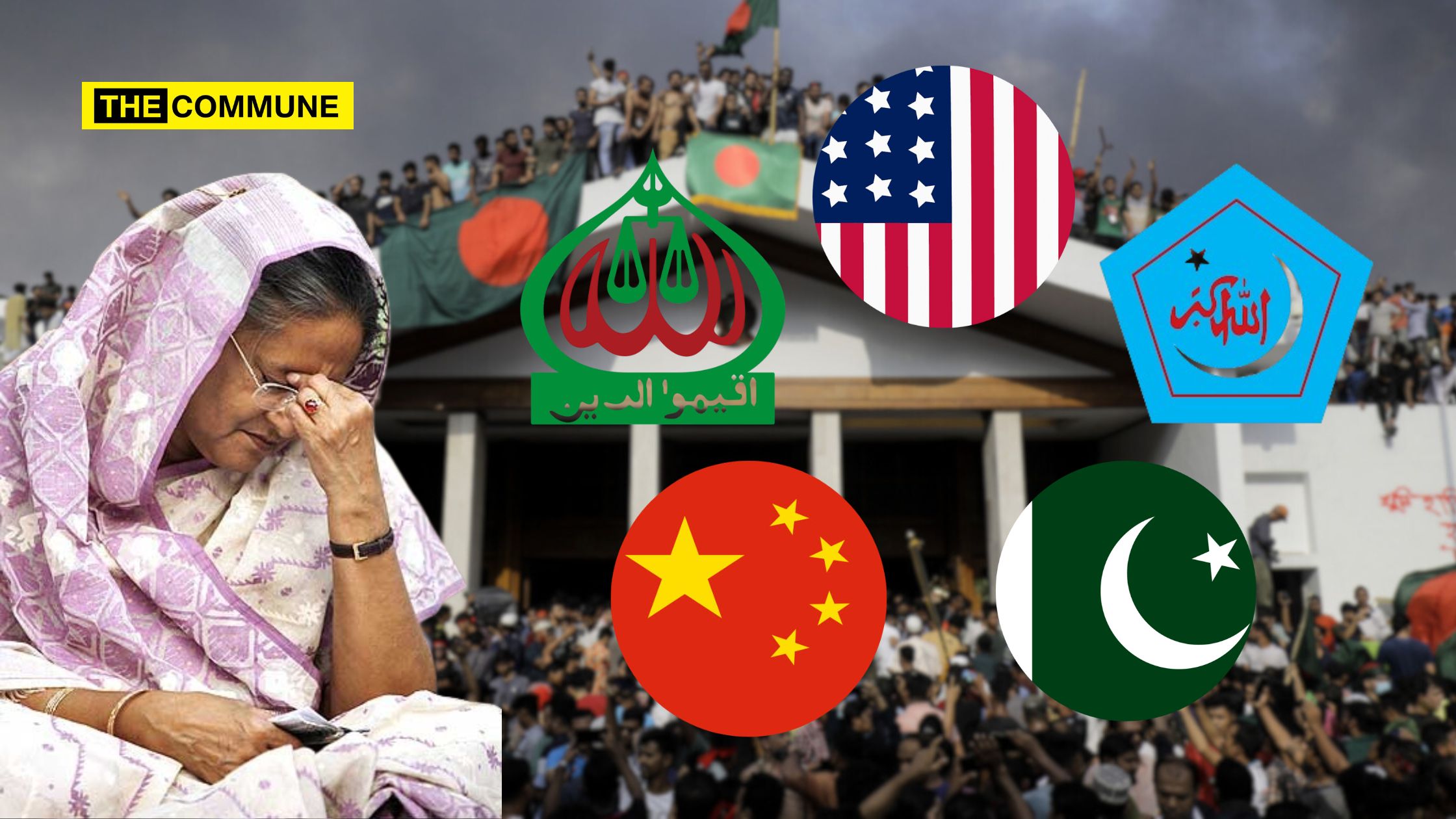
Coup, Chaos, And Conspiracy: Bangladesh’s Descent Into Political Upheaval

Coup, Chaos, And Conspiracy: Bangladesh's Descent Into Political Upheaval

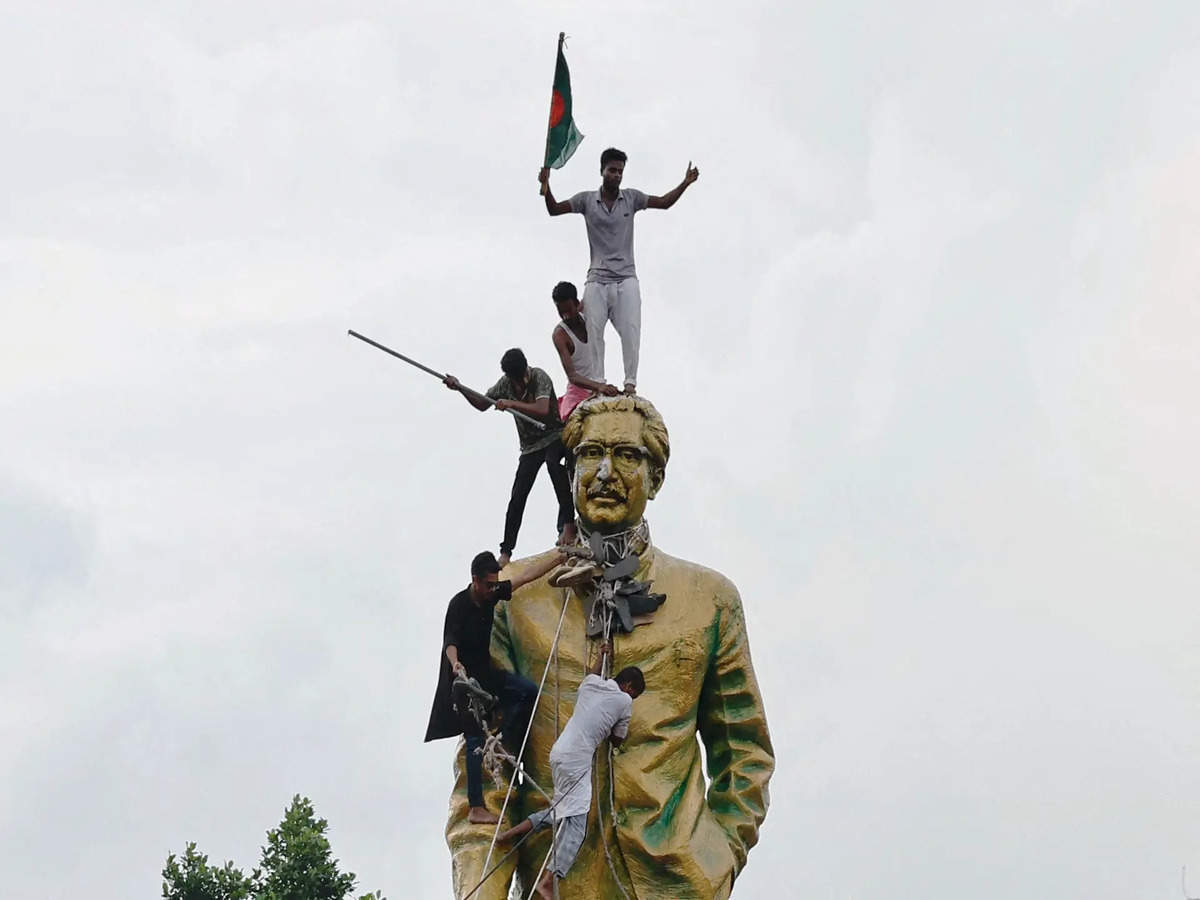
As Sheikh Hasina fled to India on 5 August 2024 after the coup in Dhaka, it is anticipated that the former Bangladesh PM will extend her stay indefinitely due to a “technical roadblock” hindering her travel plans to the UK. This situation mirrors a past occurrence of her exile following the tragic assassination of her father and Bangladesh’s founder, Sheikh Mujibur Rehman, in 1975 during a similar coup. Hasina was in exile, along with her mother and almost all of her family members.

New Delhi is arranging to host Hasina for as long as necessary. Initially, she intended to journey to London to be with her niece Tulip Siddiq, who currently serves as a member of the British Parliament, holding the positions of economic secretary to the Treasury and Labour MP for Hampstead and Highgate. However, the obstacle lies within the UK’s Immigration regulations, which lack provisions for individuals to apply for asylum or seek temporary refuge outside the UK.

Reports indicate that Hasina is exploring alternatives with different nations, such as the UAE and Saudi Arabia, in addition to the countries where her close relatives currently live, such as the United States, the United Kingdom, Finland, and India.

The Fall Of Dhaka

The fall of Dhaka after the coup is alleged to have resulted from aggressive information and psychological warfare tactics employed by external forces, as a lack of adequate resources hindered any effective response. The impact was not confined to the coup or the realm of politics. Instead, it undermined the fundamental principles of liberty that previous generations in Bangladesh struggled to uphold in the face of atrocities, such as genocide and sexual violence.

Bangladesh gained independence from Pakistani rule five decades ago. The United States deployed its 7th Fleet in the Bay of Bengal to impede Bangladesh’s liberation. The liberty earned through Mujibur Rehman’s sacrifice, and the influence of Rabindranath Tagore’s principles has been snatched away. The United States, Pakistan, and China hijacked the movement initiated by Bangladeshis protesting against fair quotas.

USA’s Influence Through Indo-Pacific Strategy

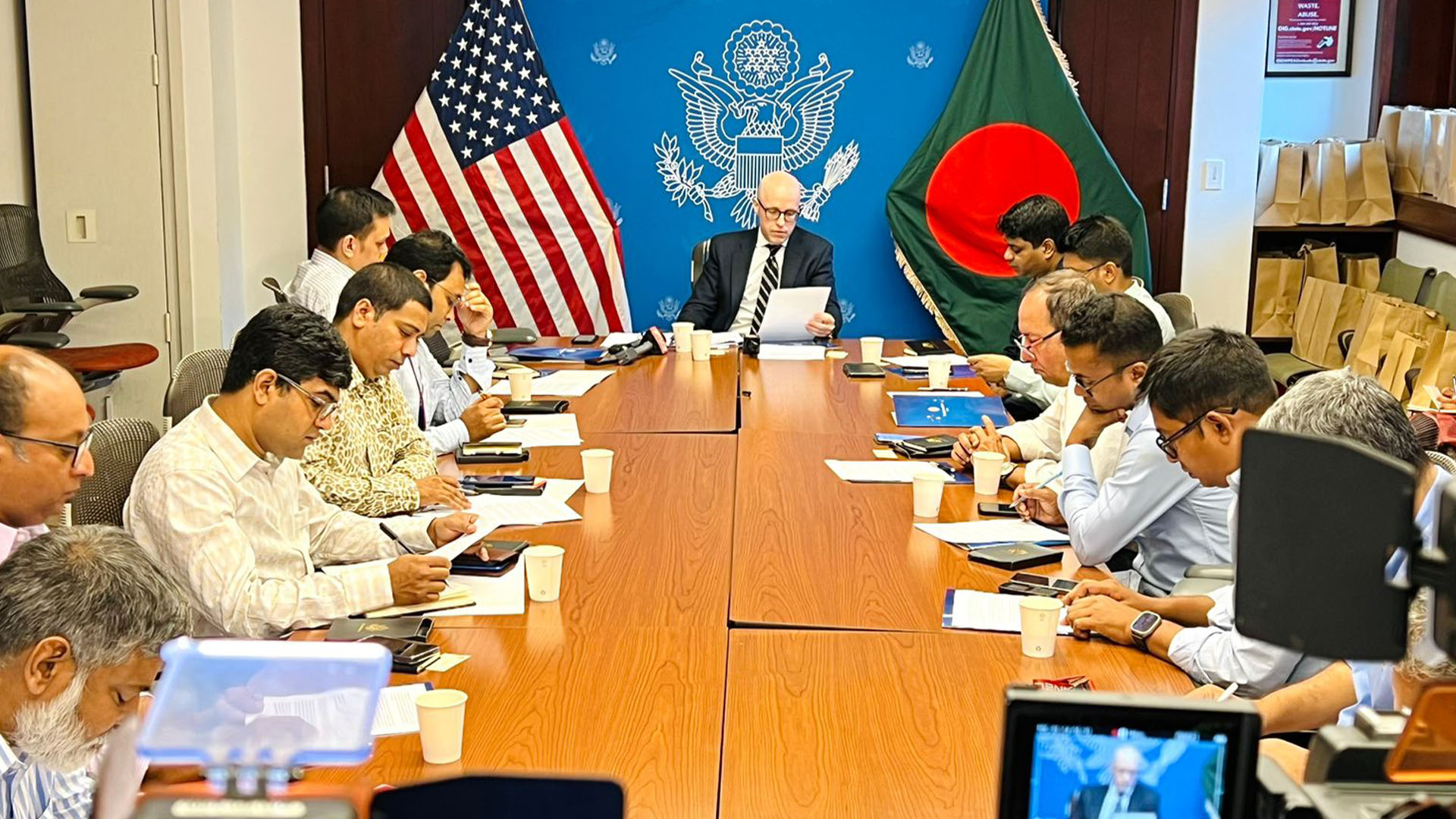
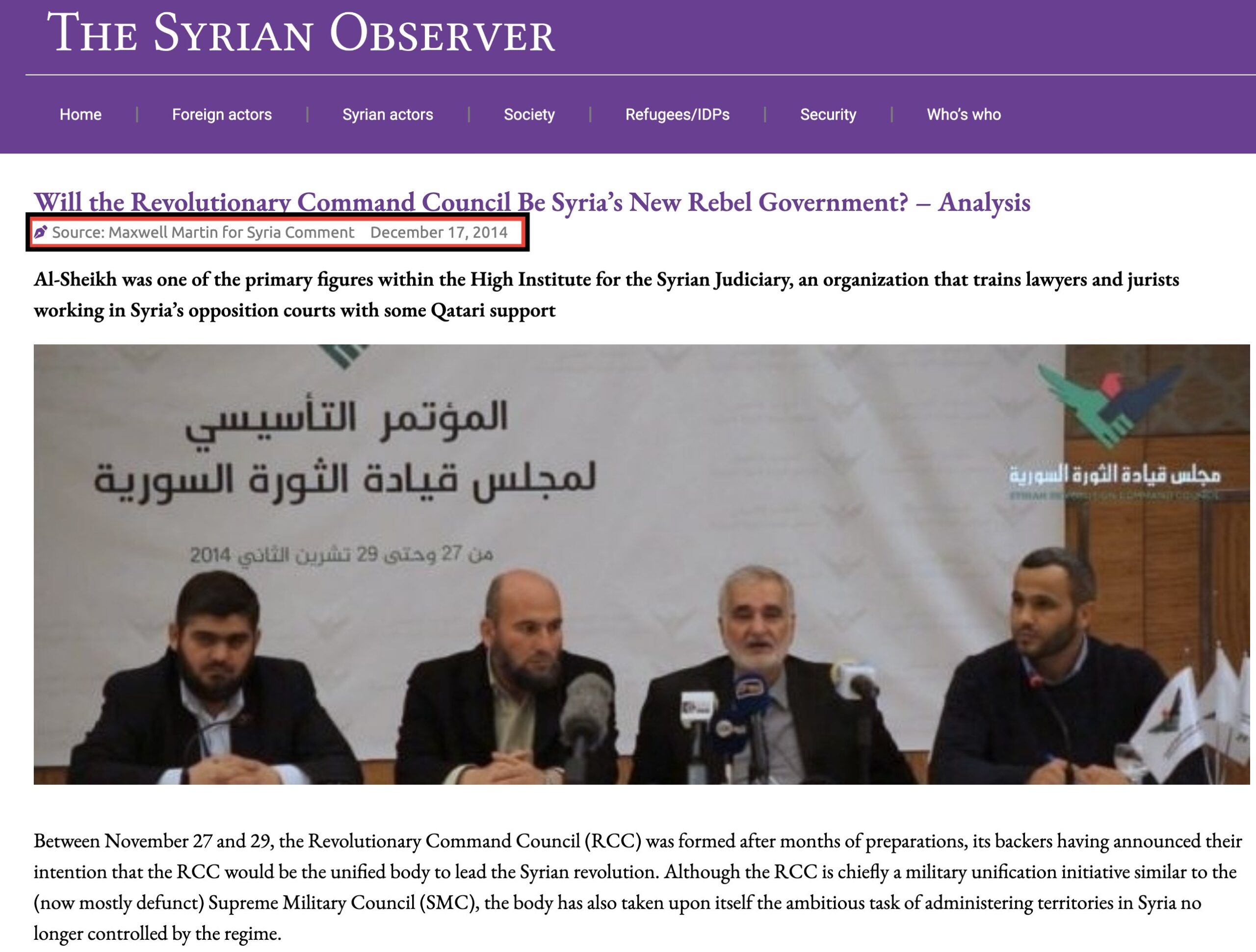
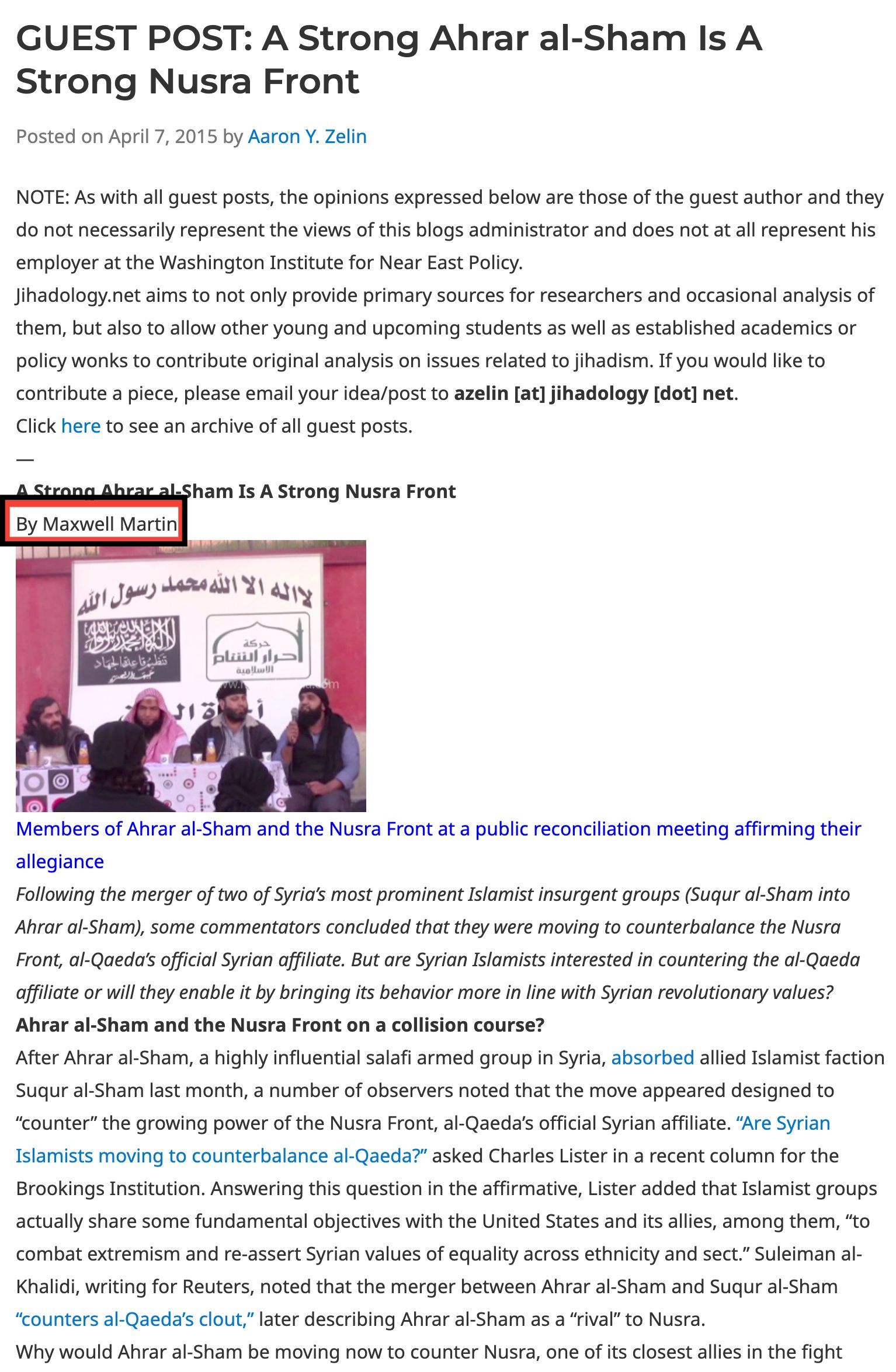
At a briefing titled “Indo-Pacific Strategy for Bangladesh” held on 24 April 2024, Maxwell Martin, the political officer from the State Department at the US Embassy, emphasised that the US views Bangladesh independently of its relationship with India. Martin reiterated the US’s commitment to supporting the Bangladeshi armed forces in achieving their “Forces Goal 2030” to enhance regional security.

With expertise in analysing the dynamics of revolutions involving Jihad, Martin’s in-depth knowledge ranges from Arabic language proficiency to the Arab Spring, establishing rebel governments in Syria, and understanding the connections between Al-Qaeda in the Indian Subcontinent (AQIS) and Jamaat-e-Islami and its militant factions. This background equips him to gauge the sentiments in Dhaka during times of protest, prompting questions on the relevance of such specialised insight in the context of Dhaka.

Influence Of Chinese & Communists

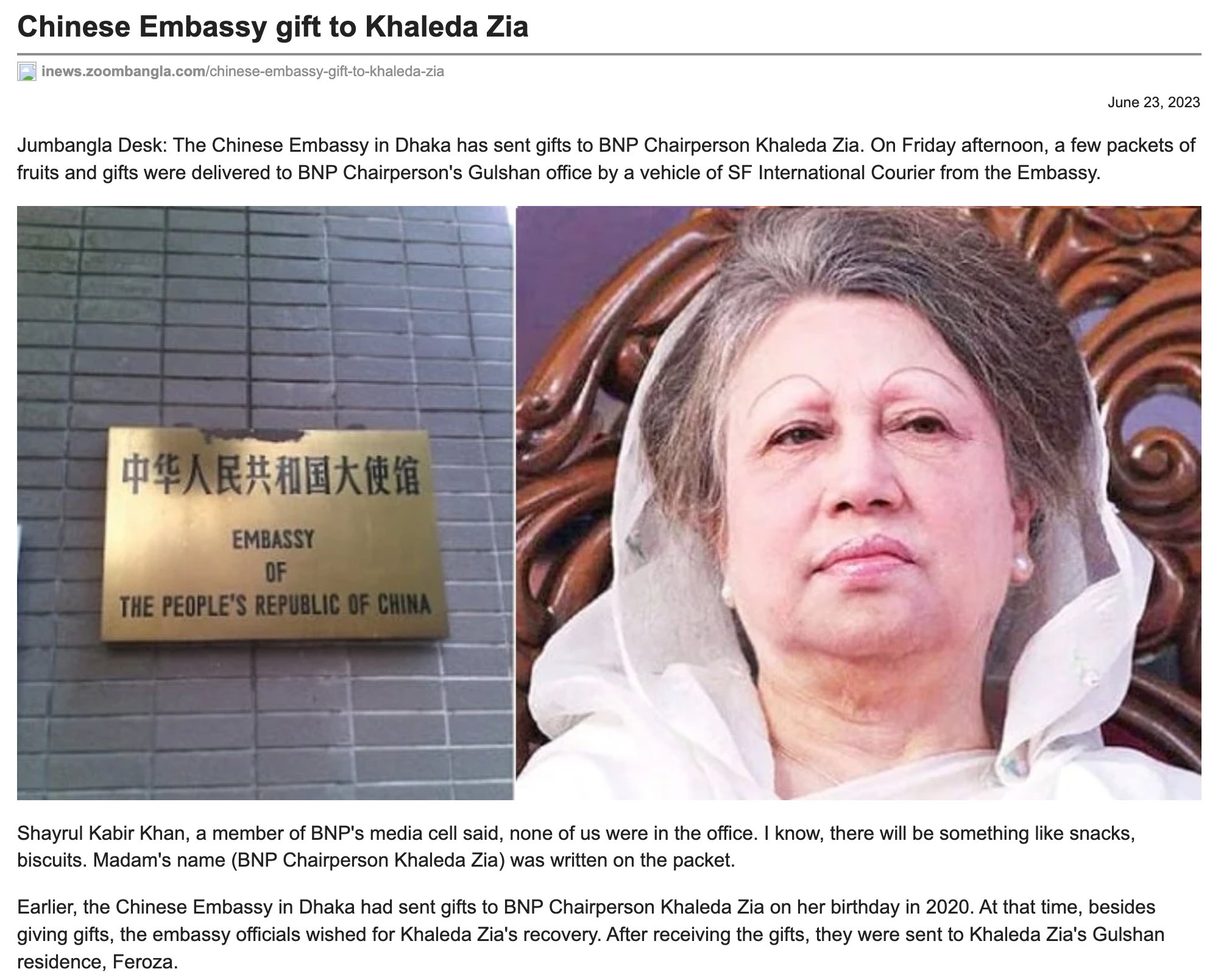
During the ongoing protests in Bangladesh, the Chinese embassy is reported to have sent gifts to BNP Chairperson Khaleda Zia through SF International Courier. Khaleda Zia had previously received gifts from the Chinese embassy in 2020.

Amid the heated protests in Dhaka, Chinese officials were allegedly seen moving freely, and Pakistani embassy officials accompanied them. Members of Jamaat-e-Islami (JeI), who had reportedly infiltrated the student protests, even recognised Chinese embassy officials as allies.

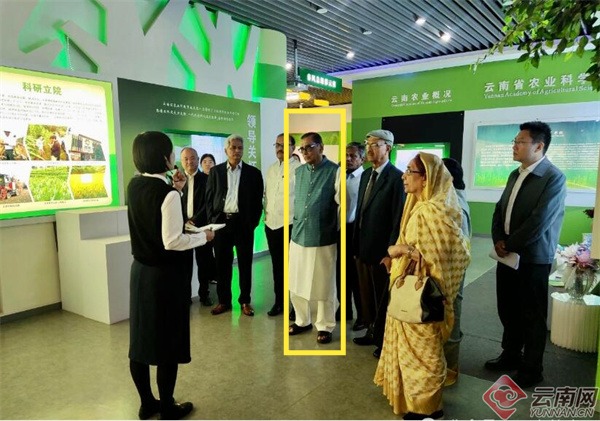
Another buzz in Dhaka politics revolves around Rashid Khan Menon, the Chairman of the Workers Party of Bangladesh. Between 13 to 18 May 2024, Rashid Khan Menon, Dilip Barua, General Secretary of the Communist Party (ML), and Shirin Akhter, General Secretary of the National Socialist Party, visited Yunnan, China.

Chinese Ambassador to Bangladesh, Yao Wen, is said to have played an active role in organising mass rallies against the Hasina government upon the return of the communist trio from Yunnan. Subsequently, ISI allegedly embedded Jamaat elements into the protests to try and influence the situation.

Pakistan’s Aspiration To Re-Create East Pakistan

Pakistan’s ongoing ambition to re-establish East Pakistan has been evident since its defeat in 1971, with the shadow of the 93000-figure looming over the Pakistani Army for the past 52 years. Recent events have seen former ISI Chief Lt. Gen. Naveed Mukhtar linked to an allegedly failed assassination plot targeting Sheikh Hasina. Rallies supporting the ‘Razakar’ were said to be orchestrated in collaboration with Left-wing parties. Presently, Pakistan is reported to be lobbying for the lifting of the ban on JeI through their association with BNP as a recognition of their efforts.

The Islamic Chhatra Shibir (ICS)

The crucial question now is whether Bangladeshis will allow the “Islamic Chhatra Shibir (ICS) terrorists” to seize power. ICS is said to have garnered a notorious reputation for criminal activities across Bangladesh. Operating under the guise of a student organisation, the group’s members are said to have been involved in numerous cases of murder and rape. Note: Chhatra Shibir refers to Student camp.

One example of such a situation occurred in 2020 when a married woman was subjected to gang rape in Sylhet. The woman and her husband were at MC College one Friday evening when they were forcibly taken to the college hostel by a group of individuals who sexually assaulted the woman while detaining her husband.

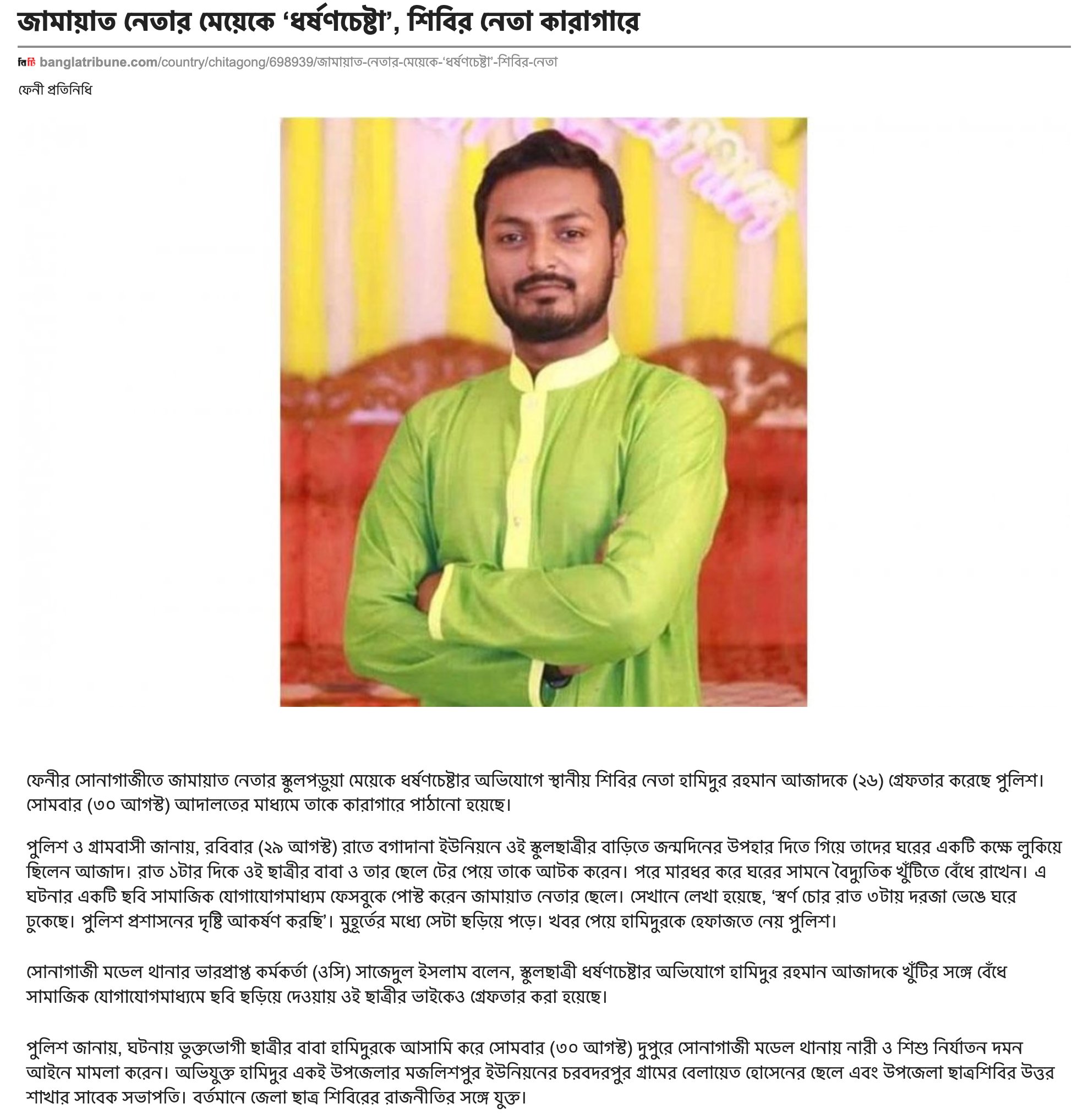
In a separate case, a Shibir leader named Hamidur Rahman Azad (26) was apprehended in August 2021 for attempting to rape a schoolgirl in Sonagazi. Similarly, in March of the same year, Shafiqul Islam, a local ICS leader, raped a young girl when she approached him for onions.

The incidents do not end there; ICS is also said to be involved in trafficking underage Bangladeshi girls to Chinese buyers. Recently, on 8 June 2024, a Chinese national named ‘Jisao Suhui’ was arrested by Bangladeshi police in Uttara for allegedly collaborating with Chhatra Shibir members in human trafficking from the Chittagong hill tracts to China. ICS members are said to entice teenage girls with lucrative job offers through social media, only to exploit and sell them to Chinese buyers after subjecting them to days of sexual abuse.

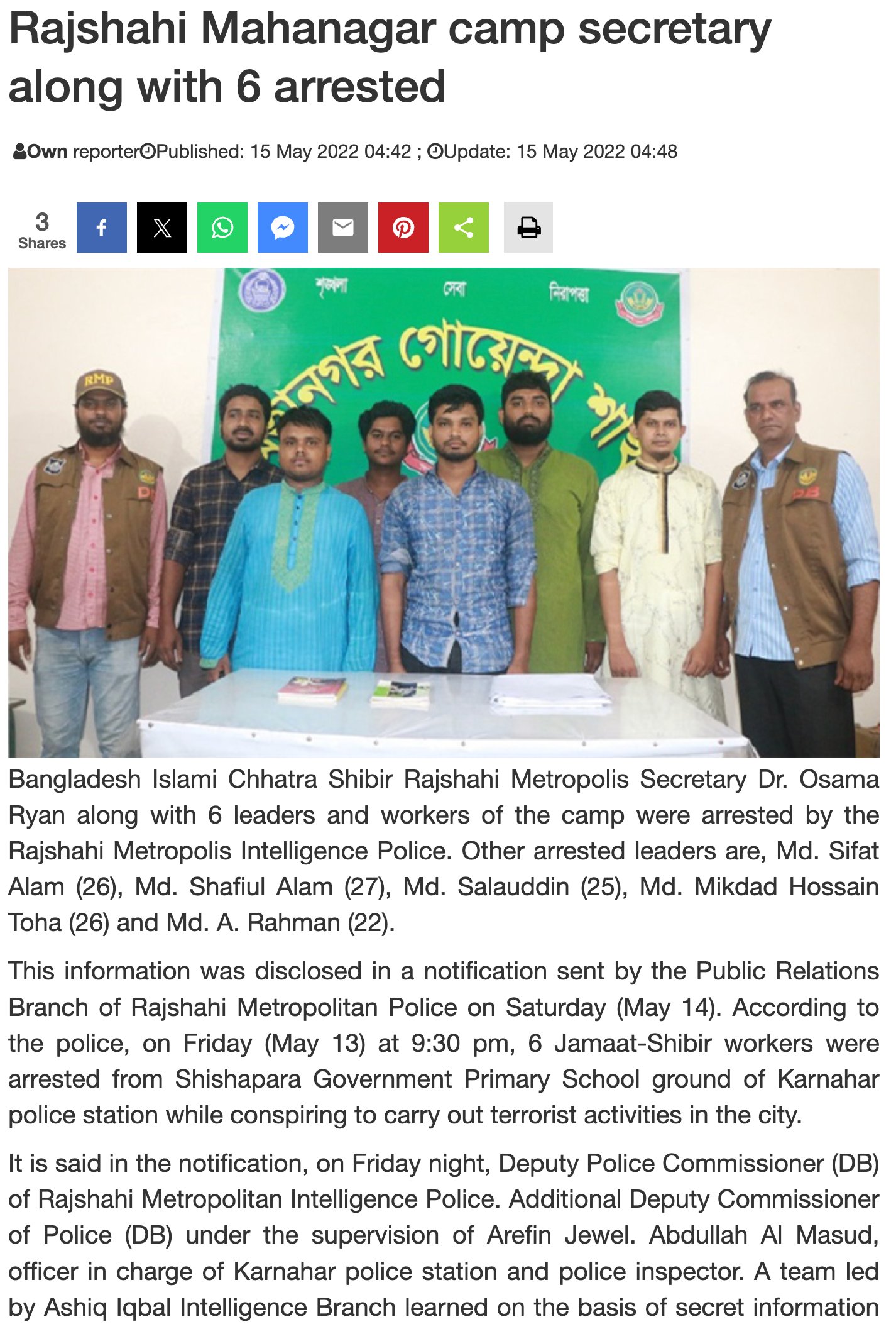
Aside from engaging in acts of rape and murder, ICS members are also said to be implicated in terrorist activities. In May 2022, the Secretary of Bangladesh Islami Chhatra Shibir Rajshahi Metropolis, Dr. Osama Ryan, and six associates were detained on terrorism charges. The ISIS terrorists responsible for the Holy Artisan Bakery attack in July 2016, which resulted in the deaths of 23 individuals, were supported by the Islamic Chhatra Shibir network, with many ICS members affiliated with groups like Jamaat Ul Mujahideen, AQIS, and ISIS.

According to the data from 2022, foreign direct investment in Bangladesh increased to $3.44 billion, a 37% growth. Up until August 4, the country was recognised as one of the rapidly developing commercial centres in Asia. With a consistent annual increase in foreign direct investment flows, the ongoing job crisis might have been resolved within seven years.

Extremist groups initiated destructive actions by setting ablaze luxury hotels and destroying public infrastructures, roads, and even the national parliament and Sheikh Hasina’s residence after the coup. The protest, supposedly aimed at protecting meritocracy, is overshadowed by the extremist ideology of Jamaat-e-Islami and ICS, orchestrated successfully by Pakistan.

The influx of foreign direct investment is anticipated to halt, leaving no funds available to enhance quality of life. The students and young people of Bangladesh, who previously rallied for their rightful demands, are now confronted with the necessity to confront their extremist forces or adapt to surviving in a failed state.

In the past, similar distressing situations have been observed in conflicts like the Iraq War, Libya, and Afghanistan. Presently, in Bangladesh, democracy and minority lives are under threat following a coup orchestrated by terrorists who have infiltrated under the guise of protestors. This trend of using student protests as a cover for a coup and persecution of Hindu minorities is alarming and threatens the stability of the region.

(This article is Based on an X thread by Nepal Correspondence)

Subscribe to our channels on TelegramWhatsApp, and Instagram and get the best stories of the day delivered to you personally. 
BJP-Led NDA Govt Tables Waqf (Amendment) Bill 2024 – A Look At The Proposed Amendments

Modi govt introduces Waqf Amendment Bill

The NDA government under PM Modi plans to present the highly discussed Waqf (Amendment) Bill, 2024, in the lower house of Parliament on 8 August 2024. The proposed legislation seeks to revise the Waqf Act of 1995, which governs Waqf boards. The Bill proposes 44 amendments intended to repeal specific provisions of the current Waqf Act.

These changes aim to adjust the existing regulations overseeing Waqf boards substantially. Significantly, the Bill seeks to increase the representation of Muslim women and non-Muslims in Waqf boards, demonstrating a commitment to inclusivity and diversity.

Advocate Vishnu Shankar Jain who has been very vocal about the misuse of the Waqf Act welcomed the proposed Bill. He took to his X handle and wrote, ” Very well researched waqf amendment bill 2024 has been prepared by the central govt. I thank the government for understanding the issue and bringing legislative changes. This bill will solve the issue and stop the illegal activities under the garb of waqf.”

A look at the amendments in question:

Aghakhani And Bohra Waqf

Amendment of Section 3: This amendment introduces new definitions and modifies existing ones, including definitions for “Aghakhani waqf” and “Bohra waqf,” as well as terms like “Collector,” “Government Organisation,” and “Government property.” It also specifies that waqf creation must be formal and introduces a “portal and database” for waqf information.

Amendment of Sections 6 and 7: This amendment includes Aghakhani and Bohra waqfs in the list of disputes and removes the clause making the Tribunal’s decisions final, aligning the Tribunal’s dispute resolution authority with the broader judicial system.

Amendment of Sections 13 and 14: This change establishes separate Auqaf Boards for Bohras and Aghakhanis and expands the composition of the State Waqf Boards to include non-Muslim members, ensuring broader representation.

Does the Govt Own The Land Or Is It The Waqf?

New Sections 3A, 3B, and 3C: These sections set conditions for creating a waqf, requiring the creator to be the legal owner and capable of transferring the property. They also mandate the registration of waqf properties on a central portal within six months, including detailed information about the property, creator, deed of waqf, management, income, and expenses.

According to Section 3C:

  1. Any property identified or declared government property before or after this Act begins will not be considered waqf property.
  2. If there is any question about a property’s status as government property, it will be referred to the Collector, who will investigate, determine the property’s status, and report to the State Government. Until the report is submitted, the property will not be treated as waqf’s.
  3. If the Collector concludes that the property is government property, corrections will be made in the revenue records, and the report will be sent to the State Government.
  4. Following receipt of the Collector’s report, the State Government will instruct the Board to update the records accordingly.

Amendment of Section 4: This change replaces Survey Officers with the Collector for conducting waqf surveys in compliance with State revenue laws.

Amendment of Section 5: New sub-sections require uploading the list of auqaf on the central portal and issuing a public notice before deciding on land mutations.

Central Waqf Council To Include Non-Muslims

Amendment of Section 9: This amendment expands the Central Waqf Council to include non-Muslim members, promoting inclusivity.

The Council shall consist of the following members:

  • The Union Minister in charge of waqf, serving as the Chairperson ex officio.
  • Three Members of Parliament, including two from the House of the People and one from the Council of States.
  • Members appointed by the Central Government from among Muslims, including:
    • Three individuals representing significant Muslim organizations.
    • Chairpersons of three Boards, appointed on a rotating basis.
    • One person representing mutawallis of waqf with an annual income of five lakh rupees or more.
    •   Three prominent scholars in Muslim law.
    •   Two former Supreme Court or High Court judges.
    •   One nationally renowned advocate.
    •   Four distinguished individuals in the fields of administration or management, financial management, engineering or architecture, and medicine.
    •   The Additional Secretary or Joint Secretary from the Union Ministry dealing with waqf matters, serving ex officio.
    •   Two of the members appointed must be women.
    •   Additionally, two members must be non-Muslims.

Amendment of Section 16: This change introduces conviction with a sentence of two years or more as a reason for disqualification from the Board.

Amendment of Section 17: This amendment mandates that the Council must convene at least once a month.

Omission of Section 20A: Section 20A is entirely removed from the Act.

Amendment of Section 23: The new sub-section requires the Board to have a full-time Chief Executive Officer appointed by the State Government, at least at the rank of Joint Secretary to the State Government.

Amendment of Section 32: Sub-section (2), clause (e) removes the Explanation and proviso. Sub-section (3) eliminates the finality of the Tribunal’s decision.

Amendment of Section 33: Sub-section (4) removes the Tribunal’s power to stay the Chief Executive Officer’s orders. Sub-section (6) is also omitted.

No Registration On Waqf Portal If Property Is Disputed

Amendment of Section 36: Starting with the Waqf (Amendment) Act, 2024, a waqf deed is required to create a waqf. Registration must be completed through the central portal, with details specified by the Central Government. If a waqf deed is missing, full details are not required. The Collector will verify the validity of the application. Disputed or government-owned properties will not be registered until resolved by a court. The previous rule on registration details has been removed. Additionally, once a waqf is registered, a certificate will be issued through the portal, and no legal action can be taken for unregistered waqfs six months after the Act begins.

Amendment of Section 37: Sub-section (1) requires details to comply with rules set by the Central Government and changes “provided by regulations” to “prescribed by the Central Government.” Sub-section (3) now mandates a public notice before altering land records. This notice must be published in two daily newspapers, including one in the local language, giving affected individuals the opportunity to respond.

Waqf Will Not Decide Which Property Belongs To Them

Amendment of Section 40: This amendment removes the section that granted the Board the authority to decide if a property is waqf property.

All Financial Reports To Be Submitted To Centre

Amendment of Section 46: This change adjusts the deadlines and details required for submitting financial reports to the central government.

Amendment of Section 47: This amendment alters the requirements for audits and the process for appointing auditors for waqf properties. It stipulates that audits may be conducted by a panel appointed by the State Government or directed by the Comptroller and Auditor-General of India, with audit reports published as specified by the Central Government.

Amendment of Section 48: This amendment introduces provisions for how audit reports should be published and how notices for objections should be issued.

Who Can Be A Mutawalli?

Insertion of Section 50A: A new Section 50A disqualifies individuals from being appointed or continuing as a mutawalli if they:

  • Are under 21 years old,
  • Are mentally unsound,
  • Are an undischarged insolvent,
  • Have been convicted of a crime and sentenced to at least two years in prison,
  • Have encroached on waqf property,
  • Have previously been removed as a mutawalli or by a court/tribunal for mismanagement or corruption.

Amendment of Section 52: In sub-section (4), the provision making the Tribunal’s decision on appeals final has been removed.

Punishment For Violators

Amendment of Section 52A: Changes include replacing “rigorous imprisonment” with “imprisonment”. It also includes returning property to the waqf rather than the Board. Also, it removes sub-sections (2) and (4).

Amendment of Section 55A: The clause stating finality of the Tribunal’s decision has been removed.

Amendments to Section 61: This section updates penalty rules, imposing fines between twenty thousand and fifty thousand rupees for failing to meet requirements without justification. New penalties include imprisonment of up to six months and fines ranging from twenty thousand to one lakh rupees for mutawallis who do not hand over property, follow instructions, provide accounts, or upload details. Some previous clauses (e) and (f) have been removed.

Amendments of Section 64: The rules for maintaining accounts have been updated. Penalties will be applied for improper account keeping or failure to submit yearly statements within a year. Additionally, members of unlawful associations under the Unlawful Activities (Prevention) Act of 1967 are now disqualified. The provision making the Tribunal’s decision on appeals final has also been removed.

Amendment of Section 65: Sub-section (3) specifies that tasks must be completed within six months.

Amendment of Section 67: It allows a 60-day period to appeal to the Tribunal. It also removes the provision that the Tribunal’s decision is final.

Amendment of Section 69: One rule has been eliminated, and a new requirement has been added for public notice and inviting objections before making decisions.

Amendment of Section 72: The interest rate has been revised from seven to five per cent, and the provision making the Board’s decisions final has been removed.

Amendment of Section 73: The rule that makes the Tribunal’s decision on appeals final has been removed.

Tribunal Or High Court To Handle Waqf Disputes

Amendment of Section 83: Other Tribunals may now be assigned to handle this Act. If no Tribunal functions, appeals can be made to the High Court. Tribunals must have two members: a District Judge (Chairman) and a Joint Secretary. The Chairman can act alone if the other member is absent. The Chairman and member can serve for a maximum of five years or until they turn 65, whichever comes first. The provision making Tribunal decisions final has been removed, allowing appeals to the High Court within 90 days.

Amendment of Section 84: Decisions must be made within six months of the application, with an additional six months allowed if reasons are recorded.

Amendment of Section 91: References have been updated from the old Land Acquisition Act to the 2013 Act, and the decision-making period has been shortened from three months to one month. New rules delay orders if the Board claims the property.

Amendment of Section 100: The term “Survey Commissioner” has been replaced with “Collector.”

Amendment of Section 101: All references to “Survey Commissioner” have been changed to “Collector.”

Amendments of Sections 104 and 107: These amendments omit the Act’s application to properties donated by non-Muslims and the provision making the Limitation Act, 1963, inapplicable to waqf property recovery.

Amendments of Sections 108 and 108A: They remove sections concerning special provisions for evacuee waqf properties and the Act’s overriding effect.

Insertion of Section 108B: This new section grants the Central Government the authority to create rules under the Act.

Amendment of Section 109: It modifies the power to create rules, specifying matters for which rules can be established.

Amendment of Section 110: It revises the Board’s power to make regulations. It also includes procedural and administrative details such as notifications and notices.

Financial And Delegated Legislation

The financial memorandum indicates that no additional financial expenditure is required. Its provisions for delegated legislation allow the Central Government to make detailed rules for the Act’s implementation. The bill is expected to pass both houses of Parliament before being signed into law by the President.

Since its inception, the Waqf has faced significant scrutiny due to legal disputes and irregularities. There have been widespread demands for its abolition or a revision of the relevant legislation. The proposed amendments address these concerns by increasing government oversight and enhancing transparency and accountability in Waqf operations.

(With inputs from Organiser)

Subscribe to our channels on TelegramWhatsApp, and Instagram and get the best stories of the day delivered to you personally. 
From 1946 To Date – 78 Years Of Persecution: The Continuous Struggle Of Bangladesh’s Hindu Minority

History Of Persecution: Continuous Struggle Of Bangladeshi Hindus

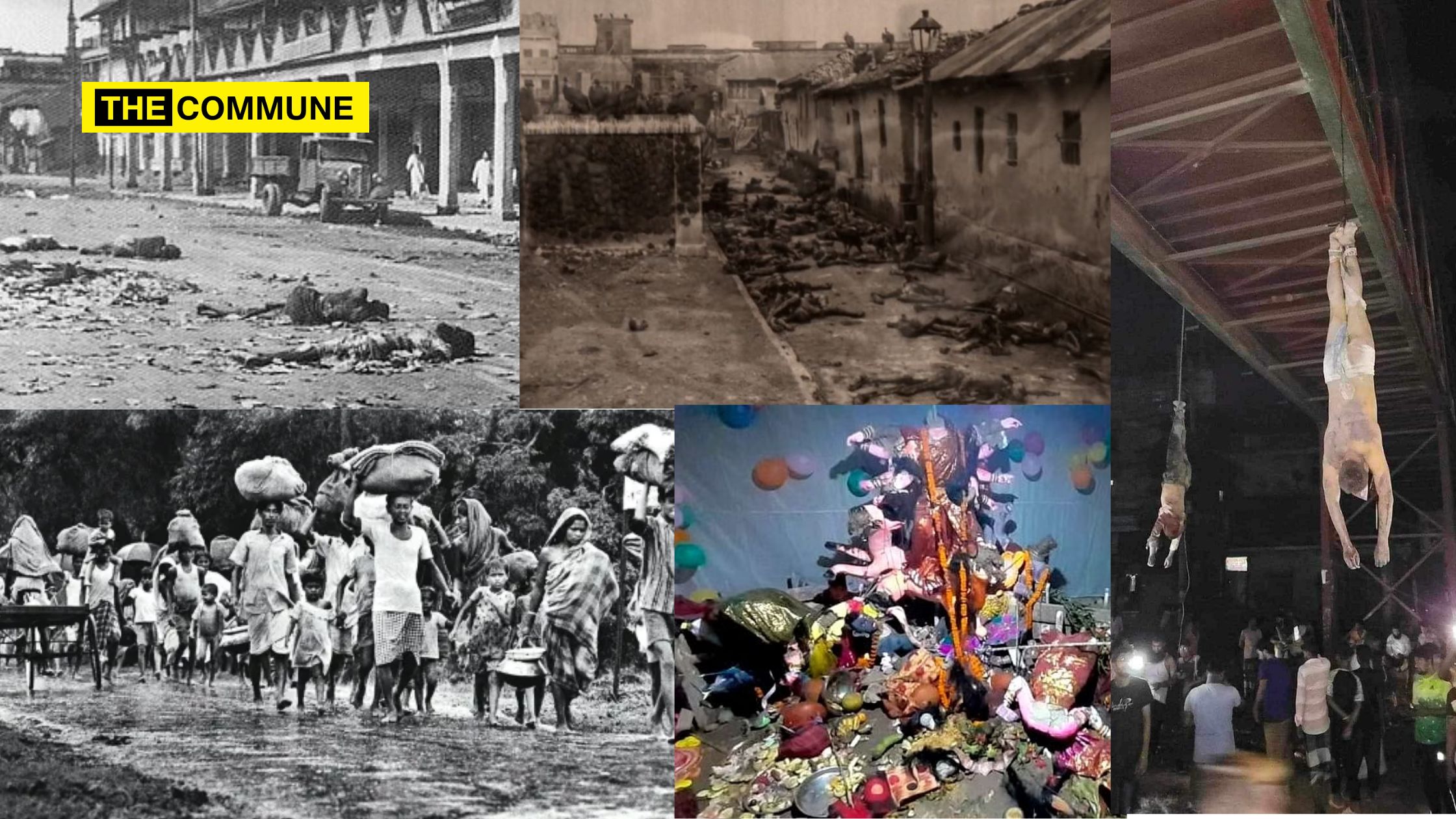
The Hindu community in Bangladesh has endured severe persecution over the decades, starting with the Direct Action Day in 1946 and continuing through various violent periods such as the Noakhali genocide in 1946, the 1971 Bangladesh Liberation War, and recurrent pogroms, including those in 1992 and 2024. These atrocities, characterised by massacres, rapes, abductions, and systematic destruction of Hindu properties, have led to a significant decline in the Hindu population from 28% in 1940 to 8.96% in 2011.

The history of atrocities against Hindus in Bangladesh underscores a persistent pattern of systemic violence and persecution over decades. This ongoing persecution highlights the continuous struggle of Hindus for safety and rights from the earliest days.

1946 – Direct Action Plan

On 16 August 1946, the Muslim League Council declared ‘Direct Action Day’ to emphasise their demand for a separate Muslim homeland following the British departure from the Indian subcontinent. The date was chosen because it marked the anniversary of the Battle of Badr, a significant early victory for Islam. The All-India Muslim League aimed to use violence to intimidate Hindus and their leaders into conceding a separate Muslim-majority country after the British exit.

SN Usman, the Mayor of Calcutta and Secretary of the Calcutta Muslim League distributed a leaflet in Bangla that ominously read:

Kafer! Toder dhongsher aar deri nei! Sarbik hotyakando ghotbe!” (“Infidels! Your end is not far off! There will be a massacre!”).

The ominous day began with a massive public meeting of the Muslim League at the Calcutta Maidan. Muslim workers from the jute mills of Howrah flocked into the city, heading toward Ochterlony’s needle monument for the grand meeting to ‘celebrate’ Direct Action Day. No representatives from the non-Muslim press attended the gathering. During the event, Suhrawardy, then the Premier of Bengal, boldly declared that he would challenge the British to prevent Mr. Nehru from ruling Bengal. He emphasised that Direct Action Day would mark the initial step in the Muslim struggle for emancipation.

The assembly included a significant number of Muslim hoodlums, whose numbers grew as the meeting concluded. These individuals moved towards the city’s shopping centres, immediately looting Hindu shops and houses. They spread through the town, shouting battle cries such as “Allahu Akbar,” “Pakistan Zindabad,” “Muslim League Zindabad,” “Lekar Rahenge Pakistan,” and “Ladke Lenge Pakistan.”

Then, the torching began. Hindu-populated areas such as the southern part of Amherst Street, Bortola, and Jorasanko were engulfed in flames within no time. Fires blazed through the night, accompanied by war cries of “Allahu Akbar, Ladke Lenge Pakistan.” This persecution continued unabated the next day. An Additional Judge of Alipore Court was killed while trying to save a young boy fleeing from the hoodlums. Until midmorning on the 17th, there was no sign of any policemen.

A mob of violent Islamists attacked Victoria College. All the girls were raped in the classroom, then killed and hung naked from the windows. The naked bodies of Hindu girls were displayed from hooks at Raja Bazar beef shops. Many rapists were armed with iron bars and lathis.

The brutality of the Razakars affected Hindus in Kolkata across various sections, castes, and professions. For example, Rajab Ali led a Muslim mob from Kasai bustee (slum) that set fire to two Hindu slums in Sasthitala, inhabited mainly by Dalits, the so-called lower castes. Suhrawardy personally visited the slum and areas around Narkeldanga main road and Maniktala main road to organise groups of Hindu hunters, ensuring a bloodbath of Hindu corpses.

In another shocking anti-Hindu persecution incident in Metiaburuz, around seven hundred Bihari and Odiya labourers were butchered by a Muslim mob led by local Communist Party leader Sayed Abdulla Farooqui.

On 17 August, Farooqui, President of the Garden Reach Textile Workers’ Union, along with Elian Mistry, a hardline Muslim League hooligan, led a vast armed mob into the mill compound of Kesoram Cotton Mills in the Lichubagan area. Hindu labourers, who were also part of the same union, showed their union cards to the bloodthirsty mobs, only to be laughed at and murdered. Their bodies were chopped and thrown into the river.

In the early hours of 17 August, a Muslim mob ransacked a Hindu household at 25 BudhuOstragar Lane, murdering 25 out of 37 members, looting, and setting the house on fire.

From 18 August, Muslim goons began facing retaliation. Hindu Kalwars from Bihar and U.P. led the charge, soon joined by Sikhs and Hindu Bengalis. Armed with crowbars, swords, and other weapons, they sought to avenge the killings with a ferocity previously unseen. As with Hindu dwellings, there was widespread torching in Muslim areas as well.

Gopal Chandra Mukhopadhyay, affectionately known as Gopal ‘Patha,’ became a symbol of Hindu resistance. He shattered Jinnah and his Muslim League Islamists’ dreams of forcibly including Hindu-majority Calcutta and its surrounding districts in East Pakistan by unleashing a mass genocide during the infamous Direct Action call on 16 August 1946.

Gopal, along with his group of Hindu boys, fought back against the Islamist terrorists starting on 18 August, thus saving millions of Bengali Hindu men, women, and children from certain extinction.

Unfortunately, many of the children of the poor and helpless Bengali Hindu women saved by Gopal in 1946 from the rapist and murderous Islamist gangs during Direct Action in Calcutta have been drawn into communist politics and now defame their saviour as a ‘dacoit’ or a ‘goonda‘. It is crucial to share the true story of this unsung hero of Bengal and India.

Gopal ‘Patha’ saved Hindus from being massacred by the Islamist terrorists of Suhrawardy and Jinnah during Direct Action in 1946.

1946 – Noakhali Genocide

The Noakhali Genocide was a series of organised massacres, rapes, abductions, and widespread looting and arson of Hindu properties. These atrocities were perpetrated by the Muslim community in the districts of Noakhali in the Chittagong Division of Bengal (now in Bangladesh) during October-November 1946, just a year before India’s independence from British rule.

The Noakhali Genocide affected areas covering more than 2,000 square miles, which are under the jurisdiction of Ramganj, Begumganj, Raipur, Lakshmipur, Chhagalnaiya, and Sandwip police stations in Noakhali district and Hajiganj, Faridganj, Chandpur, Laksham, and Chauddagram police stations in Tipperah district.

The massacre began on October 10, coinciding with Kojagari Lakshmi Puja, and continued for about a week. During this period, around 50,000 Hindus were trapped in the affected areas under strict Muslim surveillance, rendering the local administration powerless. In some regions, Hindus had to obtain permits from Muslim leaders to travel outside their villages.

When elections were held in the provinces of India in 1937, the provincial power of Bengal shifted to the Muslims. However, under British rule, Hindus primarily held positions of authority (such as control of zamindari). They were also more advanced in education and economics. With the new Muslim government, educated and financially advanced Hindus were forced to comply with many new laws in various ways.

On August 29 that year, during the occasion of Eid, a group of Hindu fishermen were attacked with deadly weapons while fishing in the Feni River. One fisherman was killed, and two others were seriously injured. In another incident, nine Hindu fishermen from Charuriah were severely assaulted with deadly weapons, resulting in seven being admitted to the hospital.

The Partition Of 1947

After the British departed, the Partition of India created three regions: Bharat, East Pakistan, and West Pakistan. Despite the populations of East and West Pakistan being nearly equal, political power and decision-making were predominantly centralised in West Pakistan.

During the discussions about partition, the then-Prime Minister of Bengal in British India (1946-1947) proposed an independent and united Bengal. However, this proposal was not accepted, and the partition proceeded according to Mountbatten’s plan.

Once the boundaries were established, Pakistan emerged as two geographically and culturally distinct areas, with India situated between them. The authorities in West Pakistan viewed the Bengali Muslims in the East as “too ‘Bengali'”. They considered their interpretation of Islam to be “inferior and impure,” leading to perceptions of the Bengalis as unreliable “co-religionists.” Additionally, Bengali Hindus were often targeted. The West Pakistani authorities attempted to assimilate the Bengali culture into their own.

In March 1948, during a civic reception in Dhaka, Pakistan’s founder, Jinnah, declared that “Urdu and only Urdu will remain as the state language of Pakistan.” This announcement sparked immediate protests from Dhaka University students in front of Jinnah, which led to a military crackdown in East Pakistan.

Army units were deployed to villages, specifically targeting Hindu communities. It was a common practice to kill Hindu men, as the absence of circumcision could identify them. Virtually no area was untouched by this persecution, and there were instances where Hindu women were also massacred.

1971 Genocide

The “71’s genocide” was the horrific ethnic cleansing of Bengalis, particularly Bengali Hindus, in East Pakistan (now Bangladesh) during the Bangladesh Liberation War. This atrocity was carried out by the Pakistan Armed Forces and their allied militia, the Razakars.

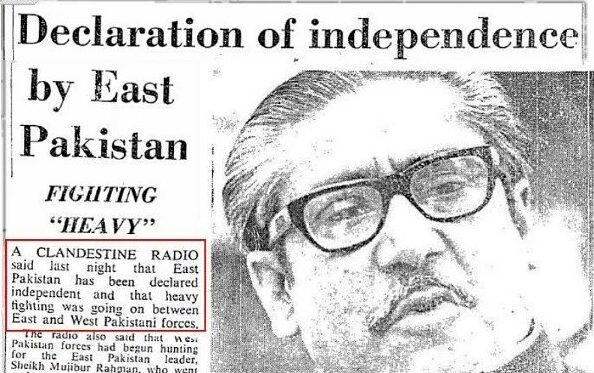
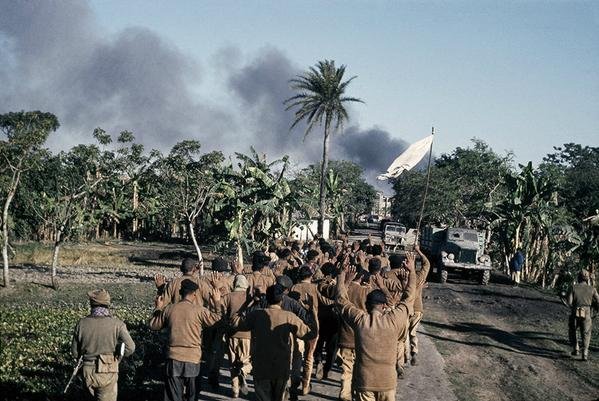
On 16 December 1971, Bangladesh achieved independence following a brutal genocide and a protracted liberation struggle against the West Pakistani army. During this period, Hindus across Bangladesh were targeted, with many being killed and their women abducted and raped.

The genocide began on 25 March 1971, when the Pakistani military launched a ten-month campaign against the Bengali and persecution of Hindu communities in East Pakistan. This campaign constituted a clear case of genocide as outlined by the United Nations Genocide Convention. The conflict led to the Bangladesh Liberation War and a subsequent 13-day Indo-Pakistan War. Both wars concluded on 16 December 1971, with Pakistan’s surrender.

To the Pakistani military, Hindu, Bengali, and Indian identities were viewed as interchangeable. Although Hindus were mainly targeted, Bengali Muslims, Christians, Buddhists, and other religious groups also suffered greatly. By the end of March 1971, around 1.5 million Bengalis were displaced, and by November 1971, approximately 10 million Bengalis—predominantly Hindus—had sought refuge in India.
While exact figures are challenging to determine, estimates suggest that around 3 million people were killed and at least 200,000 women were raped. Bangladeshi journalist and policy analyst Anushay Hossain notes that some experts estimate the number of raped women and girls to be closer to 400,000.

Pakistani imams declared Bengali Hindu women as “war booty,” and fatwas were issued, legitimising them as spoils of war. Many of these women either died in captivity, committed suicide, or fled to India.

Countless women were subjected to looting and rape by the Pakistani army during this period. Hindu massacres occurred with disturbing frequency, including the notorious Burunga massacre. On 26 May 1971, the Pakistani military brutally murdered 94 Hindus at Burunga High School. This atrocity is just one of many horrific acts perpetrated against the Hindu population in Bangladesh.

The Pakistani army killed thousands of people, including academics, students, and even sleeping rickshaw pullers, often at close range. Among the notable victims were the respected scholar GC Dev and the eminent academic Jyotirmoy Guhathakurta. Overall, an estimated 3 million people were killed, and more than 10 million were forced to seek refuge in neighbouring India.

How Did It Start?

In 1970, East Pakistan was struck by the devastating Bhola cyclone, and the Pakistani government’s slow response exacerbated the crisis. In the subsequent elections, the Awami League, led by Sheikh Mujibur Rahman, secured a national majority, dominating East Pakistan. However, the West Pakistani establishment obstructed their efforts to form a government.

With encouragement from Zulfikar Ali Bhutto, President Yahya Khan banned the Awami League and imposed martial law. During this period, the Pakistani Army destroyed the Ramna Kali Mandir (temple) and killed around 85 Hindus. On 22 February 1971, General Yahya Khan is reported to have said, “Kill three million of them, and the rest will eat out of our hands.”

In March 1971, the Pakistani Army launched ‘Operation Searchlight’ to suppress Bengali separatist sentiments. The Pakistani state justified this operation by citing anti-Bihari violence by Bengalis earlier in the month. However, political instability in East Pakistan followed, with both Sayyed Mohammad Ahsan, the Pakistani governor, and his successor, Sahibzada Yakub Khan, resigning from their positions. This turmoil allowed Bengali protesters and the Awami League to gain control.

Originally scheduled to begin on March 1, the operation commenced on 25 March. Targets included Jagannath Hall, a dormitory for non-Muslim students at Dhaka University, Rajarbagh Police Lines, and Pilkhana, the headquarters of the East Pakistan Rifles. Neighbourhoods in old Dhaka with significant Hindu populations were also attacked. On that night, American journalist Robert Payne estimated that 7,000 people were killed and 3,000 were arrested.

The first report on the Bangladesh genocide was published by West Pakistani journalist Anthony Mascarenhas in The Sunday Times of London on June 13, 1971, under the headline “Genocide.” Mascarenhas wrote: “I saw Hindus hunted from village to village and door to door, shot on sight after a cursory ‘short-arm inspection’ revealed they were uncircumcised. I heard the screams of men bludgeoned to death in the compound of the Circuit House in Comilla. I saw truckloads of other victims and those who tried to help them being hauled away ‘for disposal’ under the cover of darkness and curfew.”

During the war, a fatwa from West Pakistan declared that the Bengali freedom fighters were Hindus, and their women could be considered “booty of war.”

By early December 1971, Pakistani forces began a campaign of retaliation, targeting and killing around 1,000 intellectuals and prominent Bangladeshis. However, on 16 December 1971, West Pakistan’s military forces surrendered abruptly as tensions between India and West Pakistan reached a critical breaking point.

1992: Babri Demolition Led To Temple Destruction In Bangladesh

The 1992 Bangladesh pogroms were a series of violent attacks against Bengali Hindus carried out by Islamist groups in response to the demolition of the Babri Masjid. This persecution, fueled by long-standing hatred and a desire for revenge dating back to 1947, began in December 1992 and continued until March 1993.

On 7 December 1992, the Dhakeshwari Temple was attacked, and the Bholanath Giri Ashram in Dhaka was looted. Hindu-owned jewellery shops in old Dhaka were also looted, and Hindu houses in Rayerbazar were set on fire. The novelist Taslima Nasreen described the attack on the Dhakeshwari Temple in her book ‘Lajja’, noting that the main temple was burned.

The riots disrupted the SAARC Quadrangular cricket tournament. On 7 December, a mob of around 5,000 Muslims armed with iron rods and bamboo sticks attempted to storm the Dhaka National Stadium during a match between Bangladesh and India A. The police responded with tear gas and rubber bullets, but the game was abandoned after 8.1 overs. Although the match was rescheduled for December 10 and the final between India A and Pakistan A for December 11, both were ultimately cancelled.

On 8 December 1992, violence against Hindus erupted in Kutubdia Upazila in Cox’s Bazar District. Muslim mobs attacked 14 Hindu temples, burning eight and damaging six. In Ali Akbar Dale, 51 Hindu houses were destroyed, and another 30 in Choufaldandi were also attacked. In Sylhet, one house was set on fire in the town centre, and ten temples were torched. In Chittagong District, the villages of Fatikchari and Mireswari were wholly burned, and five Hindu temples, including Panchanan Dham and Tulsi Dham, were attacked and damaged.

By the time the violence subsided, it was reported that ten people had been killed, and numerous Hindu temples and homes had been destroyed. Jamaat-e-Islami, an ally of the ruling Bangladesh Nationalist Party (BNP), was involved in the persecution.

In October 1990, over two years before the actual demolition of the Babri Masjid, a rumour spread in Bangladesh that the structure had been destroyed. This led to widespread violence, resulting in the demolition of over 3,500 temples and sexual assaults on more than 2,400 Hindu women. Hindu properties were set ablaze, and the ‘Human Rights Congress for Bangladesh Minorities (HRCBM) reported that these attacks occurred in the presence of police authorities. The report detailed that during 1989-90 alone, over 1,000 women were raped, hundreds of temples were demolished, and Hindu homes were looted and burned.

2021 – Bangladeshi Hindu Genocide Following Lies Spread About Blasphemy

On 11 October 2021, the Hindu festival of Durga Puja began, celebrating the goddess Durga’s victory over evil. The festivities were marred by violence starting on 13 October 2021 when a provocative Facebook post surfaced, showing a Durga idol with her foot on the Quran instead of the devil’s body. This post, believed to have been intentionally created to incite violence, led to widespread unrest.
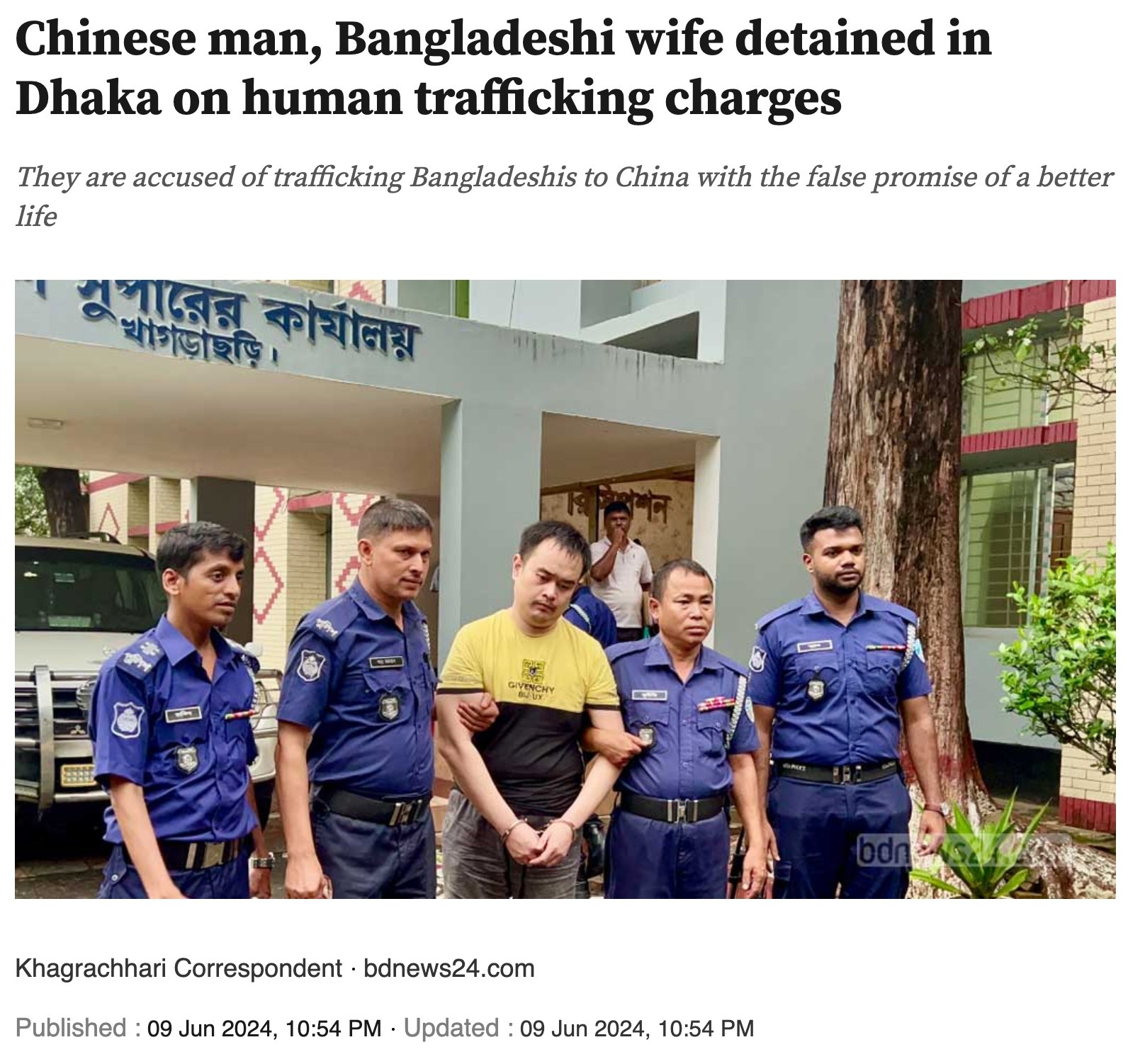
Investigations revealed that Iqbal Hossain, a Muslim man with psychological issues, had placed the Quran in the Hindu temple. However, the inflammatory post incited violence that continued beyond the Durga celebrations. Over 100 people were injured, at least six were killed, and mobs of up to 500 people attacked 80 Hindu temples. Additionally, 66 homes were vandalised, and 22 were set on fire by 19 October 2021.

Unabated Persecution of the Hindu Community In Bangladesh

In the lead-up to the Bangladesh elections, the Hindu community faced increasing political persecution. Many Hindu families in Shailkupa Upazila, Khulna Division, were forced to leave their homes and sell them at low prices to escape religious persecution.

According to a report by Kalbela News, the minority community was subjected to persecution threats from Islamist groups, leading many Hindu families to migrate to other parts of the country. Over the past few years, there have been reports of more than 1,000 attacks on temples and Hindu homes, as well as thousands of sexual assaults on Hindu women.

Bangladesh Hindu Population

The Hindu population in Bangladesh has experienced a steady decline over the years, falling from 28% in 1940 to 8.96% in 2011. This decline includes two significant periods: the first around the time of partition and the second during the 1971 Bangladesh War, which led to the country’s liberation.

Despite Bangladesh’s overall population more than doubling over the past 50 years, the number of Hindus has decreased by approximately 7.5 million (75 lakh). In contrast, the numbers of Buddhists, Christians, and individuals of other religions have remained relatively stable.

Violence Against Hindus In 2024

Approximately 500 people have died in violent protests related to quota demands, with the majority being Hindus. These protests are also being used as an excuse for Hindu persecution.

Anti-government demonstrators marched to Dhaka and stormed the Prime Minister’s palace, resulting in a weekend of violence that left dozens dead. In response, the military imposed an indefinite curfew, and authorities cut off internet access to curb the unrest.

In Bangladesh, Muslim mobs have caused significant havoc for minority Hindus. Reports from 27 districts indicate widespread minority persecution attacks, including the burning of Hindu homes, looting of shops, and vandalism of temples.

The protests, which began in July with students opposing a controversial quota system for government jobs, have attracted hundreds of thousands. The situation turned violent on July 16 when clashes erupted between protesters, security officials, and pro-government activists. The Supreme Court intervened to reverse the decision, but renewed anti-government demonstrations continued through the weekend, sparking further violence.

The ongoing protests have become a significant crisis for Prime Minister Sheikh Hasina, ending her 15-year rule. On 5 August 2024, fearing for her safety, Hasina fled the country on an Air Force jet and resides in India.

Following her departure, on 6 August 2024, separate Dhaka Metropolitan Magistrate Courts granted bail to 2,200 members of the Bangladesh Nationalist Party (BNP) and the banned Jamaat-e-Islami. These individuals had been jailed due to the recent turmoil over the quota reform movement.

BNP standing committee members Amir Khasru Mahmud Chowdhury, Nazrul Islam Khan, Senior Joint Secretary General Ruhul Kabir Rizvi, Shamsur Rahman alias Shimul Biswas, Saiful Alam Nirob, Rafikul Alam Maznu, Jamaat Secretary General Mia Golam Parwar, and Bangladesh Jatiya Party Chairman Andaleev Rahman Partho were among those granted bail.

Other released inmates include members of the banned Islamist group Jamaat-e-Islami Bangladesh, which has been causing chaos on the streets following Sheikh Hasina’s ouster and targeting minority communities, particularly Hindus.

Since Sheikh Hasina’s fall, Jamaat-e-Islami members have been compiling lists of Hindu businesses and homes for persecution. Hindus, fearing for their safety, have reported that many are unable to relocate due to the presence of armed Jamaat-e-Islami and other Islamist groups patrolling the streets.

Jamaat-e-Islami, an Islamist organisation inspired by the Muslim Brotherhood, was founded in 1941 by theorist Syed Abul Ala Maududi in British India. After the partition of India, the organisation evolved into Jamaat-e-Islami Hind, Jamaat-e-Islami Pakistan, Jamaat-e-Islami Bangladesh, and Jamaat-e-Islami Kashmir.

The historical and ongoing pattern of persecution of the Hindu community in Bangladesh is a deeply troubling chapter in India’s neighbourhood. The persistent violence, persecution, discrimination, and displacement of these Hindus are a stark reminder of the fragility of Hindu lives in such countries that don’t curb the radical Islamist’s hatred for non-Muslims.

Subscribe to our channels on TelegramWhatsApp, and Instagram and get the best stories of the day delivered to you personally.