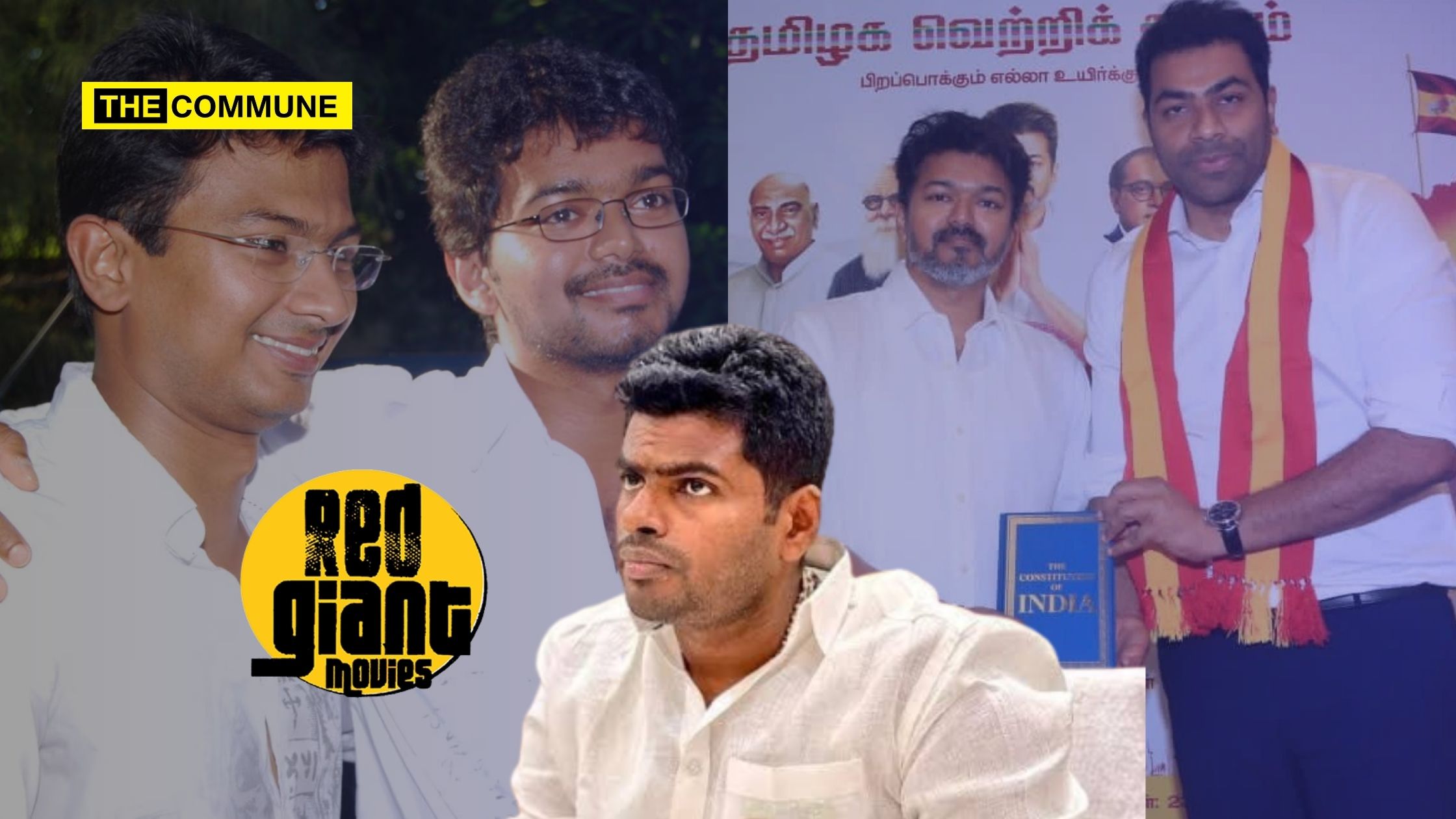
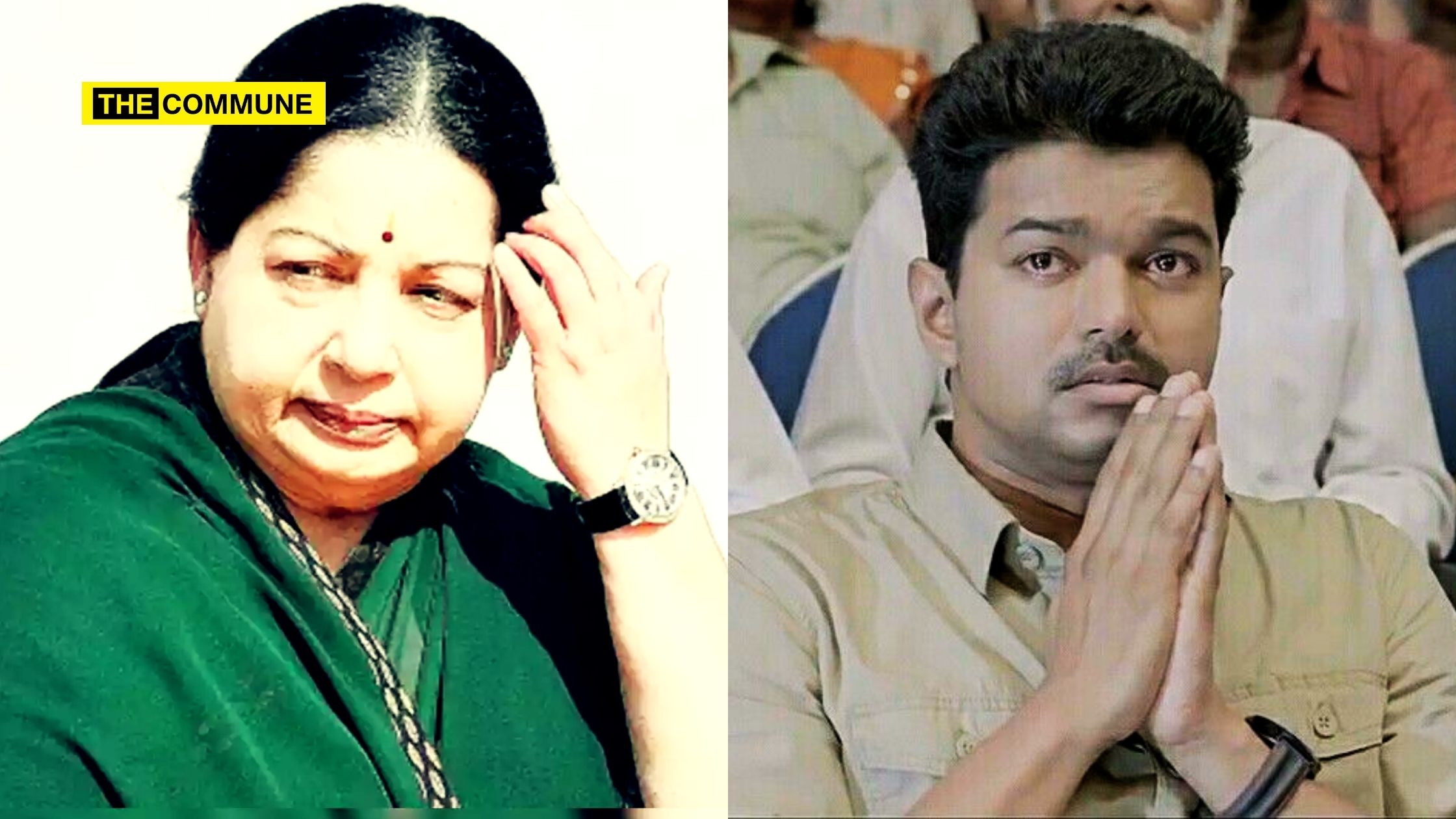
Tamil Nadu BJP president K Annamalai had earlier launched a scathing attack on actor-turned-politician Vijay, accusing his party, Tamizhaga Vetri Kazhagam (TVK), of being a “B-team” of the ruling DMK. He alleged that TVK was a covert project designed to help the DMK retain power in the state.
Addressing reporters, Annamalai criticized Vijay for not engaging in active politics and instead opting for a “work-from-home” approach. He also mocked the actor’s on-screen portrayals, stating,“While Vijay acts with women on screen, BJP workers are on the ground, fighting for public welfare.”
“DMK’s B-team is Vijay, and I assert this. After seeing TVK’s activities, I can say with certainty that TVK is the DMK’s secret project to retain power in 2026,”Annamalai claimed. He further questioned Vijay’s stance on the state-run liquor retailer TASMAC, saying,“You smoke and drink on screen. What right do you have to talk about TASMAC?”
TVK Hits Back, Accuses BJP Of Diverting DMK Issues
A few days earlier, at TVK’s General Body Meeting, party General Secretary (Election Campaign Management) Aadhav Arjuna launched a blistering attack on the DMK and its allies while also cautioning AIADMK against aligning with the BJP.
Arjuna likened the DMK’s political strategies to those of a Nazi regime, accusing the ruling party of fueling the BJP’s growth by constantly positioning Annamalai as its main opponent.“They create an enemy in Annamalai. Every day, Annamalai screams, and they reply. But this only helps the BJP grow,”he said.
Arjuna also claimed that DMK had deliberately elevated Annamalai to divert attention.“When the tiger is sleeping quietly, a goat jumps for attention. This is the narrative employed by the BJP from the Centre. DMK has made Annamalai their ‘setting’ to distract the public,”he alleged.
He further argued that DMK’s opposition to the BJP was a mere vote-bank strategy, orchestrated to cement a political succession plan for Udhayanidhi Stalin.“DMK is creating a setting in Delhi to make Stalin’s son the next Chief Minister,”Arjuna claimed.
Annamalai Counters TVK’s Allegations
In response to Arjuna’s remarks, Annamalai released a video hitting back at Vijay and TVK. He accused the actor of having longstanding ties with DMK through Red Giant Movies, the production house owned by Udhayanidhi Stalin.
Annamalai said,“Vijay must understand something. Red Giant Movies’ inauguration was done by Vijay himself – through his film Kuruvi. Be it Beast or any other film, it was Red Giant that managed both the production and distribution of these films. I am saying this based on evidence. If someone is accusing us (Bharatiya Janata Party), Vijay must ask himself this question – Who was the one who introduced Red Giant Movies to TN via the film Kuruvi? Today, the media industry is under the control of one person, under the dominance of Udhayanidhi Stalin, who was the one who performed the inauguration for Red Giant.”
He further alleged that a former DMK member (Aadhav Arjuna), now part of TVK, had misused lottery money while shifting political allegiances.“Today some people from the TVK are speaking about us. There was a person who is now in TVK. Earlier he was in DMK, he worked for them using lottery money. He then jumped ship to VCK with the same lottery money. Today he has moved from VCK to TVK. His goal is to convert Tamizhaga Vetri Kazhagam into Lottery Virpanai Kazhagam (Lottery Sales Party). And today, these people are accusing me,” Annamalai said.
The war of words between Annamalai and TVK signals the growing political heat in Tamil Nadu as parties position themselves ahead of the 2026 Assembly elections.
Subscribe to our channels on Telegram, WhatsApp, and Instagram and get the best stories of the day delivered to you personally.
After exposing the theatrics of the ruling DMK government’s latest attempt to blame the BJP-led Central Government for reducing MGNREGA funds, on 29 March 2025, Tamil Nadu BJP President K Annamalai raised critical questions to Chief Minister MK Stalin, asked when the CM would fulfill his election promise of providing 100 to 150 days of work to the people and whether he would authorize a CBI investigation into the widespread corruption in the MGNREGA scheme in Tamil Nadu, citing irregularities in a panchayat in Erode district as an example.
On 30 March 2025, Annamalai took to his official X account to urge Chief Minister MK Stalin to respond to the following questions, asking, “Tamil Nadu CM Thiru @mkstalin should answer the following questions.
Tamil Nadu has received a historically high allocation of ₹39,339 Crores from our Central Government under the able leadership of our Hon PM Thiru @narendramodi avl in the last four years under the MGNREGA Scheme. Thiru @mkstalin, since you’ve now been caught in the web of irregularities in the scheme’s execution, would you issue consent to the CBI to investigate the rampant corruption in the scheme in Tamil Nadu? We have given one sample village for the people to understand the magnitude of this corruption.
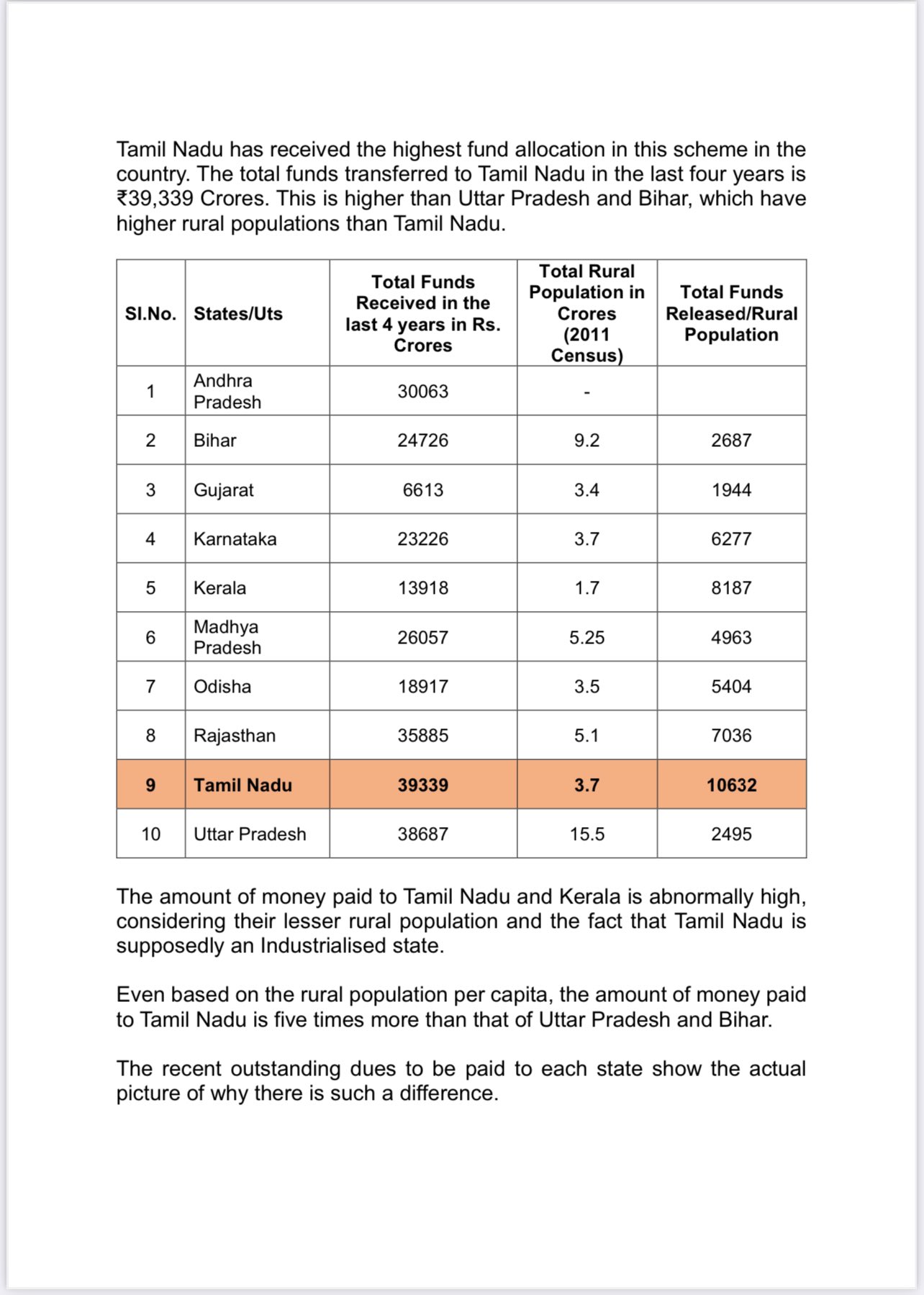
Are you aware that the states with three times or five times more rural populations have received lesser funds than Tamil Nadu under the MGNREGA scheme?
When do you plan to fulfill the poll promise of increasing the MGNREGA workdays from 100 to 150? Thiru @mkstalin, your party has looted funds that were meant for our hardworking people. DMK is not just corrupt; it is conniving, cruel, divisive and corrupt.
MGNREGA irregularity in one panchayat in Erode District in Tamil Nadu.”
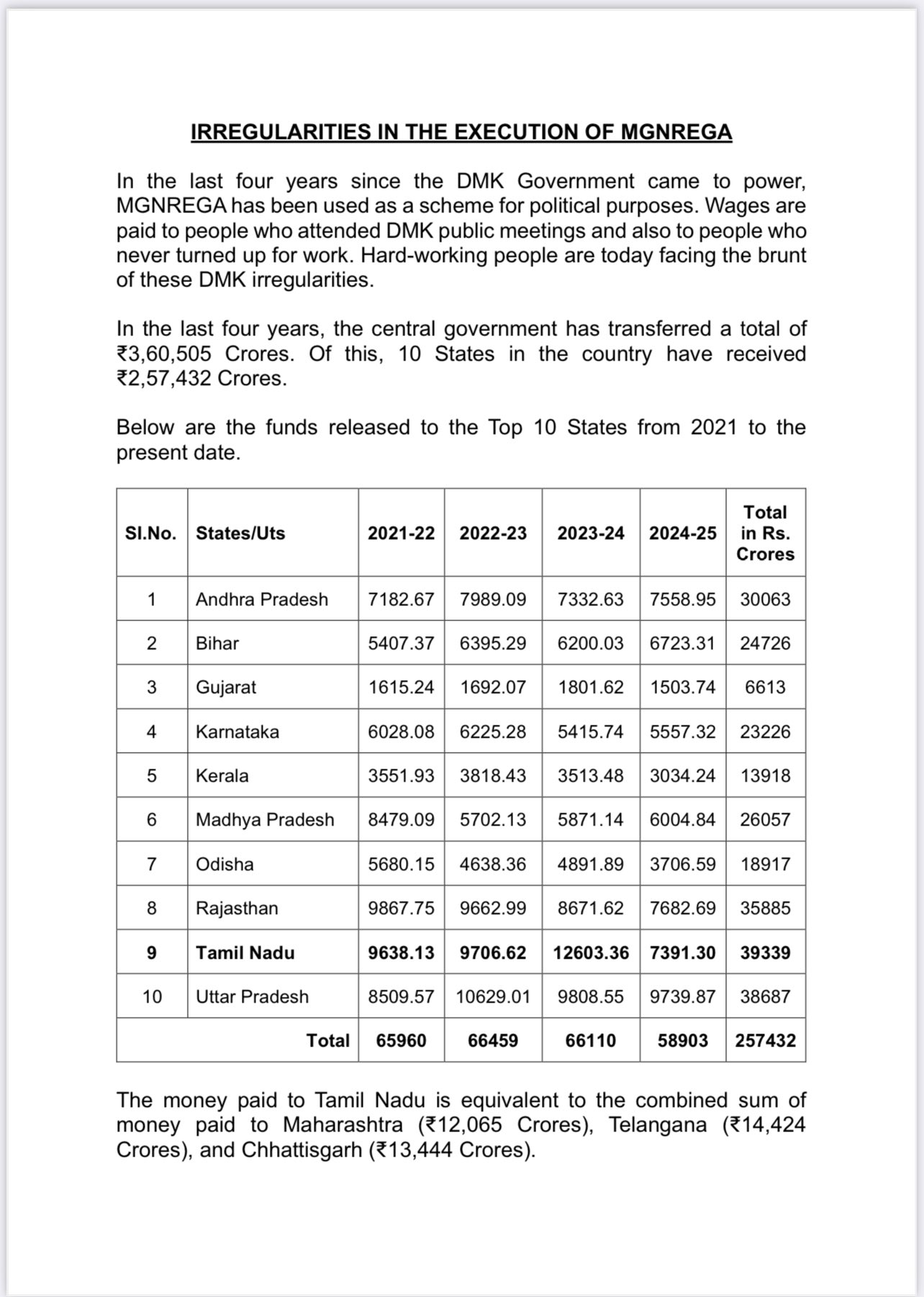
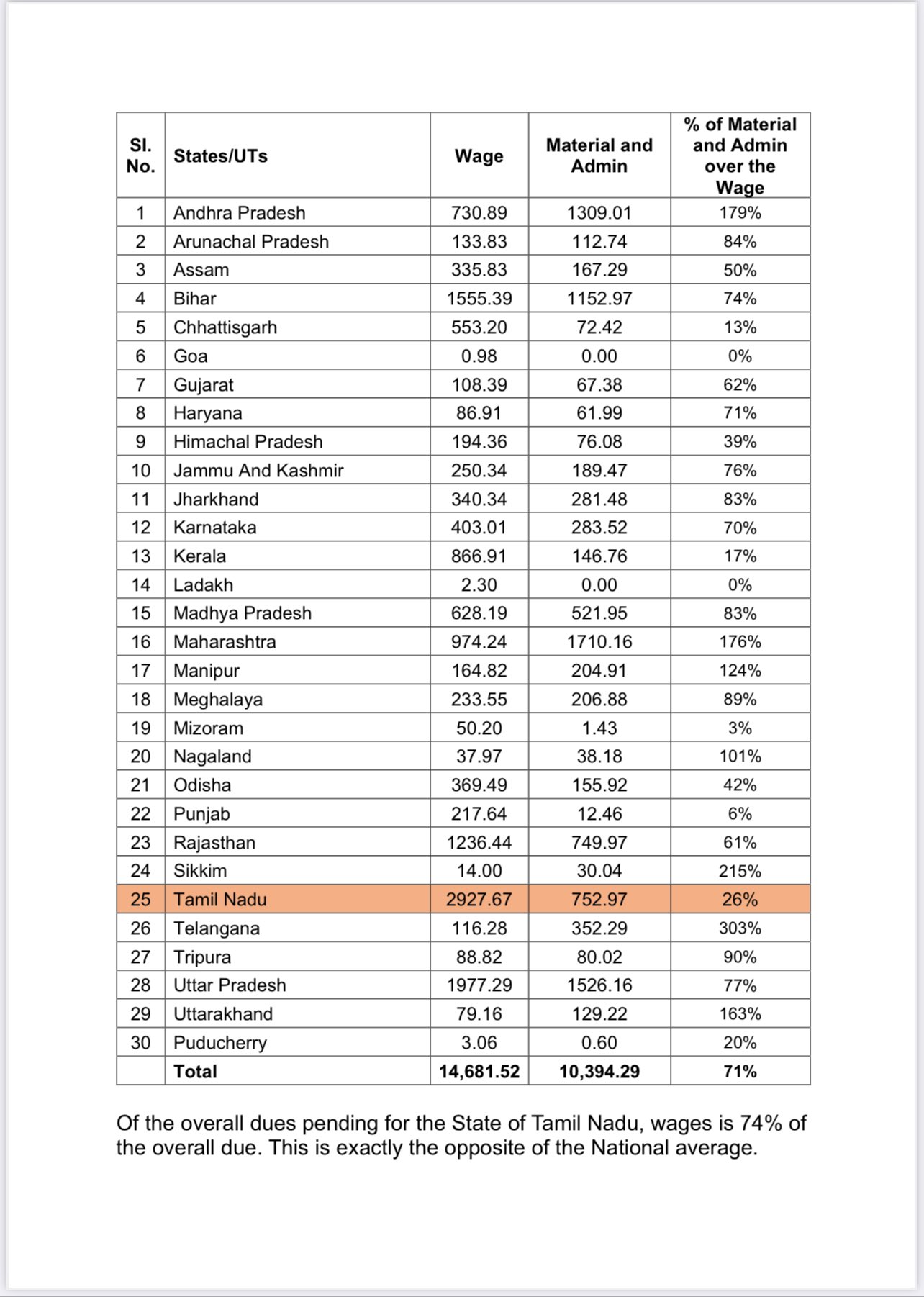
The attached document titled “Irregularities in the execution of MGNREGA” states, “In the last four years since the DMK Government came to power, MGNREGA has been used as a scheme for political purposes. Wages are paid to people who attended DMK public meetings and also to people who never turned up for work. Hard-working people are today facing the brunt of these DMK irregularities. In the last four years, the central government has transferred a total of 3,60,505 Crores. Of this, 10 States in the country have received 2,57,432 Crores. The money paid to Tamil Nadu is equivalent to the combined sum of money paid to Maharashtra (12,065 Crores), Telangana (14,424 Crores), and Chhattisgarh (13,444 Crores). Tamil Nadu has received the highest fund allocation in this scheme in the country. The total funds transferred to Tamil Nadu in the last four years is 39,339 Crores. This is higher than Uttar Pradesh and Bihar, which have higher rural populations than Tamil Nadu. The amount of money paid to Tamil Nadu and Kerala is abnormally high, considering their lesser rural population and the fact that Tamil Nadu is supposedly an Industrialised state. Even based on the rural population per capita, the amount of money paid to Tamil Nadu is five times more than that of Uttar Pradesh and Bihar. The recent outstanding dues to be paid to each state show the actual picture of why there is such a difference. Of the overall dues pending for the State of Tamil Nadu, wages is 74% of the overall due. This is exactly the opposite of the National average”
MGNREGA Irregularities Reported in a Panchayat in Erode District, Tamil Nadu
The document details serious irregularities in the implementation of the Mahatma Gandhi National Rural Employment Guarantee Act (MGNREGA) in a panchayat in Erode District, Tamil Nadu, involving Project Coordinator V. Ganesan and his accomplices. The allegations claim that they manipulated attendance records to create fake worker attendance, thereby embezzling lakhs of rupees.
Irregularities in Attendance Records
The following instances highlight the misuse of attendance registers:
07.09.2023: V. Ganesan marked himself as on duty during working hours while actually attending a political party-affiliated district agricultural workers’ union meeting in Trichy.
11.01.2024: He falsely recorded his attendance as being on duty while attending a Pongal gift distribution event in the Gopi assembly constituency alongside a political party’s union secretary.
08.02.2024: He marked himself present during working hours while participating in a welfare scheme distribution ceremony in Erode.
10.02.2024: He registered his presence as being on duty during a political party’s election manifesto preparation meeting in Avinashi.
08.03.2024: He falsely recorded his attendance during working hours while attending a political event in Chennai with the union secretary.
Formal Complaints and Government Response
On 15 March 2024, a formal complaint was lodged with the Gopichettipalayam Block Development Officer, supported by relevant evidence. Subsequently, complaints were also filed with the Election Commission of India and the District Collector on 20 March 2024, highlighting the misuse of a government job for political campaigning. The complaints were registered under Complaint Nos.: 778571, 778548, and 778588.
Following the investigation, the District Collector ordered legal action against V. Ganesan. The Block Development Officer interrogated him, after which V. Ganesan resigned from his government position on 12 March 2024. However, no legal action was pursued against him, with government officials citing his resignation as the reason for the lack of further action.
Complicity and Embezzlement
The complainant alleges that higher government officials may have been complicit in allowing V. Ganesan to escape accountability. Despite clear evidence of irregularities and embezzlement of significant funds, no recovery was made, and no legal proceedings were initiated against him.
The complainant has urged for a thorough investigation into the matter, requesting accountability not only for V. Ganesan but also for senior government officials who allegedly failed to take appropriate action. The investigation should also address the recovery of the embezzled funds.
Embezzlement Case: Involvement of Project Coordinator V. Ganesan and his Accomplices in Falsifying Attendance Records to Misappropriate Lakhs of Rupees. The details of the irregularity are outlined below.
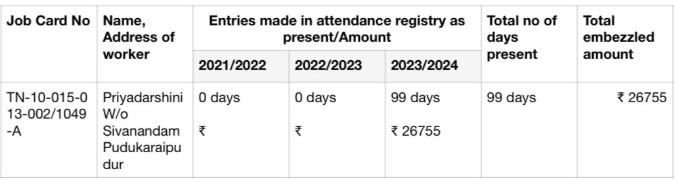
In Embezzlement Case 1, one of the workers named Priyadarshini, wife of Sivanandam from Pudukaraipur. According to the records, Priyadarshini had zero actual working days in both the 2021/2022 and 2022/2023 periods, yet a total of 99 fake working days were registered in the 2023/2024 period. This fraudulent activity led to the embezzlement of ₹26,755. The manipulation of attendance registers was not an isolated incident, but part of a larger scheme designed to siphon off government funds through fake entries and ghost workers.
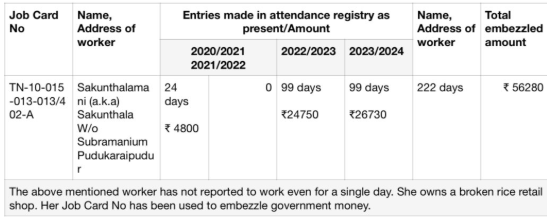
Embezzlement Case 2, involves a worker named Sakunthalamani, also known as Sakunthala, wife of Subramanium from Pudukaraipurudur. It is alleged that the worker never reported to work even a single day yet records falsely show 24 days of work in the 2020/2021 period, earning ₹4,800, and zero working days in 2021/2022. In 2022/2023, she was falsely credited with 99 days of work, earning ₹24,750, and again 99 days of work in 2023/2024, totaling ₹26,730. This fraudulent activity resulted in the embezzlement of ₹56,280. Interestingly, Sakunthala owns a broken rice retail shop, which raises questions about the legitimacy of her registration under the MGNREGA scheme. This case highlights how government funds were siphoned off using fake entries, exploiting the system’s vulnerabilities.
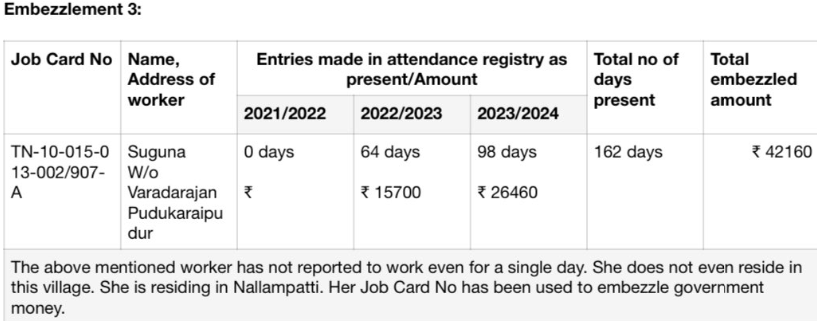
Embezzlement Case 3 involves Suguna, the wife of Varadarajan from Pudukaraipurudur, who was falsely recorded as present for 64 days in 2022/2023 and 98 days in 2023/2024, totaling 162 fake working days. Notably, Suguna did not report to work even once and resides in Nallampatti, far from the village where her job card was registered. This led to an embezzlement of ₹42,160. The fraudulent claim raises concerns about the misuse of the scheme to divert funds meant for genuine rural workers.
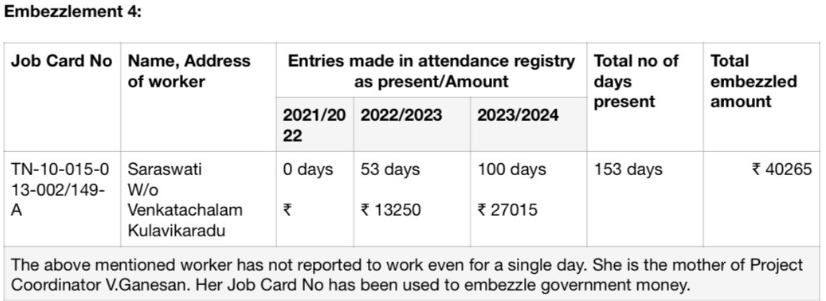
Embezzlement Case 4 involves Saraswati, the wife of Venkatachalam from Kulavikaradu, was listed as present for 53 days in 2022/2023 and 100 days in 2023/2024, accumulating a total of 153 fake working days. Saraswati never reported to work at all, and her connection to the Project Coordinator V. Ganesan as his mother—raises serious questions. This fraudulent activity resulted in the embezzlement of ₹40,265, highlighting the potential for conflicts of interest within the administrative framework overseeing MGNREGA.
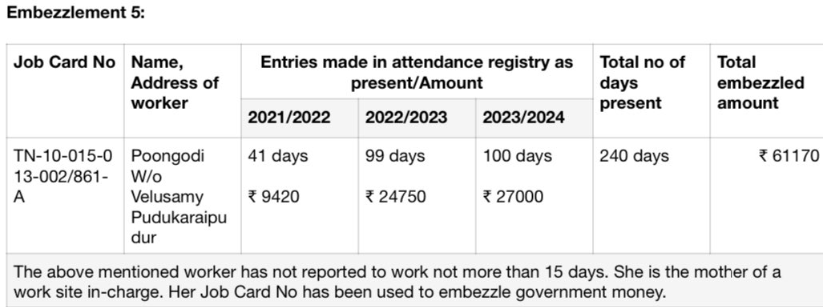
In Embezzlement Case 5, Poongodi, wife of Velusamy from Pudukaraipurudur, has been falsely credited with a total of 240 working days across the years 2022/2023, 2023/2024, and 2024/2025, amounting to an embezzled sum of ₹61,170. Records show 41 days in 2022/2023, 99 days in 2023/2024, and 100 days in 2024/2025, despite Poongodi having reported to work for no more than 15 days in reality. Notably, she is the mother of a worksite in-charge and her job card was exploited to siphon off government funds.
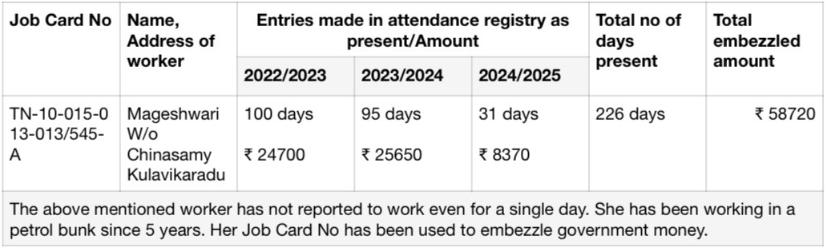
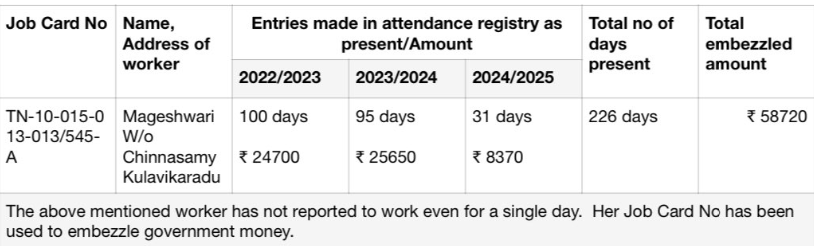
In Embezzlement Case 6, Mageshwari, wife of Chinasamy from Kulavikaradu, was fraudulently recorded with 226 working days over the years 2022/2023, 2023/2024, and 2024/2025, leading to an embezzlement of ₹58,720. The records falsely claim 100 days in 2022/2023, 95 days in 2023/2024, and 31 days in 2024/2025. In reality, Mageshwari has not reported for any work under the MGNREGA scheme as she has been employed at a petrol bunk for the past five years. Her job card was misused to channel government funds for personal gain.
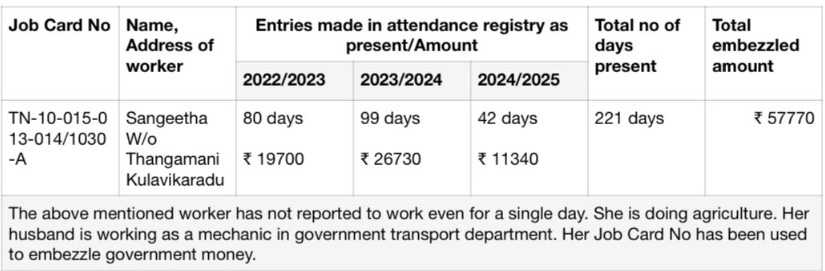
In Embezzlement Case 7, Sangeetha, wife of Thangamani from Kulavikaradu, was fraudulently credited with a total of 221 working days between 2022/2023 and 2024/2025, amounting to an embezzled sum of ₹57,770. The attendance records show 80 days in 2022/2023, 99 days in 2023/2024, and 42 days in 2024/2025. However, Sangeetha has never reported to work under the MGNREGA scheme as she is engaged in agriculture, and her husband works as a mechanic in the government transport department. Her job card was illicitly used to divert government funds.
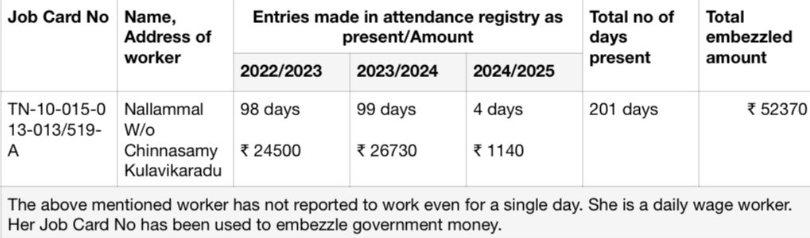
In the case of Embezzlement 8, it was found that Nallammal, wife of Chinnasamy from Kulavikaradu, had her job card (No. TN-10-015-0 13-013/519-A) used to falsely record attendance for a total of 201 days across three financial years—98 days in 2022/2023, 99 days in 2023/2024, and 4 days in 2024/2025. Despite these fraudulent entries, she never reported to work even a single day. Nallammal, identified as a daily wage worker, had her job card exploited to embezzle ₹52,370 from government funds.
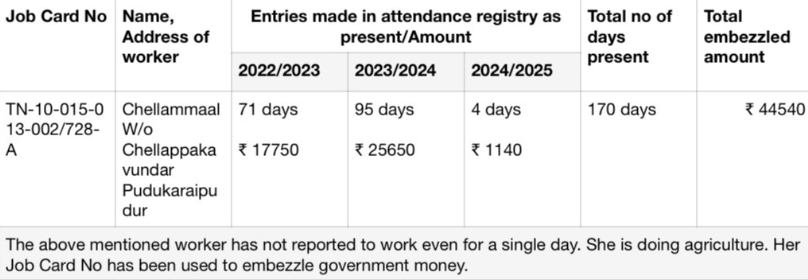
Similarly, in Embezzlement 9, Chellammaal, wife of Chellappaka Vundar from Pudukaraipurudur, was found to have her job card (No. TN-10-015-0 13-002/728-A) used to record 170 fake working days over three years—71 days in 2022/2023, 95 days in 2023/2024, and 4 days in 2024/2025. Chellammaal has never reported to work and is engaged in agriculture. The fraudulent entries resulted in an embezzlement of ₹44,540.
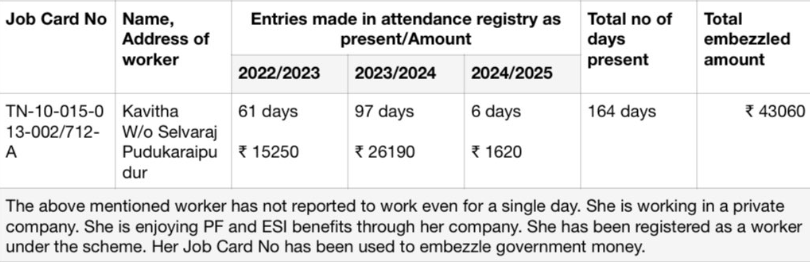
In Embezzlement 10, Kavitha, wife of Selvaraj from Pudukaraipurudur, had her job card (No. TN-10-015-0 13-002/712-A) used to falsely claim 164 days of work across three years—61 days in 2022/2023, 97 days in 2023/2024, and 6 days in 2024/2025. Interestingly, Kavitha has not worked even a single day under the MGNREGA scheme as she is employed in a private company and receives PF and ESI benefits through her employer. Her job card was misused to embezzle ₹43,060 in government funds.
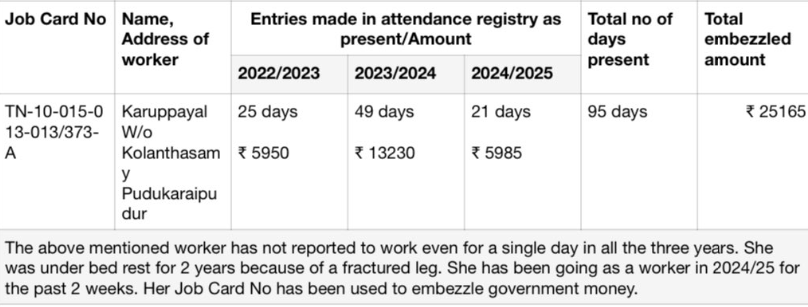
In Embezzlement Case 11, Karuppayal, wife of Kolanthasamy with job card number TN-10-015-0 13-013/373-A, had her attendance falsely recorded for a total of 95 days across three financial years—25 days in 2022/2023, 49 days in 2023/2024, and 21 days in 2024/2025. Despite these fraudulent entries, she never reported to work even a single day. Notably, Karuppayal was on bed rest for two years due to a fractured leg and has only been attending work for the past two weeks in 2024/2025. Her job card was exploited to embezzle ₹25,165 from government funds.
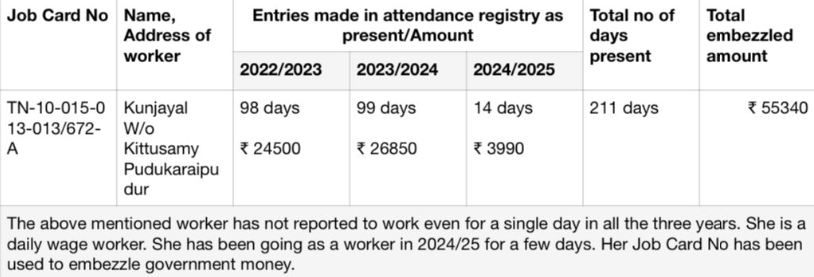
In Embezzlement Case 12, Kunjayal, wife of Kittusamy with job card number TN-10-015-0 13-013/672-A, was falsely credited with 211 days of work over three years—98 days in 2022/2023, 99 days in 2023/2024, and 14 days in 2024/2025. However, she never reported to work even a single day. Kunjayal, identified as a daily wage worker, has only been attending work for a few days in 2024/2025. Her job card was misused to embezzle ₹55,340 from government resources.
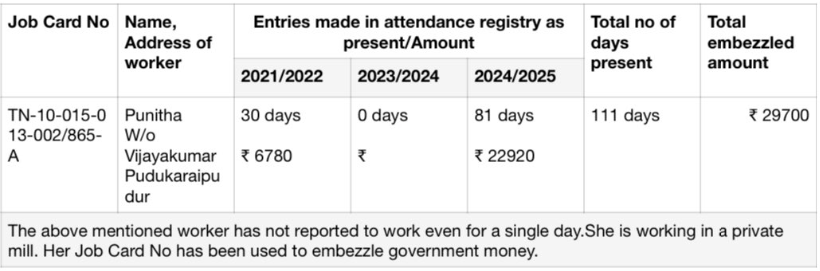
In Embezzlement Case 13, Punitha, wife of an unidentified individual with job card number TN-10-015-0 13-002/865-A, had her attendance falsely recorded for a total of 111 days across three years—30 days in 2021/2022, 0 days in 2023/2024, and 81 days in 2024/2025. Punitha never reported to work, as she is employed in a private mill. Her job card was fraudulently used to embezzle ₹29,700 in government funds.
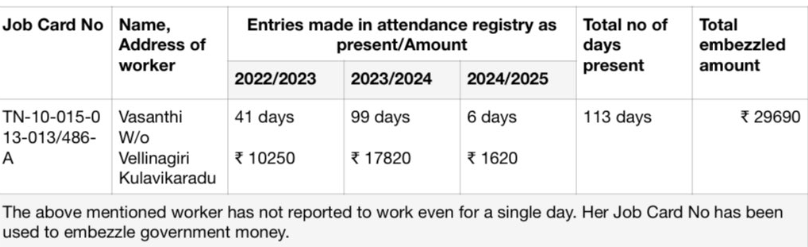
In Embezzlement Case 14, Vasanthi, wife of Vellinagiri from Kulavikaradu, was fraudulently credited with 113 days of work across two financial years—41 days in 2022/2023, 99 days in 2023/2024 and 6 days in 2024/2025. Despite these entries, she never reported to work even a single day. Her job card was misused to embezzle a total of ₹29,690 from government funds.
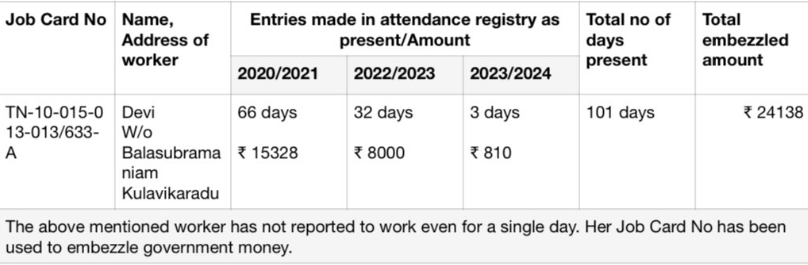
In Embezzlement Case 15, Devi, wife of Balasubramaniam from Kulavikaradu, had her attendance falsely recorded for 101 days over three years—66 days in 2020/2021, 32 days in 2022/2023, and 3 days in 2023/2024. However, she did not report to work on any of these days. Her job card, TN-10-015-0 13-013/633-A, was exploited to embezzle ₹24,138 from government resources.
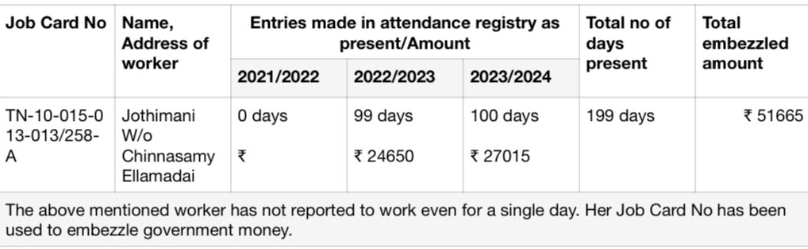
In Embezzlement Case 16, Jothimani, wife of Chinnasamy from Ellamadai, was falsely credited with 199 days of work across three years—0 days in 2021/2022, 99 days in 2022/2023, and 100 days in 2023/2024. Despite these records, she never reported to work. Her job card, TN-10-015-0 13-013/258-A, was used to embezzle ₹51,665 from the government’s funds.
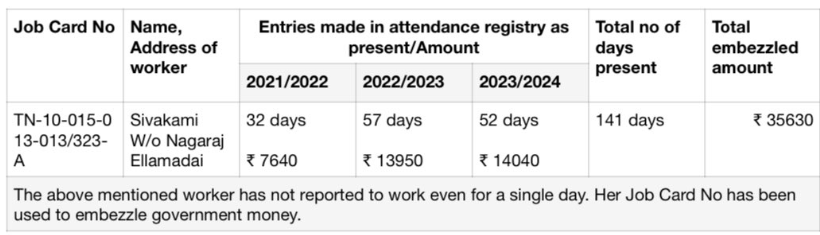
In Embezzlement Case 17, Sivakami, wife of Nagaraj from Ellamadai, was falsely credited with 141 days of work across three financial years—32 days in 2021/2022, 57 days in 2022/2023, and 52 days in 2023/2024. Despite these entries, she never reported to work even a single day. Her job card, TN-10-015-0 13-013/323-A, was exploited to embezzle a total of ₹35,630 from government funds.
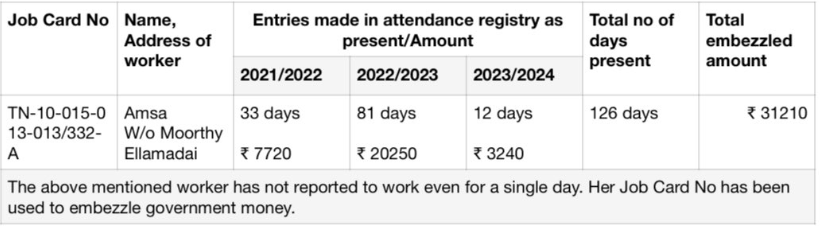
In Embezzlement Case 18, Amsa, wife of Moorthy from Ellamadai, had her attendance fraudulently recorded for 126 days—33 days in 2021/2022, 81 days in 2022/2023, and 12 days in 2023/2024. However, she did not report to work during any of these days. Her job card, TN-10-015-0 A 13-013/332-A, was used to siphon off ₹31,210 from government resources.
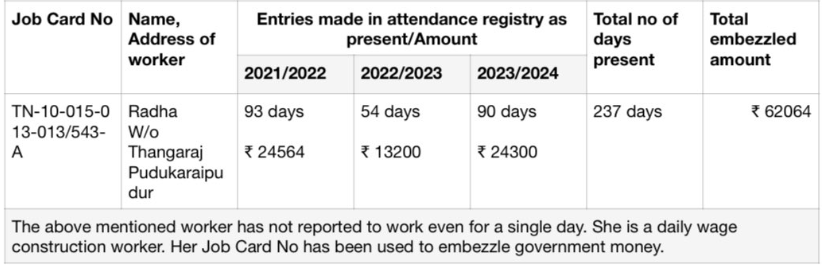
In Embezzlement Case 19, Radha, wife of Thangaraj from Pudukaraipurudur, was falsely credited with 237 days of work over three years—93 days in 2021/2022, 54 days in 2022/2023, and 90 days in 2023/2024. She has not reported to work even once, despite being registered under the MGNREGA scheme. Her job card, TN-10-015-0 13-013/543-A, was misused to embezzle ₹62,064 from government funds.
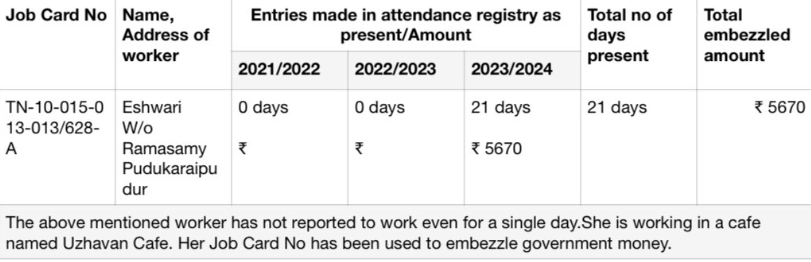
In Embezzlement Case 20, Eshwari, wife of Ramasamy from Pudukaraipurudur, was falsely recorded as present for 21 days over three financial years—0 days in 2021/2022, 0 days in 2022/2023, and 21 days in 2023/2024. Despite these entries, she never reported to work even a single day. Interestingly, she is employed at Uzhavan Cafe, which raises questions about the legitimacy of her registration under the MGNREGA scheme. Her job card, TN-10-015-0 13-013/628-A, was manipulated to embezzle ₹5,670 from government funds.
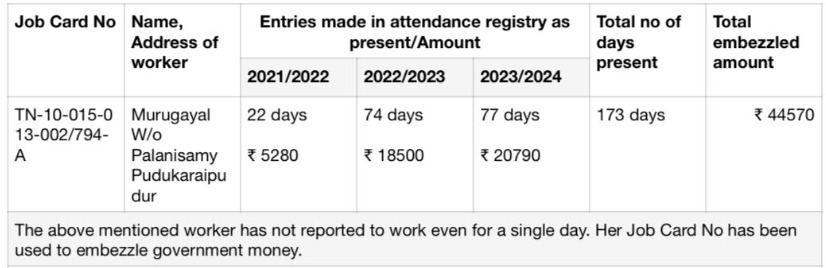
In Embezzlement Case 21, Murugayal, wife of Palanisamy from Pudukaraipurudur, was credited with 173 days of work—22 days in 2021/2022, 74 days in 2022/2023, and 77 days in 2023/2024—despite not having reported to work even once. Her job card, TN-10-015-0 13-002/794-A, was used to siphon off ₹44,570 in total government funds through fraudulent attendance records.
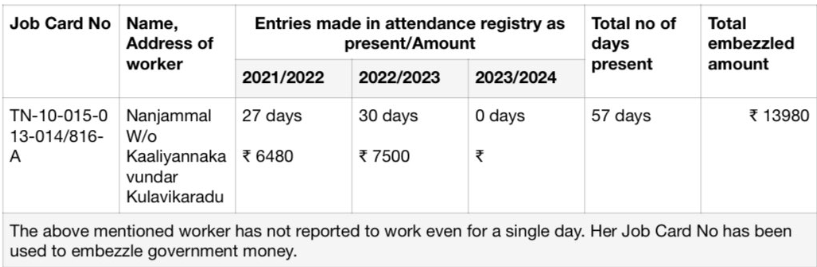
In Embezzlement Case 22, Nanjammal, wife of Kaaliyannakavundar from Kulavikaradu, was credited with 57 days of work—had her attendance falsely recorded for 27 days in 2021/2022, 30 days in 2022/2023, and 0 days in 2023/2024, despite never reporting to work. Her job card, TN-10-015-0 13-014/816-A, was manipulated to embezzle ₹13,980 from government resources.
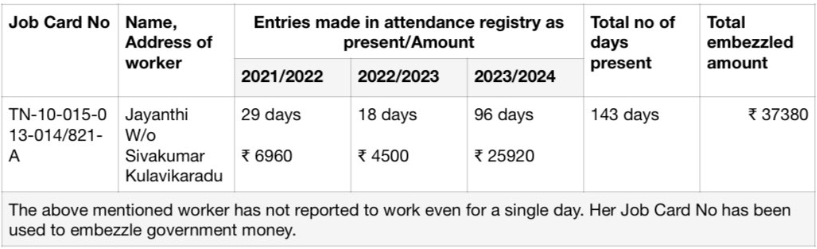
In Embezzlement Case 23, Jayanthi, wife of Sivakumar from Kulavikaradu, was falsely recorded as present for 143 days over three financial years—29 days in 2021/2022, 18 days in 2022/2023, and 96 days in 2023/2024—despite never reporting to work. Her job card, TN-10-015-0 13-014/821-A, was manipulated to embezzle ₹37,380 from government funds.
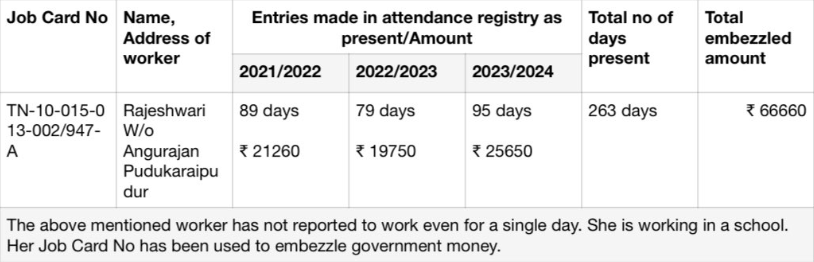
In Embezzlement Case 24, Rajeshwari, wife of Angurajan from Pudukaraipurudur, had her attendance fraudulently marked for 263 days—89 days in 2021/2022, 79 days in 2022/2023, and 95 days in 2023/2024—without ever reporting to work. She is employed at a school, which raises concerns about the misuse of MGNREGA job cards. Her job card, TN-10-015-0 13-002/947-A, was used to embezzle a total of ₹66,660.
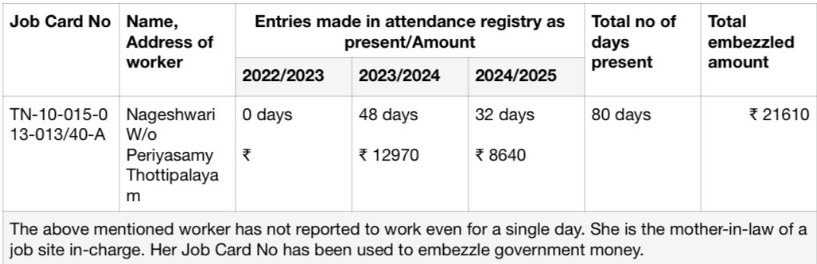
In Embezzlement Case 25, Nageshwari, wife of Periyasamy from Thottipalayam, was falsely credited with 80 days of work—0 days in 2022/2023, 48 days in 2023/2024, and 32 days in 2024/2025—despite not reporting to work at all and being the mother-in-law of a job site in-charge, her job card, TN-10-015-0 13-013/40-A, was manipulated to embezzle ₹21,610 from government resources.
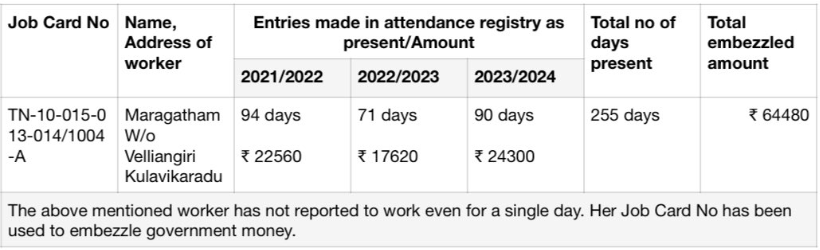
In Embezzlement Case 26, Maragatham, wife of Velliangiri from Kulavikaradu, was falsely marked present for 255 days across three financial years—94 days in 2021/2022, 71 days in 2022/2023, and 90 days in 2023/2024—despite never reporting to work. Her job card, TN-10-015-0 13-014/1004-A, was manipulated to embezzle a total of ₹64,480 from government funds.
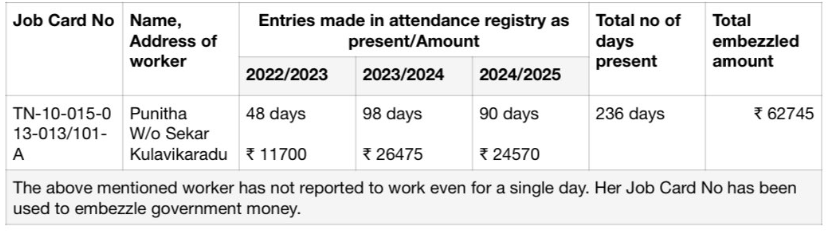
In Embezzlement Case 27, Punitha, wife of Sekar from Kulavikaradu, had her attendance fraudulently recorded for 236 days—48 days in 2022/2023, 98 days in 2023/2024, and 90 days in 2024/2025—without ever reporting to work. Her job card, TN-10-015-0 13-013/101-A, was used to embezzle ₹62,745 from government resources.
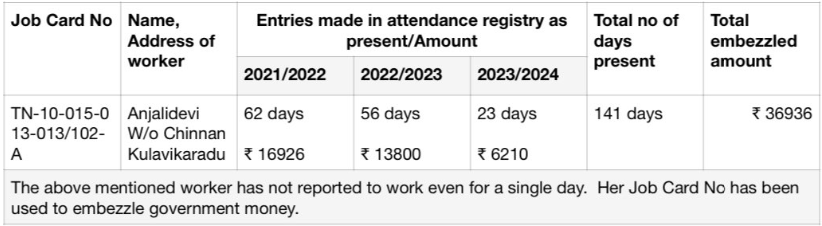
In Embezzlement Case 28, Anjalidevi, wife of Chinnan from Kulavikaradu, was falsely credited with 141 days of work—62 days in 2021/2022, 56 days in 2022/2023, and 23 days in 2023/2024—despite not reporting to work at all. Her job card, TN-10-015-0 13-013/102-A, facilitated the embezzlement of ₹36,936.
In Embezzlement Case 29, Mageshwari, wife of Chinnasamy from Kulavikaradu, was falsely recorded as present for 226 days—100 days in 2022/2023, 95 days in 2023/2024, and 31 days in 2024/2025—without reporting to work. Her job card, TN-10-015-0 13-013/545-A, was manipulated to embezzle ₹58,720 from government funds.
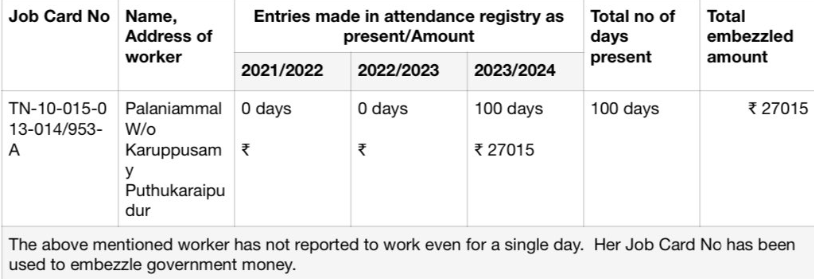
In Embezzlement Case 30, Palaniammal, wife of Karuppusamy from Puthukaraipudur, was falsely marked present for 100 days in the year 2023/2024, despite never reporting to work. Her job card, TN-10-015-0 13-014/953-A, was manipulated to embezzle ₹27,015 from government funds.
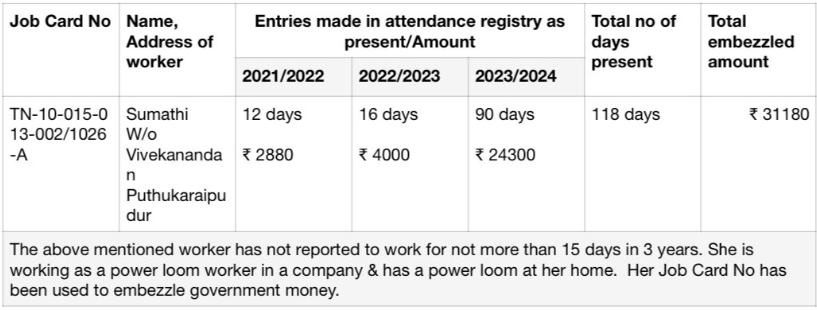
In Embezzlement Case 31, Sumathi, wife of Vivekanandan from Puthukaraipudur, was falsely credited with 118 days of work—12 days in 2021/2022, 16 days in 2022/2023, and 90 days in 2023/2024—despite not reporting to work for more than 15 days in total. She is employed as a power loom worker in a company and also operates a power loom at home. Her job card, TN-10-015-0 13-002/1026-A, was used to embezzle ₹31,180 from government resources.
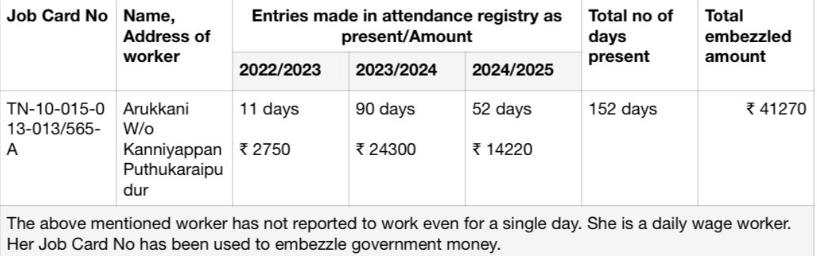
In Embezzlement Case 32, Arukkani, wife of Kanniyappan from Puthukaraipudur, was fraudulently recorded as present for 152 days—11 days in 2022/2023, 90 days in 2023/2024, and 52 days in 2024/2025—without ever reporting to work. A daily wage worker, her job card, TN-10-015-0 13-013/565-A, was manipulated to embezzle ₹41,270 from government funds.
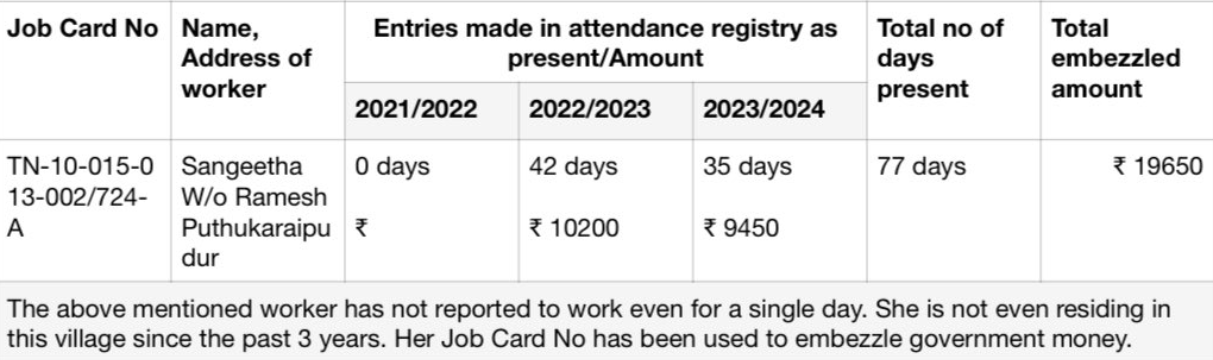
In Embezzlement Case 33, Sangeetha, wife of Ramesh from Puthukaraipudur, was falsely marked present for 77 days— 0 days in 2021/2022, 42 days in 2022/2023, and 35 days in 2023/2024—despite not reporting to work even once. She has not resided in the village for the past three years. Her job card, TN-10-015-0 13-002/724-A, was manipulated to embezzle ₹19,650 from government funds.
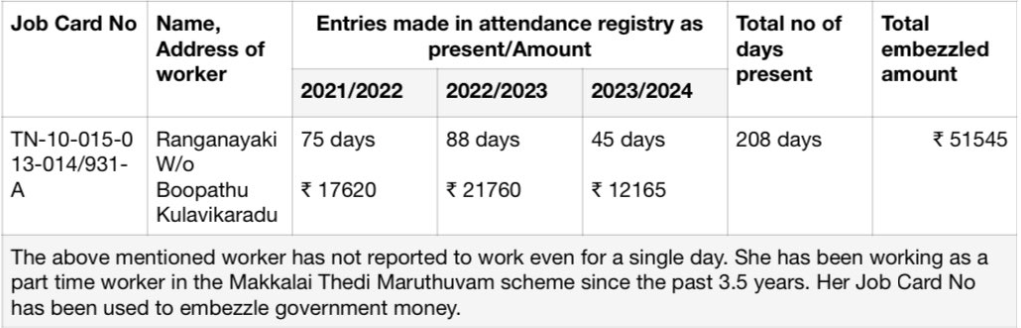
In Embezzlement Case 34, Ranganayaki, wife of Boopathu from Kulavikaradu, was fraudulently recorded as present for 208 days—75 days in 2021/2022, 88 days in 2022/2023, and 45 days in 2023/2024—without ever reporting to work. She has been employed as a part-time worker under the Makkalai Thedi Maruthuvam scheme for the past 3.5 years. Her job card, TN-10-015-0 13-014/931-A, was misused to embezzle ₹51,545 from government resources.
The preliminary investigation has uncovered a coordinated fraud under the Mahatma Gandhi National Rural Employment Guarantee Scheme (MGNREGA), involving the fabrication of attendance records for non-existent workers. This massive misappropriation of government funds, totaling ₹14,11,103 (Fourteen Lakh Eleven Thousand Hundred and Three only), was carried out with the connivance of Mr. V. Ganesan, the MGNREGA project coordinator of Gopi Panchayat, along with the then work site in-charges.
Tamil Nadu CM Thiru @mkstalin should answer the following questions.
1)Tamil Nadu has received a historically high allocation of ₹39,339 Crores from our Central Government under the able leadership of our Hon PM Thiru @narendramodi avl in the last four years under the MGNREGA… pic.twitter.com/BI9jeo6XCk
These cases highlight a recurring pattern of embezzlement through fake attendance entries, where job cards of individuals who were either inactive, working elsewhere, or unable to work due to physical constraints were manipulated to divert government funds unlawfully.
This revelation by TN BJP Chief Annamalai comes against the backdrop of the DMK’s announcement of statewide protests against the Union Government. The DMK is spearheading demonstrations across Tamil Nadu, criticizing the Union Government for withholding ₹4,304 crores owed to the state under the 100-day work guarantee scheme. Protests are being held at 1,170 locations across 850 DMK union branches, with active participation from individuals involved in the 100-day work scheme.
Chief Minister MK Stalin, through his official X account, stated, “Today, the DMK stood shoulder to shoulder with lakhs of rural #MGNREGS workers across 1,600 protest sites in Tamil Nadu, raising one thunderous question to the Union BJP Government: #WhereIsOurMoney? Denying funds meant for wages to those who toiled under the scorching sun is not just an administrative failure. It is cruelty.* The #SadistBJP Government is deliberately withholding the funds, punishing the rural poor of Tamil Nadu for rejecting them at the ballot. Release the pending Rs. 4,034 crore in #MGNREGA funds owed to us immediately. *Stop this political sadism* against the people of Tamil Nadu.”
Today, the DMK stood shoulder to shoulder with lakhs of rural #MGNREGS workers across 1,600 protest sites in Tamil Nadu, raising one thunderous question to the Union BJP Government: *#WhereIsOurMoney?*
*Denying funds meant for wages to those who toiled under the scorching sun is… pic.twitter.com/KuGcUPmtCZ
In response, Annamalai criticized the DMK for what he described as political “drama,” asserting that the people of Tamil Nadu were growing tired of the government’s antics. He pointed out that Tamil Nadu had received the highest allocation under MGNREGA, totaling ₹39,339 crores over the past four years. Despite this substantial funding, the government faced allegations of overlooking reports of fund misuse and administrative lapses. Later, Annamalai revealed widespread irregularities in the MGNREGA scheme across the state, highlighting the extent of the mismanagement.
Annamalai through his social media post, stated, “DMK Minister Thiru KKSSR Ramachandran is known for hitting women with petition when they seek solutions to their problems. Today, he sped at lightning speed after being questioned by our @BJP4TamilNadu functionary Smt Meena avl about why he called for a Gram Sabha meeting and converted it into a protest against the Central Govt demanding funds for MGNREGA. The people of TN know well that under the MGNREGA, TN has received the highest allocation of ₹39,339 Crores in our country in the last four years, and the DMK Govt has turned a blind eye towards complaints of irregularities in the scheme’s execution and the misappropriation of funds by corrupt DMK functionaries. The people of TN have had enough of DMK’s drama.”
DMK Minister Thiru KKSSR Ramachandran is known for hitting women with petition when they seek solutions to their problems.
Today, he sped at lightning speed after being questioned by our @BJP4TamilNadu functionary Smt Meena avl about why he called for a Gram Sabha meeting and… pic.twitter.com/ZSnyAIKod1
Tamil Nadu has long seen the intertwining of cinema and politics, but few leaders commanded the respect and authority of the late Chief Minister J. Jayalalithaa. One of the most telling examples of her firm leadership was how she handled actor Vijay during the Thalaivaa controversy—a moment that showcased her no-nonsense approach to keeping cinema stars in line.
Vijay Flexes His Muscles, ADMK Gave One Kick Between His Legs
In 2013, Vijay’s film Thalaivaa (directed by A.L. Vijay) was set for release with the tagline “Time to Lead.” While seemingly harmless, the phrase raised eyebrows in political circles, given Vijay’s father S.A. Chandrasekhar’sopen political ambitions for his son. The AIADMK government, under Jayalalithaa, saw this as an indirect challenge—a star testing the waters for a future political entry without due respect for the established leadership.
Prior to its scheduled release on August 9, 2013, several Chennai theaters received bomb threats from an obscure group named the Oppressed Students’ Revolutionary Union.These threats led to widespread cancellations of screenings across Tamil Nadu.The Times of India reported that the film’s release was stalled due to these threats, with theaters opting out of screening the movie.
When anonymous threats disrupted the film’s release, the state refused to provide security, sending a clear message: No one, not even a top star, could operate outside the system.
Jayalalithaa’s Firm Hand: Discipline Over Drama
Rather than allowing Vijay to play the victim, Jayalalithaa ensured he understood the consequences of overreach. When he arrived unannounced at her Kodanad retreat seeking intervention, she denied him an audience, putting him in his place.
Vijay, realizing his mistake, issued a public video appeal, respectfully addressing her as “Amma” and acknowledging her leadership. His tone was far from defiant—it was corrective.
“I have always admired Amma’s straightforwardness… I request her to do whatever is necessary,“he said, accepting the need to fall in line.
The Great Turnaround: Vijay’s Strategic Surrender
If Thalaivaa marked Vijay’s ‘punishment‘, what followed was his calculated path to redemption. His career, which had faced roadblocks under the DMK’s reign, took a dramatic turn once he publicly aligned with Jayalalithaa. He refrained from making political statements and distanced himself from any potential threats to the AIADMK leadership.
The result? The very government that crushed Thalaivaa paved the way for Vijay’s meteoric rise in Tamil cinema. His films, once struggling to find theatres, suddenly dominated the box office. The AIADMK government granted tax exemptions, ensured prime screening slots, and re-established Vijay as a bankable star. His movies like Velayudham and Nanban received unprecedented releases, securing his position as Tamil cinema’s leading man.
Bending Over Backwards: Vijay’s Political Silence
Jayalalithaa’s unchallenged dominance over Tamil Nadu ensured that Vijay remained firmly in his place. Unlike his contemporary Kamal Haasan, who often voiced his political opinions, Vijay stayed silent on crucial issues until Jayalalithaa’s passing in 2016. He refrained from questioning the government, avoided controversial statements, and focused entirely on his film career. The once outspoken actor had been effectively tamed.
Why This Was Necessary
Jayalalithaa’s approach wasn’t about vendetta—it was about maintaining order. Tamil Nadu had seen actors like MGR and Karunanidhi transition from cinema to politics, but they earned their place through discipline and loyalty to their parties. Vijay, at that time, was seen as a star trying to leverage his fame without paying his dues.
By putting him in his place, Jayalalithaa:
✔ Prevented recklessness of the film stars from destabilizing the system.
✔ Ensured that stars respected the government’s authority.
✔ Sent a message to the entire film industry: fame doesn’t override protocol.
The Aftermath: A Humbled Star
Post-Thalaivaa, Vijay became more cautious. His subsequent films (Jilla, Kaththi) avoided any political undertones, and he refrained from controversial statements. Only years later, after Jayalalithaa’s passing, did he cautiously step into politics with his Tamilaga Vettri Kazhagam (TVK)—this time, seemingly with more preparation.
Jayalalithaa wasn’t “bullying” Vijay—she was keeping him in check. In a state where film stars often blur the lines between entertainment and politics, her firm stance ensured that no one could take the system for granted.
Had she not intervened, Tamil Nadu might have seen more stars attempting shortcuts to power—disrupting both cinema and governance.
Her lesson to Vijay remains relevant today: True leadership isn’t about stardom—it’s about responsibility, respect, and knowing your place before aiming higher.
While some called it harsh, Jayalalithaa’s action was a masterclass in keeping overambitious ‘tharkuri’ stars grounded.
Subscribe to our channels on Telegram, WhatsApp, and Instagram and get the best stories of the day delivered to you personally.
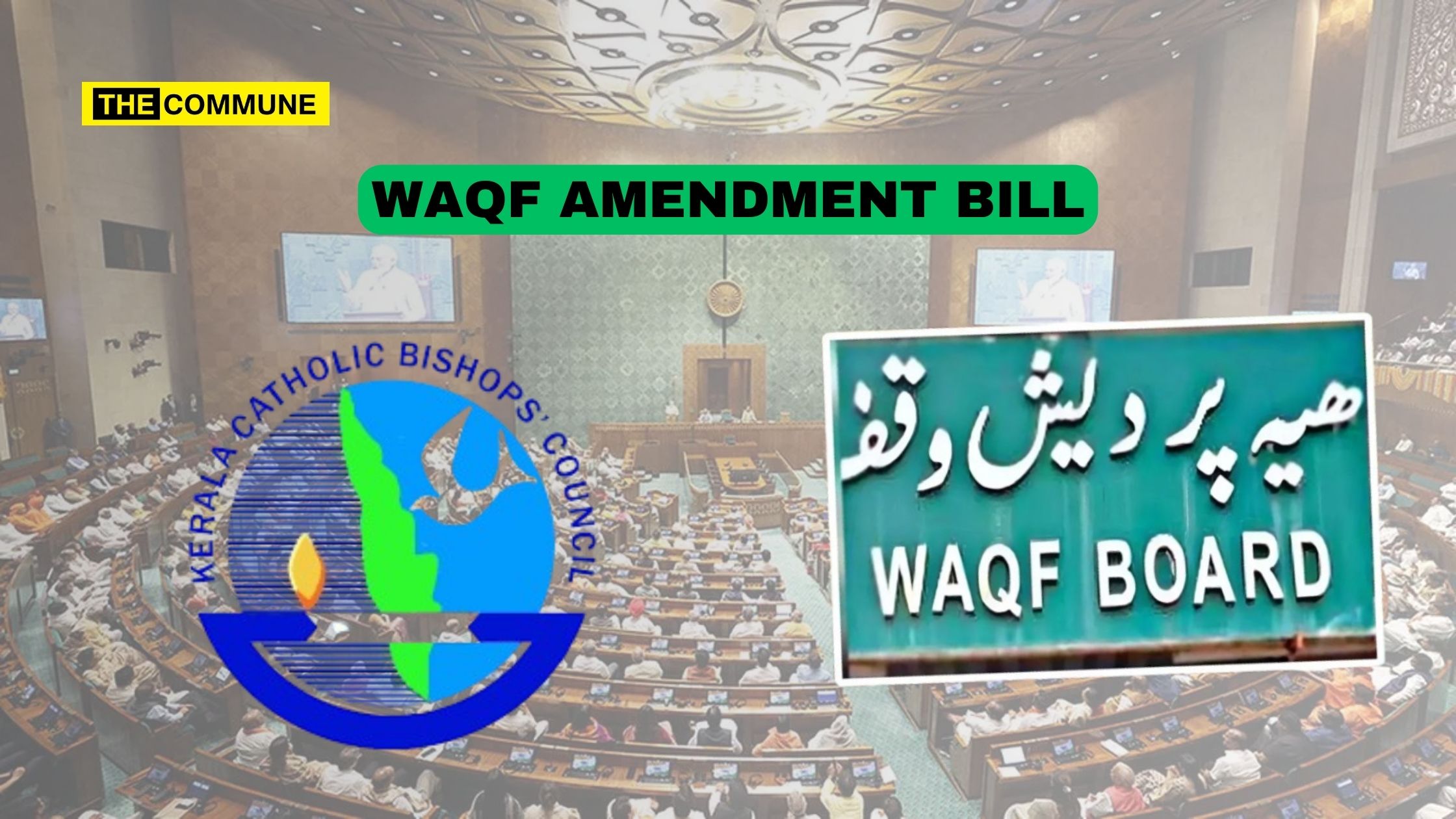
The Kerala Catholic Bishops’ Council (KCBC) has called on the members of Parliament from the state to support amendments to the Waqf Act, citing certain provisions as “unconstitutional and unjust.”
In a statement released on Sunday, 30 March 2025, KCBC highlighted the ongoing Munambam land dispute, where residents face legal uncertainty over property ownership. The dispute stems from claims raised under the existing Waqf Act, which allows challenges to land transactions involving properties that were once endowed for religious or charitable purposes. The Farook College management, which had sold the disputed land to Munambam residents, maintains that it was received as a gift, strengthening calls for legislative amendments.
“There should be a solution to the Munambam issue. The Farook College management has asserted that the land in question was gifted. MPs should cooperate to amend the Waqf Act, which currently permits claims against such properties,” the KCBC stated in its appeal.
The council’s demand has received backing from key Union ministers. Finance Minister Nirmala Sitharaman welcomed the KCBC’s stance, stating on social media that their appeal for amendments addresses sections of the Waqf Act that are “unfair” and “anti-constitutional.”
A welcome step by the Kerala Catholic Bishops Council (KCBC).
Their call is for amending the sections which are “unfair” and “anti-constitutional”in the existing Waqf Act.
“Kerala Catholic bishops put weight behind Centre’s Waqf (Amendment) Bill.”
Minister of Earth Sciences Kiren Rijiju also supported the request, emphasizing that lawmakers must protect the rights of Munambam residents.
I welcome the request by Kerala Catholic Bishops' Council (KCBC) to all MPs of Kerala to support the Waqf Amendment Bill as a Minister and as a minority community member.
It is the duty of those in politics to care for and address problems and challenges faced by our people. For… pic.twitter.com/GQR8kr1Zgz
In Kerala’s Ernakulam district, 400 Christian and 200 Hindu families are battling to keep their ancestral homes as the Waqf Board asserts ownership over land that their communities have occupied for generations. The properties in question lie in the coastal regions of Munambam and Cherai, areas historically inhabited by the Latin Catholic fishing community. The dispute, centered around the legal status of the land, has revived decades-old tensions and brought significant distress to the residents.
The Waqf Act governs properties dedicated to religious or charitable purposes under Islamic law. While recent amendments have aimed at increasing transparency, critics argue that certain provisions infringe upon property rights and create avenues for misuse.
In January 2025, Kerala Congress (Joseph faction) MP Francis George announced his support for the proposed Waqf Amendment Bill in Parliament, pledging to take a positive stand on the matter. Speaking at the 100th day of the Munambam land struggle, organized under the leadership of the Assembly of Christian Trust Services (ACTS), George emphasized his commitment to justice and fairness, declaring that his party is ready to cooperate with anyone to uphold these principles. His statement was met with jubilation by the people of Munambam.
The Kerala Legislative Assembly, on 14 October 2024, unanimously passed a resolution urging the Union government to withdraw the Waqf Amendment Bill 2024. The resolution argued that the bill undermines secular principles and threatens the democratic values enshrined in the federal structure of the Constitution. It contended that the proposed amendments would weaken the authority of state Waqf Boards and infringe on state rights by replacing elected members with a board of nominated officials.
Subscribe to our channels on Telegram, WhatsApp, and Instagram and get the best stories of the day delivered to you personally.
The infusion of Dravidian ideology, which has often surfaced in TNPSC exams despite factual inaccuracies, has now extended into the academic sphere of Tamil Nadu’s 10th standard students. It appears that the DMK has been strategically attempting to embed its ideology in the minds of students—whether they aim for government jobs or simply to excel academically—suggesting that understanding or praising Dravidian principles is essential for academic success.
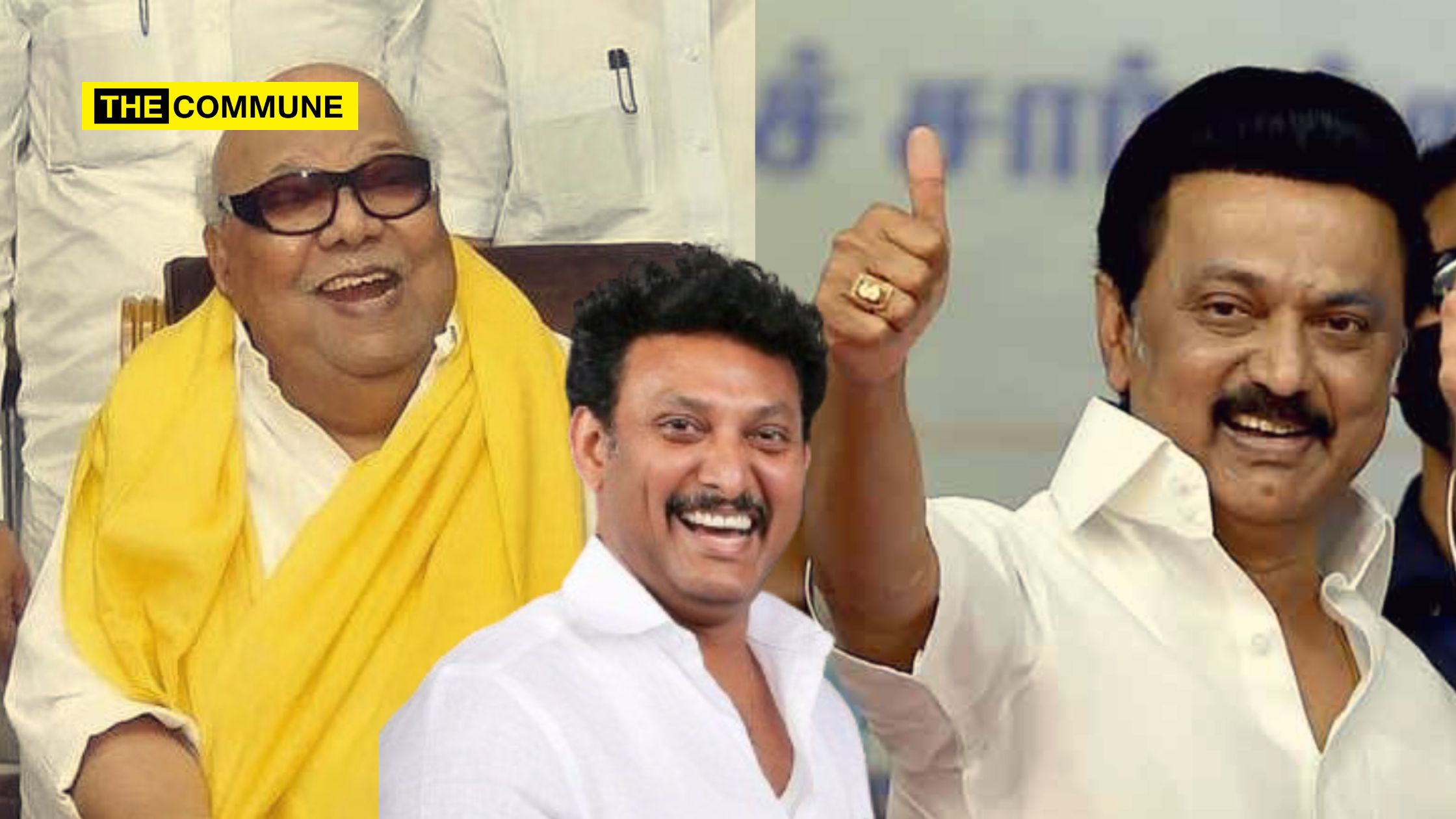
The recent controversy erupted following a question in the Tamil Nadu 10th standard public exam that asked students to write an eight-mark essay praising the late Chief Minister of Tamil Nadu and DMK leader M. Karunanidhi. The question read: “Describe and write under the title ‘Multifaceted Kalaignar’ using the titles of Kalaignar’s struggle—Kalaignar’s oration, Kalaignar’s drama, screenwriter, and lyricist.” This prompt, which inaccurately linked Karunanidhi, who had no role in the Indian freedom struggle, has sparked widespread debate and criticism.
Many critics argue that instead of addressing pressing issues like administrative inefficiencies and irregularities within the education department, the government is focusing on instilling Dravidian ideology in students.
In response, Tamil Nadu BJP State Secretary SG Suryah criticized the DMK government, particularly School Education Minister Anbil Mahesh, through his official account on X, stating, “What kind of freedom fighter is Karunanidhi, that such a question is being asked in the 10th standard public examination? Isn’t it enough for School Education Minister Anbil Mahesh to be the head of his grandson’s fan club and a slave to his father? Should questions as this asked about Karunanidhi in public exams? Is this cabinet just there to spread the glory of the Karunanidhi family? You lack the strength to fix the crumbling schools in rural areas, and should be ashamed to impose lessons about Karunanidhi on students.”
பத்தாம் வகுப்பு பொதுத் தேர்வில் கேள்வி கேட்கும் அளவிற்கு #கருணாநிதி என்ன சுதந்திர போராட்ட தியாகியா?
பள்ளிக்கல்வித்துறை அமைச்சர் அன்பில் மகேஷ் பேரனுக்கு ரசிகர் மன்ற தலைவராகவும், அப்பாவுக்கு அடிமையாகவும் இருப்பது பத்தாதா? பொது தேர்வில் இப்படி கருணாநிதி பற்றி கேள்வி வைக்க… pic.twitter.com/lHYHRdqw3h
Earlier Attempts To Dravidianize State Competitive Exams
During the examination held on 13 July 2024, TNPSC included a question that stated, “Who is certified as, “Socrates of South Asia” by UNESCO a unit organisation of United Nation?” perpetuating the propaganda endorsed by DMK and other Dravidianist organizations, aiming to portray E.V. Ramasamy Naicker (EVR) as an international leader. Despite repeatedly debunking of this falsehood, with the UNESCO itself putting statement that no such award was given EVR, TNPSC persists in promoting it.
துணை ஆட்சியாளர் துணை காவல் கண்காணிப்பாளர தேர்ந்தெடுக்க நேற்று TNPSC group 1 exam ல கேட்கபட்ட திராவிடியாத்தனமான கேள்விய பாருங்க மக்களே இந்த பொய்ய எத்தனை தடவை செருப்பால அடுச்சு ஓட விட்டாலும் திருட்டு திமுக @mkstalin திராவிடியா அரசாங்கம் திருந்துற மாதிரி இல்ல?@annamalai_kpic.twitter.com/PytHLfYTQ1
In July 2024, the TNPSC faced strong criticism for portraying Tamil Nadu freedom fighter Vanchinathan as a criminal in the assassination case of Robert Ashe during India’s struggle for independence, which is seen as aligning with colonial British perspectives.
In the recently concluded Group 1 examination held on 13 July 2024, TNPSC included a question that states, “Who was the first accused in Ashe murder’s case?.” This question has offended many individuals and sparked criticism of the TNPSC on the internet and social media.
TNPSC GROUP 1 ல் கேட்கப்பட்ட கேள்வி வாஞ்சிநாதன் குற்றவாளியாம்🤦♀️🤦♂️
— 🇮🇳Prabhu Manoharan🚩 (@PrabhuManohara3) July 16, 2024
This new narrative was crafted by Dravidianists to portray Ashe as a “crusader for social justice” while depicting Vanchinathan as a casteist Brahmin. They claim that Vanchinathan was provoked by Ashe’s wife, Mary Lillian Patterson, who allegedly helped a pregnant outcast woman in need of urgent medical care pass through the agraharam. According to this version, Vanchinathan killed Ashe to protect the Brahminical establishment. However, there is no concrete evidence to support this claim, and this narrative has been debunked due to the lack of conclusive proof.
Subscribe to our channels on Telegram, WhatsApp, and Instagram and get the best stories of the day delivered to you personally.
US President Donald Trump has hit out at “fake news media” and the “radical left” for allegedly conducting a biased coverage of messages leaked from a Signal group chat, where US officials had discussed strikes on Iran-backed Houthi targets in Yemen.
Republican Senator Markwayne Mullin, in an interview with NBC News earlier on Sunday, spoke about the Signal chat controversy and said, “The conversation should be about why did the Biden administration not do anything in the last two years, instead of this Signal chat. There was no classified information given out, it was a thoughtful conversation, and the attack was extremely successful.”
Following this statement, Donald Trump, in a post on Sunday on Truth Social, his own social media platform, praised the Senator for his response, “A GREAT job by Senator Markwayne Mullin on beating back Kristen Welker’s, and the the Radical Left’s Witch Hunt, on the never ending Signal story. They just don’t stop – Over and over they go!” He added, “Meet the Fake Press should instead explain how successful the attack was, and how Sleepy Joe Biden should have done it YEARS AGO. This story and narrative is so old and boring, but only used because we are having the most successful “First One Hundred Presidential Days” in the history of America, and they can’t find anything else to talk about.”
Trump also slammed NBC News in the post saying, “The Fake News Media has the lowest Approval Ratings in history, and for good reason. MAKE AMERICA GREAT AGAIN!!!” President Trump told NBC News on Saturday that he would not fire anyone involved in a group chat that inadvertently disclosed plans for airstrikes on Yemen to a journalist. In a wide-ranging interview with NBC’s Kristen Welker, Trump pushed back on reports that some in his circle had encouraged him to fire Michael Waltz, the National Security Advisor (NSA). The New York Times reported on Saturday that Trump had spent much of the past week consulting with aides about whether he should fire Waltz amid mounting fallout from the episode.
But Trump told Welker that he still had confidence in Waltz and in Defence Secretary Pete Hegseth, and he continued to downplay the seriousness of the incident. “I don’t fire people because of fake news and because of witch hunts,” the US President said. Controversy erupted after NSA Waltz accidentally added the Editor-in-Chief of The Atlantic magazine to a Signal group chat discussing details of US strikes aimed at Houthi targets in Yemen. The group chat, consisted of high profile individuals from the Trump administration, such as Defence Secretary Hegseth and Vice-President J.D. Vance, CIA Director John Ratcliffe, and National Intelligence Director Tulsi Gabbard. It including timings of strikes on Yemen, the type of planes being issued, as well as conversations about US “being the only country capable” of conducting such strikes. The Atlantic published the actual transcript of US attack plans, however, the Trump administration has maintained that none of the information shared was sensitive.
–IANS
Subscribe to our channels on Telegram, WhatsApp, and Instagram and get the best stories of the day delivered to you personally.
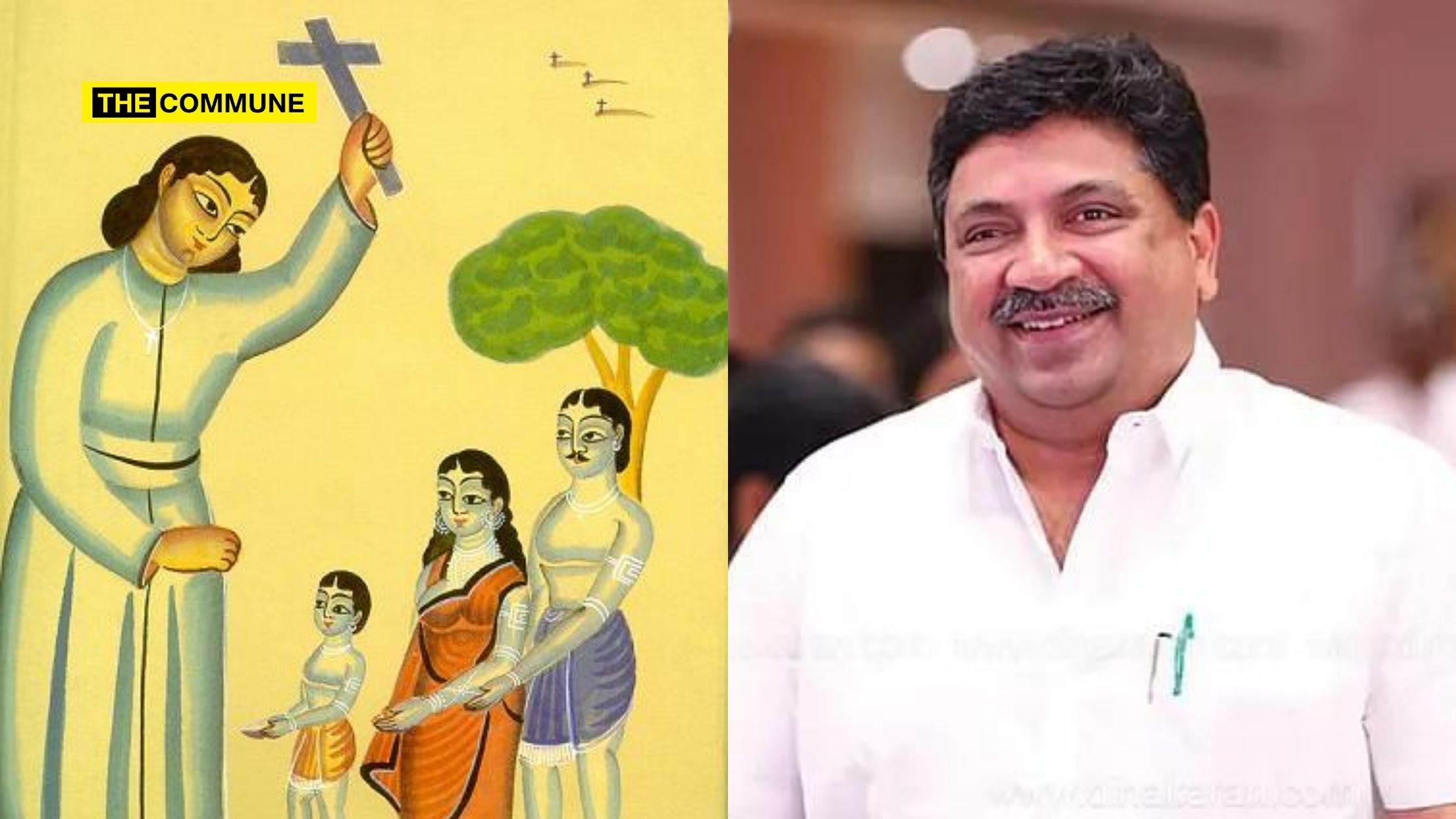
The Dravidian movement is said to be an offshoot of missionary agenda, and this is proved by the Dravidianists time and again. This time, the Dravidianist lie of attributing the education system in Tamil Nadu to the Christian missionaries has been peddled by none other than DMK Minister PTR Palanivel Thiagarajan.
DMK Minister for Information Technology and Digital Services, Palanivel Thiaga Rajan, highlighted the ‘significant contributions‘ of Christian missionaries in ‘advancing education and healthcare‘ in Tamil Nadu during his address at The American College’s graduation ceremony on Saturday, 29 March 2025.
Drawing parallels with the Justice Party’s efforts in democratizing education, PTR emphasized that missionaries were instrumental in ensuring equal opportunities for all.“Christian missionaries have played a great role in improving the state of education and health in Tamil Nadu,”he said.
Addressing the graduating students, Rajan urged them to serve as role models for future generations. He cited distinguished alumni, including orator Solomon Pappiah, artist-writer Manohar Devadoss, and Food and Civil Supplies Minister R. Sakkarapani, as examples of individuals who have brought pride to the institution.
1,856 undergraduate and 535 postgraduate students received their degrees during the ceremony. The event was attended by Bishop-President Rt. Rev. D. Jeyasingh Prince Prabhakaran, Principal and Secretary M. Davamani Christober, and other dignitaries.
The Dravidianist Lie
It is noteworthy that the traditional Indian education system, where teaching was considered a virtuous profession, was deliberately dismantled by the British. Brahmins, who were primarily teachers and often economically disadvantaged, played a key role in imparting education, but this system was systematically destroyed under colonial rule.
The Madras province, since 1823, had provided education without discrimination based on caste, religion, or gender. Separate institutions functioned for Tamil, Kannada, Malayalam, Sanskrit, and other languages, catering to diverse linguistic needs. In the 1820s, education was free for students, ensuring broader access. Interestingly, Shudras were more educated than Brahmins in mother tongue education, indicating that learning was widespread across different social groups.
Historical insights from the book“The First Native Voice of Madras: Gazulu Lakshminarasu Chetty” reveal that a survey ordered by Munroe on educational institutions had shown education was traditionally community-managed, with tax-free community land sustaining the system. However, Munroe’s policies reportedly taxed most of this land, disrupting the existing educational structure. The 19th century was described as a period of extreme oppression, marked by forced conversions and a slave trade allegedly orchestrated by the British.
It is also noteworthy that the East India Company was tasked with evangelizing the people, changing their faith, and bringing them to the Gospel when they came to trade in India. He stated that the British initially considered transitioning from a trading focus to territorial control in Bengal, prompting debates within the British government. However, after deliberation, they concluded that the colonization methods employed in America, Australia, and Canada, involving the destruction of local populations through diseases, were not feasible for India.
All these truths have been buried by the Dravidianists, and they continue to uphold the lie about missionaries being the harbinger of education to TN. It could also be possible that PTR Palanivel Thiagarajan, himself an alumnus of The Lawrence School, Lovedale, was influenced by his alma mater for making such ignorant statements.
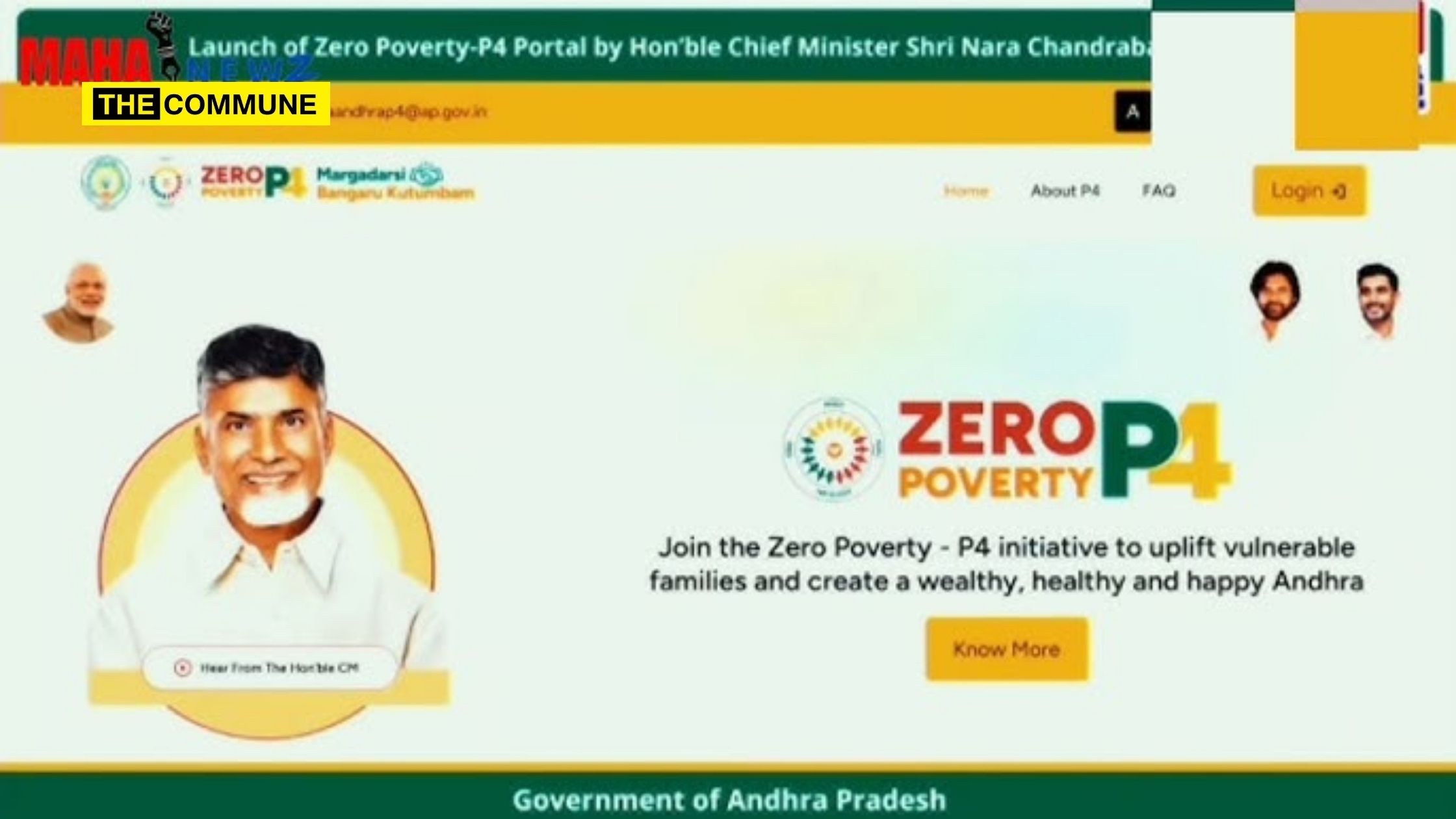
Andhra Pradesh Chief Minister N. Chandrababu Naidu launched the ‘Zero Poverty-P4’ initiative and expressed confidence that this programme will be a game changer in society.
Launching the programme in Amaravati along with the Deputy Chief Minister Pawan Kalyan on the occasion of Telugu New Year Ugadi, he stated that P4 is an extraordinary scheme that will create history. Addressing a public meeting, the Chief Minister said that any programme that is taken up on Ugadi day will certainly become a resounding success.
He made it clear that P4 is being launched only with the sole objective of alleviating poverty. Last week, he said that P4 is aimed at enabling the wealthy to support the underprivileged sections of society.
The platform is open to everyone who comes forward voluntarily to offer support to the poor. The government will bring both donors and beneficiaries onto a common platform. In the first phase, 20 lakh families will benefit under the scheme. He mentioned that the per capita income during the previous fiscal was Rs 2,66,995, while this year it is Rs 2,98,065.
He was confident that this would go up to Rs 5,42,985 by 2028-29 and reach Rs 55 lakh by 2047. Chandrababu said that he would be completing 50 years in public life in another three years.
“For the first time, I became MLA in 1978, and in another three years, I will be completing 50 years as MLA. My entire life is dedicated to you, who have been supporting me for the past five decades. I have become MLA for nine times, of which four times as Chief Minister. For 15 years, I was the Leader of the Opposition and 30 years as party president. No one else in the country has got the respect which I received,” he said.
He recalled that TDP founder N.T. Rama Rao was a person with discipline and perseverance, and he never relaxed till he reached his target. He stated that he was raised under such a strict, disciplined personality.
“For the past 47 years, I have been into public life, and I always thought about the progress of the State. I wished that the lifestyle of the people should be transformed,” he added. Observing that he always believed in good governance and clean politics, the Chief Minister said that he had introduced several programmes only with a view to bringing in changes in the people’s lives.
“I have introduced Prajala Vaddaku Palana, Janma Bhoomi and the IT revolution. I do not know anything else except work, and I do not have any kind of habits. After waking up every day, I always think about what kind of programmes will bring total transformation in the lives of the people,” he said.
Making it clear that he had never committed any kind of mistake and will never do it, the Chief Minister said he too has a family and that the Heritage was founded and handed over to the family members so that they will not earn any livelihood through politics. “They do not depend on me, and in fact, I depend on them. If the family is financially independent, we will be brave. My wife does not know politics, and I will not enter into any kind of business,” Chandrababu said.
–IANS
Subscribe to our channels on Telegram, WhatsApp, and Instagram and get the best stories of the day delivered to you personally.
Hours after US President Donald Trump threatened Iran with bombing and secondary tariffs, the armed forces in Iran have reportedly readied missiles for a potential response to Washington.
In a post on Monday on X, Iranian army said, “Information received by the Tehran Times indicates that Iran’s missiles are loaded onto launchers in all underground missile cities and are ready for launch. Opening the Pandora’s box will come at a heavy cost for the US government and its allies.”
According to a report with the Tehran Times, a significant number of launch-ready missiles have been located in underground facilities scattered across the country. Trump, on Sunday had threatened Iran with bombings and secondary tariffs if Tehran did not come to an agreement with Washington over its nuclear programme.
In his first remarks since Iran rejected direct negotiations with Washington last week, Trump told NBC News that the US and Iranian officials were talking, but did not elaborate. “If they don’t make a deal, there will be bombing,” Trump said in a telephone interview.
“It will be bombing the likes of which they have never seen before.” “There’s a chance that if they don’t make a deal, that I will do secondary tariffs on them like I did four years ago,” he added.
In response, Iran sent a letter to Trump through Oman, urging Tehran to reach a new nuclear deal, saying its policy was to not engage in direct negotiations with the US while under its maximum pressure campaign and military threats, Tehran’s Foreign Minister was quoted as saying on Thursday.
In the interview, Trump also threatened so-called secondary tariffs, which affect buyers of a country’s goods, on both Russia and Iran. He signed an executive order last week authorising such tariffs on buyers of Venezuelan oil.
Trump did not elaborate on those potential tariffs. In his first 2017-21 term, Trump withdrew the US from a 2015 deal between Iran and world powers that placed strict limits on Tehran’s disputed nuclear activities in exchange for sanctions relief. Trump also reimposed sweeping US sanctions.
Since then, the Islamic Republic has far surpassed the agreed limits in its escalating program of uranium enrichment. Tehran has so far rebuffed Trump’s warning to make a deal or face military consequences.
–IANS
Subscribe to our channels on Telegram, WhatsApp, and Instagram and get the best stories of the day delivered to you personally.
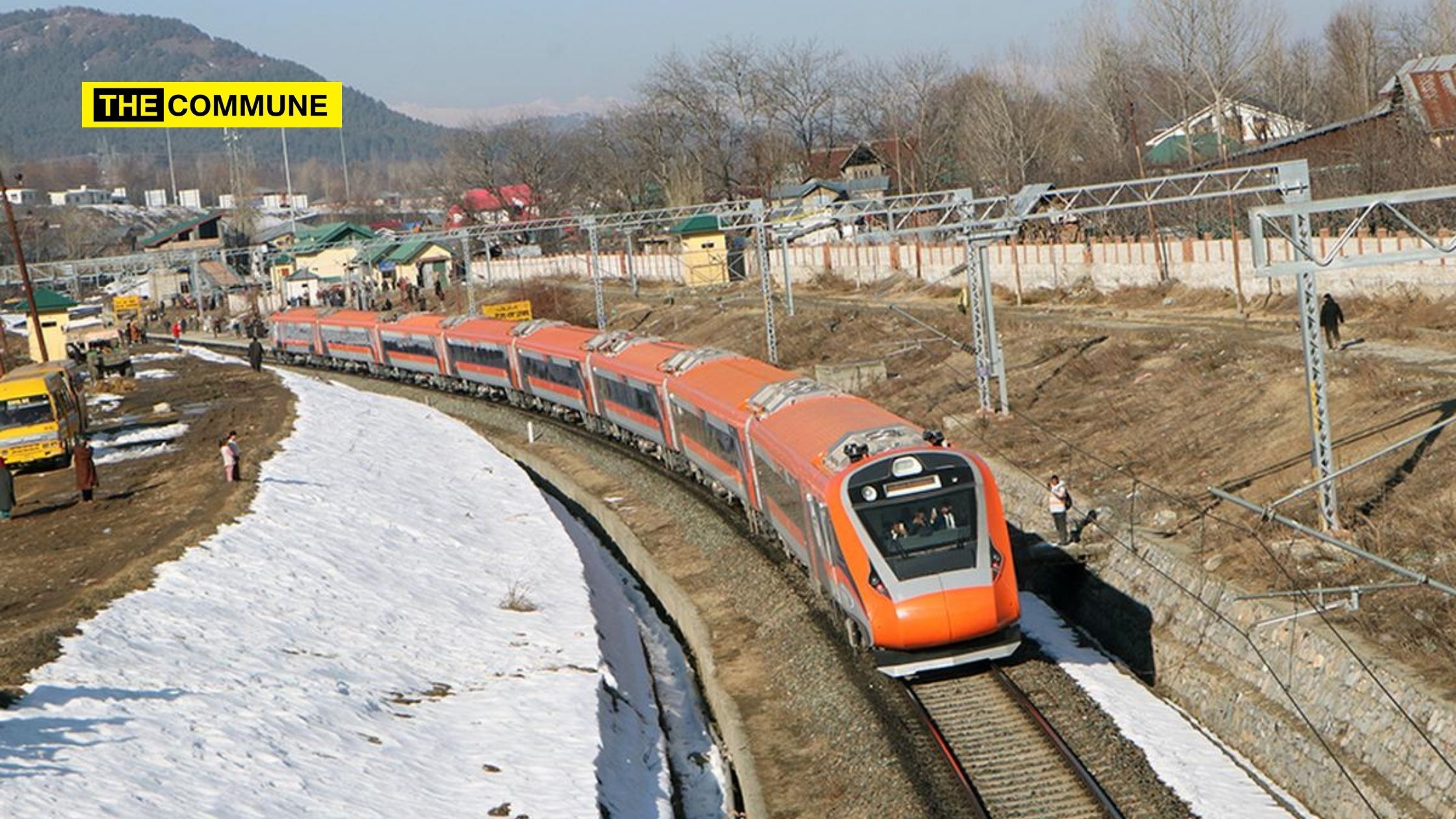
Union Minister Jitendra Singh has said that Prime Minister Narendra Modi will inaugurate the Jammu-Srinagar Vande Bharat train service on April 19 from Katra, marking the completion of the 272-km Udhampur-Srinagar-Baramulla railway link project.
Speaking to reporters in Jammu on Sunday, the Union Minister Singh said, “Prime Minister Modi will arrive in Udhampur on April 19. He will visit the world’s highest railway bridge and inaugurate it. After that, he will flag off the Vande Bharat train from Katra.”
The Jammu-Katra-Srinagar Vande Bharat Express will commence operations from Katra, as the Jammu railway station is currently undergoing renovation.
According to officials, the rail link project was completed last month. Trial runs of the train on the Katra-Baramulla route have been successfully conducted. The Commissioner of Railway Safety approved the train service between Katra and Kashmir in January, they said. Officials said that the Vande Bharat Express is expected to cut down travel time considerably between Jammu and Srinagar, offering a modern and efficient rail service for the region.
The launch of the train will meet the longstanding demand for direct rail connectivity to Kashmir. At present, train services are limited to the Sangaldan-Baramulla route within the Valley and from Katra to various destinations across the country.
Officials said that the ambitious project to connect Kashmir by rail began in 1997 but encountered numerous delays due to challenging geological, topographical, and meteorological conditions. The project comprises 38 tunnels stretching a total of 119 km, including the 12.75 km-long Tunnel T-49, the longest transportation tunnel in India.
Additionally, it features 927 bridges spanning 13 km in total, with the iconic Chenab Bridge standing out. This bridge, measuring 1,315 metres in length with a 467-metre arch span, rises 359 metres above the riverbed — making it 35 metres taller than the Eiffel Tower and the highest arch railway bridge in the world.
According to a Ministry of Railways statement, the Jammu-Srinagar Vande Bharat train is specially designed with anti freezing features. The Snow removal train, moving ahead of passenger and freight trains, will make sure that trains on this strategic route run all through the year, day and night. This will ensure all-weather connectivity between both regions. To give passengers a comfortable and safe travel experience, the Railways has used Anti-Vibration seismic devices in the project as this region falls in Zone-V earthquake vulnerability. These dampers will absorb the tremors in the Himalayan terrain and thus maintain faster and safer travel for commuters.
“The Vande Bharat Express running in Kashmir is different from the Vande Bharat Express running across the country. It is specially designed to operate smoothly in extreme cold conditions, i.e. as low as -20°C. To ensure comfort for passengers and drivers, the train is equipped with advanced heating systems,” as per the statement. The driver’s cabin features a heated windshield to prevent it from fogging up or freezing, ensuring clear visibility in extreme temperatures. The train also has heating elements in the plumbing and bio-toilets to prevent water from freezing, ensuring that essential systems continue to function during cold weather.
–IANS
Subscribe to our channels on Telegram, WhatsApp, and Instagram and get the best stories of the day delivered to you personally.