UK Hindi ‘Scholar’ Francesca Orsini, Who Opposed CAA, Deported Over Visa Violations; Take A Look At Her Controversial Academic Legacy
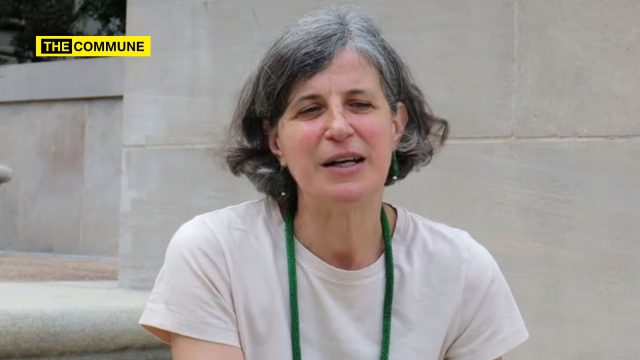
Francesca Orsini, a UK-based Hindi scholar and professor emeritus at the School of Oriental and African Studies (SOAS), University of London, was denied entry into India and deported from Delhi airport on 20 October 2025 over alleged visa violations, according to news agency PTI.
Orsini, who arrived in Delhi from Hong Kong, was reportedly blacklisted by Indian authorities in March 2025 for breaching visa conditions. She was travelling on a tourist visa, which officials said she had previously misused for academic purposes. A source in the Ministry of Home Affairs (MHA), quoted by PTI, stated that “Francesca Orsini was on a tourist visa but violating visa conditions. This is standard global practice; anyone found violating visa norms can be blacklisted.”
Officials said Orsini was deported to Hong Kong within hours because her stated purpose of visit did not match her visa category. She told authorities she held a valid five-year visa and was visiting India to meet friends.
Academic Background and Controversial Scholarship
Orsini is a respected scholar of Hindi literature with deep connections to India. She completed her undergraduate studies in Hindi from Venice University, Italy, and studied in New Delhi at the Central Institute of Hindi and Jawaharlal Nehru University before earning her PhD from SOAS.
Her notable works include:
- “The Hindi Public Sphere: 1920–1940”
- “East of Delhi: Multilingual Literary Culture and World Literature”
- “Print and Pleasure: Popular Literature and Entertaining Fictions in Colonial North India”
Orsini is currently professor emerita of Hindi and South Asian Literature at SOAS’ School of Languages, Cultures and Linguistics. She had attended an academic conference in China before attempting to enter India and had last visited the country in October 2024.
Criticism of Academic Approach
Critics have accused Orsini of promoting a “Cultural Marxist” agenda in her scholarship. Her work has been characterized as:
- Framing Hindi’s historical development as a “communal power play” rather than organic evolution
- Creating a “distorted narrative” that undermines India’s linguistic unity
- Romanticizing pre-colonial multilingualism while vilifying post-colonial linguistic consolidation
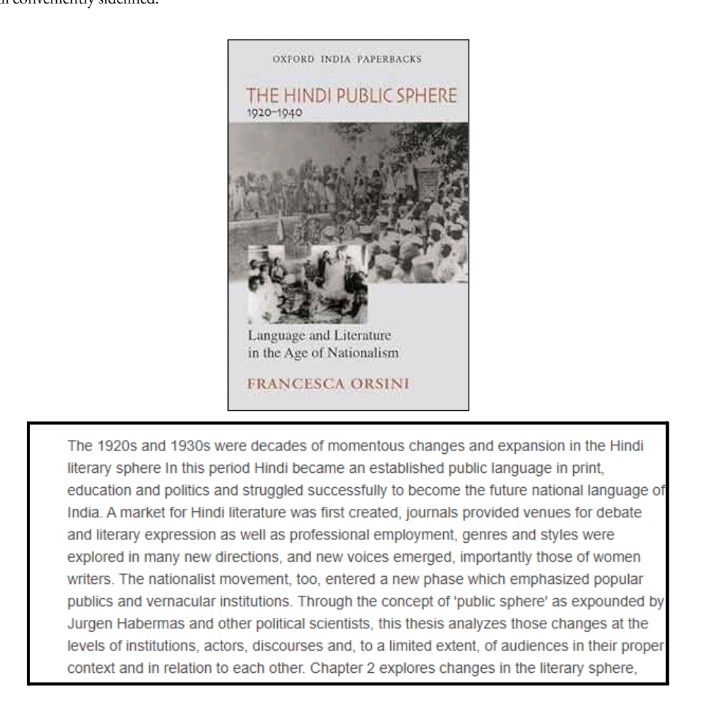
Her 2002 book The Hindi Public Sphere (1920–1940) argues that Hindi’s rise as a national language occurred primarily through political mobilization during the 1920s and 1930s. Critics, however, have accused the work of minimizing grassroots factors such as Bhakti poetry, vernacular education, and local print networks.
In a 2002 essay titled “India in the mirror of World Fiction”, Orsini described the Ramayana and Mahabharata as “amoral” works and compared them unfavourably with modern liberal literature. She expressed disapproval that figures like Bhagwan Ram could no longer be openly criticised in India, where the BJP-led NDA government was in power.
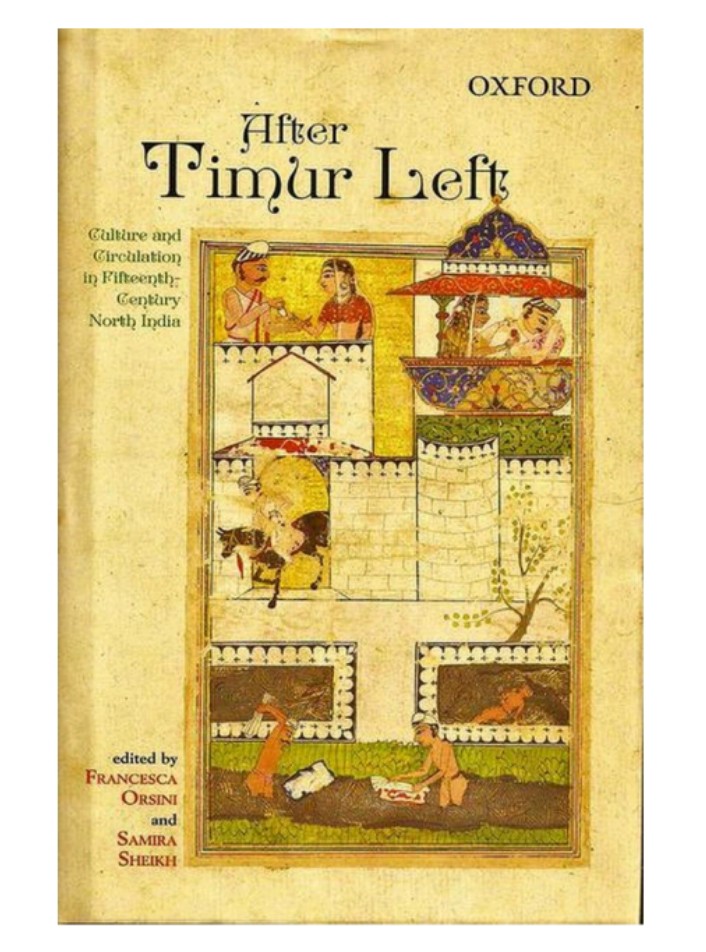
In subsequent writings, Orsini explored premodern North India’s multilingual literary cultures. Her edited 2016 volume After Timur Left examined 15th-century literary production across languages such as Hindi, Persian, and Avadhi, portraying precolonial India as a linguistically diverse and interconnected region. Detractors allege that she “romanticized” precolonial diversity while portraying postcolonial linguistic consolidation as an ideological regression.
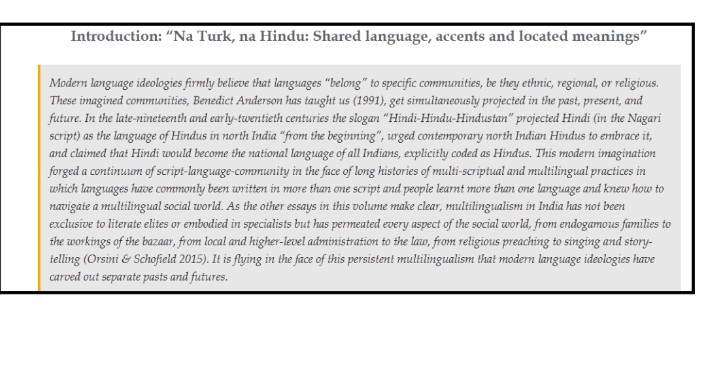
Her chapter “Na Turk Na Hindu” in the SOAS essay collection A Multilingual Nation accused nationalist linguistics for “communalizing languages.” Critics claim that in doing so, Orsini constructed what they describe as a “Hindi–Hindu–Hindustan” caricature that simplifies complex linguistic histories into political binaries. She argued that nationalist movements redefined India’s multilingual traditions into rigid identities linking script, language, and religion.
Her 2023 book East of Delhi further examined Awadh’s literary ecology, spanning Hindi, Urdu, Persian, Avadhi, and Braj arguing that colonial and nationalist agendas fragmented what was once a fluid multilingual world.
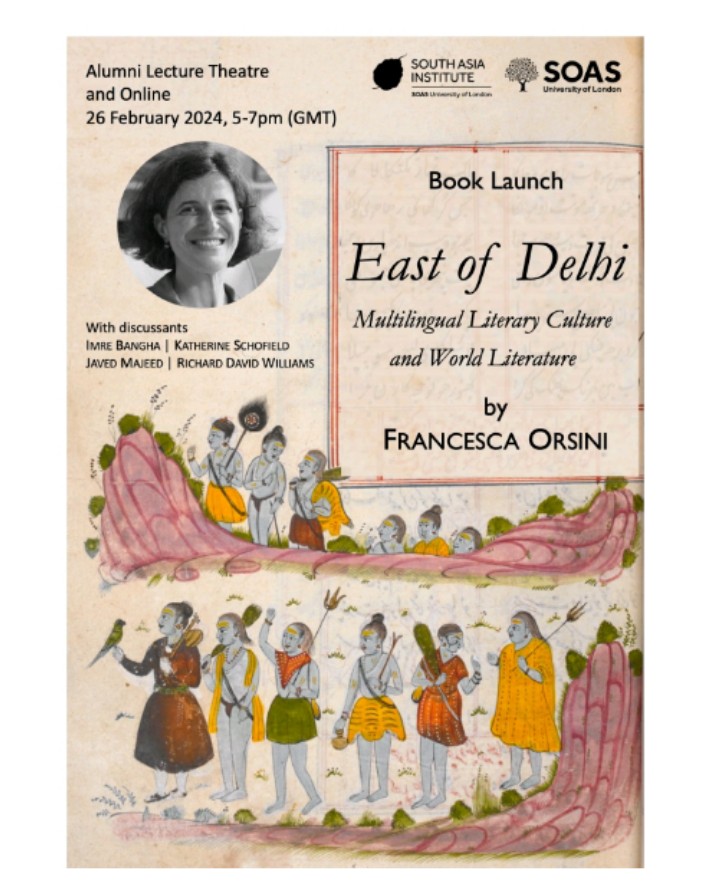
Reviewers sympathetic to her approach praised the book’s archival depth, while others accused it of sidelining the socioeconomic and cultural processes – urbanization, vernacular schooling, and the expansion of print markets that organically contributed to Hindi’s development.
Across her academic career, Orsini’s work has often emphasized the political dimensions of language and identity. Her critics, particularly within Indian nationalist and pro-Hindi circles, describe her approach as “Cultural Marxist” and accuse her of framing Hindi’s historical evolution as an instrument of dominance rather than as an outcome of popular and cultural synthesis.
Critics argue that her scholarship consistently deconstructs national identity as “manufactured”, casts modern Hindi as hegemony rather than heritage and ignores social and economic drivers like urbanization, vernacular schooling, and local print markets.
Anti-CAA Stance
Francesca Orsini, often portrayed as an apolitical academic, has a well-documented record of political alignment with left-liberal causes and critics of the Indian state. During the 2019–2020 anti-CAA protests, she joined a group of international scholars who publicly condemned Indian police action and accused the Government of India of sectarian bias.
Her political positioning extends to earlier controversies as well. In March 2016, Orsini was among more than 150 global academics who signed an open letter defending Jawaharlal Nehru University professor Nivedita Menon, who had come under public scrutiny for remarks questioning India’s position on Kashmir. The statement denounced what it called a “vicious right-wing media campaign” against Menon and urged JNU’s administration to safeguard academic freedom and protect her right to express dissenting views on Kashmir’s political status.
(This article is based on an X thread by The Chronology)
Subscribe to our channels on Telegram, Instagram and YouTube to get the best stories of the day delivered to you personally.