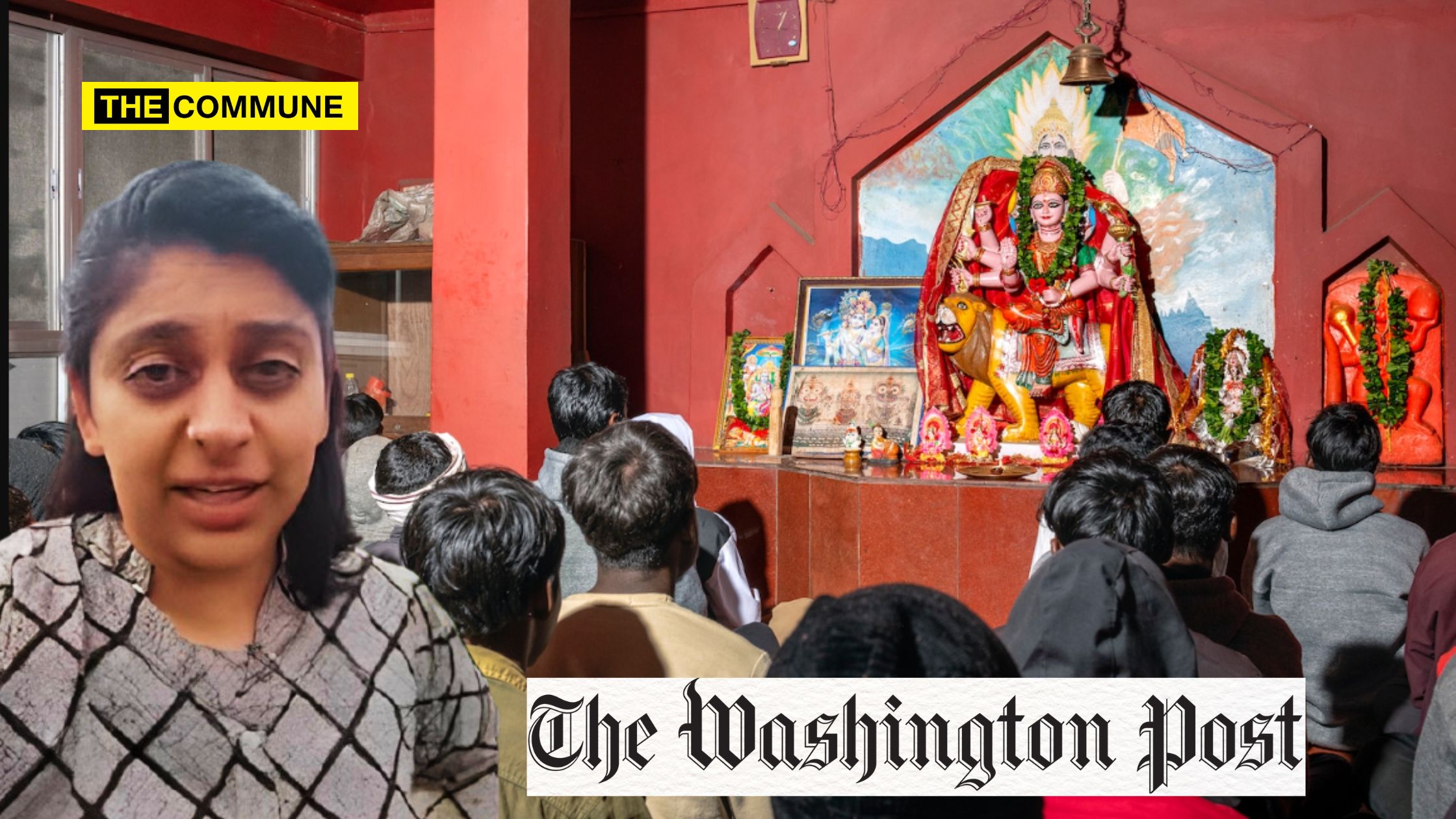
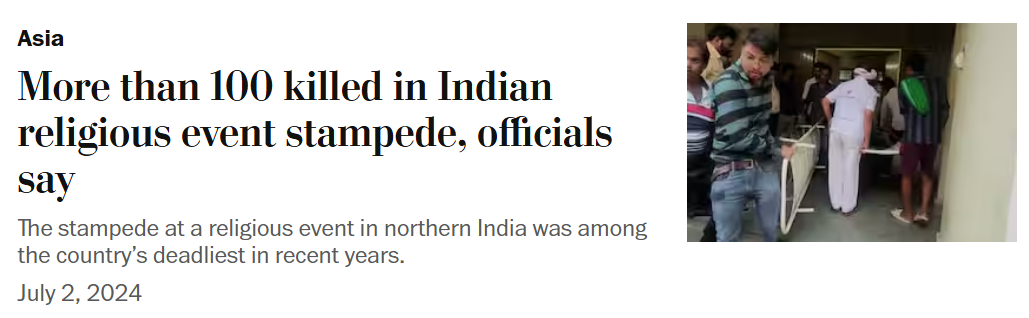
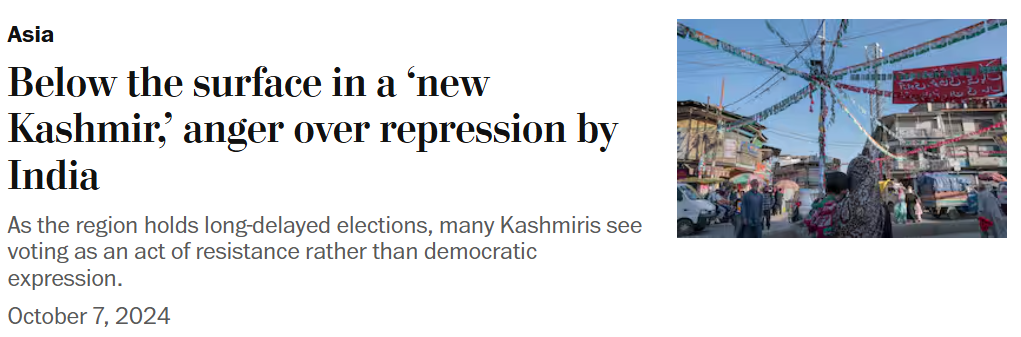
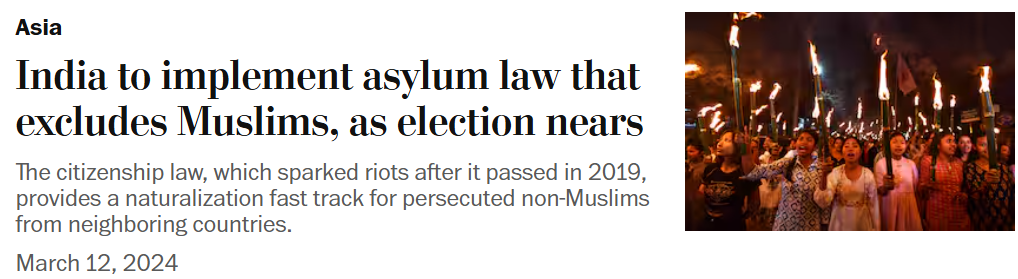
The journalist, comfortably sitting far from the ground realities of Jharkhand, seems indifferent to the aggressive evangelism that seeks to uproot and alter the tribal way of life, often with promises of aid followed by abandonment once the conversions are achieved. However, the journalist is alarmed when Hindu groups work to reconnect these communities to their cultural roots, branding the effort as problematic. A recent piece in The Washington Post exemplifies this concern, as it attempts to create tension between Hindus and tribal communities in Jharkhand.
Published on 1 February 2025, the article ‘Hindu nationalists make gains among India’s tribes and spur backlash’ penned by karishma mehrotra accused Hindu groups of running ‘evangelical campaigns’ aimed at converting tribals to Hinduism. It further claimed that organizations like the RSS were undermining tribal cultures by persuading them to identify as part of the larger Hindu community.
This attack comes at a time when Jharkhand is already grappling with significant proselytism and conversion tactics from Muslim and Christian groups. The Washington Post article suggested that right-wing Hindu groups are trying to transform the country into a Hindu nation, aiming to assimilate millions of tribal people who have traditionally been outside the mainstream religious fold.
The piece belittled the efforts of Hindu organizations trying to preserve the cultural identity of the tribal communities, which are at risk due to predatory conversion tactics. It appears the resistance from these groups against evangelical practices has unsettled the interests of the Washington Post.
Contrary to the newspaper’s claims, Hindu groups in Jharkhand aren’t aggressively pushing for conversions. With Hindus already constituting a majority in the state, their main focus is on preventing the large-scale conversions promoted by Muslim and Christian evangelical groups.
The Washington Post also targeted organizations such as Vikas Bharti and Vanvasi Kalyan Ashram. The article accused Vikas Bharti of dividing the tribal communities by distinguishing them between Hindus, Christians, and nature worshippers. It misrepresented an invitation by Kumkum Maitra of Vikas Bharti to local tribals during Shivratri as an attempt to proselytize nature worshippers.
Another organization, Vanvasi Kalyan Ashram, was also criticized for allegedly competing with Christian evangelists in neighboring Chhattisgarh. The Washington Post referred to controversial figures to make exaggerated claims about the organization’s activities, including the accusation that Vikas Bharti was conducting ‘ghar wapsi’ (reconversion) of tribals who had previously converted to Christianity.
The article also touched on the ongoing controversy around the Sarna Code, which seeks to classify tribal communities as a distinct religious group. In 2020, the Jharkhand government moved to include Sarna as a separate religion in the 2021 Census. While the BJP supported the initiative, it remains a contentious issue. Some in the RSS believe that tribal communities should be considered part of Hinduism, a belief actively promoted through organizations like Vanvasi Kalyan Ashram.
Sarna Code supporters argue that recognizing the Sarna identity would better protect the cultural practices of tribal communities. However, the Washington Post framed the debate as a conflict between Hindus and ‘nature worshippers’, suggesting that the push for the Sarna Code was a challenge to Hindu organizations’ efforts.
The article concludes by highlighting a tribal nurse working with Vanvasi Kalyan Ashram, who allegedly felt forced to identify as Hindu despite identifying as Sarna. This serves to further paint the situation as one of coercion and division.
In sum, the Washington Post‘s article reflects a broader attempt to stir discord and create a divide between Hindu groups and tribal communities in Jharkhand, presenting Hindu efforts to reconnect tribals with their cultural roots as a threat to tribal identity.
Who Is Karishma Mehrotra?
Karishma Mehrotra is a journalist known for her anti-establishment views, working for The Washington Post. She has often been accused of writing articles that criticize the Indian government and promote anti-Hindu sentiments. Despite facing backlash and having some of her narratives debunked, she continues to push these agendas under the guise of journalism, with little regard for the consequences.
Her writings have been viewed as an attempt to tarnish India’s image on international platforms, often through misleading or inaccurate portrayals. Below are examples of her work that highlight this ongoing effort to spread biased narratives about the government.
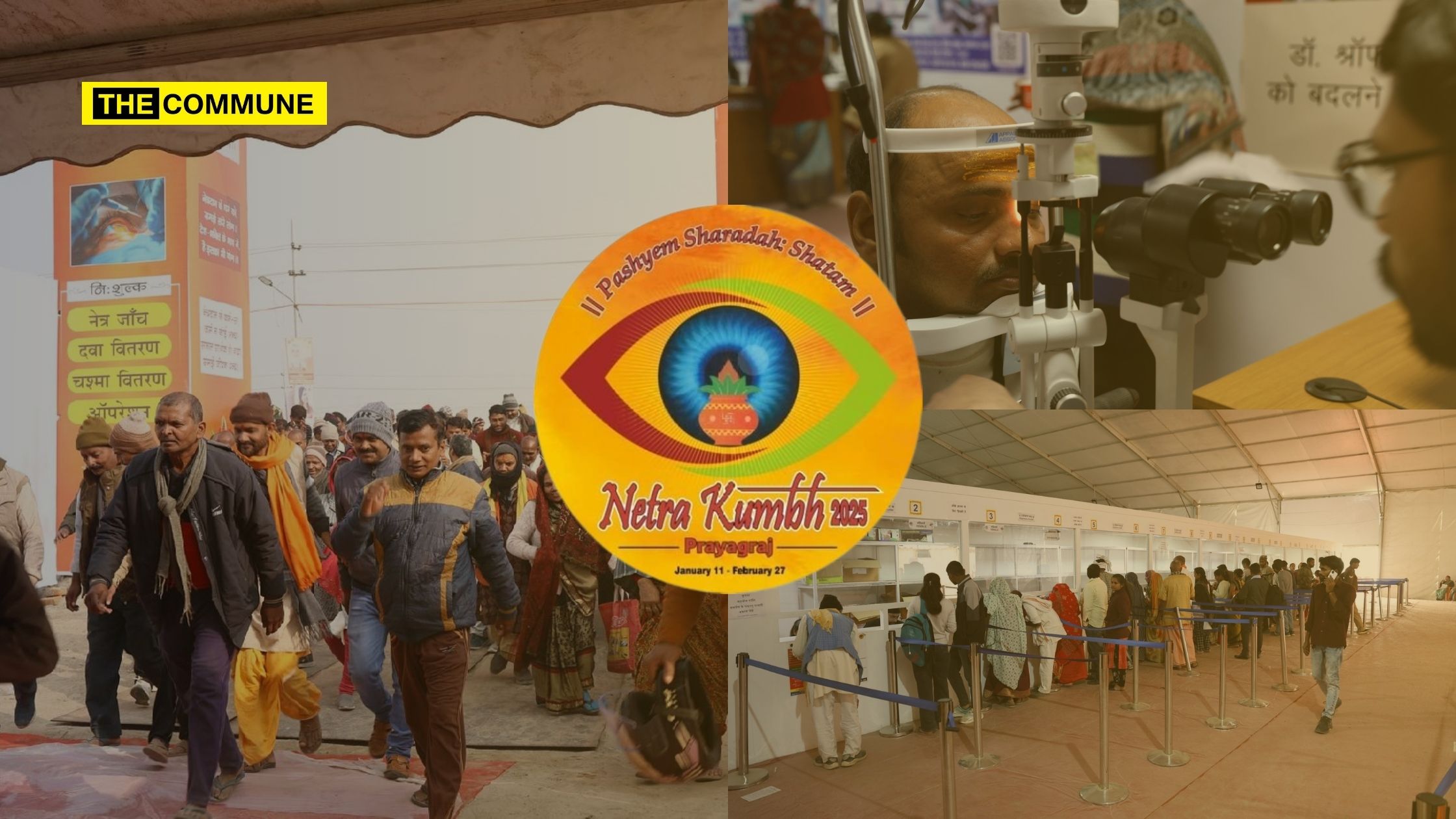
In an ambitious effort to combat preventable blindness, the Netra Kumbh 2025 initiative was launched during the Maha Kumbh and it will run through 26 February 2025, at Prayagraj. This large-scale humanitarian project aims to provide free comprehensive eye care services to hundreds of thousands of individuals across India.
The campaign has set unprecedented targets, including conducting 500,000 eye tests, distributing 300,000 spectacles, and performing 50,000 free eye operations with the support of 500 eye specialists. This marks a significant scaling up from their 2019 achievement of serving over 200,000 devotees.
Netra Kumbh’s mission addresses a critical health crisis in India, where more than 12.5 million people are visually impaired, many due to preventable causes. The initiative aligns with multiple United Nations Development Programme (UNDP) Sustainable Development Goals, including Good Health & Well-Being, Gender Equality, and Reduced Inequalities.
The project’s implementation follows a carefully planned roadmap that began with its ideation phase on 15 August 2024, followed by a groundbreaking ceremony (Bhumi Pujan) on 28 September 2024. The initiative offers a comprehensive range of services including free eye check-ups, medicine distribution, spectacles, and surgical interventions.
*महाकुँभ मेले में कैसी कैसी जन सुविधायें उपलब्ध हैं पर मीडिया में चर्चा तक नही।* pic.twitter.com/K6gQWl5K9E
To ensure widespread impact, Netra Kumbh has established multiple coordination centers across India. The main center is located in Prayagraj at Vajpayee Dental Hospital, with additional offices in Nagpur and Noida. The initiative is actively recruiting volunteers, doctors, hospitals, and optometrists to support its ambitious goals.
Despite challenges posed by the pandemic during their 2021 campaign, the organization successfully provided critical eye care to tens of thousands of patients. Building on this resilience, Netra Kumbh 2025 aims to create a sustainable impact by facilitating surgeries near patients’ home locations, extending their reach beyond the event period.
The initiative welcomes public participation through various channels, including volunteer opportunities and donations. Interested medical professionals, institutions, and volunteers can register through their official channels.
Netra Kumbh 2025 represents one of the world’s largest coordinated efforts to address preventable blindness, combining medical expertise with humanitarian service. The project exemplifies a significant step toward the organization’s vision of creating a corneal blindness-free India.
The Trump administration took decisive action against the contentious United States Agency for International Development (USAID), including placing senior officials on leave, firing contractors, and implementing a broad freeze on foreign assistance. Elon Musk, who now leads the Department of Government Efficiency (DOGE), has called USAID a “criminal organization,” declaring that “it’s time for it to die” in a tweet on February 2nd. In response, the USAID website and its X account were shut down.
For years, USAID has been unofficially viewed as a tool of U.S. regime change operations. Established in the early 1960s to oversee humanitarian aid programs, USAID’s mission has often been entangled with covert activities involving regime change, secret funding, and undermining sovereign nations.
India has been a focal point for USAID’s efforts. In addition to direct financial aid, USAID has funded numerous projects and NGOs working internationally, some of which operate in India with the aim of undermining national and Hindu interests. For instance, the Atlantic Council, financed by USAID and backed by the U.S. “deep state,” launched a campaign using journalists and ‘fact-checkers’ to censor private messages on platforms like WhatsApp, in an attempt to weaken support for Prime Minister Narendra Modi. Notably, billionaire George Soros, who created a $1 billion fund to challenge nationalist leaders like Modi and Donald Trump, was also a major donor to this initiative.
The U.S. deep state, with its extensive influence, is like a complex web of interconnected interests. For example, credible sources suggest that USAID and the deep state have significant ties with the Indian National Congress, particularly through Sam Pitroda, a key mentor to Rahul Gandhi and the Congress overseas chair.
Over the years, USAID has managed large budgets for its initiatives, which have included supporting regime changes, promoting favorable governments, and destabilizing political leaders opposed by left-liberals. A significant portion of these activities has been funded by U.S. taxpayers, with the agency overseeing more than $40 billion in funding for the 2023 fiscal year—accounting for over a third of the Department of State’s budget for Foreign Operations and related programs.
As Trump and Musk’s DOGE intensify their scrutiny of USAID, more layers of previously hidden interference are coming to light. OpIndia reveals one particularly disturbing aspect—its role in efforts to convert Hindus in India to Christianity, with substantial financial backing from USAID.
World Vision presents itself as a secular organization focused on humanitarian efforts, claiming not to engage in proselytization or let its religious beliefs influence its partnerships or the children it serves. On its website’s FAQ section, the NGO asserts that recipients of its aid do not need to be Christian, and that proselytization is not part of its activities. World Vision India similarly states that while it is a Christian organization, its actions are driven solely by the love of Jesus Christ, without attempting to exploit the poor for conversions. Despite these claims, there is evidence to suggest that the organization’s activities may not align with its stated principles.
World Vision has received funding from USAID, which has been linked to efforts that some view as predatory proselytization disguised as humanitarian work. Many Christian missionary organizations, including World Vision, are accused of exploiting the vulnerabilities of the poor and marginalized to convert them to Christianity. The Hinduphobia Tracker, which tracks religiously motivated hate crimes against Hindus, defines “Proselytization by Inducement” as a form of religious conversion that involves exploiting an individual’s economic hardships—such as offering financial support, job opportunities, or medical care—in exchange for conversion.
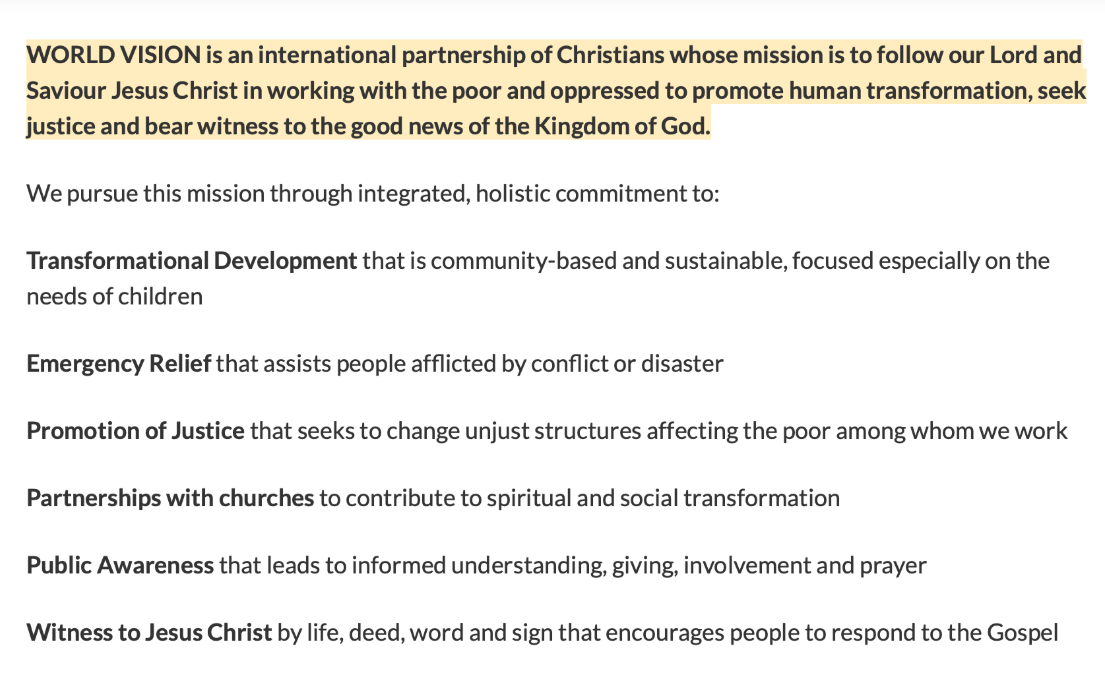
World Vision’s mission statement offers further insight into its intentions. The statement on its website highlights the organization’s Christian identity and mission to “follow Lord and Saviour Jesus Christ,” promote human transformation, and “bear witness to the good news of the Kingdom of God.” The explicit goal of encouraging individuals to “respond to the Gospel” indicates that evangelism is central to its work, despite the organization’s claim of being non-proselytizing.
Image Source: OpIndia
This contradiction was noted in a 2009 HuffPost article, which pointed out that World Vision Singapore’s mission statement acknowledges the commitment to disciple followers of Jesus Christ and spread the Gospel through service, words, and actions.
Additionally, the organization’s websites present a dichotomy. While wvi.org, the main website, claims a neutral stance, worldvision.org—access to which is blocked in India—clearly showcases World Vision’s proselytizing efforts, including a section dedicated to partnerships with churches. On this page, World Vision expresses its goal of mobilizing the church and spreading the Gospel beyond the church walls, a direct indication of proselytization efforts aimed at vulnerable communities. The website also lists several faith-based organizations involved in similar evangelical activities, especially targeting indigenous populations in India.
World Vision’s financial documents, such as the IRS Form 990 for the fiscal year ending 2023, further confirm the organization’s Christian identity and its classification as a church, reinforcing its missionary focus.
Reports from as early as 2002 and 2010, such as one by journalist S.K. Shashikumar, document World Vision’s proselytization efforts in India. In Gujarat, the organization conducted Bible schools and spiritual retreats for children and young people, while in Orissa, it helped local churches by organizing leadership training for pastors. In tribal areas like Gajapati and Bhil, World Vision has been actively involved in church development and community outreach, positioning itself as an evangelical force within these regions.
Despite its claims of neutrality, World Vision’s actions, financial affiliations, and mission statement suggest that proselytization remains a core component of its operations, particularly in regions like India, where it works among marginalized communities.
World Vision Advocacy: A Tool for U.S. Foreign Policy
Iain Buchanan, author of Armies of God: Study in Militant Christianity, argues that missionary organizations like World Vision are instrumental in advancing U.S. foreign policy goals. In a 2018 interview with DNA, Buchanan emphasized that the U.S. government strategically utilizes Christian organizations to serve its foreign policy interests. He claimed that the line between religious and secular efforts is intentionally blurred, with over 600 U.S.-based evangelical groups forming a vast, highly organized network targeting non-Christians globally.
Buchanan further asserted that World Vision functions as an extension of the U.S. State Department, alongside other major evangelical organizations such as Campus Crusade, Youth with a Mission, and Samaritan’s Purse. He suggested that these partnerships are not only aligned with U.S. interests but also receive support through specific legislation like the International Religious Freedom Act of 1998.
Given what we now know about USAID’s operations, World Vision’s receipt of billions in funding, its proselytizing activities in countries like India, and the U.S. Department of State’s involvement in regime-change operations, Buchanan’s 2018 claims seem increasingly accurate.
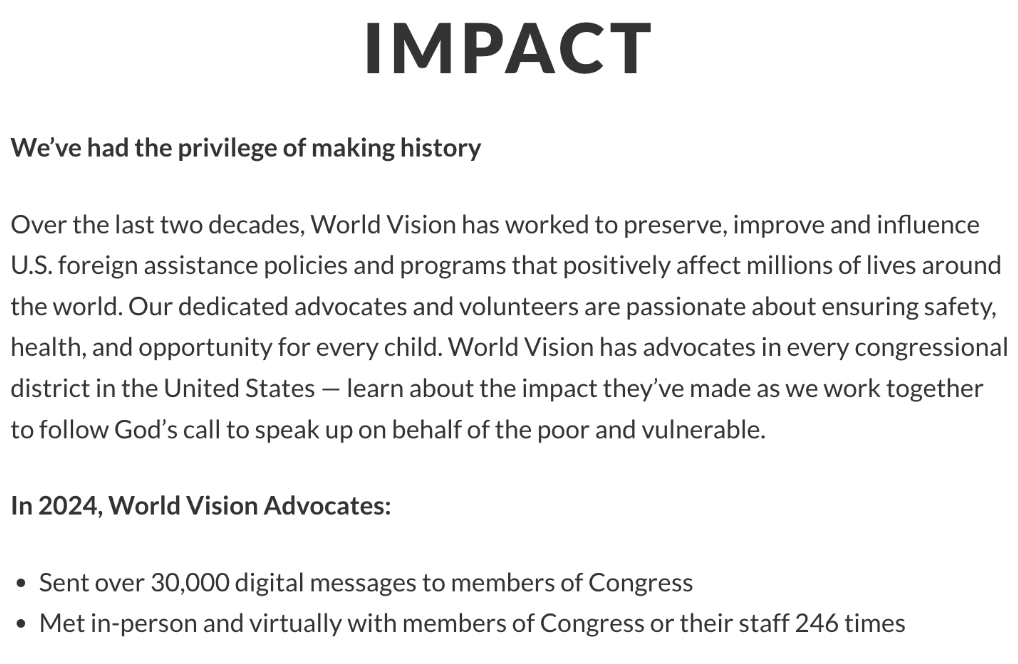
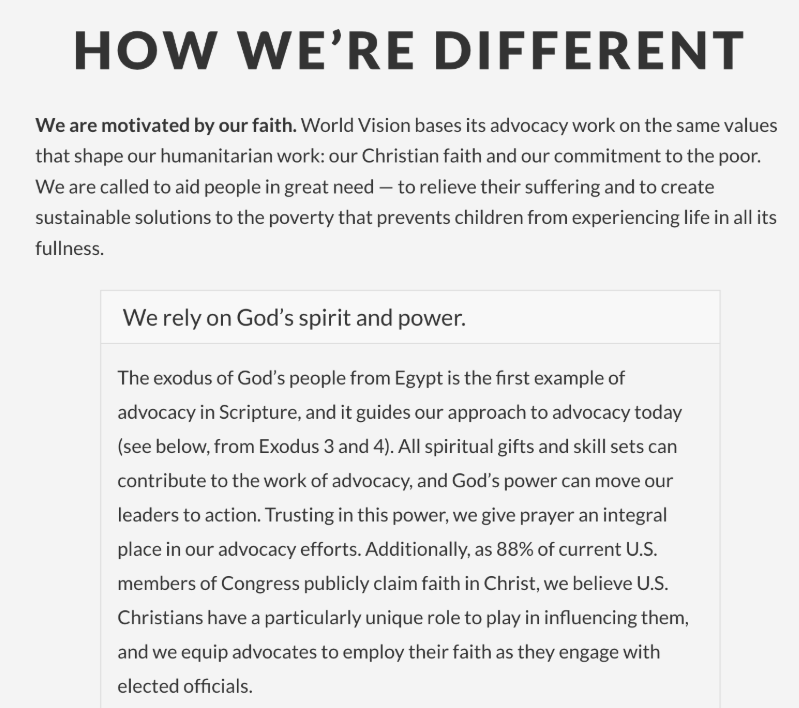
World Vision has been involved in lobbying efforts as well. According to its latest IRS filing, the organization spent over $180,000 on lobbying, particularly around elections, and has direct connections with government officials and legislators. This adds further weight to the argument that World Vision’s advocacy efforts are deeply tied to influencing U.S. foreign policy, particularly in areas related to foreign aid and Christian missionary activities. World Vision Advocacy itself states its goal is to influence U.S. foreign assistance policy, driven by Christian faith. If its advocacy targets foreign aid policy in the U.S. with a Christian agenda, this suggests the organization’s efforts are centered on expanding Christianity both within and outside the U.S. With billions in funding from USAID directed to Christian organizations, coupled with its classification as a church by the IRS, it is clear that World Vision is less a humanitarian entity and more an arm of U.S. foreign policy.
Image Source: OpIndiaImage Source: OpIndia
World Evangelical Alliance: A Key Partner of World Vision
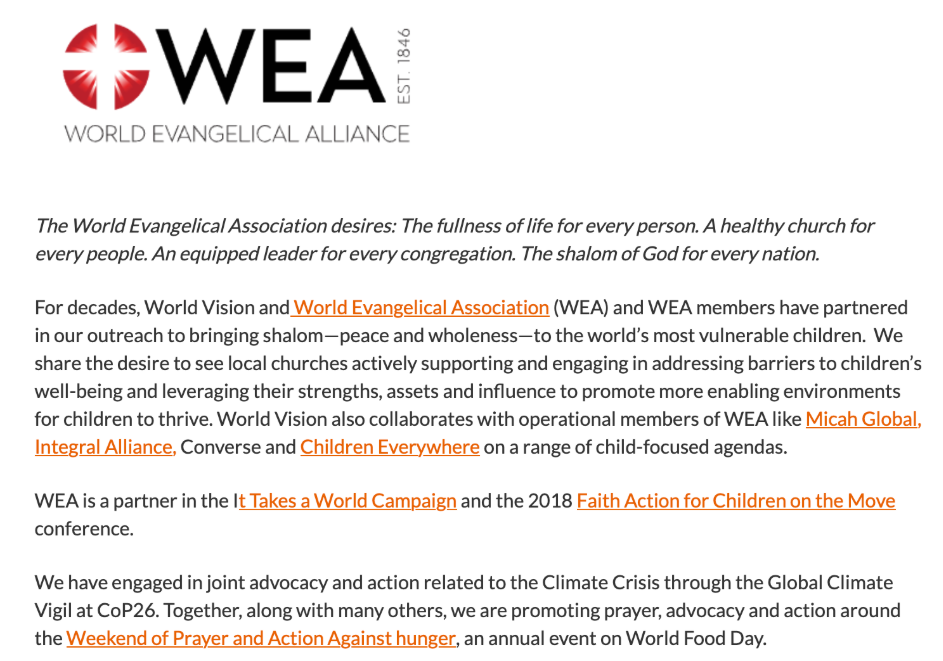
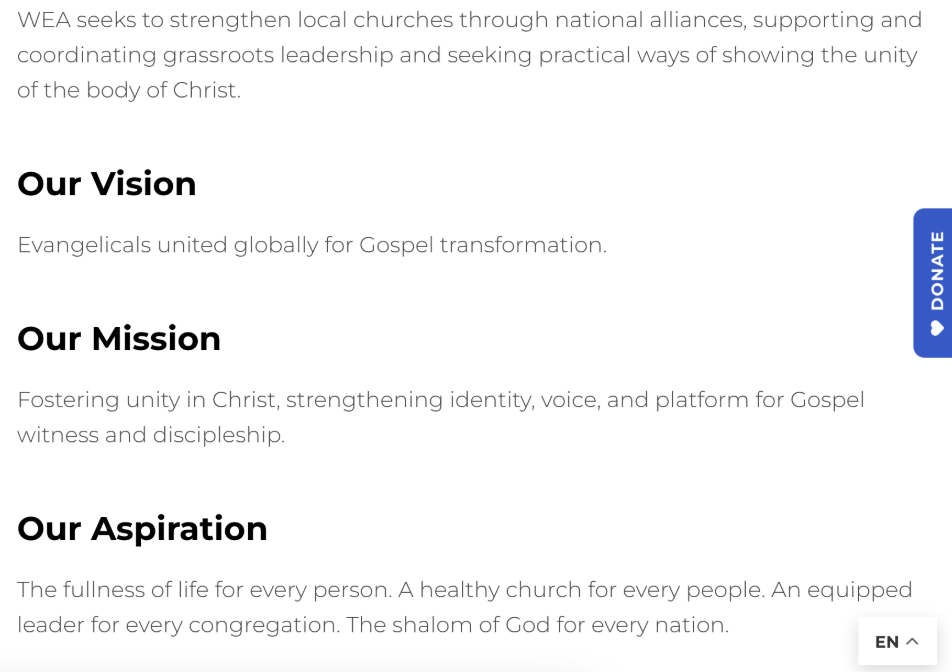
World Vision partners with several faith-based organizations in its humanitarian efforts, including the World Evangelical Alliance (WEA). The WEA’s own mission statement reveals its theological goals, aiming to establish Christianity worldwide. Its statement, “A healthy Church for every people. The shalom of God for every nation,” reflects its mission to spread the gospel and create a global Christian “kingdom.”
Image Source: OpIndiaImage Source: OpIndia
The WEA is governed by an International Council made up of regional representatives, one of whom is Dr. Snehal Pinto, director of Ryan International Schools in India. Ryan International has faced scrutiny for alleged involvement in proselytizing activities. In 2017, the tragic murder of a student at a Ryan International school highlighted concerns about the school’s strict religious practices, including the forced promotion of Christianity. A former student accused the school of replacing educational displays with Bible verses, removing Hindu symbols, and pressuring students to sing hymns in extreme weather conditions.
Dr. Pinto’s association with WEA adds to concerns about the evangelical nature of World Vision’s partners, particularly in India, where the conversion efforts of such organizations are a significant issue.
The WEA’s Evangelical Mission
Thomas Schirrmacher, the CEO of the WEA, has been open about the organization’s evangelical goals. Schirrmacher has expressed that religious freedom includes the right to convert others, and that the WEA’s mission is not to promote world peace, but to create a space for Christian witness in a diverse world. In 2021, the WEA signed an agreement with one of the largest Muslim organizations, agreeing to attempt to convert Muslims without causing conflict. This further affirms that proselytizing is central to WEA’s mission, and by extension, World Vision’s.
In 2008, WEA admitted to engaging in proselytism, stating that its “Mission Commission” is focused on spreading Christianity. The WEA’s 2023 forecast also reiterates its goal of converting more people to Christianity and increasing its global influence. This includes endorsing practices like “Yeshu Yeshu” in India, where Hinduism is appropriated for forced conversions.
With WEA’s clear evangelical objectives and its partnership with World Vision, it’s evident that conversion to Christianity and spreading the gospel among the “vulnerable” are central to the operations of both organizations, even though they often present themselves as humanitarian entities.
Behind the Facade of a ‘Humanitarian Organization’: World Vision’s Alleged Links to Hamas
World Vision, often presented as a humanitarian organization, has been embroiled in serious allegations regarding its financial support of Hamas, a designated terrorist group responsible for the October 7 attacks in Gaza. These attacks led to the deaths of over 1,200 Israelis and the kidnapping of more than 200 individuals. The accusations against World Vision come in the context of its Gaza operations, particularly the actions of Mohammad El-Halabi, the organization’s Gaza manager.
In 2021, the Israeli Registrar of Non-Profits filed a petition to dissolve a local branch of World Vision, citing allegations of financial mismanagement and terror financing. After an extensive investigation, the Registrar concluded that World Vision had failed to carry out its claimed humanitarian efforts and instead had diverted funds, including to Hamas. The case centers on allegations that El-Halabi directed $50 million in aid meant for humanitarian projects to Hamas. While World Vision’s Australian branch denied these accusations, insisting on proper financial oversight, an independent audit revealed concerning discrepancies. The audit showed unclear financial transactions, multiple bank accounts, and payments to individuals whose activities were not in line with the organization’s declared humanitarian missions. Furthermore, checks from the non-profit were found in the possession of Hamas operatives.
In addition to the Hamas allegations, World Vision has been connected to other controversial activities. According to Sam Westrop of the Middle East Forum, World Vision also assisted in directing funds to the Islamic Relief Agency, a Sudanese organization with known ties to Osama bin Laden. USAID reportedly funded this organization with $125,000, despite the fact that the group had been designated as a terrorist entity. USAID officials were allegedly aware of this designation. Westrop’s claim underscores a broader issue of oversight failures, with the Israeli Registrar concluding that World Vision was either negligent in its financial oversight or complicit in diverting funds to terror groups.
World Council of Churches and World Vision’s Partnership: Links to Extremist Groups
The World Council of Churches (WCC), another key partner of World Vision, has also been linked to controversial organizations and individuals. The WCC describes itself as a fellowship of churches dedicated to unity in Christ and advancing Christian missions globally. However, its partnerships, including with organizations like Bread for the World, raise questions about the funding of groups with potential links to radical or separatist elements.
One such example involves Harsh Mander, an Indian activist with ties to groups that have been associated with separatist and extremist activities in India. Bread for the World, funded by the WCC, has supported Mander’s initiatives, which have drawn criticism for promoting divisive ideologies. These connections highlight concerns about the broader networks within which World Vision operates, raising questions about the nature of its partnerships and the ideological underpinnings of some of its affiliated organizations.
The World Council of Churches (WCC) is funded by several governments worldwide, either directly or indirectly. According to NGO Monitor, one of the largest contributors to WCC is Bread for the World, a German-based NGO.
In 2018, a report titled “Amarnath Yatra: A Militarized Pilgrimage” was released, undermining the Hindu faith. Reports found it was published by the Jammu Kashmir Coalition of Civil Society (JKCCS) in collaboration with Equitable Tourism Options (Equations), based in Bangalore. The report had links to Islamist groups, Urban Naxals, and Christian organizations, including Bread for the World.
Equations, which co-published the report, has received significant funding from Bread for the World in the past. The NGO focuses on non-exploitative tourism and advocates for democracy in decision-making processes. Their funding records reveal substantial contributions from Bread for the World and Misereor. In 2018 alone, Equations received over Rs. 26 lakhs from Bread for the World and more than Rs. 24 lakhs from Misereor.
Bread for the World describes itself as a collective Christian voice, working towards ending world hunger. The organization has close ties with evangelical churches and partners with other organizations like Oxfam. In India, it funds several NGOs, including the South Central India Network for Development Alternatives (SCINDeA), which focuses on marginalized groups like tribals and Dalits, and the Rongmei Naga Baptist Association (RNBA), which runs a theological seminary.
One of the most significant recipients of funding from Bread for the World is the Centre for World Solidarity (CWS), which promotes a rights-based approach to governance and human rights. Bread for the World also contributes to the Socio-Legal Information Center (SLIC), including its Human Rights Law Network (HRLN). HRLN is involved in multiple human rights causes, including the defense of Rohingya refugees, and has supported controversial issues such as the abolition of sedition laws.
Harsh Mander, a prominent social activist, also has links with Bread for the World. After leaving the Indian Administrative Service (IAS), Mander became active in civil society organizations and is currently the director of the Centre for Equity Studies (CES), which has received funding from Christian evangelical groups, including Bread for the World. Mander has been involved in various contentious causes, such as advocating for religious conversions, opposing the Citizenship Amendment Act (CAA), and supporting controversial figures like Ishrat Jahan and Yakub Memon.
Mander’s organization, Karwaan-e-Mohabbat, published a misleading report on violence at Aligarh Muslim University, which was later debunked. Mander was also involved in protests against the CAA and was part of a group that supported the Delhi anti-Hindu riots. His close associations with foreign-funded NGOs have raised concerns about external influence in India’s domestic affairs.
Other NGOs funded by Bread for the World include INSAF, which also opposed the CAA and contributed to sentiments leading up to the Delhi riots. Additionally, Bread for the World has ties with USAID, with USAID administrator Samantha Power praising the organization in recent months.
In 2024, the National Council of Churches in India (NCCI), affiliated with WCC, condemned the Uttar Pradesh government’s proposed anti-conversion bill. This bill aims to further strengthen anti-conversion laws, which have been a point of contention for organizations like the World Evangelical Alliance (WEA), which criticized India’s anti-conversion laws at the UN.
WEA, which also maintains close ties with WCC, misrepresented the violence in Manipur, claiming it was aimed at Christian Kukis when, in reality, the majority of the violence targeted the Hindu Meitei community. Additionally, WEA has previously vilified Hindus and the BJP government, especially in Karnataka, which was ruled by the BJP in 2012.
In 2023, Jayakumar Christian, CEO of World Vision India, expressed support for controversial figures such as Stan Swamy, a suspected Urban Naxal involved in the Bhima Koregaon violence. He also made alarming statements about introducing Hindus to Jesus Christ, showcasing a divisive religious agenda.
World Vision India, funded by USAID and Bread for the World, came under scrutiny when the Modi government suspended its Foreign Contribution Regulation Act (FCRA) license in 2022. While left-wing narratives framed the suspension as an attack on an organization helping the poor, the government’s decision was based on concerns about World Vision India’s religious activities and foreign influence under the guise of humanitarian work.
Chronology of Actions Against World Vision:
Tax Audit and Assessments Background:
In the fiscal year 2016-17, the Income Tax Department (IT Department) initiated a Special Audit under Section 142(2A) of the Income Tax Act, 1961 for the Assessment Year (AY) 2014-15 (Financial Year 2013-14). On July 31, 2017, the Society received a demand notice under Section 156 of the Act, requiring payment of INR 101.92 crores, based on the IT Department’s evaluation of allowable expenses. The Society appealed on August 24, 2017, pointing out legal and factual mistakes in the IT Department’s assessment. To prevent being categorized as an “assessee in default,” the Society paid INR 10 crores as part of the tax demand.
Direct Bank Deductions and Additional Tax Demands:
In February 2018, the IT Department initiated direct deductions of 20% of the total tax demand from the Society’s bank accounts as part of enforcement action.
Assessment for the Year 2017-18 (Financial Year 2016-17):
On December 24, 2019, the Deputy Commissioner of Income Tax (Exemptions) issued an order under Section 143(3), calculating a payable tax of INR 31.39 crores. A demand notice was issued under Section 156, stipulating payment within 30 days or an appeal within 60 days. The Society filed an appeal on January 18, 2020, challenging legal and factual errors in the IT Department’s findings. To avoid the risk of being deemed an “assessee in default,” the Society made a payment of INR 1.56 crores as part of the tax demand.
Assessment for the Year 2018-19 (Financial Year 2017-18):
On September 14, 2021, the Additional/Joint/Deputy/Assistant Commissioner of Income Tax issued an order under Section 143(3), determining a payable tax of INR 5 crores. A demand notice under Section 156 required payment within 30 days or an appeal within 60 days. The Society paid INR 5 crores to avoid being categorized as an “assessee in default” and also filed a writ petition in the Madras High Court, contesting legal errors in the IT Department’s order.
Assessment for the Year 2021-22 (Financial Year 2020-21):
On December 30, 2022, the Income Tax Department’s Assessment Unit issued an order under Section 143(3), calculating a payable tax of INR 9.99 crores. A demand notice was issued under Section 156, requiring payment within 30 days or an appeal within 60 days. The Society filed a writ petition in the Madras High Court, arguing legal errors in the IT Department’s assessment. The Madras High Court granted an interim stay on the assessment order and tax demand.
Allegations Against World Vision:
According to some sources, the Modi government canceled World Vision’s FCRA (Foreign Contribution Regulation Act) license due to alleged involvement in illegal conversion activities in India. The cancellation of the license effectively halted the flow of hundreds of crores being funneled into India for religious conversion, particularly targeting Hindus, a practice allegedly carried out by World Vision since its establishment in 1951.
In conclusion, the World Vision International, as reported by Congress, has received billions of dollars from USAID, with nearly $2 billion provided over the span of 10 years. As one of the largest recipients of USAID funds, World Vision India received hundreds of crores annually from this U.S. government-backed funding. Despite presenting itself as a humanitarian organization, World Vision has been accused of using its resources to promote Christian fundamentalism and convert Hindus, particularly targeting vulnerable groups such as women and children.
Operating in India since 1951, World Vision has reportedly been involved in conversion activities for over 70 years. In 2024, the Indian government revoked its FCRA license, significantly disrupting its activities in the country. Although USAID funding has been frozen, there are concerns that such organizations might seek alternative funding sources or renewed support through other channels from the U.S. government.
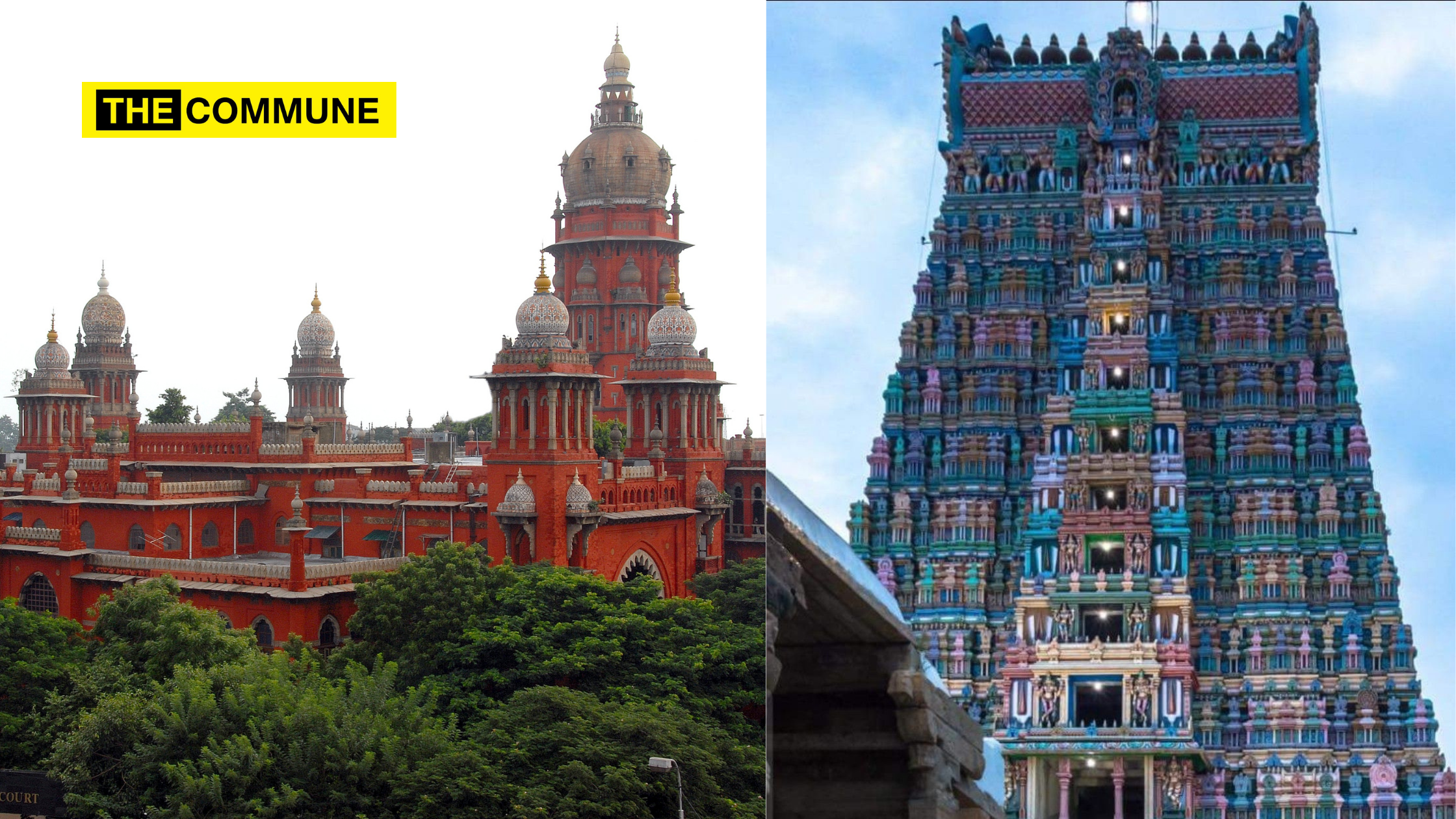
On 5 February 2025, Tirumala Tirupati Devasthanams (TTD) took action against 18 employees for participating in non-Hindu religious activities while also taking part in TTD festivals and rituals. This move was backed by a legal precedent set in November 2023 when the Andhra Pradesh High Court upheld Rule 3, affirming that trust boards have the authority to mandate service conditions, including the requirement that employees follow the Hindu religion.
In this article, we will look at seven court rulings in India regarding the employment of Hindu or non-Hindu individuals in temples.
#1 SC Rules Against Caste And Religious Barriers In Temple Appointments
On 16 December 2024, the Supreme Court heard the case Vinod Kumar M.P. and Ors. v. The Malabar Devaswom Board & Ors. [Special Leave to Appeal (C) No(s). 29188/2024], filed against The Malabar Devaswom Board. The Supreme Court dismissed the Special Leave Petition challenging the Kerala High Court’s decision to set aside the appointment of non-hereditary trustees of Sree Vairamcode Bhagavathi Devaswom by the Malabar Devaswom Board. The Bench, comprising Justices M.M. Sundresh and Aravind Kumar, clarified that the ruling would not affect the petitioners’ future eligibility. The Court emphasized that caste, race, religion, or language cannot be barriers to appointments and that non-hereditary trustee selections must follow strict fairness principles. The petition alleged political favoritism in trustee appointments, which the Court addressed by reinforcing merit-based selection criteria.
#2 Madras HC Upholds Hindu-Only Hiring Policy in Temple-Run College
On 26 November 2024, the Madras High Court dismissed a petition challenging an employment notification by Arulmigu Kapaleeswarar Arts and Science College, a self-financing institution run by the Arulmigu Kapaleeswar Temple. The petitioner, A. Suhail, a Muslim, argued that restricting appointments to Hindus violated constitutional provisions on equal opportunity. However, Justice Vivek Kumar Singh ruled that the college, as a religious institution governed by the HR&CE Act, could require employees to be Hindu. The Court held that Article 16(5) permitted such restrictions and dismissed the petition for lacking merit.
#3 AP High Court Upholds Termination of Temple Employee for Religious Conversion
On 17 November 2024, the Andhra Pradesh High Court upheld the termination of an employee of Sri Bramarambha Mallikarjuna Swamy Varla Devasthanam after he converted to Christianity. Justice Harinath N ruled that the termination was valid under Article 16(5) of the Constitution and Rule 3 of the Andhra Pradesh Religious Institutions Service Rules, which require temple employees to be Hindu. The petitioner argued he had not converted, but the Court found evidence of his marriage in a church under Christian rites. The petition was dismissed, affirming the temple’s right to enforce religious requirements.
#4 SC Allows Govt Employees to Manage Temples in Absence of Trustees
On 5 October 2022, the Supreme Court upheld the Tamil Nadu government’s deputation of government employees to manage temples due to a lack of trustees. Justices D.Y. Chandrachud and Hima Kohli ruled that the move was in the temples’ best interest under the Tamil Nadu Hindu Religious and Charitable Endowments Act, 1959. Petitioner T.R. Ramesh argued that only trustees could appoint temple staff, but the Court found the deputation necessary to prevent administrative chaos. The Court ordered Tamil Nadu to provide data on temples without trustees and those managed by government officers.
#5 Hyderabad HC Stays Termination of Non-Hindu TTD Employees
On 22 February 2018, the Hyderabad High Court halted Tirumala Tirupati Devasthanams (TTD) from terminating 36 Muslim and Christian employees. Justices Ramesh Ranganathan and K. Vijaya Lakshmi questioned why authorities enforced Rule 9(6) after two decades, despite no mention during recruitment. The court criticized TTD’s sudden stance and stated it would review the constitutional validity of the rule. The bench emphasized that TTD runs institutions beyond temples and warned that executive officers responsible for hiring non-Hindus should also be held accountable.
#6 Madras HC Rules That Hindu Temples Can Choose Hindu-Owned Security Agencies
On 4 October 2011, the Madras High Court ruled that Hindu temples cannot be compelled to hire security agencies owned by non-Hindus. Justice K. Chandru dismissed a petition challenging a tender by Subhramaniya Swamy Temple, stating that temple management has the right to decide on sensitive matters like security. The court cited Section 10 of the Tamil Nadu Hindu Religious and Charitable Endowments Act, which mandates temple servants must be Hindus. It rejected claims of discrimination, emphasizing that religious reforms must come from within the faith, not through judicial intervention.
#7 Karnataka HC: No Blanket Ban on Non-Hindus in Endowment Offices
On 15 December 2020, the Karnataka High Court dismissed petitions seeking to bar non-Hindus from working under the Commissioner for Hindu Religious Institutions and Charitable Endowments. The Bench of Chief Justice Abhay Oka and Justice S. Vishwajith Shetty ruled that the 1997 Act does not prohibit non-Hindus from holding certain posts. It noted that roles like data entry or supervision are not directly linked to religious administration. The court also rejected objections to a Muslim officer’s name on a temple festival invite, stating that secular governance includes facilitating religious events across faiths.
Subscribe to our channels on Telegram, WhatsApp, and Instagram and get the best stories of the day delivered to you personally.
Canadian Prime Minister Justin Trudeau has said that US President Donald Trump’s threat to annex Canada “is a real thing,” media reported. According to a CBC News report, Trudeau told business leaders on Friday at the Canada-US Economic Summit in Toronto that it would be motivated by the access to Canada’s critical minerals.
“Trump has it in mind that the easiest way to do it is absorbing our country and it is a real thing,” Trudeau was quoted as saying. The Prime Minister went on to say that Trump is driven because the US could benefit from Canada’s critical mineral resources, Xinhua news agency reported.
Trudeau made the remarks after delivering an opening address to the summit Friday morning, outlining the key issues facing the country when it comes to Canada’s trading relationship with the US, CTV News reported. The Canadian PM said Canada needs both a tactical response to Trump’s tariff threats in the short term, as well as a strategy for dealing with a less cooperative US in the long term.
In an interview with CNN before Trump’s inauguration, Trudeau said that Trump’s comments about turning Canada into the United States’ 51st state are just a distraction from the consequences of Trump’s tariff threats. Trump’s threat to make Canada the 51st state a distraction from tariff fallout, Trudeau said.
He added that Canada becoming another US state was “not going to happen”. The Trump administration last week announced to impose tariffs on imports from Canada, and Canada hit back with 25-per cent tariffs on 155 billion Canadian dollars ($107 billion) worth of American goods. The two countries then paused the proposed tariffs for at least 30 days. Trump has said if Canada wants to avoid steep tariffs it could become the 51st US state.
However, after Trudeau made commitments to bolster security at Canada’s border, Trump announced on Monday a pause on the proposed tariffs for at least a month. After a call with Trump, Trudeau said Canada would be implementing its previously announced $1.3 billion border plan, as well as committing to appointing a “fentanyl czar” and listing cartels as terrorists.
–IANS
Subscribe to our channels on Telegram, WhatsApp, and Instagram and get the best stories of the day delivered to you personally.
Former Seattle City Council member Kshama Sawant has claimed that the Indian government has denied her a visa, preventing her from visiting her ailing mother in India. In a post on X last week, Sawant stated,“India’s PM Modi & the BJP government are denying me a visa to see my ill mother. I’m not alone. Modi has retaliated against other activists & journalists, denying or revoking entry into India.” She linked the alleged visa denial to her past criticism of the Indian government, particularly her opposition to the Citizenship Amendment Act (CAA) and the National Register of Citizens (NRC).
India's PM Modi & the BJP government are denying me a visa to see my ill mother.
I’m not alone. Modi has retaliated against other activists & journalists, denying or revoking entry into India.
However, did you know that the anti-CAA activist threw her grandpa under the bus to score political brownie points. She pushed for Seattle to include caste in its anti-discrimination laws, citing an incident from her childhood—claiming that, at six years old, she heard her grandfather use a “slur” to summon their lower-caste maid. Of course, her grandfather never had the chance to defend himself against this accusation. When political agendas are at stake, some people will say anything to justify their cause. Imagine a 6 year old being able to remember such minute details!
Never forget that this Kshama is the same person who threw her own grandfather under the bus to score political brownie points. When she wanted to force Seattle to add caste to their anti discrimination laws – the example she gave was of her own past as a 6 year old hearing her… https://t.co/uR6b5P2fdHpic.twitter.com/nCXx0V07f5
— Savitri Mumukshu – सावित्री मुमुक्षु (@MumukshuSavitri) February 7, 2025
Now she wants the Indian government to give her a visa to visit her allegedly ailing mother. Earlier, along with her husband, the duo created a ruckus outside the Indian consulate in Seattle. Her cronies recorded a video of her and her husband ranting against the Modi administration.
She even invoked Mahatma Gandhi and spoke about India being a country of civil disobedience. In the video, she is seen saying, “They are threatening to call the police on us. They kept saying this is not the way. We said aren’t you from the same country that I was born in, the country of Mahatma Gandhi, a country of civil disobedience which was integral to India’s revolution for independence from the British empire?”
Hehehe … this video is so fingerlickingly delicious. Kshama Sawant & her cucksband are citing mahatma Gandhi and displaying their furious impotence outside the Indian consulate in Seattle. Comeuppance is ❤️ pic.twitter.com/IHo2gdr6bw
The Indian Consulate in Seattle posted on their official X handle about the ruckus that Sawant and her husband had been creating at the premises. They wrote, “Today, the Consulate was forced to deal with a law and order situation arising from the unauthorized entry by certain individuals into the Consulate premises after office hours. Despite repeated requests, these individuals refused to leave the Consulate premises and engaged in aggressive and threatening behaviour with the Consulate staff. We were compelled to call in relevant local authorities to deal with the situation. Further action is being initiated against the trespassers.”
Today, the Consulate was forced to deal with a law and order situation arising from the unauthorized entry by certain individuals into the Consulate premises after office hours.
Despite repeated requests, these individuals refused to leave the Consulate premises and engaged in…
This denial of a visa comes amid Sawant’s history of controversial political actions. In February 2020, Sawant was behind a Seattle City Council resolution condemning India’s CAA and NRC. The resolution, which passed unanimously, reaffirmed Seattle as a welcoming city, expressing solidarity with the city’s South Asian community, regardless of religion and caste. It opposed the CAA and NRC, calling them discriminatory to Muslims, oppressed castes, women, indigenous, and LGBT people.
The resolution called on the Indian Parliament to repeal the CAA, halt the NRC, and ratify various UN treaties to aid refugees. Ahsan Khan, president of the Indian American Muslim Council, praised the move, stating that Seattle’s decision should serve as a message to those undermining pluralism and religious freedom. Thenmozhi Soundararajan of Equality Labs also expressed support, framing Seattle’s action as part of a global outcry against the CAA.
In February 2023, Sawant sponsored another controversial resolution, making Seattle the first city in the United States to officially recognize “caste” as a protected category under its non-discrimination policy. The ordinance was criticized by Hindu organizations for singling out South Asians, potentially leading to bias against the community.
Subscribe to our channels on Telegram, WhatsApp, and Instagram and get the best stories of the day delivered to you personally.
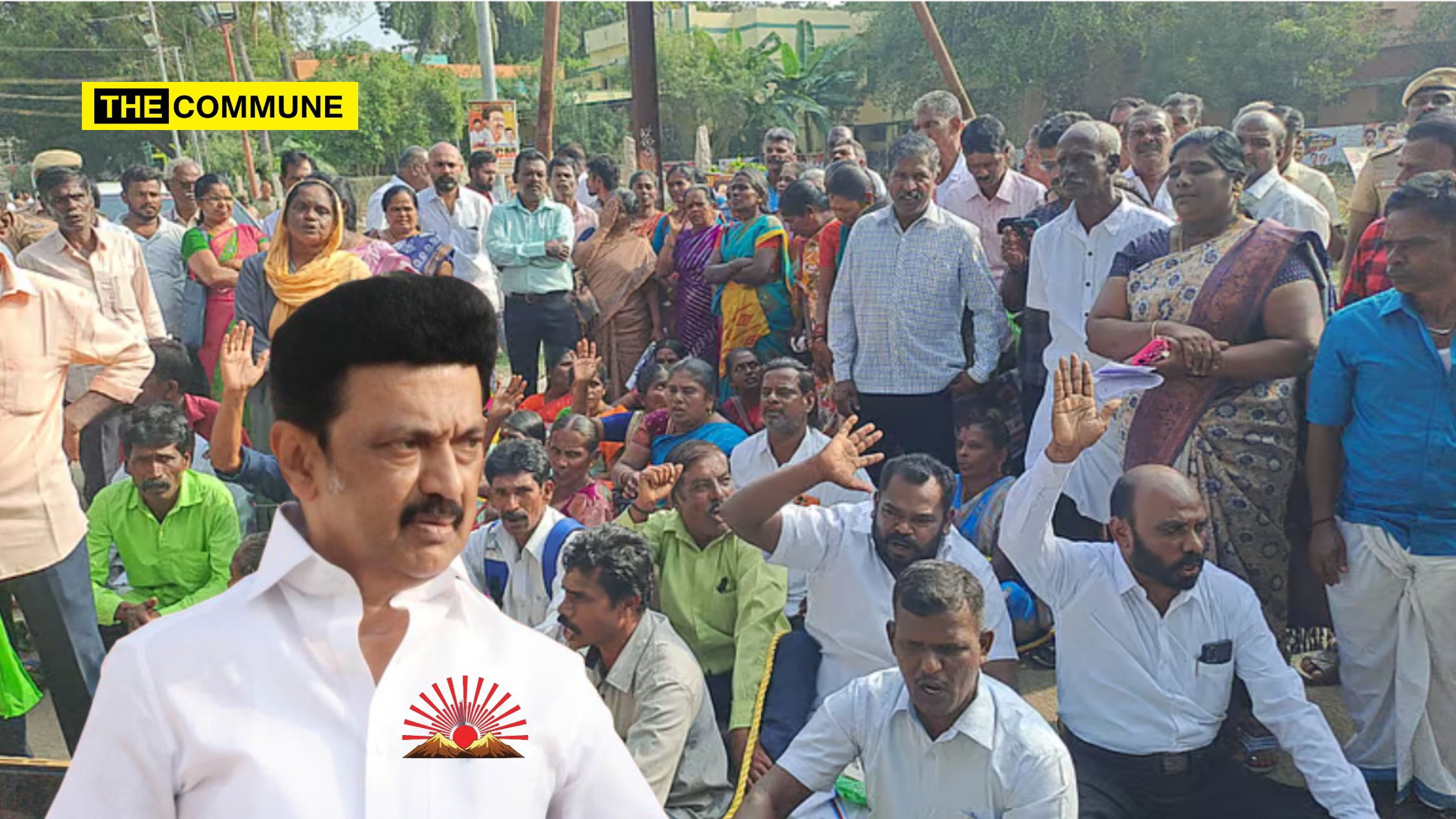
The fate of Manjolai tea estate workers remains uncertain, leaving them frustrated and disheartened after Chief Minister M.K. Stalin failed to address their concerns. These workers, employed at the Bombay Burmah Trading Corporation Ltd (BBTCL) tea plantation in the Western Ghats near Ambasamudram in Tirunelveli district, have been struggling since the plantation’s closure. The shutdown has left over 500 workers and their families without a livelihood. Despite numerous requests to the government over the past nine months to reopen the plant, the government has been unresponsive, and the workers’ hopes were dashed even during the Chief Minister’s recent visit to the area.
During his two-day visit to Tirunelveli district, Stalin inaugurated various government projects. On the first day, he launched the Tata Solar and Vikram Solar initiatives and held a road show with the public. Later, he met with newly inducted party members and executives. In a lighter moment, Stalin visited a shop Iruttu Kadai halwa, enjoyed the treat, and posted a photo on social media.
The second day of his visit was marked by plans to meet with the Manjolai tea estate workers at the Vannarapettai government guest house. The workers, who had traveled overnight to meet him, arrived at 7 a.m. but were kept waiting until 9 a.m. Frustrated, they staged a dharna outside the guest house. The police tried to disperse the protesters but eventually allowed five workers to meet with the Chief Minister. However, their concerns were not addressed, and they were only given the opportunity to submit a petition before being sent away.
The workers expressed their disappointment, revealing that they had been without work for nearly nine months after the BBTCL administration shut down the tea estate. With no work in tea estates, they have been struggling to make ends meet. Despite receiving assurances from DMK Minister K.N. Nehru that they would be allowed to meet Stalin, their hopes were shattered when the Chief Minister’s convoy left without stopping to hear them out.
Feeling ignored and let down, the workers voiced their anger, stating they had endured immense hardship to meet Stalin, hoping for a resolution to their problems. However, their last hope was now crushed.
Meanwhile, Chief Minister Stalin went on to inaugurate 23 completed projects worth ₹1,304.66 crore at a government hospital, laid the foundation for 20 new projects worth ₹309.05 crore, and distributed welfare aid totaling ₹167 crore to 75,151 beneficiaries. During his address, Stalin reiterated that Tirunelveli district would soon see significant growth, describing it as the “tiger’s leap” of the future, while also emphasizing that the DMK’s policies and achievements would ensure its continued governance in Tamil Nadu.
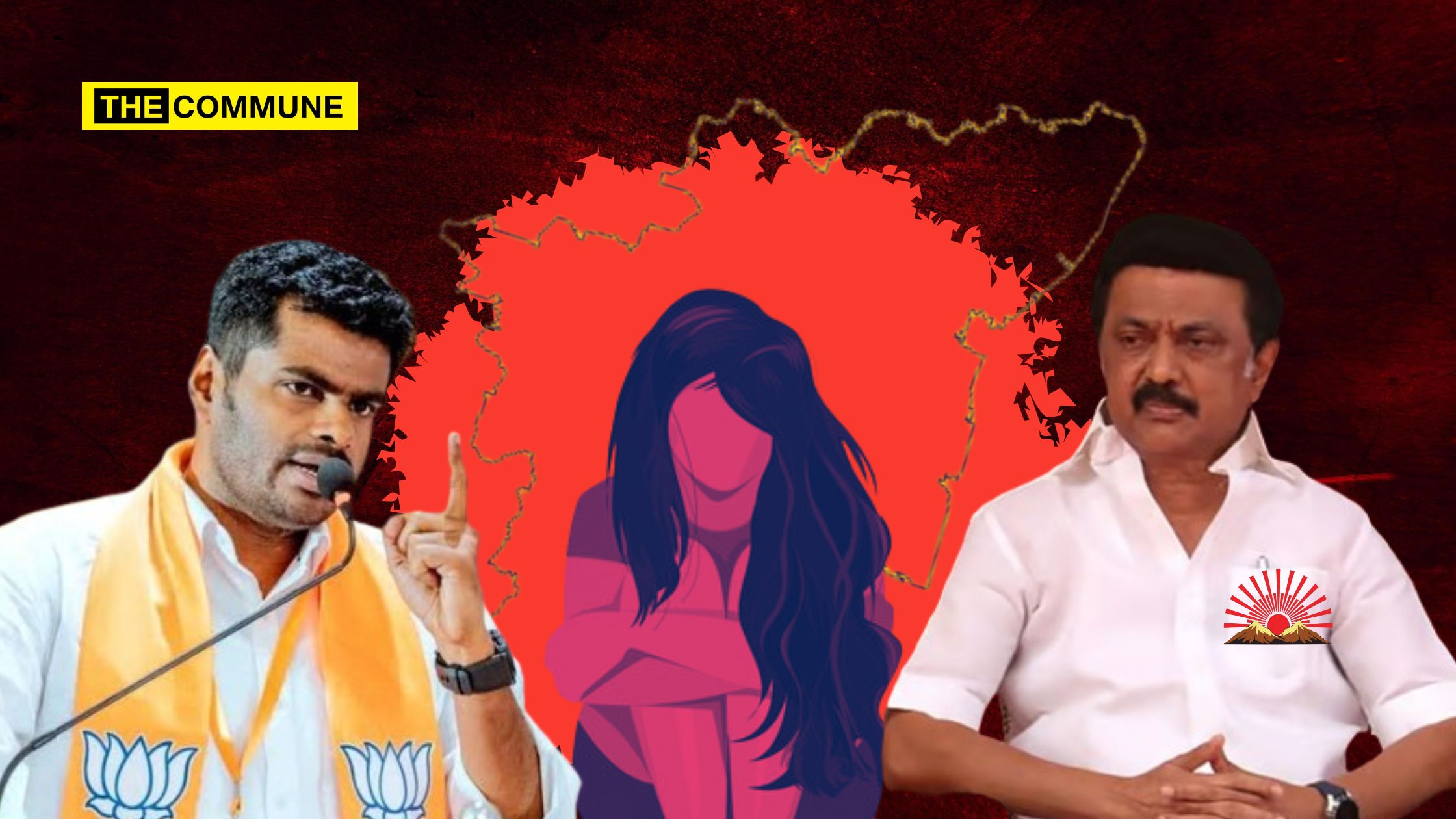
Tamil Nadu BJP President Annamalai has criticized the ruling DMK government for its failure to address the growing issue of crimes against women and children, particularly the rise in sexual harassment, rape, and murder. He pointed out that these incidents are becoming increasingly common, and the media is dominated by such reports, creating fear in society, especially pushing women back into traditional, restrictive roles.
Annamalai shared a list of serious crimes on his official X account, questioning whether Chief Minister MK Stalin is unconcerned by the alarming rise in such incidents, as the DMK government has failed to take significant action. It is noteworthy here that despite Stalin’s recent pledge in the assembly to implement stricter laws to combat crimes against women, these promises have remained unfulfilled, with no real changes visible on the ground.
TN BJP chief Annamalai via his official X accounted stated, “My heart aches reading the news that comes out every day in Tamil Nadu. Our society is becoming so unsafe that not a day goes by without sexual crimes against women. Before the shock of the news of a Krishnagiri government school girl being sexually assaulted by three teachers subsided, today morning alone, there were reports of crimes against women such as the sexual harassment of a fourth-grade student by private school administrators in Manapparai, the sexual harassment of a pregnant woman travelling in a train in Vellore and pushed off from the train, the sexual harassment of a government school girl by a physical education teacher in Salem, and the murder of a panchayat vice-chairman’s wife by entering the house in Tirupattur. Where is Tamil Nadu going? The DMK runs a useless government based on the principle that “as is the king so are the subjects” and using the state machinery to protect the criminals if they are DMK members has led to the fact that today anti-social elements have no fear of the law or the police. Doesn’t it bother you, Chief Minister @mkstalin, from adults women to small children, are not safe in Tamil Nadu?”
தமிழகத்தில் ஒவ்வொரு நாளும் வெளியாகும் செய்திகளைப் படிக்கும்போது மனம் பதைபதைக்கிறது. பெண்களுக்கு எதிரான பாலியல் குற்றங்கள் நடைபெறாத நாளே இல்லை என்னும் அளவுக்கு, நமது சமூகம் பாதுகாப்பற்றதாக மாறி வருகிறது.
கிருஷ்ணகிரி அரசுப் பள்ளி மாணவி, மூன்று ஆசிரியர்களால் பாலியல் வன்கொடுமை…
The United States Agency for International Development (USAID) is facing mounting criticism following an executive order signed by President Donald Trump, pausing foreign assistance for 90 days. The move comes amid allegations of excessive and questionable spending by the agency, prompting investigations and administrative action.
President Trump, who has long criticized USAID’s operations, stated, “USAID is being run by radical lunatics,” vowing to eliminate what he calls “waste, fraud, and abuse.” Secretary of State Marco Rubio also weighed in, calling USAID a “global charity” operating with little regard for U.S. national interests. As a result, USAID’s Washington headquarters has been temporarily closed, and several senior officials have been placed on leave pending investigations.
The House Foreign Affairs Committee, chaired by Representative Brian Mast, recently disclosed a series of expenditures that it described as “outrageous.” The committee’s findings include the following:
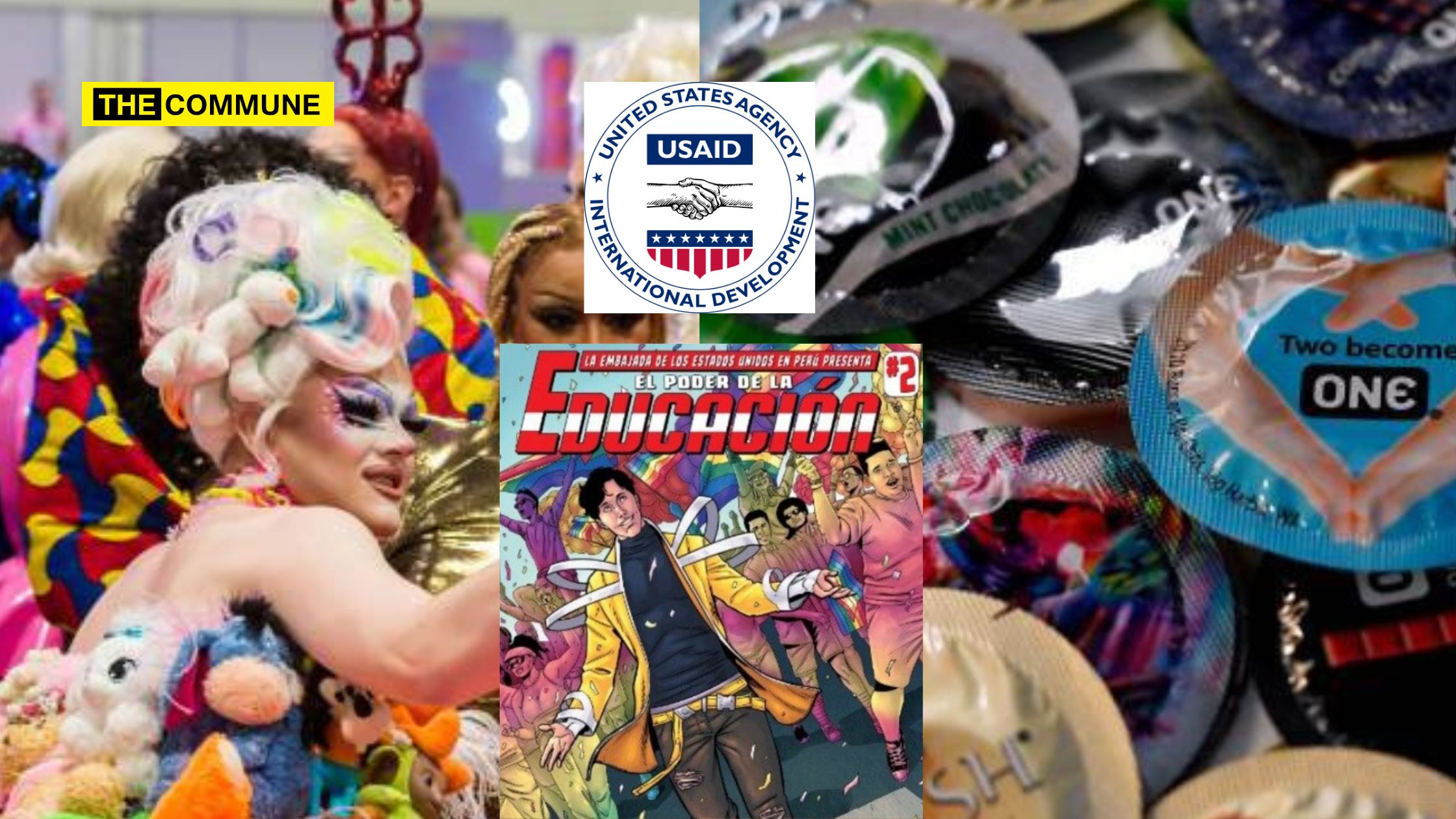
$15 million for condoms for the Taliban – Representative Mast claimed that USAID allocated this sum to provide condoms to the Taliban, an extremist group known for suppressing women’s rights.
$446,000 to promote atheism in Nepal – Funds were allegedly funneled to promote secularism in the predominantly Hindu nation.
$47,000 for a transgender opera in Colombia – U.S. taxpayer dollars were reportedly used to fund a transgender-themed opera performance.
$20,600 for drag shows in Ecuador – USAID provided grants to LGBTQ organizations, including funds used for a two-day drag workshop.
$350 million for a pier in Gaza – The project, ostensibly for humanitarian aid, has been criticized as potentially benefiting terrorist groups.
$1 million for LGBTQ advocacy in Africa – Funds were allocated to promote LGBTQ rights in West and Central Africa despite opposition from local governments.
$3 million for LGBTQ initiatives in the Caribbean – Critics argue that there was no clear explanation of how these funds were distributed.
$55,000 for a climate change seminar in Argentina – The event was exclusively open to female and LGBTQ journalists, raising inclusivity concerns.
$2 million for gender reassignment procedures in Guatemala – Funding was allocated for medical procedures and activism in a traditionally conservative country.
$425,000 to make Indonesian coffee businesses more gender-inclusive – This initiative sparked debate over its relevance to American taxpayers.
$32,000 for a transgender comic book in Peru – Funds were used to create an LGBTQ-focused publication.
Millions to EcoHealth Alliance, linked to the Wuhan Lab – USAID has reportedly supported the organization connected to controversial COVID-19 research.
Food aid reaching al-Qaeda fighters in Syria – Reports indicate that humanitarian assistance may have inadvertently benefited extremist groups.
Hundreds of millions for Afghan poppy cultivation – USAID’s investments in irrigation and farming allegedly helped sustain the Taliban’s heroin trade.
$14 million in cash vouchers for migrants at the U.S.-Mexico border – Critics claim the policy encourages illegal immigration.
The White House and congressional Republicans have called for greater oversight and accountability in USAID’s financial decisions. The agency has yet to officially respond to the allegations, but investigations are expected to continue in the coming weeks.
The 2025 edition of the Chennai Rainbow Film Festival 2025, organized by the LGBTQIA+ community, will take place under the leadership of transgender activist Sasha, daughter of actress Shakeela. This will be the festival’s 4th edition, and it marks the 7th year of the event’s history. Actress Shakeela shared that the festival has received over 2,000 submissions from around the world, including films, short films, and documentaries that showcase the lives of LGBTQIA+ individuals.
From these, 55 films have been selected and will be showcased during the festival on the 7th, 8th, and 9th of February 2025. The films will be divided into four categories, with the top three being chosen for special recognition. Shakeela emphasized that the films will address important societal issues faced by the LGBTQIA+ community, reflecting the struggles and challenges they’ve faced, especially highlighting the significance of the Supreme Court’s decriminalization of Section 377, which once made LGBTQIA+ individuals subject to punishment.
The festival will also feature discussions on the work done to fight for this legal change and the transformation in the community since the repeal of the law. Among the special guests at the event are actress Vanitha Vijayakumar, writer Manusha Puthiran, actress and social activist Rekha Nair, model and activist Thirunambi Karan Raman, and transgender activist Sasha. The event will be moderated by transgender actress Neha. Additionally, other notable figures, including Jaya, Sreejith, Supreme Court lawyer Prabhakaran, journalist Priya Menon, and Kerala-based activist Sanathiya, will join the discussions moderated by Saran Jayaraman.
There will also be artistic performances, dance routines, and two emotional stage plays aimed at engaging the public. One of the key highlights of the event will be the presentation of the Rainbow Ambassador Award, which honors individuals who have supported the LGBTQIA+ community through various platforms. This year, the award will be presented to kiruthiga udhayanidhi, journalist Asifa Fatima, director Nandini for movie Inspector Rishi, actress Shakeela, TM Krishnan and among others. The awards are presented by Narthaki Nataraj, an Indian trans woman Bharatanatyam dancer and 2019 Padma Shree awardee, S Ve Shekher, Seetha Lakshmi IAS and Playback Singer Mano.
Krithika Udhayanidhi, the wife of the Deputy Chief Minister, has been recognised for her filmmaking, particularly for her movie Kadhalika Neramillai, which explores the story of two men in a romantic relationship.
Subscribe to our channels on Telegram, WhatsApp, and Instagram and get the best stories of the day delivered to you personally.