Home Blog Page 392

Sambhaavnaa, USAID & Akash Banerjee: The Hidden Network Behind India’s Media Manipulation?
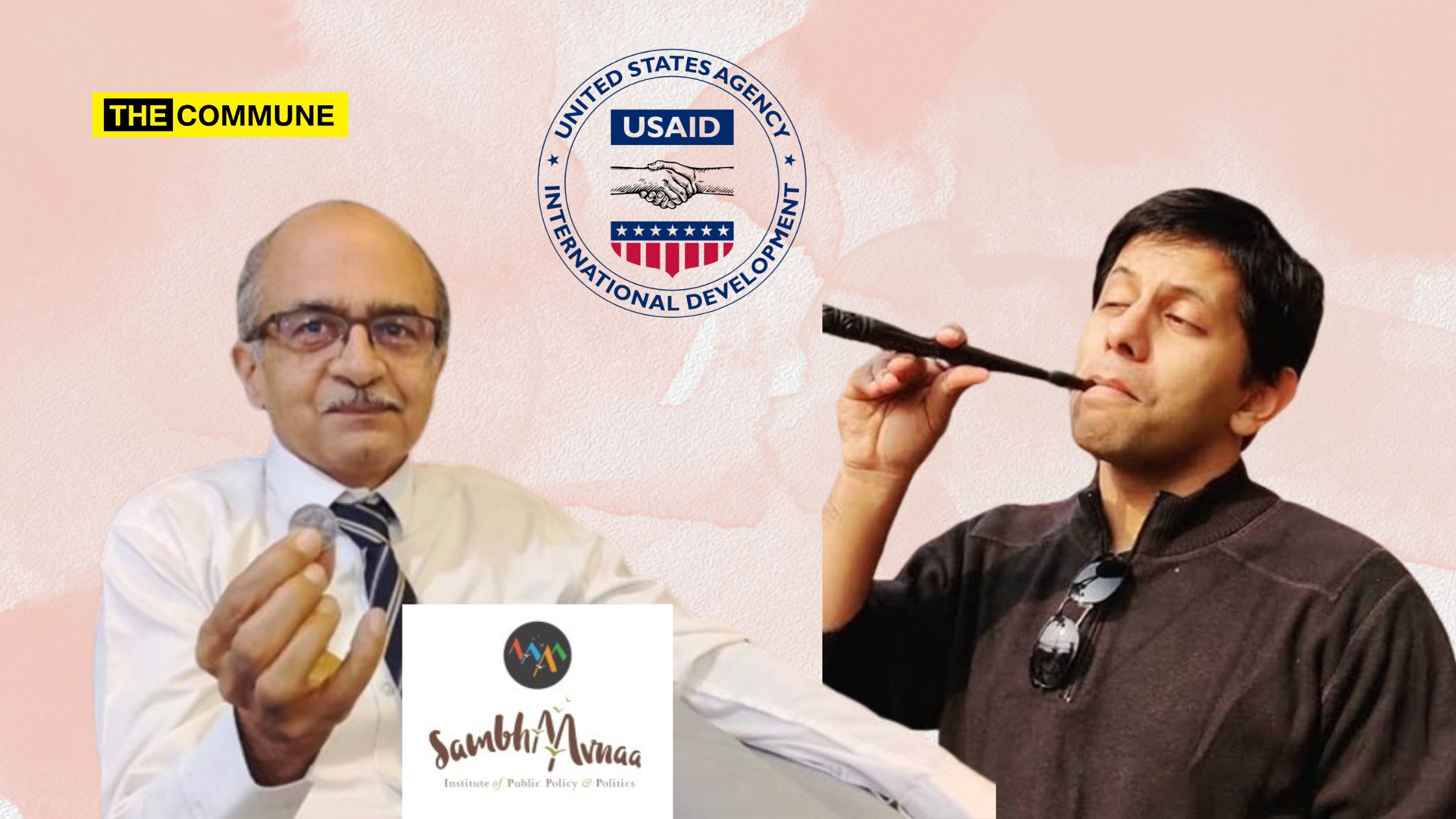
In February 2025, WikiLeaks exposed a massive funding operation by the United States Agency for International Development (USAID), revealing its financial backing of the anti-India ecosystem. This revelation exposed the deep involvement of USAID in shaping narratives critical of the Indian government, particularly through organizations like Internews and its Indian affiliates. One of the most notable connections was Prashant Bhushan’s Sambhaavnaa Institute of Public Policy and Politics, which has long been a hub for left-leaning media figures and activists critical of the Modi government. This exposure raised serious questions about the extent of foreign interference in India’s internal affairs, particularly through media and social influence campaigns.

US Embassy & Association With “Influencers” In India

Let’s jog our memory a bit – In July 2024, the US Embassy in India announced an event for Indian social media influencers and content creators, branded as “Influence to Impact,” scheduled for 25 July 2024. The event aimed to enhance digital engagement on social issues and promote “active citizenship.” However, the selection of YouTuber “DeshBhakt” Akash Banerjee—known for his leftist and anti-BJP propaganda—as the key speaker raised eyebrows. While the initiative appeared neutral on the surface, the embassy’s promotional content suggested subtle political interference in India’s internal discourse. This raised a fundamental question: Why was the US Embassy in India so invested in shaping Indian public opinion on domestic issues? Was it their role to push narratives on “active citizenship,” or was it an attempt to subtly interfere in India’s political landscape, especially given the Modi government’s firm stance against direct foreign intervention?

That was not the first time the US Embassy in India amplified voices known for their leftist and anti-BJP views. In March 2023, the embassy endorsed controversial radio jockey Sayema Rahman for Women’s History Month, sparking outrage due to her history of anti-Hindu and Islamist rhetoric. Despite widespread criticism, the embassy promoted Sayema as a voice for democracy. Similarly, the selection of Akash Banerjee for the “Influence to Impact” event drew backlash, given his controversial content, including trivializing the brutal rape and murder of Nirbhaya. By positioning Banerjee as a mentor to Indian influencers, the embassy’s repeated endorsement of such figures raised concerns about whether the US was genuinely promoting meaningful change or grooming Indian influencers to push narratives aligned with American interests.

Sambhaavnaa Institute & Akash Banerjee

The Sambhaavnaa Institute of Public Policy and Politics, established in 2004 by Prashant Bhushan under the Kumud Bhushan Education Society, claims to address societal injustices but has been accused of fostering a left-leaning media ecosystem in India.

Located in Kandbari village, Himachal Pradesh, the institute has become a hub for workshops featuring prominent leftist figures, including Yogendra Yadav, Harsh Mander, Medha Patkar, Pratik Sinha (Alt News), Ravish Kumar, and others. These individuals are known for their anti-BJP and anti-Hindu rhetoric, raising questions about the institute’s true agenda.

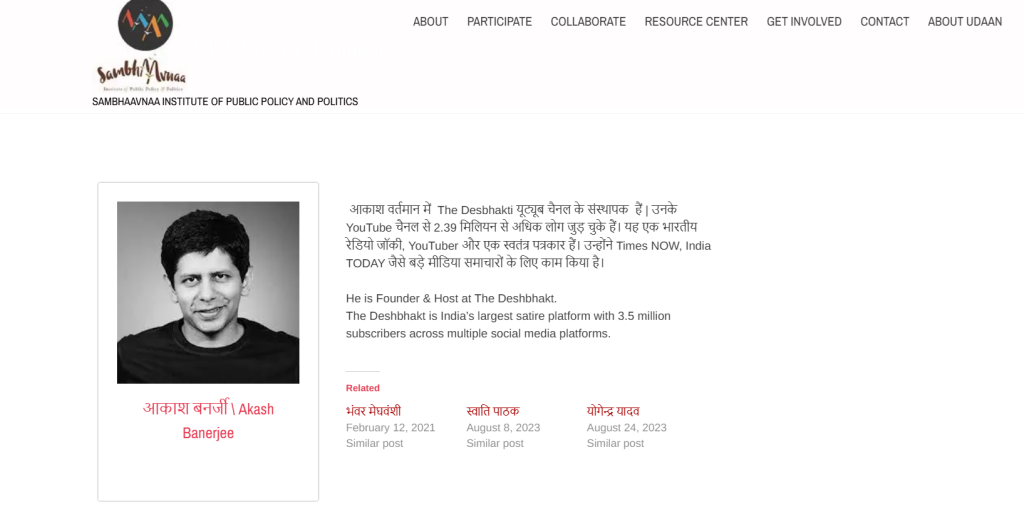
The institute’s network includes journalists and media professionals such as Paranjoy Guha Thakurta, Ravleen Kaur, Atul Chaurasia (Newslaundry), and Akash Banerjee (DeshBhakt), who is listed as one of its “resource people.” Banerjee, a YouTuber known for his anti-BJP propaganda, has been actively involved in shaping narratives critical of the Indian government.
Sambhaavnaa’s activities are further linked to USAID-funded Internews, a global media organization accused of steering narratives in politically sensitive regions. Internews, which has funneled millions into media training and fact-checking initiatives, supports Factshala in India, a program tied to controversial media figures like Shekhar Gupta (The Print) and Ritu Kapur (The Quint). This connection exposes a broader strategy of foreign-funded influence over India’s media landscape, aimed at promoting leftist narratives under the guise of media literacy and social justice. The institute’s ties to USAID and its association with propagandists like Banerjee highlight its role in shaping anti-government discourse in India.

US’ History Of Interfering With Internal Affairs Of Other Countries

The US has a long history of meddling in the internal affairs of other nations, including India. Over the years, Washington has been accused of interfering in the political affairs and elections of India, Bangladesh, and several other countries. US government bodies have routinely targeted the Modi administration through biased reports on human rights, hate speech, and minority rights, often relying on leftist sources. On multiple occasions, the US government has issued unsolicited statements on India’s internal policy matters under the pretext of “deep concerns.” For instance, the US State Department’s statement in support of the 2020–21 farmers’ protests against the Modi government’s agricultural reforms were condemned by New Delhi as unwarranted interference. Similarly, US lawmakers criticized India’s Citizenship Amendment Act (CAA) in 2019, labeling it discriminatory, and the US House of Representatives held hearings on human rights in Kashmir after the abrogation of Article 370.

Eric Garcetti, the US Ambassador to India, has repeatedly made direct remarks on India’s domestic issues. In a recent instance, he commented on the Manipur violence, offering unsolicited opinions on the situation. He even took a veiled jab at Prime Minister Narendra Modi following his visit to Russia, suggesting that India’s strategic autonomy does not exist in times of conflict—implying that the US disapproves of India’s independent foreign policy. It is evident that the US prefers a weak Indian government, one that can be easily influenced, rather than a strong, assertive leadership like Modi’s.

Since direct interventions have failed to shift India’s major policy decisions, the US appears to be exploring subtler means to shape public opinion. One such method is the recruitment and training of “fact-checkers” under the pretense of promoting media literacy. The US Embassy in India has launched the “Empowering Media Savvy Youth” project, allocating a budget of $200,000 to “combat online manipulation” and “reinforce regional security.” This initiative raises concerns about the US’s real intentions—would Washington tolerate similar programs initiated by the Indian Embassy in the US to shape American public opinion?

The US’s Strategy: Influencers, Fact-Checkers, And Media Training

This pattern of influence is not confined to India. The Biden administration itself has adopted a strategy of paying influencers to control narratives and sway public opinion. Reports suggest that ahead of the upcoming US presidential elections, the Democratic National Committee (DNC) has engaged around 150 influencers across platforms like Instagram, TikTok, and YouTube, spending over $1 million on pro-Biden content. By leveraging influencers, the administration aims to reach young voters who increasingly consume news through social media rather than mainstream media. The CIA has also used pop culture and digital platforms to subtly push narratives in both domestic and international arenas, making intelligence agencies less conspicuous while maximizing their influence.

Ultimately, the US’s growing influence over Indian social media, fact-checking networks, and media literacy programs points to a larger strategy of narrative control. Whether through embassy-endorsed influencers, strategic funding of media training programs, or intelligence-backed digital campaigns, the US is actively shaping India’s information landscape while maintaining the illusion of non-interference. This neo-colonial approach undermines India’s sovereignty and the principles of genuine bilateral cooperation. If the US truly values its partnership with India, it must respect the country’s right to independent policymaking, rather than attempting to engineer public opinion through carefully orchestrated influence campaigns.

(With input from OpIndia)

Subscribe to our channels on Telegram, WhatsApp, and Instagram and get the best stories of the day delivered to you personally.
DMK Coimbatore Functionary Whose Grandkids Study 3 Language Policy In CBSE School Vandalizes Hindi Name In Pollachi Railway Station

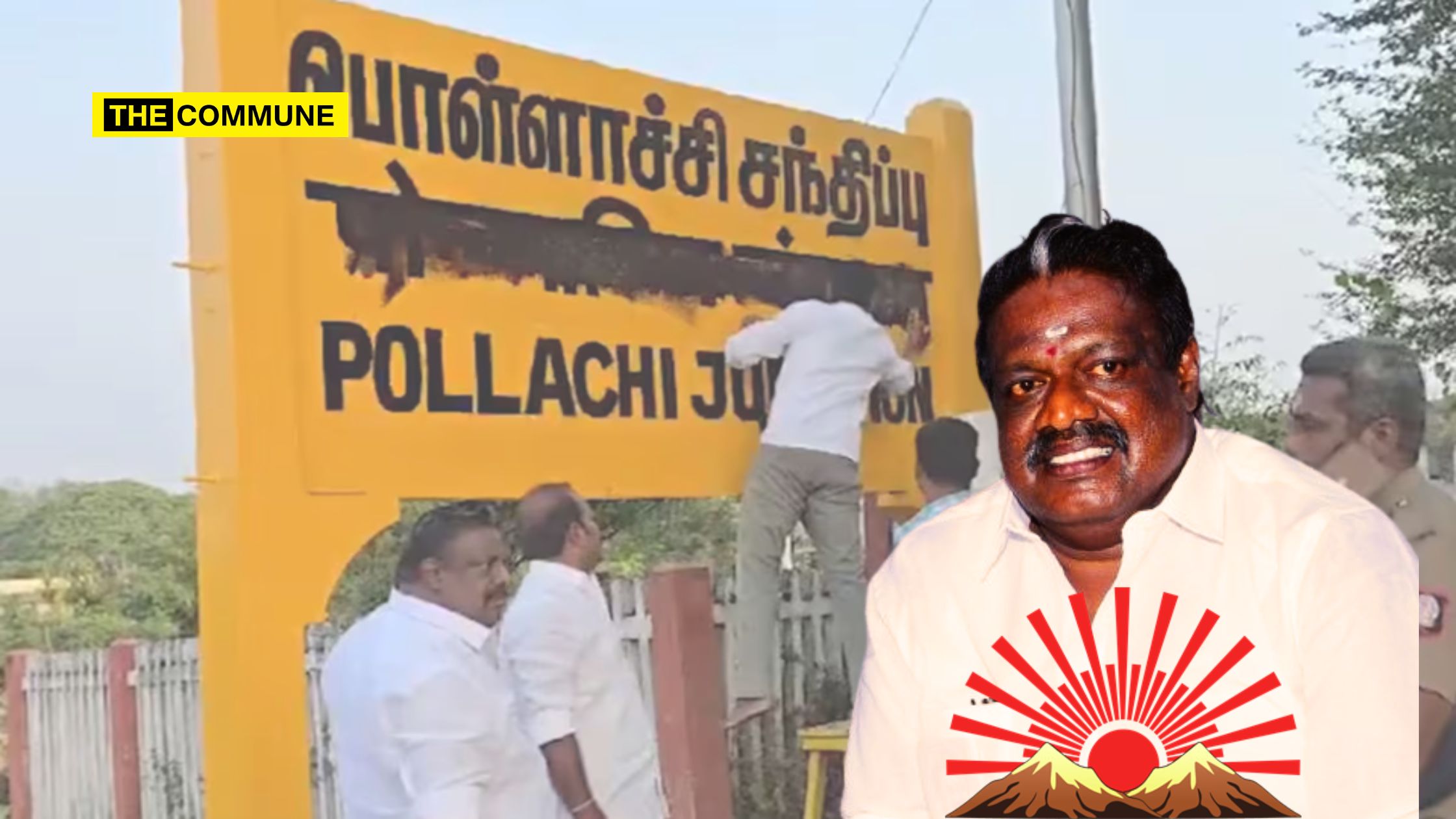
A Coimbatore DMK functionary, ‘Thendral’ Selvaraj, who has been ‘vocal’, like his party, against the Centre’s alleged imposition of Hindi through the National Education Policy (NEP) 2020, was booked on 23 February 2025 for defacing Hindi lettering on a signboard at Pollachi Junction railway station.

However, in a glaring contradiction, it has come to light that his own grandchildren study in private schools that follow the three-language policy, including Hindi, under NEP 2020.

The Railway Protection Force (RPF) registered a case against Selvaraj, who is in charge of DMK’s legal wing for Coimbatore South, along with four others under Sections 166 (defacing public notices), 147 (trespass and refusal to desist from trespass), and 145(b) (committing a nuisance or act of indecency or using abusive or obscene language) of the Railways Act, 1989.

According to the Palakkad Division of the Southern Railway, a group of men entered Pollachi Junction around 7:20 a.m. on Sunday, 23 February 2025, and vandalized the Hindi text on a station signboard using black paint. RPF personnel detained the individuals and restored the defaced board soon after the incident.

A video of the act, which was widely circulated on social media, shows Selvaraj and his supporters blackening the Hindi text while protesting against what they claim is the Centre’s hidden agenda to impose Hindi.

Ironically, while Selvaraj vehemently opposes the three-language policy in public, his own family seems to have embraced it. As posted on X by BJP Coimbatore South District President Vasantharajan, his son, Manimaran Thendral Selvaraj, serves as the deputy organizer of the DMK youth wing in Coimbatore South. Manimaran’s son, Maran, is currently studying at Subhash Vidya Mandir, a private school offering three languages, including Hindi. Similarly, Selvaraj’s daughter, Manimala, who is a member of the Pollachi 13th ward city council, has enrolled her son, Aadhavan, in Shanthi Nikethan Private School, which also follows a three-language curriculum.

The contradiction has sparked a debate on social media, with critics pointing out the apparent double standards of the DMK leader. While he publicly protests against the inclusion of Hindi in Tamil Nadu’s educational framework, his family members seem to have no qualms about following the same policy in private institutions.

DMK leaders, including Chief Minister M.K. Stalin, have long been vocal opponents of Hindi imposition in Tamil Nadu. Speaking recently on the issue, Stalin reiterated that the Centre “cannot impose Hindi as long as the DMK exists.” However, revelations about Selvaraj’s family’s education choices have raised questions about the party’s commitment to its stated principles.

Signboard Restored

It is noteworthy that when the vandalism went viral, DRM Palghat was alerted on X by the RailwaySeva handle.

And within about 2 hours, the defaulters were identified, booked, and the signboard was restored with Hindi lettering as before.

(With inputs from The Hindu)

Subscribe to our channels on Telegram, WhatsApp, and Instagram and get the best stories of the day delivered to you personally.

DMK MP Kathir Anand’s CBSE School Offers Hindi, Tamil, And Telugu Contrary To His Party’s Anti-NEP, Anti-Hindi Rhetoric

The Dravidianist parties in Tamil Nadu, especially the DMK and its notable allies have been protesting against the alleged imposition of Hindi under the NEP 2020 in the state. While there is no known imposition, the education policy mandates that students study 3 languages as part of their curriculum. Dravidianists faking their love for Tamil allege that such practices will erase Tamil and impose Hindi (when the mandate is that students can learn any other language, not necessarily Hindi).

However, this hypocrisy gets exposed every single day given that political party leaders in Tamil Nadu, the majority of them if not all, run schools as well.

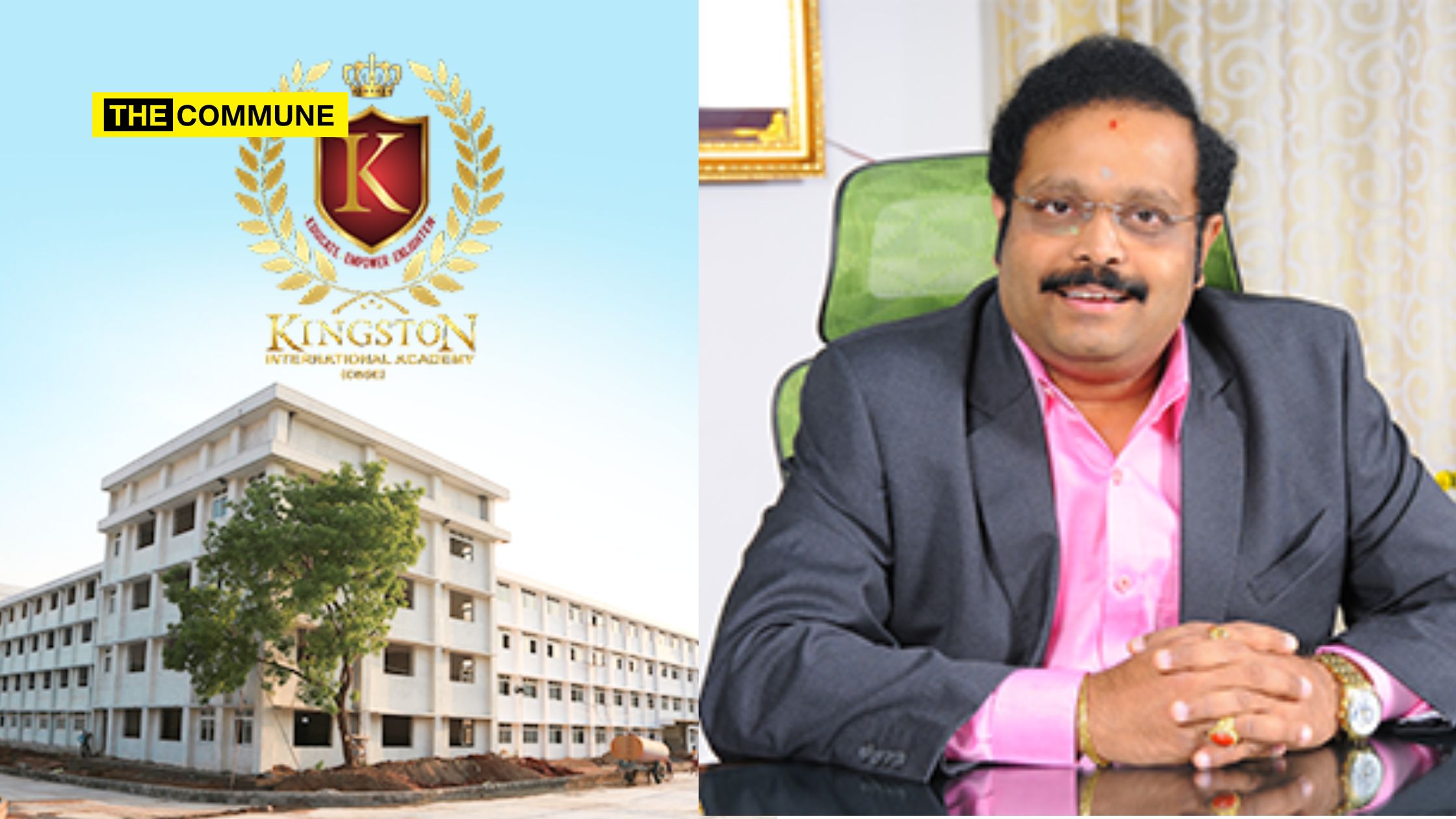
This time it is DMK MP Kathir Anand’s turn. He is the son of DMK Minister Duraimurugan. Kathir Anand is the Chairman of Kingston Group of Institutions, Vellore and his wife Sangeetha Kathir Anand is the Chairwoman.

This school is a CBSE school located in Vellore and they proudly claim that the school offers holistic learning. Ironically, for all the drama the DMK members do about 3-language policy and NEP2020, this school offers Hindi, Tamil, and even Telugu as an option for languages to the students.

We had earlier exposed that nearly 30-40 DMK members had a CBSE school attached to them.

Kathir Anand is already on that list along with DMK allies and Dravidianist parties like the TVK.

DMK MLA Markandeyan’s Sri Ambal Vidhyalaya

Now, DMK MLA GV Markandeyan is under the spotlight. He is one of the managing trustees of a CBSE school named Sri Ambal Vidhyalaya in Vilathikulam, Thoothukudi. This is an English-medium CBSE school. It is noteworthy that GV Markandeyan is an MLA from the same constituency – Vilathikulam.

Part-Time Politician Vijay’s Vijay Vidyashram

Part-time politician Vijay was exposed a few days ago for running a CBSE school that promotes learning Hindi. Some videos of the students at the school have been circulating on social media. These are most likely from the school’s Instagram handle. In one such video is a Hindi play performed by Class 3 students. This is from a performance for Hindi Diwas.

VCK MP Thirumavalavan’s Blue Star Secondary School

Anti-NEP and Anti-Hindi VCK chief Thirumavalavan was also exposed recently by TN BJP President K Annamalai. Thirumavalavan ias associated with Blue Star Secondary School, a CBSE-affiliated school in Velachery, Chennai, which offers trilingual education.

The blatant hypocrisy of the Dravidianist parties and its allies cannot be ignored. While they vocally criticize the three-language policy and present themselves as champions of Tamil, the inconvenient truth is that they all run CBSE schools in Tamil Nadu that directly follows the very policy they claim to oppose. Their attempt to position themselves as saviours of Tamil language rights crumbles in the face of this exposed contradiction.

Subscribe to our channels on TelegramWhatsApp, and Instagram and get the best stories of the day delivered to you personally.

Are Dravidian Model Govt Schools Safe? Alarming Rise In Sexual Assault Cases In TN Govt Schools

The situation in Tamil Nadu is becoming increasingly alarming as more and more cases of sexual harassment involving girl students in government-run schools are being reported daily. Even within a span of 48 hours, 3-4 cases of sexual assault have been reported. Despite this surge in incidents, neither the ruling DMK nor the School Education Department has taken significant measures to address the issue. Here are some recent cases of sexual harassment in Tamil Nadu government schools

Lab Assistant Arrested Under POCSO Act For Sexual Harassment In Salem Government School

Kumaresan (57), a lab assistant at a government school in Salem, was arrested under the POCSO Act for allegedly sexually harassing female students.

The incident occurred a few days ago when Kumaresan reportedly harassed the girls who were in the school lab. The students reported the incident to their class teacher, who then informed the headmaster, Ilango. In response, Ilango notified the district child protection office officials.

Officials from the district child protection office visited the school, personally investigated the students, and confirmed the harassment allegations against Kumaresan. Subsequently, the headmaster filed a complaint at the Ammapettai police station.

Following the complaint, the Ammapettai police conducted an investigation and arrested Kumaresan under the POCSO Act. He was produced in court and has since been sent to Salem Central Jail.

Govt. Teacher In Trichy Arrested For Alleged Sexual Harassment Of Second-Grade Student

A second-grade student at a Podhavur government primary school in Trichy was reportedly subjected to sexual harassment.

The incident took place while the student was cleaning the classroom at a school in the Podhavur area of Trichy district. During this time, a teacher at the school allegedly sexually harassed the student.

The girl’s parents filed a complaint with the police, leading to the arrest of the teacher, Jayaraj Susainathan. Initial police investigations have also uncovered some additional information related to the incident. It has been revealed that there have been sexual harassment complaints against this teacher for the past ten years. It appears he has been threatening the affected students and their parents during this period. Subsequently, a POCSO case has been registered against the teacher, who was produced before a judge and has been sent to jail.

Govt. School Headmaster In Pudukottai Arrested For Alleged Sexual Harassment Of Several Female Students

A 58-year-old assistant headmaster of a government high school in Pudukottai was arrested on 17 February 2025 under the Protection of Children from Sexual Offences (POCSO) Act for allegedly sexually harassing multiple girl students.

The arrest followed a week-long inquiry by the district child protection officer (DCPO) after a student contacted the Childline helpline (1098) on 10 February 2025, reporting the misconduct. Based on the inquiry, the DCPO lodged a formal complaint against the accused for allegedly inappropriately touching female students on the school premises. Following his arrest, the assistant headmaster was produced before the Pudukottai Mahila Court on Tuesday and remanded in judicial custody for 14 days. The Thirumayam all-woman police station has booked him under the POCSO Act and Section 7 of the Juvenile Justice (Protection of Children) Act. Authorities suspect that the accused may have been involved in similar misconduct for several months, though an in-depth investigation is still underway.

Govt. Teacher Commits Suicide Following Allegations Of Sexual Harassment By Student

A government school teacher in Ramanathapuram district died by suicide while under investigation for alleged sexual harassment of female students.

According to sources, the police, school education department officials, and child welfare officers had launched an inquiry into the allegations when the teacher was found dead on Tuesday (18 February 2025) morning. Authorities have not disclosed further details regarding the case.

The body was sent for post-mortem examination, and officials stated that the exact cause of death will be confirmed following the autopsy report. Investigations are ongoing.

Math Teacher Accused Of Sexual Harassment At Tiruppur Corporation School

A math teacher at a corporation school at Noyyal Road in Tiruppur has been accused of sexually harassing multiple students, triggering protests from outraged parents. The accused, identified as Sundara Vadivelu, allegedly targeted seventh-grade students over the past few months.

The issue came to light last Friday (7 February 2025) when parents lodged a complaint with the school principal. Following the allegations, officials, including the Tiruppur District Education Officer, the Assistant Commissioner of Police, and the District Child Protection Officer, launched an investigation. Sources indicate that more than ten children have come forward with complaints so far.

Authorities are also probing whether similar incidents have occurred involving other students, including boys, given that the school has a mixed-gender enrollment of over 700 students.

The accused teacher has been absent from school for the past week, reportedly taking leave before the allegations surfaced. His absence has further fueled tensions, with parents cordoning off the school in protest.

To control the situation, police have been deployed, and officials have urged parents gathered at the school premises to disperse. The investigation is ongoing as authorities work to determine the full extent of the allegations.

Temporary Teacher Arrested For Sexually Harassing Students At Govt School In Yercaud

A shocking incident of sexual harassment has come to light at a government higher secondary school in Yercaud, Salem district, where a temporary graduate teacher has been accused of harassing students. According to reports, Ilayakannu, a 37-year-old teacher from Neyyamali, Bettanayakkanpalayam, Salem district, had been sexually harassing 10th and 11th grade students at the school.

In a swift and decisive move, the Salem District Tribal Welfare Project Officer, Suganthi Parimalam, has ordered the permanent dismissal of the teacher. 

The incident came to light when an 11th standard student from Vellimalai, who is a resident of the school hostel, complained to the school principal that Ilayakannu, a 37-year-old temporary graduate teacher, had been sexually harassing her and four of her friends. The principal immediately informed the Salem District Child Protection and Welfare Committee officials, who conducted an investigation and found the allegations to be true.

A complaint was filed at the Kondambatti All Women’s Police Station, and a case was registered against Ilayakannu under the Protection of Children from Sexual Offences (POCSO) Act. The police subsequently arrested him.

The Tribal Welfare Department was informed about the incident, and Officer Suganthi Parimalam conducted an investigation, which led to the dismissal of Ilayakannu from his position as a temporary graduate teacher.

The incident has sent shockwaves through the community in Yercaud, and parents of students at the school are demanding greater safety and security measures to protect their children from such incidents in the future. The swift action taken by the Tribal Welfare Officer has been welcomed by social activists, who are calling for greater accountability and stricter measures to prevent such abuses of power and trust.

The government higher secondary school in Yercaud is run by the Tribal Welfare Department, and the incident has raised concerns about the safety and well-being of students, particularly girls, in educational institutions.

Temporary Physical Education Teacher Arrested For Sexually Harassing Student In Salem

In yet another disturbing incident of teacher misconduct, a temporary physical education teacher at a government model school in Kuppur, Sikkampat panchayat of Salem district, has been accused of sexually harassing an 11th grade female student. The incident comes on the heels of similar cases reported in Krishnagiri and Trichy, where teachers and school administrators were accused of abusing female students.

According to reports, Sivakumar, a 40-year-old temporary physical education teacher, allegedly sexually harassed the 11th grade student and violated her by making inappropriate comments about her appearance. The student reported the incident to the school principal, who immediately informed the District Child Protection Commission.

Following an investigation by the commission, it was confirmed that Sivakumar had indeed sexually harassed the student. The principal then filed a complaint against Sivakumar at the Omalur All Women Police Station, and the police registered a case under the Protection of Children from Sexual Offences (POCSO) Act. Sivakumar was subsequently arrested and is currently being investigated.

3 Govt School Teachers In Krishnagiri Arrested For Gang-Raping Minor Girl

A disturbing incident, came to light where three teachers have been arrested under the POCSO Act for the sexual assault of a female student at a Panchayat Union middle school near Bargur, in Krishnagiri district.

The victim, an 8th grade student, who had not attended school for over a month, revealed to the school headmistress that she had been sexually assaulted by three teachers from the same school—Arumugam (48), Chinnaswamy (57), and Prakash (37). According to the student, the teachers gang-raped her, resulting in pregnancy and an abortion.

The headmistress, upon learning of the assault, filed a complaint with the Child Welfare Protection Center (Child Line), which then conducted an investigation at the student’s home.The Child Welfare Committee immediately informed the Bargur All Women Police Station, leading to an inquiry by local police and DSP Muthukrishnan.

Following the investigation, the teachers were arrested and charged under the POCSO Act. The victim was sent for a medical examination at the Krishnagiri Government Medical College Hospital.The Krishnagiri District Principal Educational Officer (In-charge), Muniraj, has ordered the suspension of the three teachers pending further investigation.

The incident has shocked the local community, prompting public protests. Residents staged a road blockade near the school, demanding strict action against the accused teachers and a thorough investigation into whether other students had been affected. Police intervened and held discussions with the protesters, eventually dispersing the crowd.

Other Recent Minor Sexual Assault Cases In TN

Let’s take a look at a few other cases of sexual assault on minors in Tamil Nadu.

Manapparai Minor Sexual Assault

The Trichy District Police arrested five individuals, including the trustee and senior staff members of a private CBSE School near Manapparai, following a complaint of sexual harassment of a fourth-grade student. According to the police statement, a trustee of the school and the husband of the principal, allegedly sexually abused a 9-year-old student inside her classroom after sending the teacher outside on 6 February 2025. The victim’s grandmother lodged a written complaint at 10:00 PM the same day at the Manapparai All Women’s Police Station, leading to the immediate registration of a case and subsequent arrests. Five individuals were arrested.

Salem Govt School Teacher Booked Under POCSO Act

A 48-year-old government schoolteacher has been booked under the POCSO Act for allegedly misbehaving with a plus-one student in Salem district. The accused, Sivakumar of Sasthri Nagar, Erode, works as a physical education teacher at a government school in Omalur. On 2 February 2025, during a seminar at a polytechnic college, he allegedly acted inappropriately toward the student. The victim later reported the incident to the school headmaster, who conducted an internal inquiry before filing a complaint with the Omalur All Women’s Police Station. Following this, police registered a case and have launched a detailed investigation.


These incidents have sparked widespread outrage and concern among social activists, who are demanding that the government take immediate action to address the growing number of cases of teacher misconduct and sexual harassment in schools. 

Within just a week, these incidents highlight the deteriorating law and order situation in Dravidian Model Tamil Nadu under the DMK regime. The state is witnessing a pattern of unchecked violence against women and children. Lawlessness has reached the hilt in the state within just 3.5 years of DMK rule.

Subscribe to our channels on TelegramWhatsApp, and Instagram and get the best stories of the day delivered to you personally.

Chhaava: The Tale Of Sambhaji Maharaj – A Heroic Story Lost In Poor Filmmaking

First, this movie needed to be made. Chhatrapati Sambhaji Maharaj was a Sanatani hero, a man who did not give up on his faith to save his life. What little I had heard of him earlier made him out, unfairly, to be a wastrel and not a patch on his illustrious father. That needs to be rewritten and disseminated to the upcoming generations.

Vicky Kaushal IS Sambhaji. He exudes that confidence and aura that one would expect from a king.

The man who really does steal the show is Akshaye Khanna, as Aurangzeb. If you didn’t know that he had played the role, you wouldn’t have figured it out. His transformation is stark and that brooding menace, malevolent, yet turning increasingly defeatist, is well done.

The costumes are well made and seem pretty authentic. The sarees worn by the women are gorgeous and, as my wife assures me, are reflective of those likely worn by Marathi women of that day and age with Benaras silks and Paithani sarees predominating.

Now for the bits that bothered me.

Every historical depiction I see on screen in India, I automatically compare to the serial from the 80s, Chanakya. And EVERY single one of them falls short, including this one.

The screenplay is very amateurish. The dialogues are stilted. The fights all appear the same after a while. The repeated screaming by Vicky Kaushal with closeups of his clenched jaws or wide-open mouth can only be appreciated so many times.

The characters all seem to be caricatures, barring Sambhaji and Aurangzeb, maybe. The guy who is seditious, is shown with nervous, shifty eyes. It seems more like theatre with the exaggerated facial contortions than cinema.

Continuity is another problem. The story spans a number of years, but you wouldn’t know it from looking at the actors. Rashmika Mandana looks pretty but never seems to age even as her kids miraculously seem to grow up, with Rajaram growing up to become a 7-8 year old. Even Shambhaji doesn’t seem to age during that time. These are simple issues, and I am not sure why our filmmakers do not pay attention to them.

And the music. Oh God, the music. Loud, jarring, insistent, incessant. Orchestral hits are great for key moments. But if the entirety of the music is a never-ending stream of clashing cymbals and loud brass sections, it gets very annoying. I just looked it up, and am stunned that the music director is AR Rahman. I mean, what????!!!!! It was as amateurish an attempt as me playing on the keyboards with the “orchestral hit” setting.

Actually, if anyone wants to make a historical film, please just give it to Ilaiyaraaja Ayya. He would have done a fabulous job. If you couldn’t him, then give it to Atul-Ajay.

ARR perhaps forgot that pauses are good. EVERY SINGLE scene has music. Whether it is Sambhaji or Aurangzeb or any other character speaking. They all appear unspeakably noble or unspeakably villainish and the music will beat you over the head to make sure that you understand who is depicting what aspect!

Overall, I expected better. I am glad the story has been told, and that people will now dig deeper to understand who Chatrapati Shambhaji was and about his courage and valour. For that I am grateful.

But just as a movie? Disappointed.

Arun Krishnan is the author of Battle of Vathapi: Nandi’s Charge.

Subscribe to our channels on TelegramWhatsApp, and Instagram and get the best stories of the day delivered to you personally.

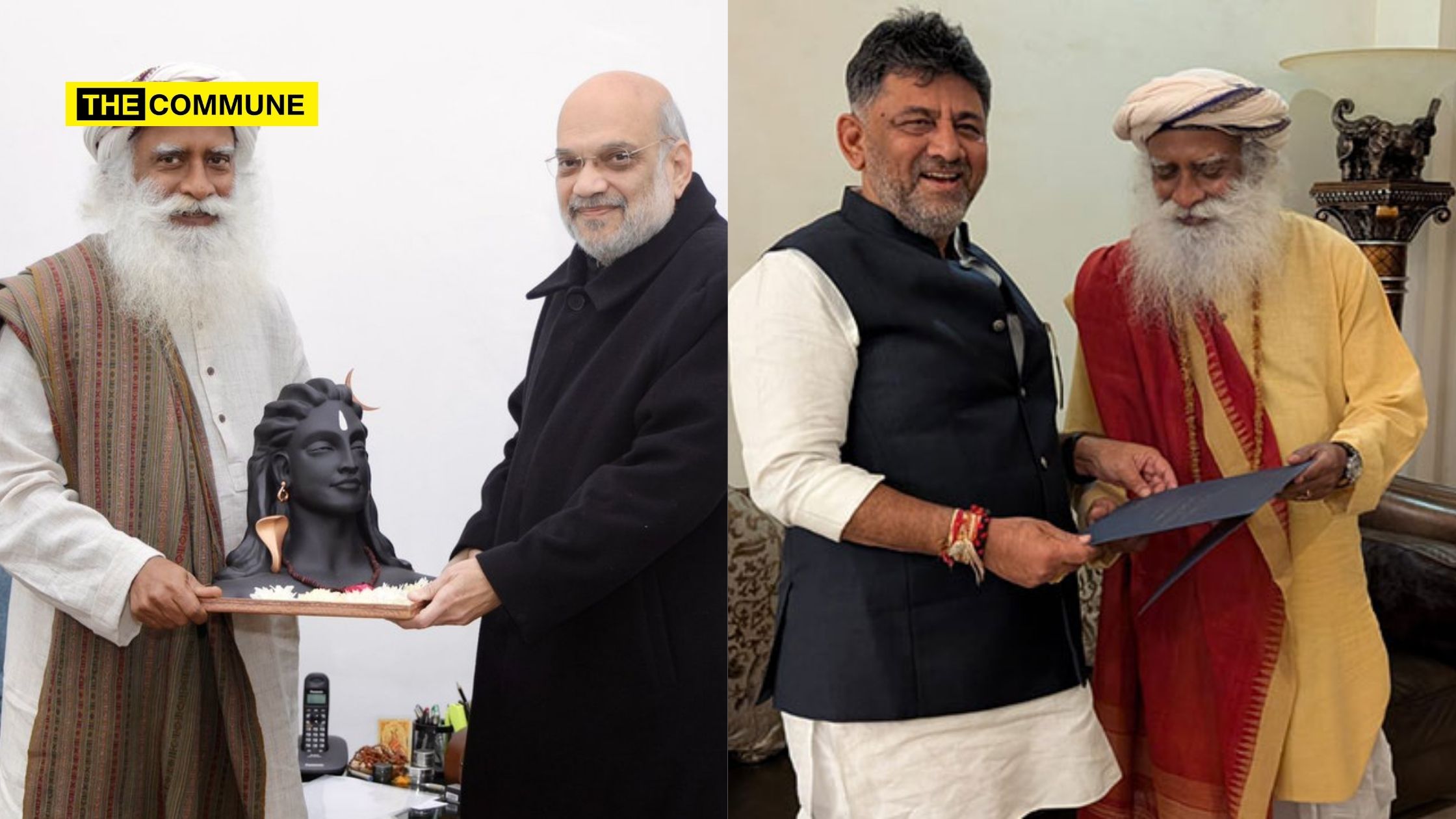
Union Home Minister Amit Shah & Karnataka Deputy CM D.K. Shivakumar To Attend Isha Mahashivratri Celebrations On February 26

Isha Yoga Center in Coimbatore is set to host an electrifying Mahashivratri celebration on February 26, bringing together millions for a night of profound spiritual energy and cultural vibrance. The event will be graced by Union Home Minister Shri Amit Shah and Karnataka Deputy Chief Minister Shri D.K. Shivakumar as special guests, making this year’s gathering even more momentous.

At a press conference held today (February 22, 2025) at the Coimbatore Press Club, Swami Paaraga, regional coordinator of Isha Foundation, addressed the media alongside Isha volunteers Ganesh Ravindran and Saravanan.

Speaking at the event, Swami Paaraga said, “In India’s spiritual tradition, the Shivratri in the Tamil month of Maasi is celebrated as Mahashivratri. On this night, due to planetary alignments, human energies naturally move upward. To harness this possibility, our culture has observed Mahashivratri as a night of wakefulness for thousands of years.”

He further stated, “The 31st Mahashivratri celebration at Isha will be a grand affair, featuring Union Home Minister Amit Shah and Karnataka Deputy Chief Minister D.K. Shivakumar as esteemed guests.”

The festival will take place in front of the iconic Adiyogi statue, beginning at 6 PM on February 26 and continuing until 6 AM the following morning. Under the guidance of Sadhguru, the night will be filled with powerful meditations, mantra chanting, and spellbinding performances by renowned artists.

A major highlight of the event will be Sadhguru’s midnight Mahamantra initiation, an opportunity for participants to experience deep meditative states. Additionally, Sadhguru will unveil a free meditation app, Miracle of the Mind. Featuring a 7-minute guided meditation with Sadhguru, this app aims to empower individuals to establish a daily meditation practice that can easily fit their schedule.

For the convenience of attendees, arrangements have been made for parking, purified drinking water, hygienic restrooms, and emergency medical assistance. Special seating has been prioritised for people of Tamil Nadu.

Those interested can register online at Isha Mahashivratri Website or attend as walk-ins with free entry. As part of the tradition, Maha Annadanam will be offered, ensuring free food for thousands of devotees. The event will be broadcast live from over 100 locations across India, including 50 sites in Tamil Nadu and 25 in Kerala, with streaming available in 22 languages. It will also be aired on 150+ TV channels, digital platforms, and 100+ PVR-INOX theatres, while Jio, Hotstar, ZEE5, and major FM radio stations will carry live coverage.

To keep the energy high through the night, live music performances will feature Satya Prakash, a popular Tamil singer; Subha Raghavendra a Karnataka-based vocalist; hip-hop artist Danish Singh (Paradox); the renowned Marathi music duo Ajay-Atul; Muktidan Gadhvi, a Gujarati folk singer; and Cassandra Mae, a German artist known for Bhartiya devotional songs.

Subscribe to our channels on TelegramWhatsApp, and Instagram and get the best stories of the day delivered to you personally.
UPI Dominates India’s Digital Payments Landscape, Handling 84% Of All Transactions In FY24 And Revolutionizing Financial Inclusion

Amid a surge in digital payments where nearly four out of five payments in the country were conducted on the Unified Payments Interface (UPI) in FY24, UPI has emerged as the dominant force driving financial inclusion, merchant adoption and cross-border transactions.

According to a new industry report, UPI now drives 84 per cent of all digital transactions in India. The report by fintech consulting and advisory firm The Digital Fifth, UPI represents more than just a payment system — it’s an entire financial ecosystem shaping India’s digital-first economy. “With UPI handling 16 billion transactions a month and projected to grow 3x by the end of 2030, the role of robust, high-resilience switching infrastructure becomes paramount,” according to Sameer Singh Jaini, Founder and CEO of The Digital Fifth.

Real-time fraud detection, cloud-native architecture, and scalable, dual-core switches are no longer optional; they are essential to ensuring frictionless, secure, and fail-proof digital payments as India continues its journey toward a truly cashless, globally connected economy, he mentioned. UPI transactions surged 4 times from 2021 to 2024, reaching 172 billion transactions annually. It now dominates digital payments, far outpacing card-based and wallet transactions. With 30 million+ merchants onboarded on UPI, the merchant-to-consumer (P2M) segment is growing at 67 per cent on-year, outpacing peer-to-peer (P2P) transactions and signalling UPI’s transition into the primary retail payment system, the report mentioned.

According to the RBI, digital payments across India recorded a double-digit jump of 11.1 per cent year-on-year (YoY) as on September 2024. According to the report, the share of the UPI in the country’s digital payments has surged from 34 per cent in 2019 to an impressive over 83 per cent in 2024, with a remarkable CAGR (cumulative average growth rate) of 74 per cent over the last five years. At a macro level, the volume of UPI transactions increased from 375 crore in 2018 to 17,221 crore in 2024, whereas the total value of transactions surged from ₹5.86 lakh crore in 2018 to ₹246.83 lakh crore in 2024.

—IANS

Subscribe to our channels on TelegramWhatsApp, and Instagram and get the best stories of the day delivered to you personally.
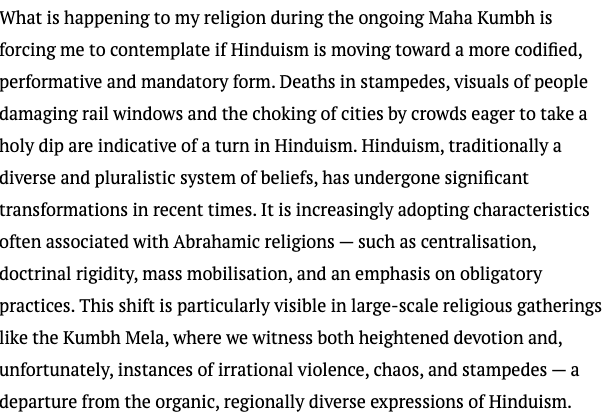
Mrs. Savita Jha Khan’s Rant About Mahakumbh On Indian Express Shows They’re Terrified About Too Many Hindus Coming Together

I came across an ‘opinion’ piece by Dr Savita Jha Khan on the apparently disturbing trend of Hindus assembling in large numbers. What is put across as a concern looks more like fear when one reads the piece.

At the outset, Mrs Khan wonders whether going to Kumbh means Hindus have started following a codified, performative & mandatory form of Hinduism. This assumption is shocking because Hinduism is not a bunch of random beliefs. It has its codes, its rituals & mandates.

Mrs Khan thinks that Hindus are increasingly adopting Abrahamic characters like centralisation, rigidity, mass mobilisation, etc. She doesn’t give any proof of either centralisation or rigidity of Hindus but uses these words more than once in her opinion.

Mass mobilisation has always been a part of Hinduism. Foreign travellers & Indian historians have mentioned mass events. Bathing rituals were common even in the SSC times. The Great Bath is a proof of that.

The Kumbh Mela is not the ultimate destination even today. It is voluntary. Mrs Khan believes that Kumbh was a journey for oldies nearing their end. This is not true. Yes a lot of elderlies would go on pilgrimage, but does she know why it was so?

It was mostly because yatra was difficult. People would walk or travel in carts for weeks & sleep under trees or in sarais. They were exposed to adverse weather, wild animals, snake bites, dacoits, etc. Making such a hard journey, to & fro was extremely dangerous.

Here, Mrs Khan makes so many assumptions, as if she personally knows everyone going to Kumbh. Of course participation has increased. Because now it is not dangerous to go on a yatra. People do not wait for their children to get married before going on a yatra anymore.

Then out of no where Mrs Khan brings in Kanwar Yatra. Probably because she cannot bring in the Tazia processions or Shab-e-barat anarchy.

Fear of Mrs Khan is evident here. She thinks only Abrahamic faiths have the concept of processions & gatherings. It is sad that despite being a student & a teacher of history she has so little knowledge of Indic faiths.

Faxian in his travel records mentions grand processions at least twice. Once in Hotan & once in Pataliputra. The tradition of grand procession is definitely not a ‘new’ thing as she wants us to believe. Again more Hindus are going on pilgrimage because it is easy to do so now.

Here Mrs Khan has completely lost it. She is scared that Hindus are now participating in ever larger numbers in their festivals, yatras & congregations. She thinks Hindus are better off praying at home than assembling in massive numbers.

Mrs Khan thinks that people bathing at Kumbh is some how a ‘challenge to Hinduism’s foundational essence’. This is typical of Marxist historians who are experts in twisting facts. Rivers & river bathing has been mentioned in Rigveda & Puranas.

The Rigveda has an entire hymn (Nadistuti Sukta RV 10:75) dedicated to praises of rivers. Bhagirath did tapa to bring Ganga down to earth so his ancestors could attain moksha. Rivers & river bathing has always been integral to Hinduism.

Vedas & Puranas are the very foundation of Hinduism & they exalt bathing in rivers. There is a reason Kumbh happens every 12 years & not on a convenient weekend. There is a long history of mass gatherings, processions & yatras, which Mrs Khan conveniently forgot.

Mrs Khan pretends to ‘worry’ about the changes in Hinduism but in fact she is just wants Hindus to not show any sign of cohesiveness. She would rather have them divided on caste & language than come together for peaceful spiritual gatherings.

Vijender Sharma is a history enthusiast and author. He has written two books, Essays on Indic History & The Cusp Years, on the lesser known aspects of Indian history.

Subscribe to our channels on TelegramWhatsApp, and Instagram and get the best stories of the day delivered to you personally.

 

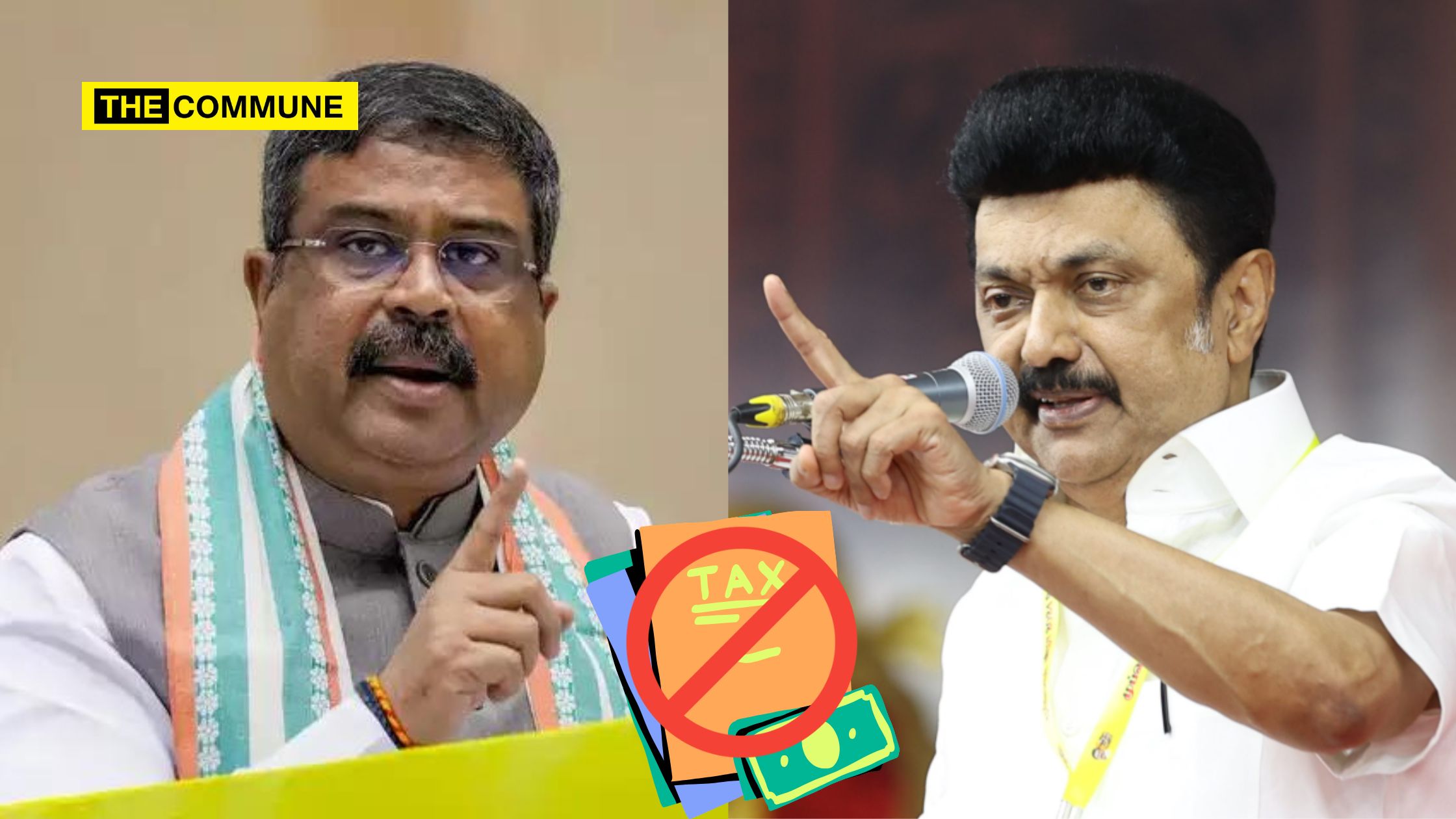
DMK’s New Dravidian Model Of Separatist Politics?: TN CM MK Stalin Threatens To Withhold Taxes To Centre

Tamil Nadu Chief Minister M K Stalin escalated his confrontation with the Modi government on Friday regarding the National Education Policy (NEP) and the distribution of funds. He stated that the DMK could easily refuse to pay taxes collected by the Union government from the state, emphasizing that “federalism is about give-and-take.”

In response to Union Education Minister Dharmendra Pradhan’s claim that Tamil Nadu could lose ₹5,000 crore for not implementing the PM Shri scheme linked to NEP, Stalin accused the Centre of being envious of the states’ progress and attempting to hinder their development.

Stalin also criticized the Centre for withholding states’ rightful share of resources, stating, “After extracting all state taxes through the GST regime, the Union government is now refusing to release the dues owed to states, deny new schemes, or provide funds for joint state-federal projects.”

Warning the Centre not to provoke Tamil pride, Stalin said, “Don’t stir the hornet’s nest. Don’t challenge the unique spirit of Tamil people. As long as I am here, and as long as the DMK is here, no anti-Tamil agenda will succeed.”

Pradhan responded to Stalin’s opposition to the NEP, accusing Tamil Nadu’s stance of being politically motivated and harmful to students. On his X handle, he shared a letter to Stalin, calling the state’s opposition to NEP “highly inappropriate” and “narrow-minded.” He criticized the Tamil Nadu government for using “intimidation for political reasons” and urged the state to focus on students’ well-being instead of politicizing education. Pradhan emphasized that the Modi government was dedicated to promoting Tamil culture globally and clarified that the NEP was designed to modernize the education system while respecting linguistic and cultural diversity, reiterating that no language would be imposed on any state or community.

Stalin, speaking at a gathering in Cuddalore, argued that the true disaster for India was the Union government’s failure to understand federalism. He claimed, “NEP isn’t about improving education; it’s about advancing the agenda of creating a homogeneous India.”

This is not the first time that the DMK has resorted to separatist rhetoric.

Earlier in November 2024, DMK scion Udhayanidhi Stalin received a map of separate South India, which indirectly references the “Dravida Nadu” separatist ideology once propagated by the DMK.

On 10 June 2021, the DMK IT wing’s official Twitter account quoted late former Tamil Nadu Chief Minister Annadurai, saying that the demand for a separate “Dravida Nadu” is still relevant, and has fuelled separatism.

(With Inputs From TOI)

Subscribe to our channels on TelegramWhatsApp, and Instagram and get the best stories of the day delivered to you personally.
Dravidian Model Development: Flyover Projects Stuck In Limbo Cause Chaos In Chennai’s T Nagar, Nolambur, Vyasarpadi, And Kodungaiyur; Traffic, Sewage Issues, And Business Losses Mount

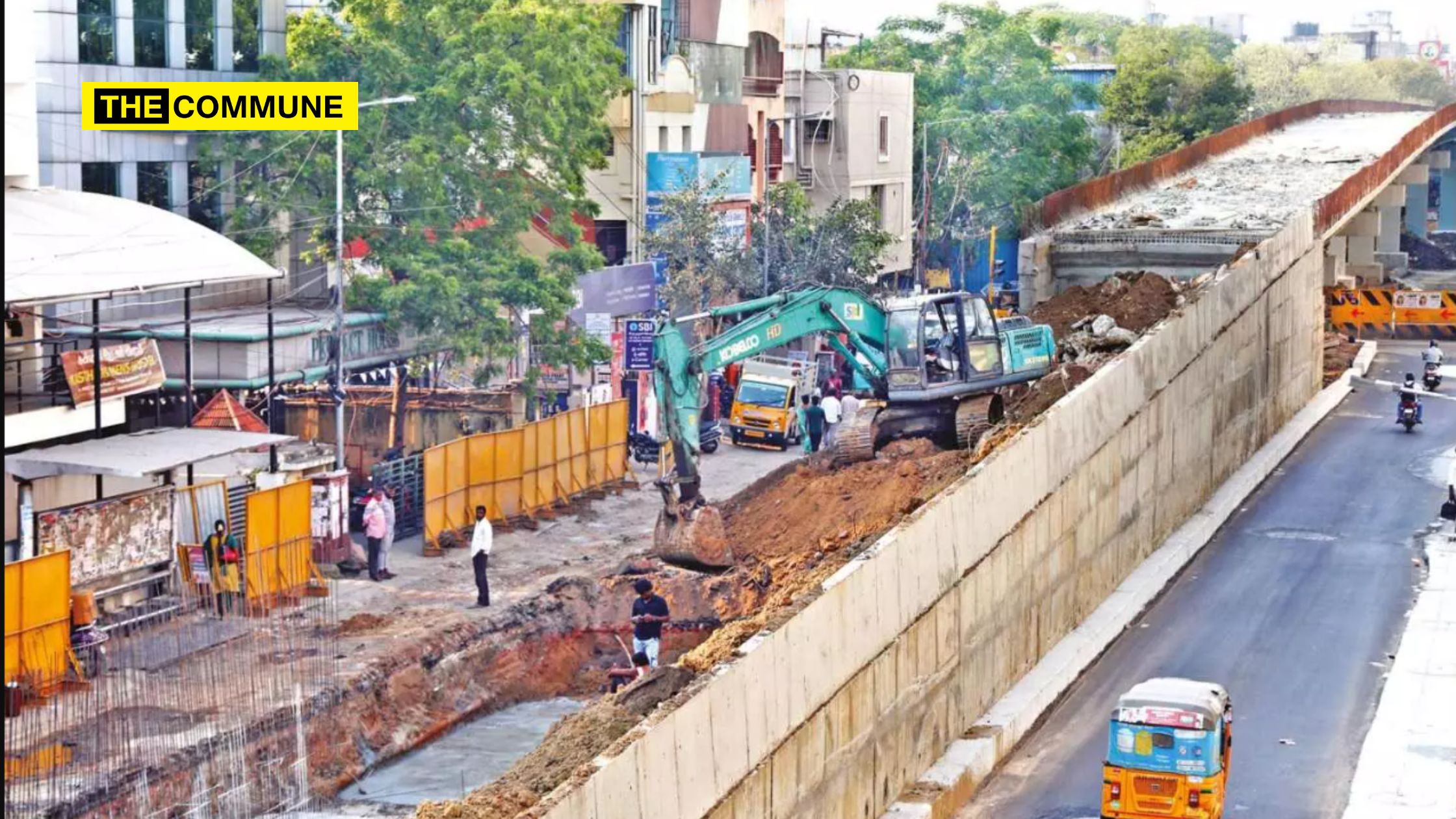
The so-called Dravidian Model of development is once again exposed as a failure, with stalled flyover projects in T Nagar, Nolambur, Vyasarpadi, and Kodungaiyur leaving residents to suffer crippling traffic congestion, sewage overflows, business losses, frequent power cuts, and endless detours. Despite grand claims of progress, these projects have remained incomplete for over two years, turning daily commutes into nightmares and crippling local businesses.

In T Nagar, over 1,000 homes across 25 lanes are trapped due to the prolonged closure of Usman Road, which has been blocked for a year and a half because of delays in the construction of a ₹130-crore flyover connecting Anna Salai with Panagal Park. B Kannan, secretary of the T Nagar Resident Welfare Association, was quoted saying in a Times of India report that even ambulances struggle to reach the area, as residents must navigate narrow lanes to exit through Duraisamy subway. “Our street is completely inaccessible to cars,” he added. Furthermore, the flyover project has caused damage to power lines and Metrowater pipes, leading to sewage backups and up to eight-hour power cuts, according to Kannan.

The flyover, originally scheduled for completion by December 2024, is only 70% complete. The Greater Chennai Corporation (GCC) is facing alignment challenges in connecting the new 1.2 km flyover from CIT Nagar with the existing one at Ranganathan Street. These delays have caused 2 km detours, pushing roughly 10,000 vehicles per hour onto Panagal Park, Venkatnarayana Road, Thandapani Street, and Burkit Road to access Anna Salai, severely impacting local businesses.

In North Chennai, delays in flyover projects have created a chaotic situation. Patients attempting to visit a GCC dialysis center in Vyasarpadi face major difficulties due to the stalled ₹226-crore Vyasarpadi-Pulianthope flyover project, which has seen only 40% of its work completed over two years. The road is completely dug up, with minimal progress and few workers present. Business owners complain of high rent payments but no customers due to the area being blocked off.

GCC officials acknowledged that seven out of 36 piles on railway land remain uninstalled, which has delayed the project. “We have paid ₹9 crore in charges to the railways, but we’re still waiting for necessary permissions,” an official noted.

The situation is equally perilous for pedestrians, as the construction has left walkways damaged and unprotected, forcing people, including women and children, to walk through unsafe work zones. Swathy S, a 38-year-old mother, described the danger, “A small slip could cost our lives.”

The ₹96-crore Korukkupet-Kodungaiyur flyover project has also been stalled for two years, as railways have yet to place girders on piles above the tracks. This delay forces motorists to take a 2 km detour via Basin Bridge. GCC Commissioner J Kumaragurubaran said progress above the railway tracks has been slow, but assured that work would be coordinated with the railways to complete all flyovers by this year.

However, Southern Railway’s Chennai Divisional Railway Manager Vishwanath Eerya denied any delays, stating that all railway-related work is proceeding as scheduled, with all necessary permissions granted to GCC. Deputy Mayor Mahesh Kumar pointed out that councillors are facing criticism due to the delays attributed to the railways.

(With Inputs From TOI)

Subscribe to our channels on TelegramWhatsApp, and Instagram and get the best stories of the day delivered to you personally.