Home Blog Page 325

Pahalgam Terror Attack: DMK Supporter And The Hindu’s Frontline Editor Radhakrishnan Blames Modi Govt Whitewashing Terror Attack By Islamist Terrorists

In the aftermath of the brutal terrorist attack in Pahalgam, Anantnag district of Jammu & Kashmir—where Islamist militants, having openly declared jihad, specifically targeted and killed Hindu tourists—certain sections of Tamil Nadu’s media shockingly chose to downplay the violence. Rather than condemning the murder of 28 innocent civilians, these self-proclaimed journalists used the tragedy as a political opportunity to attack the central government, particularly Prime Minister Narendra Modi and Home Minister Amit Shah.

One glaring example of this shameful response came from The Hindu‘s Frontline Editor, R.K. Radhakrishnan. In a series of social media posts, he launched into a tirade—not against the terrorists—but against the Centre. Moments after news of the terror strike broke, Radhakrishnan tweeted from his official account, I’m not “shocked;” I’m fed up of being told lies and propaganda of “normalcy” in Kashmir #PahalgamTerroristAttack.”

His words raised eyebrows—not for their journalistic insight, but for their complete lack of humanity. Instead of mourning the victims or condemning the barbarity of the attack, Radhakrishnan focused his outrage on the ruling BJP government in the centre.

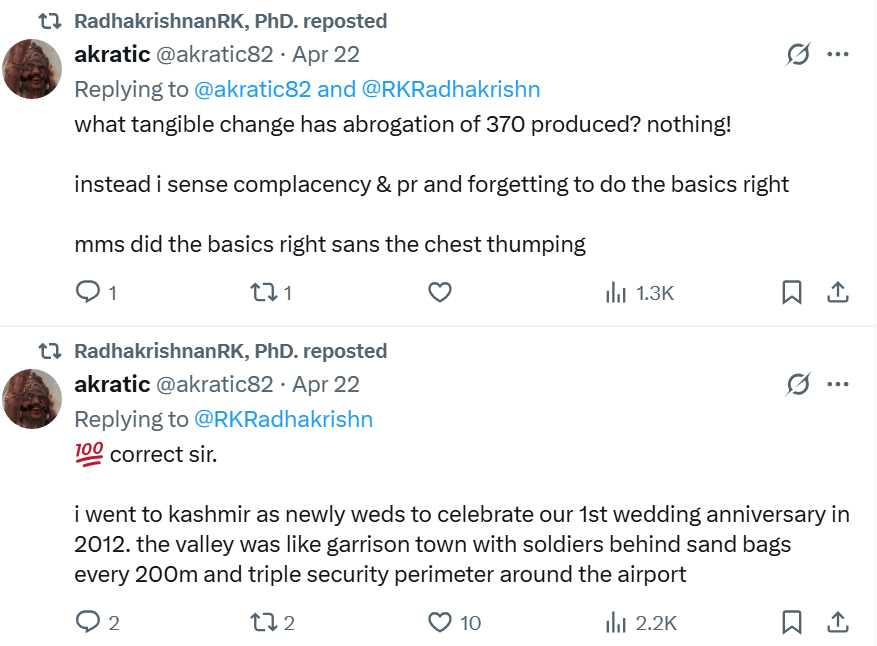
It became evident that his anger was not rooted in concern for the victims but was rather an extension of his political stance—opposing the abrogation of Article 370. The same agenda echoed through the responses he highlighted in his post, particularly a reply by a user named ‘Akratic’ who wrote by praising the Congress rule, “💯 correct sir. i went to kashmir as newly weds to celebrate our 1st wedding anniversary in 2012. the valley was like garrison town with soldiers behind sand bags every 200m and triple security perimeter around the airport.”

The commenter then doubled down with a follow-up, “what tangible change has abrogation of 370 produced? nothing! instead i sense complacency & pr and forgetting to do the basics right mms did the basics right sans the chest thumping.” 

This entire exchange exposed a disturbing priority—where the focus was not on condemning terrorism or empathizing with victims, but on using a tragedy to push a political narrative aligned with the Congress party’s stance on Kashmir. Rather than uniting against terrorism, such commentary sadly dilutes the seriousness of the threat and turns national security into a point-scoring game.

Radhakrishnan continued his rant—this time directing his frustration at Tamil Nadu’s media outlets for reporting the harsh truth that Hindu tourists were deliberately targeted. Reports revealed that the attackers had asked victims to recite the Kalma and, upon refusal, opened fire. Instead of acknowledging the severity of this communal targeting, Radhakrishnan criticized the local media for allegedly being instructed to push hashtags linking the attack to “Islamic terror.

In his response, he insinuated that the Tamil media was being used to promote a specific narrative and wrote, The media, including the sheep in Tamilnadu, have been told to run hashtags on Islamic Terror, it appears. Hindus can go on tour and be killed by random terrorists in Kashmir, but neither the incompetent LG nor the saffronised Union Home Ministry, will do much because these killings will be used for propaganda against Muslims in India – regardless of the fact that @PMOIndia is closest to UAE and tries to cozy up to MBS!”

He brazenly implied that the terror attack was orchestrated not just as an act of violence, but as part of a larger conspiracy—suggesting that the killings would be exploited to fuel propaganda against Muslims in India.

In another post Radhakrishnan wrote, Very clear that @TamilJanamNews says @AmitShah failed to protect Hindus!” 

What was even more outrageous was R.K. Radhakrishnan’s final claim—he insinuated that Prime Minister Narendra Modi was using the Pahalgam terror attack as a political tool to campaign ahead of the upcoming Bihar elections. This narrative stood in stark contrast to the facts. Back on 30 March 2025, multiple news outlets had already reported that the Prime Minister was scheduled to visit Bihar for a major development project and to attend National Panchayati Raj Day events in Madhubani on 24 April 2025.

Yet, dismissing these pre-announced official engagements, The Hindu’s Frontline editor Radhakrishnan shamelessly peddled, “All indications in #Dharbhanga (police presence, preparations) point to the fact that @PMOIndia ’s visit is on for April 24, even though his presence is imperative in Delhi. As always, he starts campaigning five months ahead of #Bihar election – though it will be given an official-sounding reason!”

In yet another mocking post, he questioned the motive behind the retaliation, saying, “One encounter before Modiji’s Dharbhanga meeting ?”

Subscribe to our channels on TelegramWhatsApp, and Instagram and get the best stories of the day delivered to you personally.

Lawyer Receives Death Threat Over Land Dispute In Thiruvarur; VCK Union Secretary Among 5 Arrested

The Needamangalam police have arrested five individuals, including the Needamangalam union secretary of the Viduthalai Chiruthaigal Katchi, in connection with a death threat issued to a lawyer over a land dispute.

Kesavan (38), a lawyer and party member residing in Manalur, had recently purchased a 23-cent plot near his home. The dispute began when Puthivan (49), the union secretary of the same party, claimed longstanding rights over the land, leading to ongoing tensions between the two.

Two days ago, Kesavan erected a fence around the property. In response, Puthivan and his relatives allegedly demolished the fence and issued death threats. Following a complaint by Kesavan, police registered a case under five sections and arrested Puthivan, his younger brother Bhaskar (47), Rajendran (50), Vijayakumar (39), and Sridhar (42). Investigations are ongoing.

(With inputs from Kamadhenu)

Subscribe to our channels on TelegramWhatsApp, and Instagram and get the best stories of the day delivered to you personally.

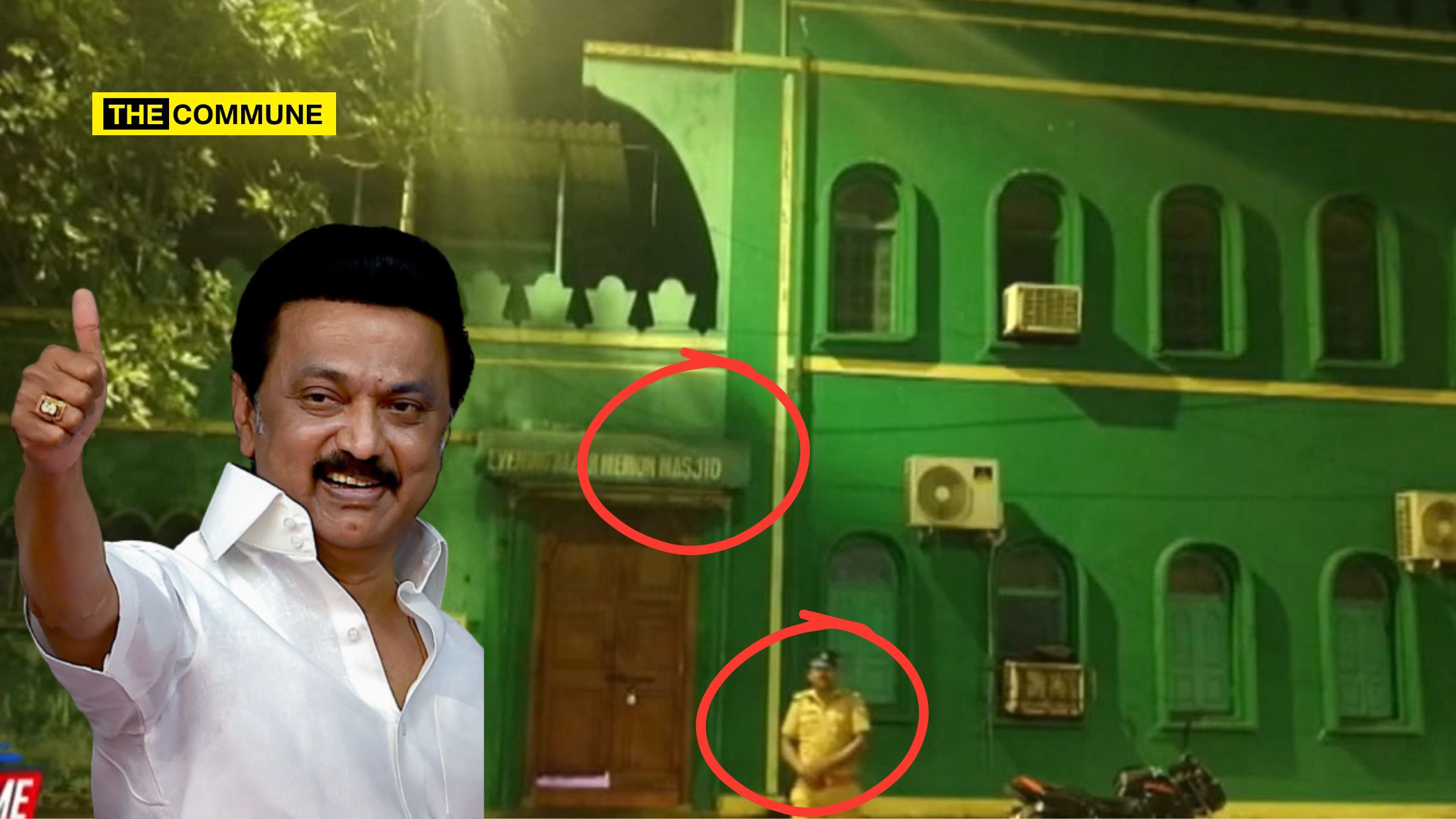
Dravidian Model: Heavy Police Security At Mosques In Tamil Nadu Following Pahalgam Terror Attack

In what comes as a weird response to the recent terror attack in Pahalgam, Jammu and Kashmir, the DMK government in Tamil Nadu has ramped up security measures across the state, particularly around places of worship. Police presence has been significantly increased at mosques, including those in Chennai, with officers instructed to conduct frequent patrols and maintain strict overnight vigilance.

Security has also been tightened at key public locations such as railway stations and bus stands. Authorities are closely monitoring social media platforms to detect and prevent any potential unrest or misinformation.

It is noteworthy that the DMK government announced its ₹65 crore plan to build a new Haj House in Nanganallur in March 2025, despite an existing one in Periyamedu. Critics accused the party of minority appeasement and vote-bank politics ahead of elections, citing unfulfilled promises like the ₹1,000 crore allocation for temple development. The move drew ire for neglecting temple upkeep while prioritizing Muslim-focused projects. Concerns also arose over the Haj House’s location in a Hindu-majority area near Chennai Airport, with fears of law and order issues and potential misuse for smuggling activities, further fueling controversy around the DMK’s governance priorities.

Subscribe to our channels on TelegramWhatsApp, and Instagram and get the best stories of the day delivered to you personally.

DMK-Supporting Dravidianist YouTubers Blame Modi Govt To Give Clean Chit To Pakistani Terrorists

As expected, several Dravidianist propagandists and DMK-supporting YouTubers have quickly mobilized to shift the narrative surrounding the recent terror attack in Pahalgam, Anantnag district, Jammu & Kashmir—where Hindus were specifically targeted. Instead of acknowledging the religiously motivated nature of the attack, these content creators have focused their criticism on the BJP-led central government, blaming Union Home Minister Amit Shah and Prime Minister Narendra Modi for the security lapse.

What’s even more disturbing is the way these YouTubers rushed to downplay the clear anti-Hindu motives behind the attack. Despite reports that the terrorists declared a ‘jihad,’ demanded victims recite the kalma, and stripped tourists to identify their religion—deliberately targeting Hindus—these Dravidianist influencers have shown a shocking reluctance to acknowledge the facts. Their apparent goal? To preserve the minority Muslim vote bank and stay in favor with their political patron, the DMK.

One notable example is Senthil Vel, who runs the Tamil Kelvi YouTube channel and former anchor for the Tamil news outlet Maalai Murasu. He controversially questioned why those calling the Pahalgam terrorists “Muslims” don’t also label espionage suspects arrested in India as “Hindus.” Another channel, Arakalagam, echoed this exact sentiment, further fueling confusion and deflection.

Many viewers were left baffled by the false equivalence between terrorist acts and espionage cases, but these influencers appeared more interested in reinforcing the DMK’s narrative than addressing the seriousness of the attack. Senthil Vel even went a step further by emphasizing that those arrested in espionage cases were not only Hindus but also Brahmins—exposing the deeply rooted caste-based animosity often associated with hardline Dravidianist rhetoric.

These reactions have sparked outrage and concern among the public, who see them as a blatant attempt to politicize a tragedy and shield religiously motivated violence from scrutiny.

As the video opens, Senthil Vel, a self-styled Dravidianist journalist, dives into a dramatic monologue, promising to deliver a “hard-hitting exposé” on alleged links between terrorists and BJP members. With a fiery tone, he declares, “Before we dive into this video. Today, I’m going to reveal the supposed connections between terrorists and BJP executives—with proof. So, these so-called ‘fake patriots’ run away. 25 citizens have been sacrificed due to terrorism. We’ve all spoken out in anger against terrorism, and I too condemn the Pahalgam terror attack. But let me be clear—the Prime Minister, Home Minister, and Defence Minister are directly responsible. They must resign. I’m accusing them that they are weak and going to criticize them even more. I’m not here to bluff anything. I’m going to show the links between terrorists and BJP members, explain in detail who were all arrested. Enough of sacrificing innocent lives for dirty politics. And now, certain groups are shamelessly pushing anti-Muslim hashtags online. What injustice!”

Despite this intense introduction, the video quickly derails. Like many Congress and Dravidianist social media figures, Senthil Vel attempts to argue that “terrorism has no religion.” But his core argument is built on flawed comparisons—equating espionage cases involving Hindu individuals with religiously motivated terror attacks carried out by Islamist groups, particularly from Pakistan. The logic doesn’t hold up, and rather than proving a point, it reveals a poor understanding of the fundamental differences between espionage and terrorism.

Worse still, he makes a blatantly casteist remark, implying that many involved in such activities are Brahmins, “Most of them are the ones who say, ‘We are born with brains, we are intelligent.’ They are half of it. I don’t want to say more.” This thinly veiled jab reflects a deep-rooted bias that frequently surfaces in Dravidianist discourse.

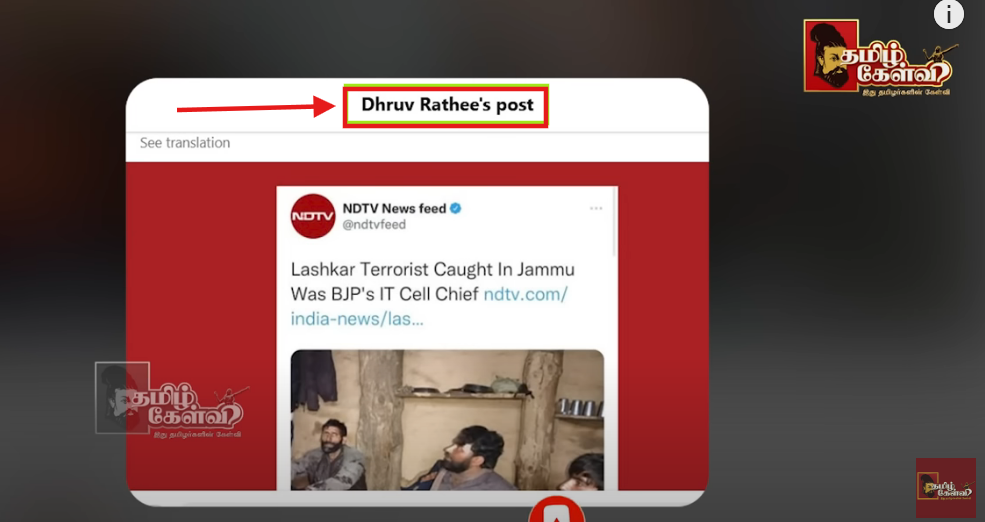
Senthil Vel attempts to further his argument by presenting a list of alleged “Hindu terrorists,” the first case he cites involves a July 2024 news report, initially promoted by Congress & AAP sympathizer Dhruv Rathee who was widely known for his partisan, left-leaning propaganda.

According to the report from NDTV, Talib Hussain Shah, a wanted Lashkar-e-Taiba terrorist captured in Jammu and Kashmir, was affiliated with the BJP’s Minority Morcha and handled their social media in Jammu. However, the timeline and context were misrepresented. The incident wasn’t recent, and more importantly, the accused was a Muslim, contradicting Senthil Vel’s attempt to show Hindus in the same light. This visibly confused him mid-video, and rather than correcting the inconsistency, he scrambled to deflect blame back onto the BJP—accusing the party of giving space to terrorists. The irony was glaring.

Senthil Vel then cited another post—this time from Alt News co-founder Mohammed Zubair, a propagandist frequently accused of spreading misleading or partisan narratives favoring Congress and its allies like the DMK, TMC, and others. Referring to content published by Alt News, Senthil Vel claimed that a BJP IT Cell member, Dhruv Saxena, along with 10 others, had been arrested for allegedly assisting Pakistan’s ISI in spying on the Indian Army.

He presented this as a major embarrassment for the BJP. However, what was more questionable than the allegation itself was the near-total silence from mainstream media outlets on the matter—only Alt News had reported it prominently, raising concerns about the credibility and selective amplification of such stories. This, in fact, was a point of contention that had already been heavily pushed by Congress and its ecosystem. Despite his attempt to frame it as a significant expose, the reliance on a single, politically biased source and the lack of broader media coverage casts serious doubt on the narrative being promoted.

Continuing his attempt to tie terrorism to the BJP, Dravidianist YouTuber Senthil Vel brought up the much-discussed case of journalist Ved Pratap Vaidik’s controversial meeting with terrorist mastermind Hafiz Saeed. The meeting, which triggered uproar in Parliament at the time, was politicized further by Congress leader Rahul Gandhi, who remarked, “The man is from the RSS. That’s a known fact. We want to know if the Indian embassy facilitated this meeting.”

However, the facts were different. Ved Pratap Vaidik met Saeed as a journalist, risking his safety for an interview. Much like Tamil journalist Nakkeeran Gopal—who once interviewed the dreaded bandit Veerappan and has long been a known DMK supporter—Vaidik’s meeting was more journalistic than ideological. Yet, unlike Vaidik, Gopal was never accused or vilified; in fact, he was even utilized by the Tamil Nadu government. Journalists, at times, pursue uncomfortable truths. But Senthil Vel seemed more interested in pushing a narrative rather than evaluating the facts.

He also listed a series of espionage-related arrests, wrongly labeling them as evidence of “Hindu terrorism,” failing to distinguish between acts of spying and religiously motivated terror. Here are some of the cases he cited:

  • Pradeep Kurulkar (DRDO scientist): Arrested for allegedly leaking sensitive information to Pakistan. Congress claimed he had longstanding ties with the RSS and came from a family associated with the Sangh for generations. [Reported by Economic Times]

  • Mahesh Kumar (MES employee): Allegedly honey-trapped by a Pakistani military agent via Facebook and arrested in Haryana. [India Today]

  • Deepak Shirsath (HAL employee): Accused of sharing confidential fighter jet details with Pakistan’s ISI via WhatsApp and social media. [NDTV]

  • Rajeev Sharma (Journalist): Arrested for passing information to Chinese agents. A Chinese woman and a Nepalese man were also detained in connection with the case. [The Hindu]

  • Madhuri Gupta (Ex-Diplomat): Convicted and sentenced to three years in jail for spying for Pakistan during her tenure at the Indian High Commission in Islamabad. [The Hindu]

  • Indian Navy Honeytrap Case: Thirteen naval personnel apprehended for espionage involving suspected social media contacts with Pakistani operatives. [India Today]

  • ISI Agent Trail – Gujarat/UP: An ISI-linked agent, Rajaka Khumbhar, was arrested by NIA in Gujarat. A money trail of Rs 5,000 led to a contact in Uttar Pradesh. The case involved sensitive information leaks traced back to a man named Mohammad Rashid. [TOI]

  • BSF Jawan in Smuggling Racket: Sumit Kumar, a BSF constable, was arrested as the alleged kingpin in a Pakistan-linked arms and heroin smuggling ring. Weapons bearing Pakistan Ordinance Factory markings and Rs 32.3 lakh in drug money were seized. [TOI]

While espionage is undoubtedly a national security threat, Senthil Vel’s attempt to equate these cases with terrorism driven by religious ideology is a false equivalence. Terrorism—especially incidents like the Pahalgam attack targeting Hindus—is fundamentally different from cases of spying or smuggling.

What was meant to be a bold exposé quickly unraveled into a confused, misinformed rant riddled with contradictions, caste-based jabs, and selective outrage. Senthil Vel’s attempt to push a politically convenient narrative only exposed the fragility of the argument and the desperation to defend an increasingly indefensible position.

Subscribe to our channels on TelegramWhatsApp, and Instagram and get the best stories of the day delivered to you personally.

Pakistan Simp Dravidianist YouTuber Madan Gowri Whitewashes Islamic Terrorists Involved In Pahalgam Terror Attack

When 28 innocent civilians, including tourists and local guides, were slaughtered by Islamic terrorists in Pahalgam, the entire nation was in mourning. But while India grieved, one self-proclaimed “neutral” YouTuber was busy doing what he does best—whitewashing terror, trivializing Hindu suffering, and peddling his Dravidianist, Pakistan-simp agenda.

We’re talking about Madan Gowri, the first Indian YouTuber to proudly travel to Pakistan and return parroting propaganda about how “safe” Hindus are there, despite mountains of evidence to the contrary: forced conversions, kidnappings, temple desecrations, and more. And now, in the face of one of the deadliest terror attacks on Indian soil since Mumbai 2008, he’s done it again.

Madan Gowri’s 11-Minute Masterclass In Cowardice

In his Pahalgam video titled “PAHALGAM Issue EXPLAINED | Tamil | MG Squad”, Madan Gowri manages to talk for over 12 minutes about the murder of 28 civilians—without ever once naming the Islamic terrorist ideology behind the attack.

No mention of radical Islam.
No mention of the Jihadist motive—despite survivors confirming the attackers asked people’s religion before opening fire.
No mention of the terror organization that was behind the attacks, or its clear Pakistan-backed objective to “cleanse” Kashmir of non-Muslims.
Not even the word “Muslim” or “Islamic” crosses his lips.

Instead, Gowri delivers a lecture on “unity” and “not dividing people”. That’s right: after an Islamist attack that explicitly targeted people based on their faith, he tells the victims not to be divided. That’s the equivalent of standing at the site of a lynching and telling the family of the dead to stay “calm and secular.”

The Pattern Of Selective Outrage

This isn’t new for Madan Gowri. Whether it’s the massacre of Kashmiri Pandits, the oppression of Pakistani Hindus, or violent Islamist protests in Tamil Nadu, he consistently sidesteps the truth in favor of a distorted, appeasement-driven narrative.

In his Thiruparankundram Hill video, he painted animal sacrifices and illegal encroachments by a dargah as “cultural coexistence,” while blaming Hindu Munnani for opposing it. He failed to mention the SDPI’s role, the political meddling by MP Navas Kani, or the ongoing legal disputes about the sacred hill. He brushed aside Hindu religious sensitivities, portraying all protests as “extremism.”

Gowri’s idea of “balance” always seems to lean one way: protect Islamist sentiment, bash Hindu protestors, and avoid naming Islamic extremism—no matter how brutal or bloody the incident.

Dravidian Hypocrisy & Love For Pakistan In HD

Madan Gowri is part of a wider Dravidianist clique that has long expressed soft support for separatist ideas under the guise of federalism, secularism, or anti-North India rhetoric. These are the same people who:

  • Opposed the abrogation of Article 370, painting it as an “attack on Kashmiri autonomy” rather than a step toward national integration.
  • Raised questions about the Indian Army’s presence in Kashmir, parroting the exact language used by Pakistan-backed propagandists.
  • Supported the DMK’s betrayal on Katchatheevu, gifting away Indian territory with a smile.

They shed crocodile tears for “Kashmiris” but go radio silent when Kashmiri Hindus are raped, murdered, or exiled. They scream “intolerance” when a movie faces boycott but look away when temples are bombed or pilgrims gunned down.

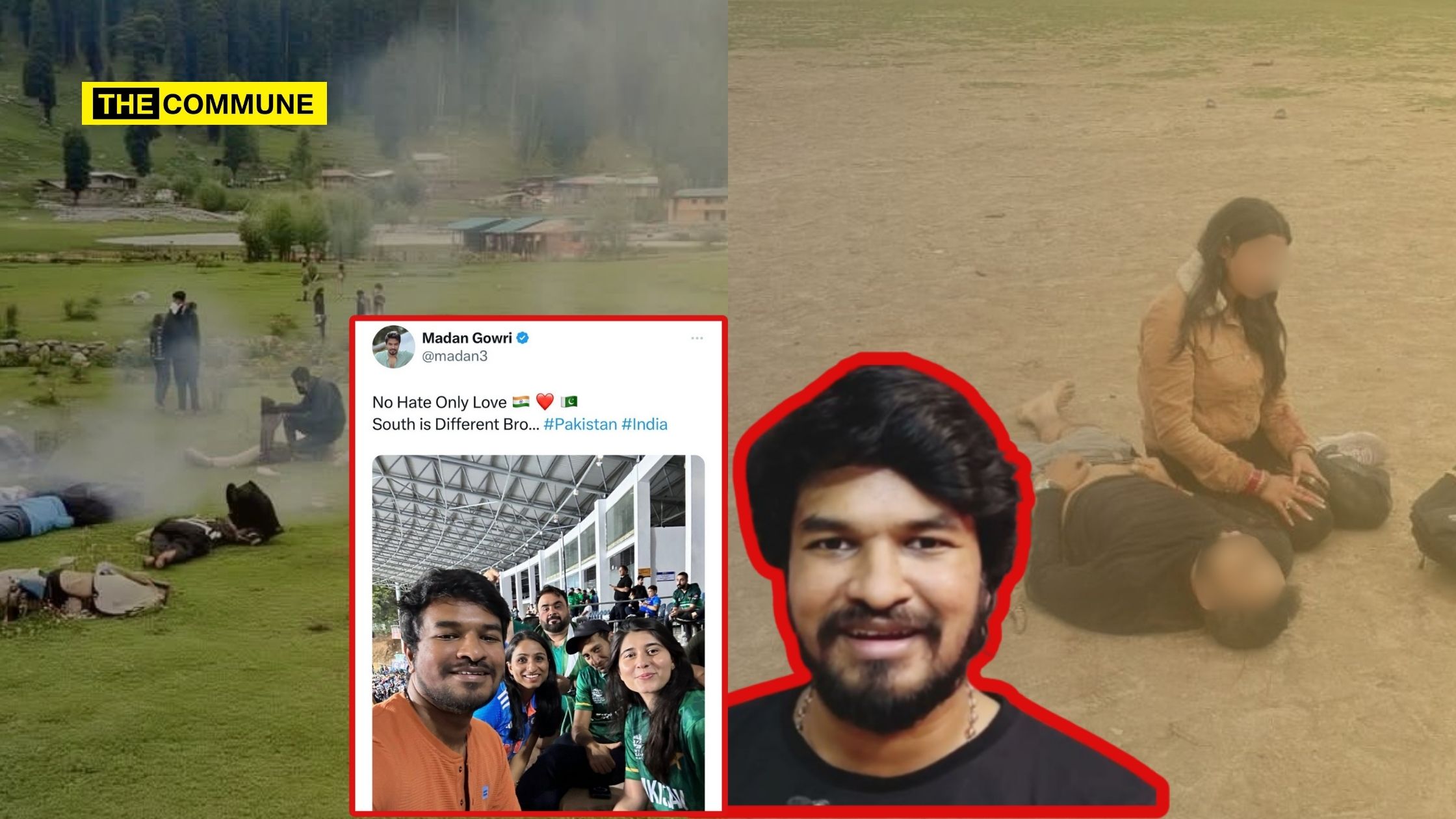
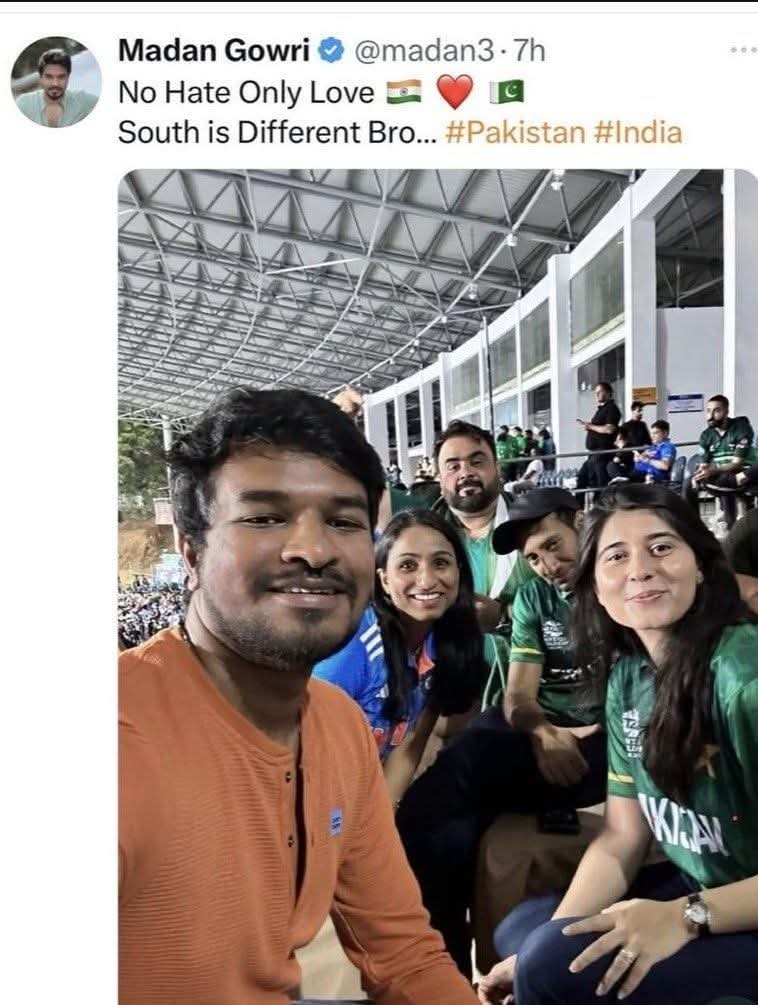
During the ICC World Cup 2023, along with other Dravidianist Pakistan simps, Madan Gowri also posted all messages of “love for Pakistan” on his X handle. Here’s an example.

Another exhibit of his love for Islamists is his “regret” for such an incident. Not sure if he made any such post when the roles were reversed.

Moral Cowardice Disguised As Neutrality

Let’s call it what it is: Madan Gowri is not neutral. He is not objective. He is a mouthpiece for a sick, self-loathing ideology that blames India for being attacked, and tiptoes around the very forces trying to tear the nation apart.

By refusing to name the Islamist terrorists responsible for Pahalgam
By equating victims’ grief with “division”
By once again playing the “we are all one” card only when Hindus die

Madan Gowri has shown us exactly what he is: a moral coward, a Pakistan simp, and a disgrace to Indians.

Subscribe to our channels on Telegram, WhatsApp, and Instagram and get the best stories of the day delivered to you personally.

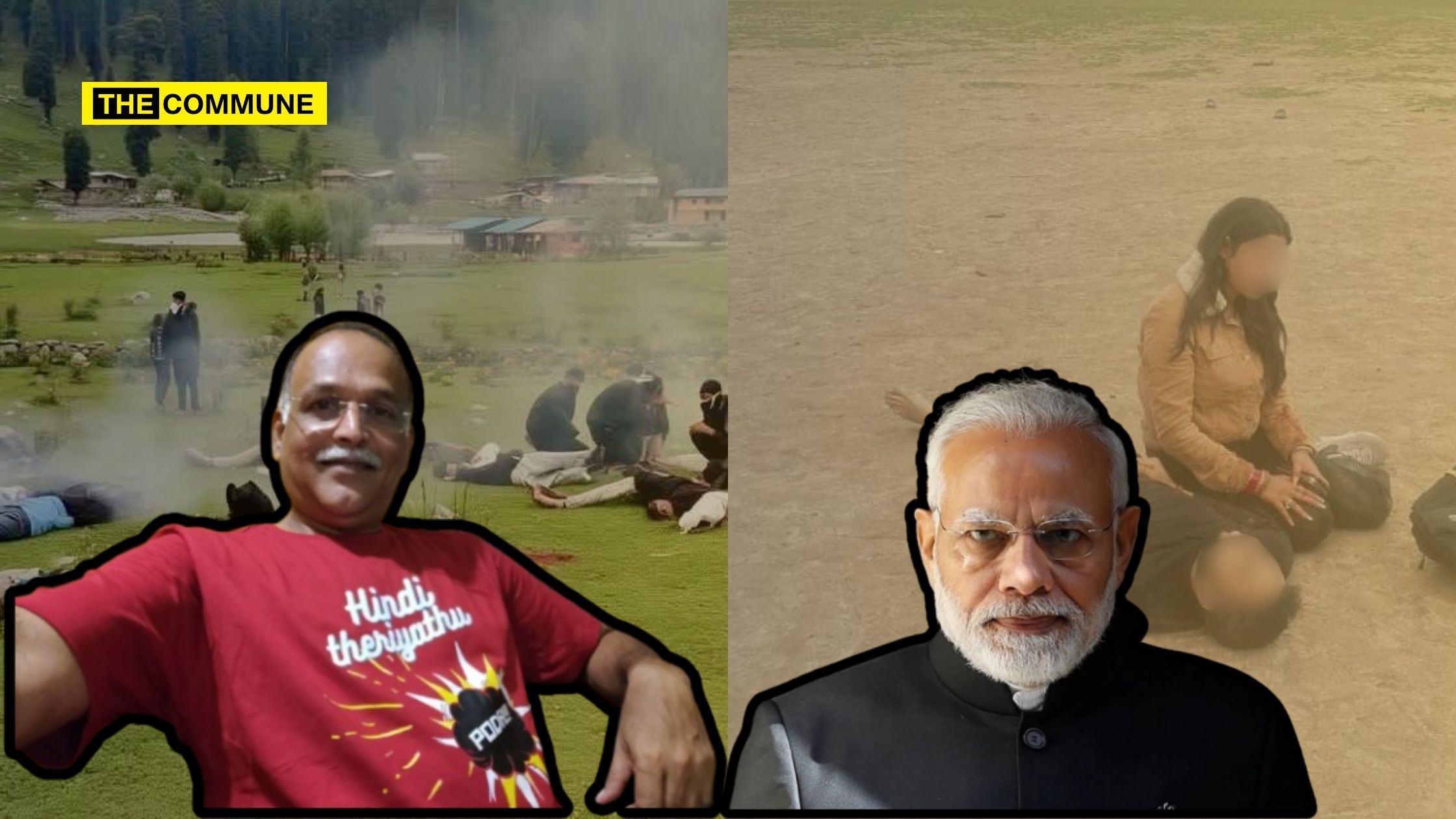
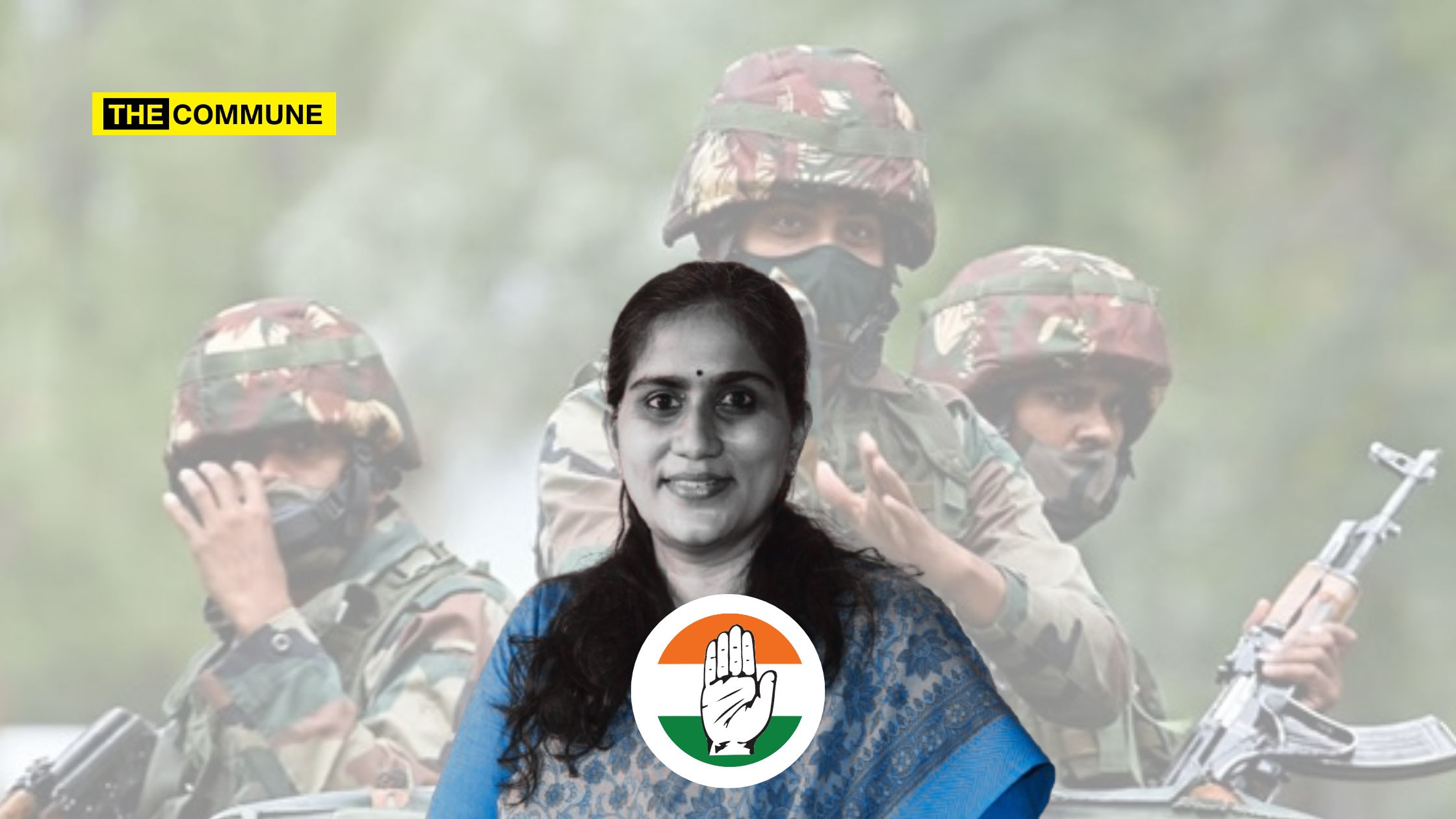
“Surgical Strikes An Eyewash”, TN Congress Spokesperson Lakshmi Ramachandran Insults Indian Army’s Actions Post Uri And Pulwama Attacks

As the news of the Pahalgam terror attack spread, several panel discussions took place on various news channels across the country. Among them was a discussion on Thanthi TV titled “Kashmir terror attack: Is it a threat to national security?” .

The panel included retired army officer Lt Col Thiagarajan, Congress spokie Lakshmi Ramachandran, BJP’s Shrikanth, and a political analyst named Ponraj.

Lakshmi Ramachandran

All through the video Lakshmi Ramachandran peddled the same narrative that she has been posting on her X handle. This is what she wrote after news of the attack started circulating on social media and news platforms.

In her post, she wrote, “Attack by Pakistani terrorists on innocent tourists in Pehalgam is extremely disturbing. The way Godi media is reporting the ghastly attack, treading a careful line lest they displease Modi-Shah, is highly irritating. They are making this a Hindu-Muslim issue to please their bosses. They are claiming that the terrorists made sure that the victims were Hindus before shooting them down. Some of the victims are Tamils and Telugus we hear. How the hell will Pakistani terrorists distinguish between a Tamil Muslim and Tamil Hindu? Shame on you Godi media. You have no humanity left in you. INDIANS were killed and the perpetrators should not be spared.” 

She continued to blame the Modi government for security lapse and questioned why when Article 370 has been abrogated why terrorism is still causing a nuisance in the valley. She blamed the centre for being “careless”.

When she was questioned about the Congress’ actions after the 2008 Mumbai terror attack, very coolly she said, “Don’t indulge in whataboutery.”

Towards the end, she said, “Instead of doing some eyewash activities like surgical strikes, we must bring the perpetrators to justice.” She further added, “Instead of acting under pressure, with no knee-jerk reactions, the terrorists must be identified and killed.”

When another panelist Lt Col Thiagarajan called out her calling the surgical strikes a scam/sham, she started screaming and said, “PM was the one who politicised Pulwama.”

Maybe Lakshmi Ramachandran has no idea what a surgical strike means or probably she is peddling the same narrative her political masters did when the aftermath of the Uri attack and the Pulwama attacks which resulted in two surgical strikes inside Pakistani territory by the Indian Armed Forces. Her political master ie, Rahul Gandhi and his minions called the surgical strike a sham and demanded proof of it.

Panelist Ponraj

While Dravidianist sympathiser Ponraj Vellaichamy came across as giving his expert opinion, he seemed to be conveying what was already in the news and started blaming the centre for a security lapse, a stance very similar to Lakshmi Ramachandran’s.

What was even more shocking was he was parroting the same lines as in the Dravidianist YouTuber Senthil’s video where he talks about an alleged “BJP connection” to the terror attack.

In Senthil’s video, he brings up 2022 news items where a BJP member was found to be an LeT terrorist, some news about honeytraps and how information got leaked.

In this panel discussion, Ponraj also peddled the same lies, he was seen reading out these lines from some notes – all that he mentioned were only sounding like WhatsApp forwards and part of a larger narrative to blame BJP and Modi for the terror attack.

Sinister 2025 Pahalgam Hindu Massacre Leaves 28 Dead, Dozens Injured in Kashmir

On 22 April 2025, militants carried out a brutal attack in the scenic Baisaran meadow near Pahalgam in Jammu and Kashmir’s Anantnag district, killing at least 28 people and injuring more than 20 others. The assault, one of the deadliest in the region since the 2019 Pulwama bombing, was claimed by The Resistance Front (TRF), a Lashkar-e-Taiba offshoot. Indian officials condemned the incident as a terrorist act, with evidence suggesting the attackers aimed to resist alleged demographic shifts in the Kashmir Valley.

The Attack

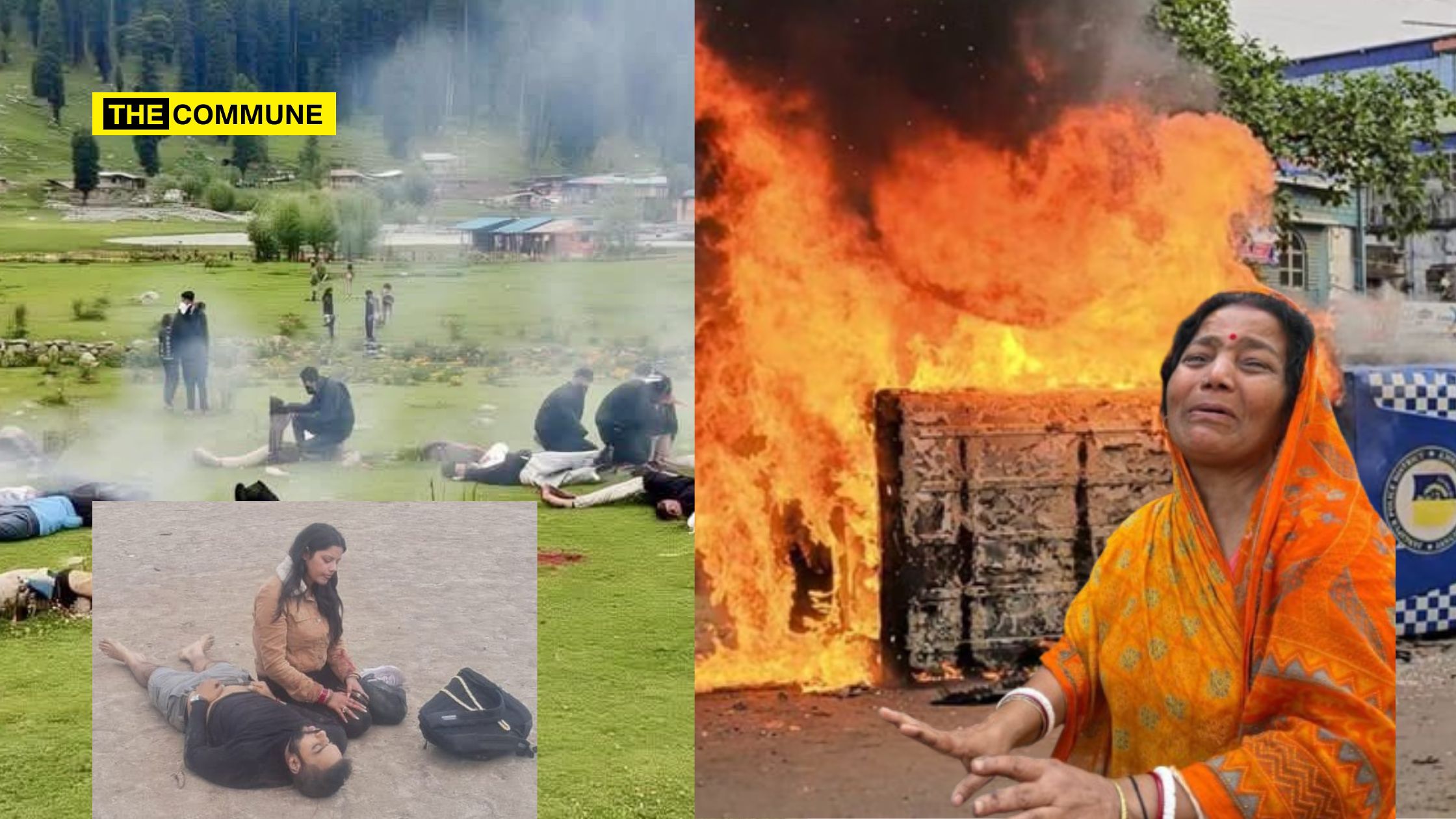
Around 2:50 PM, between four and six armed militants disguised in military-style clothing emerged from the nearby forest and opened fire on a crowd of tourists enjoying the clear weather after days of rain. Survivors recounted that the attackers initially posed as security personnel, asking victims for their names and religious identity before launching a targeted assault.

Eyewitnesses reported that the militants singled out non-Muslims by demanding that individuals recite the Islamic kalma and checking for circumcision—those who failed were executed. Most of the victims were men. In a chilling account, a gunman reportedly spared a woman, telling her she was being left alive to “tell Prime Minister Modi what happened here.”

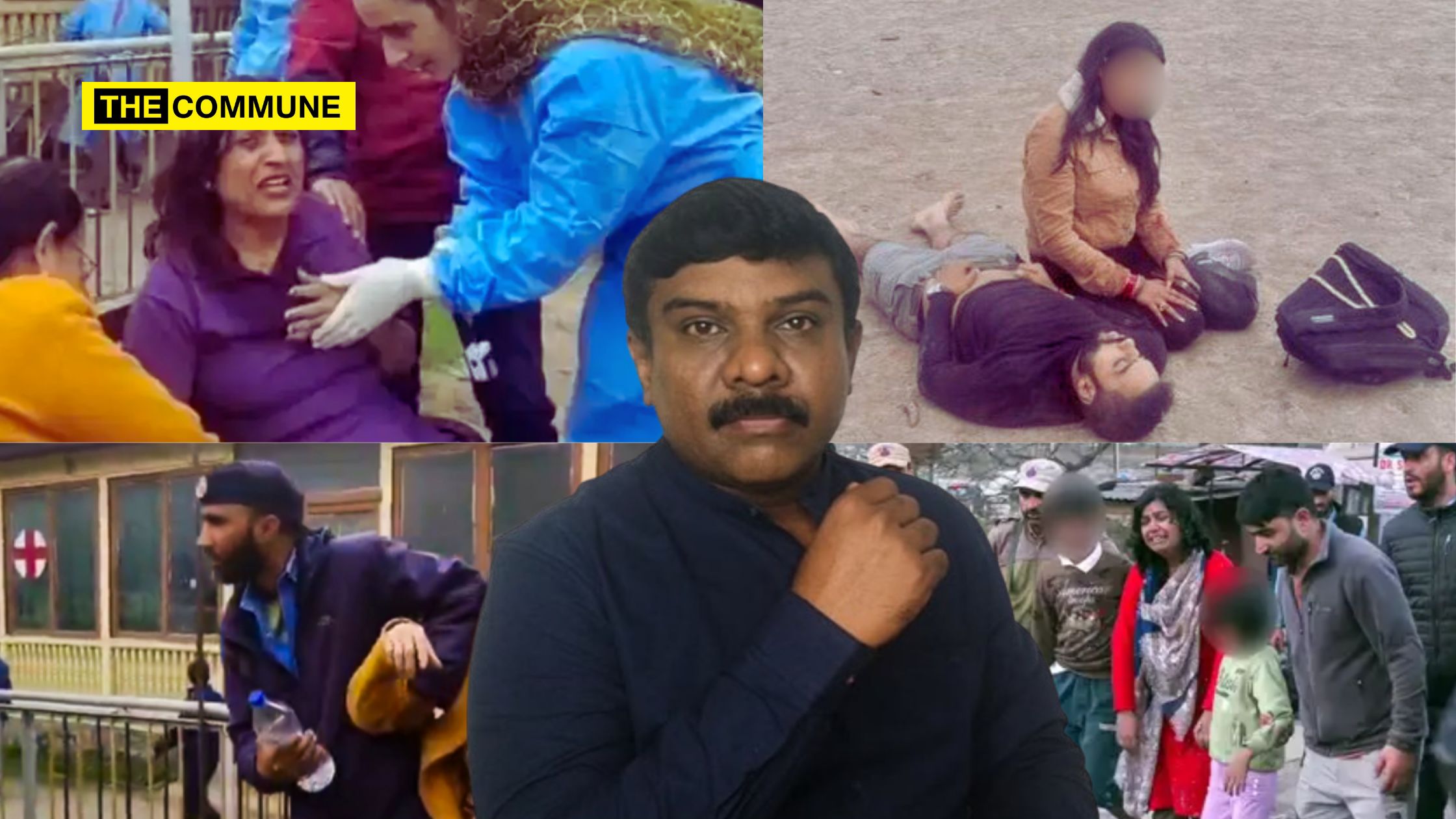
Graphic videos circulated online showed blood-soaked victims lying across the meadow, with terrified survivors pleading for help. Emergency responders quickly arrived, transporting the wounded to nearby hospitals, with some critically injured individuals airlifted to a military hospital in Srinagar.

Casualties

The attack claimed the lives of 28 civilians, including:

  • 24 Indian tourists from states like Karnataka, Kerala, Maharashtra, Odisha, Gujarat, Haryana, West Bengal, and Uttar Pradesh,

  • 2 locals from Jammu and Kashmir, and

  • 2 foreign nationals from Nepal and the UAE.

Among the deceased were a 26-year-old Indian Navy officer and an Intelligence Bureau official. Over 20 others were seriously injured, hailing from Tamil Nadu, Gujarat, and Maharashtra.

Security forces swiftly launched a joint search and cordon operation, involving the Indian Army and local police. Helicopters were deployed to track the militants, and a temporary lockdown was imposed in parts of Pahalgam.

The Resistance Front (TRF), which operates under the umbrella of Pakistan-based Lashkar-e-Taiba, claimed responsibility. In a statement, the group justified the attack by accusing the Indian government of settling over 85,000 “outsiders” in the region, allegedly attempting to alter the valley’s demographic makeup.

Despite widespread media coverage and survivor testimonies confirming that victims were forced to strip and recite the Islamic kalma to determine if they were Hindu or Muslim—with threats of being shot otherwise—Tamil Nadu Congress spokesperson Lakshmi Ramachandran chose to downplay the communal nature of the attack. By insisting it was merely a generic act of terrorism, not one specifically targeting Hindus, she appeared to be prioritizing political optics and vote-bank considerations over acknowledging the truth.

PM Modi’s Clarion Call

Prime Minister Narendra Modi, addressing a gathering in Bihar’s Madhubani, strongly condemned the Pahalgam terror attack that killed 26, including 25 tourists and a local. Starting with a silent tribute, he declared the entire nation is united in grief and anger. Modi emphasized that the attack was not just on innocent people but on India’s soul, vowing that the perpetrators and their backers would face unimaginable punishment.

In a global message, he asserted that India will pursue terrorists to the ends of the earth and will not let terrorism go unpunished. The Prime Minister cut short his Saudi Arabia visit and chaired a high-level security meeting, following which India initiated diplomatic action against Pakistan—suspending the Indus Water Treaty, halting SAARC visa exemptions, reducing the Pakistani High Commission’s staff, and closing the Attari check post. Modi thanked world leaders for their solidarity and reaffirmed India’s resolve to crush terrorism.

Subscribe to our channels on TelegramWhatsApp, and Instagram and get the best stories of the day delivered to you personally.

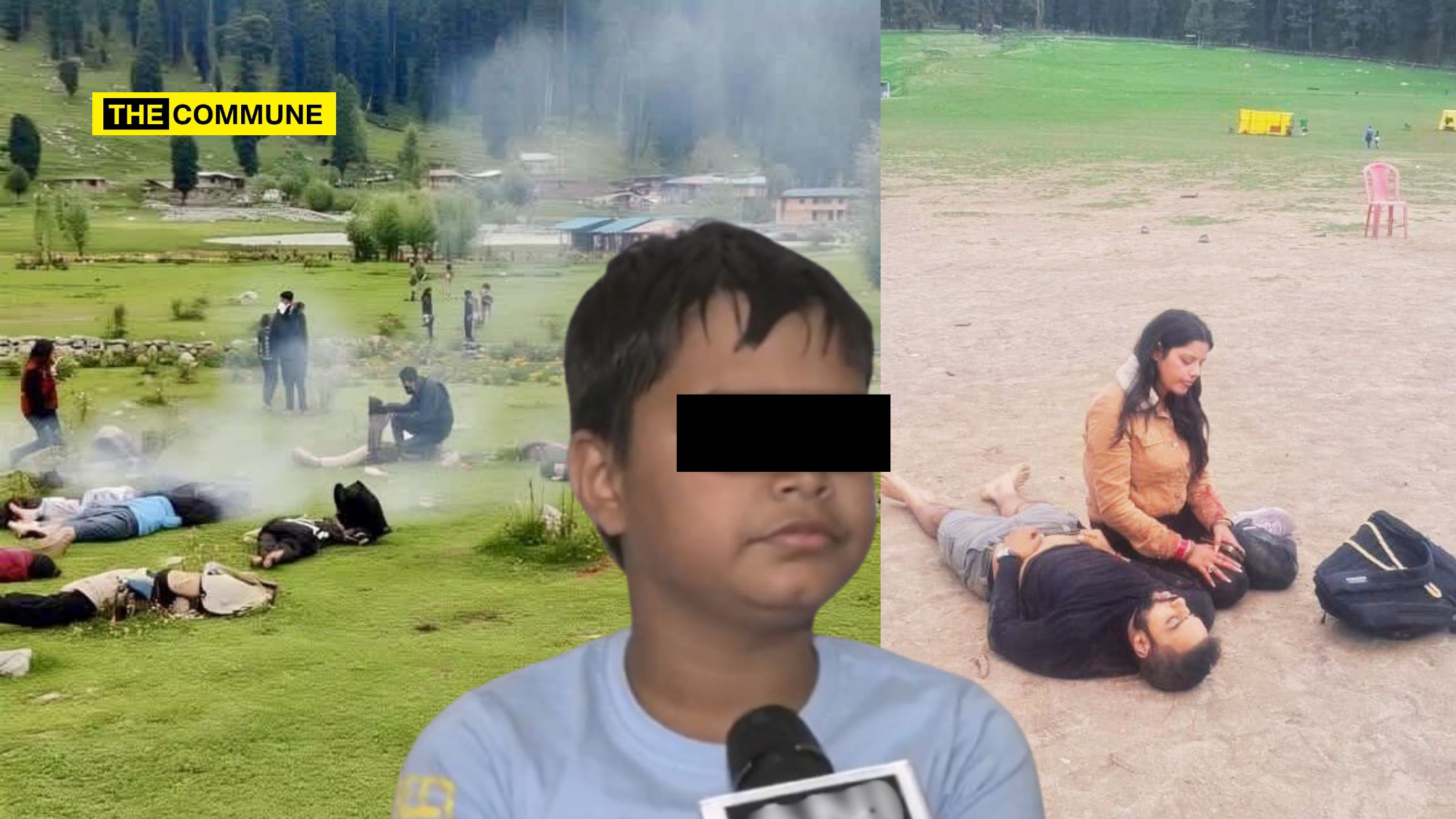
“They Separated Hindu Men And Shot Them, Told To Recite Kalma Thrice”: This Kid’s Testimonial Is A Slap On The Face Of Congress, Leftists And “Terror Has No Religion” Brigade

The tragic terror attack in Pahalgam, Jammu and Kashmir, on 22 April 2025, that took the lives of 28 innocent people, has sent shockwaves across India. The senseless bloodshed has left families devastated, and the grief is shared by citizens from every corner of the nation. However, it is the disturbing and heartbreaking testimonial from young Naksh Kalthia, whose father Shailesh Himmatbhai Kalthia was one of the victims, that has exposed the brutal reality of the attack—and in doing so, has delivered a resounding challenge to the political and intellectual elites who have long preached the myth thatterror has no religion.”

As Naksh recounts his harrowing experience, the chilling details are impossible to ignore. Amid the terror attack, the perpetrators singled out Hindu men, forcing them to separate from the others. They then demanded that the men recite theKalma”—a declaration of faith in Islam. Those who were unable to do so were executed in cold blood. The women and children were spared, but the men were subjected to a horrifying fate that exposed the true, religiously motivated nature of the attack.

Speaking to ANI, Naksh’s words are searing in their simplicity. He said, “We went to Pahalgam in Kashmir. We had seen 5 points in Pahalgam and out of that Mini Switzerland was at the top. We were there only for 10-15 minutes, we were hungry, so we were eating food. At this time, we heard gunshots. We asked the restaurant folks what happened, they were also not aware. When the gunshots became more, we understood that terrorists had entered the area, so we hid ourselves. But they found us. We saw two terrorists. I heard one of them ordering all the men to separate into Muslims and Hindus and then shot all the Hindu men. They did not ask anything else, just asked the men to segregate themselves as Hindus and Muslims and killed the Hindus. The terrorists asked the men to recite ‘Kalma’ three times. Muslims knew that language and they recited it thrice. All those who could not recite it were shot. Once the terrorists left, the locals came and said that all those who had survived should go downhill immediately. I was on the pony, and my mother and sister climbed down on foot. After we reached, the army arrived, maybe an hour or so after we climbed down from the point. The military base was there. We stayed there for a while and left for the hotel in the evening. The terrorists were not letting him (my father) speak at allThey did not say anything (to my mother) …”

He further said, “There were totally 20-30 people – Hindu men. I was behind my parents and sister so when my father was shot I did not see it, I couldn’t see it from where I was.”

When asked about the terrorists, he described them saying, “One of the terrorists was fair and had a beard. He was wearing a Mohemmedan-type cap and had a camera tied to his head. He was wearing a white T-shirt and black jeans. I don’t know if they were recording. I saw two of them but I don’t know if anyone else was there. They spared the women and the children and shot everyone else.”

This heart-wrenching testimony from a young survivor challenges the false narrative propagated by many in India’s political landscape. For years, the Congress Party and its spokespersons like we have in TN – Lakshmi Ramachandran, the left-wing intellectuals, and their allies in theTerror Has No Religionbrigade have attempted to downplay the religious motives behind terror attacks. However, Naksh Kalthia’s testimony paints a grim picture that simply cannot be ignored.

Here’s what Lakshmi Ramachandran said as soon as the news of the terror attack broke out. On her X handle, she wrote, “Attack by Pakistani terrorists on innocent tourists in Pehalgam is extremely disturbing. The way Godi media is reporting the ghastly attack, treading a careful line lest they displease Modi-Shah, is highly irritating. They are making this a Hindu-Muslim issue to please their bosses. They are claiming that the terrorists made sure that the victims were Hindus before shooting them down. Some of the victims are Tamils and Telugus we hear. How the hell will Pakistani terrorists distinguish between a Tamil Muslim and Tamil Hindu? Shame on you Godi media. You have no humanity left in you. INDIANS were killed and the perpetrators should not be spared.” 

The terrorists in Pahalgam did not treat their victims as faceless people—they identified them by their religion and separated them accordingly. The cold, religiously motivated execution of Hindu men stands in stark contrast to the claims made by political leaders and activists who continue to push the myth thatterrorism has no religion.Naksh’s account reveals the painful truth: in this case, religion was central to the attack.

The attack in Pahalgam was not an isolated event. In fact, it is just the latest example of a long history of religiously motivated violence in Kashmir and elsewhere. Yet, time and again, the Congress-led opposition, leftists, and self-proclaimed secularists have dismissed such incidents as mereviolence,refusing to confront the uncomfortable reality of Islamic terrorism. They continue to claim that terrorism is rooted in poverty, social inequality, or mindless extremism. But Naksh’s testimonial shatters this narrative and exposes the uncomfortable truth: terrorism is often a religiously fueled act.

Subscribe to our channels on Telegram, WhatsApp, and Instagram and get the best stories of the day delivered to you personally.
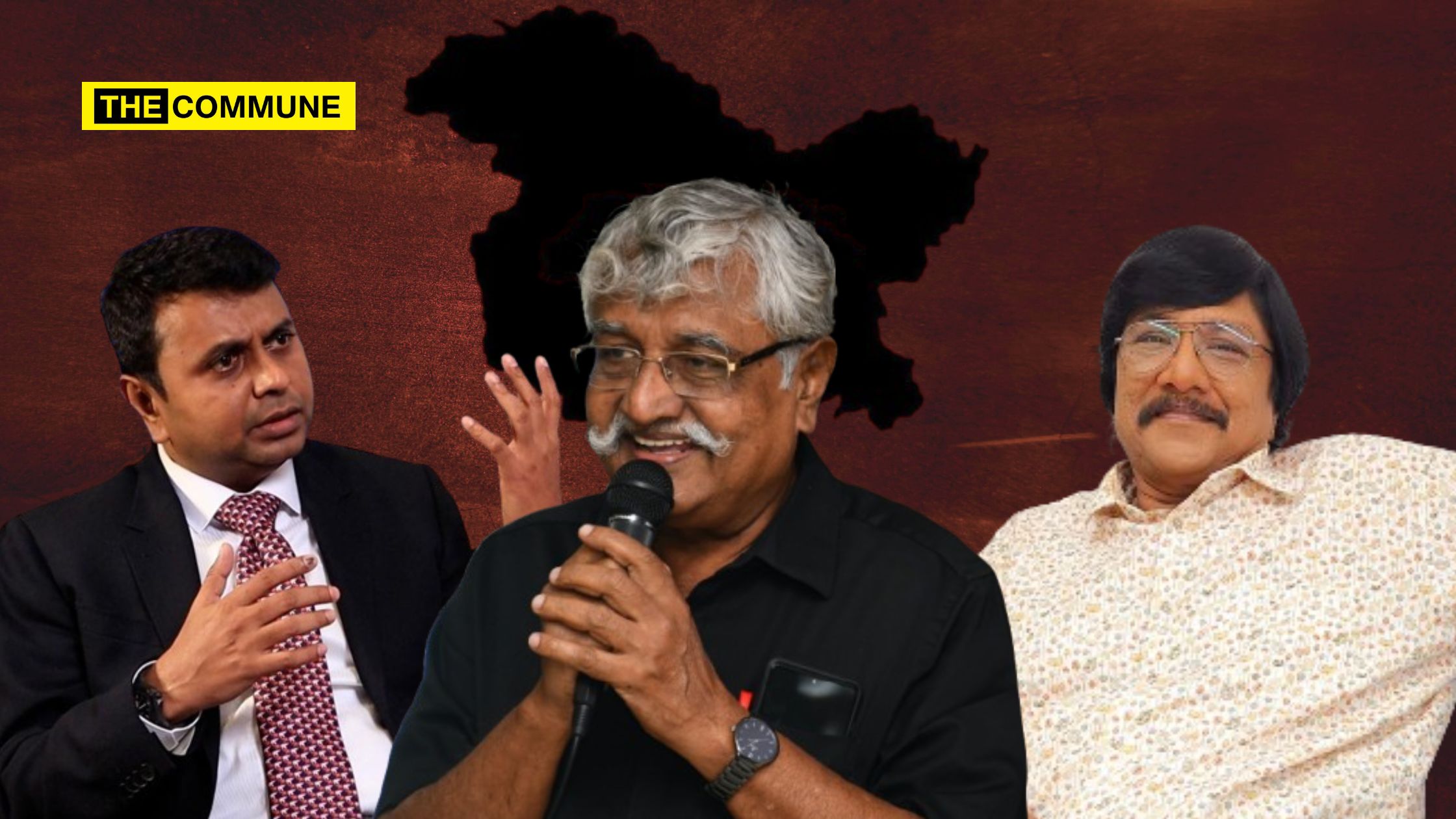
The Many Times When DMK And Dravidian Stockists Supported Pakistan

Regardless of which party is in power, the central government, citizens, and armed forces of India have consistently and firmly upheld the belief that “Kashmir is, and will always remain, an integral part of India.” Many still aspire to see the day when territories of Jammu and Kashmir currently under illegal occupation by Pakistan and China are rightfully reclaimed.

However, in stark contrast, certain political voices in Tamil Nadu—particularly from the Dravidianist and Periyarists, as well as the Congress-led I.N.D.I alliance partner DMK—appear to follow a different narrative. At times, their rhetoric has surprisingly aligned with Pakistan’s stance on Kashmir, raising eyebrows across the country. These positions have not only been expressed in public forums but also openly pushed during television debates, creating significant controversy.

Below are notable instances where leaders and spokespersons from the Dravidianist, Periyarist, and Congress-I.N.D.I allies —especially those associated with the DMK—have made statements that seemingly echo or support Pakistan’s viewpoint on Jammu and Kashmir.

When DK Leader Suba Veerapandian Peddled Hate-Filled Rant Comparing Modi Govt to Hitler, Alleged Ethnic Cleansing Of Kashmiri Muslims

In a highly charged and controversial speech, Suba Veerapandian, General Secretary of the Dravida Iyakka Tamilar Peravai, accused the central government of authoritarianism and alleged communal targeting, drawing parallels between Prime Minister Narendra Modi and Adolf Hitler.

He said, “Some ask how Modi can be called authoritarian when he came to power through elections. Hitler too came to power in 1933 through elections. By 1934, he had declared himself a dictator. At least Hitler took a year — but for Modi just three months is enough. We strongly condemn this as it goes toward authoritarianism. As we’ve said, ‘The people of Kashmir are our people. The blood of Kashmir is Tamil blood. Tamils will always stand by justice, with anyone.’”

Continuing his address, Veerapandian added, “Today, Kashmir is surrounded by the army. Communication have been severed. Former Chief Ministers are under arrest. We don’t know what will happen next, and many fear what’s to come. Friends,  Just as Hitler aimed to wipe out the Jewish race, this government under Modi and Amit Shah has taken its first step toward the total destruction of Muslims. Note, this is only the first step. After destroying the Muslims, If their objective includes targeting other minorities, suppressing communists, and dividing the people along caste lines, and giving the nation only to Brahmins then let it be known—this nation will resist with everything it has, till it’s last breath.”

The speech has drawn widespread criticism online, with many accusing Veerapandian of fear-mongering and inflammatory rhetoric.

When DMK Spokesperson Saravanan Annadurai Said “Kashmir Was Never Integral Part Of India”

During a debate on Republic TV aired on 12 August 2019, DMK spokesperson Saravanan Annadurai stirred controversy by stating, “Kashmir was never an integral part of India.” The discussion, hosted by Editor-in-Chief Arnab Goswami, centered around the abrogation of Article 370. Saravanan made the remark while defending DMK’s ally, the Congress party, against accusations of communalizing the Kashmir issue.

He also criticized the BJP-led central government, calling it “fascist” and accusing it of bypassing public consensus in its handling of the Kashmir matter. His comments were challenged by BJP representative Aman Sinha, who maintained that Jammu and Kashmir was unified with India and the recent changes were merely a constitutional reorganization. Saravanan responded, “That is your dream. Kashmir was never an integral part of India,” escalating the tension on the show.

Moments after Saravanan made his contentious remark regarding Jammu and Kashmir during the debate, anchor Arnab Goswami reacted sharply, turning the spotlight on DMK leader M.K. Stalin. Calling out the party chief directly, Arnab questioned whether Stalin endorsed his spokesperson’s statement that “Jammu and Kashmir is not an integral part of India.”

He went on to accuse Saravanan of challenging the nation’s sovereignty and demanded a clear response from the DMK leadership. “Mr. Stalin, does your party share this view? The country deserves to know your stand. If your party believes J&K is not an integral part of India, then you have no place in national politics,” Arnab declared. He further suggested that if such views persist, the DMK should be de-recognized by the Election Commission, warning that this could pave the way for more divisive or secessionist rhetoric in the future.

Following public backlash and rising controversy, Saravanan later clarified that his comments were his personal opinion and not reflective of the DMK’s official stance. In a statement issued through the party, he asserted that he did not make any remark undermining the country’s integrity. He explained that his statement referred to the historical context of Kashmir’s integration, noting that the region formally became part of India in 1956 through an agreement with then-Maharaja Hari Singh.

Saravanan also expressed frustration that he was not given an opportunity to fully explain himself during the noisy debate, saying his remarks were taken out of context. Despite a moment when Arnab offered a chance to clarify his position, Saravanan exited the program, prompting the anchor to accuse him of “running away” and publicly challenge DMK leader M.K. Stalin to declare the party’s stance on Kashmir.

As the debate clip circulated widely on social media, speculation intensified, with some reports even suggesting a possible probe by the National Investigation Agency (NIA). In response, the DMK released an official statement reiterating that Saravanan did not question India’s sovereignty and that the interpretation of his remarks had been misrepresented in the chaotic environment of the live broadcast.

When DMK Spokesperson Manushya Puthiran Blames Army Presence for Rise in Terrorism in Kashmir

S. Abdul Hameed, popularly known by his pen name Manushya Puthiran and a spokesperson for the DMK, stirred controversy during a segment on Kalaignar News, where he made contentious remarks linking military presence to the growth of terrorism in Kashmir. He suggested that the army’s role in the region is counterproductive and could fuel radicalization.

He said, “Terrorism often takes root when there is internal contradictions especially when certain regions are treated unfairly, denied of justice. In Kashmir, the locals are threatened significantly through army. These can create sympathy for terrorist among the local population. In such situation, the affected region should be freed from military restrictions, but they believe by increasing military action will suppress terrorism. The problem is history from various countries shows that when military force is used excessively among people, it often creates a situation where extremists make a connection with the local population.”

He didn’t stop at Kashmir. He went on to link the government’s treatment of marginalized communities to the rise of Naxalism, “Take the Naxalite issue, for instance. When the government continuously mistreats tribal communities, Adivasis, and landless people, they are left with no alternative but to gravitate toward supporting extremists’ mentality. This was the major factor behind the spread of Naxalism in several states.”

His statements have drawn strong criticism online and from political opponents, who accuse him of justifying extremist violence and undermining national security forces.

Subscribe to our channels on TelegramWhatsApp, and Instagram and get the best stories of the day delivered to you personally.

Pahalgam Terror Attack: How Western Media Whitewashed A Hindu Massacre

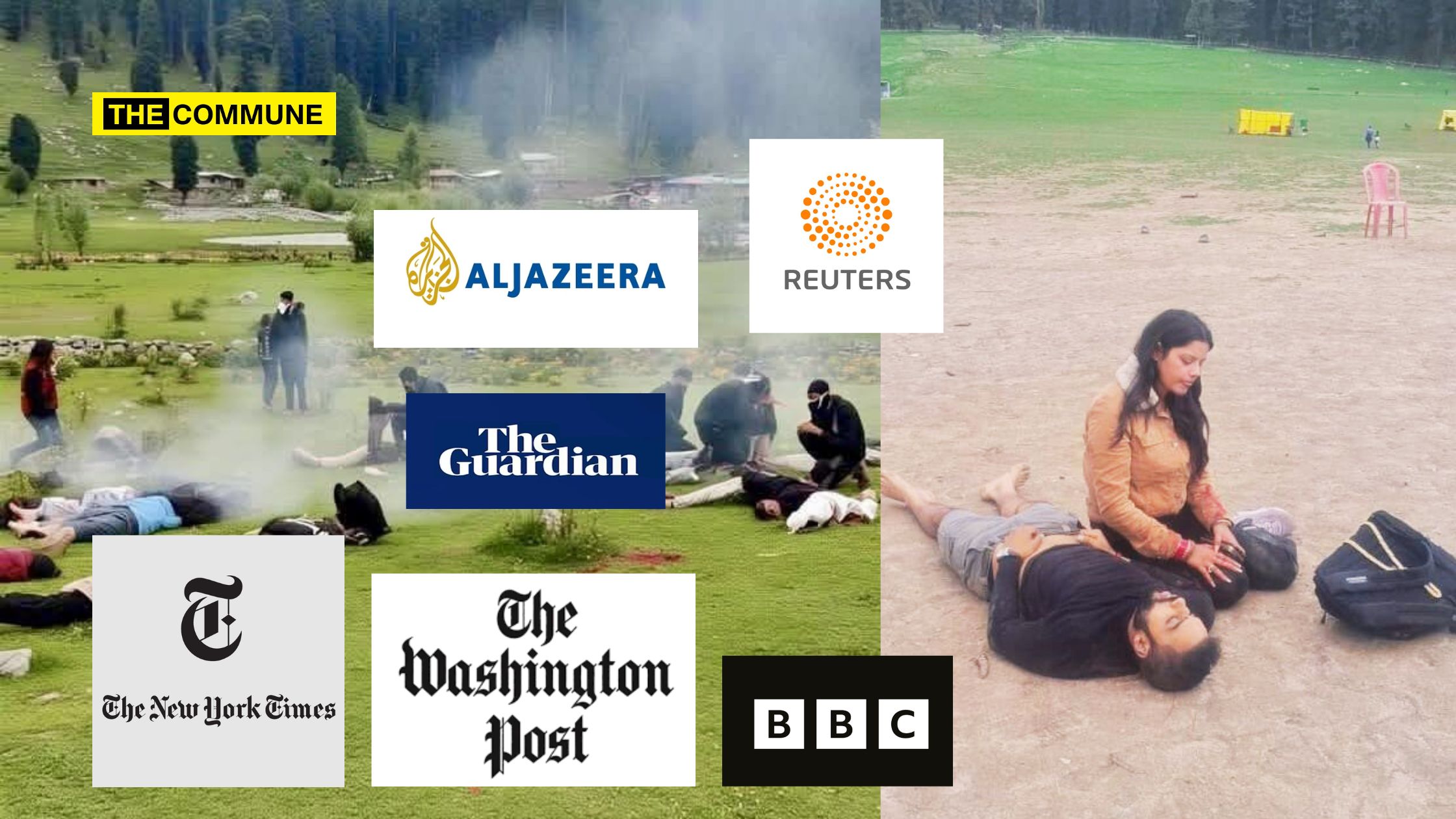
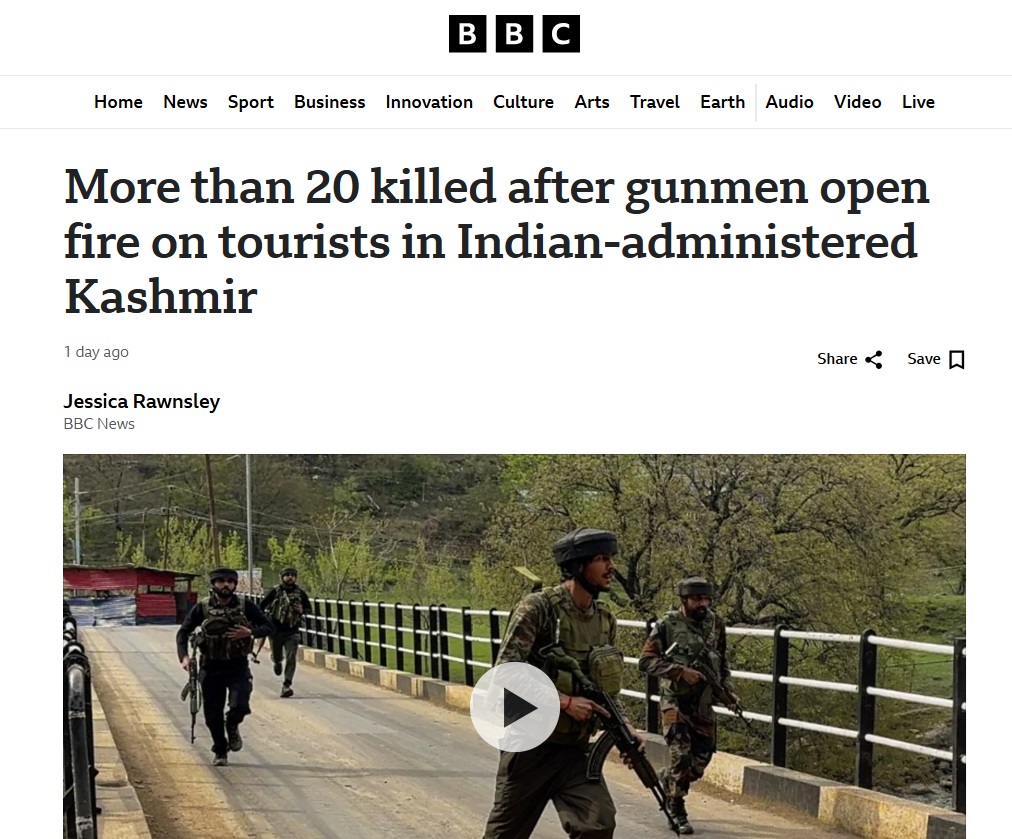
In the wake of the brutal terrorist attack in Pahalgam, Jammu, and Kashmir, where 28 innocent civilians, including several Hindu tourists, were killed, global media outlets have been accused of downplaying the nature of the violence and its perpetrators. Despite overwhelming evidence that this attack was the handiwork of terrorists, several major Western media organizations, including Al Jazeera, The New York Times (NYT), BBC, Reuters, and The Washington Post, have employed language that seems to shield the true identity of the attackers.

Al Jazeera’s ‘Cautious’ Language

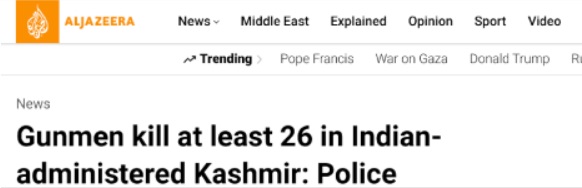
Al Jazeera, a Qatari news outlet which is often seen as a Jihad enabler, described the assailants in Pahalgam as “armed persons” rather than terrorists. The media outlet referred to the attack in its report by using terms like “gunmen” and placing the phrase “terrorist attack” in quotation marks, subtly suggesting a lack of clarity.

Following backlash, they changed the title to “Attack on tourists kills 26 in Indian-administered Kashmir: Police”.

This is not the first time Al Jazeera has resorted to such linguistic manipulation—historically, the network has used “gunmen” and “armed men” to describe terrorists in conflict zones, particularly when it involves Kashmir. By not directly labeling them as terrorists, Al Jazeera appears to deflect the responsibility of calling out terrorism when it involves groups sympathetic to Pakistan’s interests.

WaPo Downplays Terror, Echoes Separatist Narrative

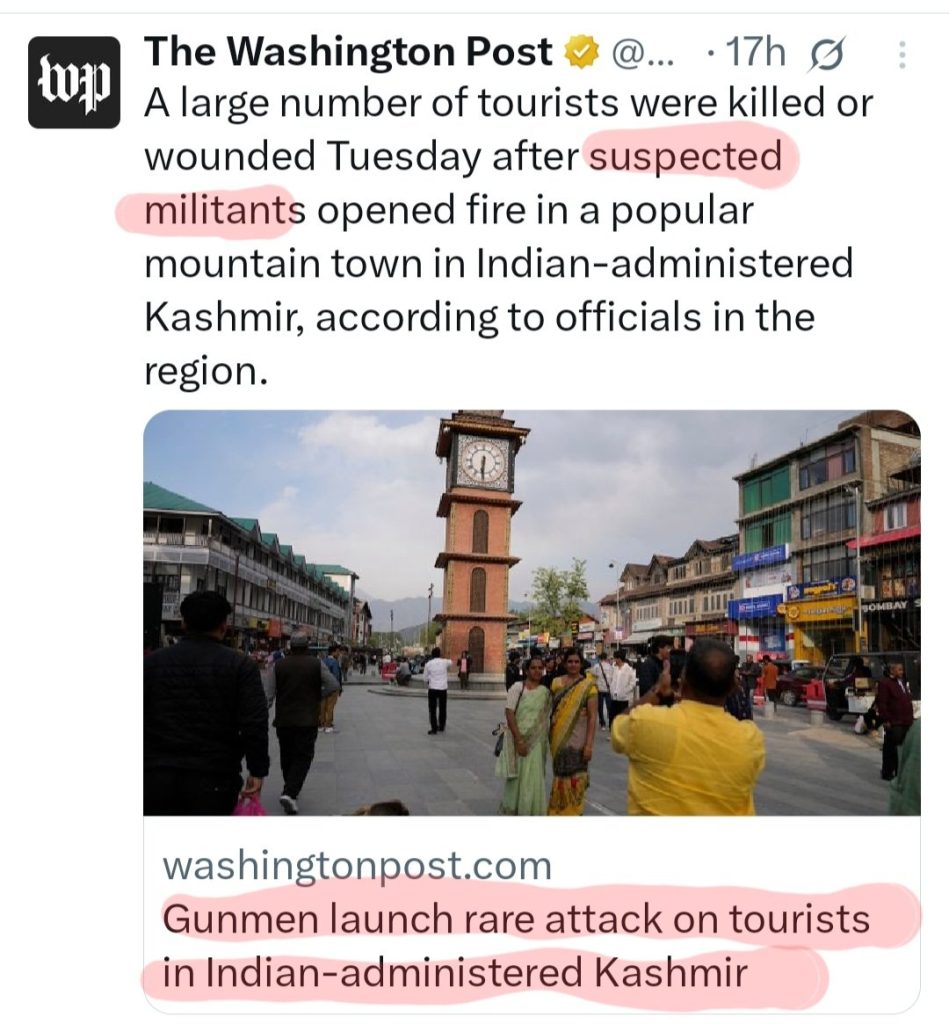
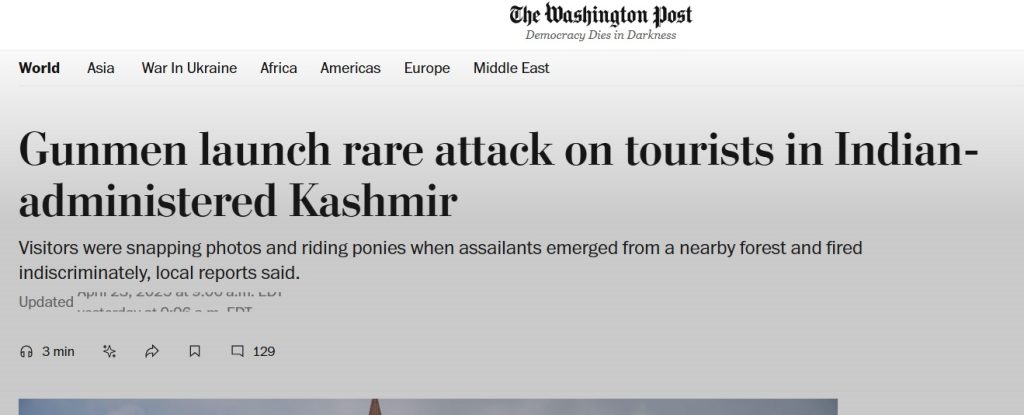
The Washington Post whitewashed the Kashmir terror attack by calling the region “Indian-administered Kashmir,” subtly questioning India’s sovereignty. It described the attackers as “gunmen” and “suspected militants” and avoided mentioning Islamist motives. The article emphasized India’s “harsh crackdown” and “rights abuses,” inserting unrelated grievances to deflect from the brutality of the massacre. Instead of focusing on the victims, it highlighted separatist aspirations and cast doubt on India’s stability narrative.

The piece framed the attack as part of a broader conflict rather than a targeted act of terror, using vague, passive phrasing to obscure the killers’ identity and ideological background.

This omission of crucial facts, including the religious targeting of the victims, raises serious questions about the newspaper’s objectivity.

BBC: Historical Bias and Evasive Language

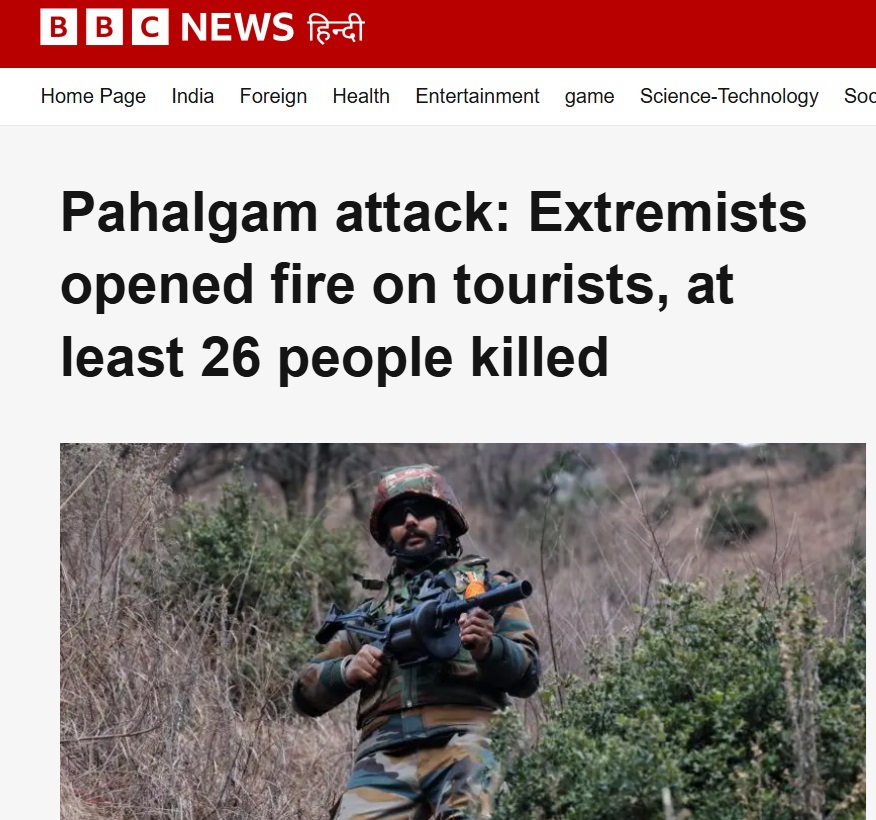
The BBC, often seen as a global authority in news coverage, has faced consistent criticism for its biased reporting on Kashmir. In its latest coverage, BBC avoided calling the attackers “terrorists” and referred to them as “gunmen.” The BBC also described the region as “India-administered Kashmir” and referred to the attack as a part of a “separatist rebellion,” subtly implying the insurgents’ actions were a legitimate response to a so-called occupation.

BBC Hindi uses the word “extremists” to describe the terrorists.

This kind of framing has been a hallmark of BBC’s coverage of Kashmir, where the institution often acts in a way that diminishes India’s sovereignty over the region.

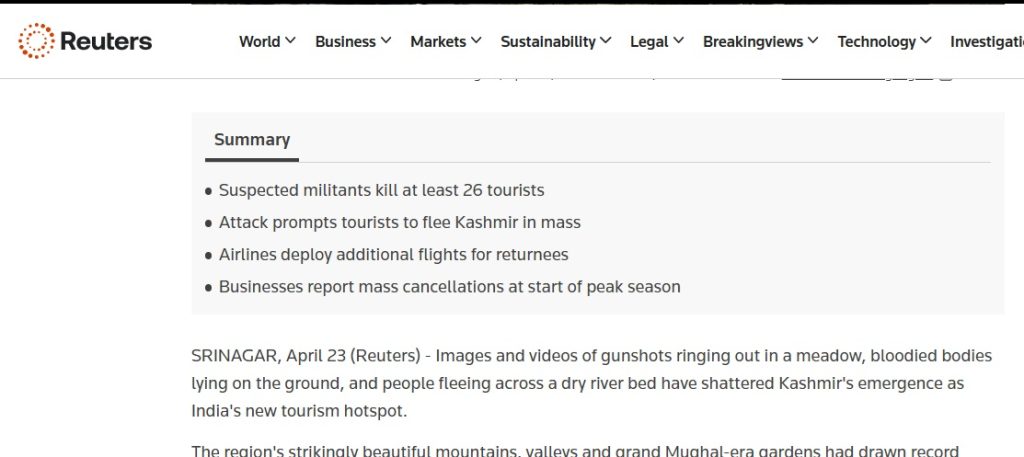
Reuters Downplays Terrorist Attack As Act By “Suspected Militants”

Despite the brutality of the massacre, where eyewitnesses confirmed that the attackers selectively targeted Hindus before opening fire, Reuters chose to describe the perpetrators merely as “suspected militants.” This phrasing has drawn sharp criticism for downplaying the nature of the attack and ignoring the ideological motivations behind it.

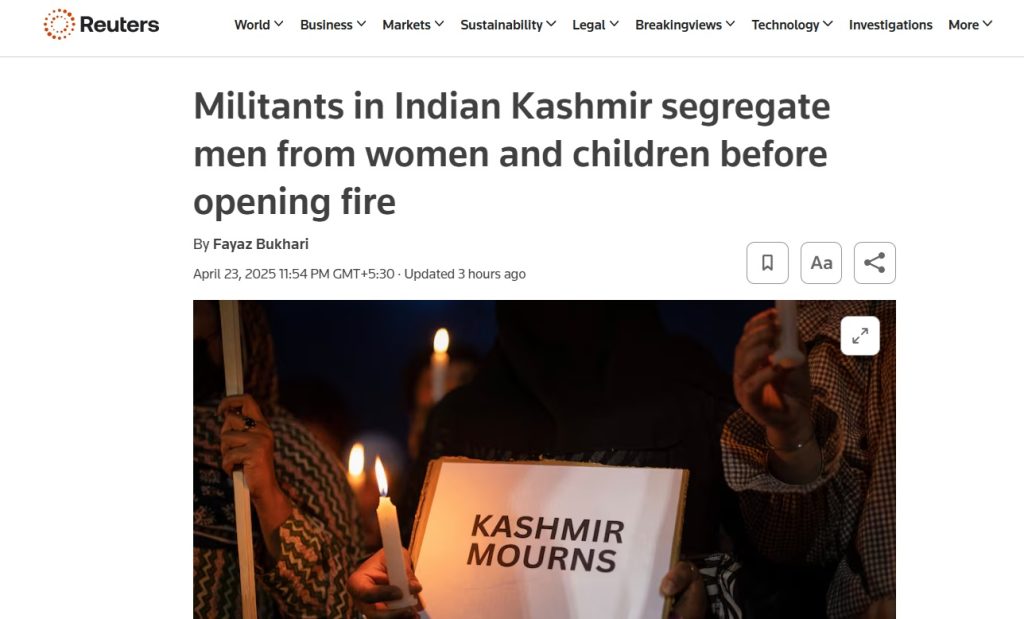
In another article, Reuters whitewashes the victims’ identities by not referring to them as Hindu men – the article talks about how the Hindus and Muslims were segregated by the terrorists.

By using such ambiguous terminology, Reuters is also contributing to a narrative that obscures the reality of Islamist terrorism in Kashmir and avoids confronting the communal targeting involved in the killings.

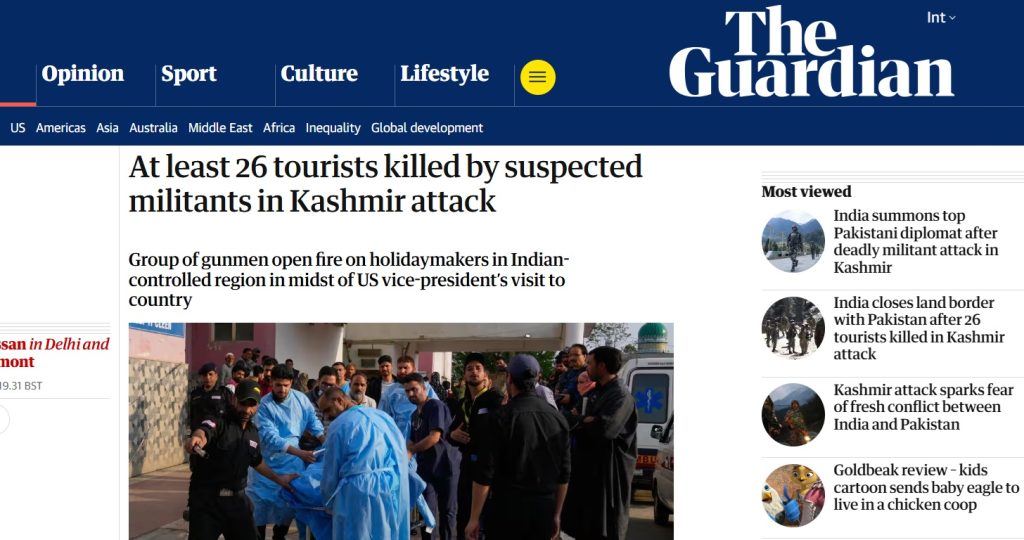
Group Of Gunmen, Suspected Militants – Guardian Whitewashes Terrorists

The Guardian downplayed the Kashmir terror attack by repeatedly labeling the perpetrators as a “group of gunmen” and “suspected militants” instead of terrorists, avoiding clear condemnation. It emphasized the scenic setting, quoted survivors in distress, and focused on the emotional aftermath rather than ideological motives or the extremist nature of the attack. The piece failed to frame the assault as terrorism, instead treating it as part of the broader “regional conflict.”

By attributing the motive to “anger over the settlement,” the Guardian subtly justified the violence, aligning with a narrative that masks religiously motivated terror under political grievances.

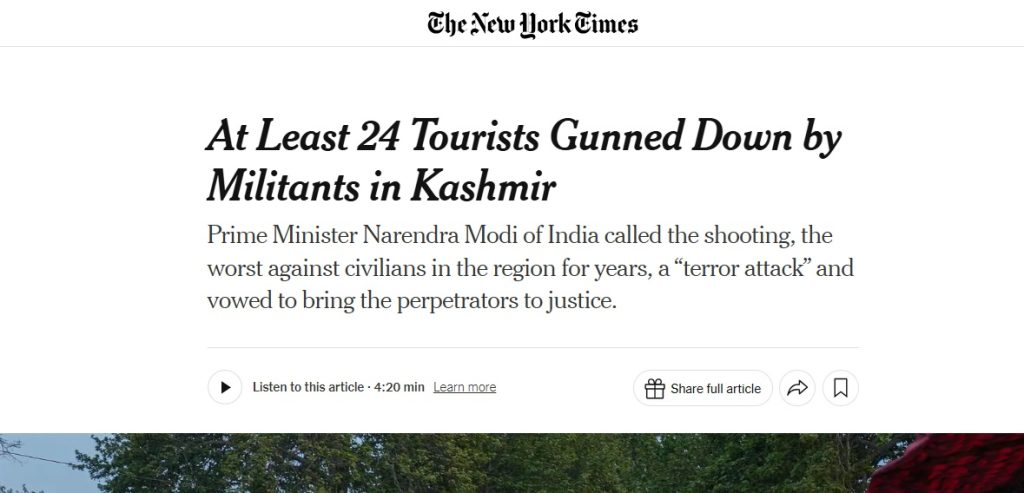
NYT Softens Kashmir Massacre With Scenic Framing And Passive Language

The New York Times downplayed the Kashmir terror attack by highlighting the “picturesque” setting instead of using direct terms like Islamist terrorism. It avoided naming the perpetrators, used passive language like “gunmen began firing” and framed the violence within the context of the Indo-Pak conflict rather than religious terrorism. It prioritized landscape descriptions over ideological motives. By emphasizing India’s governance in Kashmir and hinting at “security lapses,” the NYT subtly shifted focus from the killers to political management, thus diluting the nature of the attack.

The Omissions That Matter

Despite global condemnation of the Pahalgam attack, including statements from world leaders such as US President Donald Trump, Russian President Vladimir Putin, and Israeli Prime Minister Benjamin Netanyahu, Western media outlets have continued to employ euphemistic language to avoid identifying the perpetrators as terrorists. The most glaring omission is the failure to report that the attackers targeted Hindu victims based on religious identity—an act of religious persecution that the media outlets conveniently downplayed.

The global media’s selective reporting of terrorist activities is not limited to Kashmir. Similar patterns were observed when it came to other terrorist attacks, including those by Hamas in Israel. However, the reluctance to call out terrorism when it happens in Kashmir, and the continuous use of terms like “gunmen” and “militants,” suggests a political bias that undermines the severity of terrorism in India.

This selective portrayal of terrorist acts not only distorts the reality for global audiences but also contributes to the global narrative that undermines India’s sovereignty over Kashmir. The failure to accurately label these attackers as “terrorists” demonstrates the media’s willingness to downplay the gravity of such acts to fit political narratives.

(With inputs from OpIndia)

Subscribe to our channels on Telegram, WhatsApp, and Instagram and get the best stories of the day delivered to you personally.
From Murshidabad To Pahalgam: Our Silence Fuels Their Jihad — Time To Speak Uncomfortable Truths

In the annals of Indian history, there runs a dark, unbroken thread—a thread woven from centuries of conquest, humiliation, and violence that began with the Islamic invasions of the subcontinent. From the destruction of the temple by Mahmud of Ghazni, to the mass slaughter of innocents under Aurangzeb’s tyranny, the story of Islamic radicalism is not one of isolated acts, but of a sustained ideological war against the Indian civilization, especially its spiritual spine: the Sanatana Dharma.

And yet, even after centuries of bloodshed, even as the soil of India drank the tears and blood of its children, we as a nation have been taught not to remember, but to forget. To forgive without reckoning. To move on without reflection. Our education system, our intellectual circles, our mainstream discourse—each has sanitized history to fit a narrative of appeasement, of imposed harmony, of false equivalence. The trauma of Hindu civilization has been buried under layers of euphemism and academic erasure.

But truth does not die—it waits. The ideology that razed Somnath, Ayodhya, Kashi, and Mathura did not vanish with the Mughals. It did not end at Partition. It lives, mutated and emboldened, finding new names and faces, operating from Madrassas and terror cells, from pulpits and political backrooms. It now casts its shadow in Pahalgam and Murshidabad, in Udaipur and Kashi—not as an echo of the past, but as a continuation of an unbroken civilizational assault.

Still, we remain unwilling to name this enemy. We remain shackled by the fear of being labelled intolerant, communal, or regressive—while the very forces that thrive on division and destruction march onward, cloaked in the language of rights and pluralism. Our silence is not virtuous; it is complicit. It gives safe harbour to those who once led elephants into temple sanctums to desecrate the murtis, who now walk in courtrooms and corridors of power under the protection of law and the banner of secularism.

The time for silence is over. The time for euphemism is past. A nation that forgets its wounds opens them again. A civilization that will not defend itself—culturally, spiritually, and intellectually—invites its own demise.

The Cost of Cowardice: Murshidabad to Pahalgam

In Murshidabad, Hindus were hacked to death in their own homes. Their screams dissolved into the night; their blood washed away by the silence of a nation too afraid to confront the truth. There were no candlelight vigils in the heart of Lutyens’ Delhi, no emotional op-eds in national dailies, no hashtags trending in righteous indignation. The machinery that mobilizes outrage at the faintest perceived injustice was conspicuously still. Why? Because the victims were inconvenient. Their deaths did not fit the curated script of selective secularism.

Instead of naming the ideology behind the butchery, the headlines whispered of “local tensions”—a grotesque euphemism for jihadist hate. That silence was not neutrality. It was betrayal. And that cowardice—disguised as balance—gave courage to the butchers of Pahalgam.
Pahalgam was not an isolated event. It was a statement of intent. It was a war cry from the ideological successors of those who ravaged this land for centuries. It was a chilling reminder that the enemies of Bharat are not sleeping—they are evolving, rebranding, and striking with calculated precision.

The Resistance Front (TRF), the group that claimed responsibility, is not some organic Kashmiri uprising—it is the modern avatar of Lashkar-e-Taiba, the same Pakistani state-sponsored hydra that masterminded 26/11. TRF is nothing more than a PR facelift—a sophisticated deception designed to confuse the West, dodge blacklists, and maintain the charade of “local dissent.”

But the greater threat is not merely across the border. It is within. TRF and its handlers thrive because they are shielded, knowingly or unknowingly, by a network of enablers embedded in India itself. These are the so-called activists who cry for human rights only when the perpetrator fits a convenient profile. These are the media houses that cloak terror in neutral tones, the academics who romanticize radicalism in the name of “resistance,” and the politicians who appease for votes while graves are dug for innocents. It is this internal sabotage—this ideological treason—that emboldens the jihadist playbook.

The cost of cowardice is measured not just in corpses, but in the corrosion of a nation’s will. Each time the state hesitates to call jihad by its name, each time the media deflects, and each time the intellectual class offers false equivalence, the enemy gains ground. What happened in Murshidabad was a warning. What happened in Pahalgam was the proof.

The Domestic Enablers: India’s Opposition and Intellectual Cowards

Who nurtured the environment where such extremism could take root again? Who allowed the Kashmir narrative to drift from justice for the lakhs displaced Kashmiri Pandits to teary-eyed editorials for stone-pelters who maim soldiers and shield terrorists? The answer lies not in Pakistan alone—but in the polished drawing rooms of Delhi, in TV studios where the truth goes to die, and in the corridors of power where India’s political opposition and their intellectual foot soldiers operate with surgical precision.

It is they who turned the discourse from victim justice to terrorist empathy. It is they who humanized the gunman and demonized the soldier. They manufacture outrage for distant deaths in Gaza yet scroll past the hacked bodies in Murshidabad. When a terrorist is neutralized in the Valley, it is Rahul Gandhi who questions the army’s actions and lectures about “dialogue.” It is Mehbooba Mufti who cries crocodile tears for “our boys,” never once mentioning the officers martyred by their bullets. When Pulwama happened, it was not Pakistan but the Indian opposition that ran to court, demanding “proof.” That is not dissent. That is disgrace.

Let us talk about the media darlings, the left-liberal intelligentsia—those with column inches in The Wire, The Caravan, and NDTV. When the Gyanvapi revelations surfaced, they scoffed at centuries of desecration as “Hindutva propaganda.”

When Nupur Sharma quoted Hadiths, they blamed her for the beheading of Kanhaiya Lal. Not the killer. Not the ideology. But the one who dared to speak. Arundhati Roy once called for Kashmir’s “freedom.” She is still feted in Western universities and local literary festivals; never mind the seditious rot she spreads.

Ramachandra Guha, who prides himself as a historian, rarely finds space in his volumes to acknowledge the genocides of Hindus through centuries—unless to add “context” that somehow absolves the perpetrators. Rana Ayyub cries foul over Islamophobia abroad while conveniently silent on Hindu girls abducted and converted under coercion.

These are not just acts of omission—they are acts of betrayal. Betrayal of memory. Betrayal of martyrdom. Betrayal of the very idea of India. In the name of secularism, they defend the intolerant. In the name of harmony, they silence the truth. In the name of intellectualism, they elevate lies to virtue.

And what is the cost of this treachery? Temples vandalized and dismissed as “isolated incidents.” Killings justified with invented grievances. Institutions are infiltrated by ideological partisans who wear the garb of neutrality while pushing the agenda of fragmentation. This is not mere politics. It is a soft insurgency—waged not with weapons, but with words, white lies, and weaponized empathy.

Time For Hindus To Awaken

This is no longer about political allegiance or policy choices. This is not about Right versus Left—it is about Right versus Wrong. It is about survival—of a civilization, a culture, a way of life. The Hindu civilization has teetered on the edge of extinction more than once—through centuries of brutal invasions, desecration, and systematic attempts to erase its spiritual and cultural foundations. And yet, it endured—not because of global sympathy or institutional protections, but because of the sheer will of its people. Because of valour, not votes. Because of sacrifice, not slogans.

Today, Hindus are the last surviving major indigenous civilization on Earth. The Greeks fell. The Persians submitted. The ancient Egyptians were absorbed into oblivion. But the Hindus, battered and bloodied, held the line. That miracle of continuity is now being tested again—and this time, the assault is not just from outside, but from within. Apathy has replaced alertness. Silence has been sold as a virtue. Tolerance has been weaponized into weakness.

It is time for Hindus to awaken—not in hatred, but in unapologetic clarity. To stop whispering when they are wronged. To stop looking over their shoulder before mourning their own dead. To demand justice—not as a plea, but as a birthright. When their people are lynched, they must call it what it is: a hate crime. When their temples are razed or encroached, they must not seek permission to rebuild—they must reclaim. When their gods are mocked, they must not beg for tolerance—they must assert dignity. Enough with playing by rules no one else follows.

We must re-learn the courage of Chhatrapati Shivaji Maharaj, who refused to bow before tyranny and built not just forts but a spirit of defiance. We must revive the cunning wisdom of Chanakya, who understood that strategy and survival go hand in hand. We must remember Rani Durgavati, who chose to die with a sword in hand rather than surrender her honour. These were not fringe heroes. They were the lifeblood of our civilizational resistance.

We must also reclaim our narratives from those who seek to dilute or distort them—from those who speak of peace but practice cowardice, who call for secularism but preach selective silence. Let us be clear: peace without truth is surrender, and harmony without justice is slavery with a smile. Most of all, we must stop pretending. Pretending that terrorism in India is rootless, faceless, or “local.” It is not. It is Islamic in origin, jihadist in design, and executed with a clear theological and ideological motive. To deny this is to abandon the victims. To blur this truth is to embolden the killers.

The Path Forward: Speak The Truth, Unapologetically

Islamic terrorism is not merely a “law and order” challenge—it is an ideological war, a clash between civilizations, between those who believe in coexistence and those who seek domination. And in any war—especially a civilizational one—clarity is not optional. Clarity is survival.
This is not paranoia. This is a pattern. This ideology is not some distant threat. It is an ideology woven into the very core of Islamic radicalism, as seen in the Quranic verses often invoked by extremists to justify violence.

For example, Surah At-Tawbah (9:5) calls for the slaying of idolaters wherever they are found, with the ultimate goal of spreading the supremacy of Islam by force: “Then when the sacred months have passed, kill the idolaters wherever you find them, and capture them and besiege them and sit in wait for them at every place of ambush.” Surah At-Tawbah (9:29) goes further, directing followers to wage war against non-believers until they submit: “Fight those who do not believe in Allah or in the Last Day and who do not consider unlawful what Allah and His Messenger have made unlawful… until they give the jizyah willingly while they are humbled.”

Surah Al-Mujadila (58:22) tells us, “You will not find a people who believe in Allah and the Last Day, loving those who oppose Allah and His Messenger…” The clear message is that any non-Muslim, any person who does not submit to the will of Allah, is considered an enemy. This worldview, as twisted as it is, is what drives radical elements to target and kill innocent Hindus, who are seen as obstacles to the expansion of this ideology.

These verses are not isolated. They form the bedrock of a militant and expansionist ideology that radical groups have used to justify terror in every corner of the world. From the streets of Murshidabad to the forests of Kashmir, the ideology of hatred has been allowed to spread and infect minds, unchecked and unchallenged. And yet, even now, our media softens the edges. Our politicians hedge their words. Our intellectuals search for “root causes.” No more. The time for cowardly euphemisms is over. This is not about narrative control—it is about national clarity. You do not defeat a hydra by patting its head. You defeat it by naming it, shaming it, and crushing it at its roots.

We must reclaim the national conversation from those who anesthetize us with half-truths. We must demand accountability—not only from terrorists and their state sponsors but from those within our borders who provide them ideological cover. The professors who justify jihad in op-eds. The anchors who twist facts into fiction. The bureaucrats who equate victim and perpetrator in reports. They must all be exposed, their motives laid bare. Because their silence is not neutral—it is collaboration.

We must rewrite our history—not with hate, but with honesty. The temples destroyed, the cultures erased, the genocides whitewashed—these are not footnotes. They are foundational. No civilization can walk forward with its past buried under a lie. And no people can survive if they are taught to feel shame for simply remembering who they are.

And above all, we must ensure the silence of Murshidabad is never repeated. That indifference must never again be the national response to Hindu suffering. The victims deserve memory. The killers deserve justice. And the future deserves the truth. And to the Hindus of this land—this is not the time to whisper. This is the time to roar. Not in vengeance, but in vindication. Not in rage, but in resolve. Let your temples rise again, let your stories be told again, let your pride breathe again—not behind closed doors, but in the open, under the sun, without fear, without apology.

Anand Krishna is a Kerala-based lawyer and a columnist.

Subscribe to our channels on TelegramWhatsApp, and Instagram and get the best stories of the day delivered to you personally.