Home Blog Page 281

Satish Acharya, An Overrated Cartoonist Who Is A Two-Bit Congress Propagandist
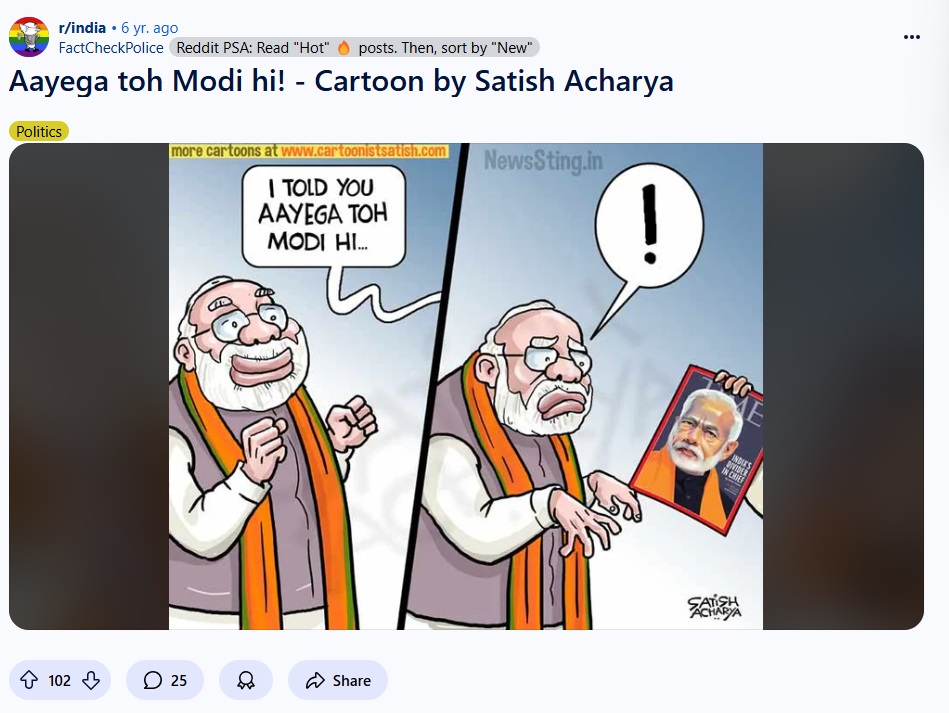
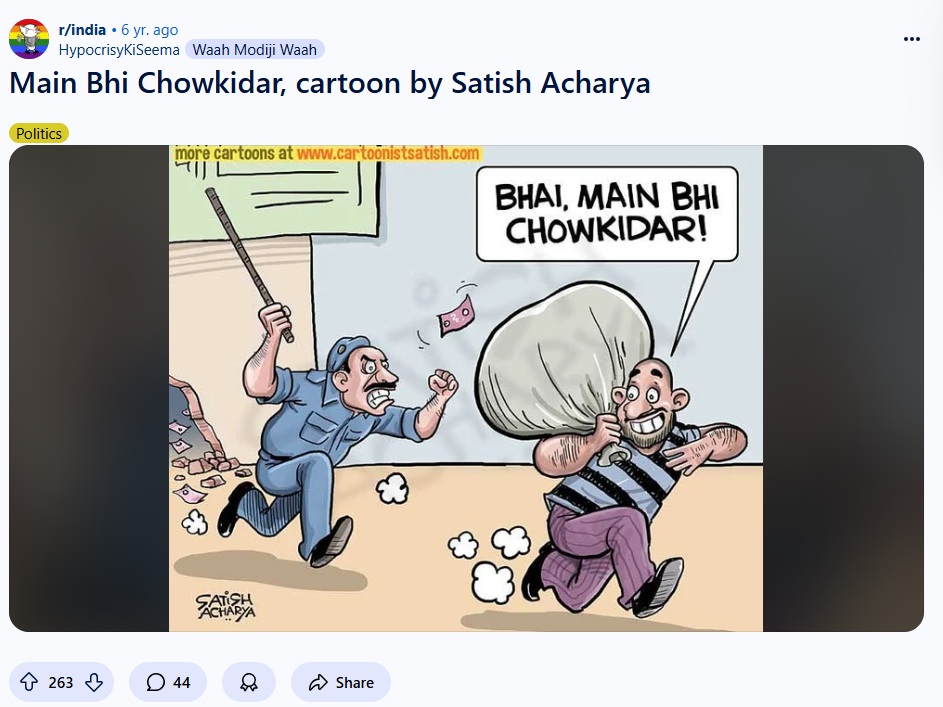
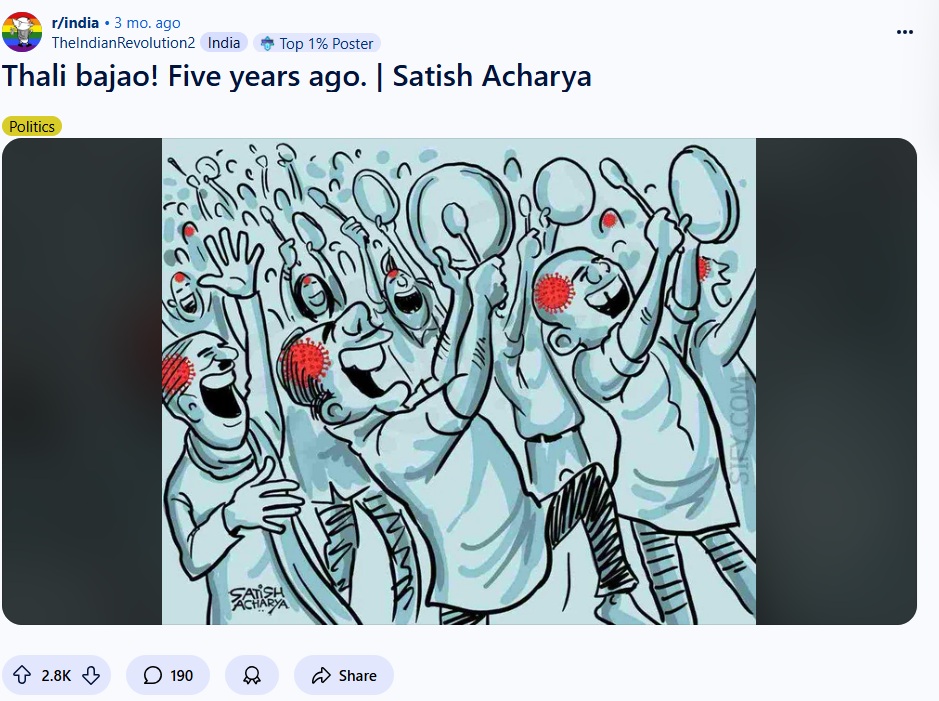
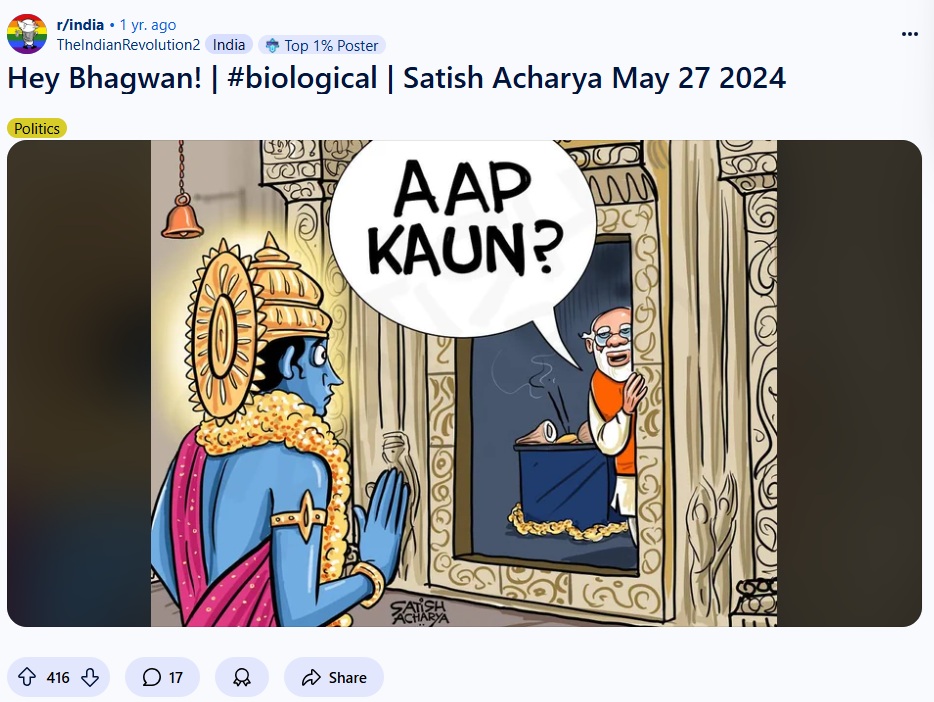
He positions himself as a satirist, a “neutral” cartoonist who allegedly questions the establishments in power through his works of art. But does he? If one takes a look at his work, right through the years, one can easily confirm that cartoonist Satish Acharya masquerades as a neutral voice while serving as a de facto propagandist for the Indian National Congress.

Far from balanced critique, his body of work only appears to be a calculated effort to shield the Congress party while obsessively lampooning its political rivals. A pattern of selective targeting, ideological omission, and conspicuous silence during Congress failures paints a damning picture of compromised integrity.

Let us take a look at each of his works, available in public domain and analyse it for “neutrality”.

Election Season Satire Or Electioneering?

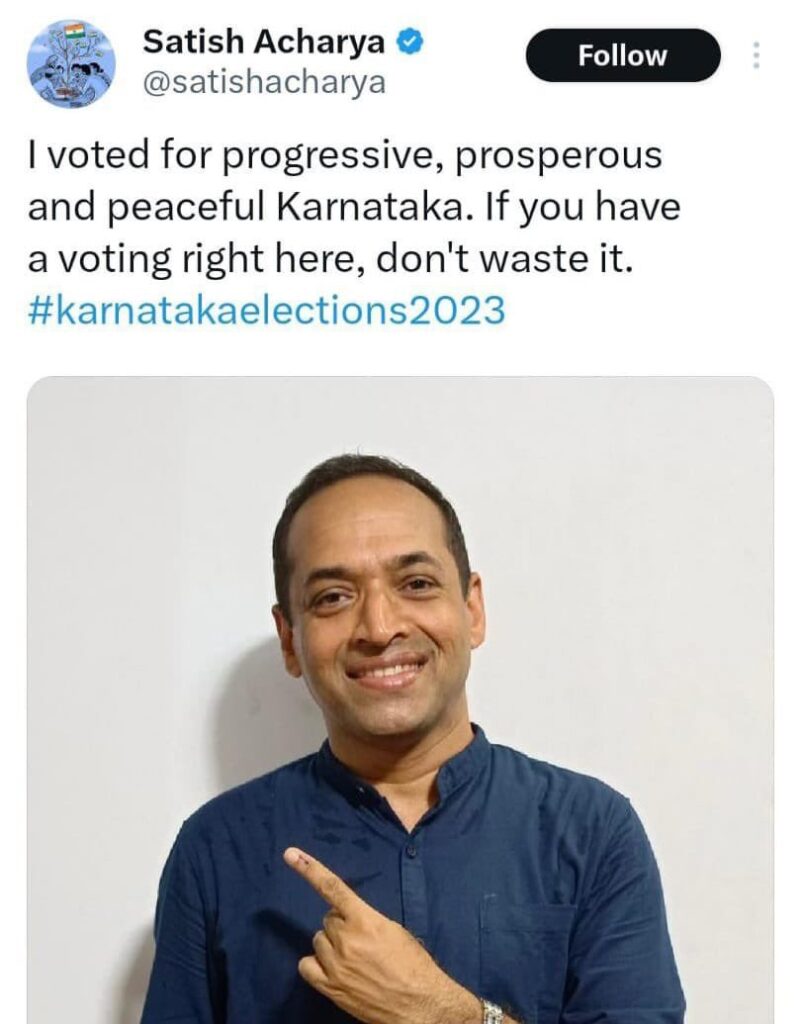
When the Assembly elections for Karnataka took place, Acharya posted on his X handle that he had voted for “progressive, prosperous, and peaceful Karnataka.”
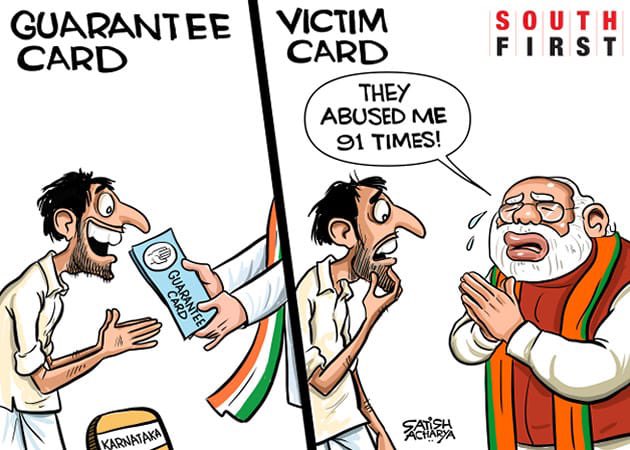
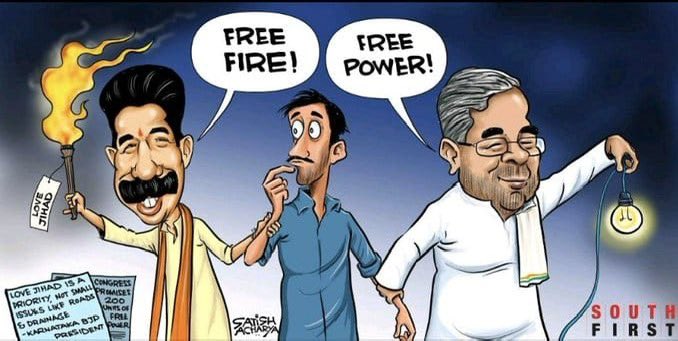
But when it came to the campaign period, he used his political cartoons to seemingly give the Congress an edge. Acharya’s cartoons conspicuously amplified Congress’s campaign promises while vilifying BJP policies. One viral cartoon juxtaposed Congress’s “Guarantee Card” — referencing free electricity and welfare schemes — against Prime Minister Narendra Modi’s “Victim Card,” portraying the BJP as divisive for raising concerns about “Love Jihad”. 
Another illustration depicted then-CM Siddaramaiah leading citizens toward “prosperity” via freebies, contrasting BJP’s rhetoric as “free fire”.
Tried To “Normalize” Wearing Hijab In Schools

He has earlier spoken against the Jihad ban in Karnataka. Acharya attempted to normalize the wearing of religious attire over school uniforms. However, his attempt was slammed by Islamists.
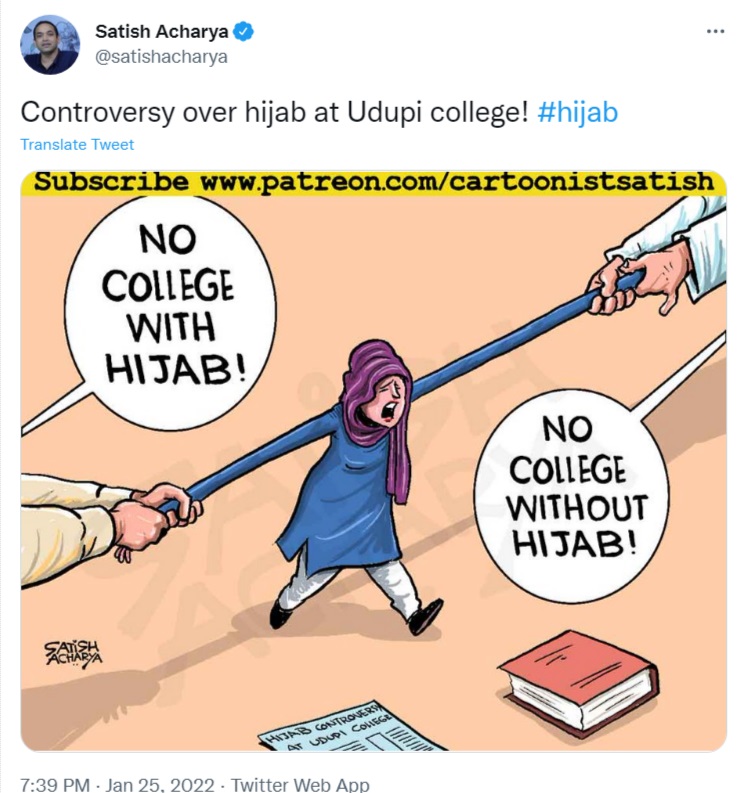
Image Source: OpIndia

Mocked Hindus Over Vaccine Hesitancy While Ignoring Muslim Demand For “Halal” Vaccine

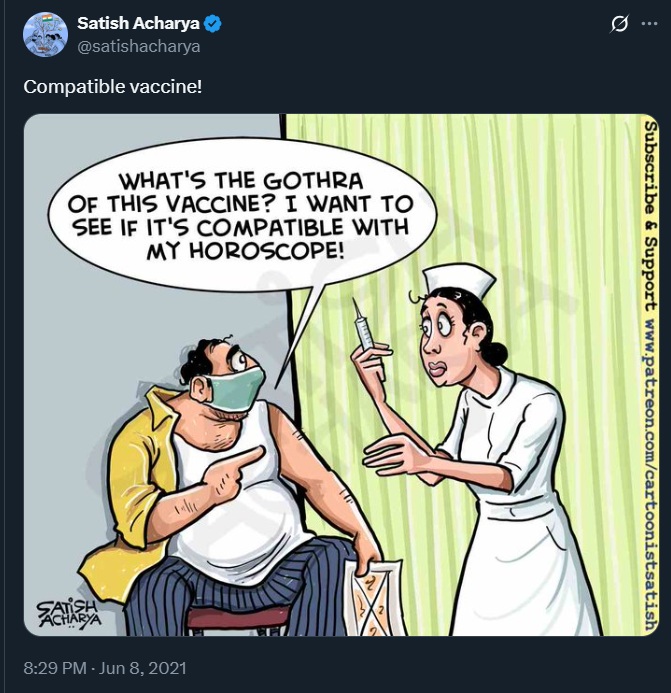
Acharya also mocked Hindus over vaccine hesitancy but avoided addressing similar concerns within the Muslim community regarding the halal status of vaccines. He shared a cartoon depicting a man asking the nurse about the ‘Gothra’ of the vaccine to match it with his horoscope, something unheard of in the Hindu community. However, he refused to make a satire on Muslims demanding for Halal vaccine. 
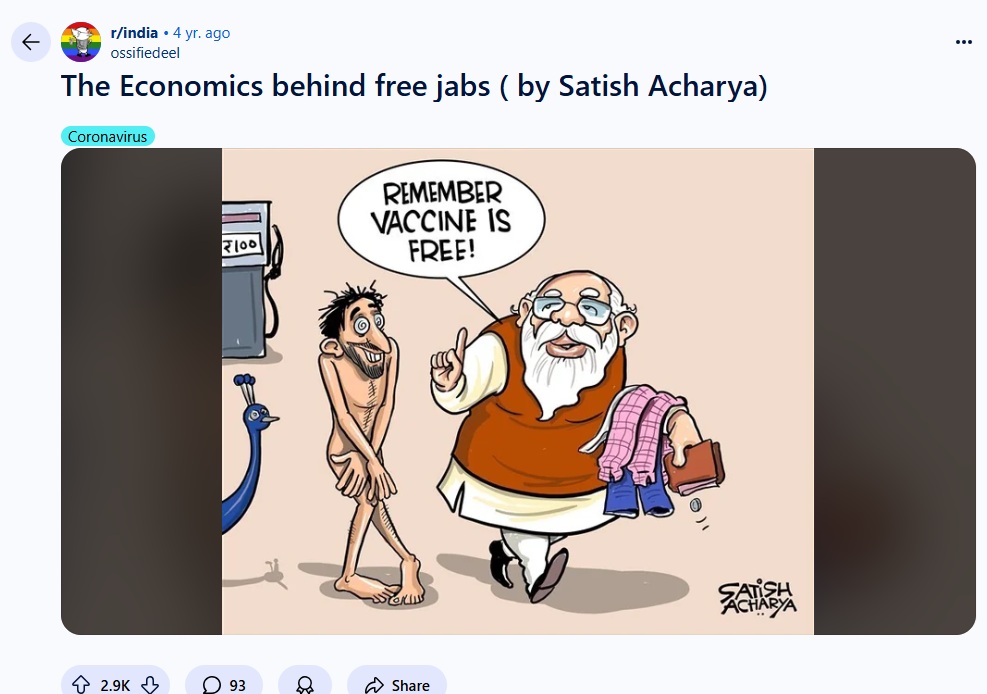
He also mocked the PM for giving “vaccines for free” while charging taxes! Maybe he should have lived in our neighbouring countries where we know how the economy is spirallying southwards!
Some Blatant Anti-BJP Propaganda

Let us take a look at his blatant anti-BJP and anti-Modi propaganda.

Mocking PM Modi for his interview with the BBC many years ago (with Karan Thapar) where he drank water and that allegedly was a sign of him being scared, Acharya came up with a cartoon when there was talk about PM Modi’s podcast with Lex Fridman. PM Modi not only nailed the interview, it garnered massive traffic just hours after its release.
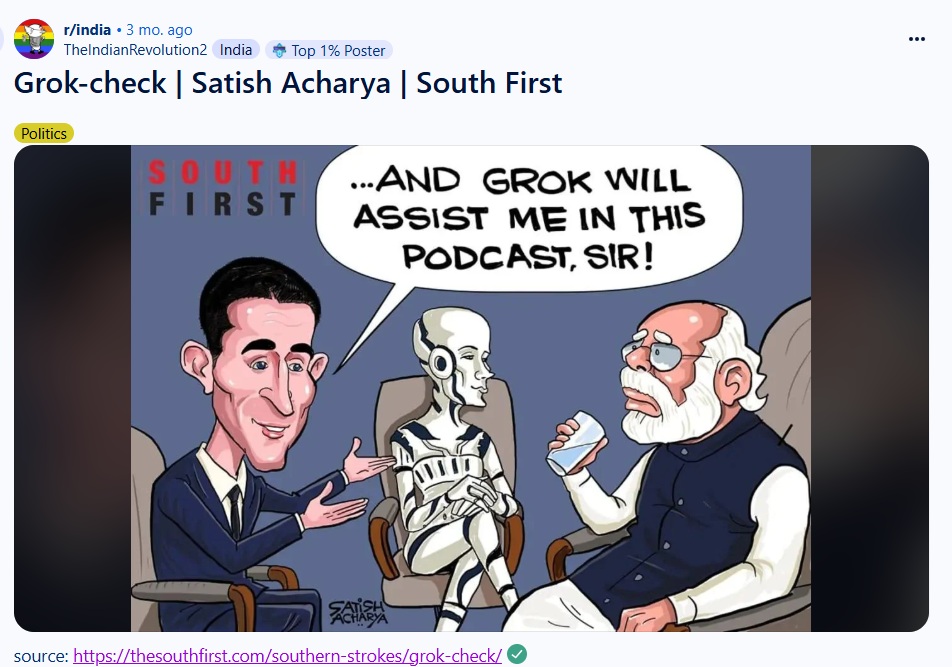
Much to Acharya’s annoyance and dismay, the podcast has 4.8 million views till date!

Ahead of the Delhi elections in 2020, Acharya shared a cartoon suggesting that the BJP is trying to frame the polls as a “Kejriwal vs Pakistan” contest.
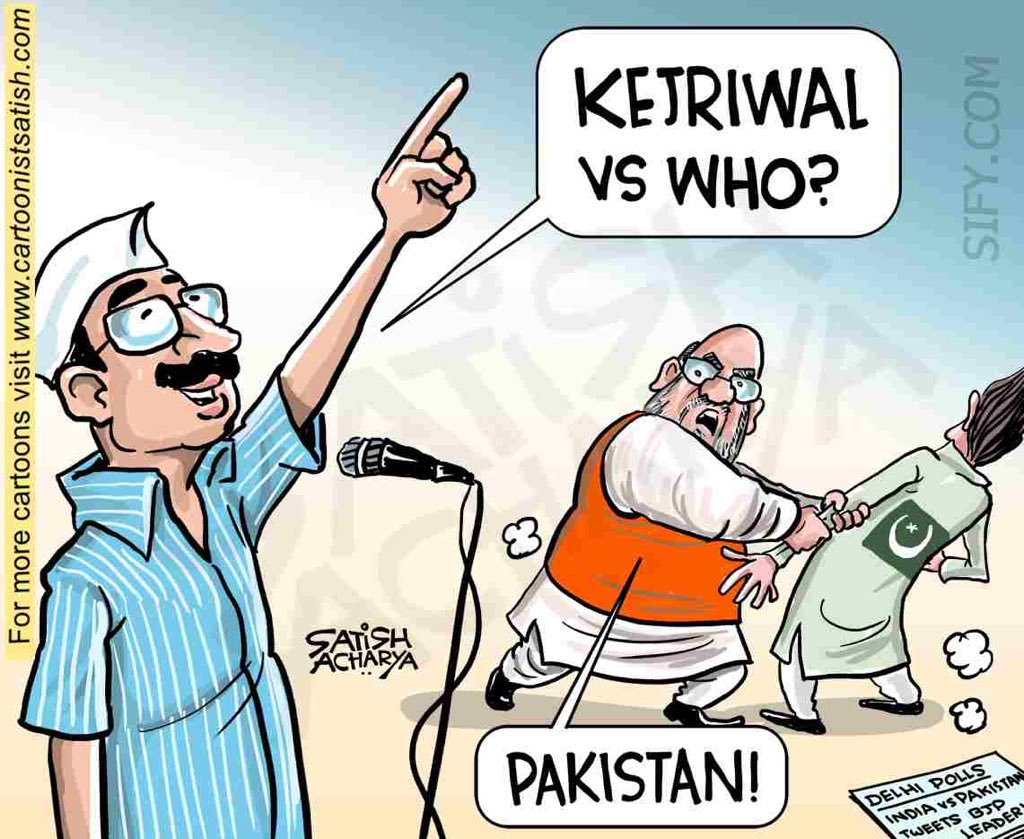
But in doing so, he conveniently forgot a key fact: when India conducted surgical strikes against Pakistan in response to the Uri attack, it was Arvind Kejriwal himself—along with a few others—who publicly questioned the military operation and demanded proof.
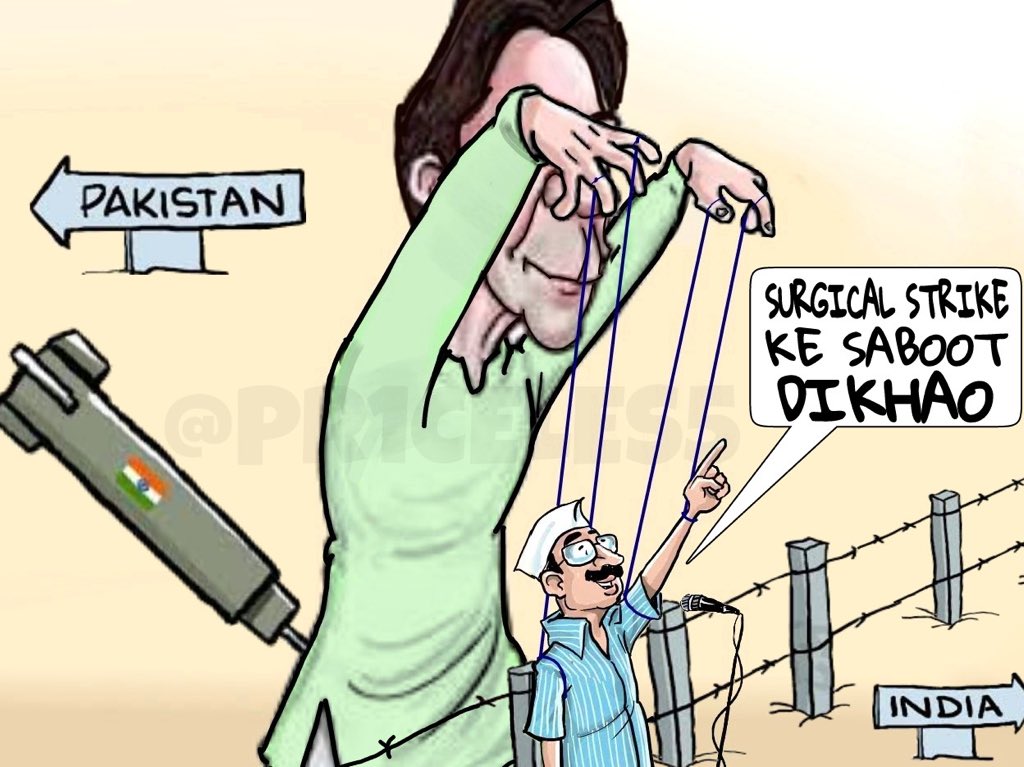
Image Source: Amol Draws On X

The same year, Acharya published a cartoon portraying India as the reason for dragging down the global economy, pointing to policy decisions like demonetisation as the cause.
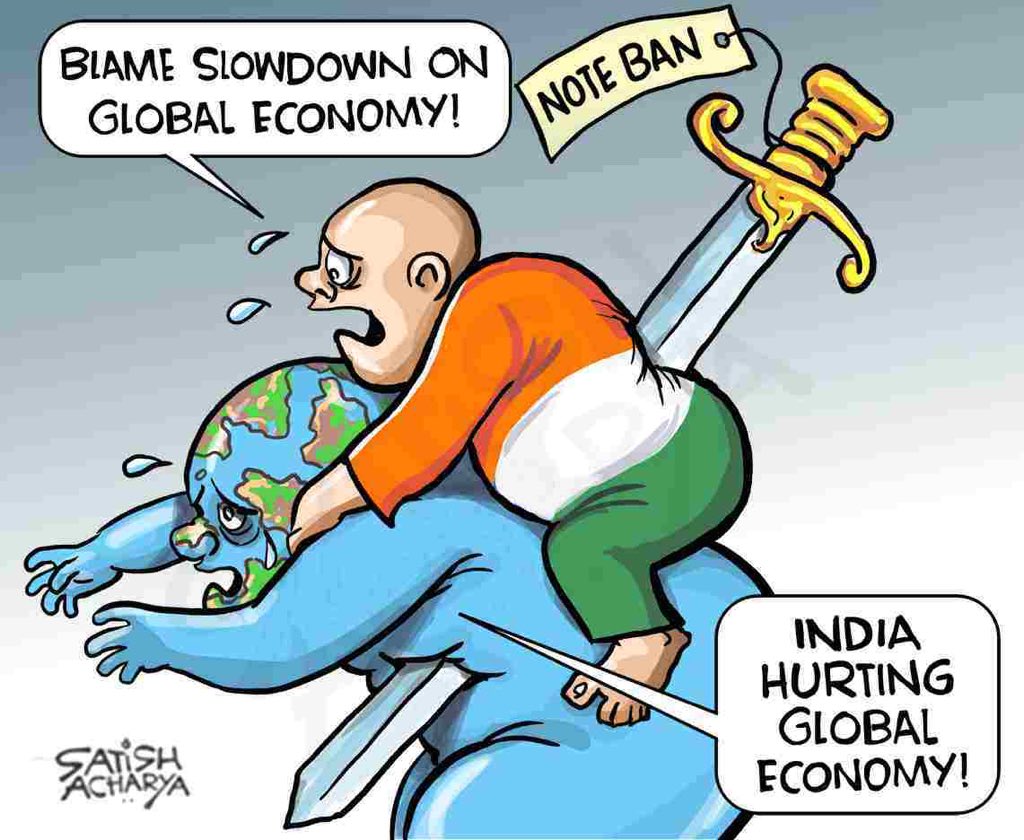
Image Source: X

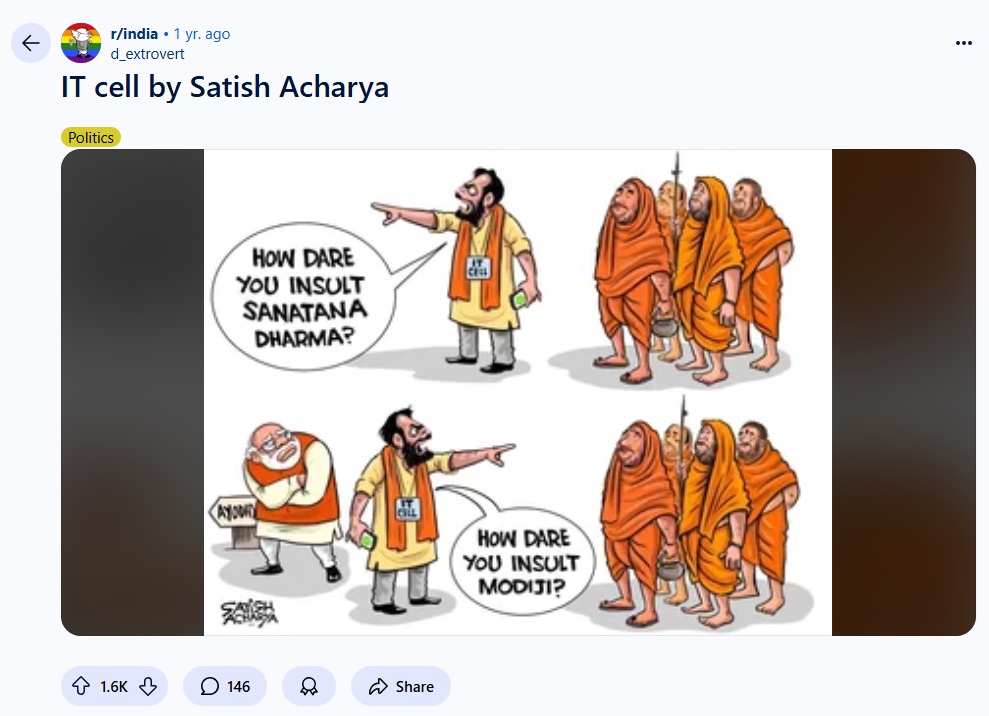
Here are some more anti-BJP cartoons which you will find aplenty but hardly a few on Congress:
In another cartoon which was supposedly pulled down after Mumbai Police interfered, it showed the BJP and various machinery of the government were hands in glove on many things and together they protected “Adani”, allegedly during the Hindenburg scandal.
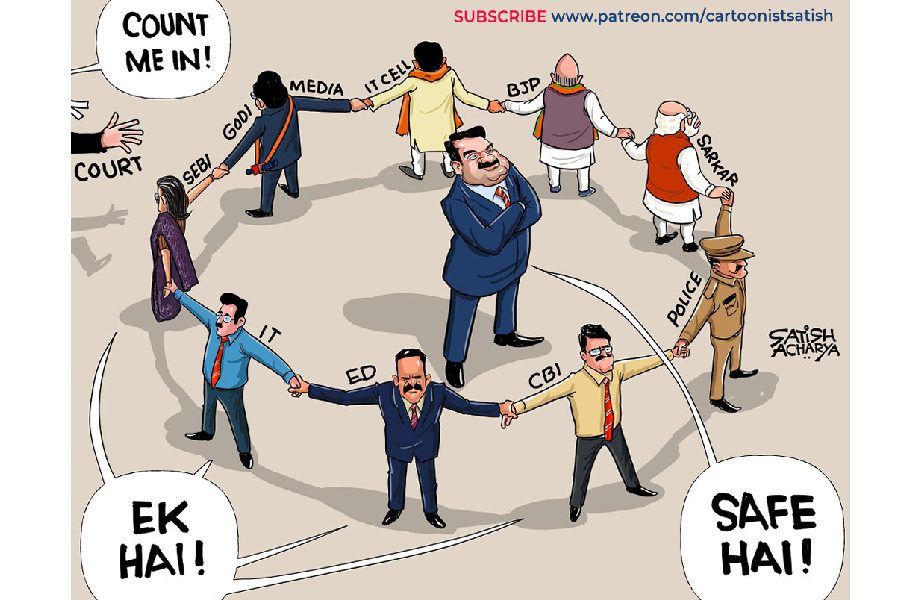
Image Source: The Telegraph

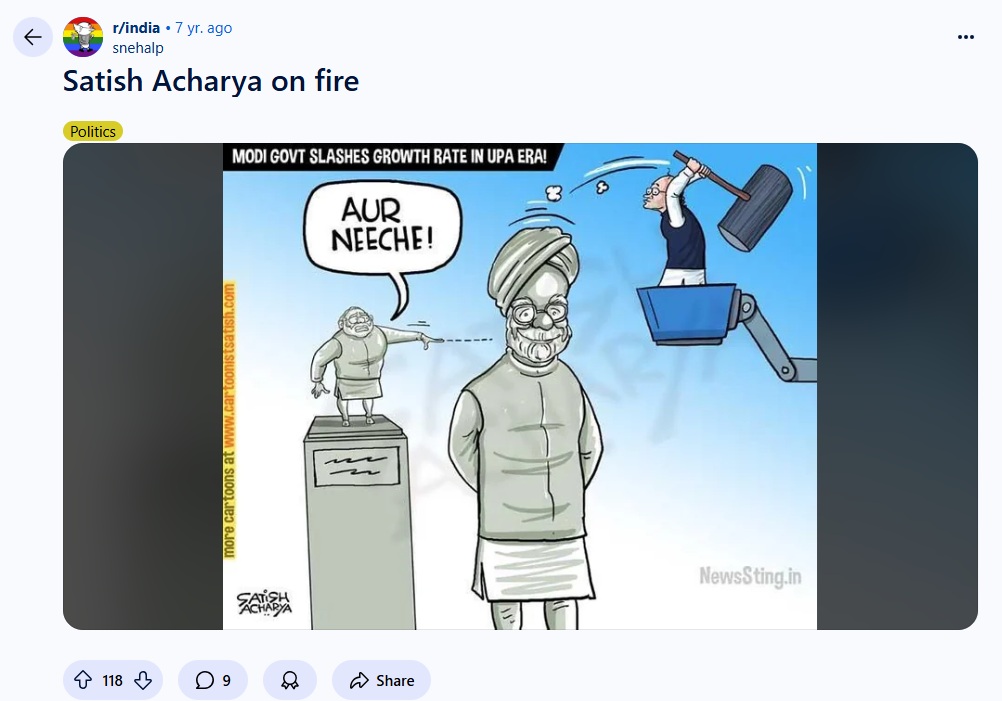
In 2018, the Modi government revised the UPA-era GDP growth rates downward primarily due to a change in the base year from 2004–05 to 2011–12 and the use of updated data sources and methodologies. The Central Statistics Office (CSO) and NITI Aayog stated that the new back-series incorporated improved methods and internationally comparable standards, as per the UN’s System of National Accounts.

Key reasons for the downward revision include new data sources – for example, mining data now came from public sector annual returns instead of the Indian Bureau of Mines. In telecom, growth was recalculated using “minutes of usage” rather than subscriber numbers. The share of primary and secondary sectors increased while services declined due to revised inputs.

Critics noted the revisions came just before the 2019 elections and contradicted earlier NSC committee findings showing higher UPA growth. However, the government defended the changes as technical and non-political.

And Acharya had to come up with a cartoon!
Like his Congress leaders, Acharya also peddled the same lies claiming that PM Modi’s inclusive banking scheme was to bail out the banking frauds and NPAs.

Similarly, he spewed the same lies in the form of cartoons as Congress claimed PM Modi and the BJP themselves orchestrated the Pulwama terrorist attack in February 2019 which killed 40 of our soldiers. PM Modi vowed to take revenge and we saw Balakote strikes happen. But for Acharya and his ilk, it was an election propaganda.
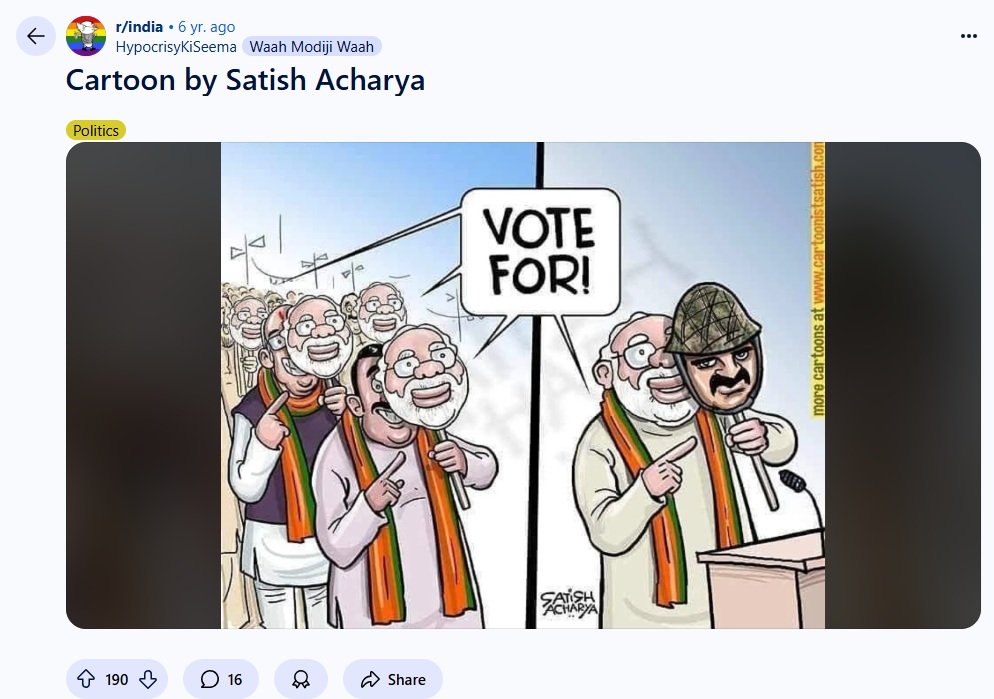
He made another cartoon on the same terror attack indicating that Modi had claimed there was no major terror attack during the first Modi term. But come February 2019, the brutal attack took place and he peddled propaganda that Modi sought votes in the name of the Pulwama terror attack.
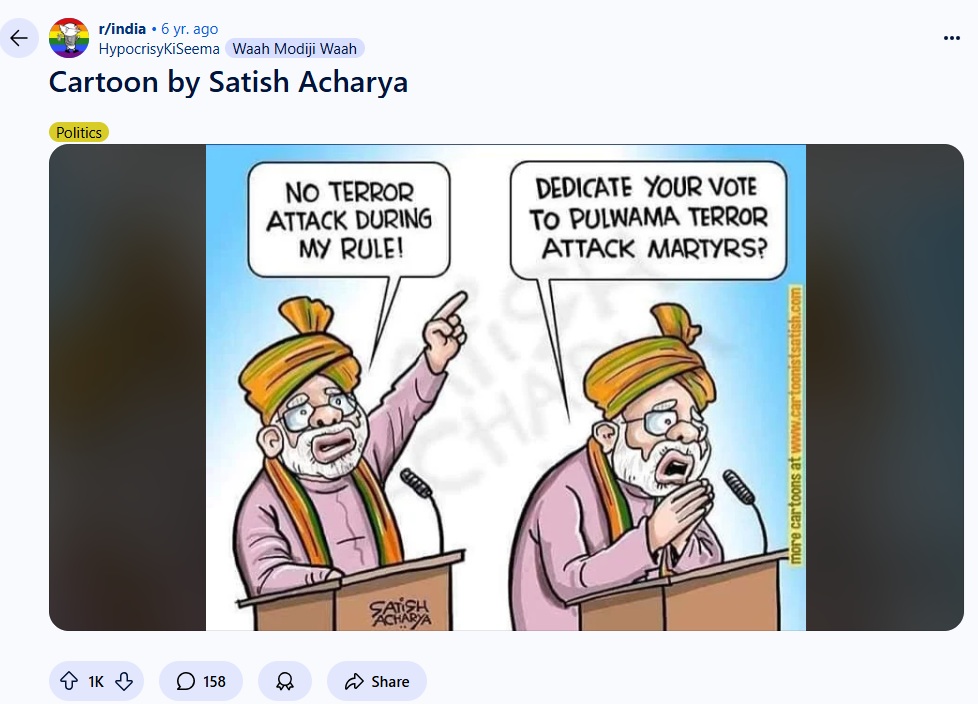
One should remind Satish Acharya that during the Congress era, there was atleast one news item about a bomb blast or a terror attack in some corner of the country. But he rather focuses on Modi and the terror attack that intelligence couldn’t foil.

Following the Balakote strikes, Congress and its supporters, especially the Leftist ecosystem peddled the same propaganda as the Pakistanis who claimed that the air strikes only destroyed trees and not terror camps as claimed by the central government. He came up with these cartoons questioning the absence of “proof” after the strikes.
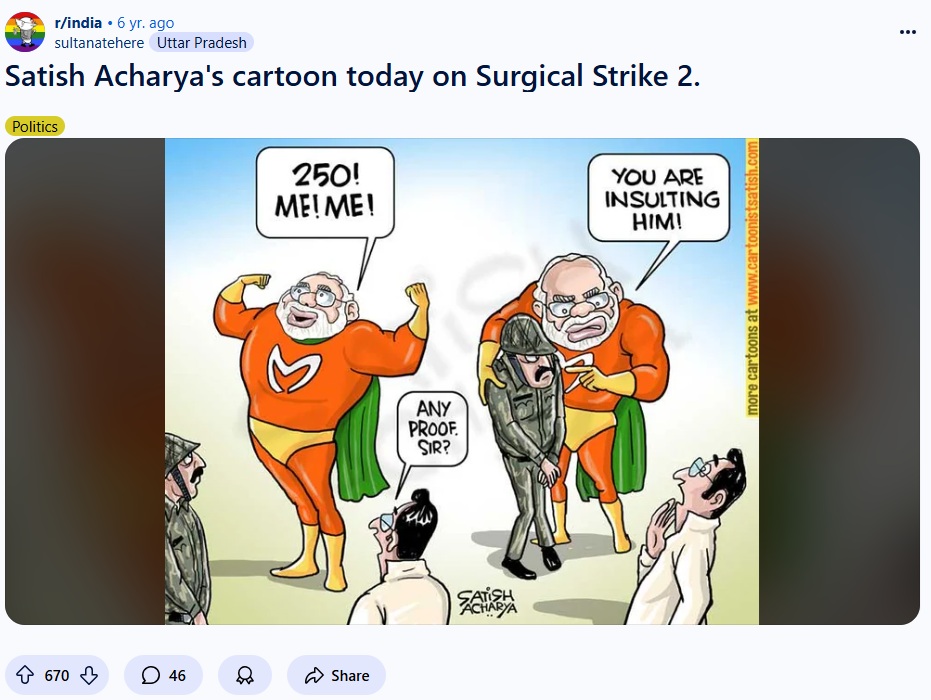
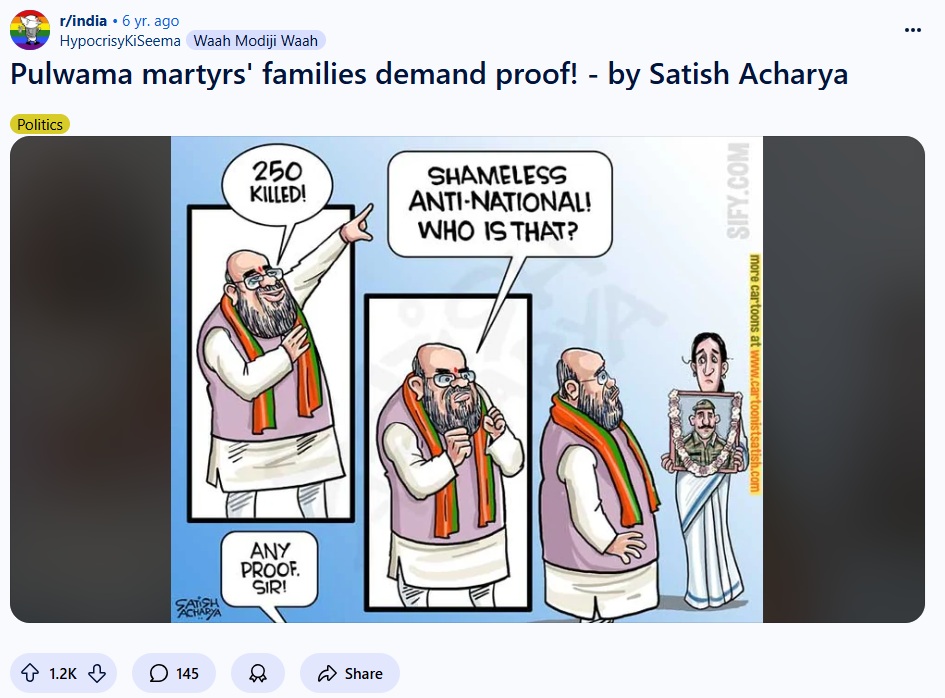
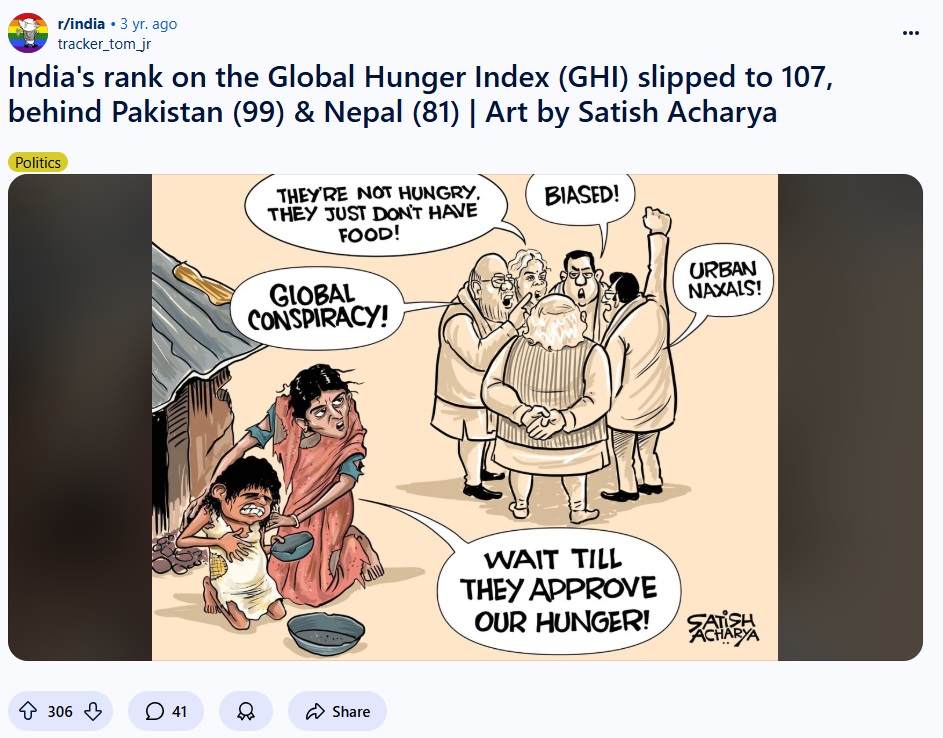
Just like how leftists peddle propaganda about bad governance under Modi, Satish Acharya also rode on the Hunger Index lie to denounce PM Modi.
In 2024, just ahead of the Lok Sabha polls, Prime Minister Modi appeared on several podcasts and offered interviews to many media channels. This did not sit well with Congress supporters and people like Satish Acharya had to make fun of it.
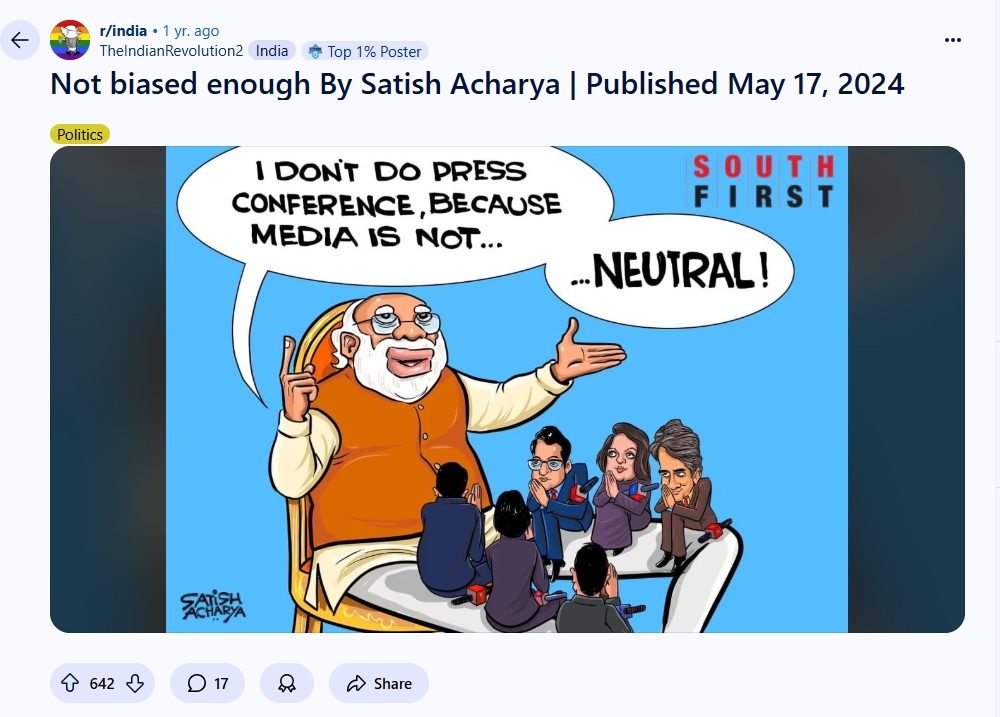
Here’s another one – it looks very much like pure hate for a man who is working for the country round the clock.
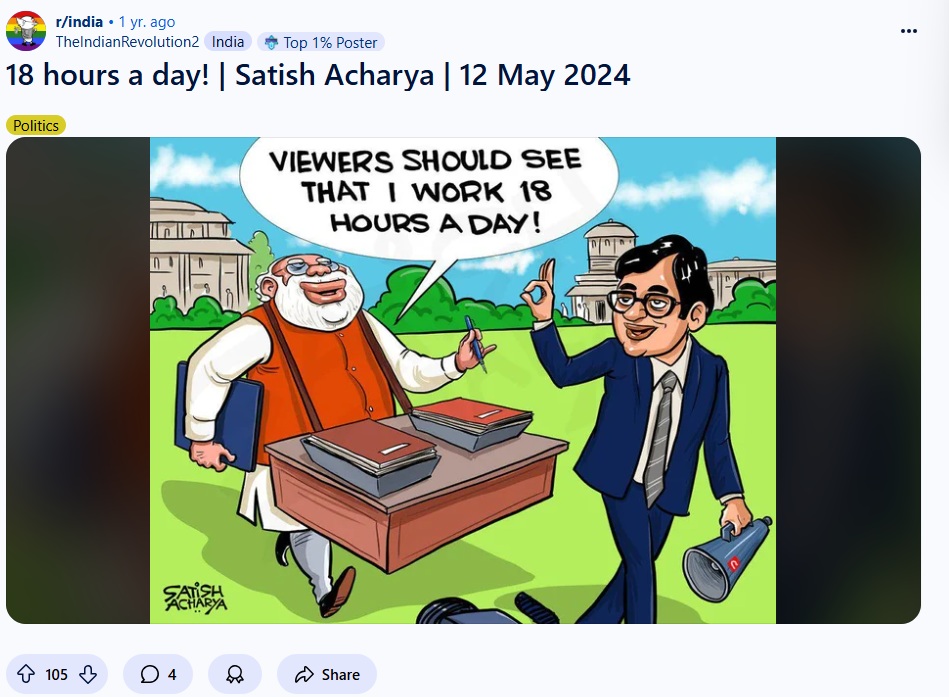
One would wonder if he made anything about Rahul Gandhi’s interviews and press conferences where he has had senior Congress leaders like Jairam Ramesh prompt him when asked a question by the reporters. But Acharya stays true to his idols, he would not make any derogatory cartoons on them.

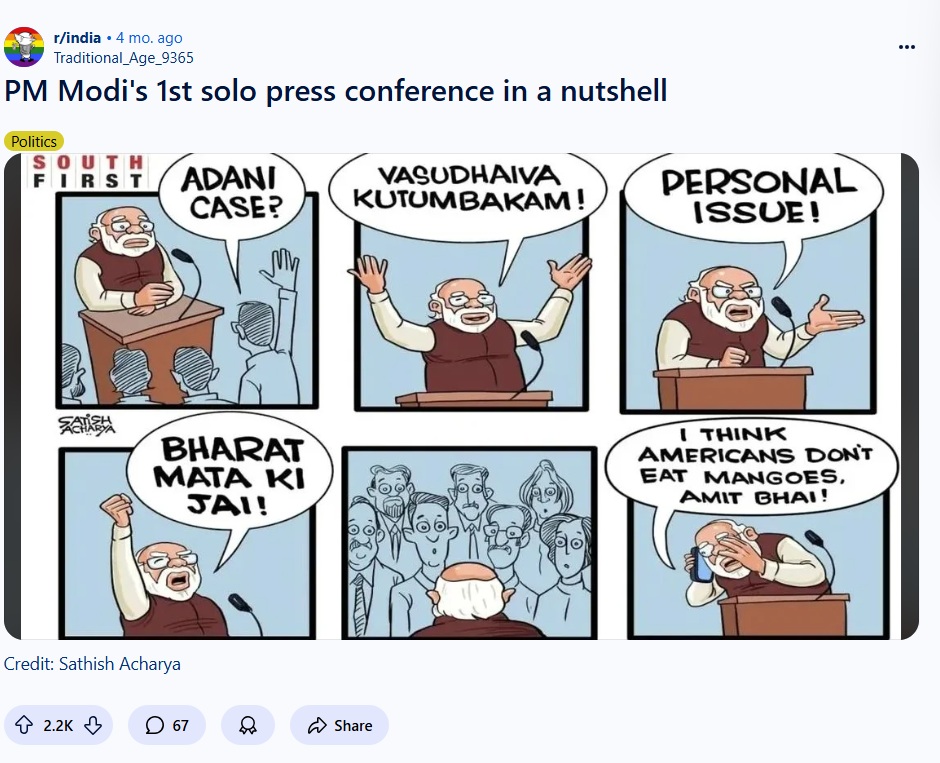
In another post mocking PM Modi’s recent (2025) visit to the US and the time when he met the press along with POTUS Donald Trump, there were questions aimed at PM Modi that were needless and felt wanton. Acharya had to amplify this.
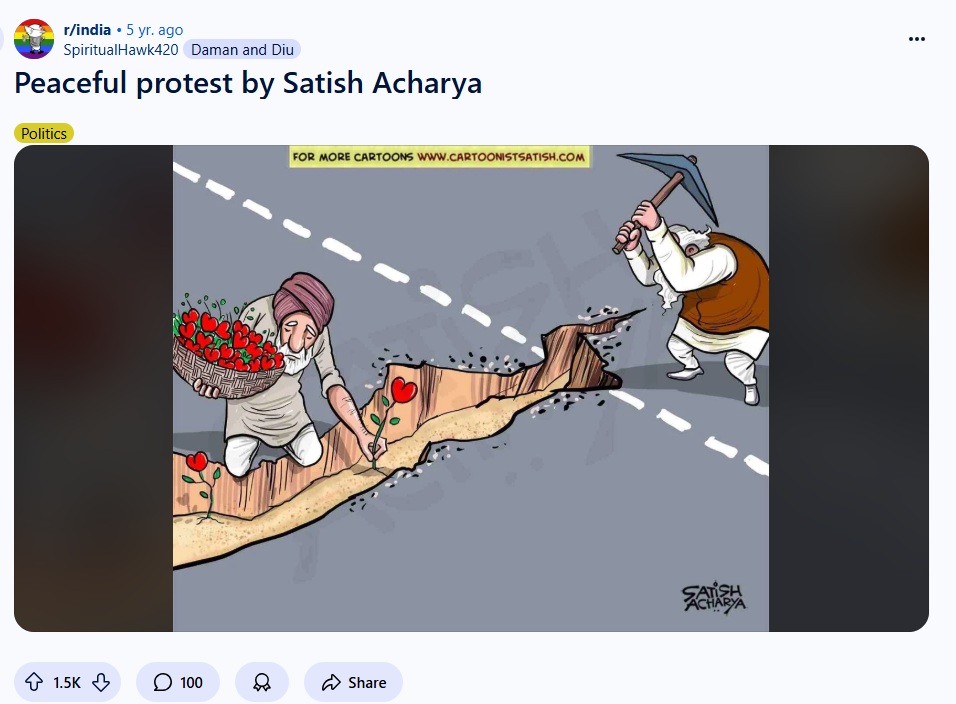
Love is blind but it cannot be as blind as the Congress supporters have for their leader and party. Only people like Satish Acharya seemed to assume that the farmer protests were “peaceful” and it was PM Modi who was causing division. Well, we all know the outcome of these protests and how they went on for more than a year.
Praising Rahul Gandhi For Meeting People & Denouncing PM Modi

Following the Hathras incident, Manipur riots, NEET related issues, Rahul Gandhi seemed to be hopping everywhere meeting people and this Acharya claims is the job of a PM while Modi did nothing allegedly. Maybe Acharya doesn’t know which jurisdiction falls under who when one is in power.
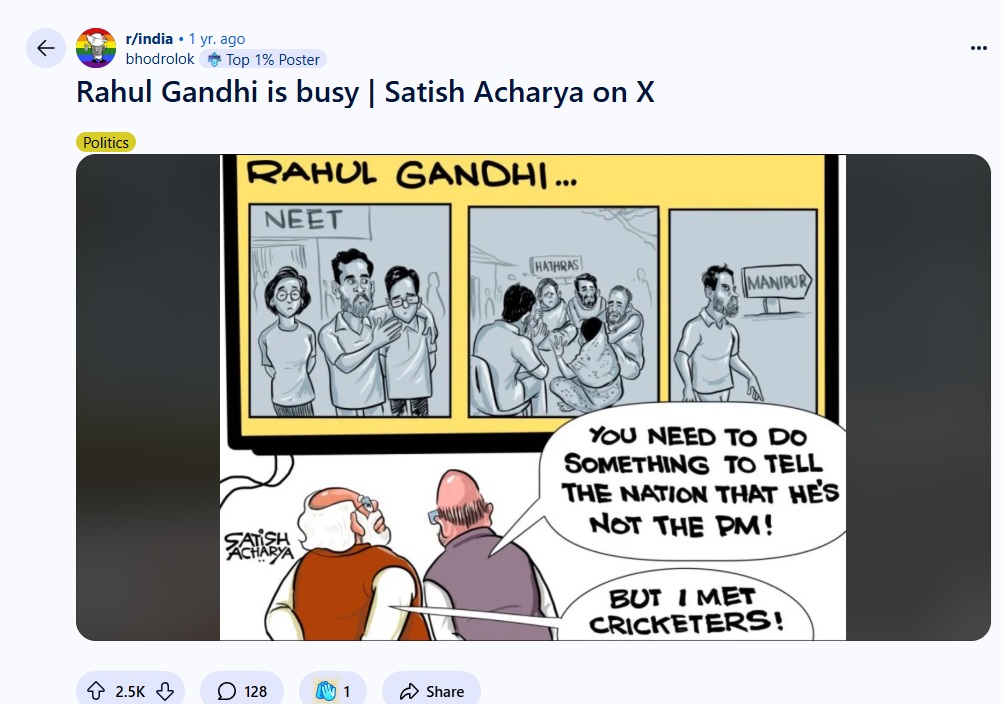
By the way, did Acharya question why Rahul Gandhi flew off to Bangkok to party following the 26/11 terror attack in Mumbai? Selective amnesia and blindness, you see!

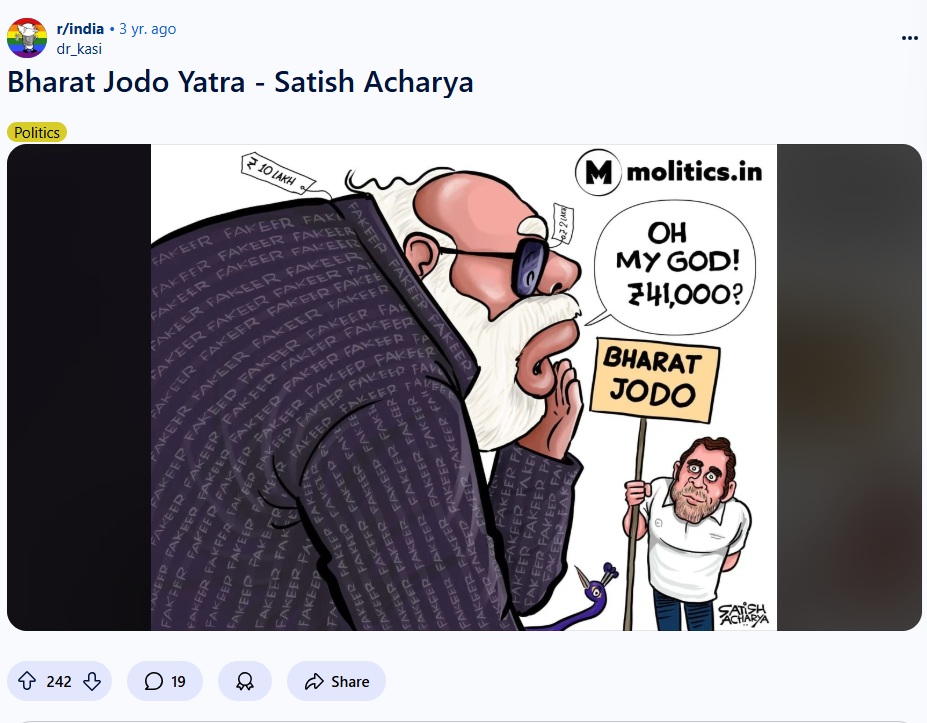
Like a true Congress stooge, Acharya was disillusioned by his leader Rahul Gandhi’s Bharat Jodo Yatra which he thought will help bring back his dear party to power in the country. Well, condolences!
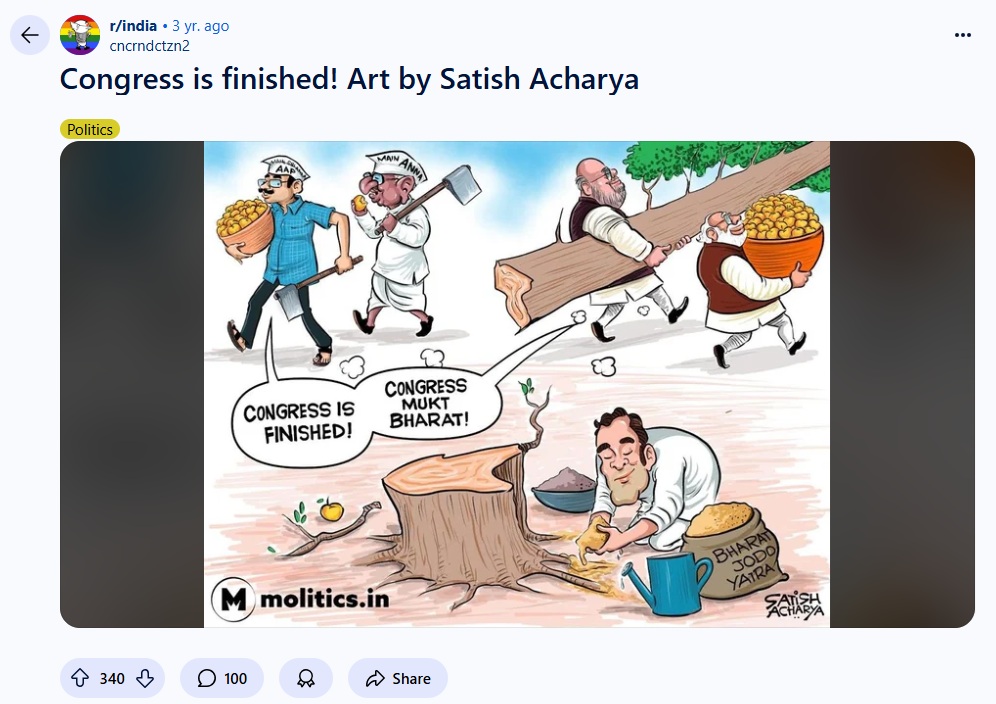
Satish Acharya also seemed to be throwing a fit when his dearest leader Rahul Gandhi was not allowed to go to Sambhal. So, he had to vent his frustration by making a cartoon.
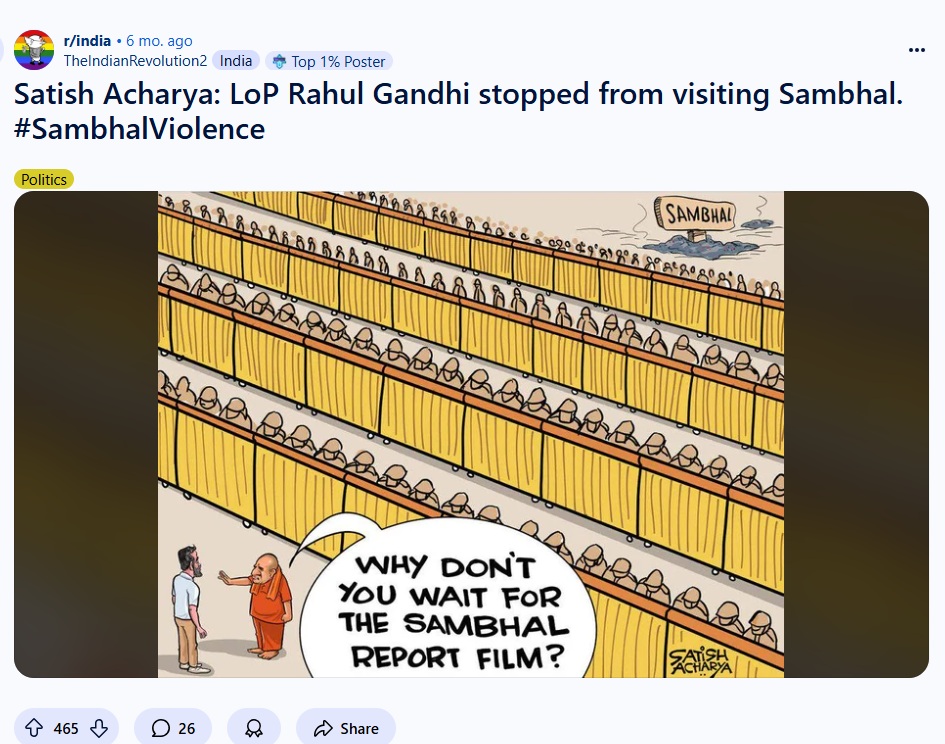
Remember the time when PM Modi’s pinstriped suit hit the headlines in 2016 and a few years later, people questioned why Rahul Gandhi wore expensive branded t-shirts during his Bharat Jodo Yatra. Now Acharya is so smart, he connected the two to show that PM Modi’s suit was much more expensive that the paltry ₹41000 Burberry branded white tee.
Because that is how he can show who he is loyal to!

Yet another case of unconditional love for his leader and the t-shirt wearing brave dude was displayed too.
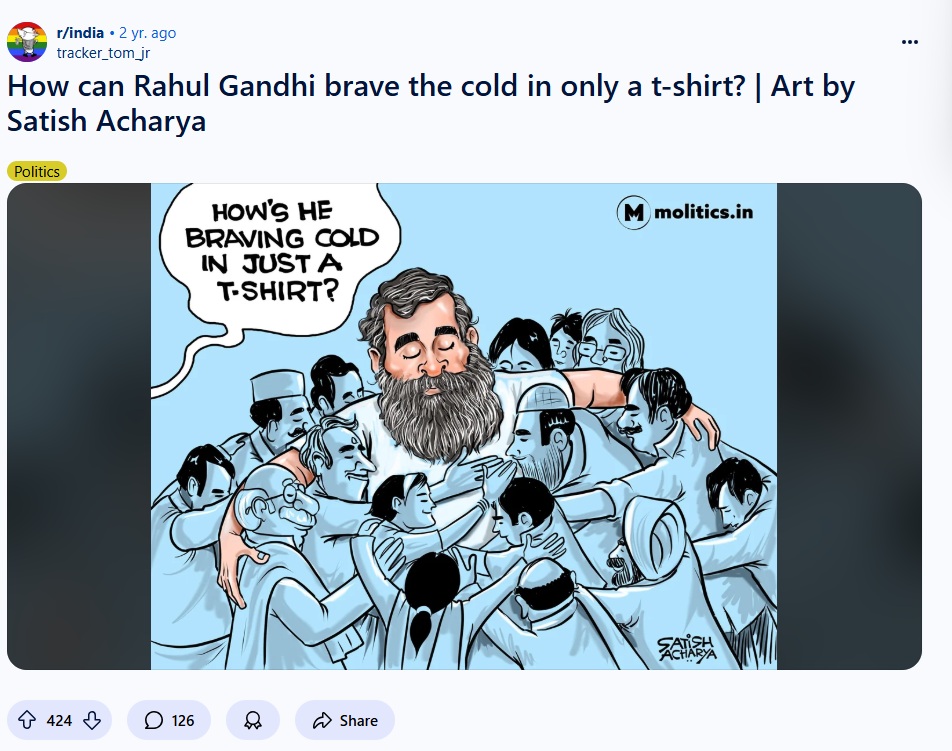
Followers, rather Bhakts, like him were so much in awe that Rahul the great could weather the cold with just that t-shirt on, what a superhero!

All this is to undo those rare weak moments when Satish Acharya and his ilk could have questioned Rahul Gandhi, or did they?

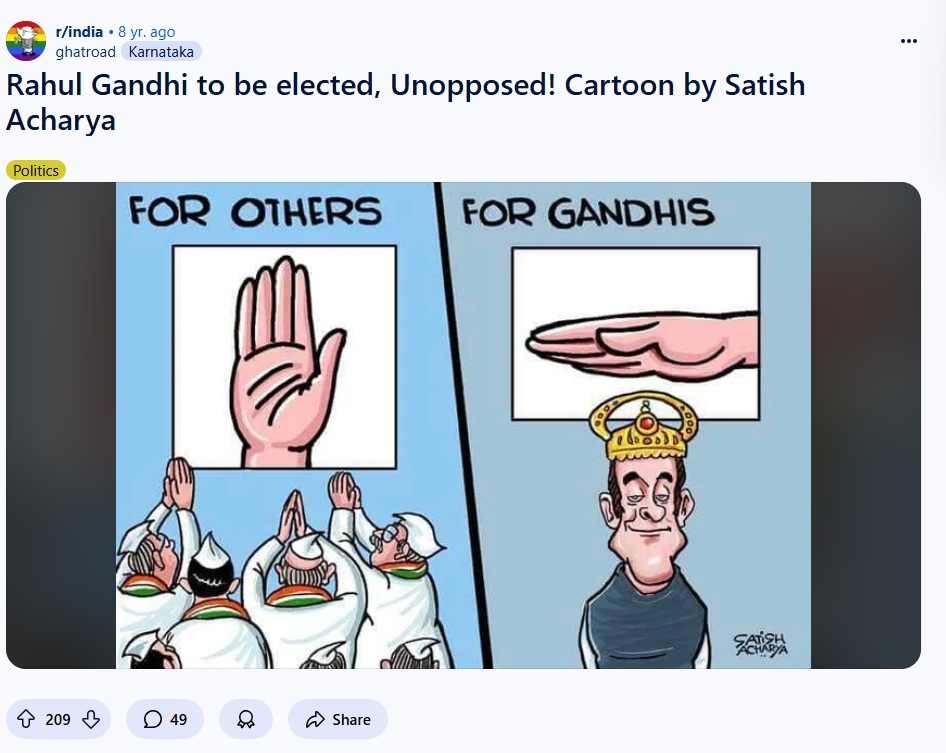
In a cartoon shared 8 years ago, we wonder if Acharya was happy that Rahul Gandhi was elected unopposed as the Congress President as he had his mother’s hand over him.
Instances Where Blind Hate For Narendra Modi Is Exhibited

Here are a few instances where plain hate for the man, our PM Modi resulted in vicious cartoons from the “neutral” satirist.
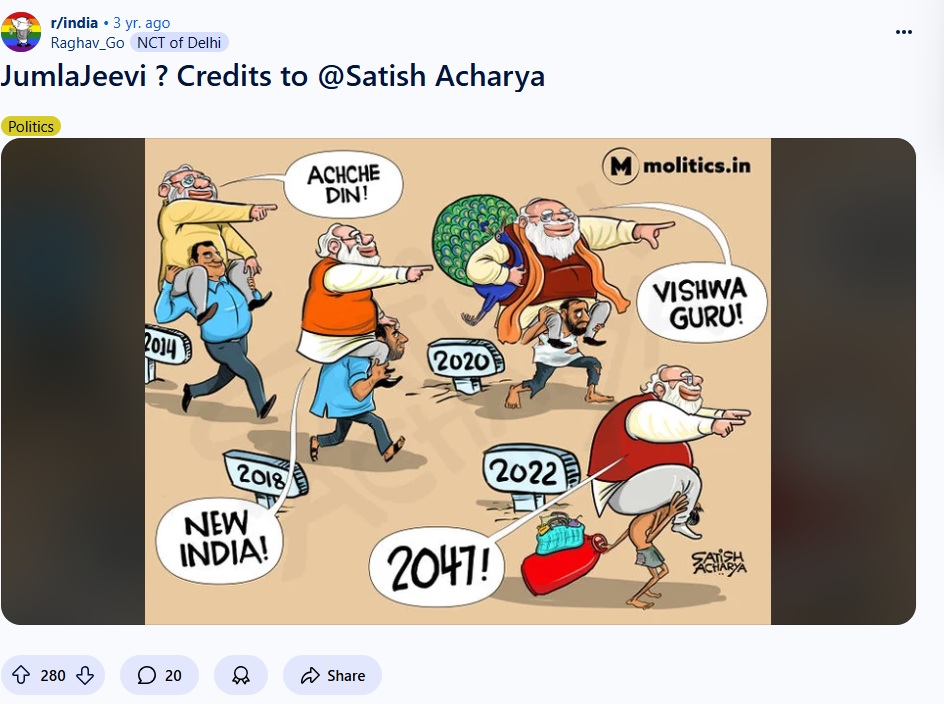
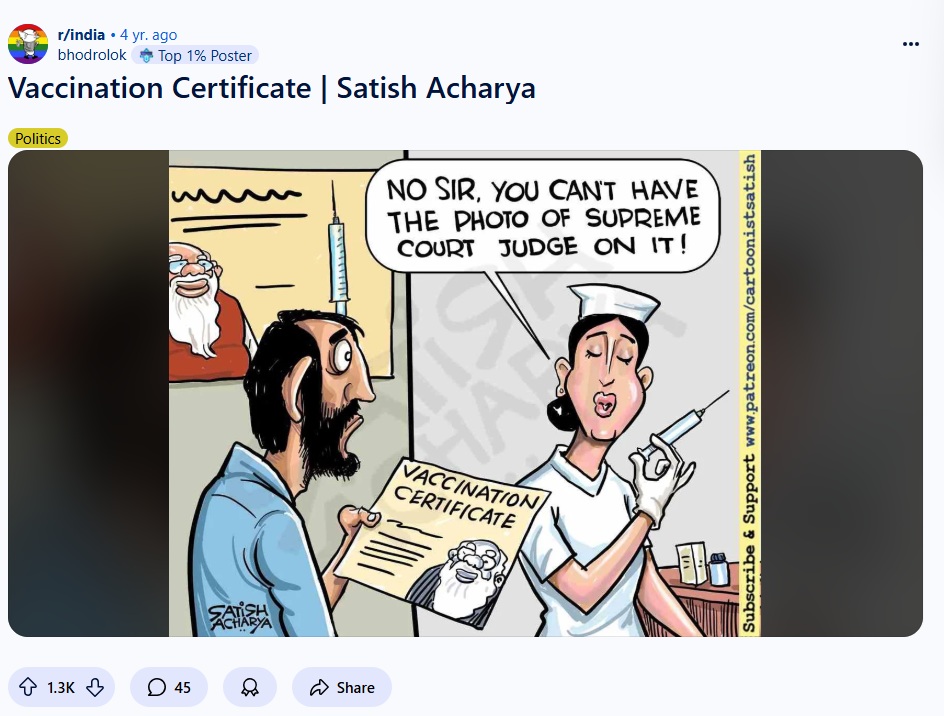
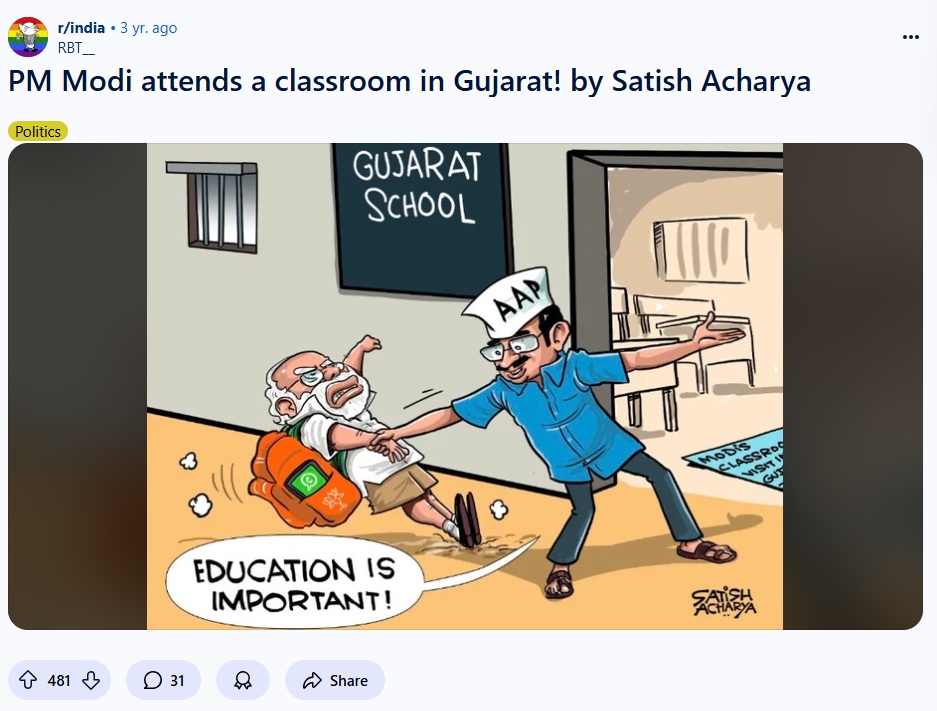
And how could he let go of the chance to mock the RSS background of our PM. In this cartoon, he has depicted that and also alleged that Modi uses WhatsApp to get his information – the infamous “WhatsApp University” jibe.
Mocking UP CM Yogi Adityanath

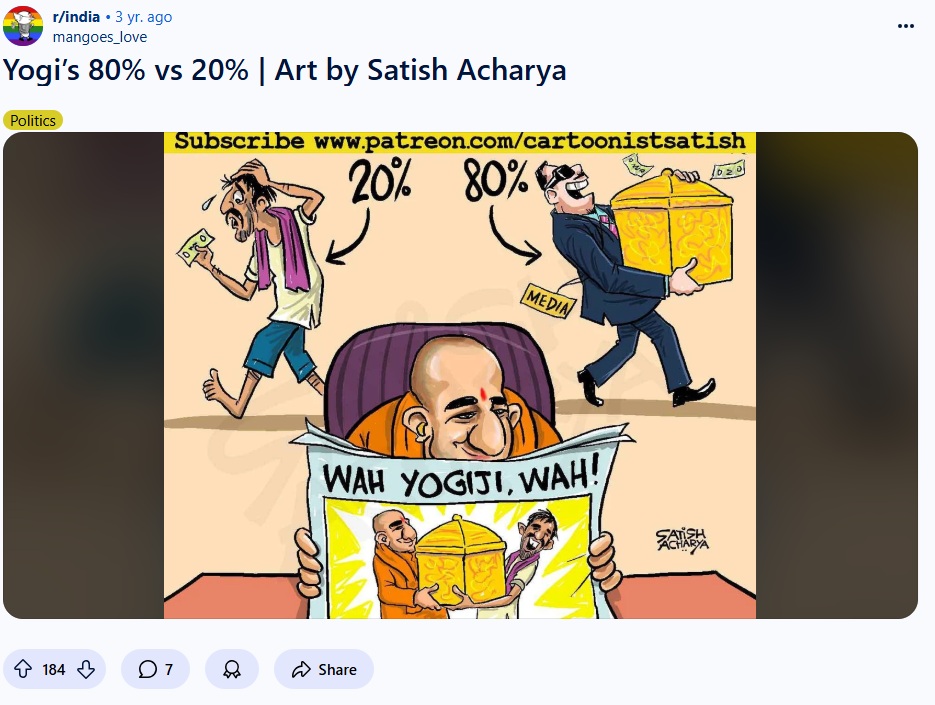
In January 2022, Uttar Pradesh Chief Minister Yogi Adityanath stated that the upcoming state elections would be an “80% versus 20%” contest, claiming that 80% of voters support BJP’s agenda of nationalism, good governance, and development, while 20% are habitual opponents. The Opposition, including Congress, Samajwadi Party (SP), and Bahujan Samaj Party (BSP), alleged that the remark was a communal dog whistle targeting Muslims, who make up around 20% of the state’s population. They accused Adityanath and the BJP of stoking religious divisions for electoral gain just before the model code of conduct was enforced.

Acharya had to make a cartoon on this where he claimed 80% comprised of the rich and 20%, the poor! Creativity ka bhi seema hoti hai!
Claimed UP CM Yogi Adityanath was painting the entire state saffron after news was reported that the Uttar Pradesh Chief Minister was having government buildings across the state painted in saffron—particularly targeting sections that were previously green. Notable examples include state transport buses, the Haj office, and even the Chief Minister’s own office.

Mocking Atal Bihari Vajpayee’s Death

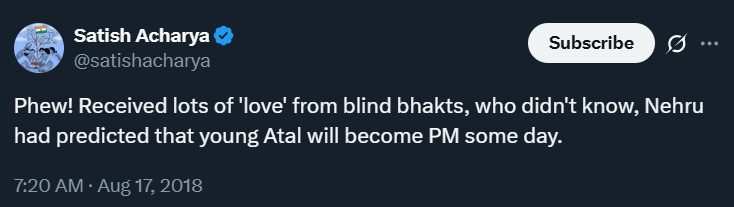
When former Prime Minister Atal Bihari Vajpayee passed away, Acharya came up with a cartoon which seemed to use the moment to glorify Nehru instead. Viewers found it either a veiled jibe at the BJP or a confusing tribute, with Acharya later offering an explanation. The cartoon allegedly referenced Nehru’s old remark predicting Vajpayee’s future as PM, leading to interpretations that Vajpayee owed his rise to Nehru.
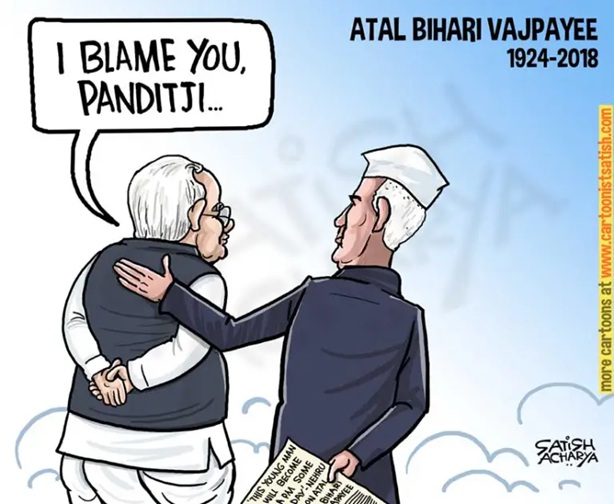
Image Source: X

Critics slammed it as either a veiled jab at the BJP or an unclear tribute lacking sensitivity. The cartoonist had to issue an explanation clarifying his intent—which many found to be condescending.
The backlash raised questions not just about bias, but also about the cartoon’s taste, timing, and overall quality.

Congress Censorship And Acharya’s Complicity

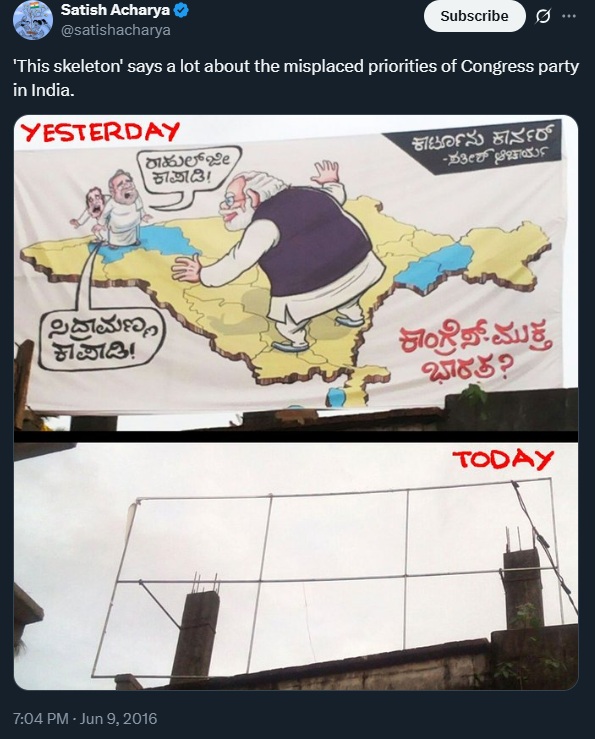
In 2016, Congress pressured Acharya to remove the below cartoon critiquing then-Karnataka CM Siddaramaiah and Rahul Gandhi. 
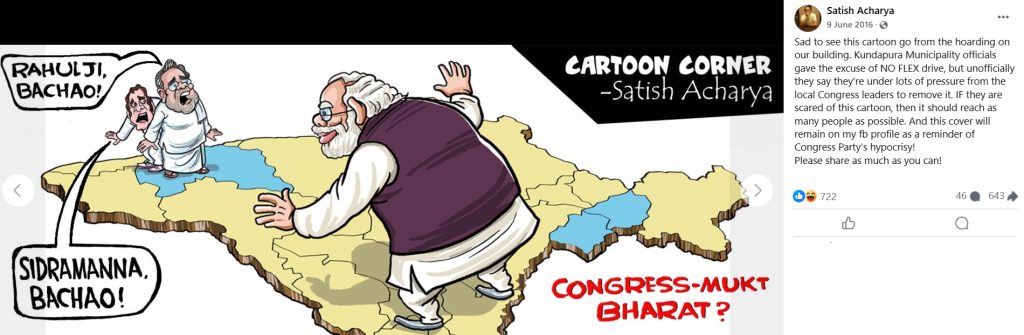
After municipal authorities — allegedly at Congress’s behest — forced him to withdraw the cartoon from public hoardings, Acharya tweeted, “This skeleton says a lot about Congress’s priorities” but stopped short of direct criticism.
Bengaluru Stampede Following RCB Win

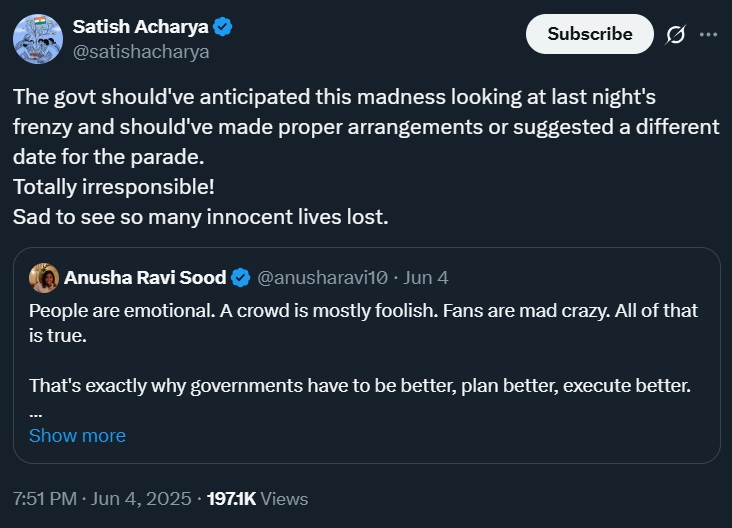
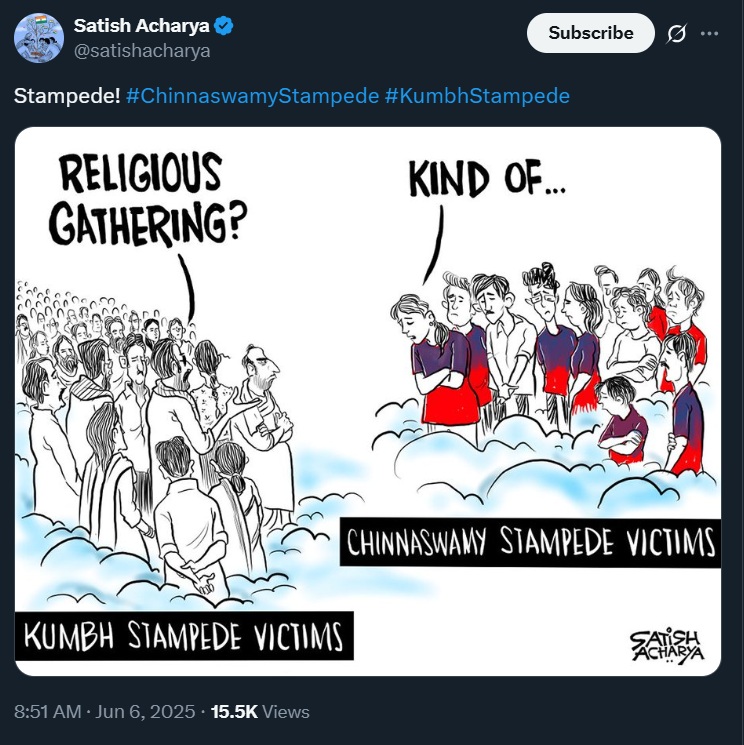
For all the cartoons he has made on stampedes before, especially the Kumbh Mela one where he pointed directly to UP CM Yogi Adityanath, one would assume Acharya would probably question the Congress government for their shoddy crowd management. But what did Acharya do? He came up with words instead of art. He wrote on his X handle following the stampede that killed over 11 people injuring more than 50 – “The govt should’ve anticipated this madness looking at last night’s frenzy and should’ve made proper arrangements or suggested a different date for the parade. Totally irresponsible! Sad to see so many innocent lives lost.”
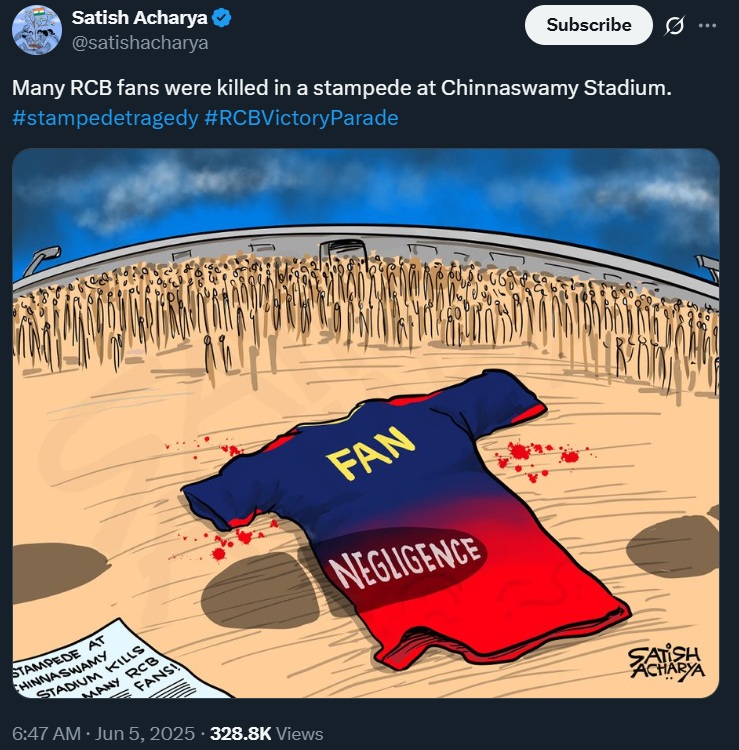
After backlash, he came up with a cartoon that did not blame the Congress government but seemed to blame RCB.
When people started reminding him in the comments about how he blamed Yogi Adityanath for the Kumbh Mela stampede, he came up with a few more.
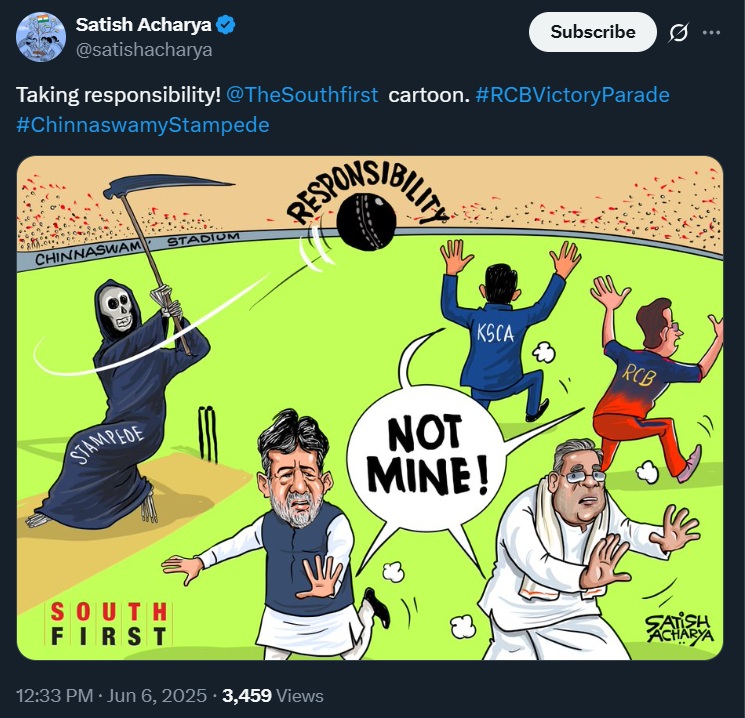
In a cartoon for TNM wannabe South First, probably because he was asked by the editors, he brought the political establishment into the picture.
Acharya did something similar when the need arose to raise questions against the administration in Karnataka. However, these are the times that people like Acharya seem to swallow adhesive and focus on using words. On 19 March 2024, the same cartoonist who voted for progressive Congress and made a positive cartoon on the free electricity freebie was complaining of frequent power cuts. He wrote on his X handle, “ಸನ್ಮಾನ್ಯ ಮುಖ್ಯಮಂತ್ರಿಗಳಾದ ಶ್ರೀ @siddaramaiah ಸರ್, lots of children & youngsters are preparing for exams. And in this part of Karnataka(not sure about other parts), there’s been frequent power cuts. Last Sunday, there was a power cut from 11 am till 7.30 PM. Today, no power for the whole day(Tuesdays are known for regular power cuts, but can’t that be avoided during exam time?) Please remember that most families can’t afford inverter or generator. Please be compassionate towards students.”
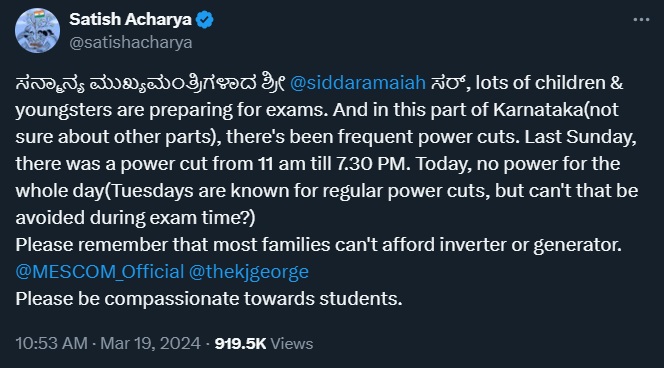
Acharya could have very well made a satire on the power cuts in Karnataka. But he chose to use words to “speak” about the problem.

Propaganda Disguised As Art

Acharya’s career reflects a calculated duality: posing as an independent satirist while furthering Congress-aligned narratives. His selective outrage, ideological omissions, and tolerance for Congress censorship reveal a pattern indistinguishable from party propaganda. While he occasionally criticizes Congress to maintain plausible deniability, his work overwhelmingly services a partisan agenda, leveraging satire’s credibility to mask ideological bias.

Subscribe to our channels on Telegram, WhatsApp, and Instagram and get the best stories of the day delivered to you personally.
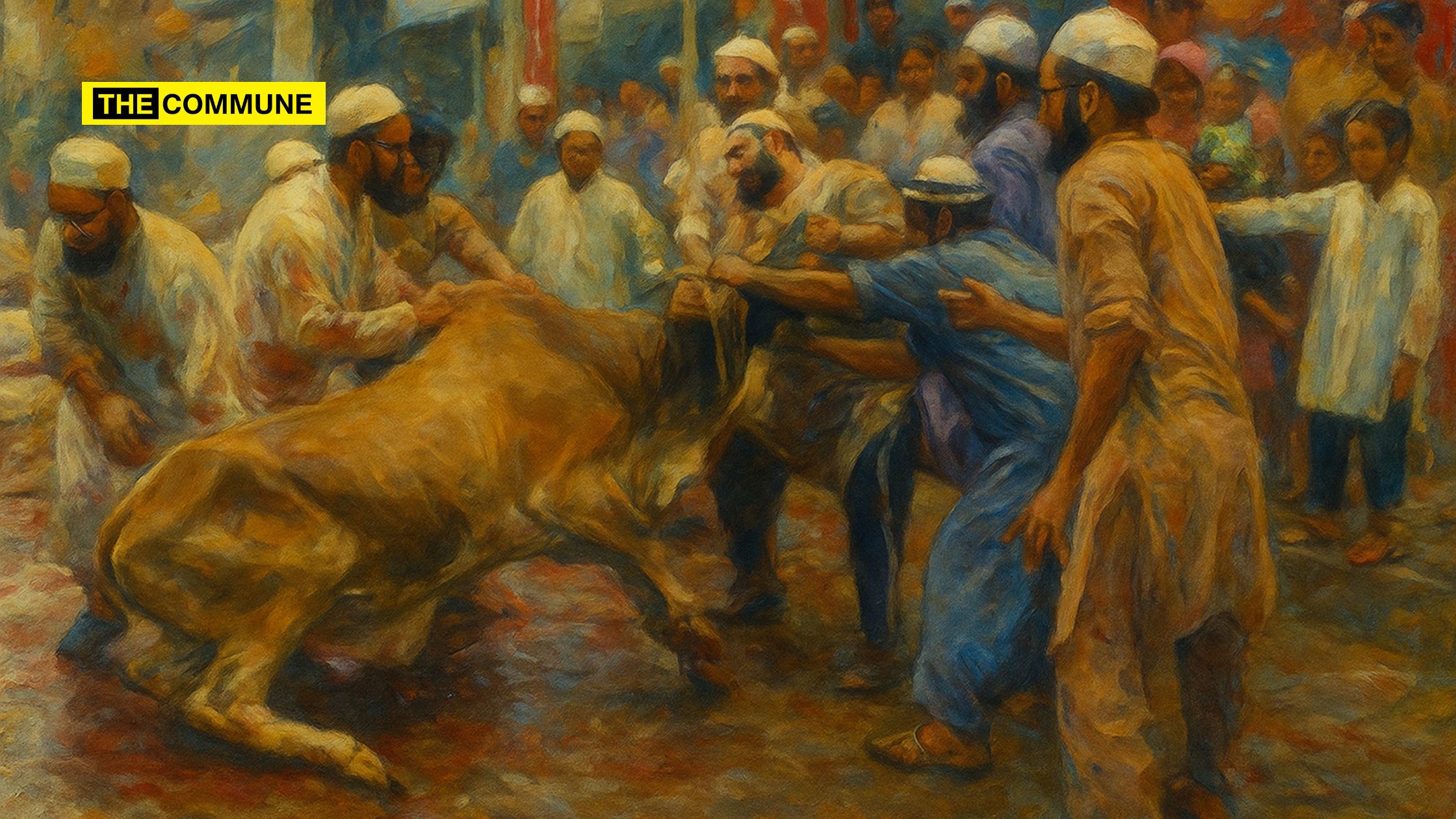
Despite Cows Not Being Plenty In Arabia, How And Why Cow Slaughter Became Part Of Bakrid In India?

Beef in India is a political food. It is not a question of individual rights over what they have in the plate. It is about whether what they have in the plate is offensive to the Hindus or not. That is why you have people on social media you like to taunt Hindus with pictures of them eating beef. That is why you have streets of Bengal flooded with cow’s blood.

Across India, beef is often framed as synonymous with the cultural milieu of Dalits and Islam. In the case of Dalits it is understandable about how beef became part of their cuisine. Beef was often a cheap and accessible source of protein for Dalits, who faced exclusion and significant economic hardship. They didn’t have a choice over their dietary habits.

In the case of Muslims, it is different as beef is not rooted in Islamic doctrine alone, and is not universal. In fact, in places like Saudi Arabia — the birthplace of Islam — cows are not even plentiful, and beef has never played a central cultural or religious role.

According to Statista, as of 2022, Saudi Arabia had approximately 17.5 million sheep, 6.8 million goats, 2.2 million camels, and 312,000 cows on farms

Despite recent pushes in Saudi Arabia’s cattle and dairy industry, beef remains less prevalent, with sheep and goat meat being more common, especially during Eid al-Adha.

So why, then, has beef become so tightly linked with Muslim identity in India, Pakistan, and Bangladesh?

Islamic Law And The Permissibility Of Beef

The festival of Eid al-Adha, known as the “Festival of Sacrifice,” involves slaughtering livestock, typically sheep, goats and camel. Islam, as a religion, does not place any spiritual importance on cows — unlike Hinduism. According to Islamic dietary rules (halal), the consumption of beef is permitted, so long as the animal is slaughtered following prescribed guidelines. The Qur’an mentions cattle among the animals created by God for human use — for food, transport, and trade.

However, Islam does not single out beef consumption as a religious obligation or preference. In most parts of the Islamic world — including Saudi Arabia, Egypt, and Iran — the most commonly consumed meats are goat, lamb, and camel, owing to ecological factors. Cattle were historically scarce in the arid Arabian peninsula, which lacked sufficient grazing pastures to sustain large bovine populations.

Hinduism And The Sacred Cow

In stark contrast, the cow holds a sacred place in Hinduism, symbolizing purity, fertility, and non-violence. Hindus associate cows with the goddess Kamadhenu and regard the animal as the giver of sustenance, especially in agrarian societies.

Although evidence suggests that beef consumption may have existed in early Vedic times, by the early Common Era, cow slaughter had become taboo for many orthodox Hindus. Thus, any association with beef consumption became culturally and morally charged — particularly when it involved non-Hindus.

Mission: Humiliate Hindus

The arrival of Islamic rulers in the Indian subcontinent, starting with the Delhi Sultanate (13th century) and later the Mughal Empire, introduced new food practices and preferences. While not all Muslim rulers encouraged cow slaughter — emperors like Akbar even discouraged it out of respect for Hindu sentiments — the act of beef consumption nevertheless became a symbolic line of difference. Some rulers permitted or patronized cattle slaughter during religious festivals like Eid al-Adha, leading to tensions with Hindu communities.

Romila Thapar notes that during medieval Islamic rule, cow slaughter was occasionally employed to undermine Hindu socio-religious structures, particularly during conquests. Specific examples include Aurangzeb’s desecration of the Chintamani Parshvanath Jain temple by killing a cow inside and converting it into a mosque, called the “Might of Islam”. Khwaja Moinuddin Chishti’s followers brought a cow daily to a temple, slaughtered it, and cooked kebabs to humiliate local Hindus.

Over time, beef consumption evolved from a mundane dietary practice into a marker of Muslim identity to establish their supremacy over Hindus and humiliate them. Beef became symbolically tied to Islam, particularly during conversions. For some converts, eating beef marked a break from Hindu practices, where the cow is revered.

In contemporary India, public beef consumption, such as at “beef parties” is also to counter Hindus. In 2017, challenging the central government’s attempt to impose a ban on cow slaughter, Rijil Makkutty and his associates forcefully brought a calf into the street and killed it in a violent public display. In 2015, the then Jammu & Kashmir MLA Engineer Rashid organized a beef party. A beef fest was organized in Sree Kerala Varma college by ‘activists’ of Students Federation of India (SFI), a body aligned with the Communist Party of India-Marxist (CPI-M). A student group in IIT Madras too organized a beef party. These beef parties and cow slaughter events is done to provoke and humiliate Hindus.

So, when blood of cows inundate the streets of Bengal, it is not an event. It is a statement. An act of desecration. They want you to wade through the cow’s blood with disgust so that they can satiate their sadistic itch.

When calves are dragged onto streets and butchered in full public view, it’s not a stand for dietary freedom — it’s a brutal spectacle designed to spit on the faith of millions. These so-called “beef parties” aren’t expressions of dissent; they are political blood rituals meant to provoke, offend, and degrade. In a land where the cow is venerated by the majority, such acts cross the line from cultural expression to calculated cultural warfare. They do not demand respect — they demand submission. And when cow slaughter becomes a tool of ideological vengeance, it’s not just tradition that is under attack. They attack your existence.

Vallavaraayan is a political writer. 

Subscribe to our channels on TelegramWhatsApp, and Instagram and get the best stories of the day delivered to you personally.
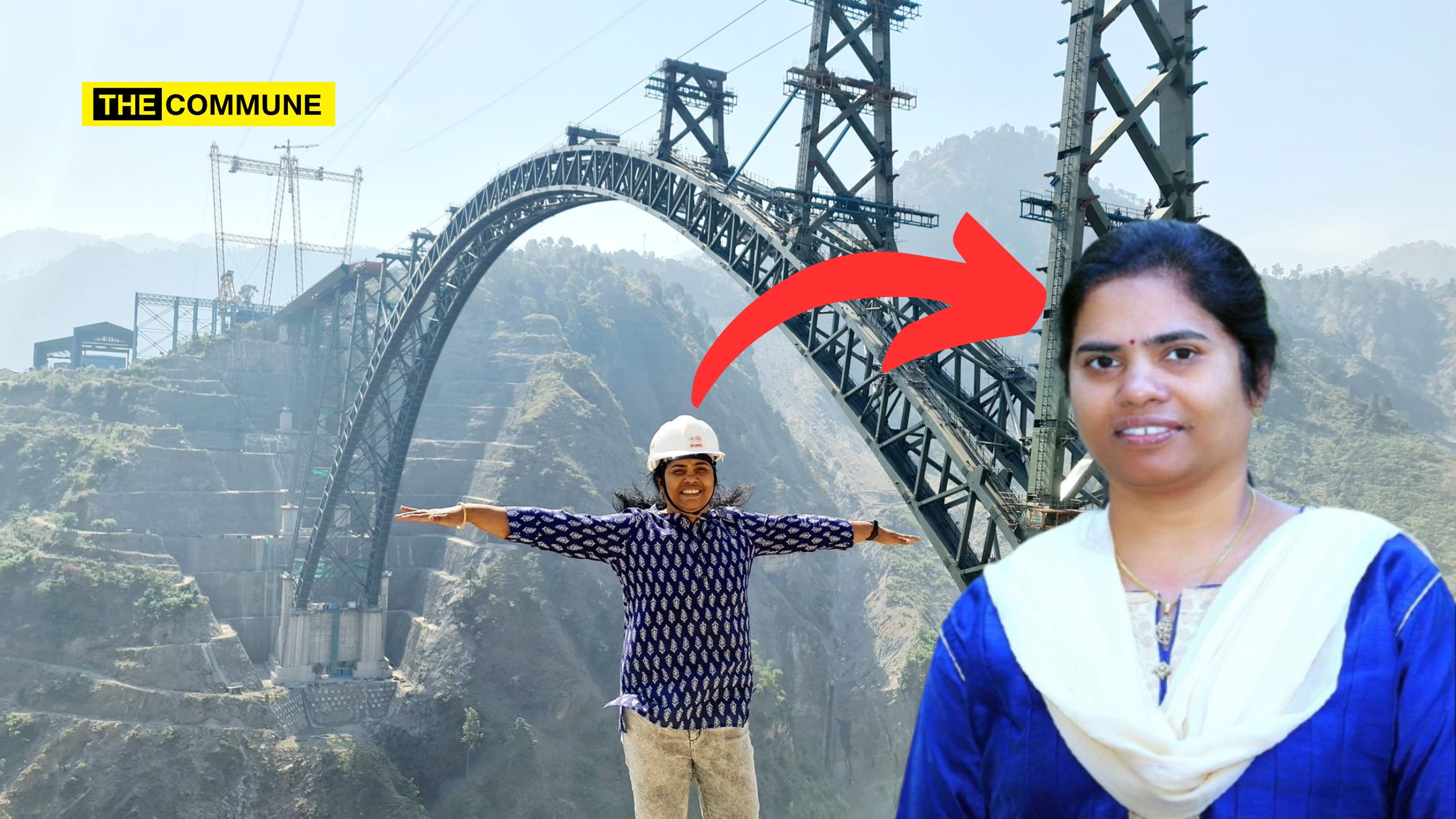
The Woman Who Moved Mountains: The Untold Story Of IISC Prof. G Madhavi Latha Instrumental In Building The World’s Tallest Rail Bridge

You’ve probably admired the stunning vistas of the Chenab Rail Bridge — the tallest railway bridge in the world.

But have you heard the story behind its creation? Let’s explore the lesser-known journey of the remarkable woman who played a key role in making it a reality: Professor Gali Madhavi Latha.

Prof. Gali Madhavi Latha is the geotechnical engineer whose expertise helped shape the engineering marvel that is the Chenab Rail Bridge in Kashmir. Spanning 17 years of effort, this structure is not just a bridge — it’s a testament to human ingenuity and perseverance.

Towering at 359 meters — higher than the Eiffel Tower — the Chenab Bridge links Kashmir to the rest of India through the rail network. It’s more than an infrastructure feat; it’s a powerful emblem of national integration and engineering excellence.

Back in 2005, Northern Railway enlisted Prof. Latha as the lead geotechnical consultant. Her mission? Conquer the harsh Himalayan terrain, stabilize fractured rock slopes, and make an audacious vision possible.

Holding a PhD in Geotechnical Engineering from IIT Madras and backed by research from IISc Bangalore, she was well-versed in the science of rock and soil mechanics. But the Chenab project posed unprecedented challenges that would push even the most seasoned expert to the limit.

She trekked through rugged landscapes, crossed rivers in boats, and examined complex geological formations in a region prone to earthquakes. The extreme conditions weren’t deterrents — they were simply part of the job.

Her approach was unconventional yet necessary: a dynamic, “design-on-the-go” method. Standard engineering formulas wouldn’t hold up against the unpredictable Himalayan geology, so she adapted strategies on-site and devised solutions in real time.

When unstable rock formations and hidden cavities were discovered, she led large-scale operations involving cement grouting and rock anchoring — reinforcing the slopes with over 66 kilometers of anchors, effectively stitching the mountain together.

At times, she stayed on-site around the clock, guiding excavation teams through high-risk situations where a single miscalculation could lead to catastrophe. Her work demanded accuracy, courage, and constant vigilance.

The bridge was engineered to endure extreme forces — winds of up to 260 km/h and earthquakes exceeding magnitude 8. It was Prof. Latha’s geotechnical designs that ensured the bridge could withstand such pressure while remaining safe and stable.

After nearly two decades of dedication, she finally visited the completed bridge in 2022 — not in her professional capacity, but as a mother, showing her children what determination and expertise can accomplish.

In 2021, she was honoured as the Best Woman Geotechnical Researcher by the Indian Geotechnical Society. Though the Chenab Bridge may be her most iconic work, her contributions to the field extend far beyond it.

She served as Editor-in-Chief of the Indian Geotechnical Journal from 2016 to 2022 and continues to mentor aspiring engineers at IISc Bangalore. For her, building infrastructure is only part of the mission — the rest is about inspiring the next generation.

On June 4, 2025, the Chenab Bridge hosted its first Vande Bharat Express test run — a milestone for Indian Railways and for national pride. Behind that moment was the quiet brilliance of Prof. Latha’s foundational work.

Today, the Chenab Rail Bridge stands as a global symbol of Indian engineering prowess. And beneath its towering steel and concrete lies the unwavering legacy of Prof. Gali Madhavi Latha — the woman who, quite literally, moved mountains.

Subscribe to our channels on TelegramWhatsApp, and Instagram and get the best stories of the day delivered to you personally.

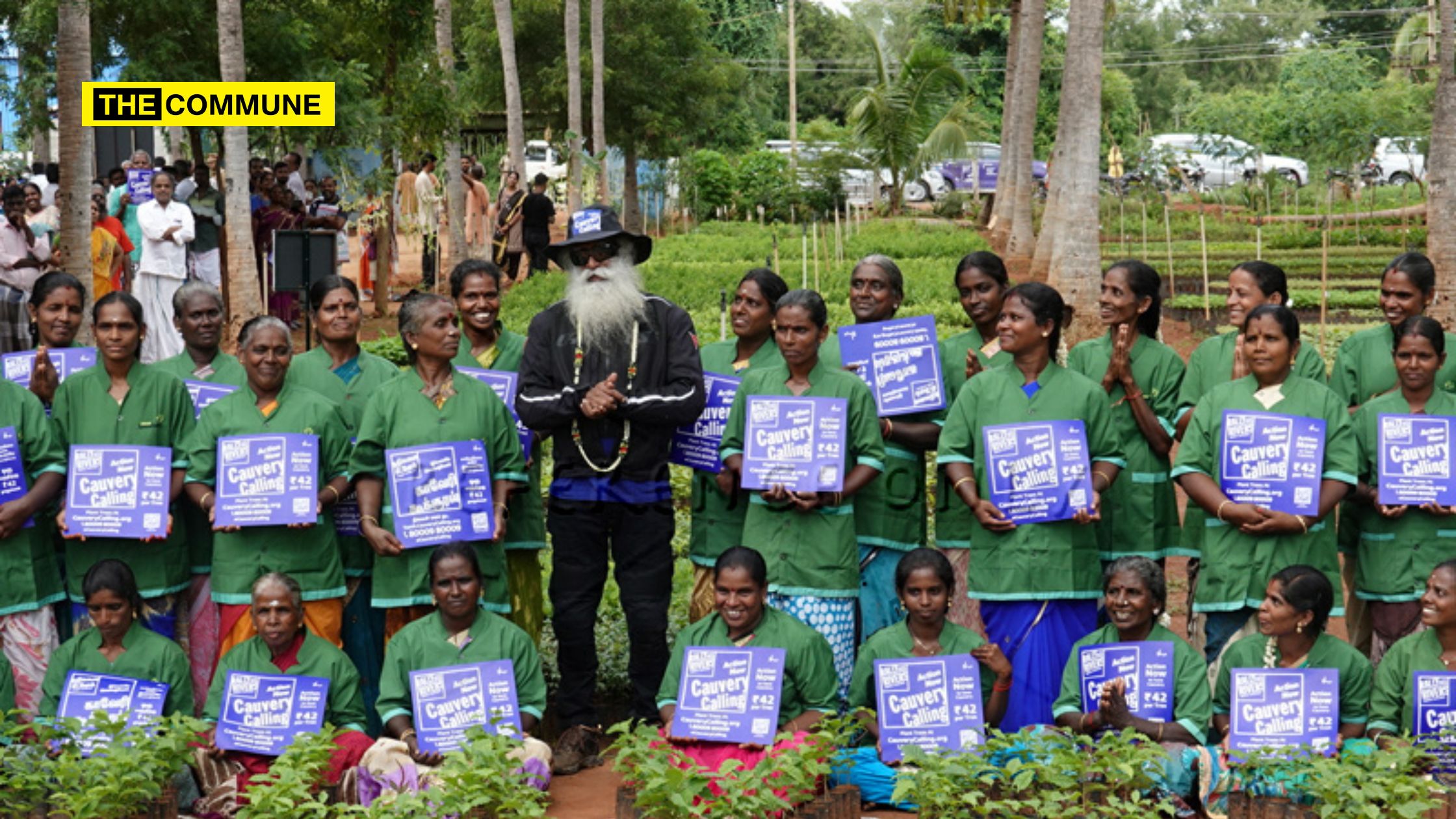
1.36 Cr Saplings Planted In 2024–25 Under Cauvery Calling, Total Plantation Soars To 12.2 Cr

Envisioned by Sadhguru, the Cauvery Calling movement enabled the plantation of 1.36 crore saplings across 34,000 acres in the Cauvery basin during 2024–25. To date, a total of 12.2 crore saplings have been planted, supporting 2.38 lakh farmers in adopting tree-based agriculture. Remarkably, in the last year alone, 50,931 farmers and citizens actively participated in this large-scale ecological effort.

Cauvery Calling is the world’s largest farmer-driven ecological initiative and a groundbreaking eco-restoration effort with the potential to transform tropical regions. Named Top Innovator by the Trillion Trees: India Challenge, the movement aims to rejuvenate the Cauvery River—lifeline to 8.4 crore people—while enhancing farmers’ incomes by enabling the plantation of 242 crore trees on private farmland. It promotes tree-based agriculture that helps enrich soil health and improve water retention, in turn helping sustain the river’s year-round flow.

Sadhguru had earlier shared on X, “#CauveryCalling will demonstrate to the world that it is possible to change the terrain of degraded Land by taking planned & strategized Action. Everyone who is nourished by Soil & Water must be a part of this Movement. Let Us Make It Happen.”

https://x.com/SadhguruJV/status/1486693731273097218

Reflecting on the achievement, Anand Ethirajalu, Project Director of Cauvery Calling and representative of the Save Soil movement, emphasized the urgency of soil regeneration– one of the key objectives of the movement. He said, “One of the key topics that we were campaigning during this COP29 summit of UNFCCC and COP16 of UNCCD is that less than 4 percent of the global climate finance is actually reaching agriculture and food systems.”

“We highlighted this because climate change cannot be fixed in the atmosphere. It can be fixed only in the soil. Putting more focus and investment in soil regeneration through tree-based agriculture is the need of the hour, and that’s what we’ve been doing!”

Providing a large quantity of quality saplings is crucial to achieving the goal of planting over a crore saplings each year. The Cauvery Calling production centres play a vital role in this effort. The production centres include a nursery in Cuddalore, one of the world’s largest single-site nurseries, entirely run by women, with a capacity to produce 85 lakh saplings. Together with the nursery at Thiruvannamalai, which produces 15 lakh saplings, these centres form the backbone of the initiative.

These nurseries supply 40 distribution centres across Tamil Nadu and 10 centres in Karnataka. Together, these nurseries offer 29 high-value timber species, including Teak, Red Sandalwood, Rosewood, and Mahogany at a subsidized rate of Rs. 3 per sapling. The Nursery at Sadhguru Sannidhi Bengaluru also reached a significant milestone of enabling plantation of 1,00,000 saplings since its inception in December 2023. At present, it has enabled the plantation of over 1.3 lakh saplings.

Cauvery Calling is enhancing farmer livelihoods by enabling them to run sapling production and distribution franchises. Farmers are trained and supported to manage nurseries and supply high-quality organic saplings to their communities.

Bolstering on-ground support, Cauvery Calling deployed over 160 field executives to visit more than 32,000 farmlands. These executives offer free consultations from pre-plantation to post-plantation, aiming to spread awareness about the benefits of adopting tree-based agriculture. During the visits, the executives check soil type, soil depth and conduct water test and recommend tree species suitable for their respective farmlands. These recommendations are carefully curated after considering the region’s endemic tree varieties, agro-climatic conditions and income-cycle expectations of the farmers.

Cauvery Calling also engages with farmers through Farmer Producer Organizations (FPOs), NGOs, Krishi Vigyan Kendras, Gram Panchayats, and agricultural expos. Over 52,000 farmers are supported through 225+ active WhatsApp groups that provide real-time advice. A dedicated helpline, operational daily from 9 a.m. to 9 p.m., resolves farmer queries within 24–48 hours using insights from experts and model farmers.

The movement also organized 2 mega training programs and 6 zonal programs in 2024, with 8,721 farmers participating. Experts from prestigious institutions like the National Research Centre for Banana (NRCB), Indian Institute of Horticultural Research (IIHR), National Institute of Food Technology Entrepreneurship and Management (NIFTEM), and Central Tuber Crops Research Institute (CTCRI) shared practical knowledge about tree-based agriculture.

In 2024, on landmark days such as World Environment Day (June 5), Van Mahotsav Week (July 1–7), Gandhi Jayanti (October 2), and World Soil Day (December 5), etc, 506 plantation events were conducted, resulting in the planting of 10 lakh saplings.

Subscribe to our channels on TelegramWhatsApp, and Instagram and get the best stories of the day delivered to you personally.
India’s First Indigenous Tamil AI

In a historic leap for linguistic technology and cultural preservation, India is set to launch the world’s first artificial intelligence system developed exclusively for a single language—Tamil.

The official unveiling of the Tamil AI project will take place today at IIT Madras, Chennai, in a landmark event attended by Union Minister for Electronics and IT, Ashwini Vaishnaw, and international dignitaries from Malaysia, the UK, and other countries. The presence of such global leaders underscores the international significance of this pioneering initiative. IIT Madras Director, Prof. V. Kamakoti, will also be present at the launch.

The brainchild behind the project, Ashvathaman, shared his vision with the media, stating:

“If there’s any language besides English to have its own comprehensive AI knowledge base, it’s going to be Tamil.”

Unlike conventional language models, the Tamil AI is being developed as a literary intelligence system, deeply rooted in classical Tamil grammar and poetic forms. From composing Asiriyappa and Venpa to performing metrical analysis using Yappilakkanam, the AI is tailored to uphold the linguistic richness of Tamil.

It will allow users to ask questions, write essays, and generate traditional poetry in pure Tamil, effectively becoming a living digital archive of Tamil culture, literature, and ethical values (Aram). The system also aims to serve as a bridge for non-Tamil speakers to learn Tamil through their native languages, thus connecting global linguistic communities through AI.

What sets this project apart is its 100% indigenous development—a proud moment for Indian technological capability. This marks a significant milestone, not just for Tamils worldwide, but for the global AI community witnessing the emergence of language-specific, culturally intelligent AI.

As the Tamil AI takes its first official step, it promises to be more than a technological tool—it stands as a monument to Tamil heritage in the digital age.


Subscribe to our channels on TelegramWhatsApp, and Instagram and get the best stories of the day delivered to you personally.

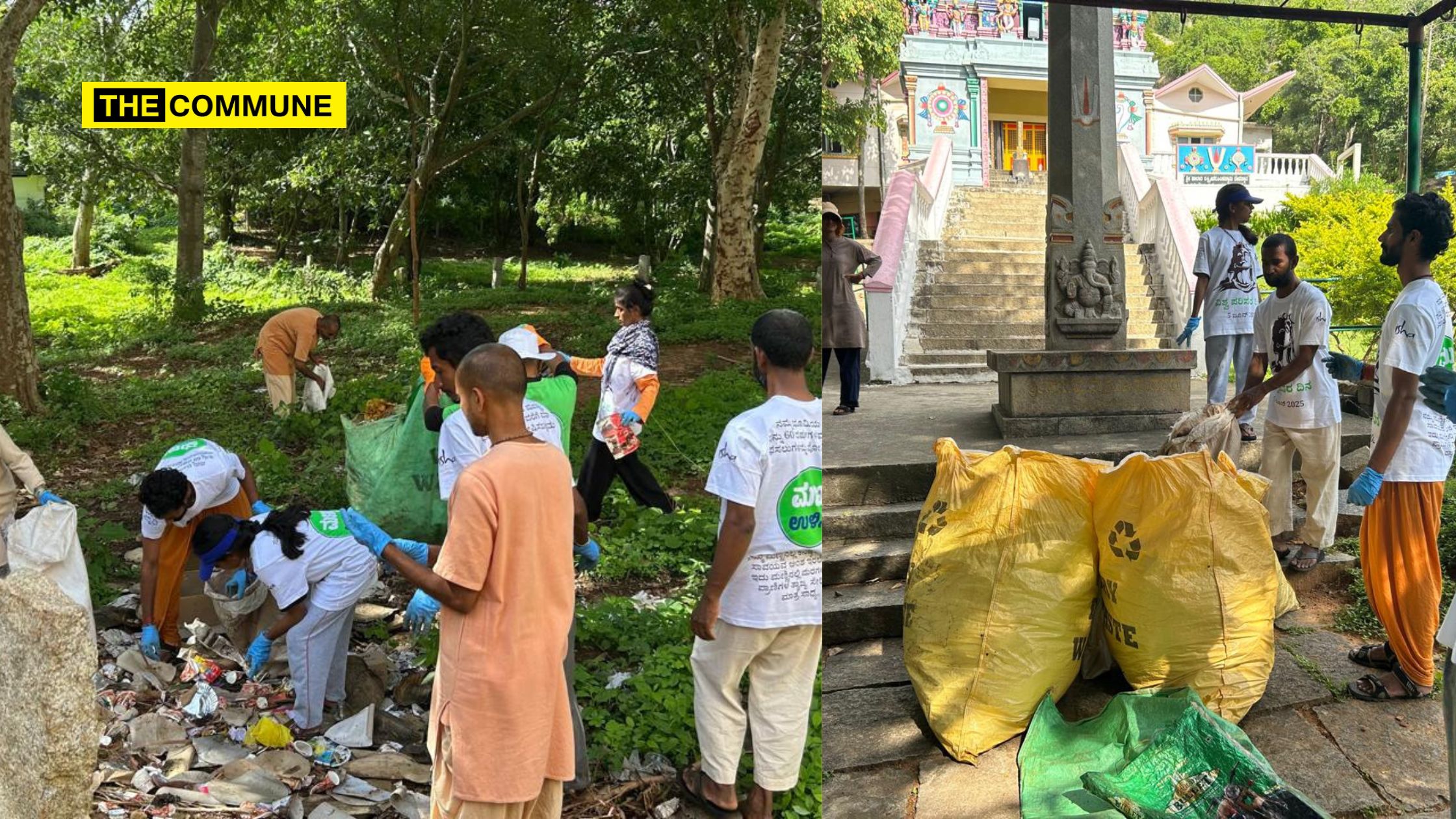
World Environment Day: Volunteers From Sadhguru Sannidhi Chikkaballapura Clean Jalari Narasimhaswamy Devasthana 

Marking World Environment Day, 40 volunteers from Sadhguru Sannidhi Bengaluru, Chikkaballapura, undertook an extensive clean-up of the revered Jalari Narasimhaswamy Devasthana, located at the peak of the Narasimha Devasthana Hills. The volunteers collected and brought down 40 bags, primarily of plastic waste, as part of a larger commitment to the theme of this year’s Environment Day: Ending Plastic Pollution

This impactful drive also marked the beginning of a month-long environmental campaign in 22 villages of Avalagurki and Thippenahalli panchayats, led by Hasiru Chikkaballapura, an ecological initiative of Sadhguru Sannidhi. The campaign will focus on raising awareness about plastic waste management, especially among women and youth, while reinforcing sustainable practices across rural communities surrounding the Sadhguru Sannidhi. 

The launch of this month-long campaign was held at the temple premises and graced by Shri Muniraju BM, PDO of Thippenahalli Panchayath; Shri Sundaresh, priest from Jalari Narasimha Swamy temple; Shri M. Narasimhaiah, Assistant Agriculture Officer (Retd.) from the Watershed Development Department, Chikkaballapura; Air Vice Marshal (Retd.) Shri Vikas Yajurvedi and Swami Lavana, Coordinator, Hasiru Chikkaballapura Project. The dignitaries shared insights on local environmental challenges, dangers of microplastics, ecological preservation, soil enrichment and the need for collective grassroots action. 

The campaign will include plastic awareness sessions, household-level workshops, games competitions, prizes for winners, and the distribution of drumstick saplings to promote nutrition and green cover. Special focus will be given to women SHG members, as they are the key drivers of behavioural change within families. Through fun, participative formats and targeted messaging, Hasiru Chikkaballapura aims to make sustainable habits accessible and actionable at the village level. 

Hasiru Chikkaballapur is an environmental outreach initiative of Sadhguru Sannidhi aimed at enriching soil and conserving water, boosting farmers’ incomes through tree-based agriculture and enhancing community health and wellbeing.

Subscribe to our channels on TelegramWhatsApp, and Instagram and get the best stories of the day delivered to you personally.
Paramasivan Fathima Review: A Bold Take On Religious Conversion That Could’ve Been Tamil Cinema’s Kantara With Better Storytelling

Paramasivan Fathima dares to tread where few in Tamil cinema have. In a cinematic landscape dominated by Dravidianist narratives that often seek to de-Hinduize Tamil identity, this film plants its feet firmly in the soil of Tamil spiritual tradition and boldly questions the unsettling realities of religious conversions sweeping through the hinterlands.

At its core, the film exposes how Christian missionary activity, often masked under the garb of charity and upliftment, can fracture not just families but entire villages. Be it chocolates handed to innocent children or job offers dangled before the desperate, the film doesn’t shy away from depicting how conversion through enticement erodes native culture and community bonds.

The most striking achievement of Paramasivan Fathima lies in its rejection of the myth that Tamil Nadu is solely “Periyar’s Land.” Instead, it reclaims the Tamil identity through the spiritual lens of Periyapuranam, honoring ancestral worship and asserting the omnipresence of Shiva as central to Tamil heritage. The film also doesn’t hold back when it comes to calling out religious fanatics who brand Hindus as Satan-worshippers.

The film highlights a critical issue: government-aided schools run by Christian institutions receive public funding for salaries and operational costs, yet they actively engage in religious indoctrination and are openly identified as Christian establishments. This contradiction was also emphasized by the director during the press meet. The filmmakers could’ve made this the core of the film just like how Director Mohan G effectively made the issue of ‘crypto-Christians’ the central core in Rudra Thandavam. Missionary forces misusing foreign funds and engaging in illicit activities gets only a passing mention with no depth.

The film also gives strong rebuttals to Dravidianist filmmakers. In one scene, the protagonist delivers a stinging rebuttal to a character (played by M.S. Bhaskar) who parrots the colonial cliché that we owe our education to the British. “They came here to beg,” he retorts. No Gnanavels were harmed in this scene.

In another scene, a character played by ‘Cool’ Suresh utters the line, “Once you make a woman fall in love with you, you should finish the ‘matter’ immediately.” The protagonist’s immediate slap felt like a tight slap given to a certain caste-obsessed filmmaker.

Yet, for all its boldness in content, Paramasivan Fathima falters in craft. The first half is sluggish, bogged down by clichéd tropes and clumsy writing.  The supernatural elements, which could’ve elevated the story into something mythic and memorable, suffer from a lack of narrative innovation. Dubbing mismatches in multiple scenes disrupt immersion, and while the film’s shoestring budget is understandable, it doesn’t excuse the uneven screenplay and underwhelming execution. The second half of Paramasivan Fathima is where the narrative gains momentum but by that time, you’ve already had enough.

The film also flirts with the supernatural, building toward a Kantara-esque climax with metaphysical realm rooted in Tamil Hindu belief systems. But it doesn’t have the magic that Kantara has.

In the hands of more seasoned storytellers, this could’ve been Tamil cinema’s Kantara—a spiritual, cultural, and cinematic experience rolled into one. But even with its flaws, Paramasivan Fathima stands out as a rare, gutsy voice in Tamil cinema—unafraid to ask uncomfortable questions, challenge dominant dogmas, and reclaim space for a more rooted, unapologetic Tamil Hindu identity.

Kaushik is a freelance writer.

Subscribe to our channels on TelegramWhatsApp, and Instagram and get the best stories of the day delivered to you personally.
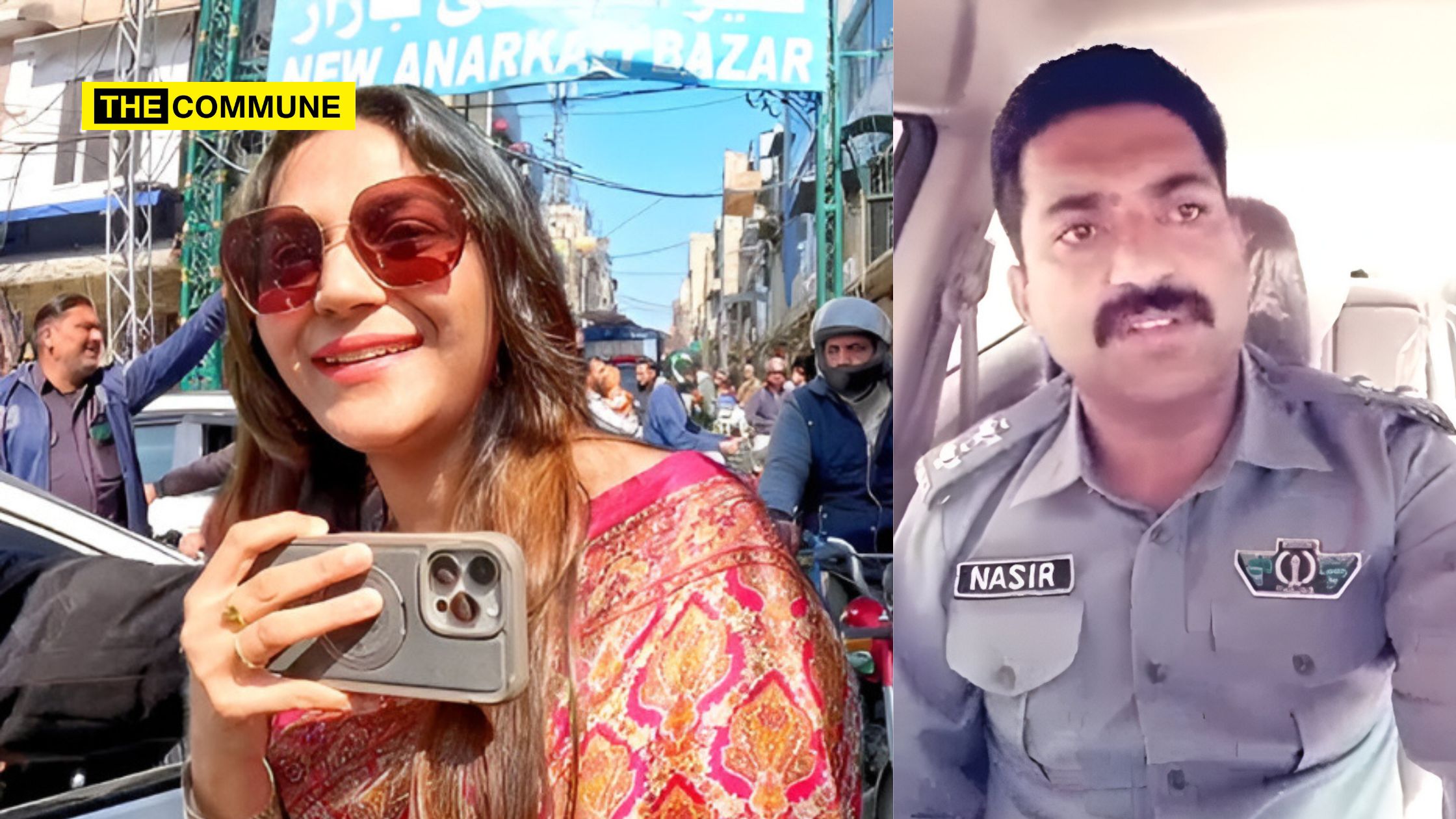
Fresh Evidence Links Indian YouTuber Jyoti Malhotra To Retired Pakistani Officer In Espionage Case

New details have emerged in the espionage case against Indian YouTuber Jyoti Malhotra, with investigative agencies uncovering her direct link to retired Pakistani police Sub-Inspector Nasir Dhillon, who is now under the scanner for alleged Intelligence operations against India. According to Intelligence sources, Malhotra was in personal contact with Dhillon and had even appeared alongside him in a podcast episode.

Their meeting reportedly took place during one of Malhotra’s earlier visits to Pakistan. Dhillon, who launched his own YouTube channel after retiring from the Pakistani police, initially projected himself as a promoter of peace and cultural dialogue between India and Pakistan. However, investigators now believe that behind the public persona lay a covert mission orchestrated by Pakistan’s Inter-Services Intelligence (ISI) and military.

Officials allege that Dhillon operated as a conduit for Pakistani Intelligence, using his channel to reach out to Indian YouTubers. After establishing friendly ties with them, he would allegedly introduce them to ISI operatives and gradually assign them tasks aimed at gathering sensitive information about the Indian Army and security establishments. Malhotra, 36, is believed to be one such individual who was manipulated through this network. Sources further confirm that Dhillon’s connections extended to Ehsan-ur-Rahim, alias Danish, a Pakistani High Commission staffer in New Delhi who was expelled by Indian authorities on 13 May for suspected espionage.

Investigators have found credible evidence linking Dhillon and Danish, indicating a broader and more organised spy ring operating under diplomatic cover. Jyoti Malhotra was arrested on May 16 under the Official Secrets Act and relevant provisions of the Bharatiya Nyaya Sanhita. She has since undergone multiple rounds of interrogation by both local police and central Intelligence agencies. She is among 12 individuals detained so far in Punjab, Haryana, and Uttar Pradesh as part of a wider crackdown on an alleged spy network attempting to exploit Indian digital influencers for Intelligence-gathering. As the probe deepens, security agencies are now expanding their focus to identify more potential infiltrators connected to this network, raising serious concerns over the use of social media as a new front for espionage.

-IANS

Subscribe to our channels on TelegramWhatsApp, and Instagram and get the best stories of the day delivered to you personally.
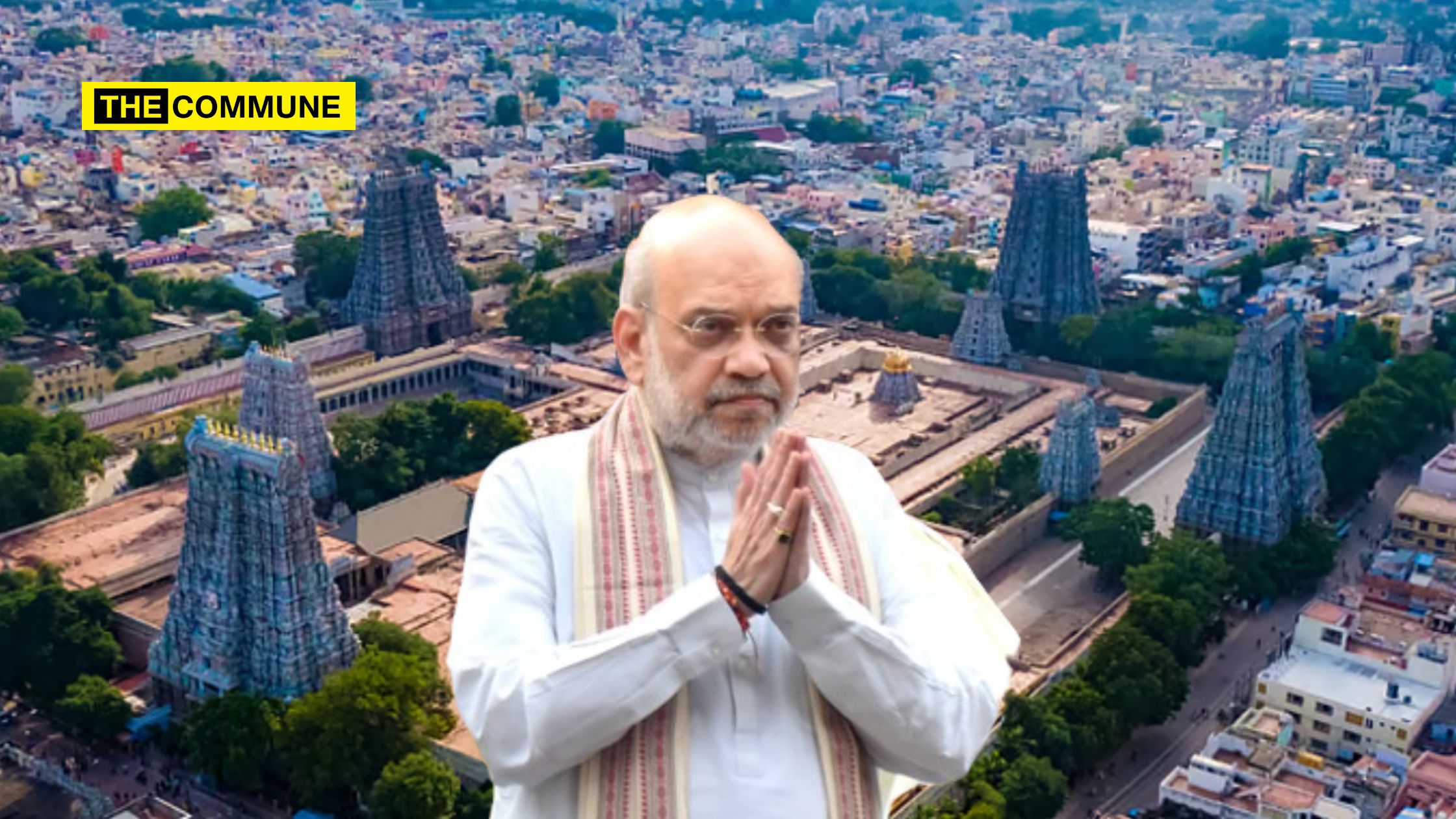
Amit Shah’s Madurai Visit Signals BJP’s Southern Strategy Push Ahead Of 2026 Tamil Nadu Polls

Union Home Minister and senior BJP leader Amit Shah is set to visit Madurai on 7 June, sparking renewed political interest in Tamil Nadu over the party’s southern strategy and the potential expansion of the NDA in the state.

According to party sources, HM Shah will arrive in Madurai late on 7 June and is scheduled to participate in the BJP’s Tamil Nadu core committee meeting the following day. He will also address office-bearers from the state, district, and mandal levels in what is being viewed as a strategic push to strengthen the BJP’s base in the southern districts. BJP national co-in-charge for Tamil Nadu, P. Sudhakar Reddy, said the visit would primarily focus on strengthening the party’s organisational structure and preparing for the 2026 Tamil Nadu Assembly elections.

“He will speak on various matters, including the achievements of the Modi government over the past 11 years. Amit Shah will also outline a road map for the BJP’s strategy in the state,” Reddy said. HM Shah’s visit comes at a time when discussions over the NDA’s expansion in Tamil Nadu are gaining traction. His previous visit to the state on 11 April marked a significant political moment, as it was during that trip to Chennai that he formally announced the revival of the BJP-AIADMK alliance. That announcement sent ripples across the state’s political landscape.

Commenting on the choice of Madurai as the venue, BJP state vice-president Narayanan Thirupathy dismissed any special political significance. “The Union Home Minister has previously chaired meetings in Chennai and Coimbatore. This time it’s Madurai,” he said. However, BJP insiders suggest that Madurai, often referred to as the cultural capital of Tamil Nadu, holds symbolic value.

The city has long been a stronghold of spiritual and cultural traditions aligned with the Sangh Parivar, and the party is keen to consolidate its base in the southern belt. In line with this, the BJP and its affiliate Hindu Munnani are organising a ‘Lord Muruga Devotees Conference’ in Madurai later this month. Tamil Nadu BJP spokesperson and senior leader ANS Prasad highlighted the impact of HM Shah’s earlier visit.

“His April 11 trip to Tamil Nadu changed the political narrative in the state. The announcement of the AIADMK-BJP alliance shook the DMK and its allies. Since then, leaders including Chief Minister M.K. Stalin have consistently addressed the implications of that alliance. Tamil Nadu politics can now be seen in two phases before and after Amit Shah’s April visit.” Prasad added that HM Shah’s upcoming speech in Madurai is expected to offer clear direction for the 2026 elections.

-IANS

Subscribe to our channels on TelegramWhatsApp, and Instagram and get the best stories of the day delivered to you personally.

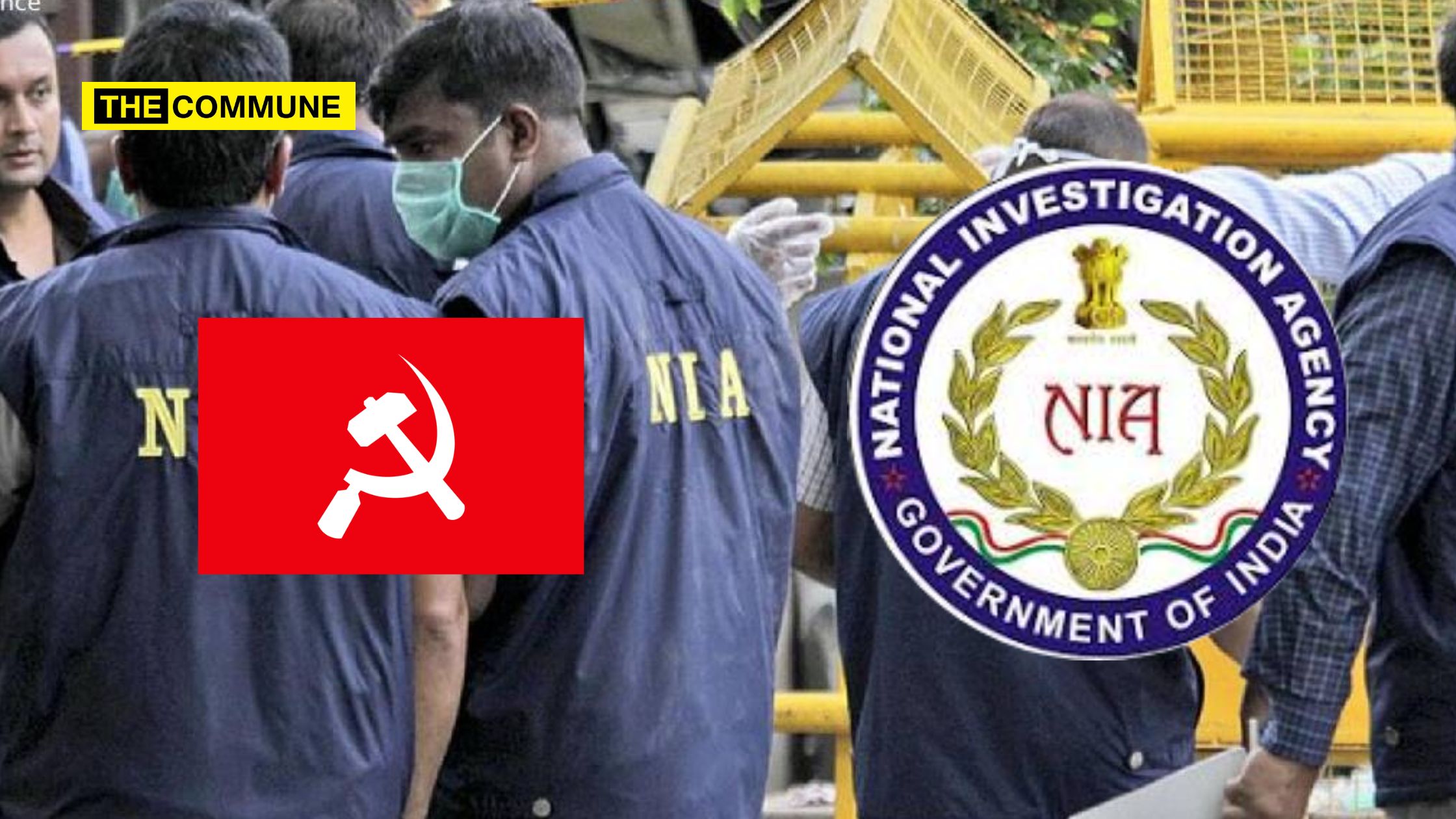
NIA Chargesheets Maoist Cadre Ashu Korsa In Targeted Killing Of Army Jawan In Chhattisgarh

The National Investigation Agency (NIA) has filed a chargesheet against Maoist cadre Ashu Korsa in connection with the targeted killing of an Indian Army jawan, Motiram Achala, in Chhattisgarh. The chargesheet, filed in the NIA special court in Jagdalpur, outlines Korsa’s involvement in a larger conspiracy orchestrated by the banned CPI (Maoist) to eliminate Achala.

Achala, a soldier visiting his native village, was brutally shot dead on 25 February 2024, while attending a local fair in Useli village in the Amabeda area of Kanker district. The attack, carried out in full public view, was intended to instil fear among locals and deter individuals associated with security forces. The case was initially registered by local police but was transferred to the NIA on 29 February 2024, due to its national security implications. Investigations revealed that Korsa was an active armed cadre of the Kuyemari Area Committee under the North Bastar Division of the CPI (Maoist).

Alongside another senior Maoist leader, he played a key role in identifying Achala and executing the attack. The operation was part of a broader strategy by the insurgent group to assert dominance in the region and intimidate civilians. Korsa was arrested by the NIA in December last year, marking a significant breakthrough in the case. His involvement underscores the deep-rooted network of Maoist insurgency in Chhattisgarh, where armed cadres continue to challenge state authority through violent means.

The agency has invoked multiple sections of the Indian Penal Code, including murder and criminal conspiracy, along with provisions of the Unlawful Activities (Prevention) Act. The investigation remains ongoing as authorities work to uncover additional conspirators and map the full extent of the Maoist network behind the attack. The NIA’s efforts reflect a broader push to dismantle insurgent operations and restore stability in the affected regions. Security forces continue to monitor developments closely, ensuring that those responsible for such acts of violence are brought to justice. The case serves as a stark reminder of the persistent threat posed by extremist elements operating in India’s conflict-ridden areas.

-IANS

Subscribe to our channels on TelegramWhatsApp, and Instagram and get the best stories of the day delivered to you personally.