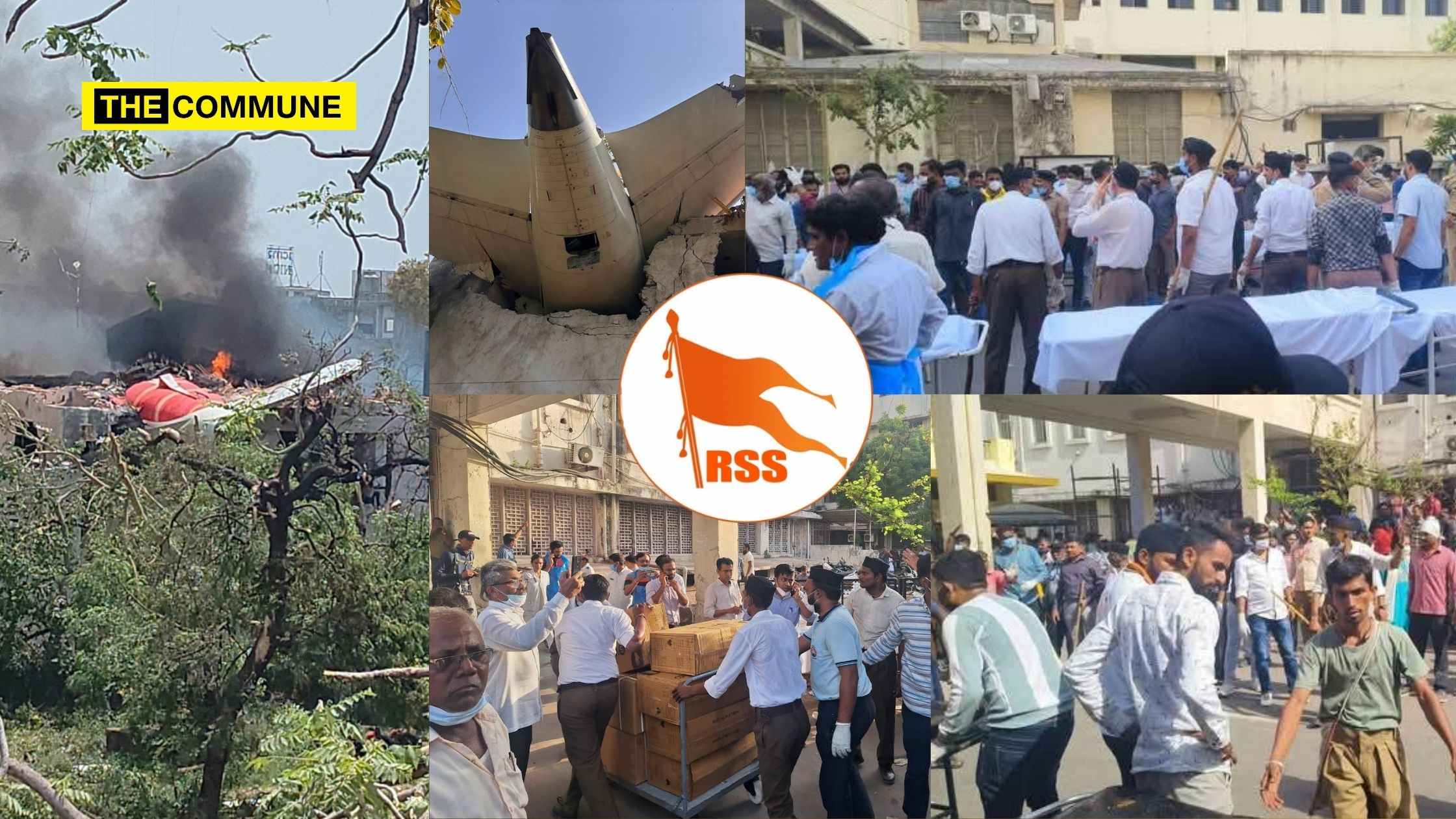
In the wake of the tragic Air India Boeing 787-8 Dreamliner crash in Ahmedabad’s Meghaninagar area on 12 June 2025, Rashtriya Swayamsevak Sangh (RSS) swayamsevaks rushed to aid victims’ families and support rescue operations alongside local administration, police, and medical teams.
The horrific incident, which involved a flight with 242 people on board — 230 passengers and 12 crew members — resulted in numerous deaths and injuries and left many in shock. Among the passengers were 169 Indian nationals, 52 British, 7 Portuguese, and 1 Canadian citizen. One survivor — sitting in seat 11A — was found alive after the incident and is currently undergoing treatment at a nearby hospital, according to Ahmedabad Police Commissioner G.S. Malik.
RSS Swayamsevaks’ Ground Efforts
Just half an hour after Air India flight 171 went down — a catastrophic incident that resulted in numerous deaths and injuries — scores of RSS cadres were already on the ground, extending a helping hand in whatever way they could. The local RSS unit in Karnavati, where Dr. Hedgewar Bhawan (the RSS’s Ahmedabad headquarters) is located, quickly mobilised its members. Mahanagar Karyavah, Hardik Parikh, was busy contacting colleagues and sending messages in their WhatsApp group to bring in additional help.
“In tough times, RSS always helps people and stands at the forefront of service,” Parikh said outside the post-mortem section of Civil Hospital, Ahmedabad. “We have deployed mostly taruns (adults) who can actively work on the ground. It’s our duty to serve society.”
Outside the hospital’s mortuary, nearly 200 RSS workers in their traditional dark brown trousers, white shirts, black caps, and bamboo sticks were engaged in crowd control, guiding victims’ families, and offering much-needed support. The tragedy — which saw a flight filled with people, many looking forward to a new future in London — come down in a ball of fire — forced hospitals, emergency services, and the community to respond collectively.
Swayamsevaks are working in two phases, with 175 members in each team, delivering aid across multiple aspects of the operation:
Managing rescue operations at the crash site.
Traffic management in and around the hospital.
Support during post-mortem procedures.
Assisting in the collection of DNA samples to aid in victim identification.
Organizing food, water, and other necessities for over 2,000 people.
Collaborating with Kalupur Swaminarayan Mandir for food distribution.
Donating blood in response to appeals by hospital authorities.
RSS volunteers are actively assisting in relief efforts in Ahmedabad. We extend our condolences to the bereaved families and pray for the recovery of the injured. #PlaneCrashpic.twitter.com/qguplf1avN
RSS members, alongside Gujarat Police and medical staff, were fully engaged in delivering aid and honoring the dignity of the deceased. They provided food, water bottles, and other necessities to the family members who rushed to the hospital to identify their relatives’ bodies. Additionally, many people came forward to donate blood in response to appeals made by hospital authorities. The Sangh’s workers facilitated these donors and supported them through the process.
At the hospital, RSS cadres were also busy offering food and refreshments — “We are providing tea, biscuits, and khichdi. Whoever wants to eat can take it,” Parikh explained, adding that the team was organizing its efforts in shifts. Those who had finished their shift made way for a fresh group to take their place. “We are here for the next few days until the situation normalises.”
Time and again, whether in the face of natural disasters or human tragedies—cyclones, floods, earthquakes, or any crisis—the selfless service of RSS swayamsevaks shines through. Wherever help is needed most, you’ll find them on the front lines, working tirelessly to bring relief, hope, and strength to those affected. Their unwavering commitment to service ensures that when it matters most, the Sangh is always there, boots on the ground and hearts in the mission.
According to updated estimates from the Pew Research Center, Islam recorded the most rapid growth among the world’s major religions in the decade leading up to 2020. The findings, based on a detailed analysis of approximately 2,700 censuses and surveys, confirm that Islam outpaced all other faiths in population growth, followed by Christianity.
The global Muslim population saw an increase of 357 million people, with its share rising by 1.8 percentage points, reaching 28.8% of the total world population. This significant rise is largely attributed to high birth rates and overall demographic expansion in Muslim-majority nations. Notable increases in the Muslim population share were observed in countries such as Kazakhstan, Benin, and Lebanon, each witnessing a rise of at least 5 percentage points. In contrast, Tanzania and Oman experienced a decline of similar magnitude.
While Christianity continues to be the world’s largest religion, its growth has slowed in several regions. The global Christian population rose by 122 million, reaching 2.3 billion, but its percentage of the world population fell by 1.8 points, now also standing at 28.8%. The study highlighted that more Christians now reside in Africa than in Europe, though a majority of nations continue to have Christian majorities.
Buddhism was the only major religion that saw a decline in both absolute numbers and global share, with fewer adherents in 2020 compared to a decade earlier.
Meanwhile, Hinduism kept pace with the global population growth rate. The number of Hindus increased by 126 million, bringing the total to about 1.9 billion, maintaining a steady global share.
The Jewish population, representing around 0.2% of the world, experienced modest but stable growth.
Significantly, individuals identifying as having no religious affiliation—often referred to as “nones”—also experienced substantial growth. Along with Muslims, they were the only major group to record a notable increase. By 2020, around 75.8% of the global population identified with a religious group, indicating that religion remains a central aspect of identity for most people worldwide.
Understanding Religious Switching
The term religious switching refers to the trend where individuals either stop identifying with the religion they were raised in or adopt a different one. This phenomenon is particularly common among younger generations, many of whom either grew up without a religious affiliation or chose to leave their family’s faith. Among all groups, the religiously unaffiliated recorded the largest net gains over the past decade, further highlighting the shifting dynamics in global religious identification.
Subscribe to our channels on Telegram, WhatsApp, and Instagram and get the best stories of the day delivered to you personally.
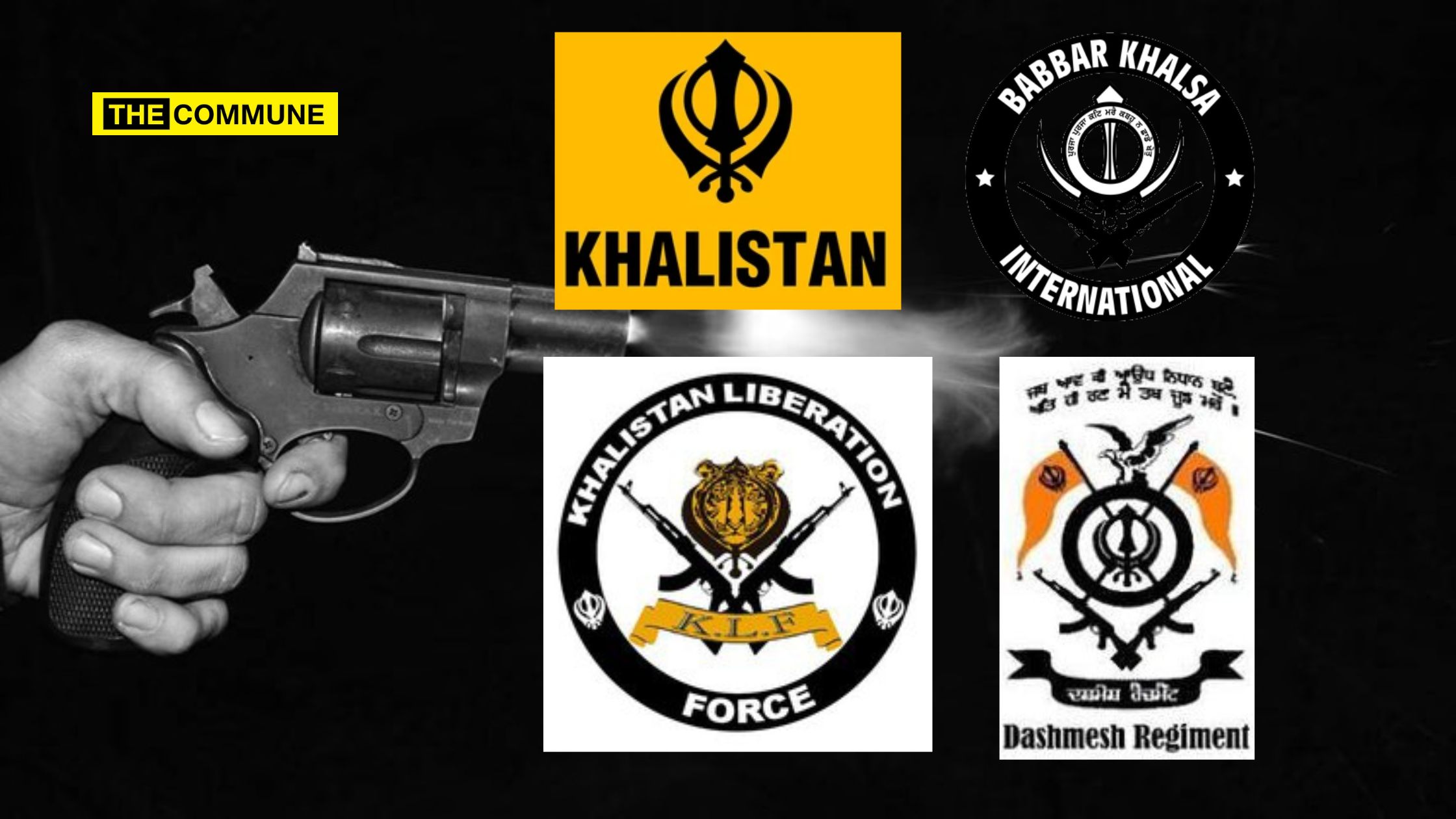
This report documents ten significant cases of targeted killings of Hindus by Punjab-based separatist elements between 2016 and 2025. One such incident occurred on 14 March 2025, when Shiv Sena district president Mangat Rai Manga was shot dead by three motorcycle-borne assailants in Moga district. Initial investigations revealed that the attackers were acting on the instructions of Pakistan-based Babbar Khalsa International (BKI) operative Harvinder Rinda.
#1 Shiv Sena Leader Mangat Rai Murdered by BKI-Linked Assailants
On 14 March 2025, Shiv Sena district president Mangat Rai Manga was gunned down by three motorcycle-borne assailants in Moga district, Punjab. The attackers also injured two bystanders, including an 11-year-old boy. The Punjab Police launched an investigation and arrested three individuals affiliated with Babbar Khalsa International (BKI), a Pakistan-based terror outfit. Among the arrested were Arun alias Deepu and Rajveer. Officials confirmed the attackers acted under instructions from BKI mastermind Harvinder Rinda. While personal enmity was suggested as the motive, the case was deeply rooted in a broader terror conspiracy involving cross-border separatist elements.
#2 Arsh Dalla Gang Shooters Arrested in Gwalior Murder
On 7 November 2024, Jaswant Singh was shot dead outside his residence in Gwalior, Madhya Pradesh. Investigations pointed to the involvement of the gang led by Arshdeep Dalla, a Punjab separatist figure operating from Canada. Two of Dalla’s shooters, Navjot Singh and Anmolpreet Singh, were arrested and found in possession of foreign-manufactured pistols from Australia and China. Their mobile phones had international IMEI numbers, indicating overseas coordination. Following the murder, Canadian authorities detained Dalla. The case revealed an expanding cross-border terror network targeting Hindus and Indian nationalists, with direct operational links between foreign handlers and local shooters.
#3 VHP Leader Vikas Prabhakar Assassinated in BKI Plot
On 13 April 2024, Vishwa Hindu Parishad (VHP) leader Vikas Prabhakar, also known as Vikas Bagga, was shot dead at his sweet shop in Nangal, Rupnagar district, Punjab. The murder was carried out by terrorists linked to Babbar Khalsa International (BKI). An NIA investigation uncovered a larger conspiracy coordinated from Pakistan, Germany, and Dubai. Wadhawa Singh, a BKI leader, instructed Germany-based operatives Harjeet Singh and Kulbir Singh to supply weapons and funding for the attack. Three men—Mandeep Kumar, Surinder Kumar, and Gurpreet Ram—were arrested, while the main conspirators remain absconding. The killing marked another instance of transnational extremist violence.
#4 Congress Leader Baljinder Singh Killed, Arsh Dala Claims Responsibility
On 19 September 2023, Congress leader Baljinder Singh Balli was shot dead at his home by two unidentified assailants on a motorcycle. Shortly after the murder, known Punjab separatist and gangster Arsh Dala claimed responsibility for the attack. In a video statement, Dala alleged that Balli had “ruined his future” and forced him into a life of crime. The murder sent shockwaves across the political landscape in Punjab and highlighted the growing influence of separatist elements with transnational links who are now targeting mainstream political figures to settle personal and ideological scores.
#5 Hindu Leader Sudhir Suri Shot Dead Outside Amritsar Temple
On 4 November 2022, Hindu leader Sudhir Suri was shot dead in a crowded area outside Gopal Mandir in Amritsar, Punjab. The attacker, Sandeep Singh Sunny, was apprehended by police on the spot. Investigators found a Khalistan sticker on the car used in the crime, suggesting a separatist connection. Suri had been under threat for some time, with intelligence inputs indicating that Khalistan sympathizers abroad had conspired to assassinate him. His killing was seen as part of a pattern of targeted violence against Hindu leaders in Punjab, orchestrated or encouraged by extremist groups with foreign support.
#6 RSS Leader Ravinder Gosai Assassinated by Khalistani Militants
On 20 October 2017, RSS leader Ravinder Gosai was shot dead near his home in Ludhiana, Punjab. The assassination came just weeks after the Punjab Police had arrested seven members of the Khalistan-linked group Babbar Khalsa International on September 26. The arrested militants, found in possession of firearms and ammunition, confessed during interrogation that they were targeting Hindu leaders who opposed Khalistani ideology. Gosai’s murder marked another violent act in the resurgence of separatist extremism in Punjab, where targeted killings have become a tool for spreading fear and destabilizing communal harmony.
On 6 August 2017, retired Brigadier Jagdish Gagneja, deputy chief of the Punjab unit of the RSS, was shot in broad daylight by unidentified gunmen. He succumbed to his injuries later. The Dashmesh Regiment, a shadowy pro-Khalistan extremist outfit, claimed responsibility through an email sent to major media outlets, including PTI. Gagneja had been an outspoken critic of separatist ideologies, and his murder underscored the growing boldness of Khalistani terror groups operating both within India and through international support networks. The killing raised concerns about a resurgence of insurgent activity in Punjab reminiscent of the 1980s.
#8 KLF Behind Double Murder of Shiv Sena Leaders in Ludhiana
On 25 February 2017, Satpal Sharma and his son Ramesh Sharma, both Shiv Sena leaders and followers of Dera Sacha Sauda, were shot dead by Khalistan Liberation Force (KLF) terrorists in the Jageda area of Ludhiana, Punjab. The attack occurred at a ‘Naam Charcha Ghar’ during a religious gathering. According to the National Investigation Agency (NIA), the murder was part of a larger international conspiracy orchestrated by KLF’s top leadership to incite communal tensions and eliminate ideological opponents. The incident further highlighted the cross-border influence and violent tactics of pro-Khalistan extremist groups operating in Punjab.
#9 Amit Sharma Assassinated by KLF-Sponsored Killers in Meerut Link
On 14 January 2017, Amit Sharma, head of Shri Hindu Takht, was gunned down by two unidentified assailants riding a motorcycle in Punjab. Investigations by the NIA revealed that the Khalistan Liberation Front (KLF) had masterminded the murder as part of a broader plot to destabilize communal harmony in the region. The NIA chargesheet named Ashish Kumar, Javed, and Arshad Ali, all from Meerut, Uttar Pradesh, as key accused in executing the targeted killing. The cold-blooded murder was one of several carried out by KLF operatives targeting prominent Hindu figures in an attempt to revive separatist militancy.
#10 Shiv Sena’s Durga Gupta Murdered by Pro-Khalistan Sharpshooter
On 23 April 2016, Durga Gupta, leader of the Shiv Sena’s labour cell in Punjab, was shot dead in Khanna, Ludhiana district. Police investigations led to the arrest of sharpshooter Hardeep Singh Shera, who was found to be connected with Khalistani extremist networks. Gupta’s assassination marked the beginning of a disturbing trend of targeted killings of Hindu leaders by pro-Khalistan elements in Punjab. Shera’s name later appeared in multiple similar cases, establishing a pattern of hired killings orchestrated to reignite separatist sentiments in the state. The murder triggered widespread concern over the resurgence of Khalistani terror infrastructure.
Subscribe to our channels on Telegram, WhatsApp, and Instagram and get the best stories of the day delivered to you personally.
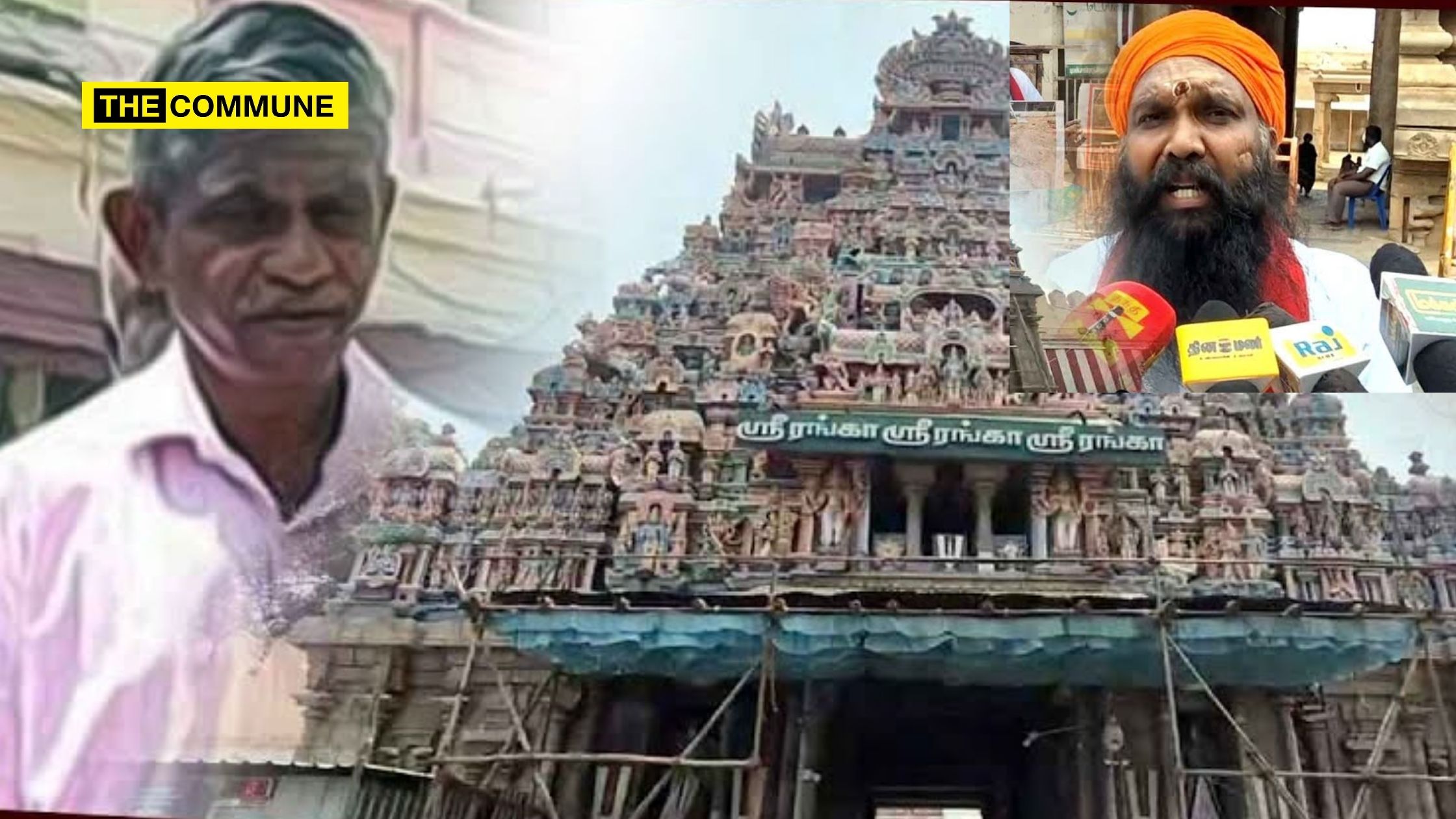
Rama Ravikumar, the head of Hindu Tamilar Katchi, has submitted a formal complaint to the Joint Commissioner of Srirangam Temple, objecting to the recent appointment of Velmurugan as the internal superintendent overseeing temple jewels at the Srirangam Ranganathar Temple in Tiruchirappalli.
The objection stems from Velmurugan’s prior controversial tenure as an executive officer at the Kalakastheeswarar Temple in Dindigul during 2013–2014. According to Ravi Kumar, during that period, significant damage occurred at the ancient temple, including the destruction of sacred idols, deity statues, and historical peacock mandapa pillars as part of the renovation activities. The matter is currently under judicial review in a Dindigul court, with Velmurugan facing legal scrutiny.
Despite these allegations, Velmurugan has now been entrusted with responsibilities at one of Tamil Nadu’s most revered temples. The Hindu Tamizhar Katchi strongly condemned this decision, especially as he is now in charge of safeguarding valuable temple jewels at Srirangam.
Ravi Kumar emphasized that someone accused of desecrating temple heritage should not be permitted to serve in such a sacred and responsible position. “It is deeply inappropriate to appoint someone who has allegedly disrespected divine property to oversee the Lord’s treasures. Anyone who has acted against the sanctity of a temple should be disqualified from temple service,” he said, urging immediate action from the authorities.
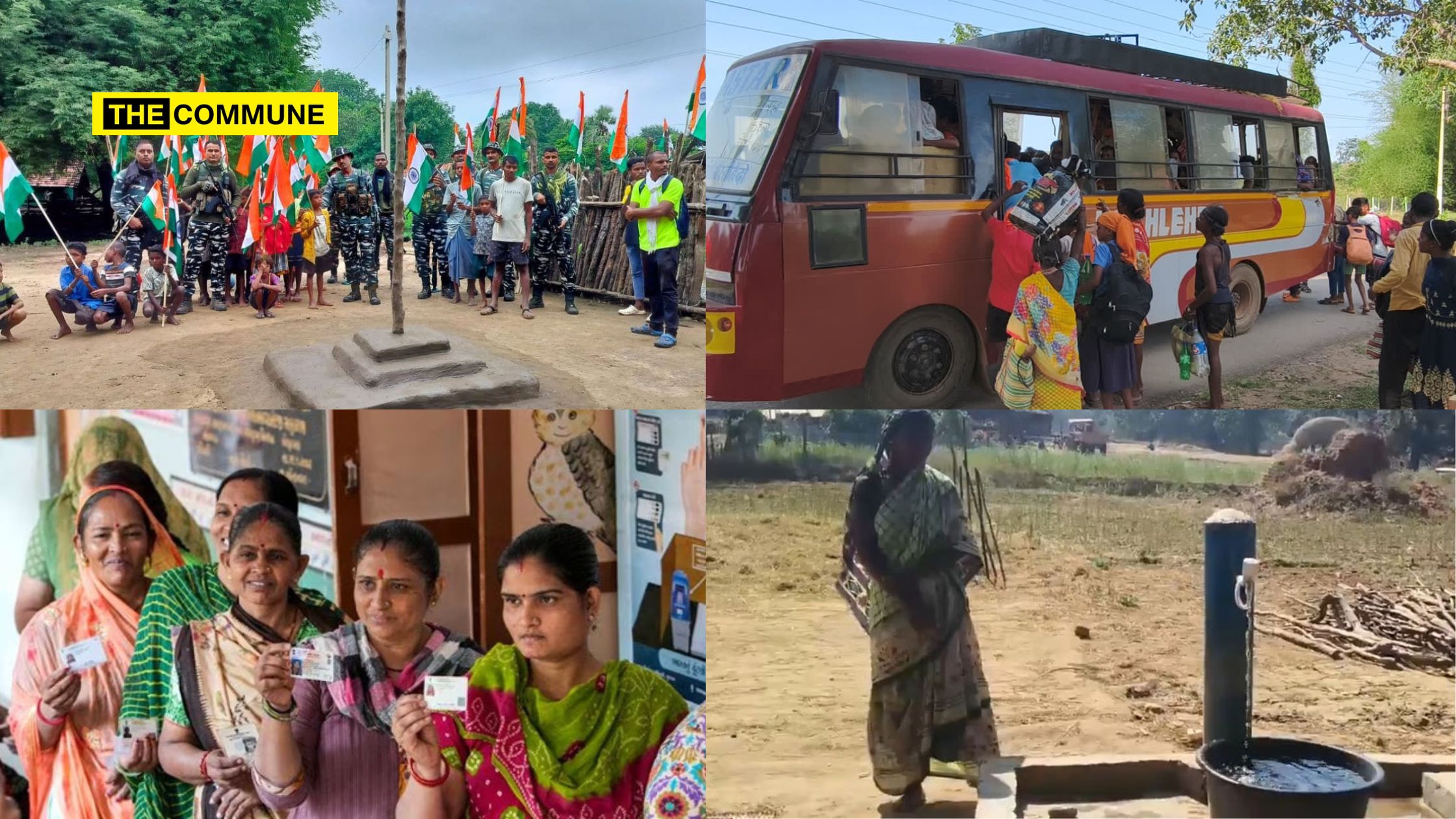
On 20 May 2025, a public bus reached Kutul, a remote village in Narayanpur district of Chhattisgarh, for the first time since Independence. Nestled deep within the Naxal-affected Abujhmad region, this event marked a symbolic breakthrough in accessibility and state presence.
Owing to sustained security operations and developmental efforts from 2016 to 2025, several areas long under Naxal control have seen unprecedented transformation. This report compiles 24 such landmark achievements—each a “first since Independence”—across India’s most challenging insurgency-hit regions.
These milestones reflect a growing restoration of governance, infrastructure, and public services in areas once considered inaccessible or unsafe.
#1 First-Ever Bus to Kutul Marks Dawn of Development in Naxal-Hit Abujhmad
On 20 May 2025, for the first time since Independence, a public bus reached Kutul village in Chhattisgarh’s Naxal-affected Abujhmad region. Operated by Bastar Travels, the service runs through several remote villages, offering newfound access to healthcare, education, and markets. Initiated by the Narayanpur district administration and police, the project followed improved security and the laying of NH-130D. Villagers expressed both joy and concerns—while grateful for the connectivity, many called for lower fares and larger buses. Once hostile to development, locals now embrace this transformation, with the Kutul bus symbolizing a powerful shift toward inclusion and progress.
#2 First Bus Reaches Katejhari, Ending 78-Year Wait in Naxal-Affected Gadchiroli
On 19 May 2025, a state-run passenger bus entered Katejhari village in Maharashtra’s Naxal-hit Gadchiroli district for the first time since Independence, marking a historic moment of transformation. Once a Maoist stronghold, the region saw major counter-insurgency success, enabling the rollout of this long-awaited public transport. The 100km route connects 12 villages, improving access to healthcare, education, and jobs. Residents celebrated with music and joy, calling the service a lifeline. Officials see the initiative as a vital step in restoring normalcy, building trust, and ensuring development in an area previously crippled by decades of guerrilla control and isolation.
First time since Independence, passenger bus rolls into a remote village in naxal-affected Gadchiroli district pic.twitter.com/AasrSYTq7O
#3 After 77 Years, First Bus Reaches Kategaon in Gadchiroli
On 26 April 2025, a state-run bus reached the tribal village of Kategaon in Maharashtra’s Gadchiroli district for the first time in 77 years since Independence. Once a Maoist stronghold marked by violence and isolation, the village is now witnessing the winds of change. The Maharashtra State Road Transport Corporation launched the new service to connect Kategaon with the district headquarters, symbolizing progress, access, and reintegration into the mainstream. The sound of the bus horn, replacing decades of silence and conflict, was welcomed by villagers with hope, marking a new chapter in the region’s journey toward development.
WATCH || Winds of change sweep through Gadchiroli, a former Maoist-hit district in Maharashtra. For the first time in 77 years, a state-run bus reached the tribal village of Kategaon—once echoing with gunfire, now with the sound of a bus horn. Here's a report. pic.twitter.com/eztCjBrpdf
#4 Timenar Village Electrified After 77 Years in Bastar Region
On 23 March 2025, electricity reached Timenar village in Bijapur district, Chhattisgarh, for the first time since Independence, marking a historic milestone for this Maoist-affected region. Under the Chief Minister’s Manjra-Tola Electrification Scheme, all 53 households were electrified, ending decades of darkness. Residents expressed joy, noting the newfound safety and opportunities for their children. Chief Minister Vishnu Deo Sai hailed it as the beginning of a new era of governance and development in Bastar. The initiative reflects the state’s efforts to reclaim remote areas from Left-Wing Extremism and bring them into the mainstream of progress and prosperity.
#5 Kerlapenda Votes for the First Time Since Independence
On 24 February 2025, Kerlapenda village in Sukma district, Chhattisgarh, cast votes for the first time since Independence during the third phase of the state’s Panchayat polls. Once severely affected by Naxal violence, the village saw peaceful polling under tight security. Visuals showed villagers waiting calmly in queues, expressing hope for development. A voter shared that it was their first opportunity to raise concerns before elected leaders. In a related milestone, residents of Bijapur district also braved tough terrains to vote. These historic events signal a shift towards democratic participation in previously insurgency-hit regions of Chhattisgarh.
#6 Chunchuna Village Gets Clean Drinking Water for the First Time
On 2 February 2025, Chunchuna village in Balrampur, Chhattisgarh, received clean drinking water for the first time since Independence under the Jal Jeevan Mission. Located in a remote, Naxal-affected region near the Chhattisgarh-Jharkhand border, the village previously lacked basic infrastructure, forcing residents to fetch water from distant sources. Now, about 100 households have 24-hour access to safe water through household taps. Executive Engineer Pankaj Jain highlighted the transformation made possible by road connectivity and source development. Grateful villagers hailed the initiative as life-changing, marking a major step toward health, dignity, and development in this long-neglected area.
#7 Chilkapalli Village Electrified for the First Time Since Independence
On 27 January 2025, Chilkapalli village in Chhattisgarh’s Bijapur district received electricity for the first time under the state’s ‘Niyad Nellanar’ Yojana. Located 50 km from the district headquarters, the Naxal-affected village had remained in darkness since Independence. The electrification, completed after three to four months of effort, marked the sixth village illuminated under the scheme. Villagers expressed joy, citing improved safety, cooking, and education. The initiative, led by Chief Minister Vishnu Deo Sai, aims to transform remote tribal areas with basic amenities. Officials hailed it as a milestone in both rural development and the fight against Maoist extremism.
#8 Tricolor Hoisted for the First Time in 26 Bastar Villages
On 26 January 2025, the national flag was unfurled for the first time since Independence in 26 remote villages across Chhattisgarh’s Bastar division. These areas, once Naxal strongholds, had never celebrated national festivals due to insurgent threats. With the establishment of 26 new security camps and improved coordination between local police and paramilitary forces, villages such as Gundam, Kondapalli, Kasturmeta, and Puvarti finally celebrated Republic Day. Residents proudly hoisted the tricolor and took out rallies alongside CRPF and police personnel. Officials hailed the moment as a sign of growing peace, development, and the weakening grip of Maoist terror.
#9 Tumalpaad Village Hoists Tricolor for the First Time
On 26 January 2025, the Indian tricolor was hoisted for the first time in Tumalpaad village, Sukma district, marking a historic moment on Republic Day. Once a Naxal stronghold, Tumalpaad has seen a positive transformation due to successful anti-Naxal operations. CRPF Commandant Himanshu Pandey and his team led the celebrations, distributing sweets and engaging with villagers, who earlier feared contact with security forces. The event symbolizes growing trust and the villagers’ shift against Naxalism. Chief Minister Vishnu Deo Sai, celebrating in Ambikapur, reaffirmed the government’s commitment to building a peaceful, development-focused, and Naxal-free Chhattisgarh.
#10 Puvarti Village Watches TV for the First Time Since Independence
On 14 December 2024, Puvarti village in Sukma, Chhattisgarh, accessed television for the first time since independence, marking a milestone in rural development. Villagers watched Doordarshan’s news, serials, and educational content with great enthusiasm. As part of the Chhattisgarh government’s Niyad Nellanar Yojana, solar-powered appliances and TV sets were installed by CREDA in Puvarti and nearby villages. The initiative brought joy and a sense of connection to the outside world. District Collector Devesh Kumar Dhruv highlighted this as a major step toward sustainable development and empowerment in Naxal-affected areas through clean energy and access to information.
#11 Tricolor Hoisted in Hidma’s Stronghold for the First Time
On 17 February 2025, security forces established a new police camp in Puvarti village, Sukma, Chhattisgarh—home of dreaded Naxal commander Madvi Hidma—and hoisted the tricolor for the first time since Independence. Once a Naxal hub where strategies against security forces were planned, Puvarti was under the parallel rule of Maoists. Hidma, born in Puvarti and active since 1996, leads the PLGA Battalion-1 and is on the CPI (Maoist) Central Committee. He gained notoriety for attacks like the 2013 Jheeram Ghati massacre and the 2017 Burkapal ambush. A ₹40 lakh bounty is on his head, making this symbolic victory highly significant.
#12 Tricolor to Rise Again in Bastar’s Naxal Strongholds
In Bastar, Chhattisgarh, the Republic is set to rise again as security forces reclaim Naxal-dominated zones. In the past month alone, 10 new camps have been established in strongholds like Duled and Gangalur, pushing back Maoist influence. Duled, once a bastion of top Naxal leaders including Hidma, Ravi, and Sujata, will witness the tricolor hoisted after 40 years. Villagers, once forced to display black flags, now prepare to proudly celebrate Republic Day with security personnel. Similarly, in Gangalur—once a major Naxal recruitment hub—camps in Mutvendi and Kavadgaon mark a new beginning of peace and national pride.
#13 Tricolour Hoisted for the First Time in Maoist-Affected Villages of Bastar and Gadchiroli
On 26 January 2024, the national Tricolour was unfurled for the first time since Independence in nine tribal villages of Chhattisgarh’s Bastar region—Dumripalnar, Murkrajkonda, Saletong, Duled, Kawadgaon, Mudhvandi, Pariya, Muler, and Palnar—previously under Maoist control. The CRPF shared visuals of Republic Day celebrations with locals, marking a turning point in the region’s fight against Left-wing extremism. In Maharashtra’s Gadchiroli district, flag-hoisting took place in Irapner and Bisamundi, deep inside Maoist strongholds. In a symbolic moment, a physically challenged father of a soldier, Sitaram Gawade, hoisted the flag with pride, signaling defiance and hope.
कण कण में गणतंत्र!
छत्तीसगढ़ के अति नक्सल प्रभावित सुकमा स्थित दुल्लेड़ गाँव में 2 बटालियन #CRPF, कोबरा एवं ज़िला बल के जवानों ने उत्साही ग्रामीणों के साथ मिलकर गणतंत्र दिवस के अवसर पर तिरंगा फहराया। इस अवसर पर बच्चों की प्रसन्नता देखते ही बन रही थी। यह नक्सलवाद के घटते प्रभाव… pic.twitter.com/SksJ6XKGbE
#14 Tricolour Unfurled in Gadchiroli’s Irapner, a Maoist Stronghold
On 26 January 2024, India’s national flag was hoisted for the first time in Irapner, a remote village in Maharashtra’s Gadchiroli district, located just 5 km from the Maoist stronghold of Abujhmarh. Previously known for black flag hoisting and desecration of the Tricolour, Irapner witnessed a historic moment when 70-year-old Sitaram Gawade, a physically challenged father of an army soldier, raised the flag with pride. The event was made possible by SDPO Nitin Ganapure, who trekked through forest terrain with commandos. The Tricolour was also raised in nearby Bisamundi, signaling a symbolic victory against Maoist intimidation.
#15 600 Villages in Bastar Celebrate Independence Day Free from Naxal Fear
On 15 August 2023, 600 villages in Chhattisgarh’s Bastar division, once gripped by Naxal terror for four decades, celebrated Independence Day by hoisting the national flag with pride. In areas like Sukma, Bijapur, Bastar, and Narayanpur, villagers who once observed the day under duress now rejoiced freely, thanks to successful anti-Naxal operations and the establishment of over 40 new police camps in three years. For the first time, 15 villages—including in Bijapur, Bastar, and Sukma—held flag-hoisting ceremonies, singing the national anthem alongside police personnel. The region, once marked by black flags, now proudly flies the Tricolour.
#16 Bastar Villages Hoist Tricolour for First Time After Decades of Maoist Control
On 15 August 2023, eight Maoist-affected villages in Chhattisgarh’s Bastar division hoisted the national flag for the first time since Independence, replacing the black and red flags once raised by Maoist insurgents. Villages like Silger Nala, Bedre, and Tondamarka celebrated with ‘Tiranga Rallies’ and community participation. This milestone was made possible by the Chhattisgarh Police and CRPF establishing new security camps and promoting the state’s ‘Triveni’ plan of faith, development, and security. Children participated with enthusiasm, learning about Independence Day. IG P Sundarraj hailed the event as a sign of growing democracy and the retreat of left-wing extremism.
#17 First DC Visit to Budha Pahad After Independence Brings Hope
On 12 October 2022, for the first time since Independence, a district collector visited Budha Pahad, a former Naxalite stronghold in Jharkhand. Following a successful joint operation by the state police, CRPF, and paramilitary forces that cleared the area of Naxals, Collector Ramesh Gholap undertook a challenging journey through dense forests and hilly terrain to reach the region. As part of the ‘Aapki Yojana-Aapki Sarkar-Aapke Dwar’ campaign, he met villagers, listened to their concerns, and initiated steps to deliver development schemes, pensions, and essential services to 11 villages, aiming to restore faith in governance and improve lives.
#18 Tricolour Hoisted for the First Time in Six Naxal-Affected Villages of Bastar
On 15 August 2022, the national flag was hoisted for the first time since Independence in six Naxal-affected villages of Chhattisgarh’s Bastar region. This historic event was made possible after new army camps were established in the areas, paving the way for development and diminishing Maoist influence. The villages—Chinnagelur, Timnar, Hiroli (Bijapur), and Bedre, Dabbamarka, Tondamarka (Sukma)—witnessed enthusiastic celebrations. Additional villages like Pidmel, Dabbakonta, Silger, and Kunded also celebrated Independence Day for the first time. Authorities credited the reduced Maoist presence and increased security for enabling patriotic celebrations in these long-neglected, violence-prone regions.
#19 Tricolour Hoisted for the First Time in Chandameta Village After 75 Years
On the 76th Independence Day, Chandameta village in Bastar, Chhattisgarh, hoisted the national flag for the first time since Independence, marking a powerful moment of national integration. Long affected by Naxal violence, the area had never witnessed such celebrations due to extremist threats. Encouraged by CRPF personnel, villagers warmly welcomed the initiative and proudly displayed the tricolour at their homes. This effort not only uplifted local morale but also strengthened bonds between residents and security forces. Chief Minister Bhupesh Baghel credited the success to the state’s three-pronged approach of trust, development, and security in countering Left-Wing Extremism.
#20 Minpa Village Hoists Tricolour for the First Time Since Independence
On 26 January 2021, the national flag was hoisted for the first time in Minpa village, Sukma district, Chhattisgarh—a historic moment in a region long dominated by Naxal influence. CRPF jawans, along with local villagers, celebrated Republic Day by raising the tricolour where 17 soldiers were martyred just a year earlier. Many villagers, unaware of Republic Day’s significance, learned about it through a local girl who translated its meaning. Encouraged and united, the villagers joined the CRPF in waving the flag and chanting patriotic slogans. This powerful gesture marked a step toward reclaiming peace and integration in a conflict-ridden area.
#21 BSF Hoists Tricolour for First Time at New Base in Maoist-Hit Mohupadar
On 1 November 2020, the BSF hoisted the national flag for the first time at its newly established Company Operating Base in Mohupadar, a Maoist-affected village in Malkangiri, Odisha. Located deep in the jungles near the Odisha-Chhattisgarh border, the base was created to counter Naxal violence and promote development. The flag hoisting, attended by BSF officers, police, local leaders, and villagers, symbolized a crucial step toward restoring peace and governance. This marked the first Independence Day celebration since the base’s operationalization in May that year. The BSF continues its anti-Naxal operations while aiming to build trust and improve local infrastructure.
#22 Tricolour Hoisted for First Time in Maoist Stronghold Gorasetu
On 1 November 2020, the national flag was hoisted for the first time in Gorasetu village, under Panasput panchayat of Swabhiman Anchal, Odisha, after the establishment of a BSF camp. Previously a Maoist stronghold where black flags were raised, the village witnessed this historic event as Malkangiri SP Rishikesh Khilari and BSF officers reached the area on foot and set up a temporary camp. The hoisting symbolized a turning point, with BSF DIG Sukumar Sarangi highlighting it as a step toward deeper security penetration and accelerated development. Gorasetu became the sixth BSF camp in Swabhiman Anchal’s Maoist-affected belt.
#23 Tribal Children Hoist Tricolour for the First Time in Rewali Village
On 15 August 2017, tribal children in Rewali village of Dantewada, Chhattisgarh, hoisted the national flag for the first time in their government-run schools, defying Maoist threats. Despite Naxal warnings and black flag campaigns in the Bastar region, the children marched to school, unfurled the tricolour, and sang the national anthem under the guidance of their teachers. Maoist leaflets discouraging participation had surfaced in nearby villages, but the children’s act was seen as a significant blow to Maoist influence. While isolated black flag incidents occurred, the Independence Day celebrations in Dantewada and surrounding districts were largely peaceful.
#24 Tricolour Hoisted After Three Decades in Gompad Village
On 15 August 2016, the national flag was hoisted for the first time in 30 years in Gompad village, a Naxal stronghold in Sukma, Chhattisgarh. Led by AAP leader and tribal activist Soni Sori, the “Tiranga Yatra” culminated in a historic celebration despite no roads and Maoist threats. The village, infamous for fake encounters including the alleged killing of Madkam Hidme, saw over 500 locals join in chanting “Vande Mataram.” Sori, Hidme’s sister Laxmi, and others hoisted the flag and paid tribute. The event marked a symbolic defiance of Maoist black flag traditions and a rare assertion of democratic rights.
Subscribe to our channels on Telegram, WhatsApp, and Instagram and get the best stories of the day delivered to you personally.
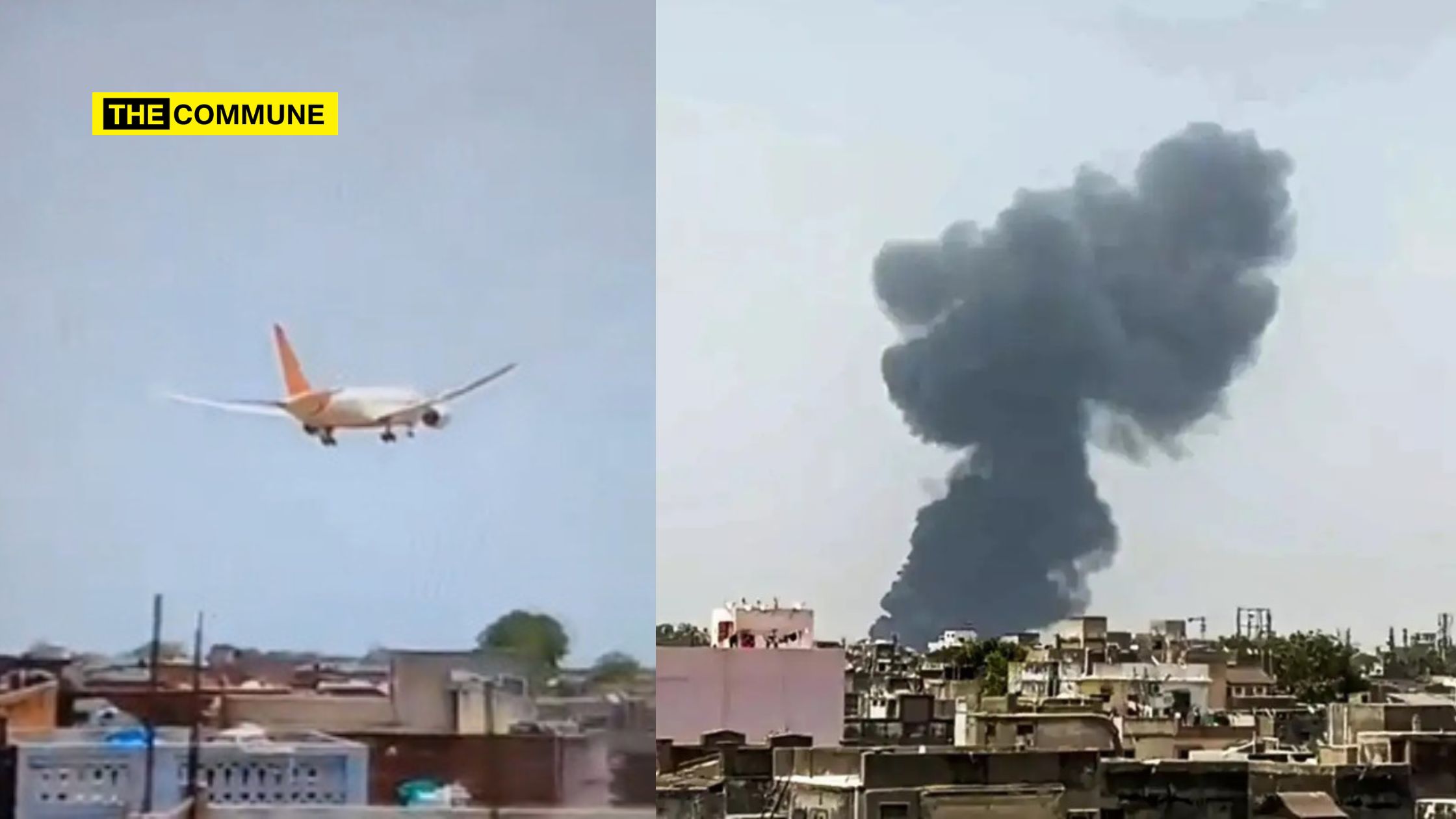
In one of the worst air disasters India has witnessed in nearly three decades, an Air India Boeing Dreamliner carrying 242 passengers and crew members crashed shortly after takeoff from Ahmedabad’s Sardar Vallabhbhai Patel International Airport on the afternoon of 12 June 2025. The London-bound flight, AI-171, crashed within five minutes of departure, around 1:39 PM, plunging into a densely populated area near the airport.
Thick plumes of smoke were seen rising from the crash site, with visuals flooding social media. Residents nearby rushed to the scene to assist rescue operations before emergency teams arrived.
The flight that departed from Ahmedabad at 13:38 hrs with 242 passengers & crew on a Boeing 787-8 tragically met with a #PlaneCrash crashing into the BJ Medical College UG Hostel mess. God knows how many lives were lost, Prayers for everyone's safety.🙏 pic.twitter.com/WdrsQWqfka
According to the Directorate General of Civil Aviation (DGCA), the aircraft was a Boeing 787-8 with registration VT-ANB. It was under the command of Captain Sumeet Sabharwal and First Officer Clive Kunder. Onboard were 242 individuals, including 169 Indian nationals, 53 British nationals, one Canadian, and seven Portuguese citizens, along with 2 pilots and 10 cabin crew members.
Prime Minister Narendra Modi, expressing his grief on social media platform X, said, “The tragedy in Ahmedabad has stunned and saddened us. It is heartbreaking beyond words.” He has directed Union Home Minister Amit Shah and Civil Aviation Minister K. Rammohan Naidu to travel to Ahmedabad to oversee relief and response efforts.
The tragedy in Ahmedabad has stunned and saddened us. It is heartbreaking beyond words. In this sad hour, my thoughts are with everyone affected by it. Have been in touch with Ministers and authorities who are working to assist those affected.
Air India confirmed the crash and activated an emergency control center. The airline has set up a dedicated passenger helpline — 1800 5691 444 — to assist families and provide information. Chairman N. Chandrasekaran expressed condolences and assured that all possible support was being extended to the victims’ families.
Home Minister Amit Shah, en route to Ahmedabad, said on X, “Pained beyond words by the tragic plane crash in Ahmedabad. Disaster response forces have been quickly rushed to the crash site.” Shah has spoken with Gujarat CM Bhupendra Patel and senior state officials to coordinate relief operations.
Chief Minister Patel, returning urgently from Surat, stated that he has instructed officials to begin rescue efforts on a war footing and ordered a green corridor for swift medical evacuation of the injured. He assured full medical treatment and support for those affected.
The Ministry of Civil Aviation has suspended operations at Ahmedabad airport until further notice. Gatwick Airport, the flight’s intended destination, confirmed that the aircraft was scheduled to land in London at 18:25 local time.
An investigation has been launched, with the Aircraft Accident Investigation Bureau (AAIB) team en route to the crash site. A control room has been activated for coordination. Contact numbers: 011-24610843 and 9650391859.
In the aftermath of the devastating terror attack in Pahalgam, intelligence agencies have uncovered a troubling digital network. A WhatsApp group based in Pakistan, reportedly involving around 100 Indian nationals, is under nationwide surveillance by central and state security forces. Among the members, approximately 30 individuals hail from Tamil Nadu, prompting increased scrutiny by local authorities.
The group, known as ‘Jamaat-ul-Muslimeen’, has been labeled by Tamil Nadu police as having anti-national tendencies. Security officials have flagged it as ideologically similar to Hizb-ut-Tahrir (HuT)—a radical outfit that was dismantled in Chennai in 2024. That operation, led by the National Investigation Agency (NIA) and local police, resulted in the arrest of 13 individuals. While investigations into HuT continue, Jamaat-ul-Muslimeen emerged as another organization using similar recruitment and communication strategies.
International Connections Raise Alarm
According to reports, Sri Lankan nationals are also active participants in the group. Operating out of Karachi since 1962, Jamaat-ul-Muslimeen is known to oppose mainstream Islamic traditions and has drawn members from various Indian states, including Uttar Pradesh, Rajasthan, Maharashtra, and Tamil Nadu.
A senior Tamil Nadu police official stated, “Several Sri Lankan members are actively involved in the group’s operations. HuT previously used platforms like WhatsApp and YouTube Live to spread anti-India propaganda. We believe Jamaat-ul-Muslimeen might be adopting a similar approach.”
Ongoing Monitoring and Precautions
As of now, 30 individuals from districts such as Ramanathapuram, Tenkasi, and Coimbatore are under surveillance. Authorities emphasize that no overtly suspicious activities have been recorded yet, but close observation continues.
“We are keeping a close eye on their movements and digital communications,” a senior officer confirmed. “While there is no immediate cause for alarm, the group’s nature and affiliations require consistent vigilance.”
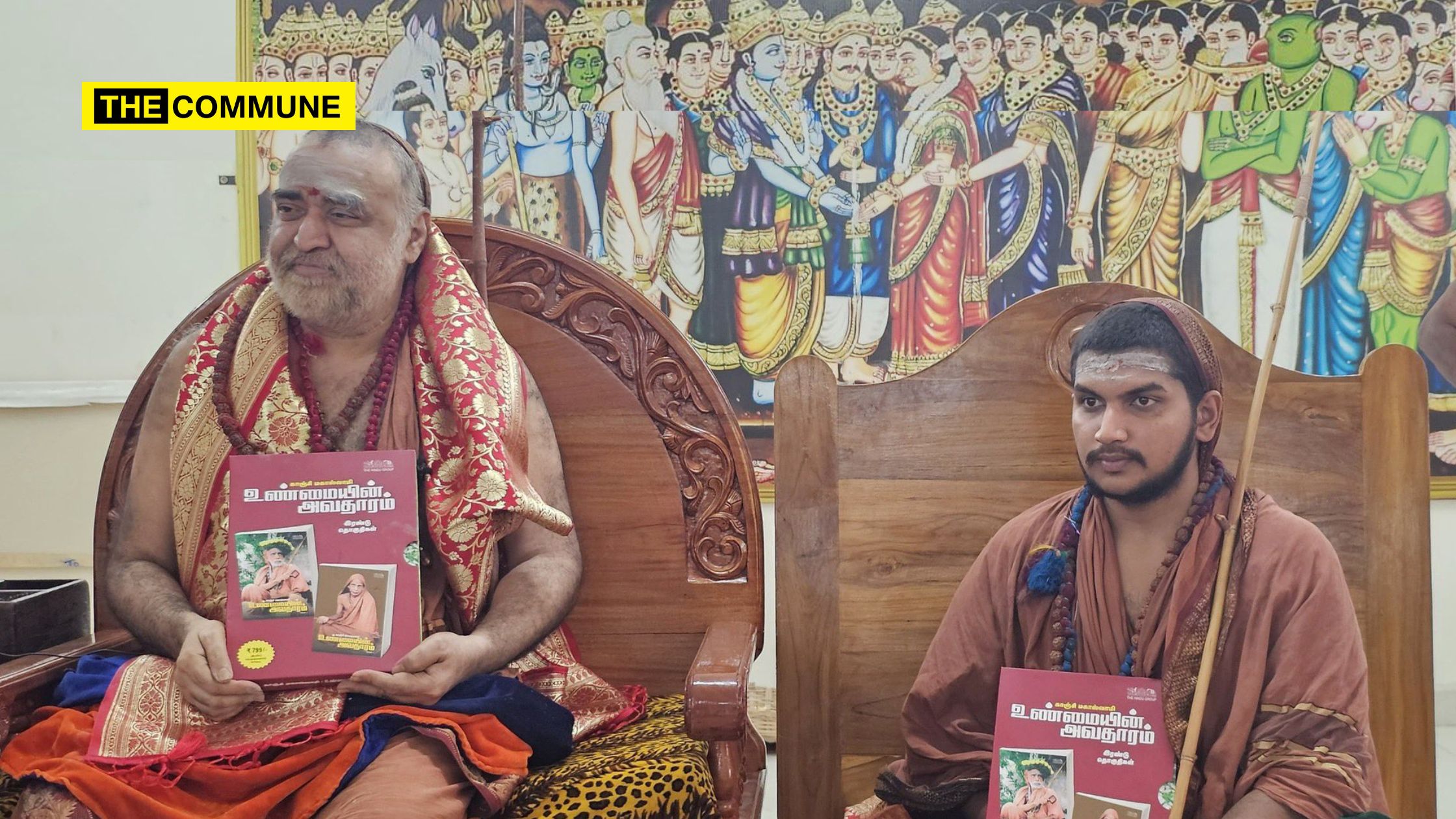
On 10 June 2025, Sri Shankara Vijayendra Saraswati Shankaracharya, the head of the Kanchi Kamakoti Peetam, formally released the Tamil translations of the two-volume work titled “Embodiment of Truth – Kanchi Mahaswami” (Unmayin Avatharam – Kanchi Mahaswami), originally published by The Hindu Group. The release event was held at the Kanchi Mutt’s Tirupati branch.
The Shankaracharya expressed appreciation for The Hindu Group’s contribution in making the teachings and spiritual discourses of the 68th pontiff, Sri Chandrasekharendra Saraswati Mahaswamigal, accessible to a wider audience. He mentioned that the books were initially released in English, but due to repeated requests from devotees, they have now been translated into Tamil.
He noted that the books offer an in-depth look into Mahaswamigal’s life, spiritual travels, teachings, and the widespread respect he commanded. The content has been compiled using archival materials—reports and photographs originally published in The Hindu—along with personal anecdotes and experiences shared by the current Shankaracharya.
Deep-Rooted Association
The Shankaracharya also emphasized the long-standing bond between Kanchi Mutt and The Hindu Group, recalling a historic visit by Mahaswamigal to The Hindu’s office. During the ceremony, the first copies of the Tamil editions were presented to Prof. Devanathachariar from the National Sanskrit University, Tirupati, and P. Vaidyanathan, Chairman of Integrated Enterprises.
Ahead of the book launch, special poojas were performed at the Kamakshi Amman Temple in Kancheepuram and at Mahaswamigal’s Adhishtanam at the Kanchi Mutt. The two-volume set is priced at ₹799, but as part of a limited-time launch offer, it is available for ₹599. Copies can be purchased through The Hindu’s official bookstore.
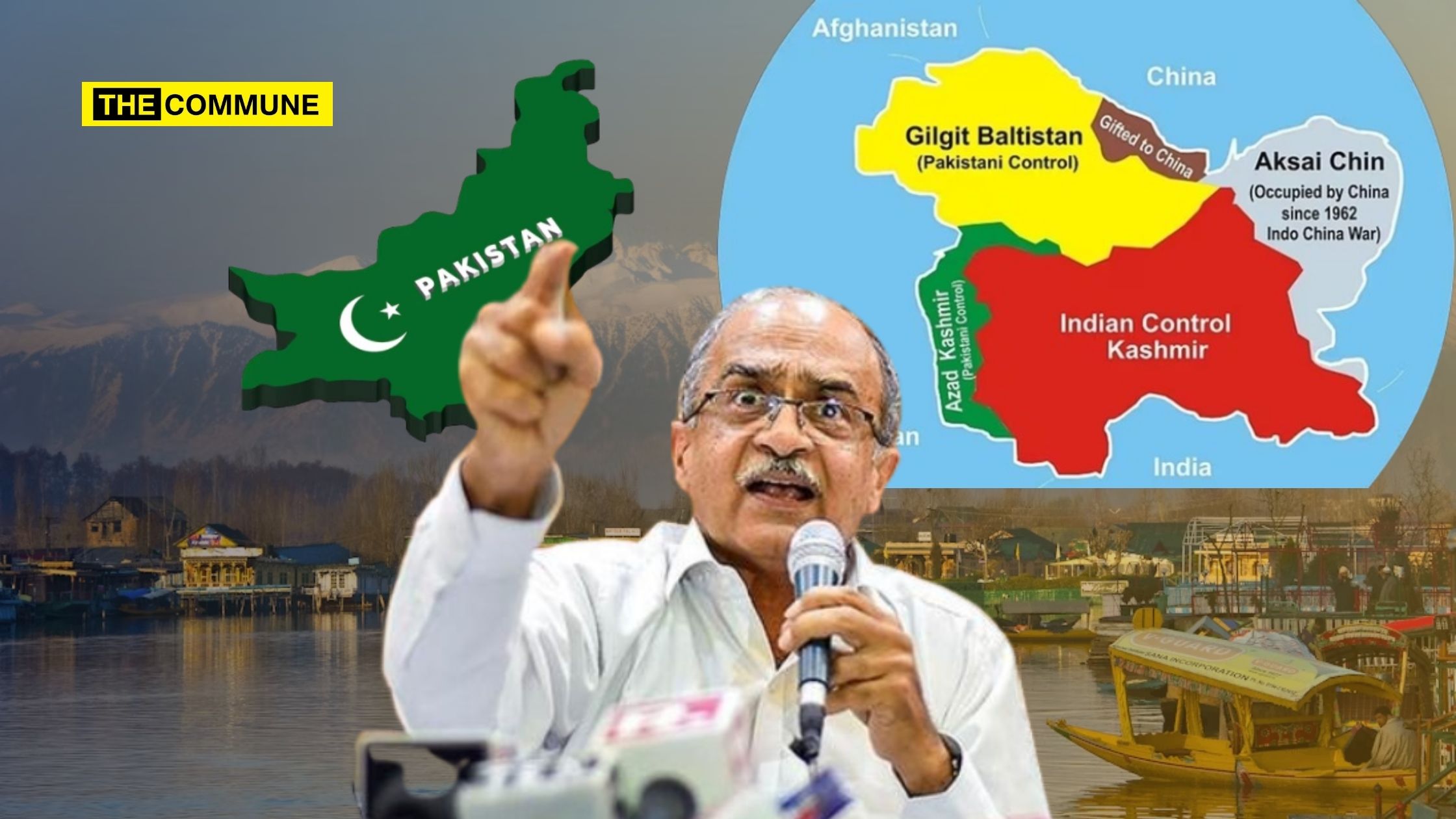
Supreme Court advocate Prashant Bhushan has long been a controversial figure in Indian public discourse. Once seen as a supporter of the Aam Aadmi Party and a fierce critic of the Congress-led UPA government particularly during the 2G and coal scam era. Bhushan later shifted roles to advising the same Congress party, raising eyebrows over his ideological consistency. Over the years, he has courted controversy not just for his legal activism, but also for his vocal stance on Kashmir, media narratives, and a soft corner for extremist elements, including Maoists.
What many might not know is that Bhushan has a history of taking positions on Kashmir that often align closely with Pakistan’s rhetoric from pushing for demilitarization to opposing infrastructure development and questioning counter-terror operations. Here’s a timeline of some of the most debated positions he has taken:
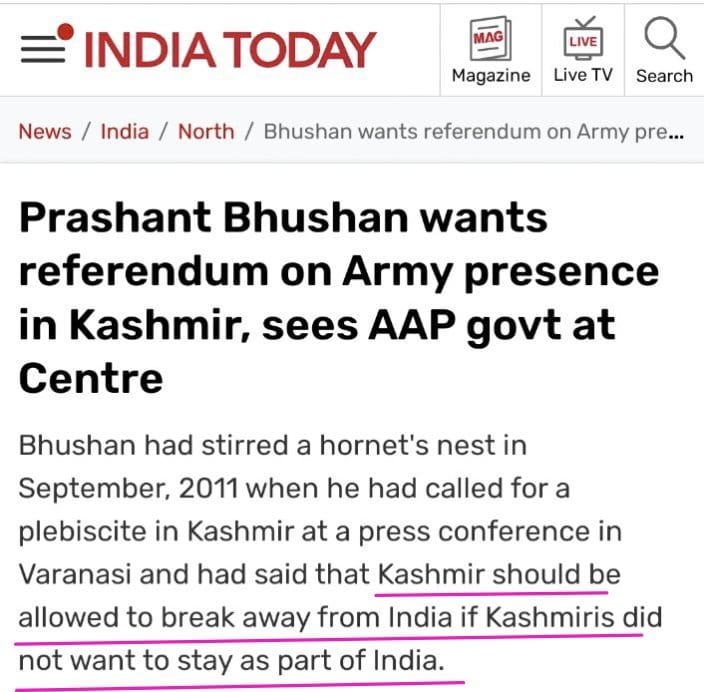
Advocating Plebiscite In Kashmir (2011)
At a press conference in Varanasi, Bhushan called for the repeal of AFSPA in Jammu and Kashmir, withdrawal of the Indian Army, and even a UN-backed plebiscite to determine if Kashmiris wanted to remain with India.
Implication? A plebiscite, as demanded by Pakistan for decades, would risk handing Kashmir to Pakistan. His remarks triggered public outrage, and he was even physically attacked at the event. Yet, this didn’t deter him from continuing with similar rhetoric.
Bhushan filed a PIL in the Delhi High Court through the Centre for Public Interest Litigation (CPIL), demanding a review of the alignment of the Katra-Banihal rail link, which includes the Chenab Railway Bridge—a critical infrastructure project aimed at connecting Kashmir with the rest of India.
Critics argue this caused delays in a strategic project vital for regional integration and security. Was this just about “public interest,” or was there an attempt to slow development in Kashmir?
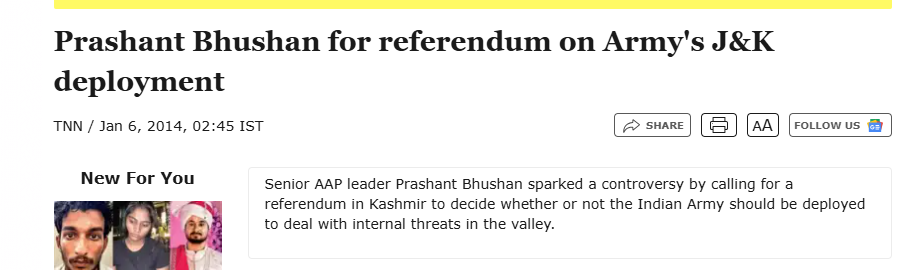
Repeating Call To Withdraw Army From J&K (2014)
Bhushan again demanded the withdrawal of Indian forces from Kashmir, suggesting that the local population be “consulted” on the need for military presence. In a region facing continuous infiltration and terrorism, can the army be removed based on public sentiment alone?
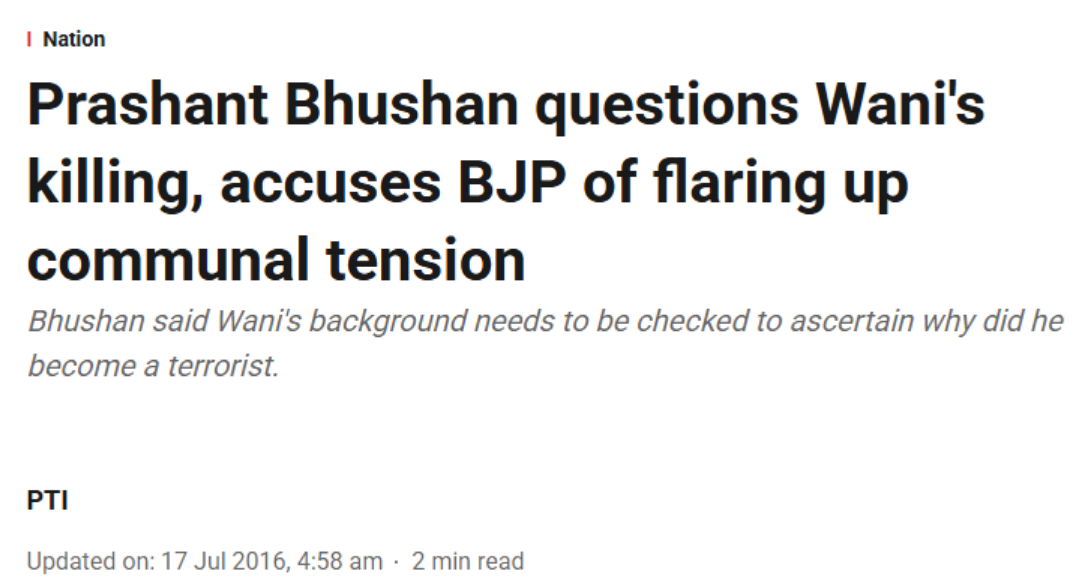
Sympathizing For Terrorist Burhan Wani (2016)
After the killing of Hizbul Mujahideen commander Burhan Wani, Bhushan questioned whether it was a fake encounter. He implied that Wani was radicalized because his brother was allegedly beaten by security forces, appearing to justify his path toward terrorism. He allegedly said, “Wani’s brother was beaten by security forces, fueled radicalization in Burhan” and questioned, “What feeling would this have generated in a 15-year old boy seeing his brother being beaten up by security men?”
This drew heavy criticism, as many viewed it as undermining national security and rationalizing militancy.
Justifying Pulwama Suicide Bomber 2019
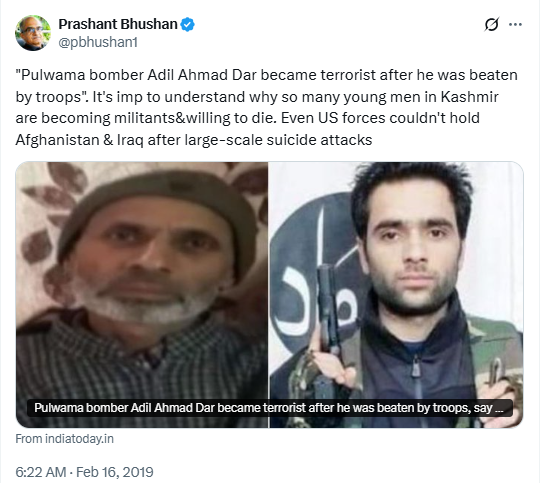
In a tweet following the Pulwama attack, where 40 CRPF personnel were martyred, Bhushan wrote that Adil Ahmad Dar became a terrorist after being beaten by troops, comparing the Kashmir situation to insurgencies in Afghanistan and Iraq.
Controversially Bhusan wrote, “Pulwama bomber Adil Ahmad Dar became terrorist after he was beaten by troops. It’s imp to understand why so many young men in Kashmir are becoming militants & willing to die. Even US forces couldn’t hold Afghanistan & Iraq after large-scale suicide attacks.”
Many found this deeply insensitive, interpreting it as rationalizing terrorism and blaming Indian forces rather than the perpetrators.
Opposing Revocation Of Article 370 (2019)
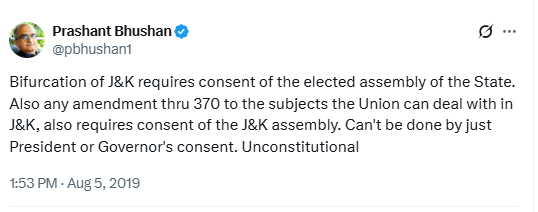
Bhushan opposed the scrapping of Article 370, calling it “unconstitutional” and claiming that it required the consent of the J&K assembly. He also criticized the Supreme Court’s judgment on the matter. This position, again, mirrored Pakistan’s objections almost word for word.
In a post he stated, “Bifurcation of J&K requires consent of the elected assembly of the State. Also any amendment thru 370 to the subjects the Union can deal with in J&K, also requires consent of the J&K assembly. Can’t be done by just President or Governor’s consent. Unconstitutional .”
Pushing For Removal Of President’s Rule In J&K (2022)
Representing the People’s Union for Civil Liberties (PUCL), Bhushan filed a petition to lift President’s Rule in J&K, arguing that elections must be held. The move was seen by critics as an attempt to politicize security decisions in a sensitive border region.
Amplifying Foreign Misinformation (2024)
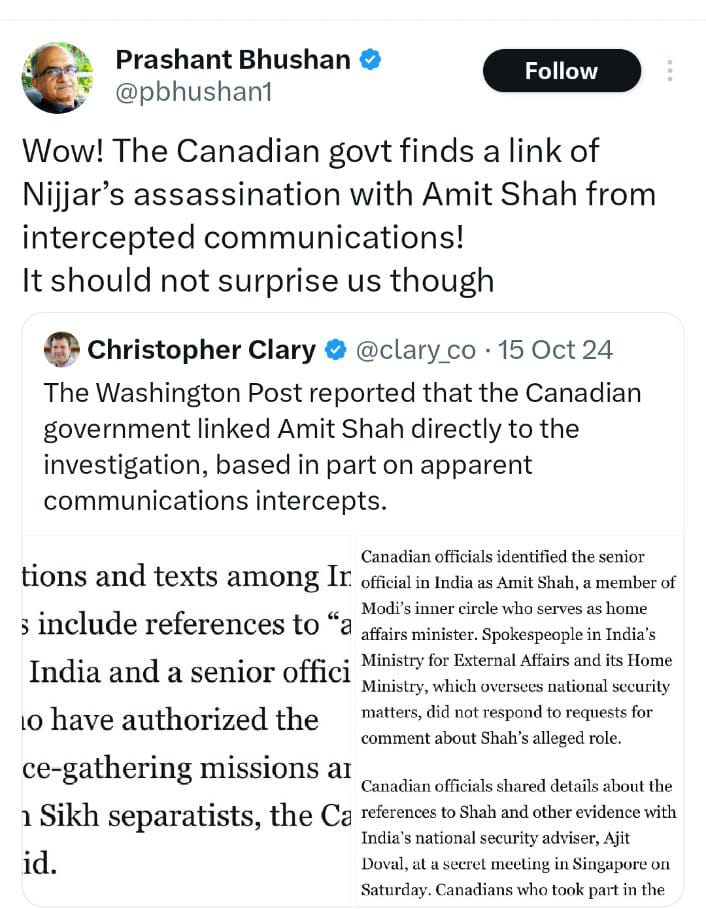
In 2024, Bhushan quoted Pakistani-sympathetic analyst Christopher Clary and responded to a dubious claim about Amit Shah’s alleged involvement in the assassination of Canadian Khalistani separatist Hardeep Singh Nijjar, based on a controversial Washington Post article.
Bhushan tweeted, “Wow! The Canadian govt finds a link of Nijjar’s assassination with Amit Shah from intercepted communications! It should not surprise us though .” Even though Canada never confirmed such a link, Bhushan’s tweet lent credibility to an unverified, fake narrative.
The Core Question remains, why do Prashant Bhushan’s views on Kashmir consistently mirror the position of Pakistan? From opposing military presence to resisting infrastructure, to defending known terrorists and echoing foreign propaganda, Bhushan’s record reveals a pattern of detrimental to national interests. This post isn’t just about one person’s opinions—it raises deeper concerns about legal activism being used to push geopolitical narratives that may not align with India’s sovereignty and security priorities.
Between 2011 and 2025, numerous instances have been documented of Christian missionaries employing inculturation—the strategic adaptation of Hindu cultural and religious elements—as a means to make Christianity appear more familiar and acceptable to Hindus, thereby facilitating conversions.
Inculturation in this context refers to the deliberate use of Hindu symbols, rituals, and traditions—such as applying tilak, performing vehicle pujas, or sprinkling holy water—to mask proselytizing efforts as culturally rooted practices.
On 9 June 2025, a video that went viral on social media showcased how such mimicry is often used to ease resistance among Hindu communities.
This report presents 14 documented methods of inculturation used by Church groups and missionary networks in India over the past decade, raising important questions about cultural appropriation, religious integrity, and covert conversion strategies.
#1: Mimicking Hindu Rituals – Vehicle Puja, Tilak, and Water Sprinkling
On 9 June 2025, a viral social media video exposed how Christian missionaries strategically imitate Hindu rituals—such as vehicle puja, applying tilak, or sprinkling water—to make Christianity appear culturally familiar to Hindu communities. By rebranding these practices with Christian meanings, missionaries blur religious lines and create the illusion of shared traditions. This calculated form of inculturation misleads local populations, easing resistance to conversion and encouraging acceptance of Christian teachings under the guise of cultural continuity. Such tactics are part of a broader effort to facilitate religious conversions by erasing clear distinctions between the two faiths.
If Hindus perform puja when buying a new vehicle, it is superstition, if they sprinkle water on it, it is science.
#2 Church-Led Shobha Yatra Akin To Hindu Traditions
A video that was viral on social media in December 2023 showed that Christian missionary groups have begun organizing Shobha Yatras that closely imitate Hindu religious processions. These events feature traditional music, chants, saffron cloth, malas, incense, and adapted versions of Hindu prayers—such as a “Gayatri Mantra” for Jesus and “Jesus Suprabhatham.” This method of inculturation is designed to create a sense of cultural familiarity, making the transition to Christianity feel spiritually seamless for potential converts. By mirroring Hindu customs in outward form, missionaries aim to reduce resistance and make Christian practices appear as a natural extension of local religious life.
In another inculturation tactic, Christian missionary groups have begun imitating Hindu idol worship by promoting and selling idols of Jesus that resemble Hindu deities. While publicly criticizing Hindus for engaging in “Vigraharadhana” (idol worship), these groups simultaneously adopt the same practice by offering Jesus idols designed to appeal to traditional Hindu sensibilities. This contradictory approach seeks to blur religious boundaries and make Christianity appear culturally aligned with Hindu traditions. The strategy aims to attract Hindu devotees by presenting Jesus in familiar visual forms, thereby easing the path for conversion through symbolic assimilation and emotional resonance.
Inorder to convert Hindus, #ConversionMafia ‘accuses’ Hindus of doing “Vigraharadhana”
What are xistians doing? Why are they Selling Vigrahas of Zesus.
#4 Imitation Of Hindu Temple Architecture for Conversions
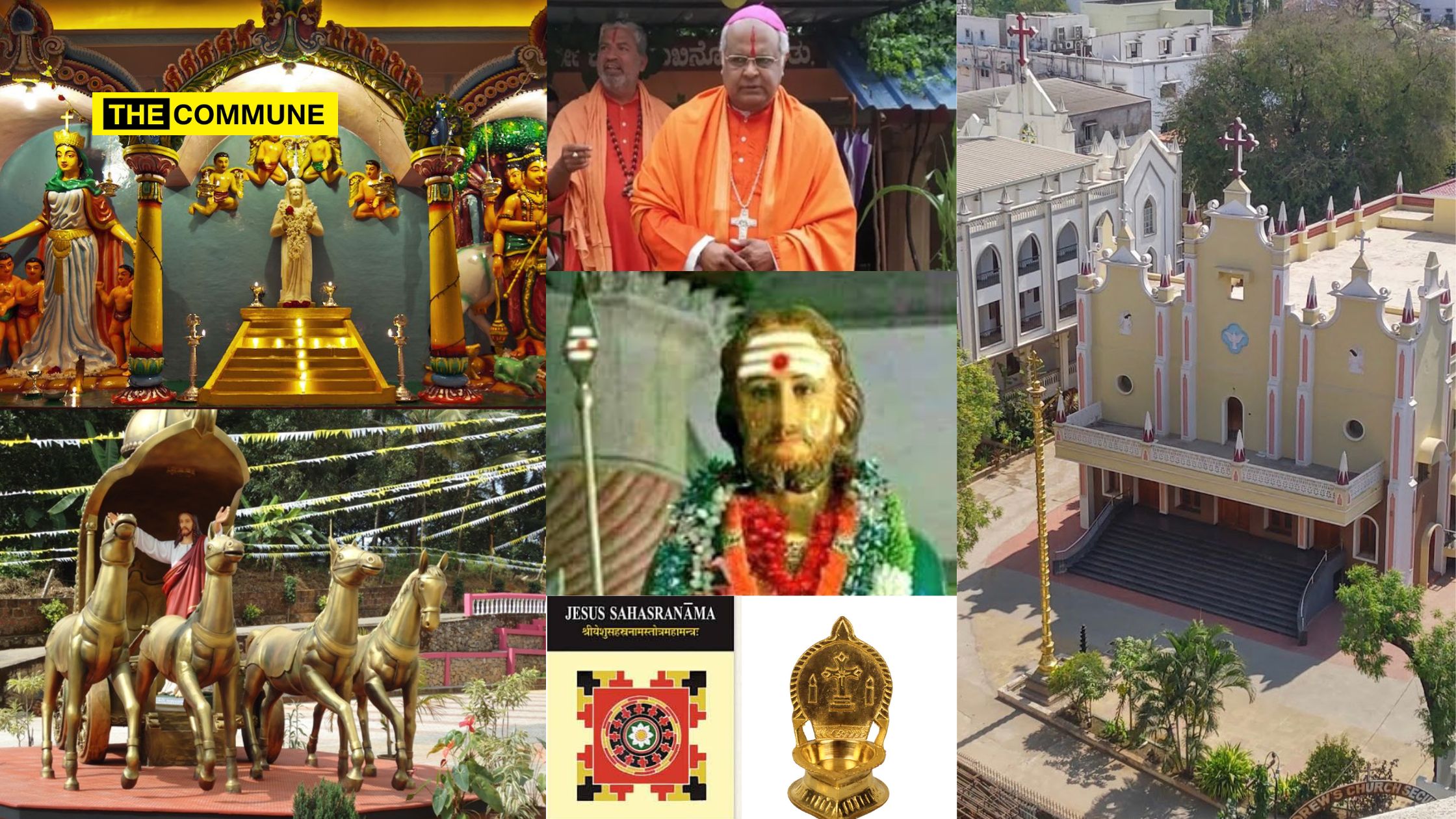
A growing trend in missionary-led conversions involves imitating Hindu temple architecture by adding Christian symbols—especially the cross—to existing or newly built temple-like structures. This method seeks to blur the visual and cultural distinctions between Hinduism and Christianity, making the latter appear more familiar and acceptable to local populations. By adopting the external appearance of Hindu temples, including gopurams, mandapams, and other structural elements, missionaries subtly introduce Christianity under a Hindu guise. This deceptive architectural inculturation deeply disturbs many locals, with some even expressing emotional distress and alienation due to the cultural erosion and aggressive conversion tactics involved.
ஏசப்பா நவ் : அட பொரும்மா. எதுக்கு இந்தியாவுக்கு வந்தோம் என்று வெறுத்து போற அளவுக்கு இவிங்க கொடுமையில் நானே பாதிக்கபட்டேன்.🙄🙄 Excuse me, what is the procedure to get rid of this country?☹️☹️☹️☹️☹️☹️ pic.twitter.com/5PWgEIQGgZ
A striking example of inculturation was observed in Pandalat, West Bengal, where a statue of Mother Mary was displayed in a form closely resembling traditional Hindu goddess idols. Christian missionaries increasingly adopt the visual iconography of Hindu deities—replicating attire, posture, ornaments, and artistic styles—to depict Christian figures like Mary or Jesus. This tactic is aimed at making Christianity more relatable to Hindus, especially in rural and culturally rooted areas. By visually blending religious identities, such methods obscure distinctions and create a deceptive familiarity that facilitates religious conversions, raising serious concerns about cultural appropriation and spiritual manipulation.
They on track … They are doing it in different places with same pattern…
In a strategic move to blend in with local religious traditions, several churches—especially in South India—are being referred to using Hindu temple terminology such as Devalayam or Mandiram instead of the word “Church.” This renaming tactic is part of the broader inculturation strategy employed by missionary groups to reduce cultural resistance and increase acceptance among Hindu communities. By adopting terms deeply associated with Hindu worship spaces, the aim is to blur religious distinctions and create a sense of familiarity. This linguistic camouflage facilitates smoother conversions while masking the distinct theological differences between the two faiths.
— Mission Kaali – Say No To Conversion (@missionkaali) June 23, 2021
#7 Cross with Rudraksha – Symbolic Camouflage for Conversion
In an effort to appeal to Hindu communities, certain missionary groups have adopted the practice of blending Christian symbols with core Hindu icons. One notable example is the wearing of Rudraksha beads—sacred in Hinduism—along with a Christian cross. Some missionaries even dress as saffron-clad yogis while wearing these mixed symbols. This method of inculturation aims to create a visual and cultural familiarity that disarms resistance and fosters acceptance. By appropriating revered Hindu symbols, these tactics are designed to subtly blur religious lines and facilitate conversions under the guise of cultural continuity rather than theological divergence.
— Hindu Yuva Gujarat (@HinduYuvaOffice) May 2, 2020
#8 Bible Panchangam – Mimicking Hindu Calendar for Conversion
In a strategic move to appeal to Hindu sensibilities, the Church of South India has introduced a “Bible Panchangam,” modeled after the traditional Hindu panchang (calendar). The Hindu panchang holds deep religious and cultural significance, guiding rituals, festivals, and daily observances. By presenting a Christian version that mimics this format, missionaries attempt to blur the distinction between faiths and make Christianity appear culturally compatible. This form of inculturation is aimed at easing the path to conversion by exploiting familiar Hindu traditions, thereby attracting individuals who might otherwise resist direct religious proselytization.
Church of South India – Bible Panchangam. What else is left for inculturation from a "Pagan" religion? Christards. 👿 pic.twitter.com/1Pdoxacq7t
#9 Church Dwajasthambam – Mimicking Temple Flag Masts to Attract Hindus
Several churches in Tamil Nadu, including one in Chennai, have begun erectingDwajasthambams—flag masts traditionally found in Hindu temples—at their entrances. These symbolic pillars, which represent the connection between earth and heaven in Hindu cosmology, are now adapted by churches to blend into the local religious landscape. This practice is part of a broader “inculturation” strategy by Christian missionaries to integrate Hindu elements into church worship—mirroring temple rituals, festivals, symbols, and architecture—to make Christianity appear culturally familiar, especially to potential Hindu converts. Critics argue it’s a calculated method to lure Hindus under the guise of spiritual similarity.
How & When did Dwajasthambam, which is an integral part of a Hindu temple, become a part of a Church?
#10 Adapting Classical Dance Forms – Kathakali Used for Jesus’s Story
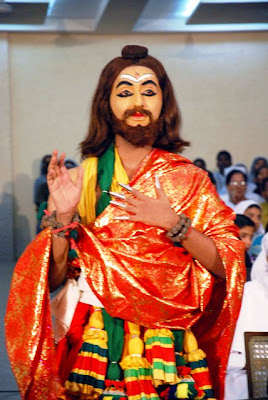
In a striking example of inculturation, Christian missionaries have adaptedKathakali—Kerala’s classical dance form traditionally used to narrate Hindu epics like the Mahabharata and Ramayana—to depict the story of Jesus Christ’s crucifixion. At the Chavara Cultural Centre in Kozhikode, the play Divya Karunya Charitham, scripted by Radha Madhavan and based on a poem by Fr. Jose Chencheriyil, was staged under the direction of Kalamandalam Sajan. This performance is part of a larger trend where core elements of Bharatiya culture, including sacred dance forms, are repurposed by missionaries to make Christian narratives resonate more with Hindu audiences.
#11 Replicating Mahabharata Imagery – Jesus Depicted Like Arjuna
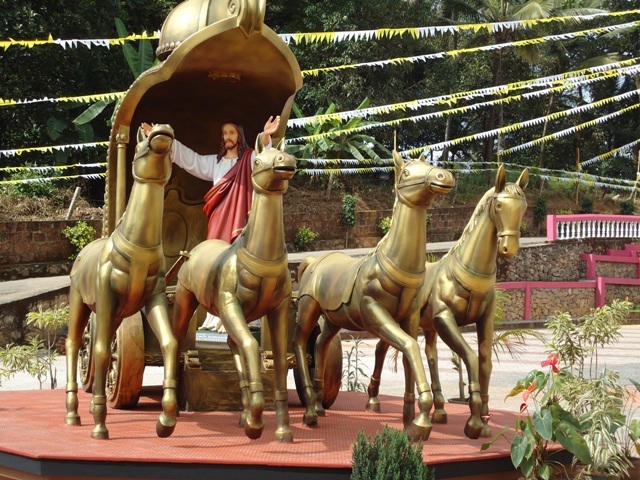
In an evident attempt at cultural assimilation, Christian missionaries have begun using iconic imagery from Hindu epics to make their messages more relatable to Hindu communities. A notable example is found at St. Alphonso Church in Dwarka, where Jesus is portrayed riding a chariot strikingly similar to that of Arjuna from the Mahabharata. This visual strategy mirrors the familiar narrative style of Hindu mythology, blurring religious distinctions and making Christian symbols appear culturally native.
Such symbolic replications are part of a broader inculturation effort aimed at easing religious conversions by leveraging the emotional power of Hindu traditions.
#12 Transforming Vishnu Sahasranama into Jesus Sahasranama
Christian missionaries have attempted to culturally reframe Hindu devotional traditions by creating a “Jesus Sahasranama,” modeled directly after the Vishnu Sahasranama. This Christianized version attributes a thousand epithets to Jesus, claiming its roots in ancient Syriac prayers and structural inspiration from Vedic hymns. The book promoting this practice asserts that each divine name holds a metaphysical essence (“esse”) and that chanting these names leads to spiritual fulfillment and mystic experience. This adaptation is positioned as a new dimension of Christology, aligning with inculturation strategies that blend Christian theology with Hindu forms to attract and convert Hindu devotees.
— Mission Kaali – Say No To Conversion (@missionkaali) May 9, 2020
#13 Imitation of Hindu Deity Icons at Altars
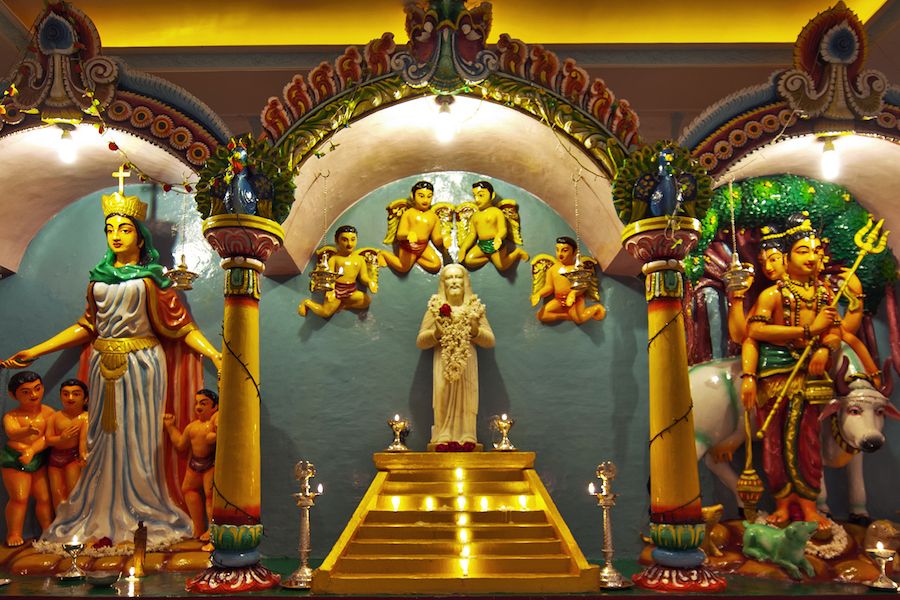
Christian missionaries have increasingly adopted Hindu iconographic elements in their places of worship to ease the conversion process. A notable example is the “Altar Jesus Temple,” which features depictions that blend the imagery of Hindu gods with figures of Jesus and Mary. This deliberate visual syncretism includes commonly seen symbols like the sacred “Om” placed near Jesus’ image, creating an impression of spiritual continuity. By imitating Hindu idols and merging them with Christian icons, missionaries aim to make Christianity appear more culturally familiar to Hindus, thereby facilitating conversions through emotional and visual assimilation.
#14 Christian Diyas Mimicking Hindu Worship Objects
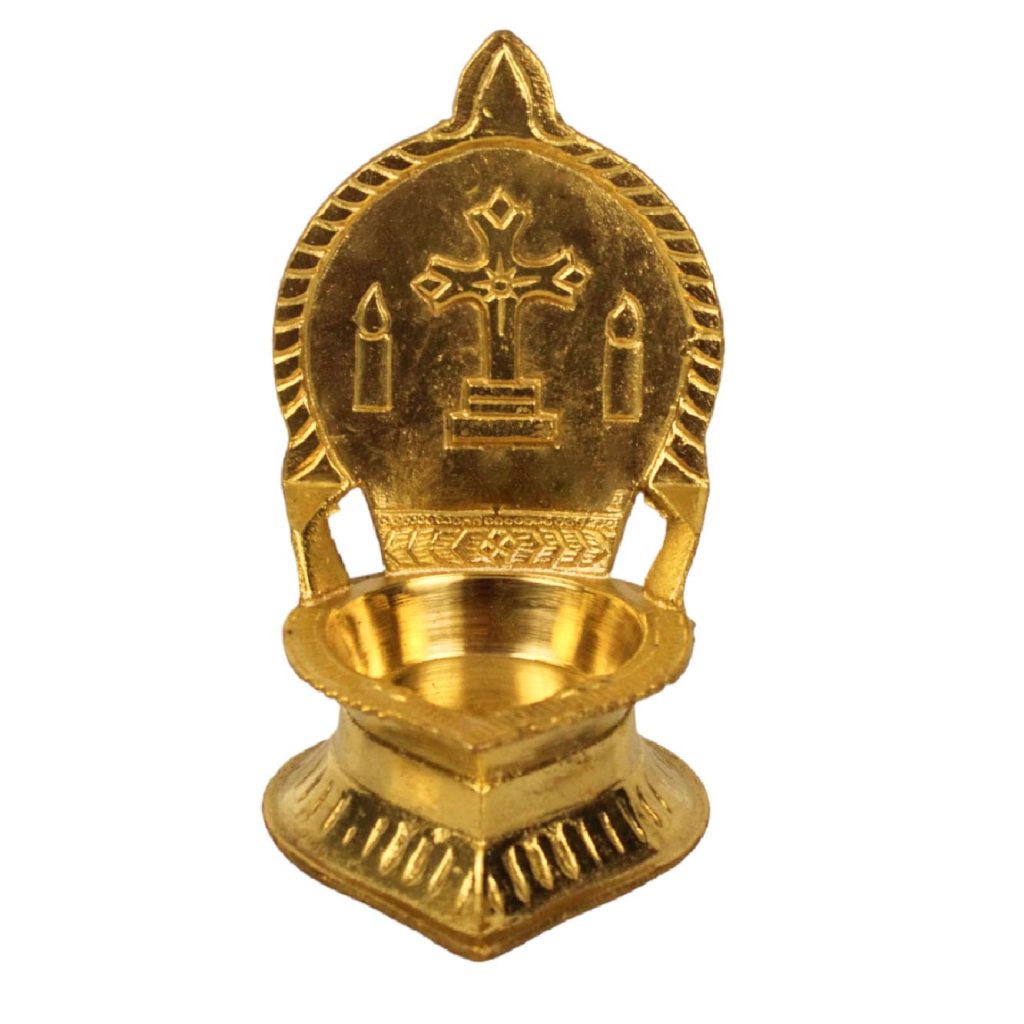
Christian groups have begun replicating traditional Hindu worship items such as diyas, integrating Christian symbols like crosses, candles, or images of Mary into their design. These “Christian diyas” are often nearly identical in appearance to Hindu lamps but are subtly altered to reflect Christian iconography. Sold on platforms like Amazon and other online portals, they mirror the aesthetic and devotional tone of Hindu practices. This method of inculturation seeks to blur religious distinctions and make Christianity appear more familiar and acceptable to Hindu communities, thereby aiding in the conversion process through cultural appropriation.
Image Source: Amazon
Subscribe to our channels on Telegram, WhatsApp, and Instagram and get the best stories of the day delivered to you personally.