Home Blog Page 27

How Pakistan Becomes A Smokescreen To Mask A Far More Dangerous Internal Threat
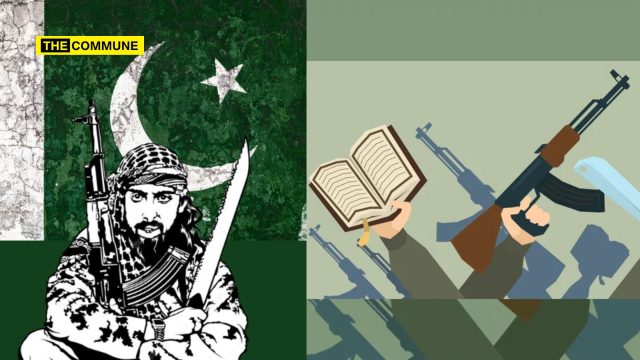
Consider the immediate aftermath of any terror attack in India. A bomb rips through a market in Jaipur. A train is blasted in Mumbai. Gunmen lay siege to a temple. Before the smoke has cleared, before the last victim has been identified, the machinery of our national consensus whirs into motion. The script is as predictable as it is comforting. Within an hour, television anchors, their faces grim, will speculate about the “masterminds across the border.”

Government spokesmen will release identical statements: “We condemn this cowardly act” and “We will give a fitting reply.” The conversation is now firmly, and exclusively, about Pakistan. The purpose of this ritual is not to find the truth. The purpose is to pre-empt the truth. The purpose is to ensure that the one set of questions that truly matters is never asked. Who is the man who lives in that Pune colony who surveyed the German Bakery? Who is the “student” in Jaipur who procured the bicycles? Who is the “local businessman” in Mumbai who provided the safe house? These are uncomfortable questions. They are inconvenient questions.

The official narrative, the one taught in our textbooks and repeated by our public intellectuals, is that the ideology which created Pakistan left India with the new border. That the Muslims who “chose” India were, by definition, secular, moderate, and committed to the new republic. But let us put these assumptions to the stress test. The demand for Partition was the political culmination of an ideological assertion: that a separate Muslim identity, law, and society (the “Ummah”) could not be submerged into a composite, non-sectarian, democratic state. This ideology did not evaporate on August 15, 1947. It simply changed its tactics. It burrowed. It waited. It presented itself not as a demand for a separate state, but as a demand for special status within the Indian state. Every time the state has been confronted with this obstinacy, it has buckled. This is the “secularism” we have practiced. When the Supreme Court granted a pittance to an elderly woman, Shah Bano, the entire clerical establishment rose as one. The “liberals” who now lecture us on television were silent. The state, led by a Prime Minister with a brute majority, overturned the court’s judgment. This is of a piece with the insistence on separate personal laws, the riots over cartoons in a distant country, the organized opposition to Vande Mataram, the refusal to allow reform. This is a relentless political project. It is the assertion of a parallel sovereignty. And this is the very history that the “Blame Pakistan” reflex is designed to make us forget.

The great truth of our age is this: the single-minded focus on Pakistan is an analytical error. One can even go as far as to say that it is a sophisticated, multi-layered, and wholly deliberate act of intellectual and political evasion. It is the shield which our entire establishment, new and old, from South Block to the newsrooms of Delhi, holds up to protect itself from a reality it dares not name. That reality is the history, and the continuing present, of Islamic obstinacy and radicalism within India.

Now, see how this evasion connects directly to terror. A module cannot function on air. A Pakistani agent, no matter how skilled, cannot simply walk into a sensitive area and plant a bomb. He needs a network. He needs a local guide, a translator, someone to rent a flat, to buy a SIM card, to procure the chemicals, to weld the containers. He needs, in short, a domestic support system. And what has our own investigative history shown? Time and again, after the media’s focus has moved on, the charge sheets are filed. And who are the names? They are not phantoms from Islamabad. They are the members of the Students Islamic Movement of India (SIMI). They are the founders of the “Indian” Mujahideen. They are local clerics, university students, and software engineers from Azamgarh, from Bhatkal, from Kerala. They are Indians. Their motive is not Pakistani nationalism. Their motive is the same ideology that our establishment has refused to confront for seventy years. They are fighting for that same parallel sovereignty. They see the Indian state, its constitution, and its “kafir” society as the enemy.

But the “Blame Pakistan” narrative performs a vital service. For the ‘secular’ establishment of old, it was a tool to appease a vote-bank. But for the new ‘pro-Hindutva’ establishment, this evasion is more profound. Why? Because blaming Pakistan is easy. It is the perfect performance of nationalism. It allows for a muscular, theatrical display which electrifies the base and consumes the news cycle. It requires no hard choices, no messy internal reforms. The alternative, confronting the domestic fifth column, is the hornet’s nest that they choose not to confront. To do so would be to admit that the problem is not a simple foreign policy dispute but a deep-fanged societal rot. It would mean undertaking the hard, grinding, unpopular work of statecraft: genuine police reform, the modernization of madrasas, the enforcement of a uniform civil code against all opposition, and the patient, thankless task of intelligence gathering in hostile domestic localities. Why bother with this difficult, protracted war at home when a spectacular, prime-time “fitting reply” to Pakistan gives you all the political capital at a fraction of the cost? The “nationalist” establishment has discovered that the rhetoric of strength is a perfect substitute for the creation of a hard state.

The result of this grand, collusive deception is that the problem is never solved. It only festers. By attributing every attack to an external enemy, we give a free pass, a complete immunity, to the internal, ideological fifth column that sustains it. We are, in effect, pruning the weed while carefully watering its roots. The 26/11 Mumbai attack was the perfect example. It was a Pakistani plot. But it could not have been executed without the maps and surveillance provided by domestic facilitators. Yet, even in that case, which part of the story was quietly buried? The hunt for the Indian helpers. We have chosen a comfortable lie over an inconvenient truth. The ‘secularists’ traded national security for the applause of a moribund intellectual class. The ‘nationalists’, more cynically, trade it for the roar of the crowd, for the tactical convenience of an external enemy. The result is the same. This shared delusion will not last. The nature of reality is that it does not care for our narratives. It has a way of asserting itself, often in the most brutal fashion. By refusing to name the enemy within our gates, by all sides shielding themselves with the “foreign hand” theory, we are not displaying secular tolerance or nationalist strength. We are committing national suicide.

Postscript

Let us be unambiguous. The case against Pakistan is settled. It is an irredeemable state dedicated to our destruction, and it must be treated as such. The question is not whether to confront Pakistan, but what else we are failing to do while we are so consumed. The obsessive focus on Pakistan is not a lie, but it is a half-truth so vast it functions as a lie. It is the ‘nationalist’ establishment’s great alibi. It is the single, deafening drumbeat they use to drown out the sounds of the enemy already inside the gates. An enemy they perhaps find politically inconvenient, and therefore terrifying, to name.

Yours truthfully,

Nishkala

Subscribe to our channels on WhatsAppTelegram, Instagram and YouTube to get the best stories of the day delivered to you personally.

No, Chanakya Is Not A Fantasy, But Devdutt’s Self-Proclaimed ‘Scholarship’ Certainly Is As He Writes Like A Deracinated Missionary Stooge

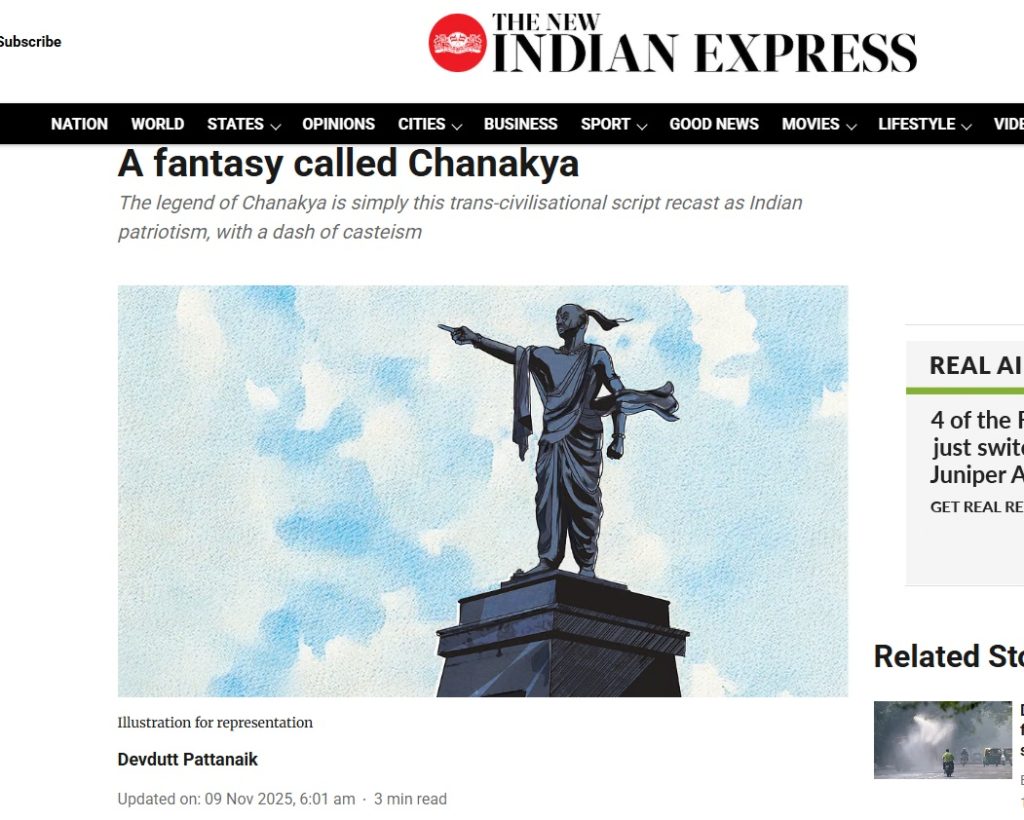
On 9 November 2025, mythological fiction author Devdutt Pattanaik, known for his fantasy book series, posted about an article he wrote for The New Indian Express.

The article was titled “A fantasy called Chanakya”, with a byline. “The legend of Chanakya is simply this trans-civilisational script recast as Indian patriotism, with a dash of casteism”

This is not just wrong but mischievous ideological narrative building by Pattanaik.

The Impossible Standard Of Proof

Pattanaik’s central premise is that “there is absolutely no historical evidence that a man called Chanakya ever lived.” He demands contemporaneous, archaeological proof – a coin, an inscription, a royal edict bearing his name.

This standard is just unrealistic. If we were to apply it universally, we would have to dismiss the existence of most major figures from ancient history.

Alexander the Great: Our primary accounts of his life were written 300-400 years after his death by Greco-Roman historians like Arrian and Plutarch. There are no contemporary Indian records of his invasion.

The Buddha: There is zero contemporaneous evidence of his birth, life, or teachings. His existence is reconstructed from texts compiled centuries later by communities with a vested interest in promoting his legacy.

Jesus Christ: The earliest New Testament gospels were written decades after his crucifixion, by followers, not neutral observers. There is no Roman record of his existence from his lifetime.

Would a “selfie from Pataliputra” be enough for Pattanaik? Ancient history is not a court case where you get inscriptions on demand to prove something ‘beyond a reasonable doubt.’ It is a forensic science that pieces together probabilities from fragmented, often biased, and later sources. By Pattanaik’s logic, the fields of classical and ancient history would cease to exist.

The Plurality Of Sources: A Consensus Of Traditions

Pattanaik dismisses the sources on Chanakya as “later Buddhist and Jain chronicles and Sanskrit plays… imagined after 500 AD.” This oversimplifies the whole thing.

What makes Chanakya credible is that so many unrelated traditions mention him. He appears in:

  • Buddhist texts like the Mahavamsa (5th century CE), which draw on older Sri Lankan commentaries.
  • Jain texts like the Parishishtaparvan (12th century CE), which meticulously detail Chandragupta’s conversion to Jainism and his death by sallekhana (ritual fasting) in Shravanabelagola—a tradition supported by local inscriptions and enduring worship.
  • Sanskrit literature, most notably Vishakhadatta’s political drama Mudrarakshasa (c. 4th-8th century CE), which takes the Chanakya-Chandragupta story as its central plot.

These are not a single, monolithic “Brahminical” narrative. They are competing accounts from traditions that were often doctrinally opposed to each other. Yet, they all converge on one central fact: a brilliant, shrewd Brahmin named Chanakya (or Kautilya) was the mastermind behind the Mauryan empire’s rise. For these diverse traditions to independently affirm his pivotal role is powerful evidence of his historicity, not a reason for dismissal.

The Arthashastra: A Text With Layers, Not A Forgery

Pattanaik points to references to Chinese silk and Roman gold coins in the Arthashastra to claim it was composed around 200 AD, “almost 400 years after Mauryan rule.”

This is a classic case of mistaking the leaves for the tree. Mainstream scholarship, including historians like R. C. Majumdar and D. D. Kosambi, agrees that the core of the Arthashastra is a product of the Mauryan period. The text we have today likely underwent centuries of transmission, with later scribes and scholars adding commentaries, examples, and updating terminology—a process known as interpolation.

The presence of a later interpolation does not invalidate the entire text’s origin. The sophisticated detailing of a complex bureaucracy, taxation, and espionage in the Arthashastra aligns perfectly with what we know of the vast Mauryan state from Ashokan edicts and Megasthenes’ account.

The “Mentor Trope” And Selective Cultural Skepticism

Pattanaik argues that the Chanakya story is merely a common “narrative trope” found globally, comparing it to Merlin and King Arthur, Hemachandra and Kumarapala, or Vidyaranya and the founders of Vijayanagara.

This argument backfires spectacularly. The universal presence of the “wise mentor” archetype doesn’t prove these figures are fictional; it points to a recurring historical and sociological reality. Powerful rulers have often relied on the counsel of learned advisors.

The Buddhist monk Nagasena debated and guided the Indo-Greek king Menander, as recorded in the Milinda Panha.

As Pattanaik himself notes, the Phagpa Lama was a preceptor to the Mongol emperor Kublai Khan.

Why are these relationships, or that of Aristotle and Alexander, not dismissed as pure fiction, while Chanakya’s is deemed a “fantasy”? The bias is hard to miss: only Indian civilizational heroes, particularly those valorized in a “Hindu” or “Brahminical” context, are subjected to this level of deconstructive scrutiny. The mentor-king trope is accepted as a plausible historical reality everywhere except in this specific Indian instance.

The Agenda Of Selective Historical Destruction

The most telling part of Pattanaik’s thesis is what he doesn’t attack. He will never write a column titled “A fantasy called St. Thomas,” despite the complete lack of contemporary evidence for the apostle’s legendary journey to Kerala in 52 CE; a story crucial to the identity of many Indian Christians.

He will never question the existence of the Buddha, whose life is documented only in texts written centuries after his parinirvana by his devoted followers. This selective application of “skepticism” exposes the game: the target is not historical inaccuracy, but specific elements of the Indian/Hindu historical consciousness that do not align with a particular ideological worldview.

It is possible that Devdutt and his ilk would also claim Nalanda university was destroyed by Brahmins based on some spurious later period texts; however, they will not believe Chanakya existed because it comes from later period texts. The standard of evidence is flexible, bending to serve a pre-determined narrative that often seeks to undermine traditional Indian institutions.

History Is Not A Weapon

Devdutt Pattanaik’s article is a masterclass in historical nihilism disguised as progressive scholarship. By imposing an impossible standard of proof, ignoring the consensus-building methodology of historians, and applying his skepticism with glaring selectivity, he does not enlighten but obscures.

The figure of Chanakya—the brilliant, ruthless strategist who orchestrated the fall of the Nanda empire and the rise of India’s first major imperial power—is supported by a robust cross-traditional consensus. His legacy, encoded in the Arthashastra, resonated across Asia for over a millennium, with his aphorisms being translated and treasured from Nepal to Tibet and Sri Lanka.

To dismiss this as a “convenient fiction” is not just bad history; it is an attempt to sever a people from a pillar of their historical memory. If there’s any fantasy here, it’s the idea that you can throw out every old source that doesn’t fit your politics.

In the end, what Pattanaik peddles is not history but a deracinated sermon meant to shame Indians out of their own civilisational confidence. Chanakya endures not because of blind patriotism, but because multiple traditions, texts, and centuries of scholarship recognise the magnitude of his political genius.

Reducing him to a “fantasy” says nothing about Chanakya and everything about the ideological compulsions of those desperate to unwrite India’s past. A civilisation that produced the Arthashastra does not need validation from armchair mythographers masquerading as scholars. The real fantasy is the belief that selective skepticism can erase a figure who has lived robustly in the subcontinent’s historical, literary, and political memory for over 2,000 years.

Subscribe to our channels on WhatsApp, Telegram, Instagram and YouTube to get the best stories of the day delivered to you personally.

University Of Madras Stonewalls RTIs On Four Aided Colleges In Chennai; Whistleblower Escalates Complaint To TN Information Commission

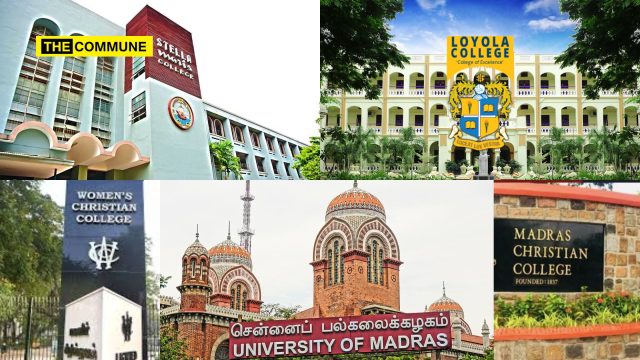
In yet another blow to transparency in Tamil Nadu’s higher education system, the University of Madras (UoM) has failed to respond to a series of RTI applications and First Appeals filed regarding four prominent aided colleges in Chennai — Loyola College, Stella Maris College, Women’s Christian College, and Madras Christian College.

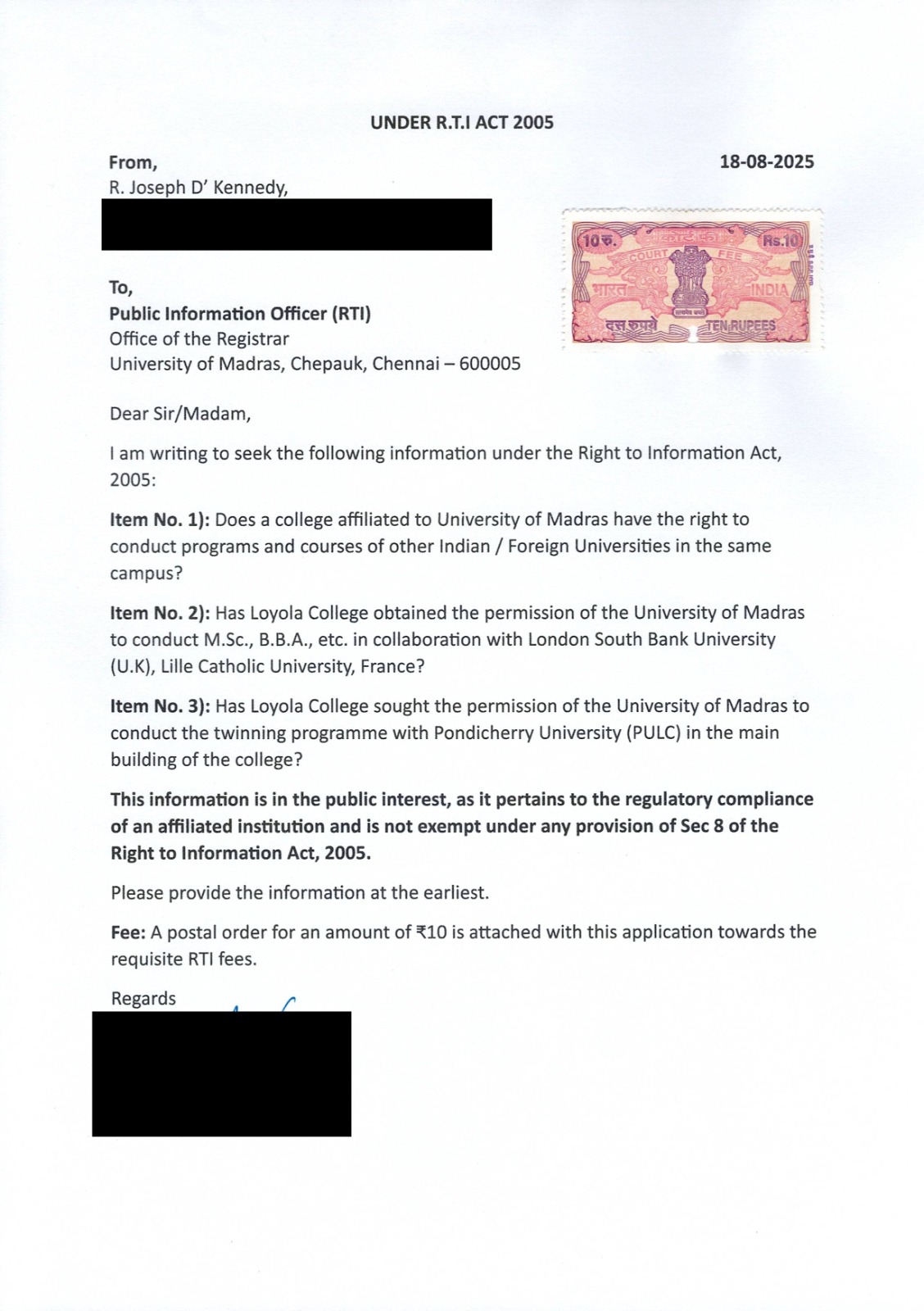
RTI activist and Loyola alumnus R. Joseph D’ Kennedy had sought crucial documents from the University of Madras pertaining to statutory approvals for foreign collaborations, twinning programmes, and international partnerships undertaken by these institutions.

Despite the RTI Act mandating a response within 30 days, the University of Madras did not reply to any of the four RTIs, nor did it act on the First Appeals filed under Section 19(1) of the Act.

This non-response qualifies as a “deemed refusal” under Section 7(2) of the RTI Act, 2005, a serious violation that can attract penalties under Section 20.

A Pattern Of Deliberate Silence?

According to Kennedy, the University’s silence is not an administrative lapse but a deliberate attempt to shield violations committed by elite aided colleges that operate with political influence and zero accountability despite receiving government funds.

Four RTIs, four First Appeals — and not a single response. This is not incompetence. This is a cover-up,” he said.

He also alleged that the foreign collaborations in question — including Loyola College’s controversial partnership with Pondicherry University and multiple unapproved international tie-ups — have been operating without mandatory UGC and University approvals, in potential violation of the UGC (Promotion and Maintenance of Standards of Academic Collaboration) Regulations.

Complaint Filed Before Tamil Nadu Information Commission

After receiving no response for more than a month, Kennedy has officially filed a complaint with the Tamil Nadu Information Commission (TNIC) under Section 18 of the RTI Act.

His petition requests the Commission to:

– Initiate an inquiry against the University of Madras
– Direct immediate disclosure of all pending information
– Impose penalties on the Public Information Officer (PIO) for willful defiance of the Act
– Issue strict directions to prevent recurrence of such violations

Why Loyola Is At The Centre Of The Storm?

Loyola College has been under intense scrutiny for over a year, with allegations involving:

– Unapproved international academic tie-ups
– Questionable twinning arrangement with Pondicherry University
– Lack of transparency in autonomous decisions
– Political interference in administrative and academic functioning

The RTI documents Kennedy seeks are expected to reveal how these programmes were run without mandatory approvals, in violation of:

– UGC Regulations
– University of Madras statutes
– Tamil Nadu government guidelines for aided colleges

Other Colleges Mentioned Only To Show Pattern

Although Kennedy filed similar RTIs regarding:

– Stella Maris College
– Women’s Christian College
– Madras Christian College

The Loyola RTI is the most explosive of the four. That is why the University is desperate to keep it buried,” Kennedy stated.

Legal experts say that denial of information across four separate RTIs, especially involving aided colleges, could attract strong action from the Commission.

Subscribe to our channels on WhatsAppTelegram, Instagram and YouTube to get the best stories of the day delivered to you personally.

DMK Goon Attacks BJP Functionary In Broad Daylight For Alerting Police About Land Grab Attempt, BJP Leaders Slam Stalin Govt For Pathetic Law & Order

A local Bharatiya Janata Party (BJP) functionary in Tamil Nadu, identified as Manikandan, was allegedly assaulted outside his residence.

Manikandan was attacked by a DMK functionary, Arumugam, allegedly after he informed the police about a purported attempt to encroach on government land. The BJP has claimed that the assault reflects a growing culture of political intimidation under the DMK regime.

The incident quickly escalated online after Tamil Nadu BJP leaders called out Chief Minister M.K. Stalin, accusing the DMK of “goondagiri” and warning that “Tamil Nadu will no longer tolerate intimidation, corruption, and violence masquerading as governance.”

Police sources stated that a case has been registered and investigations are underway to ascertain the sequence of events.

The incident was strongly condemned by BJP’s state president Nayinar Nagendran, who took to social media and accused the DMK of “fascist attacks”. In his statement, Nagendran called the attack brutal and a sign of breakdown in law and order. He further alleged that DMK’s regime has emboldened its members to pursue crimes ranging from property usurpation to violence, and called on Chief Minister M.K. Stalin to immediately arrest the accused, irrespective of party affiliations.

“5 more months Thiru @mkstalin, just 5 more months! TN will no longer tolerate intimidation, corruption, and violence masquerading as governance.”, wrote BJP leader Annamalai.

Subscribe to our channels on WhatsAppTelegram, Instagram and YouTube to get the best stories of the day delivered to you personally.

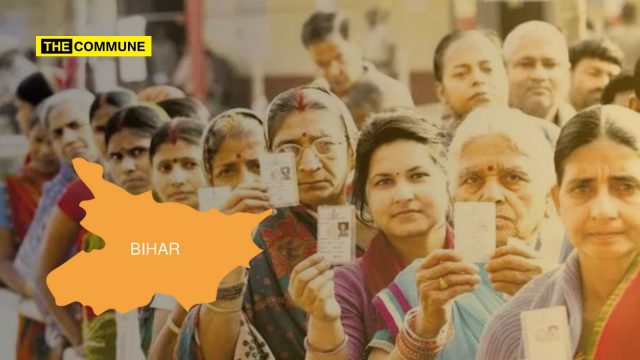
Busting The ‘Congress-RJD Lost Because Of SIR’ Propaganda: Here’s What Bihar’s Numbers Reveal

bihar sir draft voter rolls objection claim

Bihar election has put a full stop to vote theft allegations.

The accusation is that 6.8 million (68 lakh) voters were removed in the SIR (Summary Revision of Electoral Rolls). Opposition parties claim all of these were INDIA alliance voters.

This 6.8 million represents 10% of Bihar’s total voters.

If the Election Commission had removed genuine voters as INDIA alliance parties claim, this number should have been reflected in voter turnout.

Bihar’s average voter turnout is 60%.

If vote theft occurred, if INDIA alliance’s accusation is true, voter turnout in this election should have decreased by up to 10%.

But voter turnout has created history. 67% has been recorded.

So where are the 10% voters removed by the Election Commission?

In Bihar where an average of 60 out of 100 people vote, this time 67 people have voted. The fact that this happened even after removing 10% voters confirms that the Election Commission removed only fake and deceased voters. It becomes crystal clear that what Rahul calls vote theft and what INDIA alliance parties say is a lie.

If what I.N.D.I. alliance says is true, they must explain how voter turnout increased. Moreover, if 10% genuine voters were removed, and that too voters who were going to vote for I.N.D.I. alliance, then 67% recorded votes + 10% excluded votes would total 77%. Since such voter turnout has never happened in Bihar’s history, we can understand that Rahul’s accusation is false.

The recorded votes in Bihar election itself are witness to the fact that the Election Commission’s SIR process has been conducted very fairly and honestly.

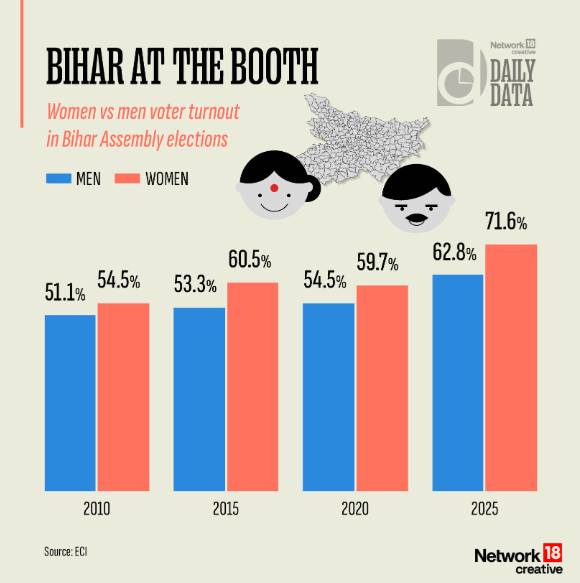
Tamil Nadu Chief Minister’s accusation that women’s votes were going to be removed has also been proven false in the Bihar election. 71.6% women have voted in this election, which is unprecedented.

Opposition parties must stop deceiving people by telling lies about vote theft anymore.

This is sufficient proof that the Election Commission has restored credibility in itself.

Ideaman Mahadevan is a writer and political commentator.

Subscribe to our channels on WhatsAppTelegram, Instagram and YouTube to get the best stories of the day delivered to you personally.

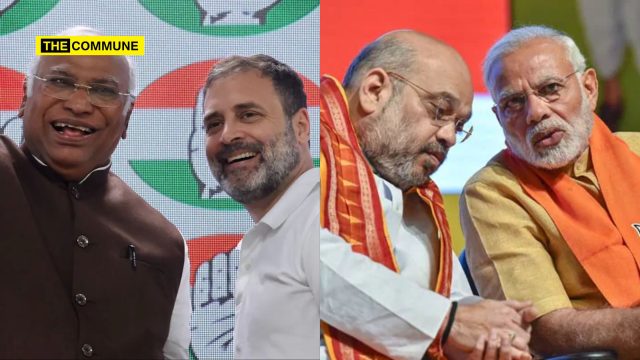
Congress Doesn’t Learn, BJP Never Stops Learning – That’s The Difference

An electoral victory is never the result of any single factor. It is a complex convergence of party organisation, candidate quality, caste equations, financial muscle, campaign strategy, the strengths and flaws of opponents, leadership appeal, welfare promises, and the prevailing political mood.

Yet the DMK, Congress, and similar parties refuse to confront this reality. Every defeat is blamed on EVMs, vote theft, or imaginary conspiracies. They know the truth. Dishonest messaging for political survival has become second nature. But even if they posture outside, shouldn’t they at least introspect within? Congress doesn’t even attempt that.

By contrast, the BJP keeps winning because it follows a clear formula rooted in discipline, strategy, and constant evolution.

1. Learning From Defeats

Critics mock the BJP for operating in “election mode” 24×7, 365 days. Ironically, that is exactly why they keep winning. The party immediately studies every loss, fixes weaknesses, rebuilds alliances, and begins preparing for the next victory.

Take Karnataka. Months before the election, Congress launched an aggressive campaign. Freebie politics became an advantage for them, especially when PM Modi publicly criticised such giveaways. Internal issues — the Yediyurappa factor, and the alliance breakdown with Kumaraswamy — hurt the BJP. Yet BJP’s vote share did not fall, which itself was a strategic advantage.

And the BJP learned. It realised that freebies could no longer be ignored. So in the next big contest — Madhya Pradesh — Shivraj Singh Chouhan launched and implemented a women-centric welfare scheme well before voting. Congress’s “freebie brahmastra” was neutralised. BJP retained power by securing alliances and beginning the campaign months in advance.

After losing Himachal and Karnataka to welfare politics, the BJP adjusted. The same formula worked in Maharashtra, Haryana, and now in Bihar, where Nitish Kumar’s women-oriented scheme became a decisive factor in the thumping victory.

2. Replacing Unpopular Candidates

Another BJP trademark is ruthlessly replacing candidates who have lost public goodwill. This shields the party from anti-incumbency despite long years in power.

Congress simply cannot do this. In many states the same exhausted faces repeatedly contest and repeatedly lose, ensuring the party’s continued decline.

3. Caste Representation Done Strategically

BJP’s social engineering is a political case study. The party ensures broad caste representation in both tickets and leadership positions. This inclusive structure consolidates votes and prevents resentment.

Few parties match this level of granular social outreach.

4. Strengthening Alliances

A major reason for BJP’s 2023 Karnataka defeat was the absence of a BJP–JDS tie-up. The day the assembly results were declared, BJP began repairing that relationship. The result? A strong showing in the subsequent parliamentary election.

Similarly, bringing Nitish Kumar and Chandrababu Naidu back into the NDA was a masterstroke — the Modi government today rests on their support.

In Bihar, the earlier split with Chirag Paswan hurt the NDA. This time, BJP brought him back, gave him a Cabinet berth, and allocated 29 seats to his party. The result is the sweeping mandate we see today.

Even smaller tactical moves matter. In the previous election, actor Sharan Singh campaigned against the BJP-Nitish alliance and contributed to their losses. This time he campaigned for the NDA. Such invisible micro-strategies often shape outcomes.

There are many such examples. But they all underline one point: learning from mistakes is the foundation of BJP’s victories.

Now ask: has Congress done even one of these things?

Congress does not respect state parties, yet depends entirely on them. In alliance after alliance, regional partners end up carrying Congress’s burden.

No wonder AAP, Trinamool and others avoid Congress when it comes to state elections.

In Bihar too, many voters believe Tejashwi Yadav might have won an even bigger mandate had he not allied with the Congress.

Congress has become a burden — electorally and organisationally.

Congress – A Party In Decay

No power in Tamil Nadu since 1967

No power in West Bengal since 1977

No organisational presence in Odisha

No comeback possible in Maharashtra

The party has no leadership pipeline, no strategy for growth, no ability to retain talent. Leaders like Sharad Pawar, Jyotiraditya Scindia, Himanta Biswa Sarma — the list runs into hundreds — all walked out after being ignored and humiliated.

Himanta, once a Congress minister, was made to wait outside offices. Today he is BJP’s Chief Minister in Assam.

This arrogance flows from the top. Congress today functions with a royal mindset. Rahul Gandhi behaves like a crown prince who believes everyone exists to serve him, that the nation must lift him to the Prime Minister’s chair.

With no leadership qualities, no mass connection, no consistency, no oratory, and no strategic thinking, he remains incapable of delivering victory. His only achievement is a long political career without a single major achievement.

The Verdict In Bihar

Congress can blame EVMs, the Election Commission, or imaginary conspiracies.
But those who fool themselves cannot fool the people.

Indian voters reward humility, correction, and hard work. Those who bow to the people’s verdict, fix their weaknesses, and return stronger are always given another chance. History offers countless examples.

Ideaman Mahadevan is a writer and political commentator.

Subscribe to our channels on WhatsApp, Telegram, Instagram and YouTube to get the best stories of the day delivered to you personally.
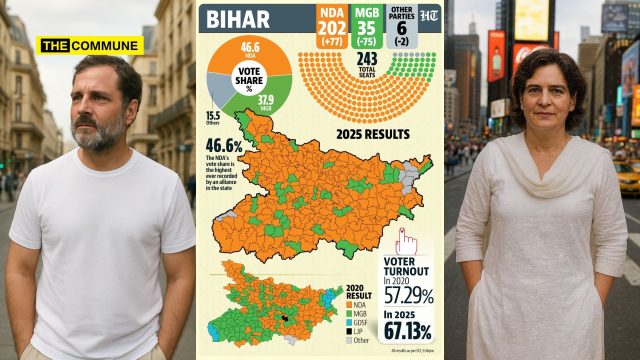
Rahul Gandhi Reportedly In Europe And Priyanka In New York Even As Congress Cadres Cope With Humiliating Defeat In Bihar Elections

Even as the Congress faces a massive, humiliating defeat in the Bihar elections, Rahul Gandhi is reportedly holidaying in Europe.

As shell-shocked leaders hunt for explanations and the cadre struggles to stay motivated, their chief campaigner’s disappearance has become a cause of concern for the Congress and its supporters.

During a panel discussion on Puthiya Thalaimurai, Senior Editor of The News Minute Shabbir Ahmed remarked on the absence of senior Congress leaders Rahul Gandhi and Priyanka Gandhi from the country on the day election results were announced.

Ahmed noted that Rahul Gandhi was in Europe and Priyanka Gandhi was in New York even as counting was underway, pointing out that Rahul Gandhi had also been out of town during the campaign period. He said their absence at a crucial political moment raised questions about the Congress leadership’s visibility and engagement during the election cycle.

It is noteworthy that Rahul Gandhi is absent every time there is something important happening in the country – be it elections or otherwise.

During the peak of Bihar Assembly election campaign, Rahul Gandhi was on a trip to South American countries.

Before that, after completing his so-called Voter Adhikar Yatra in Bihar, he quietly slipped away to Langkawi. The trip only came to light when pictures of him vacationing surfaced on social media.

Below are some other instances.

December 2024: Another Private Trip to Vietnam when nation was mourning Manmohan Singh’s death
Gandhi embarked on a “private” trip to Vietnam, which was not publicly announced in advance. The Congress leader left for New Year’s celebrations when the “country was mourning Prime Minister Dr. Manmohan Singh’s demise. The lack of details about his activities or return date drew criticism, especially given the Congress party’s ongoing efforts to strengthen its opposition stance ahead of the 2025 political calendar.

December 2023: Spotted on SpiceJet Flight to Dubai
Gandhi was reportedly seen boarding a SpiceJet flight to Dubai, with no prior announcement from the Congress party. The trip’s purpose remained undisclosed, prompting questions about its timing amid state election campaigns.

December 2022: Bharat Jodo Yatra Paused, Whereabouts Unknown
During the Bharat Jodo Yatra, the march was halted for nine days in December 2022. Gandhi’s whereabouts during this period were not disclosed, leading to speculation about a possible foreign trip.

December 2021: Personal Trip to Italy via Doha, Qatar
Gandhi traveled to Italy via Doha on December 29, 2021, reportedly to visit family, skipping election rallies in Punjab ahead of the 2022 state elections. The Congress party confirmed the “personal” nature of the trip but provided no further details, drawing criticism for his absence during a critical campaign period.

December 2020: Personal Trip to Italy
Gandhi undertook a “personal trip” to Italy to visit his grandmother, skipping the Congress party’s Foundation Day celebrations. The unannounced departure was seen as a missed opportunity to rally party workers, prompting backlash from opponents.

October 2023: Mysterious Trip to Uzbekistan
Gandhi’s “mysterious trip” to Uzbekistan was highlighted by critics for its lack of transparency. Unverified reports suggested meetings with unspecified individuals, though no concrete evidence supported claims of controversial engagements.

2015–2018: Frequent Personal Trips
Gandhi’s travels during this period included Turkey (June 2016, for his birthday), Italy (2017, to visit his grandmother), and multiple trips to Europe and the US for personal and party-related engagements.

February–April 2015: South-East Asia (Thailand, Cambodia, Myanmar, Vietnam)
Gandhi was absent from India for nearly 60 days, visiting Thailand, Cambodia, Myanmar, and Vietnam. He reportedly attended a meditation course in Myanmar, raising concerns about his prolonged absence during a politically active period.

Subscribe to our channels on WhatsAppTelegram, Instagram and YouTube to get the best stories of the day delivered to you personally. 

DMK Stepping Up Outreach To Christian Voters? ‘Arputha Peruvizha’ Events Reportedly Organised Amid Fears Of Minority Vote Shift To Vijay’s TVK

The Dravida Munnetra Kazhagam (DMK) has reportedly begun organising a series of “Arputha Peruvizha” (Miracle Festivals) across Tamil Nadu as part of an effort to retain Christian support ahead of the next election cycle. The move follows internal assessments that a section of minority voters, traditionally aligned with the DMK–Congress alliance, may be drifting towards actor Vijay’s recently launched party, Tamizhaga Vettri Kazhagam (TVK).

Christians and Muslims have historically backed the DMK-led alliance in the state. Their support played a significant role in the coalition’s sweep of 159 constituencies during the 2021 Assembly elections. However, officials said intelligence inputs submitted to the government after Vijay’s recent campaign in Nagapattinam, which drew heavy crowds, indicated a possible shift in Christian voting preferences. Women supporters at the event were seen carrying placards featuring both Jesus and Vijay, suggesting TVK’s outreach to the community.

In response, the DMK has reportedly rolled out Christmas-season campaigns aimed at reinforcing its hold over Christian voters. The first “Arputha Peruvizha” was held in Udhagamandalam (Ooty) under the Coimbatore zone, reportedly backed by former minister Senthil Balaji. Around 90,000 attendees from the Nilgiris and Coimbatore districts are said to have taken part in the gathering, which featured special prayers led by prominent CSI pastors. The event was organised by George, the DMK’s Ooty city secretary and district planning committee member.

Buoyed by the turnout, party leaders have approved similar programmes to be conducted across all eight DMK zones – north, south, east, and west – through the Christmas period. According to party insiders, the DMK intends to work closely with influential Christian clergy to consolidate support and prevent any erosion of its traditional minority vote base.

Apart from this, M.K. Stalin met members of the Tamil Nadu Bishops’ Council (TNBC) at the Secretariat, where the delegation led by Archbishop Dr. George Anthonysamy submitted a memorandum outlining key concerns of the Christian community. The meeting, facilitated by Rev. Dr. Vincent Chinnadurai and attended by senior bishops, clergy, and state officials, highlighted issues such as exemptions for minority-aided schools under Section 19 of the Private Schools Regulation Act, extending welfare schemes like free textbooks and laptops to students in minority institutions, approval and staff fixation for English-medium sections in aided schools, political reservation for Dalit Christians, and MBC status for Christian Vanniyars. The Bishops appreciated the government’s commitment to social justice and minority welfare, while the Chief Minister assured full support and praised the Church’s contributions to education, healthcare, and social development.

(Source: Dinamalar, Catholic Connect)

Subscribe to our channels on WhatsAppTelegram, Instagram and YouTube to get the best stories of the day delivered to you personally. 

Chennai Tea Shop Owner Arrested For Beating Stray Dog To Death That Chased And Tried To Bite An Elderly

A tea shop owner in Chennai has been arrested for allegedly beating a stray dog to death after it chased an elderly man near his shop. The incident occurred on Bhajan Lal Street in Mylapore on Wednesday evening.

Police said the accused, Mohan (56), who runs a tea stall in the area, reacted angrily when a stray dog attempted to bite an elderly customer. The man reportedly ran into the shop for safety. Mohan then picked up a wooden stick and repeatedly struck the dog until it died, before disposing of the body in a garbage bin.

A local resident recorded the assault on a cellphone, and the video was later circulated widely on social media, drawing strong condemnation from animal welfare groups. Activists reached the spot soon after, recovered the dog’s body from the bin, and sent it for a post-mortem examination at a veterinary hospital. They also filed a complaint with the Mylapore Police Station.

Police said Mohan was arrested based on the complaint and video evidence. He has been booked under Section 325 of the Bharatiya Nyaya Sanhita (BNS) for killing an animal.

The viral video has sparked renewed debate over stray dog management in the state. Tamil Nadu has seen a steady rise in stray dog numbers across districts, leading to an increase in attacks on children and the elderly.

Officials noted that the state government has recently expanded sterilization programmes and rabies vaccination drives for stray dogs. Government-run primary health centres have also been directed to provide medical care for people injured in dog attacks.

(Source: ETV Bharat)

Subscribe to our channels on WhatsApp, Telegram, Instagram and YouTube to get the best stories of the day delivered to you personally. 
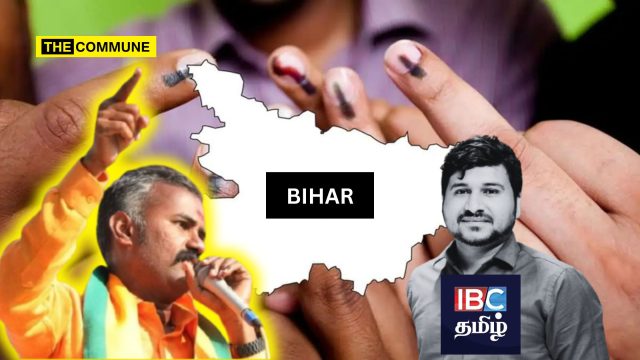
IBC Tamil Dravidianist Journo Shankara Sharma Apologizes On Air After BJP Leader Asuvathaman Slams His For Baseless ‘Vote Theft’ Remark On Bihar Election Results

A live discussion on IBC Tamil turned heated on Friday, 14 November 2025, after BJP leader Asuvathaman confronted the channel’s reporter Shankara Sharma over a comment made during the channel’s coverage of the Bihar Assembly election results.

IBC Tamil, one of the several Dravidian-leaning media outlets in the state, was running its analysis as counting trends showed a decisive mandate for the BJP–JDU alliance. During the programme, anchor Shankara Sharma invited BJP’s Asuvathaman to join the discussion. As soon as the interaction began, Sharma remarked: “What sir, it seems like you have stolen a lot of votes and won?”

“Are you running a channel or doing some other business? What kind of language is this?” he asked, interrupting Sharma. “Speak only after you apologise. If you don’t apologise, I will file a case.”

Sharma initially attempted to continue the discussion, saying he was merely referring to the voting trend. But Asuvathaman refused to engage further until the reporter apologised. He reminded Sharma that the channel had reached out repeatedly asking him to participate in the programme.

“It was you who begged me for an hour,” he said. “What language are you using now? Apologise first. If you don’t, things will be different.”

Realising the escalation on air, Sharma withdrew his earlier comment and issued an apology, saying: “I take back what I said, and I apologise.”

Subscribe to our channels on WhatsAppTelegram, Instagram and YouTube to get the best stories of the day delivered to you personally.