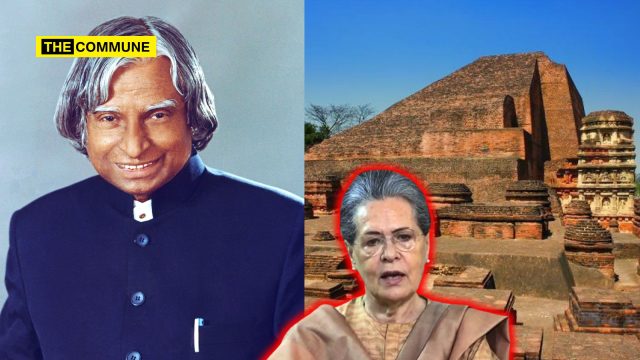
With Bihar elections being the talk of the town, during eveyr campaign Congress scion Rahul Gandhi makes one claim after another, one promise after another. Recently, Rahul Gandhi, during recent rallies in Bihar (particularly Begusarai and Nalanda), promised that if the I.N.D.I alliance came to power at the Centre, his government would open a world-class university in Bihar, comparable to the historic Nalanda University. He stated that students from around the world would come to study there, emphasizing a personal guarantee of reviving Nalanda’s educational legacy.
Pathetic!
Rahul Gandhi claims UPA built Nalanda University with big experts
He does not say how Dr. Kalam resigned from Nalanda in disgust in 2011
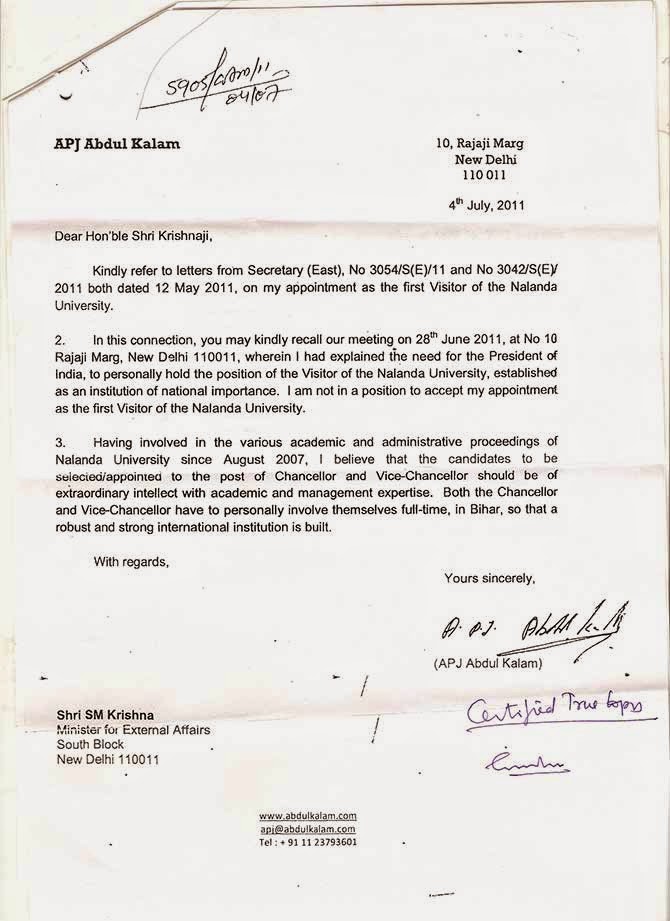
But did you know that back in 2011 when UPA was in power, former president Dr Abdul Kalam resigned from the university in disgust. His resignation letter reveals a lot about what was going on inside.
The letter, written on 4 July 2011, was not initially made public and remains a stinging indictment of how the project, conceptualised as a 21st-century reincarnation of the ancient Buddhist seat of learning, was, in his view, derailed by Prof. Amartya Sen and bureaucratic overreach.
Dr. Kalam’s letter, kept out of public view until it was retrieved through an RTI application, revealed his deep disappointment with the manner in which Nalanda University was being handled. He wrote that he could “no longer remain associated” with the project, citing opaque decision-making, questionable appointments, and a loss of focus on its foundational vision.
A Project Gone Astray
Kalam had been associated with the Nalanda revival since 2007, playing a key role in conceptualizing it as an international institution rooted in India’s civilizational heritage. However, by 2011 he was increasingly uncomfortable with how the project, overseen by the Ministry of External Affairs (MEA) under the UPA government, had become, in his words, detached from its educational purpose.
The letter argued that the top leadership positions in the new university – Chancellor and Vice-Chancellor – should be filled by individuals of “extraordinary intellect with academic and management expertise” who would live and work full-time in Bihar. Instead, appointments were allegedly made through closed-door decisions.
Dr. Kalam’s exit came soon after Prof. Amartya Sen, head of the university’s Mentor Group and later Chairman of the Governing Board, brought in Dr. Gopa Sabharwal, a Delhi-based sociology reader, as Vice-Chancellor-designate without his consultation.
The Rift Between Vision and Vanity
The rift between Kalam and Sen represented a clash of worldviews. Kalam saw Nalanda as a spiritual and intellectual revival of India’s ancient academic traditions, a collaborative Asian endeavour reflecting the legacy of monks and scholars such as Silabhadra, Dharmapala, and Santarakshita. Sen, on the other hand, envisioned an international liberal university modelled on Western academic structures, drawing comparisons to Oxford and Harvard.
This divergence soon became public. By the time the letter surfaced in 2012, it confirmed long-rumoured tensions between the two, between Kalam’s insistence on grounding the project in India’s educational philosophy and Sen’s cosmopolitan institutional approach.
Allegations of Nepotism and Mismanagement
The controversy deepened when RTI disclosures and parliamentary reports revealed that several appointments at the fledgling institution were made without due process. Dr. Gopa Sabharwal, appointed as Vice-Chancellor-designate in 2010, reportedly did not meet UGC norms, which require a minimum of ten years’ experience as a professor and proven academic distinction.
Her associates, including Upinder Singh, Daman Singh, and Amrit Singh, daughters of then Prime Minister Manmohan Singh, as well as her colleagues Dr. Anjana Sharma and Dr. Nayanjot Lahiri, were found to have drawn salaries from the university, some while residing abroad. The Nalanda headquarters, meant to be in Rajgir, Bihar, had also been quietly relocated to RK Puram, New Delhi, soon after the project’s formal notification.
The Standing Committee on External Affairs, in its subsequent report, noted that the project cost, initially pegged at ₹1,005 crore in 2007, had ballooned amid a lack of financial transparency. By 2015, the Finance Ministry was questioning the MEA on why government financial rules were being bypassed in what was ostensibly a publicly funded institution.
A Mentor Group Without a Mission
At the core of the criticism lay the Mentor Group chaired by Amartya Sen, which was tasked with finalizing the university’s blueprint within nine months of its creation in 2007. However, the group continued for three years, conducting meetings in Singapore, Tokyo, New York, and Delhi, costing the exchequer ₹2.11 crore, without submitting a final report or financial plan.
When the project’s Governing Board was finally constituted in 2011, Sen, as its chair, oversaw his own nomination as Chancellor in a meeting held in Beijing. This dual role sparked allegations of conflict of interest and self-appointment, further aggravating criticism of elitism and lack of accountability.
The Fallout and Political Dimensions
In the years that followed, Nalanda University became emblematic of UPA-era institutional controversies. Critics described it as a “private estate with public money,” functioning without adequate oversight or academic grounding.
By 2015, after questions from the Finance Ministry’s Department of Expenditure, Prof. Sen stepped down as Chancellor, complaining of government interference under the new NDA administration. The university continued under interim leadership, struggling to define its academic character even as construction of the Rajgir campus neared completion.
The National Investigation Agency (NIA) has achieved a significant breakthrough in the Red Fort area car bomb blast case with the arrest of Amir Rashid Ali, a Kashmiri resident accused of conspiring with the suicide bomber to carry out the deadly terror attack.
The incident, which occurred on November 10, claimed the lives of 10 innocent individuals and left 32 others injured.
Amir Rashid Ali, a resident of Samboora, Pampore in Jammu and Kashmir, was apprehended by the NIA in Delhi following a massive search operation. The car used in the attack was registered in his name, and investigations revealed that he had facilitated the purchase of the vehicle, which was later transformed into a vehicle-borne Improvised Explosive Device (IED) to execute the blast.
The arrest marks the first major development in the case since the NIA took over the investigation from the Delhi Police.
NIA investigations have established that Ali conspired with the alleged suicide bomber, Umar Un Nabi, a 29-year-old resident of Pulwama District and an Assistant Professor in the General Medicine Department at Al Falah University in Faridabad.
Forensic evidence has confirmed Nabi’s identity as the deceased driver of the IED-laden vehicle. The anti-terror agency has also seized another vehicle belonging to Nabi, which is currently being examined for evidence. So far, the NIA has interviewed 73 witnesses, including those injured in the blast that rocked the national capital. The explosion, which occurred near the historic Red Fort, has prompted a coordinated response involving Delhi Police, Jammu & Kashmir Police, Haryana Police, UP Police, and various other agencies.
The NIA is continuing its investigation across multiple states, pursuing leads to uncover the larger conspiracy behind the bombing and identify other individuals involved. The case has been registered as RC-21/2025/NIA/DLI.
Authorities are working diligently to piece together the network behind this act of terror, with the arrest of Ali seen as a critical step toward dismantling the plot. Further updates are awaited as the investigation progresses.
Subscribe to our channels on WhatsApp, Telegram,Instagram and YouTube to get the best stories of the day delivered to you personally.
The Gujarat Anti-Terrorism Squad (ATS) arrested three men in early November in what officials describe as an alleged ricin-based terror plot. The accused have been identified as Dr. Ahmed Mohiyuddin Syed (35), Azad Suleman Sheikh (20) and Mohammad Suhail Mohammad Saleem Khan (23). According to the ATS, Syed who holds a medical degree from China, told investigators he had been preparing ricin and had sourced research materials, chemical equipment and raw ingredients.
ATS officials say Syed was allegedly working under the direction of an Afghanistan-based operative named Abu Khadija, linked to Islamic State – Khorasan Province (ISKP), and that he maintained contacts in Pakistan. In a raid near Adalaj Toll Plaza, police recovered two Glock pistols, one Beretta, 30 live cartridges and about four litres of castor oil from a vehicle Syed was driving – materials that authorities allege could be used in ricin preparation.
Forensic examination of devices seized from Syed reportedly helped trace the two other suspects, from Uttar Pradesh, who are accused of supplying weapons and carrying out reconnaissance at crowded locations in Lucknow, Delhi and Ahmedabad. The ATS says the arms consignments were allegedly routed via Hanumangarh and dropped by drones across the Pakistan border.
What remains unproven, investigators stress, is the precise plot — including whether ricin was intended to be used in food or temple prasad, or how far the plan had progressed. Officials have told media the trio had assembled ricin-related materials and that the doctor had been researching extraction techniques from castor beans, but independent forensic confirmation of a completed toxin or any successful contamination has not been publicly disclosed.
“All three accused, along with the wanted Abu Khadija, have been booked under UAPA, the Bharatiya Nyaya Sanhita and the Arms Act,” the ATS said. Syed was remanded to police custody until 17 November while investigations continue. Investigators say they are tracing communication records and handlers to determine motive, targets and whether others were involved.
Ricin is a potent toxin derived from castor beans; small quantities can be lethal if ingested, injected or inhaled. Security agencies worldwide treat any allegation of ricin-use with extreme seriousness because of its lethality and historical use in assassination attempts. The ATS has described the case as a worrying example of alleged interest among extremists in chemical agents.
On 31 October 2025, Telangana Chief Minister A. Revanth Reddy sparked controversy during a public rally in Jubilee Hills, where he made remarks critical of Operation Sindoor and questioned the response of the Indian Armed Forces. Addressing the gathering, Reddy alleged that the forces “did not react” when Pakistan attacked India, implying inaction during the cross-border confrontation. His comments have since drawn sharp criticism for undermining the military’s role in a nationally sensitive operation.
An analysis of the public statements and positions taken by leaders of the Indian National Congress from the Kargil War in 1999 to Operation Sindoor in 2025 reveals a persistent pattern of questioning the government’s actions against terrorism.
In this article, we look at 54 instances that highlight occasions where Congress leaders have sought proof for military operations, blamed the Indian governments for intelligence failures, expressed skepticism about cross-border strikes, and made statements characterized as sympathetic towards Pakistan. The party’s stance has consistently sparked political controversy, with critics accusing it of undermining national security and the armed forces for political gain.
#1 CM Revanth Reddy Mocks Operation Sindoor – 31 October 2025
Telangana Chief Minister and senior Congress leader Revanth Reddy publicly questioned the efficacy of Operation Sindoor, India’s military response to a major terrorist attack. Addressing a rally in Hyderabad, Reddy alleged that the Indian armed forces “did not react” when Pakistan initiated aggression. He further stated, “when Pakistan kicked us and we didn’t retaliate,” a remark widely condemned as an insult to the military.
Telangana Congress CM Revanth Reddy at a rally: “Pakistan kicked us on our backs… and the BJP government couldn’t even bomb them!”
Mocking our jawans who crushed terror camps in Operation Sindoor? Shameful! National security isn’t a political stunt! pic.twitter.com/bF96l3VX7Z
#2 Imran Masood Compares Bhagat Singh to Hamas – 23 October 2025
Congress MP Imran Masood stirred controversy by comparing the Palestinian militant group Hamas to Indian freedom fighter Bhagat Singh. During a podcast, Masood claimed that Hamas was “fighting for their land” just as Bhagat Singh did. He also downplayed the impact of Operation Sindoor, stating it had no role in “bringing Pakistan to its knees.”
#3 Sam Pitroda’s “At Home in Pakistan” Remark – 19 September 2025
Sam Pitroda, Chairman of the Indian Overseas Congress, sparked outrage with his comments on India’s foreign policy. He advised the government to improve relations with neighbours, stating, “I’ve been to Pakistan, and I must tell you, I felt at home.”
Watch: Indian Overseas Congress chief Sam Pitroda says, “Our foreign policy, according to me, must first focus on our neighbourhood. Can we really substantially improve relationships with our neighbours?… I’ve been to Pakistan, and I must tell you, I felt at home. I’ve been to… pic.twitter.com/DINq138mvW
The remark, made amidst ongoing tensions, was criticized as being insensitive and trivializing the security threats posed by cross-border terrorism. Opponents accused him of being out of touch with ground realities and displaying an inappropriate affinity for a hostile nation.
#4 Chidambaram’s “Clean Chit” on Pahalgam Attack – 26 July 2025
Senior Congress leader P. Chidambaram questioned the government’s assertion that terrorists from Pakistan carried out the Pahalgam attack. In an interview, he asked, “Why do you assume that the attackers came from Pakistan?” and suggested they could be “homegrown terrorists.” He also accused the government of “hiding the losses” suffered during Operation Sindoor.
His comments were seen as giving a clean chit to Pakistan and echoing its narrative, leading to accusations of undermining national unity in the face of terrorism.
Previous Instances Of Chidambaram Peddling Pro- Pakistan Agenda
In May 2025, during a controversy over an India-Pakistan
ceasefire agreement, Chidambaram questioned whether
India’s decision was influenced by external pressure, particularly from the United States.
In April 2019, while speaking at an Observer Research
Foundation (ORF) symposium, Chidambaram stated that
India must “change its behaviour toward Pakistan” in
order to bring about a change in Islamabad’s conduct. He emphasized that “war is not an option” and
advocated for a more harmonious relationship.
In February 2017, Chidambaram asserted that India must
continuously engage with Pakistan, stating, “We are neighbours… we will be neighbours for hundreds of years.” He cautioned against flip-flop foreign policy and
argued that dialogue was the only sustainable solution.
In December 2016, during a public discussion, Chidambaram insisted that India should not walk away from diplomacy even in the face of provocations. “You have to continue to engage with Pakistan,” he said, adding that eventually, India must find a way to coexist peacefully.
#5 Wadettiwar on Religion and Terrorism – 28 April 2025
Congress MLA Vijay Wadettiwar made controversial statements following the Pahalgam attack, where terrorists were reported to have targeted victims based on their religion. He questioned this narrative, asking, “Do terrorists have time for all this?” and asserted that “terrorists don’t have any religion.”
#WATCH | Nagpur, Maharashtra | Congress MLA Vijay Wadettiwar says, “The government should take responsibility for the #PahalgamTerroristAttack. They (the government) are saying that terrorists killed people after asking them (about their religion). Do terrorists have time for all… pic.twitter.com/88ic7AM5gf
By diverting the focus from the targeted nature of the violence to a debate on the perpetrators’ motives, his comments were criticized for attempting to whitewash a clear case of communally-motivated terror.
#6 Safiuddin Soz Urges Trust in Pakistan – 28 April 2025
Congress leader and former Union Minister Safiuddin Soz made a controversial appeal in the aftermath of the Pahalgam attack. He stated that if Pakistan denies its involvement, India should “accept it for now and trust its investigative agencies.” He emphasized dialogue as the only solution, stating, “There is no military solution.”
VIDEO | Here is what former Union Minister Saifuddin Soz says on the Indus Water Treaty: “For Pakistan the water is very important for irrigation and drinking purposes. If the river water cannot be diverted the state of Punjab and Jammu and Kashmir will be totally submerged. The… pic.twitter.com/TZWPEtWNhA
This call for trusting a nation that India alleges sponsors terrorism was widely condemned as naive and against national security interests.
#7 Karnataka Minister Ramappa Timmapur Questions Religious Angle in Terror Attacks – 27 April 2025
Karnataka cabinet minister and Congress leader Ramappa Balappa Timmapur stirred controversy with remarks downplaying the religious targeting in terror attacks. Timmapur said terrorists “kill and flee” without asking victims’ religion, arguing that “some vested interests” wrongly link every incident to faith. He further accused the BJP of “trying to take political advantage from the deaths of innocents,” alleging the party has “played politics even when the country faces danger.”
#8 Congress Leader Karan Singh Says ‘Better If We Do Not Go to War’ After Pahalgam Attack – 26 April 2025
Senior Congress leader Dr. Karan Singh commented on the Pahalgam terror attack, urging restraint amid rising tensions. Singh acknowledged that “necessary steps have been taken” in response to the incident but cautioned against immediate military escalation. “It’s better if we do not go to war now, but we will see how the situation develops,” he said.
#WATCH | Delhi: On Pahalgam terror attack, senior Congress leader Dr Karan Singh says, “Steps have been taken and they were necessary… Its better if we do not go to war now, but we will see how the situation develops…” pic.twitter.com/crc4C7gMVv
#9 Robert Vadra Links Pahalgam Attack to Social Atmosphere – 28 April 2025
Robert Vadra, husband of Congress MP Priyanka Gandhi, made a controversial statement linking the Pahalgam terror attack to the domestic social atmosphere. He claimed, “The atmosphere in the country is deteriorating in the name of Hindu-Muslim, due to which Muslims are feeling uncomfortable, and this is the reason why people are being killed after asking for their identity.”
#10 Mani Shankar Aiyar Blames Partition for Pahalgam – 26 April 2025
Senior Congress leader Mani Shankar Aiyar attributed the Pahalgam terror attack to “unresolved questions of Partition.” Speaking at an event, he suggested that historical issues from 1947 were the root cause of contemporary terrorism.
Pahalgam tragedy reflects ‘unresolved questions of partition’
Manishankar Aiyer has taken the lead.. waiting for Sam Pitroda and Digvijay Singh to join in .. the Cong party is simply incorrigible! https://t.co/yd0gZjWy3Mpic.twitter.com/R3IXUqiYBV
#11 Siddaramaiah Opposes War, Advocates Security Strengthening – 26 April 2025
Following the Pahalgam attack, Karnataka Chief Minister Siddaramaiah stated, “There is no need for war with Pakistan. We are not in favor of war. We should take strict steps and strengthen our security.” While advocating for strengthened security, his outright rejection of war as an option, even as a last resort, was seen by critics as signaling a lack of resolve and potentially undermining India’s deterrent posture against a state that sponsors terrorism.
#12 Youth Congress Leader Questions Religious Angle of Attack – 25 April 2025
Youth Congress leader Mohammad Arman questioned the narrative that terrorists targeted victims based on religion in the Pahalgam attack. He posted on social media that giving a “religious angle” was inappropriate, suggesting similar incidents had happened before without a religious motive.
– नाम- मोहम्मद अरमान
– दावा- यूथ कांग्रेस का नेता
– कांग्रेस नेता श्रीनिवास BV के साथ कवर फोटो
– पहलगाम हत्याकांड पर इसका ट्वीट देखिए
#13 Mumtaz Patel Says ‘Terrorism Has No Religion’ After Pahalgam Attack – 25 April 2025
Following the Pahalgam terror attack, Congress leader Mumtaz Patel urged people not to communalize the tragedy, emphasizing unity over division. Speaking to reporters, the Congress women’s leader said that “terrorism has no religion” and warned against using such incidents to polarize society.
Her statement came amid heightened tensions and political debate over the attack, which left several civilians dead.
#14 Rahul Gandhi Questions Aircraft Losses in Operation Sindoor – 19 May 2025
Congress leader Rahul Gandhi directly challenged the government over Operation Sindoor, demanding to know how many Indian aircraft were lost. In a post on social media platform X, he stated, “EAM Jaishankar’s silence isn’t just telling — it’s damning.”
EAM Jaishankar’s silence isn’t just telling — it’s damning.
So I’ll ask again: How many Indian aircraft did we lose because Pakistan knew?
This wasn’t a lapse. It was a crime. And the nation deserves the truth. https://t.co/izn4LmBGJZ
He escalated his allegation by calling the operation a “crime” rather than a lapse.
#15 Revanth Reddy Questions PM Modi on Rafale Losses After Operation Sindoor – 29 May 2025
At a ‘Jai Hind’ rally in Hyderabad, Telangana Chief Minister and Congress leader Revanth Reddy questioned Prime Minister Narendra Modi over the post-Operation Sindoor ceasefire and alleged losses of Rafale fighter jets. Reddy claimed Pakistan had “downed Rafale jets” and demanded that the Prime Minister disclose how many were lost in action. Accusing Modi of favouring industrial allies in defence deals, he said the government owed the public transparency over the Rafale procurement. During his speech, Reddy controversially referred to Pakistan as “Mana Pakistan” (Our Pakistan), sparking sharp criticism.
#16 Rashid Alvi Questions Government’s Claims After Operation Sindoor – 7 May 2025
Commenting on Operation Sindoor, Congress leader Rashid Alvi said that while India’s armed forces had fulfilled their duty, the government owed the nation greater clarity on the operation’s outcome. Alvi asked whether “every single terrorist was killed” and cautioned that the threat was far from over.
#WATCH | Delhi: On #OperationSindoor, Congress leader Rashid Alvi says, “Much better reply needs to be given, this is bare minimum. Our forces did what govt of India told them to do, but the question again arises. Was every single terrorist killed? Will there won’t be another… pic.twitter.com/Rtn2tXPVP8
Referring to Prime Minister Narendra Modi’s earlier statement about eliminating terrorist strongholds, he said if such destruction had truly occurred, it would be commendable — but the government must ensure there is “no next Pahalgam”. Alvi urged stronger and more transparent measures against terrorism.
#17 Congress Leader M Laxman Blames Centre for Security Lapses in Pahalgam Attack – 25 April 2025
Reacting to the Pahalgam terror attack, Karnataka Congress leader M. Laxman accused the central government of politicising the tragedy ahead of assembly elections in five states. He said the BJP was seeking “cheap publicity” from the incident instead of addressing security failures. Laxman remarked that since the Union government controls key security and police appointments, it must take responsibility for the lapses. He also noted that Muslims were among the victims, calling it a “secular terror attack,” and urged the government to strengthen national security instead of engaging in political blame games.
#18 Charanjit Channi Questions Surgical Strikes – 3 May 2025
Congress MP Charanjit Singh Channi publicly cast doubt on the authenticity of the 2019 Balakot surgical strikes. He stated, “We have never seen where in Pakistan the strikes were done and where people were killed… Surgical strikes were not seen anywhere.” He admitted to always having demanded proof of the strikes. His comments were seen as aligning with Pakistani rhetoric, which also denies that the strikes occurred, and were criticized for insulting the competence and integrity of the Indian Armed Forces.
#19 Revanth Reddy Questions Authenticity of 2019 Balakot Airstrikes – 10 May 2024
Telangana Chief Minister Revanth Reddy questioned the authenticity of the 2019 Balakot airstrikes, suggesting that “nobody knows for sure if the airstrike took place as claimed.” Speaking at a press conference, the Congress leader criticised Prime Minister Narendra Modi for alleged intelligence failures leading to the Pulwama attack, accusing the Centre of mishandling national security. Reddy said that had the Congress been in power, internal security would not have been “left in anyone’s hands,” and questioned why key intelligence agencies like the IB and R&AW were not effectively utilised before the Pulwama tragedy.
#20 Adhir Ranjan Chowdhury Seeks Proof of Balakot Strikes – 5 February 2024
Congress MP Adhir Ranjan Chowdhury demanded proof of the Balakot airstrikes in Parliament, stating, “What happened in the Balakot airstrikes is still unclear. Where is the proof?” He cited international agencies that had questioned the strikes’ efficacy. This public doubting of the Indian Air Force’s successful operation was seen as undermining military morale and aligning with the narrative of Pakistan and skeptical international voices, rather than supporting India’s strategic actions.
Senior Congress leader Digvijaya Singh repeatedly questioned the validity of the Indian Army’s surgical strikes. At a public rally, he termed the government’s claims “bogus,” asserting, “there is no proof.” He accused the government of “ruling with the help of lies.” He said, “They (Centre) talk about surgical strikes and that they have killed so many of them (militants) but there is no proof. The Centre is ruling with the help of lies. I want to tell you that this country belongs to all of us.” His direct accusation that the military action was fabricated drew fierce condemnation from the ruling BJP and veterans’ groups, who accused him of insulting the armed forces and damaging national morale for political purposes.
#22 Sam Pitroda Questions Balakot Casualty Figures – 22 March 2019
Amid national sentiment supporting the Balakot airstrikes, Indian Overseas Congress chief Sam Pitroda expressed skepticism. Referring to international media reports, he stated, “I would like to know a little more… Did we really kill 300 people? I don’t know that.”
#23 Hariprasad Alleges “Match-Fixing” Between Modi and Imran Khan – 23 March 2019
Congress leader B.K. Hariprasad made a sensational allegation, telling reporters that “there is a match-fixing between Narendra Modi and Imran Khan, or else this Pulwama incident would not have taken place.” This direct insinuation of collusion between the Indian Prime Minister and the Pakistani leadership in a terror attack that killed 40 soldiers was condemned as a baseless and treacherous conspiracy theory that crossed all lines of political discourse.
#24 Kamal Nath Demands Balakot Strike Details – 7 March 2019
Madhya Pradesh Chief Minister Kamal Nath joined other Congress leaders in questioning the Balakot airstrikes, demanding the government disclose specific facts, including the number of casualties and buildings destroyed. He stated, “I don’t understand what’s keeping the government away from disclosing these facts.” This public demand for sensitive operational details was criticized for potentially compromising national security and for echoing the line of questioning taken by international media and Pakistan, rather than standing firmly with the armed forces.
#25 Chidambaram Seeks Clarity on Casualty Figures in Balakot Airstrike – 4 March 2019
Following India’s Balakot airstrike in Pakistan, former Finance Minister and Congress leader P. Chidambaram questioned the government’s claim on the number of casualties. In a post on X, he noted that the IAF Vice Air Marshal declined to specify figures, while the MEA statement mentioned no civilian or military deaths, asking, “Who put out the number of casualties at 300–350?” Chidambaram said that while he trusted the government as a citizen, India must provide credible evidence if it wants the international community to believe its claims, instead of engaging in partisan attacks.
IAF Vice Air Marshal declined to comment on casualties. MEA statement said there were no civilian or military casualties. So, who put out the number of casualties as 300-350?
#26 Navjot Singh Sidhu Demands Proof of Balakot Airstrike Casualties – 4 March 2019
Former Punjab Minister and Congress leader Navjot Singh Sidhu questioned the government’s claims about the Balakot airstrike, demanding proof of the reported 300 terrorist casualties. In a post on X, Sidhu asked, “300 terrorists dead — yes or no? Were you uprooting terrorists or trees? Was it an election gimmick?” Criticising what he called the politicisation of the armed forces, Sidhu said deceit was being spread “in the guise of fighting a foreign enemy” and urged political leaders to maintain the sanctity of the army, calling it “as sacred as the state itself.”
#27 Congress Questions Casualty Figures of Balakot – 4 March 2019
The Congress party held a press conference where spokesperson R.P.N. Singh highlighted the differing casualty figures from the Balakot strike, asking, “Where are these figures coming from?” He accused the BJP of “blatantly politicising the air strikes.” While questioning the government’s messaging, the public’s focus on the exact “body count” was seen as trivializing the strategic objective of the strike and playing into the hands of those seeking to diminish its impact.
#28 Kapil Sibal Cites International Media on Balakot – 4 March 2019
Senior Congress leader Kapil Sibal demanded proof of the Balakot airstrikes, citing reports from international media outlets like the New York Times and The Guardian that questioned the damage caused. He stated that the government must “make the effort” to prove its claims “if we want the world to believe.”
Modiji :
Is international media :
1) New York Times
2) London based Jane’s Information Group
3) Washinton Post
4) Daily Telegraph
5) The Guardian
6) Reuters
reporting no proof of militant losses at Balakot pro-Pakistan ?
#29 Chellakumar Alleges Pulwama was “Orchestrated” by PM Modi – 27 February 2019
Goa Congress leader Chellakumar claimed the Pulwama attack was “orchestrated by PM Modi,” drawing a parallel with unsubstantiated theories about the Godhra incident. He demanded to see the terrorist’s body as proof. These extreme comments, accusing the Prime Minister of India of orchestrating a massacre of security personnel, were widely denounced as seditious and representative of a deeply irresponsible political culture.
#30 Anto Antony Alleges BJP Involvement in Pulwama – 28 February 2024
Congress Leader Anto Antony made the explosive allegation that the BJP was behind the Pulwama attack, questioning how explosives could reach the site without the government’s knowledge. He asked, “How Pakistan could be at fault for an incident happened within Indian borders?” effectively shifting the primary blame from the Pakistan-based terror group to the Indian government. This conspiracy theory was widely condemned as irresponsible and insulting to the memory of the martyred CRPF personnel.
#31 Rahul Gandhi Questions PM Modi Over Ignored Pulwama Intelligence – 16 February 2021
Congress leader Rahul Gandhi accused Prime Minister Narendra Modi of ignoring prior intelligence warnings before the 2019 Pulwama terror attack. Citing a Frontline report, Gandhi alleged that actionable inputs about a possible suicide strike in Jammu and Kashmir were overlooked. He claimed that on the day of the attack, 14 February 2019, the Prime Minister was busy shooting a film, instead of acting on security alerts. Gandhi said the government’s failure to act on credible intelligence led to the death of Indian soldiers and demanded accountability for the lapses that enabled the Pulwama tragedy.
#32 Pawan Khera Questions Government on Pulwama Lapses – 3 March 2019
Congress spokesperson Pawan Khera aggressively questioned the government over the Pulwama attack, asking how the explosives reached the area and why a civilian vehicle was allowed near the convoy. He also questioned the Prime Minister’s whereabouts for two hours after the attack. While demanding accountability, the tone and timing of the questions were seen as attempting to shift the blame entirely onto the Indian government, potentially deflecting attention from the role of Pakistan-based Jaish-e-Mohammed.
#33 Rahul Gandhi Implies PM Modi Benefited from Pulwama – 14 February 2020
Marking the first anniversary of the Pulwama terror attack, Congress leader Rahul Gandhi raised questions over the government’s accountability and transparency. In a post on X, Gandhi asked, “Who benefitted the most from the attack? What is the outcome of the inquiry? Who in the BJP government has been held accountable for the security lapses?”
#34 Congress Questions Government Over Pulwama Intelligence – 21 February 2019
Following the Pulwama terror attack, Congress spokesperson Randeep Singh Surjewala questioned the government’s intelligence apparatus. He asked, “Is our Intelligence so weak under Ajit Doval that terrorists were able to carry 350kg of explosives through the most protected highway in the country?” He further probed how the terrorists knew the convoy’s route, suggesting an intelligence breach. While demanding accountability, this line of questioning was criticized for focusing blame on the Indian government’s failures rather than squarely on the Pakistani-based terrorists who executed the attack.
#35 Congress Blames Modi Government for Leadership Failure in Uri Attack – 19 September 2016
Following the terror attack on an Army camp in Uri, Congress spokesperson Randeep Singh Surjewala held the Narendra Modi government responsible, calling it a “failure of political leadership.” In a series of posts on X, Surjewala said India’s Pakistan policy was “confused and contradictory”, citing the decision to invite Pakistan’s ISI to probe the Pathankot attack as evidence. He questioned why India continued to face repeated terror strikes under the Modi government and asserted that the Defence Minister must be held accountable for ongoing lapses in border and national security.
#36 Navjot Singh Sidhu Says ‘Terrorism Has No Religion or Nationality’ After Pulwama Attack – 15 February 2019
Following the Pulwama terror attack, former Congress leader Navjot Singh Sidhu condemned the violence but said that terrorism should not be linked to any country or religion. Calling the incident a “cowardly attack,” Sidhu said the perpetrators must be brought to justice but stressed that “taking someone’s life is not a solution.” He added, “Terrorism has no religion, no caste, no party, and no nation.” His remarks, perceived as giving a clean chit to Pakistan, sparked widespread backlash, especially as India blamed Pakistan-based groups for the deadly attack on CRPF personnel.
#37 Navjot Sidhu Praises Imran Khan as “Farishta” – 26 November 2018
On the anniversary of the 26/11 Mumbai attacks, Congress leader Navjot Singh Sidhu referred to Pakistani Prime Minister Imran Khan as a “Farishta” (angel). He also credited Khan for the Kartarpur Corridor initiative. Praising the leader of a nation that India holds responsible for harboring the perpetrators of the 26/11 attacks was seen as a grave error in judgment and deeply hurtful to the sentiments of the victims’ families and the nation at large.
#38 Sanjay Nirupam Demands Proof for Surgical Strikes – 4 October 2016
After the 2016 surgical strikes on terror launch pads in Pakistan-occupied Kashmir, Congress leader Sanjay Nirupam called the government’s claims “fake.” He demanded that the Centre provide proof, arguing that without it, Pakistan was able to insult India on international platforms. He accused the government of taking political advantage of the soldiers’ sacrifices. This demand for proof set a precedent for Congress leaders publicly doubting the word of the Indian military establishment.
#39 P. Chidambaram Questions Surgical Strike Proof – 4 October 2016
Senior Congress leader P. Chidambaram stated that since the government had taken “political ownership” of the surgical strikes, it was natural for people to demand the release of video proof. He commented, “I am sure the government has thought through the consequences of taking the political ownership for a purely military action.” This was seen as a sophisticated but clear demand for proof, setting the stage for the party’s prolonged questioning of the operation’s authenticity.
#40 Rahul Gandhi’s “Khoon Ki Dalali” Accusation – 6 October 2016
In a sharp attack on Prime Minister Narendra Modi, Rahul Gandhi accused him of “Khoon Ki Dalali” (brokerage of blood) over the 2016 surgical strikes. He alleged that the PM was hiding behind the blood of soldiers and profiting from their sacrifice for political gains. He said, “Hamare jawaan hain jinhone khoon diya hai, jinhone surgical strike kiya, unke khoon ke peechhe aap (PM) chhupe hue ho. Unki dalali kar rahe ho…Yeh bilkul ghalat hai…Hindustan ki sena ne Hindustan ka kaam kiya, aap apna kaam keejiye.”
Congress leader Mani Shankar Aiyar questioned the utility of surgical strikes, Referring to Prime Minister Modi, Aiyar said those who have guts to conduct surgical strikes, seem to have no
guts in holding dialogue and resolving the issue. “If they had sat for dialogue, things would not have turned that ugly in Kashmir,” Aiyar said. “How many surgical strikes will they conduct? The number of surgical strikes on Pakistan for occupying Kashmir is more than the terror attacks by them on Kashmir in India. But the consequences of attack remains the same. Both are increasing,” Aiyar said. “If Modi has the courage, he should go to Kashmir and talk” Aiyar said.
#42 Randeep Surjewala Calls Uri Attack a “Political Leadership Failure” – 19 September 2016
After the Uri terror attack, Congress spokesperson Randeep Singh Surjewala blamed the Modi government directly, calling it a “political leadership failure.” Surjewala said that, “Decision to invite ISI (Inter-Services Intelligence) to investigate Pathankot terror attack manifested two glaring flaws in Modi government’s Pakistan policy — confused and confused. India’s borders and national security has been under siege for last two years. Defence Minister should be held accountable,” Surjewala added. He criticized the government’s Pakistan policy as “confused” and cited the decision to invite the ISI to investigate the Pathankot attack as a flaw.
#43 A.K. Antony Blames Modi Government for Security Lapse in Uri Attack – 18 September 2016
Following the Uri terror attack in Jammu and Kashmir that killed 17 soldiers, Congress leader A.K. Antony blamed the Narendra Modi government for what he called a “serious security lapse.” Speaking to reporters, the former Defence Minister said the incident reflected failures in preventing militant infiltration and securing military installations. Antony noted that the attack came soon after the Pathankot airbase strike, where militants similarly breached a high-security zone. Warning that the Kashmir situation was “drifting toward dangerous propositions,” Antony urged the government to strengthen border security and take accountability for repeated intelligence and defence lapses.
#44 Kapil Sibal on Dialogue with Pakistan Post-Sarabjit – 4 May 2013
After the death of Indian citizen Sarabjit Singh in a Pakistani jail, Congress leader Kapil Sibal argued against suspending dialogue with Pakistan. He stated, “We are upset. But that does not mean that on that ground alone, we should break off our dialogue with Pakistan.” Sibal had said, “You (Pakistan) should have protected Sarabjit because he was in your jail, just like we protected Kasab.”
#45 Manmohan Singh’s Cautious Stance Post-26/11 – 23 December 2008
In the aftermath of the 26/11 Mumbai attacks, Prime Minister Manmohan Singh of the Congress party emphasized diplomatic over military responses. He stated, “The issue is not war. The issue is that the Pakistani territory is used to aid and abet terror.” He urged Pakistan to dismantle terror infrastructure and comply with UN resolutions. While diplomatically sound, this cautious approach was criticized as being weak and failing to deliver a strong enough deterrent to Pakistan, especially compared to later military responses under a different government.
#46 Digvijaya Singh Alleges RSS Link to 26/11 – 28 December 2010
In a highly controversial move, senior Congress leader Digvijaya Singh promoted a theory that the Rashtriya Swayamsevak Sangh (RSS) was involved in the 26/11 Mumbai attacks. He released a book titled “26/11 RSS Ki Saazish?” and claimed that slain ATS chief Hemant Karkare had expressed fears from “Hindu extremists” hours before his death. This allegation, which mirrored Pakistani propaganda seeking to shift blame from the Lashkar-e-Taiba, was widely condemned as a baseless and malicious attack on a nationalist organization.
#47 Vijay Wadettiwar’s Allegation on Hemant Karkare’s Death – 5 May 2024
Maharashtra Congress leader Vijay Wadettiwar made a shocking allegation that Hemant Karkare, the ATS chief martyred during the 26/11 attacks, was not killed by terrorist Ajmal Kasab but by “an RSS-affiliated cop.” He further called public prosecutor Ujjwal Nikam a “traitor” for suppressing this alleged fact. This baseless claim, which contradicted all official evidence and court findings, caused a national uproar and was seen as a deeply irresponsible attempt to rewrite history for political motives.
#48 Salman Khurshid on Sonia Gandhi and Batla House – 9 February 2012
Congress leader Salman Khurshid revealed that party president Sonia Gandhi “wept bitterly” after being shown images from the Batla House encounter, a police operation against suspected terrorists. Khurshid stated that this led to efforts for a judicial inquiry, which were paused due to elections. The portrayal of grief over an anti-terror operation, rather than unequivocal support for the police, was seen as sympathy for the suspects and cast doubt on the legitimacy of the encounter
#49 Sonia Gandhi Blames Government for Parliament Attack – 20 December 2001
Just days after the terrorist attack on the Indian Parliament, Congress President Sonia Gandhi attributed the breach to a failure of the central government. She called it a “failure to act upon available intelligence,” drawing a parallel with the Kargil conflict. Sonia Gandhi had said that “it is distressing that the government showed itself so ill-prepared for the attack notwithstanding advance intelligence furnished among others by our state government in Maharashtra.” she
said that it was the “failure of the intelligence which led to tragedy of Kargil. it is again the failure to act upon available intelligence which lies at the root of the attack on parliament”.
Congress MP Shashi Tharoor publicly criticized the execution of Parliament attack convict Afzal Guru, which was carried out by the Congress-led UPA government. He tweeted that the hanging was “wrong & badly handled,” suggesting his family should have been warned and his body returned. Tharoor posted on Feb 9, 2015, “I think the hanging was both wrong & badly handled. Family should have been warned, given a last meeting & body returned.”
#51 Congress’s Stance on Kargil War Commemoration – 26 July 2009
After coming to power in 2004, the Congress-led UPA government did not officially commemorate Kargil Vijay Diwas for the first five years of its tenure. Congress MP Rashid Alvi explicitly stated that “Kargil isn’t a thing to be celebrated,” arguing that the war was fought on Indian territory due to an intelligence failure.
#52 Congress Leaders Apologize for Afzal Guru’s Hanging – 7 February 2015
Five Congress MLAs from Jammu & Kashmir issued a written apology for the way Afzal Guru was executed by the Congress-led UPA government. They stated that not allowing his family a final meeting was a “mistake” and demanded the return of his mortal remains, calling it a “humanitarian issue.” This apology to the family of a man convicted of attacking the symbol of Indian democracy was widely condemned as an act of political appeasement and a gross insult to the victims and the security forces.
#53 P. Chidambaram Questions Afzal Guru’s Conviction – 25 February 2016
Senior Congress leader P. Chidambaram cast doubt on the judicial process that led to the hanging of Parliament attack convict Afzal Guru. He stated, “I think it is possible to hold an honest opinion that the Afzal Guru case was perhaps not correctly decided.” Speaking on the Afzal issue, Chidambaram said it was not
possible for him to raise doubts over the court’s judgement while being in the government. He was the finance minister at the time when Afzal Guru was hanged.
#54 Prakash Jaiswal Forgets Kargil War Date – 26 July 2009
Former Minister of State for Home Affairs and Congress leader, Prakash Jaiswal, displayed a shocking lack of awareness about the Kargil War. When asked about Kargil Vijay Diwas, he could not recall when the war was fought. This lapse was seen as symbolic of the Congress party’s perceived disregard for a significant chapter in India’s military history, especially given their simultaneous reluctance to officially commemorate the victory during their tenure.
#55 Ravinder Sharma Calls Kargil an NDA Intelligence Failure – 27 July 2014
JKPCC Chief Spokesperson Ravinder Sharma stated that the Kargil War was a result of an “intelligence failure” and a “diplomatic defeat” for the then NDA government. By framing a war in which the Indian military achieved a hard-fought victory primarily as a failure of the ruling party, the Congress was accused of politicizing a moment of national sacrifice and unity, and of tarnishing the legacy of the soldiers who fought and died to reclaim Indian territory.
Subscribe to our channels on WhatsApp, Telegram,Instagram and YouTube to get the best stories of the day delivered to you personally.
Between 2015 and 2025, several Indian courts delivered landmark judgments questioning the misuse of polygamy in Islam and affirming the rights of Muslim women against unjust practices.
From the Supreme Court to multiple High Courts, judges ruled that polygamy cannot be exploited for selfish reasons, and that equality, consent, and financial responsibility are key conditions under both law and faith. These rulings, spread across a decade, mark an important evolution in India’s judicial approach toward gender justice in Muslim personal law.
#1 Kerala High Court: First Wife’s Consent Mandatory for Second Marriage – 30 October 2025
Justice P.B. Kunhihannan ruled that no Muslim man can register a second marriage without the opinion and consent of his first wife. The court clarified that though Muslim personal law allows multiple marriages under specific conditions, registration requires transparency and notice to the first wife. The petition to register a second marriage was dismissed, and the court affirmed that bypassing the first wife’s consent renders the second marriage legally invalid.
#2 Allahabad High Court: Polygamy Cannot Be Misused for Selfish Reasons – 15 May 2025
Justice Deshwal stated that Islam allows polygamy for welfare, not for self-gratification, and that equality between wives is a sacred condition. The judgment came while hearing the case of Furkan, who secretly remarried despite being unable to support his first wife. The court cited earlier rulings from 2020 to stress that polygamy’s misuse violates both Islamic and civil law, emphasizing that personal liberty cannot override women’s rights or fairness.
#3 Kerala High Court: Polygamy No Excuse to Avoid Maintenance – 22 September 2025
In the case filed by Jubairiya, the first wife, the court ruled that a financially incapable husband cannot evade maintenance obligations by remarrying. Justice Kunhihannan held that polygamy does not nullify a man’s duty under Section 125 CrPC to provide for his wife and children. The husband’s plea to reduce alimony after his second marriage was rejected, and the court reaffirmed the ₹10,000 monthly maintenance order.
#4 Madras High Court: Second Marriage Amounts to Cruelty to First Wife – 6 November 2024
Justice Swaminathan ruled that marrying a second wife without the consent or knowledge of the first wife causes mental cruelty. The court said such actions lead to social humiliation and emotional trauma, qualifying as grounds for divorce under family law. Referring to a similar 2018 case, the judge observed that polygamy practiced without empathy or equality violates the dignity of women and constitutes legal cruelty.
#5 Patna High Court: Valid Second Marriage Still Causes Distress to First Wife – 8 May 2024
The Patna High Court held that even a valid second marriage under Muslim law can inflict mental cruelty on the first wife. Justice Singh observed that a husband’s remarriage, though technically permissible, violates the spirit of equality and fairness central to Islam. The court stated that a woman perceives her husband’s second marriage as social and emotional betrayal, reaffirming that legality cannot override moral responsibility.
#6 Madras High Court: Unequal Treatment Makes Polygamy Cruelty – 22 December 2023
The bench ruled that failure to treat both wives equally constitutes cruelty, even if polygamy is permitted under personal law. In a petition filed by Anfone Banu, the court upheld her divorce, noting her husband’s neglect and emotional abuse after his second marriage. The judges stated that Islam demands fairness between spouses; otherwise, polygamy becomes unlawful and abusive.
#7 Allahabad High Court: Financially Weak Men Cannot Marry Again – 3 November 2022
Citing the Quran (Surah 4: Ayat 3), the court ruled that men lacking financial capacity to support their existing families have no right to remarry. The case involved Hamidunissa, whose husband remarried without providing for her or their children. The court held that economic and moral obligations must come before the privilege of multiple marriages.
#8 Karnataka High Court: No Relief for Husband Who Abandons First Wife – 13 September 2020
The Karnataka High Court denied relief to Rasheed Patel, who abandoned his first wife and remarried. The bench said that although personal law permits polygamy, abandonment and neglect make it unlawful in the eyes of statutory law. The court upheld the wife’s right to maintenance, stressing that religious permission cannot justify cruelty or desertion.
#9 Supreme Court: Polygamy Not a Fundamental Right – 10 February 2015
In a landmark decision, the Supreme Court ruled that the right to polygamy is not protected under Article 25 of the Constitution. The court upheld the dismissal of a government employee who remarried while his first wife was alive, stating that personal laws cannot override service conduct rules or public morality.
Subscribe to our channels on WhatsApp, Telegram,Instagram and YouTube to get the best stories of the day delivered to you personally.
Over the past decade, Tipu Sultan, the 18th-century ruler of Mysore has remained a lightning rod of political and social controversy in Karnataka. From government-backed celebrations to heated public protests, his legacy continues to divide communities and fuel ideological clashes.
This report compiles 11 key incidents between 2015 and 2025 where individuals, institutions, or political parties glorified Tipu Sultan, sparking debate over his historical image as either a “freedom fighter” or a “religious aggressor.”
#1 IUML Urges Karnataka Congress to Hold Grand Tipu Jayanti – 5 November 2025
The Indian Union Muslim League (IUML) urged the Karnataka Congress government to organise a grand Tipu Jayanti celebration on 10 November 2025, accusing it of neglecting the event for two consecutive years. IUML leader C. Abdul Rahiman called Tipu Sultan a “patriot” and alleged the government was erasing his contributions from textbooks. He warned that Congress leaders should resign if the event was not held, reigniting political tensions over the former Mysore ruler’s divisive legacy.
#2 Minister Mahadevappa Credits Tipu Sultan for KRS Dam Foundation – 4 August 2025
Karnataka Social Welfare Minister H.C. Mahadevappa claimed that Tipu Sultan, not Nalwadi Krishnaraja Wadiyar, had laid the foundation of the Krishna Raja Sagar (KRS) Dam. Speaking on Wadiyar’s death anniversary, Mahadevappa argued that an inscription at the dam’s main gate supported his claim. He also credited Tipu with abolishing the Devadasi system, resisting land monopolies, promoting trade hubs like Gubbi and Harihara, and introducing sericulture to India.
#3 Protests Erupt After Tipu Portrait Garlanded With Footwear – 31 January 2025
A portrait of Tipu Sultan was found garlanded with footwear in Sirwar town, triggering large-scale protests by members of the Muslim community. Demonstrators blocked roads and set tyres ablaze, demanding swift arrests. Police registered an FIR and promised action within 24 hours.
#4 Mysuru Hosts Joint Kannada Rajyotsava and Tipu Jayanti Event – 11 November 2023
The Tipu Kannada Rajyotsava Vedike hosted a joint celebration of Kannada Rajyotsava and Tipu Jayanti at Milan Function Hall. The event featured patriotic songs and dances, with speakers praising Tipu Sultan’s “courage and resistance” against the British. Former MLA Tanveer Sait and local leaders lauded Tipu’s contributions to Karnataka’s identity. The program concluded with a symbolic parade of participants dressed as Tipu Sultan.
#5 AIMIM Granted Permission to Celebrate Tipu Jayanti – 10 November 2022
The All India Majlis-e-Ittehadul Muslimeen (AIMIM) received permission from the Hubballi municipal corporation to hold a Tipu Jayanti celebration at the Eidgah Grounds. The mayor clarified that while the venue could host cultural events, large-scale gatherings with “big leaders” would not be allowed.
#6 Panel Recommends Retaining Tipu Sultan Chapter in Textbooks – 27 May 2022
A review committee appointed by the Karnataka government recommended retaining the Tipu Sultan chapter in school textbooks (Classes 6–10). The panel advised correcting factual errors and maintaining a “neutral tone” while also adding sections on other regional rulers.
#7 Protests Erupt Over State-Sponsored Tipu Jayanti Celebration – 12 April 2022
The Congress-led Karnataka government’s decision to observe Tipu Sultan’s birth anniversary triggered statewide protests. Demonstrations erupted in Kodagu, Bengaluru, and Mysuru, forcing the authorities to impose Section 144 and deploy heavy police forces. The government described Tipu as a “freedom fighter,” while opponents accused it of “communal appeasement.”
#8 Citizens Celebrate Tipu Jayanti Despite Government Ban – 11 November 2019
Despite the state government’s refusal to officially observe Tipu Sultan Jayanti, thousands of citizens in Mandya and nearby districts held independent celebrations. Local organisers claimed Tipu deserved recognition for fighting the British, while critics argued the event whitewashed his atrocities against Hindus and Kodavas. Police monitored the gatherings, but no violence was reported.
#9 Tipu Jayanti Celebrated Under Tight Security – 10 November 2018
Under the Congress–JD(S) coalition government, Karnataka officially celebrated Tipu Jayanti amid massive security arrangements. Prohibitory orders were imposed in sensitive districts like Kodagu, where anti-Tipu protests were anticipated. Both pro- and anti-Tipu processions were banned.
#10 Udupi District Administration Marks Tipu Jayanti – 10 November 2015
The Udupi District Administration, in coordination with the Minority Welfare Department, officially celebrated Tipu Sultan Jayanti. The event featured speeches extolling Tipu’s rule and cultural performances highlighting his “progressive reforms.” Unlike previous years marked by protests, the 2015 event proceeded peacefully.
Subscribe to our channels on WhatsApp, Telegram,Instagram and YouTube to get the best stories of the day delivered to you personally.
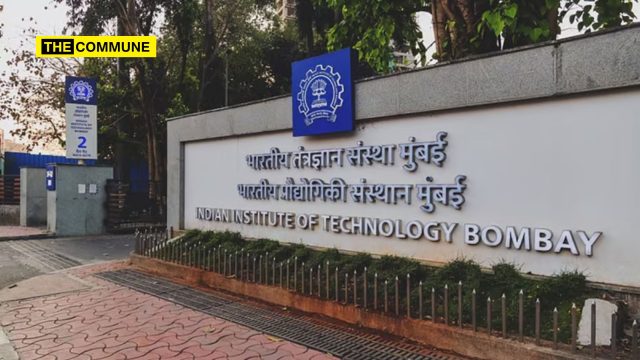
A prestigious academic institution became the scene of a serious security incident on Sunday night, as a female student at the Indian Institute of Technology (IIT) Bombay was allegedly surrounded and intimidated by a large Islamist mob after she objected to loud music playing past campus curfew.
The incident, which occurred near Hostel 10 around 11:00 PM on 9 November 2025, has ignited fierce debate about campus safety and administrative accountability. According to multiple student accounts, the trouble began when the student approached a wedding celebration on campus to request that the music be turned down, citing an upcoming examination.
The situation escalated rapidly. Eyewitnesses report that instead of complying, a group of approximately 50-60 Islamist individuals from the wedding gathering surrounded the student and four to five of her classmates who had arrived to support her.
In a statement posted on X, the student group “IIT B for Bharat” called for an impartial inquiry. The group urged both the institute’s administration and the Mumbai Police to ensure the safety of students and to identify all those involved in the confrontation.
A serious incident occurred on the @iitbombay campus on the night of 9 November 2025; a mob of around 50 Muslims allegedly surrounded an @iitbombay female student when she raised a concern about loud music being played beyond the permitted hours (after 10 PM).
Students present described a scene of intense intimidation. The mob allegedly responded with aggressive shouting, abusive language, and death threats, with witnesses reporting hearing statements like, “Tu bahar nikal, tere ko jaan se maar denge” (“Step outside, we will kill you”). Female students were also reportedly targeted with sexist remarks about their clothing.
The confrontation only de-escalated with the arrival of the Associate Dean of Student Affairs and officers from the Mumbai Police. However, in a detail that has deeply concerned the campus community, the targeted students were reportedly too fearful of retaliation to file a formal written complaint with the authorities at the scene.
The student group ‘IIT B for Bharat’ has since broken the administration’s public silence on the matter, issuing a statement on social media platform X that condemned the violence and the subsequent administrative inaction.
“We urge the IIT Bombay administration and Mumbai Police to conduct a fair, transparent, and impartial investigation to ensure accountability for all responsible parties,” the statement read. “Safety and justice cannot be selective. Intimidation and mob violence have no place in an academic institution.”
At the time of this report, there has been no official public statement from the IIT Bombay administration regarding the incident or the allegations, leaving the campus community awaiting answers and action.
According to the sources @iitbombay permits current and retired permanent staff members to book the Gulmohar Lawns for family functions such as weddings. The venue is located adjacent to Hostel 10 (a girls’ hostel). Anwar and Dilawar Sheikh, who are brothers and former IITB… https://t.co/BLOQn8J8Klpic.twitter.com/Zv0rEhELbL
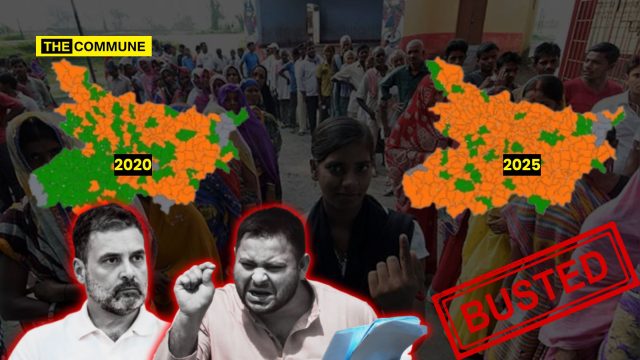
The results of the 2025 Bihar Assembly elections have once again exposed a fundamental truth about the Congress–RJD ecosystem: when they lose, they don’t introspect — they manufacture conspiracy theories. Their latest excuse is not just desperate, it is mathematically absurd. According to their melodramatic script, the Special Intensive Revision (SIR) exercise “deleted 65 lakh voters” — all, by some miracle, exclusively from their own support base.
This claim would have been laughable if it wasn’t being peddled so seriously.
The Numbers Completely Busts The 65-Lakh Deletion Myth
Let’s examine the official vote counts from 2020 and 2025 — numbers that don’t bend for convenient propaganda:
2025 Bihar Assembly Elections:
BJP: 10,081,143
JDU: 9,667,118
RJD: 11,546,055
INC: 4,374,579
2020 Bihar Assembly Elections:
BJP: 8,202,067
JDU: 6,485,179
RJD: 9,738,855
INC: 3,995,319
Now look at what actually happened:
BJP gained 18 lakh votes.
JDU gained 31 lakh votes.
RJD gained 18 lakh votes.
Congress gained nearly 4 lakh votes.
Yes — even the Congress party that is shouting the loudest about “deleted voters” saw its vote tally increase. Yes — even RJD, the supposed “victim,” saw its vote count swell by 18 lakh.
In fact in absolute terms, RJD has got more votes than BJP.
If 65 lakh opposition voters were genuinely deleted, how on earth are all major parties, including Congress and RJD, showing substantial gains?
The 65-Lakh Claim Is Nothing More Than A Excuse To Cover Incompetency
For weeks, the Congress–RJD camp has ranted about “6.5 million voters” being removed. But if such a massive and targeted deletion had really happened:
Opposition vote totals would have collapsed.
At the very least, they would have stagnated.
Instead, we see the opposite: Growth across all major parties — including those screaming conspiracy.
The 65-lakh bogeyman is nothing but a post-defeat pacifier for Rahul Gandhi who suffered a humiliating defeat on Children’s Day.
Higher Turnout, More Votes, Zero Suppression
The 2025 election saw a more engaged electorate. More people voted. More votes were cast for every major party. A state that supposedly lost 65 lakh voters somehow clocked higher participation — a statistical impossibility if the Congress–RJD story were even remotely true.
So Why Did Congress–RJD Lose?
Their loss had nothing to do with voter rolls and everything to do with: uninspiring leadership, stale messaging, weak organisation, and the utter lack of a coherent vision for Bihar.
Blaming SIR is simply their way of dodging accountability — a refusal to confront the fact that Bihar rejected them on politics, performance, and credibility.
The 65-Lakh Myth Has No Legs
Data is a stubborn, unforgiving thing. And Bihar’s 2025 numbers make one fact crystal clear:
There was no mass disenfranchisement.
There was no 65-lakh deletion.
The 65-lakh excuse is only a facade to cover Rahul Gandhi’s miserable leadership.
The people of Bihar weren’t robbed of their votes.
They just showed two dynasts their aukaat.
S. Kaushik is a political writer.
Subscribe to our channels on WhatsApp, Telegram,Instagram and YouTube to get the best stories of the day delivered to you personally.
Consider the immediate aftermath of any terror attack in India. A bomb rips through a market in Jaipur. A train is blasted in Mumbai. Gunmen lay siege to a temple. Before the smoke has cleared, before the last victim has been identified, the machinery of our national consensus whirs into motion. The script is as predictable as it is comforting. Within an hour, television anchors, their faces grim, will speculate about the “masterminds across the border.”
Government spokesmen will release identical statements: “We condemn this cowardly act” and “We will give a fitting reply.” The conversation is now firmly, and exclusively, about Pakistan. The purpose of this ritual is not to find the truth. The purpose is to pre-empt the truth. The purpose is to ensure that the one set of questions that truly matters is never asked. Who is the man who lives in that Pune colony who surveyed the German Bakery? Who is the “student” in Jaipur who procured the bicycles? Who is the “local businessman” in Mumbai who provided the safe house? These are uncomfortable questions. They are inconvenient questions.
The official narrative, the one taught in our textbooks and repeated by our public intellectuals, is that the ideology which created Pakistan left India with the new border. That the Muslims who “chose” India were, by definition, secular, moderate, and committed to the new republic. But let us put these assumptions to the stress test. The demand for Partition was the political culmination of an ideological assertion: that a separate Muslim identity, law, and society (the “Ummah”) could not be submerged into a composite, non-sectarian, democratic state. This ideology did not evaporate on August 15, 1947. It simply changed its tactics. It burrowed. It waited. It presented itself not as a demand for a separate state, but as a demand for special status within the Indian state. Every time the state has been confronted with this obstinacy, it has buckled. This is the “secularism” we have practiced. When the Supreme Court granted a pittance to an elderly woman, Shah Bano, the entire clerical establishment rose as one. The “liberals” who now lecture us on television were silent. The state, led by a Prime Minister with a brute majority, overturned the court’s judgment. This is of a piece with the insistence on separate personal laws, the riots over cartoons in a distant country, the organized opposition to Vande Mataram, the refusal to allow reform. This is a relentless political project. It is the assertion of a parallel sovereignty. And this is the very history that the “Blame Pakistan” reflex is designed to make us forget.
The great truth of our age is this: the single-minded focus on Pakistan is an analytical error. One can even go as far as to say that it is a sophisticated, multi-layered, and wholly deliberate act of intellectual and political evasion. It is the shield which our entire establishment, new and old, from South Block to the newsrooms of Delhi, holds up to protect itself from a reality it dares not name. That reality is the history, and the continuing present, of Islamic obstinacy and radicalism within India.
Now, see how this evasion connects directly to terror. A module cannot function on air. A Pakistani agent, no matter how skilled, cannot simply walk into a sensitive area and plant a bomb. He needs a network. He needs a local guide, a translator, someone to rent a flat, to buy a SIM card, to procure the chemicals, to weld the containers. He needs, in short, a domestic support system. And what has our own investigative history shown? Time and again, after the media’s focus has moved on, the charge sheets are filed. And who are the names? They are not phantoms from Islamabad. They are the members of the Students Islamic Movement of India (SIMI). They are the founders of the “Indian” Mujahideen. They are local clerics, university students, and software engineers from Azamgarh, from Bhatkal, from Kerala. They are Indians. Their motive is not Pakistani nationalism. Their motive is the same ideology that our establishment has refused to confront for seventy years. They are fighting for that same parallel sovereignty. They see the Indian state, its constitution, and its “kafir” society as the enemy.
But the “Blame Pakistan” narrative performs a vital service. For the ‘secular’ establishment of old, it was a tool to appease a vote-bank. But for the new ‘pro-Hindutva’ establishment, this evasion is more profound. Why? Because blaming Pakistan is easy. It is the perfect performance of nationalism. It allows for a muscular, theatrical display which electrifies the base and consumes the news cycle. It requires no hard choices, no messy internal reforms. The alternative, confronting the domestic fifth column, is the hornet’s nest that they choose not to confront. To do so would be to admit that the problem is not a simple foreign policy dispute but a deep-fanged societal rot. It would mean undertaking the hard, grinding, unpopular work of statecraft: genuine police reform, the modernization of madrasas, the enforcement of a uniform civil code against all opposition, and the patient, thankless task of intelligence gathering in hostile domestic localities. Why bother with this difficult, protracted war at home when a spectacular, prime-time “fitting reply” to Pakistan gives you all the political capital at a fraction of the cost? The “nationalist” establishment has discovered that the rhetoric of strength is a perfect substitute for the creation of a hard state.
The result of this grand, collusive deception is that the problem is never solved. It only festers. By attributing every attack to an external enemy, we give a free pass, a complete immunity, to the internal, ideological fifth column that sustains it. We are, in effect, pruning the weed while carefully watering its roots. The 26/11 Mumbai attack was the perfect example. It was a Pakistani plot. But it could not have been executed without the maps and surveillance provided by domestic facilitators. Yet, even in that case, which part of the story was quietly buried? The hunt for the Indian helpers. We have chosen a comfortable lie over an inconvenient truth. The ‘secularists’ traded national security for the applause of a moribund intellectual class. The ‘nationalists’, more cynically, trade it for the roar of the crowd, for the tactical convenience of an external enemy. The result is the same. This shared delusion will not last. The nature of reality is that it does not care for our narratives. It has a way of asserting itself, often in the most brutal fashion. By refusing to name the enemy within our gates, by all sides shielding themselves with the “foreign hand” theory, we are not displaying secular tolerance or nationalist strength. We are committing national suicide.
Postscript
Let us be unambiguous. The case against Pakistan is settled. It is an irredeemable state dedicated to our destruction, and it must be treated as such. The question is not whether to confront Pakistan, but what else we are failing to do while we are so consumed. The obsessive focus on Pakistan is not a lie, but it is a half-truth so vast it functions as a lie. It is the ‘nationalist’ establishment’s great alibi. It is the single, deafening drumbeat they use to drown out the sounds of the enemy already inside the gates. An enemy they perhaps find politically inconvenient, and therefore terrifying, to name.
Yours truthfully,
Nishkala
Subscribe to our channels on WhatsApp, Telegram,Instagram and YouTube to get the best stories of the day delivered to you personally.
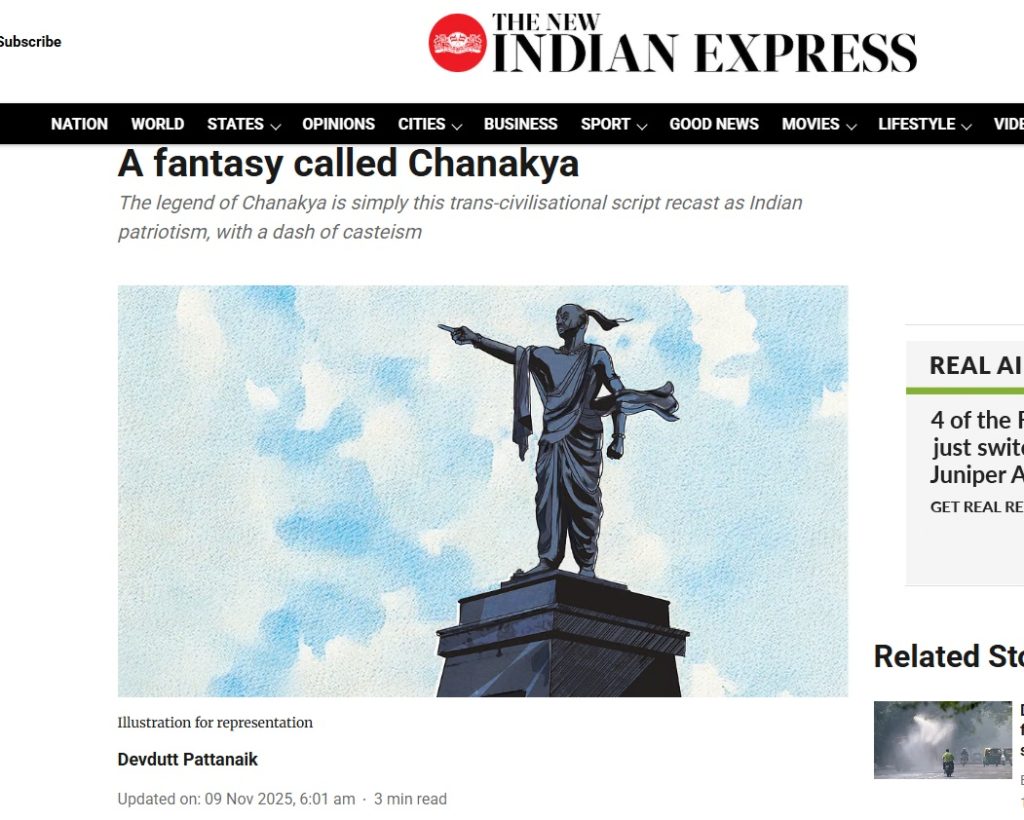
On 9 November 2025, mythological fiction author Devdutt Pattanaik, known for his fantasy book series, posted about an article he wrote for The New Indian Express.
The article was titled “A fantasy called Chanakya”, with a byline. “The legend of Chanakya is simply this trans-civilisational script recast as Indian patriotism, with a dash of casteism”
This is not just wrong but mischievous ideological narrative building by Pattanaik.
The Impossible Standard Of Proof
Pattanaik’s central premise is that “there is absolutely no historical evidence that a man called Chanakya ever lived.” He demands contemporaneous, archaeological proof – a coin, an inscription, a royal edict bearing his name.
This standard is just unrealistic. If we were to apply it universally, we would have to dismiss the existence of most major figures from ancient history.
Alexander the Great: Our primary accounts of his life were written 300-400 years after his death by Greco-Roman historians like Arrian and Plutarch. There are no contemporary Indian records of his invasion.
The Buddha: There is zero contemporaneous evidence of his birth, life, or teachings. His existence is reconstructed from texts compiled centuries later by communities with a vested interest in promoting his legacy.
Jesus Christ: The earliest New Testament gospels were written decades after his crucifixion, by followers, not neutral observers. There is no Roman record of his existence from his lifetime.
Would a “selfie from Pataliputra” be enough for Pattanaik? Ancient history is not a court case where you get inscriptions on demand to prove something ‘beyond a reasonable doubt.’ It is a forensic science that pieces together probabilities from fragmented, often biased, and later sources. By Pattanaik’s logic, the fields of classical and ancient history would cease to exist.
The Plurality Of Sources: A Consensus Of Traditions
Pattanaik dismisses the sources on Chanakya as “later Buddhist and Jain chronicles and Sanskrit plays… imagined after 500 AD.” This oversimplifies the whole thing.
What makes Chanakya credible is that so many unrelated traditions mention him. He appears in:
Buddhist texts like the Mahavamsa (5th century CE), which draw on older Sri Lankan commentaries.
Jain texts like the Parishishtaparvan (12th century CE), which meticulously detail Chandragupta’s conversion to Jainism and his death by sallekhana (ritual fasting) in Shravanabelagola—a tradition supported by local inscriptions and enduring worship.
Sanskrit literature, most notably Vishakhadatta’s political drama Mudrarakshasa (c. 4th-8th century CE), which takes the Chanakya-Chandragupta story as its central plot.
These are not a single, monolithic “Brahminical” narrative. They are competing accounts from traditions that were often doctrinally opposed to each other. Yet, they all converge on one central fact: a brilliant, shrewd Brahmin named Chanakya (or Kautilya) was the mastermind behind the Mauryan empire’s rise. For these diverse traditions to independently affirm his pivotal role is powerful evidence of his historicity, not a reason for dismissal.
The Arthashastra: A Text With Layers, Not A Forgery
Pattanaik points to references to Chinese silk and Roman gold coins in the Arthashastra to claim it was composed around 200 AD, “almost 400 years after Mauryan rule.”
This is a classic case of mistaking the leaves for the tree. Mainstream scholarship, including historians like R. C. Majumdar and D. D. Kosambi, agrees that the core of the Arthashastra is a product of the Mauryan period. The text we have today likely underwent centuries of transmission, with later scribes and scholars adding commentaries, examples, and updating terminology—a process known as interpolation.
The presence of a later interpolation does not invalidate the entire text’s origin. The sophisticated detailing of a complex bureaucracy, taxation, and espionage in the Arthashastra aligns perfectly with what we know of the vast Mauryan state from Ashokan edicts and Megasthenes’ account.
The “Mentor Trope” And Selective Cultural Skepticism
Pattanaik argues that the Chanakya story is merely a common “narrative trope” found globally, comparing it to Merlin and King Arthur, Hemachandra and Kumarapala, or Vidyaranya and the founders of Vijayanagara.
This argument backfires spectacularly. The universal presence of the “wise mentor” archetype doesn’t prove these figures are fictional; it points to a recurring historical and sociological reality. Powerful rulers have often relied on the counsel of learned advisors.
The Buddhist monk Nagasena debated and guided the Indo-Greek king Menander, as recorded in the Milinda Panha.
As Pattanaik himself notes, the Phagpa Lama was a preceptor to the Mongol emperor Kublai Khan.
Why are these relationships, or that of Aristotle and Alexander, not dismissed as pure fiction, while Chanakya’s is deemed a “fantasy”? The bias is hard to miss: only Indian civilizational heroes, particularly those valorized in a “Hindu” or “Brahminical” context, are subjected to this level of deconstructive scrutiny. The mentor-king trope is accepted as a plausible historical reality everywhere except in this specific Indian instance.
The Agenda Of Selective Historical Destruction
The most telling part of Pattanaik’s thesis is what he doesn’t attack. He will never write a column titled “A fantasy called St. Thomas,” despite the complete lack of contemporary evidence for the apostle’s legendary journey to Kerala in 52 CE; a story crucial to the identity of many Indian Christians.
He will never question the existence of the Buddha, whose life is documented only in texts written centuries after his parinirvana by his devoted followers. This selective application of “skepticism” exposes the game: the target is not historical inaccuracy, but specific elements of the Indian/Hindu historical consciousness that do not align with a particular ideological worldview.
It is possible that Devdutt and his ilk would also claim Nalanda university was destroyed by Brahmins based on some spurious later period texts; however, they will not believe Chanakya existed because it comes from later period texts. The standard of evidence is flexible, bending to serve a pre-determined narrative that often seeks to undermine traditional Indian institutions.
History Is Not A Weapon
Devdutt Pattanaik’s article is a masterclass in historical nihilism disguised as progressive scholarship. By imposing an impossible standard of proof, ignoring the consensus-building methodology of historians, and applying his skepticism with glaring selectivity, he does not enlighten but obscures.
The figure of Chanakya—the brilliant, ruthless strategist who orchestrated the fall of the Nanda empire and the rise of India’s first major imperial power—is supported by a robust cross-traditional consensus. His legacy, encoded in the Arthashastra, resonated across Asia for over a millennium, with his aphorisms being translated and treasured from Nepal to Tibet and Sri Lanka.
To dismiss this as a “convenient fiction” is not just bad history; it is an attempt to sever a people from a pillar of their historical memory. If there’s any fantasy here, it’s the idea that you can throw out every old source that doesn’t fit your politics.
In the end, what Pattanaik peddles is not history but a deracinated sermon meant to shame Indians out of their own civilisational confidence. Chanakya endures not because of blind patriotism, but because multiple traditions, texts, and centuries of scholarship recognise the magnitude of his political genius.
Reducing him to a “fantasy” says nothing about Chanakya and everything about the ideological compulsions of those desperate to unwrite India’s past. A civilisation that produced the Arthashastra does not need validation from armchair mythographers masquerading as scholars. The real fantasy is the belief that selective skepticism can erase a figure who has lived robustly in the subcontinent’s historical, literary, and political memory for over 2,000 years.
Subscribe to our channels on WhatsApp, Telegram,Instagram and YouTube to get the best stories of the day delivered to you personally.