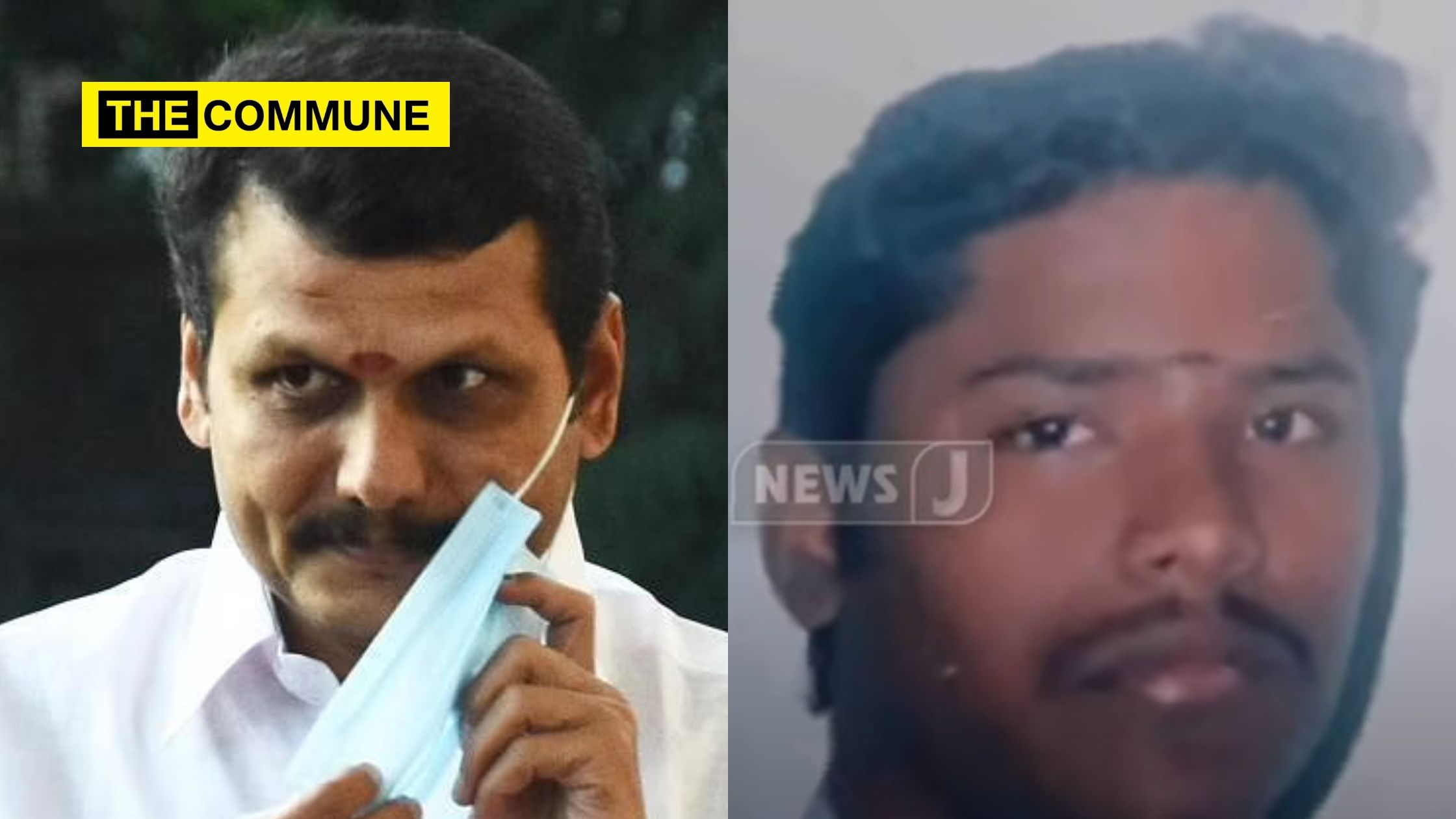
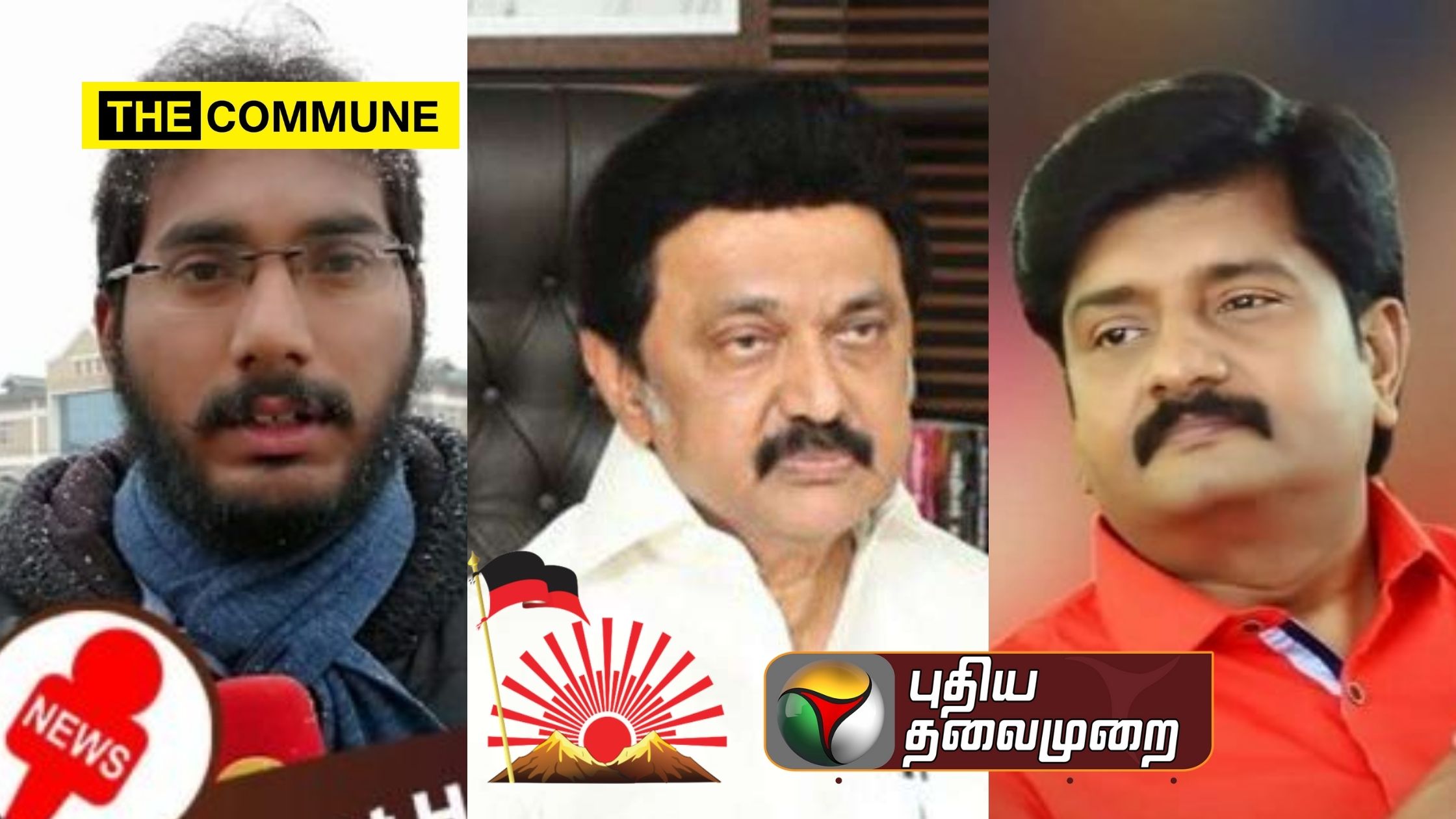
A bunch of DMK goons attacked a private hospital in Tirupur district creating commotion frightening the nurses and patients in the hospital.
About 10 DMK goons had gone to a private hospital in Udumalaipettai for getting treatment. Some of them were reportedly under the influence of alcohol and had to wait for some time.
The enraged DMK goons engaged in a heated spat with the hospital staff and nurses hurling abuses at them. They broke the glass in the hospital and started breaking other things causing panic among patients.
Those in the hospital recorded the video and which is now going viral on social media.
A complaint has been lodged at the Udumalaipettai police station on behalf of the hospital management.
Thermocol could be the material of the future for construction of earthquake-resistant buildings, with thermal insulation and could also save energy required to develop construction materials.
Researchers at IIT Roorkee have found that thermocol or Expanded Polystyrene (EPS) is used as a composite material in core of reinforced concrete sandwich, could resist earthquake forces on up to four-storey buildings.
The researchers tested a full-scale building and a number of wall elements constructed with thermocol sandwiched between two layers of concrete at the National Seismic Test Facility (NSTF) of the Department of Earthquake Engineering, IIT Roorkee, developed under Fund for Improvement of S&T Infrastructure (FIST) programme of Department of Science & Technology (DST), Government of India. Mr Adil Ahmad, the research Scholar who conducted the tests, evaluated the behaviour of the constructions under lateral forces, as earthquake causes a force predominantly in lateral direction. The investigation was supplemented with detailed computer simulation of a realistic 4-storey building. Prof. Yogendra Singh, supervising the research, informed that the analysis shows that a four-storey building constructed with this technique is capable of resisting earthquake forces, even in the most seismic zone (V) of the country, without any additional structural support.
They have attributed this earthquake resistance capability to the fact that the EPS layer is sandwiched between two layers of concrete having reinforcement in the form of welded wire mesh. The researchers said that the force being applied on a building during an earthquake arises due to the inertia effect and hence depends on the mass of the building. Thermocol resists earthquakes by reducing the mass of the building.
In this technique, the EPS core and the wire mesh reinforcement is produced in a factory. The building skeleton is first erected from the factory-made core and reinforcement panels, and then concrete is sprayed on the skeleton core. This technique does not require any shuttering and hence can be constructed very fast.
Besides resisting earthquakes, the use of expanded polystyrene core in concrete walls of a building can result in thermal comfort. The core provides the necessary insulation against the heat transfer between building interior and exterior environment. This can help in keeping the building interiors cool in hot environments and warm during cold conditions. India suffers a large variation of temperature in different parts of the country and during different seasons of the year. Therefore, thermal comfort is a crucial consideration along with structural safety.
The technology also has the potential of saving construction material and energy, with an overall reduction in carbon footprint of buildings. It replaces a large portion of concrete volume from the walls and floor/roof. This replacement of concrete with the extremely lightweight EPS not only reduces mass, thereby decreasing the earthquake force acting on a building but also diminishes the burden on the natural resources and energy required to produce the cement concrete.
Click here to subscribe to The Commune on Telegram and get the best stories of the day delivered to you personally.
Union Minister for Finance and Corporate Affairs, Nirmala Sitharaman, today launched the asset monetisation pipeline of Central ministries and public sector entities: ‘National Monetisation Pipeline (NMP Volumes 1 & 2)’. The pipeline has been developed by NITI Aayog, in consultation with infrastructure line ministries, based on the mandate for ‘Asset Monetisation’ under Union Budget 2021-22. NMP estimates aggregate monetisation potential of Rs 6.0 lakh crores through core assets of the Central Government, over a four-year period, from FY 2022 to FY 2025.
Volumes 1 and 2 of the report on NMP was released today in the presence of Vice Chairman (NITI Aayog), CEO (NITI Aayog), and Secretaries of infrastructure line ministries included under the pipeline—Roads, Transport and Highways, Railways, Power, Pipeline and Natural Gas, Civil Aviation, Shipping Ports and Waterways, Telecommunications, Food and Public Distribution, Mining, Coal and Housing and Urban Affairs—along with Secretary (Department of Economic Affairs) and Secretary (Department of Investment and Public Asset Management).
Union Minister of Finance, while launching the pipeline, said, “The Asset Monetisation programme has taken shape because of the vision of our Hon’ble Prime Minister who has always believed in universal access to high-quality and affordable infrastructure to the common citizen of India. Asset monetisation, based on the philosophy of Creation through Monetisation, is aimed at tapping private sector investment for new infrastructure creation. This is necessary for creating employment opportunities, thereby enabling high economic growth and seamlessly integrating the rural and semi-urban areas for overall public welfare.” Smt. Sitharaman further enumerated the reforms and initiatives undertaken by the current Government towards accelerated infrastructure development and for incentivizing private sector investments. This included the recent ‘Scheme of Financial Assistance to States for Capital Expenditure’, which incentivizes State Governments to recycle State Government-owned asset for fast-tracking greenfield infrastructure.
“The strategic objective of the programme is to unlock the value of investments in brownfield public sector assets by tapping institutional and long-term patient capital, which can thereafter be leveraged for further public investments,” Vice Chairman, NITI Aayog, said during the launch. He emphasized on the modality of such unlocking, which is envisaged to be by way of structured contractual partnership as against privatization or slump sale of assets.
NMP is envisaged to serve as a medium-term roadmap for identifying potential monetisation- ready projects, across various infrastructure sectors. CEO, NITI Aayog said, “The NMP is aimed at creating a systematic and transparent mechanism for public authorities to monitor the performance of the initiative and for investors to plan their future activities. Asset Monetisation needs to be viewed not just as a funding mechanism, but as an overall paradigm shift in infrastructure operations, augmentation and maintenance considering private sector’s resource efficiencies and its ability to dynamically adapt to the evolving global and economic reality. New models like Infrastructure Investment Trusts & Real Estate Investment Trusts will enable not just financial and strategic investors but also common people to participate in this asset class thereby opening new avenues for investment. I hence consider the NMP document to be a criticalstep towards making India’s Infrastructure truly world class.”
NMP is a culmination of insights, feedback and experiences consolidated through multi-stakeholder consultations undertaken by NITI Aayog, Ministry of Finance and line ministries. Several rounds of discussion have been held by NITI Aayog with the stakeholders. The pipeline has been deliberated at length in inter-ministerial meeting chaired by Cabinet Secretary. This is therefore a whole of a government initiative.
Secretaries of all infrastructure ministries affirmed their resolve towards achieving their respective targets set under NMP, working jointly with NITI Aayog and Ministry of Finance.
As part of a multi-layer institutional mechanism for overall implementation and monitoring of the Asset Monetization programme, an empowered Core Group of Secretaries on Asset Monetization (CGAM) under the chairmanship of Cabinet Secretary has been constituted. The Government is committed to making the Asset Monetisation programme, avalue-accretive proposition both for the public sector and private investors/developers, through improved infrastructure quality and operations and maintenance. This is aimed at achieving the broader and longer-term vision of ‘inclusiveness and empowerment of common citizens through best in class infrastructure’.
Union Minister of State (Independent Charge) for the Ministry of Science and Technology; Ministry of Earth Sciences and Union Minister of State for Prime Minister’s Office; Ministry of Personnel, Public Grievances and Pensions; Department of Atomic Energy and Department of Space, Jitendra Singh said that the new portal under Bhuvan “Yuktdhara”, which has been released today, will facilitate planning of new MGNREGA assets using Remote Sensing and GIS based information. The Minister said that this platform will serve as a repository of assets (Geotags) created under various national rural development programmes i.e. MGNREGA, Integrated Watershed Management Programme, Per Drop More Crop and Rashtriya Krishi Vikas Yojana etc., along with field photographs.
Speaking at the launch of “Yuktdhara” Geospatial Planning Portal by Union Minister of Rural Development & Panchayati Raj, Shri Giriraj Singh, Dr. Singh said that the name given is very apt as word ‘Yukt’ is derived from Yojanam, the planning and ‘Dhara’ indicates the flow. He said that it is definitely a culmination of untiring joint efforts of ISRO and Ministry of Rural development made towards realising a G2G service for rural planning in support of decentralized decision making.
Dr. Singh acknowledged the potential and services of ISRO’s Geoportal Bhuvan and said highlighted that due to its rich information base, satellite images and analytical capabilities, Bhuvan, in fact, has become a de-facto geospatial platform for number of developmental planning activities in the country.
The Minister said that The high point is that, this portal integrates wide variety of thematic layers, multi-temporal high resolution earth observation data with analysis tools. Planners will analyse previous assets under various schemes and facilitates identification of new works using online tools. Plans prepared will be evaluated by appropriate authorities under State Departments. Thus, Yuktdhara based plans will be prepared by grassroot functionary and verified by appropriate authorities for relevance and resource allocation. This would ensure quality of plan and enable a long term monitoring of the assets created over the years.
The Minister pointed out that GeoMGNREGA on Bhuvan has received wide acclaims. The Before-During-After Geotagging of assets has successfully implemented the progress based disbursement of the funds during the process of creation of rural assets. Also, a Citizen-centric Mobile Application JANMANREGA has helped rural population for providing feedback using Bhuvan services. He was of the view that the synergy of Geographic Information and Earth Observation technology has not only brought the value of location to each rural asset, but also brought in unprecedented transparency in MGNREGA programme.
Dr. Singh said that the Customisation on Bhuvan as per process requirement of Ministry of Rural Development, continuous handholding of State functionaries and also enthusiasm demonstrated by State Department personnel in adopting the technology for building GeoMGNREGA database is noteworthy and is a first of its kind massive exercise in the whole world.
Click here to subscribe to The Commune on Telegram and get the best stories of the day delivered to you personally.
Indian Institute of Technology Madras has developed India’s first indigenous motorized wheelchair vehicle that can be used not only on roads but even on uneven terrains.
Called ‘NeoBolt’, it has a maximum speed of 25 kmph and travels up to 25 km per charge. It empowers wheelchair users with a convenient, safe and low-cost mode of outdoor mobility when compared to cars, autorickshaws or modified scooters. NeoBolt is powered by a Lithium-Ion Battery that will give 25Kms for every charge.
Throughout the development process, the IIT-M Researchers collaborated extensively with organizations and hospitals working among people with locomotor disability and built the products factoring in their experiences and making constant design adjustments.
NeoBolt was developed by a team led by Prof. Sujatha Srinivasan, Department of Mechanical Engineering, IIT Madras, and has been commercialized through a startup called ‘NeoMotion.’ The Startup has been co-founded by Prof. Sujatha Srinivasan and an IIT Madras Alumnus Mr. SwostikSourav Dash, who is the CEO of NeoMotion.
Prof. Sujatha Srinivasan also led the team that developed India’s first indigenously-designed Standing Wheelchair called ‘Arise,’ which enables a wheelchair user to shift from sitting to standing position.
Highlighting the vision behind developing these products, Prof. Sujatha Srinivasan,Faculty Head,TTK Center for Rehabilitation Research and Device Development (R2D2), IIT Madras, said, “Our centre’s vision is to transform the disability landscape in India by creating functional and affordable assistive devices. How often do you see a wheelchair user at a school, an office, a shop or a theatre? Wheelchair users are typically restricted to the four walls of their home, which affects their community participation and their ability to contribute to the economy.”
Further, Prof. Sujatha Srinivasan said,“NeoMotion, the start-up from R2D2 incubated at IIT Madras, is here to transform the landscape through game-changing and world-class wheelchair products designed and made in India – for India and the world.”
The start-up has also developed and commercially launched ‘NeoFly,’ a personalized wheelchair designed to enhance health and lifestyle. As much as 18 customizations ensure a perfect fit to the user’s requirements.
“NeoFly is the first Indian Wheelchair that is customised to the user. It is built to provide comfort, efficient propulsion, higher manoeuvrability and superior ergonomics. The motor-powered attachment, NeoBolt converts NeoFly into a safe, road-worthy vehicle that can navigate any kind of terrain that we may normally encounter – drive through unpaved streets or climb a steep gradient. And do this comfortably as it has suspensions to absorb the shocks,” added Prof. Sujatha Srinivasan.
Products with features comparable to NeoBolt are available only in the global market and are at least three to five times more expensive.
Elaborating on the current status, Mr. SwostikSourav Dash, Co-Founder and CEO of NeoMotion, said,“NeoFly and NeoBolt are presently being used by over 600 users across 28 States in India. The feedback has been positive. The demo units are available in 15 dealer outlets and four rehabilitation centres in major cities, pan India. With our unique NeoFit system, the entire customization is done remotely, so that a well-fitting NeoFly lands at the user’s doorstep.”
Further, Mr. SwostikSourav Dash said,“Along with product warranty, we provide spare parts and after-sales service so that our users can use the products hassle-free. Our immediate focus is to ramp up production and make NeoFly and NeoBolt available to users across India. NeoFly personalized wheelchair is available at Rs. 39,900 and NeoBolt motorized add-on is available at Rs. 55,000. We offer convenient EMI options. Users can pre-book their orders with us for just Rs. 1,000 by registering on our website.”
It is estimated that around three lakh wheelchairs are sold annually in India, of which 2.5 lakh are imported. Nearly 95 percent of all wheelchairs sold in India are ‘one-size-fits-all,’ which restricts mobility, damages health, and lowers self-confidence. ‘NeoFly’ and ‘NeoBolt’ developed by the IIT Madras Team are intended at addressing these issues.
NeoFly covers three to five times more distance for every push owing to the right posture, a rigid frame and an ergonomic pushrim. A 30% smaller footprint for same seating area enhances accessibility of narrow spaces. The design conforms to user’s body, making the user more visible than the wheelchair. NeoCushion, a cushion with every NeoFly, is specially designed to enhance skincare, stability and ease of transfer.
NeoBolt is a motor-powered clip-on which converts NeoFly into a safe, roadworthy vehicle. It is designed to enable wheelchair users to go out into the world and explore life. It eliminates the need to transfer into other vehicles and can be independently attached by the user within seconds.
NeoFly Feature Highlights include:
Puncture Resistant Tires, Indoor and Outdoor Options
Ergonomic Pushrim
Rigid Frame Design
Adjustable Backrest Height & Angle
Adjustable Footrest Height & Angle
Five Size Options of Seat Width & Seat Depth
Safety Anti-Tippers
NeoBolt Feature Highlights include:
Quick and Easy Attachment Design (Patented)
Safety Anti-Tippers (Patented)
Li-Ion Battery, 25 km per charge, 4 hours recharge
After taking control of Kabul without firing a bullet which led to the end of democracy in Afghanistan, the Taliban has now set its sights on the fabled and impregnable Panjshir Valley as hundreds of Taliban mujahideen’s are heading over there to stomp out the last resistance, reports Hindustan Times.
Even though the head of the National Resistance Front Ahmad Massoud said that he wanted to hold negotiations with the Taliban but that his forces are also ready to fight.
Massoud is the son of legendary fighter Ahmad Shah Massoud, who led the war effort against the Soviet Union throughout the 1980s, and later fought the Taliban and ensured Panjshir Valley could be part of this tyrannical regime.
Massoud who has united hands with President Amrullah Saleh, “We want to make the Taliban realise that the only way forward is through negotiation. We do not want a war to break out.”
Massoud along with Saleh managed to gather forces made up of regular army units and special forces as well as local militia fighters who are willing to fight to the bitter end and as Massoud said, “They want to defend, they want to fight, they want to resist against any totalitarian regime.”
President Amrullah Saleh in a tweet said, Talibs have massed forces near the entrance of Panjshir a day after they got trapped in ambush zones of neighboring Andarab valley & hardly went out in one piece. Meanwhile Salang highway is closed by the forces of the Resistance. “There are terrains to be avoided”. See you,”.
Talibs have massed forces near the entrance of Panjshir a day after they got trapped in ambush zones of neighboring Andarab valley & hardly went out in one piece. Meanwhile Salang highway is closed by the forces of the Resistance. "There are terrains to be avoided". See you.
The central government is considering banning both the factions of the All Party Hurriyat Conference under the stringent provisions of the Unlawful Activities Prevention Act (UAPA), reports Indian Express.
If this ban is enforced on Hurriyat which supports Pakistan and the Taliban, it would allow the security agencies to arrest any office bearer for being associated with either of the two factions of Hurriyat, the hardline one, as well as the moderate one which is led by Ashraf Sehrai and Mirwaiz Umar Farooq, respectively.
But more importantly, the ban would allow the agencies to block the flow of funds to the two factions which allows them to run with their agendas.
The call to ban the Hurriyat Conference has been taking traction for a while, but now there is evidence and intelligence provided by the Jammu and Kashmir (J&K) Police and central agencies like the National Investigation Agency (NIA) and the Enforcement Directorate (ED) to make such a decision.
However, the Government is still to take the final call as such decisions can only be taken and approved at the highest level following the arrest of six individuals involved in a Pakistani MBBS seat racket.
The MBBS seats as the probe discovered by the J&K Police found that it was allocated to Hurriyat leaders which were sold, and the money was used to finance terror and secessionist activities.
Click here to subscribe to The Commune on Telegram and get the best stories of the day delivered to you personally.
Rabid Islamic preacher of Pakistan decent Anjem Choudary who was recently released from prison has said that the Taliban must impose “jaziya” also known as “infidel tax” on non-Muslims living in Afghanistan.
Anjem Choudary who is the founding member of Islam4UK that wants Shara law to be imposed in the United Kingdom has been a motivator of jihadi fighters and dozens of terrorist murders have now called on the Taliban to impose a stricter form of Islamic justice, including stoning adulterers, chopping off the hands of thieves and lashing anyone caught drinking alcohol.
Britain's Islamic preacher,Anjem Choudary is urging the Taliban to collect “Jaziya” or “Infidel Tax” from non-Muslims living in Afghanistan, & remove traces of West from Afghanistan
UK too shud start collecting Non-Christian tax from Anjem OR remove his traces from the West
What is even more significant is that Choudary wants the Taliban to change the name of Afghanistan to Islamic State, which is what ISIS called its territory once it declared a caliphate.
“There should be the removal of all borders and an invitation to all Muslims to become citizens of the new Islamic State with the aim to unite the Muslim land of the Indian sub-continent to begin with, to be the precursor of greater unity under the Khilafah (caliphate).”
Choudary was jailed five years ago for supporting the Islamic State terror group and was banned from speaking in public following his release. However, the ban was lifted last month which means he is now free to spew his venom of hate without any fear of being sent back to prison.
Now out of prison and free to express his views, Choudary said, “The penal code or Hudood is the right of Allah to cut the hand off the thief, stone the adulterer, implementing capital punishment upon the apostate and lashing those who drink alcohol (all after due court process and evidence) must be implemented without question and hesitation.”
He also suggested that British and American forces were legitimate targets, urging Taliban fighters to point their guns at ‘occupying forces’ and anyone who ‘stands in the way of implementing the rule of Allah’.
Click here to subscribe to The Commune on Telegram and get the best stories of the day delivered to you personally.
As the work continues unabated in building the Ram Mandir the government has taken another step to put Ayodhya on the world tourist map by announcing a bullet train between Delhi and the temple town which has now been fast-tracked, reports Times Now.
As per the report, the groundwork has already been started and the Central government is planning to connect New Delhi to three major pilgrimage cities in Uttar Pradesh – Varanasi, Prayagraj, and Ayodhya, via high-speed Bullet Train.
As per plans a 130 km railway track will be laid connecting Ayodhya to Lucknow as part of the 941.5 km high-speed railway corridor linking Delhi to Varanasi via Agra-Lucknow-Allahabad and a portion of the high-speed railway corridor may go underground in Lucknow and Agra, the official said.
The distance between Delhi to Ayodhya is 670 km and the trains will travel between the speeds of 320 km/hour to 350 km/hour and will cut the travel time to just three hours between Delhi and the holy city.
Anoop Kumar Agarwal, executive director of National High-Speed Rail Corporation, visited Ayodhya to finalise the site for the railway station and said, “plan to directly connect the city of Lord Ram with the national capital”.
Already an aerial survey has been done and the plan has also been approved by the Centre and according to Agarwal, “National High-Speed Rail Corporation will begin work as soon as we receive a no-objection certificate from the AAI. It will take seven years for completion of the project,”.
Click here to subscribe to The Commune on Telegram and get the best stories of the day delivered to you personally.
The infamous ‘Dismantling Global Hindutva’ conference is yet another instance of the perception and ongoing discourse among Western academics on Hindutva and Hindu traditions.
Scheduled to take place from 10-12 September, the three-day conference is “cosponsored” by more than 60 departments or centres from more than 45 universities. That is some firepower, not only in the academic sense but also in terms of the finances that these universities bring to the table. After all, they are well-funded, elite institutions which receive millions of dollars worth of grants and endowments from wealthy patrons.
Obviously, the conference – and the imagery in the conference’s poster, which shows a saffron-coloured swayamsevak of the Rashtriya Swayamsevak Sangh (RSS), possibly seen by the conference’s organisers as representative of Hindutva, being ‘dismantled’ or taken apart by the claw-end of a hammer supposedly representing academia – has angered Hindus and their well-wishers around the world.
A poster of the ‘Dismantling Global Hindutva’ event
Why is assertion of one’s culture so bad?
This anger and outrage against the academic discourse has also much to do with the fact that these scholars who seek to ‘dismantle’ Hindutva claim the ideology to be ‘militant’, ‘fundamentalist’, ‘nationalist’, ‘ultra-nationalist’, ‘right-wing’, ‘alt-right’, ‘authoritarian’, ‘fascist’, etc. On the other hand, Hindutva is typically viewed by Hindus themselves as a natural expression of their political aspirations and an assertion of the Hindu cultures and associated traditions.
Hence this attempt at ‘dismantling’ is:
– firstly, a denial and negation of the Hindus’ political aspirations. In other words, this sort of scholarly discourse centered around Hindutva is telling Hindus that their fears of being at the mercies of a tyrannical and intolerant minority in India are unjustified despite historical and contemporary evidence. In addition, it is also telling them that the various obstacles that they face while simply practicing their age-old traditions are grossly exaggerated and are simply non-issues. (Especially the obstacles placed in front of them by the secular state; for example, consider the state enforcing women’s entry in Shani Shingnapur and Sabarimala against ancient traditions, the ban on pashubali in Tripureshwari temple, the ban on firecrackers during the festival of Deepavali, and the state managing and administering Hindu temples)
– secondly, a denigration of their cultures and traditions. Indeed, that is how Hindus view it: that certain Western scholars find some aspects of Hindu cultures and traditions to be problematic and thus are trying to ‘dismantle’ those aspects so that the Hindu traditions can fit in better with academe’s progressive and liberal view of religion and society.
The scholars of course would be quick to retort that they don’t find “Hinduism” to be objectionable, but that their objections are solely directed at Hindutva. “Hinduism” is a beautiful, tolerant and “syncretic” religion, they assure us, and tell us that Hindutva is in fact destroying the religion’s beauty, tolerance and “syncreticism” as Hindutva is an ideology that is ‘militant’, ‘fundamentalist’, ‘nationalist’, ‘ultra-nationalist’, ‘right-wing’, ‘alt-right’, ‘authoritarian’, ‘fascist’, etc. (One often finds terms like ‘brahminical’, ‘brahminism’, ‘casteist’ or ‘casteism’ used in association with not only Hindutva but also Hinduism, but let us leave those aside for now.)
The rhetoric says that Hindutva has changed “Hinduism” and India for the worse. It tells us that Hindutva has altered Hindus, their lives and the society they live in, for the worse.
Thus, those seeking to ‘dismantle’ Hindutva not only seek to uproot it from Indian or global politics (one has to assume that the ‘dismantlers’ believe that Hindutva has a global presence because they wish to ‘dismantle global Hindutva’), but also from “Hinduism” itself. They do this, they tell us, because they want to restore “Hinduism” to its more beautiful, more tolerant, and more “syncretic” nature.
One could very well call their attempts to do all this the “de-Hindutvafication” of India and Hindu traditions.
All this would lead one to believe that according to those academics, there is a clear distinction between Hindutva and “Hinduism”. Because how would you know how to ‘dismantle’ Hindutva, and not “Hinduism”, if you don’t really know what does and does not constitute these two categories?
However, any cursory reading of the peer-reviewed literature put out by most current professors and scholars of “Hinduism” would tell us that “Hinduism” is often conflated with “casteism” or “caste system”, that “Hinduism” is often “contradictory”, the definition of “Hinduism” is constantly “under contestation”.
In fact, the aforementioned event’s organisers do tell us the same thing.
“Hindutva Is Not Hinduism”
So, the same scholars who wish to de-Hindutvafy “Hinduism” maintain that there are no clear boundaries or definitions of Hinduism! “Hinduism” now becomes something very arbitrary. The study of “Hinduism” then becomes arbitrary as well, given that the student doesn’t know what exactly he/she is studying. It is then left to the students and professors of “Hinduism” to find their own way (according to their subjective views or biases of course, as there is no objective scholarly consensus on what exactly “Hinduism” is) to study what is to them an arbitrary concept.
Subsequently, any action or thought of a Hindu potentially becomes Hindutva, because there is no clear clarity on the nature or content of “Hinduism”. Sporting a tilak or a bindi, or wearing a saffron shawl, going to the temple and having darshan, adhering to a strict diet, donating money to a gaushala, recitation of a Hindu text at a public function, following a certain practice, doing a ritual – anything and everything which is (rightly or wrongly) seen as a political action can be deemed objectionable and can be termed Hindutva.
The logical extension of this line of thinking would mean that there is something inherent in the Hindu mind that makes it more susceptible to thinking objectionable thoughts and performing objectionable deeds, i.e. Hindutva. Therefore, it becomes necessary to de-Hindutvafy not only “Hinduism”, but also the Hindus themselves. And that is what these self-righteous scholars are up to.
The Why And How of ‘Dismantling’
Let us take a closer look at what may be the motives of the scholars who seek to ‘dismantle’ Hindutva. As mentioned earlier, they tell us that they are doing this because they are worried about the Hindu society and want to help in preserving its tolerant and “syncretic” nature.
While events or initiatives like ‘Dismantling Global Hindutva’ are organic or emergent phenomena, there is little pre-planned coordination between different groups or individuals involved. They work together because they are part of the same organised system.
To be clear, there is no planned conspiracy involved. There is no blueprint or checklist. To put it simply, this is how cultures interact with one another and grapple with understanding one another.
The individuals involved often claim that they feel the need to ‘dismantle’ Hindutva because through their studies, they have come to realise that there is an inherent value in Hindu society and its traditions, and that value needs to be preserved. They are ‘the good guys fighting the (Hindu) Nazis’.
Despite claiming that their study of “Hinduism” has told them that “Hinduism” itself is a very vague descriptor, the experts strangely claim that their vague knowledge of that vague subject gives them special insights. Despite vaguely hinting at their flawed understanding (or non-understanding) of Hindu traditions, they claim superiority over millions of Hindus who practice the traditions in their home and in their communities. And that must surely seem strange, no?
The same experts also identify certain historical or contemporary problems in Hindu society, like ‘Hindu fundamentalism’ or ‘caste discrimination’, and typically trace them to a hypothetical origin-point in history and use their interpretations of Hindu texts to bolster their claims. For instance, the American Indologist Sheldon Pollock theorised that the Ramayana was at the root of ‘Hindu fundamentalism’. One also comes across the oft-repeated claim that the smrti and dharmashastra texts are the root-cause of ‘casteism’.
At the same time, they also assign blame and guilt on all Hindus for problems which – they claim – have origins in Hindu texts and in how Hindus practice “Hinduism”. All Hindus are thus collectively responsible for these problems. As there is no single living individual Hindu that can be blamed for these wrongs because of the academicians’ claim that these problems originated in history and are associated with certain texts or interpretations of those texts, what is assigned is ‘collective blame’.
With that comes the ‘collective guilt’ that is to be borne by all Hindus, because by being Hindus they are all to blame for the problems created by “Hinduism”. Shaken and humiliated, Hindus come to believe – without mounting any possible challenge – that they bear guilt and responsibility.
The amelioration of guilt is through punishment. And if there is ‘collective guilt’, what could be more natural than ‘collective punishment’? Guilt-ridden Hindus would then compete with one another in feats of self-flagellation, all to show that they are not to blame. They would themselves take up the mantle of ‘dismantler’ and proceed forth to decry everything in “Hinduism” as backward, regressive or oppressive.
And that is precisely what is happening.
Readers are encouraged to read the three-part essay Is Hinduism a House Without Walls?. Here is part 1.
All views expressed in this article are strictly personal.
Click here to subscribe to The Commune on Telegram and get the best stories of the day delivered to you personally.