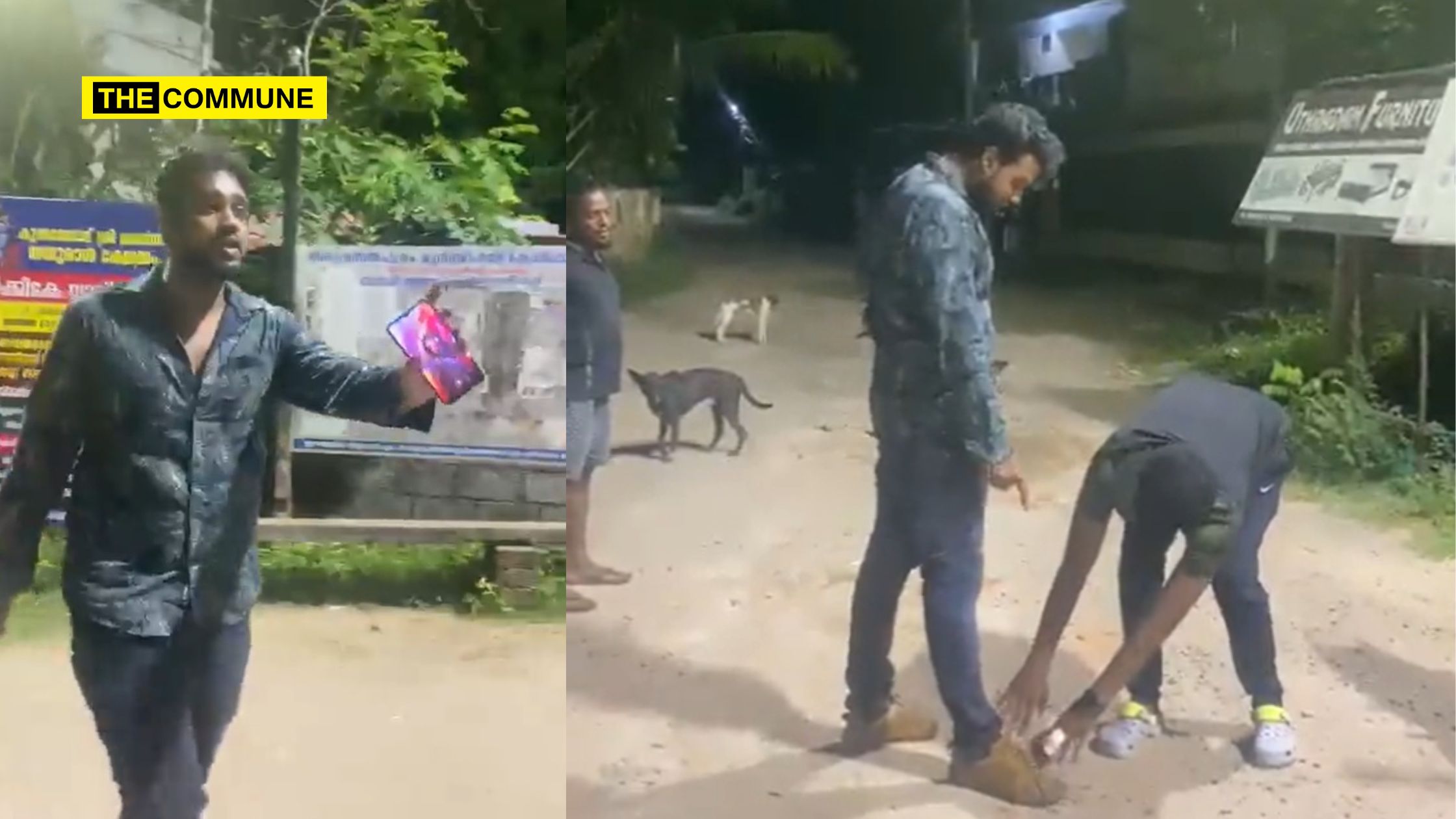
During a clash between two rival gangs, Dani, son of Airport Sajan, a CPI-M leader, encountered a youngster. The original intention was to physically assault the youngster, but upon the youngster’s arrival, Dani decided to alter his approach.
Warning ⚠️ Abusive Language!!!
Meet Mr Danny, Son of CPM Gunda Sajan who is busy with his true communist character!! After checking their mobiles, He is insisting the local boys to kiss his feet !!! This is the level of fascism the ruling party leaders carry in Kerala.. Most… pic.twitter.com/KeJVC5N72j
He intercepted the youngster and confiscated the bike key and phone he was carrying. Then, he demanded the youngster to touch his feet several times and later compelled him to kiss his feet while abusing him verbally. He said, “You shouldn’t have don’t this f* thing to me. Come on touch my feet you m*****f*****, you slut kiss my feet!”.
After the youngster did what he was told to, Dani returned the phone and keys to the youngster. The video capturing the incident was recorded by Dani’s gang and later shared on social media. Along with the footage, there are also accusations circulating about a police officer who is suspected of aiding the gangs. The incident, which occurred close to the Secretariat, has caused concern among Thiruvananthapuram residents. There are serious allegations pointing toward the influential police officer’s involvement and support for the gangs, especially given their ties to the ruling party.
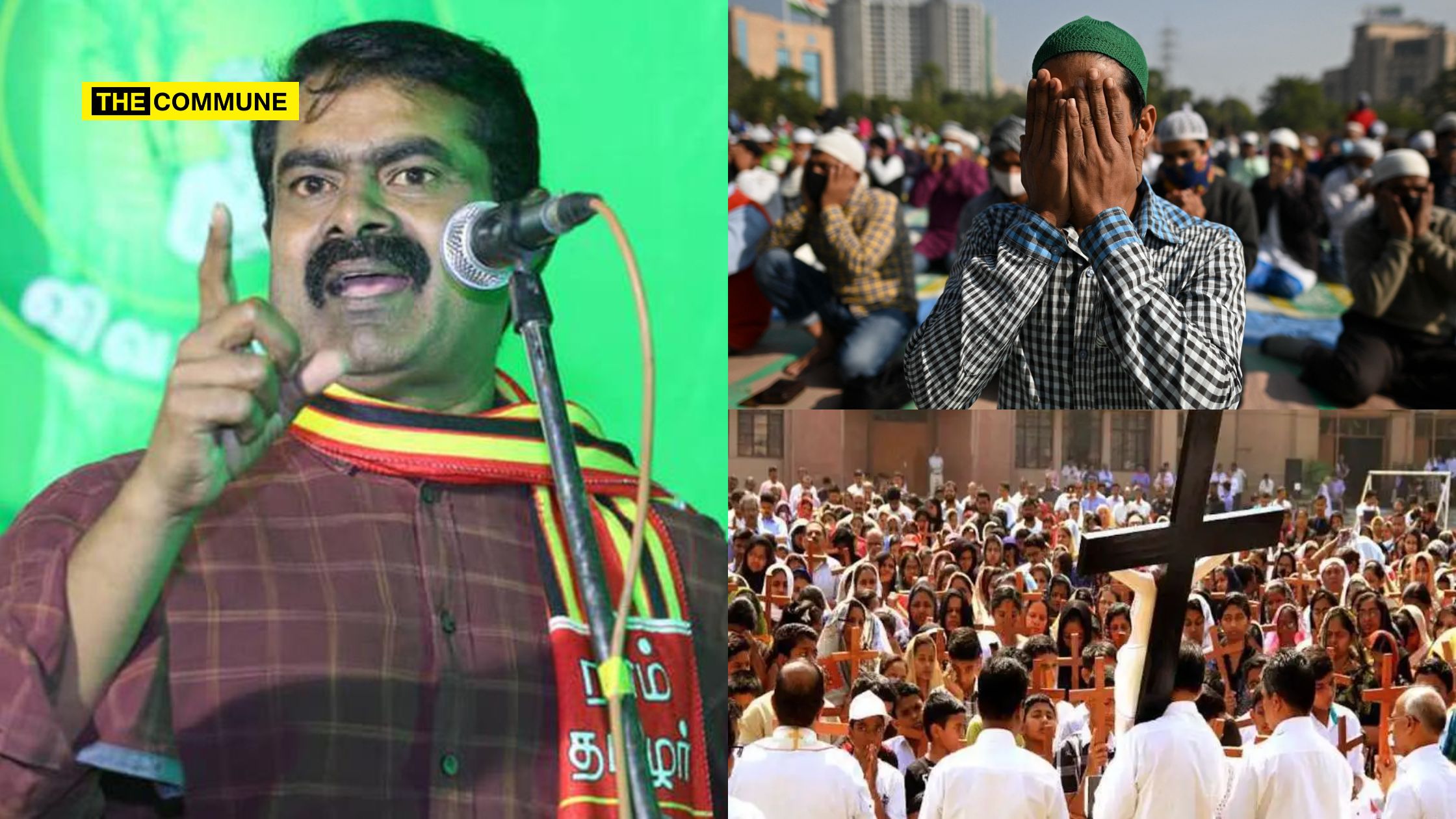
Naam Tamilar Katchi’s fiery leader, Seeman, has once again found himself at the center of a heated controversy following his recent statements regarding Christians and Muslims in Tamil Nadu. Seeman’s incendiary remarks have drawn sharp criticism from various political quarters, and his attempt to clarify his stance seems to have further fueled the fire.
The controversy began a few days ago during a protest condemning violence in Manipur when Seeman called Christian and Muslim voters as “children of Satan” castigating their voting patterns, particularly their support for Congress and the DMK. Unsurprisingly, his statements were met with swift condemnation from the DMK and its allies, including demands for an apology from Manithaneyam Makkal Katchi Chief M. H. Jawahirullah.
However, instead of offering an apology, Seeman remained defiant, stating that he wouldn’t apologize for his comments. He questioned whether the minorities would vote for him even if he did apologize, claiming that they had not supported him in the past and were unlikely to do so in the future.
In an apparent attempt to regain some ground and woo minority communities, Seeman took a defensive stance on 3 August 2023. He asserted that he would use a slipper to hit anyone who referred to Christians and Muslims as minorities. Seeman contended that both communities were integral to Tamil Nadu, hailing them as “sons of the soil” who were true Tamils. He clarified that his ire was directed only at those who supported the DMK and Congress, not at the entire Christian and Muslim communities.
Seeman went on to praise Christianity and Islam, portraying them as religions born to fight against injustice. He quoted Palani Baba (A Muslim extremist), who called Islam and Christianity a revolution against injustice, rather than a religion per se.
Regarding his earlier controversial remarks, Seeman claimed that his anger stemmed from the minorities’ consistent voting for the DMK and Congress, even though he contested in multiple elections without receiving their support.
Shifting the focus to Tamil identity, Seeman highlighted the importance of language over religion in shaping the destiny of nations. He stressed that Christians and Muslims in Tamil Nadu were Tamil at their core, asserting that people could change their religion but not their race.
In a tangent, Seeman also questioned the presence of Inbanidhi, the son of actor Udhayanidhi Stalin, at government functions, questioning whether Tamils had become subservient to the Karunanidhi family.
Seeman’s latest statements have only intensified the controversy, with political leaders and civil society expressing concern over the potential polarizing impact of his rhetoric.
Click here to subscribe to The Commune on Telegram and get the best stories of the day delivered to you personally.
Karnataka Minister of Information Technology and Rural Development, Priyank Kharge of the Congress, has been embroiled in a controversy following his recent comments on migration of people from Uttar Pradesh to southern part of India for job opportunities. In his remarks, Kharge allegedly denigrated the social infrastructure of north Indian states, sparking criticism from various quarters.
Congress after winning Karnataka wants North vs South divide for Poltics.
Congress leader @PriyankKharge insults UP, MP and whole Hindi Heartland.
Rahul Gandhi did Bharat 'Jodo' Yatra, kept alliance name I.N.D.I.A but this is its real face.
Kharge in his remark said, “Have you ever heard any Kannadiga say I am going to Uttar Pradesh for a job? I will show you how many people from UP and Madhya Pradesh are there in Karnataka. They come here because of the ecosystem. The Hindi heartland thinks that they can come to South India and earn a livelihood. Nobody from the South thinks they can go to the Hindi heartland and earn a livelihood because of the social infrastructure there.”
Kharge’s comments are typical of those peddled by his Dravidian Stock allies in Tamil Nadu, who often resort to belittling migrant workers from states like Uttar Pradesh, Bihar, Odisha, Jharkhand, West Bengal, etc who come to southern states to eke out a living.
Kharge’s comments have ignited a fierce debate, with many accusing the Congress Minister of resorting to divisive tactics and indulging in regional politics. Critics have raised questions about the Congress party’s rule at the center for over six decades and how Kharge’s remarks reflect on its governance and approach towards national integration.
The Karnataka Congress Minister’s statements were deemed unwelcoming and unbecoming of a national party member. Instead of promoting unity and inclusivity, Kharge’s comments seemed to take a dig at Indian states in the north of India and their social structure, further adding fuel to the fire of regionalism.
Moreover, Kharge’s factual inaccuracies have been called out, as it is observed that migrants from various states predominantly converge in Bengaluru, not throughout Karnataka. Several parts of the state, excluding Bengaluru and Mysuru, continue to grapple with underdevelopment and inadequate infrastructure.
One such region is Kalaburagi, a district in North Karnataka considered a bastion of the Kharge family’s political stronghold for 65 years under the Indian National Congress’s rule. Priyank Kharge is an MLA from Chittapur constituency.
Despite this long-standing association, the district remains plagued by underdevelopment, with 18.63% of the population classified as multidimensionally poor by the National Family Health Survey (2019-21), ranking it third among the poorest districts in Karnataka, behind Yadgir and Raichur.
The NITI Aayog National Multidimensional Poverty Index 2023 gives plenty of insights into the details of each of the states. Here is some information from the report for Karnataka.
Source: NITI Aayog
The average income in Bengaluru Urban region is five times higher than the average income in Kalaburagi, which stands as the poorest district in Karnataka with a per capita income of ₹1.2 lakh in FY22 as per the Karnataka Economic Survey 2022-23. It appears that the more affluent districts of Karnataka experience faster economic growth compared to the less prosperous ones.
Source: Karnataka Economic Survey 2022-23
The report states that Kalaburgi revenue region (comprising Ballari, Bidar, Kalaburgi, Koppal, Raichuru and Yadagiri districts), stood lowest in the per capita income followed by Belagavi and Mysore divisions due to less presence of industries and services sectors in these regions indicating a dire need for development of industries and services in these regions.
Source: Karnataka Economic Survey 2022-23
In Bengaluru Urban, the agriculture sector’s contribution to its GDP is only 0.5%, while in all other districts, agriculture constitutes at least 10 per cent of the GDP. However, in Yadgir, one of the poorest districts, agriculture makes up about 50% of the GDP.
The Karnataka Economic Survey 2022-23, Bengaluru Urban district accounted for 35.6% of the state’s GDP in 2021-22, reflecting its significant contribution to the total value of final goods and services in the state, followed by Dakshina Kannada (5.7%), Belagavi (4.2%).
Source: NITI Aayog
Before the launch of PM Modi’s Jal Jeevan Mission, only 15.06% households had a tap water connection. Now it has increased to 60.45%.
It is to be noted that barring 1998 and 2019, it was the Congress which had held this constituency. Priyank Kharge’s father and the so-called Congress President Mallikarjun Kharge was the MP of Kalaburagi from 2009 to 2019. Yet, the people of the region are getting as basic as tap water and bank accounts only now.
Critics argue that Kharge’s own constituency and political domain should be the primary focus of development, rather than making unwarranted comments about labor migration from other states. They point out that the lack of opportunities and development in North Karnataka, coupled with political leadership, has contributed to locals seeking employment in other states, including major cities like Mumbai and Hyderabad.
Prank minister Sorry Troll Minister Your family is ruling North Karnataka since 5 decades And the highest labour migration from Karnataka happens from these districts People from Kalaburgi and Bidar go to mumbai, hyderabad as coolies, construction labour and low wage workers… pic.twitter.com/SKuIytf8L4
Kharge’s apprehensions about labour migration from Uttar Pradesh and Bihar to Karnataka have been met with further scrutiny, as critics remind him of his alliance partners’ political reign in those states. They urge Kharge to address the issue within the context of collaborative efforts with leaders like Akhilesh Yadav, Nitish Kumar, and Lalu Yadav.
It has also been pointed out that the presence of people from various states in tier-1 cities is not an anomaly, as cities like Mumbai and Delhi also demonstrate diverse migrant populations. Thus, the claim of a lack of social infrastructure in North Indian states has been contested as factually incorrect.
Notwithstanding Kharge’s remarks, it should be acknowledged that Uttar Pradesh has demonstrated remarkable economic growth in recent years, shedding the label of a “BIMARU state.” The impressive 16.8% GDP growth in 2022-23, surpassing the national average, reflects improved law and order and increased foreign investments.
In light of the mounting criticism, Priyank Kharge faces growing calls to reflect on the developmental needs within his own constituency and work towards comprehensive solutions for the betterment of the region. As a national party member and now a state Minister, responsible and inclusive political discourse should be at the forefront of his agenda, rather than indulging in divisive rhetoric and acting like a troll on social media, say many.
Kaathavaraayan is a columnist and political commentator.
Click here to subscribe to The Commune on Telegram and get the best stories of the day delivered to you personally.
The Madurai bench of the Madras High Court issued a directive to the Tamil Nadu government’s Hindu Religious and Charitable Endowments (HR&CE) department to reinstate the banner that stated, “Only Hindus are allowed,” within the Pazhani Dhandayudhapani Swamy temple. The court made this decision while responding to a Public Interest Litigation (PIL) filed by a Hindu activist. Emphasising that removing the notice board could lead to unnecessary controversies, the court promptly ordered the authorities to maintain the notice board in its original location.
A few days ago on 22 June 2023, a controversy arose when a Muslim family expressed their desire to visit the temple. The temple staff allegedly attempted to retrieve the tickets issued to the Muslim women in the family who were wearing burqas for Darshan. Subsequently, a heated argument ensued between the Muslim family and the temple staff. Shortly after this incident, the banner at the entrance of the temple, which stated that only Hindus are allowed, was removed.
Upon learning about the removal of the banner, several pro-Hindu organizations converged at the administrative office of the Pazhani temple. They engaged in discussions with the temple authorities and demanded that the banner be reinstated.
According to reports, the Tamil Nadu government’s Hindu Religious and Charitable Endowments (HR&CE) department removed the banner stating that only Hindus are allowed at the entrance of the Pazhani Murugan temple following opposition from a Muslim family.
In a petition that was presented for hearing before the judge at the Madurai Bench of Madras High Court. Advocate Arun Swaminathan, representing the petitioner, argued that Section 48 of the Hindu Charities Act, 1947 clearly prohibits non-Hindus from entering Hindu temples. Therefore, the advocate insisted on maintaining the ban on non-Hindus entering the Pazhani temple. The advocate also requested the re-installation of the “no entry” banner for non-Hindus at the same location.
In response, the judge questioned the removal of the banner that prohibited non-Hindus from entering the temple. Further, the judge ordered the restoration of the banner at the same place. The case hearing has been adjourned for two weeks.
HR&CE Minister Sekar Babu announced his intention to appeal against the High Court order. In response to this development, temple activist TR Ramesh took to Twitter to say that he will intervene in the matter to safeguard the interests of the temple.
The Minister for @tnhrcedept ‘s announcement that he will appeal against the order of a learned Single Judge that only Hindus shd be allowed in Palani Temple – is against temple traditions & TN Temple Entry Authorisation Act. I will intervene in this case to safeguard temple. pic.twitter.com/aI3XnnkhVc
Tamil Nadu Bharatiya Janata Party President K Annamalai, as a part of his ‘En Mann En Makkal’ Padayatra was speaking to an audience in Aranthangi in Pudukottai district in Tamil Nadu.
ரேஷன் கடையில் ஸ்டிக்கர் ஒட்ட உங்க போட்டோவ வைக்குறீங்களே, டாஸ்மாக் கடையில் போய் உங்க போட்டோவ ஒட்டுங்க – அறந்தாங்கியில் தலைவர் @annamalai_kpic.twitter.com/MFU81a1Q0K
Addressing the audience, Annamalai raised concerns about the Chief Minister’s actions, claiming that he puts his sticker on central government schemes implemented in the state. “Whatever schemes that PM Modi has given, our CM here will put his sticker on it,” Annamalai stated, highlighting what he perceived as an attempt to take undue credit for initiatives funded predominantly by the central government.
He said that the central government contributes ₹33 and the state government contributes ₹2 per kilo of rice sold at the ration shop. So in total, a kilo of rice costs ₹35. Allegations of corruption were also made, with Annamalai claiming that officials at these shops demand commissions of ₹6 per kilo of rice, further burdening the citizens.
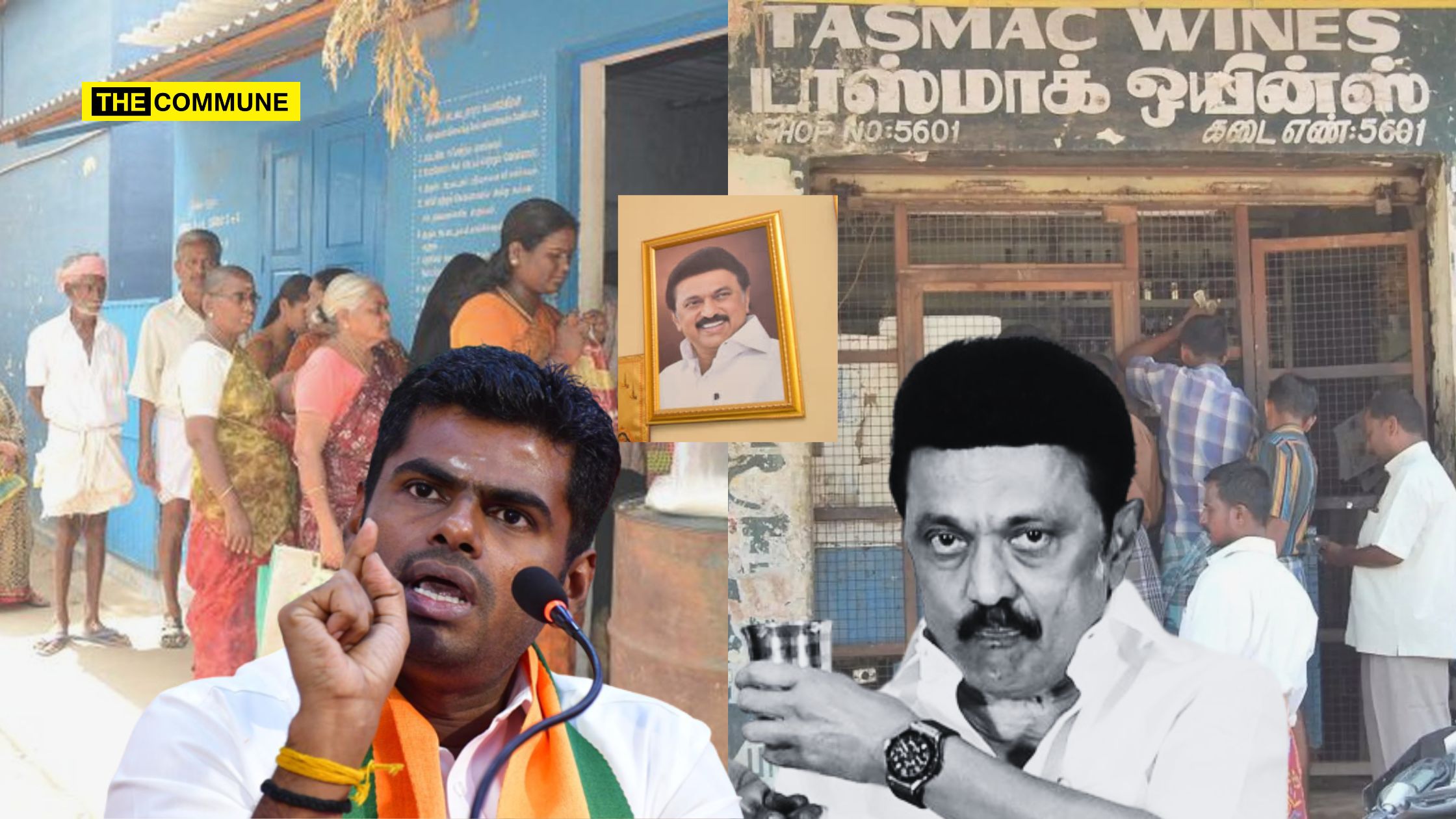
Taking a swipe at the Chief Minister’s approach, Annamalai questioned the presence of the Chief Minister’s large photographs at ration shops while criticizing the lack of similar branding at TASMAC outlets which is a state government undertaking, where alcohol is sold. “If they (DMK government) don’t do it, we (BJP karyakartas) will do it on their behalf. There should be the CM’s photo at TASMAC outlets too,” Annamalai remarked, suggesting that the CM should take responsibility for promoting alcohol consumption as well.
He also questioned, “When you can put your sticker/face on schemes funded almost 99% primarily by the central govt (PM Modi), why not place your photo as someone who encouraged drinking?”
“This is also an example of how the Dravidian model government functions,” he said.
Click here to subscribe to The Commune on Telegram and get the best stories of the day delivered to you personally.
MV Govindan, Kerala State Secretary of the CPI (M) held a press conference on 2 August 2023 regarding the controversial statements made by Assembly Speaker AN Shamsheer. According to Govindan, the Left party does not harbour any hostility towards any religion or belief system. They have consistently regarded both believers and non-believers as integral members of society. However, Govindan accused the ruling BJP at the Centre of attempting to impose a saffron hue on various aspects, including history.
He said, “India is a democracy and as per the constitution, any believer, whether he is a Hindu, Christian, Muslim, Parsi or sikh or even if he is an atheist (non-believer), everyone has equal rights. Even our first PM was a rationalist/realist. Unlike Modi who is doing the foundation ceremony of Ram temple or even recently placing Sengol in parliament.” He even suggested that the journalists read Nehru’s books, ‘Discovery of India’ and ‘Glimpses of World History’ to understand better.
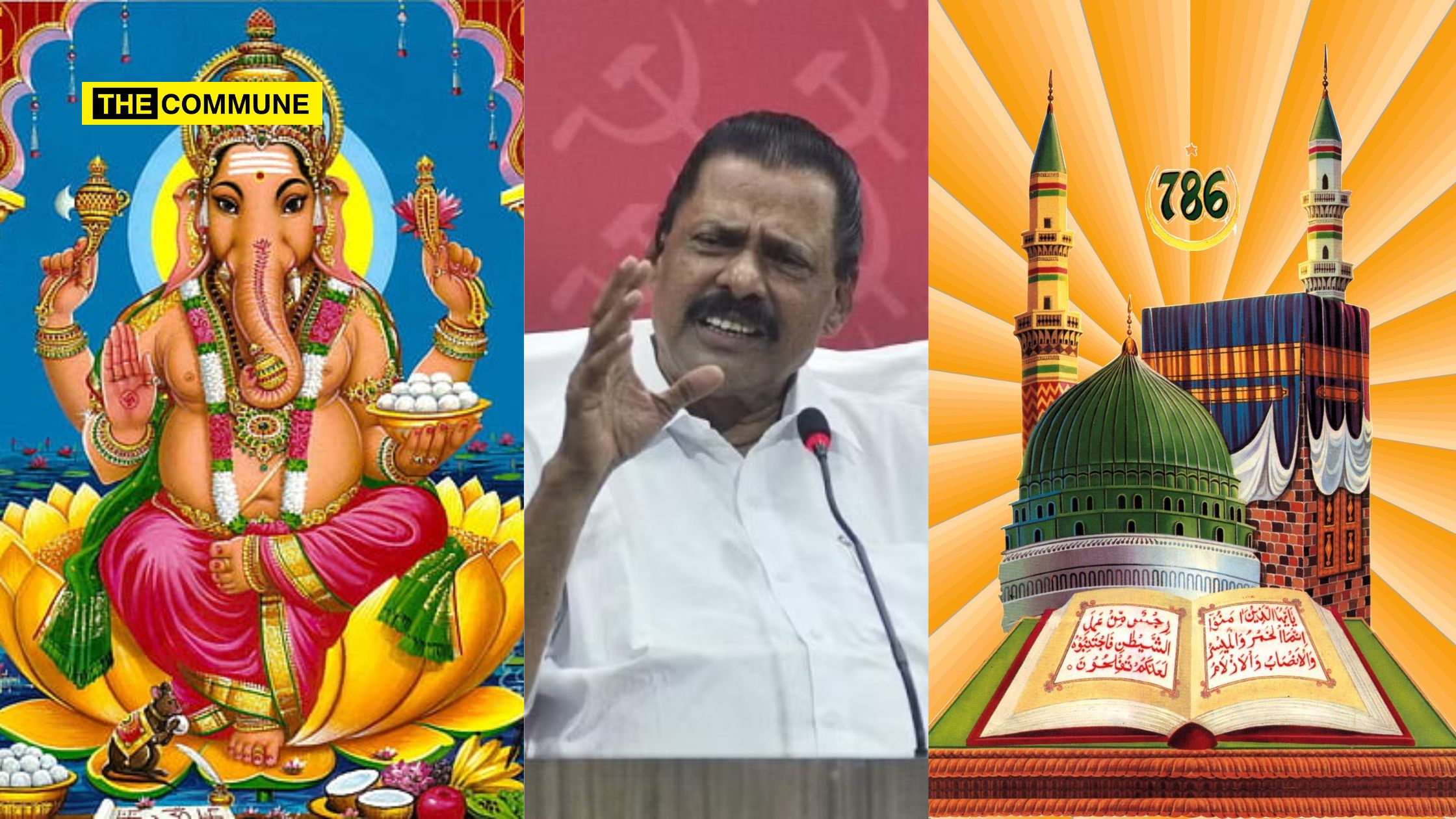
Govindan asserted that the statement regarding Lord Ganesha and plastic surgery was not initially made by Shamseer but by PM Modi himself during the launch of Reliance Hospital in Mumbai in 2014. He said Modi had stated that it is likely that Lord Ganesha’s head was reattached by a plastic surgeon.
Govindan said, “There are many myths floating around. For example, Dashavatar’s prominent avataram, which is connected to Kerala – Parashurama. It is said that when he threw his axe, it landed in Kanyakumari, so the region between Kanyakumari and Gokarna which was a sea, became land and that is Kerala. There is another myth that this land was given to Brahmins. Do you think Kerala was formed only then? Kerala has been in existence for 1000s of years before Brahminism even came to exist.” There is a book written by Chattapi Swamigal that busts this myth.
He also said that the Hindutva ideology was responsible for what is happening in Manipur, what happened in Gujarat, and now in Haryana. He blamed the RSS, BJP, and even the Congress.
When asked if Shamseer will apologise or retract his statements, Govindan said, “Shamseer will not apologise nor will he retract/rephrase his statements because there is nothing wrong in what he said. When the country is progressing forward in this day and age, their ideologies are bringing it backward and we are against it.”
“Such propaganda is wrong. Myths should be treated as myths, history as history, and science as science. You cannot move forward by rejecting science. Our party has people from all faiths, we do not discriminate based on that”, he said.
When a reporter asked whether he thought Lord Ganapati was a myth, he replied saying, “Is ganapati science then? Let us look at myths as myths only. The formation of Kerala is also a myth, right? We are not against believers.”
Journo: Is lord Ganesha a myth? CPM Secretary Govindan: Yes ofcourse!
Journo: Is Allahu a myth? Govindan: I didn't say all Gods are myths. Unlike Hindus, Muslims doesn't have 1000s of Gods. They believe in a higher concept single God!
When another reporter asked if Allah was a myth, he replied saying, “What I said was that all beliefs of believers are not a myth. There are plenty of myths, like I said, the formation of Kerala is also one. Believers can follow their beliefs. They could consider things divine that are presented as divine. We don’t question it. There are myths and those that are not,” he added.
Govindan expressed his criticism of the Leader of Opposition, V D Satheesan’s statement. Satheesan had earlier said that the Speaker’s statement could be misused as a tool by communal forces, and he suggested that it should be rectified or corrected. Govindan alleged that there are deliberate attempts to reshape historical narratives. He suggested that this rebranding of history was being manipulated for political gains in the upcoming 2024 Lok Sabha election. Govindan also accused the BJP of making use of the NSS’ (Nair Service Society) position for political purposes.
Click here to subscribe to The Commune on Telegram and get the best stories of the day delivered to you personally.
Nuh district of Haryana is in the news due to the rioting and violence that was started by a Muslim mob when a Viswa Hindu Parishad-led Shobha yatra on Shravan Somwar was taking place in Nuh, Haryana on 31 July 2023.
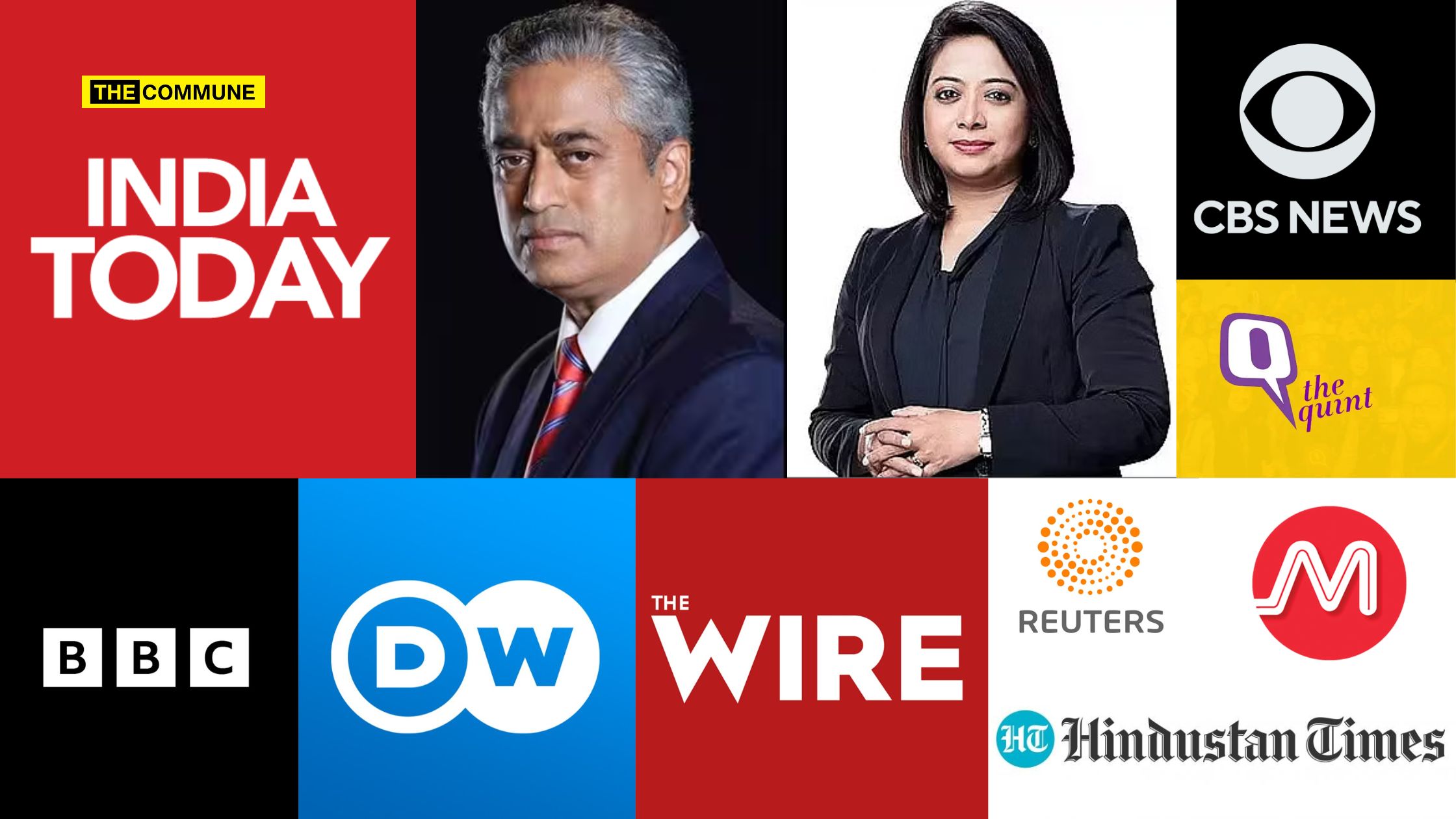
The violence which is allegedly premeditated as reported here indicates the extent of planning done before the event. It is very clear from the videos that emerged from the scene as to who was behind the attack. However, media channels from all around the world chose to report it differently. We try to explore the various headlines published in several major news media.
International Media
Maktoob Media called it “clashes that broke out during VHP rally”. In their news report, they clearly mention only the VHP and the procession and “reported” as if the violence broke out just like that. Maktoob Media was credited by BBC in a banned documentary which was perceived as a smear campaign against PM Modi.
Maktoob Media was one of the Indian publications credited by BBC for its documentary which was a smear campaign against India’s majority and government elected by it. This is how they have reported today’s violence in Nuh-Mewat –
CBS News reported the happenings by stating that “the violence started after right-wing Hindu groups, Bajrang Dal and Vishwa Hindu Parishad, led a religious procession through a Muslim-majority part of Haryana’s Nuh district.”
Report on today’s attack on Shobha Yatra in Nuh-Mewat by @CBSNews – Hindus triggered violence by taking their religious procession though a Muslim-majority area pic.twitter.com/8AuIxc2k2g
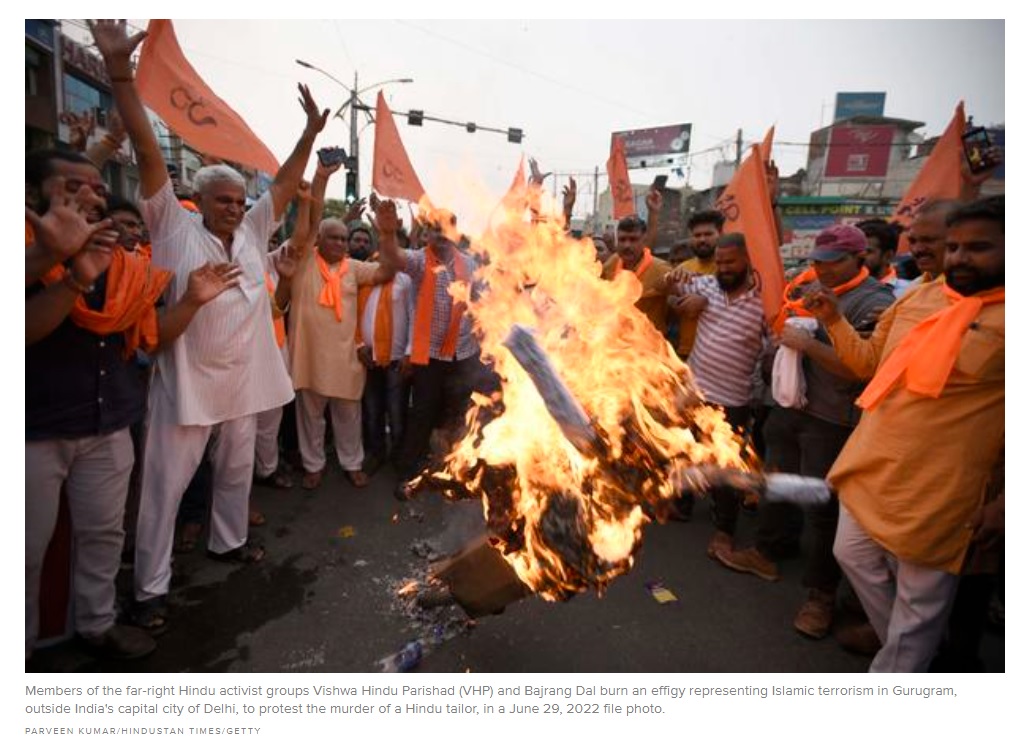
This report appears to imply that the violence against the yatris was somehow justified simply because they entered a Muslim-majority area. The article has a photo of people clad in saffron burning an effigy and this is from an incident in June 2022.
Source: CBS News
The only picture used in the story is of saffron-clad Hindus being aggressive.
This whitewashing of minority extremism is happening in the Internet age when videos are available for all to see pic.twitter.com/fUNkM3cehG
The BBC reported this violence in a similar fashion. It only highlighted the news that “Mosque set on fire, cleric killed in Indian state” and the violence broke out during “a procession by hardline Hindu nationalist groups” going by the same playbook as its counterparts.
The vocabulary of coverage of violence on a Hindu procession is typically such that Hindus end up being demonised in all aspects pic.twitter.com/WZC3yXZQyi
Reuters reported it as “clashes between Hindus and Muslims”.
Source: Swati Goel Twitter/Reuters website
These are reports by @Reuters, @BBC, @CBSNews and @dwnews. The same template coverage in all reports – that “clashes broke out between Hindus and Muslims”, real crime is “Hindu processions passing through Muslims areas”, “mosque torched and cleric killed”
They again highlighted only the fact that the mosque was burned down and that a cleric was killed and completely whitewash the horror faced by the thousands of yatris, men women, and children who had to take refuge in a temple to escape the stone pelting and firing by the Islamist mob.
DW News also follows the same template as the others.
Source: Swati Goel Twitter/DW News
The drop head reads “Communal violence has again flared up in northern India after a Hindu group marched through a Muslim-majority area in the Nuh district.”
Indian News Websites
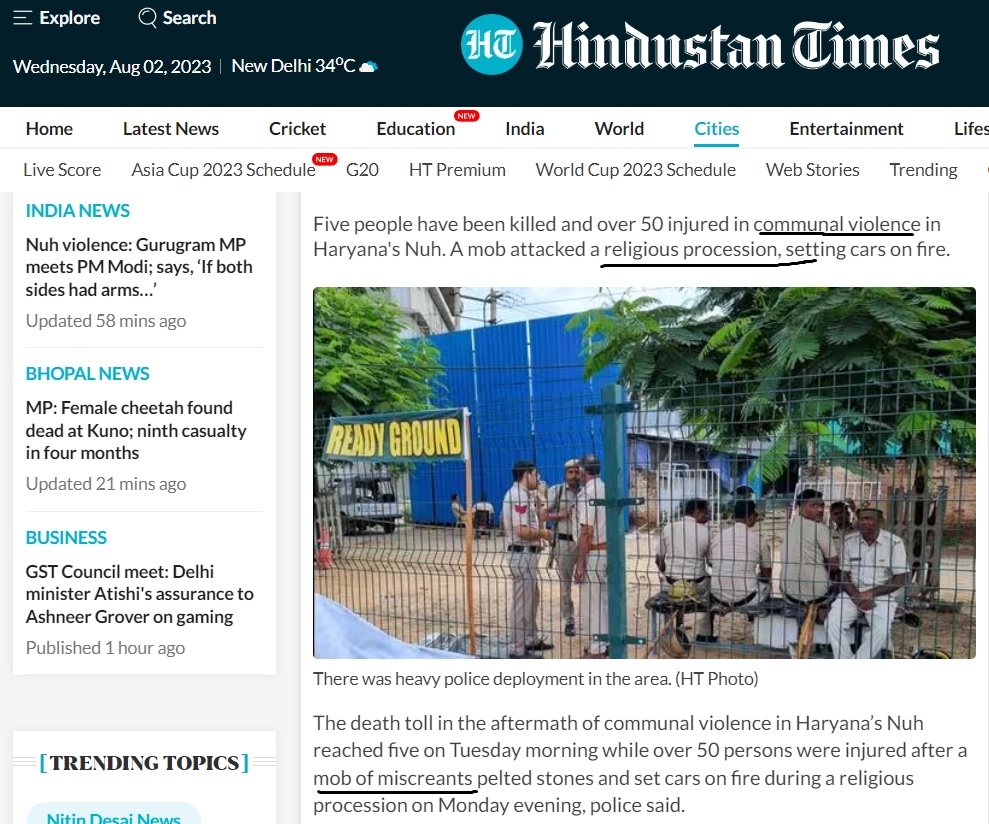
This Hindustan Times report makes it sound as if a nameless/faceless mob was responsible for all the violence that happened at Nuh when it was very clear who the perpetrators were. The details in this report only point to misdoings against the Muslim community.
Source: HT
What happened: A Hindu procession came under attack by majority community of almost wholly Islamised Nuh, part of Mewat region
How it has been reported by global and national newspapers like HT and Express: Violence erupted during a Hindu procession
In another report documenting how the violence unfolded, it sounds as if Monu Manesar’s intention to participate in the yatra was the reason, and that justified the planning of the violence.
Source: HT
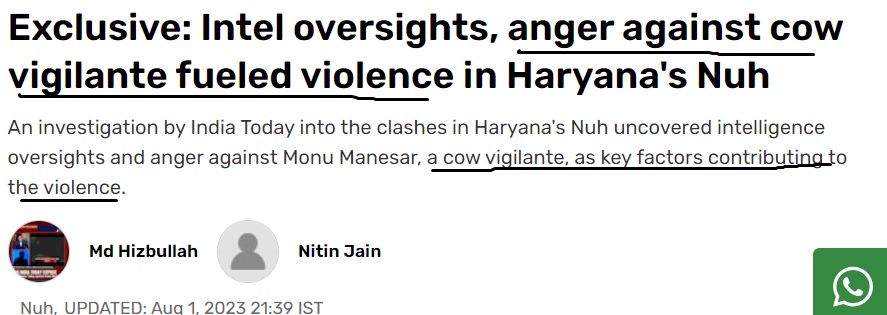
The same goes for India Today’s report, the cow vigilante was the key factor for the violence thereby making it sound justified.
Source: India Today
The Quint chose to share a video in their report with the video headline reading “.. How a Religious Procession Turned Violent” implying that it was the procession was responsible for the whole episode of violence and rioting.
In another report, The Quint talks about “Purported visuals have emerged from Badshahpur, where a mob is seen vandalising and setting fire to shops in the area. The incident took place at around 2 pm on Tuesday.”
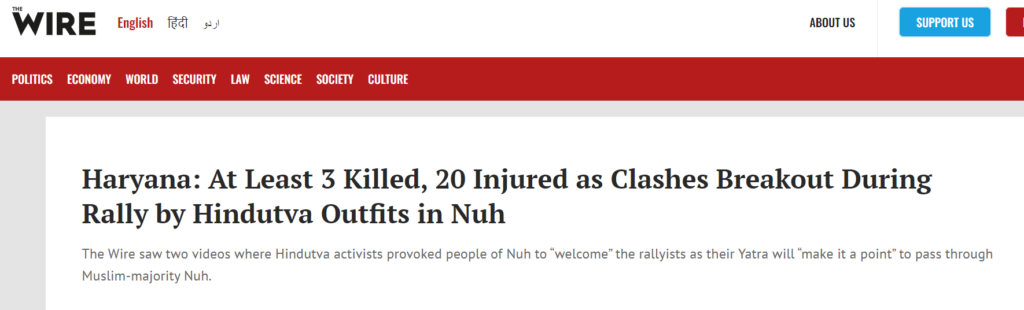
As expected, The Wire toed the line of its peers and reported the violence as “clashes that broke out during rally by Hindutva outfits in Nuh”.
The deck also claims, “The Wire saw two videos where Hindutva activists provoked people of Nuh to “welcome” the rallyists as their Yatra will “make it a point” to pass through Muslim-majority Nuh.”
Source: The Wire
Indian Journalists On Their Social Media Handles
Here’s how prominent journalists in India narrated stories about this incident. Here we have Rajdeep Sardesai, consulting editor of India Today.
In communal violence, it’s the poor who suffer the most. This man’s small roadside shop was burnt in Gurugram’s sector 66 this evening. Who will compensate him and many others like him across BOTH communities? Will the ‘mob’ who did this get away? And the key Haryana Qs: WHERE… pic.twitter.com/eMH6KK28T8
He selectively showcases a Muslim shop owner whose shop was burnt during the riots when the truth is that shops of both communities were burnt down by the rioters.
A Twitter user replied with screenshots of various victims of the riots.
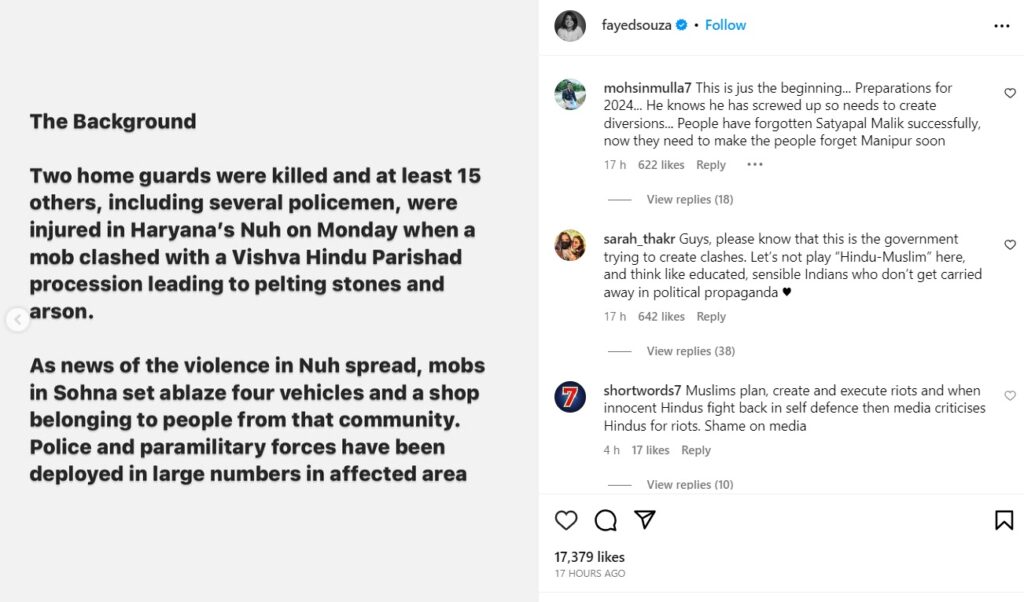
Another journalist, Faye D’Souza, took to her Instagram to post about the violence in Nuh. She follows the same template as her peers and highlights only the fact that the procession was attacked by a “mob”.
Source: Faye DSouza Instagram
A Twitter user pointed out how the “mob” she was describing had no religion.
Another Twitter user pointed out how she highlighted the name of the organisation Vishwa Hindu Parishad that she mentioned in her post that the nameless mob attacked.
Unnamed "mobs" clashed with "Vishwa Hindu Parishad" procession.
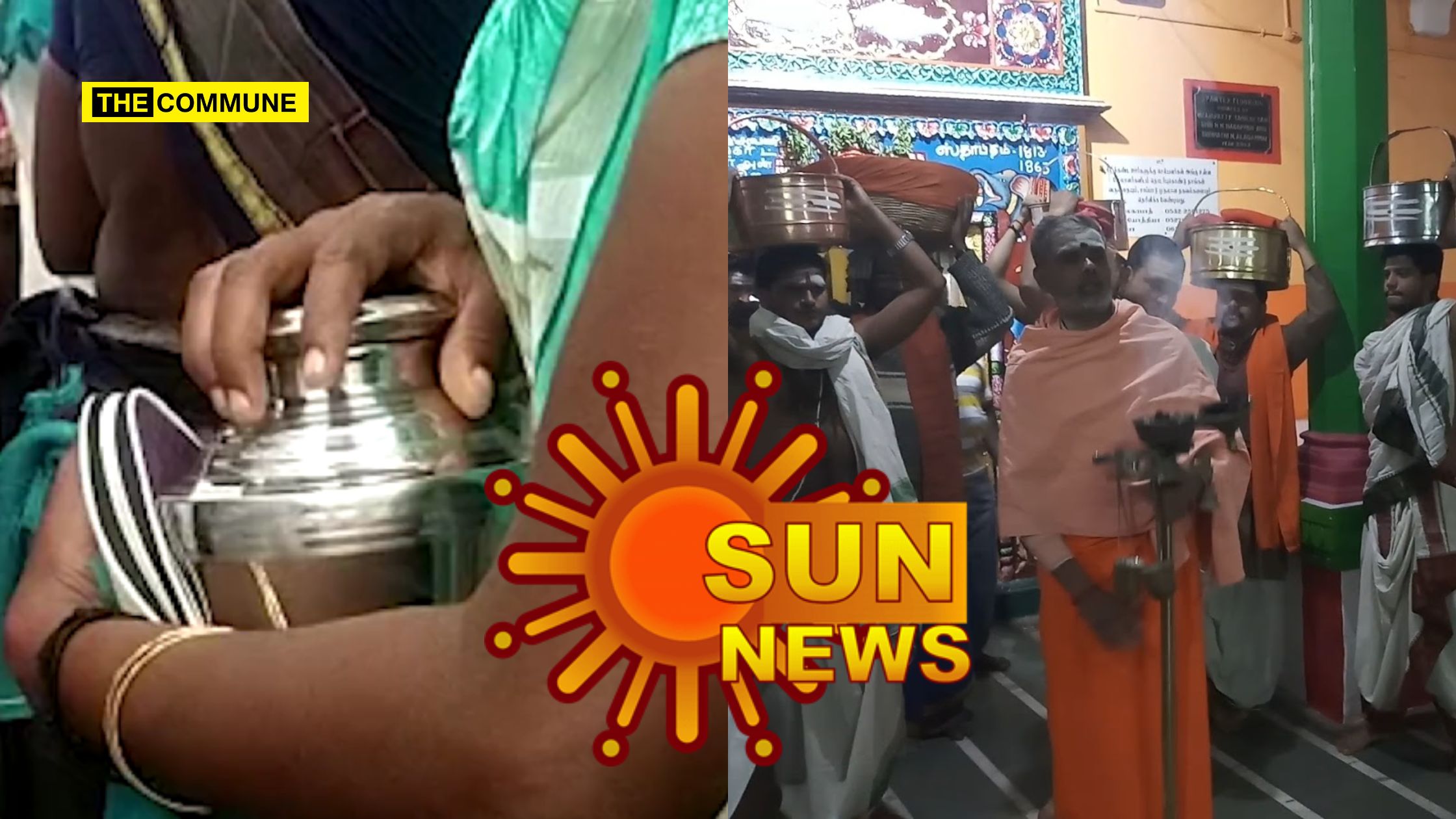
The Sun News channel’s Twitter (X) handle shared a video claiming that people are clamouring for pots to welcome Tamil Nadu Bharatiya Janata Party (BJP) leader K Annamalai at Karaikudi on 1 August 2023.
Sun News claimed that the pots (ordinary) were being distributed among the public to welcome Annamalai and that there was a shortage hence people clamoured for them and there was a commotion.
In reality, according to sources close to Annamalai, the pots (kalasa sombu) were actually used for the Nagarathar Sambo Puja at Kashi and were brought to Karaikudi to be distributed among the people in memory of the Kashi Nagarathars (a community), during Annamalai’s yatra at Karaikudi.
காசியில் இருக்கும் நகரத்தார் சம்போ பூஜையின் போது உபயோகித்த கலச கும்பங்களை காரைக்குடியில் காசி நகரத்தாரின் நினைவாக இன்று காரைக்குடியில் தலைவரின் யாத்திரையின் போது விநியோகம் செய்யப்பட்டதை உண்மைக்கு மாறான செய்தியை வெளியிட்டுள்ள கேடுகெட்ட சன் நியூஸ். https://t.co/cFHPDl3AHc
Nagarathars are a Tamil community (Nattukottai Chettiars) who perform pujas at Kashi Vishwanath Temple on a daily basis. Since the 1820s, they have been conducting Trikaala poojas daily. These Trikaala poojas are held at 4 AM, 11.30 AM, and 9 PM, and remarkably, they have been performed continuously for the past 150 years (and more) without any interruptions. Even during challenging times, such as the curfew imposed during the Quit India Movement in 1942, the poojas were granted special permission to proceed. It is said that at 10.40 AM and 9.30 PM each day, the milk for abishekam (a ritualistic bathing ceremony) and other pooja items are collected, accompanied by the chanting of “Sambo Shankara.” These specific timings hold special significance, as they are exclusively reserved for these rituals, with the other two poojas being owned by Nepal Maharaja and Kasi Maharaja.
However, Sun News chose to portray this as a commotion and clamouring for the pots. Some Twitter users did not show surprise claiming that it would be surprising only if Sun News reported the truth.
உண்மையை சொன்னால் தான் ஆச்சரியம்
— 𓄂𖤍Bhairavi Nachiyar𖤍 பாண்டிய நாட்டு இளவரசி 𓄂 (@Bhairavinachiya) August 1, 2023
Another user tweeted, “Sun News itself indicates it is a lie.”
During a school programme in Ernakulam on 21 July 2023 AN Shamseer, the Speaker of the Kerala Assembly, emphasised the promotion of science in the education sector over what he calls “myths”. He was responding to a question regarding the inventor of airplanes.
In his response, AN Shamseer stated that, according to his understanding, the Wright brothers were the inventors of the airplane. However, he also added that for those who adhere to Hindutva ideology, the first airplane is believed to be the Pushpak Vimana, a flying chariot mentioned in the Hindu epic Ramayana. He also mentioned that Hindutva ideologues promote the idea that Lord Ganesha acquired his elephant face through plastic surgery, which he dismissed as a myth. “They are promoting such myths in place of science,” said the Speaker.
Subsequently, a complaint was lodged by the BJP Thiruvananthapuram district Vice President, accusing AN Shamseer of insulting Hindu beliefs under the pretext of promoting “rational thinking”. The complainant emphasized that Shamseer’s remarks should be treated with gravity, as they were made in the presence of school children.
The complaint further asserted that cases should be filed under IPC section 153 (a), which pertains to promoting enmity between different religious groups, and section 295 (a), which addresses the act of insulting religious beliefs or religion.
In response to the incident, the Nair Service Society (NSS) announced its decision to observe Faith Preservation Day on 2 August 2023. The NSS strongly expressed its protest against Shamseer’s statements, urging the government to take decisive action and issue a sincere apology, retracting the remarks instead of downplaying the matter.
The programme for Faith Preservation Day required all NSS workers to visit the nearest Ganesha temple and present offerings as a symbolic gesture of preserving and honoring their faith.“Any behaviour that fosters religious rivalry is unacceptable. In this case, it is not right for him to continue in the post of Speaker of the Legislative Assembly. What should be done is that he should retract his statements and apologise to believers for hurting the religious sentiments. Otherwise, the state government is liable to take action against the Speaker,” Sukumaran was quoted as saying.
Previously, members of the Nair community staged a protest, and NSS General Secretary G. Sukumaran Nair participated in rituals at Vazhapally Temple in Kottayam. The NSS also declared plans for a march from Palayam Ganapathy Temple to Pazhavangadi Ganapathi Temple as part of their demonstration.
Speaking to reporters, Sukumaran Nair, when asked about the controversial remarks of Shamseer, replied, “That is foolish, who found out about it? These people say that if you go to heaven there are houries, who went to heaven and returned to tell them that there are houries in heaven? So commenting on that has no meaning.”
Nair Service Society (NSS) GenSec has used strong language against Shamseer and AK balan, demanded an apology AND subsequent govt action to ensure the religious insult is assuaged. pic.twitter.com/kSnuvAydEa
“People of the Hindu faith have lived in harmony with other religions in Kerala. When a person belonging to another community criticises our community, we cannot sit back. We will work against this with RSS and BJP if the need arises. This is about our belief system,” he said.
Sukumaran Nair also said anti-Hindu views are behind Shamseer’s remark. He warned that if Hindus are mocked, there will be harsh responses. Shamseer should apologise for his remark. “Faith is more important than science”, he said.
Other Hindu organizations like Sree Narayana Dharma Paripalana Yogam, Dheevara Sabha, and Yogakshema Sabha have condemned the remarks of Shamseer.
On August 2, 2023, Kerala Assembly Speaker AN Shamseer clarified that his comments on Hindu myths were not intended to target believers. “The Indian Constitution grants the right to believe and promote any religion. It also emphasises the duty of citizens to promote scientific temper. As someone holding a constitutional position, I simply echoed what the Constitution advocates. How can that be deemed a crime?” asked Shamseer during a press conference. He also added that “No one has the right to question my secular credentials”.
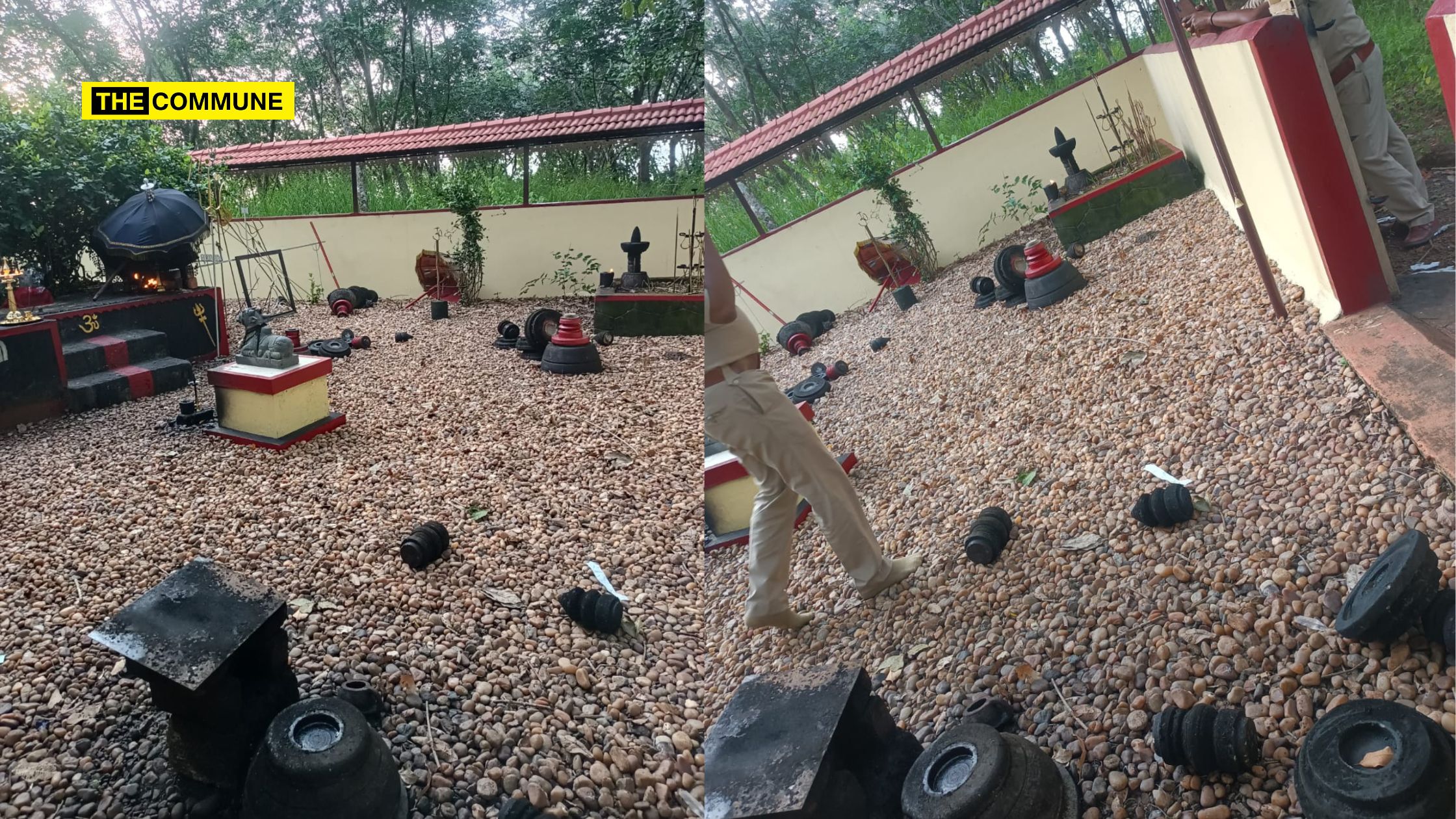
The serene atmosphere of Madhumala Moolasthana Malanada Temple was shattered when miscreants vandalised the sacred site. Aranmula police arrested a local resident, Pezhumkat Jose, in connection with the break-in and acts of destruction that occurred at the temple in Panchayat 4th ward.
The lamp around the temple was found destroyed and the tiles were also smashed. In addition, eight stone lamps were ruthlessly smashed by the culprits.
The shocking incident came to light when individuals who arrived at the temple on Monday, 31 July 2023, to install the lamp discovered the devastation. They promptly informed the Aranmula police, who immediately initiated an investigation. Fingerprint experts were called to the scene to gather evidence and assist in identifying the culprits.
The incident has sparked outrage among the local community, with members of Hindu Aikyavedi protesting against the violence perpetrated by anti-social elements on the temple premises. During the protest, Taluk President K Shashi, District Working President Raghavan Nair, Secretary Manoj Kojanchery, along with Mohandas, Hari Ilantur, and others participated in the protest.





Congress Minister Priyank Kharge’s Remarks About North Indian Migrant Workers And The Plight Of His Family’s Own Turf Kalaburagi
Karnataka Minister of Information Technology and Rural Development, Priyank Kharge of the Congress, has been embroiled in a controversy following his recent comments on migration of people from Uttar Pradesh to southern part of India for job opportunities. In his remarks, Kharge allegedly denigrated the social infrastructure of north Indian states, sparking criticism from various quarters.
Kharge in his remark said, “Have you ever heard any Kannadiga say I am going to Uttar Pradesh for a job? I will show you how many people from UP and Madhya Pradesh are there in Karnataka. They come here because of the ecosystem. The Hindi heartland thinks that they can come to South India and earn a livelihood. Nobody from the South thinks they can go to the Hindi heartland and earn a livelihood because of the social infrastructure there.”
Kharge’s comments are typical of those peddled by his Dravidian Stock allies in Tamil Nadu, who often resort to belittling migrant workers from states like Uttar Pradesh, Bihar, Odisha, Jharkhand, West Bengal, etc who come to southern states to eke out a living.
Kharge’s comments have ignited a fierce debate, with many accusing the Congress Minister of resorting to divisive tactics and indulging in regional politics. Critics have raised questions about the Congress party’s rule at the center for over six decades and how Kharge’s remarks reflect on its governance and approach towards national integration.
The Karnataka Congress Minister’s statements were deemed unwelcoming and unbecoming of a national party member. Instead of promoting unity and inclusivity, Kharge’s comments seemed to take a dig at Indian states in the north of India and their social structure, further adding fuel to the fire of regionalism.
Moreover, Kharge’s factual inaccuracies have been called out, as it is observed that migrants from various states predominantly converge in Bengaluru, not throughout Karnataka. Several parts of the state, excluding Bengaluru and Mysuru, continue to grapple with underdevelopment and inadequate infrastructure.
One such region is Kalaburagi, a district in North Karnataka considered a bastion of the Kharge family’s political stronghold for 65 years under the Indian National Congress’s rule. Priyank Kharge is an MLA from Chittapur constituency.
Despite this long-standing association, the district remains plagued by underdevelopment, with 18.63% of the population classified as multidimensionally poor by the National Family Health Survey (2019-21), ranking it third among the poorest districts in Karnataka, behind Yadgir and Raichur.
The NITI Aayog National Multidimensional Poverty Index 2023 gives plenty of insights into the details of each of the states. Here is some information from the report for Karnataka.
The average income in Bengaluru Urban region is five times higher than the average income in Kalaburagi, which stands as the poorest district in Karnataka with a per capita income of ₹1.2 lakh in FY22 as per the Karnataka Economic Survey 2022-23. It appears that the more affluent districts of Karnataka experience faster economic growth compared to the less prosperous ones.
The report states that Kalaburgi revenue region (comprising Ballari, Bidar, Kalaburgi, Koppal, Raichuru and Yadagiri districts), stood lowest in the per capita income followed by Belagavi and Mysore divisions due to less presence of industries and services sectors in these regions indicating a dire need for development of industries and services in these regions.
In Bengaluru Urban, the agriculture sector’s contribution to its GDP is only 0.5%, while in all other districts, agriculture constitutes at least 10 per cent of the GDP. However, in Yadgir, one of the poorest districts, agriculture makes up about 50% of the GDP.
The Karnataka Economic Survey 2022-23, Bengaluru Urban district accounted for 35.6% of the state’s GDP in 2021-22, reflecting its significant contribution to the total value of final goods and services in the state, followed by Dakshina Kannada (5.7%), Belagavi (4.2%).
Before the launch of PM Modi’s Jal Jeevan Mission, only 15.06% households had a tap water connection. Now it has increased to 60.45%.
It is to be noted that barring 1998 and 2019, it was the Congress which had held this constituency. Priyank Kharge’s father and the so-called Congress President Mallikarjun Kharge was the MP of Kalaburagi from 2009 to 2019. Yet, the people of the region are getting as basic as tap water and bank accounts only now.
Critics argue that Kharge’s own constituency and political domain should be the primary focus of development, rather than making unwarranted comments about labor migration from other states. They point out that the lack of opportunities and development in North Karnataka, coupled with political leadership, has contributed to locals seeking employment in other states, including major cities like Mumbai and Hyderabad.
Kharge’s apprehensions about labour migration from Uttar Pradesh and Bihar to Karnataka have been met with further scrutiny, as critics remind him of his alliance partners’ political reign in those states. They urge Kharge to address the issue within the context of collaborative efforts with leaders like Akhilesh Yadav, Nitish Kumar, and Lalu Yadav.
It has also been pointed out that the presence of people from various states in tier-1 cities is not an anomaly, as cities like Mumbai and Delhi also demonstrate diverse migrant populations. Thus, the claim of a lack of social infrastructure in North Indian states has been contested as factually incorrect.
Notwithstanding Kharge’s remarks, it should be acknowledged that Uttar Pradesh has demonstrated remarkable economic growth in recent years, shedding the label of a “BIMARU state.” The impressive 16.8% GDP growth in 2022-23, surpassing the national average, reflects improved law and order and increased foreign investments.
In light of the mounting criticism, Priyank Kharge faces growing calls to reflect on the developmental needs within his own constituency and work towards comprehensive solutions for the betterment of the region. As a national party member and now a state Minister, responsible and inclusive political discourse should be at the forefront of his agenda, rather than indulging in divisive rhetoric and acting like a troll on social media, say many.
Kaathavaraayan is a columnist and political commentator.
Click here to subscribe to The Commune on Telegram and get the best stories of the day delivered to you personally.