Home Blog Page 1176

DMK Govt’s Plan For Pen Statue Draws Flak As Govt Fails To Pay Salary Of Aided School Teachers 

The DMK government’s plans to erect a pen statue for the late DMK patriarch M Karunanidhi has drawn criticism from all quarters, even while the DMK government has delayed the payment of salary to government-aided school teachers in many districts, leaving many wondering where the money for the statue will come from when they don’t have money to pay salaries.

According to reports, the salaries of many Tamil Nadu government-aided school teachers in many districts have not been credited to their bank accounts for three days since the start of the month.

Many government-aided schools operate in the same manner as government schools throughout Tamil Nadu. The monthly salary is usually credited to each teacher’s bank account on the last day of the month.

However, government-aided school teachers in many districts have been affected as their salaries have not been credited to their bank accounts for three days since the start of this month. Protests have also been announced in some districts.

A government-aided teacher said,”Every month, the principals will post the salary list for the teachers on the Finance Department’s IFHRMS website. From the 16th to the 28th, they will upload it. However, the salary list of government-aided school teachers could not be uploaded after January 16. The Finance Department’s website refused to accept it. We immediately informed the education authorities about this. We have been insisting on this since the day this problem arose. They took no action. It is not known if there is a problem with the digital platform or if the government has not allocated funds.”

The teacher added,”Only the monthly salary we can cover the family’s expenses; in particular, the EMI for each bank loan taken. If the installments are not paid by the due date, penalties will be levied. Apart from that, every teacher has many problems including medical expenses. We have not received our salary this month, and we are very disappointed.”

It is noteworthy to mention what Tamil Nadu Finance Minister PTR Palanivel Thiagarajan who is also the Minister for Human Resources Development, had said on 2 February 2023 while speaking at an event on political strategy.

Answering a question whether it is fulfilling to be an economic expert or an MLA or a Minister, Palanivel Thiagarajan noted that while as MLA he was able to be transparent and communicate to the people about the work done, there are some constraints as a Minister.

“It is harder to measure the work done by an Opposition MLA. But at the same time, I was named in Junior Vikatan as a best performing MLA and in some awards ceremony I was honoured as one of the top 10 MLAs. Six months once, I went door-to-door, explaining the details about what I did and did not – how many schemes I fulfilled, where all the constituency development funds were spent, how many complaints were received and addressed. I was happy that I was able to bring in that kind of professionalism and transparency as an MLA. But today I have responsibilities as a Minister.”, he said.

Palanivel Thiagarajan further said “I have the exact opposite problem of being an MLA. Because, the results are coming out excellent. Far better than what I expected, with the support of my Chief Minister, we are able to bring reforms and bring out excellent outcomes. The only problem is…whatever we do, we take 100-200 initiatives, that is why the results are coming, nothing falls from the sky, nothing in life comes free like that. However, we’re not able to openly tell which initiatives, reforms, G.O, new systems, new restrictions, are bringing these outcomes. We’re not able to tell because we can achieve it only if we do it like inserting a pin inside a banana. If we tell openly, we will face a lot of opposition. We will face a volley of questions like ‘why is this happening?, these things should not be done,’ despite doing it democratically and the results showing up. Since we don’t want to create enemies unnecessarily, we’re underplaying it and going by the model of ‘let the results speak for themselves’.”

In this situation where teachers of government-aided schools are yet to get their salaries, the DMK government has announced plans to erect a pen statue for former Tamil Nadu Chief Minister Karunanidhi inside the sea. This has sparked public outrage, particularly given the Tamil Nadu government’s inability to pay the salaries of government-aided school teachers.

Social media users have also circulated information from the ‘White Paper on Finance of Tamil Nadu’ released by Tamil Nadu Finance Minister Palanivel Thiagarajan, who stated that every household in Tamil Nadu has a debt burden of ₹2,63,976. They questioned whether the pen statue was necessary given the state’s poor financial situation.

(With inputs from Vikatan)

Click here to subscribe to The Commune on Telegram and get the best stories of the day delivered to you personally.

Rabid Dravidian Stockist Journo Asks Brahmin Lady To Quit Media Industry Alleging Brahmins Are Overrepresented

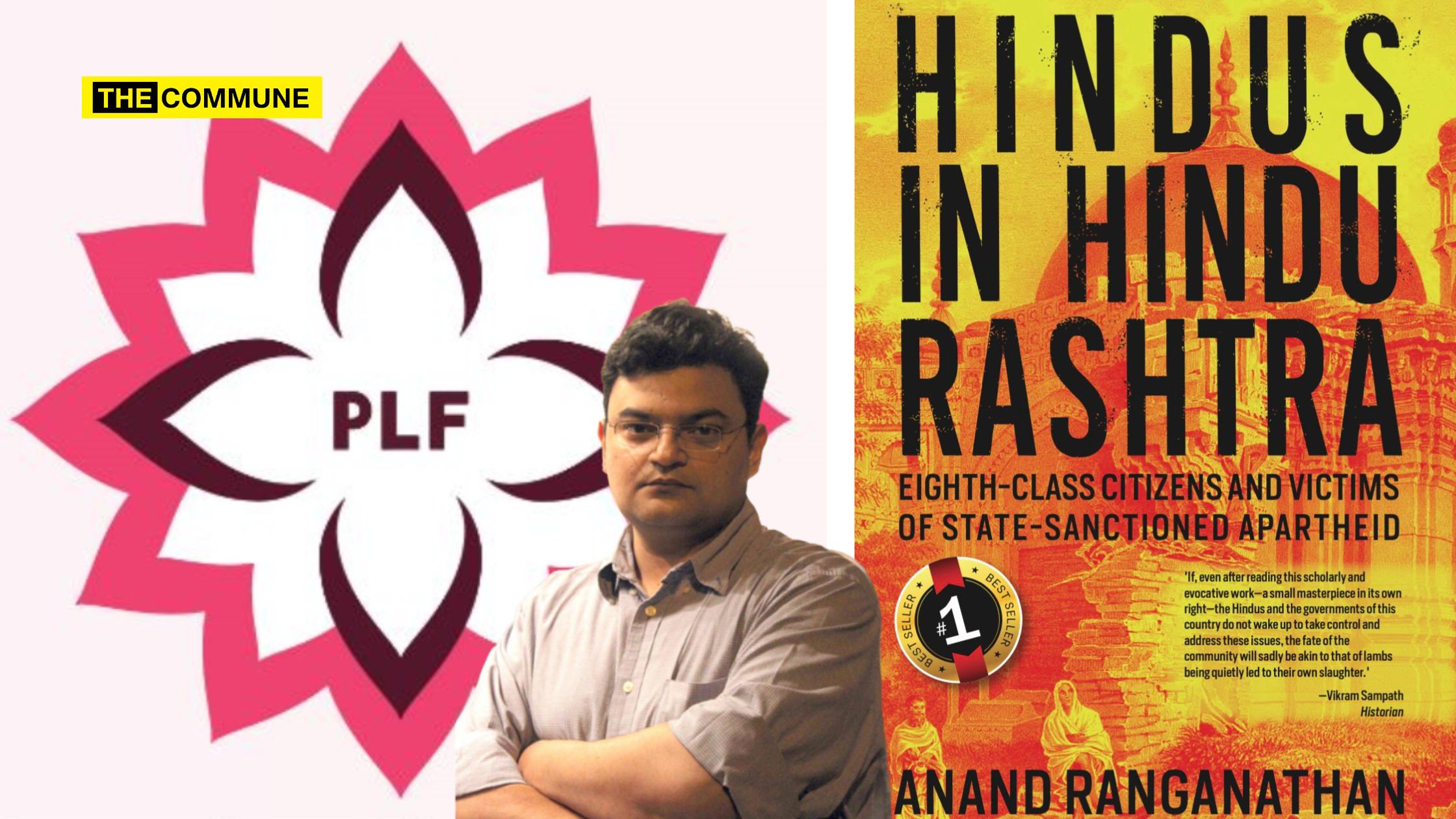
In yet another instance of spewing venom on the Brahmin, a Dravidian Stockist journalist known for anti-Brahmin verbal abuse has said that Brahmins should not enter the media industry alleging that they are disproportionately represented in journalism.

The video which went viral was shared by the director and actor Lakshmi Ramakrishnan, who was a guest on the Tamil Youtube channel run by one Karikalan who has peddled hate against Brahmins several times.

In the video shared by Lakshmi Ramakrishnan, the anchor Karikaalan can be heard saying, “All over India, 85% of the people who occupy the media industry are Brahmins. The data was released by Oxfam and Newslaundry.”

Karikaalan asked, referring to Lakshmi Ramakrishnan, a Brahmin, “Why did you enter the media industry when you are already a director, actor, and producer?”

Lakshmi Ramakrishnan, surprised to hear this question, inquired, “Are you asking why I entered the media industry?” Karikaalan replied, “Yes, I am referring to you (Brahmins). Why are you trying to rob others of opportunities by entering all fields? Let someone else (from a different caste) fill Lakshmi Ramakrishnan’s position in the media industry.”

Lakshmi Ramakrishnan wondered aloud, “Should I give up?” Karikaalan replied, “Yes, you should give up for others.”

Karikaalan further argued to Lakshmi Ramakrishnan,”Why don’t you give up, since your community has occupied the position for 2000 years?”

Lakshmi Ramakrishnan responded nonchalantly, “How can you tell me that I should not work in the media because I am of a certain caste? It is a ridiculous argument to ask me to leave the news industry because I am a Brahmin.”

Instead of asking questions to the guest, the Dravidian Stockist journo attempted to put his words and thoughts in the mouth of the guest, Lakshmi Ramakrishnan, throughout the interview. He was employing the same “Brahmins have oppressed others for 2000 years” trope peddled by ‘Periyarist’ (follower of anti-Brahmin demagogue EV Ramasamy Naicker) and other Dravidian Stockists.

Click here to subscribe to The Commune on Telegram and get the best stories of the day delivered to you personally.
Adiyogi Ratham In Erode, Thousands Have Darshan

The Adiyogi Ratham, which started its journey from the Velliangiri foothills in Coimbatore, is traveling through various villages in Erode. Thousands had the opportunity to have a darshan and receive the grace of Adiyogi in the vicinity of their homes. Thenkailaya Bhakti Peravai conducts the yatra annually before the Mahashivratri festival, allowing people unable to visit Adiyogi in Isha Yoga Center, Coimbatore to witness and receive the grace of Adiyogi in their villages.

The chariot is currently traveling in all four directions of Tamil Nadu. The Yatra is planned in a way that the five Adiyogi Rathams, which will travel twenty-five thousand kilometers spanning 30 districts in Tamil Nadu, culminate their journey in Coimbatore on the auspicious occasion of Mahashivratri.

One of these Rathams reached Erode district on the auspicious day of Pongal. After traveling through various villages such as Pariyur, Soorampatti, Kodumudi, Perundurai, Bhavani, Anthiyur, Appakudal, and Koogalur, it reached Gobi on the 1st of February. The people performed Arati as the Ratham traveled through various streets. From Gobi, the Ratham will be traveling to villages such as Kodiveri, Arasur, Perundurai, and Bangalapudur and will remain in the Erode district till the 10th of February. After that, it will return to Coimbatore.

The Yatra extends the invitation to people to attend the Isha Mahashivratri celebrations that will be happening at the Velliangiri foothills and at the Linga Bhairavi temple in Gobi on Feb 18th.

The 112-foot Adiyogi situated at the foothills of the Velliangiri hill in Coimbatore is an expression of gratitude to Adiyogi Shiva, the first Yogi, who transmitted the science of Yoga to his seven disciples, the Saptarishis. Recognized as the world’s largest bust sculpture by the Guinness World Records, the face of Adiyogi is 112 feet high, representing the 112 ways he offered for one to attain well-being and one’s Ultimate nature. Consequently, thousands of people from all over the world visit Adiyogi every day to seek his blessings.

(This is an official press release from Isha Foundation. The Commune was not involved in creating this content.)

Click here to subscribe to The Commune on Telegram and get the best stories of the day delivered to you personally.
Myanmar-Backed Islamist ARSA Terrorists Entering India Say Reports

As part of a secret plot of the Myanmar authorities, guerilla trained members of Arakan Rohingya Salvation Army (ARSA) are entering India and joining local jihadist outfits in Jammu & Kashmir, Tamil Nadu, West Bengal and northeastern provinces with the notorious agenda of spreading jihadist terror. According to a credible source, members of ARSA, who are infiltrating inside India are also being guided by Pakistani spy agency Inter-Service Intelligence (ISI), who are trying to use them in executing terrorist plots jointly with militancy groups in Tamil Nadu and West Bengal.

Until recently it was perceived by most of the counterterrorism experts and critics of Myanmar authorities that Arakan Rohingya Salvation Army (ARSA) was a pro-Rohingya terrorist entity. But recently it has been exposed that leaders of ARSA, including its founder Ataullah abu Ammar Jununi are under monthly payroll of the Myanmar government.

According to media reports, several front-ranking leaders of Arakan Rohingya Salvation Army (ARSA), including its kingpin Ataullah abu Ammar Jununi are in fact paid agents of Myanmar military junta and been on monthly payroll, with the main assignment of sabotaging return of Rohingyas to Myanmar. With this mission, Jununi and other key members of ARSA are targeting and killing pro-repatriation Rohingya leaders inside Rohingya camps in Bangladesh. These lapdogs of Myanmar military junta also are running campaign with the goal of convincing Rohingyas to give up their decades-old demand of getting legal status in Myanmar. In addition to paying monthly stipend, Myanmar’s military junta is helping members of ARSA in running illegal Yaba trade, while Ataullah abu Ammar Jununi alone gets 20 percent of the total income generated from drug trade. With this income, Jununi has purchased properties in Pakistan and also has established two medium-range industrial projects in Pakistan’s Karachi province.

It may be mentioned here that Ataullah Jununi was born in Karachi, Pakistan to a migrant family, who had fled the religious persecution in his native Rakhine State in Myanmar (also known as Arakan, Burma) sometime in the 1960s, At an early age, Ataullah’s family moved to Mecca, Saudi Arabia, where he was enrolled in a madrassa. In his later years in Mecca, Ataullah served as an imam to the Rohingya diaspora community of around 150,000. According to think-tanks Ataullah Jununi and several members of Arakan Rohingya Salvation Army (ARSA) maintains deeper connections with Afghan drug lords, while they also enjoy discreet relations with Buddhist leaders in Myanmar as well as officials of Myanmar’s intelligence agency.

Although Myanmar authorities are aware of the fact that Ataullah spent six months training in modern guerilla warfare under the Taliban in Pakistan; they succeeded in hiring him and few other key figures in ARSA by giving them offer of huge financial benefit. It is even learnt that the Myanmar military junta has allocated a large land to Ataullah Jununi, where he currently is running a Yaba manufacturing factory.

With the uncertainty of returning Rohingyas to Myanmar, there already are signs of spread of militancy activities amongst the Rohingyas. According to media reports, Arakan Rohingya Salvation Army or ARSA, which was formerly known as Harakahal-Yaqin has succeeded in recruiting more than two thousand Rohingyas as members of this jihadist outfit, while there are approximately 150 females in it. ARSA has been increasing number of recruits, while a section of the Rohingya jihadists are trained by Pakistani spy agency Inter Service Intelligence (ISI) within the mountainous areas in Nepal. For years, ARSA has been receiving fund from several countries including Turkey, Iran and Qatar, while it already has aligned with several militancy outfits including Al Qaeda, Islamic State, and Lashkar-e-Toiba.

Sources said, under direct patronization of the Myanmar military junta, members of ARSA are already taking secret preparation of establishing their total control over Cox’s Bazar district in Bangladesh and finally proclaim it as an ARSA Caliphate.

Back in 2021, a vernacular news portal in its report claimed, it has received video statement of several ARSA members who have claimed Cox’s Bazar district in Bangladesh as “part of Arakan”. They said, Rohingyas will permanently stay in Cox’s Bazar and ultimately take control of the area.

According to media reports, under direct patronization of Myanmar’s military junta, ARSA has taken over control of Yaba pills (a type of drugs also known as methamphetamine and captagon pills), are has been trafficking consignments of this drug to a number of Middle Eastern nations, Thailand, India, Philippines, Japan and South Korea with the direct help from mafia don Dawood Ibrahim’s infamous D Company as well as Lebanese Hezbollah and Palestinian Hamas. Generally, the consignments of Yaba pills are sent from Myanmar via various shipping lines in concealed consignments to the United Arab Emirates and Lebanon, wherefrom these are later re-routed to Middle Eastern nations, particularly Saudi Arabia.

Yaba has one too many nicknames to keep up with, but this little red tablet, regardless of its name, was outlawed in Thailand in the early 1970s.

Otherwise known as the madness drug or Nazi speed, is a combination of a number of stimulants. The two main substances that make up the drug are caffeine and methamphetamine, otherwise known as crystal meth.

During the recent years, use of yaba has become rampant in a number of countries including Bangladesh, India, Thailand, Philippines, Malaysia and Indonesia, while it has massive demand in the Kingdom of Saudi Arabia. Lebanese terrorist group Hezbollah has been mainly pushing yaba pills inside Saudi Arabia mostly by hiding inside various edible and non-edible consignments, including fruits and vegetable. Hezbollah also started sending yaba to South American nations, mainly, Mexico and Colombia. According to media reports, during the recent months mega-terror outfit Hamas has also aligned with Iranian proxy network, joining hands with Hezbollah and Houthis. It is anticipated, Hamas too has joined the multi-billion-dollar narco-trade.

A source claimed, the number of ARSA girls and women in various brothels in India are on rise, while a significant number of the ARSA female terrorists are also entering Indian brothels under the disguise of sex workers.

Another credible source said, Rohingyas are also trying to increase their presence within various parts of India, especially Jammu, Kashmir and West Bengal. They are seeing the current West Bengal government, which is led by Mamata Banerjee and Trinamool Congress as “friendly force”, which has mostly been ignoring the case of increase in the number of Rohingyas in West Bengal.

The disturbing news about recruiting of Rohingyas by Arakan Rohingya Salvation Army (ARSA) within Rohingya refugee camps in Bangladesh, particularly Cox’s Bazar district and Myanmar’s state-owned mobile phone company MPT’s installation of towers within Bangladesh-Myanmar borders are certainly matters of gravest concern. Bangladesh’s law enforcement and intelligence agencies should now take immediate steps in dismantling the existence of ARSA within the Rohingya camps and launch massive drives against use of MPT mobile phone SIMs inside the country.

This article was originally published in Hindu Post and has been republished here with permission.

Click here to subscribe to The Commune on Telegram and get the best stories of the day delivered to you personally.
DMK Govt Issues Guidelines For Pension Scheme Of Members Of Christian Welfare Board, Hindu Munnani Opposes For Using Tax Payers Money

Guidelines for the implementation of various welfare benefits implemented on behalf of the welfare board for preachers and workers working in churches have been released by the MK Stalin-led DMK government.

According to the DMK government, the board members’ welfare scheme will take effect on May 25. Preachers, educators, singers, cemetery workers, Christian orphanage workers, leprosy rehabilitation home workers, workers without a regular monthly salary, and church workers between the ages of 18 and 60 can apply to join the welfare board, says the DMK government’s guidelines.

Applications for membership on the welfare board can be obtained from District Backward and Minority Welfare Officers, and those interested should obtain a certificate from the parishes where they work and apply.

According to the guidelines, the identity card will be issued to those who have registered, and the membership registration period is five years, which must be renewed every five years.

The guidelines said that the registered members should apply to the District Backward and Minority Welfare Officer in the prescribed form along with suitable evidence for welfare assistance. Board members can get an old age pension if they complete seven years of continuous service and attain the age of 60 years. However, a person under the age of 60 who is unable to work due to illness is exempt from the above-mentioned condition and can still receive an old-age pension.

However, the Hindu Munnani condemned the DMK government’s policy of providing pensions to Christian preachers and workers. In a tweet, Hindu Munnani state spokesperson and Chennai city president AT Elangovan questioned the DMK government, asking, “Why should tax money, paid primarily by Hindus, be used for a minority pension scheme?”

Click here to subscribe to The Commune on Telegram and get the best stories of the day delivered to you personally.
Budget 2023: A Balanced And Prudent Budget For India’s Growth Story

The Union Budget for 2023–24 has been presented and largely meets expectations. Given that this was the final full budget before next year’s general elections, the challenge for Finance Minister Nirmala Sitharaman was to strike a balance between populism and prudence. But keeping away the populist moorings to give out freebies before the national election the Modi government has stuck the right note to present a budget that is both balanced and prudent. In this context, this article will look into why Budget 2023 is not a ‘battle line’ drawn before the election but a visionary document keeping up with the government’s trend to put India on the path of long-term growth.

The Budget FY24 will be known for the government walking the talk to the tone of Sabka Saath Sabka Vikas mantra. In continuing the earlier years’ themes, the Budget integrates various social schemes to create a holistic effect- enabling a ‘domino effect’. It will be also known as a continuation of previous budgets- setting the country on a stable path even amidst Covid and war woes.

‘Shining Star’ In A Slowing World Economy

In a difficult global macroeconomic backdrop, continuing impetus on capital expenditure the finance minister announced a significant jump in planned CAPEX to ₹ 10 lakh crores. It should help further improve India’s prospects of continuing to be outshining with strong GDP growth numbers with 10.5 percent FY24 nominal GDP estimates set out. This further helps in job creation across infrastructure, railways, power, and among others. India remains a ‘stable ship’ amidst a turbulent economic environment in the ‘sub-continent’. All of our subcontinent neighbors are reeling from the turbulent economic situation, Afghanistan is in utter chaos, Sri Lanka is in meltdown and Bangladesh is suffering strains due to runaway inflation, declining forex reserves, and social unrest. Even when the EU (3.5%), USA (2.9%), and China (3.4%) are slowing down, but even amidst this India is expecting to maintain a growth rate of 7%. The budget 2024 takes on to focus this key vision of outperforming global peers to take the top spot in the race to be an economic superpower.

Keeping The Scales Of Revenue And Deficit In The Balance

A 45-trillion-rupee ($550 billion) budget spending plan seeks to narrow the budget gap to 5.9% of the gross domestic product in the fiscal year starting April from 6.4% of GDP this year. This was made possible as the government set a target to increase tax collection by nearly 12% to 23.6 trillion rupees next fiscal year. The narrower deficit forecast ‘underscores the government’s commitment to longer-term fiscal sustainability’. Tax collections in 2022-23 are on course to better their own projections. During the April-November period of the current financial year, gross tax revenue registered a growth of 15.5% year-on-year. Net tax revenue to the center after the assignment to states grew by 7.9% on a year-on-year basis in the first eight months of 2022-23. Budget 2023 takes a leap in reducing India’s fiscal deficit while maintaining robust revenue growth.

Infrastructure: The Building Block Of ‘New India’

Infrastructure is the foundation of long-term economic development and this budget sets out to do just that. Over the last three years, and particularly after the pandemic, the government has consistently hiked the allocation for capital spending. Capital spending has a much higher multiplier effect – 2.5x – and hence adds more to economic output than revenue expenditure comprising salaries, pensions, interest payments, etc. In just three years, the capital expenditure outlay has more than doubled to ₹10 lakh crore (over 3% of the GDP) from ₹4.39 lakh crore in 2020-21. This is an acknowledgment that the strategy of higher government spending to draw in private sector investment is yet to show results; in other words, the government needs to continue to spend a lot more on infrastructure to crowd in the private sector. Complementing the Centre’s CAPEX push, Sitharaman has allowed states to raise up to ₹1.3 lakh crore through 50-year interest-free loans. The effective capital expenditure (which includes grants to states) is budgeted at ₹13.7 lakh crore for the next year, almost 13 percent higher than in 2022-23These budget provisions build on the government’s National Infrastructure Pipeline (NIP) combined with other initiatives such as ‘Make in India’ and the production-linked incentives (PLI) scheme to augment the growth of infrastructure sector. The vision of the government is in tandem with building a new India with a ‘visible and credible’ infrastructure.

The Pro-Poor Tool Called Direct Benefit Transfer (DBT)

Linking the poor to benefits has been continued in this budget. Since DBT started using technology ₹26.5 lakh crore has been transferred for central programs. It has also helped the center to save about ₹2.2 lakh crore as of March 2021 by removing the names of 9.4 crore fake beneficiaries across databases. India’s vision to step up for the poor has been inspiring for the whole world within the span of the past decade, the DBT has already expanded from 24 schemes in 43 districts to 200 central schemes and over 2,000 state government schemes pan India. The number of central schemes rose to 426 in the year 2019-2020, when more than ₹3,81,000 crore was transferred to 144.7 crore beneficiaries, helping provide relief to those whose livelihoods were impacted. The number of schemes fell to 316 in 2020-21, and 313 in 2021-22, but the funds transferred rose to over 5,52,00 crores (179.9 crore beneficiaries) and over 6,30,000 crores (179.9 crore beneficiaries), respectively. In FY 2022-23, as of 5th Jan 2023, over ₹3,80,000 crore has been distributed to 159.5 crore beneficiaries for 310 programs. The DBT scheme has enabled the accurate identification and targeting of beneficiaries and made it easy to avail of services through online applications. It ensures transparency in the transfer of funds as well and has eliminated the existence of middlemen and agents, thus curbing leakages in the delivery process. India’s DBT implementation has won praise from the International Monetary Fund and the World Bank, as well as many other international organizations, for efficiently providing support to the underprivileged sections of society.

Keeping 2024 Election Out Of The Picture

The budget scores high on multiple parameters: it has steered clear of pre-election populism, played the right counter-cyclical role, and continued fiscal consolidation, all the while staying the course on long-term reforms. The absence of outright populism has been the essence of the budget. The budget tends to look beyond the 2024 elections. Many opposition parties are giving to the idea of ‘populism’ to win over votes. This has been evident from the restoration of schemes such as ‘OPS’ by opposition-ruled states. In this context, budget stands as a ‘shining star’ amidst a galaxy of not-so-development-friendly ‘populistic’ and ‘opportunistic’ politics. Thus, the budget clearly set out a new perspective for India to carry on the path of growth in the future.

Click here to subscribe to The Commune on Telegram and get the best stories of the day delivered to you personally.
Fans of Vijay Sethupathi Put Up Posters Against North Indians Ahead Of His Hindi Films And Series Release

A fan club allegedly affiliated with Tamil actor Vijay Sethupathi has posted racist and xenophobic wall posters throughout Madurai district, urging native Tamil Nadu people to boycott North Indians.

The poster reads,”Danger… Is this Tamil Nadu or North India? Wake up now Tamils. Are we giving up our future to North Indians?”

The poster was pasted with the hashtag #BoycottVadakkans, which means boycott North Indians. The alleged posters were pasted by actor Vijay Sethupathi’s fan club named All India Sanguthevan Vijay Sethupathi Fan Club.

This Vijay Sethupathi fans posters come at a time when there is an orchestrated racist campaign against North Indians by Dravidian Stockists, Naam Tamilar cadres, and certain famous Youtube channels like ‘Paridhabangal’ who use racist slurs like ‘Vadakkans,’ ‘Paani Poori Vaayans,’ ‘Paanparak Vaayans,’ and others to abuse North Indians.

After the image of anti-North Indian posters went viral in social media, many netizens questioned Sethupathi fans who had pasted anti-North Indian posters, given that their favorite actor is now appearing in a slew of North Indian Hindi films such as Mumbaikar, Jawan, and Merry Christmas. In addition, Vijay Sethupathi’s new Hindi web series Farzi, in which he co-stars with Shahid Kapoor, is set to premiere on Amazon Prime OTT on February 10.

Click here to subscribe to The Commune on Telegram and get the best stories of the day delivered to you personally.
 

When Karunanidhi’s Statue Installed By Idol-Breakers Was Vandalized

Amid the furore over the building of a ‘pen statue’ for the late DMK patriarch Karunanidhi, the people of Tamil Nadu took the opportunity to remember the incident when Karunanidhi’s statue was razed down.

The year was 1975. Karunanidhi was the Chief Minister of Tamil Nadu. Apparently EV Ramasamy Naicker (hailed as ‘Periyar’ by his followers) was supposedly ‘impressed’ by Karunanidhi’s government and apparently ‘insisted’ on installing a statue of Karunanidhi.

Karunanidhi reportedly told EVR “Let me first think about installing a statue for you and then we will see about this.”

Accordingly, Karunanidhi installed a statue for EVR at Simpson, Chennai (just near to the present-day Omandurar Government Medical Hospital). Following this, folks of EVR’s Dravida Kazhagam undertook steps to install a Karunanidhi statue which Karunanidhi allegedly was not in favor of. But Karunanidhi couldn’t stop them.

And so, a statue of Karunanidhi sponsored by DMK’s ideological parent Dravida Kazhagam was unveiled on Mount Road in 1975 when Karunanidhi was Chief Minister! The statue was reportedly unveiled in the presence of EVR’s controversial wife Maniammai and Kundrakudi Adigal.

So, EVR and Karunanidhi had statues of themselves when they were alive and wielding power.

There would’ve been four statues of Dravidian party leaders on Mount Road (now known as Anna Salai) – EVR statue near Simpson at the beginning of Anna Road, Annadurai statue at Wallajah Road junction, Karunanidhi’s statue a few meters away from Dargah junction and MGR statue at Spencer Plaza junction.

But then, one statue earned the wrath of Tamil people when they heard that a tragedy struck them.

The day was 24 December 1987. The then Chief Minister Dr. MG Ramachandran (MGR) who the Tamil people revered as a demigod, had passed away. The entire state was drowned in sorrow.

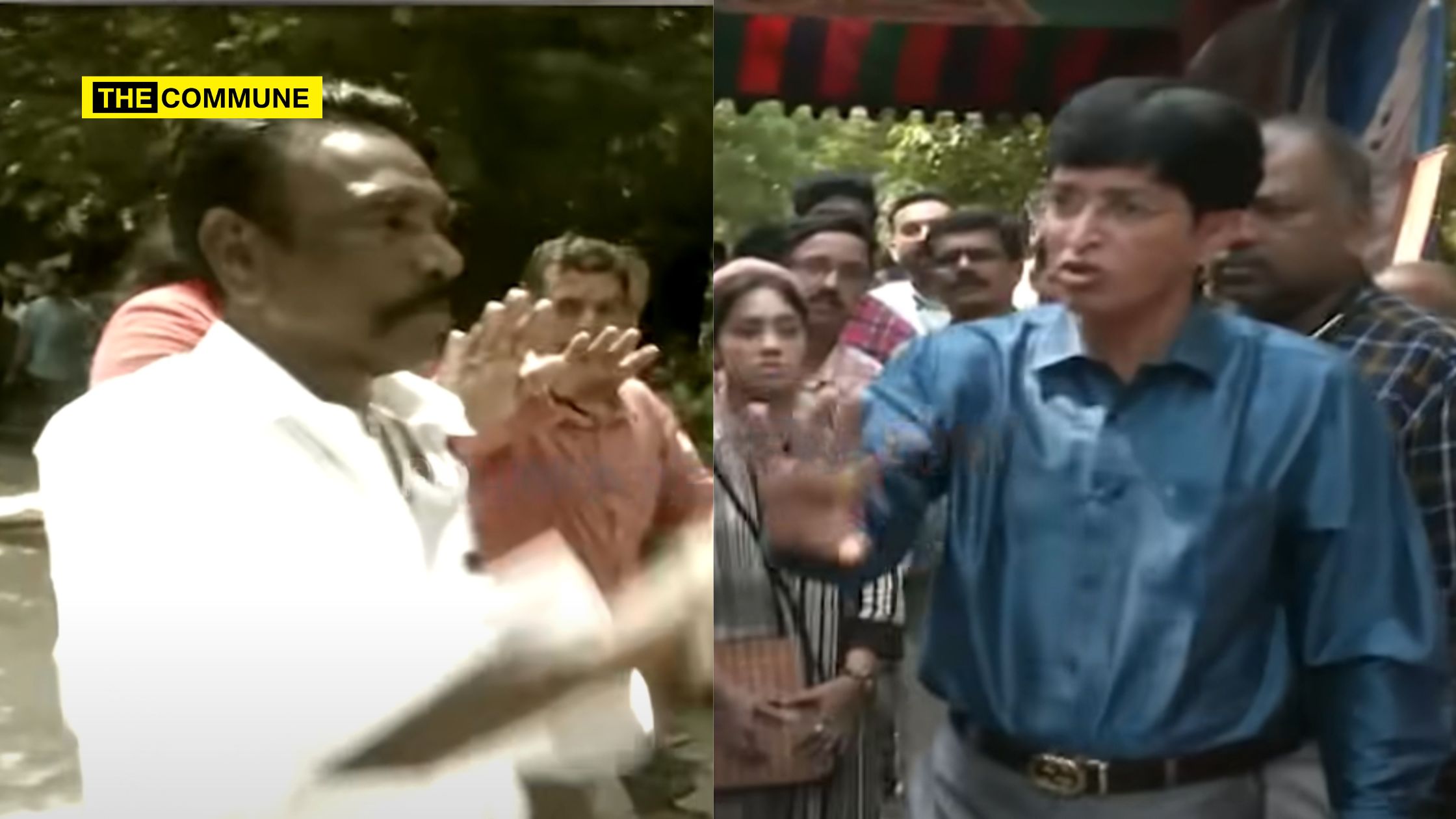
It was the time when there were high-voltage tensions between DMK and AIADMK. A young man had climbed on the pedestal of Karunanidhi’s statue, took an iron rod and began vandalizing the statue.

GC Shekhar, a photo journalist with The Telegraph who had captured this moment recounts the incident in an interview to the Deccan Herald.

“I was walking down from my office to Rajaji Hall where MGR lay in state, and I found a young man on the pedestal on which Karunanidhi’s statue stood. He soon got an iron rod to break the statue, but he could reach only upto its waist. Immediately, a cement dustbin was rolled onto the pedestal. He climbed on it and began vandalizing the statue.” Shekhar was quoted saying in Deccan Herald.

Reacting to this incident, Karunanidhi wrote in Murasoli that he took solace in the young man stabbing him from the front and not from the backside.

There were no attempts to reinstall the statue until 2022 when a bronze statue was unveiled a few meters away from where the original statue was razed down.

This incident that has scarred the DMK is once again being recollected by opposition leaders in Tamil Nadu.

Naan Tamilar Katchi head Seeman during the public hearing meeting held by Tamil Nadu Pollution Control Board (TNPCB) on 31 January 2023 said that he would break the statue if it was built inside the sea.

This comment of Seeman which grabbed news space has sent jitters to the DMK with the party’s IT wing head and Mannargudi MLA instigating violence against those opposing the pen statue.

He had retweeted the tweet of one Isai, DMK IT Wing’s State Deputy Secretary, in which he had shared the image of a man pelting a dog.

Reacting to the venom spewed by DMK IT Wing, AIADMK Spokesperson and IT wing Chennai zonal secretary Kovai Sathyan said that history will repeat itself if the DMK proceeds with installing the pen statue.


With the pen statue now becoming a polarising icon even before its installation, only time will tell if it will ever see the light of the day.

And if it does, will it meet the same fate of Karunandhi statue?

Click here to subscribe to The Commune on Telegram and get the best stories of the day delivered to you personally.

Why Do Sindhis Worship Guru Nanak And Follow Sikh Traditions?

On November 26, 2022 I gave a talk on Guru Tegh Bahadurji in Ujjain. On completion of the talk 18-20 armed Nihangs surrounded me. I was told (in Punjabi) that I must stop spreading mithya about the gurus being Hindu and Devi bhakts.

Nearly a month later i.e. on December 18 a group of Nihangs from Punjab barged into a Sindhi home in Indore and objected to moortis of Hindu Deities being worshipped in their mandir alongside the Guru Granth Sahib.

Patthat hatao they said or hand us over, the Guru Granths of all Mandirs and homes. They even submitted a memorandum to the police for Sindhis to either get Guru Granth removed by January 12, 2023 or declare all those places housing them as gurudwaras where Sikh Granthis would worship the Granth. A near similar attempts to control Sindhi Gurudwaras was made in 2020-21.

The Sindhi community could not accept removing Ganesh ji, Sri Ram, Sri Krishna from their mandirs hence decided to do away with the centuries old tradition of following Granth Sahib. Thus with a heavy heart, on January 11 and 12, Sindhis handed over Guru Granths from around 153 of their Mandirs/ Tikana in Indore to Gurudwara Imli Sahib.

Jan 11 and 12, 2023 would be remembered as a black day in the centuries old tradition of Sindhis of Indore revering the Guru Granth Sahib. None can stop them from worshipping Guru Nanak and Baba Sri Chand though.

This is not unique to India. A South east Asian Sindhi writes, “Now it is a fixed tradition, baithak (pagadiyoon in Sindhi) is almost always in the gurudwara, both were originally built by Sindhi merchants who were more affluent and even had a Sindhi Bhagat in charge. From 1980s this changed permanently. Bhagat Bheroomal was ousted, ragis and gyanis from india took over – the committee has a Sindhi or two who are in their late 80s now. The deceased are always replaced by Sikhs.”

The Shiromani Gurdwara Parbhandhak Committee (SGPC) was created in 1925 to manage gurudwaras in Punjab. An attempt is being made to make Sikhs follow the concept of One Book, like Abrahamic religions. Indic faiths are intertwined not mutually exclusive.

Also read Characteristics of Indian Philosophy

The SGPC says that Sindhis are Sehajdhari Sikhs and activists of the Satkar Committee from Punjab alleged violation of Sikh Rehat Maryada. The problem is there are differing versions of who is a Sehajdhari Sikh. Read here . The definition of who is a Sikh in the 1925 Act is typical Singh Sabha/Akali/exclusivist/separatist/alienating view. To know who are Nirankaris, Brahmin Sikhs and Ravidassa Sikhs read here

A key question is when was the Rehat Maryada created, by whom and why.

Food for thought

1. Do Sikhs have a monopoly over the Guru Granth Sahib?

The late Khushwant Singh wrote that, “While the Adi-first Granth is essentially a distillation of Vedanta in Punjabi, the last Dasam- tenth is a compilation of tales of valor of Hindu goddesses. Of the 15,028 names of God that appear in the Adi Granth, Hari occurs over 8,000 times, Ram 2,533 times followed by Prabhu, Gopal, Govind and other Hindu names for the divine. The popular Sikh coinage Wah Guru appears only 16 times.” Hari is Vishnu.

2. The word “Sikh” comes from the “Sanskrit word sishya meaning a learner or a person who takes spiritual lessons from a teacher.”

3. Dr Arvind S Godbole wrote in The Unbreakable Hindu-Sikh bond, To qualify as a ‘separate religion’ it must have a theology and philosophy distinct from other religions. These basic theological concepts are of the Sanatana Hindu religion. Shankara in his Vivekachudamani (225) calls Parabrahma as nitya or eternal. Bhagvadgita (9.18) regards the supreme as the primordial origin of the universe. The Chandogya Upanishad (8.3.8) holds that the truth is His name. Bhagvadgita, (7.25), declares that the ignorant think that the Supreme Being has a birth. The immanence of the Supreme being, a cardinal tenet of the Sanatana Hindu religion and the Sikhism differentiates then clearly from the Semitic religions, who do not subscribe to that doctrine.” To read more Of the nine schools of Indian philosophy there is no Sikh school.

Thus, it is easy for non-Khalsa Sikhs to revere the Granth Sahib.

4. Sikhs were considered very much part of the Hindu community till the 1980s-1990s. Even today they are part of the Hindu community under the Hindu Marriage Act and Income-tax Act.

5. There is plaque at the Siachen War Memorial of Guru Govind Singhji’s prayer to Shivji. “Oh Lord Shiva, grant me this boon that, I never shy away from doing good deeds. I should never be frightened away from fighting for Justice, Dharma and Rightful Cause and I should be determined to emerge victorious from this battle. Every soldier to have a pure heart and mind and let not greed come near him. When the time comes for my soul to unite with yours I should die fighting in the battle field.”

6. Scholar and author W.H. McLeod wrote, “For the Sikhs of the 18th century, the goddess Devi clearly had a considerable fascination. The goddess Durga who appears in three works in the Dasam Granth created a problem for the Tat Khalsa scholars who strongly affirmed monotheism. The question was settled by concluding that Bhagauti symbolises God as the Divine Sword.”

7. “Udasis and Nirmalas (Sanatis) today have the Granth in their establishments which they worship in virtually the same way. But they do not exactly follow Sikh Rehat Maryada of SGPC. Udasi aarti is different from Sikh ardas. Karshni Udasis even worship Krishna. Both Udasis and Nirmalas are close to sadhus of Dashnami Sampradaya, attend Kumbh Mela, and are liberal.”

Will some Sikhs remove Guru Granth Sahib from Nirmala gurudwaras?

8. Maharaja Ranjit Singh donated gold for three temples i.e. Hari Mandir in Amritsar, Kashi Vishwanath Mandir and Jwalamukhi in Himachal Pradesh. He willed the Kohinoor Diamond to Jagannath Mandir in Puri.


Also read Why did Guru Nanak visit pilgrimage towns And Why do Sikhs wear Turbans

The above are only a few examples of how both are intertwined.

History of intertwined Sindhi Nanakpanthi and Udasi culture

Disciples of Guru Nanak called themselves Nanak Panthis. Udasi began with Baba Siri Chand (son of Guru Nanak Dev and Mata Sulakhani Devi). Udasis are known as an ascetic sect as against the mainstream Sikh belief in worldly activity.


Author and Kriya Yoga teacher Jyoti Subramanian adds, “The word Udasi itself is derived from the word udas as in sad, meaning one is sad until the final merging in the divine, Parmatma. It is now popularly believed that the Udasi sect was started by Yogi Siri Chand. The fact is that the Udasis were an old sect connected with the even more ancient Nath Samradaya. The dhuni or dhuna (traditional fire pit with a tong) is a hallmark of the Naths, followers of the Gorakhnath lineage.”

Sindhi religious practices have been a mix of Nanakpanthi, Udasi, Daryapanthi and other traditions. They became followers of Guru Nanak after his visit to Shikarpur, Sindh during Udasis/ travels (1469-1539). Of the Sindhi communities Amils, Bhaibands and Shikarpuris have the largest followers of Nanak.

A South East Sindhi writes, “Most Sindhis are very much fond of Guru Granth Sahib, so much that most of my father’s generation could read it in the original Gurumukhi. There was even a complete translation of Guru Granth in Sindhi.”

Many Nanakpanthi Tikanas (Sindhi word for chapel, literally meaning where one bows down one’s head and become still) still exist in Sindh. The largest one is Sain Vali Vilayat Darbar in Shivalo Mohalla, Qambar in Shahdadkot district. It was founded by Vali Vilayat Rai in 1887. Sant Bhai Wasan Shah, Swami Dharmdas, Bhai Waliram are some known Nanakpanthi saints. Their Darbars housed Guru Granth Sahib, pictures and moortis of Sikh gurus, along with Ganesh ji, Ram ji, Hanuman ji, other Hindu Deities and Jhulelal ji.

So what is happening in India is a carry forward of that tradition.

In the late 16th century, many Sindhis became Udasi Panthis after Nanak’s son Baba Sri Chand visited Thatta. Udasi traditions in Sindh are an amalgamation of Hindu traditions, Nanakpanth, Daryapanth (followers of Jhulelal). The main Udasi pilgrimage place, in Sindh, Sadh Bela was established in 1823.

Many of the Lohana-Amils of Sindh from Uch and Multan and the Khatri Sindhis were Keshdhari Sikhs and considered Guru Nanak as their Isht Devata (personal God) for e.g. two clean shaven Sikhs story of Gulu Lalwani, founder of Binatone U.K. and actor Ranveer Singh Bhavnani.

With the mass exodus of Hindu from West Punjab in 1947, Udasi darbars like Dera Baba Bhumman Shah, Okara in Gujranwala, Bhai Pheru in Lahore were left deserted because many Sindhis migrated to India. Those who migrated to Mumbai established a branch of Vali Vilayat Rai Qambar Darbar at Kandivali in 1960.

Sindhis left behind in Sindh became more syncretic. Janamsakhis, devotional literature, hagiographies of various saints ascribed to Nanakpanth and Udasipanth were published between 1843-1947 in Sindhi in Hyderabad, Shikarpur and Sukkur regions of Sindh.

Sindhi Nanankpanth/Udasipanth vs. Colonial (modern day) Sikhism

At the time of partition, 171 major Sikh gurdwaras existed in the part that became Pakistan. Originally, they were controlled by Udasis. Their control later passed on to the Mahants and lastly, came under the control of the SGPC in 1921.

The Sikh community was told in 1947 and repeatedly thereafter that maintaining these gurdwaras, appointing sewadars/caretakers would be the responsibility of Shiromani Gurdwara Parbhandhak Committee (SGPC). “There was no response whatsoever from any source. Thus, all historical Gurdwaras including Janamsthan, Nanakana Sahib were handed over to the Pakistan Board for Trust Properties of Waqf Broad for care and maintenance.

The conditions of these sacred shrines was deteriorating and required restoration. However, little was done. Today, their condition is very poor. Gurdwaras like Nanak Garh, Badami Bagh, Lahore that are now history. (Reference – Historical Sikh Shrines in Pakistan.)

Since SGPC was the only organization that had been organizing annual Jatthas to Pakistan and known to collect charhava, it was their Dharma to spend atleast part of these cash offerings for the general upkeep of some of these historical institutions.”- A Review of Iqbal Kaisar’s, Historical Sikh Shrines in Pakistan by Dr. Ujagar Singh Bawa, Professor Bloomsburg University of Pennsylvania.

Those trying to teach maryada to Sindhi Samaj, calling them pakhandis, calling Hindu pratimas mere stones, should visit Pakistan and establish maryada in gurudwaras of historical significancelike Baal Leela, Nanakana Sahib, Keyara Sahab, Maaljee Sahib, Tamboo Sahib, Chakkee Sahib, Eminabad/ Sadipur, Gujranwala (where Babur took Guru Nanak as one of his prisoners and put him on a grinding mill) etc. It is like those wanting to establish Khalistan in India, should first do so in Lahore, the capital of Maharaja Ranjit Singh.

Conditions of most structures is poor. Gurdwaras like Nanak Garh, Badami Bagh, Lahore that are now history. (Reference – ‘Historical Sikh Shrines in Pakistan’)

The ten Gurus were Khatri Hindus

All sects of Sindhis in India as well as Pakistan have in their Tikana/ Mandir, the Guru Granth Sahib placed in the middle with all Hindu deities around it.

Don’t those who are imposing their version of Sikhism and calling presence of pratimas of Devis and Devtas around the Guru Granth beadabi know that that there were murtis in Golden Temple till about 1905 and the real name of the golden temple is Hari Mandir. Hari is none but Vishnu.

Guru Nanak worshipped Shaligram form of Shri Hari and always carried with himself, the Saligram Shila which along with his mala, Rudraksha, Padam with his image and gold coin from Shri Krishna’s times passed down by his father, his pothi, all are kept in Gurdwara Pothimala Sahib, Faridabad. Source Pothimala Gallery.

The problem has arisen because modern day Sikhism is a post 19th century colonial construct.

The 10th Guru created Khalsa to fight the Mughals. But the British used the five or external forms of Khalsa, amongst others to create differences between Sikhs and Hindus. Historian Max Arthur Macauliffe led the British charge.

Macauliffe wrote in The Sikh Religion-Its Gurus, Sacred Writings and Authors, Vol I, Preface 24-5, “I met in Lahore young men claiming to be descendants of the Gurus, who told me that they were Hindus, and that they could not read the characters in which the sacred books of the Sikhs were written…such youths are ignorant of the “Sikh religion”, of its prophecies in favour of the English, and call us Mlechhas…”

In volume 1, 22, preface Macauliffe admits having inserted an, ‘oath of loyalty to the British’ in the Khalsa initiation ritual.

Just to add some titbits

1. The Sikh Shrines were known as Dharamsalas, the word Gurdwara was came later. Some quotes.

Professor Ian J. Kerr wrote, “King Abdur Rahman of Afghanistan dismissed an appeal by Hindus to keep idols in Dharamsala of Hari Rai in Kabul. Hindus had no concern with Sikh shrines, as Sikhs had nothing to do with Hindi Thakur Dwaras and Shiv Dwaras.” Source The British and the Administration of the Golden Temple 1859, Panjab Past and Present, Vol. X, Oct 1976, pg. 315.

Teja Singh wrote in The Gurdwara Reform and the Sikh Awakening, “This Dharamsala is named after Guru Har Rai, the seventh successor of Baba Nanak.”


2. All the Gurudwaras including Hari Mandir had Vigrahas, pictures or paintings of Shiva, Vishnu ji, Hindu Devi Devtas and Guru Nanak ji till the early 20th century


3.In 1905, murtis were removed from the precincts of Golden Temple, Amritsar. Maharaja Hari Singh of Nabha was asked to interfere but he refused.


4. A newspaper published in the Punjab denounced the radical Sikhs for throwing away a Shivling that existed in the parikrama of the Golden Temple. Picture of ancient Shiv Temple in Golden Temple shared above.

5. “A painting in another temple showing Guru Gobind Singh standing with folded hands before the Goddess was obliterated with ink.” Akhbar-i Am, 10 April 1900, Selections from the Vernacular Newspapers published in the Punjab, 1900, vol. XIII, p. 200

6“In 1905, Arur singh, manager of the Golden Temple ordered the removal of all idols from the precincts Golden Temple, thereby putting an end to the performance of Hindu rituals in that area.” Ham Hindu Nahin: Arya-Sikh Relations, 1877-1905 Kenneth W. Jones, p. 211

In view of the above, can the SGPC and some Sikhs claim exclusive ownership of the ten Gurus and the Granth Sahib?

The Madra Desh Guru Govind Singhji talks about in Bichitra Natak, is Brahmavarta, the present day Sindh & undivided Punjab. Sindh is not just a geographical region but an inalienable part of our heritage.

The Sikhs, Nanakpanthi Sindhis, Punjabi Hindus have for centuries revered the Gurus and the Granth as their own, and probably have understood their teachings better since they see them from the Vedic aspect of oneness.

Sindhis fled to the Indian side after 6 January 1948 Karachi riots.

But the tradition of Gurbani went uninterrupted through centuries for Sindhis, in India as well as Pakistan.

Today, Udasipanth Sindhis follow the Gaddi of Baba Hari Ram who strengthened the Udasi panth and whose spiritual ancestry is traced to Guru Nanak Dev himself. The differences between Baba Shri Chand’s Udasis and Guru’s traditional Sikhs ceased after Guru Gobind Singh declared the Granth as the Guru.

Question –Who is the maryada following ‘Saccha Sikh’ according to SGPC?Nirankaris, Nanakpanthis, Uddsis, Niranjanis, Suthra-Shahis, Sanmal-Shahis, Dhir Malias, Sevapanthis, Sat Kartaris, Nirmalas, Namdhairs, Ravidasas or the Nihangs?

Instead of trying to distance themselves from Sanatana Dharma, Sikhs should worry conversions of Sikhs to Christianity.

This article was originally published in eSamskriti and has been republished here with permission.

DMK Fin Min Picks Fight With The Hindu’s Malini Parthasarathy, Again

Tamil Nadu Finance Minister PTR Palanivel Thiagarajan yet again picked fight with The Hindu Publishing Group’s Chairperson Malini Parthasarathy making personal remarks, in yet another instance of the DMK Minister behaving like a troll.

The DMK Minister’s remarks came in response to Malini’s tweet over Tamil Nadu Governor RN Ravi’s clarification on the Tamil Nadu versus Thamizhagam debate.

On 4 January 2023, Tamil Nadu Governor RN Ravi said that the state has experienced “regressive politics” over the past 50 years and that Thamizhagam would be a more appropriate name than Tamil Nadu while speaking at an event held at the Raj Bhavan in Chennai to felicitate the organizers and volunteers of Kashi Tamil Sangamam.

Tamil Nadu Governor RN Ravi’s emphasis on the term Thamizhagam was to show that Tamil Nadu is an integral part of India and to defeat the false narrative that Tamils are Dravidians and different from the rest of the people in India.

However, the Governor’s remarks were misconstrued which had created a furore in Tamil Nadu with the DMK using the opportunity to satiate its separatist itch.

Days later, the Governor clarified that he dwelled upon the word Tamizhagam in the historical and cultural context as there was no ‘Tamil Nadu’ per se as it exists today.

Welcoming the Governor’s stance, Malini Parthasarathy on 18 January 2023 said that the Governor’s words “became fodder for politically motivated rabble rousers”.

In a comment unbefitting of the position he holds, the DMK Finance Minister resorted to calling her names while referring to the incident when Malini Parthasarathy joined Prime Minister Narendra Modi’s clarion call to thank corona warriors.

Malini Parthasarathy hit back at the snobbish remark of the Minister calling him a ‘petty troll’.

The DMK Minister, who himself is a dynast politician belonging to a dynastic party, that demands loyalty to the Karunanidhi family, called Malini a ‘cultist’ for her appreciative remarks of the Modi government.

This is not the first time that Palanivel Thiagarajan had targeted a woman journalist. Earlier, he had attacked Malini Parthasarathy for sharing Isha Foundation’s response to the DMK minister’s diatribe which The Hindu had carried in the form of an article.

In another instance, Palanivel Thiagarajan when he was the DMK IT Wing head indulged in denigrating a Ramnath Goenka Award Winning journalist Sandhya Ravishankar who had exposed some of the false rhetoric of the Pollachi Sexual Abuse case.

Very recently he had abused business news journalist Chandra R Srikanth by invoking her caste identity.

Click here to subscribe to The Commune on Telegram and get the best stories of the day delivered to you personally.