In yet another instance of the DMK peddling hatred against Tamil Brahmins, the party’s spokesperson Rajiv Gandhi posted on his Twitter advocating genocide against the community.
Alleged ‘neutral’ political commentator Sumanth Raman had shared a snippet of E.V. Ramaswamy Naicker (EVR)’s speech in which the anti-Hindu hate mongerer calls for killing Tamil Brahmins.
“They are celebrating festival it seems.. He (Tamil Brahmin) is celebrating Soora Samharam (a festival commemorating Lord Murugan’s victory over demon king Soora Padman). He (Soora Padman) was someone who said there is no God. They (Tamil Brahmins) killed him. So, now we can kill those buggers.” EVR, who is hailed as ‘Periyar’ by his followers says in that speech.
EVR also goes on to say “That won’t be wrong. Maybe legally it will be wrong. That legal offence and all is humbug. We can’t be bothered that it is legally wrong. We have to come to this conclusion. Wherever we see a temple, we must go inside and break all the idols inside. Wherever we find a Paapaan (a derogatory way of calling Tamil Brahmins), we must kill and destroy him. He has done like this to us. He has come to this good position by doing these kinds of things only. We must also do such things to him (Tamil Brahmin). A few of us (non-Brahmins) would have to die for the cause. If one Tamilan (non-Brahmin) dies for one Tamil Brahmin, only 3 of us will die out of every hundred. Balance 84%, sorry.. 100-3 equals 97, 97-3 equals 94. 94% of us will still remain but he (Tamil Brahmin) will be completely eliminated. We will definitely go this level. We can only go step by step.”
This brazen call for genocide was given by ‘Periyar’ E.V. Ramaswamy Naicker in 1973 at Karikudi, Tamil Nadu.
Sharing this speech snippet on his Twitter, Sumanth Raman drew the attention of the people living in the rest of India to understand the hate peddled against Tamil Brahmins in Tamil Nadu.
He also added that the genocide did not happen thanks to Indira Gandhi, and AIADMK supremos M.G. Ramachandran and Jayalalithaa.
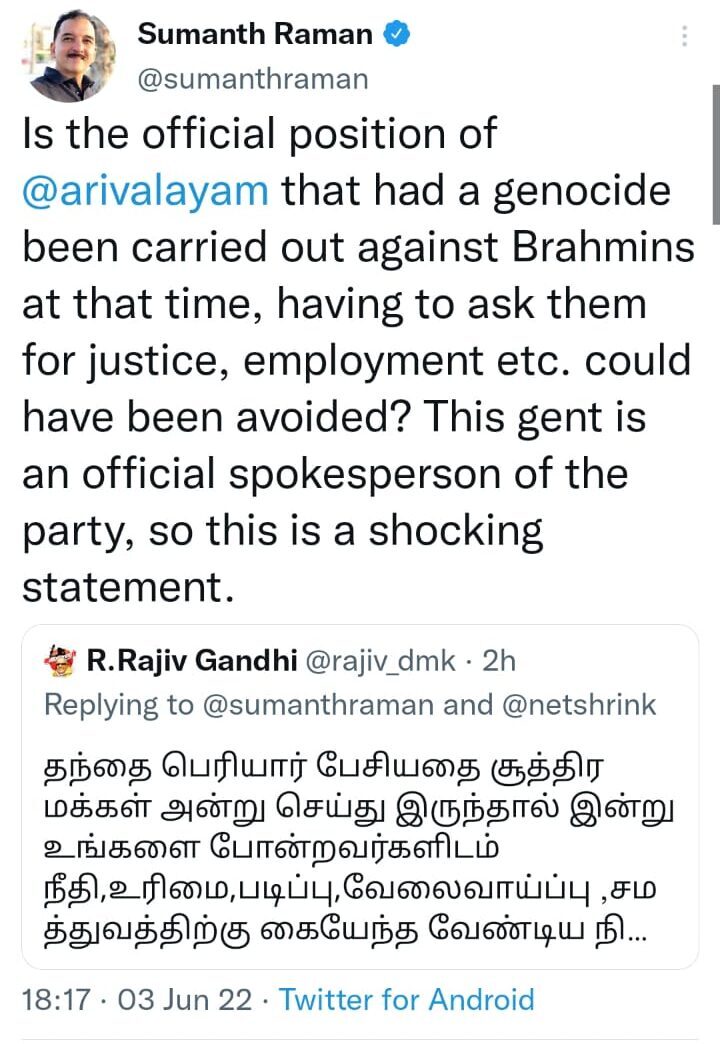
Responding to this tweet, DMK spokesperson Rajiv Gandhi wrote “Had only the Shudras carried out Periyar’s instructions, they wouldn’t have to fight with people like you today to get justice, employment, rights, education, employment and equality. At 3% you are still encroaching a lot of the space.”
This is not the first time that a call for genocide of Tamil Brahmin community has been made by ‘Periyar’ists.
Earlier in December 2021, Savukku Shankar, a DMK sympathizer and a ‘Periyar’ist, who is known for being a motor mouth posted on his social media promoting genocide against Tamil Brahmins.
Taking to both Twitter and Facebook, he had written, “If it is justified to trouble Muslims today, because of how Muslim kings had troubled us in the past, then why haven’t we started troubling Brahmins for the troubles they have given us in the past?” The post was deleted from Facebook after it was reported, as it went against the platform’s community guidelines. However, it is still available on Savukku Shankar’s twitter.
In another instance, Dr. K Kantharaj, a Dravidian-demagogue doctor who appears in several YouTube channels spewed venom and made genocidal remarks against the Tamil Brahmin community.
Calling Brahmins derogatarily as “Paapara Paya”, he goes on to say “Who are you? You are an Aryan. An immigrant. What is the connection between you and this country? You were rearing cows for a living in Central Asia. How did you come here? You and your religion do not belong here. It is there in history. You came into this country riding cows. You are today claiming this to be your country?”.
“You better go to your own country. Go there. There only you (Tamil Brahmins) were thrashed by Chengiz Khan and Taimur. You came here whimpering.”, he says.
Not just anyone : Dr K Kantharaj is a medical doctor , teacher of medical students, from political family, and from an elite #Dravidian nonbrahmin caste.
Why do they do this? If ideology is irrelevant then it is sooper weird someone would do this 🖤🖤😍 pic.twitter.com/xKQj6PcPBk
A 55-km cycle rally, marathons, awareness walks and public line-ups across Tamil Nadu by Save Soil volunteers will commemorate World Environment Day on 5 June in the state. The programs will be held in various districts including Chennai, Coimbatore, Trichy, Madurai, Salem, Erode and Thanjavur among others.
The events will raise public awareness about the looming threat of global soil extinction. They include:
A 55 km cycle rally in Chennai from Mylapore to Chengalpattu.
Marathons in Coimbatore and Salem
Walks in Madurai, Nagercoil, Erode, Namakkal and Karur districts
Line-ups of hundreds of placard-bearing volunteers at prominent places in Trichy, Thanjavur, Thiruvarur, Pudukottai, Kumbakonam, Mayiladuthurai and Perambalur districts to raise visibility for the Movement to Save Soil.
Farmers across Tamil Nadu are expected to plant 2 lakh saplings on June 3, 4 and 5 in support of the Cauvery Calling movement which is aiming to green the river basin by placing a third of the basin area under shade to protect and revive its soil as well as revitalize river Cauvery.
Sadhguru, Founder-Isha Foundation, launched the global Movement to Save Soil from extinction this March, embarking on a 100-day lone motorcycle journey of 30,000 km spanning 27 countries in Europe, Central Asia and the Middle East. Sadhguru reached India on 29th May on his Journey for Soil which will culminate in the Cauvery river basin in late June.
The primary objective of the Save Soil Movement is to urge all nations to mandate a minimum of 3-6% organic content in agricultural soils. Without this minimum organic content, soil scientists have warned of the imminent death of fertile soils worldwide. The Movement is proposing a policy-driven mandate supported by government incentives for farmers to raise organic content on farmlands.
Soil extinction could lead to unprecedented ecological, economic and social catastrophes worldwide. This includes intensifying climate change, global food and water shortages, brutal civil strife and migratory exodus across continents threatening the security and cultural fabric of every nation.
The Save Soil Movement is supported by the United Nations Convention to Combat Desertification (UNCCD), United Nations Environment Programme (UNEP), World Food Program, the International Union for Conservation of Nature (IUCN) and the Commonwealth. Since Sadhguru began his journey, 74 nations have pledged concrete action to save soil in their countries.
(This is an official press release from Isha Foundation. The Commune was not involved in creating this content.)
Click here to subscribe to The Commune on Telegram and get the best stories of the day delivered to you personally.
On one fine day in 1922, an ordinary person visited the ruins of Somnath temple and cried silently about its condition. He thought loudly: I have a dream, much before a certain Martin Luther King Jr. would say on a momentous day in 1963. He was none other than KM Munshi, who would go on to become an illustrious minister in the Nehru cabinet. His contribution to the protection of Hindu dharma was going to be immense.
The final of the tragic destructions of the Somnath Temple occurred in 1665 CE when it was converted into a mosque on the instructions of Aurangzeb. The temple was abandoned for over three centuries, only surfacing occasionally in ancient British photographs and paintings.
After Independence, the Nawab of Junagadh, under which resided the Somnath, consented to merge with Pakistan even though Hindus formed a huge 82 percent of the population. The State proclaimed its accession to Pakistan on August 15, 1947, to which the Pakistan government gave the recognition on September 13, 1947. India refused and an ‘Arzi Hukumat movement’ was launched for the economic boycott of the region. Critical commodities like kerosene, textiles, sugar, wheat and coal were denied to Junagadh. A referendum was also held and the army was sent by Sardar Patel to overcome any trouble. The Nawab then escaped to Pakistan with all his jewels, mistresses and dogs. Its dewan Shah Nawaz Bhutto requested Patel to take over the administration of the State. His son Zulfikar Ali Bhutto later went on to become the prime minister of Pakistan. However, few of the Nawab relatives, especially Babi clan, the descendants of Allaudin Khilji, chose to stay in India. One among them, Parveen Babi, later became the top actor in the Hindi film industry in the 1970s.
On the auspicious day of Diwali, Sardar Patel paid a visit to the temple on November 12, 1947, and urged it to be restored to its former glory. Suddenly, the atmosphere became pregnant with the orgasmic cries of Jai Somnath. KM Munshi, then a minister, took an active interest and ensured that the project saw the light of the day. Gandhi was a vocal votary of the temple’s reconstruction through donations from ordinary Indians, but not with government funds. Nehru, as usual, lodged a vehement opposition, dubbing it a sign of ‘Hindu Revivalism’. The measure was also opposed by Maulana Abul Kalam Azad, the education minister, arguing in one of the cabinet meetings that the ruins should be handed over to the Archaeological Survey of India (ASI) to be maintained as a historical monument. Many leftist archaeologists and historians also started their opposition to the construction, stating that history was being unjustly destroyed. Prominent among them was one B. K. Thapar of the Department of Archaeology. It is another matter that the same historians left no stone unturned to repair and restore the Muslim tombs. A Public Work, Mines and Power (WMP) Ministry was assigned the upkeep of umpteen dargahs, mazars and shrines. Both Patel and Munshi overran their objections for Somnath.
During 1947-50, after the partition, thousands of Hindu and Sikh migrants were stationed at Humayun Tomb, Purana Qila and Safdarjung tomb in Delhi, which had quite an open space. The monuments became dirty because of the human waste of the migrants. Their manicured lawns and fountains were spoiled, angering Nehru no end. He then issued a firman to evict them from the Mughal monuments as early as possible. He also kept parroting the word “secularism” even though it was not formally inserted in the constitution after opposition from members of the drafting committee. It was later included through the forty-second amendment in the preamble of the constitution by Indira Gandhi in 1976.
A trust was formed in 1949 to oversee the prestigious project. The foundation stone for the new temple was laid on May 8, 1950, and the remnants of the previous temple-cum-mosque were demolished by October 19, 1950. A new mosque was constructed at a nearby place. The new temple was designed by noted temple builder Prabhashankar Sompura, whose clan had been building temples in Gujarat for centuries. The new temple was built in the Chalukyan style and mostly used the material from the ancient remains. They diligently passed their knowledge of Shilp Shastras to their offspring and consequently, Chandrakant Sompura, his grandson, designed the new temple at Ayodhya.
In between, Digvijaysinhji Ranjitsinhji, the ruler of Jamnagar and trustee of the Somnath Trust, donated the princely sum of Rs 1 lakh towards the temple funds. He also wrote to Indian diplomats, requesting that they “send a pinch of soil, a few drops of water, and twigs from the respective countries where they were stationed, so that the reinstallation of the idol might symbolise the unity of the world and the brotherhood of men.” In this way, he wanted to convey the universal Hindu message of Vasudhaiva Kutumbakam.
This had the effect of internationalising the issue, and many diplomats opposed the measure. KM Pannikar, a Nehru loyalist, complained to Nehru, who was not happy with the project right from the start and now strongly felt that his secularism was in danger. Nehru, in turn, again cautioned Munshi, who chose to tread tactfully this time, and the measure was dropped. Jam Saheb’s aspirations would be fulfilled later when the water from rivers and oceans across seven continents was offered at the Ram Janmabhoomi temple in Ayodhya in 2020.
Sardar Patel had already died on December 15, 1950, in Mumbai and the whole responsibility had come on the shoulders of Munshi. With both Gandhi and Patel gone, Nehru now had a vice-like grip on the destiny of India. He would do whatever his whims and fancies demanded. He was the new Mughal and wanted to rule the country on the pattern of Akbar, if not Aurangzeb. Munshi was, however, determined like a warrior and kept his focus like Arjuna. Helping him in this project of national importance was VN Gadgil, the Minister of Urban Development and Rehabilitation. After a lot of hiccups, the temple was finally completed in 1951.
Munshi also planned to organise a Sanskrit conference at Somnath to which many foreign scholars were invited. Nehru initially did not have any objection but seemed to develop the cold feet later on. Munshi retaliated by writing him that the invite had already been sent and there could be no returning back. Nehru was also not happy with the presence of foreign journalists during the inauguration, for which Munshi expressed his helplessness.
The story does not end here, however. Dr. Rajendra Prasad, the then President of India, was invited to inaugurate the temple by Munshi. The preparations began for the pran-pratishtha as per the shastras in all earnest. The President gave his consent happily. When Nehru came to know of such development, he asked him firmly to reconsider his decision as it would unnecessarily annoy the Muslims. Prasad remained unmoved and ignored Nehru’s request.
Mighty peeved at such open insult, Nehru then wrote to all the chief ministers of India on May 2, 1951, to desist from associating with the temple in any capacity and many indeed obliged. On May 11, 1951, Prasad inaugurated the new temple, marking a new epoch in the history of Hindu temples.
The President, in his speech, stated that the power of reconstruction was always greater than the power of destruction.
Source:
KM Munshi, Somnath, The Shrine Eternal, 1951
Peter Van Der Veer, Ayodhya and Somnath: Eternal Shrines, Contested Histories
It may seem preposterous when I say that Maharana Pratap ought to be revered a thousand times more than even Chhatrapati Sivaji! But such is the magnificence of the illustrious nature of his personality, character, achievements, and inimitability! He was the harbinger in bringing the latent patriotism in the Bharatiya people at a time when Hindu temples were being razed to the ground by the Islamic foreign invaders who persecuted Hindus and who were destroying the ancient and immemorial religion of Bharat, which is Hinduism. Maharana Pratap was like the tremendous sun who melted the ice-cold extremism of Islamic invasion, which threatened to destroy the ancient Hindu traditions and great culture of the Bharatiya people.
Maharana Pratap was born as Pratap Singh I at Kumbhalgarh in Mewar in Rajputana in erstwhile Akhanda Bharat on the 9th of May 1540. It corresponds to the present day Kumbhal Fort at Rajsamand District in Rajasthan in modern India. He was the son of Rana Udai Singh II and Maharani Jaiwanta Bai belonging to the Sisodia dynasty. The Maharana grew up listening to the stories of Lord Krishna and stories from the Mahabharat. His mother was a great Krishna devotee, and her stories had a great influence on the young Maharana. The stories of the bravery of Rana Sanga and Bappa Rawal also inspired Maharana Pratap. It was in a similar way that the stories narrated by Jija Bai, mother of Chhatrapati Shivaji had on young Shivaji.
Maharana Pratap lived between 1540 C.E. and 1597 C.E. He became the King of Mewar on the 28th of February of 1572. He remained as the king of Mewar till his death in 1597. Mewar is part of present-day Rajasthan state in India. Rajasthan has always been renowned for its chivalrous people, who prefer death to loss of honour.
Maharana Pratap lived up to the famous reputation of Rajput bravery, honour, nobility, and immense fortitude in difficult times. He was a great man with a powerful vision, who lived way ahead of the times he lived in. He lived in treacherous times when the kith and kin within royal families often joined hands with the enemies thereby completely surrendering the well-being of their motherland. But Maharana Pratap was not like that. He knew what he wanted. He knew what others wanted. Yet, he never compromised with his principles and was a sterling example of a patriot, who would not be greedy and who would never betray the interests of his motherland even if he were to be offered the world. Such was the greatness of his courage and tallness of his character that even his animals displayed complete confidence and loyalty to him.
His loyal horse, ‘Chetak’ served him well till its dying day and saved him from the monstrous Mughals in the battle of Haldighati. His royal elephant, ‘Ram Prasad’ preferred death by fasting in captivity when it was held by Akbar.
The lack of unity amongst the Rajputs made Maharana Pratap like a lion fighting against wolves. In this he was like Veera Pandiya Kattabomman of the south of India who stood up against the British and unlike the Royal Mysore Wodeyar family, which sided with the British imperialists and never fought against the foreign rulers, which is why we must have more Maharana Prataps, Chhatrapati Shivajis, Veera Pandiya Kattabomans and Lacit Barphukhans than Nawabs and Wodeyars who sided with alien invaders like the British. The most important point to be noted is that Maharana Pratap did all this in the 16th century with less resources at his disposal.
While Akbar and Maharana Pratap were the greatest opponents, they respected each other. Akbar used marriage alliances and diplomacy alongside war to strengthen his position in Bharath whereas Maharana used his tremendous character and intelligence to protect his small but strategic kingdom of Mewar, which also makes us understand his tremendous intellect, which understood with foresight the strategic value of Mewar for Akbar. Akbar probably wanted Mewar to extend his influence to Gujarat and beyond – also controlling the ports of Gujarat given its proximity to the Arabian Sea trade routes.
The Maharana’s soldiers and people worshipped their magnificent leader.
He also never harmed women or children. He was respectful to the women folk of even his opponents. Another important point to be noted is his complete lack of greed. He was not an expansionist ruler. He only wanted to protect his land and his people. He wanted peace and progress for his people. He had no great interest in conquering other lands.
Maharana Pratap was a very tall man – both in terms of his actual height and in terms of his personality. He accepted his father’s decision to anoint Jagmal Singh as his successor in the beginning. Jagmal Singh was one of the younger half- brothers of Maharana Pratap. However, when Jagmal Singh did not discharge his duties properly, the people of Mewar asked Prince Pratap to take over as the king of Mewar and he became the 54th ruler of Mewar of the Sisodia Dynasty in 1572.
The time period when Maharana Pratap was ruling over Mewar was the time when the so called ‘Great Akbar’ was ruling over large parts of India. When the ‘great’ Mughals were busy filling their harems, Maharana was not after sensual pleasures. He was devoted to the welfare of his people and did not succumb to excess lust or greed. He often slept on the grass and under trees and ate uncooked food. Such was the devotion of the illustrious master towards his people and motherland. When most other Rajput kings and other kings from all over Bharat were bowing to the Mughals, this great king of Mewar king did not bow before the Islamic invaders and foreign invaders and thus set a great precedent for future Hindu kings like the great Chhatrapati Maharaj.
His bravery was so well known that legend says that the great Abraham Lincoln’s mother asked him to bring some sand from the land of Mewar. Indeed, a mere feel of the land of Mewar blessed and ruled by the tremendous Master, Maharana Pratap is sufficient to make anyone inspired.
Maharana Pratap ruled Mewar for a long time. He ruled Mewar for a very long time both before the famous battle of Haldighati in 1576 and after the battle of Dewair in 1582. Akbar sent eight diplomatic missions – all with the single goal of making Maharana Pratap give up his little kingdom of Mewar and hand it over to Akbar Badshah. Legend has it that Akbar did everything to entice and coerce the Maharana, but the Maharana never compromised. This included offering half of Bharat in exchange of Mewar. But Maharana Pratap never succumbed to either enticement or greed.
Maharana lived for 57 years. After becoming the ruler of Mewar, there was no turning back. The Maharana did everything to preserve the land, the language, people and culture of Mewar. Even after his demise, the coins of Mewar bore his name and picture. He never let down his people.
His war techniques of guerrilla warfare must have proved inspirational to future patriot leaders like Shivaji. The greatness of Maharana lay in his astounding abilities as a leader with a simple nature. He also read the ground reality and was mature as well. Later patriot leaders like Shivaji were influenced by the principles of the Maharana including non-coercion of women, fight for truth, kindness to animals, loyalty and courage.
His life story is unique and unprecedented in history in terms of valour and character. His life story is incredible in the context of medieval Bharat tyrannised by the mighty Mughals. It is especially important given that he never looted any king or its convoys etcetera. Maharana Pratap served as a great inspiration to thousands of patriots, who wanted to free our motherland from the suzerainty of the alien Islamic Sultans. One can be sure of the influence of the Maharana on a young man like Shivaji who was always respectful to women folk even when they belonged to the opponents’ side. There is this legend, which tells us as to how the Maharana Pratap did not harm his opponent Abdul Rahim Khan-i-Khanan’s women folk. Abdul Rahim had been sent by Akbar to conquer Mewar. Another great aspect about the Maharana was his lack of greed and history has correctly noted that he was not a marauder or looter of the opponents’ treasures. He was neither excessively lustful for women nor greedy for wealth. Does the Maharana need to display any other sign of his greatness?
Maharana Pratap did not accede to the eight diplomatic expeditions sent by Jalal -ud-din Akbar and every time, a diplomatic mission was sent back by Maharana Pratap, he knew that war was coming up. So, he started preparing for war. Akbar also used the same trick used by preceding alien invaders of Bharat and future invaders of Bharat – the policy of divide and rule! Akbar had the Maharana’s own brothers with him as well as other Rajput kings like Man Singh and Todarmal with him. Imagine the plight of the Maharana surrounded by enemies in the form of kith and kin. He had to not only stand up against the Mighty Alien Invaders – the Mughals but he also had to fight against some of his kith and kin, who had turned traitors.
But that was where the greatness of the character and intelligence of Maharana Pratap shone like a bright light. He did not succumb to greed or to lust or to treachery or to chicanery. He knew time was running out and that battles were inevitable. So, instead of running away from responsibilities for fear of war, Maharana Pratap decided to fight his enemies upfront and that’s how he did it. He met the army of Akbar at a place called Haldighati. The terrain was well known to Maharana Pratap, and he also befriended the Bhil tribals of the hills. The Bhils were very loyal to him.
The Maharana had many soldiers, but Akbar’s army was almost five-fold. But the Maharana made up for the lack of numbers with his unforeseen intensity and determination. He knew the terrain of narrow Haldighati well and his army including the Bhil forces used the Guerrilla warfare technique and massacred the Mughal army of Akbar. The Maharana had gauged beforehand that the narrow mountain pass of Haldighati would not allow the use of cavalry by Akbar.
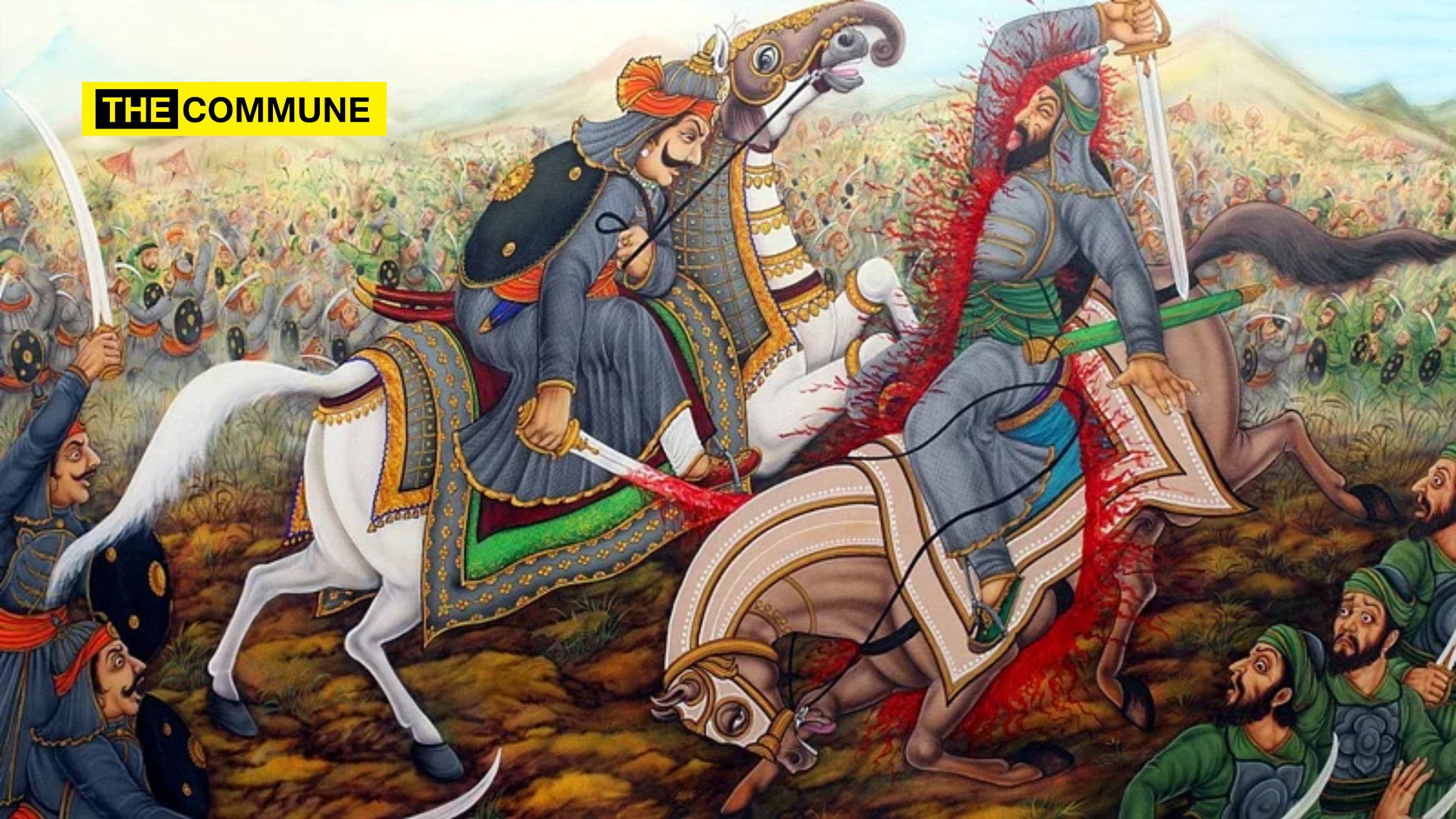
The decisive Battle of Haldighati was fought on the 18th of June, 1576 between Maharana Pratap’s army and the Mughal army sent by Akbar represented by Raja Man Singh I of Amer. However, just when the Maharana was about to be killed, his loyal horse, Chetak brought him to safety inspite of suffering grievous injuries on its leg. The Maharana did not lose the Battle of Haldighati but did not win it either. The same was the case with Akbar, ‘The Great’. The greatness of Rana Pratap was that he always knew when to fight and when to retreat. He retreated after the battle of Haldighati only to raise another army to fight against the Mughals.
The reasons behind the unprecedented success of the Maharana was his understanding of the terrain of Haldighati, the will power, the discipline and determination of the Maharana and his solders, the local Bhil tribals who were loyal to him and were good in archery and knew guerrilla warfare well, his devotion to his motherland, the uncompromising attitude of the Maharana, the tremendous intelligence of the Maharana especially with knowing when and how to attack and when to retreat, his lack of greed and lust and his ability to keep his senses under control and to go through difficult times with determination, resilience and perseverance.
The battle of Dewair took place after the battle of Haldighati. It took place in 1582. This has been recorded by the Britisher, Colonel James Tod. This was a decisive battle between the Maharana’s army and the Mughal forces. The Maharana won the battle. The Mughals stopped trying to take over Mewar. Meanwhile, Akbar had new problems to handle in Punjab, Bihar, Bengal and the North-west. Maharana soon recovered Chittorgarh, Mandalgarh, Chavand and other places of importance. Thirty-six Mughal outposts were liquidated in Mewar. Between the battle of Dewair and his death on the 19th of January of 1597, the Maharana recovered many places including the places to the left of Chittor. The citizens of Mewar who had left Mewar upon Mughals declaring war on Mewar returned to Mewar. The monsoon rainfall was good, agriculture revived and trade in Mewar started improving. Thus, the Maharana was also responsible for the revival of the economy of Mewar.
As a letter by poet, Prithiviraj Rathod reveals, there was only great leader inspiring hope of freedom for the Rajputs against the mighty Mughals and that was Maharana Pratap.
The Maharana Pratap died of injuries during a hunting expedition at Chavand on the 19th of January 1597. When the news of Maharana’s death reached Akbar, the latter cried and that is why the Maharana has always been both feared and revered. His opponents respected him. One awaits the day when a Temple for Maharana Pratap will be built in New Delhi, the capital of modern Bharat to inspire generations of Indians and patriotic people from all parts of the world for aeons to come. It will also teach the lesson that neither greed nor personal ambition is as important as protecting those and that which you love and that loving one’s motherland is the greatest privilege of life. His life was such that even the mighty Mughal, Shehenshah Akbar respected him. His life as a leader and warrior has taught generations that nothing can beat the potent combination of courage and character. Even if one lacks the resources, one’s will power can get one everything. Maharana Pratap was succeeded by Amar Singh I. Thus, the Maharana realised most his dreams of taking back Mewar.
One must not forget that Maharana Pratap was a great leader, warrior, patron of Hinduism, a person of sterling character, an epitome of courage and majesty and who was never greedy, lusty or sinful. He preferred to live and die for his motherland than go after the pursuit of material wealth and luxuries. He constructed the Chamunda Mata temple. A great temple in honour of Maharana Pratap will teach every person in this world to be willing to do anything to protect their nation. It is not the size of one’s nation, which matters but how much attached you are to it. He was one of the perfect kings to have ever existed surpassing the expansionist and greedy kings like Alexander, Ashoka and Akbar.
Click here to subscribe to The Commune on Telegram and get the best stories of the day delivered to you personally.
After protracted struggle for several decades the state of Telangana was formed on June 2nd 2014. This was possible not because of the blood, sweat and toil of millions of people. While there can be no dispute that it was the present CM of Telangana Shri. K. Chandrasekhara Rao who championed for the cause of separate statehood it must also be noted that there were several other people who played a key role in the formation of the state which the TRS party would like to erase from the history books. It would be a shame if we allowed this to happen.
History
The Telangana region has a long history even before 1000 BC, where studies have shown human habitations existed in the region since the Palaeolithic age. Historical evidence shows that this region flourished under the Satavahanas, Badamis, Chalukyas and several such empires until the emergence of powerful Kakatiya empire who were known for their innovative irrigation, architecture, sculptures and fine arts. This region was envy of the neighbours due to the economic abundance under which the Kakatiya empire flourished.
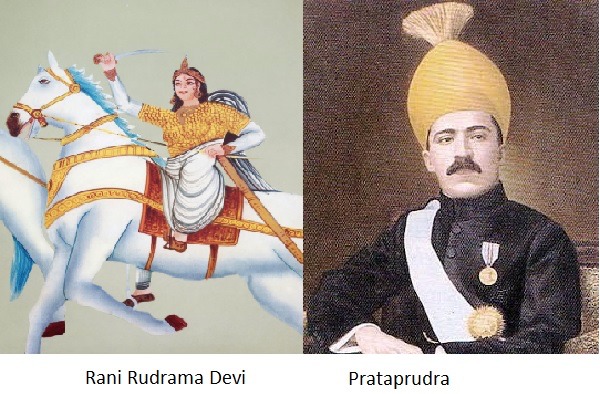
Several attempts by the alien armies such as Delhi Sultanate to wage a war in this region were strongly resisted and they failed miserably until finally the Sultan could lay siege on Warangal Fort and captured the legendary King Prataparudra who killed himself on the banks of Narmada river unwilling to be taken as prisoner by the Muslim rulers. After the annexation by Muslim rulers there was disintegration of the Kakatiya kingdom for about 150 years with utter chaos.
Rule of Nizam
After the invasion of Mughals, Asaf Jahis or Nizams ruled from 1724 to 1948. They had established a firm control in Hyderabad which is being felt even now. Their rule had ensured that the recordings and memories of all the erstwhile Hindu empires of Telangana which had been established for centuries were thrown into the dustbin.
Hyderabad state had been steadily becoming more theocratic since the beginning of the 20th century. In 1926, Mahmud Nawaz Khan a retired Hyderabad official, founded the Majlis-e-Ittehad-ul-Muslimeen which is now functioning as AIMIM led by Hyderabad MP, Barrister Asaduddin Owaisi.
Razakars & AIMIM
When India finally became independent from the British Empire in 1947, Hyderabad remained an independent princely state for a period of 13 months. It was after the independence that MIM and Razakars started to dictate terms to Nizam and systematically went about destroying the social fabric of the region.
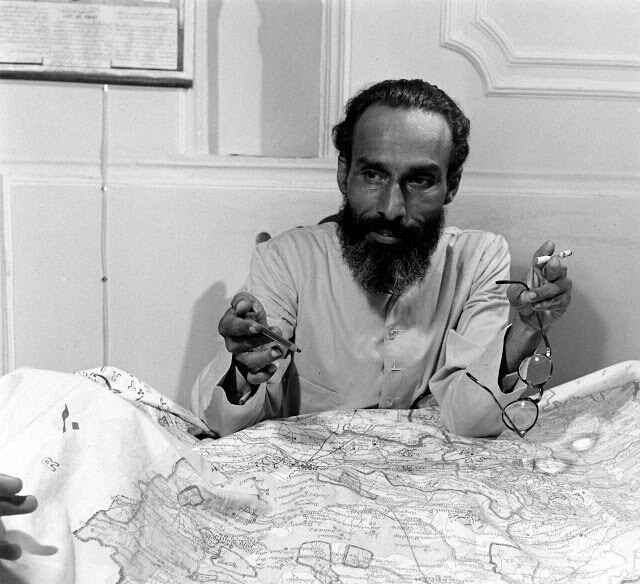
MIM had a militant & terrorist by name Kasim Razvi who claimed to be an Hyderabadi which is doubtful and he headed the Razakar movement. He was hell bent on creating Hyderabad a Muslim state and according to him the Muslim supremacy was based upon the right to conquest. Under him Razakars terrorized the Hindus, Muslim moderates and crushed Communists and Peasants. Nizam lost control and rushed to the United Nations to refer the Hyderabad state to UN Security Council.
Kasim Razvi has the infamous distinction of being the first terrorist of Independent India.
Kasim Razvi
There were also strong militant lobbies who wanted this region to be part of Pakistan. It was because of ‘Iron Man of India’ and the then Union Home Minister Sardar Vallabhai Patel who ensured that the militant forces were crushed and Hyderabad was integrated into the map of India by forcing the Nizam’s hand. Operation Polo was launched and after a brief resistance they surrendered. Mir Lalik Ali, the Prime Minister of Nizam and Kasim Razvi were arrested. Nizam of Hyderabad withdrew the complaint from United Nations and announced the region’s merger with the Indian Union.
The Razakars were disbanded after the merger of Hyderabad with India and the Majlis-e-Ittehadul Muslimeen was banned although it was rechristened as the AIMIM under the Congress Government. There is enough historic evidence to doubt that the erstwhile Razakars became part of the present day AIMIM. Kasim Razvi was jailed and served imprisonment for a decade before he undertook asylum in Pakistan.
In January 1950, M.K. Vellodi a senior civil servant was made the Chief Minister and the Nizam was made the Governor.
Birth Of Andhra Pradesh
The local people and leaders of this region always aspired to have a separate state of Telangana but due to the intense lobbying by the Congress leaders belonging to the Andhra region resulted in the creation of a unified state of Andhra Pradesh under a Gentlemen’s agreement which was overseen by then PM of India Jawarhlal Nehru. However this agreement was violated by the Andhra leaders from day 1 and the leaders at Delhi turned a blind’s eye to the injustice meted out to the region of Telangana by the leaders of Andhra.
1969 Agitation
There was always an unrest between the two regions but the then ruling party Indian National Congress silenced the Telangana leaders by offering doles in the form of administrative, executive and political positions. However in the year 1969 championed by Chenna Reddy there was intense agitation due to the non-implementation of Gentleman’s agreement and continued discrimination to Telangana region in government jobs, irrigation projects, education and public spending. It was a common knowledge that the Finance portfolio of Andhra Pradesh was most of the times in the hands of a person from Andhra region and rarely from that of Telangana which resulted in lack of funds being allocated to the region.
After Indira Gandhi’s grand victory in 1971 on the popular slogan of “Garibi Hato” and due to her reluctance to accept the statehood demand of Telangana, Chenna Reddy agreed to merge his party with Indira Gandhi’s Congress (R) party.
In the next 25 years the political landscape of Andhra Pradesh & also India saw rapid transformation. AP saw the emergence of matinee idol from Tollywood NT Rama Rao as the CM and the issue of separate statehood of Telangana was put in the backburner. The Telugu Desam Party which was founded by NTR was against the formation of separate state of Telangana since he himself hailed from Andhra region.
BJP’s Historic Kakinada Resolution
It was in the year 1997 that the Bharatiya Janata Party (BJP) passed the historic resolution seeking a separate state of Telangana. BJP was emerging as a national alternative to Congress at that time and the commitment shown by the saffron party towards creation of a separate state raised eyebrows across the political spectrum. It was for the first time that a pan Indian party was championing for the cause of separate statehood of Telangana.
BJP had always seen the Telangana region as a fertile soil for its brand of nationalistic politics. It was no wonder that in 1984 out of just the 2 seats that the party had won one was from Hannamkonda which was once the capital of Kakatiya empire. The saffron party was committed to the creation of smaller states for administrative efficiency.
However once BJP came to power in 1998 it was unable to carve out a separate state due to the political compulsion of having TDP as an ally in the undivided state of Andhra Pradesh and the survival of Atal Bihari Vajpayee Government was dependant on the support extended by Chandrababu Naidu who was against the formation of Telangana. Hence Telangana could not be formed when separate states of Chhattisgarh, Jharkhand and Uttarakhand were created by the NDA Government.
Birth Of TRS & Emergence OF YSR
Meanwhile Telangana Rashtra Samithi was formed in 2001 on the back of the then AP CM Chandrababu Naidu’s reluctance to accommodate the then Deputy Speaker Kalvakuntla Chandrashekhar Rao into his cabinet. Stung by the insult meted out to him KCR started TRS with a single ideology of creation of the state of Telangana. In the ensuing local body elections TRS party swept in the region and there was a huge groundswell of support for this emotive issue.
In the hope of achieving the separate state KCR aligned with Congress Party (which was never 100% committed to the Telangana cause) in 2004 and became an Union Minister but the newly elected Andhra Pradesh Chief Minister Dr. Y.S. Rajasekhara Reddy was too powerful and was never supportive for this cause. He had used TRS just as an ally to win sizable number of seats in the Telangana region. This led to the resignation of KCR from the Union Cabinet and there were several instances of the elected representatives of TRS resigning and forcing by elections to exhibit the support that they had for the cause of Telangana statehood.
In the 2009 general elections TRS aligned with TDP and could just win 10 assembly segments and 2 parliamentary seats. It was at this point that the support for the cause for Telangana was debilitating since Congress party had come back to power in the centre with a renewed mandate and YSR had emerged as a powerful regional satrap in the congress party who started to rule Andhra Pradesh as his personal fiefdom. Moreover the AP CM continued to show impertinence towards the division of the state.
Turning Point For The Cause
However the turning point in the creation of Telangana was certainly the unfortunate demise of YSR in a helicopter crash in September 2009 which led to a huge vacuum in the state congress leadership. Added to the fact was the reluctance of Sonia Gandhi to appoint YS Jagan Mohan Reddy who felt that he was the heir apparent for the seat of Chief Minister of AP.
Seizing the opportunity KCR went on fast-unto-death on November 29th 2009 and this led to widespread protests and anarchy in Hyderabad. In a premature announcement Union Minister P. Chidambaram announced to initiate the process for formation of separate state of Telangana on December 9th 2009. This announcement caused a huge stir and widespread protests started in the Andhra and Rayalaseema regions. Leaders of state congress party also started to speak in multiple voices and this led to pandemonium in the state. There was en mass resignation of MP’s and MLA’s from the Andhra region which threatened the survival of the Congress government in the state.
All this resulted in the Centre putting the process of formation of separate state on hold and an announcement to this effect was made on December 23rd 2009 saying that widespread consultations with all the stakeholders was necessary. Both the UPA Government at Centre and Congress Government at the state were clueless on the way forward which resulted in complete breakdown of law and order in the state.
A series of protests such as Million March, Chalo Assembly and Sakalajanula Samme (general strike) were held in the Telangana region. All these agitations were championed by TRS and T-JAC.
BJP’s Role
It is unfortunate that certain sections of people in TRS are trying to create a fake narrative today that BJP had played no role in the fight for separate statehood of Telangana. On the contrary ever since BJP was founded in 1980 the party had always stood for protecting the interests of people in this region and for the cause for separate state of Telangana. As mentioned earlier it was only due to the coalition compulsion during the NDA 1 regime that stopped BJP from the creation of separate state. It is also to be noted that Sangh Parivar and RSS played a pivotal role in fighting against the militant Razakars and ensure that Hyderabad becomes a part of Indian Union.
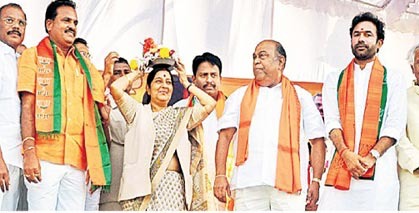
It is pertinent to note that the former Union Minister Late Sushma Swaraj had played a key role in the formation of state of Telangana. She was the first national leader to provide vocal support to the Telangana cause in a public meeting at Hyderabad. She was vociferous in lending her voice of support in the lower house of Parliament as the Leader of Opposition. So much so that 2 TRS MP’s including KCR & Vijayashanthi and 10 Congress MP’s trooped into the well of the House. She appealed to the Speaker and requested the then Prime Minister Manmohan Singh to announce the formation of the new state. She had assured the ruling UPA that NDA and its constituents would wholeheartedly support the bill in both the houses of the Parliament. She cried out that the administration in the state of AP had come to standstill and firing of rubber bullets had become the order of the day. She had even threatened in a media conference that she would resort to “Sonia Bashing” if the demand for separate state is not met.
In order to pass the statehood bill smoothly the then PM Manmohan Singh had called her for lunch and she repeatedly assured him that bill would be passed. Not for nothing she is affectionately called as the Chinnamma of Telanagana.
If it was the late leader who fought for the statehood in the Parliament the regional BJP leaders held several protests and rallies. It is a fact that entire top BJP leaders including the then Presidents Nitin Gadkari and Rajnath Singh had personally attended the various rallies, meetings and protests held at Hyderabad and at other places in Telangana.
The then BJP President of Andhra Pradesh G. Kishan Reddy who is presently the Union Minister of State for Home undertook a 22-day Telangana “Poru Yatra” a 3,500 kilometre journey through 986 villages and 88 assembly constituencies stressing the need for separate Telangana from 19th January 2012 which was flagged off by the then BJP National President Nitin Gadkari. KCR ensured that Kishan Reddy’s yatra did not get the proper coverage and this was one more conspiracy of TRS.
Several state level leaders like Bandi Sanjay, Laxman and others were active in organising protests for the cause and they were ably supported by national Secretary Muralidhar Rao who hails from the state of Telangana.
It was the TRS party which decided not to participate in this yatra fearing that the credit for formation of Telangana state would go to BJP. The intent of KCR and TRS was to showcase that the entire credit to the formation of Telangana state comes to them
Finally in spite of all the theatrics displayed by the Congress MP’s from Andhra it was the BJP leader in the Rajya Sabha and the present Vice President Shri Venkaiah Naidu who ensured that the bill was passed in the midnight and the dream of millions of people of Telangana became a reality.
Epilogue
As we celebrate the 8th anniversary of Telangana Foundation Day the citizens of the state are yet to fully realise the fruits of achieving the separate state of Telangana since the benefits have only gone to a sections of people and we see the dynastic rule of TRS in full display. Telangana was formed for Employment, Water & Irrigation & more funds for local funds for the state. Unfortunately the joblessness is galore in the state and the unemployment stands at 9.4% as on May 2022. The promise of providing Rupees 3016/- to the unemployed youth of the state which was made in 2018 is only on paper and yet to be implemented. Allegations of corruption are reported in irrigation projects. The state is struggling to pay salaries to its employees. In spite of all these challenges we are sanguine that Bangaru Telangana would soon be a reality to every citizen of Telangana and not just one family.
Not a day goes by for Tamil Nadu Chief Minister MK Stalin and his coterie of ministers, without uttering the word ‘Dravida Model’.
Mettur Dam saw good inflow because of Dravida Model.
Praggnanandhaa beat Magnus Carlsen because of Dravida Model.
The earth is rotating because of Dravida Model.
People are breathing because of Dravida Model.
Dravida Model, Dravida Model, Dravida Model!
This sticker of ‘Dravida Model’ is being pasted on anything and everything under the sun.
So, what is this ‘Dravida Model’?
The Dravidian Stockists peddle that the Dravida Model is the anti-dote to ‘communalism’ and ‘fascism’. But recent activities of the DMK government negate these claims.
To understand the reality of Dravida Model, let us analyze one aspect of it – the Dravida Model of Free Speech.
Case 1
On 29 May 2022, rabid anti-Hindu fringe outfits like Dravidar Viduthalai Kazhagam (DVK), Thol Thirumavalavan’s Viduthalai Chiruthaigal Katchi (VCK), Popular Front of India, Communists, and other “Periyar”-ist organizations had organized a ‘mega-rally’ under the name of “Periyariya Unarvalargal Kottamaippu” in Madurai.
In the rally, members belonging to the DVK led by the outfit’s Namakkal district head raised slogans abusing Hindu Gods and Hindus.
“That Maari (Goddess Amman) who asks for sacrifice of goats and pigs a God? Is Kannan (Lord Krishna), who raped woman, a God? Will a child be born if a man and man have sex? Is calling Ayyappan a God rational?”, the men clad in red shirts can be heard shouting.
No action was reported to be taken against these elements. The Dravidian Stockist media too looked the other way.
Case 2
On April 26, a rabid anti-Hindu YouTube channel named U2 Brutus released a video titled “This is the reason why Nataraja stands with his leg lifted“, in which a person who identifies himself as ‘Minor’ resorts to slandering Hindu God Siva and Goddess Kaali.
In the video, Minor says “This guy Paramasivan.. what he did was.. Only on going further we come to know the nefarious activities of his.. He keeps lifting his leg up and up and finally lifted it fully and straight… If you think stretching the leg was a good movement… I too thought so on reading about it but that is where the trick was.. The thing is ‘Thalaivan’ (referring to Lord Siva) did not wear underwear that day. Don’t laugh.. Seriously, that is what is written.. Thalaivan had gone without wearing underwear voluntarily. What will happen if someone lifts the leg up? ‘It’ (referring to penis) will fall out right? I’m not joking. That is how it is written. Once you lift your leg, it will be visible right? On seeing that the people were shocked. Thillai Kaali who was dancing got shocked after seeing it. How can she dance after that? After seeing it, she didn’t know what to do and forgot all her dance movements.”
This ‘Minor’ was felicitated and given an idol of E.V. Ramaswamy Naicker (knonwn as Periyar by his followers) by Tamil Nadu Health Minister Ma. Subramanian at an event held in April 2022.
U2 Brutus has put several videos slandering Hindus and the Hindu faith. Earlier in November 2021, the channel released a video titled “Pornography in Vedas” in which ‘Minor’ and an alleged Saivite scholar named Prakash derogate the Vedas, the holy scripture of the Hindus. No action has been taken against ‘Minor’ till date despite multiple complaints registered against him by Hindu outfits like Indu Makkal Katchi, Hindu Munnani and Sivachariyars.
Tamil Nadu Health Minister Ma. Subramanian with U2 Brutus ‘Minor’
Case 3
Surendar Natarajan alias ‘Naathigan’ of Karuppar Koottam YouTube channel who was arrested for putting abusive and vulgar videos of Hindu Gods and released weeks after DMK came to power, justified his abuses against Lord Murugan and added that he will continue to speak against Hindu puranas and Gods through his new YouTube channel.
No action has been taken on him.
Case 4
Dr. K Kantharaj, a Dravidian-demagogue doctor who appears in several YouTube channels spewed venom and made genocidal remarks against the Tamil Brahmin community.
He also derogated Hindu Gods like Lord Ram and Lord Krishna and made scandalous remarks on April 1 being marked as Tamil New Year.
“The 60 years have been named after children born out of homosexual relationship between Naradar and Vishnu. If you celebrate April 1 as Tamil New Year, you are celebrating homosexual new year not Tamil New Year.”, the Dravidianist doctor had said.
No action has been taken against him.
Despite the brazen communal vitriol spewed by these anti-social elements, the DMK government and the Dravidian Stockist media have given them a free pass.
On the other hand, the DMK government has been cracking down on its critics.
Case 5
Immediately after the DMK came to power, political commentator Kishore K Swamy was arrested on June 14, 2021, for allegedly ‘defaming’ DMK leaders MK Stalin, Karunanidhi and Annadurai. The arrest was made based on a complaint by a Kanchipuram DMK functionary.
Kishore K Swamy in his tweet had just quoted parts of a writing by Tamil poet Bharathidasan who had written about Annadurai saying that Annadurai took his niece to a wealthy man’s house to earn money.
Kishore K Swamy had also made several posts criticizing MK Stalin and his father M. Karunanidhi.
For this ‘heinous’ crime of criticizing DMK leaders, he was incarcerated and slapped with the Goondas Act languishing in prison for around 6 months.
However, the Madras High Court in December 2021 quashed the Goondas Act against Kishore following which he was released from prison.
Case 6
In another similar case, Kalyanaraman of BJP Tamil Nadu was arrested for allegedly derogating Tamil Nadu Chief Minister MK Stalin and his late father Karunanidhi.
Kalyanaraman had in a tweet posted a picture of a page from a book which talks about V. Anaimuthu’s comments on EVR’S wife Maniammai quoting from another book titled “Periyar Kolgaiku Kuzhithondiya Dravidar Kazhagam” (Dravidar Kazhagam, the one which buried Periyar’s principles).
In this, Anaimuthu sheds light on the relationship shared by Maniammai and K. Veeramani, the current head of Dravidar Kazhagam.
Kalyanaraman in his tweet had said “These are the words of Anaimuthu who traveled with EVR and documented them later… Will they be arrested now for telling the truth ?”
In response to this tweet, a person on Twitter had said that EVR fought for women’s liberation. Responding to this, Kalyanaraman said “So, you mean to say he [EVR] visited brothels to liberate them? Then our Chief Minister MK Stalin’ father Karunanidhi must have also visited the Royapuram brothel for the same. Kannadasan must have wrongly mentioned in his book Vanavaasam“.
Kalyanaraman too was slapped with the Goondas Act.
Case 7
Popular Youtuber Maridhas was arrested on December 9, 2021 for a tweet that came in the light of the death of late Chief of Defence Staff Bipin Rawat. This arrest too was made based on a complaint by a DMK functionary.
Days later, the DMK government once again received a knock on its head when the Madurai bench of the Madras High Court quashed the FIRs registered against Maridhas. But, the matter did not end there.
The DMK government once again arrested Maridhas for a video that was released during the first wave of the COVID-19 in which the YouTuber spoke about how the returnees of the Tablighi Jamaat meeting refused to cooperate with government officials and were spreading the corona virus.
This FIR too was quashed by the Madras High Court.
He had responded to a DMK executive on social media who had made derogatory remarks against Prime Minister Narendra Modi for which he was arrested and later released on bail following a protest by BJP cadres..
Case 9
Dakshinamurthy alias Seethaiyin Mainthan, a YouTuber and a Tamil nationalist ideologue was arrested on October 15, 2021 for releasing a documentary that exposed the lesser known and hidden facts about E.V. Ramasamy Naicker also known as ‘Periyar’ by his followers.
The two-part documentary bases most of its evidences on the book titled “Tamizhar Thalaivar” written by Samy Chidambaranar who wrote the book under the supervision of EVR himself and was published in the year 1939.
Seethayin Mainthan quotes several instance from the book establishing that EVR was a heavy drunkard and a pimp.
Case 10
An FIR was filed against Tamil magazine Vikatan, YouTuber Maridhas and political commentator ‘Savukku’ Shankar for speaking against G Square Realtors, a real estate company reportedly close to the DMK family.
There are several such instances where the DMK government has gone after its critics. Leader of the Opposition Edappadi K Palaniswami had slammed the DMK government in July 2021 when cases were registered against News J, a TV channel of the AIADMK party, and members of the party’s IT wing.
Hence, Karthik Gopinath’s arrest should come as no surprise as he has been going after the DMK hammer and tongs in his YouTube channel Ilaya Bharatham. At the same time, Karthik could’ve been more careful in terms of disclosure as it involves people’s money. Those in the ruling regime just need a misstep to pounce upon.
From the above instances, it becomes clear on what the Dravidian Model of ‘Free Speech’ is – crackdown on critics, give a free-pass to anti-Hindu elements.
Click here to subscribe to The Commune on Telegram and get the best stories of the day delivered to you personally.
BJP spokesperson Nupur Sharma alleged last evening that she had been receiving death and rape threats after a self-styled fact-checker tweeted portions of a video showing her making remarks on Islam’s prophet, Mohammed (Muhammad ibn Abdullah). Sharma claimed that Mohammed Zubair, co-founder of communist-leaning fact-checking website Alt News, posted a “heavily edited video” from one of her debates, saying he would be “wholly & solely” responsible “if anything untoward happens to me or any of my family members”.
“There is a so-called fact-checker who has started to vitiate the atmosphere by putting out a heavily edited and selected video from one of my debates last night. Ever since I’ve been receiving death and rape threats, including beheading threats against me and family members,” Nupur Sharma told news agency ANI.
There is a so-called fact checker who has started to vitiate atmosphere by putting out a heavily edited & selected video from one of my debates last night. Ever since, I've been receiving death & rape threats, incl beheading threats against me & family members: Nupur Sharma, BJP pic.twitter.com/IGJcP10XtG
Yesterday, Zubair had tweeted an 86 s clip from a debate on a television news channel on the Gyanvapi mosque case in which Sharma can be heard making a remark on Prophet Muhammad’s marriage, which has been controversial through the ages, as some historians have over the centuries found the prophet to be paedophilic while others have given him a clean chit, saying that the tender age of one of his wives at the time of consummation of the marriage was the norm in the 7th century Arab society — much as Islam’s present is driven by the claim that the 7th century belief system is forever modern.
After Nupur Sharma tagged Delhi Police, accusing Zubair of inciting “communal passions”, the most prolific of Alt News staff members said he was sure the police would register an FIR against the BJP spokesperson if they see the full video.
The plight of @NupurSharmaBJP is also a message to the section of the Hindutva brigade that says the BJP is no longer Hindu enough. When a BJP office bearer speaks up, this is what happens.#ArrestNupurSharma for what? Citing history? Since when has that been a crime? https://t.co/3uYYwejf4n
— Surajit Dasgupta (@surajitdasgupta) May 28, 2022
“Thanks for tagging @CPDelhi @DelhiPolice, If they happen to see the full video, I am sure there will be a sou moto FIR registered against you for inciting communal violence by sitting on a news debate and giving hate speeches targetting a religion,” he wrote.
Subsequently, Nupur Sharma posted screenshots of some tweets and said she was getting continuous death and beheading threats against her and her family because of Zubair’s “attempts to incite communal passions and vitiate the atmosphere by building a fake narrative.”
Delhi Police replied from its official Twitter handle, saying, “The matter has been forwarded to the concerned officials for necessary action. You will be contacted shortly.”
Did Nupur Sharma Defame Prophet Mohammad?
What Nupur Sharma said in the course of the controversial debate is backed by Sahih Bukhari, considered one of the most authentic retellers of Mohammed’s life and time among all Ahadith (plural of a Hadith). The contentious marriage by the prophet was with Aisha (Āʾisha bint Abī Bakr), Mohammed’s third and youngest wife. Sahih al-Bukhari’s hadith says, “… the prophet married her when she was six years old and he consummated his marriage when she was nine years old”. [7:62:64]
The topic was deemed so distinctly important by Wikipedia that it made an article “Criticism of Muhammad” separate from the main piece on Islam’s prophet.
This section of the Wikipedia article cites the works of Thomas Patrick Hughes, August Wilhelm Schlegel, William Muir and Frank R Freemon among others as references for corroboration
The question whether Prophet Mohammed was a paedophile, which Nupur Sharma raised, is a hot one on social media platforms. The issue has been debated since the era of Orkut, the first networking site that became big in India besides the United States and Brazil. The following is a screenshot from Quora.
(This article was originally published in Sirf News and has been republished here with permission.)
Click here to subscribe to The Commune on Telegram and get the best stories of the day delivered to you personally.
The bank accounts of the Popular Front of India (PFI) have been frozen by the Enforcement Department.
33 bank accounts associated with PFI have been frozen by the law enforcement agency of which 23 bank accounts belong to PFI and the rest belong to PFI’s front organization Rehab India Foundation.
ED has provisionally attached bank accounts of Popular Front of India and Rehab India Foundation having collective balance of Rs. 68,62,081 under PMLA, 2002.
The Government of Gujarat signed a Memorandum of Understanding (MoU) with Isha Outreach to conserve soil in the state making Gujarat the first Indian state to officially join the Global Movement to Save Soil. The MOU was signed in the presence of Gujarat Chief Minister Shri. Bhupendrabhai Patel and Sadhguru, founder – Isha Foundation. Several cabinet members and government officials from the Climate Change Department, the Govt. of Gujarat were also present in the event which happened in Ahmedabad.
The Chief Minister spoke of the importance of soil for our survival and affirmed that “the Gujarat state will take the lead in conserving the soil and all the other organisms which are crucial for our existence on this planet.”
Sadhguru expressed his happiness on Gujarat becoming the first Indian state to sign the MoU and appreciated the response he received in the state since his arrival from a journey of 26 nations across Europe, Central Asia and Middle East. Explaining the MoU he said, “the handbook has simple principles with which the government can make a policy.” Normally the government has to prepare the concept and then make the policy but, “we have made the concept so that the government can make the policy quickly,” he added.
Sadhguru, had earlier met the Chamber of Commerce and industry leaders. Further speaking with the media on the sidelines of signing the MoU, he reiterated the appeal to industry to “work out a carbon credit scheme for the farmers” and consider it as their responsibility. He said, “In southern India, we’ve worked with over 130,000 farmers, i.e. 1.3 lakh farmers, but last seven years we have been trying so hard to get the carbon credit for them. It’s almost impossible because the carbon credits scheme is essentially designed for industry, not suited for farmers. Farmers are not able to get it. Though they can sequester an enormous amount of carbon they’re not able to get the carbon credit.”
Sadhguru launched the Movement to Save Soil in March this year to prevent a phenomenon that UN agencies are referring to as ‘soil extinction’ – the death of fertile soils worldwide posing an existential threat to the human race. Sadhguru is currently on a 100-day, 30,000-km lone motorcycle journey across Europe, Central Asia and the Middle East to build consensus for urgent policy-driven action globally to prevent soil extinction.
The Movement comes in the wake of alarming degradation of fertile soils across the world, posing a clear and present threat to global food and water security. In India, nearly 30% of fertile soils in the country have already become barren and are incapable of yield.
The primary objective of the Save Soil Movement is to urge all nations to mandate a minimum of 3-6% organic content in agricultural soils through urgent policy reforms. Without this minimum organic content, soil scientists have warned that death of soil is imminent. To achieve its objective, the Movement aims to demonstrate the support of 3.5 billion people across the world – 60% of the world’s electorate – to Save Soil which will empower governments to act to prevent soil extinction.
The Save Soil Movement is supported by the United Nations Convention to Combat Desertification (UNCCD), the United Nations Environment Programme (UNEP), the UN World Food Programme, and the International Union for Conservation of Nature (IUCN). 74 nations around the world have pledged concrete action to save soil in their countries since Sadhguru began his lone motorcycle journey from London on 21st March.
A host of global influencers including agriculture experts, conservationists, soil scientists, political, business, cultural and environmental leaders besides celebrities and millions of citizens across the world have pledged support for the Movement.
(This is an official press release from Isha Foundation. The Commune was not involved in creating this content.)
Click here to subscribe to The Commune on Telegram and get the best stories of the day delivered to you personally.
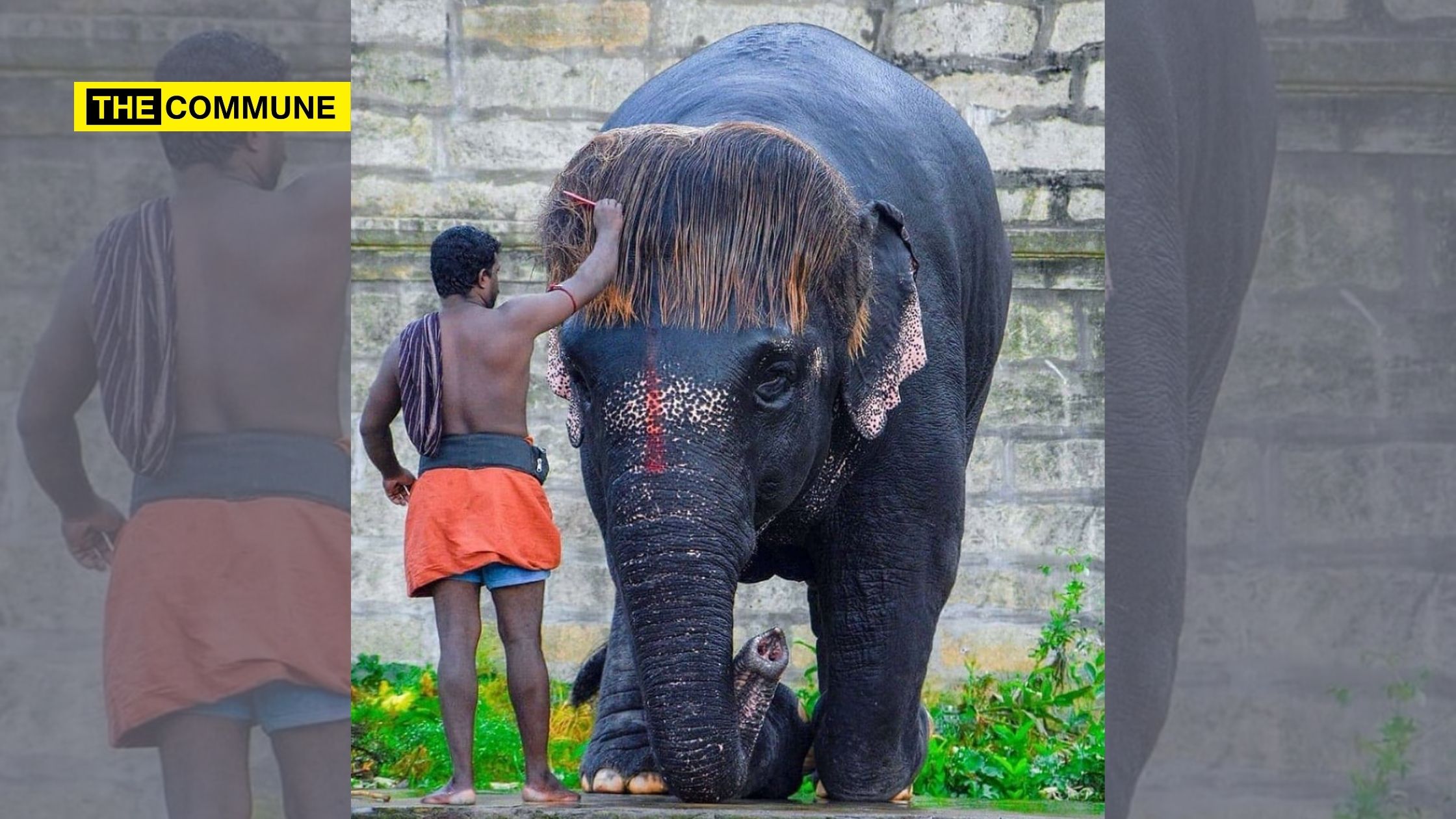
Animals and birds take up a significant portion of our Hindu Puranas and Itihasas. Out of all birds and animals, the elephant is one animal that finds repetitive mention. Starting with Lord Ganesha, whom Hindus pray to before starting any endeavour, elephants are found across all our epics and stories. It includes Airavata- the vahana (mode of movement) of Indra; Gajendra- the bhakta (devotee) of Lord Narayana; Ashwathama- the elephant that dies in the Kurukshetra war; so on and so forth.
Even in our contemporary world, elephants have an integral part to play in Hinduism. As we see when we enter most big temples, elephants are present, and they play a role in the festivals for the deity. Every temple has a specific space dedicated to the elephant where it is bathed, fed and rested. Ancient temples were built along with a portion of the complex dedicated to elephants. While these are well-known things, there are some other unknown aspects about temple elephants. Why do we have the practice of temple elephants in the first place? Which breed of elephants do temples select? What gender of elephants are preferred by temples predominantly?
Speaking about why we have elephants in temples, Kulithalai Ramalingam, a saivaite religious preacher said, “According to the Agamas, we have elephants for two purposes. Firstly, the agamas say that the water for abhisheka (thirumanjanam) for the deity is to be brought from the river or tank to the temple by placing it on the elephant. Secondly, in bigger temples with 5 Prakaras, the deity is to be brought in circumambulation around the temple on the elephant, during nityotsavam (daily festival). This also extends to when the deity comes out of the temple during festivals.” In essence, the temple elephant is an essential part of the day-to-day activities for the temple deity.
While talking about Bob-cut Sengamalam, the elephant of the Mannargudi Rajagopalaswamy Temple, Rajagopal, the Mahout said, “She came to our temple in the year 2002, when she was 14. Now, she is 34 years old. Before her, we had Senior Sengamalam who lived for 86 years as the temple elephant and passed away due to old age. Junior Sengamalam was donated to our temple by Ms Sasikala’s brother, Mr Dhivakaran.” Rajagopal has been associated with the temple elephant since his birth, but he has taken it up as a profession only after his father passed away in 2018.
In most temples, elephants are donated and not bought. So, the breed and gender of the elephant are not pre-fixed, as the temple cannot demand a specific breed from the person donating. In Mannargudi, the elephants have been females. However, this differs from temple to temple. But generally, mostly only the Indian breed of elephants are taken up for temple service. “Temples prefer female elephants as they’re easier to manage during their musth period than their male counterparts,” Rajagopal mentioned.
Considering the size of an elephant, the food intake of the animal is also beyond imagination. For example, Sengamalam generally takes 5 Kg of Venn Pongal in the morning and night. In the afternoon, she is given 250 Kg of cattle feed including reed, coconut leaves and hay. “Per day cost of the cattle feed is ₹200. This is sponsored and provided by the HR&CE department,” he said.
While mahouts have been taking quite good care of their elephants, many have gone to court against this practice, asking for a complete ban on this tradition of temple elephants. Even recently, the Tamil Nadu forest department constituted a seven-member team of experts to investigate whether temple elephants in the state are being subjected to harassment and whether these elephants are in a position to be held in captivity. The argument placed by these animal activists and the forest department is that the elephants are not taken care of properly, and are subjected to loneliness and torture. Therefore they have been trying to seek a ban on this tradition.
Speaking about the so-called torture of temple elephants, Saraswathi, an animal activist who has been fighting for the preservation of this practice, said, “You would assume that we have elephants in temples because of the Agamas of the temples. Well, while that may be true, the practice of temple elephants was initiated to protect wild elephants from fatality and death. A recent study says that 130 wild elephants died in 15 months in the Western Ghats, due to casualties like electrocution and railway accidents. However, in temples, elephants are taken very good care of, with appropriate feeding and healthcare facilities. It is important to understand that elephants are rather protected through this practice than tortured.”
Many who has asked for a ban on this practice also argued that the elephants are subjected to loneliness, and therefore they should not be separated from their habitat. When Rajagopal was asked about this, he said, “How can Sengamalam ever be lonely when I am always with her? She is like my elder daughter, not just any elephant. If she falls sick, I won’t even feel like eating or sleeping. That is the bonding I have with her. She keeps talking to me, and rightfully asks me whatever she requires, like water, rest or food. So, Sengamalam is never lonely.”
About loneliness, Saraswathi added, “A temple elephant will never feel alone because it will not only be surrounded by the mahout, but also by the devotees of the temple at all times. For the elephant, the Mahout and his assistant are its mother and father. They will have an irreplaceable bonding from a very young age.”
Those who seek a ban on this tradition also site that elephants are mostly tortured when trained. Speaking about how he trained Sengamalam, Rajagopal said, “Elephants are trained using the positive-reward system. There are a few command words which we ensure that the elephants are familiarised with. For Sengamalam, I used jaggery as a reward, and every time she obeyed a command, I would reward her with jaggery. So, even now, when she perfectly obeys my command, she gets her piece of jaggery. We mahouts rarely use violence. Maximum of elephants will get trained using the reward-system itself.”
Many have also said that a complete ban on the practice of temple elephants is not possible, as it is a deeply rooted cultural practice. “The reason why many animal welfare organisations are fighting this practice is that they want to end this domestication of elephants and instead build sanctuaries for them. They want to make money from these sanctuaries by making these elephants a matter of exhibition. The elephants are very safe now in temples, and they will be tortured if they’re put in sanctuaries. Therefore, this practice should not be stopped,” Saraswathi concluded.
While the courts have still not decided whether the domestication of elephants for temples should be continued or not, Mahouts and some animal activists still strongly believe that this practice should continue. For mahouts and the priests in temples, the elephants are like the deity himself/herself. They do not differentiate between humans and the elephant, and in fact, take more care of the animal as they create a special bond over the years. If this practice is prohibited, then it would mean that another Hindu tradition is attacked and ceased from existence.
Click here to subscribe to The Commune on Telegram and get the best stories of the day delivered to you personally.





Dravidian Model Of Free Speech: Crackdown On Critics, Give Free Pass To Anti-Hindu Elements
Not a day goes by for Tamil Nadu Chief Minister MK Stalin and his coterie of ministers, without uttering the word ‘Dravida Model’.
Mettur Dam saw good inflow because of Dravida Model.
Praggnanandhaa beat Magnus Carlsen because of Dravida Model.
The earth is rotating because of Dravida Model.
People are breathing because of Dravida Model.
Dravida Model, Dravida Model, Dravida Model!
This sticker of ‘Dravida Model’ is being pasted on anything and everything under the sun.
So, what is this ‘Dravida Model’?
The Dravidian Stockists peddle that the Dravida Model is the anti-dote to ‘communalism’ and ‘fascism’. But recent activities of the DMK government negate these claims.
To understand the reality of Dravida Model, let us analyze one aspect of it – the Dravida Model of Free Speech.
Case 1
On 29 May 2022, rabid anti-Hindu fringe outfits like Dravidar Viduthalai Kazhagam (DVK), Thol Thirumavalavan’s Viduthalai Chiruthaigal Katchi (VCK), Popular Front of India, Communists, and other “Periyar”-ist organizations had organized a ‘mega-rally’ under the name of “Periyariya Unarvalargal Kottamaippu” in Madurai.
In the rally, members belonging to the DVK led by the outfit’s Namakkal district head raised slogans abusing Hindu Gods and Hindus.
“That Maari (Goddess Amman) who asks for sacrifice of goats and pigs a God? Is Kannan (Lord Krishna), who raped woman, a God? Will a child be born if a man and man have sex? Is calling Ayyappan a God rational?”, the men clad in red shirts can be heard shouting.
No action was reported to be taken against these elements. The Dravidian Stockist media too looked the other way.
Case 2
On April 26, a rabid anti-Hindu YouTube channel named U2 Brutus released a video titled “This is the reason why Nataraja stands with his leg lifted“, in which a person who identifies himself as ‘Minor’ resorts to slandering Hindu God Siva and Goddess Kaali.
In the video, Minor says “This guy Paramasivan.. what he did was.. Only on going further we come to know the nefarious activities of his.. He keeps lifting his leg up and up and finally lifted it fully and straight… If you think stretching the leg was a good movement… I too thought so on reading about it but that is where the trick was.. The thing is ‘Thalaivan’ (referring to Lord Siva) did not wear underwear that day. Don’t laugh.. Seriously, that is what is written.. Thalaivan had gone without wearing underwear voluntarily. What will happen if someone lifts the leg up? ‘It’ (referring to penis) will fall out right? I’m not joking. That is how it is written. Once you lift your leg, it will be visible right? On seeing that the people were shocked. Thillai Kaali who was dancing got shocked after seeing it. How can she dance after that? After seeing it, she didn’t know what to do and forgot all her dance movements.”
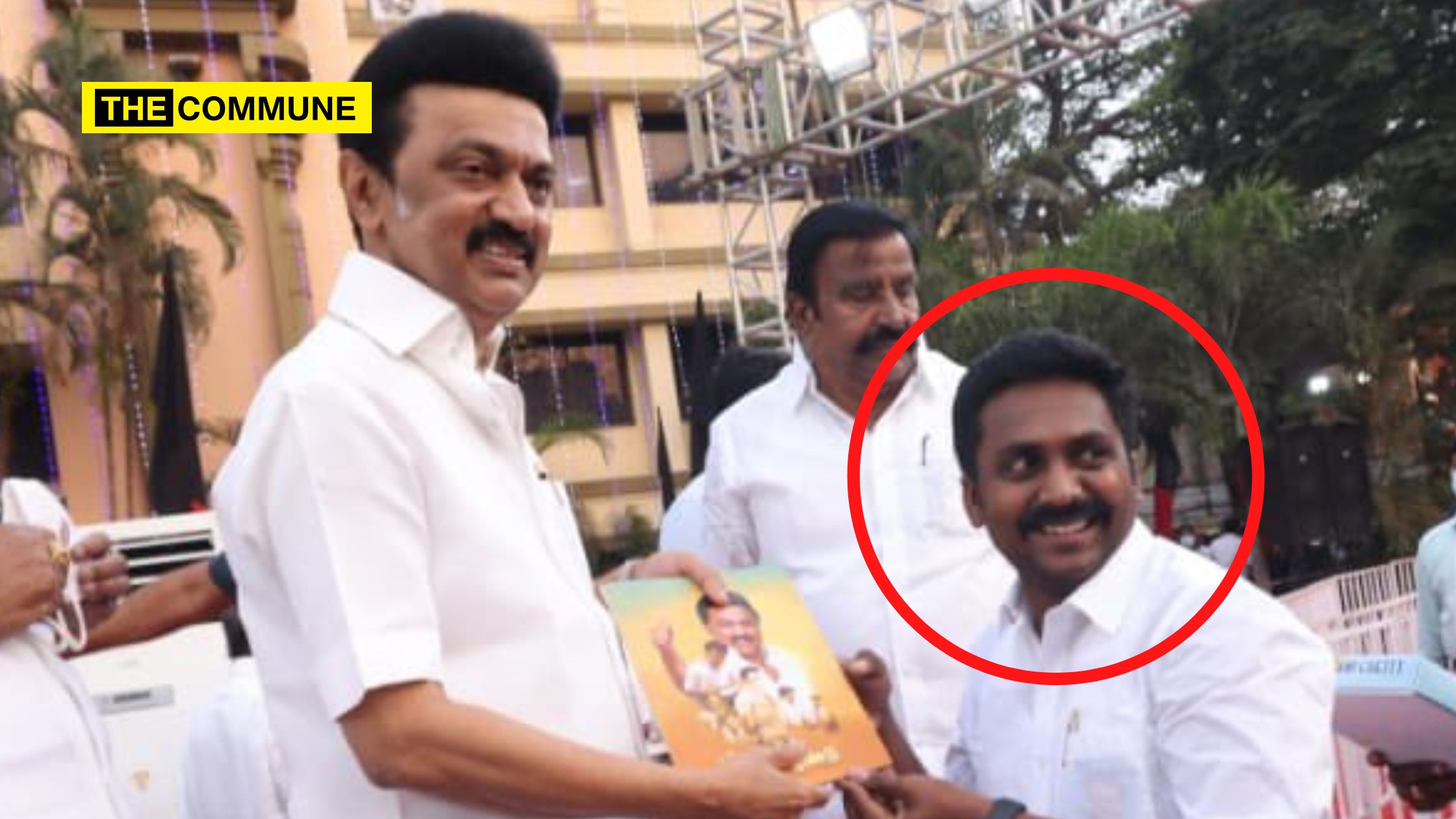
This ‘Minor’ was felicitated and given an idol of E.V. Ramaswamy Naicker (knonwn as Periyar by his followers) by Tamil Nadu Health Minister Ma. Subramanian at an event held in April 2022.
U2 Brutus has put several videos slandering Hindus and the Hindu faith. Earlier in November 2021, the channel released a video titled “Pornography in Vedas” in which ‘Minor’ and an alleged Saivite scholar named Prakash derogate the Vedas, the holy scripture of the Hindus. No action has been taken against ‘Minor’ till date despite multiple complaints registered against him by Hindu outfits like Indu Makkal Katchi, Hindu Munnani and Sivachariyars.
Case 3
Surendar Natarajan alias ‘Naathigan’ of Karuppar Koottam YouTube channel who was arrested for putting abusive and vulgar videos of Hindu Gods and released weeks after DMK came to power, justified his abuses against Lord Murugan and added that he will continue to speak against Hindu puranas and Gods through his new YouTube channel.
No action has been taken on him.
Case 4
Dr. K Kantharaj, a Dravidian-demagogue doctor who appears in several YouTube channels spewed venom and made genocidal remarks against the Tamil Brahmin community.
He also derogated Hindu Gods like Lord Ram and Lord Krishna and made scandalous remarks on April 1 being marked as Tamil New Year.
“The 60 years have been named after children born out of homosexual relationship between Naradar and Vishnu. If you celebrate April 1 as Tamil New Year, you are celebrating homosexual new year not Tamil New Year.”, the Dravidianist doctor had said.
No action has been taken against him.
Despite the brazen communal vitriol spewed by these anti-social elements, the DMK government and the Dravidian Stockist media have given them a free pass.
On the other hand, the DMK government has been cracking down on its critics.
Case 5
Immediately after the DMK came to power, political commentator Kishore K Swamy was arrested on June 14, 2021, for allegedly ‘defaming’ DMK leaders MK Stalin, Karunanidhi and Annadurai. The arrest was made based on a complaint by a Kanchipuram DMK functionary.
Kishore K Swamy in his tweet had just quoted parts of a writing by Tamil poet Bharathidasan who had written about Annadurai saying that Annadurai took his niece to a wealthy man’s house to earn money.
Kishore K Swamy had also made several posts criticizing MK Stalin and his father M. Karunanidhi.
For this ‘heinous’ crime of criticizing DMK leaders, he was incarcerated and slapped with the Goondas Act languishing in prison for around 6 months.
However, the Madras High Court in December 2021 quashed the Goondas Act against Kishore following which he was released from prison.
Case 6
In another similar case, Kalyanaraman of BJP Tamil Nadu was arrested for allegedly derogating Tamil Nadu Chief Minister MK Stalin and his late father Karunanidhi.
Kalyanaraman had in a tweet posted a picture of a page from a book which talks about V. Anaimuthu’s comments on EVR’S wife Maniammai quoting from another book titled “Periyar Kolgaiku Kuzhithondiya Dravidar Kazhagam” (Dravidar Kazhagam, the one which buried Periyar’s principles).
In this, Anaimuthu sheds light on the relationship shared by Maniammai and K. Veeramani, the current head of Dravidar Kazhagam.
Kalyanaraman in his tweet had said “These are the words of Anaimuthu who traveled with EVR and documented them later… Will they be arrested now for telling the truth ?”
In response to this tweet, a person on Twitter had said that EVR fought for women’s liberation. Responding to this, Kalyanaraman said “So, you mean to say he [EVR] visited brothels to liberate them? Then our Chief Minister MK Stalin’ father Karunanidhi must have also visited the Royapuram brothel for the same. Kannadasan must have wrongly mentioned in his book Vanavaasam“.
Kalyanaraman too was slapped with the Goondas Act.
Case 7
Popular Youtuber Maridhas was arrested on December 9, 2021 for a tweet that came in the light of the death of late Chief of Defence Staff Bipin Rawat. This arrest too was made based on a complaint by a DMK functionary.
Days later, the DMK government once again received a knock on its head when the Madurai bench of the Madras High Court quashed the FIRs registered against Maridhas. But, the matter did not end there.
The DMK government once again arrested Maridhas for a video that was released during the first wave of the COVID-19 in which the YouTuber spoke about how the returnees of the Tablighi Jamaat meeting refused to cooperate with government officials and were spreading the corona virus.
This FIR too was quashed by the Madras High Court.
Case 8
BJP IT wing office-bearer Saravana Kumar from Dindigul was arrested for allegedly criticizing the DMK government.
He had responded to a DMK executive on social media who had made derogatory remarks against Prime Minister Narendra Modi for which he was arrested and later released on bail following a protest by BJP cadres..
Case 9
Dakshinamurthy alias Seethaiyin Mainthan, a YouTuber and a Tamil nationalist ideologue was arrested on October 15, 2021 for releasing a documentary that exposed the lesser known and hidden facts about E.V. Ramasamy Naicker also known as ‘Periyar’ by his followers.
The two-part documentary bases most of its evidences on the book titled “Tamizhar Thalaivar” written by Samy Chidambaranar who wrote the book under the supervision of EVR himself and was published in the year 1939.
Seethayin Mainthan quotes several instance from the book establishing that EVR was a heavy drunkard and a pimp.
Case 10
An FIR was filed against Tamil magazine Vikatan, YouTuber Maridhas and political commentator ‘Savukku’ Shankar for speaking against G Square Realtors, a real estate company reportedly close to the DMK family.
There are several such instances where the DMK government has gone after its critics. Leader of the Opposition Edappadi K Palaniswami had slammed the DMK government in July 2021 when cases were registered against News J, a TV channel of the AIADMK party, and members of the party’s IT wing.
Hence, Karthik Gopinath’s arrest should come as no surprise as he has been going after the DMK hammer and tongs in his YouTube channel Ilaya Bharatham. At the same time, Karthik could’ve been more careful in terms of disclosure as it involves people’s money. Those in the ruling regime just need a misstep to pounce upon.
From the above instances, it becomes clear on what the Dravidian Model of ‘Free Speech’ is – crackdown on critics, give a free-pass to anti-Hindu elements.
Click here to subscribe to The Commune on Telegram and get the best stories of the day delivered to you personally.