Home Blog Page 101

DMK Govt Challenges Madras High Court’s SIT Formation Over Alleged Kidney Racket Linked To DMK MLA, Files Appeal In Supreme Court

tn kidney trafficking scandal

The DMK government in Tamil Nadu has filed an appeal in the Supreme Court challenging a Madras High Court order that directed the formation of a Special Investigation Team (SIT) to probe a kidney racket.

The Madras High Court had earlier criticized the state government for allegedly taking the kidney racket lightly and failing to register a First Information Report (FIR). The court had ordered the registration of an FIR and the formation of an SIT to investigate the case.

The High Court also instructed that the SIT submit periodical progress reports, with the first report due on 24 September 2025.

The SIT, as per the HC order, is to be headed by Southern Zone IG Prem Anand Sinha and tasked with investigating alleged irregularities in kidney sales. The probe is linked to complaints regarding the alleged exploitation of poor workers by brokers and illegal kidney donations.

The Tamil Nadu government’s appeal in the Supreme Court comes before registration of the FIR or compliance with the HC directions. Observers note that an FIR could trigger involvement from agencies such as the Enforcement Directorate, potentially uncovering alleged financial irregularities connected to hospitals reportedly owned by a DMK MLA.

In its original order, the Madurai bench of the High Court emphasized the seriousness of the case, stating: “A special investigation team headed by Southern Zone IG Prem Anand Sinha should investigate the cases related to kidney sale irregularities and submit its report by September 24.”

It is noteworthy that the kidney trafficking scandal centers on Dhanalakshmi Srinivasan Hospital, linked to DMK MLA Kathiravan, son of the hospital’s founder. Allegations suggest the hospital and its political patron shielded illegal kidney transplants targeting poor women, with brokers coercing victims and using forged Aadhaar cards. M. Anandan, a DMK party speaker, is accused of orchestrating the racket and remains absconding. Sources claim Kathiravan’s influence blocked the establishment of a government medical college in Perambalur to protect hospital interests. While the hospital publicly offers free treatment and medical camps, critics allege these initiatives may have concealed organ harvesting operations, highlighting potential systemic protection through political connections.

The Supreme Court will now hear the state government’s appeal, which seeks to stay or modify the HC’s directions regarding the investigation and SIT formation.

(With inputs from Dinakaran)

Subscribe to our channels on TelegramWhatsApp, and Instagram and get the best stories of the day delivered to you personally.

Dravidian Model DMK Govt Refuses To Pass On GST Cut Benefit To Aavin Milk Consumers While Amul And Nandini Reduce Rates

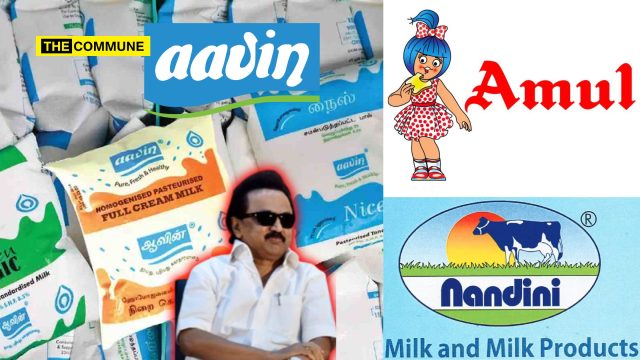
Even as leading public sector dairy cooperatives Amul and Karnataka Milk Federation’s Nandini announced price reductions following the GST cut on dairy products from 12% to 5%, Tamil Nadu’s Aavin will continue to sell milk products at existing prices when the revised GST comes into force on 22 September 2025.

Amul, Nandini, and several private brands have reportedly reduced prices of ghee, paneer, butter, ice cream, milk chocolates, and other products by Rs 25 to Rs 40, citing the GST cut.

Senior officials from the Tamil Nadu Cooperative Milk Producers Federation (TNCMPF), which owns the Aavin brand, told reporters that since Aavin calculates its final prices inclusive of GST, a formal directive from the state government is necessary before any price revision. As of Sunday night, no such directive had been issued.

A franchise retail outlet proprietor said that with the GST reduction, Aavin had adjusted the base price upward to keep the maximum retail price unchanged, effectively resulting in an increase in Aavin product prices from Monday.

During visits to Aavin outlets in Ambattur, Anna Nagar, Adyar, Korattur, and Thiruvanmiyur on Sunday, TNIE reported that staff at the outlets confirmed no instructions had been issued to lower product prices. An employee at the Ambattur outlet said that so far, they had not received any order to reduce prices of ghee or butter.

Aavin reportedly procures about 35 lakh litres of milk daily, of which 8-9 lakh litres are converted into value-added products. With the revised GST rates taking effect from Monday, Amul and Nandini have cut the per litre price of ghee from Rs 650 to Rs 610 and made corresponding reductions across other items. While Nandini has reduced prices for about 15 products, Amul has reportedly slashed prices across more than 700 dairy products.

Some Aavin customers expressed dissatisfaction over the decision to maintain prices. S Rajesh, a resident of Mullai Nagar, Ambattur, told reporters that when private brands cut ghee and butter prices by Rs 20-Rs 30 per kg, it was unfair for Aavin to continue selling at higher rates. He added that with demand rising during festivals, Aavin should pass on the GST benefit to consumers.

Aavin generates annual milk product sales worth approximately Rs 600 crore, with sales of Rs 126 crore recorded during last year’s Deepavali season.

While Amul and Nandini have proportionately reduced prices following the GST cut from 12% to 5%, Aavin continues to sell ghee and other products at the same maximum retail price.

(With inputs from The New Indian Express)

Subscribe to our channels on TelegramWhatsApp, and Instagram and get the best stories of the day delivered to you personally.

“Ban On Cousin Marriages Risks Stigmatising Communities, Family Intermarriage Builds Bonds”, Says UK MP Iqbal Opposes UK Bill Prohibiting Cousin Marriages

uk mp cousin marriage

A proposed bill to ban marriages between first cousins triggered sharp debate in the UK Parliament in 2024. The Marriage (Prohibited Degrees of Relationship) Bill, introduced under the Ten Minute Rule by Conservative MP Richard Holden, seeks to prohibit marriages between first cousins due to health risks for children born from such unions. Holden, who represents Basildon and Billericay, argued that first-cousin marriages are linked to higher chances of birth defects.

He said that certain diaspora communities, including Irish Travellers and British Pakistanis, show particularly high prevalence of cousin marriages. “Between 20 to 40 per cent of marriages occur between first cousins,” Holden said, adding, “There is a worrying trend, as this rate has increased significantly from that of their grandparents’ age group. Although there have been some reports of the rate falling within the last decade as young people push back against the system, there remains an extraordinarily strong link.”

Citing research published in the Oxford Journal of Law and Religion, Holden told Parliament that cousin marriage is practiced by about 10 per cent of the global population, with highest prevalence in the Middle East, West Asia, and North Africa.

Not all lawmakers supported the bill. Iqbal Mohamed, an Indian-origin Independent MP with roots in Gujarat, said the legislation risked stigmatising communities that practice cousin marriage. Instead, he called for public health education and genetic counselling. A video of him placing his arguments supporting the bill have gone viral on social media now.

“An estimated 35 per cent to 50 per cent of all sub-Saharan African populations either prefer or accept cousin marriage, and it is extremely common in the Middle East and South Asia,” Mohamed said.

“The reason the practice is so common is that ordinary people see family intermarriage as something that is very positive overall; as something that helps to build family bonds and puts families on a more secure financial foothold,” he argued.

“However, as is well documented, it is not without health risks for the children of those relationships, some of whom will be born out of wedlock,” he added.

Mohamed maintained that instead of prohibition, the government should encourage advanced genetic test screening for prospective married couples and expand health education programs in affected communities.

 The bill, formally titled Bill 146 2024-25 (as introduced), had its first reading in the House of Commons on 15 January 2025. It is scheduled for a second reading in mid-January 2025. But according to NDTV, its future remains uncertain as private members’ bills often require government backing to pass into law.

(With inputs from NDTV)

Subscribe to our channels on Telegram, WhatsApp, and Instagram and get the best stories of the day delivered to you personally.

TN BJP Chief Nainar Nagenthiran Slams DMK Over Forced Conversion Allegations In State Govt-Run Hostel

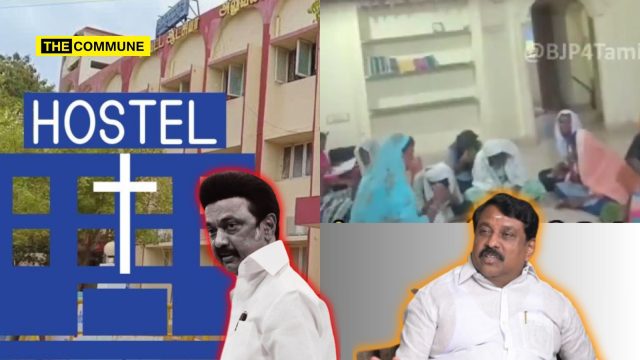
A few days ago, we reported that a complaint was lodged against the warden of a government girls’ hostel in Kalaiyarkoil, Sivaganga district, accusing her of coercing students into reading the Bible and attempting religious conversion. The issue has sparked sharp political reactions, with BJP state president Nainar Nagendran condemning the incident and questioning the DMK government’s model of social justice.

The hostel, located opposite the Kalaiyarkoil Government Teachers Training Institute, houses 68 students from Classes 6 to 12. The warden, identified as Lakshmi from Karaikudi, came under scrutiny after Manimekalai, a resident of Maruthanganallur and mother of one of the students, submitted a complaint to District Collector P. Porkodi.

In her complaint, Manimekalai alleged: “My daughter is being forced to take part in Bible readings and worship sessions. The hostel food is also being made with rotten vegetables. I’ve brought this to the collector’s attention.” She accused Lakshmi of compelling students to read the Bible daily, participate in worship services, and endure poor living conditions.

Responding to the charges, warden Lakshmi clarified: “During quarterly and half-yearly examinations, students were encouraged to sing hymns and read the Bible for moral support. After receiving the complaint, we immediately stopped the practice. I have already submitted a written explanation to the District Adi Dravidar Welfare Office.”

District authorities have taken note of the matter, and an inquiry is currently underway.

Meanwhile, BJP state president Nainar Nagenthiran issued a strong statement condemning the incident and accusing the DMK government of failing to protect students in hostels. Sharing a video related to the case, he wrote: “Is there religious conversion in the DMK government’s social justice hostels? In the Adi Dravidar Social Justice Hostel operating in Kalaiyarkovil, Sivagangai district, shocking information has emerged that Mrs. Lakshmi, who serves as the hostel warden, is allegedly forcing female students to convert their religion, subjecting those who refuse to severe cruelty, discriminating against students in the use of bathrooms and toilets, and engaging in corruption with food supplies.”

Nagendran alleged that parents had sent complaint letters to the Chief Minister and relevant officials and argued that the incident proved the government’s failure. “This is yet another piece of evidence that the @arivalayam government, takes great care in giving attractive names to every scheme, fails in implementing those schemes effectively. What benefit is there for anyone if, instead of improving basic facilities and appointing qualified staff, the government merely changes the names of buildings in various ways? Most students staying in the government’s social justice hostels face caste-based atrocities and religious oppression within the hostels themselves. Is this the DMK’s version of social justice?” he wrote.

He went on to question the government’s silence on alleged conversions: “Where does a government employee working in a government hostel get the audacity to engage in religious conversion? In the DMK regime, which continuously criticizes Hinduism while protecting other religions, is there an assumption that no action will be taken by the government if Hindus are converted? Or is the DMK itself encouraging such conversionists in an attempt to destroy Hinduism? Furthermore, isn’t it the height of atrocity to sexually harass children who refuse conversion?”

Terming forced conversions “dangerous”, the BJP leader demanded accountability: “In our country, which upholds equality, such forced religious conversions among students are dangerous. We can never allow such anti-social acts to take place within government hostels. The ruling government must not stand by and watch. Therefore, I urge the Chief Minister, Mr. @mkstalin, to suspend Mrs. Lakshmi, who is involved in this incident, and bring all other government student hostels in Tamil Nadu under his direct supervision.”

 The matter remains under investigation, with authorities expected to take further action after reviewing the complaint and explanation.

Subscribe to our channels on TelegramWhatsApp, and Instagram and get the best stories of the day delivered to you personally.

Vijay Lifts Vel While His Fans Climb On Temples With Shoes On

Vijay Lifts Vel While His Fans Climb On Temples With Shoes On

Tamilaga Vettri Kazhagam (TVK) leader and actor Vijay continued his state-wide tour on 20 September 2025, covering Nagapattinam and Thiruvarur as part of the second phase of his campaign.

Vijay began his journey in Nagapattinam in the afternoon, performing prayers and meeting volunteers who had gathered in large numbers. “Like Trichy and Ariyalur, Nagapattinam was also crowded with fans and volunteers,” observers said. He was surrounded by a contingent of volunteers as he campaigned across the town.

Later in the day, Vijay reached Thiruvarur, where he received a rousing welcome from supporters. Volunteers gave him a warm reception as he arrived after completing his Nagapattinam visit.

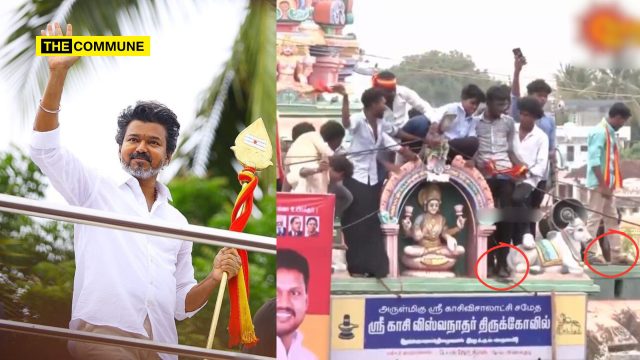
During the campaign, Vijay climbed onto a vehicle to greet the crowd. At that moment, a volunteer presented him with a human-sized Vel. Vijay lifted the Vel and waved it towards the volunteers, drawing loud cheers from his supporters.

However, the event also witnessed controversy in Thiruvarur. As Vijay prepared to deliver his speech, there was commotion after the party cadre climbed the temple tower in the area. Police intervened and removed them from the tower. Eyewitnesses reported that several cadre were wearing shoes and standing on the tower. The incident drew sharp criticism.

(With inputs from Maalai Malar)

Subscribe to our channels on TelegramWhatsApp, and Instagram and get the best stories of the day delivered to you personally.

Madras High Court Rejects Mosque’s Waqf Claim Over 1100 Acre Land, Restricts It To 2.34 Acres Citing 1712 AD Copper Plate

madras high court waqf copper plate

The Madras High Court has ruled that a mosque in Tirunelveli district is entitled to just 2.34 acres of land as waqf property, rejecting its claim over 1,100 acres. The ruling is based on a copper plate inscription from 1712, which recorded a grant by the then ruler of Madurai Samasthanam.

Justice M. Dhandapani delivered the order while partly allowing a civil revision petition filed by the Tamil Nadu government in 2018. The petition challenged a decree passed in favour of the Muthawalli of Kanmiya Pallivasal (mosque) at Kandiyaperi by the Waqf Tribunal (Tirunelveli Principal Sub Court) on 18 August 2016.

The judge heard detailed arguments from senior counsel V. Raghavachari for the Tamil Nadu Waqf Board and amicus curiae Chevanan Mohan. The State, represented by Additional Advocate General (AAG) Veera Kathiravan, argued that the mosque was not entitled to any piece of land. The AAG submitted that all the survey numbers listed by the mosque in its 2011 civil suit before the Waqf Tribunal had already been notified in 1966 under the provisions of the Tamil Nadu Inam (Abolition & Conversion into Ryotwari) Act of 1963. According to the government, the properties had been declared ryotwari lands, excluding the right of the Waqf, and several parcels had been allotted to the landless poor. It was also pointed out that 362 persons were cultivating the lands on the basis of assignment pattas.

Rejecting this contention, Justice Dhandapani observed that “once a property had been declared waqf, it would remain so.” He said the 1712 grant in favour of the mosque could not be doubted since the Telugu inscription on the copper plate had been transcribed in 1925. The inscription stated that it was a “Sarva Manyam for Masjid Dharmam” and that “it will carry on from son to grandson so long as the sun and moon last.”

The court noted that the tax-free grant given by the Madurai Samasthanam ruler had also been recorded in the Inam Fair Register of 1865 and 1866. The mosque’s entitlement to the grant had further been affirmed by the Tinnevelly Subordinate Court on 8 March 1955, and that decree had attained finality since the State, though a party, did not appeal.

However, when determining the extent of land, Justice Dhandapani pointed out that the copper plate inscription referred only to 75 kottahs. He explained that “a Google search would show that each kottah/katah would be equivalent to only 0.03124 acre.” Accordingly, the mosque was held entitled to only 2.34 acres and “nothing more.” The judge directed the Tamil Nadu Waqf Board to identify the specific piece of land on the basis of the description and boundaries mentioned in the copper plate inscription.

The court also noted that the Survey and Boundaries Act came into force only in 1923, and before that survey numbers were not in use. “In such circumstances, the mosque had failed to explain how it had claimed right over a host of survey numbers relating to a vast extent of 1,100 acres,” the judge observed.

Concluding the verdict, Justice Dhandapani said: “This court places on record its appreciation for the assistance rendered by the learned amicus Mr. Chevanan Mohan for the enlightening this court with the erudite exposition of the legal position on the subject, thereby enabling this court to render its opinion on all the facets of law relating to the issue on hand.”

(With inputs from The Hindu)

Subscribe to our channels on TelegramWhatsApp, and Instagram and get the best stories of the day delivered to you personally.

“In Kerala, Unnikrishnan Is the Name Given to People Who Indulge in Immoral Activities”, Says Kerala Youth Congress Leader Jinto John

jinto john unnikrishnan youth congress lord krishna

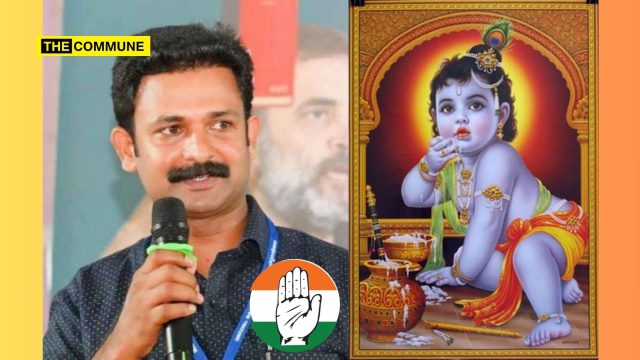
The Congress party in Kerala faces fresh embarrassment as Youth Congress leader and party spokesperson Jinto John came under fire for making a remark against Lord Krishna during a television channel discussion. The Bharatiya Janata Party (BJP) has accused him of blasphemy, demanding a public apology from both John and the Congress.

The controversy erupted during a debate on alleged cyberbullying targeting CPI(M) leader K J Shine and MLA Unnikrishnan. In the course of the discussion, John stated, “Everyone living in Kerala is sensible. In Kerala, “Unnikrishnan” is a term commonly used to describe people involved in immoral behaviour.”

Following the backlash, John expressed regret, calling it an accidental slip during the heated exchange. “It occurred in the middle of an argument with the channel anchor,” he said. However, KPCC president Sunny Joseph clarified that the question of disciplinary action had not yet reached him.

This is not the first time John has faced controversy. CPM leaders had earlier boycotted him in channel discussions after his reported defamatory post against K J Shine. Within the Congress too, discontent has been brewing over the conduct of certain Youth Congress leaders, who are accused of repeatedly putting the leadership in a difficult position.

The latest episode, involving a statement construed as disrespect towards Lord Krishna, has intensified criticism. The BJP charged that the remark was an expression of deep-seated hostility towards the Hindu faith. According to its leaders, John’s words reflected Hindu hatred and were consistent with what they described as the Congress party’s “history of Hindumesia and attacks on the beliefs of the majority population.”

While John has insisted his comment was unintended, political observers believe the controversy is likely to haunt the Congress in Kerala in the days to come.

(With inputs from OpIndia)

Subscribe to our channels on Telegram, WhatsApp, and Instagram and get the best stories of the day delivered to you personally.

Why Vijay Is Unfit To Be A Leader

vijay

Tamilaga Vettri Kazhagam chief and part-time, work-from-home politician Vijay entered politics claiming he would bring real change but his actions tell a very different story. While his initial steps were watched with cautious optimism and patience by the public as is often afforded to a political newcomer he continues to repeat the same mistakes, showing a clear lack of learning or reflection. This persistent political immaturity is evident not only in his public appearances but also in his poor execution on the ground.

A glaring example of this came during his first state-level rally ahead of the 2026 elections, which was intended to cover Tiruchi, Perambalur, and Ariyalur. Despite the ambitious announcement, he failed to even reach Perambalur and returned quietly to the comfort of his Chennai residence, all thanks to logistical failures and poor planning.

Even his much-hyped address in Tiruchi on 13 September 2025, delivered from atop his campaign vehicle, was marred by technical glitches. Out of the 20-minute speech, only one or two minutes were audible a communication disaster for someone positioning himself as a serious contender in state politics.

All these instances strongly suggest that Vijay lacks the seriousness, preparation, and intent to truly engage in public service. He may speak of change, but he has shown little evidence that he understands what that requires.

Adding to this, his political positions are increasingly indistinguishable from the ruling DMK, the very party he claims to oppose. His policy pitches often read like slightly repackaged versions of existing DMK narratives an approach that shows a lack of originality and strategic vision.

Vijay frequently invokes the legacies of stalwarts like Kamarajar and MGR, but the gap between his claims and his conduct is glaring. Leadership is built on vision, consistency, and action not empty rhetoric and stage-managed appearances. So far, Vijay has offered more spectacle than substance.

Until he proves otherwise, his political venture appears to be more about optics than outcomes a far cry from the legacy of leaders he claims to emulate. Below are some of examples why he can’t be

Vijay – A Hypocrite Who Cannot Stand by His Own Stance

Opposes Three-Language Policy, Yet Promotes It at Home and in His School

Vijay has vocally opposed the three-language policy a move aligned with Dravidian political orthodoxy. However, his own son, Jason Sanjay, studied at the elite American International School in Chennai, where students are offered a range of language options, including French, Spanish, and Korean, alongside English. Some IB schools even allow the choice of Hindi.

The stated goal of the three-language policy is to equip marginalized students with multilingual skills, improving their access to global opportunities such as careers in translation, diplomacy, and multinational corporations. Yet, Vijay opposes this policy while personally benefiting from its ethos in his own family and educational ventures.

Adding to the contradiction, Vijay runs Vijay Vidyashram, a CBSE-affiliated school in Padur, where Hindi is taught and foreign languages like French are part of the curriculum. This selective application of ideology where he resists central policies for the public while embracing them privately exposes a glaring double standard.

Silent on Kamarajar, Vocal on EVR

Vijay has frequently projected K. Kamarajar as one of TVK’s ideological icons and his cadres even called him ‘Illaya Kamarajar‘, yet he remained completely silent when DMK MP Tiruchi Siva made insensitive remarks against the late leader. Siva claimed that Kamarajar needed air-conditioning to sleep and made unverifiable claims about his final moments statements many saw as attempts to diminish Kamarajar’s legacy.

This silence stands in sharp contrast to Vijay’s quick condemnation of a UPSC prelims question that referred to E.V. Ramasamy Naicker (EVR) by his full name including the caste-associated suffix “Naicker.” Vijay labelled the mention as “deeply offensive” and accused the exam body of casteist framing.

Critics argue this selective response reflects ideological opportunism, not principled politics. If EVR and Kamarajar are both part of the party’s ideological framework, why is one defended fiercely while the other is ignored when under attack? This inconsistency erodes TVK’s credibility as a value-driven movement.

Wants Governor’s Post Abolished, Then Meets Governor for Political Leverage

Vijay has called for the abolition of the Governor’s post, echoing demands from fringe political narratives. At a rally in October 2024, he declared that the Governor’s role should be eliminated, calling it outdated and undemocratic.

Yet, just two months after this, he personally met Tamil Nadu Governor R.N. Ravi to submit a petition demanding better safety measures for women following a sexual assault incident at Anna University. While his concern for women’s safety is legitimate, his willingness to engage the very institution he wants abolished demonstrates political inconsistency. Critics question, Is the Governor’s office dispensable only when it’s politically convenient?

If Vijay truly respects constitutional principles, he would know that the Governor’s role enshrined in the Constitution by Dr. B.R. Ambedkar, whom TVK claims as a guiding figure is not something that can be casually discarded.

Claims Environmental Concern, Flies Private for Political Events

In yet another contradiction, Vijay visited Ekanapuram village to support farmers opposing the Parandur greenfield airport, citing environmental and agricultural concerns. He condemned the project for endangering farmlands and water bodies, branding it “anti-people.”

However, shortly after, he chartered a private flight to attend a political event in Coimbatore a mode of transport that directly contradicts his supposed environmental stance. Private flights are notorious for their carbon footprint and are often criticized as symbols of elitism and environmental disregard.

Vijay, during his visit to Paranduralleged that the proposed airport would destroy 90% of farmland and 13 water bodies, calling the project “anti-people. He also questioned why the DMK, which had opposed projects like the Salem eight-lane expressway and Kattupalli port, was supporting the Parandur airport. However, a closer look at the Airports Authority of India (AAI) pre-feasibility report and the Tamil Nadu government’s decision-making process reveals that Vijay’s statements are either misleading or based on incomplete information.

Vijay: An Ivory Tower Politician Detached from Ground Reality

Since launching his political party, Tamilaga Vettri Kazhagam (TVK), actor-turned-politician Vijay has maintained a conspicuous distance from the public, making only rare appearances. Most of his political communication is filtered through social media posts, earning him the moniker “part-time, work-from-home politician.” Despite lofty promises to bring about change, Vijay’s actions repeatedly expose a politician who operates from an elite, detached mindset, far removed from the everyday concerns of the people he claims to represent.

Shunning the People: No Time for His Own Supporters

A viral video from June 2025 starkly illustrates Vijay’s disconnect. A long-time fan and TVK supporter, Ayyappan from Salem, rode overnight to Neelankarai hoping to catch a glimpse of Vijay on his 51st birthday. Instead, he returned disappointed and disillusioned.

“I left Salem at 11:30 PM on my bike and reached Vijay’s residence around 6:30 AM. But he didn’t come out to greet us. We were told he’d appear by 12:30 PM, then at 1 PM, but that didn’t happen. Later, someone said he had quietly left in his car. No one saw him. It’s frustrating and hurtful.” Ayyappan told reporters.

He compared Vijay unfavorably to Rajinikanth, who traditionally appears publicly to acknowledge fans. “Would it have hurt him to wave at us for two minutes?” he asked.

The frustration reached a breaking point when Ayyappan declared he would no longer support TVK, stating he would rather vote for NOTA than back a leader who doesn’t respect his own supporters. Adding insult to injury, TVK workers reportedly responded, “One vote doesn’t matter.”

Flood Relief from a Safe Distance

During Cyclone Fengal in December 2024, which brought historic rainfall and devastation to districts like Krishnagiri and Villupuram, most political leaders hit the ground. DMK ministers, AIADMK’s Edappadi Palaniswami, and PMK’s Anbumani Ramadoss all visited affected areas and oversaw relief efforts in person.

In contrast, Vijay chose to stay within the safe confines of his Panaiyur party office, where he invited 300 flood-affected families to come to him for assistance. Aid was distributed at his headquarters not in the disaster zones. Victims were reportedly transported by bus to receive relief.

This approach drew widespread criticism online and offline. Critics questioned the optics of summoning victims to a political office rather than showing solidarity on the ground.

Many saw this as performative politics an event more suited for cameras than for crisis response. A politician who truly cares about people, critics argue, would go to the people not expect them to come to him.

Delayed Response to Protesting Sanitation Workers

Another example of Vijay’s distanced leadership emerged in August 2025, when Greater Chennai Corporation sanitation workers who had been protesting since 3 July 2025 over labor rights and working conditions were finally invited to meet Vijay on 11 August 2025 at TVK’s Panaiyur office.

Instead of visiting the protest site like most concerned leaders might, Vijay rationalized his absence by claiming that a visit would have caused traffic disruptions. In a social media post, he wrote, “To avoid public inconvenience, the workers themselves came to the TVK office.”

While he expressed solidarity with their cause and offered legal support, the eight-day delay before any meaningful interaction raised concerns about how responsive and proactive he would be as a political leader in a real-time crisis.

Across these incidents, a consistent pattern emerges: Vijay rarely steps out of his comfort zone, preferring to operate from behind screens, office desks, and controlled environments. Whether it’s failing to greet fans, refusing to visit disaster zones, or delaying engagement with protesting workers, his leadership appears reactive, stage-managed, and aloof.

Vijay’s Integrity Under the Scanner: A Pattern of Evasion, Manipulation, and Manufactured Credibility

While actor-turned-politician Joseph Vijay markets himself as a clean, youth-driven alternative in Tamil Nadu politics, his personal and political record suggests a very different story. Long before stepping into the political arena, Vijay was already facing serious allegations from tax evasion and income concealment to social media manipulation. Today, these unresolved issues have resurfaced, calling into question his personal integrity, commitment to transparency, and fitness for public life.

Tax Evasion and Concealed Income

Vijay’s financial conduct came under judicial scrutiny when the Income Tax Department imposed a penalty of ₹1.5 crore in 2022 for failing to voluntarily disclose ₹15 crore in income during FY 2015-16. The controversy stemmed from a search and seizure operation conducted in September 2015, which revealed that Vijay had received nearly ₹5 crore in unaccounted cash from the producers of Puli, in addition to ₹16 crore paid via cheque.

Initially denying the existence of unreported income, Vijay later “amicably agreed” to declare an additional ₹15 crore to avoid prolonged legal battles. His retrospective disclosure did little to impress authorities, who argued he would never have disclosed the amount if not for the raid. The IT Department also disallowed deductions claimed by Vijay, including ₹64.7 lakh in fan club expenses and depreciation worth ₹17.81 lakh.

Despite multiple appeals, the matter remains mired in controversy, with Vijay challenging the penalty order under Section 271AAB(1). The fact that a public figure with political ambitions needed legal compulsion to comply with tax laws speaks volumes about his commitment to the rule of law.

“Anti-National Mindset” – Court Slams Vijay Over Rolls-Royce Tax Evasion

Vijay’s reputation took another hit in 2021 when the Madras High Court fined him ₹1 lakh for attempting to evade entry tax on an imported Rolls-Royce. In a strongly worded judgment, Justice S.M. Subramaniam slammed the actor foranti-national mindset“, stating that such tax evasion reflects a mindset contrary to constitutional values.

“These actors portray themselves as champions of social justice but evade tax and act in a manner not in consonance with statutory obligations,” the judge noted.

The court emphasized that real heroes pay their taxes and contribute to the nation’s development, rather than indulging in luxuries while denying the state its due. Vijay’s silence about his profession in his affidavit also drew ire, with the court noting that his stardom was revealed only through his lawyer’s intervention another sign of obfuscation.

Social Media Engineering & Manipulation

While Vijay’s Instagram post from August 2025 boasting 12.5 million likes was touted as a record-breaking feat, digital analysts and political observers weren’t convinced. Despite having just 14.1 million followers, the video a simple selfie from a political rally received more likes than posts by global celebrities like Cristiano Ronaldo and Virat Kohli.
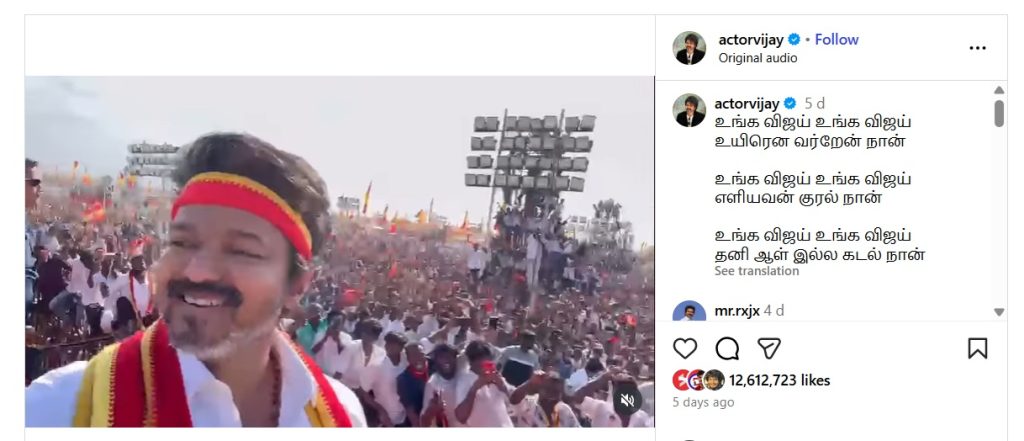
A closer look at the post’s performance reveals several red flags:

  • The video saw an engagement spike of over 11.6 million likes in less than 24 hours.
  • Instagram analytics indicate a 4,392% increase in followers and a 1,013% jump in engagement ratio in just a week.
  • The number of comments also soared by 2,843%, raising doubts about the authenticity of the interaction.

Such disproportionate growth in engagement especially compared to established global celebrities has led many to suspect that the numbers are not organic but likely the result of third-party services, including bots or purchased likes and followers.

Perhaps the most damning evidence lies in the geographical source of the engagement. Data suggests:

  • Only 1.02% of likes are from Tamil Nadu, the core of Vijay’s fan base.
  • A significant portion 38% originates from states like Uttar Pradesh, Madhya Pradesh, and Bihar, where Vijay’s political or film-related influence is minimal.
  • 26% of engagement comes from Assam, West Bengal, and Chhattisgarh, and another 18% from Maharashtra, Gujarat, Rajasthan, and Punjab.

Given Tamil Nadu’s population demographics, especially among the Instagram-active youth (ages 20–35), experts argue it’s highly unlikely for a political post to achieve such traction particularly when most engagement comes from regions with little to no connection to Vijay or his political outfit, TVK (Tamizhaga Vetri Kazhagam).

Critics claim that this recent post may be yet another manufactured publicity stunt, estimating that such engagement inflation could cost anywhere between ₹40 to ₹50 lakh, if done through paid engagement platforms. The goal, they argue, is to project Vijay as a politically powerful figure with mass appeal using numbers that don’t hold up to scrutiny.

What appears to be a viral success on social media may, in fact, be a strategic digital façade aimed at inflating political credibility. As questions grow around the authenticity of Vijay’s Instagram popularity, there is increasing demand for transparency and independent verification of the metrics involved in such posts. Observers call this yet another instance of “old wine in a new bottle” a familiar tactic dressed in a new form to create an illusion of mass support.

Deceptive Tactics – Buying Actress Fan Pages to Fake TVK’s Youth Popularity

Long before the Instagram controversy, Vijay’s team had allegedly purchased a Facebook page originally created for actress Megha Akash. With over 4 million followers, the page was quietly rebranded with TVK imagery and political slogans, misleading the public into believing the party had massive youth support.
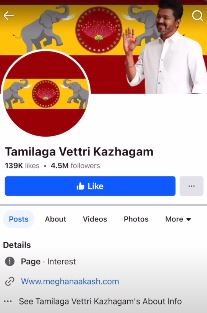
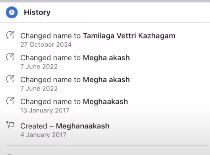
This PR stunt was exposed during a live interview, where a political analyst demonstrated how the page’s transparency data revealed its original purpose. The commentator criticized TVK’s reliance on fake online optics instead of building genuine grassroots movements, warning that such hollow tactics have failed for many politicians before.

Box Office Manipulation

Vijay’s tendency to inflate his successes isn’t limited to social media. His 2023 film Leo was advertised as a ₹600 crore blockbuster. But when producers filed official earnings with the IT department, the theatrical revenue was just ₹160.56 crore. The remaining revenue came from digital and satellite rights, not from box office performance exposing yet another case of misleading public perception.

Just like with Leo, Vijay seems to be relying on hype over substance, optics over outreach, and illusion over integrity raising serious concerns about his suitability for public office.

For a man who projects himself as the clean, youthful face of Tamil Nadu’s political future, Vijay’s record tells a different story of tax evasion, financial concealment, fake online support, and PR-driven deception.

Voters deserve leaders who lead with integrity, accountability, and authenticity—not those who manipulate metrics to manufacture mass appeal. As Tamil Nadu’s politically aware youth evaluate their choices, the critical question remains: Is Vijay building a movement—or just playing a part?

TVK Cadre Indiscipline

One of the most alarming aspects of Vijay’s party, is not merely its leadership vacuum, but the undisciplined, chaotic behavior of its cadres. Far from the image of a disciplined political force, TVK increasingly resembles an unruly fan club with little regard for public order, property, or safety. Despite repeated incidents of damage and disorder, Vijay has remained conspicuously silent raising serious questions about his control over the party he leads.

Madurai Conference: A Political Disaster Masquerading as a Rally

At TVK’s first state-level political conference in Madurai 21 August 2025, a combination of poor planning, cadre lawlessness, and sheer negligence turned what was billed as a show of strength into a humanitarian and logistical nightmare.

Mass Destruction of Property : A Dindigul-based supplier reported that over 500 of 15,000 chairs hired for the event were destroyed, with attendees climbing, jumping, and even piling 10 at a time onto single chairs. Workers attempting to intervene were met with aggression and had to retreat. The supplier, unsure of compensation, lamented that “half the investment is gone.”
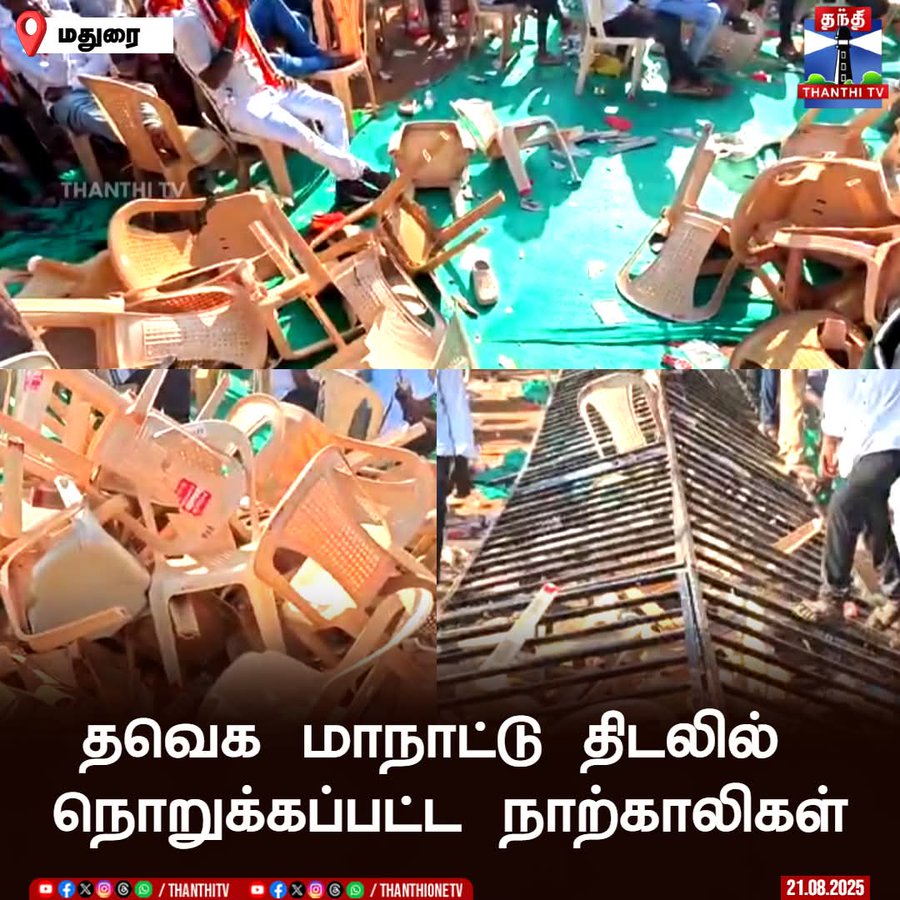
Due to the damage and mismanagement, local suppliers refused to provide chairs for the party’s second event, forcing TVK to source furniture from Kerala, an embarrassing blow to a party claiming to represent Tamil Nadu pride.

Despite temperatures soaring above 39°C (102°F), thousands were brought in from 10 AM, while the event didn’t start until 4 PM. Supporters collapsed from heat exhaustion and dehydration, with hospitals reporting over 2,000 cases of medical distress.

Shocking visuals emerged of infants separated from parents and rushed to medical tents due to unbearable conditions. Critics lambasted TVK for putting political optics over public welfare.

Rather than providing relief, TVK commercialized survival necessities:

  • Water bottle: ₹60
  • Curd rice: ₹70
  • Veg biryani: ₹120
  • Ice cream: ₹100

These inflated prices were allegedly linked to the party charging ₹10,000 per stall—prioritizing profit over people. TVK’s much-promoted “drone sprayers” were dismissed by attendees and experts alike as a cruel publicity stunt, utterly ineffective for the scale of suffering. Roshan, 18, from Kotagiri, died after suffering breathing difficulties in the overcrowded venue. Though initially treated on site, he collapsed again on the way home and was declared dead on arrival at a hospital. His death sparked outrage over the reckless crowd management.

Footage emerged showing attendees “caged” behind metal barricades, unable to move. Volunteers were seen throwing water bottles at people as if they were animals an act widely condemned on social media and by human rights observers. To prevent fans from climbing electric poles, as happened in the first conference, organizers greased the poles and bars, showing a preference for crude physical deterrents over meaningful discipline or engagement.

The event descended into a lawless free-for-all: Mobile phones and wallets were stolen near food stalls. Police complaint booths had to be set up to deal with the chaos. Alcohol consumption and even liquor bottles discarded near temples were reported an insult to religious sentiments.

What was supposed to be TVK’s grand political moment turned into a crisis of ethics, management, and accountability. Observers compared the scenes to a “Gaza-type” humanitarian breakdown, where basic dignity was sacrificed at the altar of a personality cult.

Chennai Chaos: Thiruvanmiyur Incident

On 28 March 2025, TVK’s general council meeting at Thiruvanmiyur created another public nuisance, traffic snarled for hours, vehicles parked indiscriminately, drums and loud music disrupted the area, residents and commuters were forced to endure an unwelcome Friday ordeal

Massive banners and cut-outs of Vijay covered the streets, mimicking a film premiere more than a political gathering.

Tiruchirapalli Campaign Launch: Another Chapter in Disorder

TVK’s statewide campaign launch in Trichy on 13 September 2025, further highlighted the party’s inability to maintain order.

Airport Chaos: Crowds broke police barricades as Vijay landed. Slippers, trash, and torn posters littered the airport roads showcasing a complete lack of planning and discipline.

Banner Vandalism and Firecrackers: TVK supporters tore their own party banners burst unauthorized firecrackers ignored police warnings, creating a hazardous environment. Vijay’s convoy, meant to cover 8 kilometers, took over 4 hours, and his speech was delayed significantly, throwing the entire schedule into disarray. With cadres spilling into major roads, including Pudukottai Road and Palakkarai Underbridge, traffic came to a standstill. Shops shut down, causing water shortages for attendees stuck for hours. Trichy’s normal life was held hostage by what was supposed to be a political outreach.

Coimbatore Airport: Chaos Repeats Itself

Back in April 2025, Coimbatore Airport witnessed similar disorder, TVK cadres breached the 50-person limit, parked irresponsibly on main roads, damaged barricades, grills, and trolleys in the airport, ignored airport security and disrupted operations. There was no coordination with authorities, and once again, cadres behaved like uncontrolled fans—not disciplined political workers.

From Madurai to Trichy, Chennai to Coimbatore, TVK’s public events have consistently exposed a lack of discipline, foresight, and respect for public space. Rather than serving as a platform for constructive political engagement, these gatherings have become platforms for chaos, property damage, and even tragedy.

If Vijay genuinely intends to be a political leader and not just a glorified fan club president he must urgently rein in his cadres, implement rigorous training and codes of conduct, and demonstrate a serious commitment to public order. Until then, TVK will remain not a political force, but a spectacle loud, chaotic, and ultimately unsustainable.

Vijay’s TVK Substitutes DMK To Become TN’s New Anti-Development Force

Perhaps the most telling indictment of Vijay and his party, Tamilaga Vettri Kazhagam (TVK), lies in their anti-progressive, opportunistic stance—a strategy that appears less about principles and more about political mimicry. Far from offering a genuine alternative, Vijay has positioned himself as a shadow of the very establishment he critiques, recycling the playbook of the DMK’s opposition era with little innovation or ideological depth.

Both Opposed Parandur Greenfield Airport Plainly

Vijay, during his visit to Paranduralleged that the proposed airport would destroy 90% of farmland and 13 water bodies, calling the project “anti-people. He also questioned why the DMK, which had opposed projects like the Salem eight-lane expressway and Kattupalli port, was supporting the Parandur airport. However, a closer look at the Airports Authority of India (AAI) pre-feasibility report and the Tamil Nadu government’s decision-making process reveals that Vijay’s statements are either misleading or based on incomplete information.

The Airports Authority of India (AAI) conducted a detailed study to identify the most suitable site for Chennai’s second airport, considering locations like Padalam, Thiruporur, Pannur, and Parandur. Parandur emerged as the best option due to factors such as airspace restrictions at other sites, availability of 5,369 acres of land, better connectivity through the Chennai-Bengaluru Expressway, and fewer displacements compared to Pannur. Additionally, Parandur offers significant potential for future development, unlike the more densely developed Pannur site. Vijay’s claims about the project destroying 90% of farmland and 13 water bodies lack substantiation and overlook the thorough environmental and social impact analysis in the AAI report. Critics suggest that Vijay’s opposition to the project is driven by political motives, with his visit to the protest site viewed as a publicity stunt. Aviation experts argue that Parandur is the most feasible site for the airport, and relocating the project would cause delays and increased costs.

A similar approach was taken by the DMK in 2019 when it criticized the AIADMK government while in the opposition, but once it came to power, the party acknowledged the airport as a crucial need for the state’s economy.

Both Opposed NEET

During the executive committee meeting in Panaiyur on 3 November 2024, which was presided over by Vijay, a resolution was passed calling for the abolition of the National Eligibility cum Entrance Test (NEET). This comes despite data indicating that more underprivileged students, including those from tribal communities, have been able to secure medical seats through the exam in recent years.

Even the DMK, which had previously claimed to have the ‘Secret Weapon’ to make the central government to abolish NEET, switched its stance when Chief Minister MK Stalin admitted in a recent assembly speech that the central government holds the power to revoke NEET, contradicting earlier claims. TVK’s Vijay holds a similar stance on abolishing the exam, and it remains to be seen whether he will reverse his position like the DMK in the next NEET exam season.

Both Called For Abolition Of Governor Post

TVK’s resolutions on 3 November 2024 reiterated their stance on abolishing the Governor’s post. However, in the wake of the sexual harassment case at Anna University, which allegedly involved a DMK functionary, and widespread speculation that the DMK might protect the accused, TVK party chief Vijay sought the Governor’s intervention. It seems that Vijay has now come to recognize the importance of having a neutral figure above the government, capable of questioning the state’s actions when constitutional mechanisms fail. Previously, however, without fully understanding the role and significance of the office, he had called for the abolition of the Governor’s post, which was both impractical and unconstitutional. This stance has been a hallmark of the DMK since its inception, with the party’s founder C.N. Annadurai famously describing the position of Governor as “redundant as a goat’s beard.” This sentiment continues to this day, as evidenced in the 2024 Lok Sabha election manifesto, where the DMK again called for the abolition of the Governor’s post.

Similarly, in January 2024, Udhayanidhi Stalin, the current Deputy Chief Minister and scion of the DMK, led the party’s Youth Wing in passing a resolution calling for the abolition of the Governor’s post in Tamil Nadu. The resolution argued that the governor was attempting to run a parallel administration, undermining the authority of the state’s elected representatives. The resolution, passed at the 2nd DMK Youth Wing Meet, asserted that abolishing the position of Governor was essential to safeguard democracy.

Both Opposed Three-Language Policy

Vijay has strongly opposed the three-language policy, despite his own son, Jason Sanjay, studying at the American International School in Chennai, where languages like French, Spanish, and Korean are offered alongside English. In some IB schools, students also have the option to choose Hindi. The rationale behind the three-language policy is to provide marginalized students— even many of whom currently lack access to government schools—a chance to learn a third language. This would enable them to pursue careers as translators, communicators, and open doors to international job opportunities.

However, Vijay, along with other Dravidian leaders and the DMK, oppose marginalized students to venture beyond Tamil Nadu. They seem to believe these students should remain confined to the state, study locally, and take on menial jobs, ultimately serving as a political vote base through emotional appeals. The hypocrisy lies in the fact that this “two-language policy” exception doesn’t apply to Matriculation, CBSE, or international boards, which offer a wider array of language options. Yet, Vijay appears intent on following this same narrow-minded stance.

Both Opposed Central Govt On Other Matters

TVK chief Vijay has adopted a stance similar to that of the DMK, opposing any initiatives proposed by the central government. DMK chief and Chief Minister MK Stalin argued that the legislation posed a threat to “alter India’s polity forever.” Similarly, during the TVK party resolution, Vijay strongly opposed the “one nation, one election” proposal, criticizing it as an anti-democratic move by the BJP-led Union government.

In addition, TVK has mirrored the DMK’s tendency to pander to Islamist interests. The party has called for the withdrawal of the Waqf (Amendment) Bill amid reports of vast areas of land and entire villages being claimed by the Waqf Board.

Last Word

Vijay’s political avatar is not the arrival of a leader — it is the extension of an actor’s vanity project. He lectures about morality while hiding behind the walls of luxury, tweeting sermons from the comfort of air-conditioned rooms, never once dirtying his hands in the struggles of ordinary Tamils. His hypocrisy on language, his silence when Kamarajar was dragged through the mud, and his flip-flops on the Governor reveal a man without spine or substance. He has mastered one role alone — that of a hypocrite who tailors his politics to applause.

TVK is not a party but a bloated fan club, an unruly mob that tramples on women, steals from the poor at rallies, and leaves behind chaos and even death. This is the culture Vijay has cultivated — a culture where blind loyalty is worshipped and accountability is despised. His followers sell tickets, his managers mint money, and his cadres run amok — all while he plays the “clean” messiah from a distance.

Let’s be blunt: Vijay is no Kamarajar, no MGR, not even a shadow of them. He is a tax evader who posed as a saint, a master of box-office manipulations dressing up deceit as success, and a coward who mistakes fan hysteria for political capital. Tamil Nadu deserves leaders who stand in the streets with the people — not a superstar politician who hides behind PR and lets his fandom do the dirty work.

Until he proves otherwise, Vijay will remain nothing more than what he is today: a pampered actor playing politician, a hypocrite without courage, and the head of a fan club masquerading as a movement.

Kaathavaraayan is a political writer. 

 Subscribe to our channels on TelegramWhatsApp, and Instagram and get the best stories of the day delivered to you personally.

Soros-Funded Allies And The Foreign Hands Behind Rahul Gandhi’s 2023 US Tour

In the complex arena of international diplomacy and political optics, even offhand remarks can uncover significant undercurrents. A recent clip featuring a discussion between Indian-American scholar Prof. Muqtedar Khan and Pakistani commentator Dr. Qamar Cheema has drawn attention to a lesser-known detail of Congress leader Rahul Gandhi’s 2023 trip to the United States a trip already surrounded by political scrutiny.

In the conversation, now circulating widely on social media, Professor Khan recounts an unexpected incident during a visit to the Hudson Institute in Washington, D.C. As he arrived at the venue, he discovered it was closed to outsiders due to an ongoing seminar by Rahul Gandhi. While waiting to gain access, Khan says he was joined by a man who was also attempting to enter. That man turned out to be none other than Sheikh Meshaal bin Hamad Al-Thani, the Qatari Ambassador to the U.S. According to Khan, Ambassador Al-Thani informed him that he had personally arranged Gandhi’s event at the think tank.

The claim that Qatar’s ambassador hosted a closed-door event for Rahul Gandhi at a prominent U.S. policy institution has raised questions about foreign influence and political intent. Qatar, while a key U.S. ally, has been accused of backing Islamist movements and hosting groups like Hamas, considered a terrorist organization by several countries. Given this context, the reported involvement of a senior Qatari diplomat in organizing a platform for a leading Indian opposition figure has sparked concern among foreign policy observers.

Controversial Associations Of Rahul Gandhi With Sunita Viswanath In Hudson Institute

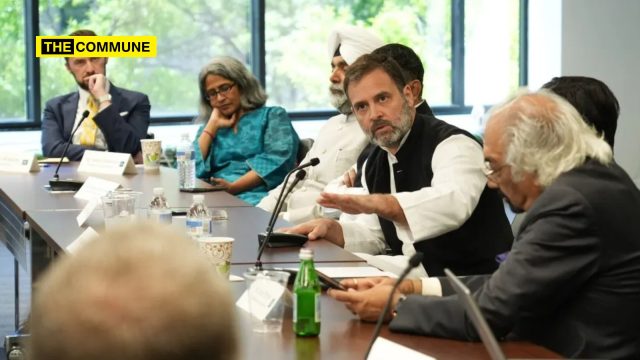
Photos from the Hudson Institute event show Rahul Gandhi seated next to Sunita Viswanath, co-founder of Hindus for Human Rights (HfHR), an organization that has often taken critical positions on Indian policy and Hindu nationalist politics. HfHR has been linked to funding from George Soros’s Open Society Foundations and associations with groups like the Indian American Muslim Council (IAMC), which has been accused of ties to extremist networks.

Viswanath has drawn criticism in the past for controversial comparisons and commentary. In a Janmashtami op-ed published by The Wire, she likened the suffering of Palestinians in Gaza to Hindu epics, even comparing Israel to Kansa a parallel many found offensive. Her group has hosted events equating Hindu identity with “supremacy,” supported the “Dismantling Global Hindutva” conference, and circulated material during Prime Minister Modi’s 2023 visit to the U.S. that critics say was intended to undermine India’s image.

Foreign Funding, Political Messaging, and Echoed Rhetoric

Analysts argue that Gandhi’s appearance alongside figures like Viswanath wasn’t accidental. His messages at these forums particularly at Hudson echoed narratives long pushed by U.S.-based advocacy groups critical of the Indian government. These included sharp critiques of the Citizenship Amendment Act (CAA) and NRC, reinterpretation of “Hindutva” as a threat distinct from “Hinduism,” and portrayals of the BJP as authoritarian.

Critics suggest these positions align with talking points promoted by HfHR, IAMC, and even international media funded by foreign philanthropists with known political agendas, including George Soros. These overlaps have raised concerns over the extent to which foreign narratives are influencing domestic political discourse.

The Unexplained White House Visit

Further adding to the speculation was a report by journalist Seema Sirohi in The Economic Times, revealing a discreet meeting Gandhi had at the White House during the same trip. The visit, notably absent from official Indian briefings, has prompted questions about protocol and transparency. Who Gandhi met, and what was discussed, remains undisclosed.

Prominent voices have also noted the presence of individuals connected to Khalistani, Kashmiri separatist, and Pakistani lobbying circles at various events on Gandhi’s U.S. itinerary. Some members of the Indian diaspora have expressed concern that such associations could impact India’s international image or even interfere in electoral politics.

Patterns of Seeking Foreign Validation?

This isn’t the first time Rahul Gandhi has been accused of inviting international commentary on India’s internal matters. In 2023, he delivered a speech at Cambridge University suggesting that democracy was under threat in India and that Western nations should intervene. In 2021, during a Harvard event, he asked U.S. officials to speak out on Indian issues, a move that drew diplomatic criticism.

Past engagements including undisclosed meetings with Chinese officials during his 2018 visit to Kailash Mansarovar have also fueled speculation about Gandhi’s foreign outreach strategies and their implications for national sovereignty.

A Coordinated Strategy?

Taken together, these developments have led some analysts to propose that Gandhi’s U.S. tour may have been more than a diaspora engagement exercise. With Qatar reportedly facilitating events, Soros-funded organizations shaping the narrative, and Islamist-linked lobbies amplifying his message, a broader strategy may have been at play one aimed at reshaping the global perception of India ahead of critical elections.

The links to controversial entities and figures, the overlap of narratives, and the Qatari ambassador’s alleged involvement raise deeper concerns about foreign influence in Indian politics. If true, this convergence of diplomatic, ideological, and political forces paints a complex picture of modern opposition politics in a globalized world.

What Comes Next?

As the clip featuring Prof. Muqtedar Khan continues to make the rounds online, public and media scrutiny of Rahul Gandhi’s foreign engagements is likely to intensify. Questions of transparency, foreign lobbying, and political alliances both at home and abroad will continue to shape the debate around the role of India’s opposition in the international arena.

Whether this was routine diplomacy or something more orchestrated remains to be seen. But in an era where narratives can shift global perceptions, the need for clarity and accountability from public figures has never been greater.

(With inputs from OpIndia)

Subscribe to our channels on Telegram, WhatsApp, and Instagram and get the best stories of the day delivered to you personally.

United States Of Xenophobia: Gujarati Women Working At Cash Counter Of South Carolina Store Shot Dead, Is USA Becoming Unsafe For Working-Class Indians?

A 21-year-old man, Zaedan Mack Hill, has been arrested in connection with two shooting incidents in Union County, South Carolina — one of which resulted in the death of a Gujarati woman, 49-year-old Kiran Patel, on September 16.

The police discovered an unconscious man (Charles Nathan Crosby) on a yard in South Mountain Street earlier that evening. Later, around 10:30 pm, Kiran Patel was shot while at the gas station/convenience store she managed in Union County. Hill reportedly approached the register, jumped over it, and shot Patel during a robbery attempt before she could hand over cash.

Patel tried to escape by running to the parking lot after throwing something (like a bottle) at Hill, but he pursued her and fired again. She was wounded by the second shot while unconscious on the ground.

Law enforcement, including the South Carolina Law Enforcement Division and the SWAT team, obtained a search and arrest warrant for Hill’s residence on South Church Street. After a multi-hour standoff, Hill was eventually taken into custody. He has been charged with murder.

United States of Xenophobia: Rising Racism and Hate Crimes Against Indians

September 2025 – Dallas, Texas: Chandramouli “Bob” Nagamallaiah, a 50-year-old motel manager from Karnataka, was brutally beheaded by a co-worker in Dallas, Texas, following a dispute over a malfunctioning washing machine. The gruesome murder has intensified concerns over the safety of Indians in America.

The tragedy reflects a broader trend that many in the Indian diaspora have been grappling with — growing hostility and personal insecurity, whether in workplaces or public spaces.

January 2025 – Washington, DC: Food delivery worker Koyyada Ravi Teja, 26, was shot at point-blank range while on duty on January 18. He died instantly.

February 2025 – Florida: Indian-origin nurse Lil Lal, 67, was brutally assaulted by psychiatric patient Steven Scantlebury, who shouted “Indians are bad” during the attack. She sustained facial disfigurement and risk of blindness. Scantlebury was charged with a hate crime and attempted second-degree murder.

March 2025 – Chino Hills, California: The BAPS Shri Swaminarayan Mandir was defaced with graffiti bearing anti-India slogans such as “F— Modi and Hindustan” and “murdabad.” Authorities launched a hate-crime investigation.

March 2025 – Wisconsin: Indian student Praveen Kumar Gampa, 27, was shot dead near his residence on March 5 in a suspected robbery.

July 2025 – Chicago, Illinois: A 31-year-old Indian student was shot in the abdomen during an argument with a pedestrian on July 23 while inside his car. He was hospitalized in critical condition.

August 2025 – Greenwood, Indiana: The BAPS Swaminarayan Hindu Temple was vandalized with anti-India graffiti on August 10. Community organizations condemned the attack, which authorities are treating as a hate crime.

September 2025 – California: On September 6, Kapil, a 26-year-old security guard from Haryana, was shot dead after confronting a man urinating outside his workplace.

September 2025 – Dallas, Texas: On September 10, Chandra Mouli “Bob” Nagamallaiah, 50, a motel manager from Karnataka, was gruesomely beheaded by a co-worker during a dispute. The accused was arrested and charged with capital murder.

January 2024 – Hartford, Connecticut: Two students, Dinesh (22) and Nikesh (21), from Telangana and Andhra Pradesh, were discovered dead under suspicious circumstances on January 15.

January 2024 – Illinois: Akul Dhawan, 18, a freshman at the University of Illinois, died of hypothermia on January 20 after being denied reentry into a campus club and failing to secure a rideshare. His father criticized campus police for failing to act quickly.

January 2024 – Purdue University, Indiana: Indian student Neel Acharya was reported missing by his mother and later found dead on January 28. The cause of death remains unknown.

February 2024 – Chicago, Illinois: Student Syed Mazahir Ali was assaulted and robbed by four armed men on February 4. He lost his phone in the incident.

February 2024 – Purdue, Indiana: PhD student Sameer Kamath, 23, was found dead in Crow’s Grove Nature Preserve on February 5. The cause of death is still unexplained.

February 2024 – Washington, DC: Dynamo Technologies co-founder Vivek Taneja, 41, died on February 10 after a street altercation in which he fell and hit his head.

March 2024 – St. Louis, Missouri: Renowned Bharatanatyam and Kuchipudi dancer Amarnath Ghosh, 34, was shot dead on March 2.

March 2024 – Cleveland, Ohio: Master’s student Mohammed Abdul Arfath, 25, was kidnapped in early March, with ransom demands made. His body was later discovered, shocking the Indian community.

March 2024 – Boston, Massachusetts: Engineering student Paruchuri Abhijit, 20, was found dead in an abandoned car on campus on March 11.

April 2024 – Ohio: Uma Satya Sai Gadde, an Indian student, died in a tragic accident on April 6.

November 2024 – San Francisco, California: Suchir Balaji, 26, was discovered dead in his apartment on November 26 under unclear circumstances.

November 2024 – Chicago, Illinois: Student Sai Teja Nukarapu, 22, was shot dead during a store robbery on November 29 despite complying with the assailants.

January 2023 – Chicago, Illinois: Just ten days after arriving in the US, 23-year-old student Nandapu Devansh was killed in a robbery on January 24. Another student from Hyderabad was also injured.

January 2023 – Seattle, Washington: Jaahnavi Kandula, 23, was fatally struck by a speeding police vehicle on January 23. Outrage grew after body-cam footage revealed an officer laughing about the incident.

April 2023 – Columbus, Ohio: Saiesh Veera, 24, was shot dead during an armed robbery at a gas station where he worked. His death came just days before he was set to graduate with a master’s degree.

November 2023 – Cincinnati, Ohio: PhD student Aaditya Adlakha, 26, was found critically wounded inside his car with multiple bullet holes after it crashed. He succumbed to injuries on November 11. Police have not made arrests.

April 2022 – Richmond Hill, Queens, New York: Two Sikh men were attacked and robbed in separate incidents, during which their turbans were forcibly removed. In another case, 70-year-old Nirmal Singh was seriously injured in an assault. These cases were investigated by the NYPD’s Hate Crime Task Force.

October 2022 – West Lafayette, Indiana: Varun Manish Chheda, a 20-year-old Purdue University student, was stabbed multiple times in the head and neck by his roommate Ji Min Sha. Authorities described the attack as unprovoked. Sha, an international student from Korea, was arrested and charged with murder.

June 2022 – Cincinnati, Ohio: Sai Charan Nakka, 25, a University of Cincinnati graduate, was found dead from a gunshot wound on June 19. The investigation remains open.

A recurring issue is that many such incidents are not officially classified as hate crimes. This underreporting obscures the full scale of the violence and makes it harder to address.

Beyond the physical violence, the psychological impact on Indian communities is profound. Families report living with fear, grief, and vulnerability, while demanding stronger measures to ensure justice and accountability.