Home Blog

17 Reported Cases In 5 Years: How Congress Governments Targeted Journalists And Influencers Across India
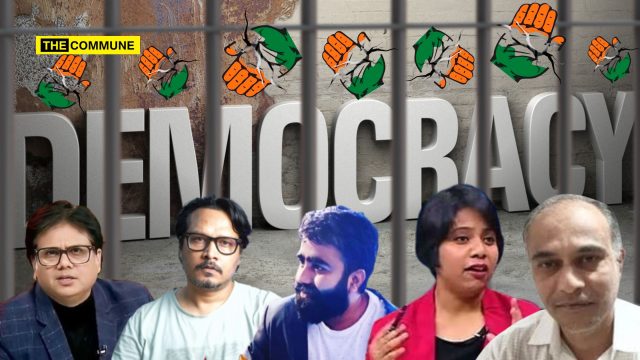
On 8 December 2025, Telangana Police arrested BJP state social media convenor Sumiran KV and two associates near the Abids Road police station in Hyderabad. The arrests came after posters appeared across the city criticising Chief Minister A. Revanth Reddy’s two-year tenure, listing allegations of real-estate interference, temple demolitions, rising street crime, and commissions in public projects.

In this report, we look at 17 incidents between 2020 and 2025 in which the Congress party or Congress-ruled state governments have filed FIRs against journalists, reporters, YouTubers, and social media influencers. These cases span Karnataka, Telangana, Rajasthan, Chhattisgarh, and West Bengal, and typically involve individuals booked for criticising party leadership, questioning governance, or highlighting local administrative failures.

Actions Against Social Media Users and Influencers

#1 Telangana Police Arrest BJP Social Media Team Over Critical Posters – 9 December 2025

Telangana police arrested BJP state social media convenor Sumiran Komarraju and two associates, Ajay and Tatipamula Sai Kiran Goud, on 8 December 2025 near Abid Road police station in Hyderabad. The arrests followed the distribution of posters criticizing Chief Minister A. Revanth Reddy’s two years in office, highlighting issues including real estate influence, temple demolitions, street crime, and alleged project commissions. The controversial poster depicted Revanth Reddy seated on a throne-like chair with multiple robotic arms extending outward, each holding placards carrying various allegations against his administration.

According to police reports, a Greater Hyderabad Municipal Corporation employee filed the complaint on 6 December 2025, leading to the subsequent arrests of the BJP social media team members.

#2 Telangana Introduces History Sheets for Social Media Posts – 23 September 2025

On 23 September 2025, the Congress government in Telangana directed Hyderabad Cyber Crime Police to open Suspect or History Sheets against social media users accused of “cyber offences” and “financial frauds,” even without convictions.

This unprecedented measure marked the first time in India that social media posts could result in users being placed on criminal history sheets. The official memo cited Standing Order 600-1 of the Telangana Police Manual and Section 111 of the Bharatiya Nyaya Sanhita, ordering police to treat such users as “habitual or addicted offenders” and place them under constant surveillance.

#3 Karnataka Police Arrest Influencer for Criticizing State Leadership – 4 December 2024

Belagavi Police arrested 38-year-old social media influencer Mohit Narasimhamurthy on charges of using abusive and unparliamentary language against Karnataka’s political leadership. The arrest followed a complaint by the Congress state unit regarding a video uploaded by Narasimhamurthy containing alleged insulting content directed at Chief Minister Siddaramaiah, Deputy Chief Minister D.K. Shivakumar, and Ministers Satish Jarkiholi and K.H. Muniyappa.

#4 Hyderabad Police File FIR Against Influencer Over Rahul Gandhi Criticism – 7 July 2024

The Cyber-Crime wing of Hyderabad police registered an FIR against social media influencer Raushan Sinha, known online as @MrSinha_, on 2 June 2024, based on a complaint by advocate Eera Venkat Naik. The complaint alleged that the influencer spread fake news related to Congress MP Rahul Gandhi’s parliamentary speech delivered on 1 June 2024. According to the complainant, Rahul Gandhi had not made any wrong statements against Hindus, but the BJP social media ecosystem was intentionally provoking Hindu sentiment for political advantage.

#5 Karnataka Police Arrest Goa-Based Influencer Over Wealth Distribution Post – 18 May 2024

Karnataka police arrested influencer Vinit Naik from his residence in Ponda, Goa, following an FIR registered by Bengaluru’s cybercrime police. The case was based on a complaint by Congress party worker J Saravanan, who alleged that Naik, operating the X account ‘Bhiku Mhatre’ under the handle @MumbaichaDon, posted content against Karnataka Chief Minister Siddaramaiah that could create enmity between Hindus and Muslims and disturb societal peace. Specifically, Vinit had posted a video of Siddaramaiah’s speech claiming that Congress wanted to take wealth from Hindus and distribute it among Muslims.

#6 Indian Youth Congress Files Complaint Against Three Prominent Influencers – 26 April 2024

Leaders of the Indian Youth Congress filed a complaint on 26 April 2024 at the Cyber Crime Police Station in Hyderabad against three prominent social media influencers: Rishi Bagree, Arun Pudur, and Ajeet Bharti. The complaint alleged that these influencers had morphed and circulated a video of Wayanad MP Rahul Gandhi’s speech delivered in Tukkuguda, Telangana, on 6 April 2024. According to IYC leaders, following Prime Minister Narendra Modi’s controversial remarks, the allegedly edited video of Rahul Gandhi’s speech was widely shared on social media. The complaint claimed that several fact-checkers had identified the video as edited.

#7 Instagram Account Holders Face Case Over Siddaramaiah Post – 12 January 2024

Bengaluru’s High Grounds police registered a case against two Instagram account holders, ‘troll_kannadiga_1’ and Kritika Kriti, for allegedly posting a morphed picture of Chief Minister Siddaramaiah accompanied by abusive comments. The FIR was filed based on a complaint by Sajay Yadav, secretary of the Karnataka Pradesh Congress Committee’s Legal Cell. The charges included promoting enmity between different groups on grounds of religion, race, and place of birth, as well as making or circulating false statements, rumors, or information with specific intent to cause harm.

#8 West Bengal Congress Files FIR Against Rishi Bagree – 1 December 2020

The West Bengal Congress filed an FIR in Kolkata against social media influencer Rishi Bagree regarding his tweet about the ongoing farmers’ protest dated 29 November 2020. In the FIR, Congress accused Bagree of attempting to incite the public through his allegedly provocative tweet and intentionally insulting Congress President Sonia Gandhi, thereby provoking the public at large with intention to break public peace and cause riots. The complaint also mentioned that Bagree committed the offense of intimidation through his social media account.

Actions Against Professional Journalists 

#9 Karnataka Congress Files FIR Against Arnab Goswami and Amit Malviya – 20 May 2025

On 20 May 2025, the Congress party filed an FIR against Republic TV editor-in-chief Arnab Goswami and BJP IT cell chief Amit Malviya for allegedly spreading misinformation against Congress. The case, registered at High Grounds police station in Karnataka, was based on a complaint by Shrikant Swaroop B N, head of the Indian Youth Congress’s legal cell.

The two were booked under Sections 192 (wantonly giving provocation with intent to cause riot) and 352 (intentional insult with intent to provoke breach of peace) of the Bharatiya Nyaya Sanhita.

#10 Congress Files Complaint Against Doordarshan Journalists – 9 May 2025

Karnataka Congress leader CM Dhananjaya filed complaints with Bengaluru’s High Grounds Police Station on 9 May 2025 against Doordarshan journalists Ashok Shrivastava and Prakhar Shrivastava. The complaint condemned a program that allegedly portrayed Congress president Mallikarjun Kharge as a “traitor” during a period of heightened military conflict with Pakistan. Congress accused the journalists of making “communal, unverified, and derogatory statements” on social media. The targeting of government-employed Doordarshan journalists was particularly notable, as it involved state-run media personnel.

#11 Hyderabad Police Arrest Two Pulse News Journalists – 12 March 2025

Hyderabad police arrested Revathi Pogadadanda, Managing Director of Pulse Digital News Network, and Tanvi Yadav on 17 March 2025 for allegedly broadcasting “offensive” content about Chief Minister A Revanth Reddy. The arrests followed a complaint by the Congress state social media unit. The Hyderabad court granted bail to both journalists on 17 March 2025, ruling that Section 111 of the Bharatiya Nyaya Sanhita could not be applied to them as there was no element of organized crime or monetary transactions involved in their journalistic work. The swift court intervention and bail grant suggested that the initial arrest may have lacked sufficient legal grounds.

#12 Telangana Journalist Booked for Complaining About Power Failure – 19 June 2024

The Telangana state government booked journalist Revathi for raising a civic issue, specifically complaining about a power failure within Hyderabad city limits. The FIR was filed at Lal Bahadur Nagar police station based on a complaint by M Dileep, a Telangana state government official.

The FIR stated that the complainant asserted the power failure allegation was false and intentionally aimed at defaming the state government and Telangana State Power Distribution Company Limited. The official requested action against Revathi for spreading false propaganda and making the incident viral on social media.

#13 Karnataka Police Book YouTuber Over Rahul Gandhi Commentary – 16 June 2024

Bengaluru’s High Grounds police booked YouTuber Ajeet Bharti for allegedly “spreading enmity between religious groups through false claims.” The FIR was filed based on a complaint by BK Bopanna, a lawyer and secretary of the Karnataka Pradesh Congress Committee’s legal cell. Bopanna’s complaint referenced a video shared by Bharti on X, claiming that Bharti falsely stated Rahul Gandhi intended to bring back the Babri Masjid in place of the Ram Mandir, and that Rahul Gandhi had never made any such statements in his speeches.

#14 Karnataka Police File FIR Against TV Anchor Sudhir Chaudhary – 11 September 2023

Karnataka police registered an FIR against TV anchor Sudhir Chaudhary for allegedly “conspiring to disrupt communal harmony and spreading misinformation” in a show he hosted on the Aaj Tak news channel. The program discussed the state government’s commercial vehicle subsidy scheme for minority communities. Chaudhary was booked at Seshadripuram police station under various sections of the Indian Penal Code for promoting enmity between groups, based on a complaint filed by a Karnataka Minorities Development Corporation official. The case involved mainstream television journalism covering government policy, with the Congress-led Karnataka government treating critical coverage of its minority welfare schemes as criminal conduct.

#15 Rajasthan Congress Files Complaint Against Zee Hindustan Anchor – 1 July 2022

The Congress filed a complaint against Zee Hindustan anchor Rohit Ranjan at Bani Park police station in Jaipur for allegedly running a doctored video of Rahul Gandhi, despite the channel withdrawing the content and issuing a public apology. The FIR was filed on the complaint of Congress worker Ram Singh Kasanwa and booked Ranjan under IPC sections 504, 505 and others. The disputed news report allegedly presented former Congress president Rahul Gandhi’s comments on Students Federation of India brutality in Wayanad, Kerala, as condoning and supporting the killers of Kanhaiya Lal in Udaipur. The case proceeded despite the channel’s corrective action and apology.

#16 Chhattisgarh Police Arrest Journalists After Congress MLAs Complain – 25 October 2021

Journalist Madhukar Dubey and technical assistant Avinash Palliwar were arrested on 25 October 2021 in Raipur, Chhattisgarh, after Congress MLAs Brihaspat Singh and Kuldeep Juneja complained that the web portal zeroparty.in published “misleading” information about them on 24 October 2021. The portal had published a report about a sting operation in which the MLAs had criticized Chief Minister Bhupesh Baghel. Two separate FIRs were registered against the media workers under various IPC sections, including extortion, threat to public servant, intentional insult, criminal intimidation, and defamation.

#17 Over 100 FIRs Filed Against Arnab Goswami Across India – 24 April 2020

More than 100 FIRs were filed by Congress party units and workers in various parts of India against Republic TV Editor-in-Chief Arnab Goswami following his comments about Congress President Sonia Gandhi after the lynching of Hindu sadhus in Palghar on 16 April 2020. Goswami had asked probing questions about why Sonia Gandhi remained silent on the incident and whether the Italian-born politician would have maintained such silence if Christian priests had been murdered instead. Goswami also alleged that he and his wife were attacked by Congress workers on 24 April 2020 while returning to their Mumbai home from the studio. The nationwide cascade of FIRs represented a coordinated response by Congress units across multiple states.

Subscribe to our channels on WhatsAppTelegram, Instagram and YouTube to get the best stories of the day delivered to you personally.
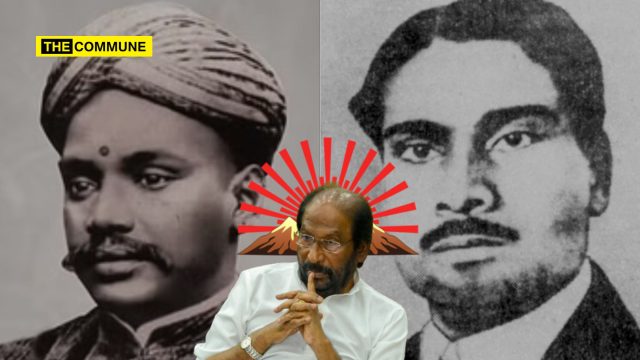
DMK Cries ‘Tamil Freedom Fighters Ignored’ In Parliament, But Ignores Them At Home

DMK Rajya Sabha MP Tiruchi Siva while speaking in the Parliament questioned what he described as the neglect of Tamil freedom fighters in North India, framing it as a historical injustice.

Raising the issue, he asked whether there were roads or streets in North India named after Tamil icons such as VO Chidambaram Pillai or Mahakavi Subramania Bharati. He further questioned whether people outside Tamil Nadu even knew who Veerapandiya Kattabomman was. Tiruchi Siva also claimed that Tamils were ignored despite their contributions to the freedom struggle and asserted that it was a Tamil, Chempakaraman, who first coined the slogan “Jai Hind.”

He said, “Is there anywhere in North India a VO Chidambaranar Road? Is there a Bharatiyar Street? Does anyone there even know who Veerapandiya Kattabomman is? Please tell me, why were we ignored? The question to ask is this: we were the ones who first coined the slogan “Jai Hind” – it was Chempakaraman who did that.”

The remarks were projected as a defence of Tamil pride and a call for national recognition of Tamil freedom fighters.

The Record The DMK Does Not Mention

While Tiruchi Siva’s questions drew attention in Parliament, they have also prompted scrutiny of the DMK’s own actions in Tamil Nadu, particularly when it had full control over naming public institutions, erecting statues, and institutionalising remembrance.

VO Chidambaram Pillai And The Tirunelveli Bus Stand

There is no dispute anywhere in India about VO Chidambaram Pillai’s stature. He is widely recognised as a pioneering leader of the Swadeshi movement and a central figure in Tamil Nadu’s freedom struggle. Tirunelveli, in particular, is inseparably associated with him, he practised law there, organised labour there, and it was there that public protests erupted after his arrest.

Yet, when a new modern bus stand was constructed in Tirunelveli under the Centre-funded Smart City scheme, the DMK government chose to name it the Periyar Bus Stand, after E.V. Ramasamy.

Image Source: Instagram

This decision was taken despite public demands that the bus stand be named after VO Chidambaram Pillai.

The choice raised an obvious question: what historical or personal connection did EV Ramasamy have with Tirunelveli district that outweighed that of VOC? The DMK has never provided a convincing answer.

Tirunelveli’s Freedom Struggle Legacy

Tirunelveli occupies a distinct place in the freedom movement. During protests following VOC’s arrest, Sub-Collector Ashe ordered firing on demonstrators, killing four people. In retaliation, revolutionary Vanchinathan assassinated Ashe. This episode is central to Tamil revolutionary history in the Indian national movement.

Despite this legacy, the most prominent modern public infrastructure in Tirunelveli was named not after VOC, but after EV Ramasamy Naicker (hailed as ‘Periyar’ by his followers) highlighting a pattern where Dravidian ideological icons are prioritised over freedom fighters.

Jai Hind Chempakaraman: Invoked, But Not Honoured

Tiruchi Siva’s reference to “Jai Hind” being coined by Chempakaraman has also drawn attention to another contradiction. If Jaihind Chempakaraman is indeed as significant as claimed, having influenced Netaji Subhas Chandra Bose and participated in revolutionary activities, then the obvious question arises: where is his public memorialisation in Tamil Nadu?

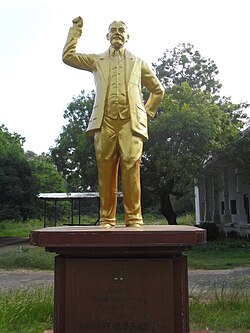
Across the State, statues of EV Ramasamy are ubiquitous – at junctions, traffic circles, and public spaces, you name it! By contrast, Jai Hind Chempakaraman has just one statue, located near the Gandhi Mandapam complex in Chennai, an area where statues are placed away from every day public visibility.

Image Source: Wikipedia

But such a great warrior – who, during the Second World War, brought the ship Emden from Germany, carried out a surgical strike here, attacked only the British and made them tremble, is forgotten.

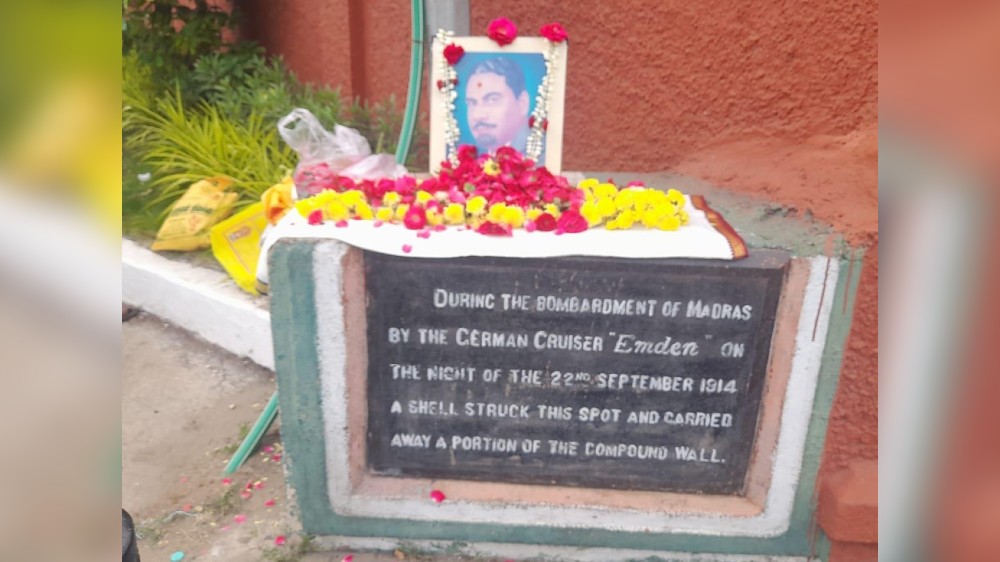
Even at the Chennai High Court complex, near the spot where Chempakaraman threw a bomb during the freedom struggle, there exists only a small memorial stone. There is no prominent statue that would prompt public curiosity or historical awareness.

Image Source: DT Next

Demands have been raised for a statue to be installed at that very site so that people can learn why that location matters. That demand, too, has not been acted upon.

A Pattern, Not An Accident

The pattern extends beyond individuals. Tamil freedom fighters such as VO Chidambaram Pillai, Jaihind Chempakaraman, Kuyili, and Mahakavi Bharatiyar travelled across India, worked with leaders from other regions, and grounded their struggle in Indian nationalism.

Yet the ideological framework the DMK promotes, Dravidianism, has historically distanced itself from Indian nationalism. EV Ramasamy himself opposed the freedom movement and rejected the idea of Indian independence as unnecessary.

This contradiction becomes sharper when DMK leaders speak of honouring freedom fighters while continuing to centre public memory around a figure who openly rejected the freedom struggle.

Recognition Outside Tamil Nadu Vs Silence Within

Contrary to the impression suggested in Parliament, Mahakavi Bharathiyar has been honoured outside Tamil Nadu, including street names in Delhi and academic chairs in universities abroad, sponsored with central support. Tamil names appear on signage in several parts of North India, and Bharathiyar’s legacy is acknowledged nationally.

The more uncomfortable question, however, is why Tamil Nadu itself, under decades of DMK rule, has failed to consistently honour its own freedom fighters in prominent public spaces.

A Question That Turns Inward

Tiruchi Siva asked Parliament why Tamil freedom fighters were ignored elsewhere. The record suggests a more immediate question: why have they been marginalised at home?

If the DMK had named major institutions after VO Chidambaram Pillai, erected visible statues of Jaihind Chempakaraman, and foregrounded nationalist freedom fighters rather than ideological icons, its moral authority on this issue would have been stronger.

Instead, the contrast remains stark. Tamil freedom fighters are invoked rhetorically, but Dravidian ideologues dominate Tamil Nadu’s public landscape.

And that contradiction, more than anything said in Parliament, continues to define the debate.

Subscribe to our channels on WhatsAppTelegram, Instagram and YouTube to get the best stories of the day delivered to you personally.

NDA Scores Major Breakthrough Win In Munambam; BJP Gains Ground In Kerala Local Body Polls

NDA Scores Major Breakthrough In Munambam; BJP Gains Ground In Kerala Local Body Polls

The National Democratic Alliance (NDA) registered a decisive victory in Munambam in the Kerala local body elections, delivering a significant political breakthrough for the BJP in a ward that has been at the centre of a prolonged dispute involving the Kerala State Waqf Board.

Munambam has witnessed sustained protests for over a year by more than 500 Christian families who have opposed an alleged claim by the Waqf Board over their land, fearing eviction. The NDA’s emphatic win in the ward has been widely seen as a mandate in favour of the BJP’s stand against the disputed claim and its support for the affected residents.

Kerala BJP general secretary Anoop Antony Joseph described the result as “historic”, stating that the people of Munambam had responded to the BJP’s consistent support during the agitation. He said the Modi government and the BJP stood with the residents in their fight against what they allege is an illegal Waqf claim, and that the verdict reflected public endorsement of that position.

The Munambam victory is expected to provide a major boost to the BJP as it looks to expand its footprint in Kerala ahead of the 2026 Assembly elections, in a state where the party has traditionally struggled to secure electoral space. The NDA has also posted strong performances in other key areas, including the Thiruvananthapuram Corporation, where it is currently ahead in the constituency represented by Congress MP Shashi Tharoor.

NDA Gains Amid Tight Statewide Contest

Counting of votes for the Kerala local body elections 2025 is underway across the state, with early trends indicating a closely contested battle primarily between the CPI(M)-led Left Democratic Front (LDF) and the Congress-led United Democratic Front (UDF), even as the NDA shows signs of incremental gains.

Vote counting began at 8 AM on Saturday, 13 December 2025, at 244 counting centres under tight security. As per data available from the State Election Commission at 12.00 pm, the UDF was leading in 451 Grama Panchayat seats, while the LDF was ahead in 371 seats. The NDA was leading in 27 seats, with others ahead in 10 seats, out of a total of 941 Grama Panchayat seats.

Reacting to the trends, BJP leader Shaun George expressed confidence about the NDA’s performance, stating that the alliance was expecting stronger results in central and south Kerala. He added that sections traditionally aligned with the UDF and Kerala Congress were increasingly shifting their support towards the BJP.

Counting is continuing in several districts, including Thiruvananthapuram, Pathanamthitta, Malappuram and Kottayam, with final results expected later in the day as the process progresses.

Source: Mathrubhumi & India Today

Subscribe to our channels on WhatsAppTelegram, Instagram and YouTube to get the best stories of the day delivered to you personally.
RTI Reveals HR&CE Dept Spent ₹1.23 Crore From Thirupparankundram Temple Funds On ‘Ecological Park Maintenance’

RTI Reveals HR&CE Dept Spent ₹1.23 Crore From Thirupparankundram Temple Funds On ‘Ecological Park Maintenance’

Temple activist group Aalayam Kaappom have raised serious questions over the utilisation of temple funds at the Arulmigu Subramaniya Swamy Temple, Thirupparankundram, after information obtained under the Right to Information (RTI) Act revealed that more than ₹1.23 crore was spent over five financial years on what was described as “ecological park maintenance”.

According to RTI details pertaining to the administration of the temple under the Hindu Religious and Charitable Endowments (HR&CE) Department, Government of Tamil Nadu, funds were diverted from the temple’s accounts during the financial years 2017–18 to 2021–22 for “சுற்றுச்சூழல் பூங்கா பராமரிப்பு” (environmental/ecological park maintenance).

The year-wise expenditure disclosed under RTI is as follows:

  • 2017–18: ₹23.68 lakh
  • 2018–19: ₹23.82 lakh
  • 2019–20: ₹19.90 lakh
  • 2020–21: ₹23.82 lakh
  • 2021–22: ₹32.39 lakh

The total amount spent over these five years comes to ₹123.61 lakh (₹1.23 crore).

Now based on the information received, it is not clear where exactly this “ecological park” is located and what specific area is being maintained using temple funds. It is important to note that the Subramaniya Swamy Temple is not a corporate entity responsible for maintaining public parks in Madurai city.

It is argued that if the expenditure is being claimed for maintenance of forest areas on the Thirupparankundram hill, such areas cannot be categorised as “parks”. Even if forest maintenance were to be cited as justification, one can question whether temple funds can legally be diverted for such purposes.

Activists alleged that the accounting head used “சுற்றுச்சூழல் சுழல்” (environmental cycle/ecological rotation) itself indicates repeated circulation of funds and questioned whether this amounted to misappropriation of temple money through inflated or fictitious expense entries.

They also stated that, based on ground-level observation, there is no visible evidence of systematic maintenance of the Thirupparankundram hill area corresponding to the magnitude of expenditure shown in the accounts.

Temple Funds vs Hilltop Deepam Dispute

The issue has gained additional significance in the context of the ongoing dispute over lighting the Karthigai Deepam on the Deepathoon (stone lamp pillar) at the hilltop of Thirupparankundram.

It is alleged that while large sums from temple funds were being spent annually under the head of environmental or park maintenance as revealed in the RTI, the same authorities have vehemently resisted permitting the lighting of the traditional Deepam on the hilltop lamp pillar, which is considered a significant cultural and religious symbol.

They accused the authorities of effectively “hiding” or neglecting the Deepathoon, while continuing to assert administrative control over the hilltop area.

It is noteworthy that Justice Swaminathan had noted concerns regarding the failure to protect temple property, including the upper portions of the Thirupparankundram hill, which are traditionally associated with the deity Murugan (Subramaniya Swamy) and regarded as part of the temple’s heritage.

The activists questioned the authority of the HR&CE Department to file appeals against judicial directions aimed at safeguarding temple property and restoring traditional practices, particularly when, according to them, the department itself had failed to protect the Deepathoon and the hilltop area.

Activists of the organisation have demanded accountability from the HR&CE Department over the expenditure of temple funds, calling for clarity on the exact location and nature of the “ecological park” allegedly maintained, detailed break-up of works executed under each financial year, legal justification for using temple funds for such purposes, and the reasons for denying permission for traditional religious practices at the hilltop despite continued financial outflows.

They have asserted that the hill belongs to Thirupparankundram Murugan and that temple funds must be used strictly for purposes aligned with the temple’s religious, cultural, and heritage obligations.

It is noteworthy that the Madras High Court as well as the Himachal Pradesh High Court and the Supreme Court have issued judgements preventing the use of temple funds for activities that are not related to the temple.

Subscribe to our channels on WhatsAppTelegram, Instagram and YouTube to get the best stories of the day delivered to you personally.
“Lighting Deepam At Uchchi Pillayar Temple Is A Recent Practice”, Thirupparankundram Villagers Announce Hunger Strike Demanding Permission To Light Karthigai Deepam At Deepathoon

Madras High Court Madurai Bench Allows Karthigai Deepam To Be Lit At The Original Spot At Thirupparankundram Hill

Residents of Thirupparankundram village have announced that they will hold a peaceful hunger strike on 13 December 2025, demanding permission to light the lamp on the Deepathoon at the hilltop, citing a High Court order obtained after their request was rejected by the local administration.

Explaining the background, a representative of the villagers said, “We had submitted a petition in Thirupparankundram village, urging the government to allow the lighting of the lamp on top of the Thirupparankundram hill peak, and to observe a peaceful hunger strike for that demand. Based on the rejection of that petition, we approached the High Court and obtained an order.”

He said the fast would be undertaken on behalf of village families and would involve the general public without any caste, religious, or political affiliation. “Tomorrow, on the 13th, on behalf of the Thirupparankundram families, without any caste or religious discrimination and without party affiliation, the general public of the village have decided to hold a hunger strike,” he said, appealing to residents of Thirupparankundram town to participate.

On participation, he said, “It is the village people, the general public. They have said that all the villages around Thirupparankundram will come fully.” He added that the protest would strictly adhere to judicial directions, stating, “The High Court has also given us certain conditions, and we have decided to organise a gathering in a way that does not violate, or goes only up to the limit of, those conditions.”

He said women would play a leading role in the protest. “Women will definitely participate in this, and in fact women are the first,” he said.

Stating the core demand, he said, “The main demand is that the lamp must be lit in the Deepathoon at the top of the hill. That is our primary demand.”

The villagers also alleged that a misleading narrative had been circulated on social media. “Until now, on social media, a wrong narrative has been spread. They claim that at the Uchi Pillaiyar temple, the lamp has been lit for more than 100 years. As far as we know, it is not even 20 years,” he said.

He further alleged that lighting the lamp at the Uchchi Pillaiyar temple was introduced to divert attention from a long-standing agitation. “Some movements have been continuously protesting for nearly 60 years that the lamp should be lit in the deepa pillar on top of the hill. To divert that struggle, only for that diversionary purpose, the practice of lighting the lamp at the Uchi Pillaiyar temple was started,” he claimed.

Questioning the practice, he said, “This Uchi Pillaiyar temple is actually a place meant for lighting the moksha deepam. In our custom, if there has been a death in a house, during the Karthigai month we do not light lamps in that house. In such a situation, how is it right that in a place where the moksha lamp is lit daily, we go and light a Karthigai Deepam?”

Responding to why the issue had gained momentum now, he said, “Until now, they only violated tradition, and we remained silent. Movements were fighting; we, the general public, stayed quiet. Now they have violated the law as well. When they violate the law and sovereignty, we are compelled to question it.”

He added that there will be someone or the other lighting a moksha deepam at that spot almost every other day.

Reiterating the villagers’ position, he said, “Lighting the Karthigai Deepam on top of the Uchchi Pillaiyar Temple is a recent practice. Not for a hundred years. What has been lit there is the Moksha Deepam alone.”

Concluding, he said that the protest would proceed in view of what they described as non-compliance with the law. “Even though this struggle has been going on for many days, now due to the refusal to respect the law itself, tomorrow, without caste or religious distinctions and without political affiliations, the people of Thirupparankundram will undertake a fast for lighting the lamp on the deepathoon at the hilltop,” he said.

Subscribe to our channels on WhatsAppTelegram, Instagram and YouTube to get the best stories of the day delivered to you personally.
“Tamil Nadu Was Already Named By Bharathi, Much Before Arignar Anna”, Says NTK Chief Seeman

In a fiery, wide-ranging speech delivered on Mahakavi Subramania Bharathi’s birth anniversary, Naam Tamilar Katchi (NTK) chief Seeman made a bold historical claim, asserting that it was the revered poet Bharathiyar, and not former Chief Minister C.N. Annadurai (“Anna”), who named the state of Tamil Nadu.

The speech, laden with sharp political and cultural commentary, directly contrasted Bharathiyar’s poetic reverence for the Tamil language with the historical criticisms of Dravidian stalwart ‘Periyar’ EV Ramasamy Naicker (EVR).

Crediting the “Poet Who Created Time”

“These people didn’t name it Tamil Nadu,” Seeman told the audience. “India hadn’t gained independence; he achieved it. States weren’t divided; he divided them. They hadn’t named it Tamil Nadu; he named it.” Framing Bharathiyar as a visionary figure, Seeman asked rhetorically, “Therefore, who is he? The poet who created time. The seer. The avatar. He is the one man in the world.”

Seeman supported his argument by quoting Bharathiyar’s own verses exalting the Tamil language and land. He recited, “Among the languages we know, the Tamil language is the sweetest, nowhere to be seen” and “Worship the auspicious Tamil country as our mother, Paapa (child), it is sweeter than nectar, Paapa. It is the land of our wise ancestors (aanrōrgal), Paapa.”

Direct Contrast with EVR’s Stance

The NTK leader used these quotes to launch a pointed attack on Periyar’s historical views. He juxtaposed Bharathiyar’s praise with EVR’s characterization of Tamil. “He (EVR) calls it a barbarian language. He calls it the land where barbarians live,” Seeman said. “But he (Bharathi) says, ‘It is the land of wise ancestors, Paapa. The word that is high is the Tamil (uyarcchol); bow to it and read it, Paapa.'”

Seeman challenged the audience to consider this contrast: “Who is he? Who is that man? He is not a barbarian. Is this man a barbarian?”

Seeman recounted Bharathi’s writings: “Go to Ceylon, Burma, Java, and many islands, and see our fish flag and tiger flag standing firm”, and asked rhetorically, “Who is he? Who is that man? He is not a barbarian. Is this man a barbarian?”

He continued that the naming of Tamil Nadu preceded independence-era politics. “You shouldn’t name the auspicious Tamil Nadu as ‘Tamil Nadu,’ brother. Pay close attention. These people didn’t name it Tamil Nadu. India hadn’t gained independence; he (Bharathi) achieved it. States weren’t divided; he (Bharathi) divided them. They hadn’t named it Tamil Nadu; he named it already,” Seeman said, describing Bharathi as “the poet who created time,” “the seer,” and “the avatar.”

Seeman continued, “He (Bharathi) is the one man in the world. He decides. He didn’t know that Sankara Linganar will come. He will fight for 79 days. He will die. Then the great man Arignar Anna will come. He will name it Tamil Nadu. Without knowing all that, he did it.” He intended to mean that Bharathiyar had already conceived the identity conceptually.

Subscribe to our channels on WhatsAppTelegram, Instagram and YouTube to get the best stories of the day delivered to you personally.
“No Legal Right For Devotees To Light Deepam At Deepathoon”, Says DMK Govt, Continues To Oppose Lighting Deepam Atop Thirupparankundram

'No Legal Right for Devotees to Seek Deepam at ‘Deepathoon’', Says DMK Govt, Continues To Oppose Lighting Deepam Atop Thirupparankundram

The Tamil Nadu government on Friday, 12 December 2025, informed the Madras High Court (Madurai Bench) that devotees who approached the court seeking permission to light the Karthigai Deepam lamp at the Thirupparankundram Hills “cannot claim such lighting as a legal right,” arguing that Article 226 powers cannot be invoked to change a longstanding religious custom.

A Division Bench of Justice G Jayachandran and Justice KK Ramakrishnan heard a batch of appeals challenging the single judge’s order directing temple authorities to light the lamp at the stone pillar (‘Deepathoon’) on the hill.

The State Authorities have also filed an appeal challenging the single judge’s December 4 order in a contempt petition, which had quashed a prohibitory order under Section 144 CrPC. Another group of appeals challenged the December 9 contempt order directing the appearance of the Chief Secretary, ADGP, DCP, and even impleading the Union Home Secretary.

AG: Devotees Do Not Have a Legal Right to Demand Lamp Lighting at Deepathoon

Appearing for the State, Advocate General (AG) P.S. Raman submitted that the appeals arise from a common order in five writ petitions filed by devotees of the ancient Thirupparankundram Murugan Temple.

He explained that the temple sits at the foothill of a 500-foot hill that also houses a dargah; that traditionally, the Karthigai Deepam lamp has been lit at the Uchi Pillaiyar temple, including this year and that a devotee, Rama Ravikumar, requested that either the temple authorities or he himself be permitted to light the lamp at a different site, now called Deepathoon, located near the dargah.

Calling it a private interest litigation, the AG said the writ court must confine itself to the petitioner’s individual rights and the statutory duties of temple authorities. “Any other issue need not be dragged into the four corners of this room. It’s for another battlefield,” he said.

After Ravikumar’s initial request was rejected, a fresh petition sought a direction either to allow him or to compel temple authorities to light the lamp at Deepathoon.

AG: No Evidence Deepathoon Was Ever a Traditional Site

AG Raman questioned the historical basis of Deepathoon. He pointed out that since the 1920 litigation, there has been no mention of Deepathoon, that devotees must establish that lamp-lighting at Deepathoon was a customary practice. He added that in the 1920 trial court ruling, part of the hill was held to belong to the Devasthanam and another part to the dargah. This was reversed on appeal. He also said that a 1994 PIL seeking a similar relief was rejected because the lamp was traditionally lit elsewhere and in 2014, the court again refused to shift the location; the order was upheld by a Division Bench.

The AG said the single judge nonetheless directed authorities to light the lamp at Deepathoon, which “he described as the correct place,” and added that the lamp could still be lit at the traditional site. This reasoning, the AG said, is now under challenge.

He argued that four courts had already applied their minds and upheld the traditional site.

“Any devotee does not have a legal right to demand that the lamp be lit in addition to the place where it is being lit,” he said.

AG: Article 226 Cannot Be Used to Change an Established Custom

The AG stressed that Article 226 is not meant to create or alter religious customs.

While acknowledging that the structure included a stone pillar, he questioned whether it was indeed a stone lamp pillar.

He argued, “If some historically acceptable evidence was placed before the court that before 1920 it used to be lit there… and if such practice was changed, the court could examine if a constitutional right was affected. But Article 226 is not intended to change a custom by creating a new custom.”

He noted that no one challenged the temple’s property rights and that the issue is not ownership but creation of a new religious custom. He added that there was “not a scrap of paper” before the single judge to identify the structure as Deepathoon.

He claimed that the only expert evidence before the court was the priests’ opinion that Agamas require lighting the lamp at Uchi Pillaiyar temple. “This finding (of the single judge) is without any factual basis,” the AG stated, calling for “greatest restraint.”

Senior Counsel Masilamani: A Vague Representation Used to Secure a Mandamus

Senior Advocate G. Masilamani, representing the Executive Officer of the temple, said the petitioner had no right to demand lighting of lamps at Deepathoon.

He warned that allowing such petitions would open a Pandora’s box, with devotees across the state seeking similar directions, making temple administration impossible.

Masilamani noted that the petitioner addressed his representation to the Executive Officer, not the Joint Commissioner of HR&CE, and the EO rightly replied. He stated that the representation never explicitly requested lighting the lamp near the stone pillar; it only sought permission to light the lamp “on the hills,” which includes Uchi Pillaiyar.

Calling it a “camouflage to secure an order of mandamus,” Masilamani said the petition sought reliefs beyond what the representation demanded.

‘Non-Practice for 175 Years Has Become Custom’

Masilamani stressed that customs are proved by longstanding practice, “From 1862 to 2025, there is no evidence to show that Deepathoon was where the Karthigai Deepam was lit. Long practice of non-practice becomes the custom.”

He also argued that the Deepathoon is not at the hilltop, the dargah is at one peak, Uchi Pillaiyar temple at another and that the Deepathoon lies 15 metres from the dargah.

He said the single judge incorrectly described the location and failed to follow established judicial precedents. If he disagreed with prior rulings, he should have referred the matter to a larger bench.

Court Seeks Permanent Resolution; State Declines to Commit

Justice Jayachandran observed, “This matter is perpetually going on from 1920. If we’re able to have a permanent resolution or solution… one day a year at a particular point in the hill, how far can a person’s claim go, without harming harmony? It is for the community to come together.”

However, the AG said the issue had been unnecessarily escalated.

Later, Senior Advocate R. Shunmugasundaram for the HR&CE department told the court that the Devasthanam alone must decide.

Justice Jayachandran asked whether the authorities would at least consider a fresh representation. Shunmugasundaram replied, “Let the authorities decide. I can’t give a word… It is the position of law.”

The court has listed the matter for 15 December 2025.

Source: LiveLaw

Subscribe to our channels on WhatsAppTelegram, Instagram and YouTube to get the best stories of the day delivered to you personally.
“No Kumkum, No Chandan, No Bindi, No Flowers”: Coimbatore Govt School Students Allege Harassment By Christian Headmistress, Girls Reportedly Assaulted For Minor Delays

Several girl students from a government school in Sulur, Kallapalayam, have accused their Headmistress, identified as Deva Kiruba Jayakrishnan, of religious discrimination, physical assault, and enforcing bans on Hindu cultural practices.

In detailed testimonies recorded on video by Dinamalar, the girls alleged that the Christian HM repeatedly ordered Hindu students to remove their bindis, kumkum, sandal paste, and flowers before entering class. One student said, “If we come wearing a bindi, she makes us wash our faces. She beats us a lot unnecessarily.”

Another Class 11 student claimed she was hospitalised due to the assault. She stated the HM beat her inside the staff room for returning late from the restroom, despite the school having only one usable toilet for around 150 girls.

Parents also alleged harassment and humiliation. One mother said her daughter returned home with her forehead forcibly washed clean, while another claimed the HM confiscated a student’s slippers and made her walk barefoot.

Another student stated, “I study at the Government Higher Secondary School, Kallapalayam, Sulur, Coimbatore. There are about 150 girls, but only four toilets. Out of those, three are always unclean. We all use one. So when we return late, even by five minutes, the HM calls us and beats us.”

She added, “She asked why we were late by five minutes. We have special class at 7 AM. After the class, when we go to eat, she asks, ‘What do you achieve by eating?’ If we cry after being beaten, she tells us not to tell at home, ‘Don’t make small issues big,’ she said.”

The students have submitted a formal complaint to the District Collector demanding the removal of the HM, citing untouchability-like treatment, repeated physical assault, and religious coercion.

Authorities have not yet released an official statement.

Subscribe to our channels on WhatsAppTelegram, Instagram and YouTube to get the best stories of the day delivered to you personally.

“Dhurandhar Script Vetted & Approved By Modi”, Pakistani Journo Mubashir Luqman Suffers Meltdown

"Dhurandhar Script Vetted & Approved By Modi", Claims Pakistani Journo Mubashir Luqman

A primetime discussion on Pakistani television has triggered widespread ridicule after host Naeem Hanif, president of the Punjab Union of Journalists, and veteran anchor Mubashir Luqman made a series of extraordinary claims about Indian cinema and Pakistani counter-propaganda efforts.

During the programme, Hanif said he possessed “credible information” that the script of the Indian film Dhurandhar, referred to on the show as “Lyari wali film, had been “personally vetted and approved” by Indian Prime Minister Narendra Modi. He further suggested this alleged involvement explained why the film was over three hours long, claiming, “Modi wrote it, so who will cut it?”

Luqman expanded on the theme, arguing that filmmaking is a complex, collaborative industry requiring “30–40 competent people” and alleging that the Punjab government under Chief Minister Maryam Nawaz had now begun directly funding Pakistani filmmakers to produce films aimed at countering Bollywood’s influence. He framed this as part of a broader information war, stating that Pakistan had fought on “the fronts of social media, satellite media, and print media,” but was lagging behind in film-based propaganda.

The conversation has gone viral in India and Pakistan, with many social media users mocking the claims as yet another instance of conspiracy-laden discourse on Pakistani television.

Meanwhile, questions about credibility have resurfaced around Hanif, who recently received a defamation notice from actress Saba Qamar for airing allegations about her personal life. Luqman, too, has faced criticism for his incendiary on-air rhetoric and previous controversies.

In May 2025, a video of Luqman sparked outrage after he said during a discussion with the same anchor Naeem Hanif that, in the event of a war with India, he wished to take Indian actresses as “sex slaves” and sought religious approval for it. The clip, shared widely online, comes amid tensions following the Pahalgam terror attack that killed 26 Hindus. Indians denounced the remarks as misogynistic and extremist. Luqman later attempted to shift the conversation, claiming he only wished to be a “warrior.”

Subscribe to our channels on WhatsAppTelegram, Instagram and YouTube to get the best stories of the day delivered to you personally.

Thirupparankundram: A 2,000-Year Sacred Hill Entangled In 100 Years Of Legal Battles

Madras High Court Madurai Bench Allows Karthigai Deepam To Be Lit At The Original Spot At Thirupparankundram Hill

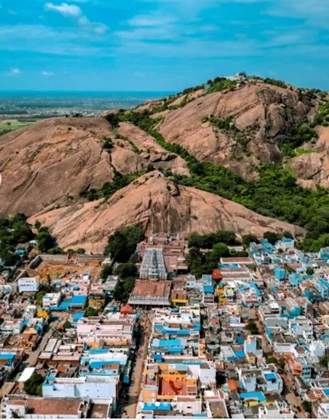
Thirupparankundram is one of the oldest temples of Tamilakam and the first among Murugan’s six abodes. Though revered in tradition, it did not enjoy the same prominence as some of the other Murugan shrines until recent decades—let alone the many legal disputes it has faced over the past century.

History

The hill, always honoured as Thiru-Parankundram, appears in early Sangam literature. Agananooru 59 by Madurai Marudhan Ilanaganar speaks of Murugan who vanquished Surapadman and resides on this cool, cave-filled hill. Agananooru 149 mentions a Murugan temple here, noting that after defeating the Cheras, Pandya king Chezhiyan returned to Madurai where the temple’s peacock flag flew high amid continuous festivals.

Paripadal has eight hymns on Murugan, several exalting Thirupparankundram as equal in sanctity to the Himalayas. One verse describes a painted hall in the temple depicting scenes such as Indra deceiving Ahalya in the form of a cat, with guides explaining the stories to visitors. Nakkeerar’s Thirumurugatrupadai—sung at Thirupparankundram—celebrates it as the foremost among Murugan shrines and offers a vivid portrayal of the sacred hill. In fact, the hill itself is regarded as a Shiva Linga, which is why a Giri Prakara has been established for devotees to circumambulate the entire hill

The temple saw significant development during the medieval Pandya period. In the early 8th century, under Pandya Parantaka Nedunjadaiyan, a rock-cut temple was excavated with five shrines dedicated to Ganapathi, Murugan, Shiva, Durga, and Vishnu. A similar Pandya cave temple from this period exists at Trichy (Lower Cave).

Two inscriptions from this era survive at Thirupparankundram. One, found in the garbhagriha of the present shrine, records: “In the 6th regnal year of Ko Maran Sadayan, Sattan Ganapathi, the Mahasamandan (commander) of the king, renovated the temple and the sacred tank Sri Tadakam,” the latter identified with the present Lakshmi Theertham.

The temple attained its present extensive structural form during the Nayaka period, especially under Thirumalai Nayakar. All these clearly establishes the fact that the Murugan temple in the hill is in worship for more than two thousand years.

Topography of the Hill

To understand the background of the legal issues surrounding the hill, it is important to know its physical and sacred layout. Thirupparankundram hill consists of two sections with two distinct peaks. The northern side of the hill houses the famous Murugan temple on the lower part of the hill. On the southern side stands an early Pandya-period rock-cut shrine known as the Umai Andavar (Ardhanareeswara) temple.

On the south-western slope, a flight of steps leads to Jain beds with Tamil-Brahmi inscriptions dating to the pre-Common Era. The north-western side has two bas-relief sculptures of Jain Tirthankaras accompanied by a Vattezhuthu inscription. Adjacent to these shrines is the temple of Palani Andavar. From this zone, steps continue upward toward the summit.

A dargah dedicated to Sikandar Shah is there atop the hill, with multiple narratives explaining its origin. Regardless of its beginnings, worship at the dargah began a few centuries ago and continues today. Beyond the dargah lies the Kasi Viswanathar temple with a pond in front. At the very top is a flat plateau between the two hill sections, traditionally known as Nellithoppu.

Legal battles

Despite the temple and hill having an antiquity of over 2,000 years, Thirupparankundram has been entangled in one legal dispute or another for more than a century. The Olugu accounts of 1802 record that the British Government recognised the hill as the property of the deity. As early as 1879, the British administration attempted to quarry the hill, which was strongly opposed by the temple authorities.

In 1915, the Dargah began occupying the Nellithoppu area by constructing a few structures. After prolonged disputes, the matter reached the court in 1920 (O.S. No. 4 of 1920). The Devasthanam, as plaintiff, argued that the entire hill belonged to the temple and that no construction was permissible. The Dargah representatives contended that the hill had two distinct parts, and that the upper portion—referred to by them as Sikandar Malai—belonged to them, thereby claiming ownership of Nellithoppu as well. Meanwhile, the Government also joined the case, arguing that the hill was state property.

After considering all sides, the Madurai Court delivered its judgement—an elaborate order that traces the hill’s history before arriving at its conclusions. The court referred to a 1909 Government Order stating that the entire hill was worshipped by Hindus as a Shiva Linga, and that the temple was not a separate structure but carved directly into the rock. It also noted an 1863 British notification referring to the “Thirupparankundram Subramanya Swami temple and its four sides including the Malai Prakaram.”

The judge personally inspected the hill before delivering the final verdict. The court ruled that the entire hill belonged to the temple, except the Dargah along with its compound wall and flagstaff, the Nellithoppu area, and the steps leading to the Dargah.

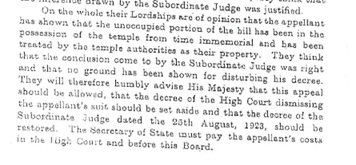
The Dargah representatives did not accept the Madurai court’s order and appealed to the Madras High Court in 1923. Although the Government was initially reluctant to participate, the High Court added it as a party and eventually ruled that the hill belonged to the Government. The Temple Devasthanam then approached the Privy Council. After examining the details, the Privy Council in 1931 upheld the Madurai court’s judgement, granting ownership of the entire hill to the Thirupparankundram temple, except for the three areas previously specified. It also observed that the construction of the Dargah was an “infliction which the Hindus might well have been forced to put up with.”

This status continued until the 1950s. Meanwhile, the Thirupparankundram Devasthanam had come under the administration of the Madurai Meenakshi Temple Devasthanam. In 1958, the Dargah side attempted to cut rocks on the hill to construct additional structures. The Madurai Devasthanam strongly objected and filed a case (O.S. No. 111 of 1958). The Dargah argued that since the rocks were located near Nellithoppu, that area belonged to them, giving them the right to quarry. The temple authorities firmly opposed this claim.
The court ordered a detailed survey to demarcate boundaries. Based on the findings, it issued a decree restraining the Dargah from cutting stones anywhere outside the flat expanse of Nellithoppu.

Lighting of Karthigai Deepam

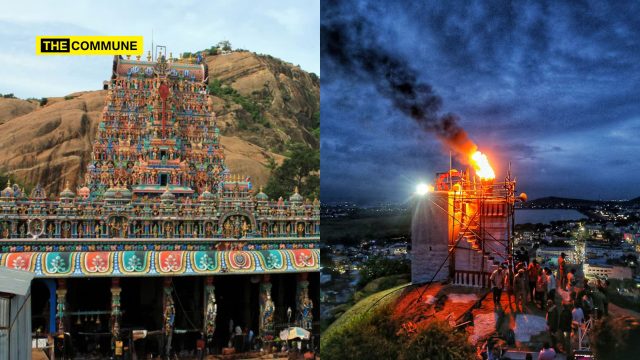
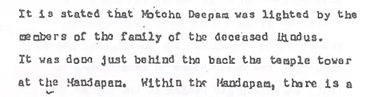
During these developments right from British period, locals say that the Karthigai Deepam—traditionally lit at the summit of the hill—was shifted to a Deepam Mandapam at the Uchipillayar temple located on a smaller hillock behind the Murugan temple. This structure was originally used by residents to light the Moksha Deepam.

In 1994, Hindu Munnani demanded the restoration of lighting the Karthigai Deepam at the summit of the hill. Shri Rajagopalan, the state president who led the agitation, was assassinated that same year. The organisation requested the temple Devasthanam to light the Deepam atop the hill so that the surrounding households could follow the traditional practice. The matter went to court, where HRCE argued that the lamp would continue to be lit only at the “traditional place.” The litigation continued for a couple of years. During this period, the Karthigai Deepam was shifted to the top of the Deepa Mandapam, where a copper vessel was used for lighting the lamp.
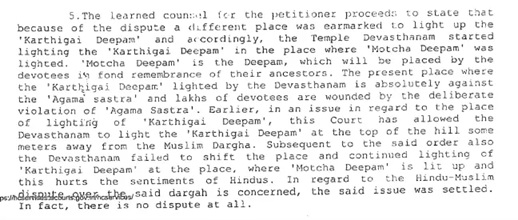
In 1996, the court ruled that since the Karthigai Deepam festival was approaching, the temple management could light the Deepam at the Uchipillayar temple for that year alone. From the following year, the Devasthanam could choose any other suitable location.

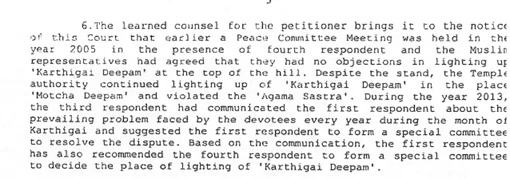
In 2005, a peace meeting was organised between the Hindu Baktha Jana Sabha of Thirupparankundram and the Dargah authorities. Both sides agreed that the Deepam could be lit at any spot located at least 15 metres away from the Dargah compound. Despite this, the temple administration continued to light the lamp at the Uchipillayar temple.

The issue resurfaced in 2014 when a writ petition was filed seeking to restore the lighting of the Deepam at the hilltop. The petitioner argued that the current location was meant only for the Moksha Deepam, not the Karthigai Deepam, and that the deviation hurt the sentiments of Hindus.

It was also pointed out that the 2005 peace agreement had not been implemented. HRCE opposed the petition. The court eventually dismissed the case. The petitioner appealed, but the appeal too was dismissed on the ground that the requested location was too close to the Dargah.

In 2024, an attempt to perform animal sacrifice at the Dargah was opposed by Hindu organisations, leading to another round of litigation. The case was heard by a Division Bench of the Madras High Court (Madurai Bench), which delivered a split verdict—one judge ordered a ban on animal slaughter on the hill, while the other dismissed the petition. As a result, the matter was referred to a third judge, who upheld the ban and confirmed that animal slaughter on the hill is prohibited.
In 2025, Thiru Rama Ravikumar and a few others filed a petition before the Madurai Bench of the Madras High Court seeking a direction to the temple authorities to light the Karthigai Deepam at the Deepathoon. HRCE opposed the plea. After evaluating the submissions, the learned judge ruled in favour of lighting the lamp at the Deepathoon and personally visited the hill to inspect the location.

In his judgement, the judge made several key observations:

1. The petitioners are persons of interest, as the demand for lighting the lamp at the Deepathoon was made by Hindu worshippers of Lord Murugan.

2. There is no merit in directing the petitioners to file a civil suit, since the question of property rights over the hill was conclusively settled as early as 1923.

3. The respondents’ claim that the matter was already decided in the 2014 judgement is untenable. The 2014 petitioner sought permission to light the lamp at the hilltop, which falls within the Dargah’s property. In contrast, the 2025 petition specifically concerns the Deepathoon—located on the lower peak—which belongs to the temple.

4. Lighting a lamp atop a temple is an ancient Tamil tradition.

The Tamil epic Jivaka Chintamani refers to “Kundril Karthigai Vilakkittanna,” indicating the age-old custom of lighting lamps on hilltops.

5. Protection of temple property is also a legal obligation.

The judge cited the practice of closing all doors of the Madras High Court once a year to prevent easement claims by the public. Similarly, temple authorities must remain vigilant to prevent encroachments. Lighting the lamp at the Deepathoon is therefore necessary not only to honour religious tradition but also to safeguard the temple’s property.

The learned judge also referred to the animal-slaughter case and noted that it was activists who took initiative, while the temple trustees had remained silent. He further cited the minutes of the peace committee meeting held on 1 December 2005, during which the Dargah management signed an agreement stating that they had no objection to lighting the Karthigai Deepam at the Deepathoon. They expressly agreed that the lamp could be lit at any location situated at least 15 metres away from the Dargah.

What followed after this verdict is now well known. Appeals have been filed, and the Hindu community is awaiting the next judgement.

TS Krishnan is a Tamil scholar, historian and author of the book The Cholas.

This article was originally published here and has been republished in The Commune with permission.

Subscribe to our channels on WhatsAppTelegram, Instagram and YouTube to get the best stories of the day delivered to you personally.