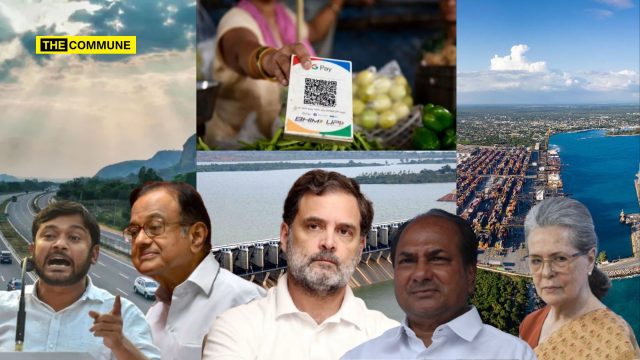
India is a country that, for decades, was told to wait. Wait for roads. Wait for ports. Wait for defence. Wait for bridges. The architects of that waiting were not always natural disasters or bureaucratic delays. Sometimes, they were political choices made deliberately, defended proudly, and occasionally admitted on the floor of Parliament.
The Congress party, its leaders and supporters have, over the years, opposed, stalled, or denounced some of India’s most consequential development projects. Here is the documented record – in their own words.
Ravish Kumar & Ganga Expressway (May 2026)
A video of Ravish Kumar reacting to the newly inaugurated Ganga Expressway has gone viral on social media, prompting widespread debate. In the clip, he is seen questioning the value of reduced travel time and expressing skepticism about the emphasis on infrastructure-led development in Uttar Pradesh.
In the video, he remarks, “Tell me, what will you do by reaching Prayagraj 5 hours earlier? The real enjoyment is in the road trip itself, not in reaching the destination. So why is the government building expressways and shortening people’s road trips?” suggesting that the experience of travel is more meaningful than reaching the destination faster.
🤡 रवीश कुमार अब पूरी तरह से पागल हो चुका है!
“गंगा एक्सप्रेसवे से 11 घंटे का सफर 6 घंटे में!”
रवीश: “अरे 5 घंटे पहले पहुँचकर क्या करोगे??” 😂
भाई, पूरा देश विकास से जश्न मना रहा है, तू रो रहा है कि लोग जल्दी पहुँच रहे हैं?
अब बोल ना — एयरपोर्ट, ट्रेन, हवाई जहाज सब बंद करवा… pic.twitter.com/SRd73tYi4f
— Arun Yadav (@BeingArun28) May 1, 2026
“An Undeveloped Border is Safer” – AK Antony, Parliament (September 2013)
No statement in independent India’s political history is more damning than this one, made voluntarily by UPA Defence Minister A.K. Antony on the floor of Parliament: “Independent India had a policy for many years that the best defence is not to develop the border. Undeveloped border is more safe than developed border. So many years, there was no construction of roads, airfields, nothing in the border areas. By that time, China continued to develop their infrastructure. Compared to us, infrastructure-wise, capability-wise in the border areas, they are ahead. I admit that. It is a part of history.”
View this post on Instagram
Read that again. A sitting defence minister of the world’s largest democracy stood in Parliament and confessed that India’s official policy was to deliberately leave its borders undeveloped while China built roads, airstrips, and supply chains right up to the LAC. The result? Doklam. Galwan. Depsang. Decades of Chinese encroachment enabled, in part, by a Congress doctrine that mistook vulnerability for strategy.
“A Planned Misadventure” – Sonia Gandhi on the Great Nicobar Project (September 2025)
In a signed op-ed in The Hindu, Congress Parliamentary Party Chairperson Sonia Gandhi called India’s ₹92,000 crore strategic infrastructure project in the Great Nicobar Islands a “planned misadventure”: “It is being insensitively pushed through, making a mockery of all legal and deliberative processes… The collective conscience cannot, and must not, stay silent when the very survival of the Shompen and Nicobarese tribes is at stake… Unconscionably, one of the country’s most vulnerable groups may have to pay the ultimate price for it.”
The Great Nicobar project, comprising a transhipment port, international airport, power plant, and township, is positioned at the intersection of the Indian Ocean and the Malacca Strait, one of the world’s most strategically vital waterways. Defence analysts describe it as India’s single most important Indo-Pacific asset. A project that gives India power projection capability in the Indo-Pacific is, in Congress’s vocabulary, a “misadventure.”
“The Poor Don’t Benefit from Roads” – Rahul Gandhi, Madhya Pradesh (November 2013)
At an election rally in Dhar, Madhya Pradesh, then Congress Vice President Rahul Gandhi said: “It is not that we do not create infrastructure. But the opposition’s thinking is that you make roads and everything will be all right… (but) the poor don’t get benefit from the roads. Roads alone won’t give food to the child or a woman.”
He went on to describe how farmers watch aircraft from their fields while “roads and airports are used by the selective rich.”
This statement was made by a man who would go on to lead the Congress party openly dismissing road construction as a development tool. The irony: it was made in Madhya Pradesh, a state that had at that very time one of the worst rural road connectivity records in India, where villages were cut off during monsoons for months at a stretch. The people of MP needed roads desperately. Their future Congress leader told them roads weren’t the answer.
“Exorbitant and Electorally Motivated” – Congress on the Bullet Train (July 2018)
In Parliament, Congress called the ₹1.10 lakh crore Mumbai-Ahmedabad Bullet Train project “exorbitant” and dismissed it as an “election bullet train” launched, they claimed, with an eye on polls rather than public good. Congress MPs also attended protest meetings alongside farmers opposing land acquisition for the project. The Congress-Shiv Sena government in Maharashtra that came to power in 2019 immediately froze land acquisition, killing years of progress.
Opposing the Statue of Unity (2018)
Congress opposed the Statue of Unity, the world’s tallest statue, honouring Sardar Vallabhbhai Patel, the man Congress spent decades marginalising from India’s national memory. They alleged it was built with Chinese components, prompting PM Modi to respond: “I recently came to know about Congress’s claims that Sardar Patel’s statue is China-made. They have stooped so low that they have now started mud-slinging over Sardar Patel.”
The same Congress-JD(S) government in Karnataka that called the Statue of Unity “wasteful” simultaneously proposed a ₹1,200 crore Cauvery statue which they welcomed as “boosting heritage.”
₹18 Lakh Crore in Stalled Projects – The UPA Infrastructure Collapse
Finance Minister Nirmala Sitharaman presented data in May 2024 showing:
Capital expenditure as a share of total government spending fell from 23% in 2003–04 to an average of 12% between 2005–2014 under UPA
दुनिया भर में सरकारें गुणवत्तापूर्ण इंफ्रास्ट्रक्चर और परिसंपत्तियों के निर्माण के लिए पूंजीगत व्यय पर जोर देती हैं और ध्यान केंद्रित करने का प्रयास करती हैं। गुणवत्तापूर्ण बुनियादी ढांचा प्रत्येक नागरिक के लिए आराम, सुविधा और ‘Ease of Living’ लाता है।
प्रत्येक किलोमीटर सड़क,… https://t.co/UOjdTo29Dr
— Nirmala Sitharaman Office (@nsitharamanoffc) May 15, 2024
Infrastructure projects worth ₹18 lakh crore were stalled between 2011-2014 alone.
India was classified among the world’s “Fragile Five” economies by 2013 – a direct consequence of chronic infrastructure neglect.
“Roads Are to Loot Bihar’s Water” – Kanhaiya Kumar on Bharatmala (March 2025)
Congress leader Kanhaiya Kumar, while opposing the Bharatmala highway expansion in Bihar, made a statement that left even his own supporters bewildered: “Construction of roads in Bihar is not infrastructure development, it is exploiting its valuable water resources.”
His claim: that the BJP was building roads in Bihar not to connect its villages and cities, but as a conspiracy to steal Bihar’s water. Roads, the most basic unit of economic development, the one thing Bihar has historically lacked and desperately needed, reframed as a plunder operation. If this is the Congress reading of infrastructure, it explains a great deal about what Bihar looked like under Congress-aligned governments for fifty years.
Dhruv Rathee Ridiculing Great Nicobar Project
Making a post on his X handle, Rathee mocked the Great Nicobar project saying, “Anyone who calls Great Nicobar as India’s Strait of Hormuz is the biggest clown “
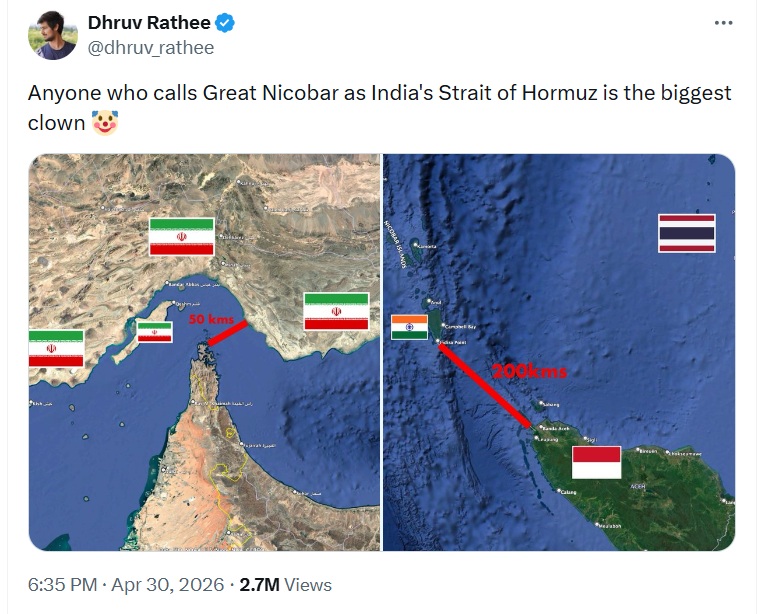
Now here’s why he is wrong. The 6-Degree Channel south of Great Nicobar is the primary maritime corridor for vessels moving from the Suez Canal/Red Sea toward the Malacca Strait. Even though the water is 200 km wide, ships follow narrow, fixed shipping lanes for safety and efficiency meaning naval control doesn’t require blocking the entire sea surface.
With Anti-Access/Area Denial (A2AD) assets like the BrahMos missile (range: 300+ km), India can monitor and target any vessel within that 200 km span from Great Nicobar. In modern naval warfare, 200 km is well within strike range, Rathee applied outdated logic of “cannon range” geography.
~94,000 ships pass through annually and nearly 80% of China’s oil imports transit the Malacca Strait. A credible Indian military presence at Great Nicobar enables surveillance, rapid response, and interdiction capability even without physically “blocking” the channel. Adani Group has struck a deal with Indonesia regarding Sabang Port located at the southern tip of that very 200 km channel, meaning India effectively has strategic presence at both sides of the passage.
Only someone with low patriotism would post something like Rathee did.
“Digital India is Not a Priority for the Poor” — P. Chidambaram on Digital Push (2017–2018)
Senior Congress leader P. Chidambaram repeatedly questioned the government’s emphasis on digitisation in the aftermath of demonetisation and during the rollout of Digital India initiatives. In multiple public remarks and writings, he argued that India was “not ready” for a cashless or heavily digitised economy, stressing that:
“Large sections of India are not digitally literate… For millions, cash is still the only mode of transaction.”
He framed the digital push as exclusionary, suggesting it overlooked ground realities like internet access, digital literacy, and rural infrastructure.
While concerns about inclusion are valid in policy debates, the broader implication was clear: skepticism toward a nationwide digital transformation at a time when India was attempting to leapfrog into a tech-driven economy through UPI, Aadhaar integration, and direct benefit transfers.
Sonia Gandhi Opposing India’s Nuclear Power
After the 1998 Pokhran tests, Sonia Gandhi said that true power lies in restraint and not showing off power.
Chidambaram said that India becoming a nuclear power was against its ‘moral authority’.
View this post on Instagram
During protests around the Kudankulam Nuclear Power Plant, Sonia Gandhi backed calls for heightened scrutiny and caution, reflecting a broader Congress stance that leaned toward public anxiety over nuclear expansion. Concerns raised by Congress leaders and echoed in party positions included:
- Risks to local populations
- Environmental and safety uncertainties
- Questions over transparency and foreign collaboration
At the time, nuclear energy was being positioned as a critical pillar of India’s long-term energy security strategy—especially to reduce dependence on fossil fuels and meet rising power demands.
The hesitation and political signaling around projects like Kudankulam fed into delays and amplified public resistance, complicating India’s civil nuclear expansion despite international agreements like the Indo-US nuclear deal.
Subscribe to our channels on WhatsApp, Telegram, Instagram and YouTube to get the best stories of the day delivered to you personally.