Leftist rag, The News Minute’s investigation into Bengaluru’s data centre water problem seems to position itself as raising legitimate policy questions, but several of its central claims are either outdated, arithmetically inconsistent, or unverified.
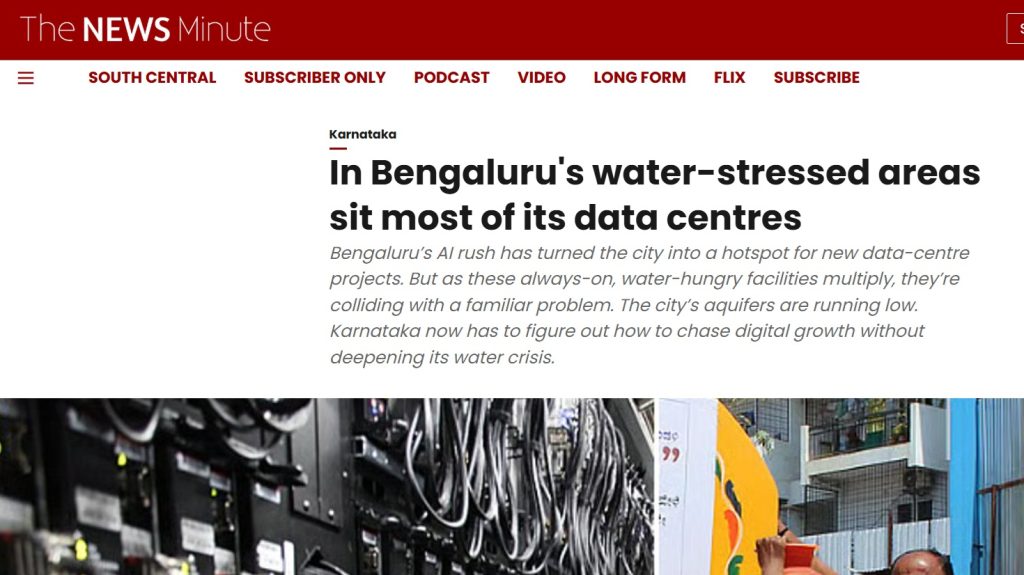
Five questions on ChatGPT use 500 ml of water. Bengaluru has 31 data centres guzzling water to do such tasks. And neither the water board, pollution control board nor the IT department can quantify their water use.
Read the full report by @kavashivani.https://t.co/eHXyCNiaXx
— Dhanya Rajendran (@dhanyarajendran) April 15, 2026
When an article is used to drive public policy, atleast the numbers have to be right.
The ChatGPT Claim Is Off by Two Orders of Magnitude
The most attention-grabbing line in the article belongs to IT Minister Priyank Kharge, who told the Karnataka Assembly: “If you ask five questions on ChatGPT, 500 ml of water is needed.”
This figure is not just imprecise. It is approximately 100 times higher than what the evidence supports and it has been publicly debunked since October 2024.
The 500 ml claim traces back to a paper titled Making AI Less Thirsty, published in October 2023, based on GPT-3’s power consumption figures that were themselves drawn from a 2020 estimate . As software engineer Sean Goedecke meticulously documented: “That figure in the 2020 paper is per-page, which the 2023 paper interprets as per-request. The amount of inference for 500ml of water is thus better understood as 10-70 pages. An average ChatGPT conversation is much shorter than that, more in the order of 3-8 messages, or 1-2 pages at most.” That alone reduces the figure by roughly 10 times.
But there is a second, larger correction: GPT-3, the model the original paper studied, has been superseded by GPT-4o and GPT-4.1, which are “widely estimated to be in the ~20B parameter range [vs GPT-3’s 175B], similar in speed to GPT-3.5, which I think is a fair proxy for total power usage. That’s another 10x improvement right out of the gate,” Goedecke writes.
Combining both corrections, conversation length and model efficiency, “an average conversation with ChatGPT is going to consume closer to ~5ml of water, not ~500ml,” he concludes. Sam Altman went further: in June 2025, he publicly stated that the average ChatGPT query uses just 0.3 ml of water. Five questions at 0.3 ml each = 1.5 ml, not 500 ml.
The TNM article quotes the Minister’s claim verbatim, with no verification, no caveat, and no contextualisation. For a piece that positions itself as a fact-driven investigation into data centre policy, uncritically amplifying a viral myth that has been debunked in public domain for over a year is a significant editorial failure.
Had a Hindu/BJP minister or MP made any such claim, the same TNM would have dissected it down to the letter, but here, they just quote verbatim and use that as a vehicle to parrot their propaganda.
The Problem With Getting the Numbers Wrong
Data centres do consume enormous quantities of water. That concern is legitimate, scientifically grounded, and urgently needs policy attention. But when a Minister cites a debunked viral statistic in the Assembly, and a publication reprints it without verification, it is pretty clear that there is an agenda behind the entire exercise. Does TNM not want data centres in India in the future? Is it trying to prevent Google from setting one up in the near future?
Subscribe to our channels on WhatsApp, Telegram, Instagram and YouTube to get the best stories of the day delivered to you personally.