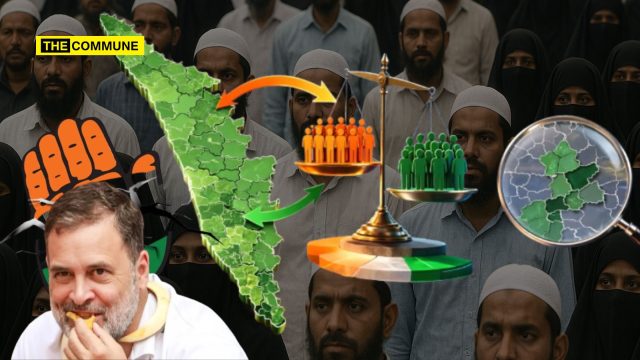
India is once again at the centre of a fierce delimitation debate. The proposed constitutional amendment to raise Lok Sabha strength from 543 to 850 seats has triggered unified resistance from southern states. Congress leader Rahul Gandhi has called the proposed exercise “anti-national,” while opposition parties argue it will destroy federal balance and reward high population growth in the Hindi heartland.
Congress’ Kerala handle mocked union minister Suresh Gopi questioning him, “Dear @TheSureshGopi, Are you going to vote for the bill that Modi has sneaked in to reduce the representation of Kerala and Southern states in the Parliament? Are you with Kerala or not? If you vote for it, then you are the worst betrayer of Kerala and its interest.”
Dear @TheSureshGopi,
Are you going to vote for the bill that Modi has sneaked in to reduce the representation of Kerala and Southern states in the Parliament?
Are you with Kerala or not? If you vote for it, then you are the worst betrayer of Kerala and its interest. pic.twitter.com/BcPGEwlC0p
— Congress Kerala (@INCKerala) April 16, 2026
But it seems that Congress has forgotten its own deeds in Kerala.
Let us rewind to 2008 – delimitation in Kerala.
In the year 2008, Kerala underwent delimitation where the constituencies were rearranged – was it justified? Let us take a look.
Kerala’s total number of Assembly seats remained at 140 before and after the 2008 delimitation. The Delimitation Commission Order of 2007 (implemented for 2011 elections) only redrew constituency boundaries based on population changes, without adding any new seats to the legislature.
Seat Distribution Did Change by District
Within the fixed total of 140, the redistribution across districts was significant:
Malappuram gained 4 seats while Pathanamthitta and Alappuzha lost 2 each and Kottayam, Thrissur, and Kollam lost 1 each.
The six Malabar districts collectively gained 7 seats (from 53 to 60), while the five southern Travancore districts lost 6 (from 54 to 48).
Why opposition to population-based delimitation lacks strong grounding- The Kerala Example
Kerala’s own experience weakens the argument against population-based delimitation. The state’s 2008 delimitation, based on the 2001 Census, clearly redrew representation across districts… pic.twitter.com/LBhVpi2sHL
— Rajiv Kumar Mishra (@rajivjournalist) April 15, 2026
The reallocation of assembly seats was carried out on the basis of population growth trends. Districts like Malappuram, which recorded the highest population increase, saw a corresponding rise in representation, while southern districts such as Pathanamthitta, where growth was slower, did not see similar gains—consistent with the standard principles of delimitation.
The 2008 delimitation exercise led to a pronounced shift in seat distribution towards northern Kerala, particularly in districts with sizeable Muslim populations. Malappuram registered the most significant increase, with its assembly seats rising from 12 to 16 -an addition of four seats. The district’s demographic profile includes approximately 70.24% Muslims, 27.60% Hindus, and 1.98% Christians. Kozhikode saw its seat count increase from 12 to 13, gaining one additional seat, with Muslims making up around 39% of its population. Palakkad’s representation also rose from 11 to 12 seats, where Muslims account for roughly 39%. Wayanad’s seats increased from 2 to 3, further strengthening representation in the northern belt. Kannur similarly saw a rise from 10 to 11 seats, with a Muslim population of about 29.43%.
This pattern of redistribution resulted in a concentration of legislative representation in the Malabar region, significantly reshaping the state’s electoral balance. Although Kerala’s overall demographic composition, as per the 2011 Census, stands at approximately 54.73% Hindus, 26.56% Muslims, and 18.38% Christians, the redrawing of constituencies effectively amplified the political weight of certain regions over others.
This exercise was carried out during the UPA1 regime – Congress was in power. And today, the same Congress cries foul.
Subscribe to our channels on WhatsApp, Telegram, Instagram and YouTube to get the best stories of the day delivered to you personally.