Amid the widening controversy over alleged sexual exploitation and forced religious conversion involving employees in a TCS-linked case in Nashik, a parallel debate has emerged on social media around corporate workplace culture, with Lenskart coming under scrutiny for its internal grooming guidelines.
The controversy centres around an introductory training document issued to employees, which outlines grooming and uniform standards to be followed across the company. The document, portions of which have gone viral online, reportedly specifies rules on employee appearance and accessories, as reported in OpIndia Hindi.
What the Document Says
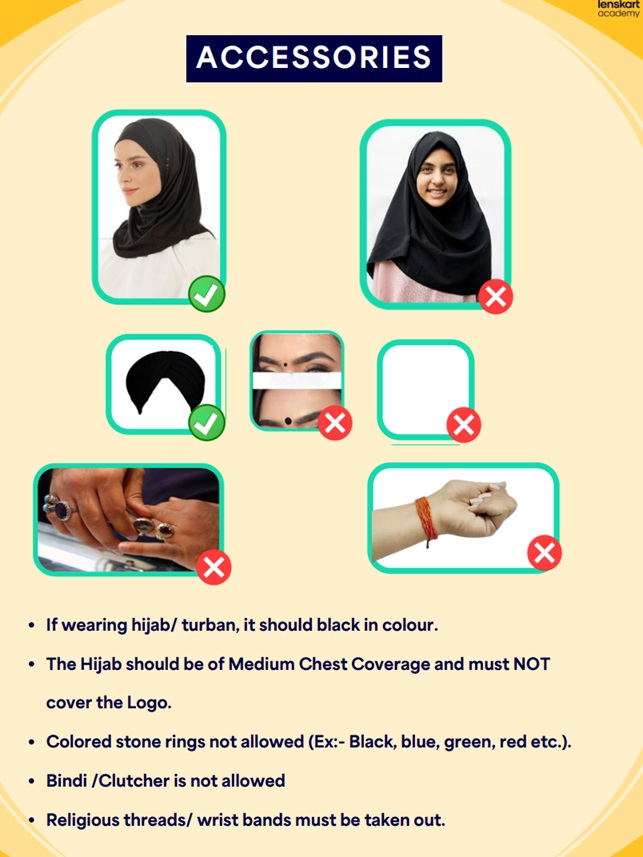
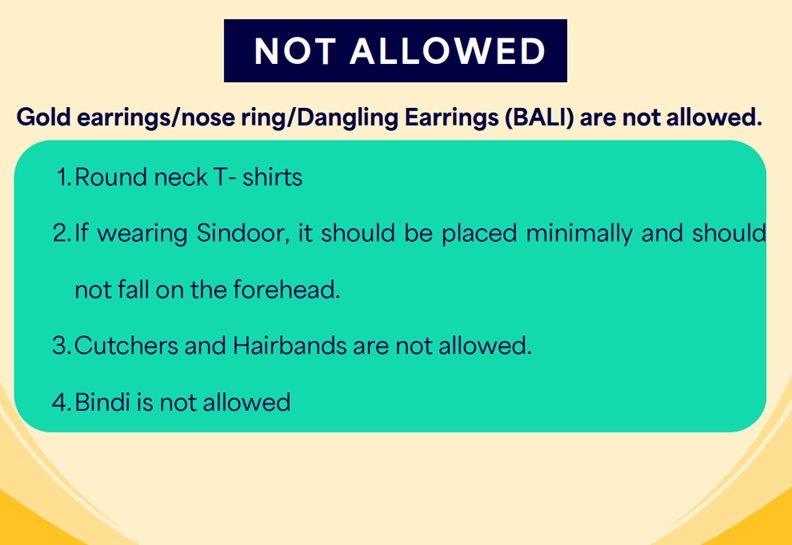
At the centre of the storm is a 23-page introductory training document given to Lenskart employees during onboarding, which lays out the company’s grooming and uniform standards. Pages 7 and 10 of the document, now widely circulated on social media — contain the following explicit rules:
- Employees are prohibited from wearing bindi, kalawa (sacred wrist thread) and clutchers
- Sindoor (vermillion), worn by married Hindu women, is permitted, but must be applied in a very small amount and must not spread across the forehead
- Hijabs and turbans are explicitly permitted with the only condition being that they must be black in colour and that a hijab should “moderately cover up to the chest”
At the same time, it reportedly allows the wearing of hijab or turban, with conditions that they must be black in colour and styled in a prescribed manner. It also mentions that coloured gemstone rings are not allowed.
Another section of the document, reportedly on page 10, addresses the use of sindoor, stating that if worn, it must be minimal and not spread across the forehead.
The viral circulation of these pages triggered strong reactions online, with several users alleging that the rules selectively target Hindu religious symbols while permitting Islamic attire. Social media users called for boycotts and criticised the company’s policies as discriminatory.
Posts circulating online also referenced a “Lenskart style guide,” shared by writer Shefali Vaidya, which reiterated similar restrictions on bindi while allowing hijab. The post questioned the rationale behind such policies in a country where a majority of employees and customers are Hindus.
So I confirmed, this is genuine. This is what @peyushbansal tells his employees, hijab is okay, but bindi/tilak/Kalawa is not, for @Lenskart_com, a company that exists in Hindu majority Bharat, where most of the employees and consumers are Hindu! What do you say to this? This is… https://t.co/jQ2EPdWPJM pic.twitter.com/SWfOajOjpo
— Shefali Vaidya. 🇮🇳 (@ShefVaidya) April 15, 2026
Ground Report
A ground report by OpIndia from a Lenskart store in Delhi confirmed that the document is authentic and in active use. A store employee, speaking on condition of anonymity, confirmed that all store-level employees are bound by these rules without exception.
Additionally, any employee who comes to work wearing a kalawa or bindi is asked to leave for the day and told they can return only if they comply. They also found that if an employee insists on wearing a kalawa, they must hide it inside their sleeve so that no customer or colleague can see it.
It is reported that rules are even stricter in laboratory settings, citing safety but the same restrictions apply even to store staff whose only job is talking to customers and selling eyewear.
When the ground reporter asked the store employee how a kalawa makes someone “unprofessional,” the employee fell silent and offered no response.
Peyush Bansal Responds But Fails To Convince Anyone
As the backlash intensified, Lenskart founder Peyush Bansal issued a statement on X. He wrote, “Hi, all. I’ve been seeing an inaccurate policy document going viral about Lenskart. I want to speak directly that this document does not reflect our present guidelines. Our policy has no restrictions on any form of religious expression, including bindi and tilak, and we continue to review our guidelines regularly. Our grooming policy has evolved over the years and outdated versions do not represent who we are today. We apologize for the confusion and concern this situation has caused. We as a company, continue to learn and build. Any lapses in our language or policies have and will continue to be addressed. We have thousands of team members across Bharat who wear their faith and culture proudly every day at our stores. They are Lenskart. Lenskart was built in Bharat, by Indians, for Indians. Every symbol and every tradition our people carry is a part of who we are as a company. I will never let that be compromised.”
Hi, all. I’ve been seeing an inaccurate policy document going viral about Lenskart.
I want to speak directly that this document does not reflect our present guidelines.
Our policy has no restrictions on any form of religious expression, including bindi and tilak, and we…
— Peyush Bansal (@peyushbansal) April 15, 2026
But this was immediately challenged by netizens pointing out that the document being circulated is dated February 2026.
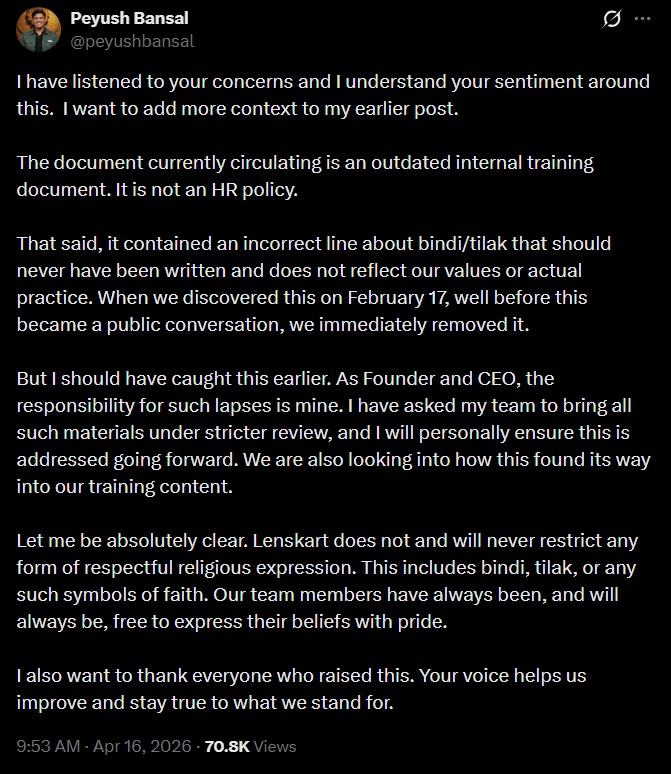
On 16 April 2026, Bansal replied to his own post and continued to claim it was an ‘outdated’, “I have listened to your concerns and I understand your sentiment around this. I want to add more context to my earlier post. The document currently circulating is an outdated internal training document. It is not an HR policy. That said, it contained an incorrect line about bindi/tilak that should never have been written and does not reflect our values or actual practice. When we discovered this on February 17, well before this became a public conversation, we immediately removed it. But I should have caught this earlier. As Founder and CEO, the responsibility for such lapses is mine. I have asked my team to bring all such materials under stricter review, and I will personally ensure this is addressed going forward. We are also looking into how this found its way into our training content. Let me be absolutely clear. Lenskart does not and will never restrict any form of respectful religious expression. This includes bindi, tilak, or any such symbols of faith. Our team members have always been, and will always be, free to express their beliefs with pride. I also want to thank everyone who raised this. Your voice helps us improve and stay true to what we stand for.”
He did not apologise nor share the latest ‘edited’ or updated document.
Why the Clarification Does Not Add Up
Several critical questions remain unanswered and Bansal’s clarification fails to address them:
The document in circulation is dated February 2026 – the very same month Bansal claims he “fixed” it. If the fix happened in February, why is a February-dated document still making the rounds?
Bansal has not released the “corrected” policy document publicly, making it impossible to verify whether any change was actually made
The Delhi store employee confirmed on the ground (as reported above) in April 2026 that these rules are still being actively enforced on staff. This directly contradicts Bansal’s claim of a fix
The Larger Context: TCS, Lenskart, and Corporate India’s Identity Problem
This controversy has erupted in the same week as the TCS Nashik case, in which a BPO unit of Tata Consultancy Services saw multiple women file FIRs alleging sexual harassment, religious coercion, and forced conversion. The dual flashpoints have triggered a broader national conversation about the work culture at large Indian corporations, specifically, whether certain companies have developed internal environments where Hindu employees’ religious identity is treated as a liability to be managed or concealed.
In Lenskart’s case, the fact that hijabs are explicitly accommodated with detailed instructions (colour, coverage, style) while Hindu symbols are either banned or must be hidden under clothing, points to a policy that is anything but neutral. In a country where religion and culture are inseparable from daily life, forcing a store employee to tuck away her kalawa or limit her sindoor is not a matter of professionalism. It is a question of dignity.
Subscribe to our channels on WhatsApp, Telegram, Instagram and YouTube to get the best stories of the day delivered to you personally.