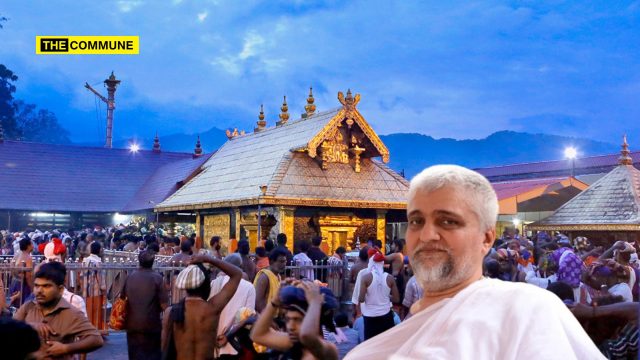
A significant constitutional intervention led by a Jain spiritual leader has emerged as a central development in the ongoing Sabarimala review proceedings, with a strong push for redefining the scope of religious autonomy in India.
At the heart of this legal challenge is Gitarth Ganga, a spiritual research institute guided by Jainacharya Yugbhushansuriji, also known as Sahebji, who has positioned himself as a key voice questioning judicial overreach into matters of faith. The organisation, along with several Jain institutions, has approached the Supreme Court as an intervenor in the Sabarimala review petitions, which are scheduled to be heard by a nine-judge Constitution Bench from 7 April 2026.
The intervention marks a shift in the discourse from a temple-entry issue to a larger constitutional question: whether courts can determine what constitutes an essential religious practice.
Jain Leader Challenges Judicial Authority Over Religion
Jainacharya Yugbhushansuriji has argued that courts should not decide what is “essential” to a religion, describing it as a theological question that lies beyond judicial competence. He has warned that continued reliance on the “essential religious practices” doctrine risks allowing courts to override deeply rooted traditions in the name of constitutional morality.
According to the submissions, religion must be guided by faith, tradition, and the community that practices it, rather than judicial interpretation. The petition asserts that religious practices are intrinsic to communities and cannot be redefined externally by the State or judiciary.
Demand for Legal Recognition of Religions as Entities
A key structural concern raised by the Jain leader is the lack of juristic recognition for Indian-origin religions, including Hinduism, Jainism, Buddhism, and Sikhism. The petition argues that these religions currently lack the legal standing to enforce rights, hold property independently, or challenge state interference in their own name.
The intervention calls on the Supreme Court to address this gap by granting religious institutions a recognised legal personality, thereby strengthening their autonomy and ability to function independently of state control.
Reinterpretation of Articles 25 and 26
Central to the Jain-led petition is a demand to reinterpret Articles 25 and 26 of the Constitution, which govern religious freedom and the management of religious affairs. The submissions argue that these provisions must be read in the context of India’s civilisational traditions rather than through frameworks borrowed from Western constitutional systems.
The petition emphasises that religious freedom is not a right granted by the Constitution but a pre-existing, inalienable right inherent to individuals and communities. It argues that the role of the Constitution is to recognise and protect this freedom, not to define or limit it.
Further, the intervention asserts that the State’s power to interfere in religious matters must be narrowly restricted to specific grounds such as public order, morality, and health, and should not extend to determining the content or validity of religious practices.
Opposition to “Essential Religious Practices” Doctrine
The Jain intervention strongly criticises the evolution of the “essential religious practices” doctrine, arguing that it effectively grants courts ecclesiastical authority, which is constitutionally impermissible.
It contends that determining what constitutes a religious practice is itself a religious function that must remain within the domain of the community and its spiritual leadership. Courts, the petition argues, should only examine whether a practice is genuinely held, not whether it is essential.
Broader Concerns Over State Interference
The submissions also highlight multiple instances of alleged state interference in religious affairs, including control over temple administration, management of religious funds, and acquisition of sacred sites. These actions, the petition argues, undermine the autonomy of religious institutions and violate constitutional protections.
The Jain organisations have pointed to cases such as the management of Parasnath Hill and restrictions on temple administration as examples of increasing state encroachment into religious domains.
Sabarimala Case as a Constitutional Turning Point
The Sabarimala review petitions arise from the Supreme Court’s 2018 judgment that allowed entry of women of all age groups into the temple, overturning a long-standing restriction linked to the celibate nature of the deity Lord Ayyappa. The verdict triggered widespread protests and led to the filing of multiple review petitions by religious groups, temple authorities, and devotees.
The current proceedings before the nine-judge bench are expected to address broader constitutional questions, including the balance between individual rights and collective religious autonomy, and the extent of judicial intervention in matters of faith.
Shift Towards Religious Autonomy
The Jain-led intervention seeks to shift the legal framework towards greater recognition of denominational autonomy under Article 26, arguing that religious groups must have the authority to manage their own affairs, including practices and traditions.
It also proposes narrowing the scope of Article 25, suggesting that individual rights must be balanced against the collective rights of religious communities.
A Wider Coalition of Petitioners
The Jain organisations are part of a broader group of petitioners challenging the 2018 verdict, including temple authorities, religious bodies, and devotee groups. These petitioners have consistently argued that the issue is not merely about gender equality but about preserving the autonomy of religious institutions and traditions.
With the Supreme Court set to revisit the Sabarimala judgment, the intervention led by Jainacharya Yugbhushansuriji has brought the question of religious autonomy to the forefront. By challenging the judiciary’s role in defining religious practices and seeking structural reforms in constitutional interpretation, the petition positions itself as a pivotal voice in what could become a landmark redefinition of the relationship between religion and the State in India.
Subscribe to our channels on WhatsApp, Telegram, Instagram and YouTube to get the best stories of the day delivered to you personally.