


The DMK government’s flagship event ‘Kalviyil Sirantha Tamil Nadu’ (Tamil Nadu That Excels in Education), held in Chennai on 25 September 2025, drew sharp criticism for resembling a political spectacle rather than a serious forum on education.
Marketed as a platform to showcase the state’s progress through schemes like the Chief Minister’s Breakfast Scheme, Naan Mudhalvan, and Pudhumai Penn–Tamil Pudhalvan, the event was dominated instead by film industry figures showering praise on Chief Minister M.K. Stalin and echoing Dravidian ideological themes.
Notably absent were academics, educators, or policy experts, while the stage was shared by directors Vetrimaaran, T.J. Gnanavel, Mysskin, Thiagarajan Kumararaja, actor Sivakarthikeyan, and political leaders including Education Minister Anbil Mahesh, Deputy CM Udhayanidhi Stalin, and Telangana CM Revanth Reddy. Critics said the showpiece was more electioneering than education.
However, the state of Dravidian Model schools in Tamil Nadu in reality paint a very different picture. Where do we start – the crumbling infrastructure or the poor performance of the students in schools compared to students from other states, or do we look at the sexual assault complaints that emanate from the government schools or do we look at the conversion attempts that take place in government-aided minority-run schools in the Dravidian model state?
Nevertheless, in this report, we have compiled all these aspects and our readers, you, can decide whether Tamil Nadu you live in is best in education – Kalviyil Sirantha Tamil Nadu’ or the worst of them all – Kalviyil Kalviyil Tharai Mattam Tamil Nadu.
TN Students Struggle In Literacy And Numeracy
ASER Report 2024
The recent ASER 2024 report highlights a disturbing gap in foundational literacy and numeracy across India, with some states showing significant recovery from pandemic disruptions while others, like Tamil Nadu, are lagging behind in key educational indicators. The report compares the progress of various states, and despite Tamil Nadu’s reputation for educational advancements, it has notably fallen short, particularly in government school performance.
Reading Skills
In 2024, when comparing literacy levels between Tamil Nadu and Uttar Pradesh for children in Standard III, Uttar Pradesh has made notable strides, especially for students able to read at the Standard II level. Tamil Nadu’s performance, however, is concerning: 8.6% of children cannot even recognize letters, 18.2% can only read letters but not words, and 36.3% can read words but not Standard I-level text. Only 12% of children can read at a Standard II level. Uttar Pradesh, by comparison, shows better results, with 34.3% of students reading at the Standard II level, a significant improvement over Tamil Nadu, which has traditionally been viewed as an educational leader. More troubling is the situation in higher classes: 45.3% of Class VI students, 56.1% in Class VII, and 64.2% in Class VIII can only read at a Standard II level.
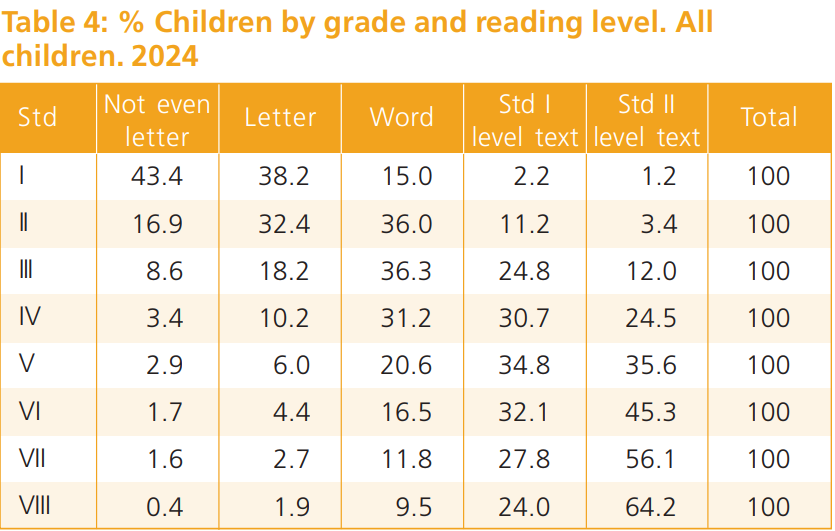

(ASER – Tamil Nadu)
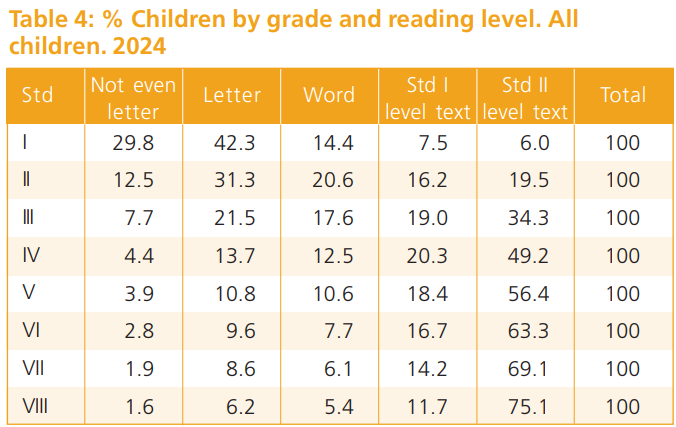

(ASER – Uttar Pradesh)
Tamil Nadu’s struggle to maintain or improve its literacy rates is evident. Despite claims by the government of improvements such as the Illam Thedi Kalvi program, literacy rates have not shown significant progress. In fact, in 2022, the percentage of children in Standard III reading at a Standard II level had drastically fallen to just 4.7%, a sharp decline from 16.8% in 2014. On the other hand, Uttar Pradesh, despite having a lower percentage in 2014 (6%), showed continuous improvement, reaching 27.9% in 2024.
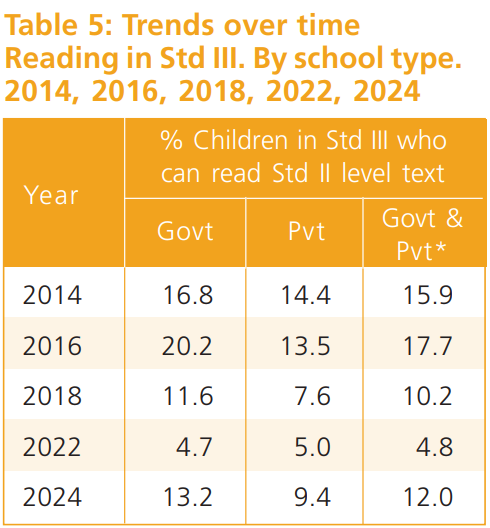

(ASER – Tamil Nadu)
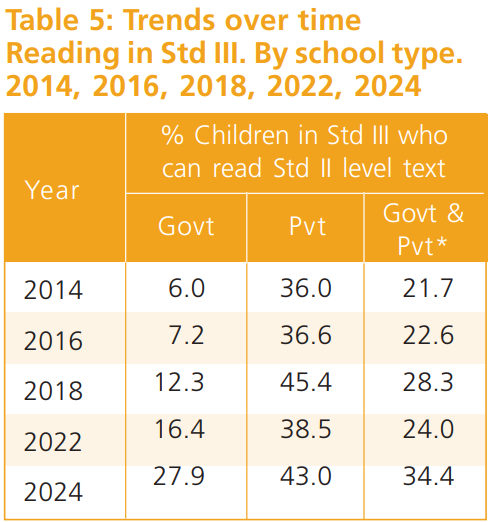

(ASER – Uttar Pradesh)
Numeracy Skills
The situation in numeracy is similarly troubling. In Tamil Nadu, the performance of Standard III students in arithmetic shows significant gaps. 5.9% of children cannot recognize numbers from 1 to 9, and 15.2% can recognize numbers up to 9 but struggle with numbers up to 99. 51.2% of students can recognize numbers up to 99 but cannot perform subtraction, while only 2.2% can perform division. Uttar Pradesh, although still facing challenges, shows better performance in numeracy, with 16.4% of children able to perform division, compared to just 2.2% in Tamil Nadu.
The trend analysis for Standard III students performing subtraction from 2014 to 2024 reveals fluctuating performance in Tamil Nadu, with a sharp decline seen in 2022, likely due to the pandemic. However, by 2024, the percentage of students able to perform subtraction has increased to 27.6%, still behind Uttar Pradesh, which has steadily improved over the years. In contrast, Uttar Pradesh’s progress in numeracy is more consistent. The state showed remarkable improvement, reaching 31.6% in 2024, surpassing Tamil Nadu’s performance.
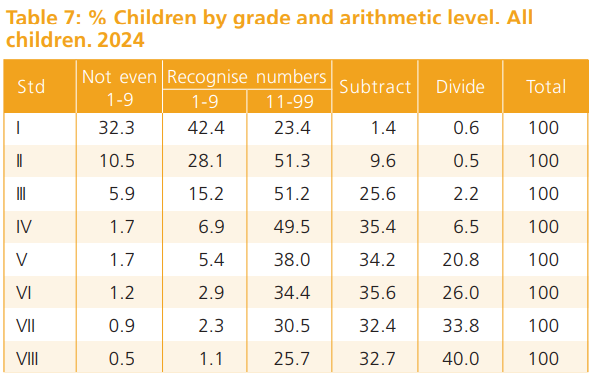

(ASER – Tamil Nadu)
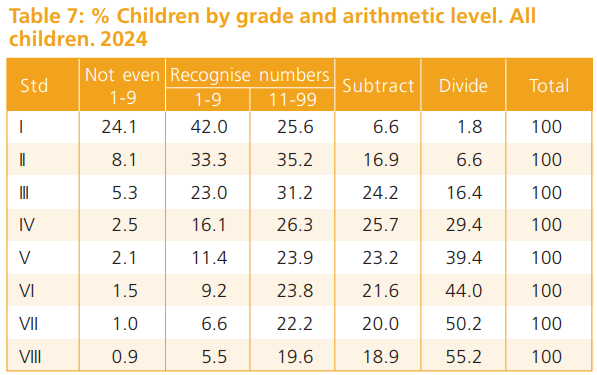

(ASER – Uttar Pradesh)
The performance in higher classes also highlights a concerning trend for Tamil Nadu. In Standard V, the percentage of children who can perform division has decreased from 25.6% in 2014 to 20.2% in 2024. Meanwhile, Uttar Pradesh has made significant strides, with the number of children performing division rising from 12.1% in 2014 to 31.8% in 2024.
In Standard VIII, Tamil Nadu’s ability to perform division has also declined, with 37.8% of children being able to perform division in 2024 compared to 39.6% in 2014. Uttar Pradesh, however, has shown a notable improvement, jumping from 30.5% in 2014 to 45.6% in 2024, surpassing both Tamil Nadu’s performance and its own previous figures.
NAS Report 2021
The National Achievement Survey (NAS) 2021 busts all these bloated claims of ‘Dravidian Model’ of education. Students in Tamil Nadu fare way below the national average across classes and subjects.
Here are some data points that highlight the abject failure of the much-hyped Dravidian Model.
Tamil Nadu Students Can’t Read/Write Basic Tamil
Only 25% of Class 3 students were found to be proficient in Tamil. 63% of Class 3 students are at basic and below basic level. While the national average of marks scored by Class 3 students in Language stands at 323, Tamil Nadu’s average score is 320 out of 500.

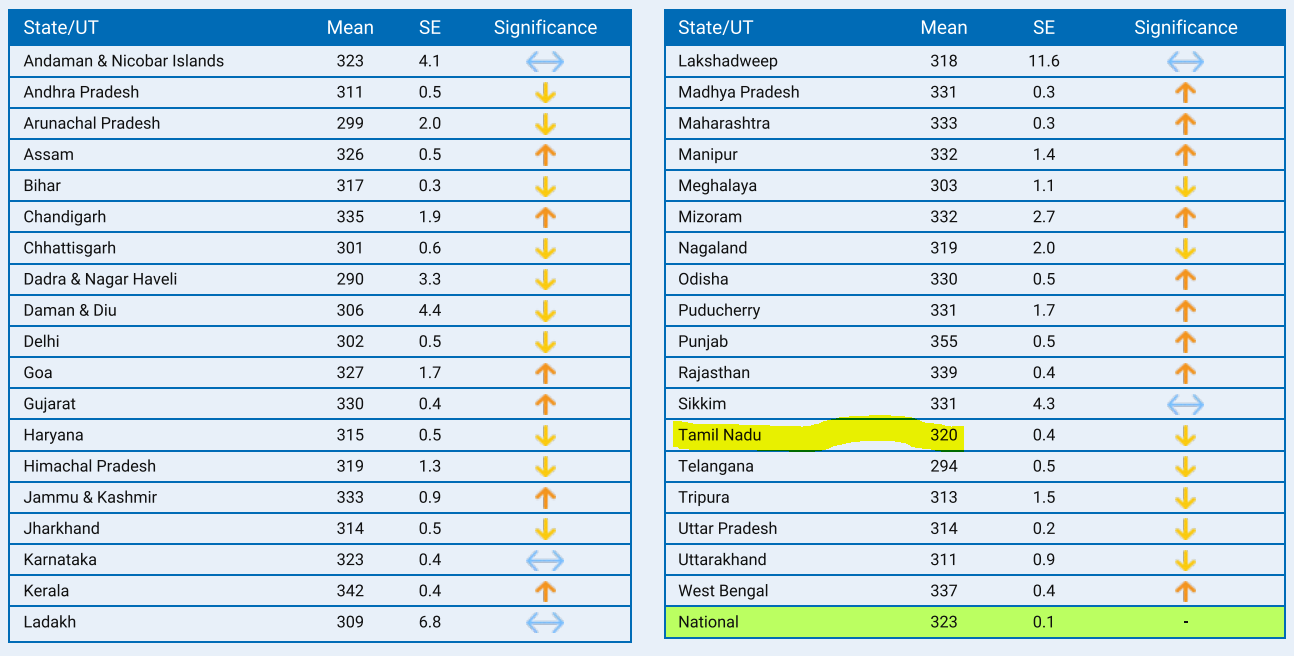
The learning outcomes in Tamil worsens as students progress to higher grades.
The average achievement score of Class 5 students in Language is 298 (national average 309) and that of Class 8 students is 284 (national average 302).

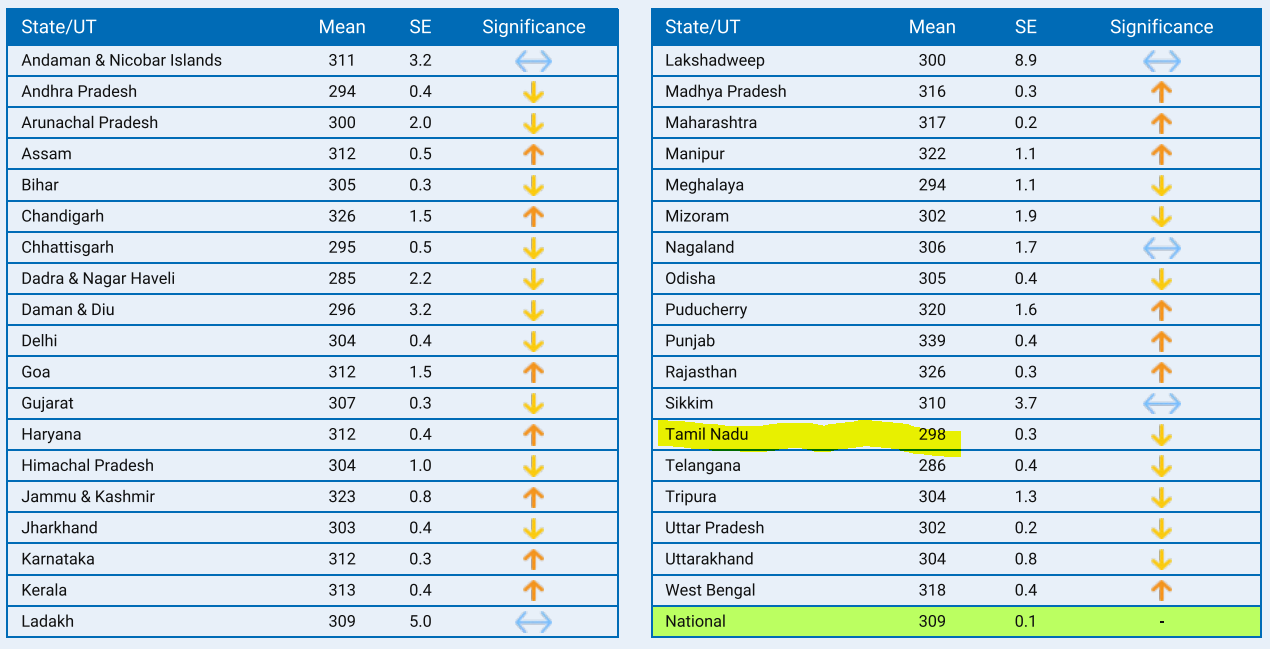

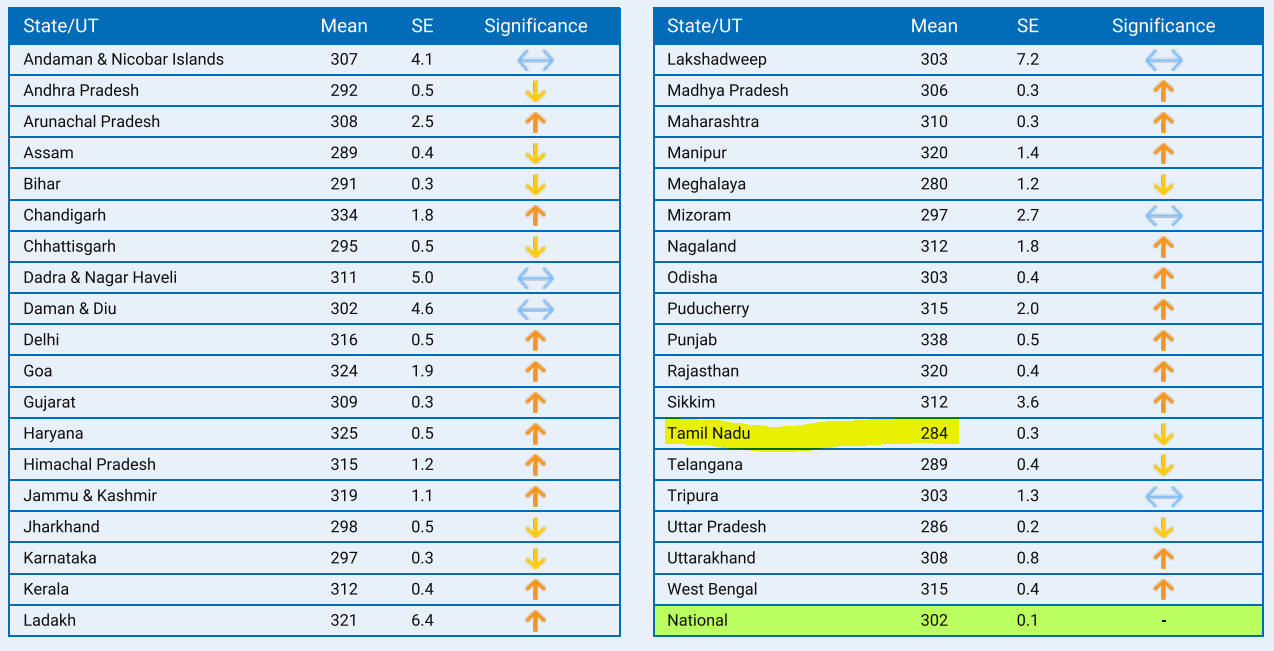
For all the talk about Tamil pride by Dravidian Stockists, Tamil Nadu fares the worst in ‘Language’ of all the southern states.
Such has been the contribution of the Dravidian Stockists in promoting and preserving the Tamil language.
On the other hand, students in states like Madhya Pradesh, Maharashtra, Gujarat, Odisha, Rajasthan have scored higher than national average.
Looking at this pathetic state of Tamil education in the state, it becomes amply clear that Tamil is not under threat due to Hindi or Sanskrit imposition but from the imposition of Dravidian Model of development.
Tamil Nadu Students Lack Analytical And Basic Math Skills
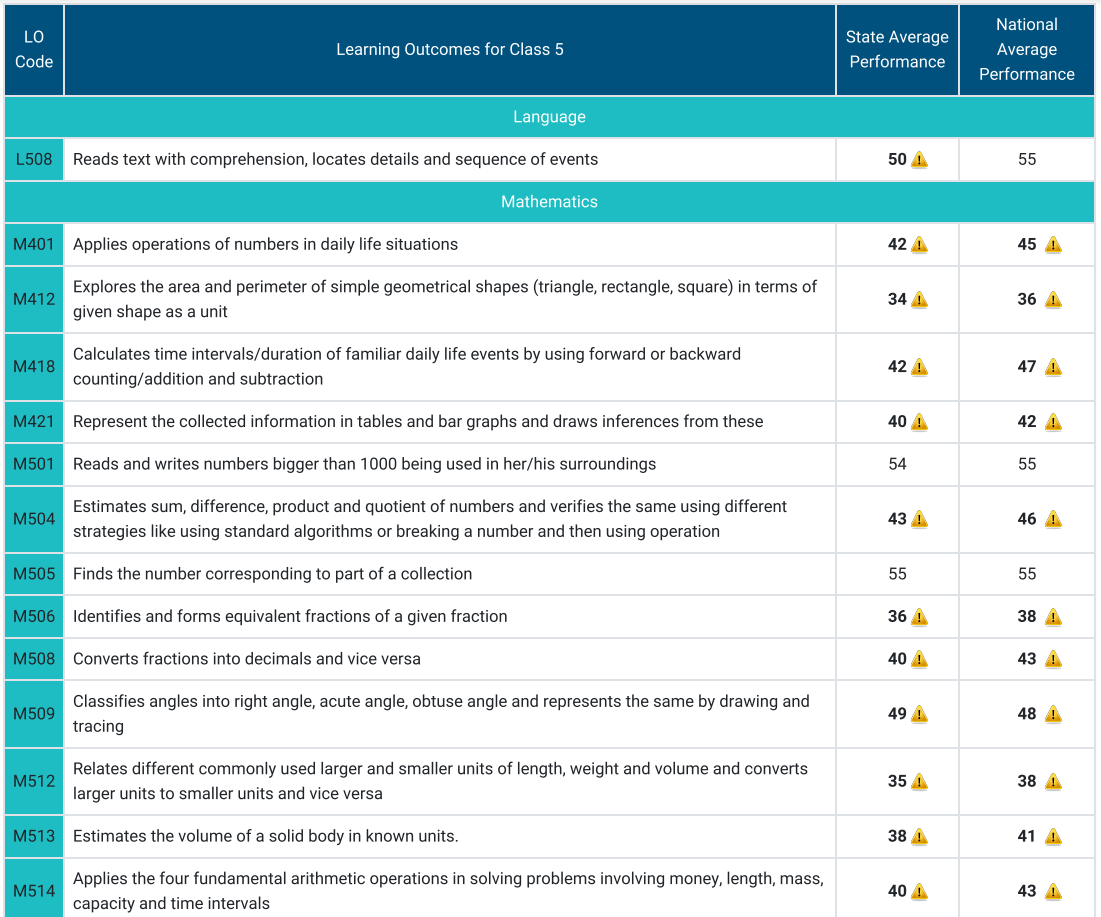
Only 46% of Class 3 students can read and write numbers upto 999 using place value. The numbers for Class 5 students would give a jolt as the average performance of children is less than 50% in every skill listed.
58% of Class 5 students can’t even apply basic mathematical operations in real life situations. It is a different matter that this is the case across India but what is important is that Tamil Nadu is below the national average in every parameter.

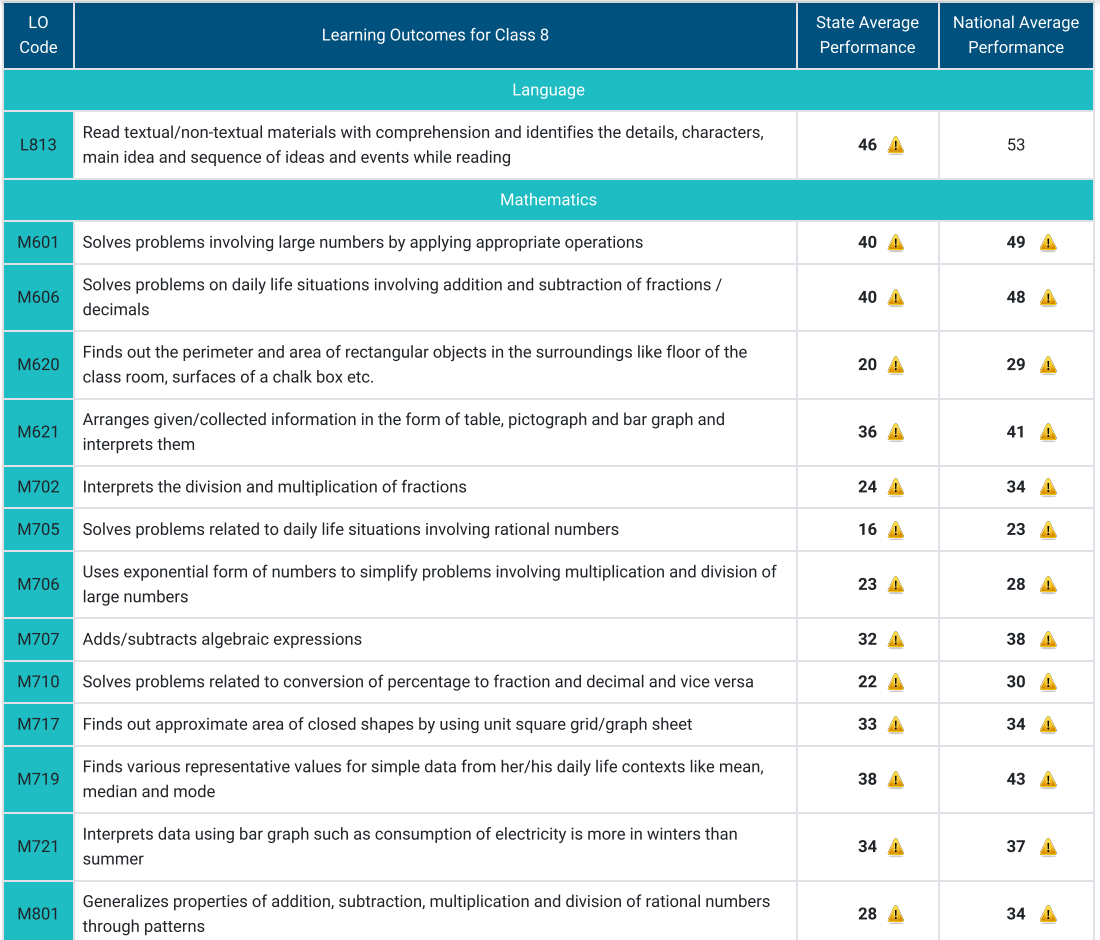
Only 40% of Class 8 students were able to solve problems on daily life situations involving fractions and decimals. The national average for the same skill is 48%. In every skill, Tamil Nadu students fare worse than their counterparts in other states.

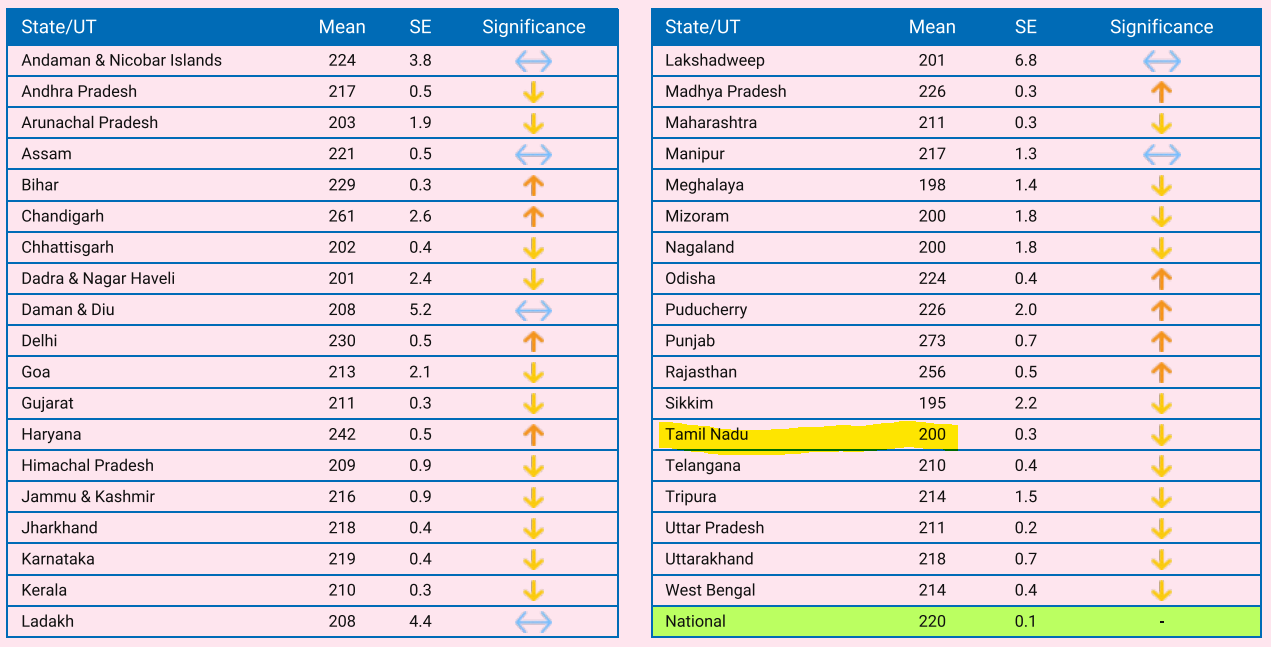
The average score secured by class 10 students in Mathematics is a 20 less than the national average with only 7% of the students having attained proficiency in the subject.
On the other hand, Bihar, Odisha, Rajashtan and Uttar Pradesh who the Dravidian Stockists call as ‘paanipoori wallas’ fare much better than Tamil Nadu students. In fact, scores of Bihar (229) and Rajasthan (256) are way above the national average.

Alarming Levels Of Scientific Aptitude
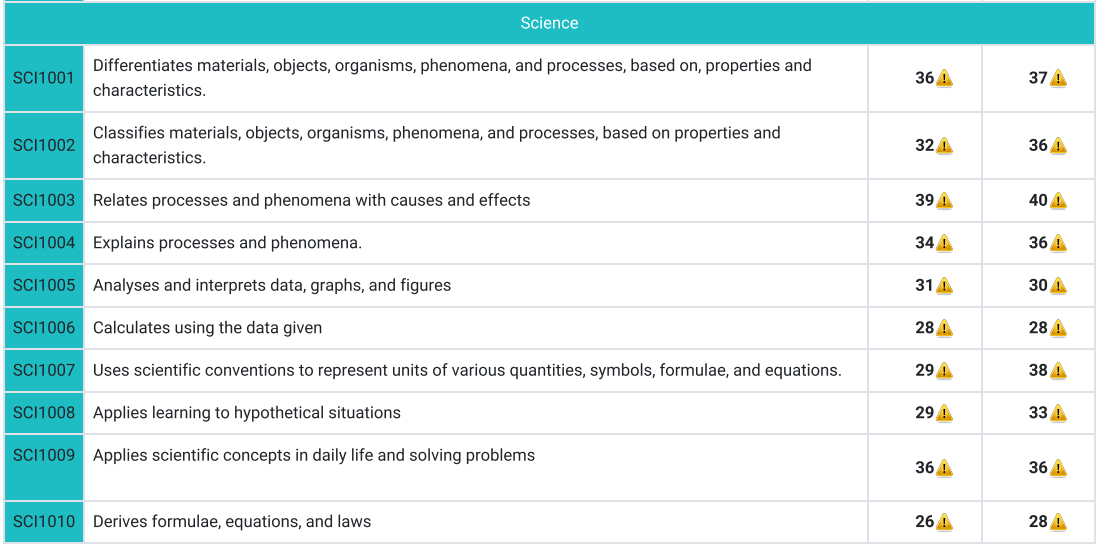
The proficiency of Tamil Nadu students over Science paints a pall of gloom over the scientific capital that the state can produce in future.
Only 2% of students in Class 10 were found to be proficient having acquired the necessary skills and learning outcomes of their level.

PARAKH 2024
Let’s take a look at the learning outcomes for Tamil Nadu as per PARAKH 2024 survey.
Below National Average In All Subjects
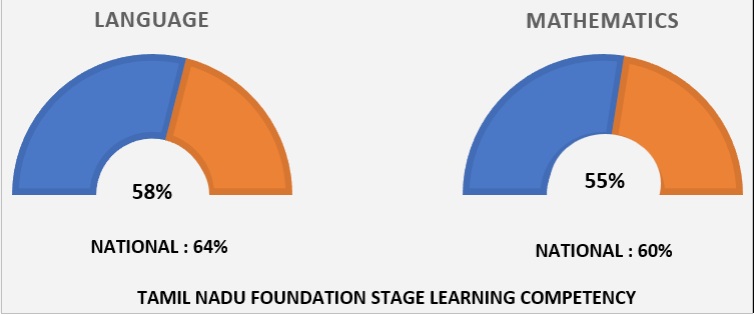
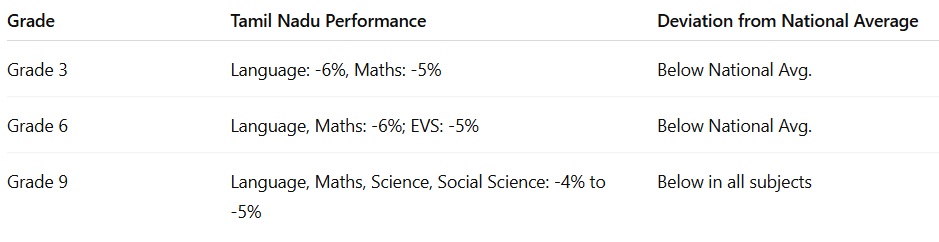
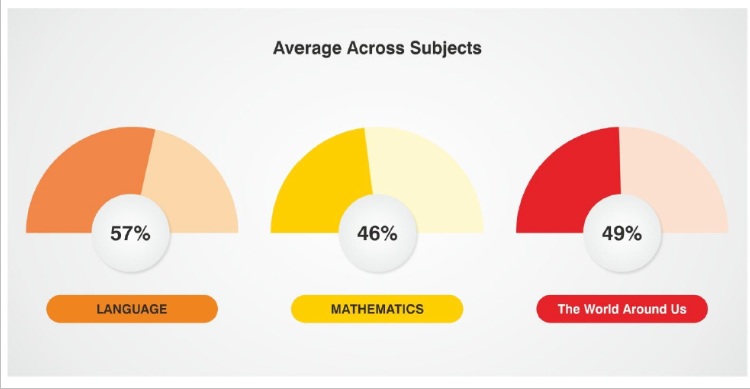
Across all three assessed grades, Grade 3 (Foundational), Grade 6 (Preparatory), and Grade 9 (Middle), Tamil Nadu’s average performance was consistently below the national average in every core subject: Language, Mathematics, Science, and Social Science.


In contrast, the “Hindi” belt or BIMARU states such as UP, Bihar, MP, performed better.
Uttar Pradesh exceeded national averages in foundational numeracy and literacy (Grade 3).
Madhya Pradesh scored above or equal to the national average in Mathematics in Grades 6 and 9.
Bihar showed growth in Language and Science scores, narrowing the gap significantly with southern counterparts.
District-Level Underperformance
None of Tamil Nadu’s districts featured among the top 50 districts nationally in any grade. However, multiple TN districts were among the bottom 50:
- Grade 3 Low Performers: Ranipet, Ramanathapuram
- Grade 6 Low Performers: Tirupathur, Vellore, Ramanathapuram
- Grade 9 Low Performers: Cuddalore, Tirupathur, Tiruvannamalai, Nagapattinam, Ariyalur
States like Punjab, Kerala, and even Madhya Pradesh and Uttar Pradesh had multiple entries in the top-performing districts list.
National Comparison And High Performers
The top-performing states offer a stark contrast:
- Grade 3: Punjab led across both language and mathematics.
- Grade 6: Kerala emerged as the top performer.
- Grade 9: Punjab again topped the charts.
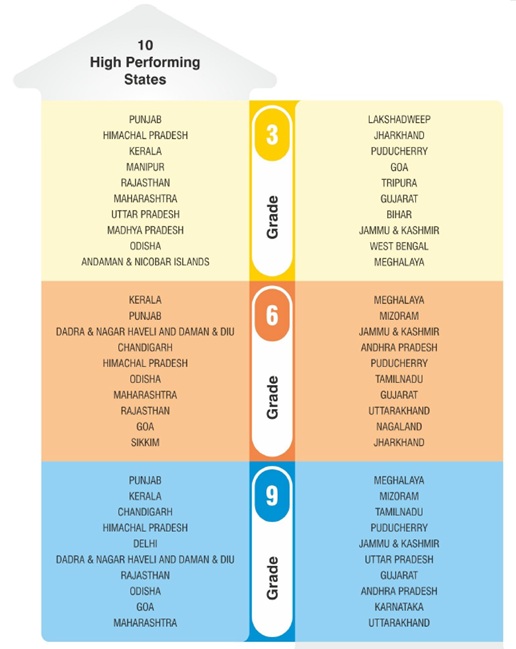

Among government schools specifically:
- Language proficiency (Grade 3): Punjab, Himachal Pradesh, Kerala, Uttar Pradesh, and Maharashtra stood out.
- Mathematics proficiency (Grade 3): Punjab, Himachal Pradesh, Kerala, Uttar Pradesh, and Dadra & Nagar Haveli and Daman & Diu were top performers.
Here are some national averages:
Assessing Preparatory Stage Competencies (Grade 6)

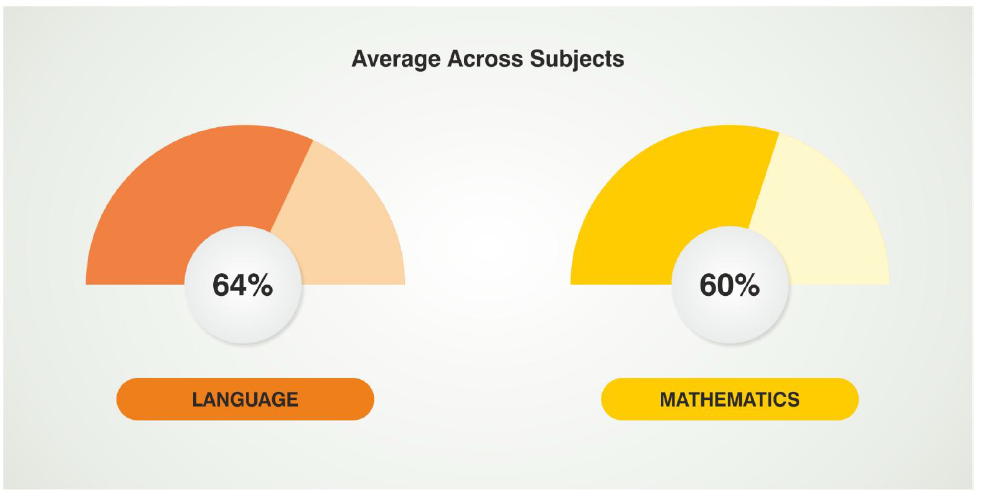

Assessing Middle Stage Competencies (Grade 9)
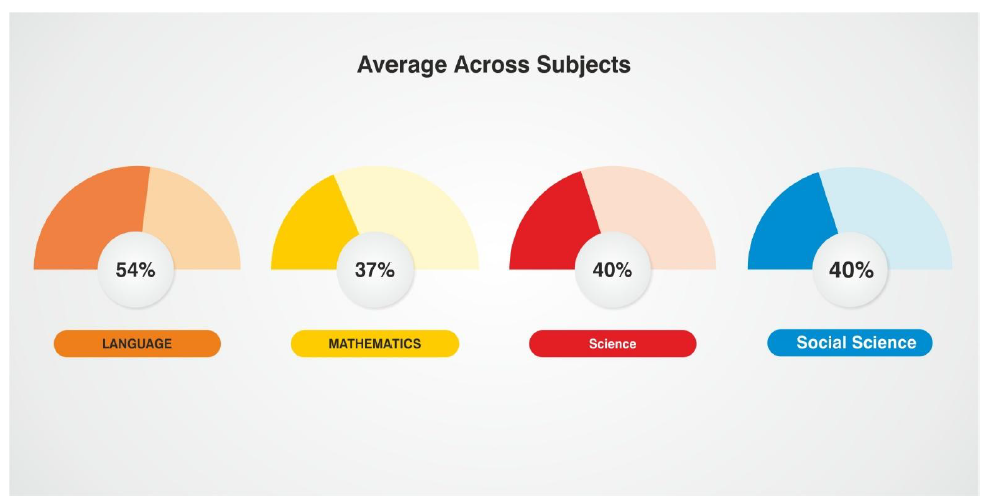

Structural Weaknesses and Systemic Gaps
Let us now take a look at the foundational weaknesses and gaps.
Foundational Competency Deficits
Less than 50% of Tamil Nadu’s Grade 3 students could perform basic reading or numeracy tasks, indicating deep-rooted foundational gaps.
In contrast, UP and MP students demonstrated better foundational competency with more than 60% proficiency in several indicators.
Declining Performance by Grade 9
Tamil Nadu’s students showed steep learning attrition by Grade 9:
- Math competency scores dropped to ~33–37%
- Science understanding was limited to 36–38%
- Social Science and Civics averaged below 40%, pointing to weak conceptual comprehension
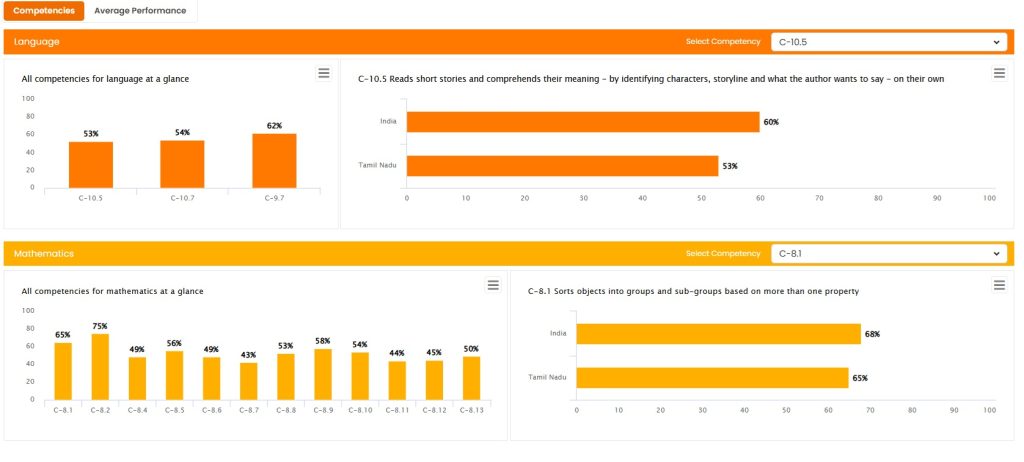

These metrics indicate a failure to transition from rote learning to conceptual application.
Teacher Preparedness and Pedagogy
Only 25% of teachers in Tamil Nadu underwent professional development in the last year among the lowest in India.
Less than 50% of teachers used toy-based learning or project-based assessment, lagging behind even northern states that have adopted NEP 2020-aligned practices.
ICT-based training participation was also below par compared to Madhya Pradesh and Bihar, which invested in EdTech post-COVID.
Inclusion, Well-Being, and Infrastructure Concerns
Let’s take a look at some of the other problematic areas.
CWSN Neglect
Only 28% of schools in Tamil Nadu had appropriate learning materials for Children With Special Needs. Assistive technologies were available in just 17% of schools.
Mental Health and SEL Deficits
17–25% of TN students reported feeling unsafe or anxious in school.
Low availability of counsellors, anti-bullying policies, and SEL practices worsens the learning environment.
Manodarpan, the national SEL initiative, remains poorly implemented in TN.
Digital and Skill Education Gap
Only 38% of students had access to a tablet/laptop at home.
Only 29% of Grade 9 students had enrolled in skill-based education, despite the state’s push for industry-linked education.
Let’s now take a look at how TN compares to a few peers such as UP, Bihar, and MP.
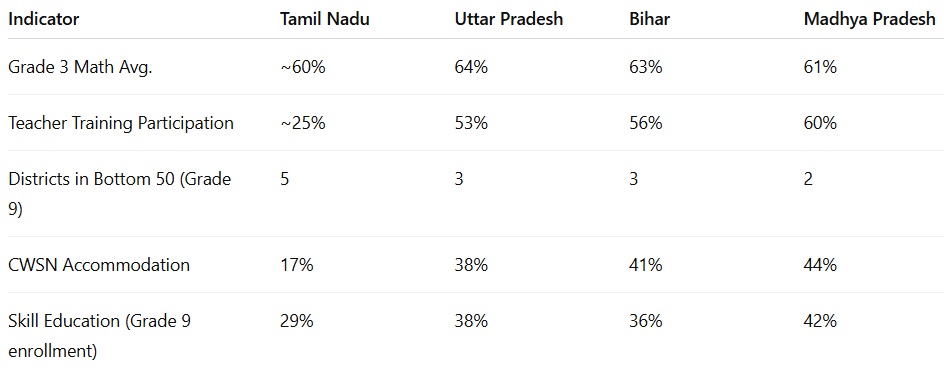

Tamil Nadu’s ideological resistance to NEP 2020 has arguably cost it crucial learning reforms. States like UP, MP, and Bihar, which have aligned their pedagogy, teacher training, and assessment with NEP’s competency-based framework, are now reaping benefits, as reflected in the PARAKH survey.
Even Kerala, while critical of some NEP aspects, adopted assessment reforms and SEL integration faster than Tamil Nadu.
Consistent Underperformance Pattern
Tamil Nadu’s underperformance follows a pattern observed in the previous National Achievement Survey (NAS). In response, the DMK-led government launched initiatives such as the #EnnumEzhuthum scheme to address foundational literacy and numeracy gaps. However, the recent PARAKH results suggest that these interventions have yet to produce meaningful outcomes.
Critics have pointed to the Dravidian Model’s politicisation of NEP 2020, arguing that opposition to the central education policy has come at the cost of addressing core learning outcomes. Commentators have also drawn parallels to the #NaanMudhalvan scheme, launched to boost skill development and placements for youth, which has similarly been criticised for lacklustre training and poor placement results.
Schools Closed Amid Falling Enrolment
In August 2025, official data showed that 207 government primary and middle schools were shut this academic year due to zero student enrolment. Tamil Nadu has over 31,000 such schools with 18.46 lakh students, but many face single-digit strength and poor infrastructure. Officials said enrolment had briefly risen during COVID-19, but parents later returned children to private schools citing teacher shortages and preference for English-medium. Closures were highest in Nilgiris (17), Sivaganga (16), and Dindigul (12). Activists warn more closures loom unless urgent upgrades and proactive enrolment measures are implemented.
Staff Shortage
In July 2025, it came to light that Tamil Nadu was facing a severe staff shortage in its 54,483 Anganwadi centres, leading to the closure of 501 centres this year, including 147 in Chennai. Over 28,000 positions, mainly teaching roles, remain vacant due to retirements and lack of new appointments since 2018. With only 75,468 staff out of the required 1.04 lakh, teachers often manage multiple centres, straining supervision and care. Parents are increasingly avoiding understaffed centres, opting for private schools if affordable. The government plans to fill 7,842 posts, but experts warn more closures may occur unless urgent action is taken to safeguard child nutrition, safety, and early education.
In January 2025, Tamil Nadu’s government schools were found to be facing a severe teacher shortage, with 2,758 schools operating with only a single teacher, serving 80,586 students. The state has 496 schools with no enrolled students, yet 889 teachers remain assigned to these vacant institutions, reflecting inefficient deployment. On average, schools have just nine teachers each, while the teacher-student ratio stands at 1:24. This understaffing compromises education quality, with single-teacher schools struggling to manage multiple classes and responsibilities.
Headmaster Shortage
Tamil Nadu is facing a critical shortage, with over 1,000 headmaster positions and thousands of teaching roles unfilled in government schools. This lack of teachers has made it increasingly difficult for educators to effectively teach students.
While all government schools fall under the Department of School Education, various wings of the department are responsible for primary and secondary schools. In Tamil Nadu, approximately 25,50,997 students are enrolled in 31,336 primary schools, with around 1,08,537 teachers. In secondary schools, there are 6,218 institutions across the state, with 27,24,256 students and 1,16,863 teachers.
The shortage of teachers and headmasters is creating significant challenges for both educators and students. Despite this, the government has failed to address these vacancies. According to teachers’ unions, more than 1,000 headmaster positions remain vacant in the state’s 37,000 primary, middle, and high schools.
What is even more alarming is the fact that the last recruitment for primary school teachers took place in 2021-2022, filling a mere 14 positions. For secondary schools, 3,043 vacancies were filled in the 2022-2023 academic year. The DMK government, instead of addressing this shortage, has resorted to using temporary staff, allowing the education system to spiral into chaos.
Crumbling Infrastructure of Dravidian Model Schools
Ceiling collapses in Dravidian Model schools, that too newly renovated ones are not new. Here is a list of such instances from the past few months.
#1 Krishnagiri
On 27 August 2024, three Class 11 students were injured when ceiling plaster fell at a newly opened government school in Krishnagiri. Built with MP funds, the incident sparked protests by over 50 parents demanding action against the contractor for alleged poor construction. Authorities assured accountability and safety measures.
#2 Thiruporur
On 9 August 2024, the ceiling of a classroom at a government school in Thiruporur collapsed, injuring five female students and sparking protests from parents who questioned the quality of the construction. The incident occurred at the Government Higher Secondary School in Siruthavur village, which serves over 350 students. At around 2 PM on 8 August 2024, a section of the ceiling in a Class 10 room gave way while 48 students were inside. Five girls sustained injuries and were promptly transported to the Thiruporur government hospital. According to police sources, two of the students were treated and sent home, while Suji, Prathikshaw, and Tamilrasi were admitted with multiple injuries.
#3 Kanchipuram
In another incident in July 2024, the ceiling of a newly constructed Panchayat Union Middle School near Kanchipuram collapsed, causing significant concern. The building, completed three months prior at an estimated cost of ₹62 lakhs, had its ceiling in one classroom suddenly give way. The incident resulted in a fan blade bending. Fortunately, the students were on the ground at the time, offering their prayers, and no one was injured. In response, parents demanded an immediate investigation by the District Collector into the building’s stability and called for strict action against those responsible. The Panchayat Union Primary and Middle Schools in Kuruvimalai had three new structures erected at a cost of ₹61.73 lakhs before the last parliamentary elections.
#4 Tirupattur
On 3 March 2024, three students from a government school near Vaniyambadi were seriously injured when the roof of a newly inaugurated classroom gave way. The collapse occurred at a panchayat union primary school in Shankarapuram, Tirupattur district.
#5 Vaniyambadi
Three students were seriously injured when the roof of a newly inaugurated classroom collapsed at a panchayat union primary school in Shankarapuram, Vaniyambadi, Tirupattur district, on 4 March 2025. The building, constructed in 2023–2024 at a cost of ₹21 lakh with funds from AIADMK MLA Senthilkumar, had been inaugurated in August 2024. The injured students, Praneeth (Class 1), Sudarsan (Class 3), and Vishek, were rescued and taken to a private hospital.
#6 Dindigul
Seven students were injured on 7 March 2025 when the roof of a recently repaired fourth-grade classroom collapsed at Dindigul Corporation Middle School. The school, built in 2009 during the DMK government, has faced structural issues, prompting ₹1 crore worth of repairs, including the affected classroom. The incident sparked panic among parents and led to the suspension of Assistant Executive Engineer Thiagarajan. Former AIADMK Minister C. Sreenivasan blamed substandard construction, while DMK Minister I. Periyasamy defended government efforts, attributing the collapse to an older faulty repair.
#7 Tiruvarur
On 7 April 2025, a roof collapse at a government middle school in Sekalangiri village, Tiruvarur district, injured four students during class. One student was seriously hurt and taken to Tiruvarur Medical College, while three others were treated for minor injuries. The building, less than a year old, has sparked public outrage over construction quality. Parents and locals demanded an immediate investigation and accountability for the substandard work. The incident follows a similar accident in Kanchipuram a day earlier, intensifying concerns about student safety in Tamil Nadu’s government schools. Many parents are now hesitant to send their children to school.
#8 Ranipet
In Ranipet, a 13-year-old boy from Thenkadappanthangal sustained serious head injuries when a boundary wall collapsed at his government school during lunch break. The eighth-grade student of the Government Panchayat Union Middle School was playing near the wall when it suddenly gave way. He was first rushed to Walajapet Government General Hospital and later transferred to CMC Hospital in Ratnagiri for advanced treatment. The incident prompted visits from education officials and has sparked concern among local residents.
#9 Erode
A year-old government school building in Tamil Nadu’s Erode district collapsed on 20 July 2025, raising fresh concerns over construction quality in state-run institutions. The Panchayat Union Middle School in Kugalur, inaugurated by Chief Minister M.K. Stalin in July 2024 at a cost of ₹64.33 lakh, saw its roof cave in on a holiday, avoiding casualties. The incident adds to a series of similar structural failures reported across districts in the past year, fueling allegations of corruption and negligence in public infrastructure projects. Parents and residents voiced fears for children’s safety in Dravidian Model government schools.
#10 Trichy
On 22 September 2025, part of the roof at Singalanthapuram Panchayat Union Primary School near Thuraiyur, Trichy district, collapsed, highlighting ongoing concerns over unsafe school infrastructure in Tamil Nadu. The building, constructed at a cost of ₹30.05 lakh, serves 34 students from classes 1 to 5. The collapse occurred in the morning as the headmaster opened the premises, with debris damaging benches and an LED TV. Fortunately, no children were present as it was a weekend. Officials acknowledged that if the incident had taken place during school hours, it could have caused serious injuries or fatalities.
#11 Chennai ‘Model School’ Students Expose Crumbling, Unsafe Conditions
In 2023, students at the Government Higher Secondary School in Mogappair, Chennai, raised disturbing complaints about unsafe and unhygienic conditions in what is officially designated a “model school.” They alleged crumbling ceilings, water leakage, and lack of proper toilets, with one girl recalling that part of the ceiling collapsed during exams. Despite repeated pleas, management reportedly responded with indifference and even hostility, forcing girls to clean toilets and verbally harassing those who resisted. Students said toilets are unusable due to filth, and many wait until reaching home to relieve themselves. During the monsoon, classrooms were flooded with stagnant water, mosquitoes, and pests, yet no action was taken. Security lapses have allowed outsiders to enter, vandalize fans, smoke, and drink inside classrooms on weekends.
Tiruppur Govt School Students Struggle Without Classrooms
At Veerapandi Government Higher Secondary School in Tiruppur, in July 2025, it came to light that over 1,200 students from Classes VI to XII are crammed into just 19 classrooms, forcing hundreds to study on terraces, verandahs, and corridors. During rains, these makeshift spaces flood, disrupting lessons. Parents and alumni say problems persist since 2017, with 100–150 students packed into single rooms, poor sanitation, no playground, and just two PE teachers. Despite repeated appeals, expansion plans have stalled in bureaucracy. Officials now claim new land has been identified, but parents remain sceptical. With monsoons approaching, the school’s dire infrastructure crisis remains unresolved.
Administrative Failures
Let’s take a look at how the administration has deteriorated over the past few years under the DMK government.
- On 12 June 2025, Kallakurichi government school students were served with food contaminated with worms and bugs. Students in a viral video emotionally pleading with the state’s education minister for clean and safe mid-day meals. According to reports, the mid-day meal served was prepared using rice that had been stored unused for over a month during the summer break. As a result, the food was spoiled, filled with worms, and emitted a strong foul odor.
- On 12 June 2025, students at CV Government School in Thoothukudi were compelled to carry hollow bricks for ongoing school construction work.
- On 2 June 2025, students at Tirunelveli’s Manakavalam Pillai Nagar government school continue to face poor conditions as a new building promised three years ago remains incomplete, forcing them to study in a temporary rented space with just one shared restroom. DMK councillor Indira led a protest, criticizing her own party for neglecting the project and demanding urgent action.
- On 5 April 2025, Two staff members at a government primary school in Kollamedu were arrested for assaulting a fifth-grade student who questioned the missing eggs during lunch. The student confronted staff after finding eggs hidden in the kitchen, prompting the cook and assistant to attack her with a broom.
- On 26 March 2025, Ponnagaram villagers protested against the government as students at the Government High School have been forced to study under tree shades and temporary sheds for six years due to the lack of proper classrooms, despite the school’s strong academic performance. The school serves 272 students with only two classrooms and one toilet, forcing villagers to build makeshift shelters.
- On 10 March 2025, students at a government school in Thiruvallur were compelled by their headmaster and teachers to carry bricks on a holiday. Locals have accused the headmaster of mistreating the students and disregarding multiple warnings about this forced labor.
- On 9 November 2024, a government-aided girls’ school in VK Puram, near Ambasamudram, screened Tamil films such as Vijay’s ‘GOAT’ to senior students and Rajinikanth’s ‘Vettaiyan’ to younger students, with charges of ₹25 and ₹10 per student, respectively.
- In June 2024 the government secondary school in Theethipalayam, Coimbatore, faced a severe classroom shortage, leading to a decline in student admissions and forcing existing students to attend classes under trees and in the parking area. Despite ongoing construction, about 100 students in classes 8 and 9 are left without proper facilities.
- On 27 August 2024, three students were injured when a section of the ceiling plaster fell on them during class at a government-run school in Krishnagiri. The accident raised significant concerns about the safety and structural integrity of the building, which had only been opened two months ago with MPLADS fund.
- In another similar incident in July 2024, a ceiling of a newly constructed Panchayat Union Middle School near Kanchipuram collapsed, wher the building, completed three months prior.
- In August 2024, another ceiling of a classroom at a government school in Thiruporur collapsed, injuring five female students and sparking protests from parents who questioned the quality of the construction.
- On 12 June 2024, the administration of St. Paul’s Girls’ Higher Secondary School in Mayiladuthurai forced students to clean their classrooms to “instill” discipline, a practice exposed when a ninth-grade student refused and was slapped by a teacher.
- In November 2023, the Government Higher Secondary School in Mogappair, Chennai, became a site of student distress due to poor conditions, including unhygienic facilities and unsafe infrastructure. Girl students raised alarming concerns that they were subjected to verbal harassment and forced cleaning duties, with teachers complicit in the mistreatment.
- In September 2023, a disturbing video went viral showing mentally challenged students at a Tamil Nadu government-aided school, run by the Church of South India (CSI), being forced to clean toilets. The students, attending the CSI School for the Mentally Challenged in Sivakasi, were reportedly made to perform this task as part of their school routine. The incident, involving over 100 students, sparked outrage after the video was shared on social media.
- Around June 2025, the Panchayat Union Higher Secondary School in Thirupalaikudi, R.S. Mangalam Taluk, was reported to lack basic facilities, including functioning toilets. Shockingly, the space near the defunct toilets was being used as a kitchen to prepare mid-day meals, causing severe hygiene and safety concerns. Female students were particularly affected, facing discomfort and unsafe conditions while attending school. Local residents and social activists have urged authorities to intervene immediately and restore proper sanitation and cooking arrangements.
- In Salem district’s Athur-Thalaivasal region, a viral video in November 2024 sparked outrage after showing students at a government high school massaging their mathematics teacher, Jayaprakash, to help him sleep during afternoons. The footage, along with other videos, also revealed the teacher sleeping in classrooms instead of teaching. Allegations suggest that Jayaprakash summoned students for these tasks during non-class periods and, at times, arrived at school intoxicated. Despite reports to the headmaster, no action was reportedly taken, raising concerns about student exploitation, teacher misconduct, and administrative inaction in government schools.
Proselytization Attempts At Govt Schools
So far, we only saw the regular failures. Did you know that government schools even became a target for proselytization? Take a look at the number of times this happened.
- On 2 May 2025, schoolchildren in Pollachi were taken without parental consent from a government school to a church, where they were forced to pray and undergo religious instruction under the guise of a health awareness camp. Parents, shocked by the incident and the attempt at religious conversion, confronted the organizers and rescued their children, leading to police filing a case against those involved.
- In October 2024, the headmistress of Government High School in Diwanshah Pudur allowed Friday Namaz to be held on school premises, disrupting the secular environment. The prayers have been conducted regularly such practices may cause religious discord and mental distress as the school serves a diverse student body
- In August 2023, protests erupted in Acchankuttam village, Tenkasi, over concerns that a government-aided Christian school was engaging in proselytization. The Tahsildar filed a complaint, leading to police action against 12 individuals accused of inciting communal unrest by mobilizing Hindu parents to withdraw their children from the school. The case stems from fears of religious conversion within the school.
- In 2022, Beatrice Thangam, a tailoring teacher at a government school in Kanyakumari district, Tamil Nadu, was accused of making objectionable remarks about Hindus and attempting to preach Christianity to her students. A Class 6 student revealed in a video that Thangam referred to Hindus as “sathaan” (devil), forced students to read the Bible, and even made them kneel and recite Christian prayers. The teacher allegedly pressured Hindu students to stitch Christian crosses and dismissed the Bhagavad Gita as “bad.”
- In 2022, a 17 year old girl studying at Sacred Heart Higher Secondary School in Thirukattupalli near Thanjavur, committed suicide by drinking poison after she was allegedly tortured to convert to Christianity by the school for her to continue her studies.
Caste Pride & Violence
For all the credit that the Dravidianists claim for “eradicating caste”, we have seen a huge surge in caste violence in schools. Here are a few such instances:
- A 10th-grade student at a government-aided school in Sripuram, Tirunelveli, was dismissed for carrying weapons, including a sickle and knives, after a student clash. The weapons were discovered during a routine bag check on 18 September 2024. .
- On 30 July 2024, two students at the Government Higher Secondary School in Valliyoor, Tirunelveli, were injured in a caste-related clash triggered by derogatory remarks about a specific caste written on a toilet wall.
- In December 2023, students from Periyar Government Higher Secondary School in Cheranmahadevi attacked students from a nearby polytechnic college over caste issues, leaving one student stabbed.
- On August 2023, three students from a dominant caste assaulted a Scheduled Caste teenager and his sister in Nanguneri. The violence resulted in injuries and hospitalisations, shocking the community.
- On 1 July 2024, another instance of caste-based pride sparked a clash among 12th-grade students at Rosalind Chelliah Government Higher Secondary School in Maruthakulam village, Nanguneri, Tirunelveli.
Sexual Assault/Harassment At Govt Schools Surged
If caste violence and other administrative failures weren’t enough, the government schools also saw sexual assault cases peak under the DMK.
- On February 2025, Kumaresan (57), a lab assistant at a government school in Salem, was arrested under the POCSO Act for allegedly sexually harassing female students.
- A second-grade student at Podhavur government primary school in Trichy was allegedly sexually assaulted by teacher Jayaraj Susainathan while cleaning the classroom. Following a complaint from the parents, Jayaraj was arrested. It has been revealed that there have been sexual harassment complaints against him for the past decade, with the teacher reportedly threatening the students and their families during this time.
- A 58-year-old assistant headmaster of a government high school in Pudukottai was arrested on 17 February 2025 under the Protection of Children from Sexual Offences (POCSO) Act for allegedly sexually harassing multiple girl students.
- Sivakumar, a 40-year-old temporary physical education teacher, allegedly sexually harassed the 11th grade student and violated her by making inappropriate comments about her appearance. Following an investigation Omalur All Women Police Station registered a case under the POCSO Act.
- 3 Govt School Teachers – Arumugam (48), Chinnaswamy (57), and Prakash (37) in Krishnagiri arrested under the POCSO Act for gang-rape of an 8th grade student resulting in pregnancy and an abortion
- Ilayakannu, a 37-year-old teacher from Neyyamali, Bettanayakkanpalayam, Salem district, had been arrested under POCSO act for sexually harassing 10th and 11th grade students at the Yercaud government higher secondary school.
- On 3 September 2024, Dr. S. Samson Daniel (31), a government doctor, was arrested under the POCSO Act on sexually assaulting minor girls at a hostel affiliated with a government-aided school in Trichy. His mother, S. Grace Sagayarani (54), who is the headmistress of the school, was also taken into custody for helping to cover up the offenses.
- On August 2024, a 13-year-old girl was allegedly sexually assaulted by a Naam Tamizhar Katchi (NTK) functionary named Sivaraman during a fake National Cadet Corps (NCC) camp at a private school near Bargur in Krishnagiri district.
- A math teacher Sundara Vadivelu working at a corporation school at Noyyal Road in Tiruppur was arrested for sexually harassing multiple students and allegedly targeted seventh-grade students over the past few months. Sources indicate that more than ten children have come forward with complaints so far.
- Suresh, a Tamil teacher at Ariyalur Government School, was arrested under the POCSO Act for sexually harassing a 6th-grade student. He threatened the student’s life to keep it secret, but she informed her parents, who then filed a police complaint.
- In July 2025, a 51-year-old science teacher at a government higher secondary school near Ooty was arrested for allegedly sexually assaulting 21 girl students, exposing grave safety lapses in Tamil Nadu’s government schools. The misconduct surfaced during a police awareness programme, with students from Classes 7, 8, and 10 filing written complaints. Despite earlier warnings to the headmistress on June 25, no action was taken. The teacher was remanded under POCSO and BNS provisions.
- In February 2025, three teachers at a middle school in Krishnagiri were arrested for allegedly assaulting a 13-year-old girl.
Substance Abuse
August 2024: A Chennai school in Kalyanapuram, Vyasarpadi, has become a hotspot for underage substance abuse, with students as young as pre-teens consuming beer and tobacco. A report on 23 August 2024, revealed a Class IX girl drinking beer in the classroom on her birthday, with her Class VII brother purchasing it, while three Class X boys were caught smoking Beedis. These incidents highlight a disturbing trend of substance abuse among students at the school.
June 2025: In June 2025, students at the Panruti Government Boys Higher Secondary School in Cuddalore district were reportedly caught using drugs such as ganja and creating a ruckus on campus. When a teacher attempted to intervene, he was attacked with stones by the students. The incident has prompted public calls for stricter measures against drug use in schools and for proper counseling services to support students.
June 2025: A 10th-grade girl from a Chennai government school was hospitalized with severe stomach pain, leading to the discovery of drug use and a medication-induced abortion. An investigation revealed she was exploited by two men, Leo and Prasanth, whom she met via Snapchat. Leo, a distant relative, allegedly gave her drugs and had sexual relations with her, resulting in pregnancy. Prasanth continued supplying drugs and abusing her. Police found hundreds of explicit videos on her phone, filmed while she was intoxicated. The case, registered under POCSO, exposes severe lapses in child safety and rising drug abuse among teenagers, leading to her rehabilitation.
Midday Meal Food Poisoning Incidents
Over the past few years, several food contamination/poisoning incidents have been reported across various districts in Tamil Nadu raising alarming questions about the quality control, hygiene practices, and oversight in the state’s school meal schemes. Despite repeated occurrences, little seems to have been done to prevent these avoidable mishaps.
#1 24 June 2025: over 50 students at Anaivari Panchayat Union Primary School reportedly fell ill after consuming breakfast suspected to have contained a lizard in Villupuram district. Several students fainted and vomited shortly after eating and were rushed to Kalpattu Government Primary Health Centre. Two temporary kitchen staff were dismissed, and the School Education Department launched an investigation.
#2 July 2025: In a government-run hostel linked to the Government Girls’ Higher Secondary School in the Courtallam area, nine female students fell ill after breakfast and were admitted to Tenkasi Government Hospital. The hostel is reportedly managed by the Hindu Religious and Charitable Endowments Department.
#3 13 August 2025: Eight students were hospitalized after a lizard was allegedly discovered in their breakfast of rava khichdi provided under the Chief Minister’s Breakfast Scheme at Punairuppu Government Primary School in Thiruvarur district.
#4 10 September 2022: In Tiruvannamalai district’s, Mothakal village, 47 students were hospitalized after eating contaminated midday meals that reportedly contained dead lizards.
#5 31 May 2022: In Pudukottai District, three children suffered from vomiting and diarrhea at the Thondaiman Nagar Anganwadi. Food served to 50 children was later found to contain beetles and worms. All children were treated at Pudukottai Government Hospital.
#6 29 October 2022: In Tiruvannamalai district, at a school near Keezhpennathur, 15 students were hospitalized after a lizard’s head was reportedly found in the food consumed by a class 10 student. Over 150 students were enrolled in the school at the time.
#7 September 2025: At a Panchayat Union Middle School in Adhivaraganatham, Cuddalore district, a lizard was found in breakfast served under the government’s meal scheme. Eighteen students had already eaten before detection. Though no health issues were reported, they were treated and sent to Chidambaram Government Hospital for observation. Parents staged protests.
Not Kalviyil Sirantha Tamil Nadu But Kalviyil Tharai Mattam Tamil Nadu
Based on the above evidence, the conclusion is clear and stark: the DMK government’s grand narrative of ‘Kalviyil Sirantha Tamil Nadu’ (Tamil Nadu That Excels in Education) is a carefully constructed myth that collapses under the weight of reality.
The state’s education system is in a profound crisis, characterized by systemic failure on every measurable parameter. The celebratory event in Chennai was a political spectacle, utterly disconnected from the grim conditions in government schools, where students grapple with alarming illiteracy and innumeracy, crumbling infrastructure, administrative neglect, and alarming safety threats, including sexual assault and substance abuse.
The data from national reports (ASER, NAS, PARAKH) is unequivocal: Tamil Nadu is not an educational leader but a laggard, consistently outperformed by states it often derides. The ideological resistance to the National Education Policy (NEP) has cost the state crucial reforms, while its own schemes have failed to deliver meaningful improvements.
Ultimately, the “Dravidian Model” of education has proven to be a catastrophic failure, prioritizing political propaganda over the fundamental right to safe, quality education. The gap between the government’s boastful claims and the heartbreaking ground reality has never been wider, leaving a generation of students to pay the price for this grand deception.
Subscribe to our channels on Telegram, WhatsApp, and Instagram and get the best stories of the day delivered to you personally.