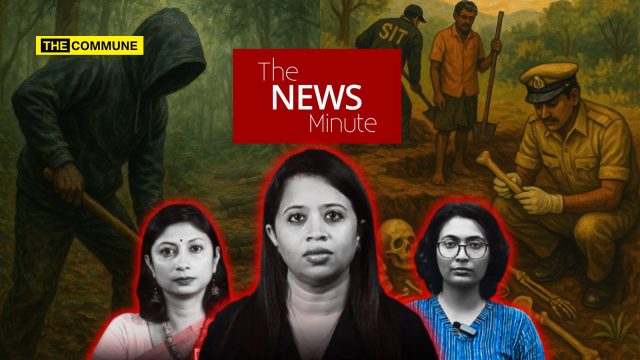
Lord Manjunatha is far more than a deity—he is the living embodiment of faith, reverence, and an eternal spiritual bond, consecrated in the sacred crucible of Dharmasthala. But this sacred temple town was dragged through the mud by the usual suspects of leftist media, with The News Minute leading the charge.
In an unmistakably malicious attempt to defame Hindus and their religious institutions, it spearheaded a campaign of baseless allegations, fabrications, and selectively distorted reporting.
While repeatedly brandishing the victim card under the guise of free speech, they sought to portray themselves as authorities on ‘exposing’ the Dharmasthala Temple management—an obvious attempt to provoke local Hindus into questioning their reverence for the temple by fabricating a scandal.
Before we get into the nitty-gritties of what and how they reported, here’s a primer that exposes their agenda.
In 2025 alone, The News Minute pushed out more than 24 full-length reports on the Dharmasthala issue without even proven allegations of sexual assault or rape being reported.
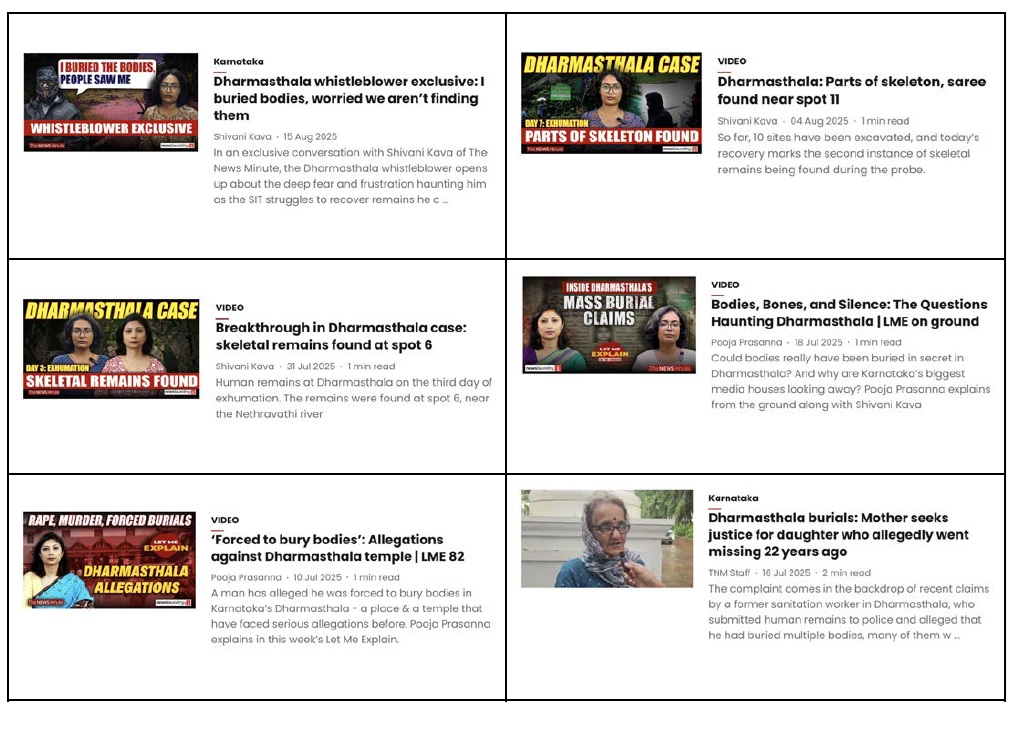
Some of the reports include:
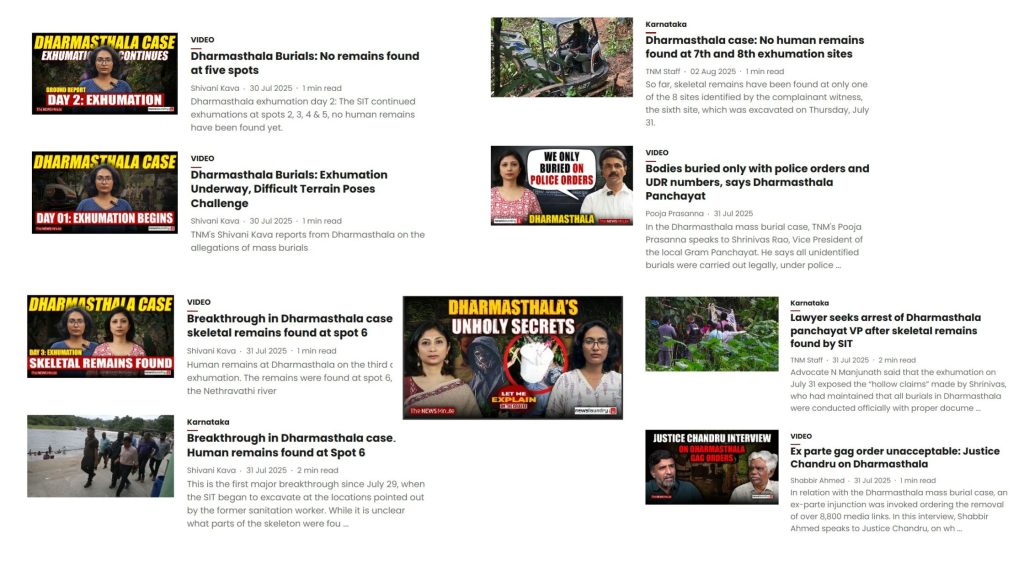
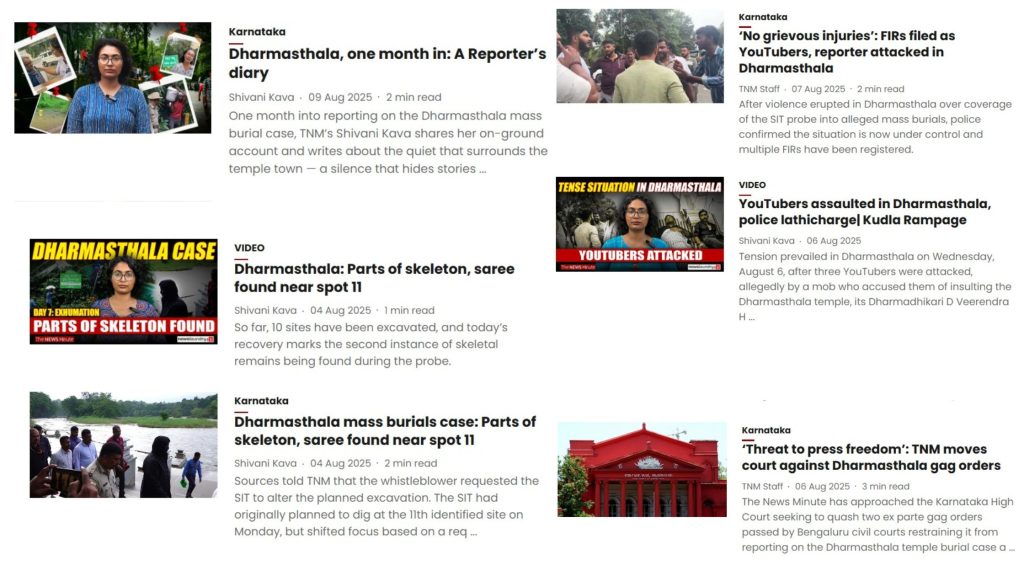
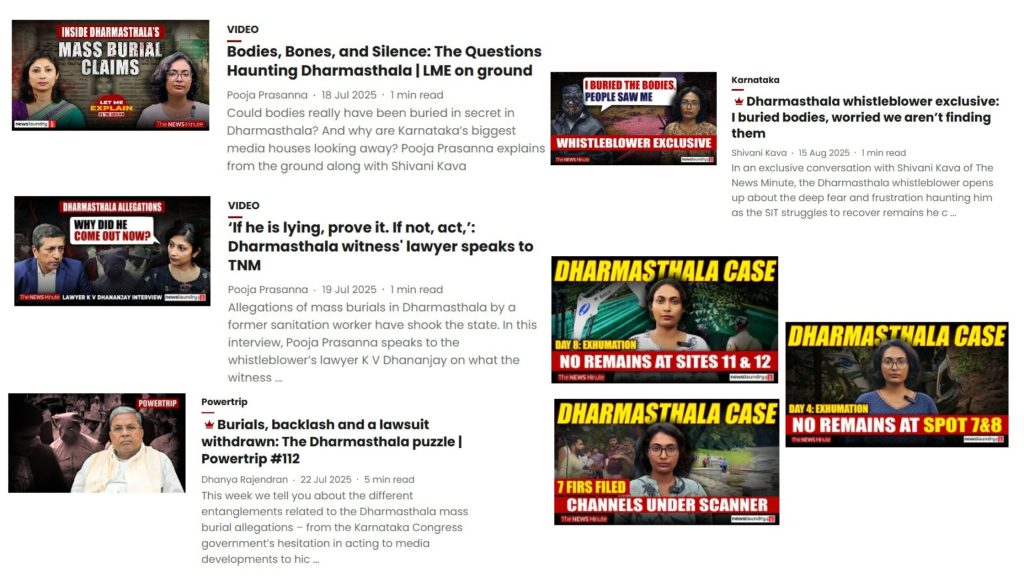
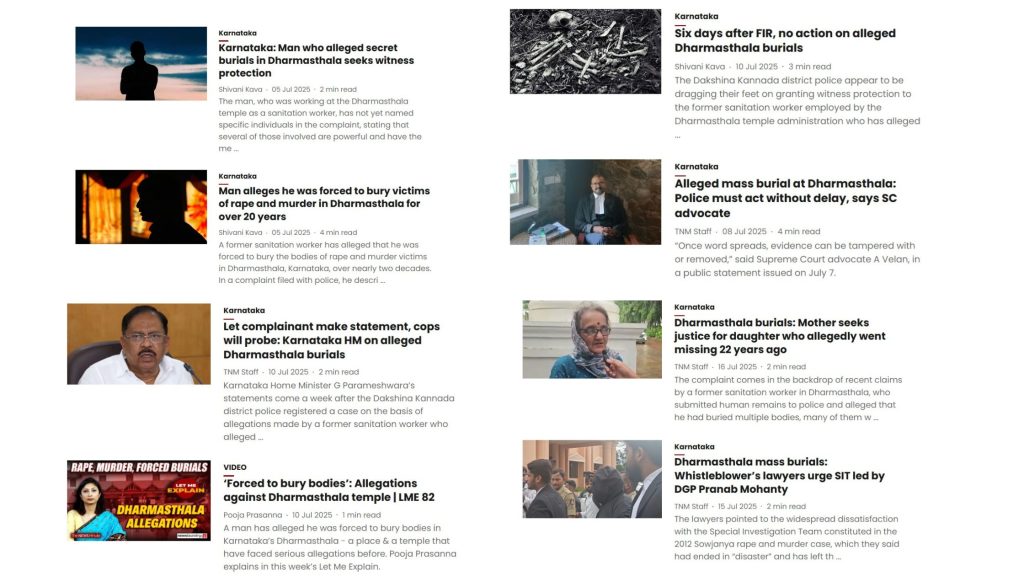
In glaring contrast, their reporting on the Anna University sexual assault case lays bare the truth—they are not The News Minute, but The New Murasoli, the DMK’s unofficial mouthpiece masquerading as a news outlet.
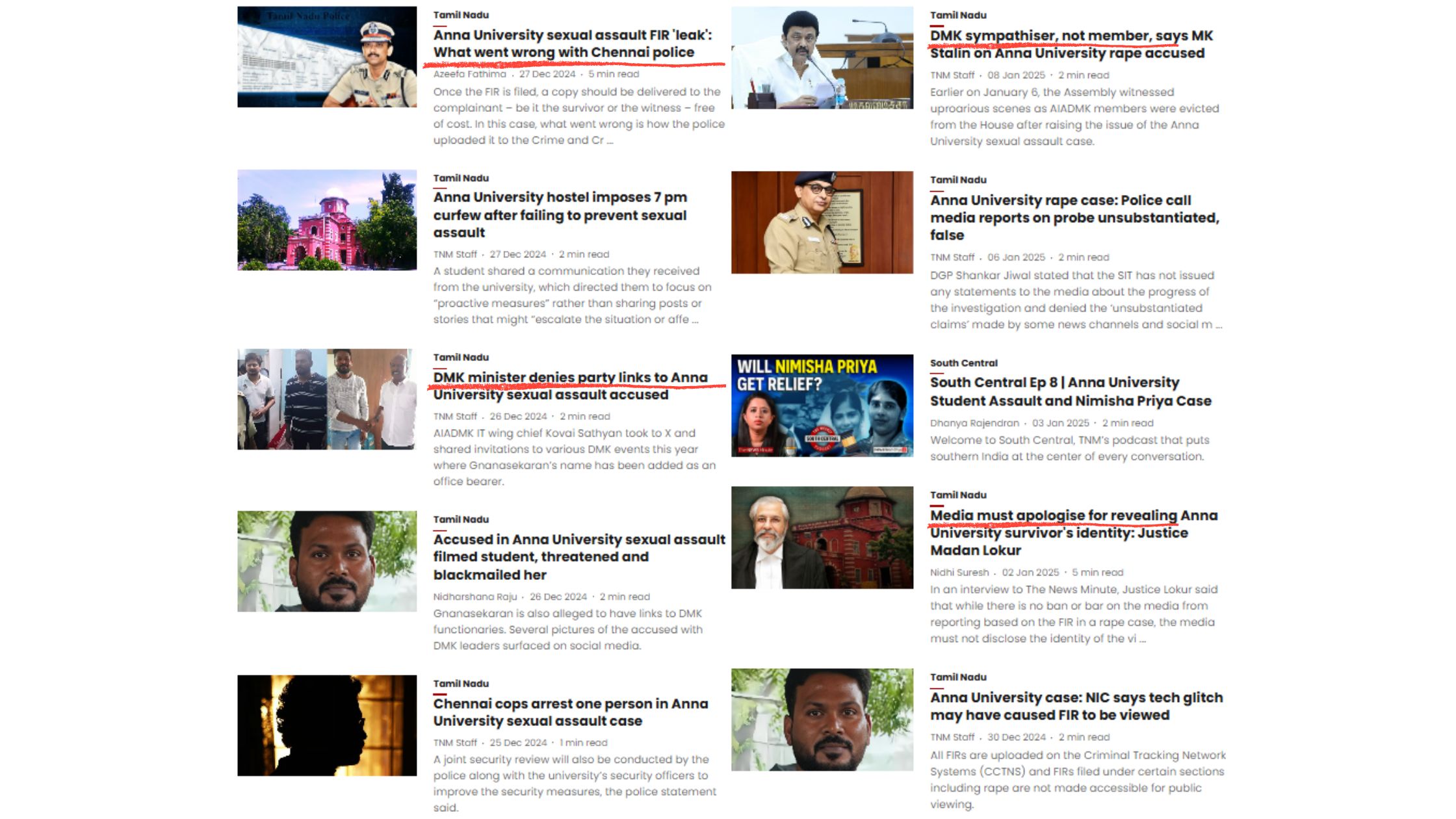
On one hand, TNM took the words of a ‘masked man’ at face value, eagerly amplifying baseless claims and peddling propaganda without a shred of proof. Yet when confronted with incontrovertible evidence implicating a DMK man as the perpetrator in the Anna University sexual assault case, it went into protective mode—downplaying the facts and shielding the party it favors.
Coming back to our topic, let’s now take a closer look at how The News Minute tried to smear the Dharmadhikari Veerendra Heggade–run Dharmasthala temple and shame Hindus about their faith.
Reporting – Facts Or Fiction?
Their “reporting” or rather concerted campaign started on 5 July 2025 when the masked man made his appearance.
The portal continued reporting on the daily developments via news articles while preparing for video interviews and explainers later in July 2025. While all their videos and explainers are presented as a neutral conversation/report, they contain several problematic elements that favour the anti-Dharmasthala narrative.
The daily exhumations were covered by their reporter Shivani Kava and one could also see Pooja Prasanna doing ground reports with Kava a few times.
Dhanya Rajendran, the editor-in-chief of the leftist portal, also chipped in during the South Central podcast episodes.
Let Me Explain ❌ Let Me Peddle Propaganda ✅
In the first offering on 10 July 2025, Pooja Prasanna used speculation and sensationalism to begin the reporting series.
The report presents a simplistic and arguably incorrect view of police procedure to cast the authorities in a negative light. Prasanna says, “The response should be immediate and that’s not an opinion. That’s how the law works.”
This is a mischaracterization. While police must investigate serious claims, a claim of this magnitude requires meticulous planning, warrants, and expert involvement. Deliberation is not “dereliction of duty”; it is a necessary step to ensure the investigation is forensically sound and legally defensible. Portraying caution as incompetence or complicity is misleading.
While discussing legal challenges to reporting is valid, Prasanna presents every gag order as an illegitimate tool to suppress truth, without adequately exploring the legal principle of protecting against defamation until a claim is proven.
The video does not ask basic journalistic questions: How could hundreds of murders and burials occur over 20 years in a major pilgrimage center without a single other person noticing? How does one man alone manage this? Where are the missing persons reports for hundreds of individuals? And how come he had a change of heart all of a sudden after 20 years? What’s the motive of the ‘masked man’?
Shifting The Narrative From ‘If’ To ‘How’ By Linking Old Cases
In the video that was published a week later, on 18 July 2025, the title and the opening statements prime the viewer to accept the premise that there is a mystery with hidden bodies, moving the discussion from “if” it happened to “how” it happened.
The report strategically links the new, unproven allegations to older, genuine tragedies (the Sowjanya case, the 1993 disappearances, alleged Ananya Bhat murder). This creates a powerful emotional and narrative connection, implying a pattern and a cover-up that spans decades. While asking if there is a pattern is valid, presenting them together as evidence for the new claim is a form of guilt by association. The existence of past unsolved crimes does not prove the current mass burial allegation.
Shivani Paints, Pooja Blurs The Picture For Propaganda
Instead of asking the right questions, the “evidence” of the skeletal remains is accepted without any critical questions.
The Panchayat vice president’s explanation (unclaimed bodies, suicides) is presented and undercut by stating it “has already been challenged as an attempt to intimidate.” Pooja Prasanna and Shivani Kava do not investigate the validity of his claims about documented procedures for unclaimed bodies, instead framing his statement purely as a threat. They use the “possibility” as a narrative device to imply truth.
While the discussion of gag orders is important context, it doesn’t prove the underlying allegation is true.
Prasanna and Kava presuppose the truth of the core allegation, frame skeptics as complicit, leverage past tragedies for emotional impact, and openly position themselves as an advocacy organization fighting a legal battle. This prioritizes narrative setting over the meticulous, evidence-based, and neutral verification that such a serious allegation demands.
Pooja Prasanna and Shivani Kava, with this kind of “journalism”, blur the lines between advocacy and reporting.
Gram Panchayat VP Interview
Pooja and Shivani interviewed Shrinivas Rao, the Gram Panchayat Vice President of Dharmasthala who explains that all unclaimed bodies are officially documented and disposed of lawfully. Records of burials (including suicides near the Netravati River) have been maintained since the 1980s, with receipts and official approvals. The panchayat denied any clandestine burials and challenges the whistleblower to provide proof.
But Pooja Prasanna’s questions are loaded and framed to imply guilt or incompetence. For example, persistently asking about rape and murder victims presupposes that such bodies were handled by the Panchayat, a claim he is explicitly denying. This is not neutral questioning; it’s an attempt to force a specific admission.
The duo of Kava and Prasanna repeatedly demand that the Vice President produce detailed police and medical reports (autopsy details, cause of death) that he has clearly stated are held by the police department, not the Panchayat. The Panchayat’s role, as he explains, is to dispose of the body after the police have completed their documentation (UDR number, post-mortem). Badgering him for documents he does not possess is a fundamental misrepresentation of the process.
The Vice President provides context for the high number of bodies (e.g., high pilgrim footfall, suicides, river accidents), but the reporters dismiss this context in favor of a more sinister narrative. He offers a plausible explanation for the statistics, that Dharmasthala attracts a large number of people in distress seeking spiritual solace, some of whom die by suicide or accident. Prasanna tries to act smart by asking, “Why here and why not in Kukke Subramanya?”.
TNM claims they are the go-to portal for anything south – Prasanna exposes her ignorance about the pilgrimage site and the local beliefs and rituals. It is a deeply held local belief that those who pass away in the sacred town of Dharmasthala attain salvation. Similar to how Hindus believe that dying in Kashi, being cremated there, or having one’s ashes immersed in the holy waters of Ganga grants moksha—the liberation from the cycle of birth and death. Does TNM not know this? A visit to the temple or speaking to the people or reading some books on the temple town will tell them but hey who cares about research!
It is even more telling of her that she chose to name another Hindu pilgrimage site and not of any other religion.
The Vice President goes on to explain that practices were less formalized before 2006, and burials might have occurred in various locations based on police direction. Instead of treating this as a historical explanation for why bodies might be found in non-cemetery areas, the reporters treat it as a “gotcha” moment, as if he is admitting to the mass burial conspiracy.
While applying scrutiny to the VPs statements, Pooja Prasanna fails to do the same to the main allegation and the masked man. They treat the masked man’s extraordinary claims as an established premise about which we detail in the upcoming sections.
Masked Man Lawyer Interview
They also carried interviews of the masked man’s lawyer KV Dhananjay. This interview was published on 19 July 2025. It is puzzling how a man who says he was “born into what is considered the lowest caste and worked as a sanitation worker” could reach out to a senior Supreme Court lawyer, why does it sound so easy? Or is there some other ‘hand’ at work here?
All through the interview, TNM allows the negative narrative is well absorbed. Dhananjay shifts the burden of proof on the police and the state by saying “If he is lying, prove it by digging. If you don’t dig, it means he’s telling the truth.” The burden of proof always lies with the accuser. The state is under no obligation to disprove every fantastical claim; it is the claimant who must present credible evidence to justify an intrusive and sensational investigation. Imagine if tomorrow someone wearing a mask alleges that bodies are buried beneath The News Minute’s office in Bengaluru—should the police be expected to raid the premises on their own, or should they first demand proof from the accuser?
The entire justification for the witness’s story is an “appeal to emotion” – he is “wrecked with guilt,” driven by “fear of God.” While this is a possible motive, a journalist should treat it as a claim, not a fact. Dhananjay insists we must take it as “prima facie true” but that is neither a journalistic standard nor a valid basis for rigorous investigation
The entire premise that “powerful people” (implicitly the Jain religious leadership) are behind this and are shielding the investigation is treated as a given, not an allegation. No evidence is presented for this central pillar of the story. Dhananjay speculates that in the 15 days, the “accused” might be moving bodies. This is pure conjecture presented with no evidence, yet it serves to poison the well; if nothing is found, he can claim the evidence was moved, not that it never existed.
Dhananjay is an advocate. His job is to present his client’s case in the most persuasive way possible. The journalist’s job is to interrogate that case. In this interview, the journalist effectively becomes the lawyer’s junior partner, allowing him to control the narrative entirely. The segment begins and ends with a promotional plea for subscriptions, framing this advocacy as “responsible and sensitive reportage,” which it is not.
Shabbir Ahmed & Justice Chandru Interview
Not to be left behind, Shabbir Ahmed brings in DMK supporting casteist retired Justice Chandru to amplify TNM’s victim card about the legal gag order. Justice Chandru called the ex parte gag orders as unconstitutional and contrary to Supreme Court precedent. He argued that reputation should be protected through damages, not censorship, and distinguishes between legitimate postponement orders to protect fair trial rights and blanket bans on publication. Chandru also condemns the routine use of expansive “John Doe” orders, which in this case targeted nearly 9,000 links, as “extraordinary” and “unjustified”. He stresses that such gag orders violate both the public’s right to information and the media’s right to report, particularly in cases like Dharmasthala where allegations are of grave public interest.
The P In Dhanya Rajendran’s Podcast Stands For Propaganda
The News Minute podcast South Central, although seems like a healthy discussion, on closer examination favours the narrative that TNM has been building so hard.
First, the discussion conflates unrelated issues – an unproven mass burial claim, decades-old unsolved murders, and statistical suicide data – into a single ominous storyline. This creates a false impression of causality, implying that past crimes and suicide rates make the new allegation plausible.
It relies heavily on anecdotes and local sentiment as substitutes for evidence. Prasanna says “locals say it is very possible” and this is used to lend weight to extraordinary claims, validating belief over verifiable proof.
The podcast assumes malice from authorities by default. The absence of extensive CCTV or police hesitation to exhume bodies is framed as evidence of guilt or complicity, inverting the burden of proof and ignoring alternative explanations like negligence or procedural caution.
The gag order debate is contextually weaponized. Instead of being examined as a broader media-law issue, it is presented as proof that the temple has “something to hide,” reinforcing a conspiracy-driven frame.
The core claim itself goes unexamined. The logistical impossibility of secretly burying hundreds of victims in a bustling pilgrimage town is never questioned, allowing the allegation to stand unchallenged.
Digging Difficult Because Of Terrain
Apart from taking the masked man’s statements/allegations as “Gospel Truth”, they make many excuses to re-affirm that the burial sites were in difficult terrain and it was tough on the excavators to dig and exhume the bodies and that they needed to dig deeper, because the weather was not conducive and what not. So how did the masked man manage to bury them if the terrain was so tough? What did he do when he was asked to bury during rainy days? Why did it not strike them to ask the masked man the same questions?
And guess what, they parked an “exclusive” interview of the masked man (wonder what prodded him to speak to them) behind a paywall.
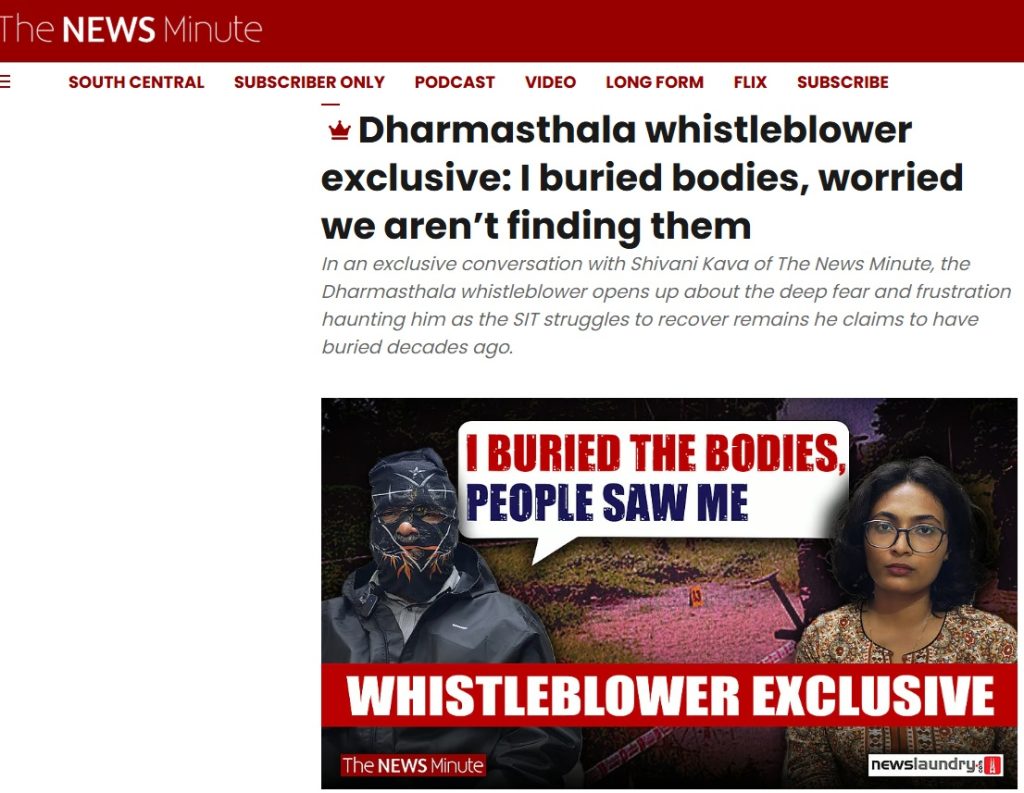
However, there is a YouTube video of the interview which is yet another attempt at legitimising the narrative.
Begging For Public Funding To Support Their Lies
The News Minute has been constantly doing the “jholi bichana” to viewers for funds to “support independent media” and their constant coverage from the ground in Dharmasthala. Every single video of theirs has this QR code flashed and viewers gaslighted to literally extort the viewers “We are bringing you this major breakthrough; now pay us to continue.”
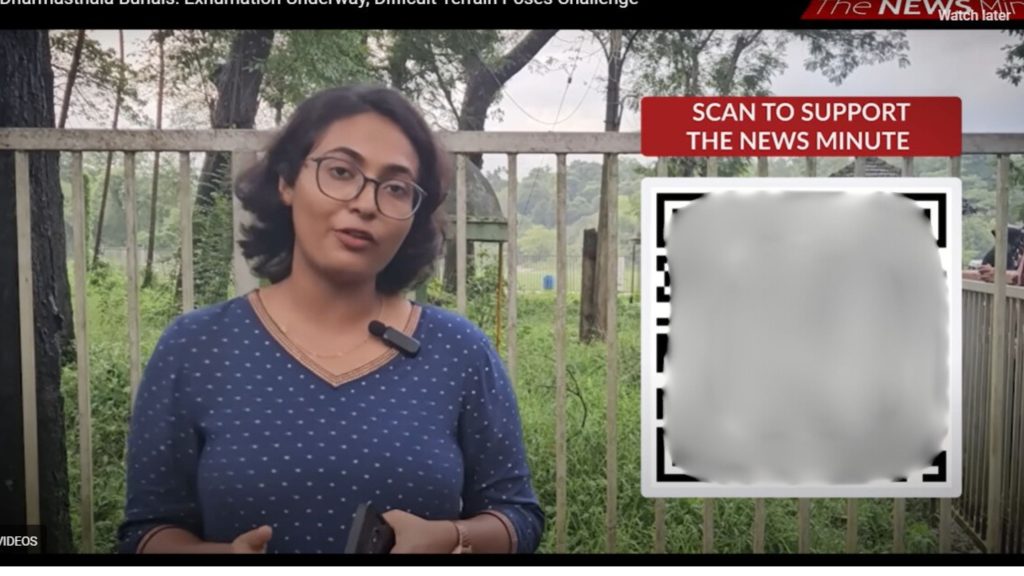
They even flashed the bowl asking viewers for money to help pay “legal bills” to fight gag orders.
Then there’s these posters too plastered across their social media handles.
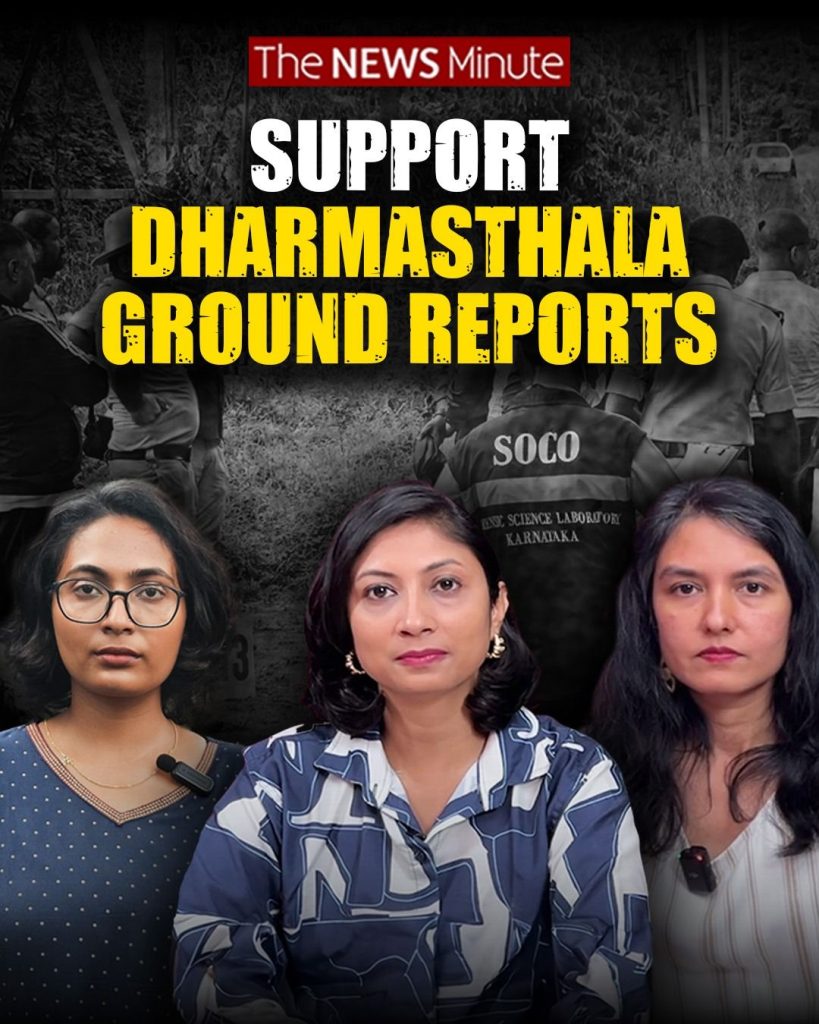
Premature Celebration When Skeletal Remains Were Discovered
TNM posted 2 videos, a short one reporting the “presence of skeletal remains” on 31 July 2025 and a longer “explainer” on 2 August 2025. These two videos are perfect examples of what can be seen as premature celebration to the news of skeletal remains found in one of the excavation sites.
In the video published on 31 July 2025, the most significant issue with the reporting is the immediate framing of the discovery of partial skeletal remains as a validation of the whistleblower’s entire story. They called it a “major breakthrough” – a highly sensational and conclusory term. Finding partial remains at one of 13+ sites confirms that a body was buried there. It does not confirm the core allegations of “hundreds of bodies,” “women and girls,” or “sexual assault.” The cause of death, identity, and date of burial are all completely unknown at this stage.
“…there might be the truth to it” – Shivani Kava, explicitly connects the find to the whistleblower’s most shocking claims, stating the discovery lends credibility to his story about burying victims of sexual assault. As with every other video, this report continues the unethical practice of linking this new discovery to unrelated, past tragedies to heighten emotional impact.
They continue to accept the whistleblower’s claims as a given and uses them as the framework for all analysis, without applying basic journalistic scrutiny. There is no mention of the most obvious and likely explanation provided by the Panchayat VP himself in their own previous interview: that these could be old, unclaimed bodies buried officially before the cemetery was built. The possibility that this is a tragic but routine burial is completely excluded from the narrative.
That the whistleblower masked man came out of guilt to help find the “100s of buried girls/women” – the reporter duo create drama, a sympathetic framing that discourages skepticism about his motives.
In the video published on 2 August 2025, Pooja Prasanna uses the discovery of partial remains (which later was found to be that of a male who died 30 years before the masked man’s tenure) to declare the whistleblower’s allegations as proven and to validate the entire “conspiracy of silence” narrative.
Starting the episode with “Dharmasthala soil has finally spoken up.” This is a dramatic and conclusive opening statement. Prasanna and TNM jumped the gun when the partial remains were found. She also says, “His allegations can no longer be dismissed as easily.” This frames the discovery as a definitive victory for the accuser’s side, moving the goalposts from “extraordinary claim requiring extraordinary proof” to “you can’t dismiss this now”, preemptively shutting down skepticism.
It must have been an egg-in-face moment for TNM when the truth about the remains surfaced. There seems to be no report on that on their website.
Prasanna asks a series of highly speculative “what if” questions that are designed to imply wrongdoing without evidence. The segment questioning why the Panchayat buried bodies in forest areas decades ago is presented as a major revelation. However, it lacks crucial context: What were the standard procedures for unclaimed bodies in rural Karnataka 20-40 years ago? Was this practice unique to Dharmasthala, or was it common in other towns with limited cemetery space and large forested areas? The reporter’s sarcastic tone (“is the panchayat claiming they trekked dangerously?”) dismisses the practical realities of the past in favor of present-day judgment. Why didn’t she ask the same question to the masked man – did he trek dangerously to bury those bodies he claims to have buried?
The report completely omits the most plausible explanations for the found remains: that they could be from an unclaimed body or a suicide that was buried following the (perhaps informal) procedures of the time. It immediately jumps to the assumption that the find validates the murder and cover-up allegation. To update our readers, the skull that the masked man submitted at the court turned out to be belonging to a man, contrary to the claims that women and young girls had buried there and the skeletal remains across all the sites that have been dug up so far, only one skeleton remain and that two that belongs to a man and it’s been almost near fully decomposed. The skull was examined at two hospitals and both the tests confirmed that it belonged to a man who died 30 years ago. A few bone fragments were found at only one place and that also belonged to another male. Some ID cards were found at another place that also belonged to a male who had reportedly clearly died of illness.
The skeletal remains with the masked man turned out to be that of a male but TNM tried to establish through “their sources at SIT” that it was not verified when the whole Kannada media was reporting the truth.
How TNM’s Propaganda Fell Like A Pack Of Cards
After all this build-up, the entire fraud narrative collapsed like a pack of cards, reinforcing the truth that baseless allegations can never stand without evidence.
Let’s take a look at how the lie unravelled:
No evidence found by SIT in the locations identified by the masked man
The skull/remains he brought with him to make the “confession” after his conscience did not let him sleep for 15+ years, turned out to be that of a male. Skeletal remains found in the excavation areas also turned out to be that of a male as mentioned above.
Masked man confesses that he was forced to make such allegations; he also said that he was trained by a gang in Chennai who made his say all this.
A woman claiming to be the first wife of the “masked man” in the Dharmasthala burial case has denied his allegations, accusing him of lying for financial gain and recalling years of domestic abuse during their marriage. She asserted that he worked as a sweeper and had no links to the alleged crimes, while villagers in Mandya confirmed his local background, civic work, and financial disputes before he abruptly left in 2014.
As the case crumbled, political attention turned to identifying the “gang” behind the conspiracy. BJP MLA from Udupi, Yashpal Suvarna, and Independent MLA G. Janardhan Reddy publicly named Congress MP Sasikanth Senthil as the key conspirator. They allege Senthil, who served as Dakshina Kannada Deputy Commissioner, orchestrated the plot using leftist and Islamist networks he cultivated during his administrative tenure.
The MLAs have pointed to Deputy CM D.K. Shivakumar’s own previous remark about a “larger conspiracy” and are now demanding the SIT have the courage to probe Senthil’s involvement, questioning if his status as a sitting Congress MP will grant him immunity.
Ananya Bhat’s alleged mother Sujatha Bhat confesses on television that all that she said was a lie; she goes on Republic Kannada to reveal that Aanya Bhat was not her daughter at all.
Sujatha Bhat’s brother states that his sister was lying and he was not aware of any daughter of hers nor the fact that she was married.
And the latest news is that the masked man is identified as one Chinnaiah (Chinnayya) from Mandya is arrested by SIT and custody is being sought.
Ever since the masked man and Sujatha Bhat’s confessions made the news, the TNM gang is missing, absconding, and preparing to peddle a new propaganda.
Last Word
The News Minute’s coverage of the Dharmasthala issue has been less about facts and more about framing. They repeatedly amplifed unverified claims, downplayed counter-evidence, did not ask the right questions, selectively invoked past tragedies, and painted gag orders as proof of guilt. By doing so, TNM has acted not as a neutral observer but as an advocacy outlet pushing a predetermined agenda. Their reporting has blurred the line between investigation and propaganda, weaponizing grief, faith, and suspicion to undermine a Hindu institution that commands deep respect across Karnataka and beyond.
The pattern is clear: while other crimes involving political actors are given minimal coverage, TNM has churned out more than two dozen stories on Dharmasthala in just a few months, turning a sacred site into the stage for their ideological theatre. This is plain narrative-building aimed at eroding trust in Hindu religious institutions. And like all such attempts against Dharma, it will ultimately fail because facts, history, and faith cannot be buried under manufactured suspicion.
Hydra is a writer with interests in exposing media bias.
Subscribe to our channels on Telegram, WhatsApp, and Instagram and get the best stories of the day delivered to you personally.