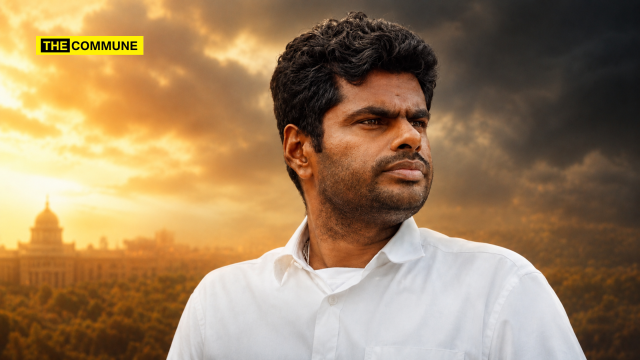
For 6 years, K Annamalai was a chest-thumping BJP leader who belted out data after data to counter propaganda pushed by Dravidian parties claiming that the North was flourishing and South was decays. The “Vadakku vazhgirathu, Therku theigiradhu” slogan which he once rubbished and rejected as the BJP president, he now appears to be pushing in a different form.
At the India Today Conclave in Chennai on Monday, 17 August 2026, Annamalai took aim at the decision-making structure of his former party, which currently leads the Union government.
The 42-year-old former IPS officer said the BJP had become increasingly “Delhi-centric” and called for greater authority for state-level leaders.
“I believe the decisions of the BJP are becoming Delhi-centric, so it is very unfortunate. That has to change,” Annamalai said.
He argued that state leaders should be given greater freedom to take decisions and implement them.
“Genuinely, they have to empower state-level leaders to make actions. It has to happen,” he said.
Annamalai then turned his criticism towards Gujarat, the home state of Prime Minister Narendra Modi and Union Home Minister Amit Shah, questioning what he called the “Gujarat-centric model of Delhi development”.
“And the Gujarat-centric model of Delhi development has to change a bit,” Annamalai said. “You can’t have all the AI companies going there or wafer companies going there, 2030 Commonwealth Games going there, 2030 police games going there, 2036 Olympic Games going to Ahmedabad. You cannot have this Gujarat model of all-India development,” he added.
“That has to change. People are watching,” Annamalai said.
But records and Annamalai’s own statements demolish his arguments completely.
Tamil Nadu Has Received Major Central Investments
Take the Chennai-Bengaluru Industrial Corridor. The Union Cabinet approved its institutional and financial structure in December 2016, with the Ponneri node in Tamil Nadu among the identified nodes.
Then came the Tamil Nadu Defence Industrial Corridor, announced in the 2018 Budget. It has five nodes: Chennai, Hosur, Coimbatore, Salem and Tiruchirappalli. According to the Ministry of Defence, 53 industries had signed MoUs or made arrangements representing potential investments of ₹11,794 crore in the Tamil Nadu corridor.
The port story is even harder to square with the claim of systematic neglect.
Between 2014-15 and 2025-26, 94 port projects worth ₹12,523 crore were implemented in Tamil Nadu. The figure was furnished by Union Commerce and Industry Minister Piyush Goyal in Parliament.
And then there is space.
On 28 February 2024, Prime Minister Narendra Modi laid the foundation stone for India’s second spaceport at Kulasekarapattinam in Thoothukudi district. The facility is specifically designed for Small Satellite Launch Vehicle missions and is also intended to support launch activities by non-government entities. Construction of the SSLV Launch Complex began in March 2025.
If every major national opportunity is supposedly being funnelled to Gujarat, why is India’s second spaceport in southern Tamil Nadu?
TN Has The Most Mudra Loan Beneficiaries
If Tamil Nadu is supposedly being systematically denied Central government support, the numbers under Pradhan Mantri Mudra Yojana (PMMY) tell a rather different story.
Launched by the Union government in 2015, Mudra provides institutional credit to micro and small businesses. Tamil Nadu ranks No. 1 in India in cumulative Mudra loan disbursements, receiving ₹3,23,647.76 crore since the scheme’s inception. Uttar Pradesh follows at ₹3,14,360.86 crore and Karnataka at ₹3,02,146.41 crore.
Tamil Nadu has also recorded the highest number of Mudra loan accounts, with over 5.62 crore accounts, and leads in the number of women beneficiaries.
The legitimate argument is that Tamil Nadu may deserve an even larger share of Central investment, infrastructure and funding. That is a perfectly reasonable political position.
But that is very different from suggesting that the Union government sends everything to Gujarat while Tamil Nadu gets nothing.
The numbers simply do not support such a sweeping claim.
Even Vande Bharat Does Not Fit the Narrative
Consider one of the Modi government’s most visible programmes: Vande Bharat.
Tamil Nadu has become a major beneficiary, not merely as an operating destination but as a manufacturing centre. Integral Coach Factory in Chennai has been central to the programme since the beginning. Indian Railways records ICF as the factory producing Vande Bharat trainsets, while the Railway Ministry has repeatedly highlighted Vande Bharat manufacturing at Chennai.
ICF had manufactured 70 Vande Bharat rakes by July 2024, and it continues to receive major production orders.
There is therefore a curious contradiction in Annamalai’s present argument: the same Union government that he now suggests is incapable of looking beyond Gujarat has entrusted one of its flagship railway manufacturing programmes to Chennai.
What Tamil Nadu Lost Was Not Always Because Delhi Said No
This is where the argument becomes even more uncomfortable.
The proposed Enayam International Container Transhipment Terminal in Kanyakumari was conceived as a major transhipment hub capable of competing with Colombo and other regional ports. The Union government itself identified Enayam and Vizhinjam as potential transhipment ports under the Sagarmala framework.
Enayam was expected to tap the enormous volume of Indian cargo being transhipped through foreign hubs. The strategic logic was straightforward: retain more of that trade within India, reduce dependence on Colombo and create a major maritime-industrial ecosystem in southern Tamil Nadu.
Instead, the project encountered sustained local opposition. The opposition was not limited to political parties; church representatives and coastal groups were prominent in the agitation. Contemporary reporting noted that the project became a major political issue in Kanyakumari and that the local parish priest was among those publicly opposing it.
The consequences were not merely political.
Today, Vizhinjam has emerged as the major transhipment facility on this stretch of the coast, while southern Tamil Nadu continues to depend heavily on Colombo for transhipment. Recent reports note that around 95% of Thoothukudi’s containers were still being transhipped through Colombo, with another share moving through Vizhinjam.
So when Tamil Nadu loses infrastructure because of agitation politics, is that also supposed to be blamed on Gujarat?
The Neutrino Observatory Is Another Example
Next, we have the India-based Neutrino Observatory at Pottipuram in Theni.
The Union government approved the ₹1,583.05-crore project in 2015. It envisaged an underground laboratory in the Bodi West Hills, a 50-kiloton magnetised iron calorimeter, and an inter-institutional centre for high-energy physics at Madurai.
The planned detector would use around 50,000 tonnes of iron and approximately 29,000 Resistive Plate Chambers. The project also involved extensive indigenous engineering and local industrial participation.
Instead of becoming a world-class scientific facility in Theni and a research ecosystem in Madurai, the project was stalled amid environmental objections and organised opposition.
Again, this was not Gujarat taking away a Tamil Nadu project.
And Annamalai Himself Once Made the Opposite Argument
Perhaps the most damaging part of the present accusation is Annamalai’s own earlier testimony.
At a News18 Town Hall in Chennai in February 2026 when he was a BJP member, when asked about the argument that Delhi was denying Tamil Nadu its due, Annamalai himself pushed back.
He pointed to the Centre’s Production Linked Incentive schemes and said that, in the automobile and components sector, 46 of 82 applications cleared were from Tamil Nadu.
He pointed to electronics and electrical components, saying that seven of 27 sectors were represented in Tamil Nadu, including iPhone manufacturing.
He also cited the Electronic Component Manufacturing Scheme and said 69% of the jobs generated under the scheme were coming to Tamil Nadu.
He pointed to Tamil Nadu’s electronics exports of around $15 billion at the time and argued that the state’s advanced industrial base was benefiting from Central schemes.
He even contrasted the state’s manufacturing growth with its broader growth figures, noting that manufacturing was growing at 14%, while simultaneously raising concerns about textile mills shutting down and what he described as “jobless growth.”
That was Annamalai’s argument then: Tamil Nadu was benefiting from Central industrial policies, and the real question was whether the state government was converting that opportunity into employment.
So what changed?
The Gujarat Semiconductor Comparison Makes the Point Even Clearer
There is also a legitimate debate to be had about whether Gujarat offers more attractive semiconductor incentives than Tamil Nadu. But even here, the evidence does not support the simplistic claim that Tamil Nadu has no competing policy framework.
Gujarat’s Semiconductor Policy 2022-27 is undeniably aggressive. It provides 75% land subsidy for the first 200 acres of a fab project and 50% subsidy on additional land. It provides a ₹2-per-unit power subsidy for 10 years, access to water at ₹12 per cubic metre for five years, and a 50% capital subsidy for captive desalination plants.
It also provides a 100% reimbursement of stamp duty and registration charges and electricity-duty concessions.
Tamil Nadu’s 2024 Semiconductor and Advanced Electronics Policy takes a different approach. It provides investment subsidies, including a fixed-capital subsidy and turnover-based subsidy; 5% interest subvention for six years, training support, land-cost incentives, stamp-duty incentives, electricity-tax incentives, quality-certification support, intellectual-property incentives and green-industry incentives.
In other words, Gujarat has built a highly aggressive greenfield semiconductor proposition around Dholera, while Tamil Nadu is leveraging its existing electronics ecosystem around Chennai, Sriperumbudur, Hosur and Coimbatore and combining capital, financing, skills, R&D and manufacturing incentives.
Annamalai left the BJP not because of Hindutva politics or lack of a free hand to operate, but because he cannot pursue regional chauvinist politics under the BJP umbrella. It is not his fault; Tamil Nadu’s public only appreciates cult politics or divisive regional pride and… https://t.co/qxAgMQehZ1 pic.twitter.com/7IRNSsiPdy
— Devesh (@logicalmyself) August 17, 2026
That is a policy competition.
It is not evidence that the Centre has declared Tamil Nadu off-limits.
Development Is Also About Whether States Are Ready to Compete
Annamalai himself made this point in his recent remarks.
Andhra Pradesh is attracting investments under Chandrababu Naidu. Karnataka has built a formidable technology ecosystem even under a Congress government. Uttar Pradesh has invested heavily in highways and infrastructure. Tamil Nadu itself remains one of India’s strongest manufacturing bases.
The Centre cannot physically manufacture infrastructure inside a state that refuses to build it.
That is particularly relevant to Tamil Nadu’s own infrastructure politics.
The state government can oppose Parandur airport. Political parties can oppose major road projects, including proposals for wider highways. Environmental and local protests can stall projects. When that happens, companies and investment do not remain patiently parked in Tamil Nadu out of loyalty. They go where land, logistics, power, water, clearances and infrastructure are available.
The answer is not to complain that Gujarat is growing.
The answer is to make Tamil Nadu compete harder.
Delhi Is Not the Only Centre of Power Either
Annamalai also argued that Indian politics cannot remain Delhi-centric and must become more state-centric.
Again, his own record complicates the argument.
The post-2014 fiscal architecture increased the states’ share of the divisible pool from the earlier 32% to 42%, while institutions such as NITI Aayog and the GST Council were designed around state participation.
The GST Council includes the Union government and state governments and operates through a constitutional framework of collective decision-making. Tamil Nadu, West Bengal, Kerala, Maharashtra, Karnataka, Andhra Pradesh and other states have a formal place in that process.
The Centre also financed the nationwide free foodgrain programme that began during the COVID period and continues to cover hundreds of millions of people, including Tamil Nadu.
And Article 370 was not a Gujarat-centric policy. Nor was the transformation of Jammu and Kashmir into a major tourism destination. Nor were the thousands of kilometres of national highways, railway projects, defence corridors, ports and industrial programmes spread across the country.
The point is not that every Central decision is perfect.
It is that “everything goes to Gujarat” is not a serious description of India’s development record.
Tamil Nadu Has Even Hosted Modi’s Most High-Profile Diplomacy
When Chinese President Xi Jinping visited India in 2019, Prime Minister Modi chose Mahabalipuram in Tamil Nadu for the informal summit.
The state also hosted the 44th Chess Olympiad in 2022, despite the DMK being openly opposed to the BJP.
International events go where the infrastructure, hospitality, security and organisational capacity exist.
If Tamil Nadu wants another major international sporting event, the question is not whether Delhi is deliberately denying it to the state. The question is whether Tamil Nadu is ready to host it and whether its government is willing to seek and secure it.
That is precisely how healthy federal competition should work.
Mr Annamalai, Your Own Words Prove You Wrong
There is nothing wrong with demanding more investment for Tamil Nadu. There is nothing wrong with questioning whether Gujarat is receiving too much. But there is a world of difference between demanding a larger share for Tamil Nadu and peddling propaganda that Delhi systematically starves Tamil Nadu while sending everything to Gujarat.
The record does not support that claim. Worse for Annamalai, his own words do not support it either.
For years, he lists data to demonstrate how Tamil Nadu was benefiting from Central schemes. He cannot now pretend those schemes, investments and opportunities did not exist simply because his political position has changed.
The facts have not changed, Mr. Annamalai. Your argument has.
Subscribe to our channels on WhatsApp, Telegram, Instagram and YouTube to get the best stories of the day delivered to you personally.