A fresh temple-land transaction involving a property estimated to be worth around ₹200 crore at Thadikombu near Dindigul has raised questions over whether the controversy surrounding the sale of temple property in Tamil Nadu runs deeper than a single disputed transaction.
The timing is particularly striking.
On 12 July 2026, a massive land grab involving 1.4 acres of prime property belonging to the Arulmigu Dhandayuthapani Swamy Temple Mutt in Palani came to light. The land, valued at around ₹100 crore and reportedly being used as a parking facility for devotees, had allegedly been sold and registered in favour of two private individuals for just ₹2 crore.
Just four days later, on 16 July 2026, a separate sale deed concerning property associated with the Sri Soundararaja Perumal Temple at Thadikombu near Dindigul was executed.
The two transactions are not being presented as legally connected at this stage. However, their extraordinary proximity in time, the involvement of temple-associated properties and the questions surrounding the manner in which both properties entered the sale process warrant closer scrutiny.
Palani Temple Land Grab Came To Light On July 12
The Palani case involved approximately 1.4 acres of prime land belonging to the Arulmigu Dhandayuthapani Swamy Temple Mutt.
The property was reportedly valued at around ₹100 crore and was being used as a parking area for devotees.
The original charitable endowment dating back to 1888 reportedly contained a specific restriction against the sale or transfer of the property.
Despite this, a private individual allegedly claimed ownership of the land and, in alleged collusion with a Sub-Registrar, managed to have the property registered in favour of two private individuals for approximately ₹2 crore.
The registration allegedly took place despite the existence of legal restrictions and an ongoing court dispute.
The matter triggered widespread public outrage. Following the controversy, the CB-CID took over the investigation, arrested four individuals and the concerned Sub-Registrar was suspended. The Madras High Court cancelled the fraudulent registration.
The alleged scam therefore involved not merely a dispute over ownership, but questions over how a protected temple property could allegedly be brought into the registration system despite restrictions on its alienation.
And then came the Thadikombu transaction.
Four Days Later, Another Temple Property Is Sold
On 16 July 2026, just four days after the Palani controversy surfaced, a sale deed was executed involving the S.V. Balusamy Iyyar and Brothers Trust and property associated with the Thadikombu temple.
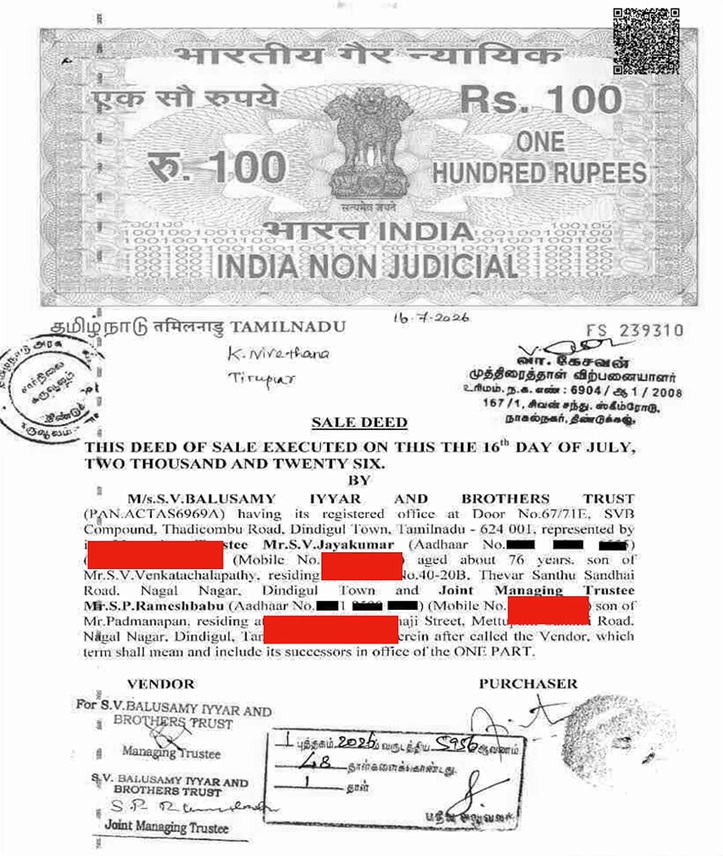
The property is estimated at around ₹200 crore, making it potentially twice the value attributed to the disputed Palani property.
Unlike the Palani transaction, however, the documents available in the Thadikombu case show a considerably longer legal trail involving an old trust deed, a rectification deed and a civil court decree.
What they do establish is a chronology that deserves examination.
Palani temple land controversy emerges – July 12.
Thadikombu temple-linked property sale deed executed – July 16.
Four days. Same pattern.
The 120-Year-Old Paper Trail
The Thadikombu property has an unusually long documentary history.
The history of the trust is also significant. The original endowment is understood to have been associated with members of the Saurashtra community, with the original documents referring to Balusamy Chettiar and other members of the Chettiar family. The property was endowed for the religious and charitable purposes connected with the temple more than a century ago.
The later documents, however, refer to the entity as the “S.V. Balusamy Iyyar and Brothers Trust”. This transition in the name and legal identity of the trust raises an important documentary question: how did the original Balusamy Chettiar endowment come to be represented by the S.V. Balusamy Iyyar and Brothers Trust in the subsequent legal proceedings and the 2026 sale deed?
The property is connected to an original trust deed dated 21 January 1905, followed by a supplementary trust deed dated 1 August 1923.
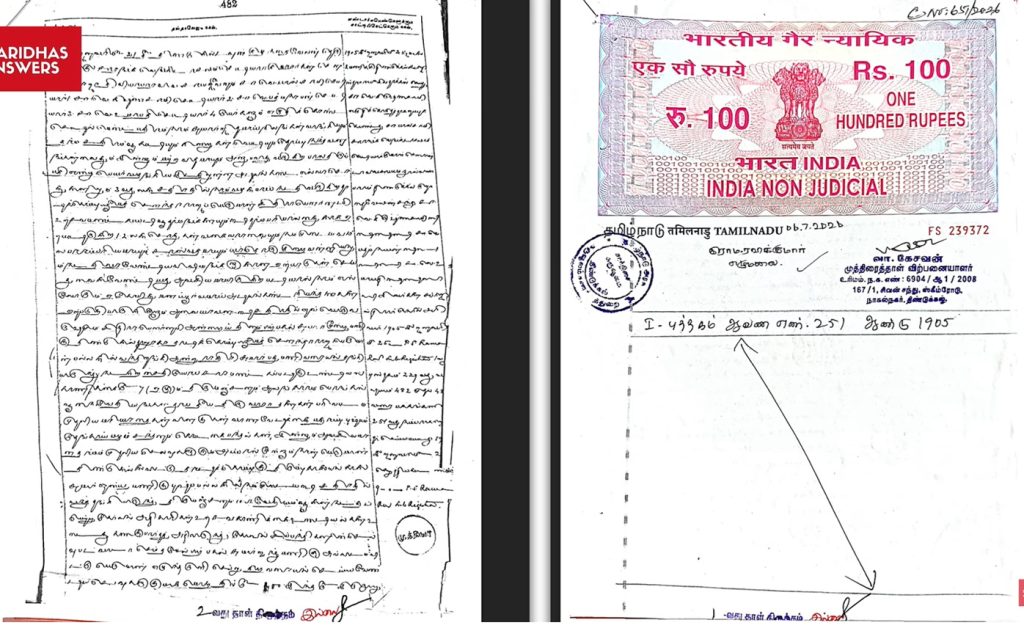
The endowment was reportedly created to provide for the religious and charitable activities of the Thadikombu Perumal Temple.
The original endowment was intended to ensure that the income from the property would continue to support the temple’s religious and charitable obligations. The purposes included expenses connected with Thirumanjanam and Alankaram during Chitra Pournami, Nei Naivedyam and other temple-related activities, besides providing annadhanam without discrimination based on caste.
More than a century later, however, the trust documents were subjected to a legal rectification.
A rectification deed was executed on 22 April 2024.
The rectification becomes particularly significant because it concerns trust documents that date back to 1905 and 1923. More than a century after the original endowment was created, changes were sought to be incorporated into the foundational documents governing the property.
The following day, the trust approached the Principal District Court at Dindigul through Original Suit No. 195 of 2024, seeking rectification of the original 1905 trust deed and the supplementary 1923 deed in accordance with the 22 April 2024 rectification deed.
The case was filed on 30 April 2024.
After the matter came up for final hearing on 9 April 2025, Principal District Judge A. Muthusaratha passed a decree on 23 April 2025, allowing the plaintiff trust to rectify the original and supplementary trust deeds in accordance with the rectification deed.
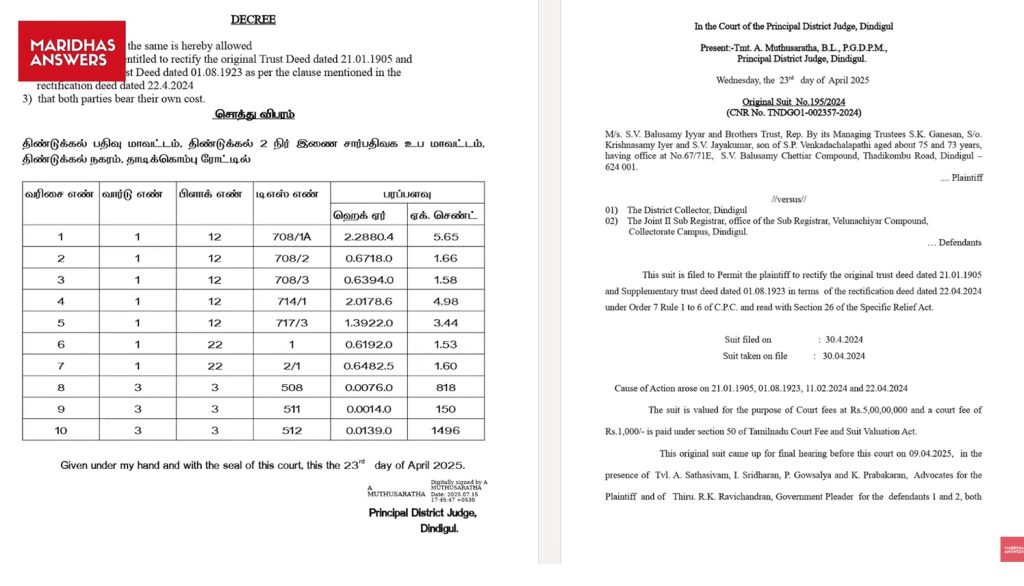
This makes the contents of the 22 April 2024 rectification deed particularly important. What precisely was being rectified in a trust deed that was more than a century old, and did any of those changes have a bearing on the trust’s ability to deal with the property?
That legal development becomes important when viewed alongside the subsequent sale.
From 1905 Endowment To 2026 Sale
The documentary sequence can therefore be laid out simply:
- January 21, 1905: Original trust deed.
- August 1, 1923: Supplementary trust deed.
- April 22, 2024: Rectification deed.
- April 30, 2024: Suit filed before the Principal District Court, Dindigul.
- April 23, 2025: Court decree permitting rectification of the original and supplementary deeds.
- 12 July 2026: Palani temple-land scam emerges, triggering CB-CID action.
- 16 July 2026: Sale deed executed concerning the Thadikombu property.
Court Orders Used To Justify The Sales
The sales of the land are said to be justified on the basis of court orders. It is reported that the documents were not prepared by ordinary document writers but by lawyers, allegedly because of the legal complications involved in the transactions.
When questioned, the lawyer reportedly maintained that the deed had simply been drafted on the basis of an existing court order.
The Sub-Registrar similarly maintained that a court order had been produced and that registration was consequently carried out.
Thus, both sides reportedly pointed towards the same legal authority—the court order—as the basis for the transaction.
The court proceedings seem to have followed a pattern in which the proposed sale and purchase of alternative agricultural land were examined through multiple hearings and adjournments before ultimately receiving judicial approval.
The alleged reasoning was that the original temple property was not generating sufficient revenue, while a replacement agricultural property could produce better returns for the temple.
This raises a larger question: if temple property is endowed for a specific religious and charitable purpose, under what circumstances can it be sold and replaced with another asset?
₹200 Crore Property For A Fraction Of Its Value?
The financial aspect makes the issue even more significant. The property is estimated at around ₹200 crore, while comparable productive land could potentially be acquired for just ₹4–6 crore.
That raises the obvious question of what happens to the balance if a ₹200-crore temple asset is disposed of and only a small portion of the proceeds is reinvested in replacement land.
It is alleged the possibility of a large amount of money being diverted into unaccounted transactions. The larger institutional question remains: why should a temple endowed with valuable land be required to sell its assets at all if those assets can instead be leased or otherwise monetised to generate sustainable income?
Temple Reportedly Earns ₹90 Lakh; Long-Term Lease Could Generate Far More
The annual revenue reportedly associated with the Thadikombu Perumal Temple at approximately ₹90 lakh.
This should not automatically be treated as inadequate income. If temple property were leased for several decades, the land could potentially generate substantially more revenue over the long term, say a 50-year lease, which, at a hypothetical annual return of ₹10 crore, could generate around ₹500 crore over five decades from the property. Ideally, rather than permanently disposing of a valuable temple asset, the administration could potentially preserve ownership while generating recurring revenue from it.
The issue assumes even greater significance given that Tamil Nadu has around 46,000 temples.
Is There A Larger Network At Play?
The emerging pattern across the Palani and Thadikombu temple land transactions has prompted questions over whether these are isolated disputes or symptoms of a larger real-estate network operating around temple properties. The alleged common blueprint involving trusts, lawyers, Sub-Registrars, court proceedings and high-value land transfers raise eyebrows. The death of an advocate linked to the Palani case is also suspicious.
Subscribe to our channels on WhatsApp, Telegram, Instagram and YouTube to get the best stories of the day delivered to you personally.