Home Blog Page 998

Bakasuran: Mohan G Yet Again Swims Against The ‘Liberal’ Ti(ra)de To Convey His Message

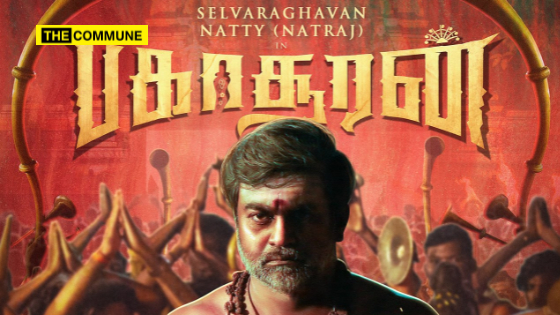
You won’t find a bolder director than Mohan G in Tamil Industry now, probably he has taken the mantle from Director Shankar in lacing social message with evil of the day with women safety at the heart of it and from social responsibility side, he has imbibed the qualities of popular ‘Kaaduvetti Guru’

Kollywood is cramped with storytellers who keep flogging the caste issue or the cliche love story or some extra marital plot, even when quality movies like Kantara and Malikappuram were made in other south Indian cinema industries. Mohan easily stands out of the crowd for he uses the medium to create maximum impact on the subject he deals with.

Draupathi was about fake marriage registration, Rudra Thandavam was about drug menace and Bakasuran is all about youngsters especially girls losing their lives in virtual world.

The song on Shiva, the destroyer, sets the tone of the movie, the background score adds value to the screenplay, the song featuring Mansoor Ali Khan in the movie is a dud and could have been avoided.

The plot is the hero, Mohan takes on the mighty with utter disdain, he talks about issues that main stream media failed to pick due to various external influence. If in Draupathi, the antagonist is a leader of a political party who misguides youngsters, Bakasuran antagonist is another political leader who made it big in education industry. Selvaraghavan and baka have given their best to add value to the plot. Slow motion fight scenes are worth a mention.

When the left liberals make movies and serials about lose moral life with anything and everything being considered fine in an individuals life, Mohan stresses upon a disciplined living for a stress-free life and society. It takes a lot of courage to go against the trend to imply technology advancement can be harmful as well.

Just like street play of Ramayana in North, Therukoothu of Mahabharatham is an indigenous art of people around Vizhupuram district and it’s dying. There are only a handful left to teach the art. Many of us might not even know the characters of Mahabharatham associated with Bheema. Mohan has deftly adapted the Mahabharata characters of Bheem and Bakasuran to contemporary times and has handled it well.

Bakasuran is a must watch, just like Draupathi, for families with a girl child in school or college. Today, we see a lot of personalities masquerading as journalists and activists who virtue-signal about freedom of choice and what not. Some of them position themselves as feminists while being a sexual predator.

Yes, it is important to ‘discipline’ and sensitize boys as well. But no matter what, there will always be sexual predators around who will not hesitate to take advantage of women’s so-called ‘freedom of choice’. There needs to be a Bakasuran to tell girls and their parents that – only they can take care of themselves. So, while the likes of elitist alleged ‘film critics’ can rubbish th as ‘Bakwaasuran’, the film will definitely hit the chord of a commoner like it did in the case of Draupathi and Rudra Thandavam. Mohan G deserves an award not for anything else but for rubbing in the nose of these elitist snobs.

Click here to subscribe to The Commune on Telegram and get the best stories of the day delivered to you personally.

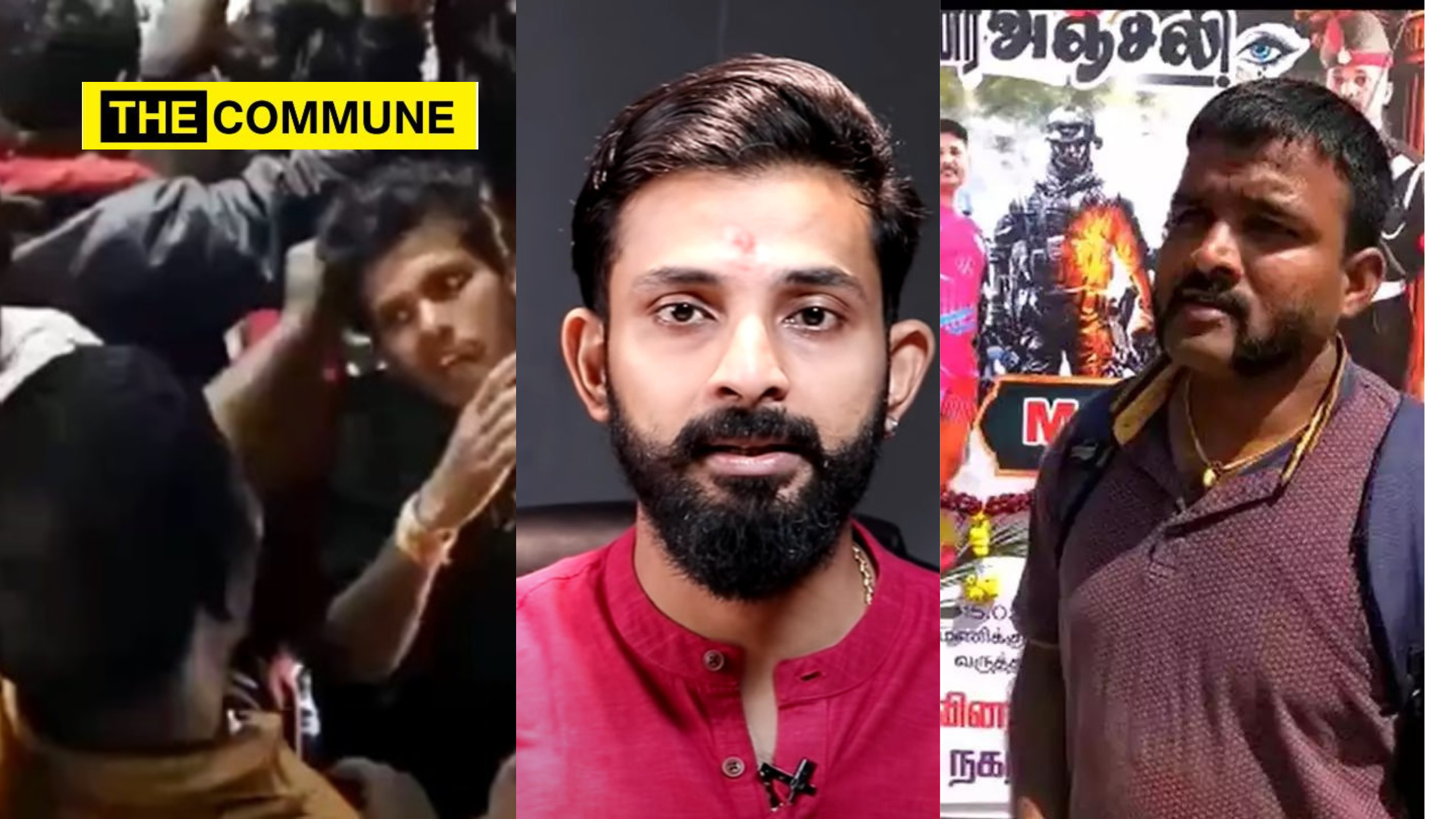
TN Police Intimidate YouTuber For Sharing Video About Army Man’s Plight, Serve Summons For Viral Video Of North Indians Being Beaten In A Train

In what appears to be an attempt to quell recent backlash against the DMK government over a video of non-Tamik migrant workers being thrashed inside a train, and the poor handling of an army man killed by a mob led by a DMK councilor, the Tamil Nadu Police have issued notices and threatened action against YouTuber Karthik Gopinath for sharing those videos on his Twitter account.

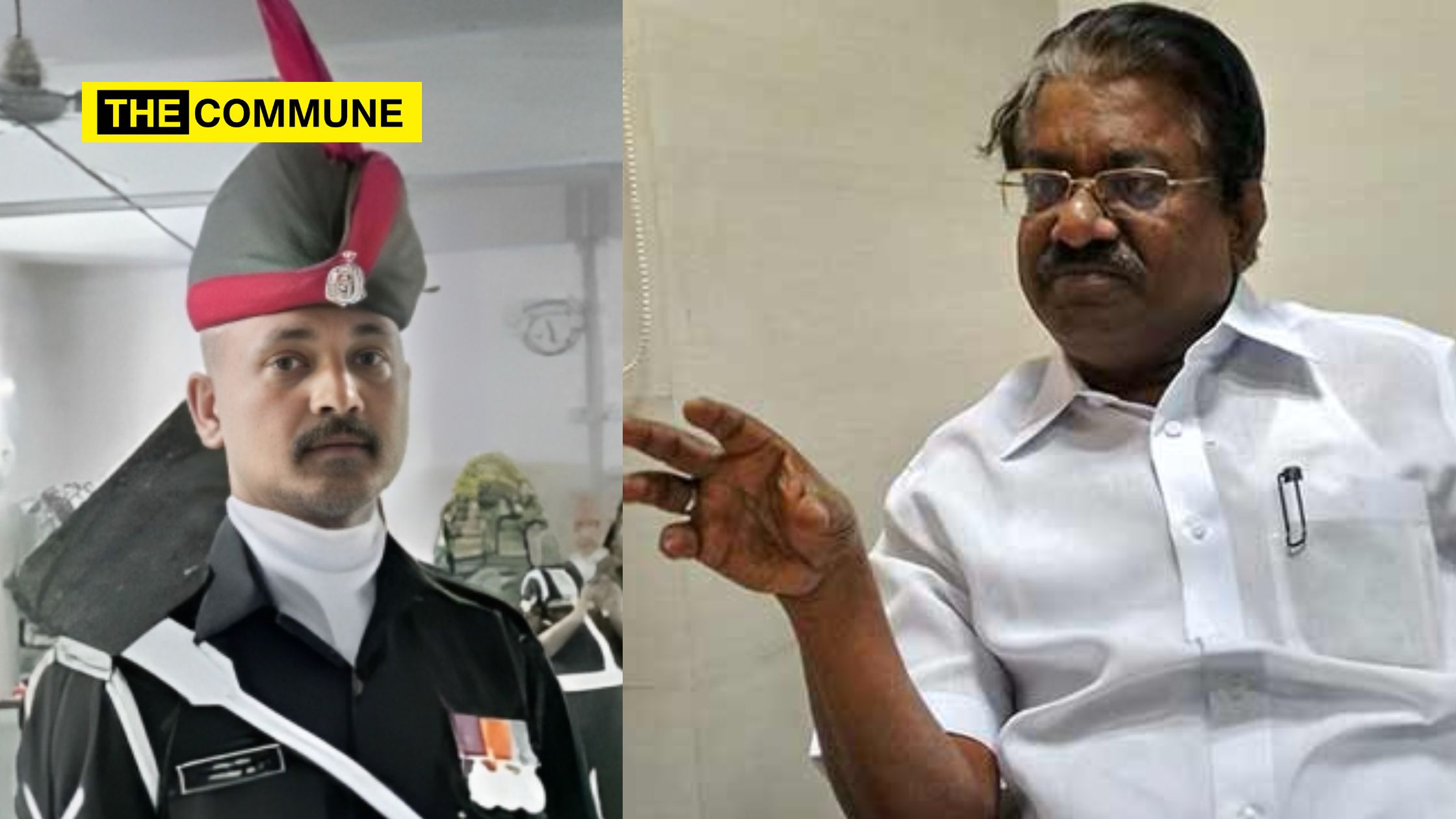
The DMK government’s handling of a case in which an Lance Naik Prabhu was beaten to death by a mob led by a DMK councillor sparked national outrage. Though the police have arrested all accused now, the DMK leaders have trivialized the incident and Tamil Nadu Chief Minister has not even condemned or expressed condolence over the murder of the soldier. The DMK leaders and Krishnagiri Superintendent of Police have been underplaying the incident as a family feud.

Following this, Krishnagiri District Police have threatened YouTuber Karthik Gopinath for sharing a video of another army man, Raghu, who was subjected to the ordeals as the deceased Prabhu by a local DMK politician.

Havildar Raghu of the Madras Regiment has served for over 15 years. He claimed that earlier in January 2023 he had to assault a man in order to save his wife and child from an armed gang in Krishnagiri similar to the one that killed Lance Naik Prabhu.

On January 7, Havildar Raghu paid a visit to Shalini, a friend of his wife Usha. Usha went to Shalini’s house to console and support her troubled friend, who was embroiled in a family feud. Raghu, who was sitting in front of the house with his toddler, was confronted by Shalini’s relatives.

Raghu said in the viral video,”I took my child out and sat on the scooty. The road was blocked by Shalini’s relatives who were armed with iron rods. They tried to murder me. When I asked them why are they confronting me, they told that I should not visit Shalini’s house.”

“While I was talking to them they attacked the ladies and for self-defence, I had to attack a person called Kumaresan and escaped along with the women who were injured. I took them to the Krishnagiri GH,” he says in the video. Raghu also stated that the inspector at Krishnagiri’s B3 Taluk police station ignored his complaint, forcing him to file a complaint with the Superintendent of Police office.

Raghu claimed that officers at the SP office told him to take his wife to the General Hospital for treatment, but no complaint was ever filed until that point. On January 12, an Inspector, a SI, and a constable arrived at Raghu’s house early in the morning and summoned him to the police station as part of usual procedure.

Raghu said in the video, “They asked me to sit in the room and asked me to tell them the details. They were getting only my details but they did not ask anything regarding the case. They made me sit in the station without food or water and in the evening, I was asked to take a Covid test in the GH. When I asked why they asked me to cooperate and then they gave me arrest intimation.”

He added that despite his attempts to explain to the police that he is an Indian Army soldier on duty, he was taken to a magistrate and placed in judicial custody until January 25. However, he was granted bail on January 22 due to the intervention of his regiment, he added.

This video was shared by Youtuber Karthik Gopinath, who claimed that DMK councillor Ramesh shielded the goons who attacked Havildar Raghu and his wife.

Karthik Gopinath also shared a video of Shalini’s relatives assaulting Havildar Raghu and his wife, which was covered by Polimer news.

This video, shared by Karthik Gopinath, depicting the ordeals of another Army soldier, Raghu, at the hands of DMK councilor Raja, quickly went viral on social media. National media outlets, including Times Now, later covered the story.

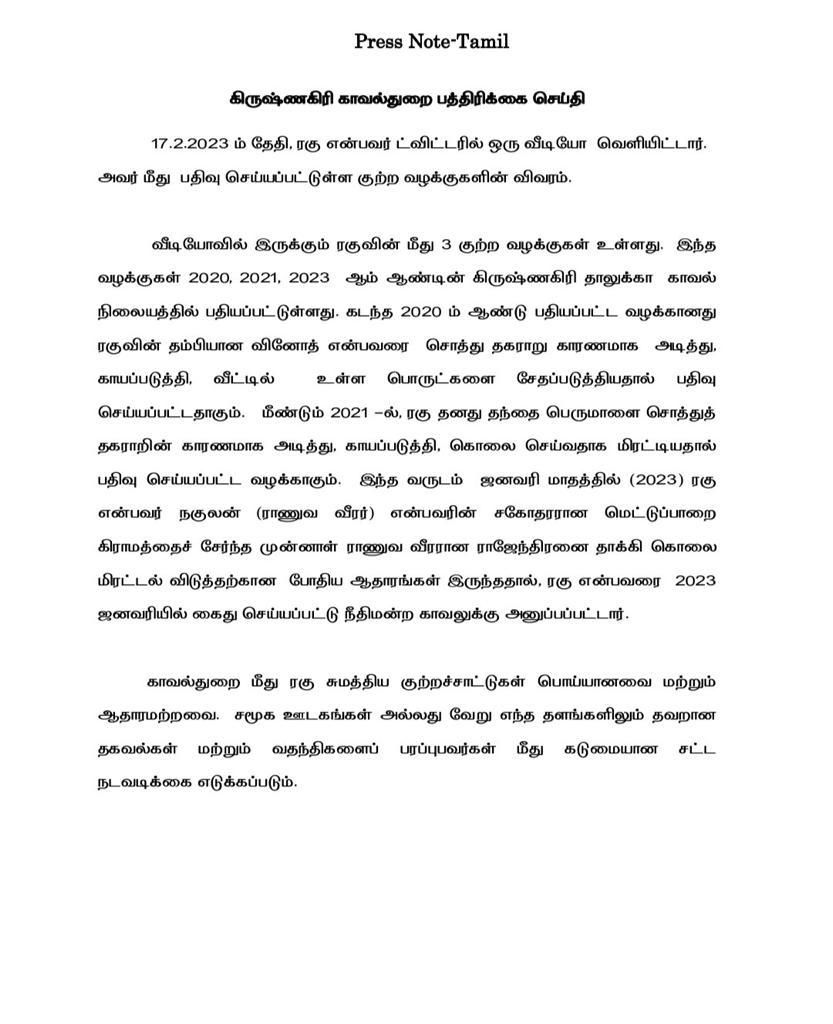
Later, Krishnagiri Police responded to Karthik Gopinath’s tweet, saying, “Raghu in this video has 3 cases against him – one assault case and 2-death threat case. All the information posted by him is not true. Strict action will be taken against the person who posted this video.”

According to the Krishnagiri police, the 2020 case pertains to Raghu’s clash with his brother Vinodh over a property dispute. A case was registered in 2021 against Raghu allegedly for assaulting and giving death threats his father Perumal again over property dispute. In January 2023, he was reportedly kept in judicial custody for assaulting and giving death threats to another former army man Rajendiran belonging to Metupparai village.

Karthik Gopinath, however, refused to succumb to the intimidation saying “SP Saroj kumar, IPS are u threatening a common man? You think you can abuse your power by “kicking” on my right to freedom of expression like you kicked some youth during protests? I have merely shared what an army jawan has sent me . Don’t bulldoze free speech sir . Jai Hind”

In another incident, the Tamil Nadu government’s Chennai Central Railyway Police issued a notice to YouTuber Karthi Gopinath under Section 160 Cr.P.C. and asked him to appear in person on 18.2.2023 regarding a video he shared showing North Indian workers being attacked by a Tamil man. The notice also stated that failure to appear in person would result in legal action being taken under Section 174 Cr.P.C.

The threat of legal action by Krishnagiri Police against Karthik Gopinath for sharing the video of Havildar Raghu and the summons by the Tamil Nadu government’s Central Raliway Police at the same time are not mere coincidences.

This is viewed as an attempt by the DMK government to silence dissenting voices.

Click here to subscribe to The Commune on Telegram and get the best stories of the day delivered to you personally.
How Kerala’s Hindus Stood Up Against Fascist Communists, What Hindus In Other States Can Learn From The Episode

Recently, Kerala High Court issued an order against the district administration’s direction to the Vellayani Devi Temple to use politically neutral colours for festival decorations. The restriction on the temple from using only saffron-coloured decorations and flags as part of Kaliyoottu festival was forced up on by Communist administration and the police citing law and order provisions. But ultimately the Court and the devotees stood up against the fascist attitude of ruling government. The ‘Left’ tendency of linking anything Hindu or saffron with ‘law and order’ issue sets up a dangerous pattern. In this context this article will look in to the controversy at Vellayani temple in Kerala and understand how devotees stood up against communist fascism in the state.

An Arbitrary Diktat

Controversy erupted after Kerala Police directed temple authorities in Thiruvananthapuram’s Vellayani to take down saffron decorations put up for the Bhadrakali temple festival and use multi-colour ones instead. Temple authorities have claimed it is an attempt by the ruling CPI(M) to destroy Hindu rituals and customs. The 70-day-long Bhadrakali festival began on February 14. Ahead of the festival, the temple committee had decorated the area using customary saffron fabric, flags and bunting. They had also made a temporary shed using saffron-coloured materials. Local police asked temple committee to use decorations of all colours, citing law and order issues. After the temple authorities refused to change the decorations, the Assistant Commissioner of police called a meeting and asked them to use multi-coloured ones. Following this, the Additional District Magistrate also called a meeting of various departments to discuss conducting the temple festival, in which the police again asked for the use of multi-coloured decorations. Police said that in previous years, there were some law-and-order problems while organising the temple festival in Vellayani. On the basis of that, they ordered the use of decorations of all colours to avoid any untoward incidents.

The Left’s Hatred Towards Anything Hindu

But this approach by police reeks of intolerance propagated by the ruling Communist party especially against the Hindus in the state. It is not the first instances in which the ruling Communist government has openly tried to destroy traditions and customs of Hindus in the state. Whether it is calling Hindus as ‘cow piss drinkers’ or ferociously destroying age old traditions of ancient temples, the ‘Left’ has took a special interest in destroying Hindu traditions.

We have all seen what have gone down in Sabarimala. The communist wanted to fervently implement the Supreme Court decision to allow women in to Sabarimala despite plea from devotees. It is not only the males but female devotees as well wanted the Left government to provide adequate time for the believers to file a review petition. The police brutality unfolded post this incident against protesting devotees is unspeakable. It is to be remembered that it is in the same state of Kerala in which parties like Muslim League exists with their ‘green flag’ and apparent secular phrase of ‘Muslim’ in its party name. But displaying saffron becomes symbol of communalism and law and order problem for them.  

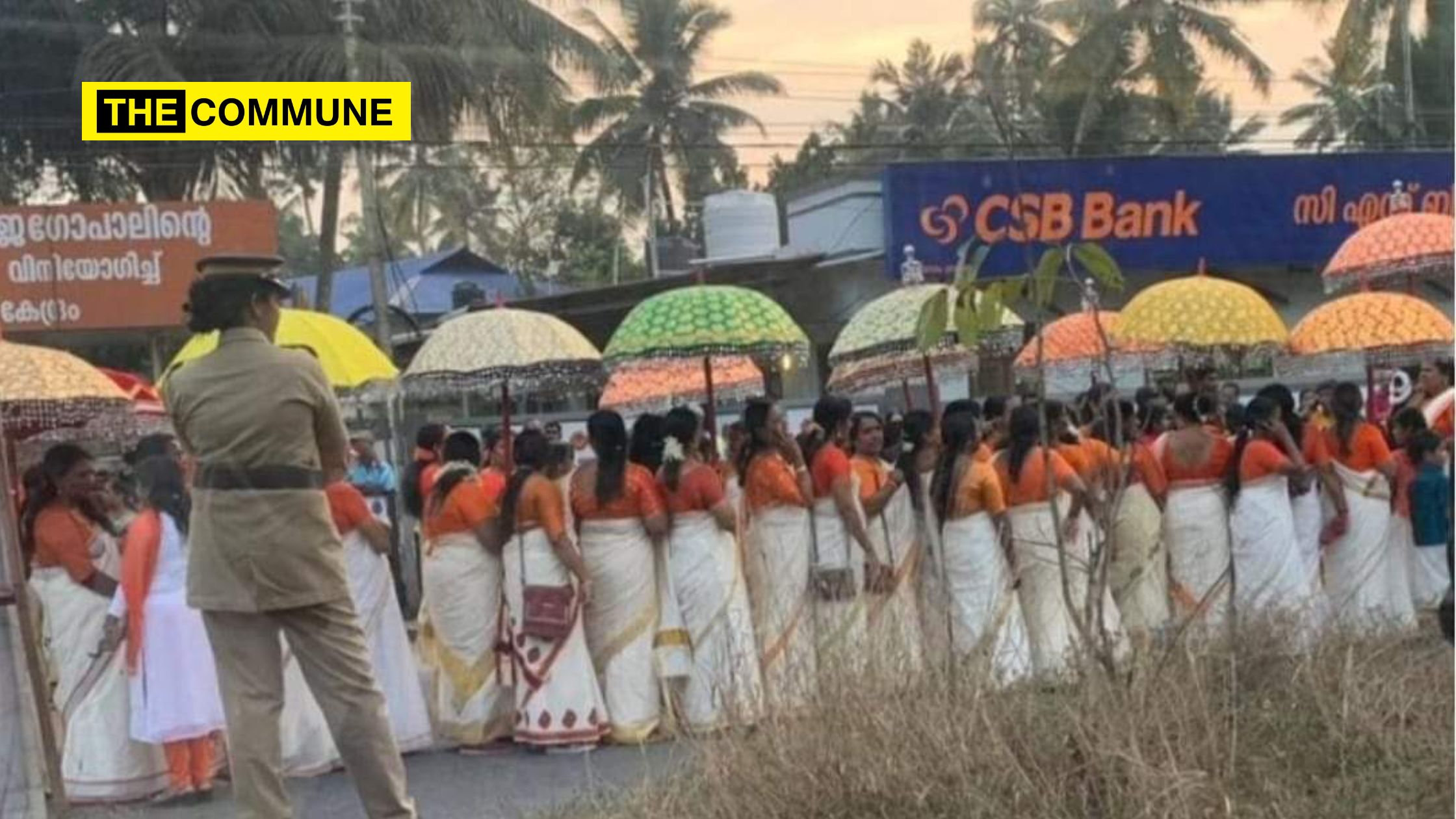
In Vellayani temple, the Hindu community adopted unique ways to oppose the ‘saffron ban’. As a mark of protest, several Hindu women wore traditional saree coupled with saffron blouses and suits with saffron dupattas.

Earlier in protest against the police instructions, devotees had set up a tent for a police post for the festival using saffron fabric. The temple authorities also had refused to remove the saffron flags and buntings. The devotees have alleged that the police are helping the anti-Hindu elements in the state. 

How The Hindus Resisted 

The Bharatiya Janata Party (BJP), Hindu Aikya Vedi and other Hindu organisations only joined the resistance by devotees. They held a protest yesterday in front of Nemom Police Station in Thiruvananthapuram over restriction on Major Vellayani Devi Temple from using only saffron-coloured decorations and flags as part of Kaliyoottu festival. The issue was taken to the Kerala High Court by the Hindu Aikavedi. The Kerala High Court ruled that the District Administration or the Police cannot insist that only politically neutral-coloured decorative materials are used for temple festivals. The orders from the Court came while the Police restrained the temple authorities of Vellayani Bhadrakali Devi temple in Thiruvananthapuram from using only saffron-coloured decorative materials as part of the Kaliyoottu festival.

Division Bench of Justice Anil K Narendran and Justice PG Ajithkumar further ruled that “Kaliyoottu festival at Major Vellayani Bhadrakali Devi Temple, which is a temple under the management of Travancore Devaswom Board has to be conducted in accordance with the custom, rituals and practices of that temple. Politics has no role to play in the conduct of daily worship and temple ceremonies and festivals. A worshipper or a devotee has no legal right to insist that saffron/orange-coloured decorative materials alone are used for festivals in a temple under the management of the Travancore Devaswom Board….Similarly, the District Administration or the Police cannot insist that only politically neutral-coloured decorative materials are used for temple festivals The District Administration or the police cannot meddle with the power of the Travancore Devaswom Board in conducting Kaliyoottu festival in accordance with the custom, rituals and practices of that temple.”

As of now the incident seems settled. The resistance of devotees and prudent decision making by the High Court has saved another traditional Hindu temple from being under attack of the communist government. This is not one odd incident of unfortunate events but only a link in the history of long drawn attack by Communists on Hindu traditions and customs. India is a democratic nation and fascism of the left using brutal police force has no place in a country like India. The citizens of Kerala should remember these atrocities unleashed by the Communists before heading to the polling booth when next election is around the corner. Only us a people can defend against this ecosystem of raw atrocities committed the Communists.

And this entire episode is a lesson for Hindus in other states to not hesitate to hit the streets for their rights.

Click here to subscribe to The Commune on Telegram and get the best stories of the day delivered to you personally. 
Mr. TM Krishna, We’ve Had Enough Of Your Virtue-Signalling

He is privileged, therefore he is. However, let him not hold this umbrella of privilege over the larger community, for his privilege is just that – HIS.

The singer makes a case in his column in The Deccan Herald for caste-based social privilege being the root of all social evils in Tamil Nadu. But the nuances and layers of privilege are lost upon the obviously privileged self-acclaimed activist.

Caste confers terrible consequences on certain sections of society – the victims are mainly the so-called “untouchables” and the Shudra castes only slightly higher up the pecking order.

But does caste confer privileges? Yes and no. The so-called “upper” castes do find privilege in their birth – but in Tamil Nadu, that has only been for a very small section of the old moneyed and land-owning Brahmins. Krishna attempts to homogenise the Brahmins of Tamil Nadu and equate them to their North Indian counterparts. This trope is not only false, it is also absurd.

In simple terms – it’s all about the money, honey. Money begets power, connections and of course, more money. The ‘accident’ of genetics that Krishna refers to has nothing to do with privilege – economics has everything to do with that privilege.

Krishna’s Privilege

TM Krishna belongs to a family that boasts of a hoary and extremely wealthy past. His grand-uncle is TT Krishnamachari, son of a Madras High Court judge TT Rangachari during the British Raj.

Krishnamachari was a two-time Union Finance Minister of independent India in Nehru’s and Morarji Desai’s cabinet. So influential was Krishnamachari, that despite having to resign over corruption allegations, Nehru brought Krishnamachari back into his cabinet without a portfolio. Morarji Desai later made him Union Finance Minister in his cabinet.

TT Krishnamachari is also the founder of the vast and wealthy TTK Group which manufactured and sold everything from pressure cookers to cosmetics and condoms.

The TTK Group, set up in 1928, according to a 2017 article in the Financial Express, provided “distribution for products ranging from foods, personal care products, writing instruments, and brands such as Cadbury’s, Max Factor, Kiwi, Kraft, Sunlight, Lifebuoy, Lux, Ponds, Brylcreem, Kellogg’s, Ovaltine, Horlicks, Sheaffer’s, Waterman’s and many more.”

TT Krishnamachari’s son TT Vasu succeeded him in his business from the 1930s. The lineage of money and influence was bequeathed to Vasu as well. A significant incident in the 1950s is narrated by the late S Muthiah, a Chennai-based historian, in his book on TT Vasu – The Man Who Could Never Say No.

“TTKs applied for a license to manufacture Ponds products in Madras. C Rajagopalachari, (Rajaji) the chief minister of Madras turned down the application saying “Sita never used cosmetics. I do not understand why Indian women need such products now.” TTK who was then the industries minister in Delhi, refused to get involved. He sent the file to prime minister Nehru saying as he was an interested party, he did not want to take a decision. Nehru approved the project and is said to have told HVR Iyengar, the principal secretary of the industries minister, “Sita was a naturally beautiful woman and not many Indians are blessed like her, so they must have the help they feel they must need.”

This same TT Vasu, an uncle of TM Krishna, would play an important role in boosting the latter’s Carnatic music career at a young age. In an interview, Seetarama Sarma, Krishna’s music guru, recounts how TT Vasu helped Krishna.

“Krishna’s first concert was in 1988 at the Spirit of Youth series at the Music Academy. I was hesitant to let him perform, but agreed on the insistence of T.T. Vasu. This concert during Navaratri turned out to be his arangetram, where he impressed one and all with a very fine performance,” he narrated. Krishna was 12 years old at the time.

Sarma states that TM Krishna was then given a slot unfailingly every year thereafter. “From 1988 onwards he was given a slot at the Academy every year without a break. He was promoted to the 2 pm slot and then the 4 pm senior slot. In 1996, he applied to AIR on my advice. He directly got the B High grade,” said the guru.

It is also of interest to note that TT Vasu was President of the Music Academy – a revered sabha which his father helped set up – since 1983. He would be President for two decades hence, playing a great role in reviving the Carnatic music industry and the Academy itself.

The purpose of this piece is not to malign TM Krishna or his family. It is to show him a mirror.

Money Begets Money & Influence

Strikingly, this background of TM Krishna’s is similar to those of the founders of the Justice Party and later the Dravidar Kazhagam and the Dravida Munnetra Kazhagam, with some exceptions.

Whether Dr C Natesa Mudaliar, TM Nair, Sir P Theagaraya Chetty, Alamelu Mangai Thayarammal, the Raja of Panagal and even EV Ramasamy Naicker or Periyar – the founders and the core supporters of the South Indian Liberation Federation as well as the subsequent Justice Party, were all wealthy, land-owning and influential people.

But none of these elite politicians were born into Brahmin families. Yet, unquestioned privilege was accorded to them.

Let us look at the other side of the story of caste – Muthuvel Karunanidhi, former chief minister of Tamil Nadu was born into a small caste group – known as the Isai Vellalars. He came from a very humble background, without any money or land, by his own admission in his autobiography Nenjukku Needhi.

Compare Karunanidhi with K Kamaraj, born into a humble Nadar home, who had to drop out of school to support his family. He too became a chief minister of Tamil Nadu, but as part of the Congress party.

The argument that money begets money, power and influence, is stark in this case. Karunanidhi’s family has gone on to become a legacy political family – his son MK Stalin is now the chief minister of the state and his grandson Udhayanidhi Stalin is being prepped to be the next.

On the other hand, Kamaraj, well known to have been a clean and non-corrupt politician, died in poverty. His family too lives in grinding poverty today, without a single member being in politics.

“The benefits that accrue from the accident of my birth are emotional, psychological, social, and economic,” says Krishna in that blithe and open way that he assumes while writing the opinion piece. However, as we have seen above, the only accident of birth that connects the dots of the supporting ecosystem is economic, i.e., money.

Homogenising Brahmins Of Tamil Nadu

TM Krishna has been an icon of self-flagellation for a few years now, his music now playing literally second fiddle to this very peculiar banner of activism. So much so, that every profile that lists him online describes him as belonging to the “upper-caste” and an activist among other things, his primary vocation as a Carnatic vocalist seemingly in the backseat.

Not all Brahmins are told they are ‘special’, not everyone receives the same validation that he did while in childhood – that his caste-related knowledge gave him that special edge, that deemed him ‘sophisticated, spiritual, abstract and elevated’. The accident of birth is an accident for all others as well. But this accident has not been so lucky for everyone just because of their caste.

For every Krishna, there are 10 ordinary ‘parpans’ (Brahmins in Tamil), whose caste probably made them less equipped for the rough and tumble of making their way in a world that was flat, where people mocked their caste and religious practises, made fun of them as being effeminate and less macho.

Many Brahmins, especially those belonging to the priestly classes, astrologers or simply book-keepers in villages, did not wind up as judges or industrialists – they remained lowly clerks, firmly entrenched in the middle class, much like everyone else from any other caste.

Numerous others continue to lead poor or middle class lives to date. Their caste is no privilege for them without a wealthy and influential godfather. No one comes to their rescue when they go under, just by virtue of their caste.

“Which is why marks in examinations is an obsession,” to quote Krishna – the very reason that the middle and lower class Tamil Brahmins drum the message into the heads of their children – study well and go to the US so that you can escape the discrimination in Tamil Nadu.

The Tout Of Tropes

Krishna says in his piece: “The benefits that accrue from the accident of my birth are emotional, psychological, social, and economic. I have placed the economic last because this is a default fall-out of all the former.”

Brahmins are 2% of the population in Tamil Nadu. A miniscule minority by demographic standards However, this does not automatically determine that the majority of brahmins are wealthy, privileged and cushioned by what Krishna states: “Caste-privileged collectivity provides us with a wide and unsaid network that is always available.”

This instead, is the privilege of generations of wealth and the wealth-privileged connectivity, which is the lot of the lucky few, to which Krishna and his hoary family belong. This connectivity, seems to have turned Krishna’s family into fantastic generations of super-achievers by his own admission: “My home is abuzz with stories of grandfathers and great-grandmothers who achieved something or the other.”

In stating this, all we are trying to establish here, is that this huge swathe of generous generalisation that Krishna uses time again to beat up himself that itself comes from his position of privilege.

This is better known as the ivory tower syndrome, that has the members viewing the world from so far up that they cannot see the ground.Is this why Krishna makes his assumptions so breezily, from higher virtual viewpoint, unable to see caste and his ecosystem have no intersection really, and makes him blind to what is going on the ground?

The average Brahmin knows reality and does not aspire beyond it politically or economically – her only life, as with most others born into other castes, is education and finding a good job; ‘accidents’ do not happen so often and so easily in the manner that Krishna states. Accidents also do not pick class; other normal people call it ‘luck’.

“Evidently, none of this is about the economic aspect directly. It is socio-cultural, and even the economically backward among the caste privileged have access to it,” says Krishna in his piece. How did he jump to this conclusion? What is the basis for such a sweeping assumption? We see that today, in temples and in society, there are Brahmins who are the lowest in the economic pecking order. In fact, priests in temples are paid ridiculously low salaries, as if by sheer dint of their caste or the ‘privileges’ that it carries, food and living expenses automatically accrue to them instantly by some divine means.

“The suicide of a person with caste privilege receives abundant social attention.” How did Krishna come to that conclusion? Recent suicides which made the news are of various celebrities – actors Lokesh Rajendran, Pauline Jessica, aka Deepa, designer and writer Thoorigai Kabilan and even Anita, a Dalit girl who became the storm of a political controversy over NEET.

The “Brahminical” horse is long dead. To flog it again and again, speaks of a perverse need to self-position. Activism “speak” today must take head on the social challenges that are the product of the time and the age we live in today.

Those with privilege can drive this change. Not to introspect and step up speaks loudly about the impetus behind such positions.

(This article was originally published in Take The Lede and has been republished here with permission.)

Click here to subscribe to The Commune on Telegram and get the best stories of the day delivered to you personally. 
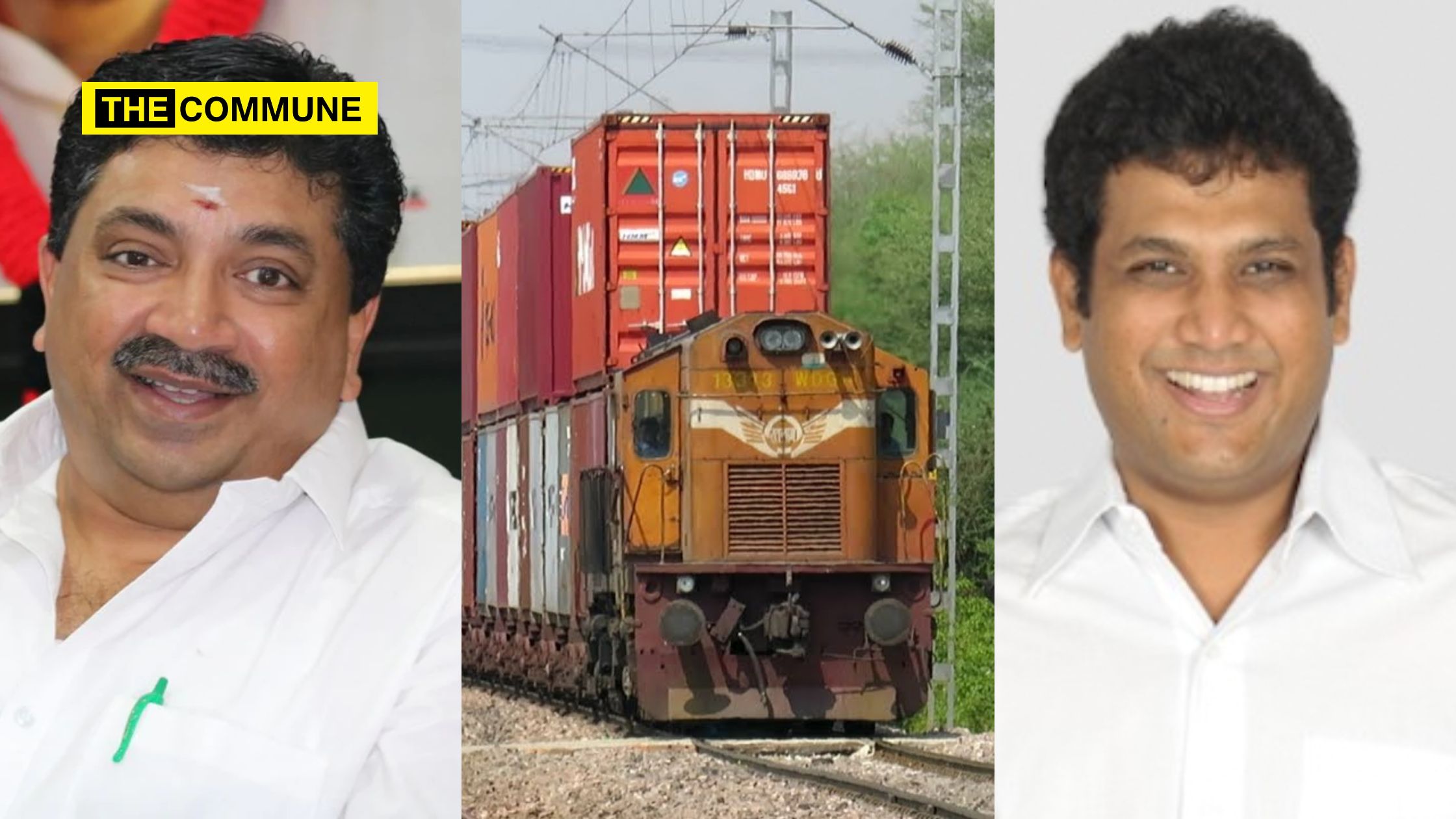
TN Fin Min PTR, DMK IT Wing Head TRB Rajaa Peddle Fake News About Rake Going Missing

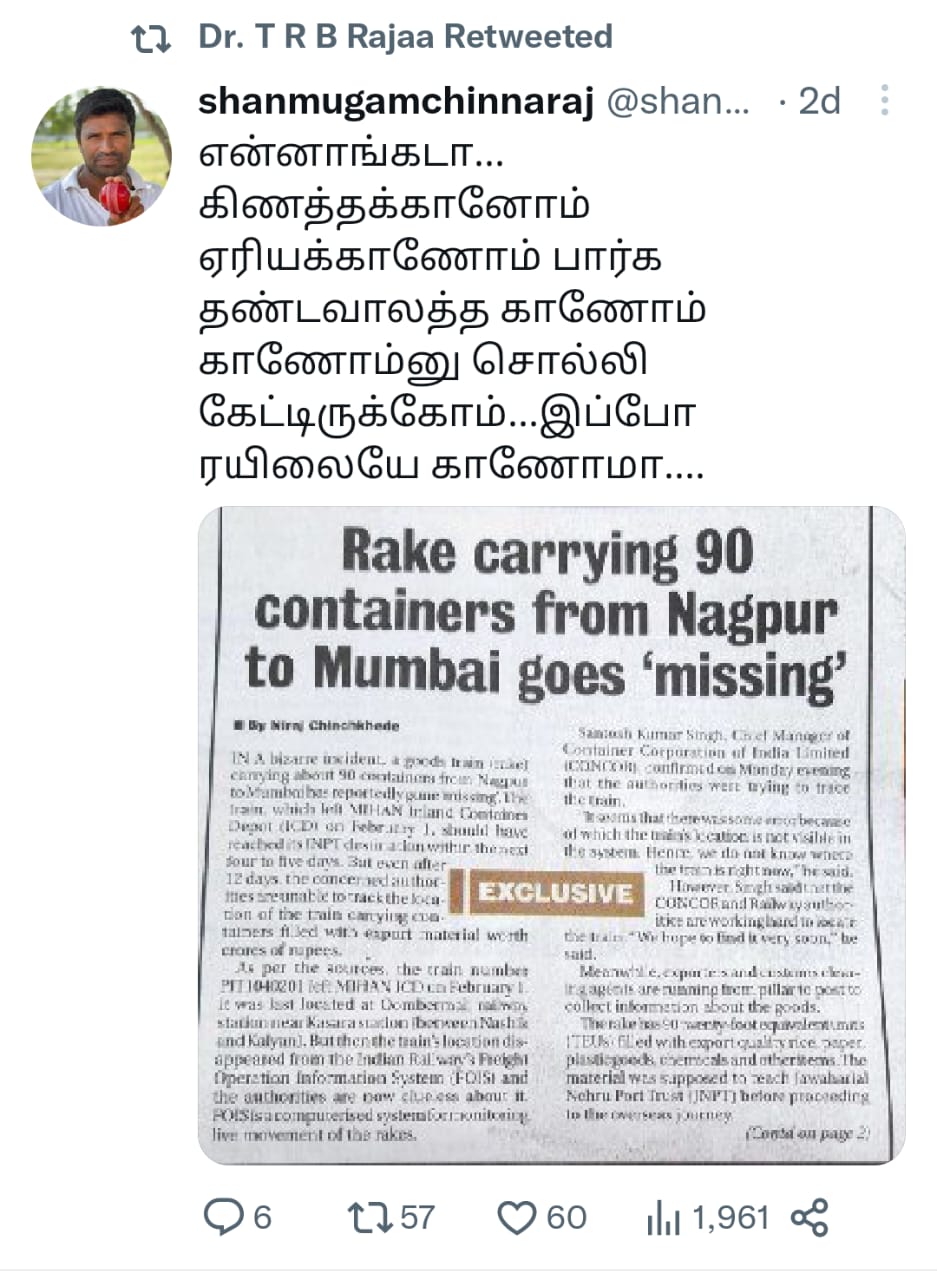
DMK leaders, including Tamil Nadu finance minister PTR Palanivel Thiyagarajan and DMK IT Wing head TRB Rajaa, spread fake news about a missing rake carrying 90 coaches from Nagpur to Mumbai.

On Tuesday (14 February 2023), some news outlets including Nagpur Today, The Hitavada and a few other news websites reported that a rake carrying 90 containers had gone missing in Nagpur.

This report, which appeared on February 14 in the online edition of ‘Hitavada,’ has been debunked by the Central Railways and the Container Corporation of India.

The Central Railways issued a detailed clarification, stating,”regarding the above matter, it is clarified that the said rake carrying 90 containers from Nagpur to Mumbai left MIHAN ICD on February 1, 2023 and arrived at Shegaon Station of Bhusaval division on February 5, 2023. The rake is not missing, as stated in the news article, and it is being physically moved to its destination, namely the JNPT Port. The incorrect information provided to the reporter will be investigated.”

Container Corporation of India Ltd has also stated that the news is baseless. “It has been established that the aforementioned news is factually incorrect. It has been informed that the subject train is being moved with priority from Shegaon to JNPT Port. As a result, the use of the word “missing” is misleading, and no authorised CONCOR representative made such a statement “In its clarification, Container Corporation of India Ltd stated.

However, this factually incorrect fake news was spread by the DMK leaders PTR, TRB Rajaa and other DMK cadres and supporters.

Tamil Nadu Finance Minister PTR Palanivel Thiagarajan, who is expected to be busy in preparing the budget for the year shared the fake news as if it is a fact stranger than fiction and that he could not believe it. The DMK Minister who is known for his abusive tweets and personal attacks said,” I couldn’t make this stuff up if I tried…”

DMK MLA and the party’s IT wing secretary TRB Rajaa too had shared the fake news.

It is worth noting that DMK Minister PTR Palanivel Thiagarajan headed the DMK IT wing before TRB Rajaa took over.

Click here to subscribe to The Commune on Telegram and get the best stories of the day delivered to you personally.
 

How Dravidian Stockists And Tamil Chauvinists Are Peddling Hate Against ‘North Indians’

Violence against non-Tamil speaking migrant workers have been on the rise in Tamil Nadu in the recent weeks with hate campaigns unleashed against them by DMK Ministers and Dravidian Stockist along with Seeman’s Naam Tamilar Katchi cadres.

Here a few instances where migrant labourers from other states have been abused, assaulted and sometimes killed.

Abused And Assaulted In A Moving Train

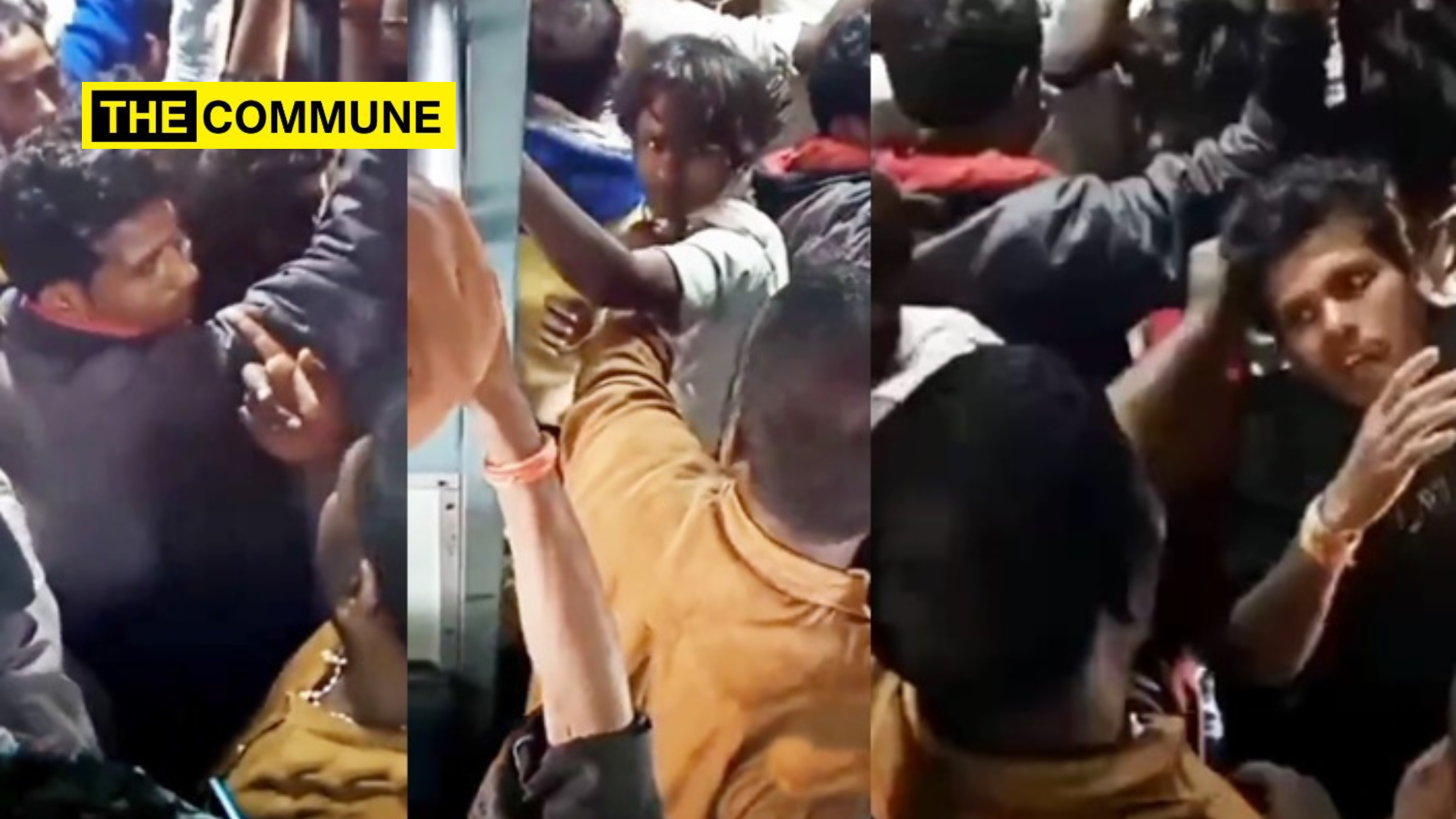
A video has gone viral on social media in which a Tamil-speaking man can be seen verbally abusing and assaulting north Indian passengers in the train.

In the above video, a man can be seen asking a another non-Tamil traveller “Tamil or Hindi?” to which another man from behind can be heard saying “all are Hindi, Hindi”.

He then hits another non-Tamil man and starts verbally abusing him.

“I am going to thrash you. Ng*tha Thev*d*ya paiyaa (son of a prostitute). K**dhi (female genitalia), you expect us to keep sucking in our place? I will keep my penis in Modi’s mouth. Thev*d*ya Paiyaa…. You expect us to suck cocks here? Thev*d*ya pasangala.”, he yells at a man.

Then he turns to another person and slaps him on the face asking “what are you staring at?”.

“These people come for work here but hit people.” another Tamil-speaking man can be heard saying in the video referring to the Tirupur incident.

The man keep continuously hitting and abusing the man. The man who is holding the camera can be heard saying “This is all being done by Modi”.

The entire incident happens in a moving train in the unreserved compartment where there were several non-Tamil migrants.

The Tamil Nadu Government Railway Police announced on social media that an FIR has been registered against the perpetrators.

West Bengal Migrant Worker Killed By Locals 

A Bengali construction worker who was stranded near Kelambakkam in Chengalpattu district was blindly attacked by local youths who mistook him for a thief. The severely injured worker died on the way to the hospital. Six people have been arrested and charged with murder in connection with the attack.

The victim has been identified as Kshetra Mohan Burman from West Bengal, who was working on the construction site of the real estate firm Casa Grande in Kelambakkam, Chengalpattu district.

Mohan, who lives with the other North Indian workers, came out of his house for dinner on the night of the incident. He got stranded in Kaaranai Nehru Nagar after having dinner at a restaurant in the Kaaranai area as he forgot the route to his house. In this scenario, six local residents, Anand, Raja, Udhaya Kumar, Vignesh, Balamurugan, and Ramesh, allegedly attacked Mohan under the mistaken belief that he was there to steal.

After receiving information, Thaazhambur police arrived on the scene and moved Mohan in a ‘108 Ambulance’ to Chromepet government hospital with severe injuries. However, he died not responding to the treatment.

Local Workers Clash With Migrants In Tirupur

A migrant worker from a garment unit at Thilagar Nagar West in Velampalayam, stepped out for a break to a roadside shop on January 14. A local resident reportedly argued with him and blew cigarette smoke at his face. This enraged the worker and the argument turned physical. The migrant worker retaliated and moved away from the spot. Later, the local along with a few friends entered the garment unit and attacked the worker. With the support of his colleagues, he retaliated.

Students In Coimbatore College Attack Non-Tamil Mess Workers

Students at the RVS Engineering College in Kannampalayam, Coimbatore clashed with migrant workers at the college mess over the quality of chicken dish served.

A viral video shows hundred of students running towards one end of the hostel mess with sticks and rods in their hands.

The Divisive ‘Dravidian Model’ Politics

These multiple instances of violence against migrant workers from other states can be seen as a fallout of the hate campaign unleashed by DMK Minister and Dravidian Stockists along with other fringe outfits like Seeman’s Naam Tamilar Katchi.

Radical Tamil Chauvinist Party Fear-Mongering About North Indians

Sebastian Seeman, the head of Naam Tamilar Katchi (NTK) is known for being a rabid demagogue whose politics has been based on othering non-Tamils in Tamil Nadu. His brand of Tamil nationalism bases itself on “Tamil Nadu for Tamils” advocating second-class treatment to non-Tamils.

In his political speeches, he has peddled hate against north Indians and even instigated violence against them.

In the above clip, Seeman says “Vadakkans, they will run helter-skelter. All the Hindi-speaking people will pack their bags and leave. I won’t know how many I will thrash. They will pack their bags in just one week.” threatening to slap false cases against them.

Idumbavanam Karthik, a Naam Tamilar cadre, has been spreading hatred against North Indians by uploading random videos from crowded places, such as markets or railway stations, and claiming that North Indians are flooding into Tamil Nadu in large numbers, which has no veracity.

https://twitter.com/idumbaikarthi/status/1616448297719468032

Saattai Duraimurugan, another Naam Tamilar cadre and serial liar who was arrested and charged under the Goondas Act for spreading lies about Foxconn, has now posted a video on his YouTube channel in which he attempts to link all crimes in Tamil Nadu to North Indians. He claimed that North Indians bring drugs from their home state and sell them in Tamil Nadu in order to live a luxurious lifestyle.

DMK Leaders Peddling Hate Against North Indians

Recently, DMK Organizational Secretary RS Bharathi sparked a controversy by saying that North Indians sell panipuri in Tamil Nadu and the Governor is also like them. He also compared the Governor to a migrant worker from Bihar and said that he would not have left without being beaten had Jayalalithaa been alive.

There are multiple instances when DMK minister K. Pondmudi resorted to ridiculing north Indians as ‘paani poori sellers’.

Tamil Nadu Health Minister Ma. Subramanian blamed ‘north Indians’ for rising number of COVID-19 cases in the state.

DMK Minister Moorthy in July 2022 instigated that Tamil people should chase away north Indian traders and businessmen.

“Only traders in Tamil Nadu should do business across the state. Businessmen from other states should not be allowed to do business in Tamil Nadu. There are lot of irregularities in businesses run by north Indians in Tamil Nadu. Tamil Nadu businessmen should come forward to remove the northern state businessmen from Tamil Nadu.”, DMK Minister Moorthy said while speaking at an event in Madurai.

DMK MP from Dharmapuri DNV Senthilkumar while speaking about the National Education Policy in Lok Sabha said, “The goal of the government in the National Education Policy is to have a Gross Enrollment ratio (GER) of 50%. This has already been achieved by Tamil Nadu. Whereas, India’s national GER is around 24.6%. We are much ahead of the American GER. Why is it that the Central Government is seeing to thrust the National Education Policy upon us? We have set principles and we have set models, the Dravidian principle models, which are successful models. If they want to implement it to make India a developed state, let them implement Tamil Nadu’s model throughout the state. Instead, why is it being thrust upon us? We totally reject it. If they want, they can go implement them in Gomutra states, which they are very keen upon.”

In an interview to Hindustan Times, Tamil Nadu Finance Minister PTR Palanivel Thiagarajan said that he can’t fathom how the BJP keeps getting re-elected in the ‘Hindi Belt’ and wondered if lack of education is the reason for it.


While on one hand political outfits have been peddling hatred against north Indian migrant labourers, popular Youtube Channels and other social media handles have been stereotyping and spreading racist canards against people of other states.

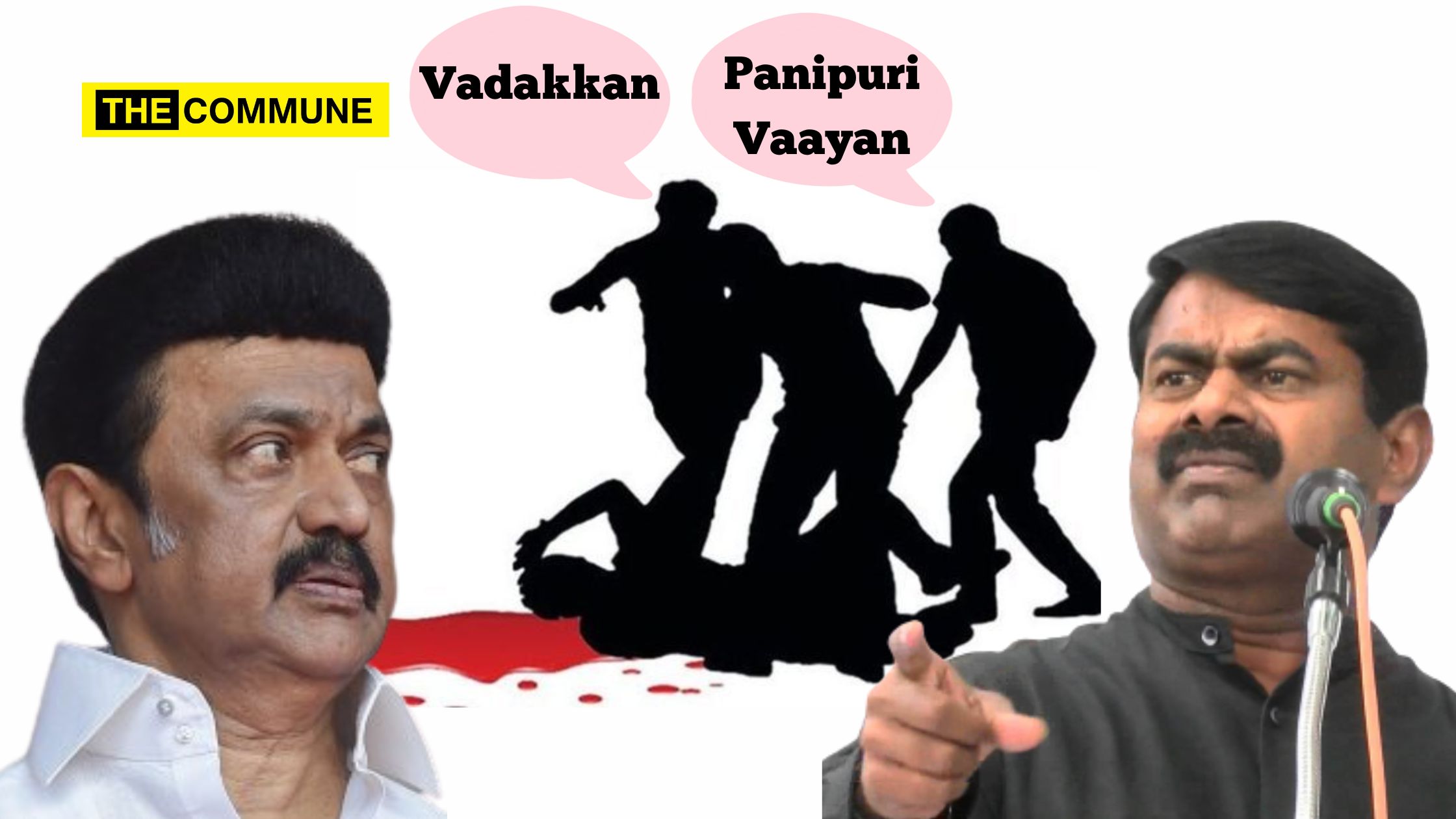
Slurs like ‘Vadakkan’, ‘Paani Puri wala’ ‘Panparag vaayan’ have been normalised through social media. Recently a popular YouTube channel named Paridhabangal, led by Gopi and Sudhakar, released a video attempting to portray North Indians in a negative light through their jokes and videos.

It is this visceral hate of the DMK and NTK towards north Indians that is spilling over to the larger society and impacting the lives of several people.

Click here to subscribe to The Commune on Telegram and get the best stories of the day delivered to you personally.
Video Of Tamil Man Abusing And Assaulting Migrant Workers In Train Goes Viral, FIR Registered

A video has gone viral on social media in which a Tamil-speaking man can be seen verbally abusing and assaulting north Indian passengers in the train.

In the above video, a man can be seen asking a another non-Tamil traveller “Tamil or Hindi?” to which another man from behind can be heard saying “all are Hindi, Hindi”.

He then hits another non-Tamil man and starts verbally abusing him.

“I am going to thrash you. Ng*tha Thev*d*ya paiyaa (son of a prostitute). K**dhi (female genitalia), you expect us to keep sucking in our place? I will keep my penis in Modi’s mouth. Thev*d*ya Paiyaa…. You expect us to suck cocks here? Thev*d*ya pasangala.”, he yells at a man.

Then he turns to another person and slaps him on the face asking “what are you staring at?”.

“These people come for work here but hit people.” another Tamil-speaking man can be heard saying in the video referring to the Tirupur incident.

The man keep continuously hitting and abusing the man. The man who is holding the camera can be heard saying “This is all being done by Modi”.

The entire incident happens in a moving train in the unreserved compartment where there were several non-Tamil migrants.

The Tamil Nadu Government Railway Police announced on social media that an FIR has been registered against the perpetrators.

Click here to subscribe to The Commune on Telegram and get the best stories of the day delivered to you personally.
Three-Day ‘Yaksha’ Festival Begins At Isha Yoga Center Coimbatore

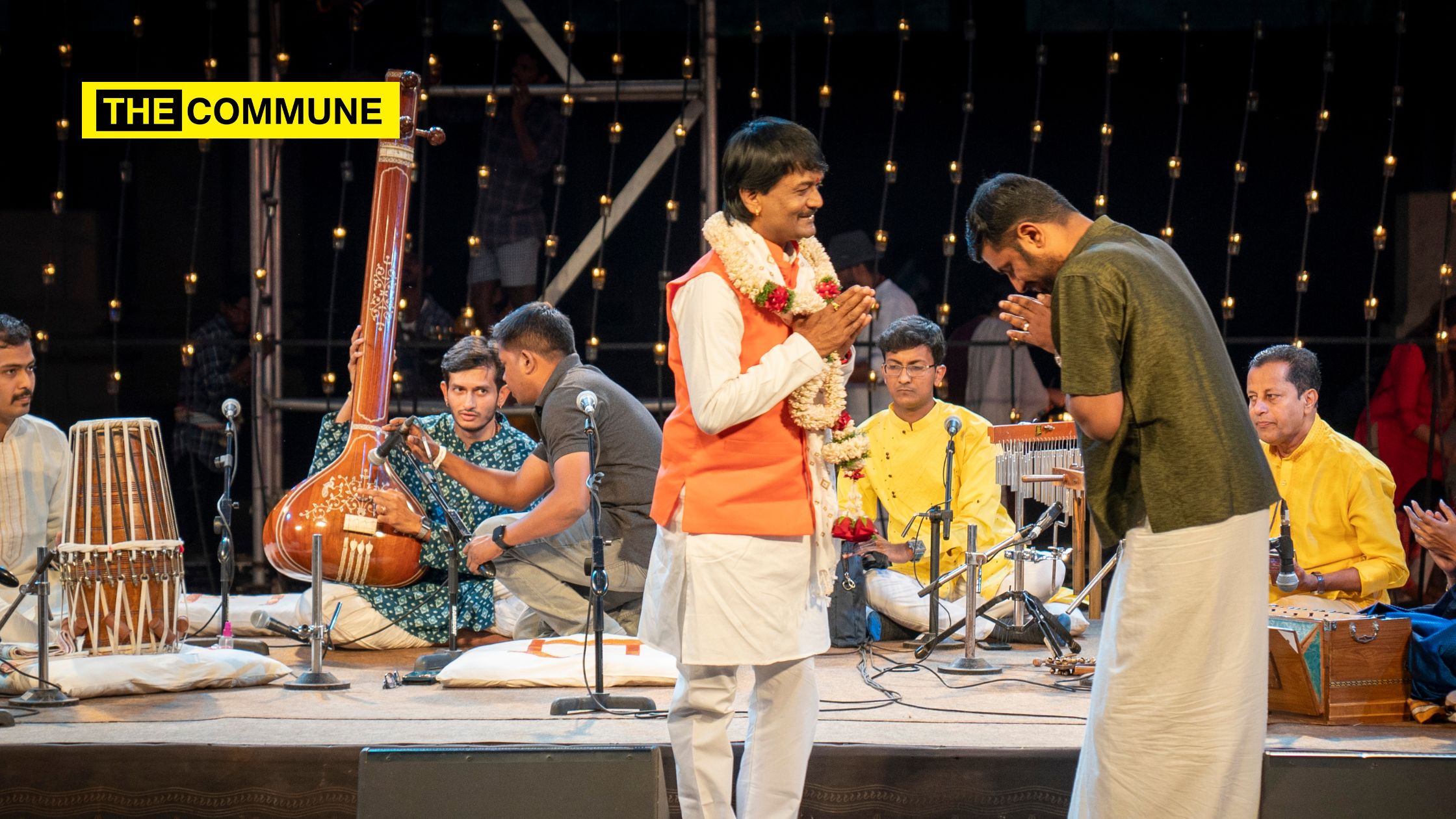
The three-day Yaksha festival, an exuberant festival of classical music & dance by world-renowned artists began today at the Isha Yoga Center in Coimbatore. Executive Trustee of Shankara Eye Foundation, Padma Shri Dr. R.V. Ramani lighted the lamp to inaugurate the festival.

Hindustani classical vocalist Jayateerth Mevundi performed on the first day of the festival. Known as a powerful and versatile vocalist, he is the proud recipient of several awards, including the prestigious Pune-based “Pula Deshpande” award for Classical Music. Befitting his stature, the powerful rendition mesmerized the hundreds of spectators from around the world watching his performance.

The following two days of the festival will witness Carnatic flutist Shashank Subramanyam and Madhavi Mudgal’s Dance Group performing Odissi on February 16th and 17th respectively. The performances are happening in Suryakund in Isha Yoga Center from 7 PM to 9 PM. All are welcome to attend the event for free. The performance is also livestreamed online.

Named after celestial beings in Indian mythology, Yaksha provides a platform for great artists to perform and connoisseurs to appreciate these ancient arts performed by masters. India’s various art forms are not only a reflection of diverse cultures but also a source of spiritual inspiration for thousands of years. Yaksha thus is an endeavor to preserve and promote the uniqueness, purity, and diversity of the country’s performing arts.

The Yaksha Festival comes ahead of the iconic Mahashivratri festival in Isha on February 18th. The nightlong festival includes Satsang and Guided Meditation by Sadhguru combined with breathtaking performances from artists across India.

(This is an official press release from Isha Foundation. The Commune was not involved in creating this content.)

Click here to subscribe to The Commune on Telegram and get the best stories of the day delivered to you personally.
5 Times When BBC Peddled Propaganda Against India

The survey by the IT department at the BBC office is not the first time the Indian government and the UK’s national broadcaster have been at loggerheads.

The British broadcaster has entered into confrontations with the Indian government several times since our independence.

Be it showing a distorted map of India, biased reporting during the second Indo-Pak war in 1965, glorifying Zulfikar Ali Bhutto’s speech in the UN Security Council, giving a communal narrative to liberation movement, projecting India’s poverty in an ugly in its documentaries, or using a 25-year-old so-called investigation by UK high commission to make a dubious documentary attacking PM Narendra Modi’s role in the Gujarat riots – an issue that has been long settled by the highest judicial authority in India – there is no dearth of instances when the BBC has deliberately attempted to undermine India’s sovereignty.

In a research paper titled “A new kind of imperialism?” the BBC, cold war broadcasting and the contested geopolitics of South Asia, author Alasdair Pinkerton meticulously documents such examples, some of which The New Indian has listed below in addition to more recent events.

1961- When BBC Gave Communal Angle To Goa Liberation Movement 

BBC covered Goa’s independence from the Portuguese in the December of 1961 with a communal lens. The BBC bulletin on 23rd December implied that only the Hindu population was happy about the departure of the Portuguese and the Christians didn’t have a role to play in the liberation movement.  Pinkerton  writes,”It would be fit to recall that the truth has been totally different and Christians in Goa, like Hindus, have been in the forefront of the freedom struggle […] Characteristically the BBC constantly termed the liberation of Goa as an “attack” or “invasion” by India.”

1965 – Biased Reportage On The Second Indo-Pak War

Similarly, in 1965 when military conflict again erupted between India and Pakistan over Kashmir, the Ministry of External Affairs reported several instances of “strong anti-Indian bias” in the BBC’s reports. One of these was the BBC newsreel broadcast calling Zulfiqar Ali Bhutto’s speech in the Security Council on 22nd September 1965  as a” highly emotional speech” that made a very deep impact on the delegates. The correspondent also called it “the most impressive and effective speech of its kind in the Council’s history.”

1970 – When Indira Gandhi Banned BBC  

Even as Congress leads the cacophony against the IT surveys at the BBC office, it is pertinent to remember that the “lowest ebb” in the India-BBC relationship was the banning of the broadcaster for 2 years by the government under the leadership of Indira Gandhi. The BBC refused to pull down two extremely distasteful documentaries that highlighted India’s poverty.

The two documentaries, Calcutta and Phantom India made by French filmmaker Louis Malle had outraged the Indian diaspora in the United Kingdom for showcasing what we now call poverty porn. “Within the days and weeks following the broadcast, the Indian High Commission in London reported receiving ‘a deluge of letters […] expressing their concern and distress at these films being derogatory to and highly biased against India,” Pinkerton writes.

There were hectic behind-the-scene discussions going on to manage this pseudo-diplomatic crisis. The author writes that the then Indian High Commissioner, Apa Pant alerted BBC and the foreign office of  “the volume and tone of the complaints it had received, demanding the removal of the films from the schedules. But BBC declined to oblige. The matter had also become highly politicized with as many as 41 Congress MPs demanding the banning of BBC for broadcasting “notoriously anti-India stories.”

2015- Ban On BBC Documentary India’s Daughter Based On Nirbhaya Rape Case 

Despite India’s protests, BBC released the controversial documentary “India’s Daughter” based on the Nirbhaya rape case. The filmmaker got exclusive access to the convicts in the case. The film, reportedly projected India as a hub of crime against women, thus tarnishing India’s global image.

2022 – India Blocks Online Sharing Of Controversial Documentary On P Modi

Ministry of External Affairs was quick to discredit the two-part documentary, “India: The Modi Question” as a dubious piece of propaganda. The documentary was based on a report on the 2002 Gujarat riots, by the British High Commission and was a brainchild of former UK Foreign Minister Jack Straw. Over 300 eminent Indians questioned the factual accuracy of the documentary and condemned it for undermining the Indian judiciary.

Opposition’s Shortsightedness On BBC Surveys

The IT surveys at the BBC office have led to a unified attack by the Opposition on the Narendra Modi government. The Opposition, led by Congress condemned the action as censorship and an attempt to silence the media. They were quick to allege it was done in response to the broadcaster’s controversial documentary “India: The Modi Question.”

BJP spokesperson Gaurav Bhatia on Tuesday categorically stated that if the BBC wanted to function in India, it must adhere to Indian laws and not allow anti-India propaganda like describing a terrorist as “charismatic”, on its platform.

While today, the raids on BBC are being seen as an assault on freedom of speech or a mere vindictive act by the Modi government, when Indira Gandhi had banned BBC’s operation in India in 1970, it was read as an inflection point in the consciousness of the young nation. For the first time, the diaspora had come together to define Indian pride, and what narrative it would allow colonial relics like BBC to carry forward.

The British Broadcast Corporation (BBC) and the Government of India’s relationship have always been tense. Right from its entry in India in 1927, and the setting up of its first Hindi Radio Service in 1940, BBC has been integral to how India in the last decade of freedom struggle and after independence was recorded and relayed to the rest of the world.

BBC finds its legitimacy from the Royal Charter which mandates it “reflects the United Kingdom, its culture and values to the world”. A large part of their income is derived from license fees from the UK government. It was set up with the purpose of keeping British officers who lived in different colonies of the vast empire across the world, connected to their home country. However, soon, the BBC was used to target the host countries. They quickly branched out into vernacular radio services, becoming the only source of news for millions of Indians in pre and post-independent India.

Despite its colonial origin, they did not wind up their services after independence and to date continue to influence the global narrative on India. Due to their colonial origin, and their record of “biased” coverage, the Indian government has always been skeptical of BBC’s programming.

With BBC continuing to penetrate the Indian vernacular digital space, it is even more necessary that the Indian government keeps a hawk eye on its editorial and financial activities. There is enough proof to justify such skepticism.

(This article was originally published in The New Indian and has been republished here with permission.)

Click here to subscribe to The Commune on Telegram and get the best stories of the day delivered to you personally.
“These Are All Small Things”: Senior DMK Leader On Army Man Being Thrashed To Death By DMK Councillor And Goons

Senior DMK leader and former Rajya Sabha MP TKS Elangovan has said that the incident where an Indian Army soldier was thrashed to death by a DMK councillor is a ‘small thing’.

A 29-year-old soldier of the Indian Army named Prabhu was beaten to death by 10 men including a DMK Municipal Councillor near Pochampalli in Krishnagiri district of Tamil Nadu.

The unfortunate incident happened over a petty dispute which resulted in an altercation.

Prabhu’s sister-in-law was washing clothes near a tank in the Pochampalli area early on February 8 to which the DMK councillor had objected. He had reportedly abused her resulting in a heated exchange between the DMK councillor and Prabhu’s family.

That evening, DMK Councillor Chinnaswamy, along with more than 10 other people, attacked Prabhakaran and Prabhu. Both of them were severely injured.

Prabhu later lodged a complaint with the Nagarasampatti police. Based on the complaint, six of the accused were arrested on February 9, but Chinnasamy and two others were absconding who were nabbed on the evening of February 15.

The incident had sent shockwaves across the nation with major English news channels making it a matter of prime time debate.

However, the DMK leaders and other Dravidian Stockists have been trivializing the horrific murder.

In an interview to India Today, former Rajya Sabha MP and senior DMK leader TKS Elangovan said “This is happening everywhere. Yesterday in Uttar Pradesh there was a clash and a mother and daughter died. So, everywhere it is happening. These are all small things. If a DMK man is involved, we have already taken action against many men who were involved in criminal activities. Same will apply to anybody.”

Earlier, Tamil Nadu State Planning Commission Member Amalorpavanathan Joseph trivialzed and demeaned the incident equating it to an incident where an alleged BJP functionary was caught for holding Marijuana.

Other Statements Made By TKS Elangovan

Elangovan had defended the anti-Hindu remark of DMK MP A. Raja when the latter said that a Shudra will remain a prostitute’s son until the person remains in Hinduism. Defending A. Raja’s statement, TKS Elangovan said that the “entry of Hinduism” has spoilt Tamil Nadu.

“The meaning of the word Shudra, what he (A. Raja) said, I am not going to talk about it. But the practice of Manu Dharma was never in the south. The entry of the Sanskrit and Hinduism into this land has spoilt this land.”, Elangovan had said.

The DMK leader had also said that the Chozhas are not Hindu kings and added that both Shaivism and Vaishnavism have been clubbed together and called Hindus.

Click here to subscribe to The Commune on Telegram and get the best stories of the day delivered to you personally.