Home Blog Page 934

The Myth Of “Opposition Unity”: Can A Congress-Led Grand Alliance Oust BJP?
This is part 2 of the series on Opposition Unity. Read part 1 here.

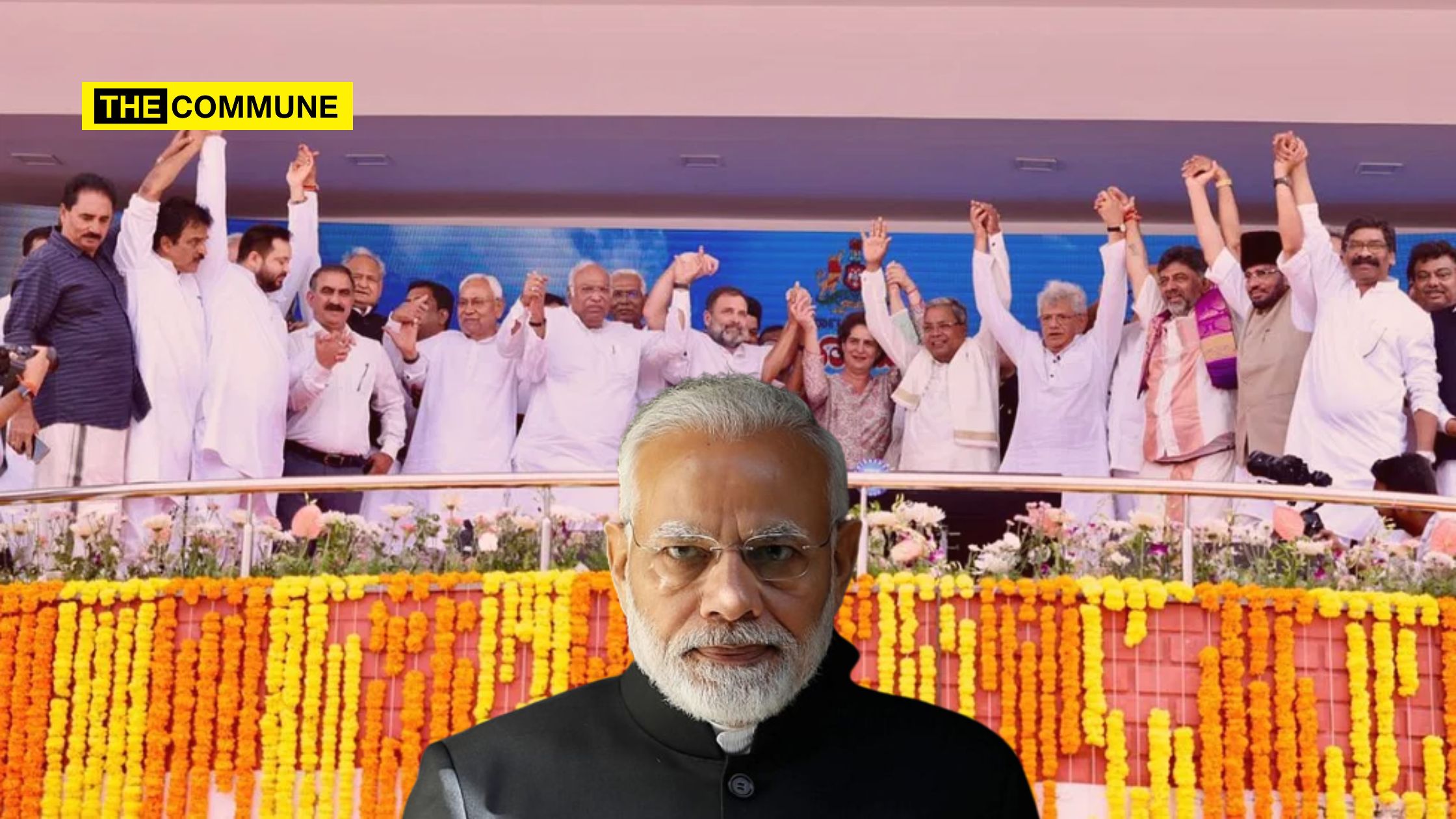
The much-hyped Opposition unity meeting at Patna on 23 June 2023 turned out to be a damp squib and nothing more than a photo opportunity of heads of several parties coming together.

As expected Arvind Kejriwal wanted to hijack the meeting with his one-point agenda of extracting guarantee from Congress party in opposing the ordinance on services in Rajya Sabha.

Congress party was smart enough to duck away from giving any guarantee to AAP lest their local units at Punjab and Delhi would be up on arms against their high command.

As usual Lalu tried to bring humor into the meeting by asking Rahul to get married soon. The only conclusion that the meeting arrived at was that the next meeting would be held at Shimla in July 2023 which is now changed to Bengaluru.

Let us also recall the fact that this concept of Grand Alliance was tried and tested in 1971 Lok Sabha elections. The idea of putting one common Opposition candidate is an ‘old wine in a new bottle’. The then opposition parties namely Congress (Organization), Praja Socialist Party, Bharatiya Jan Sangh, Swatantra Party and several regional parties came together to oust the then Prime Minister Indira Gandhi and it was a failed attempt. Refer to the picture below of the performance of the parties which were part of the ‘Grand Alliance’ then. It would meet the same fate again in 2024 for the reasons listed below.
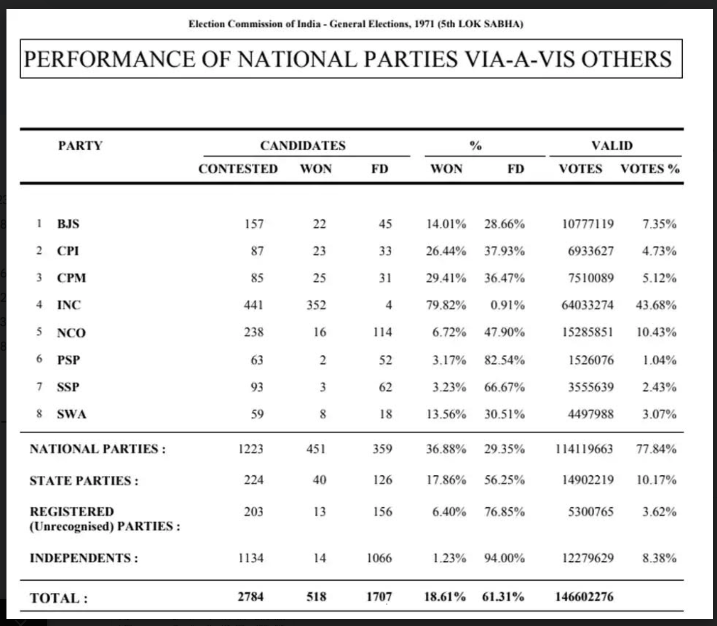
In 1971 the one-point agenda of the opposition was Indira Hatao (Remove Indira) and it failed miserably since India voted for a strong leader and the same agenda is being pursued to remove Narendra Modi from the Prime Minister post which would not cut ice with the public in 2024.

An average Indian voter is aware that these political parties are bereft of any developmental agenda or vision. It is for their own survival and their dynasty to flourish that they are uniting to fight against a man who has the vision to make India a vibrant $5 trillion economy and a global super power.

It is also important to understand the fact that for any Government to be stable in Delhi one of the two national parties need to have a minimum of 140 seats in the Lok Sabha. While the BJP under the leadership of Modi had crossed the magic number of 272+ on its own in the last 2 general elections the Grand Old Party could not even cross 10% of Lok Sabha seats in both the elections.

For the Congress to have any dream of unseating Modi from the Prime Minister’s chair its first focus needs to be on the states where it is in direct contest with BJP. There are 137 seats in states like Gujarat, Rajasthan, Madhya Pradesh & others where Congress cannot outsource its fight to any other party. While BJP won 121 out of these 137 seats in 2014 it increased its tally to 125 in 2019 pushing the fringe players like INLD at Haryana, CPIM in Tripura into oblivion.

Congress won just 8 seats in successive elections even after contesting all the 137 seats while BJP contested only in 132 seats in 2019. The reason for the free downfall of Congress party is its inability to set a narrative in these direct contests in spite of having a decent party infrastructure. The primary reason behind the Congress party’s victory in 2009 was the fact that it won 72 out of the 137 seats in 2009. There are no signs for the Congress Party to regain the lost ground in these seats.

The revival of Congress party in these 137 constituencies would also be directly impacting the saffron party and hence this should be the first focal point. As long as Congress party is unable to revive itself in this set of seats the dream of stopping Modi from occupying the PM chair for the 3rd consecutive time would only remain a dream.

While the 3rd forces are on the wane it is also significant to note that AAP is eyeing growth in these seats. Having achieved the national party status recently AAP would not leave the field open for Congress party in states like that of Gujarat & Goa where it has positioned itself as a 3rd entity. It is also important to note that AAP is dreaming to make inroads into states like Haryana, Madhya Pradesh & Rajasthan. It would be foolish to expect AAP to give a walkover for Congress since any revival of the Congress Party would shut the doors for AAP forever in these states.  

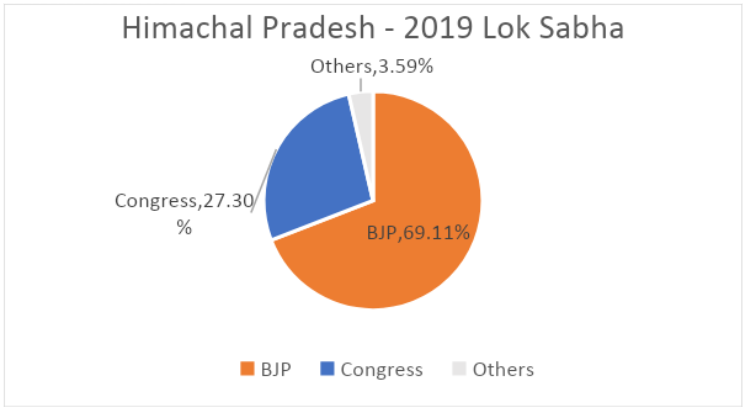
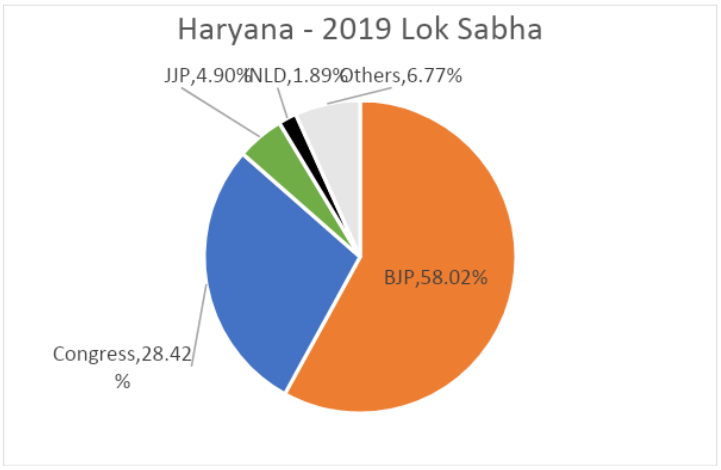
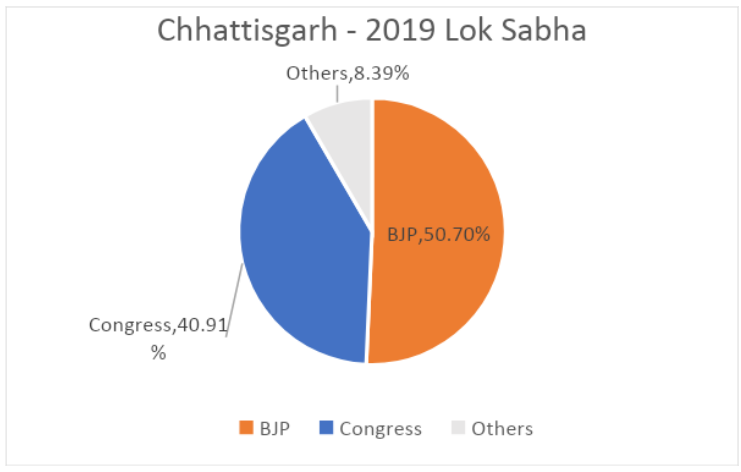
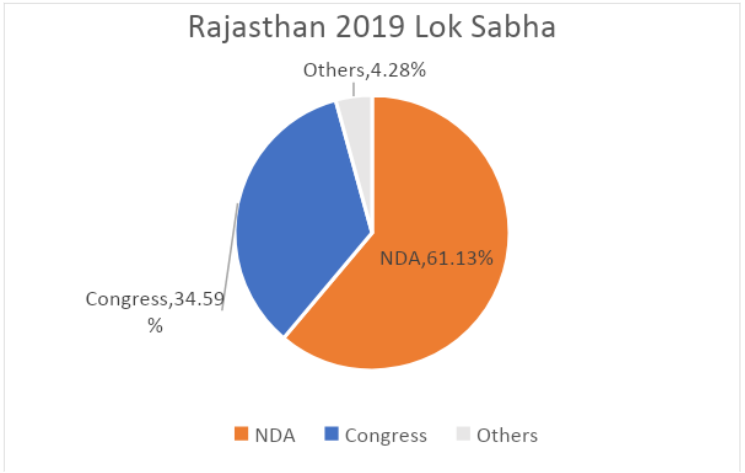
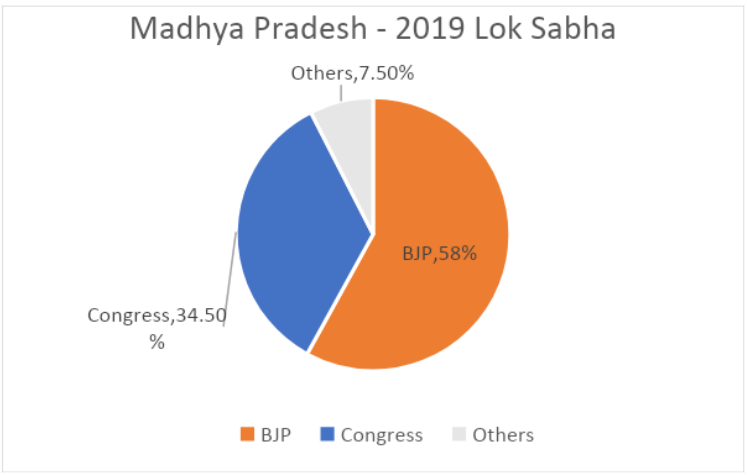
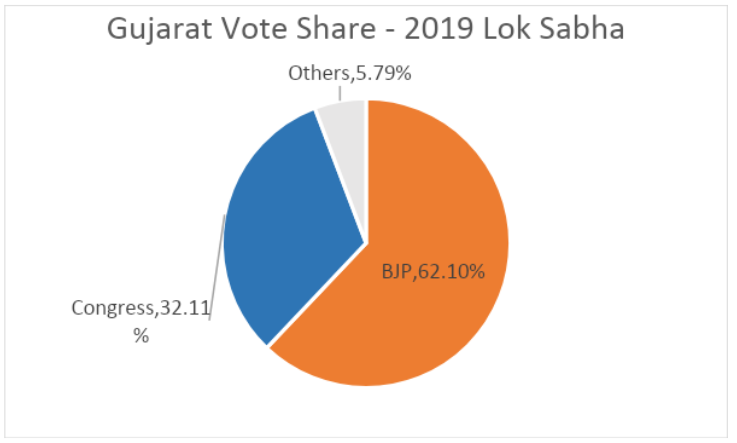
Also, the infographics below showing the vote share in 8 states would indicate the Himalayan task ahead of the Congress party since it would need a swing of over 20% in many states to unseat BJP in 2024 which at the moment looks next to impossible.

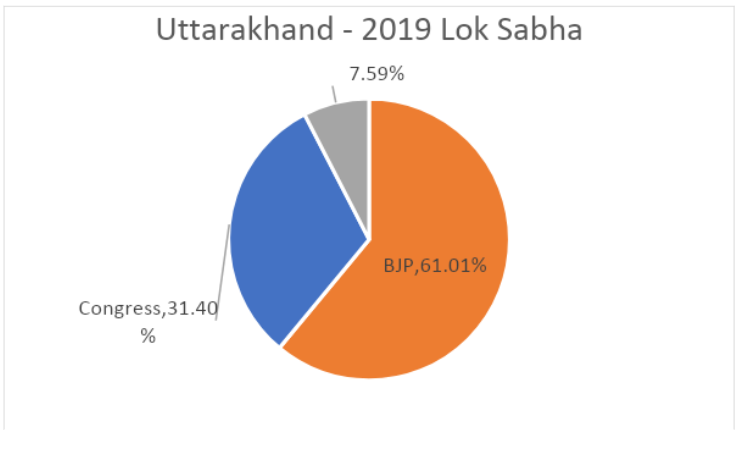
The 8 charts that we have shared are for 124 seats and it clearly indicates that when BJP contests under the leadership of Narendra Modi the party is able to pull humungous support in comparison to the assembly elections. Even in states like Rajasthan where BJP lost in December 2018 it polled a mammoth 61.13% in the Lok Sabha elections held just 5 months later. Hence as we head into the 2024 Lok Sabha polls it would be BJP & the Prime Minister Narendra Modi who would proactively set the narrative against Congress in the states where it is in head on contest. Modi also knows that it is in these states that Congress would indulge in personal attacks targeting the Prime Minister which he would use to his own advantage. 

The victory for Congress in states like Himachal Pradesh and Karnataka have become the talking point for revival of Congress party in the national scene but the reality is the fact that both these states have always voted for a change every 5 years. It is pertinent to remember that ever since 2019 Lok Sabha polls there have been 21 states which had gone for assembly elections. Out of these 21 polls, 13 states have been won by BJP led NDA and in 12 states the Saffron party is running its Government either by itself or in alliance. Congress had won in just 2 states while it is a junior partner at Jharkhand. While regional parties like Trinamool had won in West Bengal and DMK in alliance with Congress had emerged victorious in Tamizh Nadu, it is AAP which had won at Punjab & Delhi and Left alliance triumphed Congress at Kerala. Hence there is nothing much to write home about the victories of Congress party.

To stay specific to states where Congress and BJP are in direct fights there have been assembly elections to 7 states post the 2019 Lok Sabha elections and out of these 7 states Congress had been able to win only at Himachal Pradesh while BJP could score a resounding victory in 5 states. It was in Haryana that BJP needed the support of JJP to form the Government after a hung verdict. 

I am pretty sanguine that when the heads of Opposition parties meet there would be an informal discussion about these direct contests and how the Congress party performs miserably in these seats. They would also be aware that all the data points indicate that Congress is in dire straits in this set of 137 seats and only a magical revival would put BJP in backfoot which simply looks impossible and improbable.

Till such time opposition parties have the license to day dream.

JVC Sreeram is a political strategist and author and is the founder of Winning Elections.

Click here to subscribe to The Commune on Telegram and get the best stories of the day delivered to you personally.
“No Harm In Allowing Namaz For 30 Mins”: Madras HC Refuses To Stay Namaz At Dargah Near Thiruparankundram Murugan Temple

thirupparankundram karthigai deepam sikandar murugan dargah

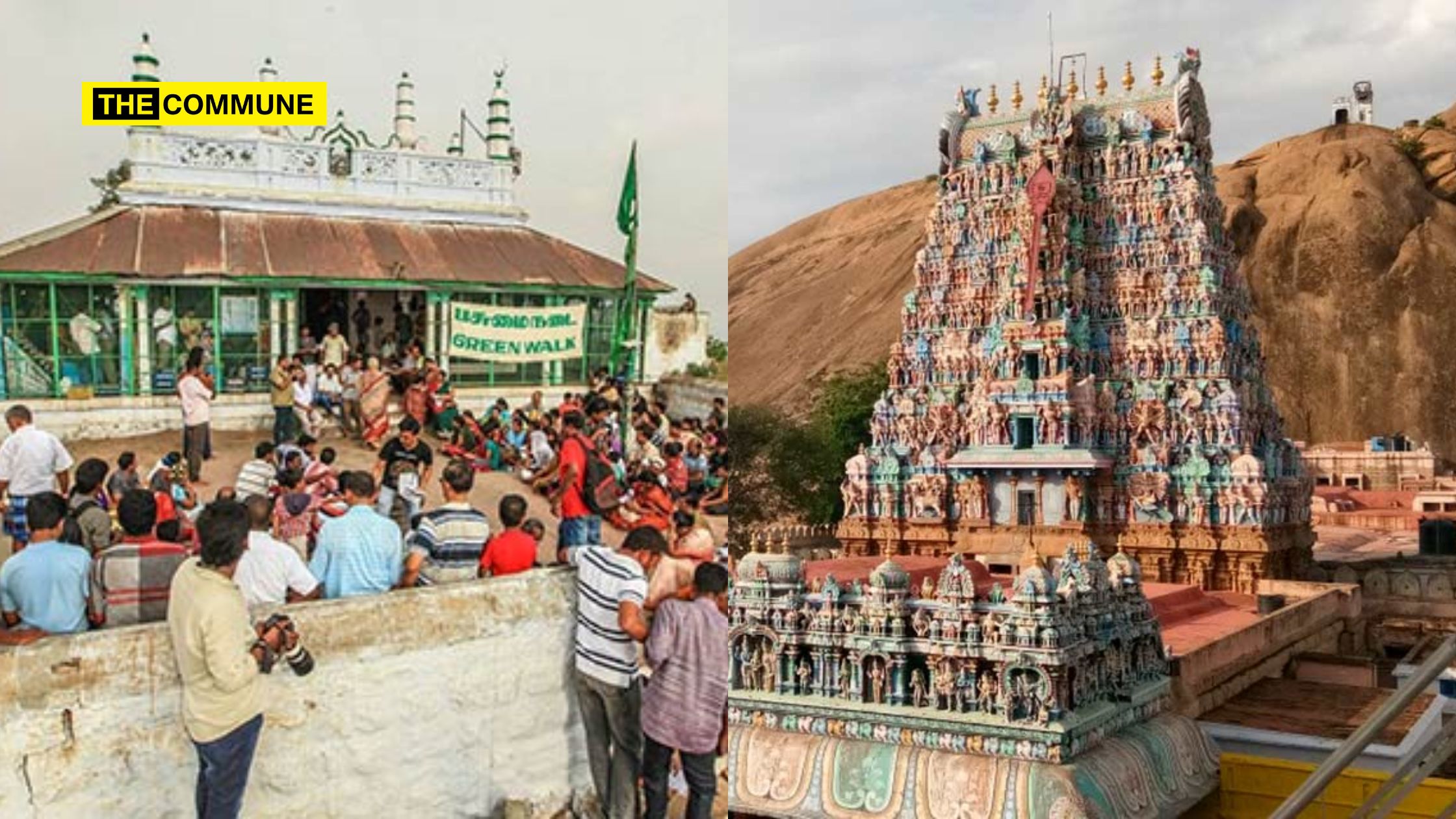
The Madras High Court has declined to prohibit the act of offering Namaz along a pathway leading to the Kasi Viswanathar Temple in Thirupparankundram, located in Madurai District.

Justices R Subramanian and L Victoria Gowri of the bench decided against issuing a temporary halt on the prayers at Nellithopu and requested the Hindu Religious & Charitable Endowment to present their response to the petition within a four-week period.

The court also expressed that there would be no harm caused by allowing 30 minutes of Namaz and assured that it would not inconvenience anyone.

The petition was initiated by Ramalingam, the State Organization Secretary of Aghila Bharatha Hanuman Sena. In his appeal, Ramalingam asserted that devotees who visited the Kasi Viswanathar Temple at the top of Thirupparakundram often took breaks and had their meals in the Nellithoppu area.

Furthermore, Ramalingam highlighted that the Jamath members usually performed their prayers at the Pallivasal Mosque, an incident that had never occurred before. He also pointed out the availability of other vacant lands in close proximity for conducting prayers.

According to Ramalingam’s submission, the Jamath members’ act of offering Namaz in Nellithopu caused disturbances and inconveniences to the public. He alleged that after the prayers, they left behind food waste and plastic, littering the pathway. Additionally, the Jamath members laid claim to the Thirupparakundram Arulmighu Subramania Swamy Thirukoil Mountain, referring to it as the “Sikkandar Mountain,” and he accused them of attempting to encroach on the land and create law and order issues.

However, despite the plea, the court was not inclined to grant an interim injunction and postponed the matter for further consideration.

About Thirupparankundram 

Thiruparankundram holds great significance as one of the six sacred abodes of Hindu God Murugan. Alongside the Subramanya Swamy temple, the hill is home to rock-cut temples from the Pandya era, as well as historically important inscriptions and rock paintings.

During the oppressive rule of the Madurai Sultanate, many prominent temples in and around Madurai were deprived of regular rituals until Kumara Kampanna defeated the Sultanate. It is believed that Muslims constructed a dargah on Thiruparankundram hill during the Sultanate’s reign.

Muslims claim that Sikandar Zulqarnain, mentioned in the Quran, arrived in Madurai to preach, aid Muslim invaders, and establish their rule. They assert that he built a mosque on Thirupparankundram hill and died there while under attack. Consequently, they consider the hill their own and refer to it as ‘Sikkandar hill.’

History Of The Dispute

Hindu groups allege that under the pretext of celebrating festivals, Muslims have gradually encroached on other parts of the hill. These Hindu groups have long opposed these actions and have demanded that the government address the encroachment. The Subramanya Swamy temple, being under the control of Tamil Nadu HR&CE Department, has been accused of playing appeasement politics.

A Vijaya Bharatham article narrates the experience of a Hindu activist involved in reclaiming Hindu rights. It states that in the past, the Karthigai deepam (a ceremonial lighting of lamps) used to be lit at the stupa in the Kashi Vishwanath temple atop the hill. However, during World War II, the British banned this practice in Thiruparankundram, and it was never resumed even after India gained independence.

During this time, Muslims began encroaching on parts of the hill. They apparently buried the body of someone named Sikkandar and built a dargah. They also started referring to the hill as ‘Sikkandar hill’ and placed Islamic green crescent flags atop it. Chinna Karuppa Thevar, a Congress MLA at the time, gathered the public and removed those flags, replacing them with the national flag. He also initiated a hunger strike, resulting in the arrest of 700 protestors.

The then Chief Minister of the Madras presidency, T Prakasam, met with Chinna Karuppa Thevar and convinced him to end the strike, fearing potential law and order issues. Muslims claimed ownership of the hill’s area where the dargah is located and took the matter to court. The London Privy Council heard the case and ruled that the entire hill belongs to Subramanya Swamy and that the dargah should not be expanded in any way.

Subsequently, Madurai Rajagopal, the former President of Hindu Munnani, took steps to revive the tradition of lighting Karthigai Deepam at the stupa near the Kashi Vishwanath temple. He undertook a padayatra (foot march) to highlight this cause. When Muslims opposed the Vinayagar Chathurthi visarjan (immersion of Ganesha idols) in Keezhaarai, Ramanathapuram, Rajagopal led the procession. Enraged by his actions, Muslims murdered Rajagopal at his doorstep.

Petitions were filed in the Supreme Court to allow Hindus to light the Karthigai deepam on the hilltop and restore the tradition. The court ruled that the temple could light the deepam anywhere, as long as it was 15 meters away from the dargah. The stupa where the deepam is usually lit is located 100 meters from the dargah.

Although the Tamil Nadu government could have allowed the deepam to be lit at the same stupa, they chose to appease Muslims by lighting it at a spot 150 meters high near the Uchi Pillayar temple. This location is typically used for lighting moksha deepam for the deceased. To this day, Hindus continue to light moksha deepam at that spot. It is said that lighting the Karthigai deepam at a location reserved for moksha deepam goes against Agama rules.

Hindu Munnani has made efforts every year to revive the tradition. However, the government refuses permission, citing concerns over law and order. In 2020, a group of Hindu Munnani activists defied the government’s ban and lit the Karthigai deepam at the traditional spot. Two individuals were arrested for this act. A Times of India Tamil report confirms that the deepam was lit near the Kashi Vishwanath temple until 1967 and that the police consistently deny permission, providing various reasons.

It is alleged that Muslims have taken advantage of this situation and expanded their influence by performing Namaz on the pathway leading to the Kashi Vishwanath temple. In August 2021, a decision was taken at a meeting chaired by the District Collector to immediately remove the flagpole illegally erected by Sikandar Shah Dargah

(With inputs from Hindu Post and Live Law)

Click here to subscribe to The Commune on Telegram and get the best stories of the day delivered to you personally.
Ayodhya Airport To Be Ready By Sep 2023

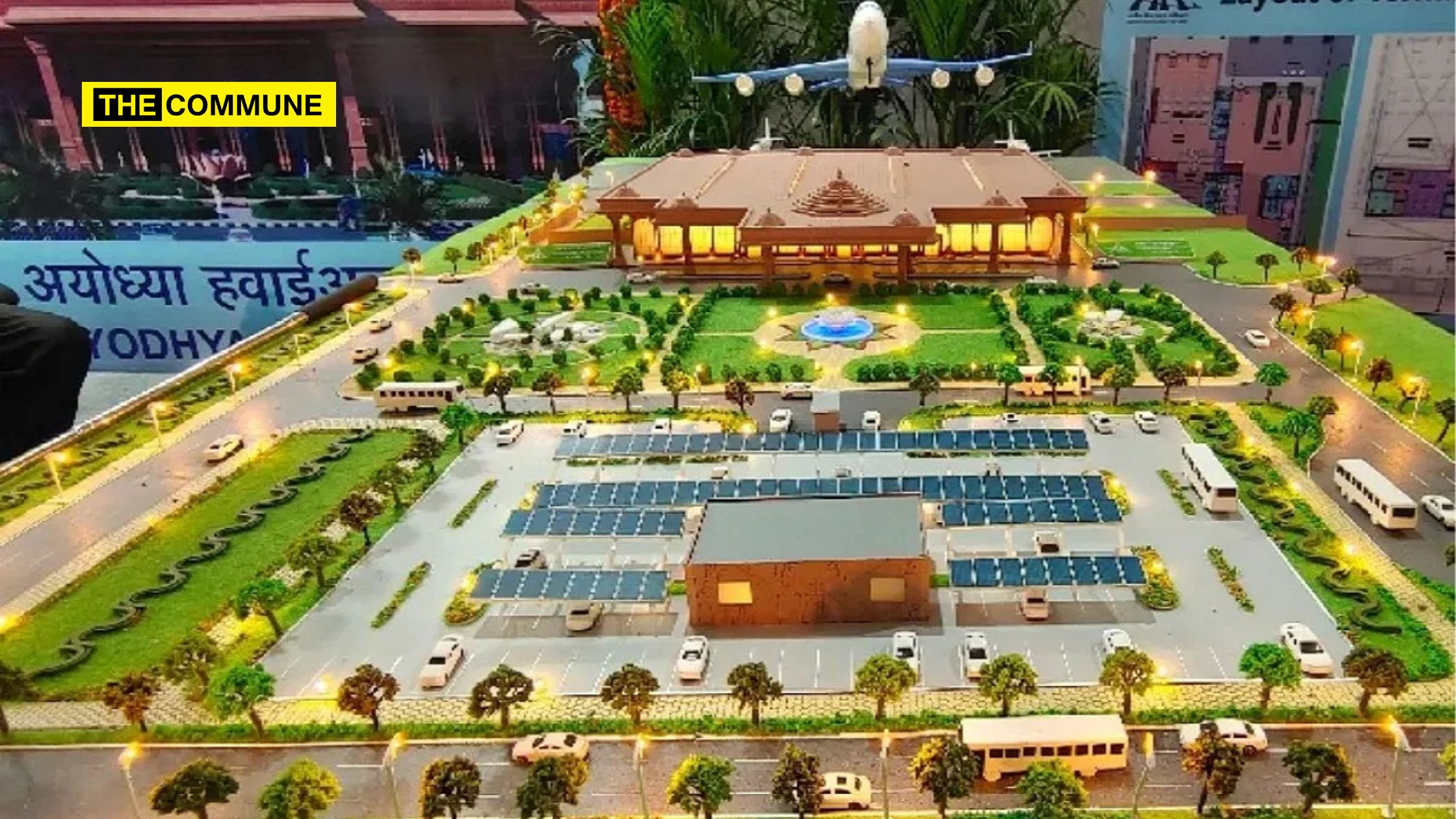
The construction of the Ayodhya Airport is expected to be completed by September 2023. The new airport will be suitable for operating A-320/B-737 type of aircraft and is being developed at an approximate cost of ₹350 crores.

The development work involves extending the existing runway from 1500m X 30m to 2200m x 45m for the operation of Code-C type of aircraft under IFR conditions. It also includes constructing an Interim Terminal Building, an ATC Tower, a Fire Station, car parking, and a new Apron for parking three Code ‘C’ type of aircraft, along with the necessary city-side and airside infrastructure. The New Interim Terminal Building covers an area of 6250 sqm and can accommodate 300 passengers during peak hours. Passenger facilities comprise eight check-in counters, three conveyor belts (one in the Departure Hall and two in the Arrival Hall), parking space for seventy-five cars and two buses. The Airport will be PRM (Passenger with reduced mobility) compliant.

The Terminal Building incorporates various sustainability features such as a Double Insulated Roofing System, Canopies for energy-saving purposes, LED Lighting, Low Heat Gain Double Glazing Unit, Rainwater Harvesting for groundwater recharge, Landscaping with fountains, HVAC, Water treatment plant, Sewage treatment plant, and the utilization of recycled water for landscaping. A solar power plant with a capacity of 250 KWP has been installed to achieve GRIHA –V ratings. The Terminal has been designed to showcase the culture and heritage of Ayodhya and the state of Uttar Pradesh, creating a sense of place for visitors.

The façade of the Terminal Building, both on the city side and airside, displays the architectural style of the upcoming Ram temple of Ayodhya. The Proposed Terminal Building reflects the magnificent Ram Mandir, offering a spiritual ambiance to visitors. The Terminal’s design incorporates varying heights of Shikhars (spires) to convey a sense of grandeur, along with decorative columns to enhance the fascia of the Terminal Building. The decorative colonnade provides an immersive experience for passengers and visitors, with the interiors adorned with local art, paintings, and murals depicting the life cycle of Lord Ram.

Regarding the development work, Jyotiraditya M. Scindia, Union Minister of Civil Aviation and Steel, expressed his thoughts, highlighting Prime Minister Narendra Modi’s visionary approach to driving infrastructure progress in India. He mentioned that the development of Ayodhya Airport exemplifies the commitment to improve air connectivity and promote tourism in the holy city. Under PM Modi’s leadership, the project aims to boost regional development and honor the rich cultural heritage associated with Lord Ram, the Minister said.

Click here to subscribe to The Commune on Telegram and get the best stories of the day delivered to you personally.
“DU Not Just A University But A Movement”: PM Modi At Centenary Celebrations Of DU

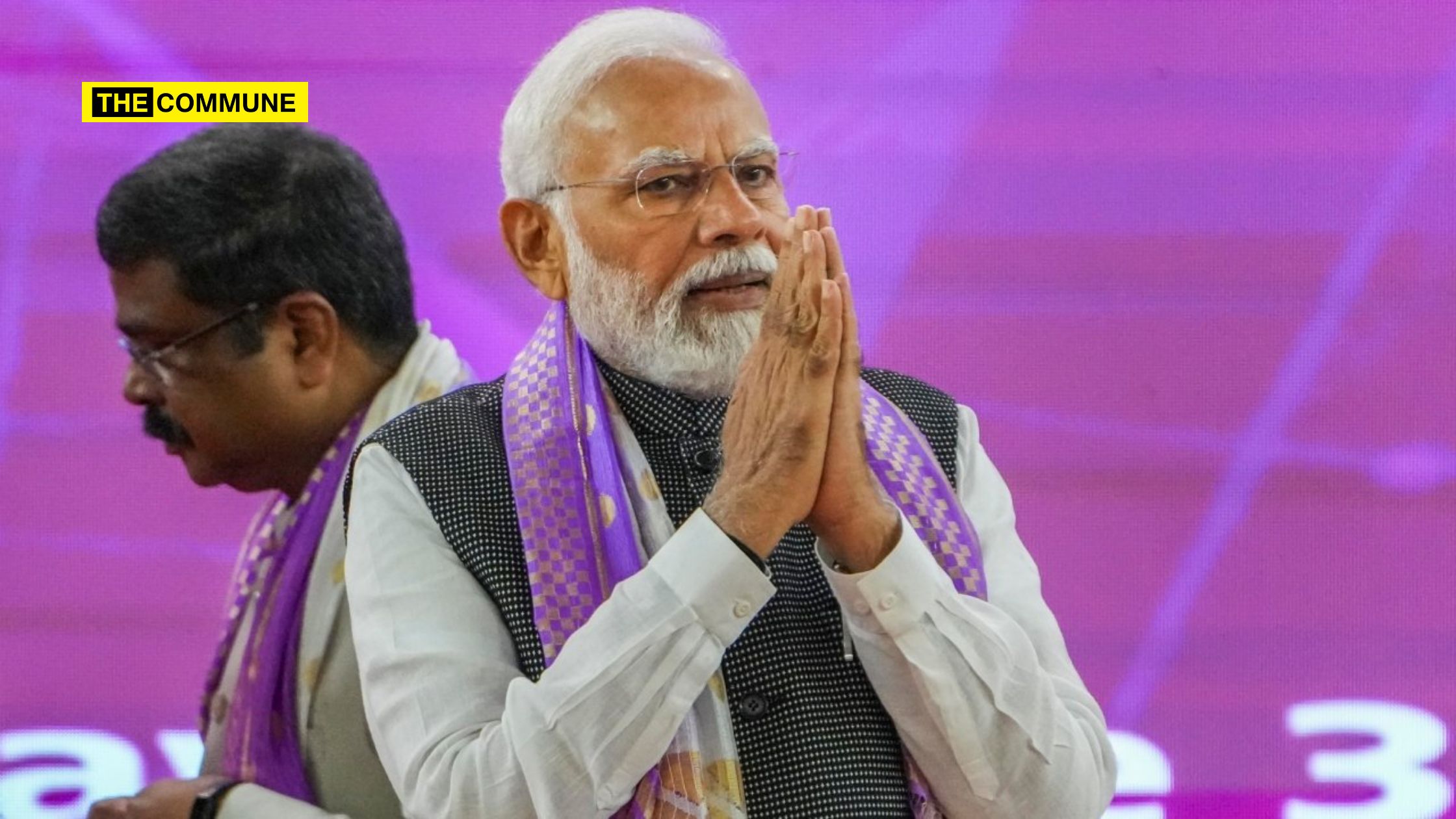
The Prime Minister, Narendra Modi, delivered a speech at the Valedictory Ceremony of Centenary Celebrations of the University of Delhi. The event took place at the Multipurpose Hall of Delhi University Sports Complex. He also inaugurated the construction of the Faculty of Technology, Computer Centre, and Academic Block in the North Campus of the University. During the ceremony, the Prime Minister launched various commemorative publications, including a compilation of the centenary celebrations, a book featuring the logo of Delhi University and its colleges, and a publication called “Aura – 100 Years of University of Delhi.”

To reach the University of Delhi, the Prime Minister traveled by metro and interacted with students during the journey. Upon arrival, he visited the exhibition called “Journey of 100 Years” and witnessed performances by the Faculty of Music and Fine Arts, including the Saraswati Vandana and University Kulgeet.

In his address, the Prime Minister expressed his strong commitment to participating in the Valedictory Ceremony and described it as a homecoming. He mentioned that a short movie shown before his speech showcased the accomplishments of notable individuals associated with Delhi University. The Prime Minister expressed his joy at being present at the university during the centenary celebrations and highlighted the significance of the company of colleagues during such visits. He also expressed happiness about traveling by metro to reach the event.

The Prime Minister acknowledged that the centenary celebrations of Delhi University coincided with India’s Azadi Ka Amrit Mahotsav, marking 75 years of independence. He stated that universities and educational institutions reflect a nation’s achievements. He referred to the historic landmarks in the 100-year journey of Delhi University, emphasizing that it has not only been a university but also a movement that has filled every moment with life. He congratulated students, teachers, and everyone associated with Delhi University on the occasion.

Regarding the alumni gathering, the Prime Minister emphasized the significance of the occasion as an opportunity to reconnect. He stated that if Delhi University has kept its emotions alive during these hundred years, it has also kept its values vibrant. Stressing the importance of knowledge, he highlighted the prosperity India enjoyed during the era of renowned universities like Nalanda and Takshila. He mentioned the adverse impact of attacks during the period of slavery, which destroyed these institutions and obstructed India’s intellectual progress.

The Prime Minister credited universities, including Delhi University, for playing a crucial role in shaping post-independence India by fostering a generation of talented youngsters. He emphasized the understanding of the past as instrumental in shaping the country’s ideals and vision for the future.

He stated that when an individual or institution is dedicated to the country, their achievements are equated with the nation’s accomplishments. The Prime Minister pointed out the remarkable growth of Delhi University, which initially had only three colleges and now has over 90. He highlighted India’s transformation from a fragile economy to one of the top five economies globally. He also mentioned the improved gender ratio at Delhi University and underlined the interconnectedness between the resolutions of an educational institution and a nation, emphasizing that deeper roots lead to greater progress.

The Prime Minister noted that Delhi University’s goal at its inception was India’s independence, but as it approaches its 125th year alongside India’s 100th year of independence, the university’s goal should be to make India a developed nation. He stated that the third decade of the 21st century would provide impetus to India’s development journey, highlighting the establishment of numerous universities, colleges, IITs, IIMs, and AIIMS as building blocks of the new India.

The Prime Minister emphasized that education is not just about teaching but also about learning. He mentioned the flexibility provided by the new National Education Policy, which allows students to choose subjects according to their interests. He also discussed the National Institutional Ranking Framework, which motivates institutions to improve quality and competitiveness while linking institutional autonomy to education quality.

He highlighted the increasing recognition of Indian universities due to forward-looking educational policies and decisions. He mentioned the rising number of Indian universities in international rankings and credited the country’s youth for their transformative role. He commended the youth for going beyond placements and degrees and instead focusing on blazing their own trail. He cited the significant increase in startups, patent filings, and India’s improved position in the Global Innovation Index as evidence of this mindset.

The Prime Minister mentioned the recent deal with the USA on the Initiative on Critical and Emerging Technology (iCET), which he believes will create new opportunities for Indian youth in various sectors, including AI and semiconductors. He highlighted the investment decisions made by companies like Micron, Google, and Applied Materials in India, which indicate a promising future for the youth.

He observed that India is on the cusp of the Industry 4.0 Revolution, with technologies like AI, AR, and VR becoming a part of everyday life. He mentioned the opportunities created in sectors like robotics, space, defense, and drones, which offer new avenues for India’s young generation.

The Prime Minister discussed the impact of India’s growing global profile on students’ curiosity and highlighted the country’s assistance to the world during the COVID-19 pandemic. He emphasized that Indian values such as democracy, equality, and mutual respect are becoming universal values, providing new opportunities for Indian youth in government, diplomacy, and other fields. He also mentioned the growing recognition of Indian teachers worldwide, contributing to India’s soft power.

The Prime Minister urged universities to prepare their mindset for this development and create a roadmap to become top-ranking institutions globally. He concluded by emphasizing the responsibility of educational institutions in preparing the minds and hearts of a nation, stating that the vision and mission of such institutions are essential for developing a future-ready generation.

The Union Minister for Education, Dharmendra Pradhan, and the Vice Chancellor of the University of Delhi, Yogesh Singh, were present at the event.

“Give Up Politics Of Hatred Against Deekshitars”: Descendants Of Vijayanagara Empire Who Reconstructed Chidambaram Natarajar Temple Condemn TN Govt

From being a sacred place of worship, the Chidambaram Nataraja Temple has become embroiled in controversy due to the recent incidents that have taken place.

At the center of the controversy is the decision to restrict public access to the Kanakasabhai (Golden Hall) in the Chidambaram Nataraja Temple for four days following the annual Aani Thirumanjanam festival. This restriction has been a longstanding tradition at the temple during this festival.

However, officials from the Hindu Religious and Charitable Endowments (HR & CE) Department and the police stormed into the Kanakasabai (Golden Platform) during the ongoing Aani Thirumanjanam festival. This move has sparked outrage and condemnation from the temple authorities and devotees.

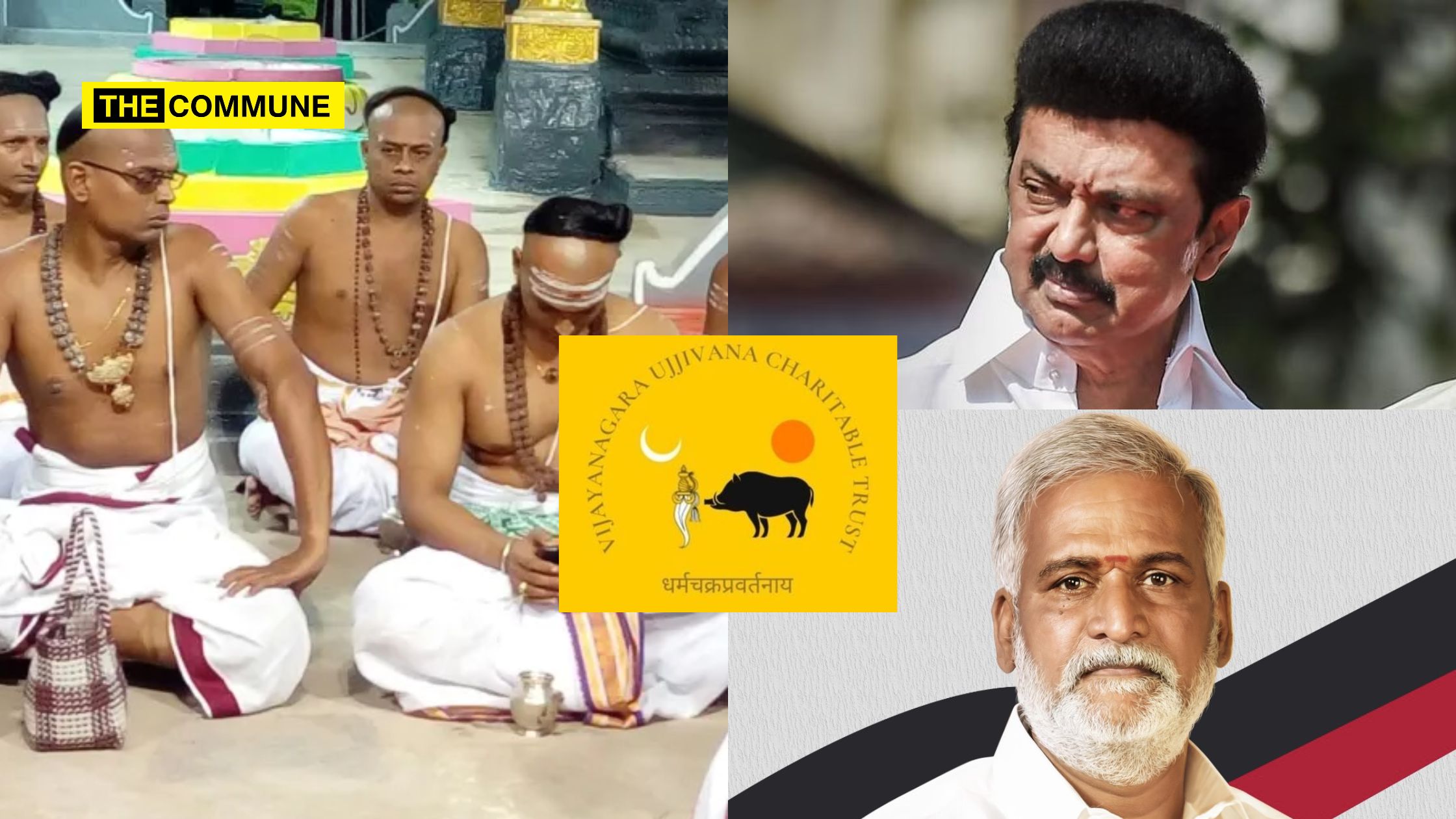
In light of this, the Vijayanagara Ujjivana Charitable Trust run by the descendants of the Vijayanagara empire condemned the distressing turn of events at the temple and the tirade against Deekshitars.

“The recent controversy in the Chidambaram Sri Nataraja Temple has hurt the sentiments of Hindu devotees across the country. It is seen that the officials of TN Government (like HR&CE department, Police etc.) are behaving in an atrociously high-handed manner with the Thillai Dikshitars who are the hereditary owners of the temple.”, the press release said.

“We see that baseless allegations are being hurled against this ancient community of worshippers and their right to administer their temple is being hindered at every step. Already the community was tarnished by the government through various baseless allegations, their minor girls were subjected to inhuman`two-finger’ test among other such targeted steps taken by the officials of the state.”, the press statement further added.

Contrary to the claims made by a few people that temples like Chidambaram Natarajar Temple were built by kings and hence their ownership should lie with the state, the Trust clarified that the rulers did not own or control or administer the temple.

“Several inscriptions with donations end with phrases like Srivaishnava Raksha, Maaheshvara Raksha etc. to specifically emphasize the fact that the temples belonged to a specific denomination and that the denomination shall administer & protect the particular temple. Once donated, the property does not remain public property. It belongs to the specific denominafion.” , it said.

“Once a land or property has been allocated by the government as a private property, neither the government nor the general public can claim the property as theirs. Just because an apartment has been presented by the state to a family, said apartment does not become state property. Similarly, when the temples were built and offered to specific sampradayas by the rulers, the state & the general public lose the right over said temples. They are not state property anymore.”, it further added.

“The current temple was restored, renovated and expanded by the Vijayanagar emperors and their Nayaka subordinates after the reconquest of Tamil lands by the empire under Kumara Kampana. Emperor Krishnadevaraya built the grand gopurams of this temple. Our ancestors certainly did not consider themselves as the owners of the temple nor did they see the temple as property of the state. The temple belongs to the Dikshitars and should remain so forever till the sun and moon remain — as they should be.”, the press release noted.

The Trust also pointed out to the sorry state of affairs of several ancient temples of Tamil Nadu saying “We see that several centuries old temples built and endowed by Cholas, Pandyas, Vijayanagar, Nayalcas and other rulers — which are under the administrative control of the HR8cCE department — remain without proper maintenance and in many cases, without even proper pujas. The government should rather concentrate its efforts towards better maintenance of these dilapidated temples instead of unnecessarily persecuting the Dikshitars of Chidambaram temple who maintain their temple in a proper manner.”

“We implore the government of Tamil Nadu to give up this politics of hatred against the Dikshitars and instead take firm steps towards maintenance and improvement of the ancient temples of the state which display the real rich culture and traditions of the Tamil land”, it concluded.

Click here to subscribe to The Commune on Telegram and get the best stories of the day delivered to you personally.
NCSC Issues Notice To TN Govt Over Hygiene Worker’s Death Brought To Light By TN BJP

The National Commission for Scheduled Castes (NCSC) has taken strong notice of a tragic incident in Pennadam town, Cuddalore district, Tamil Nadu, where a man lost his life allegedly due to inhaling toxic gas during sewer cleaning.

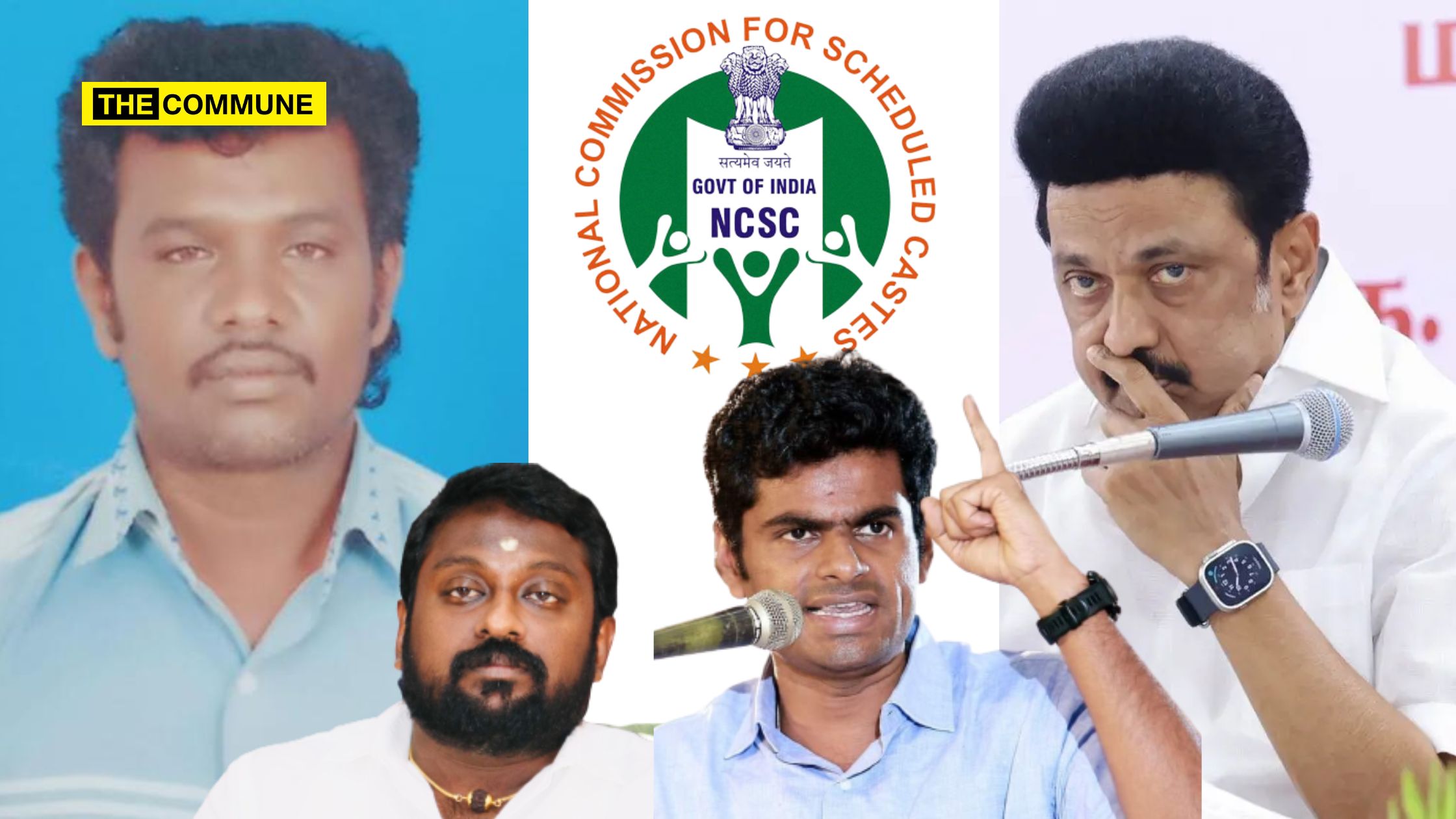
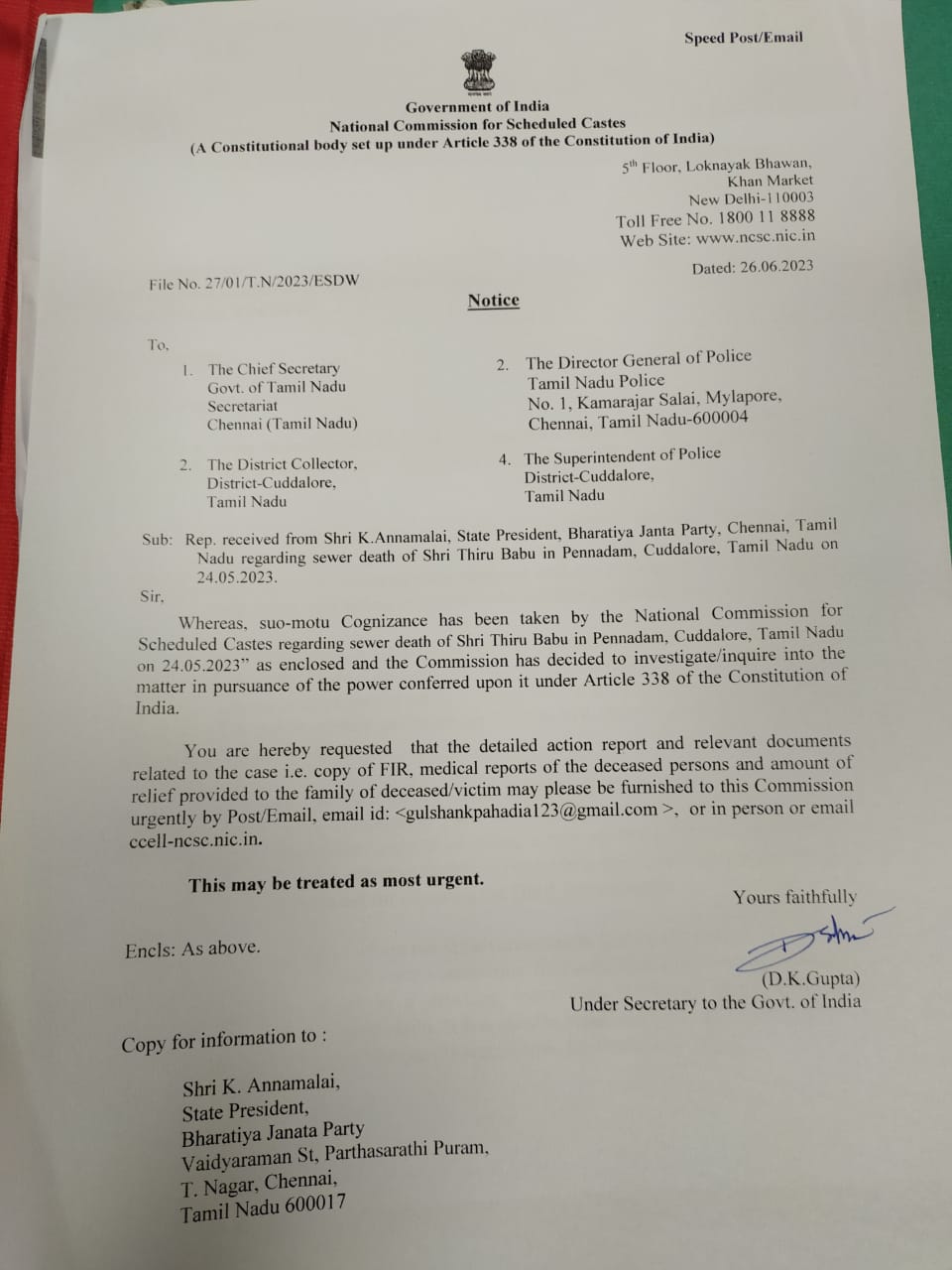
On 26 June 2023, the National Commission for Scheduled Castes (NCSC) issued a notice to the Chief Secretary of Tamil Nadu, the Director General of Police, the District Collector, and the Superintendent of Police of Cuddalore district, requesting a detailed action report and relevant documents concerning the death of a hygiene worker in Cuddalore.

The NCSC took suo-motu cognizance of the incident involving Babu, who was employed in the Pennadam Town Panchayat of Cuddalore district and passed away on 24 May 2023. In the notice, the NCSC instructed officials to provide a copy of the First Information Report (FIR), medical reports, and information about any financial support given to the deceased worker’s family. Urgency was emphasized, and the concerned officers were urged to treat the notice as a top priority.

Earlier, Chairperson of National Commission for Safai Karamcharis (NCSK) Ma. Venkatesan along with a team of officials visited Pennadam on 3 June 2023 to inquire about the incident. He also visited the spot where the deceased Babu was made to enter the drain and clean it.

Tamil Nadu BJP President K. Annamalai had collected the information and submitted it to the NCSC urging them to take appropriate action.

It is worth noting that Babu’s death became a matter of political controversy in Tamil Nadu. BJP Tamil Nadu State Secretary SG Suryah was arrested on the intervening night of 16 and 27 June 2023 for his statement against Madurai Communist Party of India (Marxist) MP Su Venkatesan over the death of a hygiene worker who was allegedly forced to clean a faeces-filled drain by a Communist councillor. Suryah inadvertently mentioned that the incident happened in Madurai instead of Cuddalore.

According to Babu’s wife Deepa’s statement in the FIR, Babu was instructed by Ward Councillor Viswanathan on 19 May 2023 to clean the sewer line in ward number 12 of the Pennadam Town Panchayat. Deepa mentioned that Babu fell unconscious immediately after entering the sewer line near Sillupanur Road in Mettutheru and was quickly rushed to a private hospital in Pennadam. He was subsequently transferred to a private hospital in Perambalur for further treatment and then to Cauvery Hospital in Trichy. Unfortunately, Babu did not respond to the treatment and passed away in the early hours of 24 May 2023. Deepa accused the ward councillor and town panchayat administrators of failing to provide safety equipment for Babu during the sewer cleaning process.

Click here to subscribe to The Commune on Telegram and get the best stories of the day delivered to you personally.
North-Indian Officers Appointed To Top Positions In TN, Netizens Question “Dravidian Model”

In what appears to be ironic, the Tamil Nadu government announced several high-level appointments on 29 June 2023, raising eyebrows among netizens.

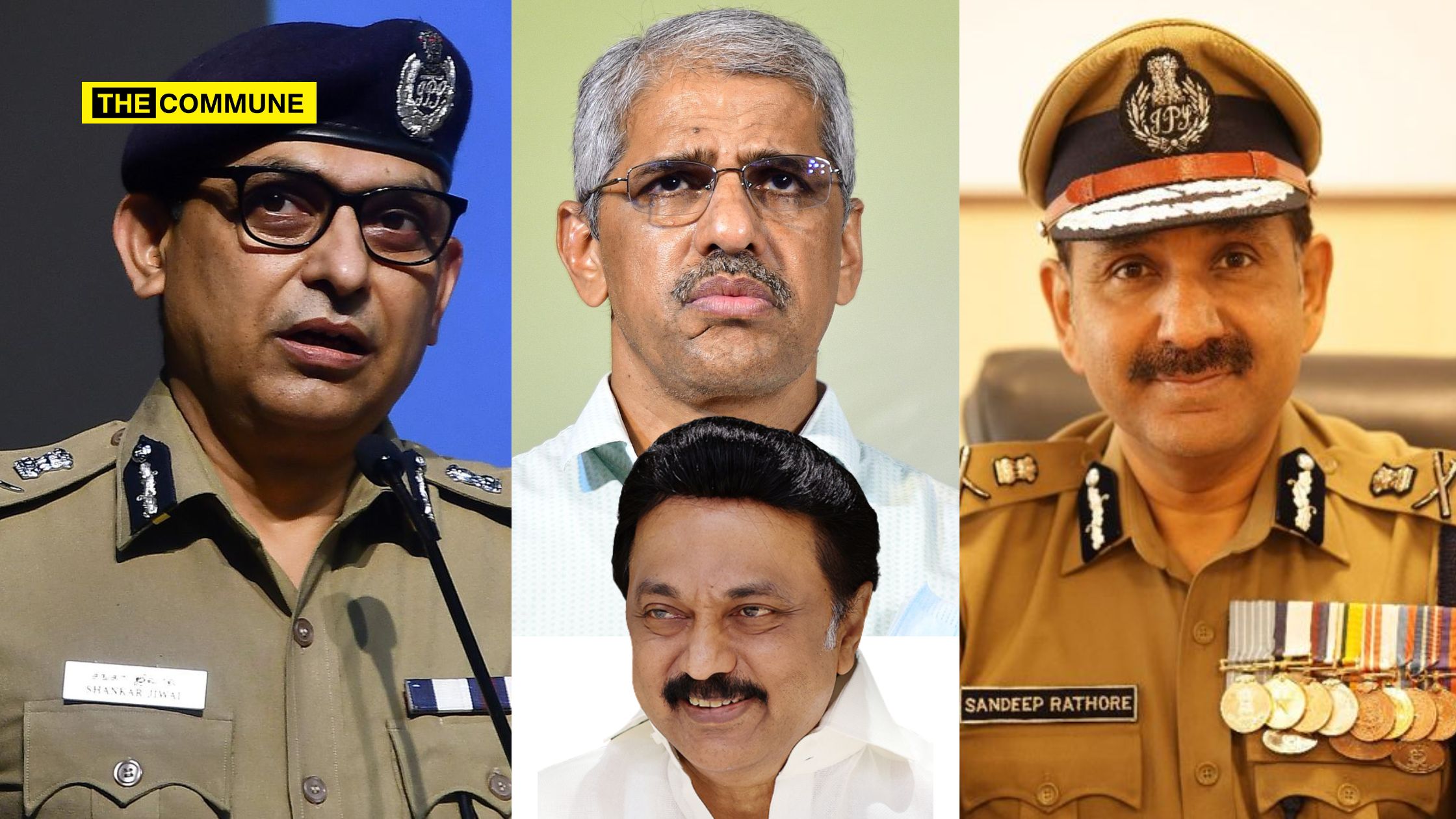
Shankar Jiwal, a 1990-batch Indian Police Service (IPS) officer, was appointed as the new Director General of Police/Head of Police Force, replacing C Sylendra Babu upon his retirement on 30 June 2023. Sandeep Rai Rathore, DGP (training) from the Police Traiing College, was named the new Commissioner of Police, Chennai, taking over from Shankar Jiwal.

Shankar Jiwal was appointed as the City Police Commissioner earlier this year as the DMK assumed power in Tamil Nadu. His tenure is said to last for two years. In addition to this, it was also announced that Shiv Das Meena will take over as the new chief secretary of the state.
However, what raises eyebrows further is that none of the newly appointed officials, including Shankar Jiwal, Sandeep Rai Rathore, and the state’s new chief secretary, Shiv Das Meena, hail from Tamil Nadu or are of Tamil origin.

Shiv Das Meena, a 1989 batch Indian Administrative Service (IAS) officer, will assume the position of chief secretary. He is a native of the Tonk district in Rajasthan. Sandeep Rai Rathore, a native of New Delhi, who completed his studies at the prestigious Delhi School of Economics, is set to take on the role of Commissioner of Police, Chennai. Similarly, Shankar Jiwal, although originally from Uttarakhand, the only exception is that he belongs to the Tamil Nadu IPS cadre.

The appointment of these non-Tamil individuals to prominent positions has raised questions, particularly in light of the members of the DMK indulging in hate politics against the “north Indians.” It seems ironic that the DMK government which earlier accused the erstwhile AIADMK government of appointing north Indians in government jobs has now placed individuals from outside the Tamil community in the highest posts of the state government.

Click here to subscribe to The Commune on Telegram and get the best stories of the day delivered to you personally.
Former CPI Town Secretary Commits Suicide Allegedly Due To Police Torture During Interrogation, Wife Also Alleged Tortured

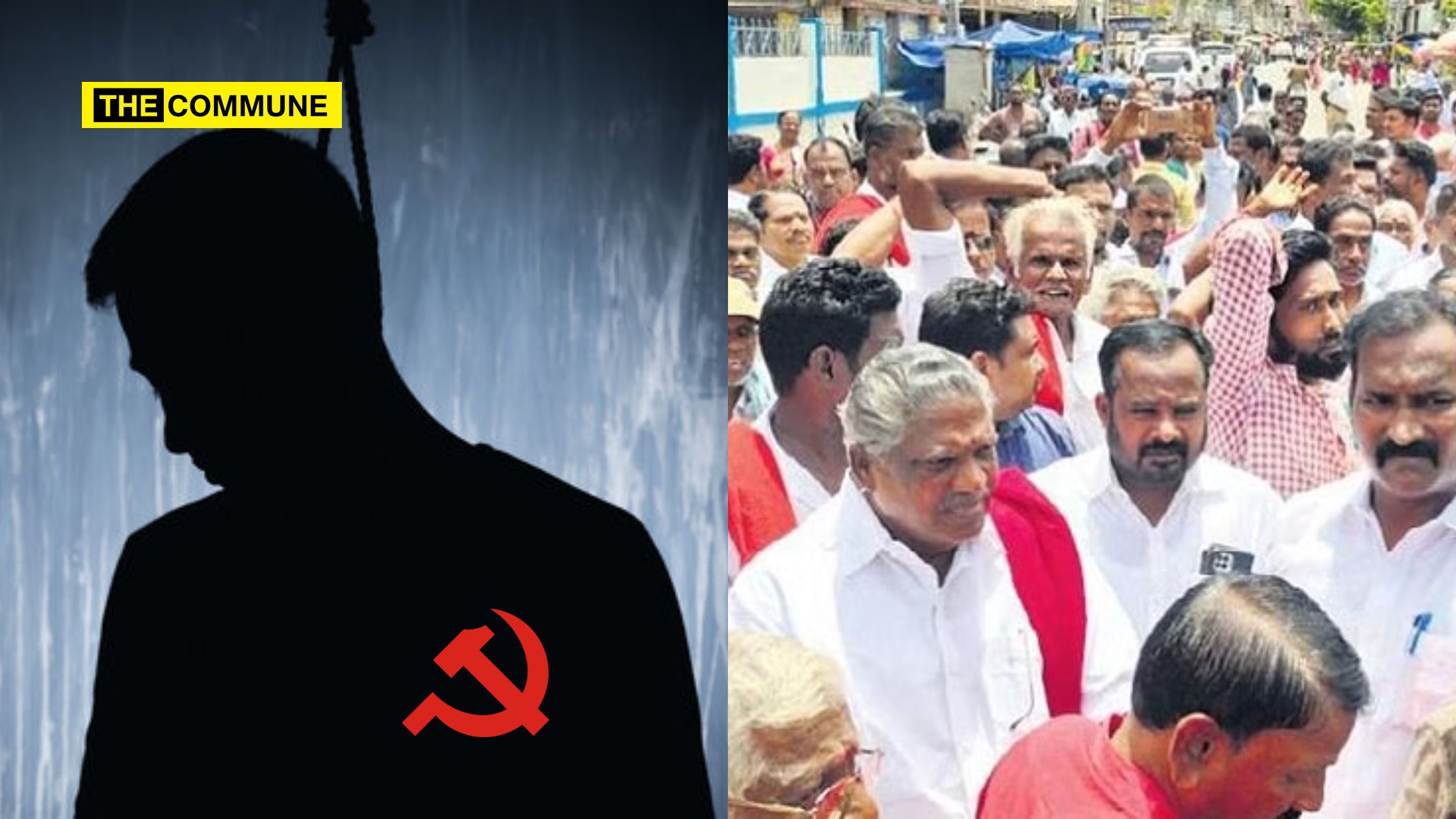
In a tragic incident that has sent shockwaves throughout the Pudukottai locality, a 58-year-old jeweller and former town secretary of the Communist Party of India (CPI), P Rajasekaran, allegedly died by suicide on Sunday night (June 25). The incident occurred just days after he was taken into police custody for interrogation. The news of his death has prompted widespread condemnation of the police, with allegations of custodial torture emerging.

The circumstances surrounding Rajasekaran’s death have ignited public anger and led to protests in the town. Traders, along with the deceased’s family members and CPI functionaries, staged a road blockade on Monday, demanding justice and an end to custodial torture. The sub-inspector of police who headed the interrogation has been placed on compulsory wait pending further investigation.

A protest march was organized to the Pattukkottai government hospital, where Rajasekaran’s body was taken. As a mark of solidarity, local jewellery shops remained closed on Monday, emphasizing the collective outrage against the alleged police brutality.

According to sources, Rajasekaran was apprehended by officers from the K K Nagar police station in Tiruchy on June 22 on charges of jewellery theft. His wife was also summoned for questioning, and a search was conducted at their residence. Both were released on June 24.

However, on Sunday, Rajasekaran failed to return home and was later discovered dead near the railway tracks in the Chettiakkadu area, near Pattukkottai. The railway police retrieved his body, which was subsequently sent to the Pattukkottai government hospital for a post-mortem examination. The police have classified the death as a suicide.

The news of Rajasekaran’s demise has elicited strong reactions from various political figures and leaders. CPI state deputy secretary N Periyasamy, Tiruthuraipoondi MLA K Marimuthu, former MLA G Palanichamy, and district secretaries M Uthirapathy and M A Bharathi engaged in talks with police officials, demanding action against those responsible for the alleged custodial torture. Former MLA N R Rangarajan further called for a CB-CID (Crime Branch-Criminal Investigation Department) investigation into the matter.

Meanwhile, the opposition leader in Tamil Nadu and general secretary of the All India Anna Dravida Munnetra Kazhagam (AIADMK), Edappadi K. Palaniswami, criticized the ruling DMK (Dravida Munnetra Kazhagam) government for the incident. Edappadi said, “Rajasekhar, a former Pattukottai town secretary of the Communist Party of India, one of the political organisations that continues to support the Vidiyal government and puppet CM MK Stalin, has committed suicide as a result of police torture.”

Palaniswami added, “There are reports that Rajasekhar has been taken by police from Trichy area for enquiry, claiming that he had bought stolen jewelery from someone a few days ago. Mr. Rajasekhar’s father Mr. Pichaikannu Paththar lived in this area with great dignity. According to the people of Pattukottai area, these people are from good families and have no chance of doing something like this. Though it is said that inquiry is a routine thing in the jewelry business, It seems that his wife was also taken into custody without any connection in the case and tortured in the name of investigation. Due to this, Mr. Rajasekhar jumped in front of the train and committed suicide.”

He stated, “A separate body should be formed to investigate Rajasekhar’s alleged suicide. As a relief, Rs 50 lakhs should be given to their family. I also urge the inept Chief Minister MK Stalin and the Vidiyal DMK government to take legal action against all those responsible, including the police officers who detained and tortured the CPI member.”

(With inputs from New Indian Express)

Click here to subscribe to The Commune on Telegram and get the best stories of the day delivered to you personally.


Family Faces Social Ostracism In Dharmapuri District

A local Chitling panchayat in Arur, Dharmapuri district, has found itself embroiled in controversy after it ostracized a family, sparking concerns about social justice and discrimination. The incident is particularly contentious as it occurred in the district represented by DMK Dharmapuri MP Senthil Kumar, who has positioned himself as a champion of social justice.

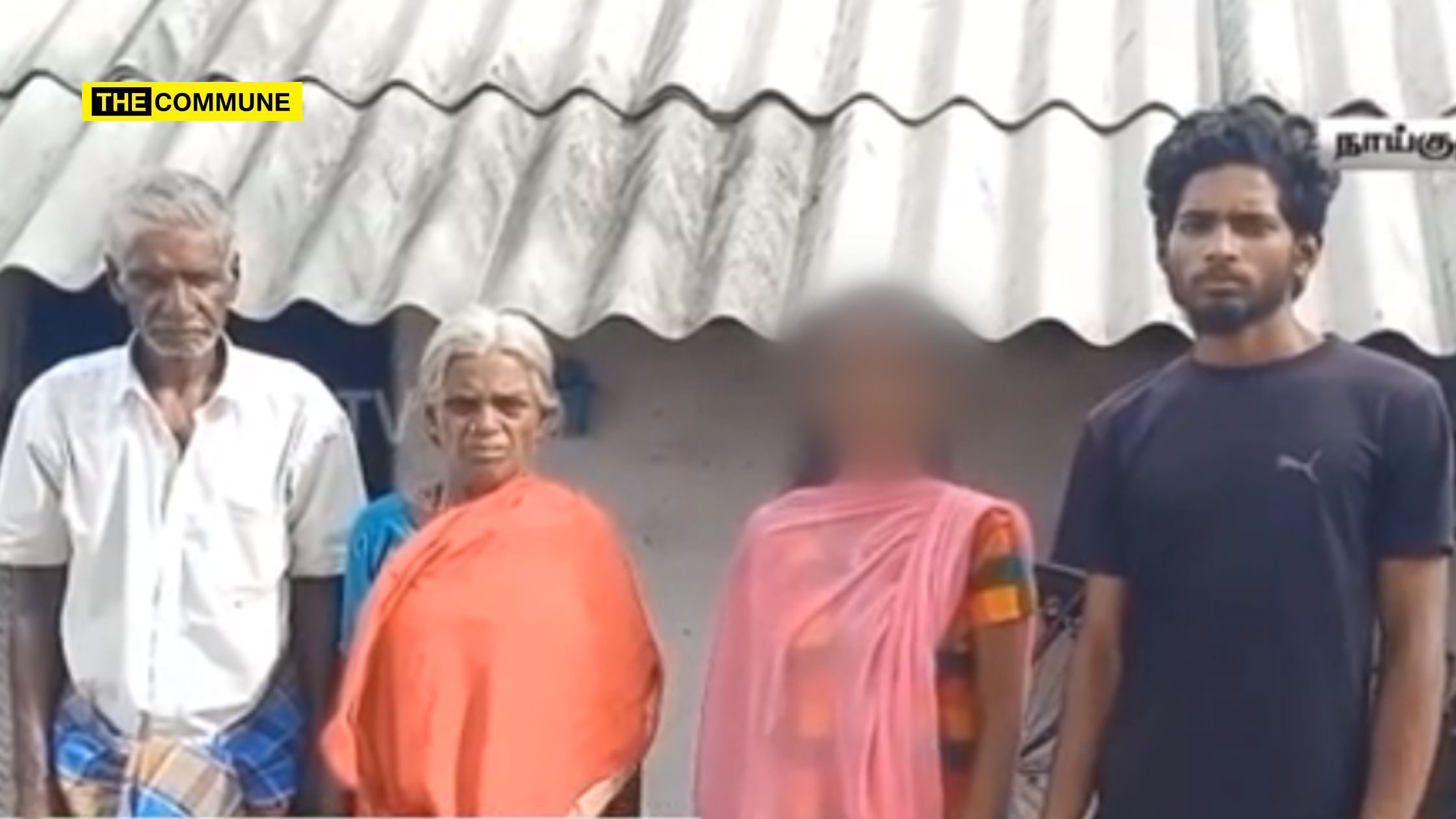
The dispute dates back thirty years when Chinna Kiriyan, belonging to the Scheduled Tribe, sold three cents of land to Arumuga Kavundar, the son of Varathappa Goundar, who resides in a neighboring garden. The sale was necessary as it provided access to Arumuga Goundar’s garden. However, it is alleged that sixteen years later, Sakthivel Gounder, the son of Arumugam Gounder, fraudulently registered a fake deed claiming ownership of the entire five cents of land.

When Chinna Kiriyan demanded the return of the land that legally did not belong to Sakthivel, the latter, who hails from a numerically dominant community, employed his influence to ostracize Chinna Kiriyan’s entire family. The family has reportedly faced social boycott for nearly five years, making it difficult for the children to attend school and interact with their peers.

In response to their plight, the Scheduled Tribe family has submitted a complaint to the Dharmapuri district collector, urging action against those responsible for their social ostracism and boycott.

Notably, the Member of Parliament representing the Dharmapuri constituency is Dr. Senthil Kumar, who has publicly identified himself as the grandson of Vadivelu ‘Gounder.’ While Senthil Kumar has projected himself as a social justice warrior and advocated for the eradication of caste divisions, critics question whether he will ensure justice for the tribal family allegedly facing social boycott by individuals from his own caste within the same district.

(With inputs from Thanthi Tv)

Click here to subscribe to The Commune on Telegram and get the best stories of the day delivered to you personally.
TN Governor Ravi Dismisses Senthil Balaji From Stalin’s Council Of Ministers

In an unprecedented move, Tamil Nadu Governor RN Ravi dismissed V. Senthil Balaji from MK Stalin’s Council of Ministers.

The office of the Governor in a press release stated that Senthil Balaji is facing serious criminal proceedings in a number of corruption cases including taking cash for jobs and money laundering.

“Abusing his position as a Minister, he has been influencing the investigation and obstructing the due process of law and justice.”, the press release said.

“Currently he is in judicial custody in a criminal case being investigated by the Enforcement Directorate. Some more criminal cases against him under Prevention of Corruption Act and the Indian Penal Code are being investigated by the State Police.”, the press release further added.

The office of the Governor noted that there are reasonable apprehensions about Senthil Balaji continuing as a Minister as it may adversely fair investigation and due process of law eventually leading to a breakdown of Constitutional machinery in the state.

This particular line has raised the eyebrows of political observers with speculations of dismissal of the DMK government itself in the state.

“Under these circumstances, Hon’ble Governor has dismissed Thiru. V. Senthil Balaji from the Council of Ministers with immediate effect.”, the press release said.

Click here to subscribe to The Commune on Telegram and get the best stories of the day delivered to you personally.