Home Blog Page 875

Capital Chennai’s Chaos: Potholed Roads In Monsoon Offer Free Mud Baths

Feature Image Courtesy: Sidharth.M.P X handle

Tamil Nadu Chief Minister MK Stalin announced on 21 September 2023, that a comprehensive survey of the road conditions in Chennai and various districts across the state will be initiated in the coming week. This decision came in response to a growing chorus of grievances from the public regarding the deplorable state of roads in the region, which has only worsened with the onset of North East monsoons.

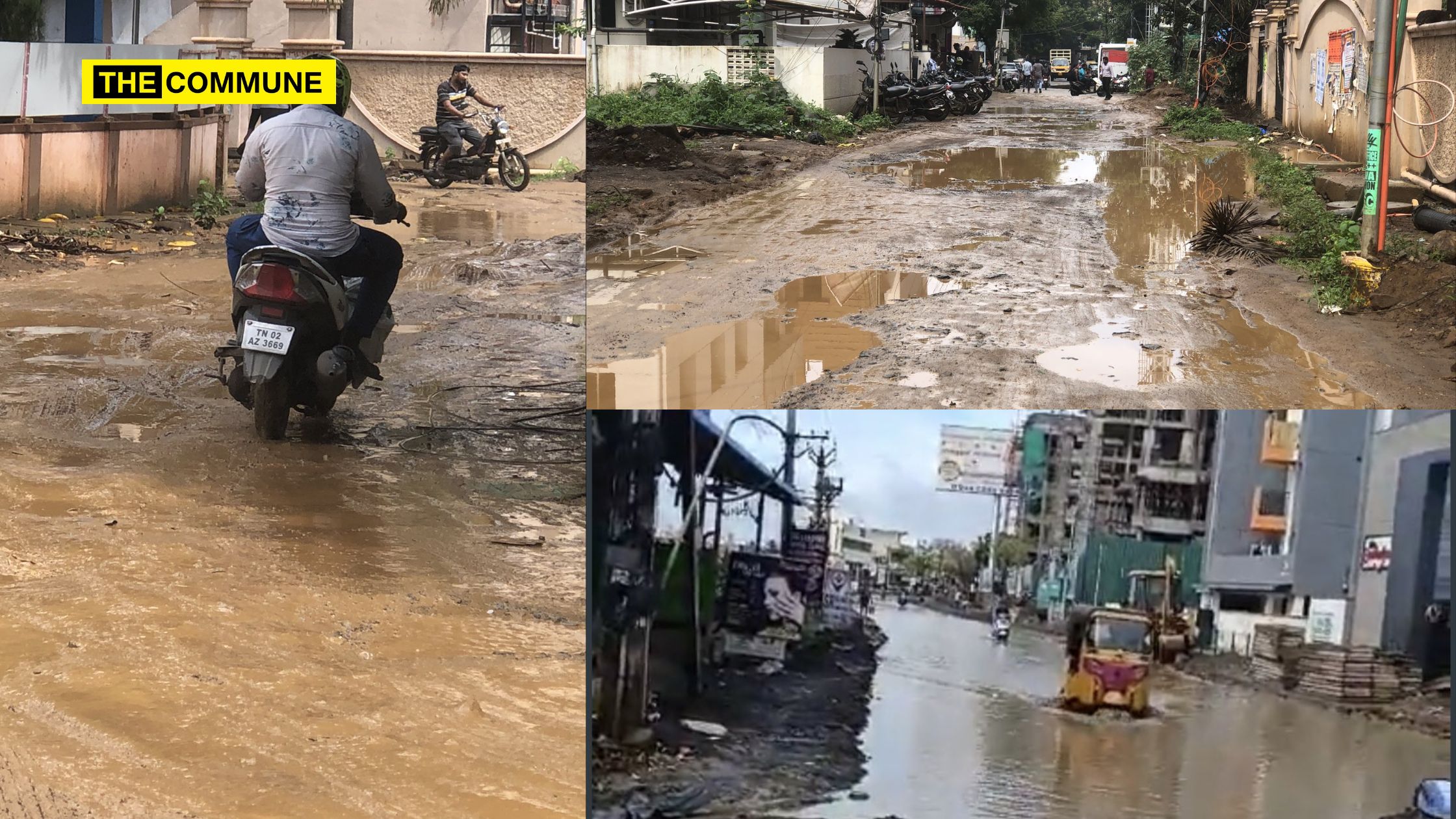
Stalin pledged his personal commitment to overseeing the efforts to enhance and repair the dilapidated road infrastructure. The persistently dire condition of roads in Chennai, compounded by the recent heavy rainfall, has left commuters in a state of considerable discomfort. The roads have essentially turned into veritable mud baths, making daily travel an arduous ordeal for the hundreds of employees who rely on these routes to earn their livelihoods.

Critics argue that the government’s response to this predicament has been conspicuously lacking in urgency and efficiency. The condition of Chennai’s roads serves as a stark reminder of the administration’s under-preparedness for the monsoons.

The rains have exposed the pathetic condition of many roads including those that lead to the offices of big international companies in the heart of the city.

The roads in Guindy Industrial Estate turned into a marshy mess just after a few spells of rain.

The main road adjoining the gate of Olympia Tech Park which is one of the busiest junctions in the city has also turned into nightmare for motorists.

The shortcut from St. Thomas Hospital near Military area which leads to Olympia Tech Park has turned into a muddy pool causing extreme inconvenience and posing serious threat to motorists as it leads to skidding.

In a few cases, authorities sprung into action after it was highlighted by a prominent journalists.

However, many areas in the city have pot-holed roads posing serious hazard and causing severe traffic jams.

Netizens have taken to social media to vent their frustrations, expressing disappointment in the DMK government’s failure to uphold its promise of ensuring better road infrastructure prior to the monsoon season. They have shared images and accounts of the abysmal road conditions in Chennai, underlining the need for immediate action to rectify this pressing issue.

Subscribe to our channels on Telegram and WhatsApp and get the best stories of the day delivered to you personally.

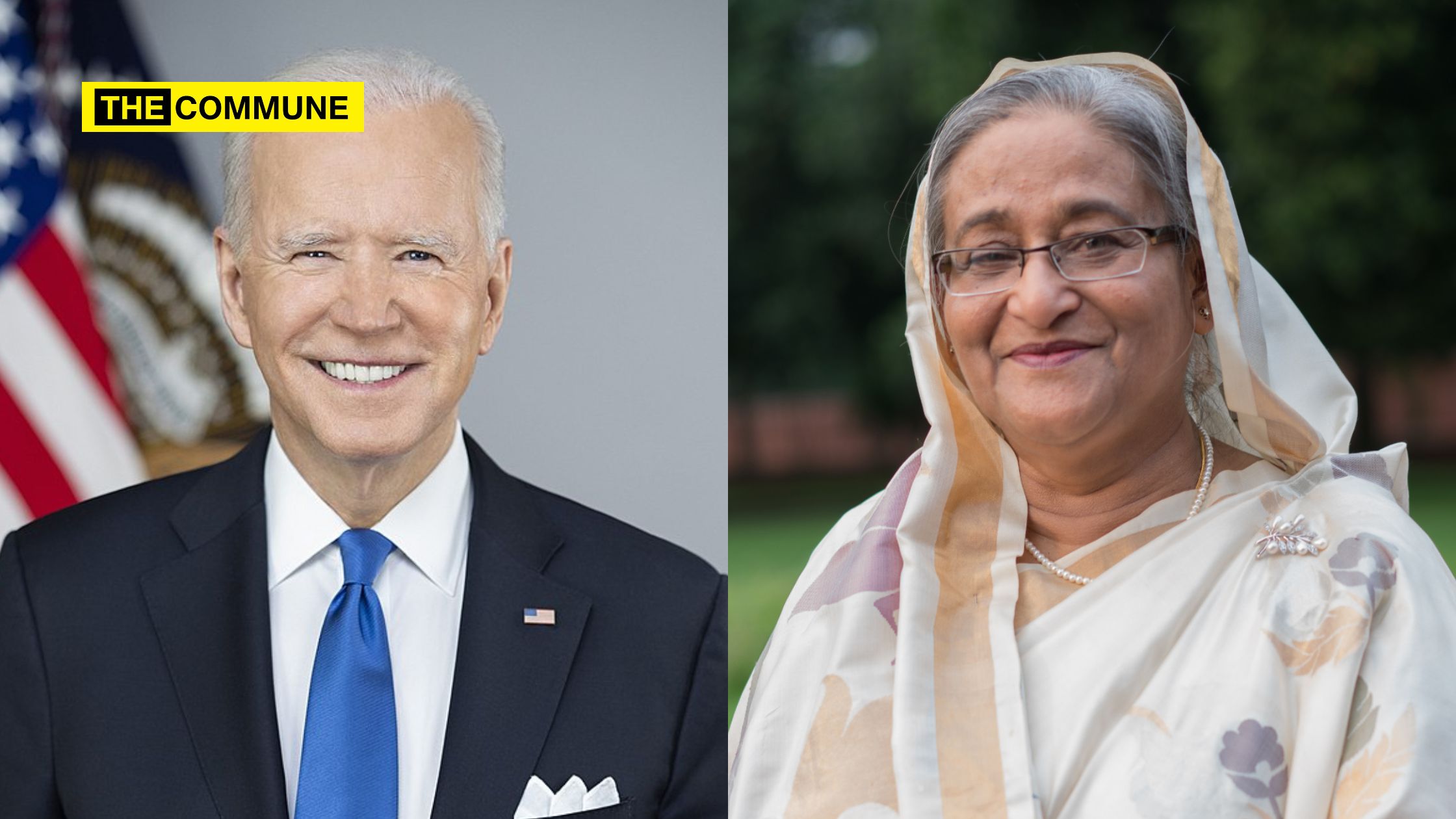
Is US Trying To Engineer Regime Change In Bangladesh To Bring A Radical Islamist Party To Power?

There are clear signs that the United States of America is interfering in the affairs of Bangladesh and trying to get rid of Prime Minister Sheikh Hasina’s government. Elections are set to place in Bangladesh in January 2024, with the Awami League, led by Sheikh Hasina, seeking a third consecutive term.

Sheikh Hasina has held the position of Prime Minister in the country since 2009 and is known for her centrist political views and has been very active on the international stage, representing Bangladesh in various global forums and advocating for issues such as climate change, refugee crises, and regional cooperation. However, now the incumbent is in trouble with the US which wants a political change to take place.

Now it seems the US is leaning towards the Bangladesh Nationalist Party (BNP) which was founded in 1978 by General Ziaur Rahman, a former military officer who became the country’s President. BNP at present gets a lot of support from the Islamists who want Sharia law implemented in one of the most secular Muslim-majority countries. 

Just two months before the elections, there are allegations that the United States government, its agencies, and the media with ties to them are involved in a “regime change operation” in Bangladesh. Efforts are currently underway to manipulate the public’s perception of the current Bangladeshi Prime Minister, Sheikh Hasina, portraying her as an “authoritarian leader.” The Joe Biden-led US government is being accused of interfering in the election process under the guise of “protecting democracy” and ensuring “free and fair elections” in the Islamic Republic.

Also, whenever the photo of a political leader from Asia, Africa, or South America appears in Time Magazine, it must be understood that their time has run out. The US which has powerful state and non-state agencies is utilizing its supportive media outlets, and local representatives in Bangladesh with the resolute in its pursuit of a ‘regime change initiative’ under the pretext of reinstating democratic governance.


In fact, in a statement, Hasina said, “They (US) are trying to eliminate democracy and introduce a government that will not have a democratic existence…It’ll be an undemocratic action,”.

In her own Parliament, she said, “They are trying to eliminate democracy and introduce a government that will not have a democratic existence,”.

https://twitter.com/WorldTimesWT/status/1647540843539046403?ref_src=twsrc%5Etfw%7Ctwcamp%5Etweetembed%7Ctwterm%5E1647540843539046403%7Ctwgr%5Ef8a254754fc0a1c868526bd5ae3894a76c1ad3d6%7Ctwcon%5Es1_&ref_url=https%3A%2F%2Fwww.opindia.com%2F2023%2F11%2Funited-states-regime-change-operation-bangladesh-election-sheikh-hasina-government%2F


Salah Uddin Shoaib Choudhury, who is a journalist based in Bangladesh has been writing for months about how the US has been interfering in Bangladesh’s internal politics.

In an article that he wrote for OpIndia, Choudhury says,During the past fourteen years, Sheikh Hasina has been committedly confronting Islamists and jihadists thus forcing Islamists on run. But, despite his disastrous retreat from Afghanistan and pushing the country to the mercy of Taliban mullahs, it seems US President Joe Biden did not learn any lesson. He is now repeating the same blunder in Bangladesh by extending patronization to Islamist forces in Bangladesh, especially Jamaat-e-Islami and their ideological partner Bangladesh Nationalist Party (BNP).

With Bangladesh’s upcoming general election scheduled for January 2024, various Islamist groups, including Jamaat-e-Islami and BNP, are vigorously striving to regain power with the backing of Western governments, particularly the Biden administration. Due to the determined efforts and lobbying of these Islamist factions, the Biden administration is currently in the process of invoking the Global Magnitsky Act to impose sanctions on a substantial number of leaders from the ruling party, as well as members of civil and military administrations, on allegations of corruption and money laundering. These measures could potentially serve as a justification for these Islamist groups to garner increased local support in the country.

In 2014, Islamists conducted organized bombings and arson incidents targeting religious minority groups, notably singling out the Hindu community. This was in retaliation for their perceived “offense” of supporting the Awami League in the elections. During this period, Hefazat called for the transformation of Bangladesh into a Caliphate, while the BNP and Jamaat demanded the reinstatement of a “caretaker government” system to supervise elections, a practice that had been eliminated by Bangladesh’s Jatiya Sangshad (National Parliament).

For a long time unable to find any political traction, Jamaat-e-Islami and its ideological partner, the BNP, have consistently labeled Prime Minister Sheikh Hasina and the leaders of the ruling Awami League as “agents of Hindus and India” which is a powerful call to divide this secular country.

In certain statements, both Jamaat and BNP have accused Sheikh Hasina of appointing Hindus to influential positions within government offices, the armed forces, law enforcement agencies, and the judiciary. They have even gone so far as to assert that Sheikh Hasina is transforming Bangladesh into a Hindu-dominated state or a subservient entity to India. Regrettably, these harmful assertions have not been adequately refuted by the ruling party or the state apparatus.

Many are calling the regime change in Bangladesh a checking mechanism for India which the US sees as a possible opponent in two decades’ time as its economy grows fast. The US has a history of interfering in the affairs of other nations often toppling governments through election manipulation or violent revolution. The US now sees India as the hegemon power in Asia which has the capability to provide net security.

As India also heads for a general election in 2024, what is now taking place in Bangladesh is an ominous sign taking place right in its neighborhood.

(Balaji is a political commentator and columnist. He tweets @LaxmanShriram78)

Subscribe to our channels on Telegram and WhatsApp and get the best stories of the day delivered to you personally.
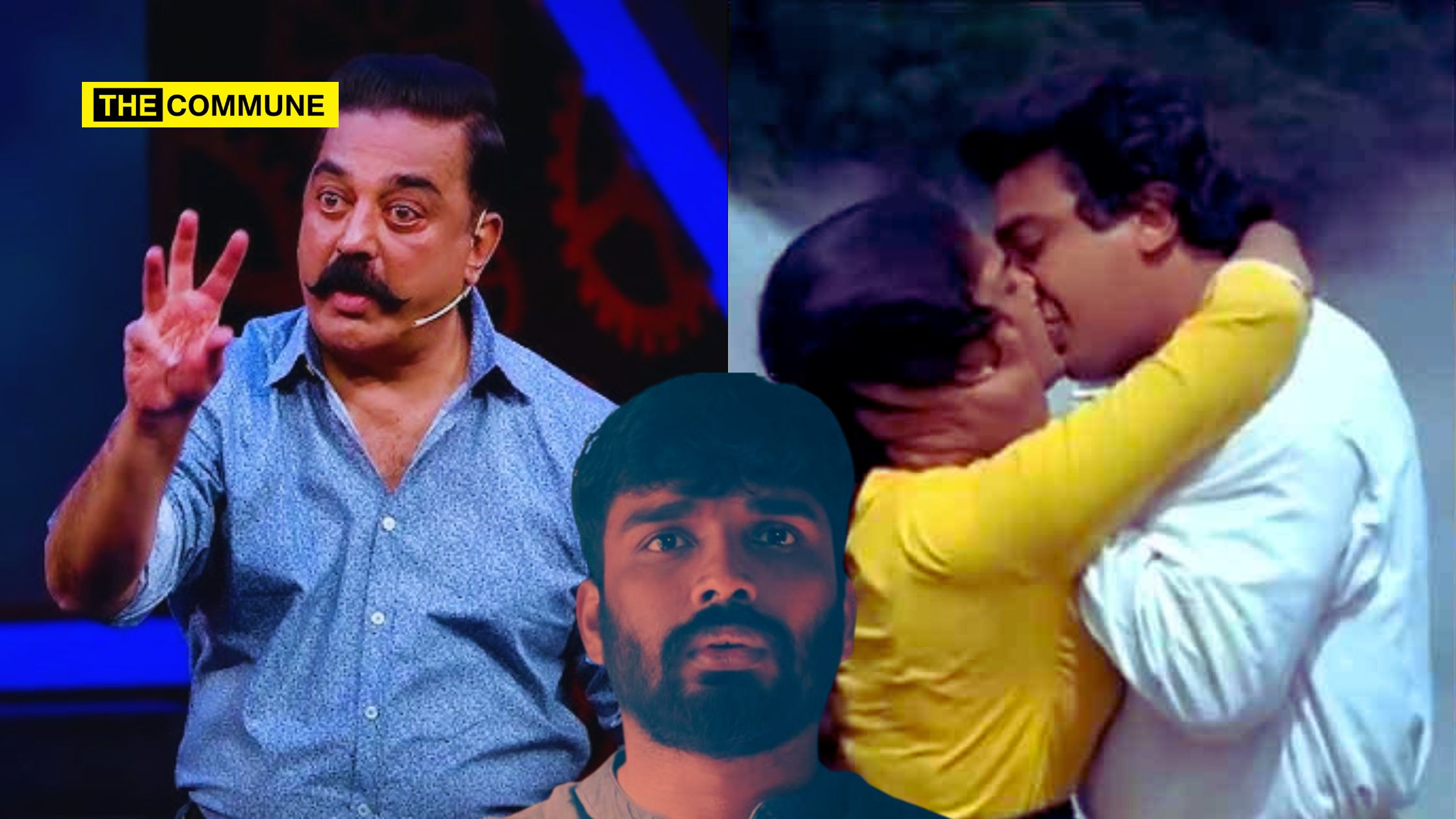
Kamal Who Kissed Underage Actress Without Consent Eliminates Bigg Boss Contestant In The ‘Interest Of Women Safety’

Irony just died a thousand deaths when Bigg Boss anchor and part-time politician Kamal Haasan, who has been accused of kissing an underage actress on screen without her consent in his early days, eliminated actor Pradeep Anthony from the Bigg Boss house with a red card expressing concerns about “women safety”.

This week’s episode of Bigg Boss Tamil 7 has become a topic of intense discussion and debate, making it one of the most talked-about episodes in the history of the reality show.

The episode saw the issuance of a red card to Pradeep Antony, one of the most influential contestants of this year’s season. Pradeep had garnered considerable attention for his unapologetic behavior and unique game strategy. However, due to concerns raised by the majority of contestants alleging “safety of women” in his presence, he was handed a red card.

During the episode on November 4, Kamal Haasan welcomed the contestants, with most of them wearing red cloth on their hands as a form of protest against Pradeep. During the season’s premiere, Kamal Haasan had distributed red cloth to all the contestants, encouraging them to use it as a symbol of their stand against injustice.

Several contestants, including Jovika, Maya, Poornima, Nixen, Raveena, Vishnu, Cool Suresh, Annabarathi, and Saravana Vickram, expressed their grievances against Pradeep. They cited instances of him making insensitive remarks about women and intimidating fellow contestants, creating an uncomfortable atmosphere inside the house. They also noted his lack of remorse despite repeated objections to his behavior.

Pradeep was given the opportunity to share his perspective, where he stated that many in the house had engaged in similar behavior and used offensive language. He claimed that he would protect all the contestants as an artist but not as a competitor. During his speech, Manichandra interjected, revealing that Pradeep had used the restroom without locking the door in the presence of women. When he was asked to lock the door for the women’s safety, he did not respond appropriately. Pradeep confessed that he had intentionally acted in this manner. Kamal Haasan abruptly halted Pradeep from explaining further, thus preventing him to let explain his side of the story in full.

Kamal Haasan then individually interviewed all the contestants, seeking their opinion on whether Pradeep should receive a red card or be allowed to continue in the game. The majority of the participants favored issuing a red card to him.

In the confession room, Kamal Haasan explained the decision to Pradeep, emphasizing that it was not a personal choice but the result of a democratic process. He stressed that the safety of women was his top priority and that he had consulted the show’s organizers. Kamal Haasan made a surprising revelation by stating that he would have left the show if Pradeep had been allowed to continue.

My opinions on this issue, you would’ve understood a little by now. But basing it only on my opinion.. just because I hold the card, I can’t use it to express my anger or take a side and take a decision. I’ve gone through a democratic process. Majority of them don’t like you to stay in this house. Importantly, women don’t feel safe. So, instead of going there again and engaging in a war of words, you can leave from here. Your suitcase will reach you.“, told Kamal Haasan which Pradeep Anthony gracefully accepts and leaves.

https://twitter.com/BBTamilVideos/status/1720851067507028004

Pradeep Antony had gained significant attention for his behavior on the show and received applause during weekend episodes, ultimately earning the support of the audience. Following the issuance of the red card, Pradeep took to his social media page to share his response.

Vichithra, one of the show’s strongest contestants, felt that the decision to oust Pradeep was unfair, suggesting that the contestants should have addressed his behavior earlier and set boundaries. Vichithra expressed concern that Pradeep had left the house with a negative image that could impact his life.

VJ Archana said that she personally felt safe with Pradeep and pointed out the hypocrisy of a few and picking on Pradeep alone.

Maya and Poornima expressed their desire for a discussion on the matter and did not anticipate that Pradeep would receive a red card.

Pradeep Antony’s close friend and actor Kavin shared a photo with him, emphasizing that those who know him well will always understand him.

Niroop Nandakumar, in a post, described the decision as unfair and suggested that it was a cruel and unjust way to remove Pradeep from the show. He believed that Pradeep’s stand had triggered the decision.

One user pointed out that Azeem (winner of Bigg Boss Tamil 6) had made transphobic and disrespectful comments but had not received a red card. Another user clarified that Azeem had indeed received a red card, but no action had been taken.

Sanam Shetty, a past contestant, criticized Pradeep’s removal as unfair, expressing disappointment in Kamal Haasan’s decision and the failure to establish the veracity of the allegations against him. She questioned the contestants’ stance, citing their interactions with Pradeep and the lack of action taken against them for various inappropriate behaviors.

Dance choreographer Sathish Krishnan also expressed disappointment over Pradeep’s eviction.

In light of this, many netizens lashed out at Kamal Haasan for shunting out Pradeep from the house undemocratically. Kamal’s past deeds as an actor has come back to haunt him with netizens questioning his virtue-signalling on “women safety”.

It is worth noting that Kamal Haasan was once accused of kissing an underage actress on screen without her consent. The alleged incident occurred during the shooting of the movie Punnagai Mannan, during which he kissed Rekha, a 16-year-old actress who had just completed 10th grade back then.

The visuals of the song “Enna Satham Indha Neram” show Kamal Haasan having sex with the 16 year old actress semi-naked.

In an interview with a YouTube channel, actress Rekha said, “I had no idea about the kissing scene. I was only 16 at the time. Neither Kamal nor Director Balachander informed me that there would be a kissing scene. I felt horrible after filming the kissing scene.”

Kamal Haasan found himself at the receiving end when his support for female wrestlers protesting against Brij Bhushan was mocked on social media. There were even calls to file a POCSO case against him for kissing an underage actress without her permission.

Subscribe to our channels on Telegram and WhatsApp and get the best stories of the day delivered to you personally.
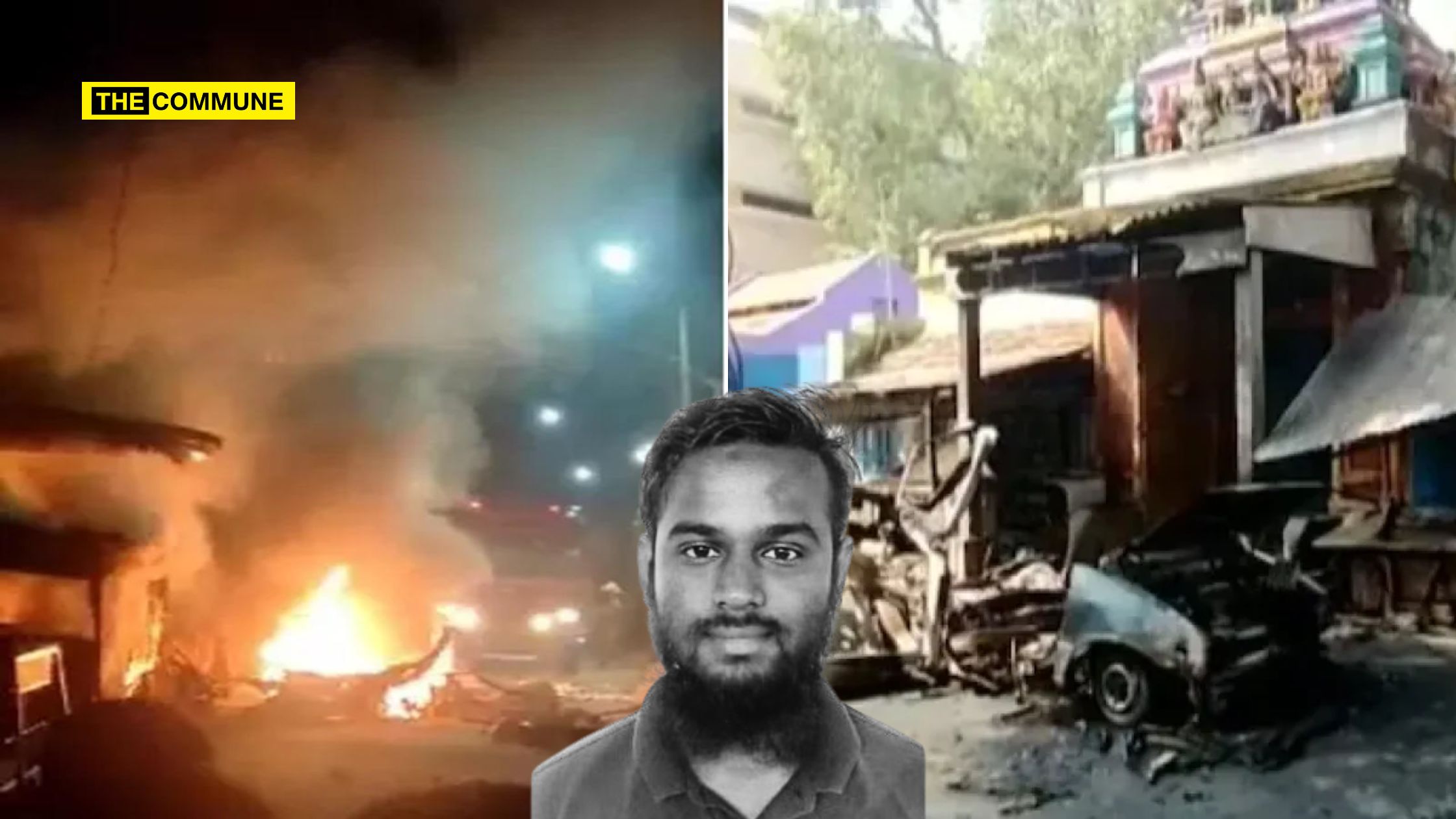
NIA Arrests 15Th Man In ISIS-Inspired Coimbatore Bomb Blast Case, Once Again Asserts It To Be A Terror Attack

The National Investigation Agency (NIA) has arrested Thaha Nazeer in connection with the car bomb explosion in Coimbatore. Nazeer, employed as a painter at an automobile sales and service company, had a prior encounter with Jamesha Mubeen, the terror suspect who died in the blast outside Kottai Easwaran Temple in Coimbatore.

Nazeer is now the 15th individual to be detained in connection with the case and is suspected of having prior knowledge of the explosion. The NIA has submitted two chargesheets encompassing a total of 11 accused.

Nazeer was taken into custody on Thursday and presented before a special court handling NIA cases in Poonamallee, Chennai, on Friday (3 November 2023)

According to Times of India, Nazeer and Jamesha Mubeen, a 29-year-old resident of Kottaimedu, had met at least three to four days before the car bomb detonation. Their meeting took place at a rental house on HMPR Street in Kottaimedu, where they conversed for over an hour. Significantly, their interaction occurred in a room containing carton boxes with explosive materials. Nazeer encountered Mubeen once again at the same location, just one day prior to the car explosion, during which Mubeen lost his life.

Mubeen’s widow disclosed their meeting with Nazeer during her statement to a judicial magistrate. Subsequently, Nazeer was detained by the NIA based on this revelation. Sources also suggest that Nazeer had prior knowledge of the car bomb explosion. Additionally, Nazeer and Mohammed Thoufiq (25) of Podanur were childhood friends, with the local police having arrested Thoufiq in the aftermath of the car bomb explosion. Reportedly, Mubeen had handed Thoufiq a handwritten document detailing the bomb-making process.

The NIA had filed two chargesheets, one on April 20 and the other on June 2, implicating a total of six accused individuals in this case.

The 2022 Coimbatore Bomb Blast Terror Attack

The 2022 Coimbatore Bomb Blast is a terrorist attack where an LPG cylinder burst inside a Maruti 800 car at around 4.30 am on 23 October 2022, causing the vehicle to explode. The vehicle carrying the improvised explosive device was driven by Jamesha Mubeen. The blast happened outside the famous Kottai Eshwaran Temple. The explosion was initially believed to be an accident but a thorough investigation into the incident, revealed that the cylinder explosion was a terrorist attack committed by Islamic terrorists during the Diwali festival. Nails and ball bearings supposedly meant for inflicting maximum casualties were also recovered from the spot. Investigtors had recovered handwritten paper documents recovered from the house of Jamesha Mubeen listing the popular spots in Coimbatore that they had plans to recce or were already done. Chemicals used for making crude bombs were also found at his house.

Subscribe to our channels on Telegram and WhatsApp and get the best stories of the day delivered to you personally.
How BJP And Eknath Shinde’s Shiv Sena Could Benefit From The Maratha Quota Agitation

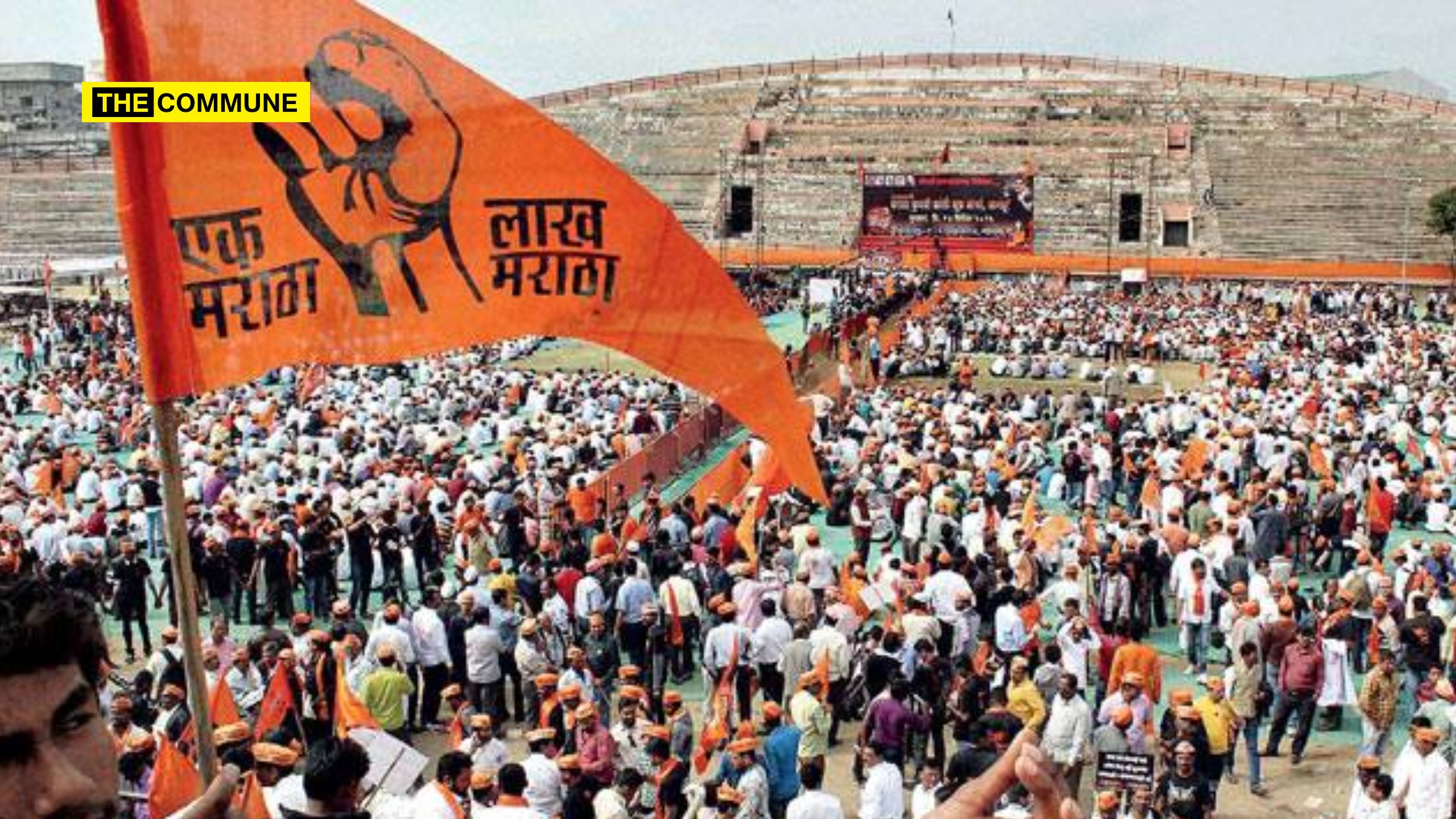
In a climate where the Sakal Hindu Samaj (a coalition of several Hindu socio political organizations) took to the streets, and with Maharashtra witnessing more than 125 rallies, it’s indeed hard to envision the popularity of such demonstrations without the participation of the majority Maratha community. The overwhelming support for these rallies underscores the significant role played by the Maratha community in these events.

In this backdrop of extensive rallies, the sudden demand for Maratha reservation and the subsequent agitation have undeniably left a profound impact on the political landscape of Maharashtra. Both the BJP and Eknath Shinde’s Shiv Sena have astutely capitalized on this issue to their political advantage.

The involvement and influence of the Maratha community in these developments have been pivotal, shaping the dynamics of the region’s politics. The interplay of community support, political maneuvering, and social dynamics has made this issue a central and transformative element in the political narrative of Maharashtra.

Political dynamics in Maharashtra have been in constant flux since 2019. However, signs of political instability emerged earlier, around 2017, when the Shiv Sena began criticizing the BJP, despite being in a coalition government. Initially perceived as friendly banter, this friction continued and escalated over time. The Shiv Sena, realizing that anti-BJP sentiments were gaining momentum, intensified its critique.

Tensions between the Shiv Sena and BJP reached a crucial point when Uddhav Thackeray, in a public meeting in 2018, launched a direct verbal assault on Prime Minister Narendra Modi, using strong language. However, despite these differences, the two parties later reconciled and contested together in the Lok Sabha and state assembly elections in 2019.

The turning point occurred when the BJP secured 105 seats, while the Shiv Sena won 63 seats. This led to a power struggle over the Chief Minister’s position, eventually resulting in the formation of the Maha Vikas Aghadi (MVA) alliance by NCP, aimed at keeping the BJP out of power. The BJP’s return to power became a reality after the Shinde faction broke away from the MVA and allied with the BJP. Following a protracted legal battle, the Supreme Court ordered the Speaker to decide on the disqualification of MLAs by December 31.

The intricate political maneuvering surrounding the Maratha reservation agitation can be summarized as follows:

The agitation was ignited by a man from Jalna district in the Marathwada region, who went on a hunger strike to demand Maratha reservations. This drew police lathi-charges, bringing Jarange Patil to the forefront as the face of the movement. The Maratha community rallied behind Jarange Patil, and opposition parties began visiting him.

As the agitation gained momentum, members of the ruling party engaged in negotiations. Initially, Jarange Patil demanded the inclusion of Marathas from Marathwada as Kunbi in the OBC category. The government accepted this demand and established a committee under Justice Shinde to facilitate the necessary proceedings. Subsequently, Jarange ended his hunger strike. Simultaneously, the OBC community began protesting against Jarange’s demand.

The coincidence of Jarange Patil’s agitation and the Supreme Court’s deadline for deciding on the disqualification petitions is indeed a compelling and intriguing factor. In the complex landscape of Maharashtra politics, the significance of not losing a Chief Minister from the majority community during such a high-intensity agitation cannot be overstated.

Historically, Maharashtra’s politics has been marked by sub-regionalism and caste-based considerations. In the Konkan region, for example, the Kunbi and Maratha communities are roughly equal in numbers and often political rivals. In Vidarbha, the movement led by Punjab Rao Deshmukh ensured that nearly all Marathas obtained the Kunbi certificate, shaping the political landscape. Western Maharashtra and Northern Maharashtra, on the other hand, revolve around issues related to sugarcane cooperatives.

Marathwada, as you’ve rightly pointed out, faces distinctive challenges, including drought, early marriages of girls, and limited landholdings. This region has garnered significant attention and support for the Maratha reservation agitation. Marathwada has a historical pattern of competition between Maratha strongmen and OBC leaders. Before 2014, leaders like former Chief Minister Vilasrao Deshmukh, a Maratha, and former Home Minister and OBC stalwart Gopinath Munde, emerged as successful grassroots leaders.

Following the passing of leaders like Munde and Deshmukh, Marathwada experienced a leadership vacuum. This vacuum inadvertently allowed Jarange Patil to step in and, at least for the less privileged Marathas, assume a leadership role in the region.

The interplay between regional dynamics, caste considerations, and leadership gaps adds layers of complexity to the Maratha reservation agitation and its political implications. It underscores the intricate nature of politics in Maharashtra and the factors that influence the political landscape.

In a calculated move, Devendra Fadnavis personally assured the OBC community that Marathas would not be included in the OBC category. Shinde, on the other hand, managed Jarange’s protest, and it was notable that the Shiv Sena, particularly a faction of Marathwada leaders, aligned with Shinde. It became evident that both Fadnavis and Shinde stood to gain politically from this agitation.

While the blame for the agitation is often attributed to Sharad Pawar’s opposition, it is important to note that in such situations, when the dominant caste becomes more vocal, the minority caste often consolidates against it. Jarange’s actions, which included a direct attack on Devendra Fadnavis, garnered sympathy from other communities, potentially strengthening the BJP’s position in upcoming elections. Additionally, Devendra Fadnavis, who had faced accusations of sidelining the OBC community, regained popularity among this group. By the end of the agitation, it was clear that Shinde had emerged as a prominent Maratha leader, further solidifying the political landscape.

Vipin is a political analyst and researcher based out of Maharashtra

Subscribe to our channels on Telegram and WhatsApp and get the best stories of the day delivered to you personally.
BJP’s Amar Prasad Reddy Denied Bail In Flagpole Removal Case For Allegedly Damaging JCB Machine

Following the removal of BJP flagpole outside BJP Tamil Nadu President K. Annamalai’s residence in Chennai, the Tamil Nadu police on 21 October 2023 arrested the party’s Sports and Skill Development Cell President Amar Prasad Reddy.

He was reportedly arrested in connection with the attacking and damaging of a JCB machine that was brought to remove the flag pole in Chennai.

Amar Prasad Reddy, who has been arrested in multiple cases, recently saw a glimmer of hope as bail was granted in the Chess Olympiad poster case where he had stuck PM Modi’s picture near MK Stalin’s. However, the legal saga continues as he faces charges related to political protests and an altercation with an assistant inspector.

Initially detained in Tambaram and held in Puzhal Jail, Chennai, the BJP Tamil Nadu functionary’s troubles mounted when he was arrested during a Nungambakkam BJP protest, where he engaged in a heated exchange with an assistant inspector.

In a recent development, Amar Prasad Reddy was brought to court by the police from Chennai in a government bus, related to a case registered in Tenkasi district. In this instance, the court granted him bail, offering a brief respite.

Concurrently, Amar Prasad Reddy’s legal team filed a bail petition in the Chengalpattu District Principal Sessions Court, seeking his release in the flagpole removal case. During the hearing, Amar Prasad Reddy’s advocate argued that his arrest was rooted in political vendetta and that the case was bailable within a few days. He maintained that Amar Prasad Reddy was singled out for throwing stones among a gathering of more than 100 people. However, the judge dismissed the bail petition.

Amar Prasad Reddy is yet to secure bail in two pending cases: the flagpole removal case and the altercation with the assistant inspector. In light of these challenges, Amar Prasad Reddy’s legal team plans to file a bail petition in the Madras High Court as the next step. Amidst this, Amar Prasad Reddy’s wife, Nirosha, has sought a restraining order against the police to prevent slapping Goondas Act against her husband.

Amar Prasad Reddy’s arrest is seen as politically motivated as he is also the joint coordinator of Annamalai’s En Mann En Makkal (My land, My people) yatra which has been garnering an unprecedented response across the state.

He is also very vocal against the ruling DMK government on social media.

Subscribe to our channels on Telegram and WhatsApp and get the best stories of the day delivered to you personally.
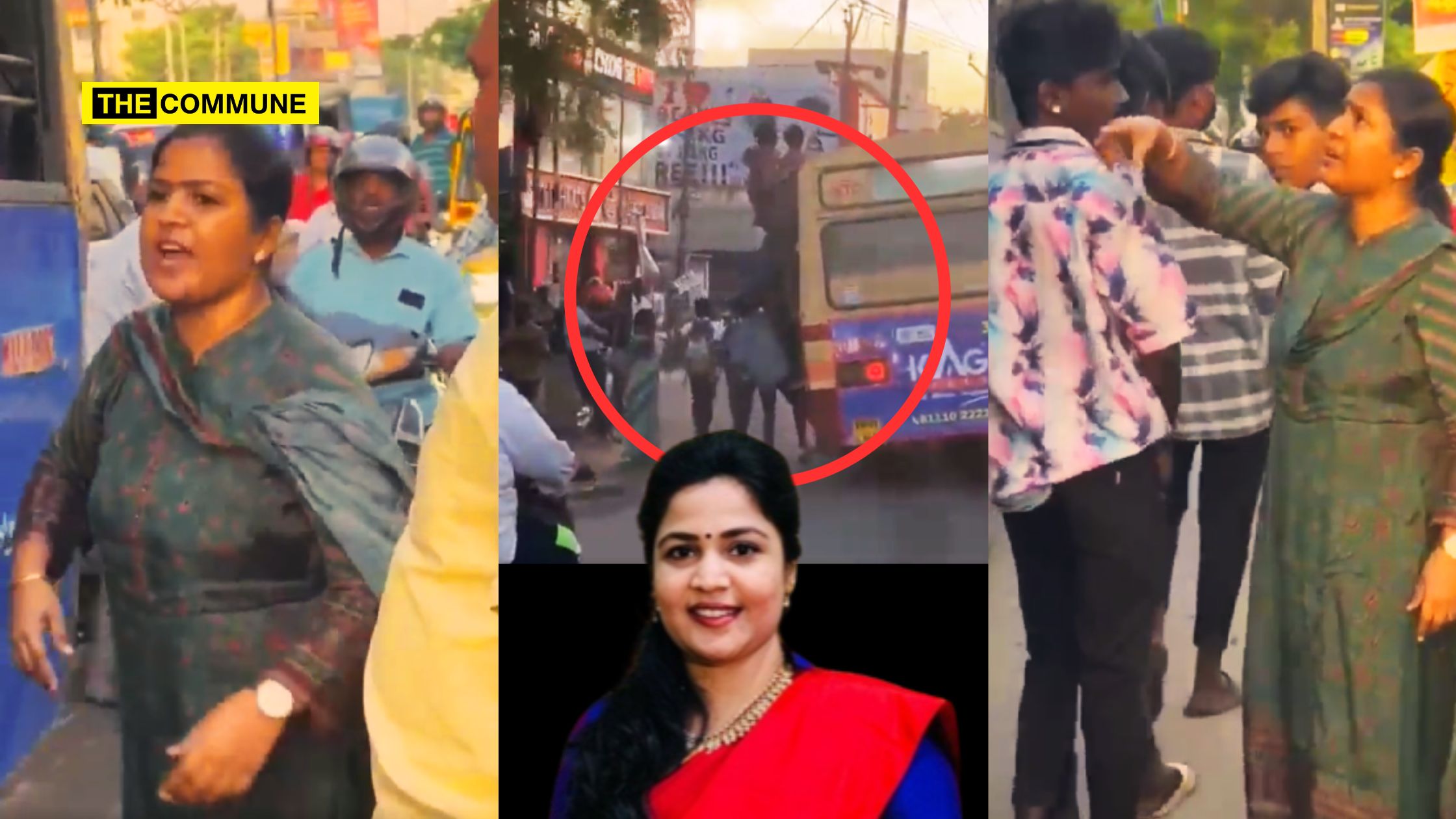
Actress-Turned-Politician Ranjana Nachiyar Arrested For Confrontation With Students Who Were Dangerously Foot Boarding And Hanging From MTC Bus

Former actress turned politician Ranjana Nachiyar, widely recognized for her roles in movies like Thupparivalan, Irumbu Thirai, and Annathey, has been apprehended following an incident where she confronted and admonished students who were dangerously hanging on the steps of a bus in Kundrathur.

Videos depicting a bus overcrowded with youngsters and students dangerously foot boarding have circulated on various social media platforms. The footage stirred controversy as it displayed Ranjana Nachiyar scolding and even physically confronting young boys who were precariously perched on the bus’s steps. Initially, she reprimanded the bus driver for allowing students to ride in such a perilous manner on the footboard. Subsequently, she took it upon herself to pull the students off the bus and even resorted to slapping a few who resisted disembarking.

In a surprising turn of events, the actress turned politician claimed to be a police officer and subjected the bus conductor to verbal abuse as well. Following the incident, the police promptly arrested Ranjana Nachiyar and escorted her to the police station for questioning.

According to information from media sources, a formal complaint was filed, resulting in the initiation of a First Information Report (FIR) at the Mangadu police station. Ranjana now faces legal charges under several sections of the Indian Penal Code (IPC), encompassing 341 (related to wrongful restraint), 323 (involving voluntary infliction of harm), 353 (pertaining to assault with the intent to obstruct a public servant from performing their duties), and 75j (addressing cruelty towards a child). During a police attempt to apprehend Ranjana at her residence on Saturday, she claimed that male police officers had knocked on her window while she was in the process of changing. A widely-circulated video captures the actor requesting an arrest warrant.

Nonetheless, a police officer clarified that no arrest warrant had been issued, and the actor was merely facing an FIR. The police account revealed that they patiently waited outside Ranjana’s residence for over half an hour before she responded to their presence. Following a lengthy altercation, the actor was eventually apprehended and transported to the Mangadu police station.

Subscribe to our channels on Telegram and WhatsApp and get the best stories of the day delivered to you personally.

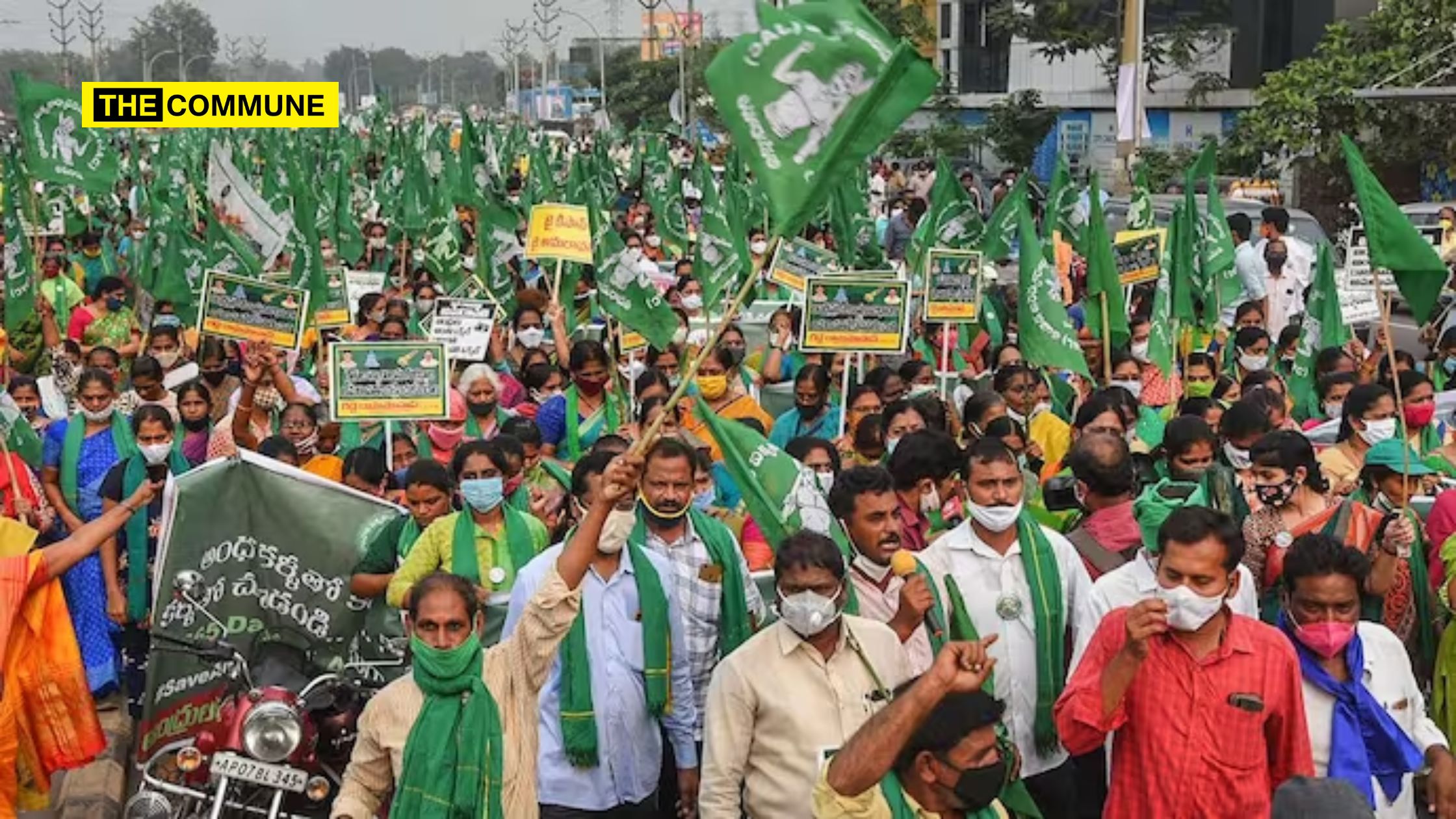
The Amaravathi Files: A Film To Uncover Farmer Injustice In Andhra Pradesh

Ever since Vivek Agnihotri’s ‘Kashmir Files’ captured the Indian and NRI (Non Resident Indian) imagination, turning it into a successful one-of-a-kind cult movie, film producers and directors have been keeping an eye out for this genre of film making – a docu-cinema format that suits certain subjects of public interest and impact. One such subject that is now being made into a ‘Kashmir Files’ type of movie, is the fight-for-justice of Andhra’s farmers, for the proposed capital city of Amaravathi in the Guntur-Vijayawada region.

The farmers of the region are caught in a quagmire of childish vengeance politics played by current Andhra Pradesh CM and leader of the YSRCP party, Jagan Mohan Reddy, who is refusing to allow the completion of the new capital city which was already under construction, when the previous Telugu Desam Party (TDP) was in power in the 2014-2019 term.

Previous CM and leader of the TDP party, Chandrababu Naidu had envisioned a unique type of “land sharing” scheme with the farmers of the region by requesting them to “donate” their farm lands to the state for a larger public cause, particularly for the purpose of building a modern, world class, new capital city for the residual Andhra Pradesh state which was partitioned in 2014 from the larger state, comprising the regions of Andhra and Telangana. While Telangana walked away with the well established capital city of Hyderabad, the residual state of Andhra Pradesh was left with the task of building a new capital city and administrative infrastructure.

News of the proposed film “Amaravathi Files”, highlighting the previous Andhra government’s scheme of a land-sharing deal with the farmers, assuring them of good rental returns from the newly built government infrastructure, commercial buildings and upper-end residential complexes, has the Andhra people eagerly awaiting its release. The film’s announcement comes in time, for Chandrababu Naidu’s release from prison on October 31. Naidu was arrested on September 9, by his political opponent and current CM, Jagan Reddy’s government, on alleged charges of financial irregularities when he had been head of the previous government between 2014-2019.

Jagan Reddy has refused to continue the construction and completion of Amaravathi. A vast majority of Andhra’s electorate sees Jagan’s decision on the capital city as a case of petty vengeance politics, with many people questioning his decision to propose moving the capital from its current location to Vishakapatnam, where he and his top aides have acquired large tracts of valuable real estate.

The man behind the proposed “Amaravathi Files” film is Telugu film maker, Bhanu Shankar who is well known for his previous works, potraying realistic Indian social themes and causes, with an intended message for society. His films ‘Raju Maharaju,’ ‘Ardhanaari,’ and ‘RDX Love’ have acquired a niche status among Telugu audiences from both Andhra and Telangana. The film will shed light on :

– The details of the previous TDP government’s landmark deal with the farmers in return for land-pooling / land acquisition.
– The farmers community’s three year struggle for the rights to their lands, given up in good faith, under the previously agreed-upon scheme with the then state government.
– The cases they have filed both in the Andhra Pradesh High Court and the Supreme Court.
– YSRCP leader Jagan Reddy’s refusal to complete the development of an already under-way city, a decision disapproved even by Jagan’s own family members including his mother, who had reportedly advised him against betraying the farmers’ trust and to honour the previous government’s terms and conditions for the capital city.

Both the Andhra High Court as well as the Supreme Court have thus far, showed sympathy for the farmers’ cause and have indicated a clear reluctance in approving Jagan Reddy’s plan of moving the current capital in addition to his proposal of a tripartite-capital consisting of Amaravathi, Vishakapatnam and Kurnool as the state’s three proposed capitals for the Legislative, Executive and Judiciary respectively.

The announcement of a facts-based, pro-farmer film for the masses, seeking to provide information and clarity on a sensitive, much debated subject, comes just months ahead of the state’s assembly elections, scheduled to be held before June of next year and may prove to be an advantage for the TDP.

Chandrababu Naidu (CBN to many, in political circles) was the subject of a dramatic arrest on September 9 on allegations of corruption in the form of kickbacks in what was termed the ‘Andhra Pradesh Skill Develeopment Scam’. Since his arrest almost two months ago, CBN’s political nemesis & current chief minister, Jagan Reddy has not missed an opportunity to pressure and utilize Andhra’s Anti Corruption Bureau (the ACB) to file more allegations of minor or major “corruption” charges against the former chief minister and TDP leader. Most people in Andhra Pradesh view his recents acts as an extreme case of vendetta politics and an indication of political nervousness, months ahead of the state’s elections in early 2024.

Thus far, the police department has not been able to unearth any significant evidence for the alleged corruption. Rumour has it that Jagan was hoping to have the Central Bureau of Investigation (CBI ) involved for more credibility but he has not been able to do so because of a lack of firm proof, on the alleged acts of misappropriation of funds by Naidu, as claimed by Jagan Reddy.

Recent surveys and well-attended political rallies of the TDP party have indicated positive trends in favour of the TDP for the 2024 state elections. With Pawan Kalyan’s JSP party pledging support to the TDP, the party’s chances of winning next year’s elections look promising. This makes Jagan Reddy nervous as he is a leader, currently out on bail, for more than thirty cases of fraud, embezzlement and other criminal acts, filed by the CBI and jailed based on evidence, back in 2012.

Not to be deterred by CBN’s absence while he was lodged in jail, his wife Bhuvaneshwari (a daughter of the immensely popular Telugu actor, the late A.P chief minister and founder of the TDP party, N.T. Rama Rao / NTR) accompanied by her daughter-in-law, is holding meetings and appealing to the common people for voting the TDP back to power on the planks of Truth, Justice and Development, in an electoral fight portrayed to be a “vote for good against evil”. To that end, Naidu’s son went on record, comparing Jagan Reddy to Ravanasura, during the recent Vijaya Dasami festivities.

CBN has been granted bail for four weeks during which time, the veteran leader who is in his seventies, is expected to undergo a cataract procedure for his eyes, at the well known LV Prasad Eye Hospital in Hyderabad. During his stay in Hyderabad, Telangana’s ruling BRS party and CM K Chandrasekar Rao are expected to convey their sympathies and well wishes to the TDP leader – a timely, calculative, politically savvy move, hoping to gain favour with the TDP’s supporters in the state, considering Telangana goes to the polls in a few weeks.

Political analysts see KCR’s attempt to gain favour with a section of the urban, educated youth and older citizens in Telangana, who still view the TDP’s administrative reign in the larger, undivided state of Andhra Pradesh, as a relatively good, progressive, pro education, pro-employment, pro-technology period in the state, when Naidu had been the Chief Minister and brought in new software companies, various other businesses and educational institutions to the state, resulting in an increase of employment opportunities in the state as well as overall progress.

Notably, there were a handful of high octane, employee-led rallies in Hyderabad, Bangalore and smaller urban centres in Telangana, showcasing strong support for CBN and the TDP party. A few demonstrations and vigils have been held in his support in the U.S as well with many NRI Telugu people from both Telugu states, offering financial and logistical aid for the rallies in Indian cities. Word is, the BRS is trying to ensure the support of this segment (the educated and well placed) of the Telugu population, in the upcoming Nov 30 Telangana state elections.

For now, the TDP leadership and cadre seem to be invigorated by the release of their leader on a four week interim bail, based on a health-related appeal filed by his lawyers. There appears to be a fresh lease of energy, enthusiasm and hope within the party’s rank and file. Public sympathy for a senior leader, arrested in an unexpected and dramatic manner, on dubious, trumped up, unproven charges of alleged corruption, appears to be growing among the general public. The sympathy factor was evident in the massive turnout of common, working class people in anticipation of CBN’s release. Large crowds waited by the roadside for several hours, to greet Naidu, welcome him and wish him well, all along the entire stretch of his road travel, from the Rajamahendravaram (Rajahmundry, East Godavai district) Central Jail to his home in the Guntur-Vijayawada region (a distance of around 175 KM).

Naidu is expected to report back to the court on November 28. The court has directed him not to engage with the media or indulge in political activities during his bail period.

Shivani is a freelance writer based out of Vijayawada. 

Subscribe to our channels on Telegram and WhatsApp and get the best stories of the day delivered to you personally.
BJP TN’s “Anniyan” Returns With Theemai Kadhaigal Episode 2: Highlights The Plight Of Law & Order In Tamil Nadu Under DMK Rule

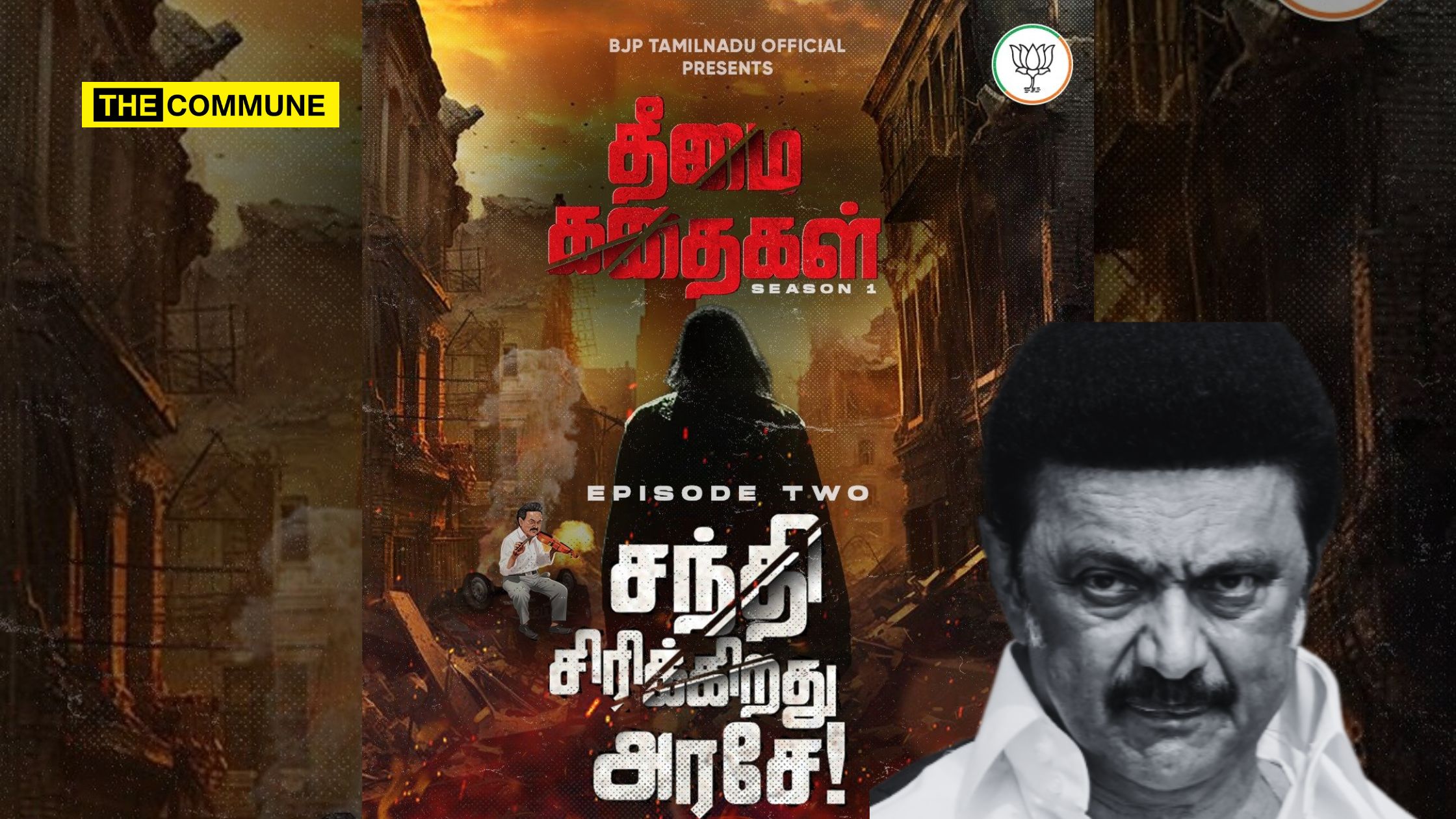
The  Bharatiya Janata Party (BJP) has released the second episode of its video series, “Theemai Kadhaigal.” The video, a political salvo, resurrects the iconic vigilante character, ‘Anniyan,’ from a popular Tamil movie of the same name, in an attempt to highlight the deteriorating law and order situation in the state.

The video commences with ‘Anniyan’ setting the stage with a chilling narrative, imagining a dire scenario where the viewer is portrayed as the protagonist. The narrative unfolds as the viewer, under a life-threatening chase by an armed gang, seeks refuge in a police station. However, shockingly, the gang breaches the sanctity of the police station, highlighting the alarming disregard for law and order. In a desperate bid for safety, the viewer flees to a court of law, only to meet a grim fate as the gang infiltrates the very courtroom. ‘Anniyan’ drives home the stark reality that these aren’t just fictional tales but recent incidents that have gripped the headlines in Tamil Nadu.

The video spotlights the clash that erupted between supporters of KN Nehru and Tirchy Siva, both belonging to the DMK, inside a police station, demonstrating a grave breach of law and order.

Another incident shown is the alleged murder attempt by a known history-sheeter within the premises of a court in Ramanathapuram.

‘Anniyan’ further delves into the dark annals of the DMK’s past, recounting the brutal murder of Communist councillor Leelavathi in 1997, who had raised her voice against corruption in water lorry mafia. Astonishingly, the DMK government in 2008 granted a release to her murderers.

The video raises concerns about the DMK’s current attempts to secure the release of individuals allegedly involved in the Coimbatore bomb blast. It also resurrects the memories of the clash between advocates and police within the hallowed precincts of the Chennai High Court in 2009.

It juxtaposes DMK leader M.K. Stalin with a historical reference, likening him to Nero, who played the fiddle while Rome burned. In this case, ‘Anniyan’ argues that Stalin is playing his own version of fiddle – the “Dravida model” – while Tamil Nadu is engulfed in the flames of rising crime.

Citing data released by the Tamil Nadu government, ‘Anniyan’ points out alarming statistics, including 48,422 thefts, 3,194 murders, 384 kidnappings, 6,512 crimes against women, and 4,504 riots, indicating a significant increase in criminal activities under the DMK’s rule.

This video places the spotlight firmly on the DMK’s commitment to law and order, echoing past promises, including a statement from M.K. Stalin himself, who had pledged to oversee the state’s law and order personally. In the face of these distressing statistics and stark incidents, ‘Anniyan’ suggests that Tamil Nadu is currently burning while its leadership seems to be playing a different tune called,” Dravida Model” altogether.

‘Anniyan’ raises hard-hitting questions for CM M.K. Stalin amidst rising violence in Tamil Nadu concerning the recent surge in violence and lapses in governance in the state.

First and foremost, ‘Anniyan’ brings attention to the Kallakurichi riots that unfolded following the tragic death of a school girl.

Why did the police department and intelligence apparatus fail to anticipate that what began as a peaceful protest would ultimately descend into violence?“, asks Anniyan. The incident raises critical questions about the administration’s ability to handle civil unrest and maintain law and order.

Furthermore, the video places a glaring spotlight on the recent Coimbatore blast.

‘Anniyan’ asks, “Why did the Chief Minister attempt to alter the course of events by initially describing the terrorist bomb blast as a mere cylinder explosion?” This move by the CM raises suspicions about transparency and accountability within the government, particularly in matters related to public safety and security.

Another heart-wrenching tragedy highlighted is the Tamil Nadu hooch tragedy, where 23 lives were lost due to the consumption of illicit liquor.

‘Anniyan’ demands an explanation, asking, “Why did the Chief Minister decide to order a raid only after 23 people had already lost their lives in this horrific incident?“. This raises questions about the government’s proactive stance on preventing such tragedies and enforcing regulations.

The video doesn’t shy away from exposing the actions of political figures within the DMK as well. It points out how the DMK high profile Senthil Balaji allegedly encouraged the activities of sand mafias, indirectly contributing to illegal sand mining in the state. Moreover, it highlights how VAO Lourde Francis was hacked to death in Thoothukudi by sand mafia.

‘Anniyan’ also calls into question the apparent hypocrisy within the DMK. While Kanimozhi, a prominent DMK member, advocates for women’s safety, the video highlights an incident in which DMK members allegedly harassed female police officers during a DMK meeting in which Kanimozhi was a participant. This stark contrast between words and actions raises doubts about the DMK’s commitment to women’s safety and gender equality.

As the ‘Anniyan’ video reaches its crescendo, it directs a poignant question towards the DMK’s political agenda, particularly in the wake of the custody death of Jeyaraj and Bennix, a case that gained immense public attention. The video spotlights the alarming increase in the number of alleged custodial deaths under the DMK’s rule, raising concerns about the state’s law enforcement practices and the safety of citizens while in custody.

In a somber conclusion, ‘Anniyan’ invokes the memory of a bygone era in Tamil Nadu when rulers like Manu Needhi Cholan, who did not hesitate to deliver justice even when it meant punishing his own son, and King Pandian, who believed in the weight of righteous judgments to the extent of sacrificing his own soul when he erred.

These historical anecdotes serve as a stark contrast to the current state of affairs, where ‘Anniyan’ argues that the DMK seems to be exploiting the land rather than upholding the principles of justice and ethical governance that were once revered in Tamil Nadu.

In the previous episode, Anniyan exposed the ‘Dravidian Model’ of healthcare highlighting instances of alleged medical negligence in Tamil Nadu government hospitals.

Subscribe to our channels on Telegram and WhatsApp and get the best stories of the day delivered to you personally.
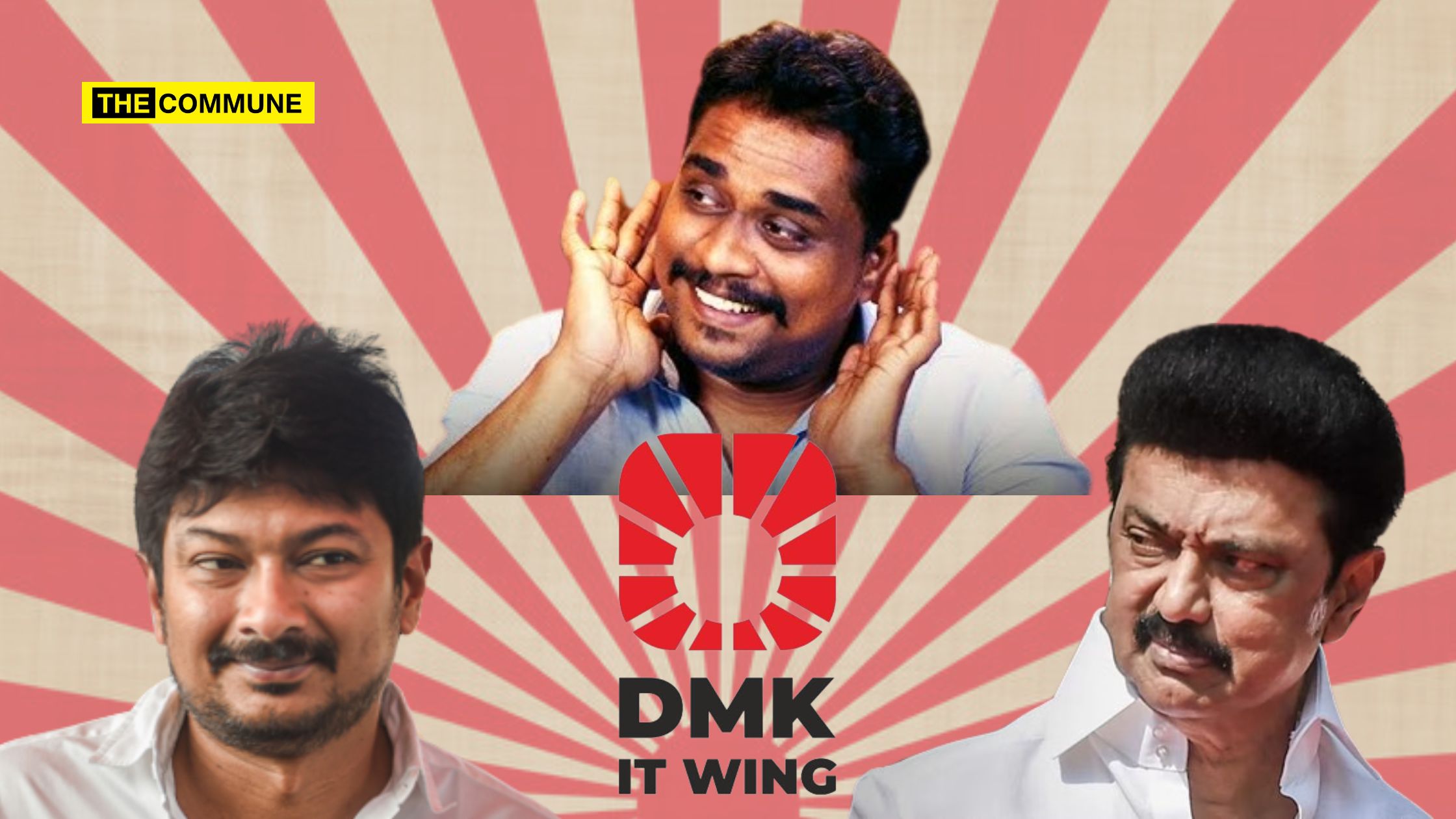
Reports Say DMK IT Wing Members Recruited Into DMK Govt’s Fact-Checking Unit

In a move that has raised concerns about threat to democracy and freedom of speech & expression, the DMK government in Tamil Nadu, has decided to create a Fact Checking Unit under the administrative control of Special Programme Implementation which is the portfolio of DMK scion and Minister Udhayanidhi Stalin.

The development comes after the DMK government faces the wrath of the  Opposition parties and people at large over the state of affairs in Tamil Nadu.

This FCU is going to be headed by Iyan Karthikeyan, a Dravidian Stockist YouTuber known for peddling DMK propaganda.  As the “Mission Director” of the Fact-Checking Unit, Iyan will receive a monthly salary of ₹3 lakh.

Iyan Karthikeyan getting ₹3 lakh per month of tax payer’s money comes at a time when nurses and teachers are fighting for equal pay and the state is in severe debt.

Iyan Karthikeyan was previously the Editor-in-Chief of YouTurn, a self-proclaimed “fact-checking” website that also has a YouTube channel where Iyan Karthikeyan along with his team rant for the most part under the pretext of “fact-checking”.

It has been stated that the primary job of the FCU will be to identify fake news and curb hate speech but critics argue that it is nothing but a fascist move to crackdown on critics of the DMK and its government.

Concerns were raised from different quarters about the flouting of rules in establishing this unit and the appointment process.

In a development that substantiates the above apprehension, it has come to light that many DMK IT wing members have been recruited into the so-called “fact-checking unit”.

According to a report by South First, DMK IT wing functionaries and cadres who are active on social media were being recruited for the unit.

The South First report quoting a state-level functionary of the DMK told reported that all the appointments are probably complete and that the unit was almost ready to function.

According to RB Udhayakumar, the Deputy Leader of Opposition belonging to AIADMK, credible sources have suggested that recruitment for this unit exclusively involves individuals with an affiliation to the DMK and those who are part of the DMK IT wing.

Since the unit has been accorded suo motu powers, it is but natural that this so-called “fact-checking unit” will go after DMK critics on social media.

Jayaram Venkatesan, a social activist of corruption watchdog ‘Arappor Iyakkam,’ observes that the fact-checking unit seems to serve as a government propaganda tool and an extension of the DMK IT wing, primarily designed to counter news and information critical of the DMK government. He further expressed puzzlement over the decision to place this unit under the control of Udhayanidhi rather than the information minister or the DIPR.

You can read more about the problems associated with the FCU in this article – Why The DMK Govt’s Fact-Checking Unit Is Undemocratic And How It Has Possibly Flouted Rules

Subscribe to our channels on Telegram and WhatsApp and get the best stories of the day delivered to you personally.