Home Blog Page 854

Vijayakanth: The Man Who Had The Guts To Take On The Giants In Tamil Nadu Politics
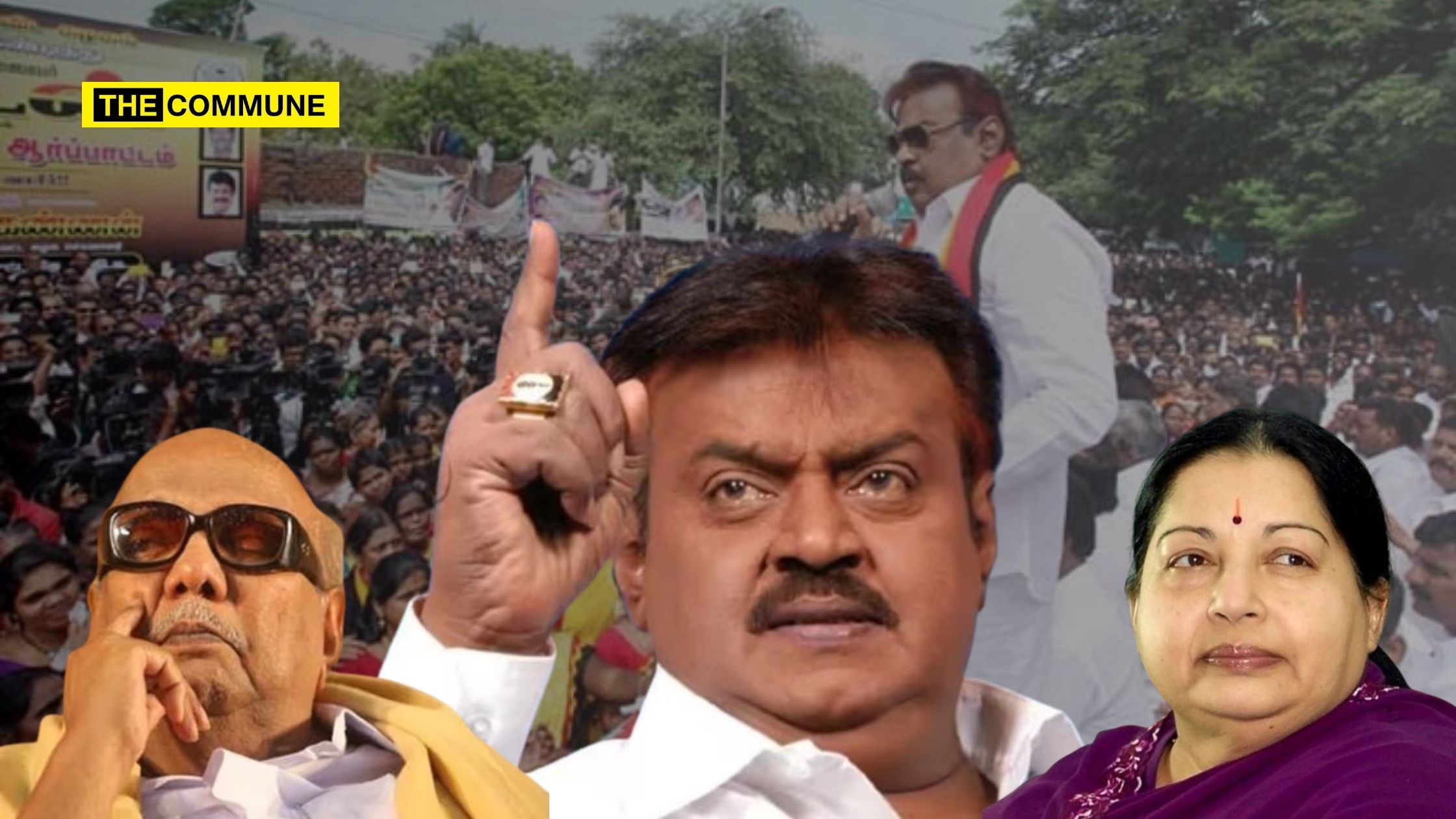
Vijayakanth, a prominent icon in Tamil cinema, seamlessly transitioned from raising his voice against corruption on the silver screen to a successful stint in politics. His swift rise in the political arena fuelled aspirations among his followers, who envisioned him as the potential Chief Minister of Tamil Nadu. Unfortunately, his political journey was cut short by deteriorating health following back-to-back political setback orchestrated by both the big Dravidian parties.

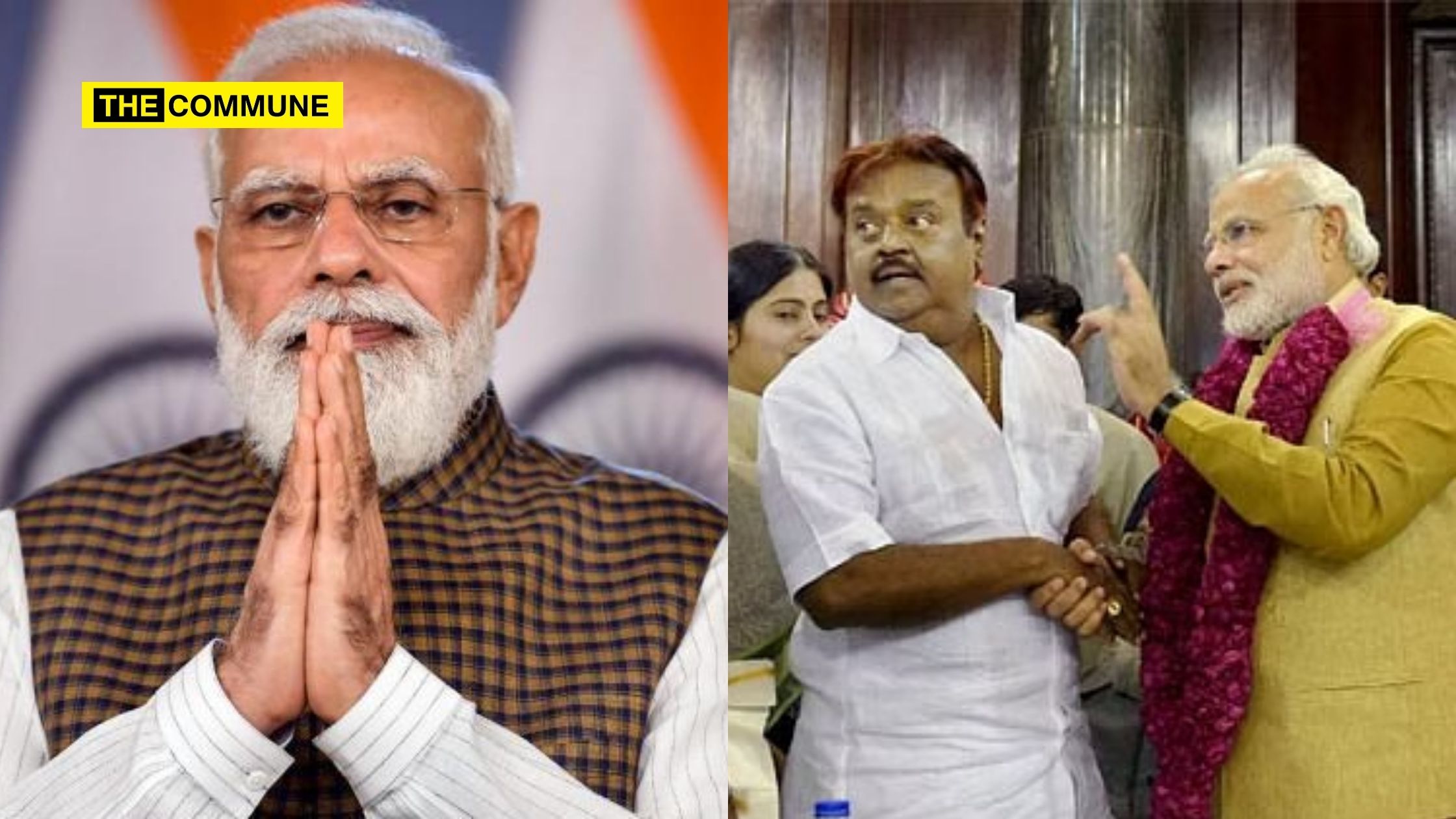
The influential Desiya Murpokku Dravida Kazhagam (DMDK), founded by Vijayakanth in 2005 in Madurai, was seen as a formidable force by political parties such as DMK, AIADMK and BJP. So much so that, Narendra Modi himself who had acknowledged his influence brought him under the National Democratic Alliance in 2014.

However, over time, the party faced challenges in maintaining its regional influence due to Vijayakanth’s ailing health. Despite this, DMDK continued to put up a valiant fight to sustain its presence in the political landscape. Vijayakanth’s recent passing has left his supporters and admirers in mourning, marking the end of an era characterized by his bold stance against corruption and significant political impact.

But if there is one thing that Vijayakanth would be remembered for, it is this – Vijayakanth unlike the other ‘kanths’ was the lone warrior who had the audacity to confront both AIADMK and DMK at their peaks emerging as a true underdog in the political arena.

The Only Force To Challenge Both DMK & ADMK 

In his political avatar, Vijayakanth shook the AIADMK and DMK out of their slumber when his party, the DMDK, secured 8.38% votes contesting on its strength in 2006, and 10.3% in the ensuing Lok Sabha elections in 2009. While his party secured just one seat in 2006 and none in 2009, he was still regarded as a significant political force and a formidable contender for the leadership position.

He openly slammed the DMK patriarch Karunanidhi for wanting to become CM at 92 years of age. In a scathing critique of DMK president M. Karunanidhi, Desiya Murpokku Dravida Kazhagam (DMDK) chief Vijayakanth delivered a forceful address, mocking the veteran leader’s sixth bid for the Tamil Nadu Chief Minister’s position. Speaking in Kulithalai, where Karunanidhi was first elected in 1957, Vijayakanth acknowledged the historical significance of the region but questioned the aspirations of the 92-year-old DMK leader. Ridiculing Karunanidhi’s relentless pursuit of power, Vijayakanth remarked, “See, he wants to be Chief Minister for the sixth time even at this age (92)… see his desire.”

The DMDK leader went on to highlight the prevalence of illegal sand mining in the area, insinuating the involvement of an opposition party leader. 

He was probably the only one to speak against Karunanidhi. In what seems to be a TV interview, he said, “Ah Kalaignar has done this, Kalaignar has done that. What Kalaignar? What did he do? I am giving him respect and calling him Kalaignar. What did he do? He pawned the state of Tamil Nadu. Even now, he keeps saying race, race. They have killed the same race in Ceylon and he is talking about race? A regime where nothing was done, what a shameful regime. People must teach a lesson to these two parties, the DMK and the Congress, this is my wish. I already said he is the pinnacle of lies. If I listen, I get angry. He lies through his teeth. The example of what a big traitor he is is that he gave you free television but he took all the connection charges. This is the truth. Who has the connections (cable TV)? Tell me. Is it with the common man? It is all there with his party people, with him, with his grandchildren, and his son. This is the truth.”

In another interview Vijayakanth says “Nobody (media) is working independently here. Everybody is just passing their time biting their teeth due to pressure. Don’t think that good politics is happening here. The press should point out mistakes of the government. Do it boldly. He (Karunanidhi) used to say that he is writing from 1954 in Murasoli and that he used to write them with his own hands. He is the man who abused Kamarajar like anything. He is the same man who asked whether only the Nehru-Gandhi family should rule, and today he is bringing his offspring into politics. And they’re doing it in alliance with the Nehru family.

He was also the only one who could challenge J Jayalalithaa too. One memorable instance etched in memory is the stern warning Vijayakanth delivered to ADMK MLAs during a session at the state assembly, directly in the presence of the formidable former CM J Jayalalithaa.

When he was the LOP, during an assembly session, Jayalalithaa accused him of having accepted defeat even before the election dates were announced. To this, Vijayakanth replied to the Speaker saying, “I have not accepted defeat. I have just replied to what was asked. Then answer me why you lost in Sankarankoil and Pennagaram. You only accepted that you cast votes thievingly.”

How He Quelled Rebellion Within The Party 

Vijayakanth faced internal upheaval as 10 senior functionaries, including three MLAs and the propaganda secretary, openly challenged his decision to align with the PWF (People’s Welfare Front). Expressing dissent, they advocated joining forces with the DMK led by M. Karunanidhi to “oust Jayalalithaa from power.” In response, Vijayakanth swiftly expelled the dissenting members, citing a violation of party discipline and damage to its reputation. Addressing the issue of party loyalty, he stated, “For me, cadres are important, and they are my strength. They and I will forgive enemies, but not betrayers.” This remark was ostensibly directed at rebel DMDK leaders who had aligned with the DMK after being expelled from the party.

He made it a point to maintain his party’s distance from the DMK till the very end.

The Friendship With Modi

During an election rally in 2009, he heaped praises on Narendra Modi who was back then the Gujarat Chief Minister, saying if people look up to Gujarat, it was because Modi doesn’t indulge in corruption. “The same can be emulated in other states as well”, he said.

In 2014, he campaigned extensively for the BJP-led front, endorsing Modi as the force capable of eradicating corruption. Here are a few videos of the equation shared by Vijayakanth and PM Modi.

Despite not winning any of the 14 seats they contested, the DMDK was the only party in the seven-party alliance to campaign in all 39 constituencies in Tamil Nadu. Premalatha was instrumental in the party’s decision to align with the BJP-led NDA, a move that contributed to the BJP’s victory in Kanyakumari. PM Modi’s praise for Premalatha and his rapport with Vijayakant at the NDA rallies are testimony to the friendly relations they shared.

Prime Minister Modi also shared a condolence note on his X handle describing the friendship the two shared.

Captain Vijayakanth, once a subject of social media trolls, garnered widespread praise for paying his last respects to former President APJ Abdul Kalam in Rameswaram. Photos of him shedding tears went viral, earning admiration from many youngsters. As the then Opposition Leader of Tamil Nadu, Vijayakanth sent a letter to Prime Minister Narendra Modi, urging the celebration of Dr. Kalam’s birthday as National Students Day. It is now a special day celebrated every year and that Vijayakanth actually had a role to play in it went unnoticed. 

A man who managed to capture the hearts of the people be it as an actor or as a politician, Vijayakanth will be remembered for all the good values and principles he stood for, and more importantly, as the only person who could take on both the giants of Tamil Nadu politics in their prime. Fare thee well, Captain!

Hydra is a freelance writer and columnist.

Subscribe to our channels on TelegramWhatsApp, and Instagram and get the best stories of the day delivered to you personally.
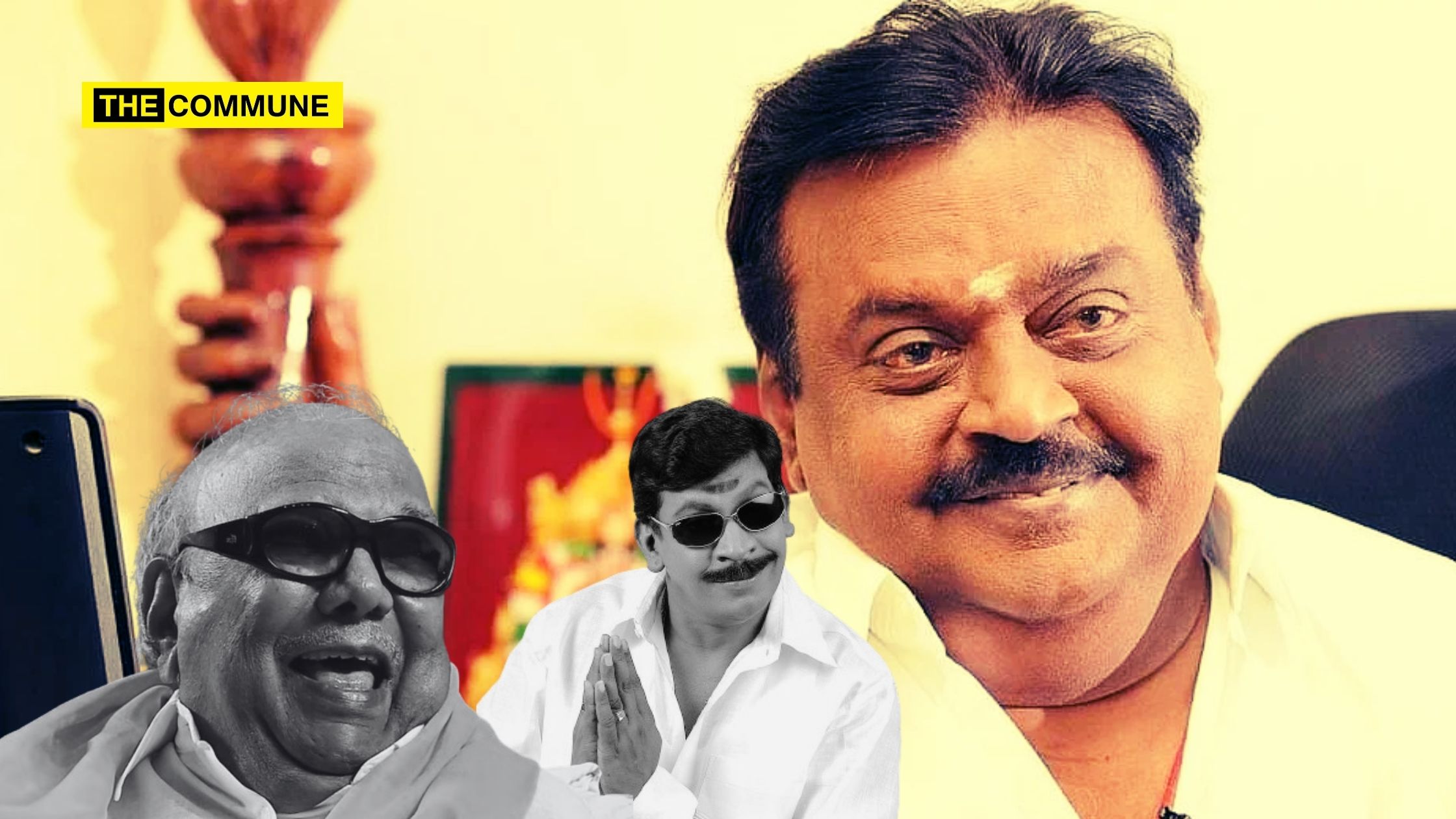
How Vadivelu Backed By DMK Abused Vijayakanth & The Dravdianist Media’s Role In Reducing Him To A Meme Material

Taking the plunge in 2005, Vijayakanth established the Desiya Murpokku Dravida Kazhagam (DMDK). The party initially posed a significant challenge to the AIADMK and Jayalalithaa’s leadership. Strategically positioning itself as an alternative to the big two Dravidian parties, the DMDK gained prominence, securing around 10% of the vote in its initial run. However, Jayalalithaa’s course correction, distancing from the BJP, and focus on welfare policies led to the decline of DMDK’s influence. Vijayakanth’s health issues, coupled with intense caricaturing by trolls and the media, contributed to a loss of political credibility, marking the party’s descent in Tamil Nadu politics.

Remarkably, until the very end, Vijayakanth refrained from forging any alliance with the DMK. Despite speculations that he might align with the DMK in 2016, he adhered to his principles, distinguishing himself from political parties known for engaging in vote bank politics. His steadfastness and unexpected anti-DMK stance surprised many.

How The DMK Troubled Him

The year was 2006 and TR Baalu, the current DMK MP from Sriperumbudur, was back then the Minister for Road Transport, Highways and Shipping in the Congress-led UPA government. The National Highways Authority of India (NHAI) department which functions under him was used to demolish the Andal Azhagar Kalyana Mandapam, a wedding hall owned by Vijayakanth’s wife which also served as his party office.

The auditorium, located on Jawaharlal Nehru Road in Chennai, falls in the path of a flyover construction project aimed at easing congestion at the Jawaharlal Nehru Road-Bangalore Highway junction.

He alleged that the DMK government was too quick to demolish the marriage hall because they couldn’t tolerate his party’s progress. He labeled it a deliberate political plot and clarified that he didn’t oppose the government’s decision to demolish the structure.

He had been willing to surrender the building for road expansion and had only requested an extension until August 31 to honor the marriage bookings.

Despite meeting with DMK president M Karunanidhi and proposing an alternative plan, the DMK government led by Karunanaidhi in the state went ahead with demolishing after sitting on the alternative plans submitted by Vijayakanth for months. This is how ruthless Karunanidhi was.

Vijayakanth, a bitter critic of Karunanidhi since then, escalated attacks following his victory in the Vridhachalam constituency in the 2006 Assembly elections. 

In the above video Vijayakanth says “Nobody (media) is working independently here. Everybody is just passing their time biting their teeth due to pressure. Don’t think that good politics is happening here. The press should point out mistakes of the government. Do it boldly. He (Karunanidhi) used to say that he is writing from 1954 in Murasoli and that he used to write them with his own hands. He is the man who abused Kamarajar like anything. He is the same man who asked whether only the Nehru-Gandhi family should rule, and today he is bringing his offspring into politics. And they’re doing it in alliance with the Nehru family.

And today the DMK is shedding tears for Vijayakanth claiming that he and Karunanidhi shared a great deal of affection. No Tamil worth his salt would buy the claims of Karunanidhi’s family and the DMK.

Vadivelu Vs Vijayakanth – Fuelled By DMK

In a protracted feud between Tamil film actor-turned-politician Vijayakanth and renowned comedian Vadivelu, tensions escalated frequently between the two. Vijayakanth accused Chief Minister M Karunanidhi of orchestrating cases against him through Vadivelu and asserted that Vadivelu was acting as a tool for the ruling DMK, which sought to counter the rise of DMDK. Both Vijayakanth and Vadivelu, hailing from Madurai and sharing a history of acting together in films, found themselves entangled in political animosity. 

Vadivelu went overboard with his criticisms to insult Vijayakanth several times, which was supported and cheered by the DMK. Here are some videos where he talks derogatorily about the politician he went to the extent of accusing him of being a drunkard. 

During the run-up to the 2011 elections, sharing the stage with DK leader Veeramani, DMK leader Karunanidhi, VCK’s Thirumavalavan, Vadivelu is seen saying, “They have given him a name, I shouldn’t say it. Captain, it seems. Why Captain? Do we call someone who is always drunk, a Captain? We call the person who drives the ship that floats on water as Captain. One who is always (stresses the word) in water (here water-thanni refers to alcohol) is not called Captain. They came to my house and asked me one day, brother, call him (Vijayakanth) the Chief Minister), I replied saying I cannot say all that.”

At what seems to be the same programme, Vadivelu goes on another rant. He says, “When there are Chief Ministers like this, someone who started a party yesterday/day before yesterday, wants to become the Chief Minister tomorrow. The thing is, 2 pillars were protruding in his wedding hall. He started a party for that and goes around saying he is the next Chief Minister, in a perpetually drunken state. Moodevi, I am asking, is the Chief Minister’s chair a game of musical chairs for you? Is that an ordinary seat? It is the fruit of 70 years of toil (looking at Karunanidhi).”

And the DMK patriarch rejoices at the acerbic attacks on Vijayakanth made by Vadivelu.

In the backdrop of the 2011 Tamil Nadu Legislative Assembly election, despite all the venom spewed by Vadivelu at the behest of the DMK, Vijayakanth emerged victorious with a phenomenal vote and seat share.

Vijayakanth registred a voteshare of 53.19% at Rishivandiyam.

Even though Vadivelu had made diatribes against Vijayakanth mindlessly, Vijayakanth never did revenge politics. He in fact was really upset that Vadivelu was not acting as he went on a lull after Jayalalithaa consolidated her power in 2011.

In an interview, Premalatha Vijayakanth notes how her husband was upset about Vadivelu not acting in any films. “He is a born artist. He should keep acting.“, Vijayakanth had apparently said.

https://twitter.com/offl_trollmafia/status/1740366889673740296

Reduced To A Troll/Meme Material By Media Amply Supported By DMK

After the zenith of the 2011 elections, Vijayakanth experienced a sharp decline in popularity exacerbated by health issues. The rise of online campaigning, marked by fake news, trolling, and dirty tricks, played a pivotal role nationally. Vijayakanth faced a relentless onslaught, transforming him from a serious contender for the CM position to a caricatured figure through memes and online mockery.

Trolls particularly targeted his bombastic style and malapropisms, contributing to his diminished image. The internet, known for cutting down public figures, amplified his perceived weaknesses. WhatsApp videos showcasing his unsteady behavior and slurred speech due to illness went viral, suggesting drunkenness. As credibility waned, his attempt to establish an alternative through the Third Front faltered amid suspicions of backroom deals with rival Kazhagams.

Despite being reduced to meme material, battling ill health for several years (and finally succumbing to it), Vijayakanth, the Karuppu MGR, the Puratchi Kalaignar, the Captain will always be remembered by the public of Tamil Nadu for the man he was. He was remembered for his kindness, large-heartedness, and innocence, leaving a lasting impact on the people. In his acting career, he was known for helping numerous technicians and small-time actors in need. The moniker he earned, “Karuppu MGR” was not just about his complexion, but for his generosity.

Today, on the day of his passing, crowds swell at the same wedding hall, that was once the reason the DMDK crossed swords with the DMK, for the people – his party workers, fans, and rivals, trickle in to have one last glimpse of the man who could have been a great political leader for Tamil Nadu. 

Vallavaraayan is a political writer.

Subscribe to our channels on TelegramWhatsApp, and Instagram and get the best stories of the day delivered to you personally.
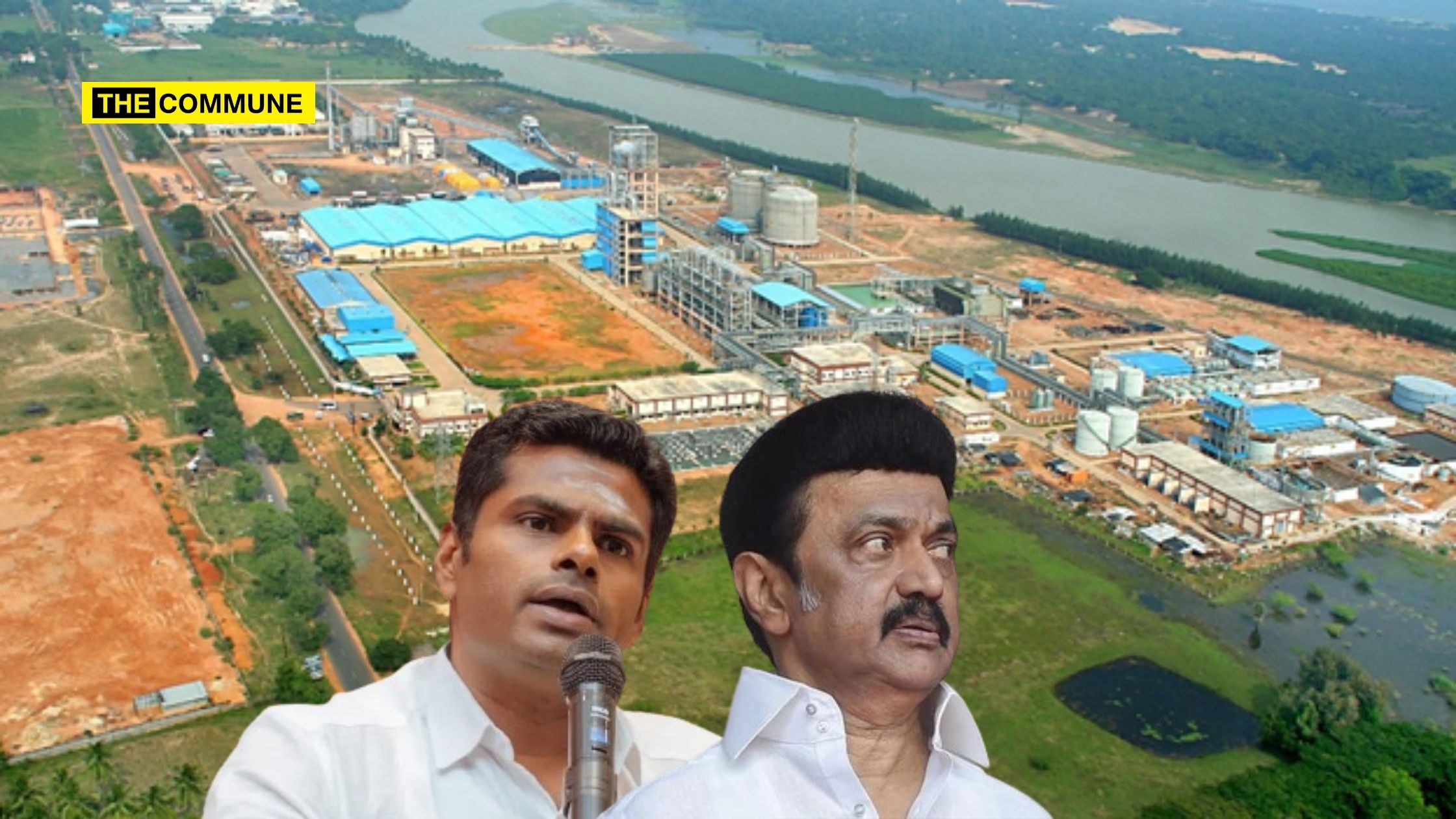
TN BJP Raises Concerns Over DMK Govt Acquiring Agricultural Land For Industrial Development In Cuddalore District

In a recent press release, the Tamil Nadu BJP expressed deep concerns over the DMK government’s approach to industrial development, citing potential threats to agricultural lands and the livelihoods of farmers. The BJP accuses the DMK of consistently attempting to acquire fertile agricultural lands for the establishment of industrial estates, thereby leaving farmers in a constant state of tension.

The BJP applauds its role in welcoming and supporting the establishment of numerous new industries in Tamil Nadu, contributing to increased employment opportunities for the youth. However, the party questions the DMK’s intentions behind destroying agricultural lands for industrial growth.

Highlighting past incidents, the press release mentions the DMK’s unsuccessful attempt in 2022 to acquire 4,000 acres of agricultural land in the Annur area of Coimbatore district for the SIPCOT project. Strong opposition from the public and the BJP led to the halting of land acquisition. Similarly, in Tiruvannamalai district, the DMK government faced opposition when attempting to acquire agricultural land, resulting in farmers being booked under the Goondas Act. The BJP’s intervention led to the dropping of the Goondas case.

The press release discloses ongoing efforts by the DMK to acquire approximately 400 acres of agricultural land in Pullur village near Thittakudi in Cuddalore district. The Tamil Nadu BJP, the first to voice opposition, submitted a petition on 15 December 2023, to the Deputy Tahsildar of Thittakudi Taluk on behalf of Cuddalore District BJP Executives. The petition raises concerns about the impact on 163 farmers cultivating crops such as paddy, sugarcane, sorghum, and cassava. It emphasises the potential threat to livelihoods and questions the necessity of destroying agricultural lands when nearby industrial parks remain underutilised.

The BJP draws attention to the contradiction between the DMK’s actions and the initiatives of Prime Minister Narendra Modi, who allocated approximately ₹2,900 crore to enhance agriculture through the Krishi Sinchayee Yojana. While the BJP acknowledges the importance of industrial development, it urges the DMK to reconsider its approach, suggesting the use of government-owned lands with no agricultural utility for industrial estates.

The press release concludes by urging the DMK government to abandon plans to destroy agricultural lands, emphasising the need to utilise existing industrial estates and avoid keeping farmers in a constant state of tension. The BJP asserts that the DMK’s focus on industrial growth at the expense of agriculture is both dangerous and questionable in motive.

Subscribe to our channels on TelegramWhatsApp, and Instagram and get the best stories of the day delivered to you personally.
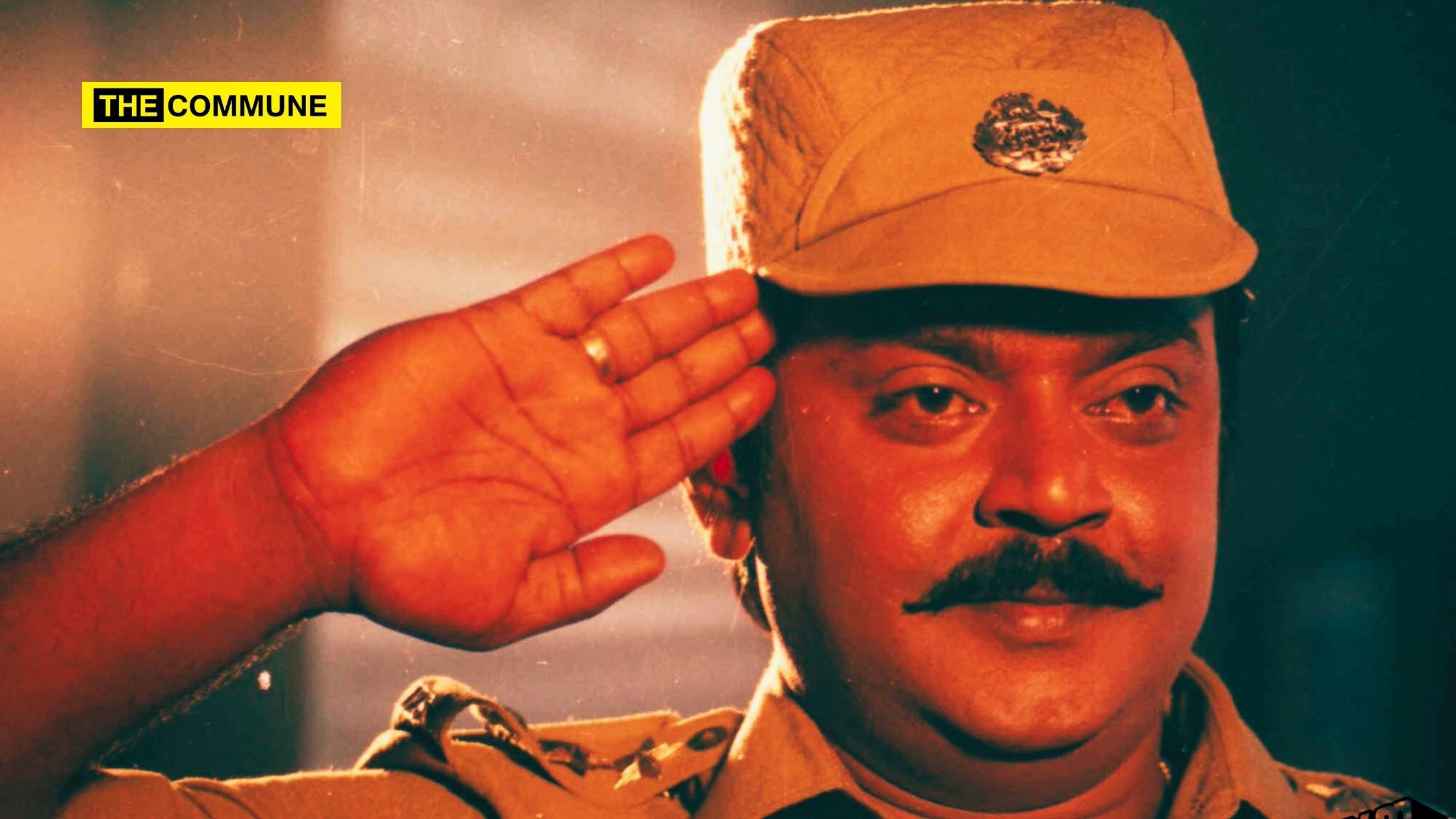
Vijayakanth: A Patriot Who Made Films To Spread Nationalism Among Youth

Vijayaraj Alagarswami, widely known as Vijayakanth, was a stalwart in the South Indian film industry and a prominent political figure. Born on 25 August 1952, Vijayakanth’s remarkable career spanned over four decades, during which he left an indelible mark as an actor, director, and politician. With a filmography of over 150 movies, he can be called the ‘Bharat Kumar’ of the South for his fervent portrayals of patriotism on the silver screen. Regrettably, the legendary actor breathed his last on 28 December 2023 in Chennai. His legacy remains etched in the hearts of admirers who cherished his contributions to cinema and politics alike. 

In the realm of Tamil cinema, actor Vijayakanth stood out as a beacon of ‘Desh Bhakti’ through his prolific career in Tamil and other South Indian languages. His cinematic legacy is deeply rooted in portraying patriotic narratives that resonated with audiences. Renowned for his impassioned performances, he can be called the ‘Bharat Kumar’ of the South Indian film industry, much like the legendary Manoj Kumar in Bollywood. Vijayakanth’s filmography boasts iconic works such as “Captain Prabhakaran,” “Thayagam,” “Ulavuthurai,” “Ramanaa,” “Vallarasu,” “Vaanchinathan,” “Thennavan,” and “Narasimha.” In the 1990s, Vijayakanth underwent a notable transformation in the types of films he chose to take on. A pivotal shift occurred as he increasingly embraced roles portraying police officers, a trend that commenced with “Pulan Visaranai.”

Following the success of “Chatriyan” in 1990, another milestone in his career was the film “Captain Prabhakaran” in 1991, elevating him to superstardom and leading to the enduring moniker “Captain.” His journey as a police officer on screen continued with impactful films such as “Sethupathi IPS” (1994), “Maanagara Kaaval” (1991), “Rajadurai” (1993), “Thai Mozhi” (1993), and “Honest Raj” (1994), solidifying his reputation in this genre.

Captain Prabhakaran: The Film That Earned Him His Moniker

Loosely based on the life of forest brigand ‘Veerappan’, the film has Vijayakanth play Prabhakaran, a dedicated police officer, tasked with tracking down Veerabhadran, a sandalwood smuggler operating near the Tamil Nadu-Karnataka border. During his mission, he unravels the enigma surrounding Veerabhadran and exposes the actual perpetrators responsible for his criminal activities.

Vijayakanth came to be known as ‘Captain’ after this film became a runaway hit.

A Man Who Had No Qualms In Speaking About The Dangers Of Terrorism

Sethupathi IPS will remain a landmark film in Vijayakanth’s career that brought out the nationalist in him. The plot revolves around Sethupathi IPS, a dedicated cop from a family with a strong history of serving the country. He uncovers a terrorist plot against the Prime Minister of India and manages to save the day but inadvertently causes the death of a terrorist who is part of the plot. This leads to the arrival of the terrorist’s vengeful brother, Sivaprakasham, who infiltrates Sethupathi’s family by pretending to be a good man and even marries Sethupathi’s mute sister.

Sivaprakasham and his terrorist gang later take over a school, leading to a hostage situation. Sethupathi arrives to confront them and ultimately defeats the terrorists, including Sivaprakasham, while safely landing their escape plane. The movie concludes with Sethupathi finally receiving his grandfather’s coveted medal for his heroism.

Another underrated film of Vijayakanth is Narasimha. In the film, after the death of terrorist leader Wasim Khan, the new leader Rasool Akhtar aims to destroy India. He kidnaps 20 Indian soldiers and brutally murders them. He also brainwashes an orphan child named Sher Khan. Meanwhile, Narasimha, a dedicated army officer, plants a bomb in a CBI office building but is later arrested. During his escape, he embarks on a killing spree, targeting those who assisted Akhtar. It is revealed that Narasimha is working undercover to save kidnapped Indian colonels. He eventually defeats Akhtar, rescues the colonels, and marries his love interest, Vaanathi, after a series of dramatic events. The film concludes with Narasimha taking Sher Khan under his wing, symbolizing unity and patriotism.

This is how the dialogue goes like this… “What freedom do you not have in India? There is a mosque on each street. Does Pakistan have a temple in every village? Here we’ve had several Muslims as Chief Justices in courts. Can a Hindu become an advocate (lawyer) in Pakistan? India had a Muslim President. Can a Hindu become a Ward Member in Pakistan? Here’s another example, an Indian cricket team captain representing 100 crores of us was a Muslim. Can a Hindu even play cricket in Pakistan? The person who created nuclear weapons for the country’s security, Abdul Kalam, was a Muslim. The song Saare Jahan Se Achcha, Hindustan Hamara was written by a Muslim. The Governor who swore in governments to power, Fatima Beevi, was a Muslim. All my friends who I value more than my life are Muslims. Here we do not see each other’s religions. We look at everyone as humans. In India, all have the same religion – Humanity. Listen to me now, the Muslims in India are living peacefully, happily, and safely compared to Hindus living in Pakistan. Whether this truth will be comprehended by passionate fools like you or not, whether the terrorists who are brainwashing people like you comprehend it or not, whether the nations across the world who are watching things happen and keeping mum comprehend it or not, that Allah who is a symbol of affection knows it.”

A Man Who Spoke About Corruption

His film Ramanaa also marked a new high in his career where Vijayakanth was respected for the role he played, stirring emotions of patriotism and doing good for the nation among the public. At a time when the actor was predominantly associated with formulaic masala films like “Vallarasu” and “Narasimma,” AR Murugadoss showcased Vijayakanth’s untapped potential with “Ramana,” marking a significant turning point in the actor’s career. In fact, “Ramanaa” served as the trailblazer that paved the way for numerous corruption-themed movies to emerge in the Kollywood film industry.

The film’s massive success coincided with Vijayakanth’s entry into the political arena in Tamil Nadu, adding another dimension to his multifaceted journey.

And the nationalist that he is he named his party “Desiya” Murpoku Dravida Kazhagam. Desiyam in Tamil means nationalism/nationalistic.

Having celebrated four decades in Tamil cinema, Vijayakanth remained a unique figure, having acted in over 150 films exclusively in Tamil. In an era dominated by stars like Rajinikanth and Kamal Haasan, Vijayakanth carved a niche for himself through his distinctive film choices. The 1990s witnessed a deliberate shift in Vijayakanth’s film choices, as he strategically incorporated patriotic themes, aligning with his burgeoning interest in politics. This decision proved fruitful, yielding commercial success and establishing him as a versatile actor adept at catering to both urban and rural audiences.

An enduring symbol of cinematic patriotism, he has left an indelible mark in the hearts and minds of young viewers who were inspired by his commitment to portraying the essence of love for the nation.

Hydra is a freelance writer and columnist.

Subscribe to our channels on TelegramWhatsApp, and Instagram and get the best stories of the day delivered to you personally.
DMK Supporting Dravidianists Abuse Fin Min Nirmala Sitharaman Invoking Her Brahmin Identity, She Had Asked HR&CE Dept To Prevent Temple Path Being Used As Public Toilet

Union Finance Minister Nirmala Sitharaman visited the flood-affected regions of Thoothukudi district on 26 December 2023. During her visit, she engaged with residents in various locations, including Korampallam, Maravanmadam in Thoothukudi Taluk, Murapanadu Kovilpathu in Srivaikuntam Taluk, and Manathi, Therku Valavallan in Eral Taluk, covering a total distance of approximately 120 kilometers. The Finance Minister directed the officials to expedite assistance to all affected individuals.

In Srivaikuntam, local residents informed Smt. Sitharaman about the severe impact of the floods on horticulture in the area. They explained that extensive agricultural land had been covered with river sand, rendering it unsuitable for cultivation. In response, the Finance Minister instructed district officials to take necessary measures to provide relief to horticultural farmers in the region.

Nirmala Sitharaman also paid a visit to the Vaikuntanathar Perumal Temple at Srivaikuntam where she inspected the chariot procession path that was ravaged by the floods. A video of her interacting and directing the officials inside the temple has gone viral on social media.

During the Brahmotsavam, the procession of the deity would go through the path that is behind the temple. However, that path was being used like an open-air public toilet by a few people leading to unbearable stench. When the Finance Minister was at the temple, a devotee had appealed to her to do something about getting the path cleaned.

Nirmala Sitharaman immediately ordered the officials to take the matter into cognizance and do the needful.

One person (probably an official) can be heard saying that a fencing would be erected soon.

Nirmala Sitharaman said that BJP Tamil Nadu’s floor leader in the Assembly, Nainar Nagendran would come and inspect whether the job has been completed or not in 15 days or a month.

If the job isn’t completed even after one month, I will come down here. Will it happen when I come? I will stand right there until the fencing is completed. No matter the work (I have). Alright?“, she can be heard telling the officials assembled at the temple.

She then makes snide remarks at the Joint Commissioner of Hindu Religious & Charitable Endowments (HR&CE) of Thoothukudi region asking him whether he listened to their grievances. The Joint Commissioner can be seen fumbling in front of the Minister.

“Perumal during the procession is coming through that path. They are asking you to clean the path which is being used like a public toilet.”, Nirmala Sitharaman says.

An official can be heard saying that the path would be guarded with proper fencing.

BJP MLA Nainar Nagendran asked how much would it cost to which Finance Minister Nirmala Sitharaman says “Why are you worried about that?

Taking jibes at the HR&CE department for not giving enough renumeration to the temple archakas, Nirmala Sitharaman says to the BJP MLA “For giving ₹3000 to these priests they (HR&CE) measure carefully like they do in ration shops. They would definitely have enough money remaining with them. They can’t pay them (archakas) salaries. Because there is a reason for that. They won’t have a problem in repairing the street/path.

She further adds “If you ask like that, they would say they’ve no money and you would also arrange CSR funds. No way!”

As she makes that comment, a devotee from the crowd can be heard saying that he can arrange ₹30,000 to which Nirmala Sitharaman replies “Wait brother! Don’t put it in the Hundi (donation box). You give wherever you want as you deem fit. Let them use the money they’ve to build it.”

She then goes on to warn the HR&CE Joint Commissioner saying “Don’t take it lightly thinking that I am talking candidly in a joking manner. They’re not asking you anything else. They’re asking you to get the path through which Perumal comes cleaned and maintained.” to which the official assures that he will get it rectified.

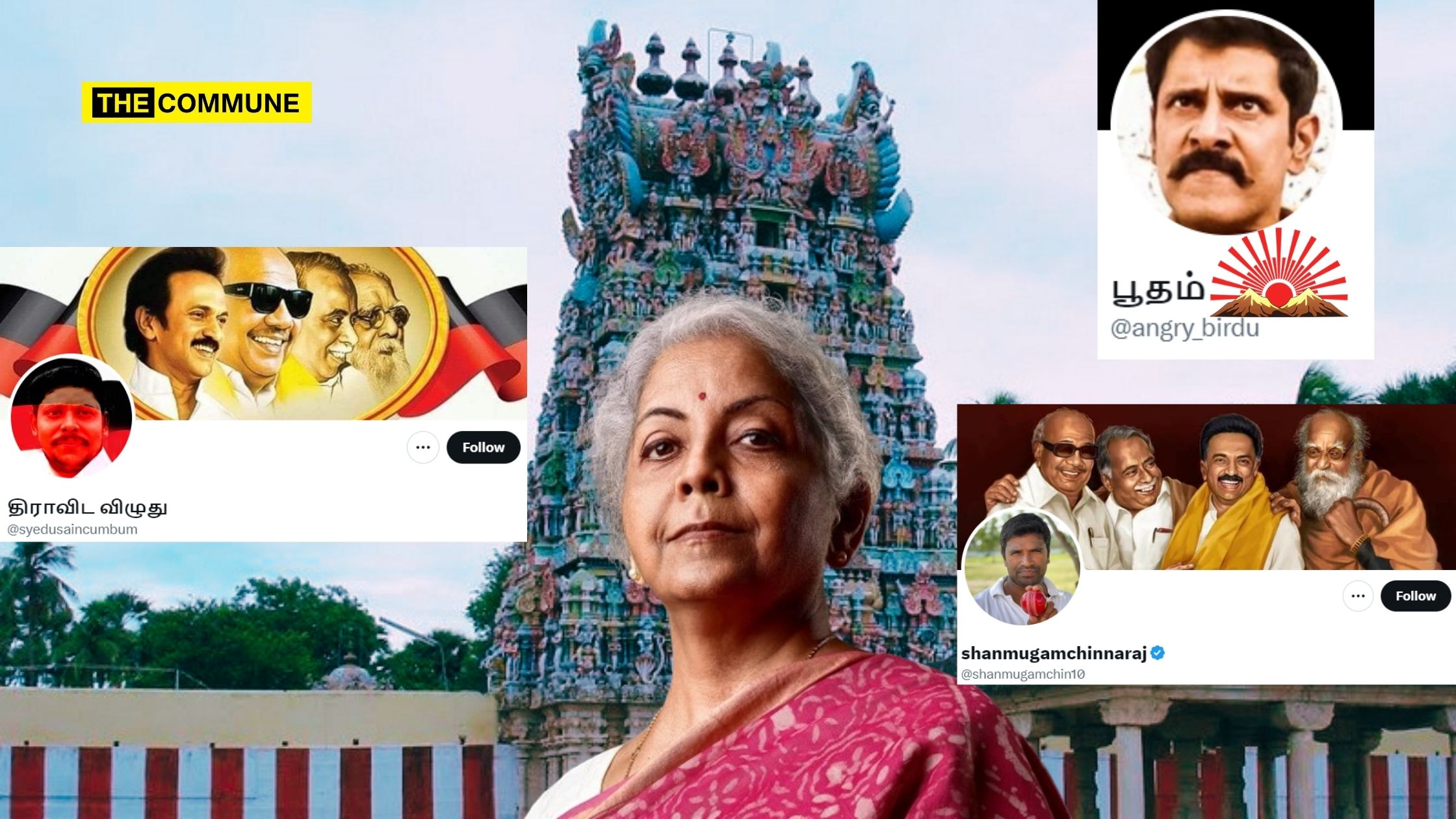
However, the DMK supporting Dravidian Stockists have unleashed vile casteist abuses at Nirmala Sitharaman invoking her Brahmin identity.

A rabid anti-Hindu Dravidianist handle promoted by senior DMK leaders (including the likes of DMK Minister PTR Palanivel Thiagarajan) said “Instead of looking at the damage caused by rains, it takes the mindset of cruel psycho to dig into what’s wrong with the Perumal temple procession route #தட்டேந்தி_நிம்மி”. 

The hashtag (Thattendhi Nimmi) in Tamil means “Nimmi holding the plate”, a casteist abusive reference pointing at her Brahmin identity as Brahmin priests survive on the donations made in the archana plate.

Another Dravidianist handle wrote: “Those who once told us to not come inside the temple are today saying if you come temple, don’t put money in hundi but put it in Iyer’s plate.

Here’s another from the same person.

Another Dravidianist DMK supporting handle @syedusaincumbum (Dravida Vizhudhu) wrote: “This Nooliban (equating sacred thread/poonol wearing Brahmins to Taliban) will go anywhere to beg with their plates even if it is a toilet.

Subscribe to our channels on TelegramWhatsApp, and Instagram and get the best stories of the day delivered to you personally.
“A Close Friend”: PM Modi Condoles The Death Of DMDK Founder Captain Vijayakanth

Actor-turned-politician and founder of Desiya Murpoku Dravida Kazhagam (DMDK), Vijayakanth, fondly called as ‘Captain’ passed away on 28 December 2023 after suffering from prolonged illness.

In November, Vijayakanth’s health deteriorated, leading to his admission to MIOT Hospital in Chennai. He was hospitalized for 14 days under medical observation due to cough and throat pain. He passed away just days after handing over the DMDK’s torch to his wife Premalatha Vijayakanth.

Tributes from cross the political spectrum have been pouring in for the late politician who changed Tamil Nadu’s political landscape forever.

Prime Minister Narendra Modi too sent an emotional condolence message calling Vijayakanth a close friend.

Extremely saddened by the passing away of Thiru Vijayakanth Ji. A legend of the Tamil film world, his charismatic performances captured the hearts of millions. As a political leader, he was deeply committed to public service, leaving a lasting impact on Tamil Nadu’s political landscape. His passing leaves a void that will be hard to fill.” PM Modi said in an X post.

He further added “He was a close friend and I fondly recall my interactions with him over the years. In this sad hour, my thoughts are with his family, fans and numerous followers. Om Shanti.

In 2005, Vijayakanth established the Desiya Murpokku Dravida Kazhagam (DMDK) party.

During the 2006 elections, DMDK contested all assembly seats but managed to secure only a modest 10 percent of the total vote share. However, besides the party’s founder-leader, none of its candidates emerged victorious.

In 2011, DMDK formed an alliance with the AIADMK and contested 41 constituencies, securing victory in 26 of them. This remarkable achievement made the Captain’s party a historic success, surpassing the DMK in seat wins and establishing itself as the principal opposition party for that year.

Vijayakanth served as the Leader of the Opposition in the Tamil Nadu Assembly from 2011 to 2016.

Subsequently, due to differences in opinion, the DMDK severed ties with the AIADMK, resulting in the mass resignation of DMDK MLAs. Consequently, the party lost its status as the primary opposition party.

Vijayakanth served as a Member of the Legislative Assembly twice, representing the Virudhachalam and Rishivandiyam constituencies.

In the 2014 parliamentary elections, the DMDK joined forces with the NDA but experienced a significant defeat, with a notable decline in its vote percentage.

In the 2016, 2019, and 2021 elections, the DMDK’s performance suffered as Vijayakanth battled health complications.

Subscribe to our channels on TelegramWhatsApp, and Instagram and get the best stories of the day delivered to you personally.
 

Decoding Tamil Nadu’s Economic Trajectory: A Tale Of Lost Opportunities Under Dravidian Rule

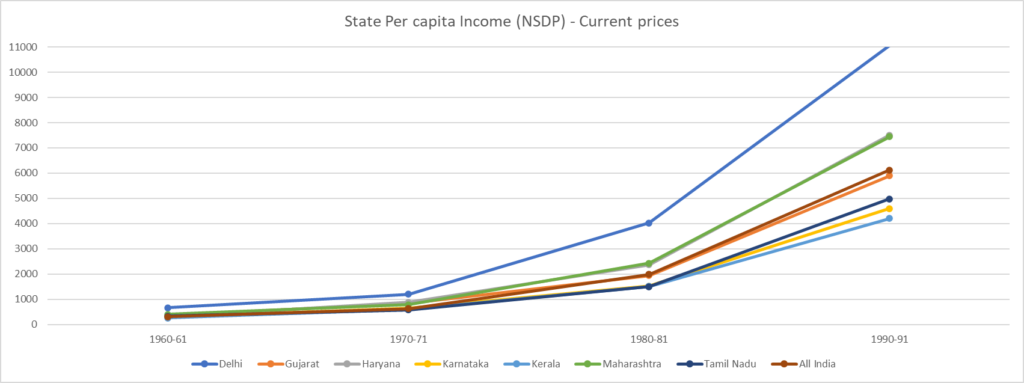
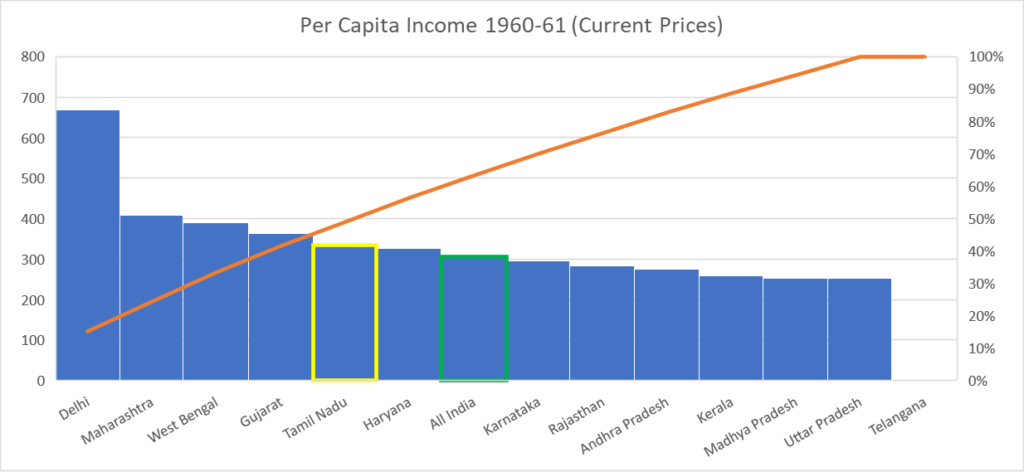
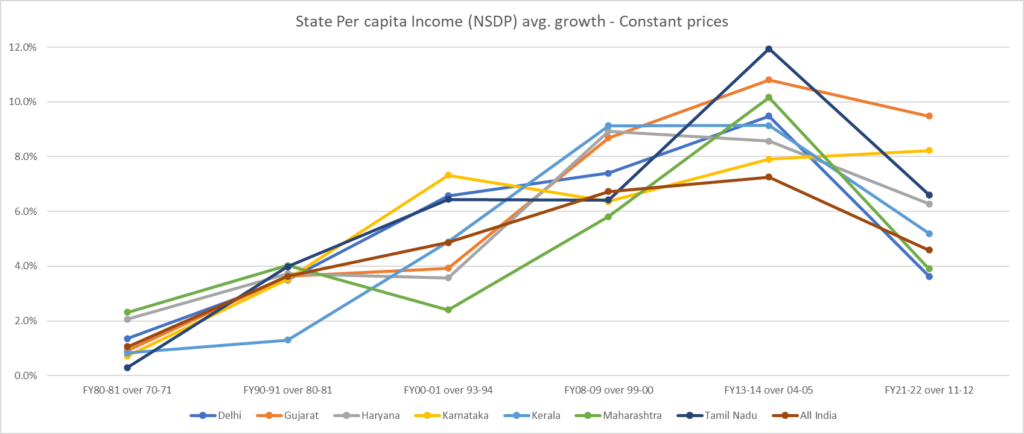
Tamil Nadu benefitted from a high base rate in the economy till the 1960s before the Dravidian parties’ rule. The state had a high literacy rate, economic levels, and per capita income among major states. Let’s look at some of the data points over decades to understand this better.

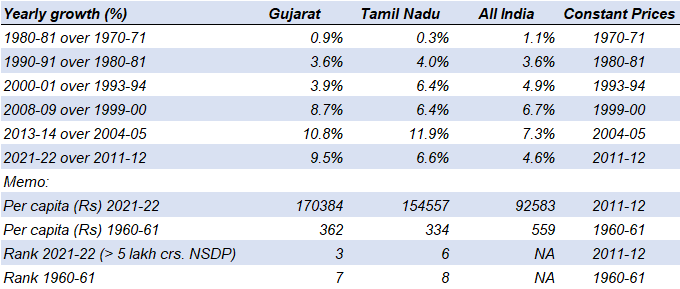
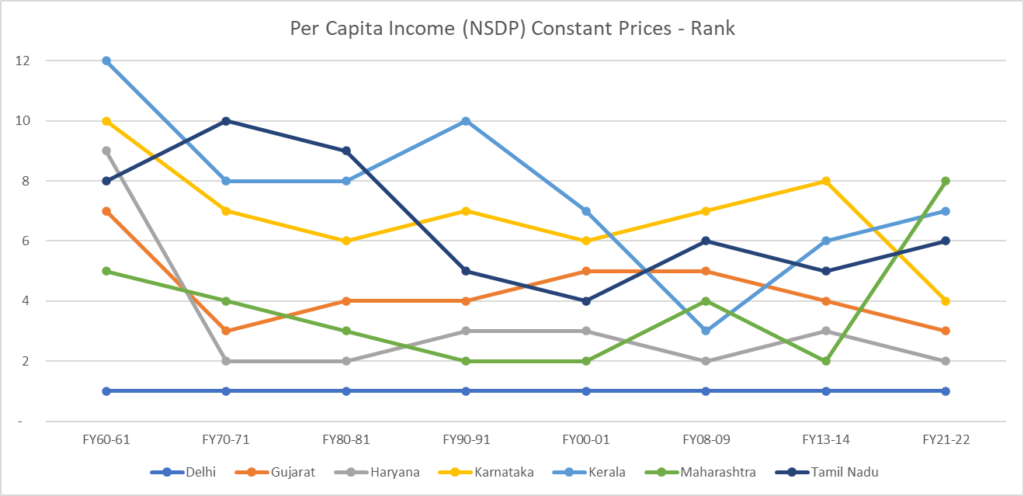
In the initial decades, Tamil Nadu had worsened its performance and played catch-up later. However, states like Haryana, Gujarat and Karnataka have done significantly better than Tamil Nadu – Noteworthy that there was No Dravidian model at play here.

The high base effect had helped the State grow its economy, bigger than its compatriots. Laggard in the first decade (the 70s) and also in the 2000s under Dravidian rule. Most of Southern states doing better than Tamil Nadu for the same period.

This table compares Tamil Nadu’s performance vis-à-vis Gujarat over decades after the State came under the rule of the Dravidian parties. Gujarat has done much better than Tamil Nadu here. This also reflects Tamil Nadu’s relative position amongst major states having high NSDP (above ₹5 lakh crores. NSDP)

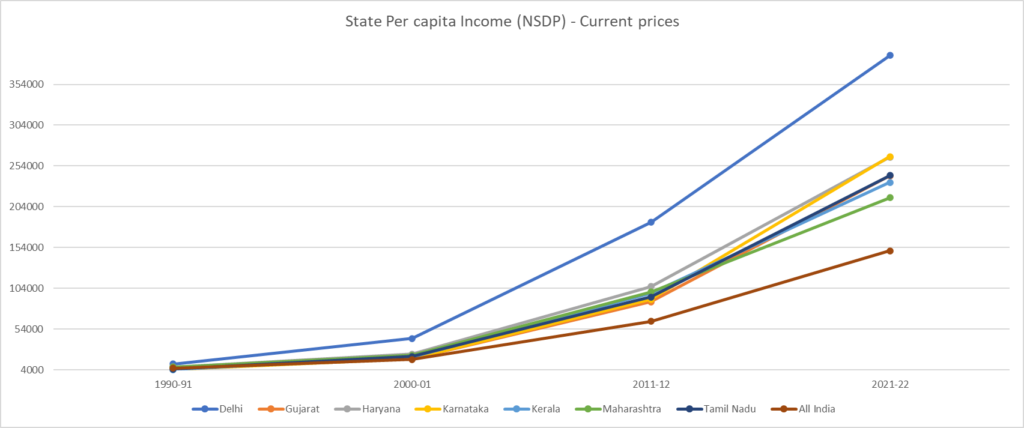
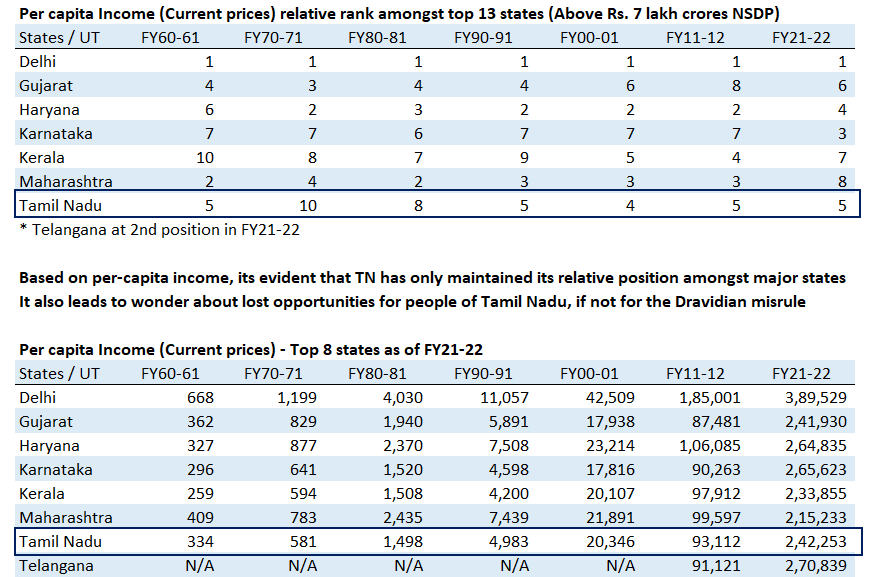
Amongst the top 13 states with NSDP (current prices) above ₹7 lakh crores (Except for Odisha & Bihar, all highly populous states covered), Tamil Nadu has been maintaining its relative position. Initially, the Dravidian rule worsened the state’s relative position – a tale of lost opportunities.

Kerala, Karnataka, and Haryana have shown better performance than Tamil Nadu; Gujarat is nearly at par, and Maharashtra shows lower performance than Tamil Nadu over the same period.


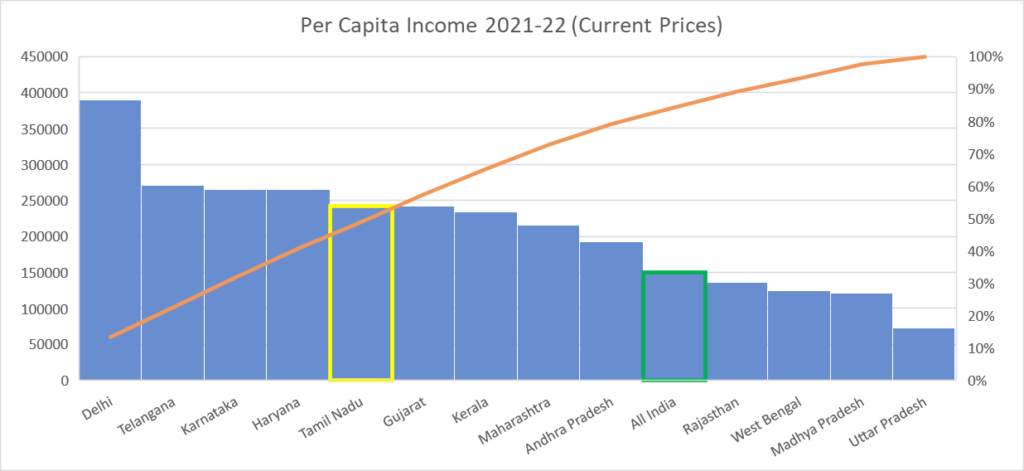
Per capita income 2021-22 (Current prices) reflects the relative standing of Tamil Nadu against major states. Tamil Nadu at 5th position with Telangana, Karnataka, and Haryana in a better position. Gujarat is nearly at par and Kerala is closely behind.


Against 1960-61, Tamil Nadu’s relative position is constant amongst major states (above ₹7 lakh crores). Southern states of Telangana and Karnataka going beyond Tamil Nadu; Maharashtra and West Bengal are seeing lower performance comparatively.


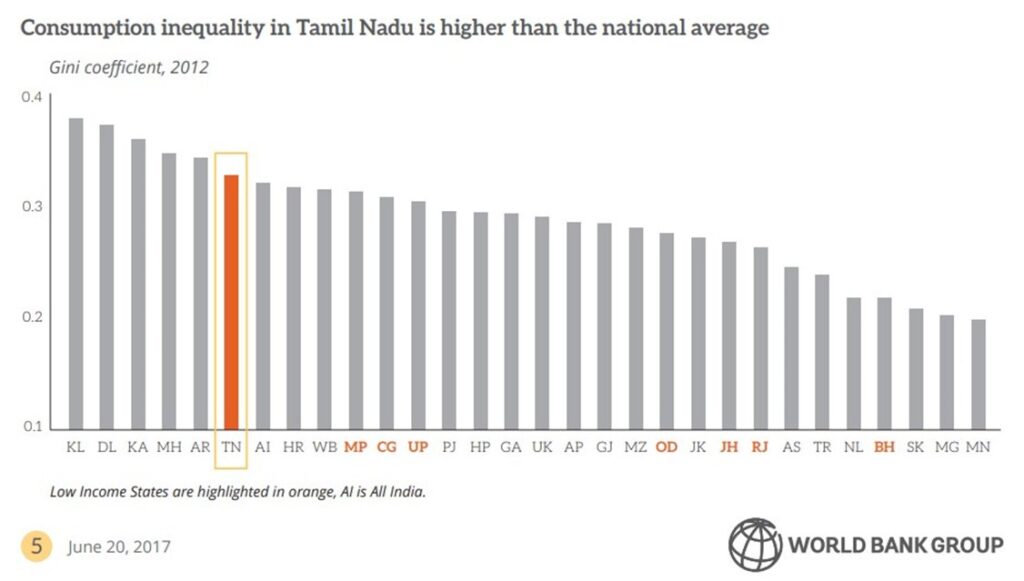
Performance of the rest of the Southern States conveys that Tamil Nadu has lost its pre-eminent position of the 1960s and has been a laggard against the best performers, under the misrule of the Dravidian parties. Moreover, the State has also not ensured equitable growth. Amongst states with high consumption inequality in India, it is higher than the national average. Dravidian misrule resulted in not harnessing its full potential by not uplifting marginalised people and victimising certain communities due to its casteist approach to governance.


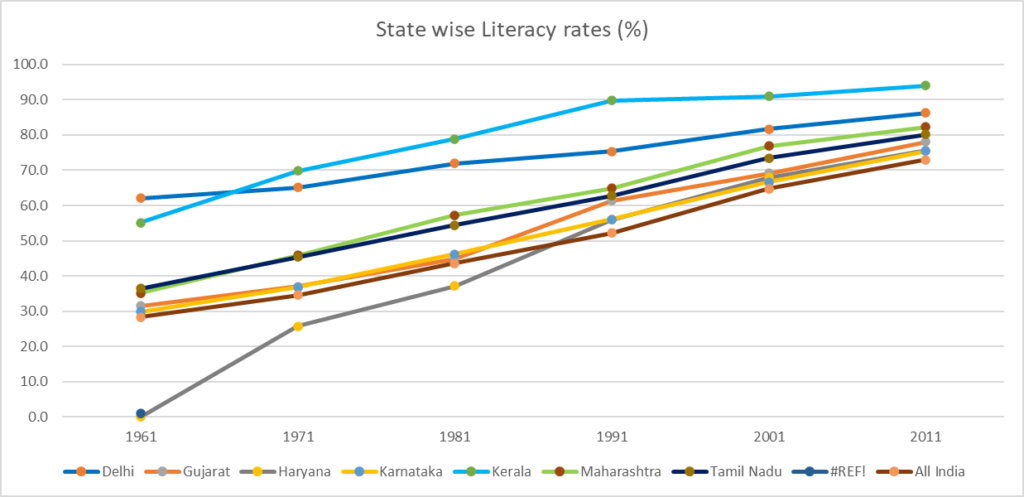
Another key parameter influencing economic growth is its literacy rate. Tamil Nadu had a 36.4% literacy rate in 1961 pre-Dravidian parties rule, 3rd amongst major states. Tamil Nadu known for its high literacy rate had the benefit of a high base rate and stood out in 1961 itself.


This base effect led Tamil Nadu to reach an 80.1% literacy rate in 2011 to make it to the 4th position. Maharashtra’s growth in the same period is better than that of Tamil Nadu. Overall, data points from 1960-61 onwards reflect a different take on Tamil Nadu’s position. More of a tale of lost opportunities under the Dravidian parties, but especially the DMK.

Source: MOSPI and Economic Survey

(This article based on the X thread by Baskar – all images are from the same thread)

Baskar is a finance professional having keen interest in current affairs and Indian culture.

Subscribe to our channels on TelegramWhatsApp, and Instagram and get the best stories of the day delivered to you personally.
Villagers In Ramanathapuram Name Road After Union Fin Min Nirmala Sitharaman After She Facilitates Crucial Railway Overpass In Lanthai Village

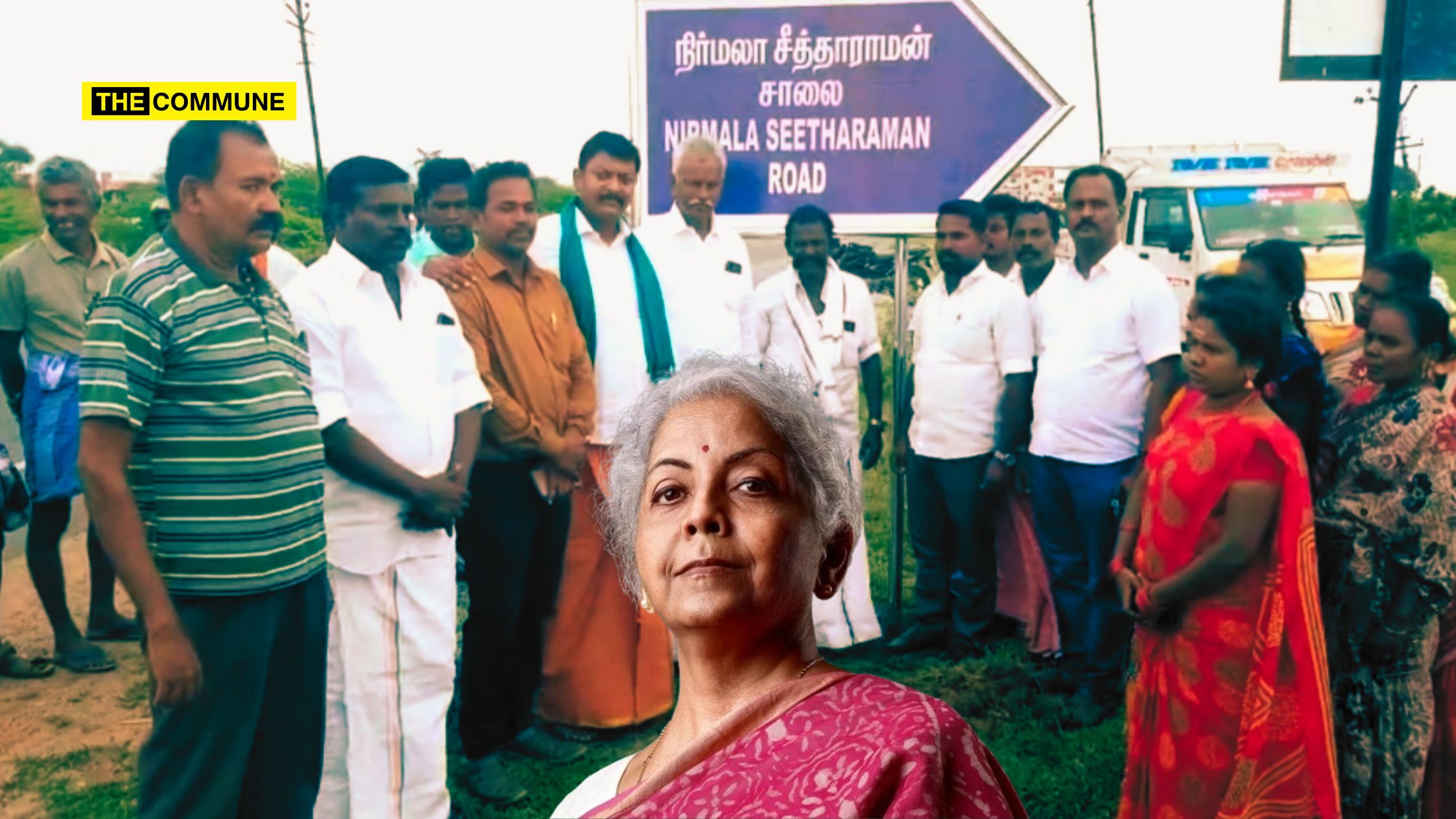
In a significant development, Union Finance Minister Nirmala Sitharaman played a pivotal role in addressing the longstanding concerns of the residents of Lanthai, Kananai, Peria Tamaraikudi, Chinna Thamaraikudi, and Tripunai villages in Tamil Nadu. During her recent visit to Rameshwaram on 29 November 2023, the Finance Minister met with Railway Minister Ashwini Vaishnaw, advocating for the construction of a manned gate or a flyover to replace the existing subway under the railway crossing in Lanthai Village.

The villagers, facing perpetual difficulties due to flooding in the region for most months of the year, expressed their concerns to the Finance Minister. They highlighted that the existing subway was the only means of connectivity for the villages, emphasizing the urgent need for a more sustainable solution to enhance accessibility and address the persistent water-related challenges.

Responding to the plea of the locals, Union FM Nirmala Sitharaman took proactive steps, requesting the construction of a flyover that would significantly benefit the affected villages. The proposed railway overpass aims to provide a reliable and flood-resistant connection to Lanthai, Kananai, Peria Tamaraikudi, Chinna Thamaraikudi, and Tripunai.

Following the Finance Minister’s intervention, a Panchayat Council meeting was convened on 5 December 2023, at the Panchayat Council Building in the presence of the Panchayat Council President, Chairman and members attended the session, where several resolutions were passed expressing gratitude and appreciation for the Finance Minister’s efforts.

The resolutions outlined the collective thanks of the people to the Hon’ble Finance Minister for her instrumental support in obtaining permission for the construction of the railway overpass. Recognising the positive impact on the lives of the villagers, the Panchayat passed a resolution to name the road after Nirmala Sitharaman as a token of gratitude for her dedication to addressing the community’s needs.

The proposed railway overpass, once realised, is expected to bring about positive transformation, providing enhanced connectivity and resilience against the challenges posed by seasonal flooding. 

In a recent update shared by Tamil Nadu Bharatiya Janata Party leader Prof Rama Sreenivasan, it became crystal clear that the road was indeed named after her as per the resolution. Dravidianists were in denial and claimed the news to be fake earlier.

Subscribe to our channels on TelegramWhatsApp, and Instagram and get the best stories of the day delivered to you personally.
Madurai Bench Of Madras High Court Orders Eviction Of Christian School Encroaching On Hindu Temple Land

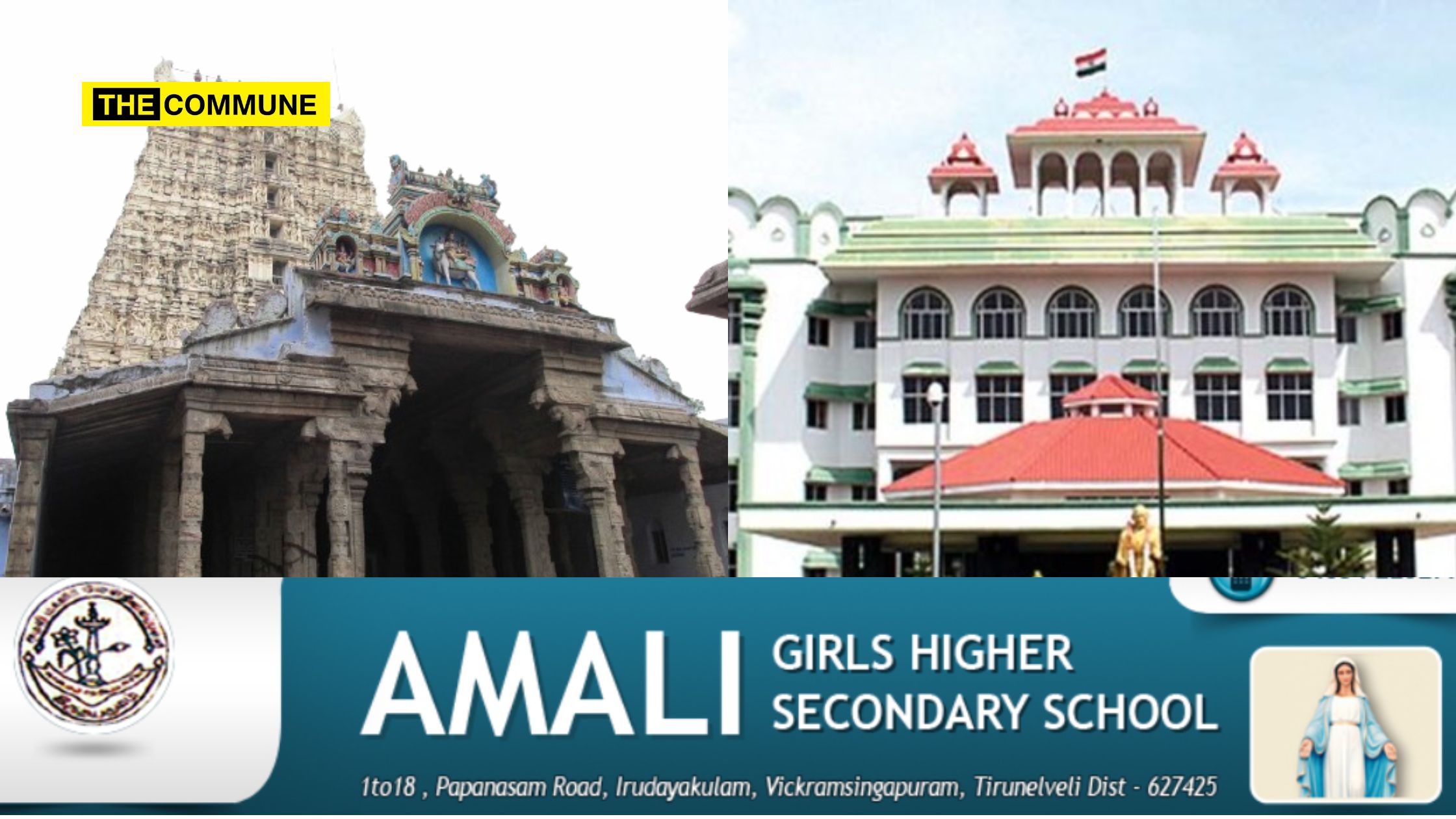
In a significant legal development, the Madras High Court’s Division Bench ordered the eviction of Amali Girls Higher Secondary School in Vickramasingapuram, Ambasamudram taluk, Tirunelveli district, for encroaching on 11 acres of Hindu temple land since 1990. The court’s well-reasoned judgment, delivered on 4 December 2023, marks a crucial step in restoring the rightful ownership of the land to the trust ‘Pillayan Arthjama Kattalai,’ falling under the supervision of the Hindu Religious and Charitable Endowment (HR&CE) department.

The legal battle dates back to 2011 when devotee M. Mariappan brought the encroachment issue to the attention of the High Court bench. Following the court’s directive, the HR&CE took cognisance of the matter, and the then commissioner, J Chandrakumar, instructed the joint commissioner (JC) in the Tirunelveli region to address the encroachment and return the land to the trust.

As reported in 2013 in the Times of India, the HR&CE JC, M. Anbumani, passed an eviction order in 2013, citing the school’s unauthorised use of the land for non-agricultural purposes and the construction of buildings. The school had initially leased the land for cultivation in 1989, with an annual rent fixed at a nominal amount of ₹2,000. However, it failed to adhere to the terms of the agreement, leading to the HR&CE’s decision to reclaim the land.

Despite the legal proceedings, the school challenged the eviction order, prompting the high court to grant a status quo for three weeks, citing potential disruptions to students. The judgement was delivered after the status quo period ended on 19 September 2013 reaffirming the HR&CE’s authority to reclaim the encroached land.

The trust, ‘Pillayan Arthjama Kattalai,’ oversees charitable activities and poojas to the deity ‘Papanasar’ at the renowned Papanasam Sivan temple on the banks of the Tamirabarani River in Tirunelveli. The revenue generated from leasing the land, including to the school, supports these activities. However, the meagre annual rent of ₹5,000 paid by the school for eleven acres, significantly below the market value, raised concerns among the public and affected the execution of poojas to the deity.

The Division Bench’s order for eviction, while upholding the interest of the students for the current academic year, provides a resolution to the prolonged legal battle and sends a clear message against encroachments on religious and endowment lands. The deadline for eviction has been set for 31 March 2024, taking into account the welfare of the students too. 

Subscribe to our channels on TelegramWhatsApp, and Instagram and get the best stories of the day delivered to you personally.
Recent Findings Reveal Harappan Civilization Is 7000-8000 Years Old

Indus Valley Had Powerful Intercontinental Mercantile Civilisation: Devdutt Pattanaik

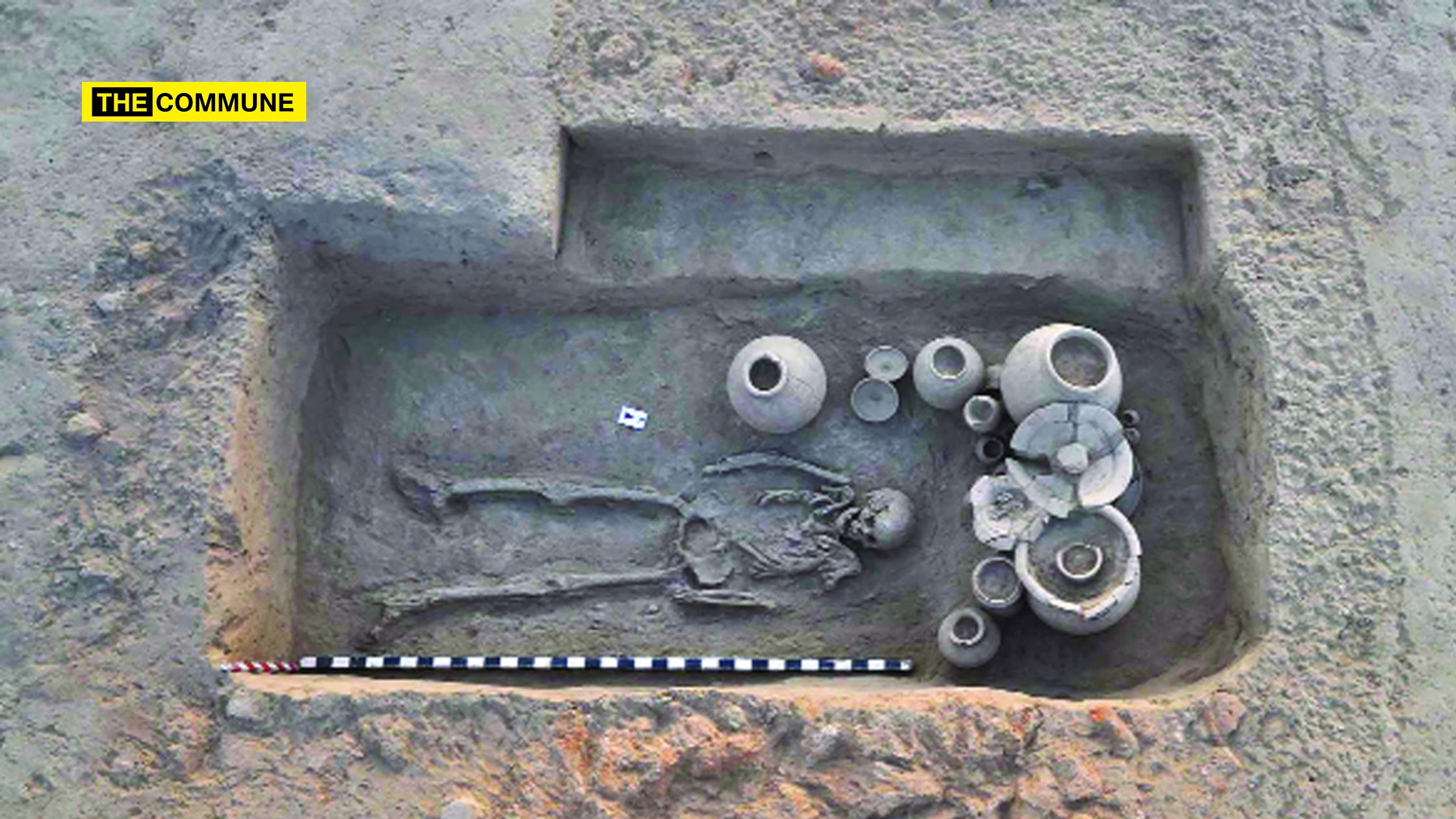
Archaeological researchers from Deccan College Pune, in collaboration with the Central Archaeological Survey of India (ASI), have unveiled a remarkable discovery at the historic site of Rakhigarhi, a village situated in Haryana’s Hisar district. According to a report by Hindustan Times, the findings suggest that the human remains found at this site date back approximately 8,000 years, shedding new light on India’s ancient history. This revelation comes as a result of the third phase of excavations conducted by ASI in conjunction with multiple research teams across the country, including experts from Deccan College Pune.

The initial phase of excavations at Rakhigarhi, led by Dr. Amarendra Nath of the Indian Archaeology Department from 1997 to 2000, yielded evidence of the North Harappan culture dating back to 2500 BC. Subsequently, the second phase of excavations, led by Professor Vasant Shinde from Deccan College Pune, took place from 2006 to 2013. During this phase, Shinde’s team collected substantial evidence and conducted DNA tests, suggesting that this culture could be over 4,000 years old. Over the past two years, ASI and Deccan College Pune have jointly conducted the third phase of excavations at Rakhigarhi, led by ASI Joint Director Sanjay Kumar Manjul and Deccan College Pune Assistant Professor Prabhodh Shirwalkar.

Shirwalkar explained, “The Harappan culture comprises three parts: East Harappan, Middle Harappan, and North Harappan (Modern). The earlier two excavations found evidence of the Middle and Modern Harappan cultures dating back around 4,000 years. However, the evidence uncovered in the third phase of excavations indicates that this culture dates back 7,000 to 8,000 years. Our team is currently preparing the final report on this significant discovery.”

The ongoing research suggests that human DNA has remained relatively unchanged over the past 8,000 years, which has been determined through the examination of human remains and traps found at the site. Additionally, a substantial burial ground was discovered, containing both human and animal traps.

The ASI is actively engaged in these excavations at the Rakhigarhi archaeological site, with a primary aim to make the site accessible to the public. This involves the preservation and exposure of structural remains for future viewing and the provision of visitor amenities.

During the excavations, a wide range of metal utensils, including gold and silver artifacts, were uncovered. Shirwalkar also highlighted the discovery of old silver and copper ornaments, as well as exquisite clay pots. Notably, the remains of expansive underground settlements, featuring courtyards and drainage systems, were also revealed. These settlements included houses with two to six bedrooms, offering insights into ancient lifestyle and housing. Clothing items, such as a colorful piece of cloth, a shawl, and a skirt, were also found.

Shirwalkar emphasized the significance of this research, stating, “This study provides compelling evidence that the Harappan civilization dates back 7,000 to 8,000 years. Collaborative efforts between India’s Department of Archaeology and Deccan College have led to this conclusion, confirming the existence of an advanced civilization in our country during this ancient era, comparable to the advancements of today.”

Earlier in the year, Union Finance Minister Nirmala Sitharaman had highlighted Rakhigarhi in her 2023 budget speech. She emphasized the development of five iconic archaeological sites, including Rakhigarhi, with the construction of on-site museums. The plan aims to showcase the antiquities uncovered at Rakhigarhi, which is now recognized as the largest Harappan site spanning 350 acres, in a museum near the site, estimated to be worth ₹23 crores.

Subscribe to our channels on TelegramWhatsApp, and Instagram and get the best stories of the day delivered to you personally.