Home Blog Page 772

‘Is This A Democracy?’, IPDS Survey On Coimbatore LS Seat Blocked; Released Through Media Later
ipds-survey-coimbatore-results-lok-sabha-annamalai-bjp-dmk-police.jpg

Indian Political Democratic Strategies or IPDS, is an organisation that conducts political/election surveys around elections for individual candidates and political parties among other services they provide. 

The organisation has been around since 2004 and has so far released about 46-48 surveys on electoral opinion polls. 

The IPDS was supposed to release a survey result for the Coimbatore Lok Sabha constituency just before the deadline of 16 April 2024. As per the Election Commission’s model code of conduct, 48 hours before elections, all campaign and election-related activities must be halted – this applies to politicians, citizens, etc. 

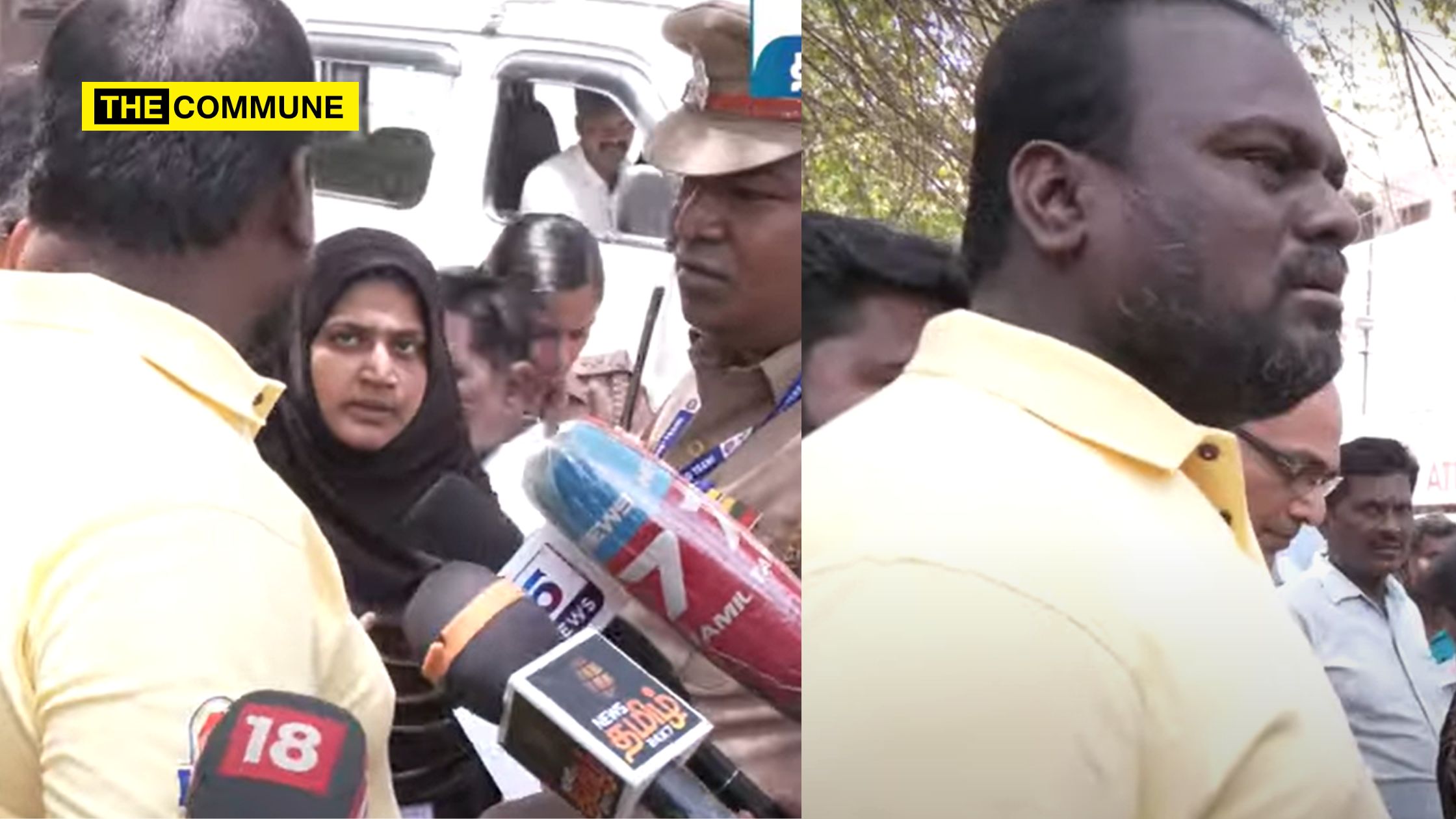
On 15 April 2024, Thirunavukkarasu, the one who runs IPDS was not allowed to release the poll survey for Coimbatore. In a viral video, Thirunavukkarasu is seen in a heated discussion with a lady wearing a burkha and a lady police asking him if he got permission from EC to release the survey results. In the video, the police are also seen. The lady claimed he needed permission to release the survey results whereas Thirunavukkarasu went on replying to her that EC had given time for everyone until 48 hours before election day. 

Thirunavukkarasu said Dinamalar had released a survey earlier that day and was going to release another on 16 April 2024. He said, “Is this a democratic country? If this is the case, why not arrest Dinamalar and close down their publication?”

He further added, “I am a common man, I am a Tamilian but I am being subjected to this. They will accept Prashant Kishore’s words or PEN’s survey? Should the truth not be told? Should the lies be covered? Is this a democracy?”

Later addressing the media, he said, “We have been forced to release our survey results in the middle of the road. IDPS was formed with the backing of Loyola College in 2004.” 

Challenging the police for their behaviour and their alleged unlawful prevention of his survey release, he said, “The Police department is preventing me from releasing a survey result. The EC states that we can release surveys until 16 April 2024. The Coimbatore LS constituency is a keenly fought battle and everyone’s eyes nationally are on it. We carried out opinion polls/surveys for the past 10 days and the results were to be published today. But today the police prevented me from doing that. I am forced to release the results from the middle of the road.”

“We began in 2004 and to date, we have never faced any such pressure or opposition. I see this as a dictatorship. In my survey for Coimbatore Lok Sabha seat, Annamalai has garnered 38.9% and Ganapathy Rajkumar 33.4% while ADMK got 18.5%,” he continued. 

He further said, “I am saying this to the police department which has subjected me to so much heartache that in the upcoming elections, BJP’s Annamalai will win with over a 1 lakh vote difference – if it doesn’t happen, I will wind up my organisation. I challenge the police department for all that they put me through that Annamalai will win in Coimbatore. I have carried out nearly 48 surveys since inception. But this time, the police department has irritated me and caused me a lot of embarrassment and grief. BJP will win Coimbatore. The people are very eager to see this change and are eager to vote for the BJP.”

Speaking about the details of the survey, he said his team surveyed approximately 4000 individuals of all ages, and all backgrounds in and around Palladam, Singanallur, Gavundampalayam, South and North Coimbatore. 

He repeated his challenge that he would shut down his organisation if his survey results were any different. He added that he was not affiliated with any political party. When asked if he thought the police were under any form of pressure due to which they prevented the survey result release, he said, “Yes, they have been harassing me since yesterday and torturing me over the phone. Every election I have predicted correctly and I have predicted that the DMK would win the 2021 elections, the 2019 MP elections, and Erode by-elections, and it did. IDPS is number 1 when it comes to surveys so what is wrong in releasing these results as well? What is the need for politics here? All these 20 years, I never faced it, this is very new for me. I am agonised by this. I have predicted that the DMK would win in almost all the elections, but today when I say Coimbatore will see BJP win, why are they politicising it?”

Subscribe to our channels on TelegramWhatsApp, and Instagram and get the best stories of the day delivered to you personally.
ADMK Parrots DMK’s False Narrative About PM Modi

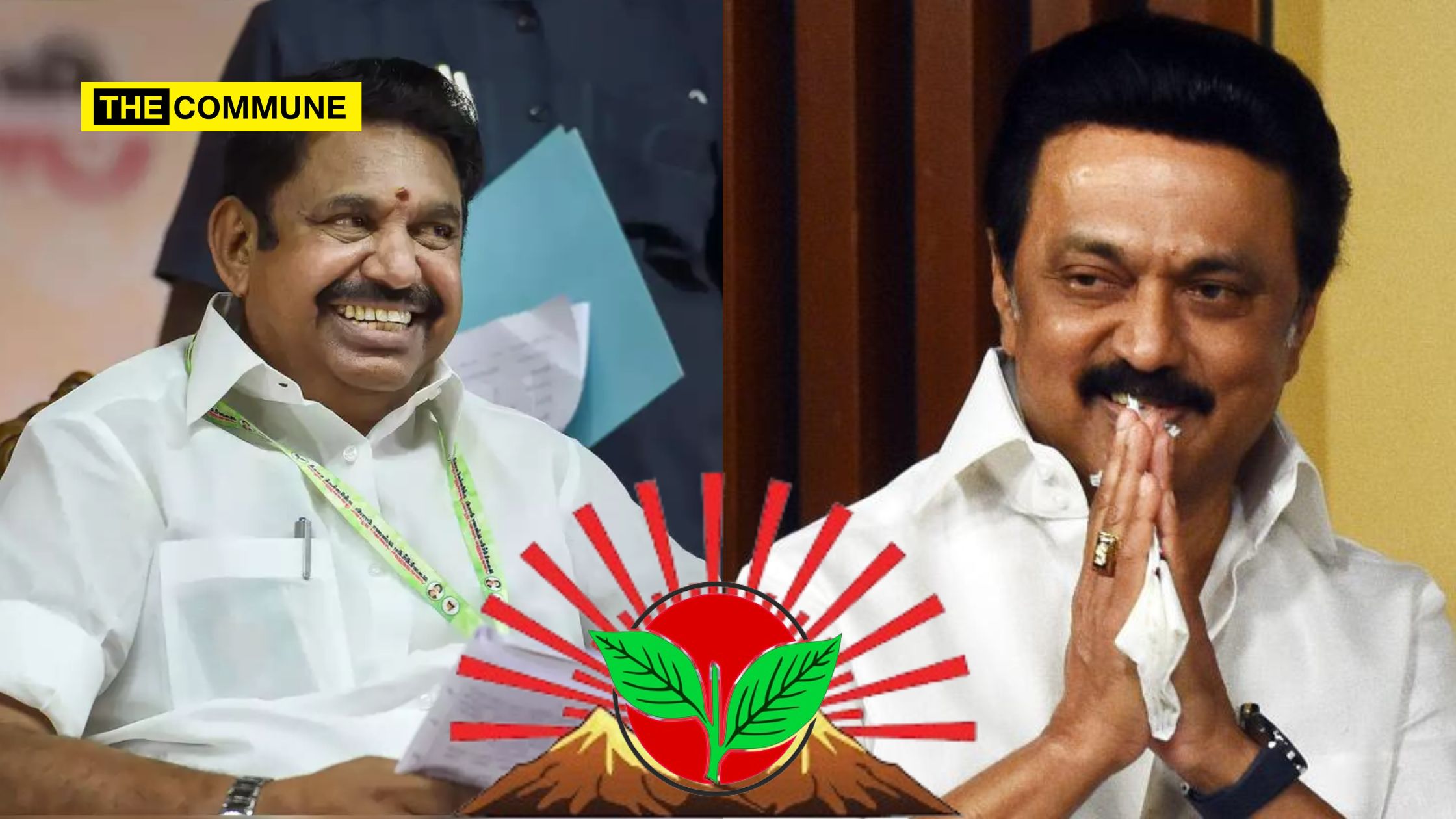
EPS' ADMK Goes The DMK Way Crying Foul About "Hindi Imposition"

The AIADMK appears to be echoing the stance of their rival opposition party DMK, mirroring the sentiments expressed by Udhayanidhi Stalin, the Minister for Youth Welfare & Sports Development and scion of the DMK. Recently, posts from the AIADMK’s IT wing on their official X account have put forth the same narrative stating “29 Paisa- Delhi ji” which was peddled by Udhayanidhi Stalin during his election campaign in Arcot on 27 March 2024.

During the Arcot rally, Prime Minister Narendra Modi was criticized, and the Union government was accused of neglecting Tamil Nadu. Udhayanidhi Stalin referred to the PM as ‘Mr29 paisa Modi‘, alleging that while the Union government collects ₹1 per individual as tax, it only allocates a mere 29 paise for each citizen’s welfare, thus disregarding the public’s needs.

Tamil Nadu BJP president K Annamalai strongly rebutted a narrative presented by DMK on 4 April 2024, asserting that the Union government led by the BJP has allocated the highest amount of funds to Tamil Nadu in the past decade. He urged Udhayanidhi to cease referring to Prime Minister Modi as ‘29 paise Modi’, warning that if such remarks persist, the BJP will retaliate by labeling him ‘Ganja Udhayanidhi‘ as the widespread availability of illicit substances like ganja in villages since the DMK assumed power.

This suggests a clandestine liaison between the DMK and its partner party AIADMK parroting the sentiments despite projecting themselves as fierce adversaries in public arenas yet maintaining a covert relationship.

What Is The Truth Behind The Allegation?

The Finance Commission of the country plays a crucial role in shaping the financial dynamics between the central government and the states. By delving into the intricate workings of financial institutions in India, it facilitates a comprehensive understanding of their operations.

Constitutional provisions regarding the imposition and collection of taxes are outlined in Articles 268 to 281 of the Indian Constitution. These provisions serve as a blueprint for the central government, offering directives on the equitable distribution of financial resources among the states. They establish a framework for harmonizing tax imposition and collection procedures between the central and state authorities, thereby fostering a coherent system of financial relations. The Fifteenth Finance Commission has formulated a tax transfer formula that considers various factors. These factors include population (15%), geographical area (15%), income disparity among states (45%), demographic transition (12.5%), preservation of forests and ecology (10%), and the effort made by states in tax collection (2.5%).

During the budget session of 2024, it was reported that Tamil Nadu’s portion of Central taxes for the fiscal year 2023-24, as per the updated Union Budget figures presented by Finance Minister Nirmala Sitharaman on 1st February 2024, would amount to ₹44,760.83 crore. This represents a 7.4% increase from the initial projection of ₹41,664.86 crore. Adjustments for previous years led to a revised estimate of ₹45,052.53 crore for Tamil Nadu’s Central tax share in 2023-24. For the interim budget of 2024-25, Tamil Nadu’s share is forecasted to be ₹49,754.95 crore, indicating an 11.2% rise from the revised figures of the preceding fiscal year. Despite a surge in tax collections, the DMK government claims it has been receiving a considerably lower share of devolution from the Centre.

The primary argument put forth by the DMK is that its allocation from the total divisible pool of Central taxes has declined significantly, from 5.305% during the 12th Finance Commission to 4.079% under the 15th Finance Commission. They highlight examples where states ruled by the BJP receive comparatively more significant returns. For instance, for every rupee contributed by Tamil Nadu to the Centre, it receives only 29 paise in return. In contrast, Uttar Pradesh receives ₹2.73, Bihar receives ₹7.06, Maharashtra receives ₹0.08, Karnataka receives ₹0.15, and Gujarat, ruled by the BJP for nearly two decades, receives ₹0.28 less than Tamil Nadu.

The Fifteenth Finance Commission determined the allocation of funds to states from the divisible pool of taxes based on three key factors: their individual needs (such as population, area, forest coverage, and ecological concerns), equity considerations (including differences in per capita income), and performance metrics (such as own tax revenue generation and reduction in fertility rates). These factors were weighted with 40% for needs, 45% for equity, and 15% for performance. As a result, Uttar Pradesh and Bihar received shares of 17.9% and 10% respectively, while Karnataka, Kerala, and Tamil Nadu received 3.65%, 1.93%, and 4.08% respectively. Notably, the inclusion of fertility rate in the formula by the Fifteenth Finance Commission aimed to incentivize states that had successfully lowered their fertility rates, though this aspect tended to benefit more developed states.

M Govinda Rao, a member of the Fourteenth Finance Commission, defended the formula, emphasizing that its aim was not merely to redistribute funds between states but to ensure that all states could provide comparable levels of services. The underlying principle was one of horizontal equity, recognizing that tax revenues collected in a state might not solely originate from that state. He acknowledged the significant rise in per capita income levels in Karnataka, Kerala, and Tamil Nadu, but cautioned against attributing this solely to the efforts of those states.

Similarly, the state isn’t solely reliant on the central government, thanks to the GST, which provides a more substantial foundation for state sustenance with a 50/50 revenue-sharing model. Therefore, the fiscal decentralization carried out by the central government doesn’t exclusively benefit the BJP-led states in the north. It aligns with the constitutional obligation to distribute funds equitably among states. Recently, the BJP administration has responded to the states’ demands by offering incentives to those that effectively reduced their fertility rates. This initiative was not undertaken by the Congress, an ally of the DMK, during their tenure in power.

https://twitter.com/OnlyTruth2024/status/1775857473746063517

Subscribe to our channels on TelegramWhatsApp, and Instagram and get the best stories of the day delivered to you personally

“You Don’t Have That Kind Of Brains In Gujarat”: DMK Minister TRB Rajaa Says As TNM Pits Tamil Nadu Against Gujarat

In a recent interview with left-leaning and the unofficial DMK-mouthpiece The News Minute, Tamil Nadu Minister for Industries and Investment, TRB Rajaa, sparked controversy with his disparaging comments targeting Gujarat and the BJP-led central government. Rajaa’s remarks, laden with divisive rhetoric, not only criticized Gujarat’s capabilities but also painted a biased narrative against the BJP and the central government led by the BJP.

During the interview, Rajaa made incendiary statements, asserting, “You don’t have that kind of brains in Gujarat.” Why did he say this? These remarks came as a response to a question by TNM’s Pooja Prasanna when she asked about how the Chief Minister had spoken about how the investments were being driven to Gujarat. TRB Rajaa said, “It is not being driven to Gujarat, some of them some of it is being diverted to Gujarat. Very very unfair. They’ve (business owners) been arm-twisted there into other into BJP-ruled States but the sad part is when they take them to such states when the investments go to such states, it doesn’t thrive there. That’s the basic problem with the BJP is that they don’t understand states, they don’t understand India. They don’t understand plurality, they don’t understand talent, they don’t understand diversity, and they don’t understand the talent that each state has. Tamil Nadu is the talent capital of India we have the best talent in the world because of the best education system because they built it over 100 years.”

While slipping into peddling the Dravidian agenda, he claimed the mid-day meal scheme was introduced by the Justice Party. He said, “It didn’t happen overnight it happened over several regimes right this is the Dravidian model of governance so we started very back in the 1920s with the mid-day meal scheme from the Justice party. So when we’ve done this over 100 years, something which takes that long and is built upon such a strong foundation, should not be played around with and we’ve done this for India we’re not doing for Tamil we’re doing this for India. The people who have studied, who come out of the institutions from Tamil Nadu, it applies worldwide in all the institutions. you call them Indians right you don’t call them just Tamil so we’ve done this for India and we are extremely proud of it.”

It is noteworthy that owing to massive reservations in Tamil Nadu, brain drain happened in the state and several bright minds moved out of TN (India) and settled in plum positions abroad. 

Talking about “talent” in TN, he said, “Now when you take investments which let’s say especially high-end investments which need high-end jobs, technically skilled jobs, skilled labor that kind of job you won’t get anywhere else in India. that’s the strength of Tamil Nadu. certain states have certain talents, certain strengths.”

He then spoke about red-category industries and advocated that they must be sent to desert states because of the landscape and the lack of talent for high-skilled technical jobs. He said, “So, in Tamil Nadu for instance, we cannot bring loads of red-category industries. Take that to Desert states. take that to let’s say your Gujarat or anywhere else where you have loads of land just plain vast arid land. but when you need technical skills you need talent you don’t have that there. You don’t have the kind of talent that you have in Tamil Nadu you don’t have that kind of brains in Gujarat. Then why would you want to do this? Take loads of solar, wind, you have loads of land, lakhs and lakhs of acres of vacant arid land, put that to good use. Why would you want to take these jobs and you’ve taken something which you can’t do and now you look at the state of that company those investors I don’t want to name them because many of them have called us back, they’ve apologized first.”

Such derogatory remarks, aimed at Gujarat’s intellectual prowess, reflect a troubling trend of regional chauvinism and unwarranted denigration of other states. By casting aspersions on Gujarat’s intellectual capacity, Rajaa not only disrespected the people of Gujarat but also perpetuated a false narrative of superiority for Tamil Nadu.

Furthermore, Rajaa’s comments extended to allegations of unfair practices by the BJP-led central government in diverting investments away from Tamil Nadu to Gujarat. He claimed, without substantiated evidence, that investments were being unfairly redirected to Gujarat, thereby insinuating favoritism by the central government towards BJP-ruled states. Such baseless accusations only serve to sow seeds of discord and mistrust among states and deepen political polarization.

Rajaa’s unfounded insinuations about Gujarat’s competency and his unsubstantiated claims regarding investment diversion not only lack credibility but also demonstrate a blatant disregard for facts and responsible discourse. 

By propagating such divisive rhetoric, The News Minute and Rajaa not only undermine the spirit of cooperative federalism but also jeopardise inter-state relations.

TNM’s role in amplifying Rajaa’s divisive narrative without critically scrutinising his claims raises concerns about journalistic integrity and impartiality. By providing a platform for Rajaa’s inflammatory remarks without proper fact-checking or counterbalancing perspectives, TNM has contributed to the dissemination of misinformation and further fueled inter-state tensions.

Amid Tamil Nadu’s election campaign, political leaders and media outlets alike must uphold principles of honesty, fairness, and respect for diverse perspectives. TRB Rajaa’s inflammatory remarks and TNM’s uncritical reporting not only undermine the democratic process but also sow seeds of discord and division, ultimately detracting from the collective pursuit of progress and unity in India.

Subscribe to our channels on TelegramWhatsApp, and Instagram and get the best stories of the day delivered to you personally.
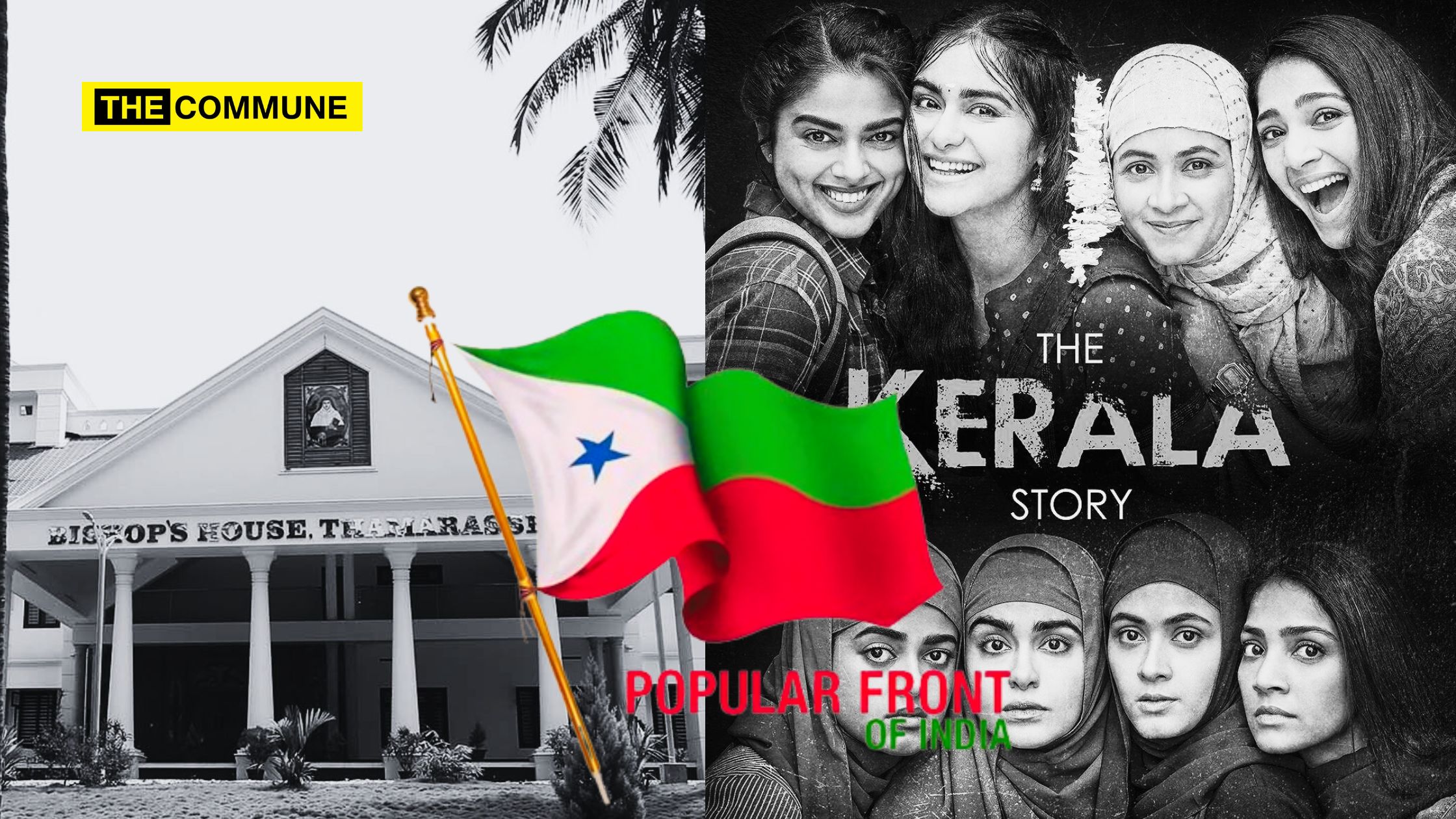
The Kerala Story – Islamists From PFI, NDF Targeted Brilliant, Well-To-Do Upper Caste Hindu & Christian Girls Reveals Special Branch Report

Following the example of the Idukki diocese, the Kerala Catholic Youth Movement (KCYM) affiliated with the Thamarassery diocese of the Syro-Malabar Church has declared its intention to showcase “The Kerala Story” in all its branches. This film, released in 2023, sparked accusations from political circles of promoting Islamophobia.

This has revived the discussion about the movie ‘The Kerala Story’, which revolves around 4 women hailing from Kerala who were compelled to embrace Islam and become associated with the Islamic State, as highlighted in the 2017 NIA charge sheet involving Sonia Sebastian, Merin Jacob, and Nimisha Nair. This occurrence sparked significant discourse in Kerala regarding the concept of “love jihad.”

TG Mohandas, speaking on ABC Malayalam news channel, made a shocking disclosure about older cases of love jihad involving Kerala girls. These cases highlight how young women were ensnared under the pretext of love and coerced into converting to Islam. Mohandas substantiated his claims with data extracted from past reports by the Kerala High Court and special investigations conducted by the Kerala Police.

TG Mohandass begins by recounting Justice KT Sankaran’s observation from 2009 regarding the presence of coercive religious conversions disguised as acts of love in Kerala. The court urged the government to consider implementing legislation to prohibit such deceitful practices. The court emphasized that “Under the pretext of love, there cannot be any compulsive, deceptive conversion.” Justice KT Sankaran made these remarks while rejecting the anticipatory bail pleas of two individuals accused of involvement in ‘love jihad’ activities. These activities allegedly involved enticing girls from other religions to marry Muslim boys with the intent of converting them to Islam. Upon reviewing the case records of ‘love jihad’ incidents, Justice Sankaran concluded that there were clear indications of forced religious conversions taking place.

According to Justice KT Sankaran, police reports indicated a deliberate effort to convert girls from a specific religion to another, with the support of certain groups. The court emphasized that this issue should concern the public, and it is the government’s responsibility to safeguard citizens’ fundamental rights. The court urged the legislature to consider passing laws to prevent coercive religious conversions, stating that using force to spread religion is illegal and could lead to law and order issues.

Citing statistics, the court noted that in the past four years, there have been 3,000 to 4,000 instances of religious conversions following romantic relationships. Police reports indicate that groups like the National Democratic Front (NDF), PFI, and Campus Front have established bases in college campuses across various cities.

It was revealed that the strategy involved targeting highly talented girls from affluent Hindu and Christian families. While there is no nationwide evidence of ‘love jihad’, the court observed that the program allegedly began in 1996 with the support of certain Muslim organizations.

Mohandas expresses empathy even as the Manmohan Singh administration permits state governments to pass laws prohibiting religious conversion through inducement or coercion. States such as Arunachal Pradesh, Gujarat, Himachal Pradesh, Madhya Pradesh, and Odisha have adopted these measures. He ironically notes that it was not the Modi government but the Congress government under Manmohan Singh in 2009 that initiated this, challenging the opposition’s narrative that the BJP champions Hindu interests.

Mohandas also shared some excerpts from the case. He said, “Another report says that the enquiry by the Special Branch reveals that fundamental outfits like NDF, PFI, Campus Front has roots in college campuses in the City referred to therein (Kozhikode). Referring to Campus Front, it is stated in the report thus: “As per the available information, the plan of this organization is to trap brilliant upper caste Hindu and Christian girls from the well-do family, especially those who are studying for professional courses and employed in IT sectors.”

It is believed that Muslim organisations like Muslim Youth Forum and Muslim Women’s organisations like Thasreen Millat, Shaheen Force, Popular Front of India, National Democratic Front, and its student organizations like Campus Front are the organizations behind the so-called Love Jihad movement. There is no concrete evidence to show the financial status of the organization. But it is known that they get support and financial assistance from National Democratic Front and Popular Front of India. Some other Muslim fundamental organizations are also arranging money from some foreign countries in Gulf. But the veracity of this information has to be ascertained,” he added.

Subscribe to our channels on TelegramWhatsApp, and Instagram and get the best stories of the day delivered to you personally.
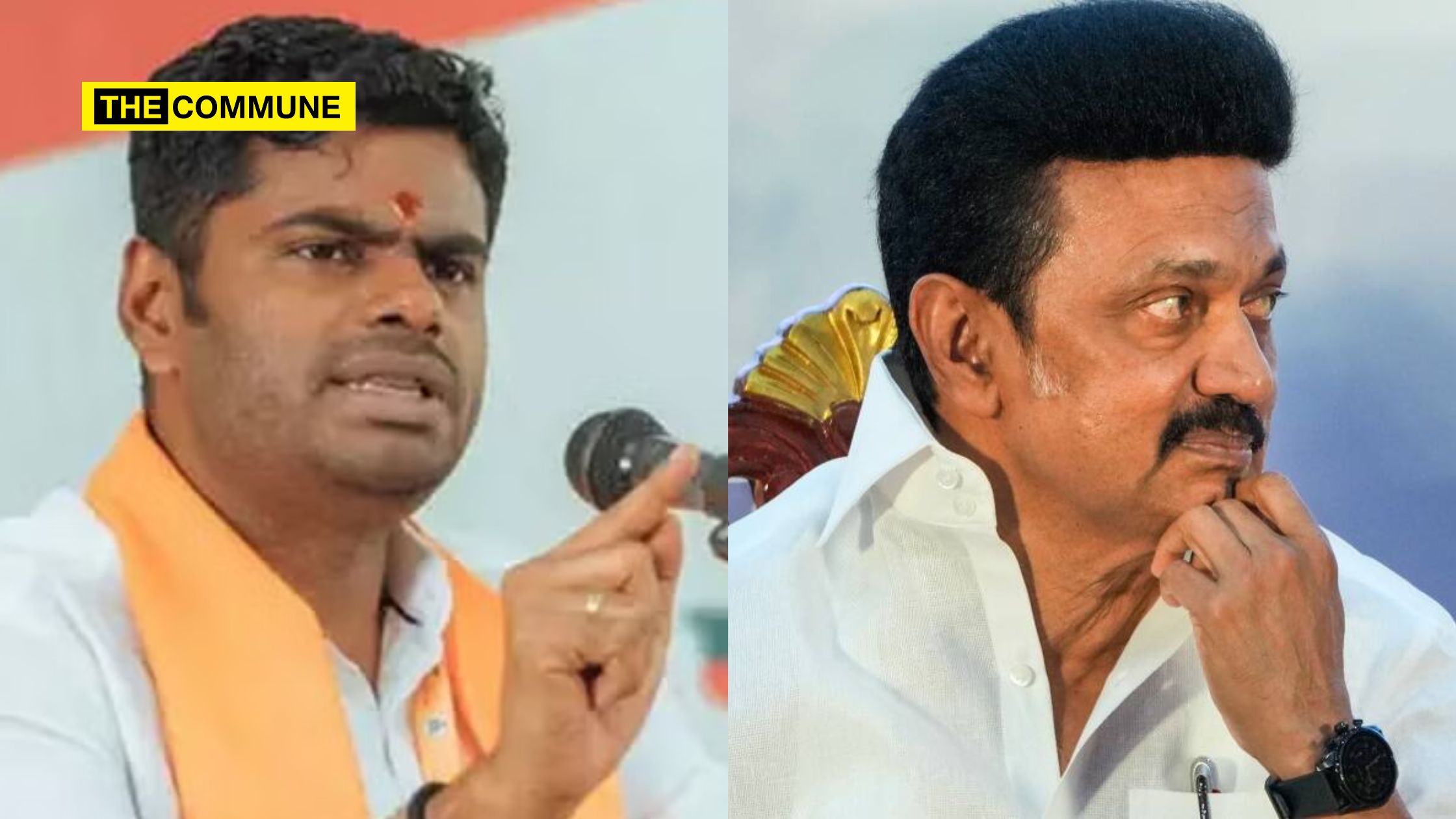
TN BJP Chief Annamalai’s Campaign Convoy Stopped By TN Police Over Flimsy Reasons; Police Register Case After Protests Ensue

Tensions rose in Coimbatore as Tamil Nadu BJP Chief, K Annamalai, staged a protest after police halted his convoy, citing a violation of the approved campaigning time limit. Annamalai, who is contesting from the Coimbatore Lok Sabha seat in the upcoming national elections, placed blame on the state’s ruling DMK government for what he termed as “draconian” actions by the police.

The incident unfolded around 10:30 PM on 14 April 2024 when Annamalai’s campaign vehicle was passing through the Ondipudhur area of the city. However, police officers stationed there refused to allow the vehicle to proceed, asserting that it was operating beyond the permissible time frame for campaigning.

Expressing frustration at the police intervention, Annamalai initiated a protest, clarifying that his intent was not to campaign but merely to greet people while remaining inside the vehicle. The ensuing demonstration resulted in traffic congestion in the vicinity.

Subsequently, police registered a case against Annamalai and 300 party workers under sections 143 and 341 of the Indian Penal Code (IPC).

In a social media statement released late that night, Annamalai criticized the DMK government’s actions, alleging that they had crossed boundaries by obstructing their campaign vehicle on what he described as flimsy grounds.

He wrote, “The excesses of the DMK Govt through the Police force have gone beyond limits as they stopped our Campaign vehicle yet again today for flimsy reasons. The Police stopped our vehicle under the pretext that I was not allowed to campaign after 10 PM while travelling through a preapproved point. Despite explaining that we were not campaigning, the lights in our vehicle were off, and we only wanted to meet the 2000 

@BJP4TamilNadu cadres in the pre-approved point through which our campaign vehicle was passing. Despite explaining to the Police officer that his actions were beyond the instructions laid down by EC, they compelled us to take an alternative route. The draconian DMK Govt will face the people’s wrath when Coimbatore Will unanimously casts its vote disapproving 3 years of misgovernance on the 19th of April.” 

Several videos are being shared on social media where Annamalai is seen engaging with the police where he elaborates on the situation, asserting that they were not engaged in campaigning and that their vehicle’s lights and the microphone were off, the police kept insisting on redirecting them through an alternative route.

Speaking to news media, Annamalai alleged that the police together with the DMK were doing everything possible to distribute money and prevent candidates like Annamalai from the BJP from campaigning freely. 

Annamalai later with his cadre staged a protest.

Tamil Nadu is one of the first states to go to polls on 19 April 2024. 

(with inputs from India Today)

Subscribe to our channels on TelegramWhatsApp, and Instagram and get the best stories of the day delivered to you personally.
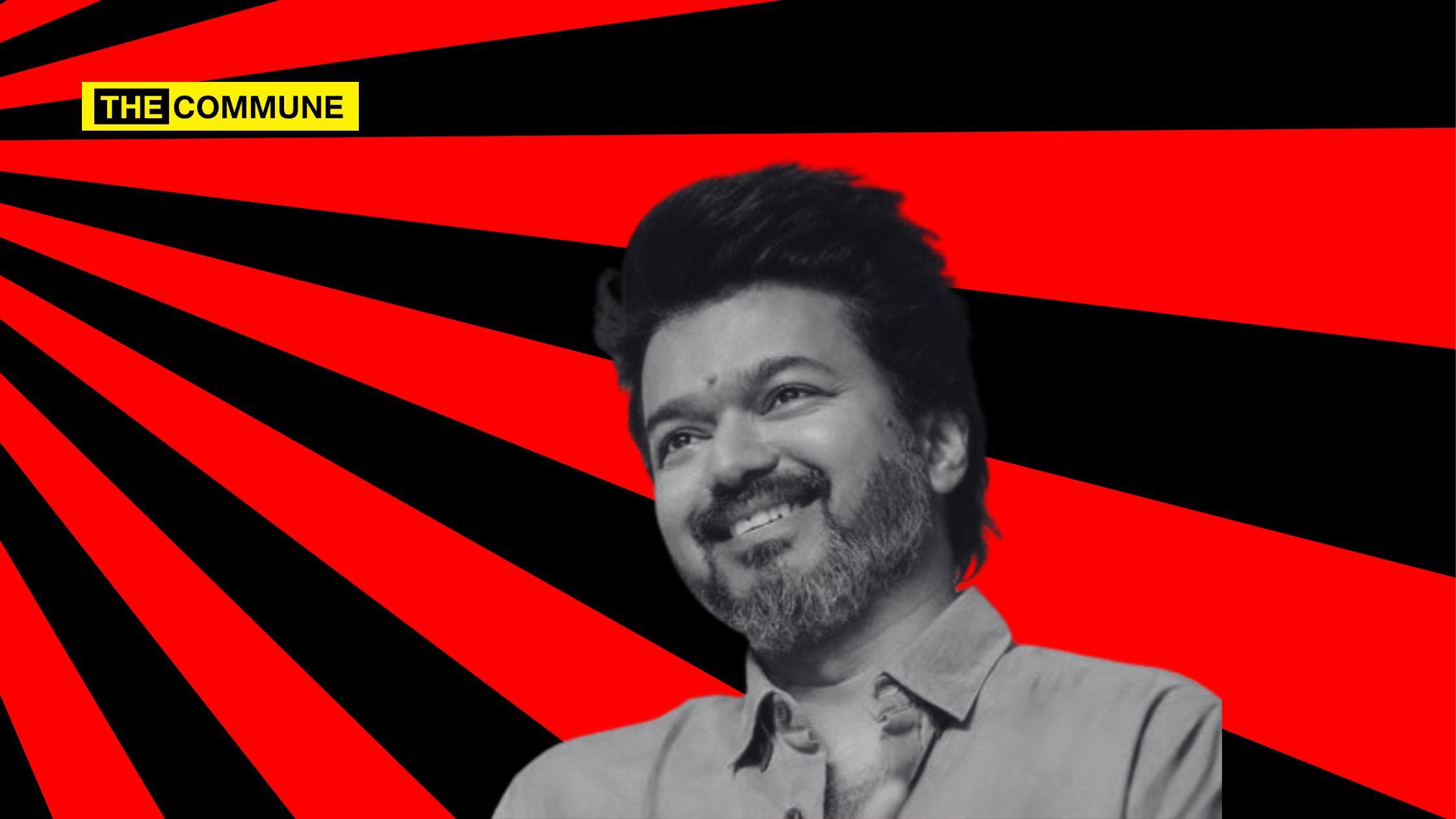
Actor And Part-Time Politician Vijay Goes The Dravidianist DMK Way, Doesn’t Wish For Tamil New Year

Is Vijay's TVK DMK 2.0? These Instances Show He's Nothing But Just Another Pseudo-Secular Dravidian Stock

On the auspicious occasion of Tamizh Puthandu (Tamil New Year) on 14 April 2024, amidst the festive spirit engulfing Tamil Nadu, notable actor and part-time politician Vijay, who recently launched his political outfit, Tamizhaga Vetri Kazhagam (TVK), stirred controversy by refraining from extending wishes for the Tamil New Year. Instead, Vijay took to social media to share greetings for Ambedkar Jayanti, which coincidentally fell on the same day.

In a tweet from the official handle of the actor’s political entity, Vijay expressed greetings for Ambedkar Jayanti, the day commemorating the birth anniversary of Dr. B. R. Ambedkar. 

This deviation from the customary wishes for Tamizh Puthandu drew sharp criticism from certain quarters, with detractors accusing Vijay of aligning with Dravidianist ideologies, particularly the Dravida Munnetra Kazhagam (DMK), which historically downplays Tamil New Year celebrations in favor of emphasizing other cultural and political events.

It is noteworthy that politicians from the ruling Dravida Munnetra Kazhagam (DMK) have conspicuously abstained from extending greetings to Hindus, particularly during festivals like Tamil New Year. Chief Minister Stalin has been observed extending wishes for various festivals celebrated in the state, excluding those of Tamil or Hindu origin.

Moreover, during their tenure in government, the DMK implemented changes that shifted the Tamil New Year to January 14/15 (Pongal), deviating from its traditional observance. This alteration in the cultural calendar has been viewed by some as an attempt to reshape the historical traditions and customs of the Tamil people.

Coming back to Vijay’s Ambedkar Jayanti post, critics expressed their disapproval, highlighting what they perceived as a departure from Vijay’s previous actions. Notably, it is worthy to point out a contrasting instance in 2022, when Vijay had extended wishes for Tamil New Year coinciding with the release of his film “Beast” on 13 April. 

The sudden shift in Vijay’s greetings was interpreted by some as a strategic maneuver following his entry into politics, indicative of opportunistic political posturing, suggesting that he may be going the Dravidianist (DMK) path and likely to abandon his previous stance on Tamil/Hindu culture and tradition.

The omission of Tamil New Year wishes by Vijay, a prominent figure in Tamil cinema and now a burgeoning political leader, has sparked debates on social media, with contrasting interpretations regarding his alignment with Dravidianist ideologies and the implications for his political aspirations.

Subscribe to our channels on TelegramWhatsApp, and Instagram and get the best stories of the day delivered to you personally. 
Suspect In High-Profile Murder Case Dead After Being Taken For Questioning By Police, Wife Alleges Custodial Death & Demands Further Probe

The recent demise of Santhakumar, a previously arrested in connection to the murder case of Varapuram Panchayat Council President, PBGT Shankar, has sparked widespread concern in the region. Santhakumar, who had been released from custody just the week prior, was brought in for questioning by authorities on 13 April 2024, but tragically passed away at the hospital due to deteriorating health conditions.

PBGT Shankar, a notorious figure in Sriperumbudur’s Varapuram Panchayat Council, was brutally murdered near Poonamalee in April 2023. Following the incident, Santhakumar, also known as Samu and a 15th Ward Councilor, was apprehended along with seven others and detained at Puzhal Jail.

On 13 April 2024, all seven suspects, including Santhakumar, were granted conditional bail and were reportedly on their way to meet their legal representatives in Putlur, near Thiruvallur. However, the group was intercepted by the Sevvapettai police for interrogation. Tragically, Santhakumar, while under investigation, succumbed to illness after being admitted to Thiruvallur Government Medical College Hospital. According to the Sevvapettai police, his demise occurred suddenly during hospitalization.

Santhakumar’s wife, upon learning of his sudden and mysterious passing, voiced suspicions regarding the circumstances surrounding his death. She asserted that her husband was in good health prior to the incident and accused the police department of negligence, demanding justice for his untimely demise.

In this context, the police have reported that they received information regarding the whereabouts of individuals allegedly involved in the murder case of BJP leader Shankar near Nasarathpet, Thiruvallur district. It was stated that these individuals were hiding near Putlur. Acting on this information, the special police unit apprehended the suspects and transported them to Sevvapettai police station for interrogation. Among the apprehended individuals was Rowdy Santhakumar, identified as the primary suspect in Shankar’s murder case and a resident of Kachipattu village near Sriperumbudur.

During the interrogation process, Rowdy Santhakumar reportedly complained of sudden chest pain. Consequently, the police promptly transferred him to Thiruvallur Government Hospital. However, medical personnel pronounced him dead en route to the hospital.

The unexpected death of a former murder suspect en route to police questioning has incited tension in Tiruvallur. Consequently, authorities, led by the District Superintendent of Police, have deployed personnel to manage the situation, particularly at Thiruvallur Government Medical College Hospital.

Another incident in the Villupuram district occurred where an individual, taken into police custody for questioning, tragically passed away under mysterious circumstances. The deceased’s family lodged a formal complaint at the office of the District Superintendent of Police. According to the son, who spoke to reporters, both he and his father worked at a bar near Savadi Medu. On April 9th, they were at the wine shop until around 10 in the evening when the son received a call from his mother asking him to bring home a loan amount. He left for home while his father assured him he would join shortly. Unbeknownst to the family, the police arrived and took the father to the station. They were only informed the next morning around 10 o’clock when the mother went to the station seeking to visit her husband, but she was denied access and told to return home. Later that afternoon, the father returned home, revealing red welts on his body upon removing his shirt. When questioned, he revealed that he had been beaten by the police. Shortly after, he began foaming at the mouth, and despite being rushed to the government hospital, he was declared dead.

The family alleges police involvement and demands a deeper investigation and a new autopsy.

Subscribe to our channels on TelegramWhatsApp, and Instagram and get the best stories of the day delivered to you personally. 

Dravidianists Cancel YouTuber Madan Gowri For Featuring BJP Leader Annamalai In Podcast

On 13 April 2024, YouTuber Madan Gowri posted the inaugural episode of the ‘Voice of Tamil Nadu 2024’ podcast featuring K Annamalai, the Tamil Nadu BJP president and Coimbatore candidate for the 2024 Lok Sabha elections. Since its release, the video has rapidly gained traction on social media, with Madan Gowri posing probing questions about the common criticisms directed at the BJP. Annamalai responded candidly, effectively addressing these critiques. Additionally, he shared insights from his personal journey, offering life advice and anecdotes along the way.

https://twitter.com/madan3/status/1779033527633526789

The interview was coordinated and arranged by YouTuber Karthik Gopinath who is also the BJP Tamil Nadu’s social media cell Vice President.

Accidental Politician

Annamalai candidly shared with host Madan Gowri that he stumbled into politics by chance. To elaborate, he likened his entry into politics to that of any ordinary citizen who harbors a disdain for politicians. Drawing from his experience working amidst the chaos of law enforcement, where criticism and frequent transfers are common, he highlighted the intensified animosity towards politicians. Annamalai, reflecting on his extensive nine-year tenure in Karnataka’s police force, recollected only a handful of specific incidents, contrasting them with the multitude of challenging encounters he had with politicians, numbering in the hundreds.

Delving into the intricacies of police duties, he cautioned against becoming too deeply entangled in criminal matters, emphasizing the detrimental impact it could have on one’s personal life. He mentioned that joining the police force at the age of 23 brought about a significant transformation and maturity in him. When he contemplated leaving his job, unsure of what to do next, he sought advice from his wife, friends, and colleagues. Ultimately, upon a friend’s suggestion, he decided to set 4 June 2019, as the date to resign, coinciding with his birthday.

Later, when his friends pointed out the profound impact of his career as a police officer on his mindset and behavior, he turned to the ancient practice of Vipassana meditation to cleanse his thoughts and clear his mind. Vipassana, which translates to “seeing things as they really are,” is a systematic method of mental purification through self-observation. It serves as a pathway to self-transformation by focusing on the intricate relationship between the mind and body. Through disciplined attention to the physical sensations that govern the body and influence the mind, practitioners directly experience this profound connection.

Politics And Actor Rajinikanth

Madan Gowri queried Annamalai about previous speculations regarding Annamalai’s potential alliance with Rajinikanth. Annamalai disclosed that Rajinikanth had personally reached out to him via phone, prompting him to arrange a meeting. Subsequently, they had multiple encounters, during which Annamalai commended Rajinikanth as a noble individual, acknowledging his contemplation of entering politics without intending harm to anyone. Their discussions transcended politics, delving into spiritual matters. Annamalai emphasized Rajinikanth’s discretion, remarking that while he holds private conversations close, Rajinikanth’s sensitivity and adherence to righteousness make the current political climate unsuitable for him. Annamalai said, “The private things should go with me to the grave but Rajini is a sensitive and dharmic soul and this toxic political culture doesn’t suit him.”

Election ‘Festivities’

When Madan Gowri inquired about the election ‘festivities’, Annamalai promptly retorted with sarcasm, suggesting that while the public may enjoy such festivals, for candidates, it feels more akin to being under pressure, like being in the hot oven. Later responding to Madan Gowri’s query about advice for young individuals aspiring for a career in politics, Annamalai highlighted the demographic trend indicating that the average age of MPs is 57, while the average age of voters is notably lower. Reflecting on his campaign experience in Kavundampalayam, Annamalai recounted an incident where a child holding a placard addressed him as Annamalai uncle and reminded him not to forget the concerns of the 2K generation kids. Drawing from this interaction, Annamalai emphasized the importance for the next generation of MPs to connect with and understand the aspirations and challenges faced by younger demographics. He suggested that the conventional approach to politics may not suffice in addressing the needs of contemporary generations.

He then narrated a story about perspective, “A child and a father go to the market, it is a big market where all kinds of goods are available. The father asks the child, did you like anything in the market? You have not asked me to buy you anything, And the child said, father, I did not see any thing, because all things were visible to you and not to me.” Annamalai commented that society aligns with our sight, expressing dissatisfaction with its lack of representation towards the young generation, while acknowledging the profound impact of the short story’s message on “perspective.” He openly expressed his sorrow, lamenting the harsh truth that young individuals entering politics in Tamil Nadu face today, stating, “The current political system does not support newcomers.” Between 2024 and 2029, it’s suggested that it’s an opportune time to involve young individuals in various roles. However, the existing party system may not readily accommodate them. The party structure tends to be entrenched, with cadres having worked alongside specific leaders for extended periods, often spanning decades. This dynamic presents a challenge for integrating the youth into the system, despite their possession of commendable knowledge and capabilities.

Language Politics

Madan Gowri carefully approached the subject of language, a cornerstone of Dravidian ideology and its political stronghold in Tamil Nadu. He raised concerns to Annamalai regarding the apparent imposition of Hindi in Tamil Nadu, questioning how leaders from the north, who predominantly speak Hindi, can effectively represent the issues faced by the people. Additionally, he pointed out that even BJP leaders predominantly speak Hindi, raising doubts about their ability to understand and address the concerns of the local population.

Annamalai expressed his intention to advocate for Tamil Nadu’s representation in both the core decision-making processes of the BJP and the cabinet. He also noted that Narendra Modi and Amit Shah, both originally Gujarati speakers, only learned Hindi after relocating to Delhi and gaining opportunities there. He drew a parallel, stating that just as Tamilians aspire for Tamil, Gujarati-speaking people have similar aspirations for their language. He highlighted that similar questions and aspirations for language may have been raised in Gujarat 20 years ago, yet now a national party has been governing there for two decades. In response to the concerns raised by opposition parties, particularly the DMK in Tamil Nadu, regarding the absence of Tamil language on aircraft and airport name cards, Annamalai addressed the stance of the Aviation Minister. Annamalai noted that the central government does not impose restrictions on language usage but clarified that they cannot enforce the use of a specific language on private business models.

Hindutva Politics

Madan Gowri questioned Annamalai about the opposition parties’ portrayal of the BJP as a Hindu-centric party. Annamalai responded by stating his efforts to dismantle that perception. He emphasized that the right-wing perspective differs, asserting that the BJP is not inherently communal. He provided examples such as Yediyurappa, the former Chief Minister of Karnataka, who garnered significant Muslim votes, and highlighted instances where Muslims voted for leaders like Modi in Gujarat and Yogi Adityanath in Uttar Pradesh.

Annamalai rejected the notion of the BJP being labeled a communal party by small clerics, citing legislative actions like the removal of Article 370, the enactment of the Citizenship Amendment Act (CAA), and the abolition of triple talaq as steps toward national unity rather than communal polarization. He argued that triple talaq, for instance, is not practiced in countries following Sharia law and that discussing its benefits to youth helps break the narrative of communalism. According to Annamalai, the BJP prioritizes the well-being of all citizens, aiming to dispel misconceptions and promote inclusivity.

Dravidianists Cancel Madan Gowri

Regrettably, upon the YouTuber’s debut of his show and his choice of Annamalai as the inaugural guest for his podcast, supporters of the DMK and Dravidianists began inundating YouTuber Madan Gowri’s posts. They expressed their dismay, accusing him of aligning with the opposing political party, and subjected him to criticism and verbal abuse, employing their typical tactics. Several of them were so upset that they unsubscribed from his YouTube channel.

https://twitter.com/thalapathy96196/status/1779180239823991140

https://twitter.com/ThalapathiRISHI/status/1779034711240876348

Subscribe to our channels on TelegramWhatsApp, and Instagram and get the best stories of the day delivered to you personally. 
‘Thalapathy Became CM To See Your Swinging Beauty’ Says DMK’s Sivaji Krishnamurthy During Campaign In Support Of Dayanidhi Maran

With just a few days left until the parliamentary elections, the DMK has deployed its most provocative, hate-driven, and divisive figure, Sivaji Krishnamurthy, as a speaker to fuel its campaign in support of the DMK and its allies. Despite facing significant backlash, including criticism from social media, political parties, and commentators, and having been suspended and later reinstated in the DMK party several times, he appears unapologetic. Without expressing any remorse, he has resumed delivering speeches laden with offensive language especially directed at opposition figures.

During a recent campaign supporting incumbent DMK Central Chennai MP Dayanidhi Maran, Sivaji Krishnamurthy urged voters to endorse Maran’s candidacy. While most campaigners typically highlight achievements, Krishnamurthy, known for his aggressive rhetoric, continued his trend of verbally attacking opposition parties. Despite this, during his speech, Krishnamurthy expressed gratitude towards party members for their persistence, which led to his reinstatement after being expelled for making hateful and abusive remarks against BJP member Khushbu Sundar.

Sivaji Krishnamurthy recounted an incident that from 2021 when they sought support to appoint MK Stalin as chief minister. The electorate duly voted for Stalin, who assumed the role and was sent to the state legislative assembly.

Addressing the women in the audience, Krishnamurthy remarked that they were all hardworking individuals. He highlighted a common scenario where women, upon receiving their salaries, often had to hand it over to their husbands, fathers-in-law, or mothers-in-law. He described how, the next day, these women would have to ask their husbands, uncles, or mothers-in-law for money for bus fare. Krishnamurthy contrasted this with Stalin’s perspective, which emphasized that women should not have to rely on anyone for such basic needs, as he believed in providing free bus services. However, in explaining this initiative, Krishnamurthy adopted a tone reminiscent of the DMK’s stance, implying that the free bus service was not earned but rather a form of government handout. This rhetoric, combined with subtle insults aimed at disrespecting women, bordered on abusive language and undermined the concept of women’s empowerment. Krishnamurthy stated, “You combed your hair, tied your saree, put on your bag, and went straight to the bus stand. You caught the bus and now you all get to sit comfortably, you can even cross your legs, and sit relaxed, swinging your legs. But your swinging leg should not fall on the man who has paid for the ticket, Because he will get jealous and say, I have bought a ticket but she is hitting me with her legs by swinging them. Our brother Thalapathy became the chief minister of this country just to see your swinging beauty.

Krishnamurthy elaborated on the recent initiatives introduced by the DMK, such as the Kalaignar Magalir Urimai Thogai programme, providing monthly financial assistance of one thousand rupees to eligible women ration card holders. Additionally, there’s the Pudhumai Pen Thittam, offering a monthly stipend of one thousand rupees to students attending government schools, along with morning breakfast schemes.

Following that, upon confronting the opposition, particularly the BJP, he swiftly reiterated a narrative that had been debunked countless times before. Narendra Modi had promised that if he were to win, he would deposit 15 lakh into every bank account. However, lacking a fundamental understanding of the zero balance account concept in the PM Jan Dhan Yojana, which aimed to integrate rural individuals into the financial system, he insisted that opening such accounts was necessary to receive the promised 15 lakh. This dissemination of falsehoods targeted innocent individuals attending the campaign. Krishnamurthy then addressed the administrative SMS charges levied by the bank, suggesting they were meant to track loan repayments associated with Vijay Mallya.

Additionally, he made suggestive remarks with double entendres, prompting a woman standing nearby to leave the scene. The young people behind him caught onto the innuendo and laughed proving yet again how DMK’s Sivaji Krishnamurthy failed to maintain decorum.

Sivaji Krishnamurthy stated, “Our brother Thalapathy (Stalin) said that he would give you a thousand rupees, right? He took it and put it in Jan Dhan Account. What that grandmother did was she got an ATM card so that her grandson and granddaughter would not take away her money. She withdrew her money in 100s up to 900, shouldn’t she put the ATM card in for the tenth time or not? She puts it in and the amount displayed is not 100 but 75! Where is the remaining 25? Shouldn’t she ask the bank? When the grandmother goes to the bank and asks where the remaining 25 is, they say it was for SMS charges and the grandma replies, I don’t have a cellphone.” Then Krishnamurthy explaining the elevated tariffs of cellphone recharge employed that same cunning double-entendre-laden rhetoric saying, “Now the cell phones coming are all dual SIM models, Our people get two SIM cards,” he further went on to blame Modi for increasing mobile rates. 

Then, disrespectfully, he targeted former governor and Tamil Nadu BJP president Tamilisai Soundararajan by making derogatory remarks about her height. He claimed she was only 3 and a half feet tall and suggested that she needed a wooden stand to stand properly on the campaign vehicle. Additionally, he mimicked her soft and humble voice in a mocking tone, calling her in a singular tone lack of respect.

Later on, Sivaji Krishnamurthy scorned and verbally attacked actor Sarath Kumar with his wife Radhika in an indecorous manner of merging his party with the BJP. Krishnamurthy said, “He wakes up the sleeping Radhika at two o’clock, ‘wake up Radhika, wake up, shall we go to Modi?’… What kind of survival is this?, he says this on stage, ‘At half past two, I asked my wife and she said we can go with Modi, my wife and I came holding hands.”

Then finally ended with criticizing the Vishwakarma scheme and peddling the DMK’s stance that this was based on an ancestral job business scheme.

Subscribe to our channels on TelegramWhatsApp, and Instagram and get the best stories of the day delivered to you personally.
Vedic Pundit Sitharaman Sastrigal Allegedly Assaulted By Dravidianist Goons For Social Media Post Asking People To Reject DMK

In Tamil Nadu, there’s a disheartening trend where individuals who express support for a party other than DMK face threats, verbal abuse, and even physical attacks. Recently, Sri Veda Vidya Gurukulam, led by Sitharaman, located in Kalancheri, Thanjavur district, witnessed such an incident.

It is alleged that Sitharaman reportedly conveyed a message advising his associates to refrain from voting for DMK and to instead endorse BJP through his social media channels. This communication allegedly sparked a confrontation, with individuals associated with DMK launching an attack in response.

While Sitharaman was out for a walk, he was allegedly confronted by two individuals of Dravidian ideology, who verbally abused and physically assaulted him. Sitharaman documented this in a video, explaining how he was dragged into the forest, assaulted, and warned to stay silent for a week. The attackers allegedly justified their actions, claiming they were instructed to warn rather than harm, but their behavior was seen as anarchic arrogance.

Sitharaman lamented that, “One of them said that if we take him and beat his knees, break his hands and legs, he will not open his mouth till he dies. What’s all this? The is the audacity. They think that if we threaten like this, these people will submit. That’s their character. As I said yesterday that they are rakshasas. The rakshasas will be like this. We should not be afraid of this. At the same time we should not forget this.

By the moment his eyes welled up with tears and he found himself rendered speechless.

“We should be very brave. Not only this time, these people (DMK) should never win elections next time as well”, he said.

Later, Sitharaman recounted the incident, noting that the individuals appeared to be police officers due to their haircut and physique. When questioned disrespectfully, one of them asked if he was Sitharaman, to which he confirmed. Subsequently, they alighted from the vehicle, assaulted his shoulder, and forcibly took him to a secluded place. One punched his abdomen, while another kicked him, Sastrigal says in the video.

Apparently, a man seated at the back remarked that their leader instructed only to warn, not harm. Sitharaman stated this modus operandi involved threats, later shall be followed by initiating fake cases if resistance continues. In light of these events, he expressed satisfaction in his discontent audio message yesterday. He emphasized the necessity of defeating the DMK, likening them to embodiments of demons.

This time we should definitely defeat DMK. A good honest government should come. Only then will sadhus and the common people can live in peace.“, he said.

The incident sparked outrage among various Hindu organizations, demanding action against the assailants. However, despite police inquiries, Sitharaman did not file a formal complaint. Nonetheless, authorities have assured an investigation into the matter.

(With Inputs From Dinamalar)

Subscribe to our channels on TelegramWhatsApp, and Instagram and get the best stories of the day delivered to you personally