Home Blog Page 480

“Are Muslims The Only People Who Need Protection? Are SCs, STs, & Indian Christians Not In Need Of Protection?” Ambedkar’s Charge Sheet Against Nehru And Congress
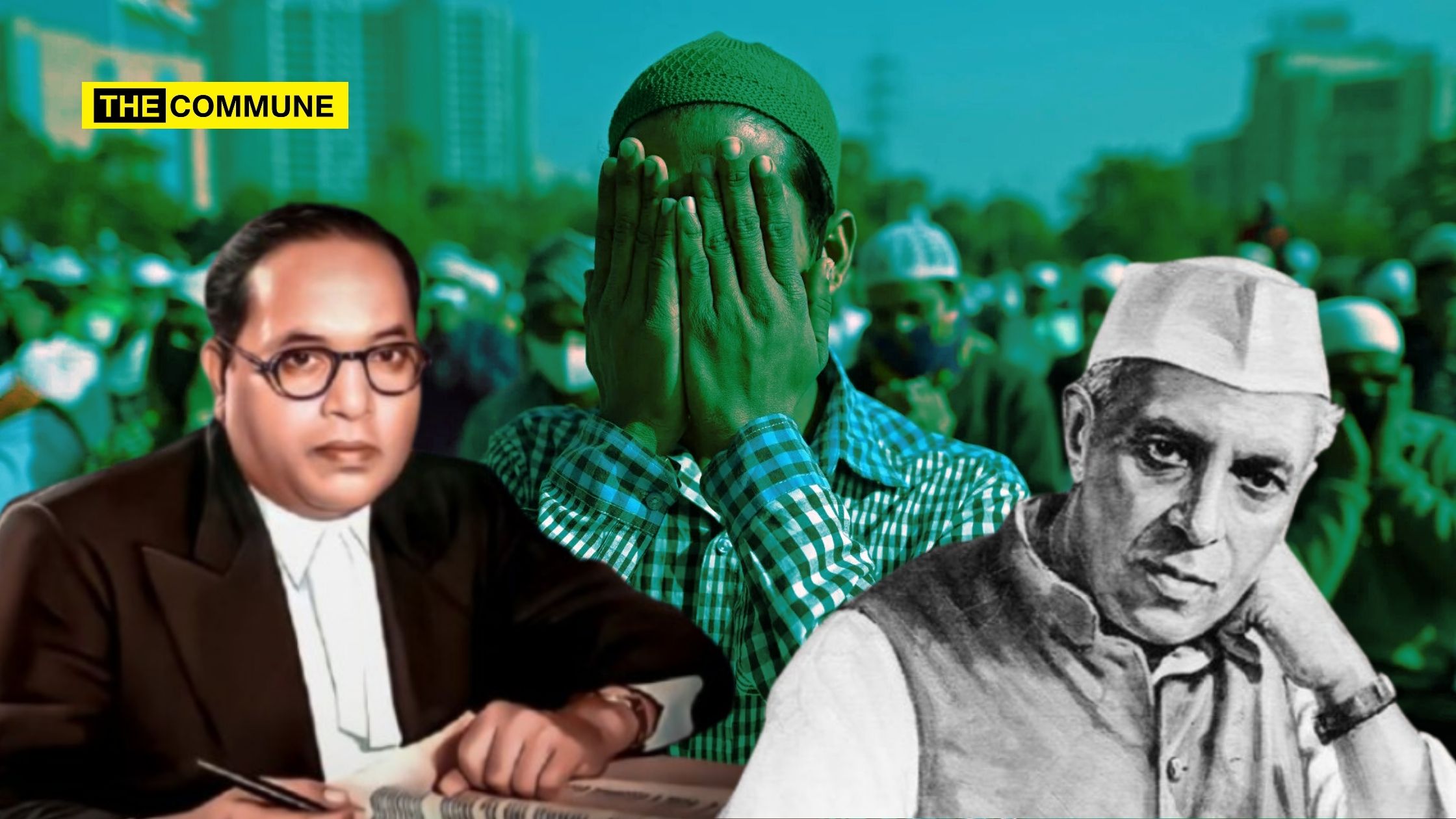
Ambedkar criticized Congress for neglecting Scheduled Castes, misusing the Constitution's promises, and failing to advance the Hindu Code Bill.

The Congress Party and its supporters often claim to be the protectors of the Constitution and the legacy of Dr BR Ambedkar. However, this narrative seems contradictory when we examine Dr. Ambedkar’s documented views. Ambedkar himself criticized Jawaharlal Nehru and the Congress Party, accusing them of dedicating all their efforts to the protection of Muslims. He famously stated that “Nehru’s whole time and attention is devoted to the protection of the Muslims.”

This criticism is evident in Dr Ambedkar’s resignation statement, recorded in Dr Babasaheb Ambedkar: Writings and Speeches, Vol. 14, Part 2, first published by the Government of Maharashtra on 14 April 1979.

The Overlooked Plight of Scheduled Castes and the Focus on Muslims

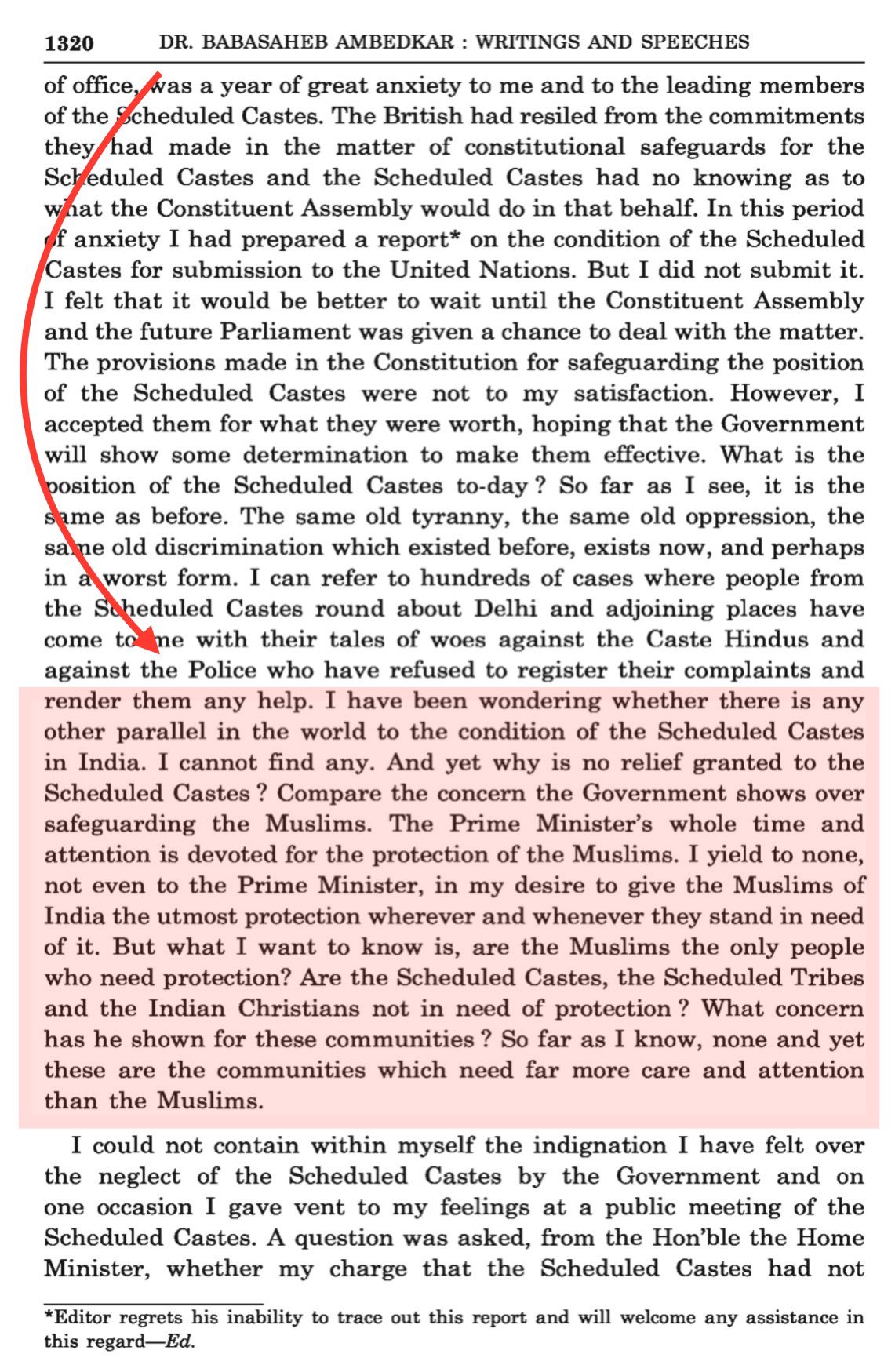
In a statement, he reflects on the condition of the Scheduled Castes in India and laments the lack of attention given to their plight. He writes, “I have been wondering whether there is any other parallel in the world to the condition of the Scheduled Castes in India. I cannot find any. And yet, why is no relief granted to the Scheduled Castes?”

He goes on to compare the government’s focus on Muslims, stating, “The Prime Minister’s whole time and attention is devoted to the protection of the Muslims.” While he acknowledges the importance of protecting Muslims, he asks, “Are the Muslims the only people who need protection? Are the Scheduled Castes, the Scheduled Tribes, and the Indian Christians not in need of protection? What concern has he shown for these communities? So far as I know, none. And yet, these are the communities which need far more care and attention than the Muslims.”
Dr Ambedkar’s Concern for the Backward Classes and Nehru Government’s Neglect

Dr. B.R. Ambedkar expressed deep concern over the government’s lack of action regarding the welfare of the Other Backward Classes (OBCs) and Scheduled Castes. In his resignation statement, he highlighted his dissatisfaction with the treatment of these communities under the Nehru government, “I will now refer to another matter that had made me dissatisfied with the Government. It relates to the treatment accorded to the Backward Classes and the Scheduled Castes.”

Ambedkar lamented that under the Nehru-led Congress government, the Constitution failed to include specific safeguards for the Backward Classes, leaving their future to be determined by the Executive Government based on the recommendations of a commission appointed by the President. He expressed his frustration, saying, “More than a year has elapsed since we passed the Constitution, but the Government has not even thought of appointing the Commission.”

Dr. Ambedkar’s Disappointment with Cabinet Exclusion and Unfulfilled Promises

Dr. B.R. Ambedkar accepted a position in the cabinet with the understanding that he would be assigned to the Planning Department, given his expertise as an economist. However, this promise was never kept, as Prime Minister Nehru took on the role of Chairman of the Planning Commission himself. Ambedkar was also excluded from important committees, including the Economic Affairs Committee. This lack of inclusion and unfulfilled commitments was one of the key reasons he cited for his resignation.

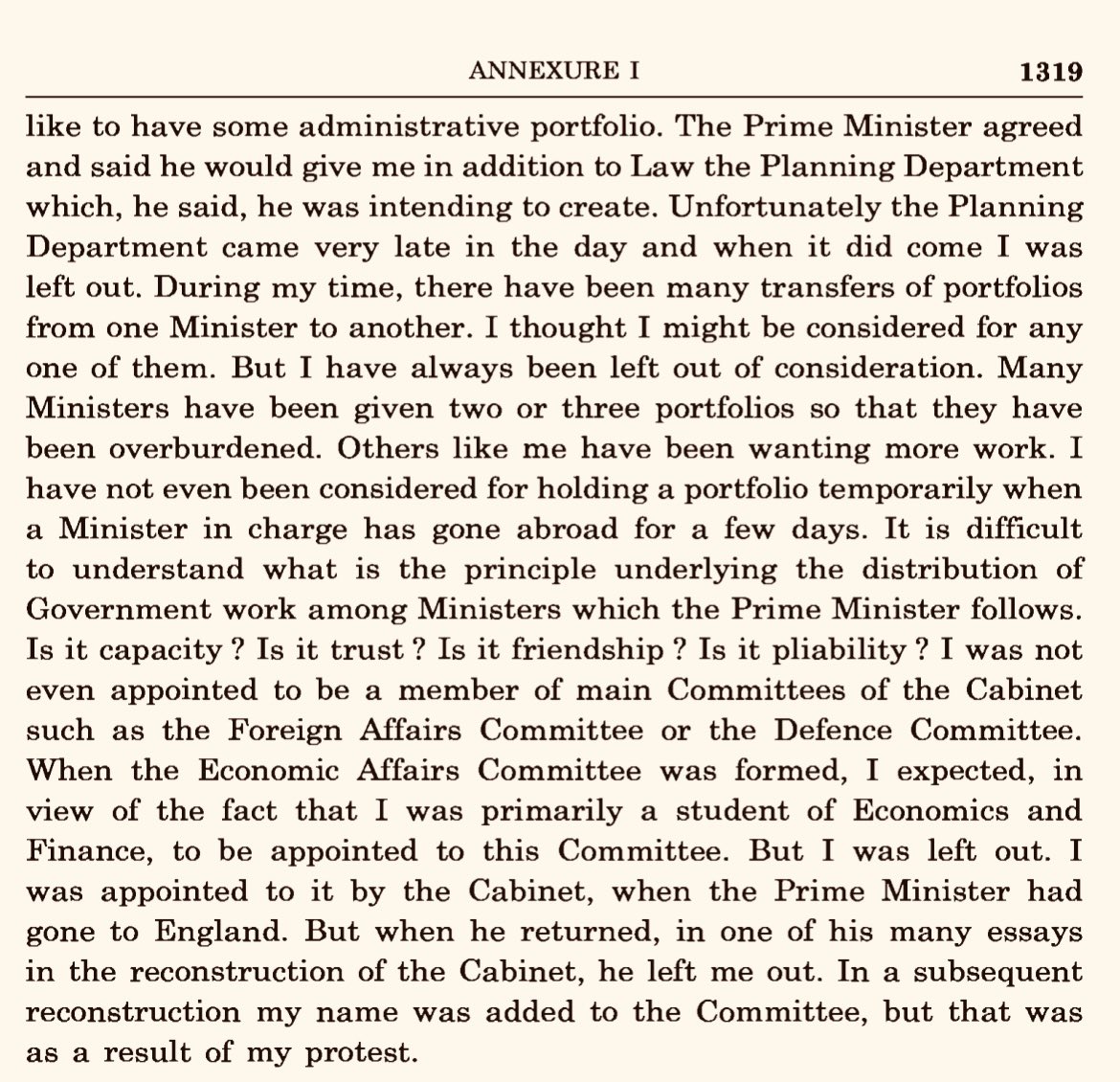
He says, “The Prime Minister agreed and said he would give me in addition to Law the Planning Department which, he said, he was intending to create. Unfortunately, the Planning Department came very late in the day and when it did come, I was left out. During my time, there have been many transfers of portfolios from one Minister to another. I thought I might be considered for any one of them. But I have always been left out of consideration. Many Ministers have been given two or three portfolios so that they have been overburdened. Others like me have been wanting more work. I have not even been considered for holding a portfolio temporarily when a Minister in charge has gone abroad for a few days. It is difficult to understand what is the principle underlying the distribution of Government work among Ministers which the Prime Minister follows.”

“Is it capacity? Is it trust? Is it friendship? Is it pliability? I was not even appointed to be a member of main Committees of the Cabinet such as the Foreign Affairs Committee or the Defence Committee.
When the Economic Affairs Committee was formed, I expected, in view of the fact that I was primarily a student of Economics and Finance, to be appointed to this Committee. But I was left out. I was appointed to it by the Cabinet, when the Prime Minister had gone to England. But when he returned, in one of his many essays in the reconstruction of the Cabinet, he left me out. In a subsequent reconstruction my name was added to the Committee, but that was as a result of my protest,” he added.
Dr. Ambedkar’s Disillusionment with Nehru’s Decision on the Hindu Code Bill

Dr. B.R. Ambedkar expressed his deep disappointment that, despite prior commitments, Prime Minister Nehru chose to abandon the Hindu Code Bill. In his resignation statement, Baba Saheb wrote, “I was, therefore, quite unable to accept the Prime Minister’s decision to abandon the (Hindu Code) Bill on the ground of time. I have been obliged to give this elaborate explanation for my resignation because some people have suggested that I am going because of my illness. I wish to repudiate any such suggestion. I am the last man to abandon my duty because of illness.”

This article is based on an X thread by Dilip Mandal.

Subscribe to our channels on TelegramWhatsApp, and Instagram and get the best stories of the day delivered to you personally.

‘Congress Press Knows Only How To Criticise, Rebuke And Revile Me’: Ambedkar Was Aware Of Media Bias

'Congress Press Knows Only How To Criticise, Rebuke And Revile Me': Ambedkar Was Aware Of Media Bias

B.R. Ambedkar, one of India’s most influential leaders and the architect of the Indian Constitution, was no stranger to the hostile and derogatory cartoons that depicted him throughout his lifetime. These cartoons, which often mocked his stature and ideologies, were not only a reflection of the deeply ingrained caste biases of the time but also a tool used by the media to undermine his work. Ambedkar, however, was acutely aware of the role the media played in shaping public opinion about him, and he did not shy away from responding to these attacks, critiquing the press for its bias and hostility.

In the early years of his political career, Ambedkar was largely respected for his intellectual contributions and leadership in the fight for Dalit rights. However, as he became a national figure and assumed the pivotal role of the Chairman of the Drafting Committee of the Indian Constitution, the tone of the media changed. Cartoons began to appear that sought to diminish his stature and question his leadership. These cartoons, created by prominent cartoonists, often portrayed Ambedkar as a villain or a figure of ridicule.

One of the most significant sources of these caricatures was the press, which Ambedkar often criticized for its one-sidedness. In 1943, during a lecture on the 101st birthday of Govind Ranade, Ambedkar expressed his frustration with the media, specifically the Congress Press, which he accused of misrepresenting his actions and intentions. He described the Congress Press as a mouthpiece that could only criticize and distort his arguments, rather than engage in meaningful debate. His words were a pointed critique of how the media, which controlled public discourse, failed to fairly represent him and his contributions to the nation.

Ambedkar’s awareness of the media’s portrayal of him was not limited to verbal criticism. He recognized the power of the press in shaping public perception, and he was determined not to allow it to define his legacy. As he once stated, “With the Press in hand, it is easy to manufacture Great Men.” Ambedkar was well aware that the same press could also destroy reputations and vilify individuals, especially those challenging the status quo. His critical stance on the media was informed by his understanding of how the press could manipulate public opinion, particularly in the context of his advocacy for Dalit rights and social justice.

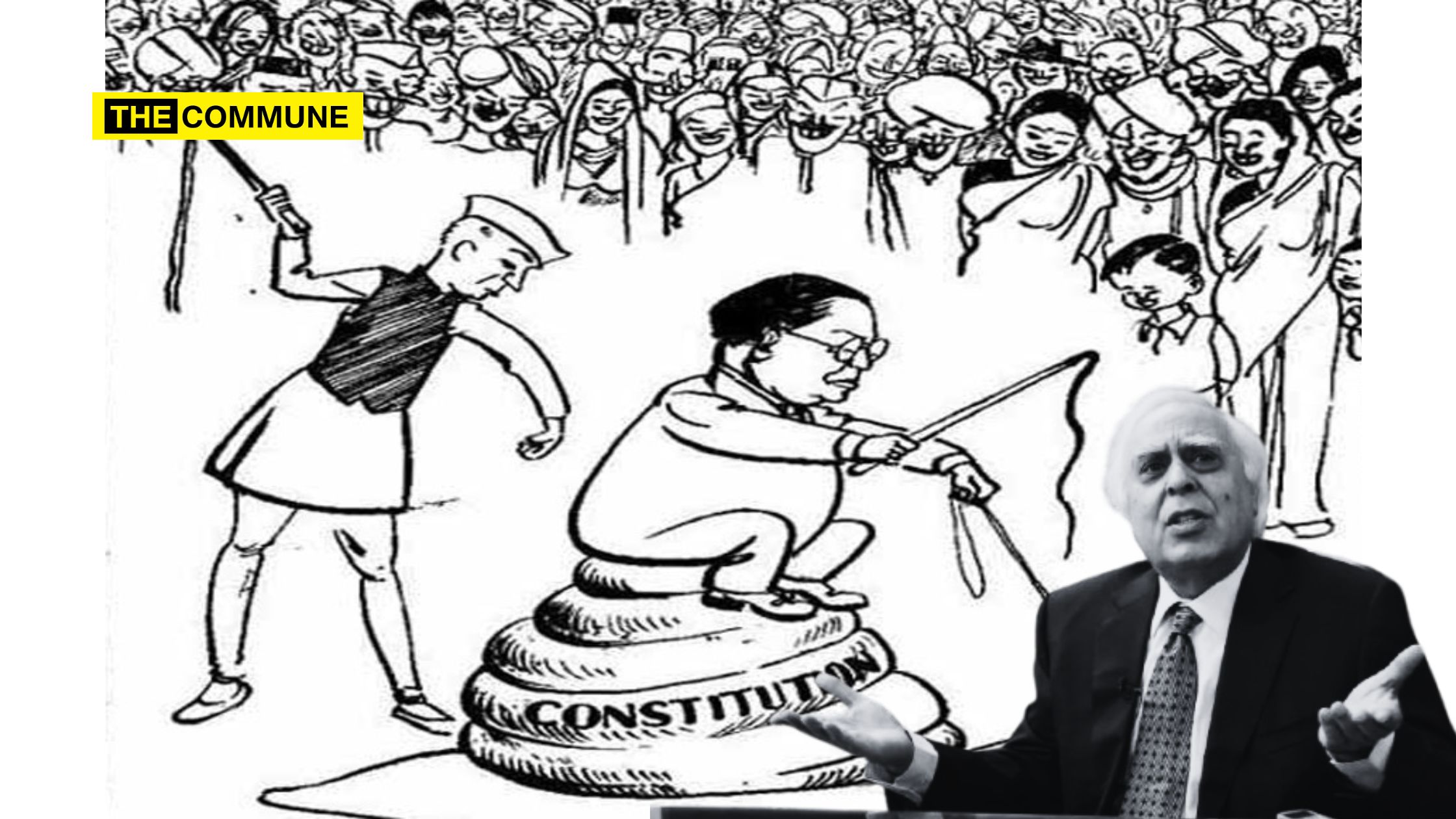
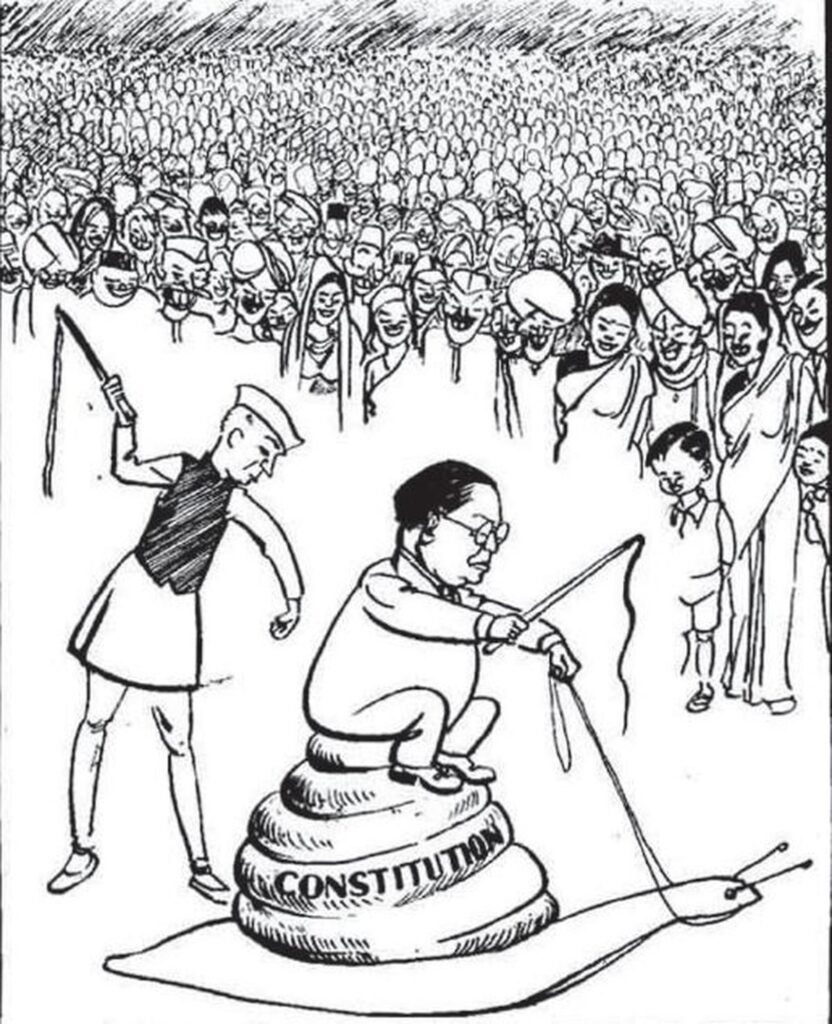
The cartoons on Ambedkar that emerged during this time were not simply humorous jabs; they were part of a larger effort to marginalize him and his work. These cartoons often depicted Ambedkar in a demeaning light, portraying him as an incompetent leader or a threat to the established social order. One notorious example from the 1960s, published in the NCERT textbook, showed Ambedkar being chased by Jawaharlal Nehru with a whip, symbolizing the frustration of the political elite with the slow pace of drafting the Constitution. While the cartoon was meant to reflect the political dynamics of the time, it also reduced Ambedkar to an object of ridicule.

Ambedkar’s response to such depictions was measured yet firm. He understood that these attacks were rooted in a deep-seated animosity toward the lower castes and their demand for equal rights. He believed that the hostility from the press and the political establishment was a manifestation of the caste hatred that prevailed in Indian society. Ambedkar’s own words on this subject, “This animosity of the Congress Press towards me can to my mind, not unfairly, be explained as a reflex of the hatred of the Hindus for the Untouchables,” highlight his understanding of the systemic forces at play. He saw the press’s hostility as a reflection of broader social dynamics, where the demands for Dalit rights were perceived as a challenge to the traditional social order.

Despite the vitriol he faced, Ambedkar remained steadfast in his mission. He chose to address the media’s attacks head-on, often using his own publications to bypass mainstream media channels that he felt were hostile to his ideas. Ambedkar launched several publications, including Mook Nayak (The Voice of the Voiceless), Bahiskrit Bharat (Excluded India), and Prabuddh Bharat (Enlightened India), to present his ideas and counter the negative narratives being propagated in the mainstream press. However, due to a lack of resources, these publications struggled to compete with the large, business-backed newspapers that dominated the media landscape.

Ambedkar’s criticisms of the press and the media’s portrayal of him were not just about defending his own image but also about challenging the larger social order that sought to suppress the voices of the marginalized. He understood that media, in its various forms, could either elevate or destroy individuals and movements. In his case, the media’s portrayal of him was a direct reflection of the caste-based discrimination he was fighting against.

The issue of how Ambedkar was depicted in cartoons and the media has continued to be relevant long after his death. In recent years, the publication of cartoons about Ambedkar has sparked controversy, most notably with the 2012 incident involving a cartoon in the NCERT textbook. The cartoon, which depicted Nehru with a whip chasing a snail labeled ‘Constitution,’ was seen by some as offensive to Ambedkar and the Dalit community. The controversy led to the cartoon being removed from the textbook, but it also underscored the ongoing tension surrounding Ambedkar’s legacy and the way he is portrayed in the media.

Ambedkar’s awareness of how the media depicted him, and his efforts to respond to and challenge those depictions, remain an important part of his legacy. His criticisms of the press, his creation of alternative media platforms, and his unflinching commitment to his principles in the face of public ridicule are a testament to his resilience and foresight. Today, as Ambedkar’s iconography continues to be celebrated and debated, his response to the media’s portrayal of him serves as a reminder of the power of representation and the importance of controlling one’s own narrative in the fight for justice and equality.

(With inputs from The Print)

Subscribe to our channels on Telegram, WhatsApp, and Instagram and get the best stories of the day delivered to you personally.
INDI Ally VCK MP Thirumavalavan Quotes Ambedkar To Say Hinduism Is A Threat To Liberty, Equality & Fraternity

INDI Ally VCK MP Thirumavalavan Quotes Ambedkar To Say Hinduism Is A Threat To Liberty, Equality & Fraternity

VCK chief Thirumavalavan seems to have a contradictory stance on Hinduism, as he simultaneously criticizes the faith while seeking blessings at temples during election campaigns.

Amid the false propaganda spread by opposition parties, claiming that Union Home Minister Amit Shah had disrespected Dr. Ambedkar through a clipped 12-second video, which portrayed him and the party in a negative light as “anti-Dalit” and “anti-Ambedkar,” the same narrative continued to circulate in Tamil Nadu even after the full video debunked the claims. VCK chief Thirumavalavan took a unique approach by adding his own “anti-Hindu” agenda to the criticism, which was particularly shocking. Despite visiting temples to worship before elections, he hypocritically criticizes Hinduism whenever possible after the elections.

On 18 October 2024, VCK chief Thirumavalavan via his official X account stated, “How can Savarkar’s descendants tolerate the fact that the entire country is talking about revolutionary Ambedkar? #AmitShah has revealed how much they are fed up. He has torn off his own veil. This is the true face of the Sangh Parivar. The Constitution and revolutionary Ambedkar are their real enemies. This is what the Viduthalai Chiruthaigal has been continuously exposing. All the praise given by the Sangh Parivar to the revolutionary Ambedkar is a great act of deceiving the common people. The revolutionary Ambedkar takes the form of ‘universal form’ (Vishwaroopam). The conspiracy attempts of the Sanadhanis will be in ashes!”  

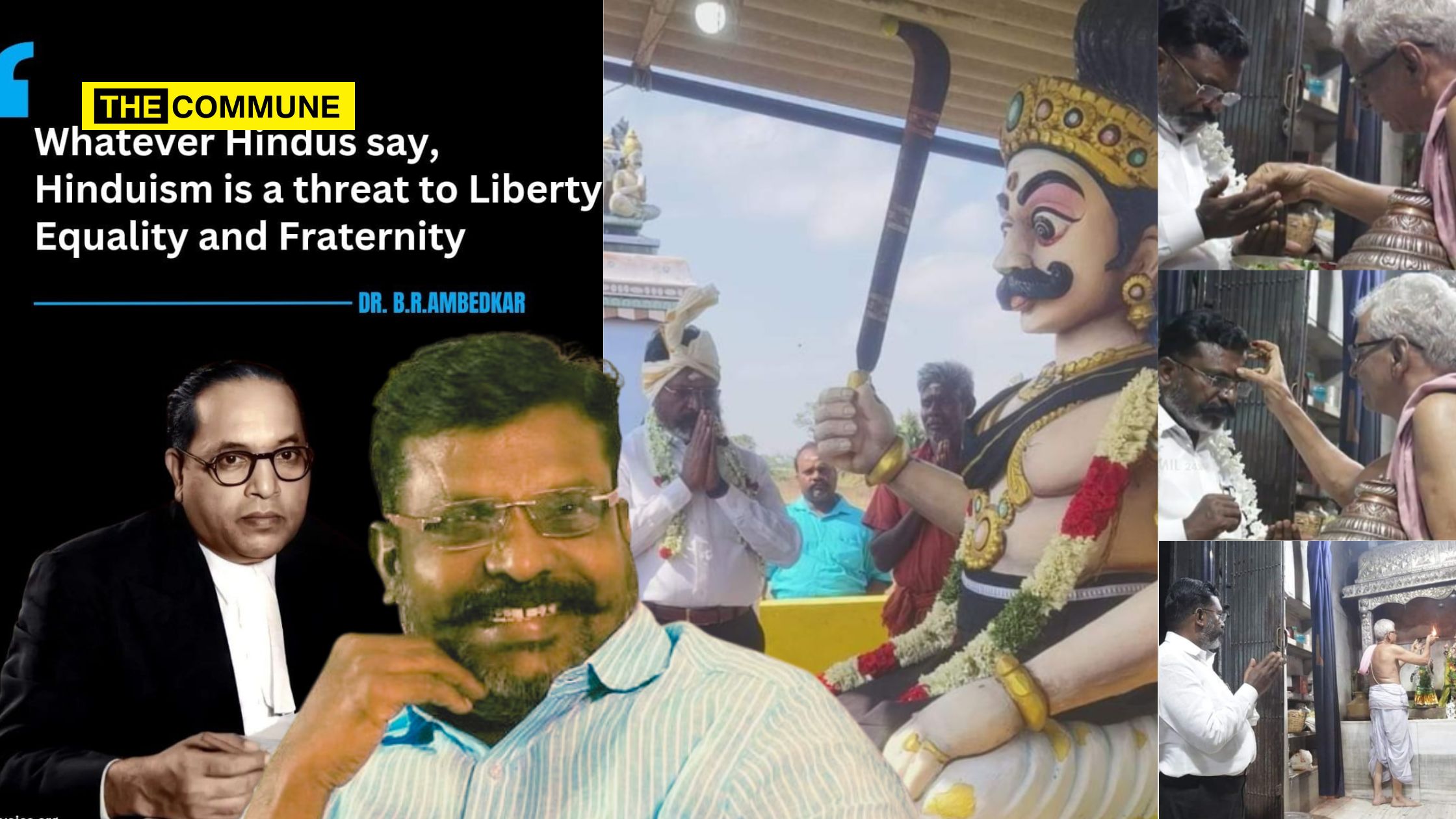
He further, with intent, shared an image of Ambedkar along with a quote aimed at criticizing Hinduism and Hindus, seemingly to settle a personal political score, “Whatever Hindus say, Hinduism is a threat to Liberty, Equality, and Fraternity.”

Previous Propaganda by VCK Chief Thirumavalavan Undermining Hindu Sentiments

Tirupati Laddu Prasadam Row

During the recent controversy over the presence of beef and pig fat in Tirupati Laddu Prasadam, which sparked outrage among the Hindu community, VCK leader and Chidambaram MP Thol Thirumavalavan intentionally trivialized the issue by claiming that animal fat in sweets is common, further exacerbating the situation.

A laboratory report revealed that beef tallow, fish oil, and palm oil were used to prepare laddus, distributed as prasad at the renowned Sri Venkateswara temple in Tirupati. The report’s findings indicate that the ghee used to prepare the iconic Tirupati laddu prasadam during the YSRCP regime contained traces of animal fat, including beef tallow and fish oil, leading to widespread outrage and claims of disrespect toward religious sentiments.

Speaking to a reporter after hoisting a 62-foot flag of his party near Madurai, Thirumavalavan said, “In most sweets or food products, using animal fat is normal and is a common practice across the world. I don’t know why it is being politicized. If it (Tirupati Laddu) should not contain animal/beef fat, then accordingly guidelines should be framed to prevent such occurrences in the future.

Called Temples – A Place with Obscene Figurines

Some time ago, Thirumavalavan addressed a gathering, expressing opposition to educational policies based on Sanatana Dharma and humorously criticizes Hindu temples in front of the audience that, “if the building has a dome, it is a mosque. If it is tall and straight, it is a church. And if it has dirty figurines, it is a temple”.

https://twitter.com/Muthuhere3/status/1772928107965448550

Called For Destruction Of All Hindu Temples

Thirumavalavan is known for his anti-Hindu politics and for spreading canards about Hinduism. He had once called temple gopurams structures with ugly figurines. In 2017, Thirumavalavan called for the destruction of all Hindu temples and building of Buddhist viharas in those places.

Thirumavalavan said, “Destroy all hindu temples and in it place build Buddhist Viharas”. Addressing a gathering convened in Perambalur, VCK Chief Thirumavalavan, asserted that areas housing Shiva and Perumal temples were originally sites of Buddhist monasteries. He contended that these Buddhist structures were replaced by the construction of Shiva and Perumal temples, advocating for their demolition to pave the way for the erection of Buddhist temples in their stead. Furthermore, he proposed the establishment of Buddhist temples at the purported sites of Lord Thiruvaranganathar’s presence and the Kanji Kamachi Amman Temple.

Said Building Temples Is A Business & Profitable

In a book release event held in Chennai, Thirumavalavan said, “Building a temple is a business. I am not joking. Unlike any other business, building temples is the most profitable and provides the highest income. Which other business is more profitable than the income generated by the Tirupati temple? What are the temple’s income and expenditure? People donate money to the Tirupathi temple. People pour money into the Ayyappan temple.”

Called Women Adhering to Sanatana Dharma Prostitutes

In another occurrence during a webinar hosted by Periyarist groups, Thirumavalavan referred to women adhering to the Sanatana tradition as prostitutes. A particular excerpt from his speech circulating on social media highlights, “how are women valued in Sanatana Dharma, how are they treated? From time immemorial, how they have been oppressed and exploited… what does Sanatana Dharma say about women? Basically, women are created as prostitutes by God. All women are prostitutes as per Hindu Dharma…Manu Dharma… All women are prostitutes… that’s how they were created by God… they’re of a status lower than men. It applies to Brahmin women as well as to other women”.

Participated In Eradicate Sanatana Dharma Conference

He also took part in the September 2023 Eradicate Sanatana Dharma conference where Udhayanidhi Stalin had compared Sanatana Dharma to mosquito and dengue and said that it had to be eradicated. In the same conference, Thirumavalavan had said “Sanatana Dharma can be destroyed when we turn OBC against FC (Forward Caste).”

Peddled Lies About Sanatana Dharma Comparing It With Islam & Christianity

On International Women’s Day (8 March 2024), a special symposium took place at Chennai Ambedkar Thital, with Thirumavalavan as the chief guest discussing “Revolutionary Ambedkar and Women’s Rights.” He said, “Take Islam, Christianity, Buddhism, Jainism, or any other religion, the core fundamental philosophy of it would be fraternity i.e brotherhood. There is one religion in the world that denies brotherhood completely, they are asking do you know what is Sanatana Dharma?  Sanatana Dharma is a dharma that says there should not be brotherhood, they say that we have understood it wrongly. Today a women judge in High Court has said that Sanatana Dharma is different from rituals, yes that’s correct, as we say, rituals and principles are different, but this Sanatana Dharma’s particular principle defines hierarchy based on birth and no one can deny it.”

“The word Sanatana means permanent, that’s different, means unchanging, it is anti-physical, anti-scientific. Nothing is fixed, everything is changing, this is the law of physics, this is the dialectic rule, that is the paradox, but they are… In Sanatana Dharma discrimination is its core, discrimination is the lifeline of Sanatana Dharma in no other religion discrimination will be the basic factor, No one talks about this. They ask why I did not criticize Christianity or Islam, without criticizing them why singling out us, that is because the discrimination is here only. I’m saying that in core principles, RC (Roman Catholic) can have discrimination, it’s an institution. CSI (Church Of South India) can have discrimination, it’s an institution, but there is no discrimination in Christianity that is the difference between the two,” he added.

Insulted Periyapuranam And Hinduism

During the Nandanar Guru Puja celebration, a sacred thread ceremony was organized to promote inclusivity. One of the key highlights of the event was Governor RN Ravi presiding over a ceremony in which over 100 individuals from Adi Dravidar communities were presented with the sacred thread, known as ‘poonool’ or ‘janeu,’ traditionally worn by Brahmins and other communities. This symbolic gesture aimed to foster inclusivity and equality. However, I.N.D.I.A. ally and VCK MP seized the opportunity to launch a tirade against Hinduism.

Hitting out at Tamil Nadu Governor RN Ravi for presiding over the function in which Nandanar community were adorned the poonool, Thirumavalavan said that the act amounted to denigration the working-class people in the name of upliftment.

This is what is Sanathanam“, he said condemning the Hindu faith.

Does the governor say that others who do not wear poonul are inferior? Will the Governor make the Adi Dravidians who are dressed in Poonul as temple priests?“, he added.

Let us reject the Periya Puranam which denigrates the king Nandan, as a cow-eating Pulayan“, Thirumavalavan said.

Hypocrisy They Name Is VCK – Turns Staunch Practicing Hindu During Elections

During the Lok Sabha elections in Tamil Nadu, on 27 March 2024, Thirumavalavan personally visited the Mayavan temple, the deity of his clan, in his native village of Anganur in Ariyalur district. During this visit, the temple priest welcomed Thirumavalavan by garlanding him and performing a ceremonial ritual of tying headgear (Thalaipagai) on his head. After completing special worship at the temple, Thirumavalavan submitted his nomination papers to Ariyalur District Collector and Election Conducting Officer Annie Mary Swarna, accompanied by Ministers Sivashankar and Panneerselvam. This action took place before the formal filing of his nomination papers.

https://twitter.com/Muthuhere3/status/1772928107965448550

Another unexpected visit came as Thirumavalavan kickstarted his election campaign in Kallakurichi. Amidst the hustle and bustle of political campaigning, Thirumavalavan, accompanied by Minister for Transport S.S. Sivasankar, took a moment to seek blessings at the temple. Not only did he offer his respects, but he also partook in the sacred rituals, receiving prasad (religious offering) and even the sacred ash, thiruneeru, from a Brahmin priest.

The image of Thirumavalavan being blessed with thiruneeru by the Brahmin priest quickly went viral. This unexpected move by the VCK chief, known for his anti-Hindu stance, was seen as a calculated attempt to appeal to the Hindu electorate, especially in light of the alliance between VCK and the DMK.

Subscribe to our channels on TelegramWhatsApp, and Instagram and get the best stories of the day delivered to you personally.

“Al Umma Exploited Youngsters, Rousing Fanaticism And Planted Bombs”: What Justice Gokulakrishnan Committee Revealed About Coimbatore Blasts Masterminded By SA Basha Whom Seeman And Thirumavalavan Glorified

Al Umma Exploited Youngsters, Rousing Fanaticism And Planted Bombs: What Justice Gokulakrishnan Committee Revealed About Coimbatore Blasts Masterminded By SA Basha Whom Seeman And Thirumavalavan Glorified

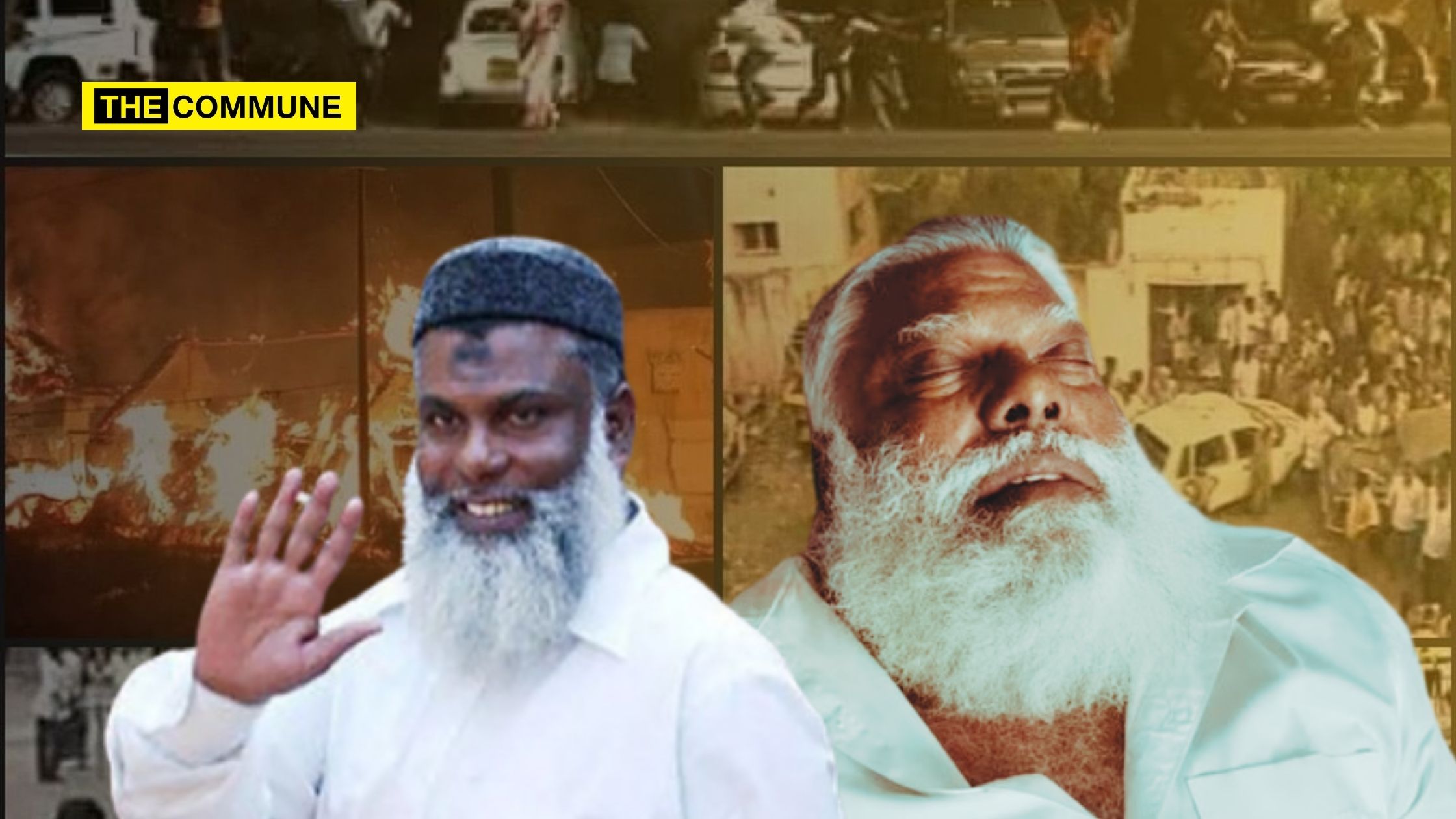
A Tamil Nadu court has condemned recent remarks by political leaders, including VCK chief Thirumavalavan and NTK leader Seeman, who referred to SA Basha, the mastermind behind the deadly 1998 Coimbatore bomb blasts, as a “martyr” and a “father figure.” These comments drew widespread criticism against the leaders for glorifying a known terrorist and undermining the victims of the attacks. The court highlighted the dangers of such rhetoric that sets a dangerous precedent for minority appeasement while disregarding the fact that Basha caused the death of 58 people and injuries to over 230 people.

Political leaders in Tamil Nadu, such as Viduthalai Chiruthaigal Katchi (VCK) chief Thirumavalavan and Naam Tamilar Katchi (NTK) chief Seeman, have faced severe criticism for their remarks following the recent death of SA Basha, the Islamist terrorist and founder of Al Ummah. Basha, whose name became synonymous with terrorism in Tamil Nadu during the 1980s and 1990s, was described by these leaders as a “martyr for a cause” and likened to a father figure. Such statements have been widely condemned as alarming and irresponsible, with critics arguing that glorifying a known terrorist sets a dangerous precedent. Many have labeled this as an act of minority appeasement that has crossed all acceptable limits.

The wounds from the devastating 1998 Coimbatore bomb blasts, orchestrated by Basha’s Islamist fundamentalist organization Al Ummah, remain fresh in the minds of the victims and their families. The coordinated attacks resulted in the tragic deaths of 58 people and left 231 others injured. Al Ummah was known for brainwashing young individuals into committing such heinous acts, leaving a trail of destruction and sorrow.

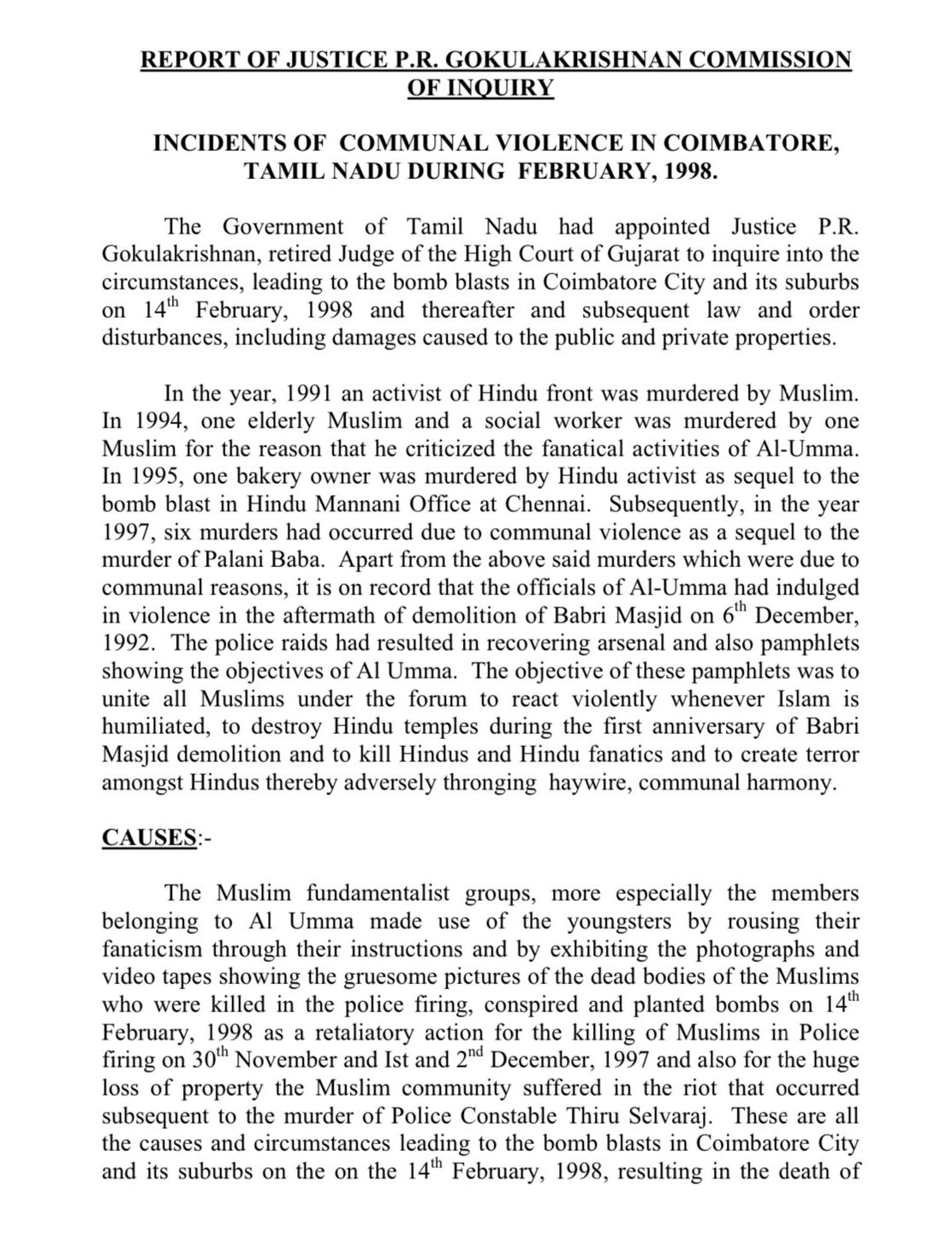
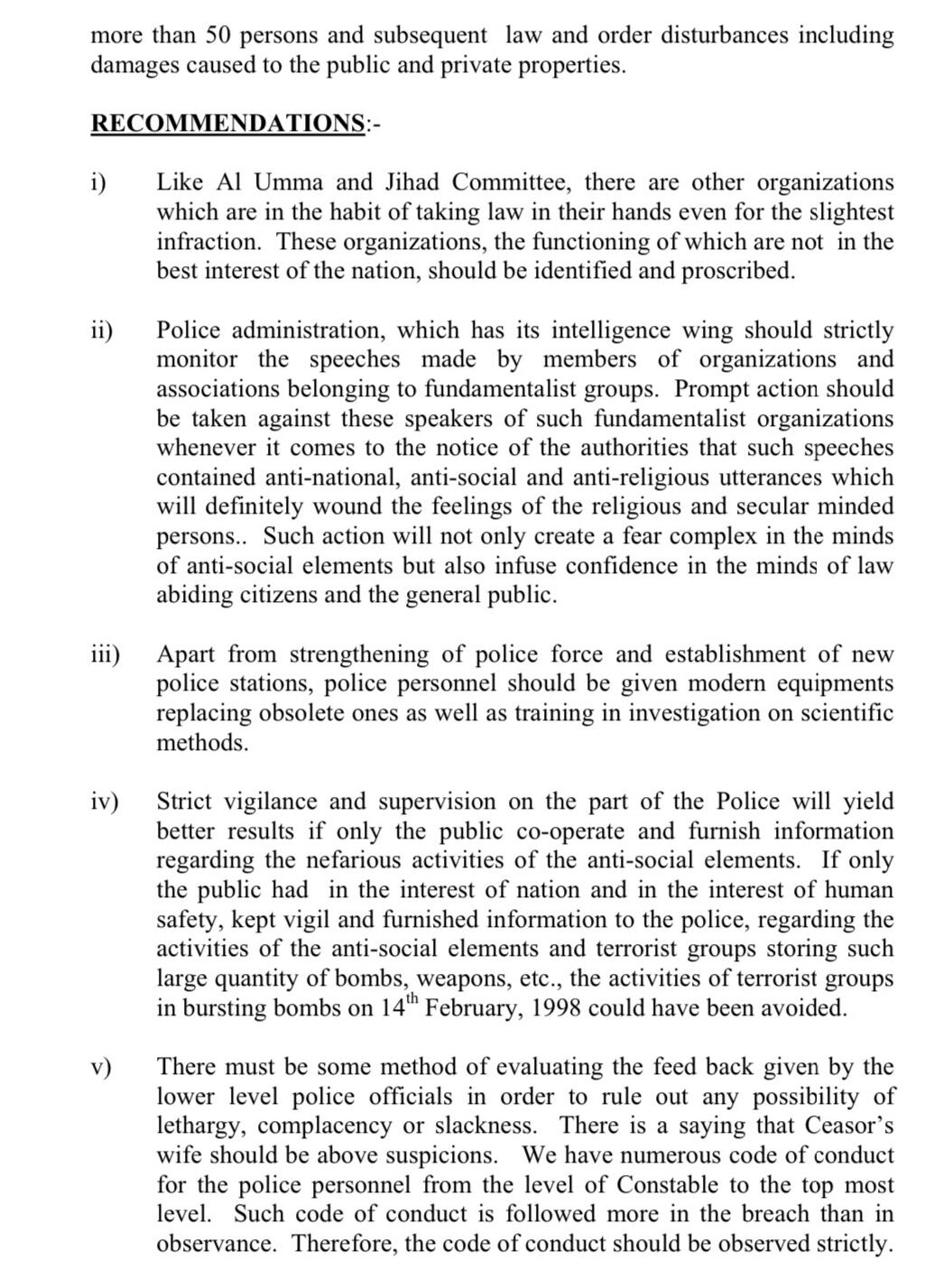
In the aftermath of the Coimbatore blasts, the Tamil Nadu government appointed Justice P.R. Gokulakrishnan, a retired judge of the Gujarat High Court, to lead an inquiry into the events that led to the bombings, the subsequent disturbances in law and order, and the damages caused to both public and private properties. The inquiry highlighted the magnitude of the atrocities and the long-lasting impact they have had on the affected communities.

A 2007 report by the “Working Group of the National Integration Council, established to examine the findings of various Commissions of Inquiry on Communal Riots, was published under the Ministry of Home Affairs.

The report from the Working Group details instances of communal violence and the role of extremist groups like Al-Umma in escalating tensions. It highlights several key incidents:

  • In 1991, a Hindu activist was murdered by a Muslim individual.
  • In 1994, an elderly Muslim social worker was killed by another Muslim for criticizing Al-Umma’s extremist activities.
  • In 1995, a Hindu activist murdered a bakery owner as retaliation for a bomb blast at a Hindu Munnani office in Chennai.
  • In 1997, six murders occurred as communal violence flared after the killing of Palani Baba.

The report also documents Al-Umma’s involvement in violence following the Babri Masjid demolition in 1992. Police raids uncovered weapons and pamphlets outlining Al-Umma’s objectives, which included:

  • Uniting Muslims under a single forum to respond violently to perceived insults to Islam.
  • Destroying Hindu temples on the Babri Masjid demolition anniversary.
  • Targeting Hindus and Hindu activists to spread fear and disrupt communal harmony.

The causes of the Coimbatore bomb blasts on 14 February 1998, are attributed to actions by Muslim fundamentalist groups, particularly Al-Umma. The group exploited young individuals by inciting fanaticism through instructions and graphic images or videos of Muslims killed during police actions. The bombings were carried out as a retaliatory response to:

  • The killing of Muslims in police firings on 30 November, 1 December, and 2 December 1997.
  • Significant property losses suffered by the Muslim community during riots following the murder of Police Constable Thiru Selvaraj.

These events collectively culminated in the devastating bomb blasts, which claimed over 50 lives, caused significant property damage, and led to widespread law and order disturbances in Coimbatore and surrounding areas.

Excerpts From the Report

Raw excerpts from the report highlights, “In the year, 1991 an activist of Hindu front was murdered by Muslim. In 1994, one elderly Muslim and a social worker was murdered by one Muslim for the reason that he criticized the fanatical activities of Al-Umma. In 1995, one bakery owner was murdered by Hindu activist as sequel to the bomb blast in Hindu Mannani Office at Chennai. Subsequently, in the year 1997, six murders had occurred due to communal violence as a sequel to the murder of Palani Baba. Apart from the above said murders which were due to communal reasons, it is on record that the officials of Al-Umma had indulged in violence in the aftermath of demolition of Babri Masjid on 6th December 1992. The police raids had resulted in recovering arsenal and also pamphlets showing the objectives of Al Umma. The objective of these pamphlets was to unite all Muslims under the forum to react violently whenever Islam is humiliated, to destroy Hindu temples during the first anniversary of Babri Masjid demolition and to kill Hindus and Hindu fanatics and to create terror amongst Hindus thereby adversely thronging haywire, communal harmony.”

Causes For 1998 Coimbatore Bomb Blast

The report highlighted, “The Muslim fundamentalist groups, more especially the members belonging to Al Umma made use of the youngsters by rousing their fanaticism through their instructions and by exhibiting the photographs and video tapes showing the gruesome pictures of the dead bodies of the Muslims who were killed in the police firing, conspired and planted bombs on 14th February, 1998 as a retaliatory action for the killing of Muslims in Police firing on 30th November and Ist and 2nd December, 1997 and also for the huge loss of property the Muslim community suffered in the riot that occurred subsequent to the murder of Police Constable Thiru Selvaraj. These are all the causes and circumstances leading to the bomb blasts in Coimbatore City and its suburbs on the on the 14th February, 1998, resulting in the death of more than 50 persons and subsequent law and order disturbances including damages caused to the public and private properties.”

Who Was SA Basha?

S.A. Basha, the mastermind behind the 1998 Coimbatore serial bomb blasts, who founded the extremist organization Al-Umma, was responsible for planning the devastating blasts that killed 58 people and injured 231 others.

The Coimbatore serial bomb blasts of 1998 (DMK was in power in then) were a grievous incident in which 58 people were killed and over 200 individuals sustained serious injuries. This devastating series of 12 bomb attacks unfolded across 11 different locations within a 12-kilometer radius. Many of the survivors continue to grapple with the long-lasting effects of the shrapnel and other injuries caused by the devastating explosions.

The chief orchestrator behind these tragic events was identified as S A Basha, the founder of Al Ummah, an Islamic fundamentalist group. Investigations revealed that these bombings were part of a larger conspiracy with the sinister aim of targeting L.K. Advani, the leader of the Bharatiya Janata Party, during his election meeting scheduled for 4 p.m. on that ill-fated day. Fortunately, Advani’s flight was delayed, and he narrowly escaped the horrors of that day.

It is noteworthy to mention that one of the suspects, Mohammed Dhalka, who was detained in connection to the 2022 Coimbatore car blast terror incident is the nephew of SA Basha. Nawab Khan, Basha’s brother, was also sentenced to one-life term and 27 years of rigorous imprisonment in the 1998 bomb blast case.

The president of the banned fundamentalist outfit Al-Umma, SA Basha, openly threatened to kill the then Gujarat Chief Minister Narendra Modi if he visited Coimbatore in July 2003. This threat was made by Basha and eight others while speaking to journalists in the Coimbatore court premises after their conviction and life imprisonment in a case related to the murder of a Hindu Munnani leader. It is noteworthy that Al-Umma and its leader were allowed to operate openly by the DMK Government until the Coimbatore blasts on 14 February 1998.

Magazines like Outlook and Frontline also acknowledged the role of the Tamil Nadu Muslim Munnetra Kazhagam (TNMMK) in these blasts. In March 1998, Frontline reported, “Within hours of the blasts, the Tamil Nadu Government banned Al-Umma and the Jihad Committee. Al-Umma founder-president S.A. Basha and 12 other members of the organization were arrested in Chennai; explosive materials and weapons were seized from his house in Triplicane, Chennai.”

Subscribe to our channels on TelegramWhatsApp, and Instagram and get the best stories of the day delivered to you personally.

How Then-HRD Min Kapil Sibal Apologised For Offensive Cartoon On Ambedkar In School Textbooks

How Then-HRD Min Kapil Sibal Apologised For Offensive Cartoon On Ambedkar In School Textbooks

In 2012, following a controversy over a cartoon depicting Dr BR Ambedkar being chased by Jawaharlal Nehru in NCERT textbooks, HRD Minister Kapil Sibal apologized and ordered its removal. The cartoon, created in the 1960s by cartoonist Shankar, sparked outrage in Parliament, particularly from opposition leaders like Thol Thirumavalavan, who demanded accountability for its inclusion. Despite Sibal’s apology, the issue fueled protests, with calls for a deeper investigation into the matter.

For all the uproar that the Congress has been trying to create in Parliament using the edited video of Union Home Minister Amit Shah over his remarks on Dr BR Ambedkar, here is a piece of history surrounding the controversial cartoon featuring Ambedkar and Nehru that made its way into textbooks. After the issue was raised in Parliament, Kapil Sibal, who was the HRD Minister, apologised for the inclusion of the cartoon. Here’s what happened.

In May 2012, a controversy erupted in both houses of Parliament on Friday over a cartoon of Dalit icon B.R. Ambedkar featured in a National Centre for Educational Research and Training (NCERT) textbook. The cartoon, which depicted Ambedkar being chased by Jawaharlal Nehru with a whip, sparked outrage, leading the government to apologize and order its removal from textbooks.


The then-Human Resource Development Minister Kapil Sibal responded to the uproar, expressing regret over the matter and assuring that the “objectionable” content would be removed from future editions of the Class 11 political science textbooks. While Sibal emphasized that he was not personally responsible for the inclusion of the cartoon, he had “no hesitation in apologizing to the nation” for the controversy. He also confirmed that a committee had been set up to review all similar content in textbooks, with all such materials slated for removal in the next academic year.

The cartoon, originally published by renowned cartoonist Shankar in the 1960s, portrays Nehru urging Ambedkar to speed up the drafting of the Constitution. The depiction was seen by critics as insulting to Ambedkar, Nehru, and the nation as a whole.

Interestingly, the matter was raised in Parliament by VCK chief Thol Thirumavalavan, who, backed by lawmakers from various parties, demanded accountability for the inclusion of the cartoon. This led to multiple disruptions in both the Lok Sabha and Rajya Sabha, with protests intensifying in the Rajya Sabha when Bahujan Samaj Party (BSP) members expressed their outrage, calling the cartoon an “intolerable insult” to their icon.

BSP members, along with other opposition leaders, insisted that the cartoon had no place in educational materials, with some even demanding immediate action rather than the minister’s assurance of future removal. Outside the Parliament, opposition leaders expressed their dismay over the cartoon’s prolonged inclusion in the NCERT textbooks, with Communist Party of India member D. Raja highlighting that it had been published since 2006 without being flagged.

The government’s apology, however, failed to calm all factions, as leaders like BSP supremo Mayawati and Rashtriya Janata Dal’s Ram Kripal Yadav called for a thorough investigation into the matter and swift action against those responsible for its inclusion.

(With inputs from India Today)

Subscribe to our channels on Telegram, WhatsApp, and Instagram and get the best stories of the day delivered to you personally.
“Nothing Happens With A Push”, Congress Scion Rahul Gandhi Arrogantly Downplays Incident At Parliament That Left 2 BJP MPs Hospitalized

Congress Scion Rahul Gandhi Arrogantly Downplays Incident At Parliament That Left 2 BJP MPs Hospitalized

Rahul Gandhi defended pushing BJP MPs during a scuffle in Parliament on 19 Dec 2024, claiming it was a response to BJP MPs obstructing his path. The confrontation, which left two BJP MPs with head injuries, occurred amid protests over Amit Shah’s controversial remarks on Dr. BR Ambedkar. Gandhi downplayed the incident, saying “nothing happens with a push.”

On 19 December 2024, the Parliament witnessed a chaotic scuffle involving Members of Parliament (MPs) from both the ruling BJP and the opposition Congress. The confrontation occurred amid a protest sparked by Union Home Minister Amit Shah’s controversial remarks about Dr BR Ambedkar, which triggered widespread protests from the opposition.

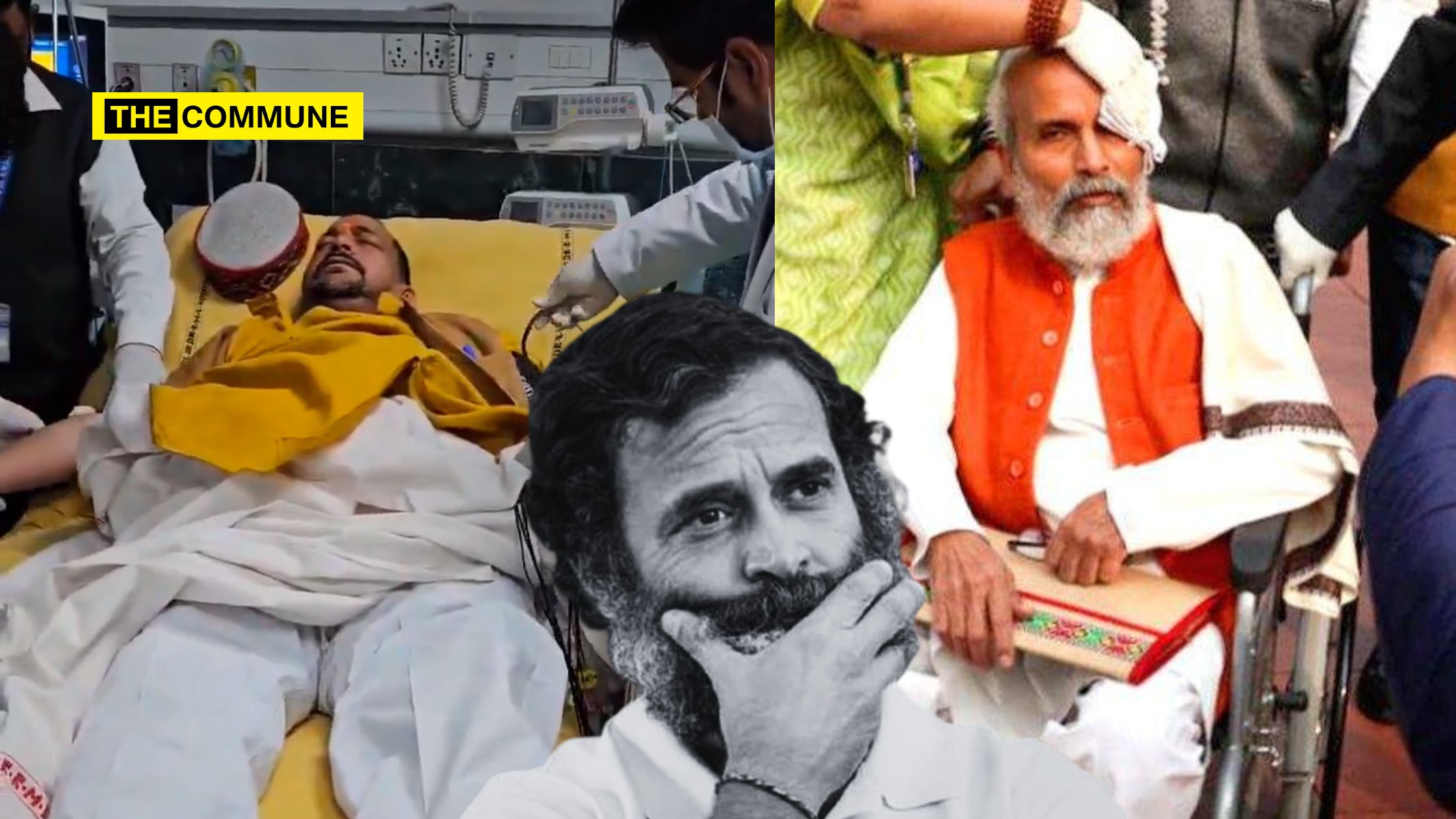
The incident unfolded when Congress leader Rahul Gandhi and other opposition MPs were attempting to enter Parliament. BJP MPs accused Rahul Gandhi of deliberately pushing BJP MPs, resulting in head injuries to two BJP MPs—Pratap Chandra Sarangi and Mukesh Rajput.

Both MPs were admitted to Ram Manohar Lohia Hospital’s Intensive Care Unit (ICU), with Sarangi reportedly suffering a deep cut to his forehead. Sarangi described the situation, stating that Gandhi pushed an MP who then fell on him, causing his injury. Rajput, who lost consciousness briefly after the incident, also sustained head injuries.

Meanwhile, BJP MPs, including Anurag Thakur, rushed to the Parliament Street police station to file a complaint against Rahul Gandhi and other Congress MPs, accusing them of physical aggression. Union Minister Dharmendra Pradhan echoed this sentiment, asserting that Gandhi’s actions had caused multiple MPs to fall, leading to the injuries of Sarangi and Rajput. BJP leaders also expressed their outrage over the incident, with Kiren Rijiju calling the behaviorshamefuland demanding an apology from Congress.

During the heated exchange, Rajya Sabha MP S Phangnon Konyak of the BJP alleged that Rahul Gandhi came very close to her and shouted at her during the protests. She stated that the incident had left her in tears, and she later submitted a formal complaint to Rajya Sabha Chairman Jagdeep Dhankhar.

The tension in Parliament continued to rise as MPs from both sides clashed over the Ambedkar issue. The opposition had staged protests in front of Makar Dwar earlier in the day, accusing BJP MPs of obstructing their protests and preventing them from voicing their concerns. Rahul Gandhi and other opposition leaders, including Congress President Mallikarjun Kharge and Priyanka Gandhi, also joined the protests, holding placards demanding an apology from Amit Shah for his remarks about Ambedkar.

The controversy surrounding Shah’s comments on Ambedkar, which he had dismissed as afashionto invoke Ambedkar’s name, intensified the protests. The Congress party filed a privilege notice against Shah, accusing him of disrespecting the Dalit icon. In response, the opposition MPs demanded Shah’s resignation, and Congress announced plans for a nationwide protest to condemn the Home Minister’s remarks.

Despite the chaos, BJP leaders remained adamant that the protests were a direct result of the opposition’s attempts to disrupt Parliament. The day ended with the House being adjourned amidst the ongoing protests, and Prime Minister Narendra Modi personally called Sarangi and Rajput to inquire about their health following the scuffle.

How Rahul Gandhi Reacted

In response to the allegations, Rahul Gandhi defended his actions, claiming that BJP MPs had obstructed his path and tried to push him and that he was simply attempting to enter Parliament. He maintained that BJP MPs were threatening and pushing him, and the confrontation was a result of their actions.

Speaking to reporters, he arrogantly said, This might be on your camera. I was trying to go inside through the Parliament entrance, BJP MPs were trying to stop me, push me, and threaten me. So this happenedYes, this has happened (Mallikarjun Kharge being pushed). But nothing happens because of a push. But this is the entrance and we have the right to go in. BJP MPs were trying to stop us from going in…The central issue is that they are attacking the Constitution and insulting the memory of Ambedkar ji.”

After admitting to manhandling, Rahul Gandhi dismissed his aggressive behavior, stating nothing happens with a push. His comments have drawn sharp criticism, as they downplay the severity of an incident that led to a head injury for senior MP Pratap Chandra Sarangi and resulted in another BJP MP being admitted to the ICU. The incident, which occurred during a scuffle in Parliament, has been condemned for its reckless nature, with critics pointing to the arrogance displayed by Gandhi and the Congress leadership in minimizing the impact of their actions.

Subscribe to our channels on Telegram, WhatsApp, and Instagram and get the best stories of the day delivered to you personally.
How Congress Replaced 6 ‘Controversial’ Cartoons In NCERT Textbooks

How Congress Replaced Controversial Cartoons In NCERT Textbooks.

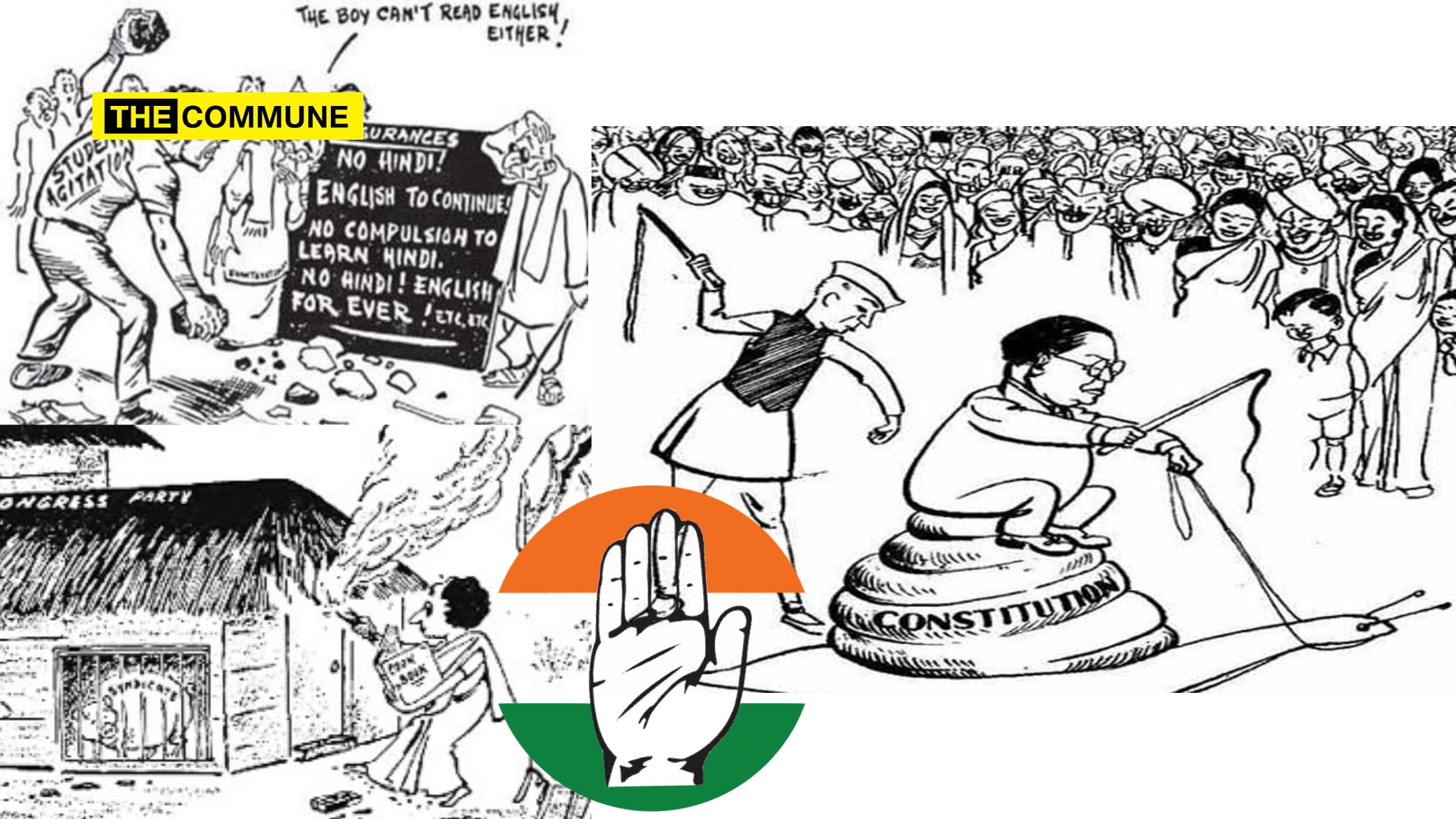
In 2012, the National Council of Educational Research and Training (NCERT) removed six cartoons from its political science textbooks after a four-month-long controversy that rocked Parliament. The decision, approved by the National Monitoring Committee, came amidst debates on freedom of expression, classroom appropriateness, and parliamentary oversight. Let’s take a look at each one of them.

The Controversial Ambedkar Cartoon

Original Content: This cartoon depicted Dr. B.R. Ambedkar seated on a snail, symbolizing the slow pace of drafting the Indian Constitution, with Jawaharlal Nehru holding a whip, seemingly urging the process forward.

Context: Created during the 1950s, the cartoon highlighted frustrations with the lengthy Constitution-making process, which took nearly three years.

Controversy: Critics argued that this cartoon undermined the dignity of Dr. Ambedkar, who chaired the drafting committee and was a key architect of the Constitution. It was also perceived as trivializing the significant work of the Constituent Assembly.

Replacement: A photograph of Dr. Rajendra Prasad greeting Dr. Ambedkar, along with an excerpt from Prasad’s speech in the Constituent Assembly on November 26, 1949, was added to honor their roles.

Booth-Capturing Cartoon

Original Content: This illustration depicted a corrupt politician as a dark-skinned man involved in booth capturing, a common electoral malpractice during India’s early democratic years.

Context: The cartoon was intended to provoke discussions on electoral corruption and the challenges of ensuring free and fair elections in India.

Controversy: The depiction of the corrupt politician as dark-skinned was criticized for reinforcing racial and caste-based stereotypes, making it inappropriate for educational settings.

Replacement: The cartoon was replaced with a blank activity box, leaving room for classroom discussions without potentially offensive imagery.

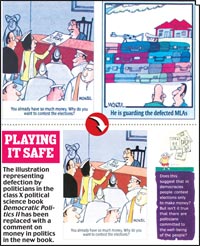
Cartoon on Political Defection

Original Content: This cartoon illustrated the issue of political defection, where politicians switched parties, often for monetary or personal gain, undermining political stability.

Context: Political defection was a major problem in Indian politics, leading to the introduction of the Anti-Defection Law in 1985. The cartoon served as a visual critique of such practices.

Controversy: The cartoon was criticized for oversimplifying a complex issue and for potentially influencing students’ perceptions of political leaders.

Replacement: It was substituted with a text-based commentary on the role of money in politics, providing a more neutral way to address the issue.

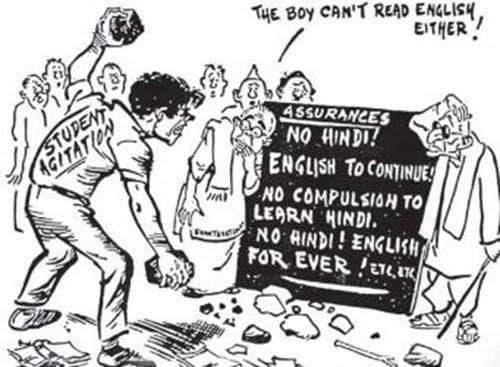
R.K. Laxman’s Anti-Hindi Agitation Cartoon

Original Content: A cartoon by renowned illustrator R.K. Laxman depicted protests during the anti-Hindi agitation in Tamil Nadu, where opposition to the imposition of Hindi as the national language led to widespread unrest.

Context: The cartoon represented linguistic diversity and the tensions surrounding language policy in post-independence India.

Controversy: Critics argued that the cartoon could revive old linguistic divides and was insensitive to the cultural sentiments of Tamil-speaking communities.

Replacement: The cartoon was removed, and an accompanying photograph related to the historical context was enlarged for better emphasis.

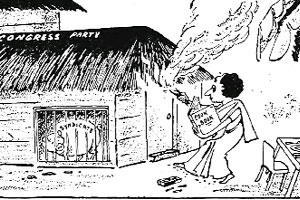
Indira Gandhi and thePig in the HutCartoon

Original Content: This cartoon depicted Indira Gandhi setting fire to a hut with a pig trapped inside. The hut symbolized the Congress party, and the pig represented the internal party syndicate.

Context: The cartoon referenced the political turmoil and internal conflicts within the Congress party during Indira Gandhi’s tenure as Prime Minister.

Controversy: The imagery of a pig, considered offensive in many cultural contexts, along with the depiction of internal political strife, was deemed inappropriate for a classroom setting.

Replacement: The cartoon was removed entirely.

Cartoon of Sheikh Abdullah Crowned by Indira Gandhi

Original Content: This cartoon showed Sheikh Abdullah, the prominent Kashmiri leader, being crowned by Indira Gandhi.

Context: The cartoon symbolized the political alliance and subsequent tensions between Sheikh Abdullah and the Congress government under Indira Gandhi.

Controversy: The cartoon was interpreted as showing favoritism or political manipulation by Indira Gandhi, which some felt was unsuitable for inclusion in a textbook.

Replacement: The cartoon was replaced with other content that maintained historical relevance without controversial depictions.

The Thorat Committee had suggested the removal of 22 cartoons from NCERT textbooks. Six had been dropped in 2012 and many were under review. While the Congress was happily disrespecting Ambedkar, they did not want the truth about the Congress party itself to be seen as a part of the curriculum.

(With inputs from India Today)

Subscribe to our channels on TelegramWhatsApp, and Instagram and get the best stories of the day delivered to you personally.

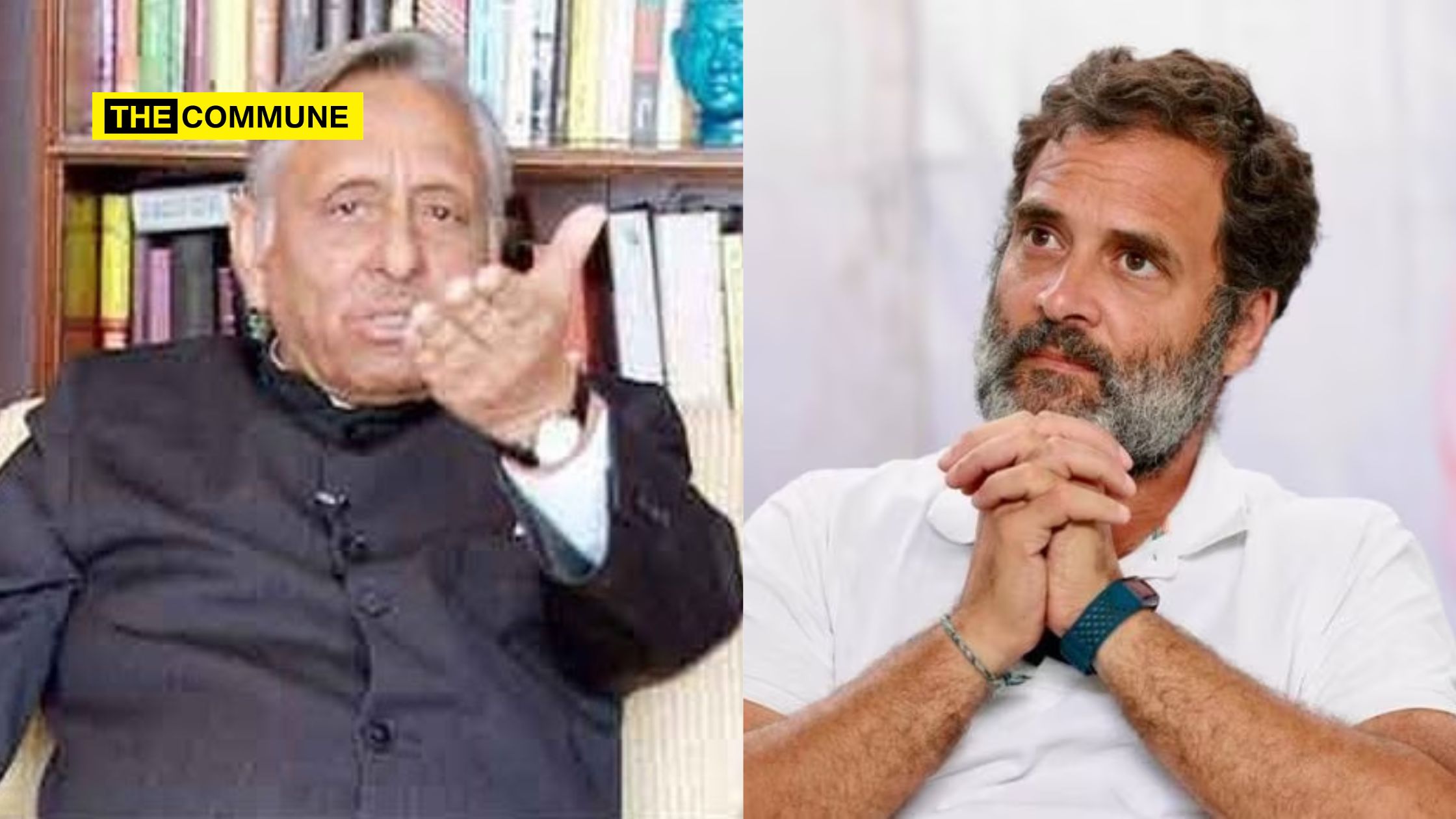
“They Found A Scapegoat In Me”, Congress Leader Mani Shankar Aiyar Reveals How His Party Used Him To Hide Rahul Gandhi’s Failure

Congress Leader Mani Shankar Aiyar Reveals How His Party Used Him To Hide Rahul Gandhi's Failure

Veteran Congress leader Mani Shankar Aiyar, known for his outspoken nature and sharp political commentary, has found himself at the center of controversies that have haunted the party. In his book, A Maverick in Politics, Aiyar details how he was made the scapegoat for Congress’s defeats in the 2014 general elections and the 2017 Gujarat assembly elections. His reflections offer a compelling narrative of political maneuvering, media sensationalism, and a party looking for an easy target.

Aiyar emphatically states that he never referred to Narendra Modi as achaiwalaand that the controversy surrounding this alleged remark was baseless. The whole recording or any part of it is still on YouTube, and you can see I never said that Aiyar asserts. He explains that it was Modi himself who perpetuated thehumble beginningsnarrative, turning it into a political tool.

Aiyar recalls an instance where Congress leaders reacted without verifying facts. Imagine a political party not asking its own member what he had said before suspending him, he writes. He describes being used as a scapegoat for the party’s impending defeat in 2014, as Congress sought to deflect blame for its lackluster campaign.

The 2017 Gujarat assembly elections brought another controversy. Aiyar’s phraseneech kisam ka aadmi(a lowly sort of person) was twisted intoneech jaati ka aadmi(a man of low caste), igniting a political firestorm. Aiyar laments, Instead of checking with me, I get a call from Republic TV telling me that Rahul Gandhi had tweeted, asking me to apologize. I was told this by Republic, of all the devils in the world.”

This misrepresentation was weaponized against him, and Aiyar was swiftly suspended from the Congress party. Reflecting on this, he accuses the BJP oftwisting wordsand Congress of failing to stand by him.

Aiyar is scathing in his critique of the media, accusing it of prioritizing sensationalism over substance. He argues that the media played a significant role in amplifying these controversies. So much of our media is obsessed with triviality, so obsessed with sensational headlines,he says, lamenting the lack of depth in political discourse.

Speaking to Deshbhakt YouTube channel, he says, I’m the scapegoat because at that time they had been projecting Rahul as winning the Gujarat election and they realized towards the end that it was not going to happen. The end result was if I’m not mistaken, I’ve given the figures here, that we got 77 seats, and they got 99 and we were about 40% and they were about 49% and I can’t remember now the exact numbers. It was a huge margin and, in those circumstances, they wanted a scapegoat, and they found a scapegoat for the 2014 elections in my so-called Chaiwala comment which I never made, and the 2017 defeat in Gujarat on this on these remarks.”

Aiyar’s criticism isn’t reserved solely for the BJP and the media; he also takes aim at his own party. He recalls how Congress leaders distanced themselves from him, with Rahul Gandhi treating him as if I was a political leper.Reflecting on his suspension and isolation, Aiyar reveals the emotional toll it took on him, leading to a severe depression.

Subscribe to our channels on Telegram, WhatsApp, and Instagram and get the best stories of the day delivered to you personally.
Uttar Pradesh: “If Your Son Was A Muslim, He Would Have Been Saved”, Says Islamist Who Kidnapped, Raped & Killed A 5-Yr-Old Hindu Boy

If Your Son Was A Muslim, He Would Have Been Saved, Says Islamist Who Kidnapped, Raped & Killed A 5-Yr-Old Hindu Boy

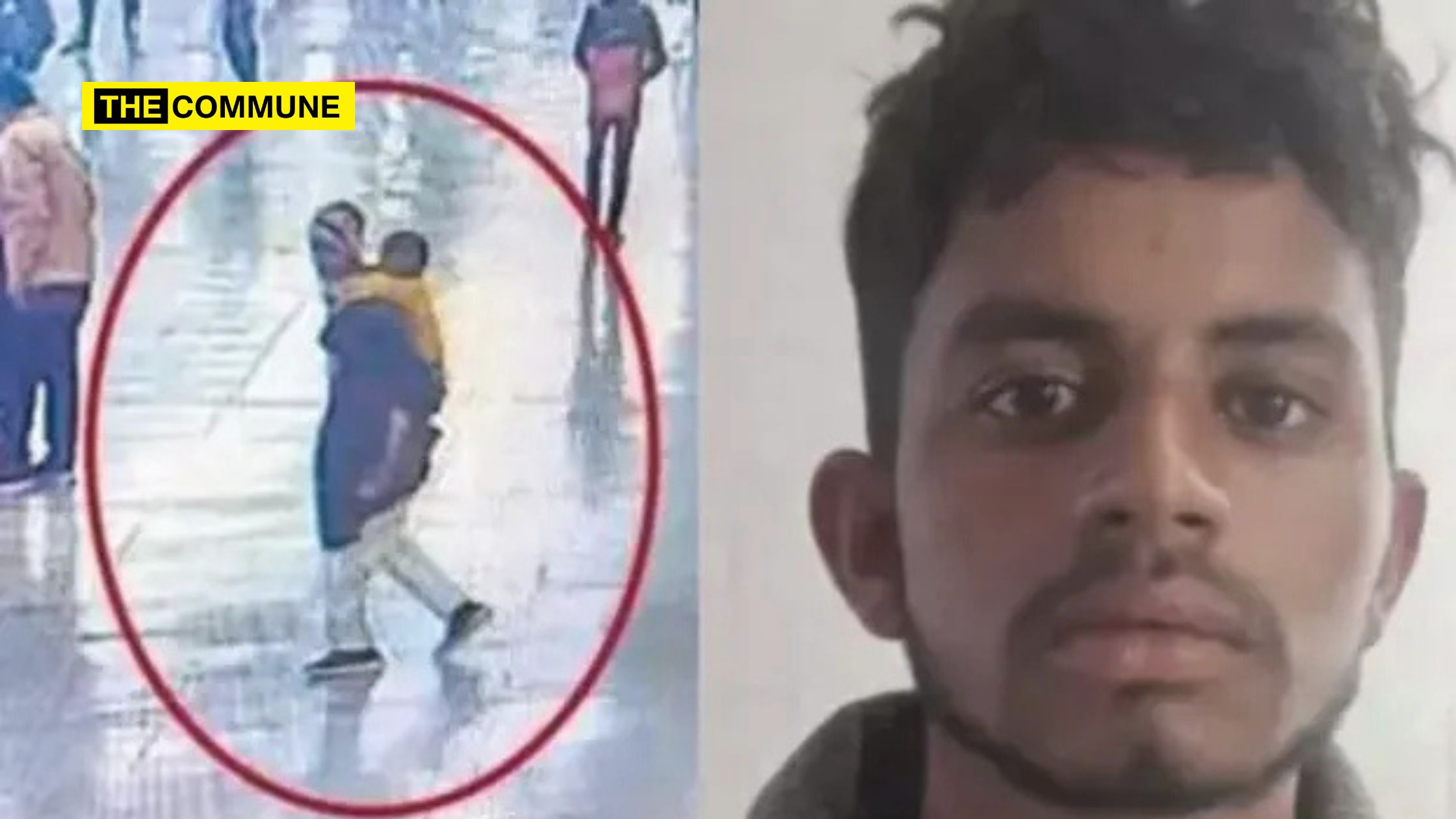
A chilling incident of religious hatred has come to light, where a five-year-old Hindu boy was kidnapped, raped, and murdered by an Islamist named Ibrahim in Lucknow because the victim wasn’t a Muslim. In a shocking confession that made the boy’s grieving mother faint in anguish, the accused said he targeted the child due to his religion.

A horrific incident occurred at Charbagh railway station where Ibrahim, a resident of Lakhimpur, approached the boy’s mother, who had arrived at the station and was attempting to cajole her crying child. He pretended to comfort the child and offered food to the mother and son, which reportedly caused them to lose consciousness. Upon regaining consciousness, the woman discovered that both her child and Ibrahim were missing.

The mother immediately alerted the authorities, prompting a search that led to the discovery of her son’s body in a warehouse near the station. Investigations revealed that Ibrahim had sexually assaulted and killed the child. When apprehended by the police, Ibrahim reportedly made a chilling statement in front of the grieving mother, stating, “If your son was a Muslim, he would have been saved. He was a Hindu. We attack Hindus.” He then laughed, which caused the mother to faint in anguish.

Dharamvir Singh of the Government Railway Police (GRP) detailed how Ibrahim befriended the woman and her child, giving the boy biscuits and chips and playing with him to gain their trust. Surveillance footage from 40 cameras at the station showed Ibrahim carrying the child across a foot-overbridge to a warehouse. Evidence such as a jacket left at a condom rack with a mobile number in its pocket led the police to track and arrest Ibrahim.

The investigation revealed that Ibrahim had assaulted the boy in the warehouse, and when the child cried out in distress, he was murdered. Ibrahim was charged under sections of rape and murder, and he is currently in custody. The incident has sparked outrage and deep sorrow in the community.

(With inputs from Hinduphobia Tracker)

Subscribe to our channels on TelegramWhatsApp, and Instagram and get the best stories of the day delivered to you personally.
“Deceitful, Orthodox, And Never A Mahatma”, Ambedkar’s Unflinching Critique Of Gandhi

“Deceitful, Orthodox, And Never A Mahatma”, Ambedkar’s Unflinching Critique Of Gandhi

Dr BR Ambedkar, a towering intellectual and social reformer, remains a prominent voice of dissent against the glorification of MK Gandhi as a “Mahatma.” In a candid interview with the BBC in 1955, Ambedkar dismantled the mythos surrounding Gandhi, offering a perspective grounded in his personal experiences and ideological clashes with the man he referred to as an “orthodox Hindu.” Ambedkar’s refusal to recognize Gandhi as “Mahatma” was not merely rhetorical—it stemmed from deep-seated disagreements on critical issues of caste, equality, and political representation.

Gandhi – An “Episode,” Not An Epoch-Maker

Ambedkar began by expressing his astonishment at the Western world’s fascination with Gandhi. He characterized Gandhi as “an episode in the history of India” rather than an epoch-maker, arguing that his relevance was artificially sustained through annual Congress-led commemorations. Without these, Ambedkar believed, Gandhi’s memory would have faded from the public consciousness. He said, So far as India is concerned, in my judgment, he was an episode in the history of India, never an epoch-maker. Gandhi has already vanished from the memory of the people of this country. His memory is kept up because the Congress party annually gives holidays, has celebrations for seven days in a week. Naturally, people’s memory is revived. But if this artificial respiration were not given, I think Gandhi would be long forgotten.”

Exposing Gandhi’s “Double-Dealing”

One of Ambedkar’s most scathing critiques was directed at what he perceived as Gandhi’s duplicity. He accused Gandhi of presenting different faces to different audiences, criticizing him for deceitful behavior: “If you read these two papers, you will see how Mr. Gandhi was deceiving the people. In the English newspaper, he posed himself as an opponent of the caste system and untouchability, and as a democrat. But if you read his Gujarati magazine, you will see him as a more orthodox man, supporting the caste system and the varnaashrama dharma.”

Ambedkar pointed out that the Western world, primarily reading Gandhi’s English writings, was oblivious to the contradictions in his Gujarati publications. He urged biographers to analyze Gandhi’s dual narratives, “Someone ought to write Mr. Gandhi’s biography by making a comparative study of the statements he made in Harijan and those in his Gujarati paper. All the biographies that have been written of him are based on his English writings, not upon his Gujarati writings.”

The Poona Pact: A Clash Of Ideologies

Ambedkar’s most direct confrontation with Gandhi came during the Poona Pact negotiations. He recounted: “The British government, in the original award, accepted my suggestion to give separate electorates to the Scheduled Castes. Gandhi didn’t want us to send our true representatives. He went on a fast, saying he would die if the award was implemented.”

Ambedkar critiqued Gandhi’s simplistic view of social harmony – “For five years, we live separately from the Hindus, with no kind of social or spiritual intercourse. What can one day of common participation in an election do to remove these hardened crusts of separatism that have grown for centuries?”

Ambedkar eventually compromised, proposing primary elections among Scheduled Castes before the general election. However, he remained skeptical of Gandhi’s intentions, asserting, “Gandhi’s object was that we should not get free independent representatives. It was just his whim. I refused to sacrifice the interests of my people to save his life.”

Gandhi’s Limited Vision For Untouchables

Ambedkar lambasted Gandhi’s focus on symbolic reforms like temple entry, dismissing them as inconsequential, “Nobody cares about Hindu temples now. The untouchables have become so conscious of the fact that temple-going is of no consequence at all. Whether you went to the temple or did not go to the temple, you would still live in untouchable quarters just the same.”

He highlighted Gandhi’s lack of commitment to addressing systemic inequalities, “Mr. Gandhi was totally opposed to giving us equal opportunities to hold high offices so that we could protect our own people. His focus was only on removing untouchability, not on uplifting the Scheduled Castes to the level of other classes.”

“Never A Mahatma”

Ambedkar’s refusal to call Gandhi “Mahatma” was rooted in his belief that Gandhi lacked the moral and social dynamism to earn such a title. Ambedkar described Gandhi as a shrewd politician rather than a saintly figure, asserting that Gandhi’s actions were often guided by personal whims and political maneuvering. He stated, “As a politician, he was never a Mahatma. I refused to call him Mahatma. I never in my life called him Mahatma. He didn’t deserve that title—not even from the point of his morality.”

Ambedkar’s critique extended beyond politics, pointing to Gandhi’s inconsistent morality and lack of genuine reformist zeal.

Ambedkar’s assessment of Gandhi offers a compelling counter-narrative to the mainstream veneration of the “Father of the Nation.” By exposing Gandhi’s contradictions and limitations, Ambedkar highlighted the complexities of India’s struggle for social justice and independence. His refusal to bestow the title of “Mahatma” on Gandhi underscores his commitment to an uncompromising vision of equality and empowerment for the oppressed. In Ambedkar’s eyes, true greatness lay not in rhetoric or symbolic gestures but in transformative action—an ideal he tirelessly pursued throughout his life.

(With inputs from Velivada)

Subscribe to our channels on Telegram, WhatsApp, and Instagram and get the best stories of the day delivered to you personally.