Home Blog Page 468

May Akshaya Tritiya Give New Strength To Viksit Bharat, Says PM Modi

Prime Minister Narendra Modi on Wednesday extended heartfelt greetings on the occasion of Akshaya Tritiya, expressing hope that the festival would serve as a catalyst in strengthening the nation’s collective resolve towards building a ‘Viksit Bharat’. Akshaya Tritiya, also known as Akha Teej or Akti, is a significant Hindu festival observed annually.

The day is believed to usher in success, good luck, and prosperity. Traditionally, people mark the occasion by purchasing gold, a symbol of wealth and security, to invite blessings for the future.

Taking to X, PM Modi posted, “Infinite best wishes to all of you on Akshaya Tritiya. May this auspicious festival dedicated to humanity bring success, prosperity and happiness to everyone, which gives new strength to the resolve of a Viksit Bharat.” Union Home Minister Amit Shah also extended his greetings through a social media post. “Infinite best wishes for Akshaya Tritiya, the festival symbolising the confluence of nature and culture. I wish that this holy festival brings eternal virtue, good fortune and prosperity in everyone’s life,” Shah wrote. Union Minister J.P. Nadda joined in conveying greetings, stating, “I convey my heartfelt best wishes to all of you on the occasion of ‘Akshaya Tritiya’ which bestows everlasting virtuous results.”

“May this auspicious day bring an inexhaustible flow of happiness, prosperity and auspicious opportunities in the life of all of you. May everyone’s life be blessed with positivity, divinity and self-study,” he added. The term Akshaya denotes something eternal or indestructible, while Tritiya refers to the third day of the Shukla Paksha in the Hindu lunar calendar. The day is considered highly auspicious for initiating new ventures, buying valuables, and performing religious rituals. Devotees believe that such acts on this day yield lifelong blessings and well-being. The festival also coincides with Parashurama Jayanti, which marks the birth anniversary of the sixth incarnation of Lord Vishnu. Devotees also pay homage to Lord Shiva, underscoring the spiritual and cultural depth of the day.

–IANS

Subscribe to our channels on TelegramWhatsApp, and Instagram and get the best stories of the day delivered to you personally.

Pakistan Minister Holds Emergency Press Meet At 2 AM, Crying Foul About India’s Military Action Within 24 To 36 Hours

Amid looming fears of strong action from India in the wake of the Pahalgam terror attack, Pakistan Federal Minister for Information and Broadcasting Attaullah Tarar held an emergency press meet at 2 a.m. Wednesday, saying that there were ‘intelligence reports of military action against their country within the next 24 to 36 hours’.

Addressing an emergency press conference, Tarar said credible intelligence-based information has warned of an Indian military action. “We have credible intelligence-based information that India is planning a military offensive against Pakistan within the next 24 to 36 hours. Any action by India will be responded to with full force,” he said.

“Pakistan will defend its territory at all costs and will respond with its full might. The nation will defend its sovereignty and territorial integrity by all means necessary. If India tries to impose a war on Pakistan, it will be solely responsible for the disastrous and devastating costs,” he added.

Tarar also called on the international community to take note of India’s “planned aggression” against Pakistan, stating that even though Islamabad offered cooperation in a neutral and credible investigation, New Delhi has not provided any proof of Islamabad’s involvement in the Pahalgam attack.

“It has been days since the Pahalgam incident, but India has not provided Pakistan with any evidence. However, we have credible evidence of India’s involvement in cross-border terrorism in our country. The International community needs to take notice of New Delhi’s planned and self-orchestrated reasoning to attack Pakistan”, he said.

“India’s habit of being the judge, jury and executioner is categorically and strongly rejected by Pakistan”, he added. The late-night emergency press conference by Pakistan’s Information Minister has come amid heavy military deployments by both sides on their borders, while the political temperature is rising every passing hour. Both sides have unleashed a range of measures against each other, with Pakistan closing its airspace for Indian airlines and India putting the crucial and critical Indus Waters Treaty (IWT) in abeyance, among other measures. Tarar’s statement comes soon after the recent statement by Pakistan’s Defence Minister Khawaja Asif, who had stated a “military incursion from India was imminent”.

Asif had also warned that Pakistan would only use its nuclear weapons if there were a direct threat to the country’s existence from India.

–IANS

Subscribe to our channels on TelegramWhatsApp, and Instagram and get the best stories of the day delivered to you personally.

Jihadi Terror Incidents In India Over The Decades – A Comprehensive Look At Congress’s Disturbing Record On National Security

manmohan singh sonia gandhi upa surgical strikes rti congress terror

India’s decades-long battle against Pakistan-sponsored terrorism, particularly in Jammu & Kashmir, represents one of the most complex counterterrorism challenges faced by any democracy. This expanded analysis examines not just the chronology of attacks, but the systemic policy failures and ideological compromises that allowed jihadist networks to flourish under successive Congress-led governments. The evidence reveals a disturbing pattern of strategic blunders, willful ignorance of security threats, and political calculations that prioritized vote banks over national security.

This report documents decades of terror incidents in India, particularly concentrated in Kashmir, with significant escalation in the 1990s and 2000s. The attacks have targeted civilians, security forces, religious sites, and infrastructure across the country, claiming thousands of lives and leaving many more injured.

Kashmir Conflict & Terror Timeline (1947-2014) & The Historical Roots of Congress’s Counterterrorism Failures

The origins of India’s current counterterrorism challenges can be traced directly to the catastrophic decisions made by Jawaharlal Nehru in the immediate aftermath of Partition. When Pakistani tribals and army irregulars launched Operation Gulmarg in October 1947, Nehru ignored multiple intelligence warnings, including detailed assessments from Gen. Akbar Khan’s memoir Raiders in Kashmir, which later confirmed Pakistan’s premeditated invasion plan. His 27-day delay in accepting Maharaja Hari Singh’s accession allowed Pakistan to consolidate control over what is now PoK, while his decision to internationalize the dispute at the UN—against the advice of V.P. Menon—locked India into a perpetual cycle of diplomatic stalemate.

The 1965 war further exposed Congress’s strategic incoherence. Despite India holding key positions at Haji Pir Pass and Turtuk sector, Prime Minister Lal Bahadur Shastri surrendered these gains in the Tashkent Agreement, a move that CIA memos from 1966 confirm was interpreted by Pakistan as weakness. By 1968, Pakistani military planners had already begun formulating their proxy war strategy, which would later manifest in the Kashmiri Pandit genocide of 1989-91.

1947-49: The First Kashmir Conflict

The partition of British India left the princely state of Jammu and Kashmir, with its Muslim majority and Hindu ruler, in a precarious position. In October 1947, Pakistani tribesmen and irregular forces invaded Kashmir with support from Pakistan’s army, triggering the first Indo-Pakistani war. The invaders plundered state armories, set markets ablaze, and targeted non-Muslims, resulting in thousands of casualties. India deployed its army after Kashmir’s Maharaja signed the instrument of accession joining India. Prime Minister Nehru approached the United Nations, leading to a ceasefire in 1949 and unimplemented UN resolutions for a plebiscite.

1965: Indo-Pakistani War and Tashkent Agreement

Pakistan launched “Operation Gibraltar” to infiltrate forces into Kashmir and incite insurgency, leading to a 17-day war between August and September 1965. The conflict ended with a UN-brokered ceasefire and the subsequent Tashkent Declaration in January 1966. Critics note that India returned strategic gains including the Haji Pir Pass under this agreement, surrendering tactical advantages without resolving the Kashmir issue.

1971: War and Shimla Agreement

The 1971 conflict began when Pakistan launched “Operation Searchlight” against East Pakistan (now Bangladesh), causing a refugee crisis in India. India’s intervention led to Pakistan’s defeat and Bangladesh’s independence. The Shimla Agreement of July 1972 established the Line of Control in Kashmir and committed both nations to bilateral resolution of disputes. India released 93,000 Pakistani prisoners of war, though critics argue India missed an opportunity to leverage its strong position for a permanent Kashmir solution.

1971-1989: Isolated Incidents

30 January 1971: Indian Airlines plane hijacked from Srinagar to Jammu by JKLF members Hashim and Ashraf Quereshi, who took it to Lahore and later burned the aircraft.

10 September 1976: Indian Airlines Boeing 737 hijacked from Delhi by six Kashmiri terrorists; passengers and crew were released and hijackers captured.

1980s-1990s: Rise of Insurgency

Pakistan’s ISI launched “Operation Tupac” in 1988 to arm Kashmiri militants. In 1990, Pakistani politician Benazir Bhutto publicly endorsed “freedom” for Kashmir, allegedly contributing to radicalization.

8 December 1989: Rubaiya Sayeed Kidnapping

JKLF militants led by Yasin Malik kidnapped Rubaiya Sayeed, daughter of India’s Home Minister Mufti Mohammad Sayeed, in Srinagar. The government released five jailed militants to secure her freedom, a decision criticized for emboldening militancy.

1989-1991: Targeting of Kashmiri Pandits

A wave of targeted killings forced the exodus of Kashmiri Pandits from the valley. Prominent victims included:

  • Tika Lal Taploo (September 14, 1989): BJP leader and lawyer shot in Srinagar’s Habba Kadal area
  • Neelkanth Ganjoo (November 4, 1989): Retired judge who had sentenced JKLF co-founder Maqbool Bhat, killed near the High Court
  • Prem Nath Bhat (December 27, 1989): Lawyer and journalist killed in Anantnag
  • Satish Kumar Tickoo (February 2, 1990): Social worker shot in Habba Kadal
  • Lassa Kaul (February 13, 1990): Doordarshan Srinagar director killed outside his home
  • Sarwanand Koul Premi (April 29, 1990): Renowned poet kidnapped, tortured and killed
  • Girija Tickoo (June 25, 1990): Schoolteacher abducted, raped, tortured and killed
  • Ashok Kumar Bhatt (January 18, 1990): Business owner shot near his home
  • Tej Krishan Razdan (February 12, 1990): Government employee abducted and shot

Congress’s Complicity In Kashmiri Pandit Exodus

The ethnic cleansing of Kashmiri Hindus was not an unforeseen tragedy but the direct result of policy paralysis and appeasement. Recently digitized J&K Police records list 1,427 targeted killings of Hindus between 1989-91, yet the Rajiv Gandhi government ignored Governor Jagmohan’s repeated warnings. Instead of cracking down on jihadist groups like the JKLF, the Congress-led Centre released 42 jailed terrorists in a futile attempt to “appease” militants. The Rubaiya Sayeed kidnapping case (1989) set a dangerous precedent, demonstrating that hostage-taking could force the Indian state into concessions.

January 25, 1990: Attack on Air Force Personnel

Yasin Malik orchestrated an attack in Rawalpora, Srinagar, killing four IAF personnel. Malik was convicted in 2022 for terror funding and waging war against India.

August 14, 1993: Kishtwar Massacre

Militants ambushed a bus in Kishtwar’s Sarthal area, killing 17 Hindu passengers.

Some Other Notable Incidents In The 1990s:

  • May 21, 1990: Assassination of Mirwaiz Maulvi Farooq, Imam of Juma Masjid
  • April 6, 1990: Abduction and killing of HMT General Manager H.L. Khera and Kashmir University Vice-Chancellor Mushir-ul-Haq
  • June 28, 1991: Abduction of Indian Oil executive K. Doraiswamy (later released)
  • March 31, 1991: Abduction of two Swedish engineers working on Uri Hydel Project
  • February 27, 1991: Abduction of Nahida Imtiaz, daughter of NC leader Saifuddin Soz
  • June 22, 1992: Six Israelis taken hostage by militants
  • October 15, 1993: Siege at Hazratbal mosque
  • June 6, 1994: Two foreigners abducted by Harkat-ul-Ansar
  • March 29, 1994: Lt. Gen. E.W. Fernandes and four senior officers killed in bomb explosion at Badami Bagh Cantonment
  • July 20, 1995: Twenty killed in Jammu bomb explosion
  • July 3, 1995: Four foreign nationals abducted from Pahalgam by Al Faran; Norwegian Hans Christian Ostrø beheaded, American John Childs escaped, others presumed dead

2000s: Continued Violence In Kashmir 

The 2000s saw a continued violence in Kashmir. The remaining Kashmiri Pandits were also targeted for being Hindus and massacre after massacre took place in the valley.

2004:

  • May 23: IED explosion on Jammu-Srinagar Highway killed 30
  • June 26: Terrorist attack in Surankote killed 12
  • July 2: Attack on MP Choudhary Lal Singh’s convoy killed 6
  • July 19: Assassination attempt on Deputy CM Mangat Ram Sharma killed 6
  • July 25: Gunfight at paramilitary base on Dal Lake killed 5
  • August 4: Ambush at CRPF camp killed 9
  • December 5: IED explosion in Pulwama killed 10

2005:

  • January 7: Suicide attack on Income Tax office in Srinagar killed 3-5
  • February 24: Suicide attack at Divisional Commissioner’s office killed 5
  • May 25: Grenade attack in Srinagar school killed 2 children
  • June 13: Car bombing in Pulwama killed 13
  • June 24: Bomb attack on security personnel bus in Srinagar killed 9
  • July 19: Attack in Udhampur village killed 5
  • July 20: Suicide attack on Army vehicle in Srinagar killed 5
  • September 9: Attack on three families in Udhampur killed 3
  • September 10: Attack on Army convoy on National Highway killed 5
  • October 10: Attack on four families in Rajouri killed 10
  • October 18: Assassination of Education Minister Dr. Ghulam Nabi Lone killed 4
  • November 5: Suicide attack near outgoing CM Mufti Mohammed Sayeed’s residence killed 10
  • November 14: Suicide attack at Srinagar business hub killed 4
  • November 15: Assassination attempt on PDP leader Ghulam Hassan Mir killed 3-6
  • November 16: Assassination attempt on Minister Usman Majeed killed 4

2006:

  • January 23: Gunfight with special operations group killed 4
  • April 9: Terrorists killed a family of 3 in Udhampur
  • April 14: Serial grenade blasts in Srinagar killed 5
  • May 1: Doda massacre killed 57
  • May 21: Attack on CM Ghulam Nabi Azad’s rally killed 6-7
  • May 25: Grenade attack in Srinagar killed 8
  • June 12: Attack on laborers in Anantnag killed 10
  • June 30: Assassination of Sheikh Nabi killed 8
  • July 11: Attack on leader in Kulgam killed 8
  • November 10: Grenade attack in Srinagar killed 6

2007:

  • February 8: Ambush on security patrol in Pulwama killed 5
  • March 30: Attack on laborers in Kulgam killed 5
  • July 29: Attack on civilian bus near Shalimar Garden killed 6
  • August 17: IED blast near security forces in Avantipora killed 5
  • October 11: IED blast in Baramullah killed 7

2008:

  • May 26: Transfer of land to Shri Amarnathji Shrine board triggered protests
  • June 13: Ambush on Army personnel killed 5
  • July 4: Ambush on Army personnel in Kupwara killed 5
  • July 19: IED blast in Army bus in Srinagar killed 10
  • July 24: Grenade attack in Srinagar killed 5
  • August 27: Suicide attack in Kenechok killed 5

2009:

  • April 21: IED explosion in Surankote killed civilians, including a woman and child
  • September 12: Car bombing outside Srinagar Central Jail killed police officers and a woman
  • September 23: Encounter in Bandipora killed 2 army personnel
  • December 30: Hizbul militants ambush in Sopore killed 4 CRPF personnel

2010-2013:

  • March 16, 2010: Attack on civilians in Srinagar killed 6, followed by stone-pelting protests between June-September
  • August 20, 2011: Army officer killed in Bandipora
  • September 27, 2011: Security personnel killed in overnight Kupwara operation
  • September 25, 2012: Top LeT commander and 1 soldier killed in Handwara
  • November 14, 2012: 3 soldiers killed foiling infiltration bid in Nowgam, Kupwara
  • December 24, 2012: Policeman killed in Kulgam encounter
  • June 24, 2013: Ambush on Army personnel in Srinagar killed 8

The UPA Era: A Golden Age For Jihadi Terror 

The UPA years were marked by some of the deadliest terror attacks in Indian history, with little decisive action taken to deter future strikes.

Key Terror Attacks Under UPA

  • 2005: Delhi Bombings (70 killed, 250 injured)
  • 2006: Mumbai Train Blasts (209 killed, 714 injured)
  • 2007: Samjhauta Express Bombings (70 killed, mostly Pakistanis)
  • 2008: 26/11 Mumbai Attacks (171 killed, 300+ injured)
  • 2010: Pune German Bakery Blast (17 killed, 54 injured)
  • 2011: Mumbai Serial Blasts (26 killed, 130 injured)
  • 2013: Hyderabad Blasts (18 killed, 131 injured)

Despite repeated attacks, the Congress government failed to:

  • Strengthen intelligence coordination.
  • Expedite counterterror operations.
  • Hold Pakistan accountable for cross-border terrorism.

Unlike the 2019 Balakot airstrikes after Pulwama, Congress chose inaction, emboldening Pakistan to continue sponsoring terror.

Other Significant Terror Attacks In UPA Regime

Between 2004-2014, under the Congress-led UPA government, India witnessed some of its deadliest terror attacks, including:

  • Batla House Encounter (2008): The Batla House encounter (2008), where two terrorists were killed, faced unjustified scrutiny from Congress leaders despite the Home Minister confirming its legitimacy. Top Congress leaders, including Sonia Gandhi, politicized the operation to appease conservative Muslim sentiments, even shedding tears for the slain terrorists. This exposed the party’s prioritization of vote banks over national security.
  • 26/11 Mumbai (2008): 171 killed, yet no military retaliation despite irrefutable evidence of ISI involvement. NSA archives reveal that three strike plans prepared by the Military Operations Directorate were vetoed. The 2008 Mumbai attacks exposed India’s unpreparedness and Congress’s lack of resolve.

    • No Military Response: Despite clear evidence of Pakistan’s involvement, PM Manmohan Singh ruled out military retaliation, fearing “escalation.”
    • Slow NSG Deployment: Commandos took 10 hours to reach Mumbai due to lack of readiness.
    • No Diplomatic Pressure: Pakistan faced minimal consequences; LeT chief Hafiz Saeed roamed freely.
  • Hyderabad Blasts (2013): 18 dead, but the Home Ministry under Sushilkumar Shinde bizarrely prioritized investigating “Hindu terror” rather than Pakistan-based groups.

  • Doda Massacre (2006): 57 Hindus slaughtered, yet the government continued its policy of “dialogue” with separatists.

Attacks Outside Of Kashmir 2010-2014

  • Pune Bombing (2010): 17 killed, 54 injured in bakery explosion
  • Varanasi Bombing (2010): 2 killed, 37 injured in blast during religious ceremony
  • Mumbai Bombings (2011): 26 killed, 130 injured in three explosions in commercial areas
  • Delhi Bombing (2011): 15 killed, 74 injured in blast outside Delhi High Court
  • Attacks on Israeli Diplomats (2012): 4 injured in Delhi incident
  • Pune Bombings (2012): 1 injured in low-intensity explosions
  • Hyderabad Blasts (2013): 18 killed, 131 injured in twin blasts in Dilsukhnagar market
  • March 2013 Srinagar Attack: 7 killed, 10 injured in militant attack on security forces
  • Bangalore Blast (2013): 16 injured in explosion near political office
  • June 2013 Srinagar Attack: 8 killed, 19 injured in assault on army convoy
  • Bodh Gaya Bombings (2013): 5 injured in multiple explosions at Buddhist temple complex
  • Patna Bombings (2013): 6 killed, 85 injured in serial blasts at political rally
  • Budgam District Blast (2014): 18 injured in explosion linked to militants

The UPA’s counterterrorism record was not just weak but actively counterproductive. The Standing Committee on Home Affairs (2013) noted a 70% decrease in IB field operatives in J&K, while the PAC report (2012) revealed that 82% of counterinsurgency equipment was obsolete.

Congress’s Ideological Sympathy for Jihadi Narratives

Instead of standing with security forces, Congress leaders often questioned encounters, defended terrorists, and even echoed Pakistani talking points. Beyond policy failures, the Congress party has repeatedly demonstrated an ideological softness toward jihadist rhetoric:

  1. Sanjay Dutt’s Leniency: Convicted in the 1993 Mumbai blasts (257 killed), he received inexplicable parole benefits, with MHA documents suggesting political interference.
  2. “Hindu Terror” Fabrication: The NIA court judgments in the Mecca Masjid and Malegaon cases noted “political pressure to implicate Hindu groups,” while Wikileaks cables (09NEWDELHI1868) exposed Rahul Gandhi’s remarks to the U.S. Ambassador that “Hindu extremism is a bigger threat than LeT.” This came just a year after 26/11, where Pakistani terrorists killed 171 Indians.
  3. Afzal Guru’s Glorification: While the Congress hesitated for years on his execution, its leaders remained silent as JNU students chanted “Afzal Guru zindabad.”
  4. Sonia Gandhi ‘Wept’ For Terrorist Deaths (Allegedly: During the Batla House Encounter (2008), two Indian Mujahideen terrorists were killed in a legitimate police operation. Sonia Gandhi reportedly cried over the terrorists’ deaths (as claimed by Salman Khurshid). Digvijaya Singh, Rahul Gandhi, and others questioned the encounter, calling it “fake.”
  5. Defending Yakub Memon (1993 Blasts Convict): Shashi Tharoor said, “State-sponsored killing diminishes us all.” Manishankar Aiyar said, “Which terrorist will get deterred by death penalties?” Digvijaya Singh compared Yakub to APJ Abdul Kalam, tweeting: “Two Indian Muslims’ funerals on the same day.”
  6. Calling Osama Bin Laden “Osama Ji”: Digvijaya Singh referred to the Al-Qaeda chief as “Osama Ji” and Hafiz Saeed as “Hafiz Sahab.” He even criticized the US for Bin Laden’s burial, saying “religious traditions should be respected.”
  7. Questioning Balakot Airstrikes (2019): Digvijaya Singh demanded “proof” of the strikes. Kapil Sibal asked“Were trees uprooted or terrorists killed?” P Chidambaram echoed Pakistani media, saying “government must provide evidence.”

Congress’s Pro-Pakistan, Anti-India Stance

Congress leaders have repeatedly parroted Pakistani propaganda, undermining India’s security. Here are a few examples:

After Pahalgam Attack (2025)

    • Congress leaders echoed Pakistani media, questioning India’s response.
    • Pakistani news channels quoted Congress statements to claim “India is divided on terrorism.”

Digvijaya Singh’s Pro-Pakistan Rhetoric

    • Called 26/11 an “RSS conspiracy.”
    • Termed Pulwama attack a durghatana (accident).
    • Demanded proof for surgical strikes.

Ghulam Nabi Azad’s Anti-Army Remark

    • “Indian Army kills more civilians than terrorists in J&K.”
    • His statement was praised by Lashkar-e-Taiba.

Congress’s Policy Failures Enabled Growth Of Terror Networks

One of the most glaring failures of the Congress-led governments was their soft stance on terror outfits. Groups like the Students Islamic Movement of India (SIMI) were allowed to operate freely for years, flourishing under Congress rule. Despite mounting evidence of SIMI’s involvement in extremist activities, successive Congress governments delayed banning the organization—often acting only after intense public and legal pressure. This hesitation to act decisively against terror groups not only emboldened them but also weakened national security efforts during critical periods.

The Modi Government’s Strategic Reset

Post-2014, India adopted a fundamentally different approach. Following terror attacks, we saw surgical strikes. We also saw amendments to anti-terror laws. The Modi administration also strangulated the financial pump to these terror networks. In short,

  • Surgical Strikes (2016) & Balakot (2019): Established new red lines, ending Pakistan’s nuclear blackmail strategy.
  • Legal Reforms: UAPA amendments plugged 78% of legal loopholes exploited during the UPA era.
  • Financial Counterterrorism: Hawala flows to J&K dropped by 92% (FIU data).

The High Cost Of Congress’s Appeasement Politics

The ₹1.2 lakh crore loss in J&K’s GDP (1990-2014), the 3,000+ civilian deaths in UPA-era attacks, and the systematic dismantling of India’s counterterror infrastructure all point to a singular truth: Congress’s policies didn’t just fail to stop terrorism—they enabled it. The Congress party’s approach to terrorism has been marked by incompetence, appeasement, and shocking sympathy for jihadis. From allowing terrorists a free run to questioning India’s armed forces, Congress leaders have repeatedly undermined national security. While the BJP government has taken strong action (surgical strikes, Balakot, Article 370 removal), Congress’s record remains one of surrender, inaction, and betrayal of India’s interests. For a nation that has suffered thousands of lives lost to terror, Congress’s legacy on security is one of failure—and unforgivable weakness.

Today, as Pakistan revives its proxy war and Congress-affiliated NGOs obstruct counterterror operations (MHA 2023 report), India must confront this legacy head-on. A White Paper on Counterterrorism Failures (1947-2014), a Judicial Commission to investigate politicized terror cases, and full declassification of Congress-era backchannel talks with Pakistan are essential first steps.

Subscribe to our channels on TelegramWhatsApp, and Instagram and get the best stories of the day delivered to you personally.

PM Modi Gives Free Hand To Indian Armed Forces To Give Crushing Blow To Pakistan

In the wake of the recent terror strike in Pahalgam, Prime Minister Narendra Modi chaired a high-level security meeting on Tuesday, bringing together key national security leaders including Defence Minister Rajnath Singh, Chief of Defence Staff General Anil Chauhan, and National Security Advisor Ajit Doval. During the meeting, PM Modi made it clear that all three branches of the Indian Armed Forces — the Army, Navy, and Air Force — have been given unrestricted operational freedom to respond decisively to terrorism.

Present at the crucial meeting were top military commanders: Army Chief General Upendra Dwivedi, Navy Chief Admiral Dinesh K. Tripathi, and Air Chief Marshal Amar Preet Singh. The discussions were held at the Prime Minister’s residence, underscoring the urgency and gravity of the situation.

According to government sources, the Prime Minister reiterated India’s unwavering commitment to eradicate terrorism and expressed strong faith in the armed forces’ ability to execute a fitting response. He assured the leadership that they are empowered to determine the nature, scale, and timing of retaliatory operations.

Top-Level Consultations And Strategic Deliberations

Shortly after the security meeting, Union Home Minister Amit Shah also visited the Prime Minister’s residence to discuss further strategic responses. Reports suggest that major countermeasures are being considered to deliver a lasting message to the perpetrators of the attack.

A day ahead of a scheduled cabinet meeting, the Prime Minister continues to engage in a series of extended sessions with top officials, security experts, and ministers. These marathon discussions reflect the government’s proactive approach to shaping a comprehensive response.

Earlier, the Modi government convened an all-party meeting, where opposition leaders expressed unequivocal support for any strong measures taken by the Centre to hold the attackers accountable.

Cabinet Committee On Security Responds With Firm Actions Against Pakistan

Following the Pahalgam attack, the Cabinet Committee on Security (CCS), led by PM Modi, met to assess the security landscape. Intelligence inputs indicated that the attack came at a time when Jammu and Kashmir was witnessing democratic progress and developmental growth, suggesting an intent to derail stability in the region.

In retaliation, the Indian government unveiled a series of stern steps targeting Pakistan:

1. Suspension of the Indus Waters Treaty signed in 1960, until Pakistan demonstrably ceases support for terrorism.

2. Closure of the Attari Integrated Checkpost, with limited exception for those returning before May 1, 2025.

3. Revocation of all SAARC Visa Exemption Scheme (SVES) privileges for Pakistani nationals. Those in India under this scheme must leave within 48 hours.

4. Expulsion of Pakistani military attaches from their High Commission in Delhi, who have been declared persona non grata.

5. Withdrawal of Indian defence attaches posted at the Indian High Commission in Islamabad, effectively vacating those positions.

These moves mark a sharp escalation in India’s diplomatic and strategic stance, reflecting the government’s zero-tolerance policy on terrorism and its cross-border sponsors.

Subscribe to our channels on TelegramWhatsApp, and Instagram and get the best stories of the day delivered to you personally.


Chennai Couple Seeks Protection After Alleging Threats From DMK Leaders, Including Chennai Mayor Priya’s Father

A major controversy has erupted following a young couple’s complaint against DMK figures, including Chennai Mayor Priya’s father, Rajan, alleging harassment and threats to their lives. The couple sought protection at the Chennai Police Commissioner’s office, claiming they feared for their safety.

Aparna (21) and Daniel Joseph (26), both from the Mangalapuram area near Otteri in Chennai, have been in a relationship for the past three years. Facing strong opposition from Aparna’s family, the couple eloped on the 23rd and got married at a temple in Medavakkam. Aparna’s father, Vijesh—a former DMK councillor of Otteri’s 74th ward—allegedly began threatening Daniel and his family following their marriage.

Fearing for their safety, the couple approached the Chennai Police Commissioner’s office and filed a formal complaint seeking protection. Speaking to the media afterward, Aparna accused her father of trying to sabotage their relationship, saying he was using his political influence to intimidate her husband and in-laws. Daniel added that their relationship began during their school years and grew stronger during college. Despite repeated efforts by Vijesh to separate them, they got married out of love and commitment.

Daniel further alleged that after their marriage, Aparna’s father enlisted the support of Mayor Priya’s father, Rajan, who reportedly detained and threatened Daniel’s father over the course of two days. According to Daniel, the threats and harassment were rooted in religious differences—he being a Christian and Aparna a Hindu—which Vijesh used as a justification to oppose the marriage.

Speaking to the media, Daniel Joseph said, “In the second week of April, her father saw her speaking to me over the phone and questioned her about it. He warned aggressively, saying, ‘Don’t talk to that boy. If you do, I’ll cut off your head and roll it along Adiseshan Nagar Road. If not, I’ll kill his father. I’ll kill you too. I’ll hang you. If anyone asks, I’ll just say the family didn’t accept the relationship. I’ll pay money and get out—that’s all my problem is. I won’t let you go with that boy. I’ll kill all the men in his family.’ Like this there were serious threats. My father was taken into custody and held for two days. Later, Mayor Priya’s father, called my family home and spoke with them. As they went to the police station, and started to threaten my father, mother, and sister which escalated the situation further. Despite all this, we both agreed to be together and left home by mutual consent.”

Speaking to the media, Daniel Joseph’s father said, “Priya’s father Rajan came and put so much pressure. He used abusive language and questioned which I could bare. Really, he was not a police officer. He did not understand they were a major and stepped into love marriage. I myself married for love, but he came aggressively to kick with his boots. That SI even brought a large pipe and hurled abusive words against my daughter and wife. An action must be taken against the SI.”

The couple has officially filed a complaint naming both Aparna’s father, Vijesh, and Chennai Mayor Priya’s father, Rajan, and is requesting protection from further harassment and intimidation.

Subscribe to our channels on Telegram, WhatsApp, and Instagram and get the best stories of the day delivered to you personally.

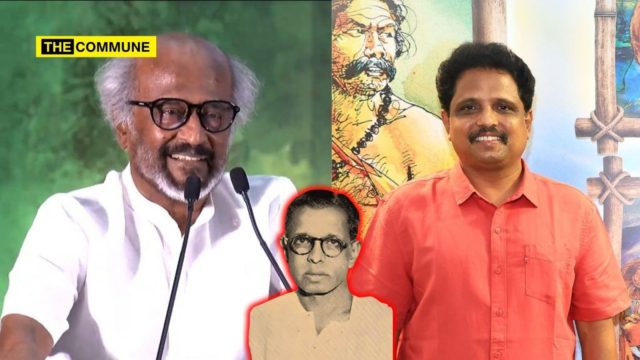
Dravidianist Kolathur Mani Attacks Gandhian Dharampal To Peddle Hate Against Brahmins

Despite getting exposed left, right and centre, Dravidianists seem unapologetic in pushing their false narrative about Brahmins. Rather than reassessing their position, they appear to be recalibrating their strategy following the collapse of the carefully constructed image of E.V. Ramasamy Naicker, (hailed as ‘Periyar’ by his followers) and the Dravidian ideology. But in an age where data speaks loud and clear, stealing the achievements of others and crediting them to their ideological figurehead simply won’t hold up.

A glaring example of this desperation is Kolathur Mani, President of Dravidar Viduthalai Kazhagam (DVK), who has long displayed open hostility toward Brahmins. Now, he’s resorting to spreading falsehoods to keep Dravidian loyalists clinging to the collapsing ideology. At a public event organized by the Cuddalore DVK, Mani boldly made a series of baseless claims—twisting historical facts beyond recognition and passing off personal opinions as absolute truth. His speech not only attacked the Indian education system during the British era but also shamelessly hijacked the legacy of Rettamalai Srinivasan, a respected Scheduled Caste activist from the Madras Presidency, crediting his contributions to EVR with a completely fabricated narrative. This isn’t just distortion—it’s intellectual theft. And no matter how many layers of lies are added, the truth always rises above.

Attacking Dharampal’s Findings

In a clear attempt to distort the well-documented findings of Gandhian thinker, historian, and political philosopher Dharampal, Kolathur Mani has taken aim at The Beautiful Tree: Indigenous Indian Education in the Eighteenth Century. Dharampal’s work, based on exhaustive research of original British colonial records—surveys commissioned by the East India Company and preserved in archives across the UK—exposes the deep-rooted and decentralized education system that existed in India prior to British rule. His findings dismantle the popular “Brahmin-dominated villainy” narrative, revealing that education was widespread and inclusive, with a large number of non-Brahmin students and teachers.

Ironically, the very followers of EVR who once propagated the falsehood that India had no education system before the British, now find themselves reluctantly acknowledging that not only did such a system exist, but it was in fact more diverse than they had claimed. And yet, unable to digest this historical truth, Kolathur Mani has launched a desperate attack to discredit Dharampal’s research—labeling it as RSS propaganda.

At a recent event, Kolathur Mani claimed, “Our people will even say now, ‘Did only Macaulay come and give us education?’ It was before that. There’s a book called ‘The Beautiful Tree,’ written by an RSS man. He has written about the state of education in India. Our people speak without reading it right. Some speak after learning about it on WhatsApp, while others just read the headlines of articles and talk without delving deeper. No one reads about the book; only if you read will you come to know. In the book, he claims that there were schools present—it discusses the number of schools in each districts, the number of girls enrolled, and everything is true, and also included the subjects taught. But what were the subjects? Astrology, cooking, and the Vedas—this was the syllabus. While learning these they claim to have had schools, were they really schools? It’s a gurukulam. Gurukulam means you go to someone’s house, work there, eat, and learn from them.”

He then brings up ‘Sivananda Gurukulam’ and pushes the worn-out claim that only Brahmins were permitted to study the Vedas—another baseless narrative intended to stoke division and sustain the falsehood that traditional education was exclusively for a certain caste. Mani also claimed that the British enacted a law in 1835 granting Scheduled Castes the right to sit on chairs—an assertion with no historical evidence to support it. He went further, saying the British also gave them the right to purchase land, again without citing any credible data or sources to back such claims.

The Truth?

Upon closer scrutiny, it becomes evident that there was no specific British law that explicitly granted lower castes the right to sit on chairs, as the two-bit Dravidianist Mani claims. The often-cited Caste Disabilities Removal Act of 1850 did not deal with social customs like seating rights but was instead aimed at removing legal disadvantages for those who converted from Hinduism to other religions—primarily to ensure legal protections for converts, particularly in matters of property and inheritance. The British motive was clearly centered on encouraging conversions, not on promoting social justice.

In a similar vein, the two-bit propagandist Kolathur Mani continue to push the distorted narrative that pre-British India lacked a proper educational system. This claim doesn’t hold up against the depth of historical research.

The Reality Of The Beautiful Tree

The title of Dharampal’s book, The Beautiful Tree, actually comes from Mahatma Gandhi’s 1931 address at Chatham House in London. There, Gandhi lamented that India had become more illiterate under British rule than it was in earlier centuries. He criticized British officials for uprooting an already-functioning native education system, calling it “a beautiful tree” that was destroyed when colonial administrators dismissed indigenous institutions as inadequate and replaced them with their own rigid models.

Dharampal’s motivation wasn’t to vilify British rule but to understand how Indian society and institutions functioned in the 18th and early 19th centuries. His work revealed that education in India was delivered through diverse institutions like pathshalas, madrasahs, and gurukulas, and that these were often maintained by local communities—including even illiterate villagers—through shared contributions. Referring to Sir Thomas Munro, then Governor of Madras, Dharampal quotes: “Every village had a school.” He further argued that using the word “school” does not fully capture the social and cultural role these institutions played.

The Comprehensive Survey

The backbone of Dharampal’s research was a comprehensive survey of indigenous education in the Madras Presidency, conducted between 1822 and 1825. This survey, overlooked by previous scholars, collected responses from District Collectors across 21 districts. It recorded not only the number of students and teachers but also detailed their caste, gender, and religion. The categories included Brahmins, Vaishyas, Shudras, Muslims, and “other castes”—a group that likely included many who would today be recognized as Scheduled Castes. Dharampal observed that schools were predominantly filled with students from non-Brahmin and lower caste backgrounds.

Students typically began their studies between the ages of five and eight and could spend five to fifteen years in school. School days started at dawn and continued until sunset, with short breaks in between. A wide array of books were used to teach subjects like reading, writing, and arithmetic. For instance, the District Collector of Bellary listed texts such as the Ramayana, Mahabharata, Panchatantra, and various regional Puranas. Other schools used Arabic and Persian texts like the Quran and Gulistan, especially in madrasahs.

Teachers also came from a variety of caste backgrounds. According to an 1836 British report from Bengal, while many educators were Brahmins or Kayasthas, a significant number came from lower castes, including Dalits like the Chandals. While higher education in Sanskrit religious texts was mostly restricted to Brahmins, other disciplines—such as medicine, astronomy, and ethics—attracted students from broader caste groups.

Education for girls was limited, though not absent. In most regions, girls, especially those from Muslim and lower caste families, were taught at home by relatives or private tutors. Exceptions existed in places like Malabar and Vishakhapatnam, where more girls from upper caste and Muslim communities attended school. The decline of indigenous education wasn’t due to a lack of quality, but rather the British taxation system, which cut off the revenue streams that had historically sustained local educational institutions.

Based on the above, it’s clear that propagandist Kolathur Mani not only dismisses well-documented historical research but also distorts the true nature of India’s traditional education system, reducing it to a mere caricature. Rather than confronting facts with reasoned critique, he resorts to labeling a scholarly work as ideological propaganda—revealing both an intellectual weakness and a deliberate misrepresentation of history.

Lies About ICS Peddled By Kolathur Mani

Kolathur Mani didn’t stop at his distortions at surface-level; he went further to allege that the Indianisation of the Indian Civil Service (ICS) was primarily driven by non-Brahmin associations and Dravidian ideologues. Mani claimed, “There were no high-ranking positions for Indians in this country—no Indian held posts such as Deputy Superintendent of Police (DSP), Deputy Collector, or Revenue Divisional Officer (RDO); all such were occupied by the British. Then, a demand arose. The Congress started a party, but it was not originally a party formed for India’s independence. It was more a association like a residents’ welfare association—an association of Indians that merely raised demands and nothing more. The first demand they (Non-Brahmin Association) kept was to provide service (administrative) to Indians. Their resolution called for the Indianisation of public services. What did that mean? It meant they were asking for posts like RDO and DSP to be opened to Indians. At that time, Indians were not allowed to sit for the ICS exams. They made the demand—and eventually, it was granted.”

However, this narrative is historically misleading.

The Truth?

The Charter Act of 1853 had already laid the foundation for Indian entry into the ICS by opening up the service to Indians and separating the executive and legislative functions of the Governor-General’s council—decades before the Non-Brahmin Movement formally began in 1916.

In reality, several key figures and organizations championed the cause of Indian representation in the civil services. Dadabhai Naoroji, often referred to as the Grand Old Man of India, persistently argued that excluding Indians from the ICS was both unjust and economically harmful. As an MP in the British Parliament (1892–1895), he advocated for the exams to be held in India.

Likewise, Surendranath Banerjee, an Ex-ICS officer turned nationalist leader, mobilized public sentiment through the Indian Association, founded in 1876, making the demand for holding the ICS exams in India a central issue. The Indian National Congress (INC), from its earliest sessions in the 1880s, passed consistent resolutions pushing for simultaneous exams in India and Britain and sought adjustments in age and qualification criteria to allow broader Indian participation.

Leaders like Gopal Krishna Gokhale and Annie Besant also played vital roles in this reform movement. Besant, despite being British, supported Indian self-rule and advocated for administrative reforms, including local conduct of ICS exams, through the Home Rule Movement. Even some British-led bodies, such as the Islington Commission in 1912, acknowledged the demand, although they often offered only partial support. The breakthrough came in 1922 when the ICS exams began to be conducted simultaneously in India and England.

Amidst all these efforts, one significant yet often overlooked figure was Rettamalai Srinivasana Scheduled Caste activist from Tamil Nadu played a pioneering role even before every others in the state by submitting multiple petitions to the colonial government demanding that the ICS exams be held in India—well ahead of many others and without the backing of elite organizations, making his contribution especially notable.

Yet, without hesitation, Mani attempted to appropriate the legacy and achievements of national leaders to support his misleading narrative—that E.V. Ramasamy (EVR) and the Dravidian movement were solely responsible for India’s major milestones. This narrative, like many others he promotes, is a distortion of historical facts.

Subscribe to our channels on Telegram, WhatsApp, and Instagram and get the best stories of the day delivered to you personally.
Mehbooba Urges Centre To Make Exception For PoK Women Married To Kashmiri Men

Mehbooba mufti

Former Jammu and Kashmir (J&K) Chief Minister and President of the Peoples Democratic Party (PDP), Mehbooba Mufti demanded on Tuesday that while deporting Pakistani nationals, the Government of India must make concessions for women from Pakistan who came here 30-40 years back, married locals and raised families here.

“The recent government directive to deport all Pakistani nationals from India has raised serious humanitarian concerns, particularly in Jammu & Kashmir. Many of those affected are women who came to India 30–40 years ago, married Indian citizens, raised families, and have long been part of our society. “We urge the government to reconsider this decision, and adopt a compassionate approach regarding women, children and the elderly. Deporting individuals who have lived peacefully in India for decades would not only be inhumane but would inflict deep emotional and physical distress on families who now know no other home,” she pleaded.

It must be recalled that many local youths, who went across to Pakistan Occupied Kashmir (PoK) for getting training in arms, came back under the then state government’s rehabilitation policy for ultras. Many such men had married Pakistani nationals during their stay in PoK. These women also came to J&K with their husbands and have since been peacefully living in Kashmir, though without any official sanction to do so.

These women have many times agitated for grant of Indian citizenship since most of them are residents of PoK, which according to the resolution of the Parliament, is an inalienable part of J&K. No decision has so far been taken regarding these women and they continue to raise families, bring up their children and engage in routine chores like any citizen of the Union Territory. The husbands of these women have given up militancy and are living as normal citizens engaging themselves in business, agriculture, education or any other bona fide profession.

–IANS

Subscribe to our channels on TelegramWhatsApp, and Instagram and get the best stories of the day delivered to you personally.

Liquor And Ganja Sold Near School Entrance In Srivilliputhur, Students Forced To Use Riverbank Path, Complaint Filed

Image Source: Kamadhenu

Residents of Panangulam village near Srivilliputhur have raised serious concerns about the safety of students after alleging that alcohol and ganja are being sold illegally near a government primary school. A complaint has been submitted to District Collector V.P. Jayaseelan demanding immediate action.

The issue pertains to the Government Panchayat Union Primary School in Panangulam, where more than 100 students are currently enrolled. According to residents, a private individual has constructed a shop adjacent to the school’s entrance and is allegedly selling liquor and ganja from the premises. The shop, they say, has obstructed the main entrance of the school, forcing students to take a detour via a nearby riverbank to attend classes.

Complainants have also claimed that those attempting to question or intervene are being threatened. A video purportedly documenting the illegal activity was submitted to the Krishnan Kovil Police Station, but residents allege that no action has been taken so far.

In their complaint to the District Collector, the residents urged authorities to take appropriate measures to remove the illegal shop and restore safe access to the school for students and the public.

(With inputs from Kamadhenu)

Subscribe to our channels on Telegram, WhatsApp, and Instagram and get the best stories of the day delivered to you personally.
Sar Tan Se Juda: Congress Shares Headless Image Of PM Modi, Reshared By Former Pak Minister

The Congress party has found itself at the center of a fierce political controversy after it shared a provocative poster on social media, appearing to take a dig at Prime Minister Narendra Modi’s absence from an all-party meeting convened in the aftermath of the recent Pahalgam terror attack. The move has drawn sharp criticism from the ruling Bharatiya Janata Party (BJP), which accused the Congress of stoking extremist sentiments and aligning itself with narratives emanating from Pakistan.

On Monday, 28 April 2025, the official Congress X handle posted an image featuring Prime Minister Modi’s body with the head edited out and the word Gayab (missing) emblazoned across it. Though the post did not explicitly name the Prime Minister, his clothes gave away their intent. The caption accompanying the image read: “Disappears at the time of responsibility”. The post was a veiled reference to PM Modi’s ‘absence’ from the all-party meeting held to discuss the terror attack in Jammu and Kashmir’s Pahalgam region.

Congress leaders, including Jairam Ramesh, have criticized the Prime Minister for skipping the meeting, insisting that a leader of his stature should have been present to brief the nation and Parliament. Rahul Gandhi and Congress President Mallikarjun Kharge have since written to the PM, demanding a special session of Parliament to discuss the terror attack.

The controversy escalated further when the same image was picked up and shared by former Pakistani Minister Fawad Hussain Chaudhry. He mocked the Indian Prime Minister, posting: “Had heard about missing horns from donkey’s head, but here Modi has gone missing.” This endorsement from a Pakistani political figure ignited outrage in Indian political circles, particularly among BJP leaders.

Reacting strongly, BJP spokesperson Gaurav Bhatia held a press conference where he displayed the Congress poster and lashed out at the opposition party. “There is a national political party that stays among us, but if we call them Lashkar-e-Pakistan Congress, it won’t be wrong,” he said. He accused the Congress of operating on the instructions of Rahul Gandhi and alleged that such posts serve to weaken India during moments of national crisis.

He went further, drawing a direct connection between the Congress poster and extremist Islamist slogans. “‘Sar tan se juda’ has become the ideology of Lashkar-e-Pakistan Congress today,” Bhatia alleged — a reference to the notorious beheading chant used by radical Islamist mobs.

Amid the uproar, the Congress attempted to distance itself from the controversy. Senior leader Jairam Ramesh clarified that there was “no political agenda” behind the poster and reiterated the party’s call for unity in responding to terrorism. He defended the criticism of the Prime Minister’s absence from the all-party meeting, emphasizing that the Congress simply wanted accountability and transparency from the government.

(With inputs from The Hindu)

Subscribe to our channels on TelegramWhatsApp, and Instagram and get the best stories of the day delivered to you personally.
Pro-Congress Social Media Influencer ‘Ranting Gola’ Booked For Peddling Pakistani Propaganda About Pahalgam Terror Attack

Shamita Yadav, better known online as ‘Ranting Gola’, has once again triggered widespread outrage and legal scrutiny after her latest rants on the Pahalgam terror attack went viral — not only in India, but also across the border in Pakistan. This time, her content was amplified by a Pakistani propaganda handle, sparking calls for legal action and stronger enforcement against her inflammatory and misleading commentary.

The Trigger: Pahalgam Terror Attack And Her Distortion

The recent terrorist attack in Pahalgam, where 26 Hindu pilgrims were brutally killed, shocked the entire nation. Initial survivor accounts revealed that Islamist militants separated Hindus from others by asking them to recite the Kalma or remove their pants, before targeting them — an act chillingly similar to past religious profiling by Pakistan-sponsored terrorists.

Instead of acknowledging the clear communal nature of the massacre, Ranting Gola chose to spin the incident as a political stunt by the Modi government, claiming it was being used for the Bihar elections. In a viral video, she accused the Indian media of “hiding the truth” and implied a false equivalence between Indian electoral politics and Islamist terrorism.

Shockingly, a Pakistani channel picked up her video and used it to attack the Indian government, labelling the Pahalgam terror attack a political gimmick.

Complaint Filed in Delhi: Anti-Bharat, Anti-Hindu, Pro-Pakistan

Following the viral video and its cross-border amplification, a formal police complaint has been filed against Shamita Yadav in Delhi, citing:

  • Potential pro-Pakistan propaganda
  • Insult to Hindu beliefs through her earlier video mocking the Manusmriti
  • Deliberate misinformation intended to stoke communal tensions
  • Content being weaponized by Pakistani handles

The complaint demands immediate action under sections related to national security, communal incitement, and online misinformation. Activists and legal experts alike argue that this is no longer just an issue of “opinion,” but one of national integrity and communal harmony.

Repeat Offender: History Of Misinformation And Hinduphobia

This isn’t the first time Ranting Gola has stirred up controversy through her content. Her pattern is familiar: sensational videos, fact-free rants, Hinduphobic overtones, and eventual backtracking.

Fake Waqf Amendment Video

Recently, she falsely claimed that the Waqf (Amendment) Bill would strip Indian Muslims of the right to bury their dead. To support this, she shared an unrelated eight-year-old video from 2017 — a local protest over an unrelated land issue — and framed it as proof of government oppression.

In truth, the Waqf Amendment is an administrative reform related to property management and has nothing to do with burial rights. Her video was slammed by legal experts and religious leaders alike as an attempt to stir panic among Muslims and defame the Indian government.

Scripted Trial Recording – Failed Attack On Abu Asim Azmi

In 2024, she came under fire for a video attacking Samajwadi Party MLA Abu Asim Azmi, accusing him of misgovernance in Govandi. When backlash erupted, she claimed the video was merely a “scripted trial recording” that was “leaked” by mistake — an excuse that only deepened skepticism around her motives.

History Of Hinduphobia

Her digital trail is littered with posts labeling:

  • Ram Navami processions as “provocative”
  • Hindu villages as threats to secularism
  • Hindu festivals as vehicles of majoritarianism

Critics argue that her brand of secularism is selectively applied — defending extremist Islamist rhetoric under the guise of minority rights while vilifying core Hindu practices and beliefs.

Deliberate Disinformation Or Clout Chase?

Observers have begun to question whether Yadav is simply an online provocateur or part of a more calculated disinformation campaign. Her use of emotionally manipulative language, false visuals, and politically timed releases suggests a strategy more dangerous than accidental misjudgment.

Many believe she is no longer just a fringe voice — she is actively undermining national discourse, enabling external enemies, and fanning communal flames, all while playing the victim card whenever challenged.

The time for leniency is over. With her content being used by anti-India Pakistani platforms, her rants misleading millions, and her continual targeting of Hindu sentiments, Ranting Gola has become a symbol of what’s wrong with today’s influencer ecosystem — no accountability, no ethics, just outrage for clicks.

Subscribe to our channels on Telegram, WhatsApp, and Instagram and get the best stories of the day delivered to you personally.