Home Blog Page 321

Gems Of Judiciary: Chengalpattu Court Acquits Hasini’s Killer Dashvanth In Mother’s Murder Case Citing Insufficient Evidence

The Chengalpattu Court today acquitted Dashvanth, a convict currently serving a death sentence and 46 years imprisonment for the 2017 rape and murder of a six-year-old girl, in a separate case involving the killing of his mother, Sarala Shekar.

The court cited insufficient evidence and unreliable witness testimony as grounds for the acquittal in the matricide case. Despite this verdict, Dashvanth remains incarcerated at Puzhal prison for the minor’s murder. This verdict came despite Dashvanth allegedly admitting to the murder of his mother in 2017.

Dashvanth, a resident of Kundrathur in Kancheepuram district, was convicted in 2018 by the Chengalpattu Mahila Court for the brutal rape and murder of a six-year-old girl, whose petrol-doused body was found dumped on a national highway. While the trial court had awarded him the death penalty plus 46 years’ imprisonment, the Supreme Court stayed the execution last year pending further appeals.

The current acquittal relates to a separate case involving the alleged murder of his mother. Legal observers note the unusual circumstance of a death row convict being tried for another murder while his capital punishment remains stayed.

Court records indicate the prosecution failed to establish Dashvanth’s guilt beyond reasonable doubt in his mother’s killing. The judge noted evidentiary gaps and credibility issues with key witnesses in delivering today’s verdict.

Authorities confirm Dashvanth has been returned to Puzhal prison to continue serving his existing sentence for the 2017 child murder case. Legal proceedings regarding his Supreme Court appeal against the death penalty remain ongoing.

(With inputs from DT Next)

Subscribe to our channels on Telegram, WhatsApp, and Instagram and get the best stories of the day delivered to you personally.

MHA Refuses To Renew FCRA License Of Andhra NGO Rural Development Trust In Andhra Pradesh, Amid Religious Conversion, Fund Misuse Allegations

In a significant development, the Ministry of Home Affairs (MHA) has refused to renew the Foreign Contribution Regulation Act (FCRA) registration of the Rural Development Trust (RDT), a prominent NGO based in Anantapur, Andhra Pradesh.

The move follows a detailed complaint filed by the Legal Rights Protection Forum (LRPF), a legal activism group, in March 2024, alleging serious violations of FCRA norms, misuse of government funds, and involvement in religious conversion activities.

The Rural Development Trust, established in 1978 by Spanish Jesuit missionary Vicente Ferrer, is currently led by his son Moncho Ferrer, who is also a foreign national. The trust had been operating under FCRA Registration No: 010120001. It is also linked to the Vicente Ferrer Foundation Inc., a U.S.-registered public charity chaired by Moncho Ferrer, which is one of RDT’s major donors.

Recent amendments to FCRA prohibit a key functionary of an Indian recipient organization from holding any official position in the donor entity. The complaint raised concerns over this dual role, citing non-compliance.

Among the most serious allegations is the misuse of foreign donations and state-provided financial assistance for religious conversion. The complaint claims that free housing colonies built under welfare schemes were used to facilitate Christian missionary activities, including the construction of churches.

Between 2014–15 and 2017–18 alone, the Andhra Pradesh government had allocated over ₹205 crore to RDT through its Housing Corporation Ltd and Rural Water Supply & Sanitation Department for various projects.

The complaint also pointed to potential violations of data privacy laws. Reports submitted by the Vicente Ferrer Foundation (VFF) to the U.S. Internal Revenue Service (IRS) indicate that personal details—including minors’ educational performance and health data—were shared with foreign donors under the Child Sponsorship Program. Sponsors reportedly received biannual updates from children about their personal lives, raising concerns about the exposure of sensitive information to foreign entities.

Adding to the controversy, the MHA’s investigation reportedly uncovered misappropriation of at least ₹26 crore. This amount was collected as patient fees at the NGO’s hospitals in Kalyanadurgam and Bathalapally, both established using foreign funds. However, the money was not routed through the FCRA-designated bank accounts, a clear violation of the Act.

In light of these findings, the MHA has refused to renew RDT’s FCRA license. The decision is seen as part of a broader crackdown on NGOs accused of flouting FCRA rules and misusing foreign contributions.

The LRPF welcomed the government’s action and urged further investigation into the trust’s financial dealings and activities, citing national and social security concerns.

Subscribe to our channels on Telegram, WhatsApp, and Instagram and get the best stories of the day delivered to you personally.
How Leftist Rag The Quint Amplified A Fake ‘Muslim Lynching’ To Distract From Pahalgam Hindu Massacre

In the aftermath of the horrific Pahalgam terror attack where 26 Hindus were brutally murdered by Islamic terrorists in Jammu and Kashmir, a disturbing pattern emerged across Indian media – the deliberate amplification of unverified stories portraying Muslims as victims of Hindu violence. The most egregious example came from The Quint, which published a completely fabricated story about a Muslim employee allegedly killed by Hindu colleagues in Bengaluru for refusing to chant Gayatri Mantra.

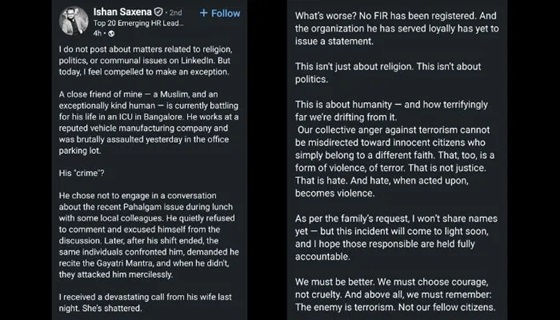
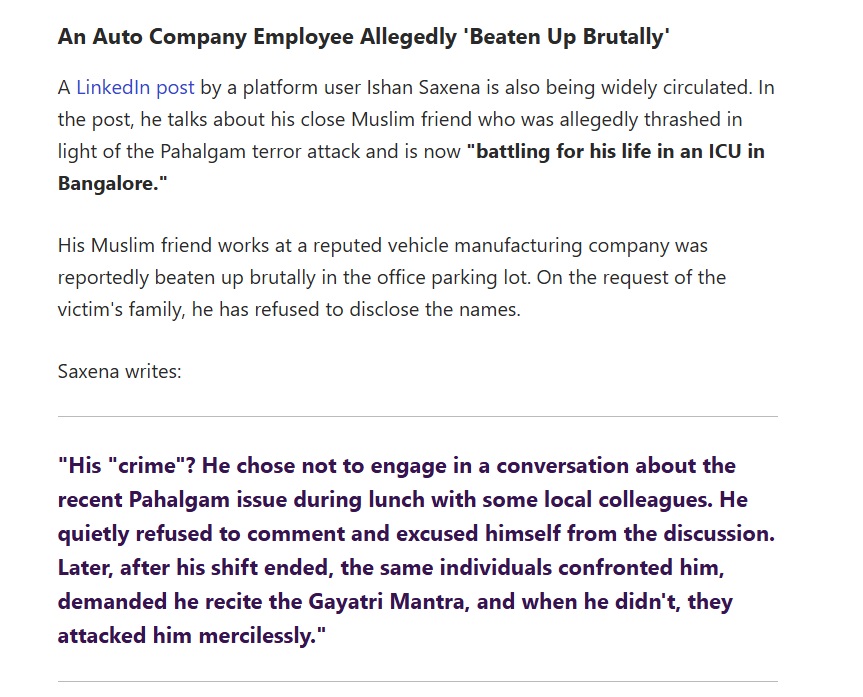
A LinkedIn post by one Ishan Saxena, a former employee of CashKaro, claimed that his Muslim friend had been assaulted and killed in Bengaluru by Hindu colleagues for refusing to comment on the Pahalgam incident and for allegedly not chanting the Gayatri Mantra.

The Viral Lie

In his dramatic account posted on 25 April 2025, Saxena described an unnamed Muslim friend supposedly employed at a prominent automobile company in Bengaluru. According to the post, this friend had been brutally assaulted by Hindu colleagues in the office parking lot after refusing to discuss the Pahalgam attack during lunch and declining to chant the Gayatri Mantra. 

Image Source: OpIndia

This post quickly amassed over 400 likes and was picked up without verification by The Quint, a media outlet that claimed to focus on exposing communal hate crimes.

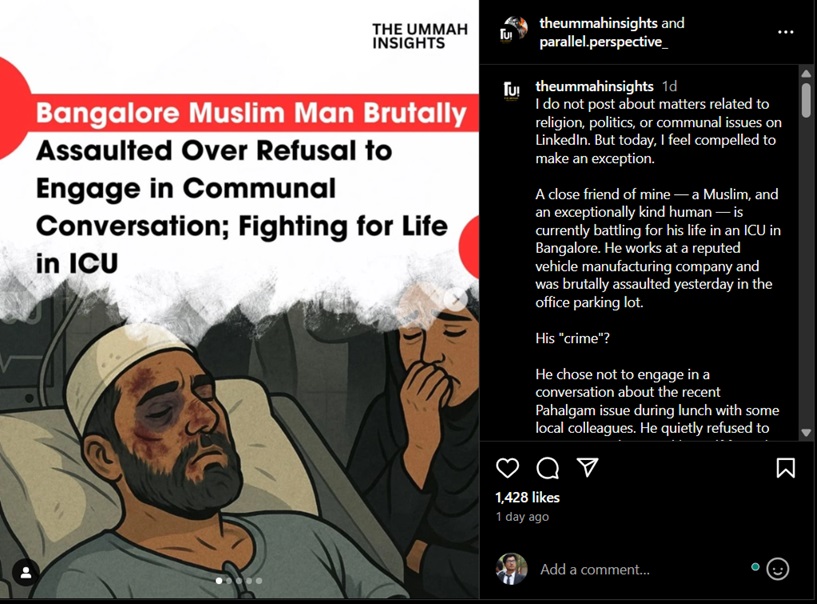
Ishan Saxena’s fabricated claims were reposted word-for-word by an Islamic Instagram page called ‘The Ummah Insights,’ accompanied by emotionally charged graphics—and by the time of writing, the post had already amassed 1,428 likes.

Image Source: OpIndia

The Quint’s subheading sensationally read, An auto company employee allegedly beaten up brutally. Journalist Aliza Noor, who authored the story, failed to verify even the most basic facts—no names were disclosed, no FIR or hospital details were cited, and most importantly, no credible police confirmation was provided.

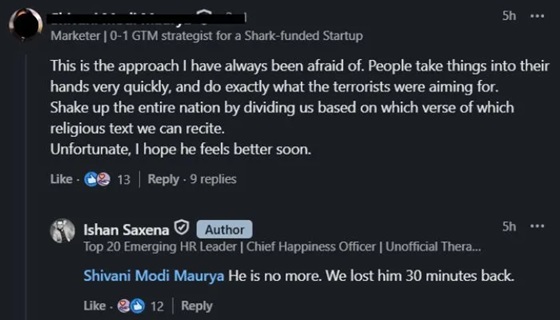
Within a day, Saxena returned to LinkedIn to update that hisfriendhad succumbed to his injuries. That was enough to incite outrage, garner sympathy, and feed into a rapidly forming narrative of widespreadanti-Muslim’ retaliation.

Image Source: OpIndia

No Trace Of Victim, No Evidence Of Crime

Despite the sensationalism, not a single local or national media outlet in Karnataka reported the incident. No Kannada newspaper, television channel, or even a digital portal mentioned such an assault in Bengaluru. This glaring omission raised red flags.

OpIndia’s Assistant Editor Dibakar Dutta and several other internet users reached out to Bengaluru police officials, tagging senior officers across zones, asking for clarity. There was no confirmation—only silence. Hours later, Ishan Saxena deleted his LinkedIn post and deactivated his account.

Soon, it was revealed that Saxena had been terminated from CashKaro nearly two months before the incident. The company issued a public statement distancing itself from his claims: We are aware of certain posts circulating online regarding statements made by Mr. Ishan Saxena (ex-CashKaro employee). We would like to clarify that Ishan Saxena was relieved of his duties at CashKaro on 27th February 2025, and the views expressed in their personal posts do not reflect the values, beliefs, or position of our company in any way. CashKaro remains committed to promoting a respectful, inclusive, and responsible environment—both within our organization and in the communities we serve.”

Meanwhile, The Quint quietly deleted the article without offering an apology, correction, or editorial note—a hallmark of accountability in journalism that it clearly bypassed. Journalist Aliza Noor also deleted her X and Instagram accounts shortly after being exposed for publishing the fake story.

When Asked, Saxena Admits:I Copied It From Someone Else”

After sustained public pressure, Saxena contacted OpIndia and admitted the entire post was copied from another LinkedIn user—whose identity he claimed not to recall. On being asked about his comment that thefriend had died’, he said he saw another user write it and simply repeated the claim.

He also confirmed that Bengaluru police had interrogated him and instructed him to delete the false post and avoid sharing unverified, communally sensitive information in the future.

In a written statement shared with OpIndia, Saxena said,I am Ishan and I recently made a LinkedIn post regarding a muslim man being attacked by his colleagues. This post was actually a copy of another LinkedIn post mentioning the incident and I had shared it in the haste of feeling bad about what all is happening in our country. I should have fact checked the post which I didn’t and I am hence issuing this apology statement for making the post regarding an incident which I thought to be true but did not fact check.”

At the time of writing, OpIndia report stated that it found no cached or archived post apart from Saxena’s that mentioned this alleged death. The story appears to have been fabricated entirely by Saxena or someone else, amplified uncritically by both social media influencers and legacy media like The Quint.

A Pattern Of Fake Narratives To Obscure Hindu Suffering

The timing of this fabrication wasn’t accidental. It came just days after one of the worst terror attacks in recent memory, where Hindus were religiously profiled, forced to reveal their identities, chant Islamic verses like the Kalma, and even strip to prove they weren’t circumcised—all before being executed. Yet instead of focusing on this heinous attack, social media was flooded with misleading content presenting Muslims as the primary victims.

This playbook has been seen before. From the widely debunkedsemen-filled balloons during Holihoax to fabricated stories of temple vigilantes, a pattern has emerged where Hindu communities and festivals are targeted with false accusations, often spread by media houses that later refuse to issue apologies when proven wrong.

The Real Victims Ignored, Fake Ones Amplified

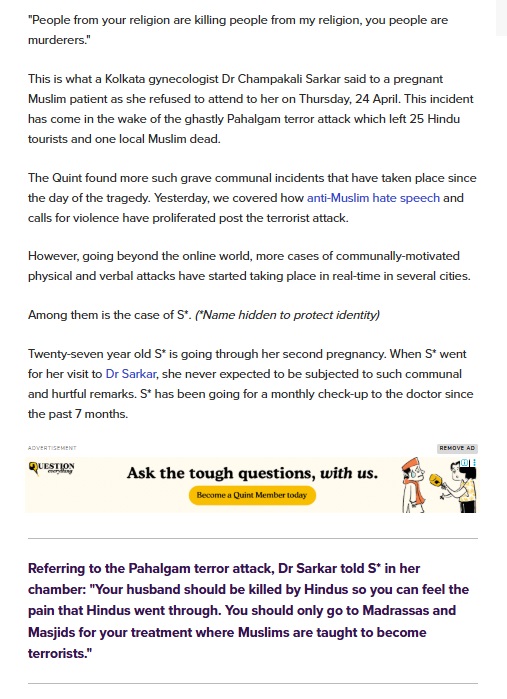
While the so-called ‘Bengaluru lynching’ never happened, another real incident did occur in Kolkata around the same time. A pregnant Muslim woman named S* alleged that she was subjected to vile communal remarks by her gynecologist, Dr. Champakali Sarkar, who reportedly told her, “People from your religion are killing people from my religion, you people are murderers.” Your husband should be killed by Hindus so you can feel the pain.”

The Quint reported this case in the same article, offering it as evidence of communal tensions sparked by the Pahalgam incident. However, Dr. Sarkar refuted the allegations, stating that she had never discriminated against patients and was being bullied by the family. She added that she had apologized nonetheless and that her conversation had been misunderstood.

A police complaint was filed in this case and may take its due course, unlike the Bengaluru hoax which fell apart within 24 hours.

Dangerous Distractions From Real Terror

This is not just about fake news—it’s about manipulating public sentiment during a time of national trauma. At a moment when the country should have stood united in mourning the victims of the Pahalgam massacre and demanding justice, a fabricated story diverted attention and inflamed communal sentiments.

That The Quint and its journalist failed to conduct even elementary checks before running the story is a damning indictment of their editorial standards. Worse, their silence after being exposed shows a lack of integrity.

(With inputs from OpIndia)

Subscribe to our channels on Telegram, WhatsApp, and Instagram and get the best stories of the day delivered to you personally.
After DMK Minister, DMK Stooge And Dravidianist Folk Singer Kovan Makes Below-The-Belt Attack On Vijay, Defames Actress Trisha

The rabid hatemonger S Sivadas, also known as Kovan, has once again surfaced on the Dravidian political stage. Known for using folk music to promote divisive rhetoric, Kovan has previously made derogatory and caste-based remarks, particularly during the AIADMK regime, targeting late Chief Minister J Jayalalithaa, her successor Edappadi K. Palaniswami, and Prime Minister Narendra Modi. Backed by the communist-aligned group Makkal Kalai Ilakkiya Kazhagam, Kovan’s recent focus has shifted to actor-turned-politician Vijay, launching personal attacks against him and his family. Notably, Kovan, once vocal in criticizing AIADMK’s governance, has remained conspicuously silent since the DMK came to power.

At the recent Dravidian Movement Centenary Conference organized by Dravida Iyakka Tamilar Peravai, Kovan launched a scathing, personal critique of Vijay. Rather than engaging in ideological discourse, Kovan’s speech took a hostile tone, filled with character attacks.

Taking a dig at TVK chief Vijay, Kovan said, “A boy came up to me yesterday and asked, ‘You say you wouldn’t allow Amit Shah or any other Shah here—so if I come with Trisha, what will you do?’ Yes, he actually asked that. And that’s the reality, isn’t it? There’s no real policy. He brings Trisha, accepting the ideas of Periyar and puts up hoardings Ambedkar, and claims to be a Periyarist and Ambedkarite, while actually working for the Sanghi’s. His role is to insult and damage the Dravidian model governance. That’s why, when he launched his party, he openly said that the Dravidian model is his enemy. Even now, he says women are not safe in Tamil Nadu. You do not know any data. The only numbers he has are those given by his party members from selling fake tickets. He has no personal knowledge. And yet, he claims about women’s safety in Tamil Nadu. Do you know that?”

Kovan the continued with a familiar Dravidianist narrative comparing Tamil Nadu to more populous state Uttar Pradesh and said, “Do you know that in Uttar Pradesh, from 2021 to 2022, there were nearly 65,000 cases of rape and sexual harassment. Yet he hasn’t said a word about that. In Tamil Nadu, it’s around 6,000 which is minimal. But without knowing the data, he still claims women aren’t safe here.”

Kovan then veered into a personal attack on Vijay and his family, even dragging in an actress, saying, “Brother, let me tell you something. Your own wife didn’t feel safe in your house that’s why she left and ran away from you. First, understand that. You should not speak about women’s safety. You went to Goa on a private jet for your female friend’s wedding. Yes, it’s a personal matter, but I have to say it because he made accusations yesterday. You went to your female friend’s wedding in Goa on a private plane, and there was another woman on that flight. Do you know who she was? It was her would be, I won’t name her. More importantly, one of the men you brought along is a Sanghi. Brother, we know you are a sanghi but you failed to hide your bangs.”

Earlier, DMK Minister MRK Panneerselvam sparked controversy by taking a veiled swipe at part-time-politician Vijay. When he asked them to interpret the initials ‘TVK’, audience members shouted out the names of actresses Trisha and Keerthy Suresh.

Subscribe to our channels on Telegram, WhatsApp, and Instagram and get the best stories of the day delivered to you personally.
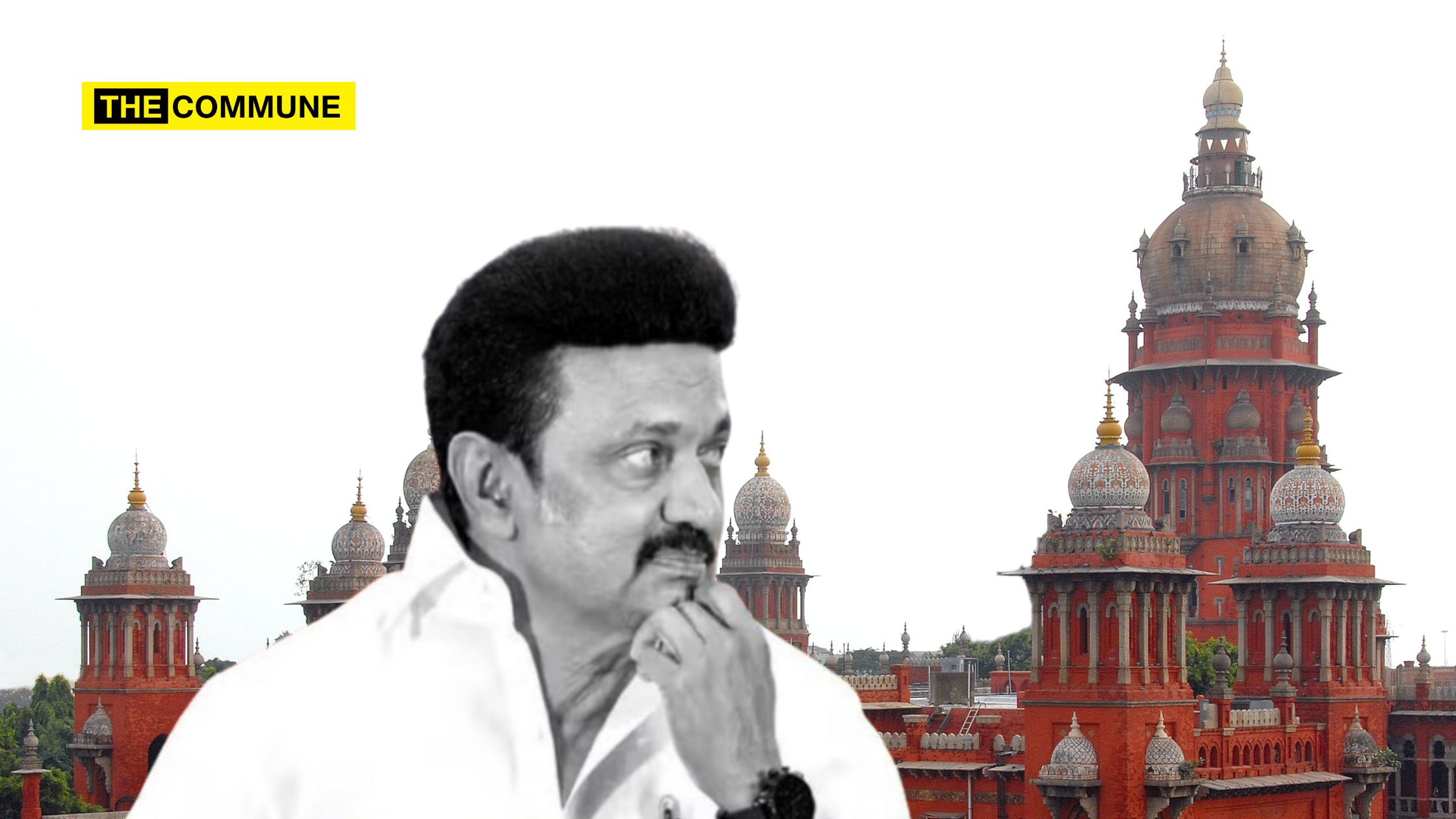
Madras High Court Slaps ₹50 Lakh Fine On DMK Govt Over Non-Payment Of Salaries To College Staff

dmk madras high court ungaludan stalin

The Madras High Court has imposed a fine of ₹50 lakh on the Tamil Nadu government for failing to comply with an order to pay salaries to non-teaching staff at a private college.

The case was brought before the court to ensure the payment of salaries to 12 non-teaching employees hired at GPG Visalakshi Women’s College in Udumalaipettai, located in the Tiruppur district. After hearing the case, the court issued a ruling mandating salary payments to these employees. However, the Secretary of the Higher Education Department, the Director of College Education, and the Joint Director of College Education for the Coimbatore Zone filed an appeal against this decision.

The bench, consisting of Justices R. Subramanian and G. Arulmurugan, who reviewed the appeals, directed that “Director of College Education C. Poorna Chandran must appear and provide an explanation regarding the approval of the appointments, stipulating that no new appointments should be made for the 12 employees approved in 1987.” The government was also required to submit documents concerning the teaching and non-teaching staff positions authorized at Visalakshi Women’s College.

On 29 April 2025, the case was revisited in the High Court. The justices criticized Director Poorna Chandran for appearing in court but failing to respond to any of the court’s questions, which they deemed unfortunate. The judges further accused officials from the Directorate of College Education of obstructing the truth by claiming that the government lacked the necessary documents about the approved staff positions. Consequently, the Tamil Nadu government’s appeal was dismissed, and a fine of ₹50 lakh was imposed.

The bench emphasized that the fine was a result of the non-cooperation and obstinacy of the Directorate of College Education officials. It ordered the Tamil Nadu government to collect ₹25 lakh of the fine from Director Poorna Chandran, with the remaining ₹25 lakh to be recovered from the officers responsible for the disappearance of the documents. Additionally, the court ruled that the 12 non-teaching employees should receive ₹1.50 lakh each in salary within eight weeks. The court also ordered that the remaining ₹32 lakh of the fine paid by the Tamil Nadu government be donated to the Cancare Foundation and Netrodaya Organisations, with ₹12 lakh allocated to each organization within eight weeks. Furthermore, the judges instructed the Higher Education Secretary to take disciplinary action against the officials responsible for the loss of the documents within the Directorate of College Education.

(With inputs from ETV Bharat)

Subscribe to our channels on Telegram, WhatsApp, and Instagram and get the best stories of the day delivered to you personally.
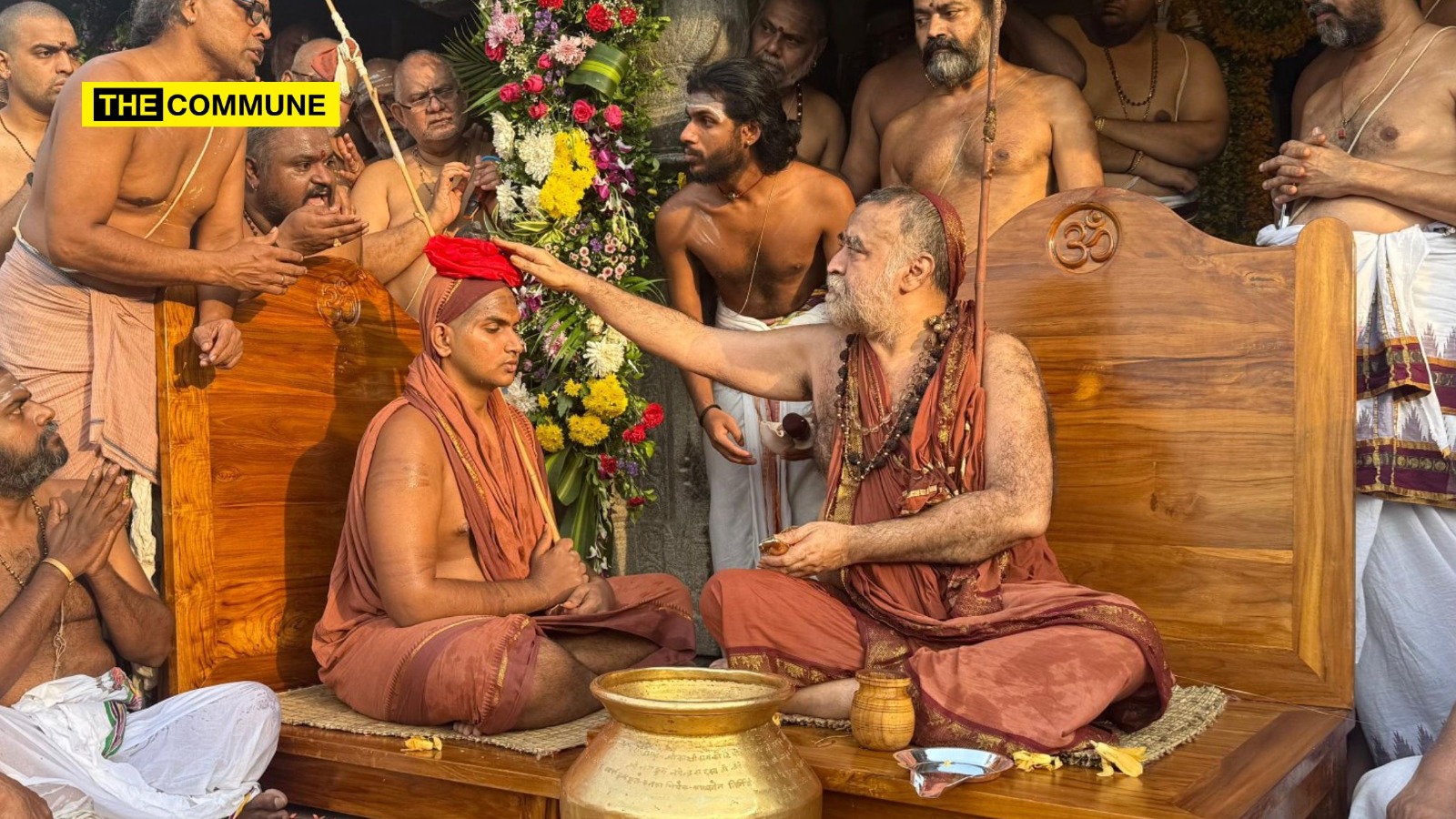
71st Shankaracharya Of Kanchi Kamkoti Matham Named As Satya Chandrasekharendra Saraswathi

In a landmark religious ceremony held on the auspicious occasion of Akshaya Tritiya, Rig Vedic scholar Duddu Satya Venkata Surya Subramanya Ganesha Sharma Dravid from Annavaram, Andhra Pradesh, was formally anointed as the 71st Shankaracharya of the Sri Kanchi Kamakoti Peetham. Upon initiation into sanyasa, he was conferred the monastic title Satya Chandrashekarendra Saraswathi Shankaracharya.

The ceremony was held in Kanchipuram at the Sri Kamakshi Amman Temple and associated shrines of the Kanchi Mutt, attended by spiritual leaders, scholars, and devotees from across the country. The event coincided with the 2534th birth anniversary celebrations of Adi Shankaracharya, the revered philosopher-saint credited with establishing the Peetham in 482 BCE.

The senior pontiff, Sri Vijayendra Saraswathi Shankaracharya, who has led the Peetham since 1983, presided over the ceremony and bestowed the sanyasa name upon the new Acharya during the Sanyasa Sweekara Mahotsavam. The rituals began on Tuesday with holy baths at Pancha Ganga Teertham, followed by special pujas at the shrines of Sri Kamakshi Ambal, Adi Shankaracharya, Sri Sureshwaracharya, and the Brindavanams of previous pontiffs including Sri Chandrasekharendra Saraswati and Sri Jayendra Saraswati.

The Purvashrama Of Sri Satya Chandrasekharendra Saraswathi

Sri Ganesha Sharma Dravid, 25, hails from a devout family in Dhuni, near Annavaram. His father, Srinivasa Surya Subramania Dhanvanthri, serves as a Vratha Purohit at the Sri Veera Venkata Satyanarayana Swamy Temple. From a young age, Ganesha Sharma was immersed in Vedic learning under the guidance of distinguished scholars including Chandukutlu Hosamane Ratnakara Bhat Sharma and Sri Pallamudi Sathya Venkata Ramanamurthy. He completed rigorous training in Rig Veda Samhita, Aitareya Brahmana, Aranyaka, and Upanishads, as well as advanced studies in Pratishakhya and other Shastric disciplines.

His journey into spiritual life began in 2009 after a brief darshan of the Kanchi Shankaracharya in Tirupati. Following the Acharya’s advice, he commenced formal Vedic training, dedicating over 12 years to intensive study and service.

Before his anointment, Ganesha Sharma served as a Rig Vedic scholar at the Sri Gnana Saraswathi Devasthanam in Basara, Telangana. He also participated in several major religious events, including the Mahamaham festival in Kumbakonam, the Athivaradar darshan in 2019, and Chaturmasya observances in Vijayawada and Kakinada. In 2024, he visited the Kanchi Mutt to seek blessings and further guidance for his Vedantic studies.

His formal induction as junior pontiff marks a significant generational transition in the Peetham’s history. With this appointment, he takes on the responsibility of guiding one of India’s most respected Advaita Vedanta institutions, headquartered near the sacred Sri Kamakshi Temple in Kanchipuram.

Representatives from temples across Tamil Nadu, Andhra Pradesh, Telangana, Karnataka, and Maharashtra offered prasadam in honor of the occasion. The Peetham reaffirmed its commitment to Vedic education, spiritual outreach, and dharmic service under the leadership of the new pontiff.

Sri Vijayendra Saraswathi, who himself assumed the role of acharya at the age of 15 on 29 May 1983, was earlier chosen by the 69th pontiff, Sri Jayendra Saraswathi, who was appointed in 1954 by the revered Sri Chandrasekarendra Saraswati, known as the “Mahaswami.”

With the anointment of Satya Chandrashekarendra Saraswathi Shankaracharya, the Kanchi Kamakoti Peetham enters a new era, continuing its unbroken lineage of spiritual heads over a span of more than 2,500 years.

Subscribe to our channels on Telegram, WhatsApp, and Instagram and get the best stories of the day delivered to you personally.
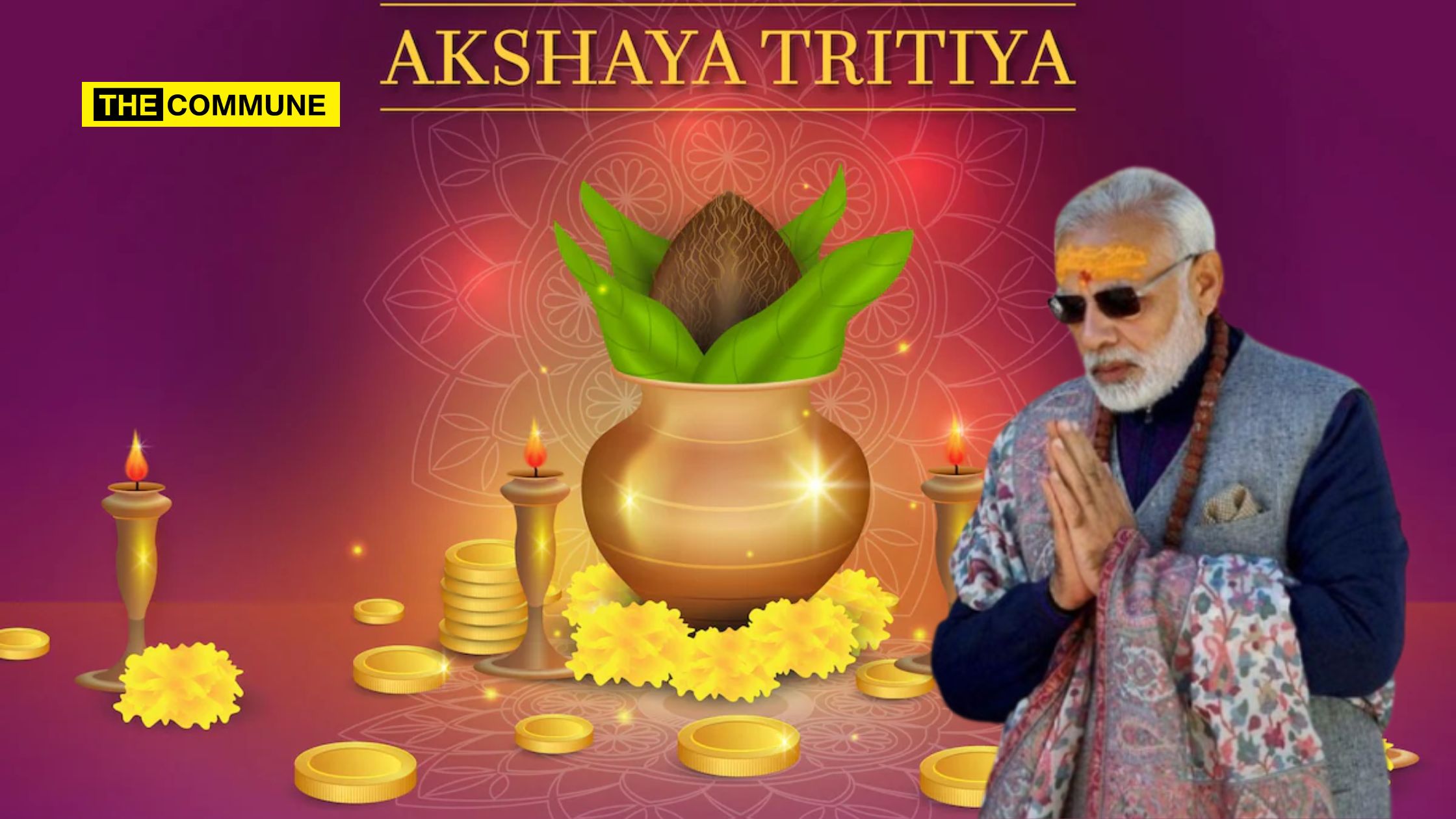
May Akshaya Tritiya Give New Strength To Viksit Bharat, Says PM Modi

Prime Minister Narendra Modi on Wednesday extended heartfelt greetings on the occasion of Akshaya Tritiya, expressing hope that the festival would serve as a catalyst in strengthening the nation’s collective resolve towards building a ‘Viksit Bharat’. Akshaya Tritiya, also known as Akha Teej or Akti, is a significant Hindu festival observed annually.

The day is believed to usher in success, good luck, and prosperity. Traditionally, people mark the occasion by purchasing gold, a symbol of wealth and security, to invite blessings for the future.

Taking to X, PM Modi posted, “Infinite best wishes to all of you on Akshaya Tritiya. May this auspicious festival dedicated to humanity bring success, prosperity and happiness to everyone, which gives new strength to the resolve of a Viksit Bharat.” Union Home Minister Amit Shah also extended his greetings through a social media post. “Infinite best wishes for Akshaya Tritiya, the festival symbolising the confluence of nature and culture. I wish that this holy festival brings eternal virtue, good fortune and prosperity in everyone’s life,” Shah wrote. Union Minister J.P. Nadda joined in conveying greetings, stating, “I convey my heartfelt best wishes to all of you on the occasion of ‘Akshaya Tritiya’ which bestows everlasting virtuous results.”

“May this auspicious day bring an inexhaustible flow of happiness, prosperity and auspicious opportunities in the life of all of you. May everyone’s life be blessed with positivity, divinity and self-study,” he added. The term Akshaya denotes something eternal or indestructible, while Tritiya refers to the third day of the Shukla Paksha in the Hindu lunar calendar. The day is considered highly auspicious for initiating new ventures, buying valuables, and performing religious rituals. Devotees believe that such acts on this day yield lifelong blessings and well-being. The festival also coincides with Parashurama Jayanti, which marks the birth anniversary of the sixth incarnation of Lord Vishnu. Devotees also pay homage to Lord Shiva, underscoring the spiritual and cultural depth of the day.

–IANS

Subscribe to our channels on TelegramWhatsApp, and Instagram and get the best stories of the day delivered to you personally.
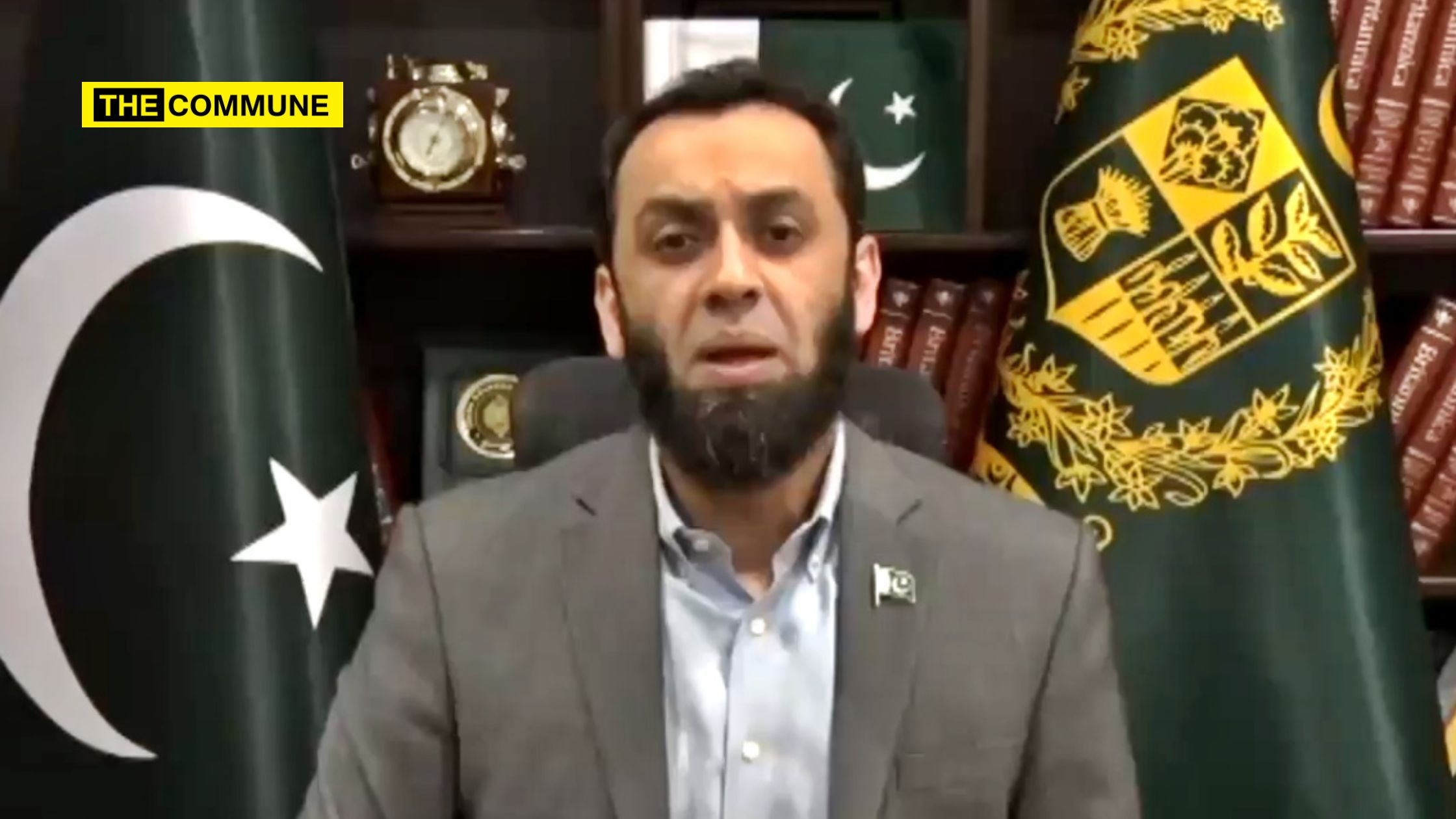
Pakistan Minister Holds Emergency Press Meet At 2 AM, Crying Foul About India’s Military Action Within 24 To 36 Hours

Amid looming fears of strong action from India in the wake of the Pahalgam terror attack, Pakistan Federal Minister for Information and Broadcasting Attaullah Tarar held an emergency press meet at 2 a.m. Wednesday, saying that there were ‘intelligence reports of military action against their country within the next 24 to 36 hours’.

Addressing an emergency press conference, Tarar said credible intelligence-based information has warned of an Indian military action. “We have credible intelligence-based information that India is planning a military offensive against Pakistan within the next 24 to 36 hours. Any action by India will be responded to with full force,” he said.

“Pakistan will defend its territory at all costs and will respond with its full might. The nation will defend its sovereignty and territorial integrity by all means necessary. If India tries to impose a war on Pakistan, it will be solely responsible for the disastrous and devastating costs,” he added.

Tarar also called on the international community to take note of India’s “planned aggression” against Pakistan, stating that even though Islamabad offered cooperation in a neutral and credible investigation, New Delhi has not provided any proof of Islamabad’s involvement in the Pahalgam attack.

“It has been days since the Pahalgam incident, but India has not provided Pakistan with any evidence. However, we have credible evidence of India’s involvement in cross-border terrorism in our country. The International community needs to take notice of New Delhi’s planned and self-orchestrated reasoning to attack Pakistan”, he said.

“India’s habit of being the judge, jury and executioner is categorically and strongly rejected by Pakistan”, he added. The late-night emergency press conference by Pakistan’s Information Minister has come amid heavy military deployments by both sides on their borders, while the political temperature is rising every passing hour. Both sides have unleashed a range of measures against each other, with Pakistan closing its airspace for Indian airlines and India putting the crucial and critical Indus Waters Treaty (IWT) in abeyance, among other measures. Tarar’s statement comes soon after the recent statement by Pakistan’s Defence Minister Khawaja Asif, who had stated a “military incursion from India was imminent”.

Asif had also warned that Pakistan would only use its nuclear weapons if there were a direct threat to the country’s existence from India.

–IANS

Subscribe to our channels on TelegramWhatsApp, and Instagram and get the best stories of the day delivered to you personally.
Jihadi Terror Incidents In India Over The Decades – A Comprehensive Look At Congress’s Disturbing Record On National Security

manmohan singh sonia gandhi upa surgical strikes rti congress terror

India’s decades-long battle against Pakistan-sponsored terrorism, particularly in Jammu & Kashmir, represents one of the most complex counterterrorism challenges faced by any democracy. This expanded analysis examines not just the chronology of attacks, but the systemic policy failures and ideological compromises that allowed jihadist networks to flourish under successive Congress-led governments. The evidence reveals a disturbing pattern of strategic blunders, willful ignorance of security threats, and political calculations that prioritized vote banks over national security.

This report documents decades of terror incidents in India, particularly concentrated in Kashmir, with significant escalation in the 1990s and 2000s. The attacks have targeted civilians, security forces, religious sites, and infrastructure across the country, claiming thousands of lives and leaving many more injured.

Kashmir Conflict & Terror Timeline (1947-2014) & The Historical Roots of Congress’s Counterterrorism Failures

The origins of India’s current counterterrorism challenges can be traced directly to the catastrophic decisions made by Jawaharlal Nehru in the immediate aftermath of Partition. When Pakistani tribals and army irregulars launched Operation Gulmarg in October 1947, Nehru ignored multiple intelligence warnings, including detailed assessments from Gen. Akbar Khan’s memoir Raiders in Kashmir, which later confirmed Pakistan’s premeditated invasion plan. His 27-day delay in accepting Maharaja Hari Singh’s accession allowed Pakistan to consolidate control over what is now PoK, while his decision to internationalize the dispute at the UN—against the advice of V.P. Menon—locked India into a perpetual cycle of diplomatic stalemate.

The 1965 war further exposed Congress’s strategic incoherence. Despite India holding key positions at Haji Pir Pass and Turtuk sector, Prime Minister Lal Bahadur Shastri surrendered these gains in the Tashkent Agreement, a move that CIA memos from 1966 confirm was interpreted by Pakistan as weakness. By 1968, Pakistani military planners had already begun formulating their proxy war strategy, which would later manifest in the Kashmiri Pandit genocide of 1989-91.

1947-49: The First Kashmir Conflict

The partition of British India left the princely state of Jammu and Kashmir, with its Muslim majority and Hindu ruler, in a precarious position. In October 1947, Pakistani tribesmen and irregular forces invaded Kashmir with support from Pakistan’s army, triggering the first Indo-Pakistani war. The invaders plundered state armories, set markets ablaze, and targeted non-Muslims, resulting in thousands of casualties. India deployed its army after Kashmir’s Maharaja signed the instrument of accession joining India. Prime Minister Nehru approached the United Nations, leading to a ceasefire in 1949 and unimplemented UN resolutions for a plebiscite.

1965: Indo-Pakistani War and Tashkent Agreement

Pakistan launched “Operation Gibraltar” to infiltrate forces into Kashmir and incite insurgency, leading to a 17-day war between August and September 1965. The conflict ended with a UN-brokered ceasefire and the subsequent Tashkent Declaration in January 1966. Critics note that India returned strategic gains including the Haji Pir Pass under this agreement, surrendering tactical advantages without resolving the Kashmir issue.

1971: War and Shimla Agreement

The 1971 conflict began when Pakistan launched “Operation Searchlight” against East Pakistan (now Bangladesh), causing a refugee crisis in India. India’s intervention led to Pakistan’s defeat and Bangladesh’s independence. The Shimla Agreement of July 1972 established the Line of Control in Kashmir and committed both nations to bilateral resolution of disputes. India released 93,000 Pakistani prisoners of war, though critics argue India missed an opportunity to leverage its strong position for a permanent Kashmir solution.

1971-1989: Isolated Incidents

30 January 1971: Indian Airlines plane hijacked from Srinagar to Jammu by JKLF members Hashim and Ashraf Quereshi, who took it to Lahore and later burned the aircraft.

10 September 1976: Indian Airlines Boeing 737 hijacked from Delhi by six Kashmiri terrorists; passengers and crew were released and hijackers captured.

1980s-1990s: Rise of Insurgency

Pakistan’s ISI launched “Operation Tupac” in 1988 to arm Kashmiri militants. In 1990, Pakistani politician Benazir Bhutto publicly endorsed “freedom” for Kashmir, allegedly contributing to radicalization.

8 December 1989: Rubaiya Sayeed Kidnapping

JKLF militants led by Yasin Malik kidnapped Rubaiya Sayeed, daughter of India’s Home Minister Mufti Mohammad Sayeed, in Srinagar. The government released five jailed militants to secure her freedom, a decision criticized for emboldening militancy.

1989-1991: Targeting of Kashmiri Pandits

A wave of targeted killings forced the exodus of Kashmiri Pandits from the valley. Prominent victims included:

  • Tika Lal Taploo (September 14, 1989): BJP leader and lawyer shot in Srinagar’s Habba Kadal area
  • Neelkanth Ganjoo (November 4, 1989): Retired judge who had sentenced JKLF co-founder Maqbool Bhat, killed near the High Court
  • Prem Nath Bhat (December 27, 1989): Lawyer and journalist killed in Anantnag
  • Satish Kumar Tickoo (February 2, 1990): Social worker shot in Habba Kadal
  • Lassa Kaul (February 13, 1990): Doordarshan Srinagar director killed outside his home
  • Sarwanand Koul Premi (April 29, 1990): Renowned poet kidnapped, tortured and killed
  • Girija Tickoo (June 25, 1990): Schoolteacher abducted, raped, tortured and killed
  • Ashok Kumar Bhatt (January 18, 1990): Business owner shot near his home
  • Tej Krishan Razdan (February 12, 1990): Government employee abducted and shot

Congress’s Complicity In Kashmiri Pandit Exodus

The ethnic cleansing of Kashmiri Hindus was not an unforeseen tragedy but the direct result of policy paralysis and appeasement. Recently digitized J&K Police records list 1,427 targeted killings of Hindus between 1989-91, yet the Rajiv Gandhi government ignored Governor Jagmohan’s repeated warnings. Instead of cracking down on jihadist groups like the JKLF, the Congress-led Centre released 42 jailed terrorists in a futile attempt to “appease” militants. The Rubaiya Sayeed kidnapping case (1989) set a dangerous precedent, demonstrating that hostage-taking could force the Indian state into concessions.

January 25, 1990: Attack on Air Force Personnel

Yasin Malik orchestrated an attack in Rawalpora, Srinagar, killing four IAF personnel. Malik was convicted in 2022 for terror funding and waging war against India.

August 14, 1993: Kishtwar Massacre

Militants ambushed a bus in Kishtwar’s Sarthal area, killing 17 Hindu passengers.

Some Other Notable Incidents In The 1990s:

  • May 21, 1990: Assassination of Mirwaiz Maulvi Farooq, Imam of Juma Masjid
  • April 6, 1990: Abduction and killing of HMT General Manager H.L. Khera and Kashmir University Vice-Chancellor Mushir-ul-Haq
  • June 28, 1991: Abduction of Indian Oil executive K. Doraiswamy (later released)
  • March 31, 1991: Abduction of two Swedish engineers working on Uri Hydel Project
  • February 27, 1991: Abduction of Nahida Imtiaz, daughter of NC leader Saifuddin Soz
  • June 22, 1992: Six Israelis taken hostage by militants
  • October 15, 1993: Siege at Hazratbal mosque
  • June 6, 1994: Two foreigners abducted by Harkat-ul-Ansar
  • March 29, 1994: Lt. Gen. E.W. Fernandes and four senior officers killed in bomb explosion at Badami Bagh Cantonment
  • July 20, 1995: Twenty killed in Jammu bomb explosion
  • July 3, 1995: Four foreign nationals abducted from Pahalgam by Al Faran; Norwegian Hans Christian Ostrø beheaded, American John Childs escaped, others presumed dead

2000s: Continued Violence In Kashmir 

The 2000s saw a continued violence in Kashmir. The remaining Kashmiri Pandits were also targeted for being Hindus and massacre after massacre took place in the valley.

2004:

  • May 23: IED explosion on Jammu-Srinagar Highway killed 30
  • June 26: Terrorist attack in Surankote killed 12
  • July 2: Attack on MP Choudhary Lal Singh’s convoy killed 6
  • July 19: Assassination attempt on Deputy CM Mangat Ram Sharma killed 6
  • July 25: Gunfight at paramilitary base on Dal Lake killed 5
  • August 4: Ambush at CRPF camp killed 9
  • December 5: IED explosion in Pulwama killed 10

2005:

  • January 7: Suicide attack on Income Tax office in Srinagar killed 3-5
  • February 24: Suicide attack at Divisional Commissioner’s office killed 5
  • May 25: Grenade attack in Srinagar school killed 2 children
  • June 13: Car bombing in Pulwama killed 13
  • June 24: Bomb attack on security personnel bus in Srinagar killed 9
  • July 19: Attack in Udhampur village killed 5
  • July 20: Suicide attack on Army vehicle in Srinagar killed 5
  • September 9: Attack on three families in Udhampur killed 3
  • September 10: Attack on Army convoy on National Highway killed 5
  • October 10: Attack on four families in Rajouri killed 10
  • October 18: Assassination of Education Minister Dr. Ghulam Nabi Lone killed 4
  • November 5: Suicide attack near outgoing CM Mufti Mohammed Sayeed’s residence killed 10
  • November 14: Suicide attack at Srinagar business hub killed 4
  • November 15: Assassination attempt on PDP leader Ghulam Hassan Mir killed 3-6
  • November 16: Assassination attempt on Minister Usman Majeed killed 4

2006:

  • January 23: Gunfight with special operations group killed 4
  • April 9: Terrorists killed a family of 3 in Udhampur
  • April 14: Serial grenade blasts in Srinagar killed 5
  • May 1: Doda massacre killed 57
  • May 21: Attack on CM Ghulam Nabi Azad’s rally killed 6-7
  • May 25: Grenade attack in Srinagar killed 8
  • June 12: Attack on laborers in Anantnag killed 10
  • June 30: Assassination of Sheikh Nabi killed 8
  • July 11: Attack on leader in Kulgam killed 8
  • November 10: Grenade attack in Srinagar killed 6

2007:

  • February 8: Ambush on security patrol in Pulwama killed 5
  • March 30: Attack on laborers in Kulgam killed 5
  • July 29: Attack on civilian bus near Shalimar Garden killed 6
  • August 17: IED blast near security forces in Avantipora killed 5
  • October 11: IED blast in Baramullah killed 7

2008:

  • May 26: Transfer of land to Shri Amarnathji Shrine board triggered protests
  • June 13: Ambush on Army personnel killed 5
  • July 4: Ambush on Army personnel in Kupwara killed 5
  • July 19: IED blast in Army bus in Srinagar killed 10
  • July 24: Grenade attack in Srinagar killed 5
  • August 27: Suicide attack in Kenechok killed 5

2009:

  • April 21: IED explosion in Surankote killed civilians, including a woman and child
  • September 12: Car bombing outside Srinagar Central Jail killed police officers and a woman
  • September 23: Encounter in Bandipora killed 2 army personnel
  • December 30: Hizbul militants ambush in Sopore killed 4 CRPF personnel

2010-2013:

  • March 16, 2010: Attack on civilians in Srinagar killed 6, followed by stone-pelting protests between June-September
  • August 20, 2011: Army officer killed in Bandipora
  • September 27, 2011: Security personnel killed in overnight Kupwara operation
  • September 25, 2012: Top LeT commander and 1 soldier killed in Handwara
  • November 14, 2012: 3 soldiers killed foiling infiltration bid in Nowgam, Kupwara
  • December 24, 2012: Policeman killed in Kulgam encounter
  • June 24, 2013: Ambush on Army personnel in Srinagar killed 8

The UPA Era: A Golden Age For Jihadi Terror 

The UPA years were marked by some of the deadliest terror attacks in Indian history, with little decisive action taken to deter future strikes.

Key Terror Attacks Under UPA

  • 2005: Delhi Bombings (70 killed, 250 injured)
  • 2006: Mumbai Train Blasts (209 killed, 714 injured)
  • 2007: Samjhauta Express Bombings (70 killed, mostly Pakistanis)
  • 2008: 26/11 Mumbai Attacks (171 killed, 300+ injured)
  • 2010: Pune German Bakery Blast (17 killed, 54 injured)
  • 2011: Mumbai Serial Blasts (26 killed, 130 injured)
  • 2013: Hyderabad Blasts (18 killed, 131 injured)

Despite repeated attacks, the Congress government failed to:

  • Strengthen intelligence coordination.
  • Expedite counterterror operations.
  • Hold Pakistan accountable for cross-border terrorism.

Unlike the 2019 Balakot airstrikes after Pulwama, Congress chose inaction, emboldening Pakistan to continue sponsoring terror.

Other Significant Terror Attacks In UPA Regime

Between 2004-2014, under the Congress-led UPA government, India witnessed some of its deadliest terror attacks, including:

  • Batla House Encounter (2008): The Batla House encounter (2008), where two terrorists were killed, faced unjustified scrutiny from Congress leaders despite the Home Minister confirming its legitimacy. Top Congress leaders, including Sonia Gandhi, politicized the operation to appease conservative Muslim sentiments, even shedding tears for the slain terrorists. This exposed the party’s prioritization of vote banks over national security.
  • 26/11 Mumbai (2008): 171 killed, yet no military retaliation despite irrefutable evidence of ISI involvement. NSA archives reveal that three strike plans prepared by the Military Operations Directorate were vetoed. The 2008 Mumbai attacks exposed India’s unpreparedness and Congress’s lack of resolve.

    • No Military Response: Despite clear evidence of Pakistan’s involvement, PM Manmohan Singh ruled out military retaliation, fearing “escalation.”
    • Slow NSG Deployment: Commandos took 10 hours to reach Mumbai due to lack of readiness.
    • No Diplomatic Pressure: Pakistan faced minimal consequences; LeT chief Hafiz Saeed roamed freely.
  • Hyderabad Blasts (2013): 18 dead, but the Home Ministry under Sushilkumar Shinde bizarrely prioritized investigating “Hindu terror” rather than Pakistan-based groups.

  • Doda Massacre (2006): 57 Hindus slaughtered, yet the government continued its policy of “dialogue” with separatists.

Attacks Outside Of Kashmir 2010-2014

  • Pune Bombing (2010): 17 killed, 54 injured in bakery explosion
  • Varanasi Bombing (2010): 2 killed, 37 injured in blast during religious ceremony
  • Mumbai Bombings (2011): 26 killed, 130 injured in three explosions in commercial areas
  • Delhi Bombing (2011): 15 killed, 74 injured in blast outside Delhi High Court
  • Attacks on Israeli Diplomats (2012): 4 injured in Delhi incident
  • Pune Bombings (2012): 1 injured in low-intensity explosions
  • Hyderabad Blasts (2013): 18 killed, 131 injured in twin blasts in Dilsukhnagar market
  • March 2013 Srinagar Attack: 7 killed, 10 injured in militant attack on security forces
  • Bangalore Blast (2013): 16 injured in explosion near political office
  • June 2013 Srinagar Attack: 8 killed, 19 injured in assault on army convoy
  • Bodh Gaya Bombings (2013): 5 injured in multiple explosions at Buddhist temple complex
  • Patna Bombings (2013): 6 killed, 85 injured in serial blasts at political rally
  • Budgam District Blast (2014): 18 injured in explosion linked to militants

The UPA’s counterterrorism record was not just weak but actively counterproductive. The Standing Committee on Home Affairs (2013) noted a 70% decrease in IB field operatives in J&K, while the PAC report (2012) revealed that 82% of counterinsurgency equipment was obsolete.

Congress’s Ideological Sympathy for Jihadi Narratives

Instead of standing with security forces, Congress leaders often questioned encounters, defended terrorists, and even echoed Pakistani talking points. Beyond policy failures, the Congress party has repeatedly demonstrated an ideological softness toward jihadist rhetoric:

  1. Sanjay Dutt’s Leniency: Convicted in the 1993 Mumbai blasts (257 killed), he received inexplicable parole benefits, with MHA documents suggesting political interference.
  2. “Hindu Terror” Fabrication: The NIA court judgments in the Mecca Masjid and Malegaon cases noted “political pressure to implicate Hindu groups,” while Wikileaks cables (09NEWDELHI1868) exposed Rahul Gandhi’s remarks to the U.S. Ambassador that “Hindu extremism is a bigger threat than LeT.” This came just a year after 26/11, where Pakistani terrorists killed 171 Indians.
  3. Afzal Guru’s Glorification: While the Congress hesitated for years on his execution, its leaders remained silent as JNU students chanted “Afzal Guru zindabad.”
  4. Sonia Gandhi ‘Wept’ For Terrorist Deaths (Allegedly: During the Batla House Encounter (2008), two Indian Mujahideen terrorists were killed in a legitimate police operation. Sonia Gandhi reportedly cried over the terrorists’ deaths (as claimed by Salman Khurshid). Digvijaya Singh, Rahul Gandhi, and others questioned the encounter, calling it “fake.”
  5. Defending Yakub Memon (1993 Blasts Convict): Shashi Tharoor said, “State-sponsored killing diminishes us all.” Manishankar Aiyar said, “Which terrorist will get deterred by death penalties?” Digvijaya Singh compared Yakub to APJ Abdul Kalam, tweeting: “Two Indian Muslims’ funerals on the same day.”
  6. Calling Osama Bin Laden “Osama Ji”: Digvijaya Singh referred to the Al-Qaeda chief as “Osama Ji” and Hafiz Saeed as “Hafiz Sahab.” He even criticized the US for Bin Laden’s burial, saying “religious traditions should be respected.”
  7. Questioning Balakot Airstrikes (2019): Digvijaya Singh demanded “proof” of the strikes. Kapil Sibal asked“Were trees uprooted or terrorists killed?” P Chidambaram echoed Pakistani media, saying “government must provide evidence.”

Congress’s Pro-Pakistan, Anti-India Stance

Congress leaders have repeatedly parroted Pakistani propaganda, undermining India’s security. Here are a few examples:

After Pahalgam Attack (2025)

    • Congress leaders echoed Pakistani media, questioning India’s response.
    • Pakistani news channels quoted Congress statements to claim “India is divided on terrorism.”

Digvijaya Singh’s Pro-Pakistan Rhetoric

    • Called 26/11 an “RSS conspiracy.”
    • Termed Pulwama attack a durghatana (accident).
    • Demanded proof for surgical strikes.

Ghulam Nabi Azad’s Anti-Army Remark

    • “Indian Army kills more civilians than terrorists in J&K.”
    • His statement was praised by Lashkar-e-Taiba.

Congress’s Policy Failures Enabled Growth Of Terror Networks

One of the most glaring failures of the Congress-led governments was their soft stance on terror outfits. Groups like the Students Islamic Movement of India (SIMI) were allowed to operate freely for years, flourishing under Congress rule. Despite mounting evidence of SIMI’s involvement in extremist activities, successive Congress governments delayed banning the organization—often acting only after intense public and legal pressure. This hesitation to act decisively against terror groups not only emboldened them but also weakened national security efforts during critical periods.

The Modi Government’s Strategic Reset

Post-2014, India adopted a fundamentally different approach. Following terror attacks, we saw surgical strikes. We also saw amendments to anti-terror laws. The Modi administration also strangulated the financial pump to these terror networks. In short,

  • Surgical Strikes (2016) & Balakot (2019): Established new red lines, ending Pakistan’s nuclear blackmail strategy.
  • Legal Reforms: UAPA amendments plugged 78% of legal loopholes exploited during the UPA era.
  • Financial Counterterrorism: Hawala flows to J&K dropped by 92% (FIU data).

The High Cost Of Congress’s Appeasement Politics

The ₹1.2 lakh crore loss in J&K’s GDP (1990-2014), the 3,000+ civilian deaths in UPA-era attacks, and the systematic dismantling of India’s counterterror infrastructure all point to a singular truth: Congress’s policies didn’t just fail to stop terrorism—they enabled it. The Congress party’s approach to terrorism has been marked by incompetence, appeasement, and shocking sympathy for jihadis. From allowing terrorists a free run to questioning India’s armed forces, Congress leaders have repeatedly undermined national security. While the BJP government has taken strong action (surgical strikes, Balakot, Article 370 removal), Congress’s record remains one of surrender, inaction, and betrayal of India’s interests. For a nation that has suffered thousands of lives lost to terror, Congress’s legacy on security is one of failure—and unforgivable weakness.

Today, as Pakistan revives its proxy war and Congress-affiliated NGOs obstruct counterterror operations (MHA 2023 report), India must confront this legacy head-on. A White Paper on Counterterrorism Failures (1947-2014), a Judicial Commission to investigate politicized terror cases, and full declassification of Congress-era backchannel talks with Pakistan are essential first steps.

Subscribe to our channels on TelegramWhatsApp, and Instagram and get the best stories of the day delivered to you personally.
PM Modi Gives Free Hand To Indian Armed Forces To Give Crushing Blow To Pakistan

In the wake of the recent terror strike in Pahalgam, Prime Minister Narendra Modi chaired a high-level security meeting on Tuesday, bringing together key national security leaders including Defence Minister Rajnath Singh, Chief of Defence Staff General Anil Chauhan, and National Security Advisor Ajit Doval. During the meeting, PM Modi made it clear that all three branches of the Indian Armed Forces — the Army, Navy, and Air Force — have been given unrestricted operational freedom to respond decisively to terrorism.

Present at the crucial meeting were top military commanders: Army Chief General Upendra Dwivedi, Navy Chief Admiral Dinesh K. Tripathi, and Air Chief Marshal Amar Preet Singh. The discussions were held at the Prime Minister’s residence, underscoring the urgency and gravity of the situation.

According to government sources, the Prime Minister reiterated India’s unwavering commitment to eradicate terrorism and expressed strong faith in the armed forces’ ability to execute a fitting response. He assured the leadership that they are empowered to determine the nature, scale, and timing of retaliatory operations.

Top-Level Consultations And Strategic Deliberations

Shortly after the security meeting, Union Home Minister Amit Shah also visited the Prime Minister’s residence to discuss further strategic responses. Reports suggest that major countermeasures are being considered to deliver a lasting message to the perpetrators of the attack.

A day ahead of a scheduled cabinet meeting, the Prime Minister continues to engage in a series of extended sessions with top officials, security experts, and ministers. These marathon discussions reflect the government’s proactive approach to shaping a comprehensive response.

Earlier, the Modi government convened an all-party meeting, where opposition leaders expressed unequivocal support for any strong measures taken by the Centre to hold the attackers accountable.

Cabinet Committee On Security Responds With Firm Actions Against Pakistan

Following the Pahalgam attack, the Cabinet Committee on Security (CCS), led by PM Modi, met to assess the security landscape. Intelligence inputs indicated that the attack came at a time when Jammu and Kashmir was witnessing democratic progress and developmental growth, suggesting an intent to derail stability in the region.

In retaliation, the Indian government unveiled a series of stern steps targeting Pakistan:

1. Suspension of the Indus Waters Treaty signed in 1960, until Pakistan demonstrably ceases support for terrorism.

2. Closure of the Attari Integrated Checkpost, with limited exception for those returning before May 1, 2025.

3. Revocation of all SAARC Visa Exemption Scheme (SVES) privileges for Pakistani nationals. Those in India under this scheme must leave within 48 hours.

4. Expulsion of Pakistani military attaches from their High Commission in Delhi, who have been declared persona non grata.

5. Withdrawal of Indian defence attaches posted at the Indian High Commission in Islamabad, effectively vacating those positions.

These moves mark a sharp escalation in India’s diplomatic and strategic stance, reflecting the government’s zero-tolerance policy on terrorism and its cross-border sponsors.

Subscribe to our channels on TelegramWhatsApp, and Instagram and get the best stories of the day delivered to you personally.