Home Blog Page 313

Retro Disaster: Netizens Call Suriya’s Latest Film As Kanguva 2, Time And Money Waste; Hattrick Flop For Suriya

suriya tamil cinema

DMK-sympathizing Dravidianist actor Suriya, appears to have walked into yet another box-office disaster with Retro, leaving audiences once again disappointed—especially on the heels of his recent flop, Kanguva. Viewers have pointed out that in both films, Suriya’s performance swings between excessive shouting and overacting, lacking the subtlety expected from a seasoned actor.

Directed by Karthik Subbaraj, Retro was touted as a highly anticipated Tamil romantic action drama. Featuring Suriya and Pooja Hegde in lead roles, the film hit theaters worldwide on 1 May 2025. Produced by Stone Bench Creations and 2D Entertainment, expectations were high due to the film’s unique genre blend, acclaimed cast, and the director’s strong track record.

Set amidst themes of love, crime, and redemption, the story follows Paarivel ‘Paari’ Kannan—a gangster trying to leave behind his violent past to start a new life with his wife Rukmini, played by Pooja Hegde. However, as old enemies resurface and secrets unravel, Paari’s journey toward peace spirals into emotional turmoil and action-laced conflict.

Despite the promising premise and strong production team, the film failed to leave a lasting impact. Viewers and netizens alike criticized Retro for being a time-waster, arguing that no amount of star power or technical finesse can salvage a film lacking in emotional engagement or a gripping storyline.

Some of the audience reactions and criticisms are summarized below:

One of the netizens lamented, #Retro – an overstuffed tiring, exhausting bore fest that loses engagement after the 25 min mark. At times had to look at my watch as to when the movie would end. @Suriya_offl deserves better than this film, not one bit a comeback.”

Another netizens reviewed the movie stating, “#Retro too many layers , too many plots and too many minutes precisely 168 minutes wasted as well , though there are exceptional scenes here and there it lacks the coherence and is disappointing.”

Another netizen lamented, “After Watching Retro, we are the Joker. Worst Movie.”

Another netizens reviewd the movie stating, “#Retro review. Dei Karthik Subbaraj, you’ll never be okay… why did you make it this cringe? 😭😭😭😭😭😭 Suriya could’ve toned down his overacting… the jail scene was straight-up laughable. Please quit cinema… you’ve made us cry like this… Hey sk fans, you will pay for this.” 

Another netizen reviewed the movie stating, “Retro Movie Review #RetroReview FDFS Review from my US Friend. Another disaster from Surya. deadly boring Positives: Pooja Hegde Negatives: All others Criticism: Poor screen play. Karthik Subburaj should have given the screenplay impacting, or film should have been sprinkled with comedy. Mixed with both, film struggles where to be serious and where to sow comedy Result? Painful for the watchers.”

Another netizen shared a video of a frustrated moviegoer who slammed the film, saying it was a complete waste of money. The viewer sarcastically remarked, “For spending ₹250 in the morning, they made us to laugh (comedy show). It wasn’t goosebumps it was Kanguva 2.” Alongside the video, the netizen trolled, “Kanguva 2, huh? I thought he’d move up from tier 2 to tier 1… but Suriya’s fallen to tier 3 instead.” in the video the audience lamented saying, “For spending 250 ruppe they have made us laugh. It was not a goosebump, its Kanguva 2” 

Another netizen mocked, “At least in Kanguva you could have run out of the theater saying the shouting gave you ear pain… 😂 But Retro? It’s not like that — you can peacefully fall asleep… 😂 Despite this if you are still thinking of watching it? Then you’re going to end up like ‘3-movie Dhanush'”

Another netizen mocked the film by sharing a satirical news card claiming that Suriya’s ‘Retro’ struggled to fill seats even for its First Day First Show, leaving theatre owners stunned.

One of the audience, frustrated after watching the movie Retro, told the media, “Retro didn’t really connect with me. It felt like they combined two or three movies into one and stuffed on us. I don’t understand why they took such lengthy one. It’s a three-hour film, and it has so much content takes that long just to tell the story. There’s so much drag and lag. Once the first half is over, it feels like the movie ends there, the second half  is entirely different content for film.”

He continued, “It felt like Suriya wanted to showcase everything his emotions, action in a single film. And the climax of this film felt like a remake of Jigarthanda 2 climax. If you look at the film in parts, Santhosh Narayanan did well with the music, and Pooja Hegde gave her career-best performance. But when you see it as a whole, you’re left wondering—why such huge content, such length? It was very lengthy and dragging.” He added, “He goes in search of love, then full action, then back to love, and again full-on action. It starts in one place, wanders off somewhere else, and finally ends in Jigarthanda 2 climax.” He rated the film 6 out of 10.

Another audience member shared their thoughts, “Both the first and second halves are too lengthy. Suriya’s presence was good, and the songs was also good. The vibe of the ‘Kanima’ song was awesome. What else? Well, we expected more from the story, but if you go in with low expectations, the movie is enjoyable. It was a comeback for Suriya he performed his part well.”

He continued, “I’d say go in with lower expectations, and you’ll probably enjoy the movie more. I went in with high expectations, so I felt a bit let down. The film runs for three hours, so there’s definitely a lag. They tried to make up for it with fight sequences—it worked to some extent, but not entirely. There’s a lot of action, and he has done martial arts in the film too.”

 Another viewer harshly criticized the film, calling it strictly average even when watched in theatres. He remarked, “Bro, this is just an average movie. It’s nowhere to claim being ‘super’ or ‘awesome.’ Even with the theatre experience, it felt average and if you’re watching on OTT, you can’t watch.”

He went on to say the script felt very plain and unimpressive. “Usually, movies pick up pace in the second half, but here, only the first half had some energy. After the flashback scene, people were just watching it casually. I don’t think it really made an impact on anyone.”

He lamented, “The entry and opening for him were solid, and his fight scene was impressive—but once the actual story began, there was nothing. That is the problem”

To sum up in a single line, Suriya’s ‘Retro’ falls flat; Dravidianist sympathizer faces another audience letdown.

Subscribe to our channels on Telegram, WhatsApp, and Instagram and get the best stories of the day delivered to you personally.
Anti-Brahmin Hatemongering DMK-Supporting Dravidianist Sex Doctor Kantharaj Peddles False Claims About HVR Iyengar, Here’s The Truth

hvr iyengar kantharaj

Dr K. Kantharaj, a self-styled “sex doctor” and Dravidianist, has made a name for himself in the Dravidian ecosystem by spewing inflammatory rhetoric—targeting Hindu beliefs, making misogynistic remarks on women, and now, distorting history to fit a divisive narrative. He continues to enjoy an uncritical audience among Dravidianist YouTubers, who accept his fabrications without the slightest attempt at verification.

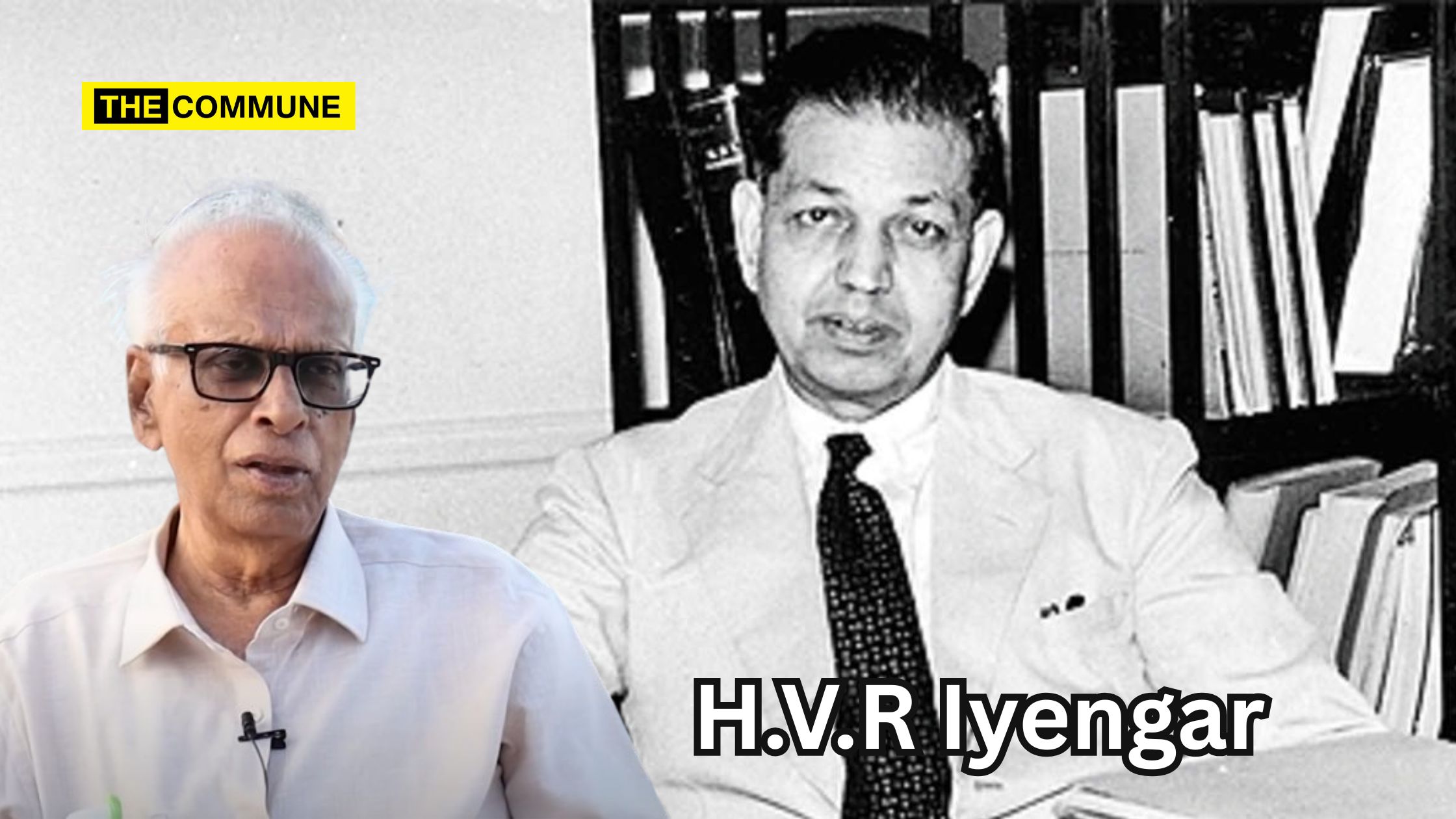
In a resurfaced video that has recently gone viral, Kantharaj spins a blatantly false claim aimed at discrediting Brahmins—a recurring theme in his videos. He asserts that HVR Iyengar served as the private secretary to Lord Mountbatten during the final years of British rule, and later went on to serve as Jawaharlal Nehru’s secretary after independence. This supposed “continuity” is presented as a veiled insinuation of Brahmin dominance and manipulation during the power transition.

In the video, Kantharaj says, “When India gained independence, the last Viceroy was Mountbatten, and his secretary was HVR Iyengar. When he stated that India should not be granted independence, HVR Iyengar was his secretary. After India gained independence, Nehru took office as the first Prime Minister, and his secretary was the same HVR Iyengar. Look at his skill.”

Shockingly, Jeeva Sagapthan, the founder and editor of Jeeva Today and a fellow Dravidianist YouTuber, endorses this false claim without fact-checking it—even though a basic Google search would have exposed the lie. It appears the priority is not truth, but appeasing an audience eager for content that aligns with Periyarist and anti-Brahmin sentiments.

The Truth: Easily Verifiable, Yet Conveniently Ignored

The historical record clearly contradicts Kantharaj’s narrative. HVR Iyengar was not Mountbatten’s secretary. A respected civil servant and banker, Iyengar served as the 6th Governor of the Reserve Bank of India from 1957 to 1962. He was inducted into the Indian Civil Service in 1926 and honored as a Companion of the Order of the Indian Empire (CIE) in 1941. Before his RBI role, he also served as Chairman of the State Bank of India. There is no credible record of him ever acting as Mountbatten’s secretary, but he was the secretary of constituent assembly.

On the contrary, the documented secretaries and aides to Lord Mountbatten during his tenure as Viceroy and Governor-General of India include:

  • Rear Admiral Ronald Brockman, who served as his private secretary and aide since their time at the Supreme Allied Command.

  • George Abell, another key private secretary during Mountbatten’s viceroyalty.

  • V.P. Menon, who served as Mountbatten’s political advisor and played a critical role in the integration of princely states.

  • Conrad Corfield, a civil servant with experience under multiple viceroys.

  • John Barratt, identified in interviews as one of Mountbatten’s secretaries.

The aim behind such misinformation appears clear: to sustain a narrative of perpetual Brahminical control, regardless of historical accuracy. By repeating unverified claims and presenting them as fact, influencers like Kantharaj shape the perceptions of their ideologically driven audiences. That fellow content creators like Jeeva Sagapthan amplify these distortions without scrutiny only reinforces the echo chamber.

Peddling False Claims About Sachin Tendulkar

This is not the first time that this two-bit hate spewing Dravidianist has made false claims. In another video interview, Kantharaj talks about India’s 1983 World Cup win and desperate to insert the Brahmin connection makes an erroneous statement where he says Tendulkar is an Iyengar.

“We won the World Cup for the first time. The match took place in England. Kapil Dev was the captain. Kapil Dev played really well and took us to the finals. Tendulkar gave him so much trouble. Kapil Dev won the matches as a single man. Everyone tried to bring him down, we can see it clearly. Tendulkar tried his level best to make India lose. He is an Iyengar, Kapil Dev, a non-brahmin. He (Kapil) single-handedly scored runs and bowled superbly too. You must see his bowling, he gave his life for it. He said he would not stop without winning.”, he said.

For starters, Sachin was born in 1973 and was 10 years old when India won the World Cup in England. 

Sachin is a Maharashtrian and not a Tamilian or an Iyengar – he belongs to the Saraswat Brahmin community. Sachin made his World Cup debut in 1992. 

Abusing Women Actors

In another video the two-bit sex doctor objectified women actors and justified them getting abused. He said, “You share bed and get paid for it, only to don a chastity mask later. What’s fair in that?” He further suggested that actresses who now complain of sexual harassment are merely trying to regain their market value.

Genocidal Call Against Brahmins

In another interview, he calls Brahmins derogatarily as “Paapara Paya”, and goes on to say “Who are you? You are an Aryan. An immigrant. What is the connection between you and this country? You were rearing cows for a living in Central Asia. How did you come here? You and your religion do not belong here. It is there in history. You came into this country riding cows. You are today claiming this to be your country?”.

“You better go to your own country. Go there. There only you (Tamil Brahmins) were thrashed by Chengiz Khan and Taimur. You came here whimpering.”, he says.

Subscribe to our channels on Telegram, WhatsApp, and Instagram and get the best stories of the day delivered to you personally.
9 Instances When Indian Voices Echoed Pakistan’s Narrative After the Pahalgam Terror Attack

pakistan pahalgam terror attack

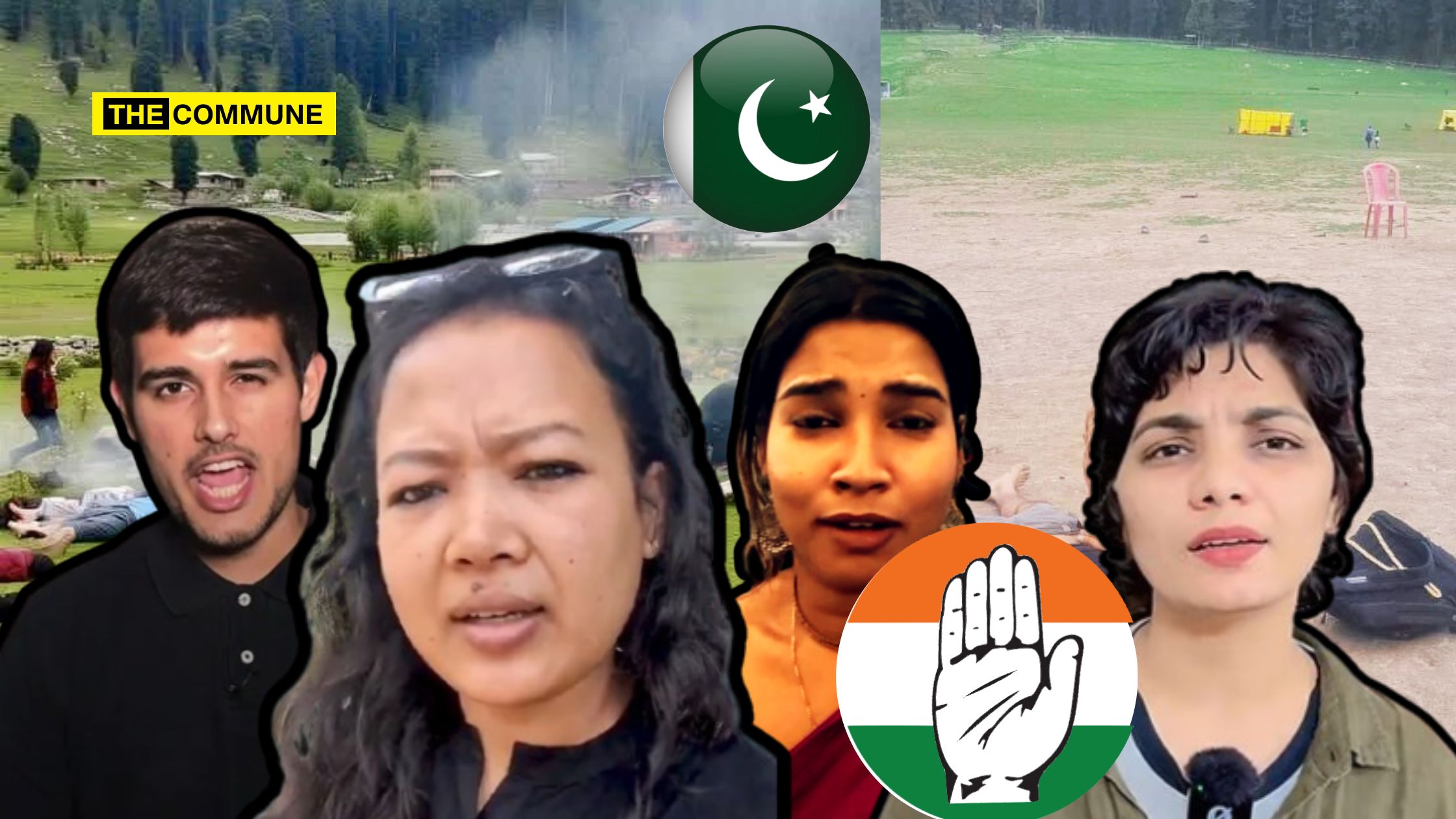
On 22 April 2025, a brutal terror attack in Pahalgam, Jammu and Kashmir claimed the lives of 26 Hindu tourists. While the nation mourned, a disturbing trend followed: several Indian politicians, activists, and social media users made statements or posts that deflected blame from the perpetrators and instead targeted the Indian government.

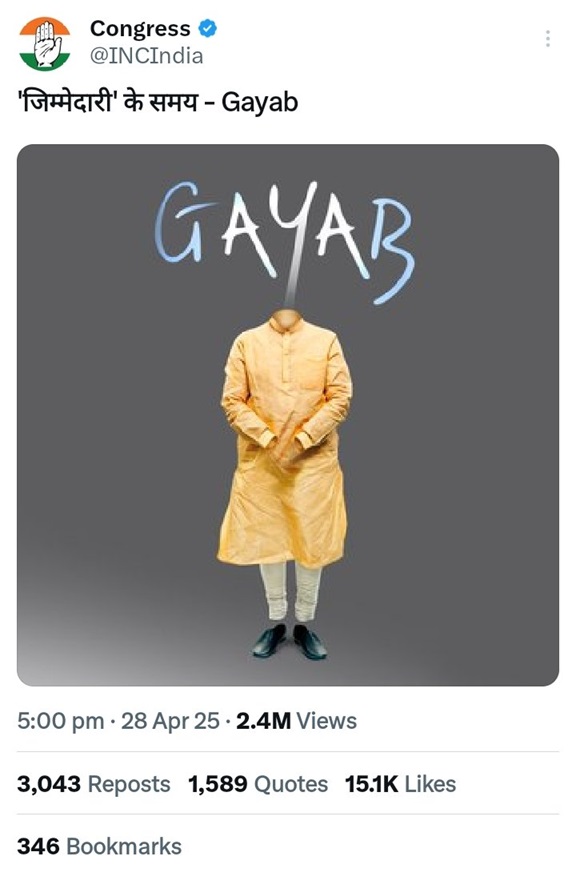
One such post came from the official X handle of the Indian National Congress, accusing Prime Minister Narendra Modi of “disappearing during times of responsibility”—accompanied by an edited image showing Modi’s head cut off. The timing and tone of such posts aligned closely with narratives pushed by Pakistani politicians and state-backed media.

This report documents 9 significant instances between 23 April and 28 April 2025, where Indian voices made controversial remarks about the Pahalgam attack—remarks that were amplified or endorsed by Pakistani leaders, commentators, and news outlets to blame India for the attack and justify terrorism.

#1 Neha Singh Rathore’s Satirical Resignation, Was Also Shared By Pakistani Handles

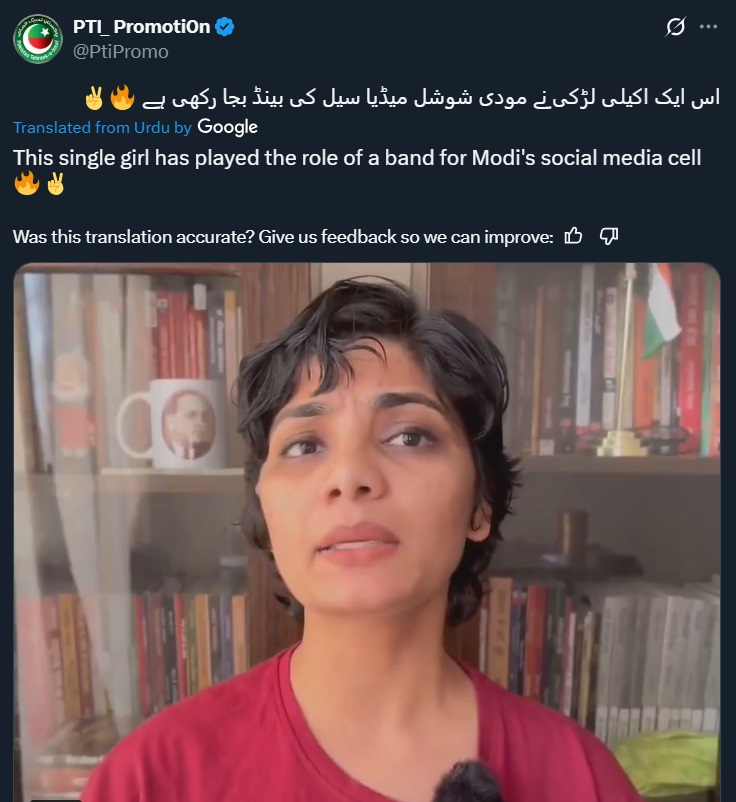
On 29 April 2025, singer and social media influencer Neha Singh Rathore posted a satirical statement mimicking a resignation: “I am going to resign from the post of Home Minister of the country today… By evening Nehruji and I will resign from the post of Prime Minister together.”

Referring to recent terror attacks and tragedies, the post was widely shared by Pakistani accounts, including “PTI_ Promoti0n”, to mock India’s leadership during the aftermath of the Pahalgam attack.

#2 Congress Handle Shares Headless Image Of PM, Fmr Pak Min Reshares It

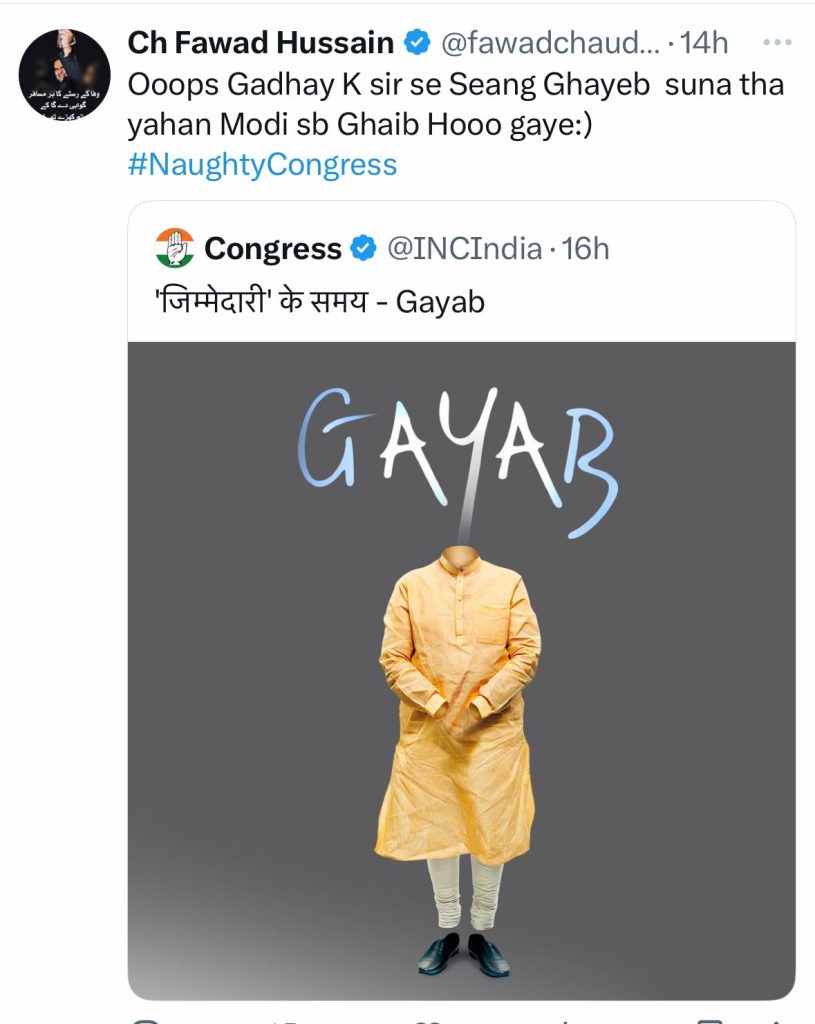
On Monday, 28 April 2025, the official Congress X handle posted an image featuring Prime Minister Modi’s body with the head edited out and the word Gayab” (missing) emblazoned across it. Though the post did not explicitly name the Prime Minister, his clothes gave away their intent. The caption accompanying the image read: “Disappears at the time of responsibility”. The post was a veiled reference to PM Modi’s ‘absence’ from the all-party meeting held to discuss the terror attack in Jammu and Kashmir’s Pahalgam region.

The controversy escalated further when the same image was picked up and shared by former Pakistani Minister Fawad Hussain Chaudhry. He mocked the Indian Prime Minister, posting: “Had heard about missing horns from donkey’s head, but here Modi has gone missing.” This endorsement from a Pakistani political figure ignited outrage in Indian political circles, particularly among BJP leaders.

#3 JindabadBharat Targeted for Criticism of BJP, Boosted by Pakistan

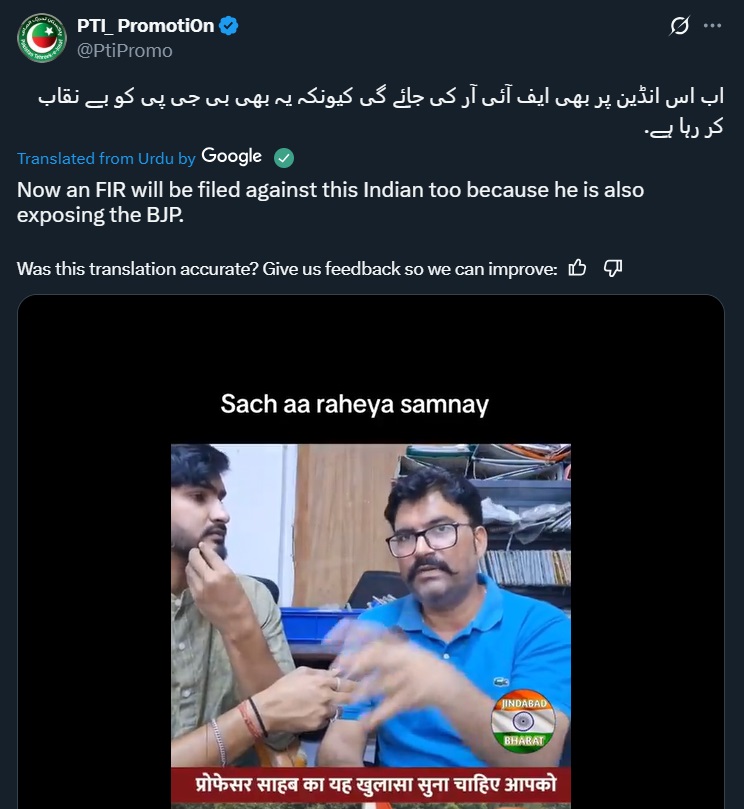
On 27 April 2025, the social media account Jindabad Bharatquestioned the apparent failure to act on security agency inputs prior to the Pahalgam terror attack. He suggested that foreign powers, particularly China and Pakistan, may be fueling unrest in India, stating, “No foreign power would want its neighbouring country to be stable.” Citing the deteriorating situation in Pakistan and alleged Chinese involvement, he speculated that China could have funded the Pakistani terrorist group behind the attack. He further accused those behind the violence of deliberately provoking riots in India and criticized authorities for ignoring advance warnings.

The post, which criticized the ruling party’s handling of dissent, was amplified by Pakistani handle “PTI_ Promoti0n” in the context of the Pahalgam terror attack backlash stating, “Now an FIR will be filed against this person too because she is also exposing the BJP.”

#4 Dhruv Rathee’s Question On Security Amplified By Pakistani Account

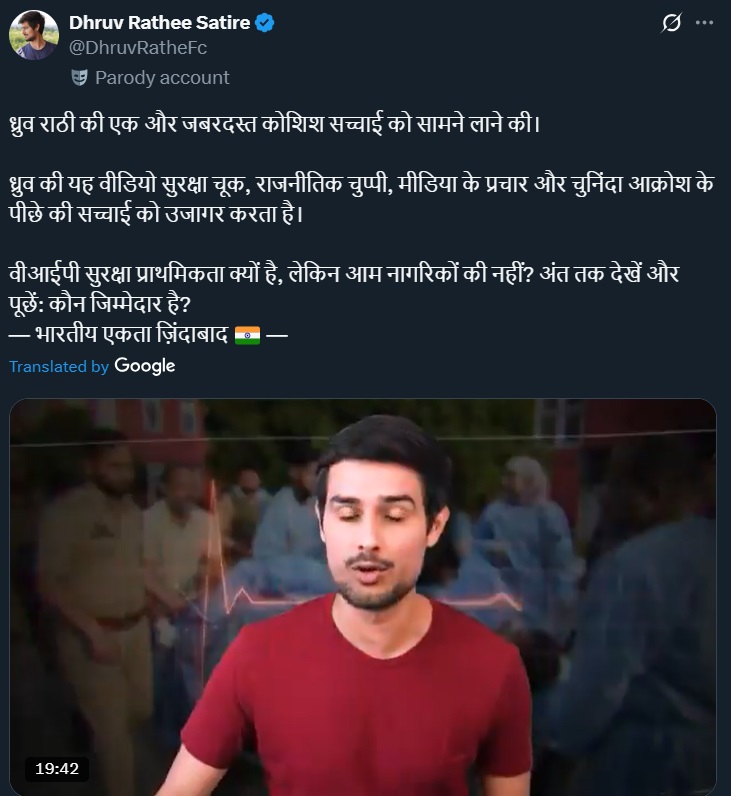
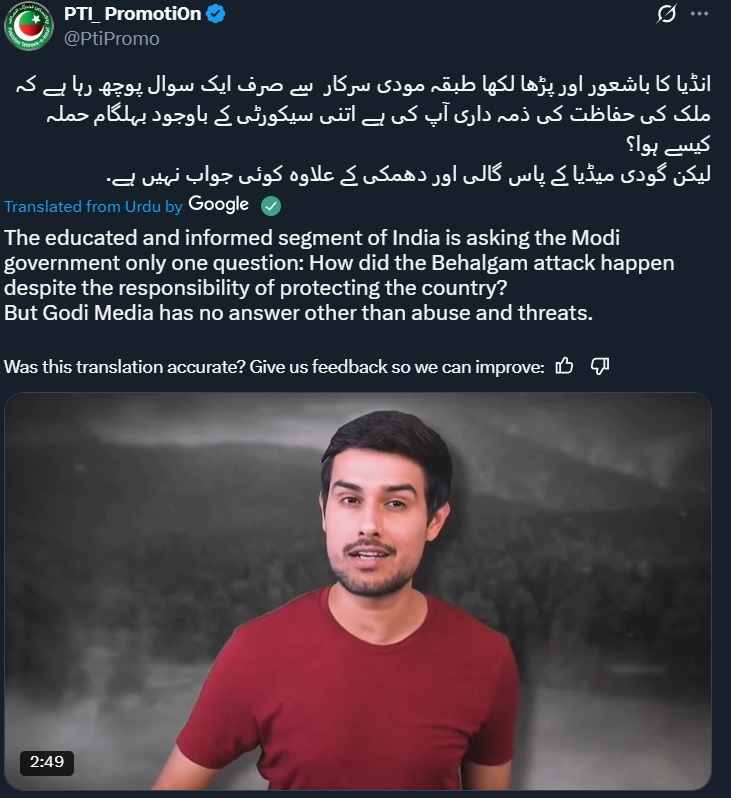
On 27 April 2025, leftist YouTuber Dhruv Rathee criticized mainstream media, alleging they respond only with abuse and threats instead of addressing the concerns with respect to the Pahalgam terror attack.

Pakistani account “PTI_ Promoti0n” shared the statement attributed to Dhruv Rathee, claiming that educated Indians were questioning the Modi government’s failure to prevent attacks like Pulwama despite heavy security.

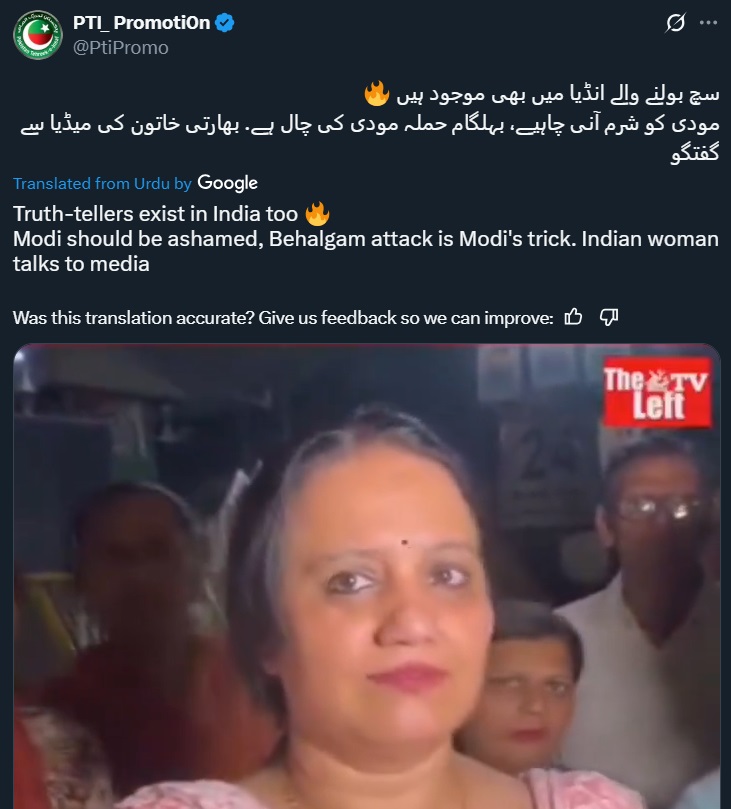
#5 Pulwama Was Modi’s Trick, Claims By Indian Woman Shared By Pakistani Account

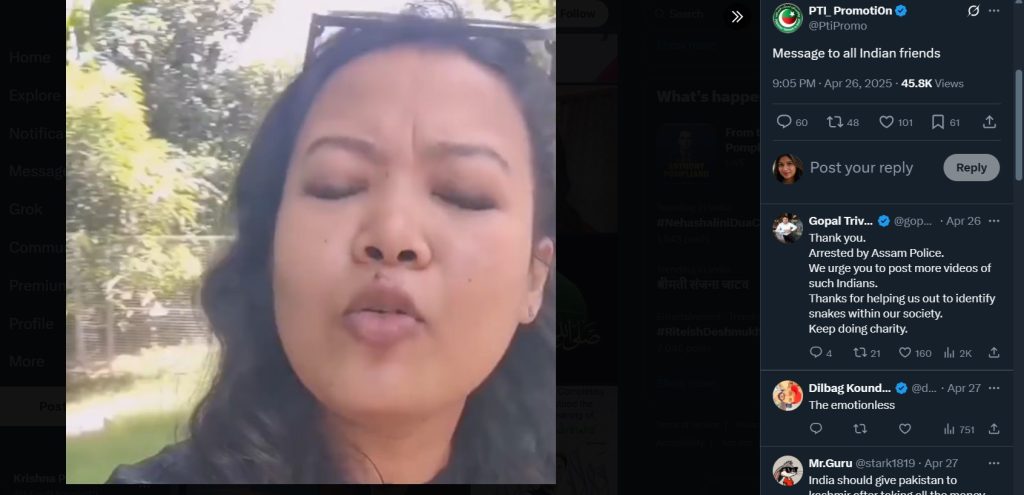
On 27 April 2025, Pakistani handle PtiPromo amplified a video of an unnamed Indian woman speaking to the media, alleging that the Pulwama attack was orchestrated by Prime Minister Modi himself. The post praised her for “speaking the truth” and said Modi should be ashamed.

#6 Tiger Yadav Team’s Post Shared To Support Pakistan Narrative

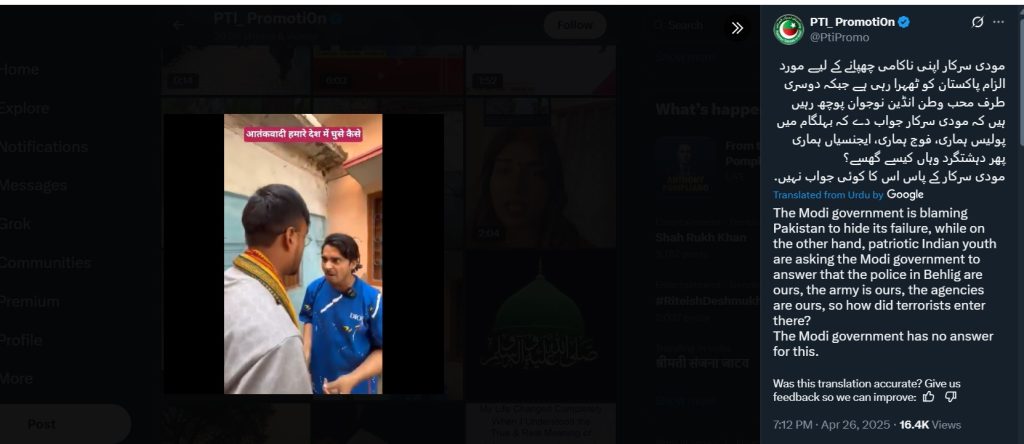
On 26 April 26, 2025, Pakistani account PtiPromo posted a statement by the page “Tiger Yadav Team” accusing the Modi government of blaming Pakistan to cover up its own failures.

The post highlighted questions raised by Indian youth about how terrorists reached Pulwama despite tight security, claiming the government had no credible explanation.

#7 Dr. Medusa’s Comment Amplified to Undermine Indian Agencies

On 26 April 2025, Pakistani handle PtiPromo shared a statement by Indian user Dr. Medusa accusing the government and mainstream media of exploiting the tragedy for TRP.

She questioned why no officials were held accountable and criticized intelligence failures, asking how such a major lapse occurred without the Home Minister’s knowledge.

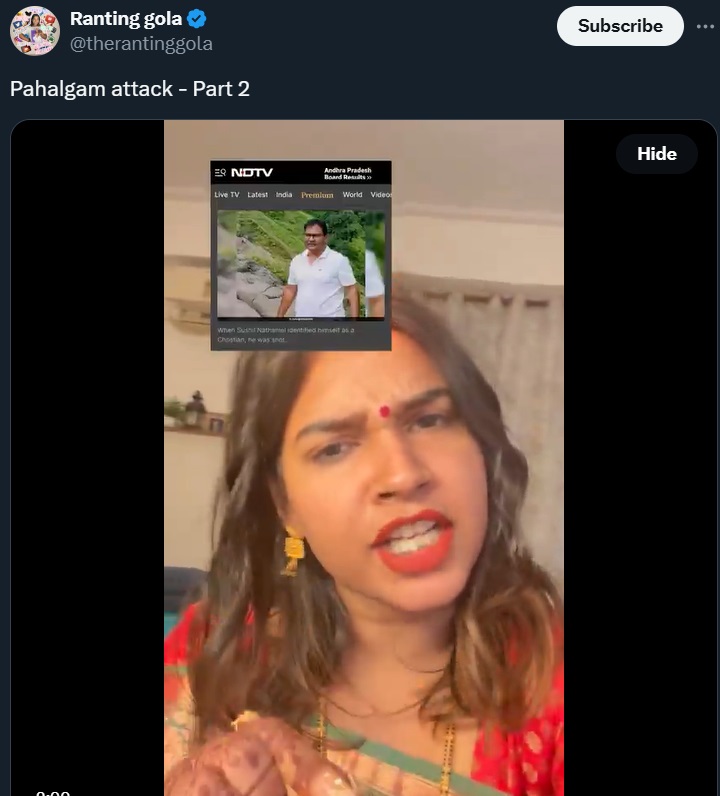
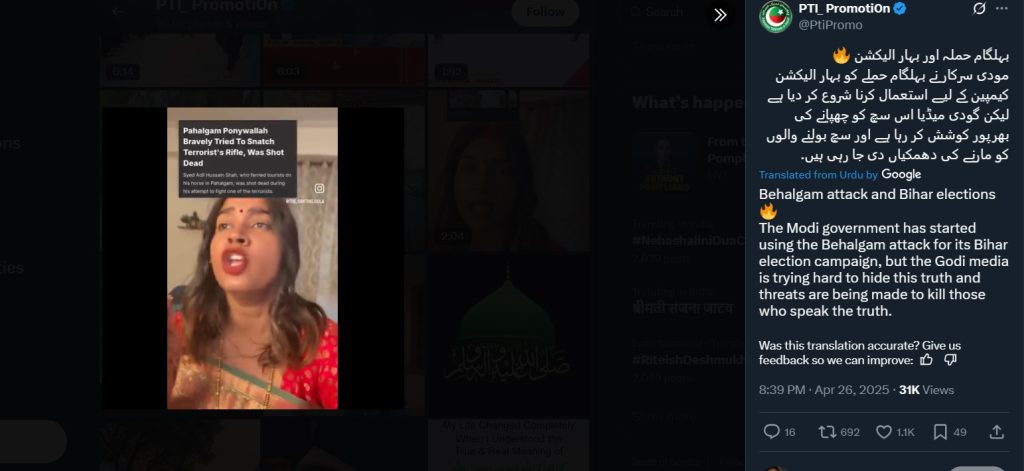
#8 Ranting Gola’s Video Sermonizing Hindus For Pahalgam Terror Attack Shared By Pakistani Handle

The recent terrorist attack in Pahalgam, where 26 Hindu pilgrims were brutally killed, shocked the entire nation. Initial survivor accounts revealed that Islamist militants separated Hindus from others by asking them to recite the Kalma or remove their pants, before targeting them — an act chillingly similar to past religious profiling by Pakistan-sponsored terrorists.

Instead of acknowledging the clear communal nature of the massacre, Ranting Gola chose to spin the incident as a political stunt by the Modi government, claiming it was being used for the Bihar elections. In a viral video, she accused the Indian media of “hiding the truth” and implied a false equivalence between Indian electoral politics and Islamist terrorism.

Shockingly, a Pakistani channel picked up her video and used it to attack the Indian government, labelling the Pahalgam terror attack a political gimmick.

#9 Anonymous Woman Praised By Pakistani Accounts For Criticising Indian Government

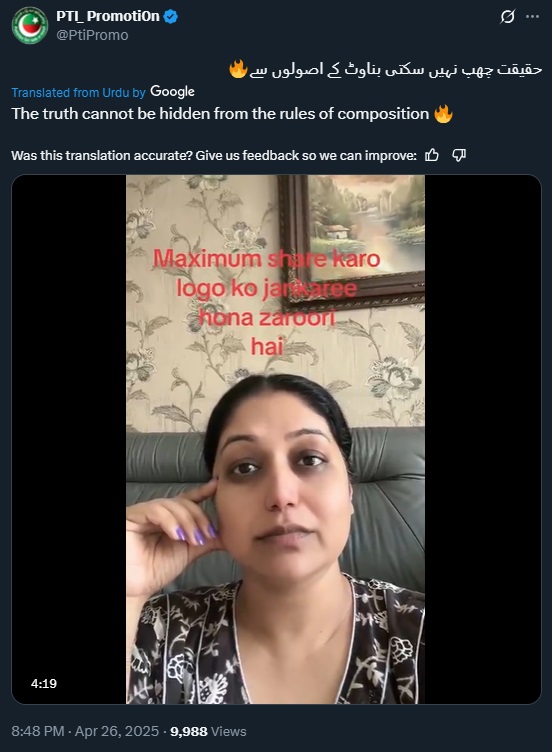
On 25 April 2025, Pakistani Twitter account @PtiPromo amplified a post praising an unnamed Indian woman for allegedly “exposing the drama of the Modi government.” The account wrote, “Salute to this woman, who despite being an Indian, is standing with the truth,” highlighting how anti-government remarks were being used to support Pakistan’s narrative post-Pahalgam attack.

Subscribe to our channels on Telegram, WhatsApp, and Instagram and get the best stories of the day delivered to you personally.
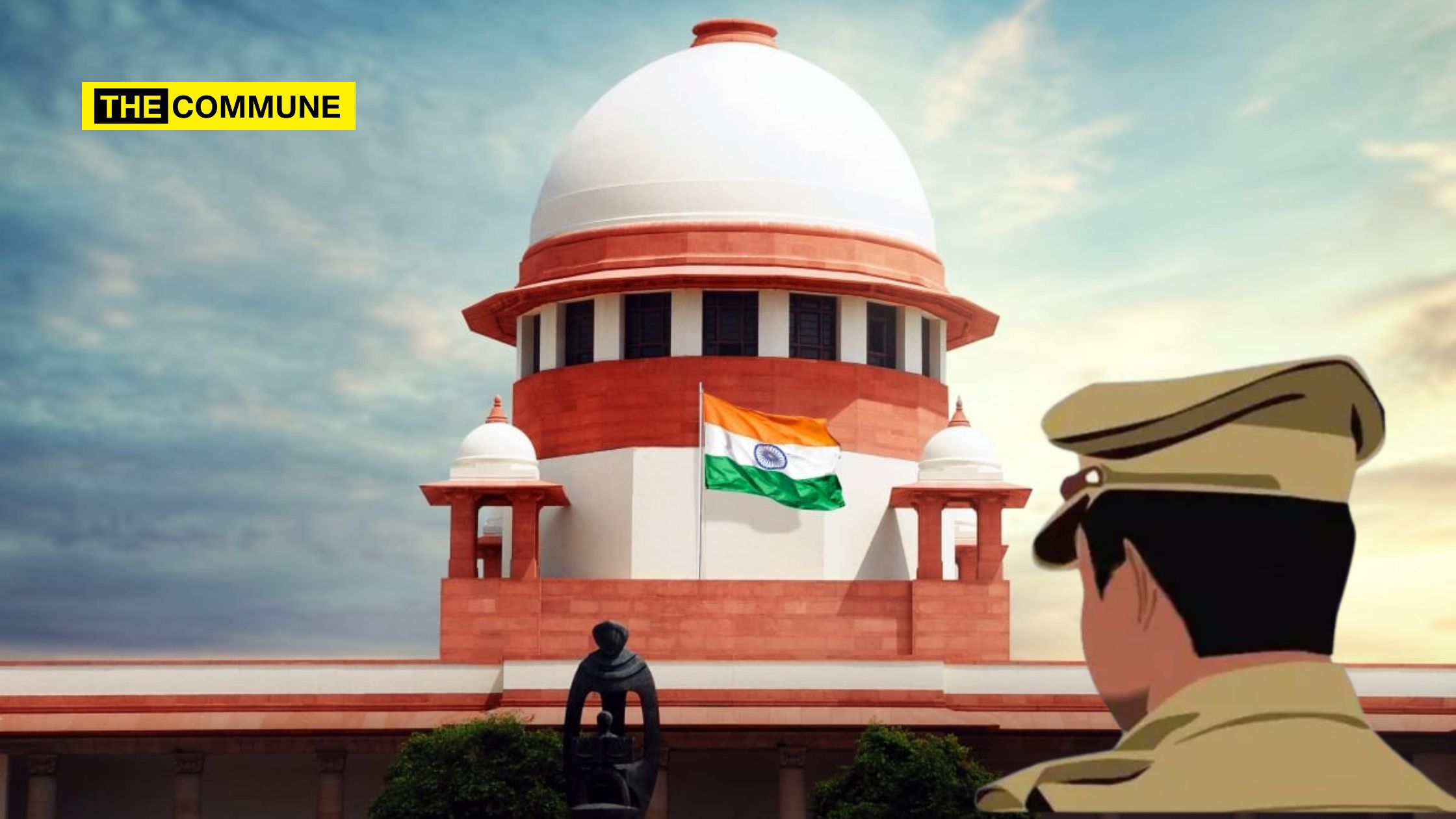
Supreme Court Upholds ₹2 Lakh Compensation Order Against TN Cop For Abusing Victim’s Mother, Refusing To Register FIR

In a strong affirmation of citizens’ constitutional rights, the Supreme Court on Wednesday, 30 April 2025, upheld a compensation order against a Tamil Nadu police inspector who refused to register a First Information Report (FIR) and verbally abused the complainant’s mother. The Court called the conduct a serious violation of fundamental and human rights under Article 21 of the Constitution.

A bench of Justices Abhay S. Oka and Ujjal Bhuyan dismissed an appeal by Pavul Yesu Dhasan, then Inspector of Police at Srivilliputhur, against the Tamil Nadu State Human Rights Commission (TNSHRC)’s order, which had directed a ₹2 lakh compensation to the victim—recoverable from the officer himself. The Madras High Court had earlier upheld the SHRC’s ruling.

The case dates back to 2013, when a man approached the Srivilliputhur police station to report cheating and misappropriation of ₹13 lakh. Despite revealing a cognizable offence, the police refused to file an FIR. When the complainant returned later with his parents to insist on action, he was made to wait for hours and his mother was allegedly subjected to “filthy” abuse by Inspector Dhasan.

The Court pulled no punches in its remarks. “Every citizen of India who goes to the police station to report commission of an offence deserves to be treated with dignity. That is his fundamental right under Article 21 of the Constitution of India,” the bench declared.

Rejecting the officer’s claim that his inaction and abuse did not amount to a human rights violation, the Court said: “The facts of this case, to say the least, are shocking. All that the respondent wanted was the registration of an FIR. The law is well settled… the petitioner being a senior officer ought to have immediately registered the First Information Report.”

The bench emphasized that denial of legal remedy, especially when accompanied by humiliation, constitutes a clear violation of human rights as defined under Section 2(1)(d) of the Protection of Human Rights Act, 1993.

By upholding the SHRC’s directive to recover compensation from the officer personally, the Supreme Court reinforced the principle of individual accountability within the framework of state responsibility. The decision is likely to set a precedent for future cases of police misconduct involving denial of legal rights or verbal abuse.

(With inputs from The Law Advice)

Subscribe to our channels on Telegram, WhatsApp, and Instagram and get the best stories of the day delivered to you personally.
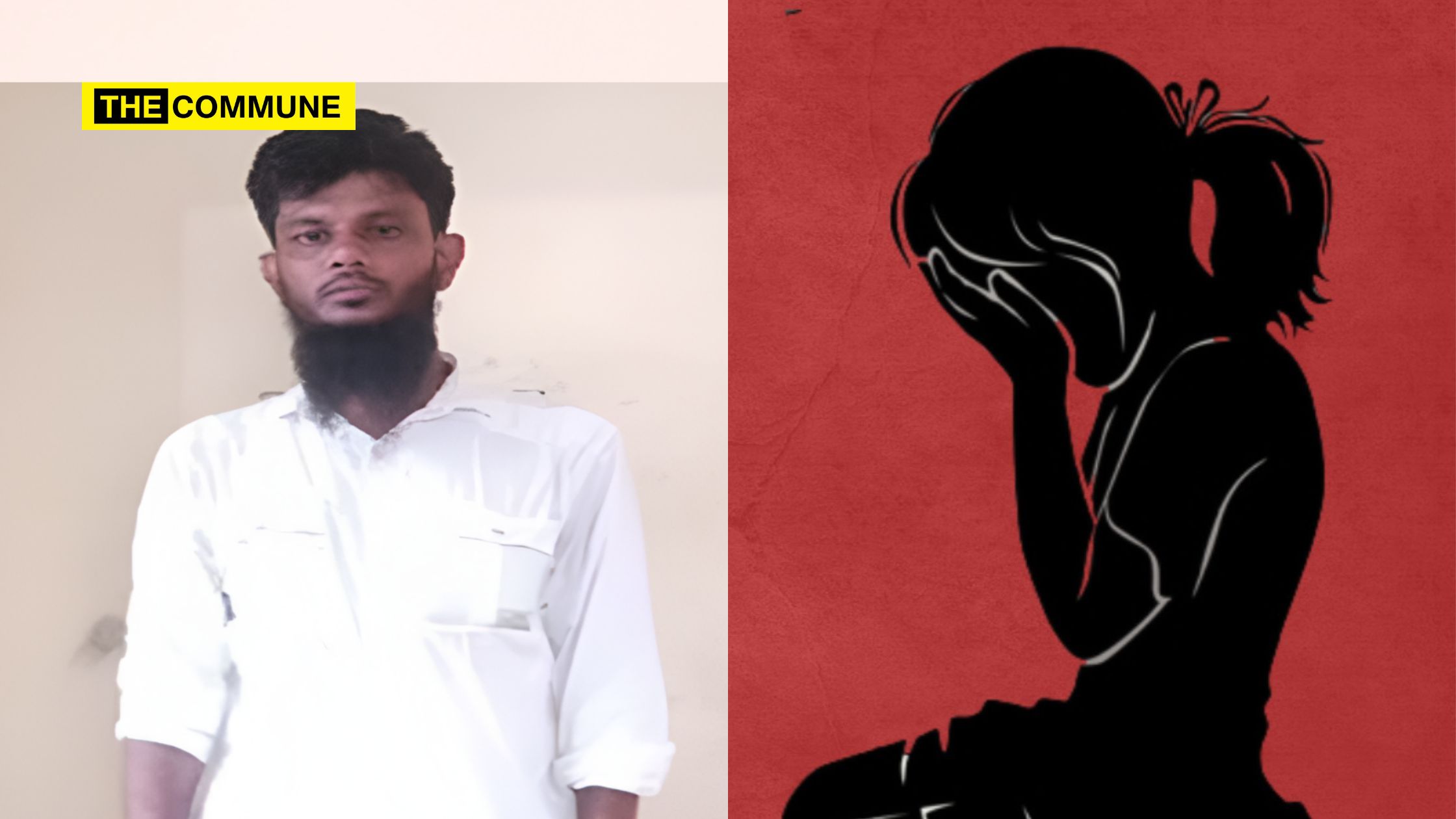
Vedaranyam: POCSO Case Filed Against Volleyball Coach Mohammed Kalilur Rahman For Repeated Sexual Assault On Minor Student Under Pretext Of Sports Training

pocso volleyball coach

A 34-year-old temporary volleyball coach from Vedaranyam taluk has been arrested for allegedly sexually assaulting a minor school student over several months by misleading her and her parents under the guise of sports training.

The accused, Mohammed Kalilur Rahman, a resident of the Thopputhurai area in Vedaranyam, had earlier accompanied students to a sports competition held at the Government Higher Secondary School in Thiruthuraipoondi, around seven months ago. During one of his visits to the school, he approached a senior girl student who was practicing volleyball, praised her skills, and assured her that she could reach the state level with his guidance.

Convinced by his promise, the student shared this with her parents. Hoping for their daughter’s progress in sports, they agreed to let her travel with Rahman to participate in what he claimed were volleyball tournaments in different cities.

However, as the coach continued taking her on frequent trips, the girl’s parents began to suspect his intentions and eventually decided not to send her for further events. Despite this, Rahman repeatedly contacted the family, insisting the student had a strong chance of winning medals.

Frustrated by their refusal, Rahman made a complaint to Childline 1098, alleging that the parents were preventing a talented student from participating in competitions. Following this, officials from the district child welfare department initiated an inquiry.

During the investigation, the parents expressed doubts about the coach’s behavior. Upon questioning the student, authorities uncovered that Rahman had lied about the competitions for months. Instead, he had taken her to various locations and sexually assaulted her, luring her with false promises of marriage.

Following these revelations, Rahman was taken into custody, and a case was registered against him under the Protection of Children from Sexual Offences (POCSO) Act at the Thiruthuraipoondi police station.

Police have also confirmed that Rahman is already married to two women who currently live separately. Investigators now believe he intended to marry the student as a third wife, exploiting her trust by posing as a mentor and coach. The incident has sparked widespread condemnation from the public and the student’s family, who are demanding strict legal action against the accused for his exploitative behavior.

(With inputs from ETV Bharat)

Subscribe to our channels on Telegram, WhatsApp, and Instagram and get the best stories of the day delivered to you personally.
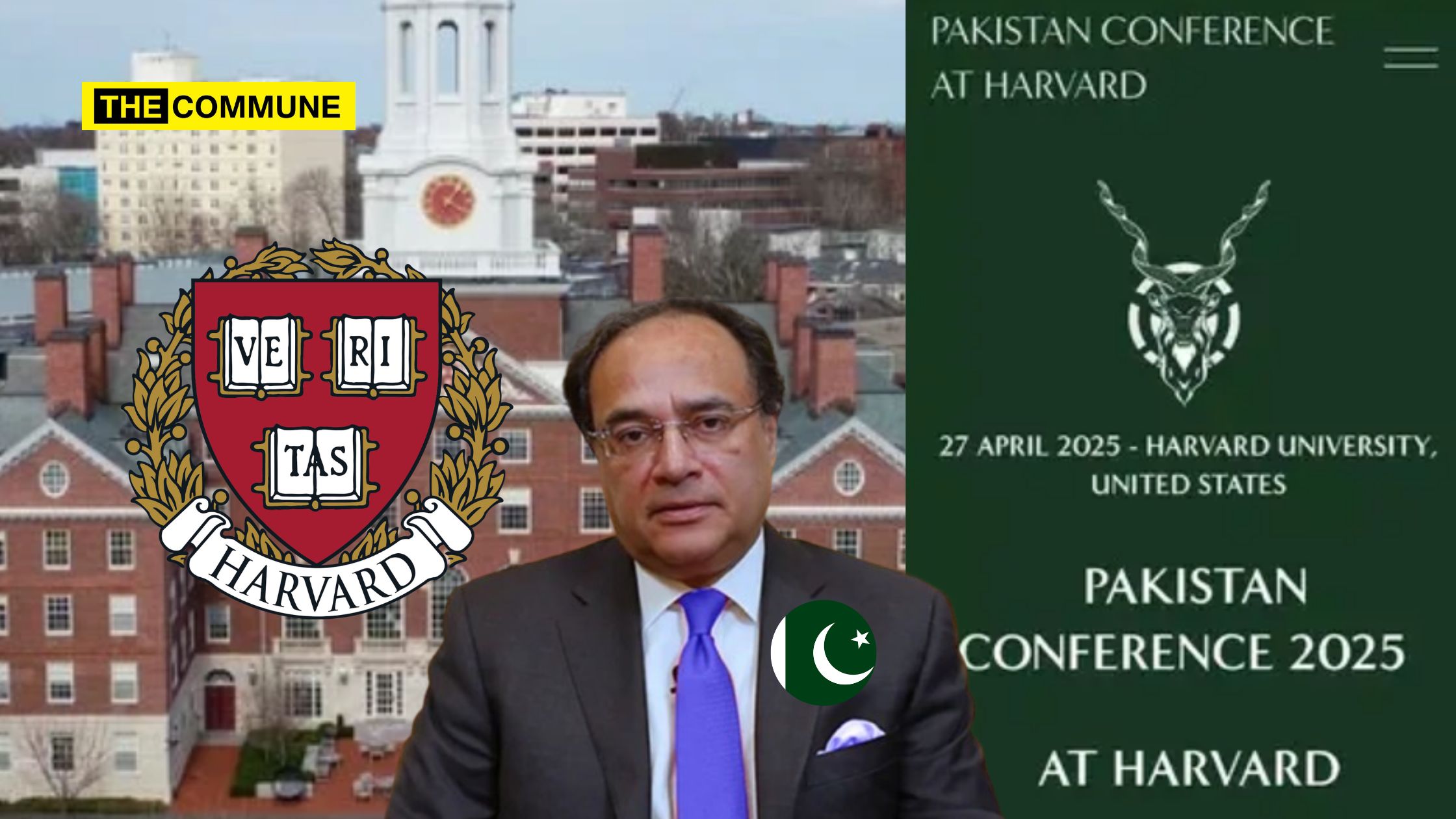
“Take A Stand Against Hinduphobia”: Indian Students At Harvard Slam University Over Invite To Pakistani Officials After Targeted Killing Of Hindus In Pahalgam Terror Attack

harvard university

Following the recent terror attack in Pahalgam, Jammu and Kashmir, Indian students at the Harvard Kennedy School have expressed strong opposition to the upcoming visit of Pakistani delegates to the university. In a formal letter addressed to U.S. Secretary of State Marco Rubio, the students requested the revocation of visas issued to Pakistani officials expected to attend the Pakistan Conference 2025 at Harvard University.

We, students at Harvard Kennedy School and members of the Harvard community, write with deep grief and urgency following the targeted terrorist attacks in Pahalgam, India on April 22, 2025. These brutal assaults, carried out by terrorists linked to the banned Lashkar-e-Taiba (LeT), deliberately sought out Hindu tourists, verified their religion, and executed them. Several survivors have shared harrowing accounts of being questioned about their faith, and those unable to recite specific Islamic verses were killed. These acts of violence were not indiscriminate-they were calculated attacks based solely on religious identity,” the letter read.

The students also condemned Pakistan’s response to the incident, pointing out that while a formal condolence was issued by Pakistan’s Foreign Ministry, several Pakistani leaders made provocative remarks and reaffirmed support for militant groups operating in Kashmir.

What concerns us further,” the letter continued, “We are alarmed to learn that Pakistani delegates including Minister of Finance Muhammad Aurangzeb and other high-ranking figures are expected to participate in the upcoming Pakistan Conference 2025 at Harvard. Welcoming representatives of a government that not only denies accountability for but also ideologically supports such religion-based terrorism, risks Harvard being complicit in legitimizing those who enable or justify these crimes.”

The students urged Senator Rubio to recommend that the U.S. State Department cancel the visas of these officials, citing national security concerns and ethical responsibility.

In a separate letter addressed to Harvard’s administration, the students appealed for institutional recognition and support, stating, “Harvard has always stood for equity, global justice, and human dignity. In recent years, the university has taken meaningful stances in support of communities affected by racism, antisemitism, Islamophobia, and other forms of hatred. We now ask for the same clarity, courage, and compassion for Hindu and Indian students grieving the targeted killing of members of their faith. We request you to take a stance against Hinduphobia.”

The letters have sparked broader discussions around university policies, religious discrimination, and the role of global academic institutions in addressing geopolitical conflicts.

Excerpts of the full letter read as follows: “We, students at Harvard Kennedy School and members of the Harvard community, write with deep grief and urgency following the targeted terrorist attacks in Pahalgam, India on April 22, 2025. These brutal assaults, carried out by terrorists linked to the banned Lashkar-e-Taiba (LeT), deliberately sought out Hindu tourists, verified their religion, and executed them. Several survivors have shared harrowing accounts of being questioned about their faith, and those unable to recite specific Islamic verses were killed. These acts of violence were not indiscriminate-they were calculated attacks based solely on religious identity.

What compounds this horror is the response from Pakistani officials. While formally denying involvement, Pakistan’s ministers and lawmakers have simultaneously issued aggressive warnings to India and reaffirmed their support for insurgent activity in Kashmir. Notably, Pakistan’s Senate passed a resolution denying responsibility for the attack while reaffirming its “unwavering commitment” to what it calls “freedom struggle”-language long used to justify terrorism. Deputy Prime Minister and Finance Minister Ishaq Dar has even issued threats of retaliation, should India take any “kinetic step” in response.

In this context, we are alarmed to learn that Pakistani delegates including Minister of Finance Muhammad Aurangzeb and other high-ranking figures are expected to participate in the upcoming Pakistan Conference 2025 at Harvard. Welcoming representatives of a government that not only denies accountability for but also ideologically supports such religion-based terrorism, risks Harvard being complicit in legitimizing those who enable or justify these crimes

Harvard has always stood for equity, global justice, and human dignity. In recent years, the university has taken meaningful stances in support of communities affected by racism, antisemitism, Islamophobia, and other forms of hatred. We now ask for the same clarity, courage, and compassion for Hindu and Indian students grieving the targeted killing of members of their faith. We request you to take a stance against Hinduphobia. 

We respectfully request that Harvard University:

  1. Issue a public statement condemning the Pahalgam terror attacks and affirming support for victims of religion-based violence.
  2. Review the participation of Pakistani officials at the Pakistan Conference 2025 in light of their government’s ideological and rhetorical support for groups like LeT.
  3. Provide emotional and institutional support to affected students through the Office for Equity, Diversity, Inclusion, and Belonging.

This is not about political posturing. It is about moral clarity. Harvard must ensure its campus does not become a platform for whitewashing state-enabled religious terrorism. We are grateful for your attention and are available to discuss this further at your convenience.”

Subscribe to our channels on Telegram, WhatsApp, and Instagram and get the best stories of the day delivered to you personally.
The Birth Of Sri Satya Chandrashekarendra Saraswathi Shankaracharya: The Profound Journey To Sanyasa And The Silent Sacrifice Of A Family

sanyasa

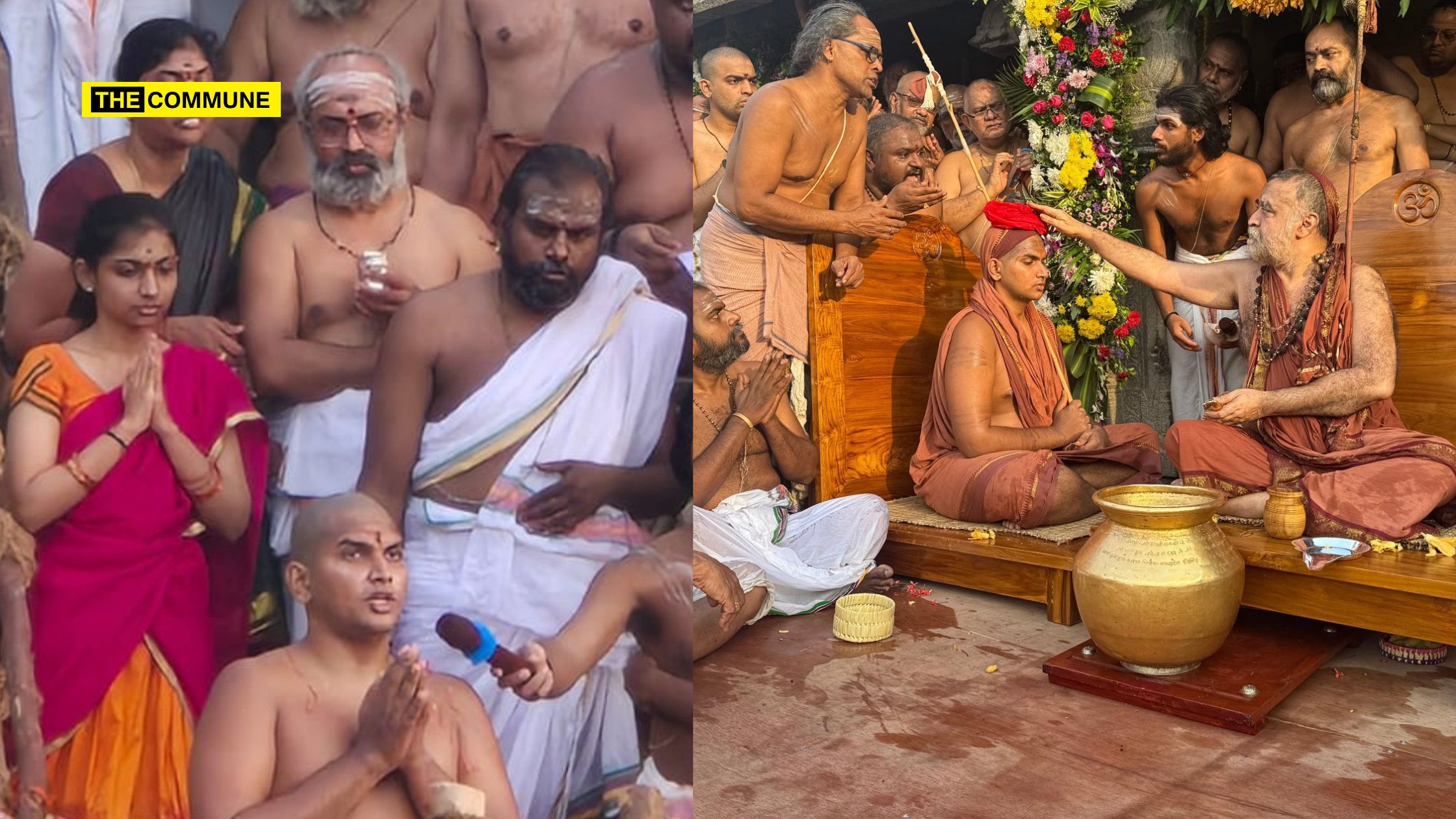
On Akshaya Tritiya this year, a historic moment unfolded at the sacred precincts of the Kanchi Kamakoti Peetam in Kancheepuram. A 25-year-old Rig Vedic scholar from Andhra Pradesh, Ganesha Sharma Dravid—now initiated as Sri Satya Chandrashekarendra Saraswathi Shankaracharya—was anointed as the 71st pontiff of the Peetam. While the rituals were majestic and the occasion momentous, what transpired was far more than ceremonial—it was the spiritual death of an individual and the silent, dignified sacrifice of a family.

What Is Sanyasa?

Sanyasa is the ultimate renunciation in the Hindu tradition. It is not merely about giving up material possessions—it is about relinquishing identity, lineage, personal will, and all worldly ties. The one who enters Sanyasa no longer lives for oneself. He or she becomes a vessel of Dharma, an instrument of the Divine.

This transformation is not metaphorical. It is enacted through elaborate rites that include the symbolic performance of one’s own funeral (antyeshti). The renunciate shaves their head, gives up the yajnopavitam (sacred thread), performs their own shraddha (ancestral rites), and offers food to themselves as if dead. Through this, the renunciate signals that the person born to a certain family, of a certain caste and name, has ceased to exist. What remains is a spiritual being, no longer a son, brother, or friend—only a child of the cosmos.

From Ganesha Sharma Dravid To Sri Satya Chandrashekarendra Saraswathi

Sri Duttu Satya Venkata Surya Subramania Ganesha Sharma was born in 2001 in Dhuni, Andhra Pradesh, to Sri Srinivasa Surya Subramania Dhanvanthri, a Vratha Purohit at the Sri Satyanarayana Swamy Temple in Annavaram, and Smt. Alivelu Mangadevi. Encouraged by the blessings of the Kanchi Kamakoti Shankaracharya, he began his Vedic education under Rig Vedic scholar Sri Ratnakara Bhat Sharma and trained rigorously for 12 years in the Rig Veda Samhita, Brahmanas, Aranyakas, Upanishads, and recitation methods like Pada and Krama.

He also studied texts like Pratishakhya and Shiksha under other esteemed scholars, while completing his formal education up to Class 10 in Annavaram. Ganesha Sharma served as a Rig Vedic Parayana scholar at temples such as Basara Saraswathi Temple and participated in key religious events like Mahamaham, Athivaradar Darshanam, and Chaturmasya camps. He also began mentoring young students in Rig Veda recitation.

In April 2024, the Shankaracharya personally charted his next phase of learning. With the Peetham’s blessings, he continued to advance studies in Yajur and Sama Veda, Vedanta, and Shastric disciplines, emerging as a promising scholar in the Vedic tradition.

The Ceremony: A Death And A Birth

The rituals began at approximately 5:00 AM. His Holiness, accompanied by Vedic hymns, traditional music, and a group of devotees, proceeded from Shrimatam to the Kamakshi temple, arriving by 5:30 AM. A warm welcome with Poornakumbham greeted him at the temple entrance, while the skies of Kanchipuram lit up with vibrant fireworks and echoed with celebratory sounds.

The ceremony took place at the Mangala Vinayaka Sannidhi, located by the Pancha-Ganga teertham. Sri Ganesha Sharma Dravid performed a ritual bath in the sacred pond and, amidst chants of mantras symbolizing renunciation, received the saffron robes, staff (Danda), water vessel (Kamandala), and seat (Asana). His Holiness imparted the Mahavakya teachings and performed an abhishekam by placing a Sudarsana Salagrama on the initiate’s head, using a conch for the ritual. In a multilingual address, His Holiness delivered an inspiring message to the global audience and formally conferred the deeksha name upon the new Acharya.

At the heart of the Sanyasa ritual is the Viraja Homa, a sacred fire ceremony in which the initiate symbolically offers up every aspect of their physical and subtle existence: bones, skin, breath, even thoughts and identities. As the mantras rise, so does the renunciate’s inner flame of detachment.Jyotiraham viraja vipapma bhuyasam,the initiate declares“May I become a being of light, free from all stain.”

Then comes the declaration:

Om bhuh sanyastam maya — I have renounced the earthly realm.

Om bhuvah sanyastam maya — I have renounced the intermediate realm.

Om svah sanyastam maya — I have renounced the celestial realm.

And finally, the vow, Abhayam sarvabhuteshu mattah — May all beings be free from fear of me.”

In these solemn words, the renunciate offers reassurance to the entire universe: I am no longer a danger to any living being. I am a monk. I will wage no external war. My only battle is within.”


A Family’s Silent Heroism

In our celebration of the spiritual elevation of a renunciate, we often overlook the quiet courage of those left behind. The parents who once raised this child, the sister who shared childhood stories and meals, must now let go—not with sorrow, but with sacred pride.

They do not just say goodbye to a family member. They relinquish all claims to him. The new Acharya will no longer perform ancestral rites for his family. He will not light the pyres of his parents. He will not carry forward the family lineage. In offering him to the world, they sever ties that, for most people, define life itself.

When people say the family hasgiven up their own,it is not just poetry—it is a profound existential truth. This is not a metaphorical separation. The thread of lineage is cut. The karmic chain, at least for this soul, ends here. And yet, this sacrifice is borne without grief or complaint. It is held as a badge of honor, as a family’s own offering to Dharma.

A Line Of Living Light

The new junior pontiff at Kanchi now joins an unbroken spiritual lineage that stretches back to Jagadguru Adi Shankaracharya, who is said to have founded the Kanchi Kamakoti Peetam in 482 BCE. His predecessor, Sri Vijayendra Saraswathi, was himself initiated into Sanyasa at the age of 15. And before him, the great Jayendra Saraswathi was chosen by none other than the legendary Chandrasekharendra Saraswathi, the Maha Periyava.

In this living chain of renunciation, every Acharya becomes not just a scholar or leader—but a burning flame of detachment and guidance.

To take Sanyasa is to walk into one’s own funeral and emerge as a living embodiment of the Infinite. It is to renounce not only wealth, power, and ego—but even memory, belonging, and selfhood. And for the family that gives such a soul to the world, it is a sacrifice no less sacred.

In an age that celebrates ownership, Sanyasa is the ultimate act of liberation. And in an era that measures worth by ties and achievements, the renunciate’s worth lies in having none.

The entire Hindu community is indebted to Sri Srinivasa Surya Subramania Dhanvanthri and Smt. Alivelu Mangadevi who gave up their own for the welfare of the world and to uphold the eternal dharma.

Subscribe to our channels on Telegram, WhatsApp, and Instagram and get the best stories of the day delivered to you personally.
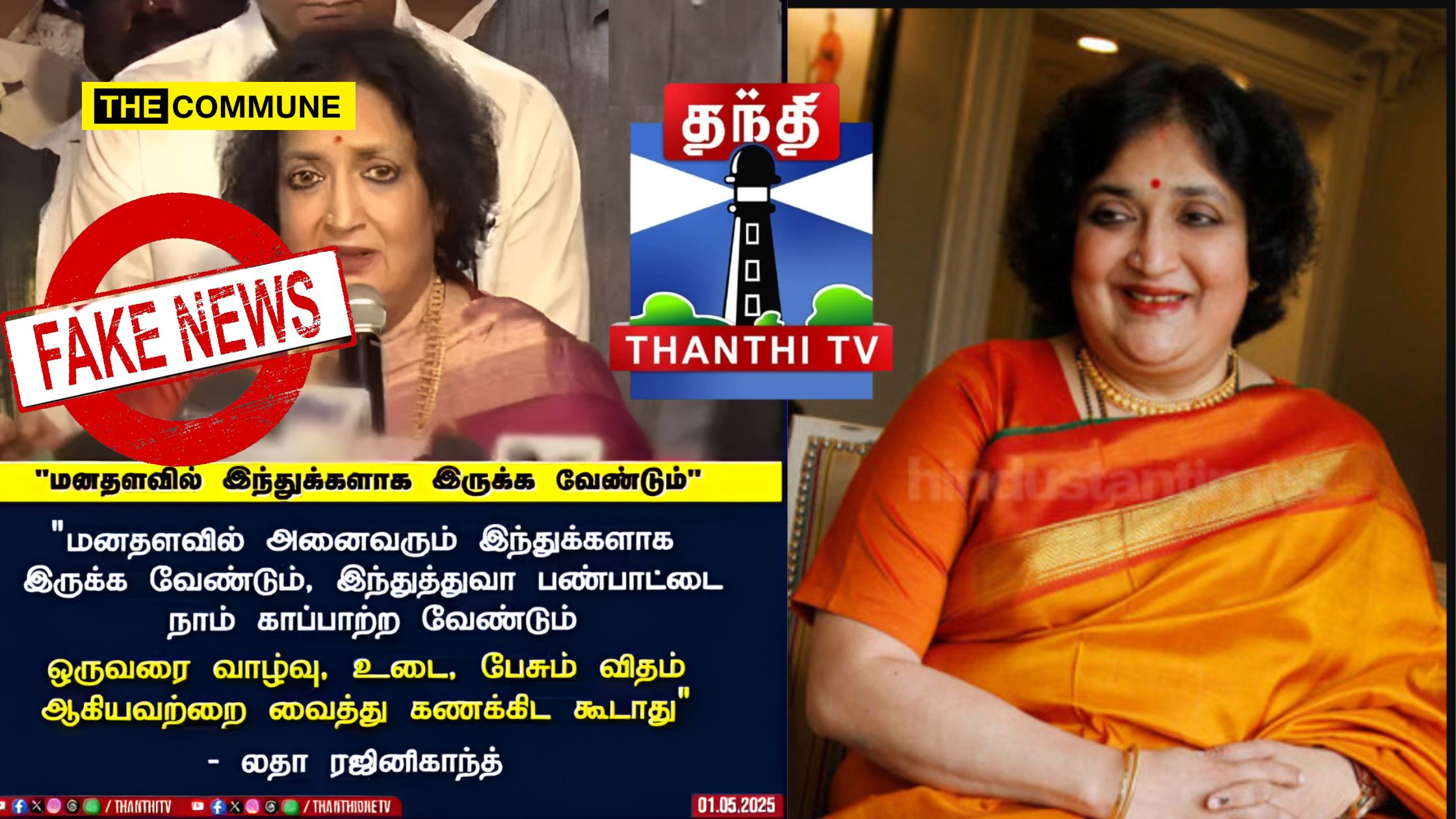
Thanthi TV Misquotes Latha Rajinikanth: Twists ‘Indian At Heart’ Into ‘Hindu At Heart’, Deletes Post Later

A recent news card by Thanthi TV sparked controversy after it allegedly misquoted Latha Rajinikanth, portraying her as a supporter of Hindutva by claiming she said, “Everyone should be Hindu at heart.” In reality, her comments emphasized the importance of maintaining Indian cultural identity, not promoting a specific religion. The news channel later deleted the news card following public backlash and accusations of distorting her words.

Latha Rajinikanth’s actual remarks came in response to her husband Rajinikanth’s concern over the cultural disconnect among today’s youth. Speaking to the media, she clarified, “(Being Indian) It is not determined by the clothes, the way one speaks or the style of one’s life, but by being Indian in spirit. Wherever one goes, that Indianness should be in our spirit, in our life and in the security system around us.”

She continued, “Even people abroad hold onto their national identities. Similarly, we too must preserve the richness of Indianness. You can embrace the global community while being 100% Indian at heart.”

These comments were made at the launch event of Bharat Seva and Sankalpam, a cultural and service initiative by Daya Foundation, which Latha Rajinikanth founded. The project, in collaboration with Bhakti Seva Samayam Agribit, aims to foster unity through Sanatana Dharma. The event in Chennai was attended by actor Rajinikanth’s brother Satyanarayana Rao and Hindu Makkal Katchi leader Arjun Sampath, among others.

Rajinikanth, in a video message for the inauguration, remarked that while Indian youth are increasingly influenced by Western trends, Westerners are turning to India for peace through practices like yoga and meditation. He expressed support for Latha’s efforts to reconnect the younger generation with India’s cultural heritage and values.

The misrepresentation by Thanthi TV and the subsequent retraction have reignited discussions about media responsibility and the politicization of personal views, especially those involving public figures.

(With inputs from One India Tamil)

Subscribe to our channels on Telegram, WhatsApp, and Instagram and get the best stories of the day delivered to you personally.
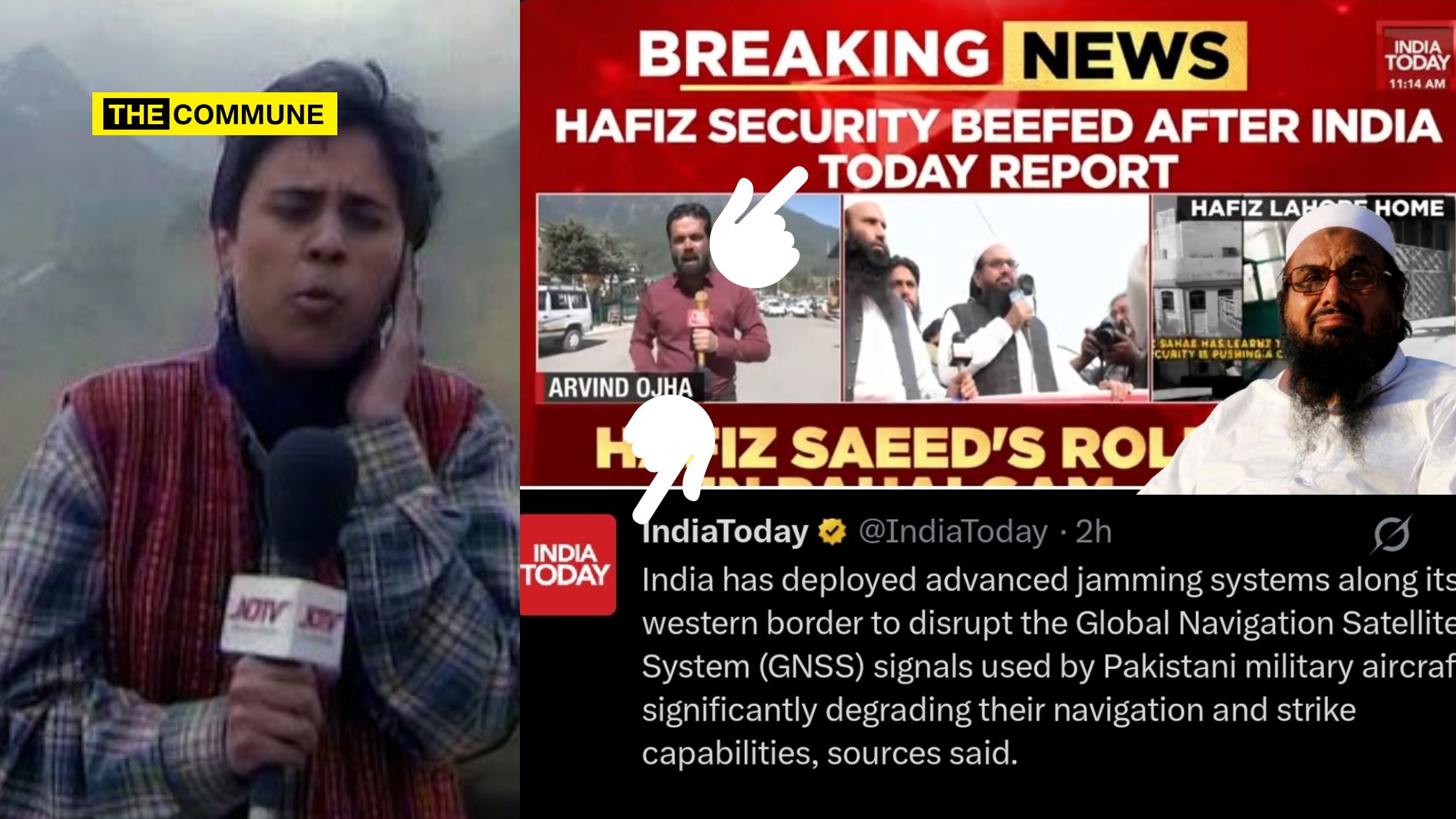
Is India Today Doing A ‘Barkha Dutt’ In 2025? Claims LeT Terrorist Hafiz Saeeds Security Beefed Up After Its Report

barkha dutt india today hafeez saeed

There are moments in journalism when the line between reporting and recklessness is not just crossed — it’s obliterated.

In 1999, during the Kargil War, ‘journalist’ Barkha Dutt’s live coverage from the war zone shocked everyone, particularly India’s military leadership. Her reporting from sensitive locations — even mentioning “56 Brigade HQ” on-air — raised alarm bells across the armed forces. Then Army Chief General VP Malik later wrote in his memoir that such coverage had revealed classified information and compromised operational secrecy. Officers like Lt Gen Mohinder Puri and Brigadier Umesh Singh Bawa echoed similar concerns in their own accounts. For many in the military, Dutt’s sensationalist war reporting wasn’t just unethical — it was dangerously irresponsible.

In 2008, during the 26/11 Mumbai terror attacks, Dutt’s name resurfaced in another controversy. This time, she broadcast details such as the floor on which hostages were located — information that could have been used in real-time by handlers monitoring Indian TV. Though she later admitted to journalistic lapses, the damage had been done. Even the Supreme Court criticized the media’s coverage of 26/11 for compromising operational safety.

Fast forward to 2025 — and it appears India Today is following the same disastrous playbook.

In a recent “exclusive,” India Today boasted that it had discovered the current location of wanted terrorist Hafiz Saeed in Lahore, citing unnamed “sources.” The story didn’t stop there. The channel followed up by reporting that Saeed’s security had been “beefed up” after their own broadcast — as though jeopardizing an intelligence operation was a badge of honor. The irony was inescapable: in its rush to break a story, India Today may have broken the element of surprise for Indian security agencies possibly planning to target Saeed.
But the recklessness didn’t end there.

In another headline-grabbing report, India Today claimed — again citing “sources” — that India had deployed GPS jamming systems along the Pakistan border. The supposed goal was to disrupt Global Navigation Satellite System (GNSS) signals used by Pakistani military aircraft. If true, this is not just another defense scoop — it’s a serious operational detail that should never have reached the public domain. Revealing it plays directly into the hands of the enemy by exposing tactical capabilities and limitations.

This kind of “scoop journalism” doesn’t serve national interest. It endangers it.

One is left wondering: has nothing been learned since the Kargil War? Are TRPs and clickbait headlines now more important than strategic discretion and national security? India Today’s willingness to jeopardize sensitive operations for a moment in the spotlight is eerily reminiscent of NDTV’s worst moment. We may well be witnessing the birth of a new NDTV — one that’s even bolder, brasher, and more reckless.

If India’s security agencies were indeed closing in on high-value targets like Hafiz Saeed, that operation might now be in jeopardy — not because of poor planning, but because a news outlet couldn’t keep its mouth shut. Worse, celebrating the fact that Saeed’s security increased because of their own reporting shows a disturbing lack of self-awareness.

Before India’s armed forces can eliminate those responsible for terrorism, perhaps they need to first plug the leaks — and hold media outlets accountable for sabotaging operations under the guise of journalism.

If Barkha Dutt’s Kargil blunder was the wake-up call, India Today’s 2025 repeat might be the final alarm. The nation cannot afford to hit snooze again.

(With inputs from News Bharati)

Subscribe to our channels on Telegram, WhatsApp, and Instagram and get the best stories of the day delivered to you personally.
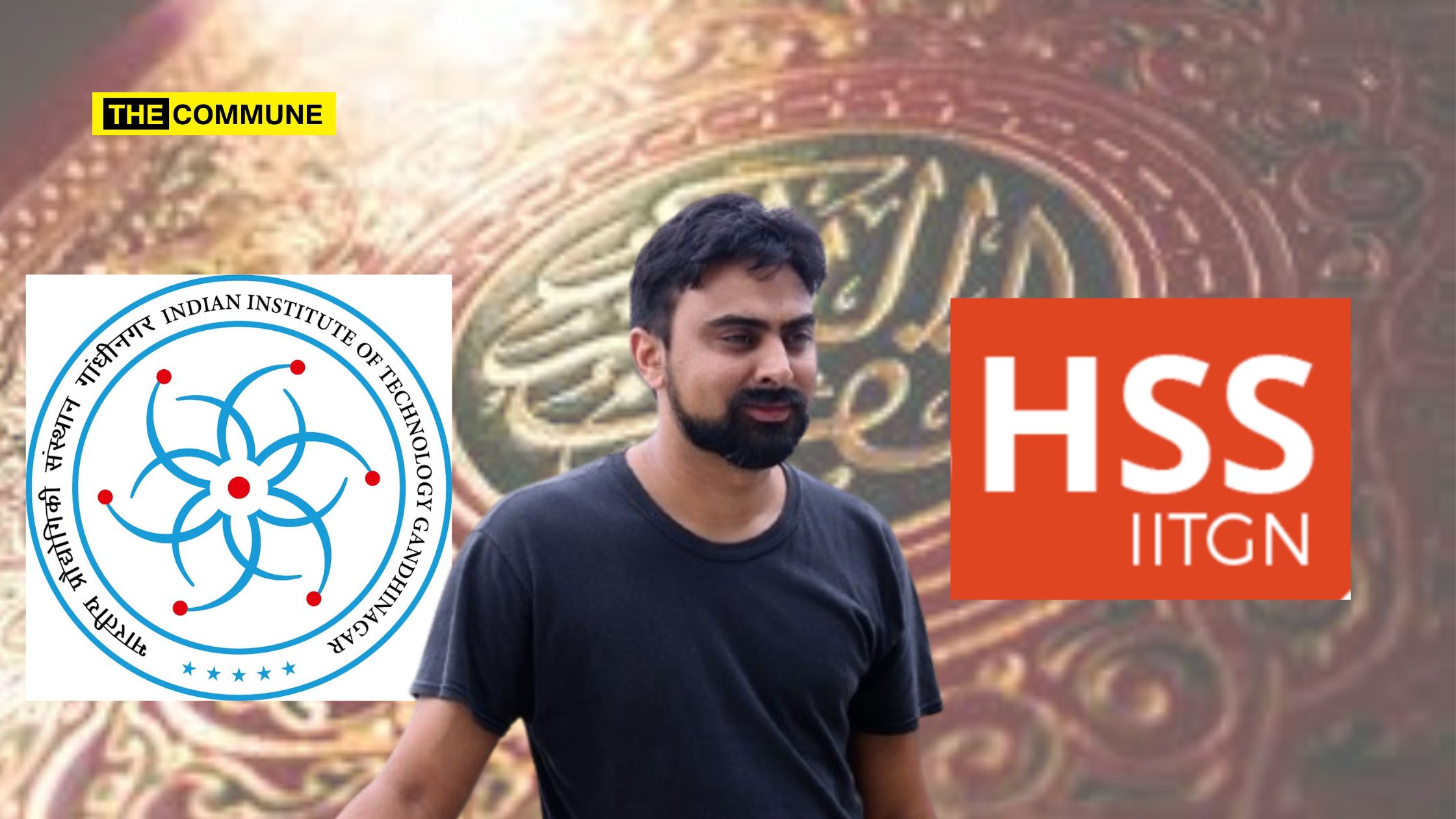
How IIT Gandhinagar’s Humanities Dept Is Pushing Islamist Agenda And Religious Dogma As ‘Research’ At Taxpayer’s Expense

In what can only be described as a disturbing snapshot of India’s elite technical institutions being hijacked by ideological forces, a recent controversy at IIT Gandhinagar (IITGN) has exposed the extent to which the Humanities departments have become breeding grounds for secrecy, intimidation, and even potential exploitation.

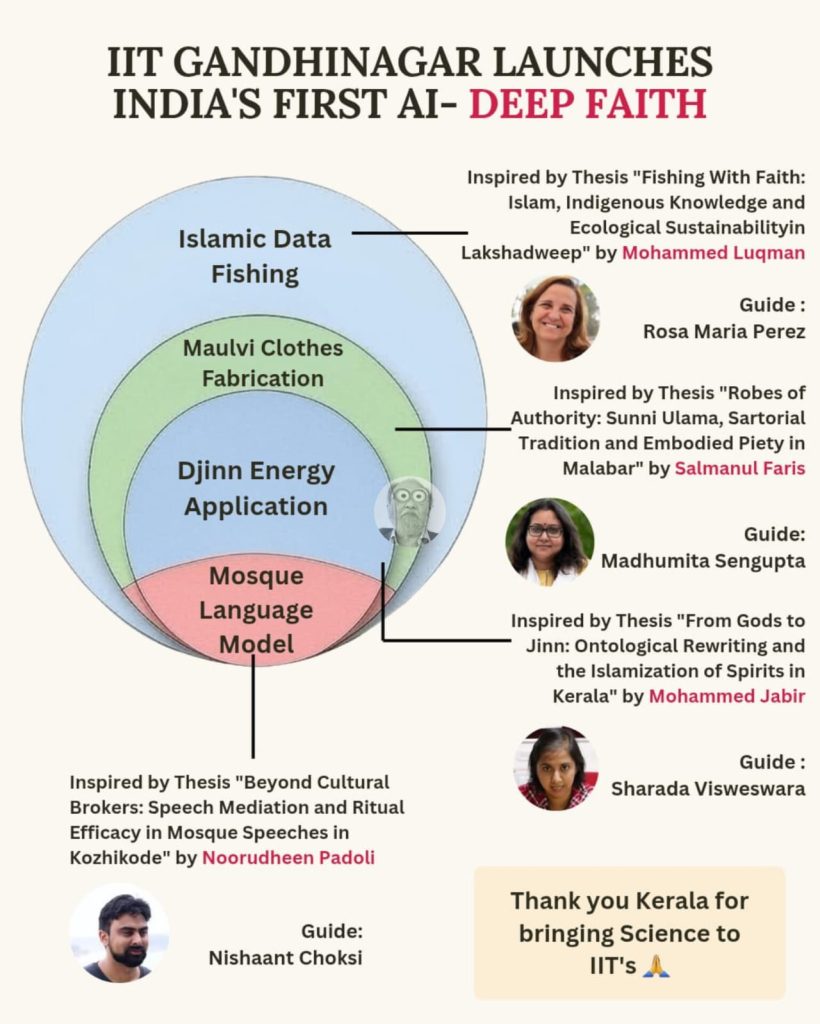
At the center of this storm is Nishaant Choksi, an Associate Professor at IITGN, whose email threatening disciplinary action against students has now gone public. His reaction followed the exposure of several thesis topics in the Humanities and Social Sciences (HSS) department, many of which are steeped in Islamic theological themes — presented not critically or historically, but with ideological approval masked as academic inquiry.

Among the research topics that have drawn concern:

  • “Fishing With Faith: Islam, Indigenous Knowledge, and Ecological Sustainability in Lakshadweep,
  • “Robes of Authority: Sunni Ulama, Sartorial Tradition and Embodied Piety in Malabar,
  • “From Gods to Jinn: Ontological Rewriting and the Islamization of Spirits in Kerala,
  • “Beyond Cultural Brokers: Speech Mediation and Ritual Efficacy in Mosque Speeches in Kozhikode.

Many of these theses appear less like neutral studies and more like glorified endorsements of religious dogma, funded by taxpayer money under the guise of social science. That this is happening in a premier science and technology institution is a scandal in itself.

This is what the research theses abstracts look like:


Title: Robes of Authority: Sunni Ulama, Sartorial Tradition, and Embodied Piety in Malabar
Supervisors: Madhumita Sengupta & Rosa Maria Perez
Summary: This thesis examines how Sunni Islamic scholars (ulama) in Malabar, Kerala, assert religious authority not only through knowledge and teachings but also through their clothing and behavior. It explores how their attire and bodily presentation serve as symbols of moral and religious authority, deeply tied to regional Islamic traditions and cultural continuity.

Title: Fishing With Faith: Islam, Indigenous Knowledge and Ecological Sustainability in Lakshadweep
Supervisor: Rosa Maria Perez
Summary: This work explores how Islamic faith practices integrate with traditional ecological knowledge in Lakshadweep. It suggests that religious beliefs influence sustainable fishing practices among the island’s Muslim communities, merging spiritual life with environmental conservation.

Title: From Gods to Jinn: Ontological Rewriting and the Islamization of Spirits in Kerala
Supervisor: Sharada Visweswara
Summary: This thesis investigates how indigenous spiritual beliefs in Kerala are reinterpreted and transformed under Islamic influence. It focuses on how traditional spirit entities are being recast as Islamic jinns, altering local ontologies and spiritual landscapes.

Title: Beyond Cultural Brokers: Speech Mediation and Ritual Efficacy in Mosque Speeches in Kozhikode
Supervisor: Nishaant Choksi
Summary: This research examines how speech acts in mosques in Kozhikode function beyond just translation or communication. It argues that imams and speakers play key roles in shaping ritual experiences and religious meanings, emphasizing their performative and mediating functions in the community.

Collectively, these theses reveal an academic trend that embeds Islamic theology and ethnography within state-funded institutional research under the guise of cultural studies.

But what is more disturbing than the ideological bent is the environment of fear and control being imposed by faculty. In his email, Choksi refers to anhonor codeand decries the sharing of internal academic information as aserious breach.One wonders: what is being hidden that the public — or even other departments — should not see?

The problem is not just ideological. Humanities departments in IITs have, for years now, operated with little scrutiny. There is growing anecdotal evidence of harassment, especially of Hindu and female students, in environments where professors are granted unchecked authority under vague principles of academic freedom.

Let’s also be clear: these are not fringe electives. These are Masters-level dissertations with official guides and academic backing. Students are not simply exploring topics — they are being inducted into an ideological pipeline. And when concerns are raised, instead of transparency, the response is threats, committees, andhonor codesthat resemble the coercive codes of closed cults more than scholarly institutions.

The truth is stark: IITs were never meant to become echo chambers for unscientific ideologies dressed up in postmodern academic lingo. Their purpose is to advance technology and science, not to become satellite departments for ideological indoctrination.

This entire episode demonstrates why Humanities departments — as they currently function — must be removed from IITs. Or at the very least, subject to the same transparency and accountability that technical departments are. If a department cannot withstand public scrutiny, then it does not belong in a public institution.

For now, the Ministry of Education and the IIT Council must step in. This is about preserving the sanctity of institutions funded by the Indian public, meant to serve the Indian public, not manipulate them.

Subscribe to our channels on Telegram, WhatsApp, and Instagram and get the best stories of the day delivered to you personally.