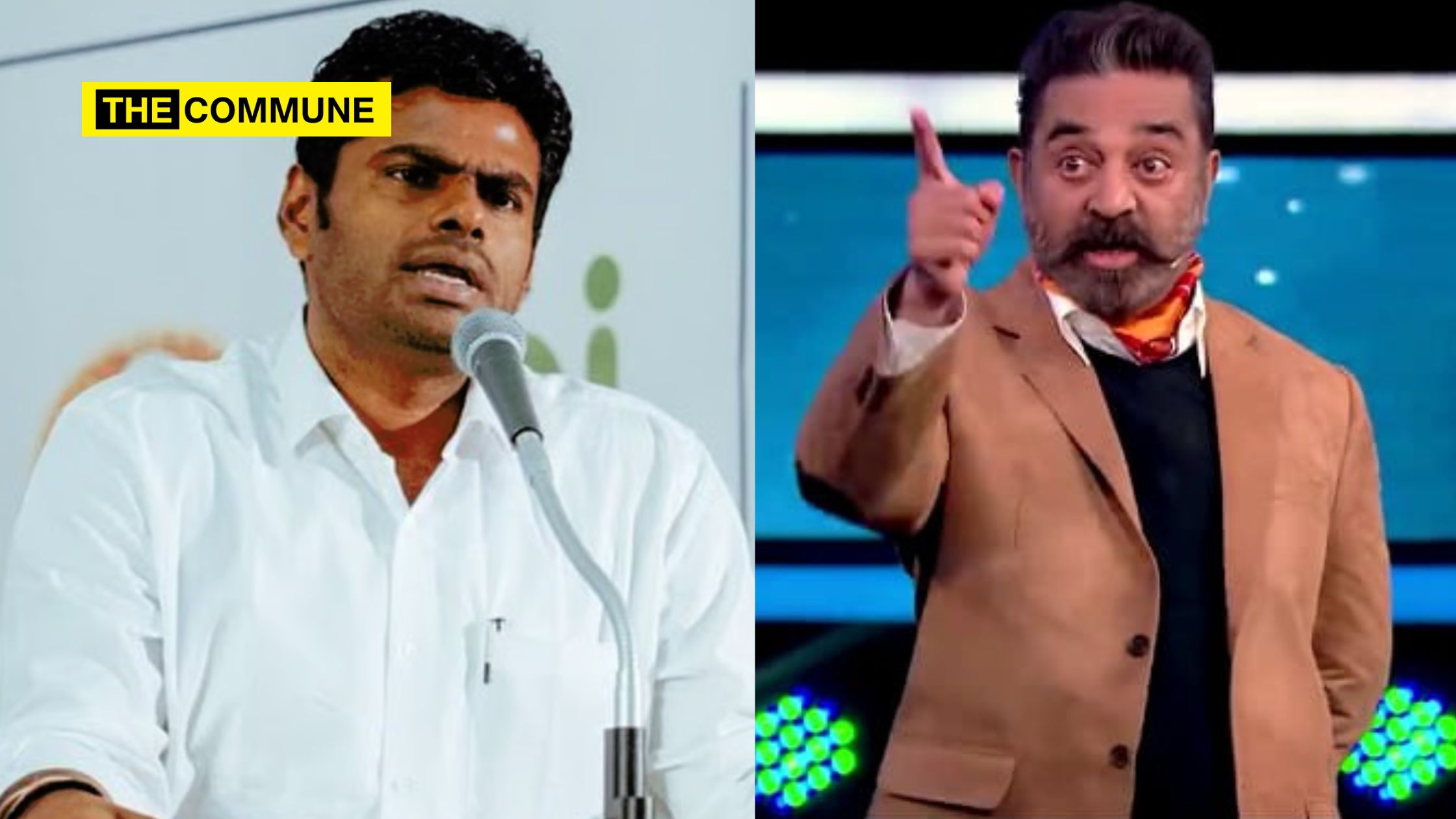
BJP leader K. Annamalai took a sharp dig at actor and Makkal Needhi Maiam (MNM) chief and DMK ally Kamal Haasan over his visit to the Karur stampede site, accusing him of siding with the ruling DMK and speaking in defence of the administration.
He said, “I am finally happy Kamal Hassan ji as a politician, as a leader of the Makkal Needhi Maiam has never found time to visit Karur, over the last many many years. Now suddenly he has found time to visit Karur – today he has gone so I am happy that he visited Karur. Now we all know what he would have spoken at Karur. We have also seen.”
“Kamal Haasan has sold his soul a long time back for one Rajya Sabha seat,” Annamalai said, referring to Haasan’s recent nomination to the Upper House. “Whatever Kamal Haasan speaks, people of Tamil Nadu are not going to take him seriously. Going to Karur and saying the administration is not at fault, who will accept that?” he added.
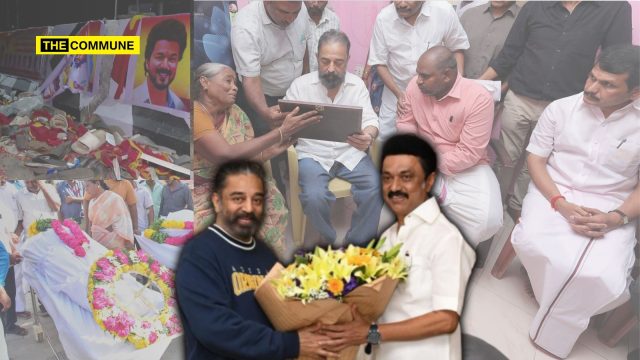
On 6 October 2025, Haasan visited the site of the September 27 stampede in Karur that left 41 people dead and over 50 injured during a rally organised by actor and Tamilaga Vettri Kazhagam (TVK) founder Vijay. Calling it a tragedy, Haasan said the organisers must take responsibility instead of shifting blame. “We came here to ensure justice and express condolences,” he said, adding that it was not the time for political blame games.
He also defended the police, saying they had done their duty and should not be criticised. Haasan reserved particular praise for the Chief Minister’s response to the crisis. “A dignified politician should show all the qualities of leadership and how to conduct things. That has been shown, and we are proud of it,” he said.
Annamalai criticised the MNM chief for what he described as a pattern of favouring the DMK government. “Kamal Haasan is a fine actor, no doubt. But when it comes to politics, whatever he says is one-sided and meant to favour DMK, even on an issue like Karur,” he said.
#WATCH | Chennai, Tamil Nadu: On actor and MNM chief Kamal Haasan’s to Karur stampede site today, BJP leader K. Annamalai says, “…Kamal Haasan has sold his soul long time back for one Rajya Sabha seat. Post that, whatever Kamal Haasan speaks, people of Tamil Nadu are not going… pic.twitter.com/jpumkIXY3J
Meanwhile, a Special Investigation Team (SIT) led by Inspector General of Police Asra Garg has been constituted to probe the incident, following directions from the Madras High Court. The court also pulled up TVK leader Vijay for leaving the venue soon after the stampede and temporarily banned public rallies on highways until a Standard Operating Procedure (SOP) is framed.
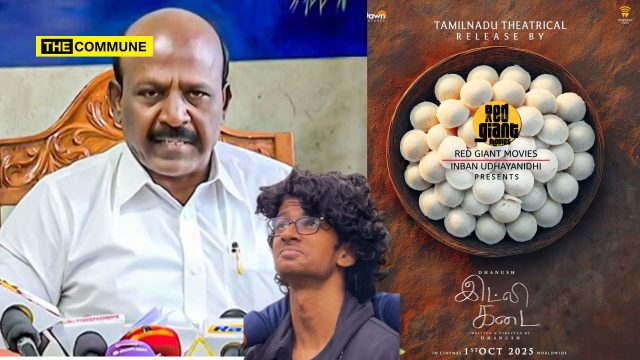
State Health and Family Welfare Minister Ma Subramanian spent Sunday hosting a special event for orphaned and single-parent children under the Tamil Nadu government’s Anbu Karangal scheme, but the outing has drawn attention for its political and cinematic overtones.
The Minister, who represents Saidapet, organised a day-long programme where nearly 400 children identified under the Chief Minister’s Anbu Karangal initiative were brought together for entertainment and welfare activities. The initiative, launched by Chief Minister M.K. Stalin provides monthly financial assistance to children who have lost one or both parents.
According to the Health Department, 399 children, including 68 who lost both parents and 331 with a single parent, had been identified for aid in the Saidapet outreach camp. On Sunday morning, the children assembled at the Minister’s office, where they were given breakfast before being taken to a local theatre for a screening of Idli Kadai, a newly released family drama featuring actor Dhanush.
The film, notably, was released by Inbanidhi Stalin, son of Minister for Youth Welfare and Sports Development Udhayanidhi Stalin, further reinforcing the DMK’s growing crossover between political and film promotion.
Following the movie, the Minister took the children to a textile showroom in T. Nagar, where they were allowed to select clothes of their choice, an activity that was widely photographed and circulated on social media. Actor Dhanush reportedly called the Minister later in the day to express appreciation for the gesture, a development promptly highlighted in official press releases.
While the outreach effort has been framed as a welfare measure under Anbu Karangal, critics noted that the event doubled as an indirect promotion for Idli Kadai, a film released under the banner associated with the ruling family. With multiple ministers publicly linking welfare outreach to cinema associated with the Stalins, the line between governance and political branding appears increasingly blurred.
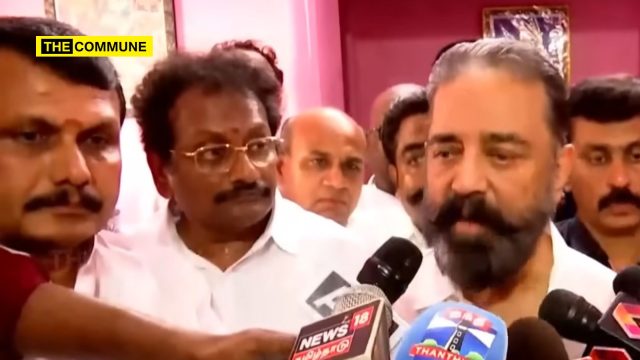
DMK ally Makkal Needhi Maiam (MNM) chief and Rajya Sabha MP Kamal Haasan on 6 October 2025 visited the site of the stampede at a Tamilaga Vettri Kazhagam (TVK) rally in Karur, meeting families of the victims. Forty-one people were killed and over 50 injured in the September 27 incident, marking one of the worst political tragedies in recent Indian history.
Speaking to the press, Haasan emphasized the need for humanity over politics. Haasan reserved particular praise for the Chief Minister’s response to the crisis. “A dignified politician should show all the qualities of leadership and how to conduct things. That has been shown, and we are proud of it,” he said.
Regarding accusations of a security lapse, he said: “This would have become a bigger tragedy had permission been granted for some other place. We were able to stop it here itself. I am happy about that. Had there been a security lapse and they all fell into the river, what situation would it have been? All opposition parties say this is due to security lapse; they accuse that way. I am a centrist and a Tamil Nadu citizen, what happened is clear to everyone.”
Specifically praising former DMK Minister for Electricity, Prohibition & Excise and Aravakurichi MLA Senthil Balaji who was arrested dramatically in June 2023 in connection with a money laundering case for which he is out on bail, DMK stooge Kamal Haasan said, “We have to thank Balaji. Rather than asking why he came, it’s more important to be happy that he came (to the site of tragedy). This is his area, his house, his town, his people, who else will come looking here if not for him? Don’t ask questions like that. It doesn’t depend on the party.”
He added, “For now, I would like to thank Balaji for arriving on time and saving lives.”
He also said, “We must ensure this doesn’t repeat and we were discussing this even in the car on our way about what we can do to prevent this from happening again.”
When asked about who should take responsibility, he said, “We all should. Why point to others for blaming responsibility, we must take responsibility. He is responsible (pointing to Senthil Balaji). He has done his duty to the best of his ability. Don’t thank him for that, don’t interrupt him, let him do what he does.”
DMK ally Makkal Needhi Maiam (MNM) chief and Rajya Sabha MP Kamal Haasan on 6 October 2025 visited the site of the stampede at a Tamilaga Vettri Kazhagam (TVK) rally in Karur, meeting families of the victims. Forty-one people were killed and over 50 injured in the September 27 incident, marking one of the worst political tragedies in recent Indian history.
Speaking to the press, Haasan emphasized the need for humanity over politics.
He also praised journalists for their role in exposing facts: “Especially journalists, because you exposed this way, the truths have started coming out little by little. In this time period, everyone is questioning who is truth. There is no single truth; from many perspectives, it appears differently. Both courts and police are forced to uncover the truth in this time. Police should be thanked, not blamed. I am not like this when I came here.”
Haasan reserved particular praise for the Chief Minister’s response to the crisis. “A dignified politician should show all the qualities of leadership and how to conduct things. That has been shown, and we are proud of it,” he said.
Haasan stressed that authorities were performing their duty and called for public support: “Because they are doing their duty. So please thank all of you who stood with this life situation until now. Please let them do their work. Sir, you have seen lights too. Have you seen which place is better? Sir, no place is good for this death.”
Regarding accusations of a security lapse, he said: “This would have become a bigger tragedy had permission been granted for some other place. We were able to stop it here itself. I am happy about that. Had there been a security lapse and they all fell into the river, what situation would it have been? All opposition parties say this is due to security lapse; they accuse that way. I am a centrist and a Tamil Nadu citizen, what happened is clear to everyone.”
Haasan urged people to avoid taking sides: “Don’t take sides in this. If you take sides, take the side of the public.”
Speaking again to the press after meeting a family, he called for prioritizing humanity and justice over political debate: “It is ‘time to apologise, time to accept mistake.’ I’ve come to express condolences to the victims of Karur tragedy. Don’t see this tragedy as numbers. Look at them as mothers, sisters and elderly. The investigation is underway. The matter is sub-judice, it not right to comment on it now. I’m a Centrist and a citizen of Tamil Nadu. Let’s not take sides in this issue. If we are to take sides, let’s take the people’s side. Chief Minister MK Stalin displayed exemplary leadership qualities and we should thank him for that. Any government will take responsibility. But the matter is now sub judice. Do not keep blaming somebody else.”
Haasan made an appeal for preventive measures, stating, “This should be a precedent for the nation and for Tamil Nadu to shine again.” He emphasized the need for collective action across party lines, suggesting, “The Chief Minister should raise this with all parties so that this does not happen again. All parties must have strict laws and meet to discuss forward-looking solutions.”
Haasan described the ongoing legal proceedings: “While Vijay, whose maiden statewide tour ended in disaster in its third week, is yet to visit the bereaved families.”
Two TVK functionaries – including district secretary Mathiyazhagan – have been arrested, while senior leaders Bussy Anand (General Secretary) and Nirmal Kumar (Deputy General Secretary) remain on the run after the Madurai Bench of the Madras High Court denied them anticipatory bail. The three, along with unnamed others, have been booked on serious charges including attempt to murder, culpable homicide not amounting to murder, and endangering public safety.
The state government has formed a Special Investigation Team (SIT) led by Inspector General of Police Asra Garg and a single-member inquiry commission headed by retired judge Justice Aruna Jagadeesan. Chief Minister MK Stalin has assured that a model guideline for political rallies and public gatherings will be framed based on the commission’s findings.
Haasan concluded by emphasizing empathy and responsible leadership: “It is pointless to give such advice now. He must do what a leader must do. That is my request. Giving advice is your prerogative. People are blaming it on DMK or blaming Senthil Balaji. No, no, look here—the one blaming is standing right here. Others blaming are asking questions. You should ask them, not us. I have not come to discuss politics here. I will come next month to discuss politics. Let them rest in peace. They must try to forget the incident. Whenever someone asks how many died, I cry for them. When I cry once, I feel better. Please allow me that.”
Haasan urged unity and patience while investigations continue: “Vijay’s party workers have gone missing; police have been searching for them. I said this earlier; it is not time to quarrel now. The law is in place. Questions have been asked, SIT has come and is investigating with senior police officers. I trust both you and I to conduct the inquiry deeply, firmly, and honestly.”
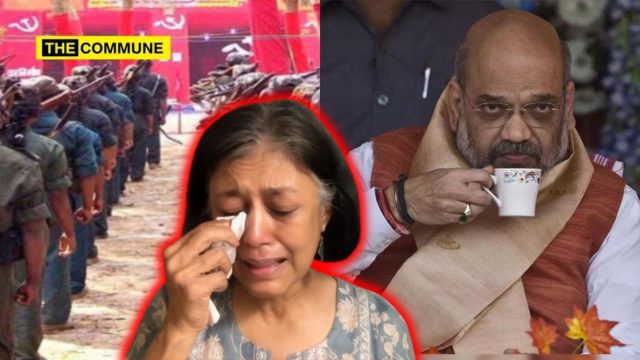
Union Home Minister Amit Shah, on 28 September 2025, delivered a firm rebuttal to a ceasefire proposal from Maoist insurgents, making it clear that the government would not negotiate but welcomed those who choose to surrender. Speaking at the valedictory session of the seminar ‘Naxal Mukt Bharat: Ending Red Terror Under Modi’s Leadership’, he referred to a letter from the banned CPI (Maoist) requesting a one-month ceasefire in exchange for surrender. Shah dismissed the demand: “If you want to surrender, there is no need for a ceasefire. Lay down your arms, not a single bullet will be fired.”
He outlined a two-pronged approach: rehabilitation for those renouncing violence, and a firm military response for those continuing attacks. “Bullets must be answered with bullets,” he warned, emphasizing protection of civilians.
Shah also criticized ideological and legal supporters of Naxalism, including leftist parties, activists, and NGOs, questioning their concern for tribal victims. “Have all the people who write these lengthy articles…ever written an article for the tribal victims?”
Reiterating the government’s goal of a Naxal-free India by 31 March 2026, Shah stressed that ending the armed movement alone is insufficient; ideological support fueling Naxalism must also be addressed. “Until Indian society understands this theory… the fight against Naxalism will not end,” he said, highlighting the importance of confronting both armed and ideological challenges to secure lasting peace.
But the leftist, Naxal/Maoist-supporting coterie seems to be breaking bangles over Shah’s stern stance.
In an interview clipping that has gone viral, Nandini Sundar – wife of editor of leftist portal The Wire, is heard lamenting, “They have actually been issuing letters. They’ve sent out five letters now asking for a ceasefire. Um and in several of the letters, uh there were some indications that you know, they wanted a ceasefire in order to talk among themselves because um at the rate that the killing has been going on, the operations have been going on. Uh it seems that the government simply wants to wipe them out militarily rather than deal with the issues that have been raised.”
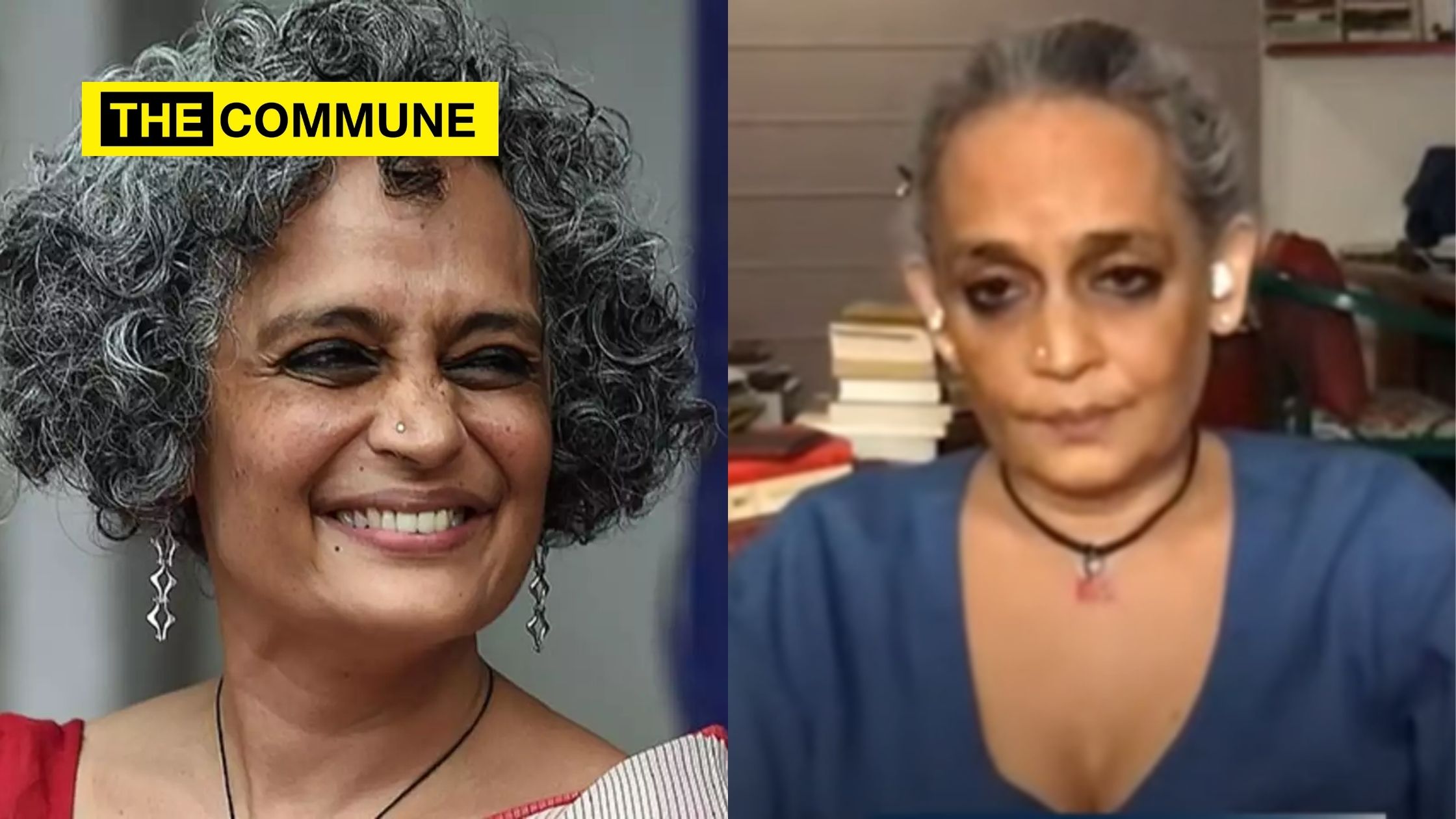
In a recent interview with anti-hindu journalist Mehdi Hasan that has sparked outrage, leftist extremist author Arundhati Roy launched a vicious attack on India’s democratic institutions, Hindu culture, and national security apparatus, repeating her familiar anti-India rhetoric that has made her a darling of Western leftist circles.
On Babri Masjid
Roy goes hyperbole on the Babri Masjid issue. She said, “I actually saw the Rath Yatra when I was in Bhopal, Advani’s Rath Yatra, the chariot procession asking for the mosque to be demolished and a temple to be built and I just saw the absolute hatred that was being whipped up you know so You knew that something was coming.”
Roy’s characteristic hyperbole ignores the complex historical context and judicial processes surrounding the Ayodhya dispute, instead reducing it to simple “hatred.”
On Her Secessionist Comments On Kashmir
Hasan, like a fanboy, seemed to be trying to do his best to be in her good books. Asking about the statements she made long back about Kashmir, he said, “You’re under threat of prosecution India right now ridiculously for comments you made on Kashmir in 2010. How do you get drawn to all these marginalized people to their causes to their struggles? Not just Muslims in Kashmir or poor people across India but Naxalites, Maoist insurgents deep in the rural jungle. What draws someone like you with your background, your upbringing? How do you end up standing with these people?”
Roy replied, “I’m not fighting on behalf of anybody. I am doing it because I’m in the swim of things. I am a part of it all and I am I have a political point of view which is not subject based. You know, I see the connection between dams and displacement and mining and climate change and fundamentalism and the walls between Hindu nationalism and the corporates. The the the fact that the Indian mass media is is criminal. There’s no other description for it. And they are owned by these corporations. There’s a direct conflict of interest. So for me it’s just developing a world view, a point of view and it doesn’t come from just theoretical stuff.”
Hasan followed it up with some more fanboy comments – “you’re being admirably modest”.
“India Used To Be A Friend Of Palestine”
Speaking on the Palestine issue and how India had “lost its dignity”, Roy said, “India used to be a friend of Palestine. India used to be a dignified country it has lost its dignity… there have been no protests about the genocide in Gaza. If 20 people protest the police don’t break it up, the shopkeepers break it up, the right-wing Hindu nationalist. I mean it’s how do you unpoison that river now.”
On Afzal Guru Hanging Done To “Please Society”
She seemed to be confused about Afzal Guru being a woman and her meeting him in jail – we are reproducing what she said as is.
“I’ve written a lot about all these fake attacks and fake terrorists and fake assassination attempts. And it started by my being in jail and meeting a woman called Afzan Guru who had been put into jail for this parliament attack which sounded so hokey from the start. And then I met her I realized she had no idea why she was there. I came out. I just went off to Goa alone with a tower of legal documents just to say what the hell is going on here, you know, and came back uh and realized that it’s absolutely crazy what’s and the Supreme Court passes a judgment sentencing someone to death saying that we have no evidence to prove that he belonged to a terrorist group. But in order to satisfy the collective conscience of society, we’re sentencing him to death. And then they hang him. Afzal Guru,”
On Bollywood and Indian Culture
When asked why Indian media and Bollywood did not condemn or speak against PM Modi, she said, “Bollywood and mainstream media anchors are like lynch mob leaders sometimes, and people who actually lynch people, put it up on YouTube and boast about it. Bollywood has made some unforgivable films that lead to mass hysteria…”
On India-Israel Relations
In her most inflammatory comments, Roy compares Hindu philosophy to fascism and makes offensive caste-based allegations.
When asked about parallels between India and Israel, she said, “Hindu nationalism and Zionism kind of walk together very easily… if you think you’re the chosen people… within Hinduism is the caste system where Brahmins are the chosen people. So the segue into that sort of fascist thinking is not a hard one to make.”
On ‘Violence’ Against Muslims in India
Roy then went on to make grotesque, exaggerated claims about violence in India that bear no resemblance to ground reality. She said, “Now it’s the Muslims who are taking that place [of Dalits]… you can just go around lynching people and you have mobs with swords come out and say Muslims should be killed, women should be raped and it’s normalized.”
On Genocide Allegations Against India
Roy propagates the dangerous and completely false theory that India is building “internment camps” for Muslims. She said, “When the citizenship amendment act came, they started building these big internment centers and they were not meant to accommodate the hundreds of millions of Muslims, but they were meant to tell people this is where you belong. You are going to be second class citizens. You do not have the rights that everybody else has. Of course, I mean India the thing is it is a very anarchic place with so many languages, so many castes, so many cultures, so much stuff to it’s like to say India is a Hindu country is like trying to pour an ocean into a Bisleri bottle, it’s hard. I don’t think that, but I don’t think that the threat isn’t there although although now in the last election you know, for a bully and a megalomaniac like Modi to have not got a majority has broken him in some ways.”
Arundhati Roy’s interview represents everything that’s wrong with the privileged activist class – living in comfort while relentlessly vilifying their own country abroad. Her statements are not just criticisms but constitute a comprehensive rejection of Indian democracy, Hindu culture, and national sovereignty. While masquerading as human rights advocacy, her rhetoric consistently aligns with India’s detractors and undermines national interests. For Roy, the Indian government that doesn’t match her radical leftist ideology is “fascist,” any expression of Hindu identity is “majoritarian,” and any act of national self-defense is “oppression.” Her words serve not to improve India but to provide ammunition to those who wish to see this great civilization weakened and divided.
Subscribe to our channels on Telegram, WhatsApp, and Instagram and get the best stories of the day delivered to you personally.
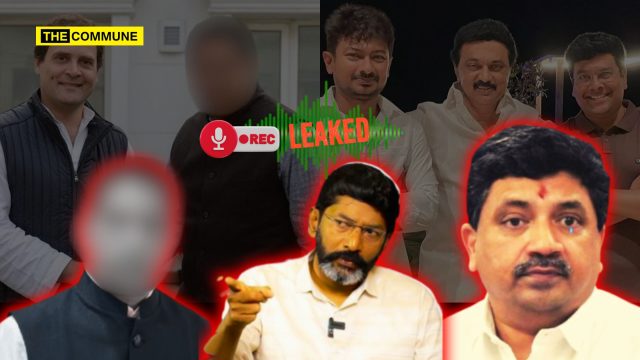
In April 2023, an audio clip alleged to be that of Tamil Nadu Finance Minister PTR Palanivel Thiagarajan has surfaced on social media in which he accuses members of MK Stalin’s family of making more money in one year than they’ve made during their lifetime.
“Both Udhay and Sabari have realised, they have made more money in one year than they [unclear] entire lives and now it’s getting to be a problem, how to handle it, how to not get caught, how to get payments here… [unclear] Its all being made gradually? 10 to 20 crores… assuming we will say 5000 crores… [unclear]. How can you [unclear] 5000 crores without paying any [unclear]”, the audio clip supposedly of PTR says.
The audio clip surfaced amidst Tamil Nadu BJP accusing DMK leaders of gaining disproportionate assets over the years.
In a massive development a few days later, another audio clip of Tamil Nadu Finance Minister PTR Palanivel Thiagarajan was released by BJP Tamil Nadu President K. Annamalai on his social media.
In the alleged audio clip of PTR, he says “I have been a longtime proponent of one man one post from the day I entered politics. It is what I like about the BJP. Who looks after the party, who looks after the people, separate those… right?”
He further went on to abuse his own partymen saying “Here every (beep) district secretary wants be an MLA and Minister. Who looks after the party? Inaudible… Ohh. it’s easier to do money management… it is not a system.. They are taking the bulk of the spoils..”
“The party, which is the CM’s son and son-in-law, ask them to make the financing… right? So, I decide after watching this for 8 months… This is not a sustainable model. The great luxury for me if I put my papers in… In the short term I get out before the shit starts blowing up in their face. I have the like… kind of… what do you say… cleanliness of my conscience that I did not have to like it wasn’t I gave up the fight too early… I don’t have to say it… I’m no longer in the post… it’s not my job… somebody did it.”, he says.
Listen to the DMK ecosystem crumbling from within. The 2nd tape of TN State FM Thiru @ptrmadurai.
However, PTR Palanivel Thiagarajan responded to the audio clip controversy which had stunned the ruling DMK because of the scandalous content. He alleged that there is conspiracy to drive a wedge between him and the DMK’s first family.
Savukku Shankar Reveals Who Leaked The Audio
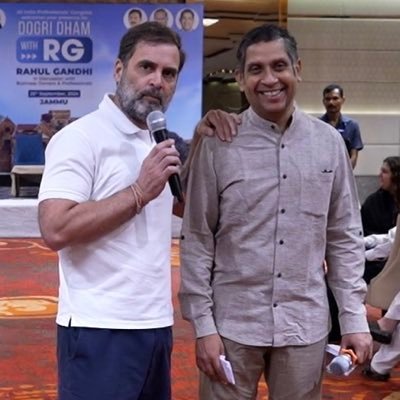
In a video on his channel, YouTuber Savukku Shankar has alleged that an audio clip purportedly featuring Tamil Nadu Finance Minister Palanivel Thiaga Rajan (PTR) was recorded and leaked by Congress leader Praveen Chakravarty.
Shankar said he received two separate audio files from Praveen Chakravarty.
According to Shankar’s narration, Praveen Chakravaty called him to inform that a Delhi journalist has an important audio of Tamil Nadu Finance Minister (PTR) and whether he would be interested in publishing it. The first audio which he received apparently had a lot of noise and he was not sure of publishing. He said he fell asleep after listening and Praveen Chakravarty called back later the same day at 7 PM and asked him whether he would publish or not saying that if he doesn’t he would give the audio to some other channel to publish.
Not wanting to lose the exclusive content, he reduced the noise in the audio with the help of his YouTube friends and published it which went viral. He said that he gave the second audio clip to BJP leader Annamalai who released it with subtitles. After Annamalai released the second clip, multiple channels amplified it and the episode contributed to intense public scrutiny of PTR.
Shankar told that for a long time he thought it must’ve been recorded by Intelligence Bureau and it was only later that he came to know who was the real person behind the audio leak.
“I got the chance to meet PTR once at his home. At that time, he was very heartbroken when he was talking to me. He felt bad that he was fired for saying the truth – son-in-law and son took 30,000 crores each. When he was talking to me, I mentioned the tape, and he said Praveen recorded it. I asked him how he knew that. He even mentioned the date. 27 January, he (Praveen Chakravarty) was having dinner at the same table as with me (PTR) and while talking to me, he recorded the conversation. I couldn’t believe how a man can do this”, alleged Shankar.
Shankar apparently probed PTR Palanivel Thiagarajan about how he was so sure that it was the Congress leader to which PTR replied back that he maintains a record of the people he meets.
He said that PTR is a systematic and organized person who keeps detailed records of appointments.
“I’ve a record of all my appointments. It is the same table Shankar. I even remember the context in which that was spoken.”, PTR allegedly told Shankar.
Shankar further went on to add that he got a call from Rahul Gandhi’s office with the Congress scion himself listening to what he was saying. Shankar said that having known the truth from PTR, he explained the tape’s provenance and revealed to the Congress leadership that he got the audio from Praveen Chakravarty.
Subscribe to our channels on Telegram, WhatsApp, and Instagram and get the best stories of the day delivered to you personally.
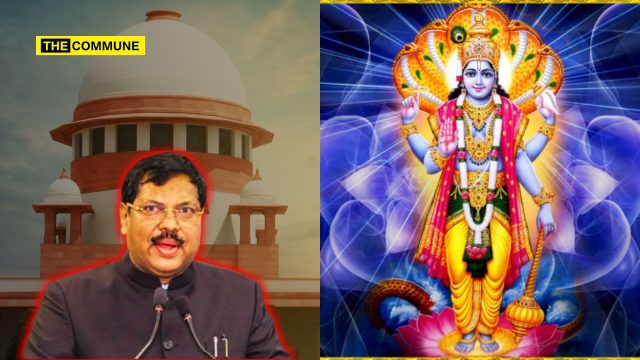
Chief Justice of India (CJI) Bhushan R. Gavai on 6 October 2025 faced an attempted shoe-hurling incident in court but decided not to take any action against the lawyer involved, instead directing officials to “just ignore” the episode.
Reportedly, after security personnel intervened and escorted the lawyer out of the courtroom, officials sought the CJI’s instructions on the future course of action. “Just ignore,” the CJI told them, asking that the lawyer be warned and let go. The lawyer was later identified as Rakesh Kishore.
The dramatic scene unfolded during the mentioning of cases before the CJI’s Bench, when Kishore suddenly approached the dais and tried to take off his shoe. As he was being taken away, he was heard shouting: “Sanatan ka apman nahi sahenge (We will not tolerate any insult to Sanatan).”
Unfazed by the commotion, the CJI urged the lawyers present to carry on with the day’s proceedings. “Don’t get distracted by all this. We are not distracted. These things do not affect me,” he said.
The incident comes in the wake of a recent controversy over the CJI’s reported remarks during a hearing last month, when a Bench of CJI Gavai and Justice K. Vinod Chandran declined to entertain a plea filed by one Rakesh Dalal. Dalal had sought directions to restore a seven-foot beheaded idol of Lord Vishnu at the Javari temple, part of the Khajuraho group of monuments in Madhya Pradesh.
The petitioner had argued that the idol was mutilated during Mughal invasions and that authorities had failed to restore it despite repeated representations. The court held that the issue fell within the jurisdiction of the Archaeological Survey of India (ASI) and not the judiciary. During the hearing, the CJI reportedly told the petitioner’s lawyer: “Go ask the deity itself to do something now. You say you are a staunch devotee of Lord Vishnu. So go and pray now. It’s an archaeological site and ASI needs to give permission etc. Sorry.”
Reacting to the incident, the CJI once again asked the court to proceed with its business, reiterating, “These things do not affect me.”
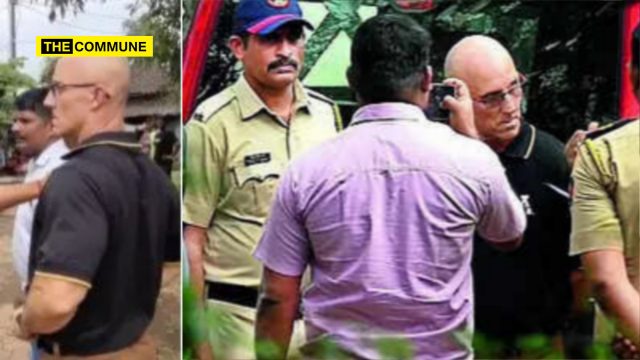
A major religious conversion racket has been busted in Bhiwandi, Thane district, Maharashtra, leading to the arrest of three individuals, including an American national identified as James Watson – allegedly an army veteran. The arrests were made on Friday, 3 October 2025, following a police complaint and subsequent raids by the local administration.
The accused have been identified as James Watson (58), a U.S. citizen residing in Thane’s Hiranandani Estate; Sainath Ganpati Sarpe (42), a resident of Vasai; and Manoj Govind Kolha (35), from Bhulshet, Chimbipada. Watson, who had reportedly entered India on a business visa, is alleged to have organised religious gatherings without obtaining the required official permissions.
The incident came to light after Ravindra Bhurkut (27) lodged a complaint at the Bhiwandi Taluka Police Station. In his statement, Bhurkut said that around 11:30 AM on Friday, he witnessed a group preaching Christianity to about 30–35 villagers outside Kolha’s residence. The group allegedly made derogatory remarks about Hinduism, describing it as a religion based on “blind faith,” and urged people to convert to Christianity, claiming that doing so would bring “happiness and success.”
According to the complaint, the accused also told attendees that prayers to Jesus Christ could cure illnesses, and inquired if any underage girls were unwell. They reportedly wrote down the names of four girls and placed their hands on the girls’ foreheads, claiming to have “healed” them through divine powers before leaving the location.
⚡ BREAKING: US national arrested for illegal conversion bid in Bhiwandi; claimed to cure illnesses:
Maharashtra police in Bhiwandi arrested a 58-year-old US national, who is in India on a business visa, and two local residents for allegedly attempting to convert villagers in… pic.twitter.com/19WoTusj7S
Following investigation, police confirmed that Watson’s visa was being misused for religious activities instead of business purposes. He was allegedly coordinating with certain villages near Padgha.
⚡ WATCH: Maharashtra Police arrested an US national named James Watson from Bhiwandi for luring villagers to convert to Christianity by promising them fake cures and prosperity. https://t.co/E7MHBEYUGHpic.twitter.com/MjskxXbcqs
It is noteworthy that Padgha is an area previously linked to a major jihadi module busted a few years ago. That module, according to earlier police investigations, had been planning attacks in Mumbai modeled on the October 7 Hamas-style operations before being intercepted by Maharashtra Police and central agencies.
1. This is not just a US national. This is US army or special Op guy.
2. He wasn’t doing conversion activity alone (that too is illegal but that is cover). He was coordinating with certain villages near Padgha.
Police Inspector Harshwardhan Barve of Bhiwandi Taluka Police Station said that the accused have been booked under Sections 299 and 302 of the Bharatiya Nyaya Sanhita, as well as under the Foreigners Act for violating visa norms, and the Maharashtra Prevention and Eradication of Human Sacrifice and Other Inhuman, Evil and Aghori Practices and Black Magic Act, 2013.
Authorities are investigating the extent of the group’s activities in rural Thane and surrounding regions, including possible links to other networks engaged in unauthorised religious propagation.
Police have stated that further action will follow based on evidence recovered from digital devices and local witness statements.
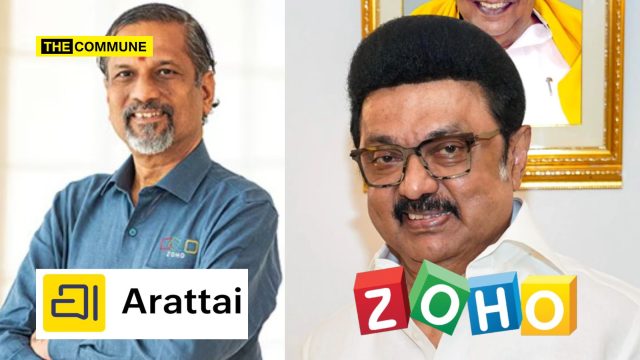
Zoho’s messaging platform, Arattai, founded by entrepreneur Sridhar Vembu, has become the focus of a coordinated online smear and hate campaign. Critics have cited ideological reasons for opposing the Indian-developed app, targeting Vembu for his Tamil Brahmin heritage and labeling him as a “Sanghi,” used as a “slur” to denote anyone leaning to the “right” or supports the central government, in online discourse.
The opposition has raised privacy concerns despite Arattai hosting all data in India, providing call encryption, and planning chat encryption upgrades. Critics continue to rely on foreign messaging platforms like WhatsApp and X, which have experienced repeated privacy breaches, while disparaging Arattai as unsafe.
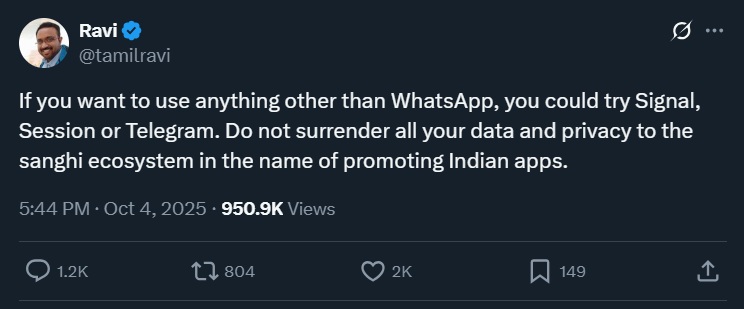
Several users have publicly declared they would refuse to use Zoho products, claiming the app is “a government trap to spy on everyone.” A post on X by user Ravi called the opposition a passing trend and suggested alternative platforms such as Signal, Session, or Telegram, warning against surrendering personal data to what he described as the “Sanghi ecosystem in the name of promoting Indian apps.”
However, observers point to extensive government and institutional usage of Zoho software in Tamil Nadu under the DMK government.
CM Helpline initiatives, including programs like “Ungaludan Stalin” and “Ungal Thogudhiyil Stalin” (Stalin in your constituency), reportedly use Zoho Desk to prepare reports on citizen complaints directly for the Chief Minister.
StartupTN, a government initiative promoting startups and incubators, uses Zoho Backstage for event registration and management. The platform allowed fast, efficient attendee check-ins by generating unique QR codes and enabling a single staff member to scan attendees in under a second using the Zoho mobile app.
Naan Mudhalvan, the Tamil Nadu Government’s skill development program, uses Zoho Backstage for training program management and deployment.
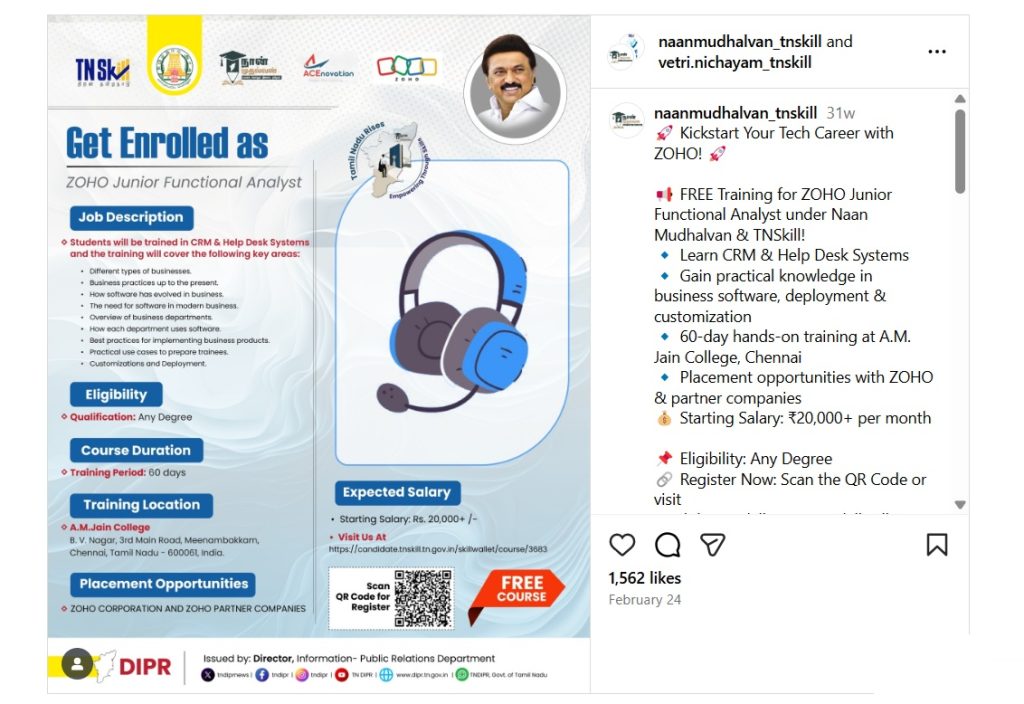
Training programs are also being offered for aspirants to build careers with Zoho:
ZOHO Junior Functional Analyst training under Naan Mudhalvan & TNSkill provides hands-on experience with CRM and Help Desk systems, business software deployment, and customization.
Starting salary for participants is reported to be ₹20,000+ per month, and candidates with any degree are eligible.
Despite online criticism, Arattai’s rising downloads suggest growing public acceptance of indigenous technology solutions based on merit rather than ideology. The controversy highlights ongoing tensions in India’s tech ecosystem between foreign platform dependency, domestic innovation, and ideological polarization.
Subscribe to our channels on Telegram, WhatsApp, and Instagram and get the best stories of the day delivered to you personally.